


Cats rarely behave like neutral accessories in paintings. They crouch, scratch, hunt, submit to an embrace or turn their attention away from the people around them. Their familiar bodies can make a scene feel domestic, yet their independence can also disturb the order that a picture appears to promise. A cat beside a still-life table does not mean the same thing as a cat in a child’s arms, at the foot of a bed or transformed into an arrangement of modern colour.
This guide follows ten works chronologically, asking what the cat does within each image. It begins with an animal drawn into a children’s prank and ends with Franz Marc’s cats treated as complete pictorial subjects. Between those points, cats become agents of disruption, affection, satire, danger and formal invention.
The selection is work-led rather than encyclopedic. It does not replace the broader Paintings hub, the directory of Famous Paintings, or the site’s guide to Painting Genres. Wider questions about animal imagery belong with Animals in Art, while studies made with pencil and ink belong to Cat Drawings. Here, the useful unit is the individual painting: where the cat appears, how the artist makes it visible and how its behaviour changes the surrounding subject.
Mischief, appetite and family intimacy
The first four works make feline action unusually concrete. These cats are teased, tempted, restrained or only lightly sketched, but each helps determine how the human figures and objects are understood. The sequence also shows why “cat painting” is not a genre in itself. A single animal can enter a comic scene, a still life, an unfinished family portrait or a satire without making those forms interchangeable.
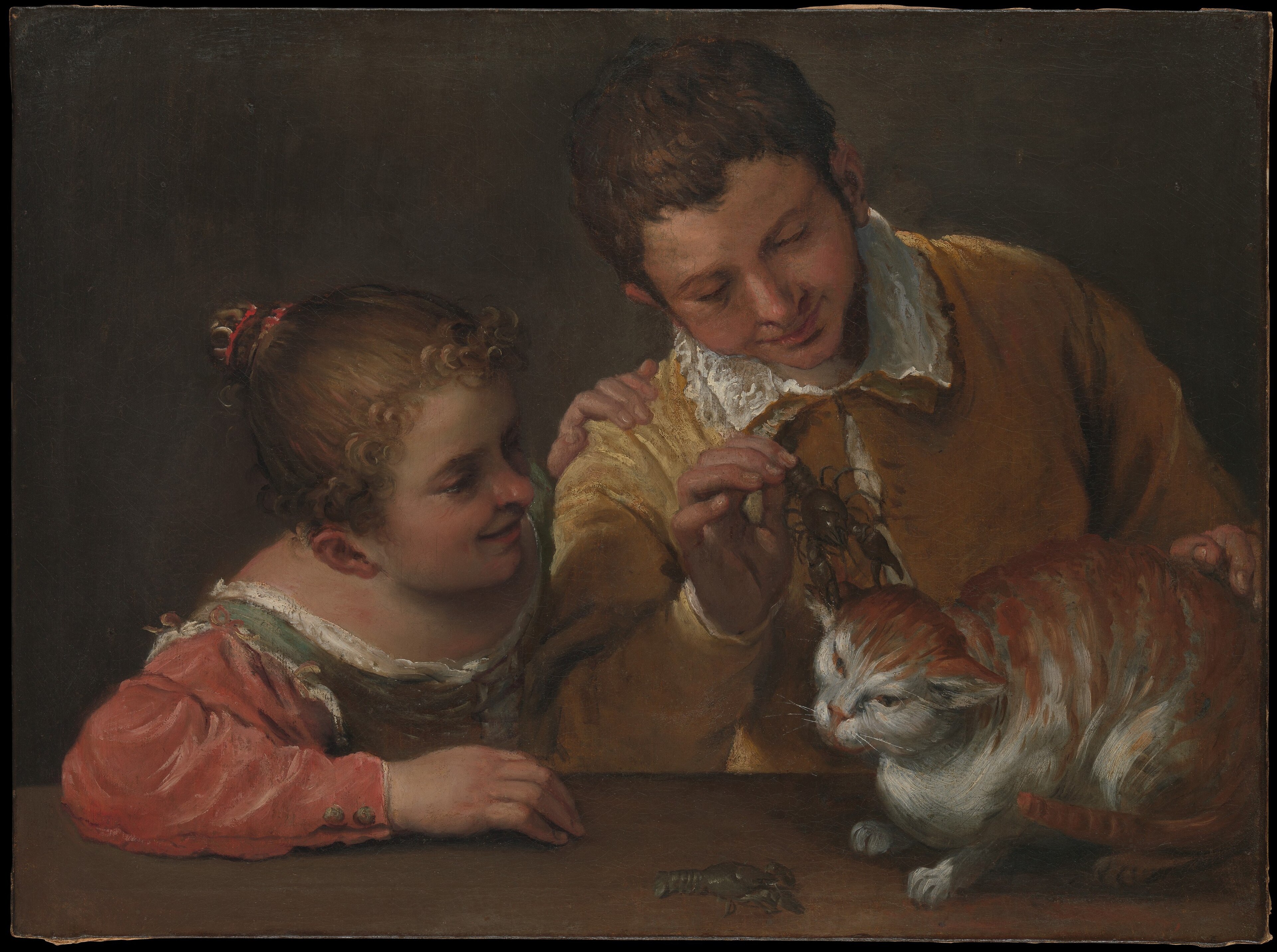
1. Two Children Teasing a Cat — Annibale Carracci, ca. 1590
In Two Children Teasing a Cat, two children lean across a table while one suspends a crayfish above a crouching cat. The compact arrangement turns looking into anticipation. One child watches the animal, the other glances outward, and the cat fixes its attention on the dangling bait. Hands, claws and the crayfish’s pincers bring several possible kinds of contact into one tense joke.
The Metropolitan Museum of Art records the painting as an oil on canvas by Annibale Carracci, dates it to about 1590, and identifies it as object 1994.142, measuring 66 by 88.9 centimetres.[1] Those facts correct the earlier provisional dating without changing the work’s place at the start of this sequence. Carracci makes the animal an active participant rather than a sign placed beside the children. Its alert body supplies the scene’s suspense: the prank is legible because viewers can imagine the cat’s next movement. Explore Annibale Carracci for the artist’s wider range of religious, mythological and observed subjects.
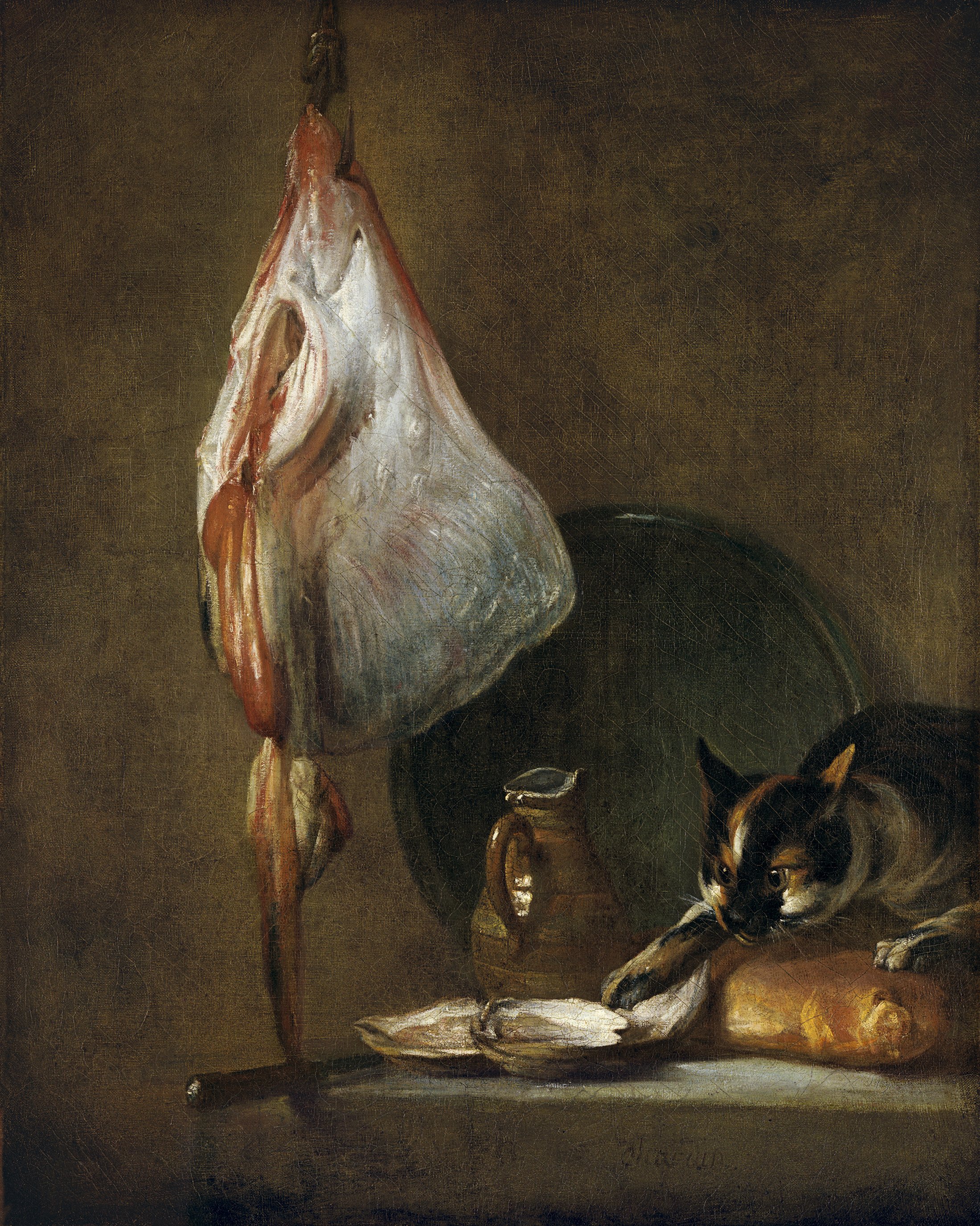
2. Still-Life with Cat and Rayfish — Jean-Baptiste-Siméon Chardin, 1728
Still-Life with Cat and Rayfish unsettles the expectation that arranged objects will remain still. Fish lie on a surface beneath a suspended ray, vessels rise behind them, and a living cat reaches towards the food. Its arched back and lifted paw introduce hunger, risk and motion into an otherwise carefully balanced display.
The Museo Nacional Thyssen-Bornemisza identifies the 1728 painting as oil on canvas, inventory 120 (1986.6), measuring 79.5 by 63 centimetres.[2] The cat does more than enliven an inventory of textures. It exposes the difference between objects arranged for sustained looking and food perceived by an animal as immediately available. The viewer may admire surfaces, edges and tonal contrasts; the cat attends to possession. That divergence gives Chardin’s still life a small drama without turning it into narrative painting. More works by Chardin place this example within his sustained attention to objects and domestic life.
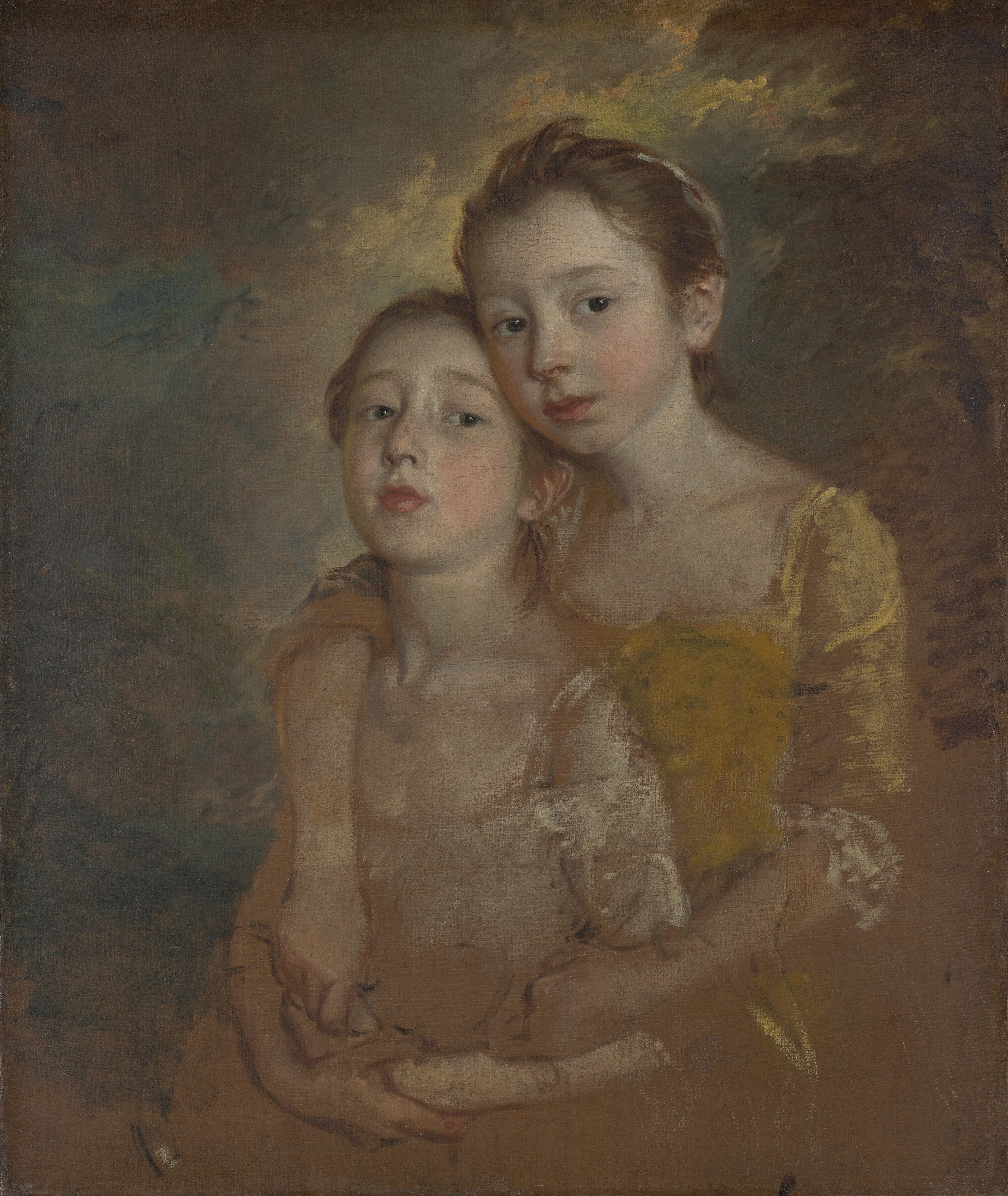
3. The Painter’s Daughters with a Cat — Thomas Gainsborough, probably 1760–1761
Thomas Gainsborough’s portrait of his daughters with a cat is intimate partly because it remains visibly unfinished. The sisters press close together. One wraps an arm around the other, while the younger holds a cat whose body is only lightly established. The animal is not polished into a separate display piece; it belongs to the interlocking gestures that connect the children.
The National Gallery dates The Painter’s Daughters with a Cat to probably 1760–61, records it as oil on canvas measuring 75.6 by 62.9 centimetres, and assigns it inventory NG3812.[3] The unfinished passages make attention itself part of the experience. Faces and hands emerge more firmly than some surrounding forms, while the cat hovers between recognisable companion and rapid notation. That incompleteness should not be mistaken for uncertainty about the object’s identity. It shows a family image whose emotional structure can be read before every surface is resolved. See Thomas Gainsborough for finished portraits and landscapes that throw this private work into relief.
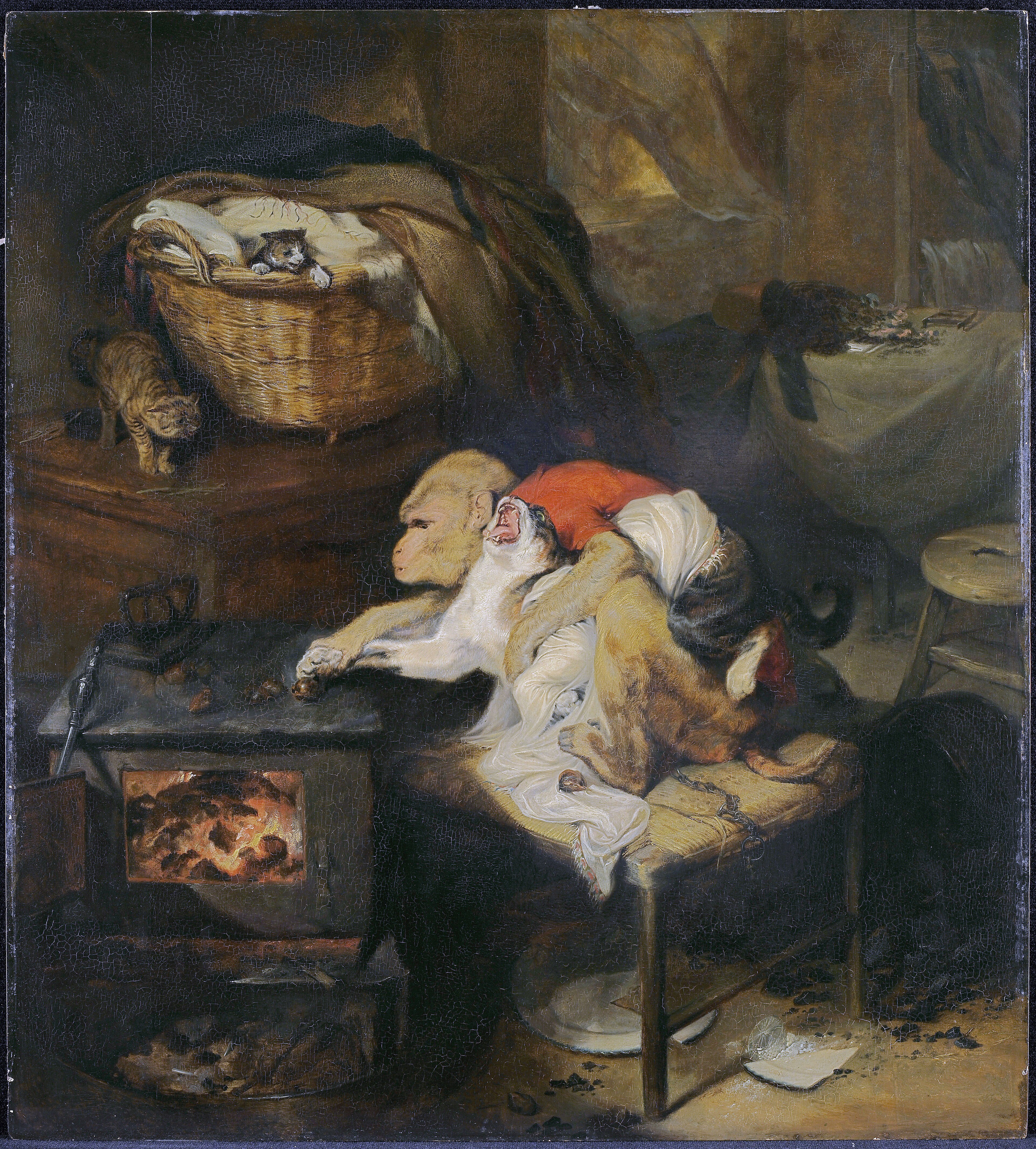
4. The Cat’s Paw — Edwin Henry Landseer, ca. 1824
In The Cat’s Paw, a monkey grips a cat and forces its paw towards chestnuts roasting over a fire. The title names the familiar idea of someone used to perform another person’s dangerous task. Landseer turns that expression into a sharply staged encounter: the monkey controls the action, the cat strains away, and the glowing hearth makes the threatened pain immediate.
The Minneapolis Institute of Art records the work as an oil on panel of about 1824, accession 82.47, measuring 76.2 by 68.8 centimetres.[4] The painting depends on highly legible animal posture. It invites recognition of coercion and self-interest without requiring the animals to become disguised people. Their bodies carry the unequal relationship. The humour is therefore uncomfortable rather than merely charming. An image that initially promises clever animal comedy becomes a study of one creature transferring risk to another. Browse Edwin Henry Landseer for other paintings in which closely observed animals support human stories and analogies.
Cats inside moral and modern figure paintings
The next four cats occupy paintings dominated by human figures. Their scale is smaller, but their placement matters. One mirrors a dangerous relationship, another sharpens a confrontational modern image, and two are held close enough for touch to become the subject. These works reward looking beyond the central face to the animal at an edge, under an arm or against a cheek.
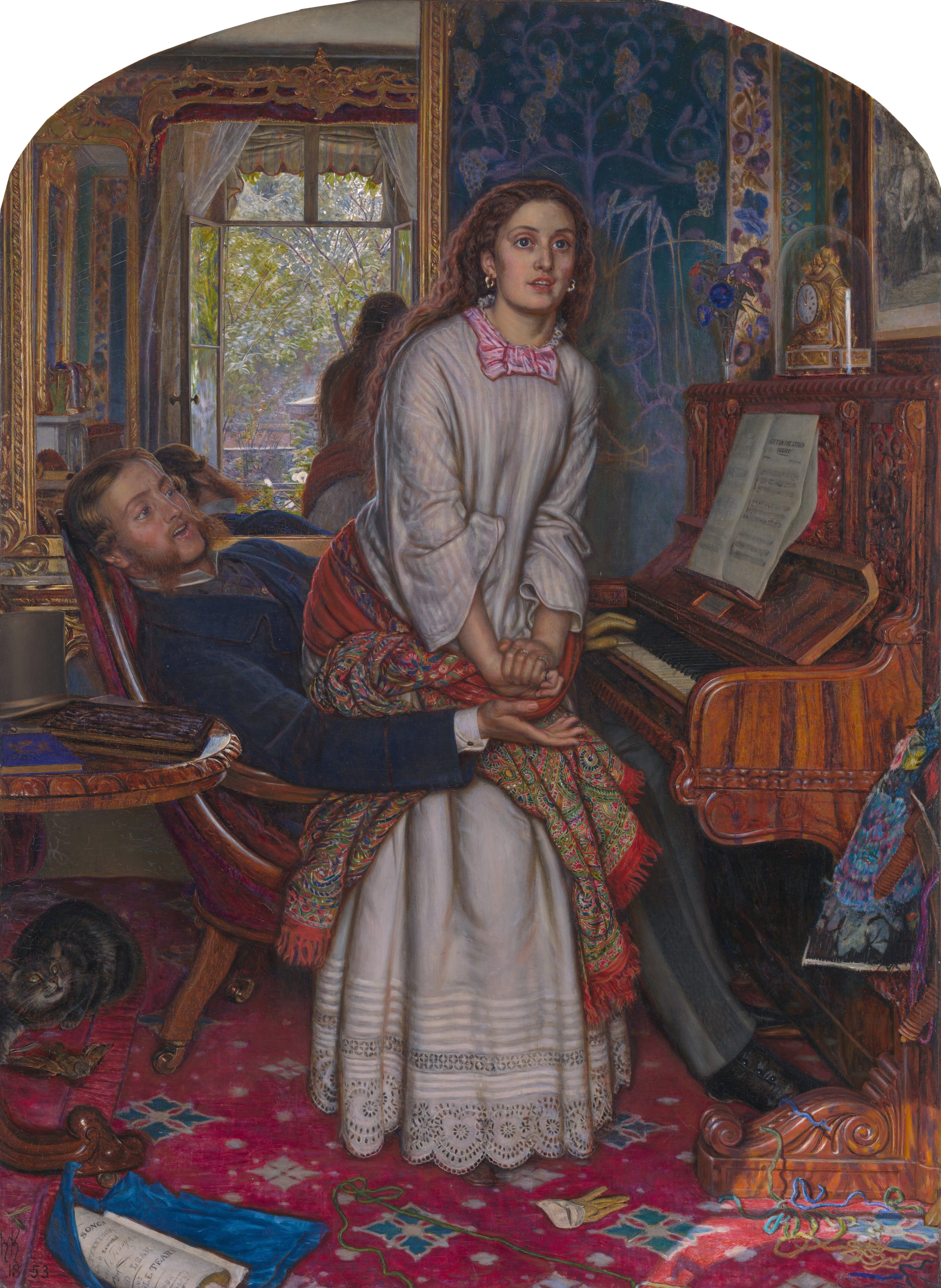
5. The Awakening Conscience — William Holman Hunt, 1853
William Holman Hunt’s The Awakening Conscience fills a richly furnished room with objects that seem available for interpretation. At its centre, a woman rises from a man’s lap and looks towards a light beyond the immediate interior. Near the lower edge, a cat crouches over a bird. The animal incident is easy to miss, but once noticed it adds pressure to the human scene: capture and vulnerability appear in miniature beneath the couple.
Tate identifies the painting as an 1853 oil on canvas, object T02075; its museum partner record gives dimensions of 76.2 by 55.9 centimetres.[5] The cat-and-bird detail should not be treated as a detachable symbol with one universal definition. Its force comes from position and analogy within this particular room. The small struggle intensifies the painting’s larger account of confinement and possible escape, while remaining an observed event in its own right. Continue to William Holman Hunt for related works built from dense material detail.
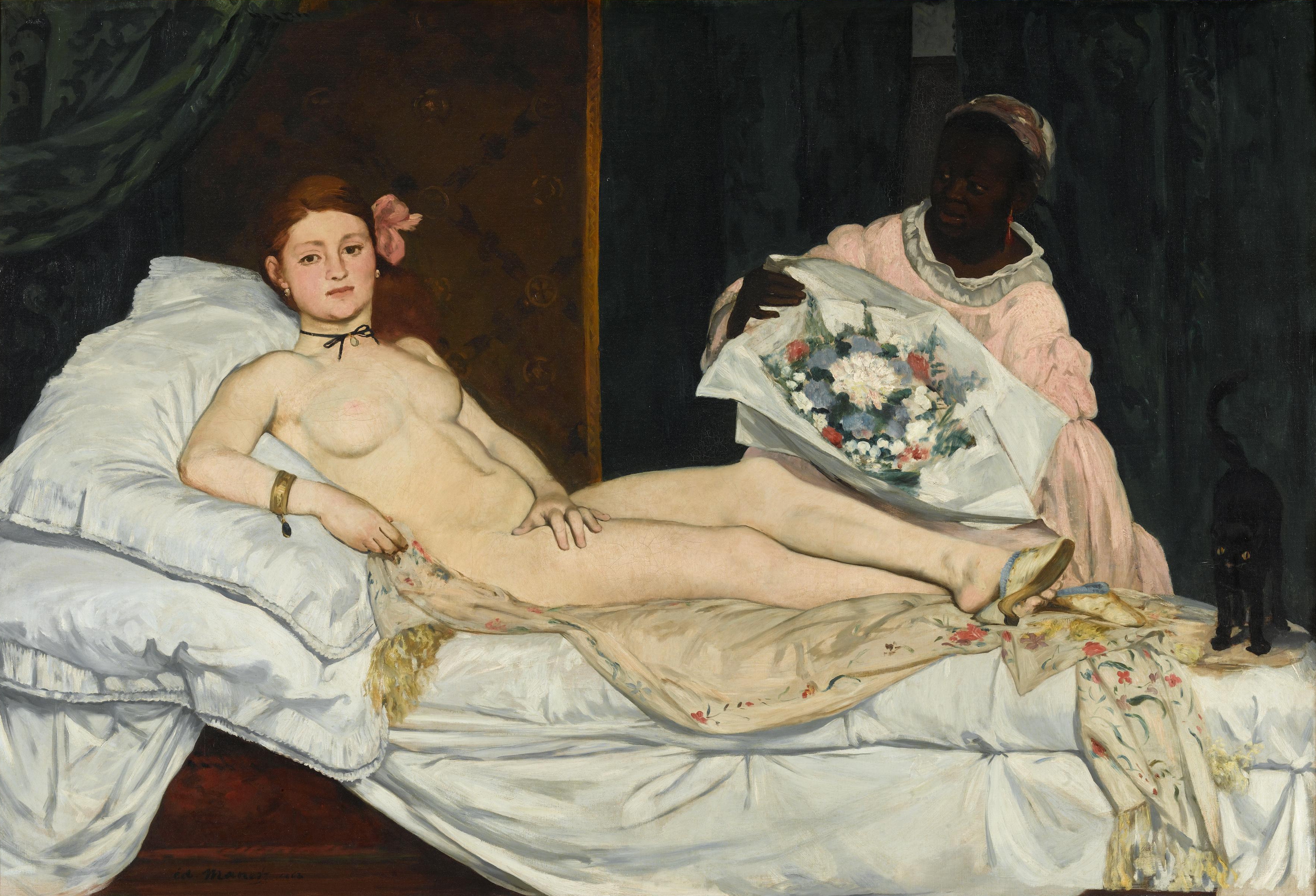
6. Olympia — Édouard Manet, 1863
The black cat in Olympia stands at the foot of the bed, tail raised and body compressed into a dark, angular silhouette. It is visually small beside the reclining figure and the maid presenting flowers, yet its alert posture interrupts the broad whites of bedding and skin. The cat does not soften the scene into domestic comfort. It contributes another direct, resistant presence.
The Musée d’Orsay records Olympia as an oil on canvas painted in 1863, inventory RF 644, measuring 130.5 by 191 centimetres.[6] Interpretations of the cat have often been consequential and contested, so it is safer to begin with what the image establishes: emphatic placement, tonal contrast, raised tail and proximity to the bed. Those choices make the animal difficult to dismiss, but they do not require one symbolic answer to exhaust its role. The cat shares the painting’s refusal of passive looking. Explore Édouard Manet for the still lifes and modern-life scenes surrounding this pivotal work.
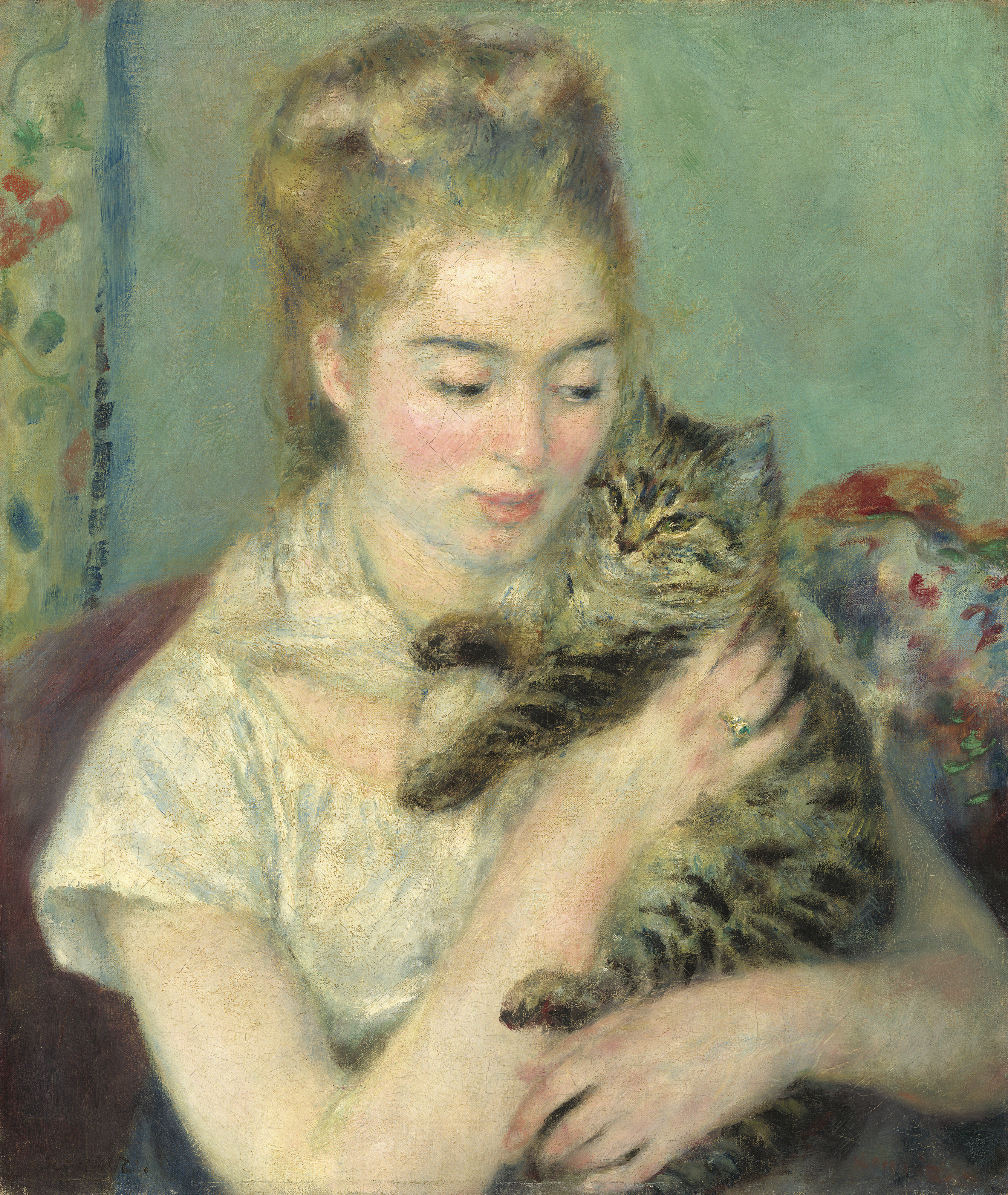
7. Woman with a Cat — Pierre-Auguste Renoir, ca. 1875
Woman with a Cat brings the animal against the sitter’s face. The woman gathers a striped cat into her arms, closes the distance between cheek and fur, and turns an ordinary act of holding into the picture’s organising gesture. Unlike Carracci’s tense baiting or Landseer’s forced contact, this touch appears voluntary on the woman’s side, while the cat retains its own compact posture and direction of attention.
The National Gallery of Art dates the oil on canvas to about 1875, records it as accession 1950.12.1, and gives its dimensions as 56 by 46.4 centimetres.[7] The relatively close crop supports the sense of physical nearness. Dress, hands, face and animal meet through broken colour rather than hard separation. Affection is conveyed through pressure and proximity, not through a staged anecdote. Visit Pierre-Auguste Renoir for portraits and figure paintings that treat touch, fabric and surrounding light differently.
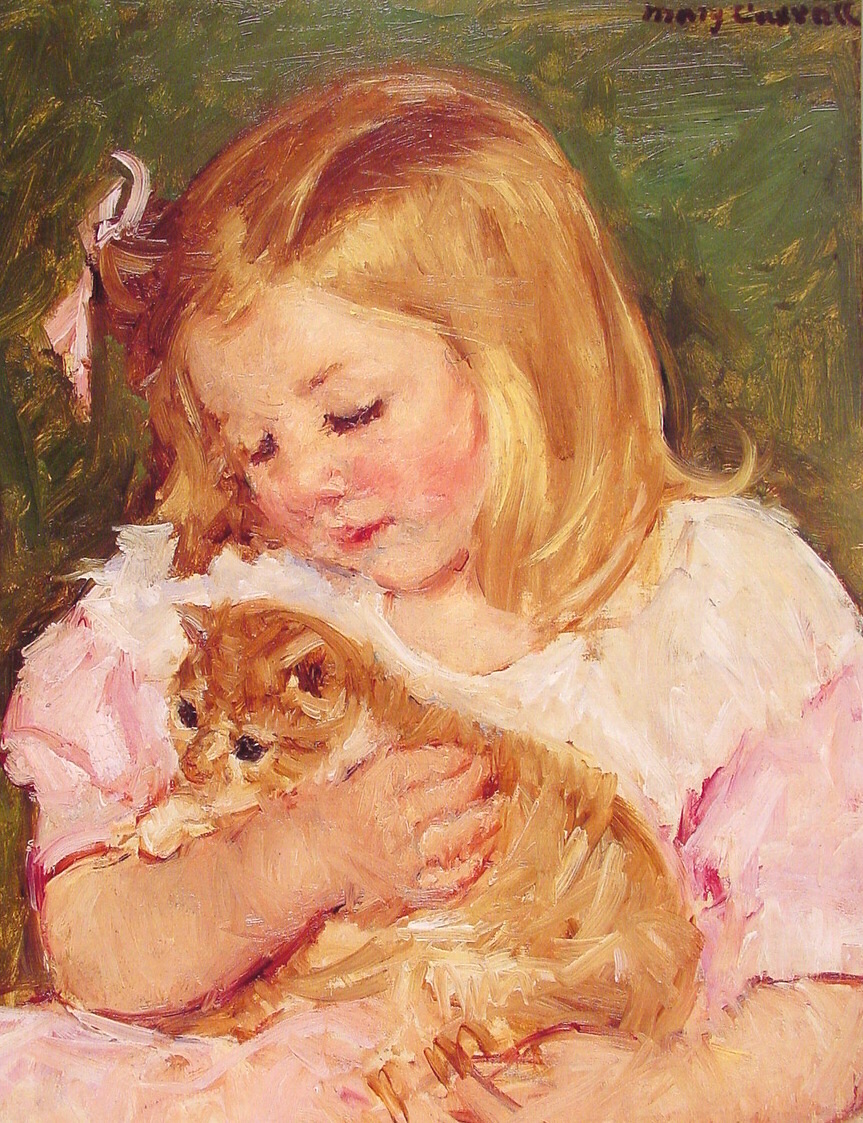
8. Sara Holding a Cat — Mary Cassatt, ca. 1907–1908
Mary Cassatt’s Sara Holding a Cat also concentrates on an embrace, but the balance feels less settled. A young girl in pink wraps both arms around an orange-and-white cat. Her face is calm and frontal; the animal’s extended body and turned head introduce another direction. Cassatt allows attachment and independence to coexist within one compact pose.
The Smithsonian American Art and Portrait Gallery inventory identifies the work as an oil on canvas from about 1908 and connects it with Adelyn Dohme Breeskin’s catalogue number 492.[8] Christie’s records the painting as approximately 41.3 by 33 centimetres, dates it to about 1907–08, and documents a chain of provenance leading to a private collection.[9] “Private collection” is therefore the responsible location description; a more specific current custody claim would go beyond the locked evidence. The selected public-domain reproduction is only 863 pixels wide, so it should remain at a modest display size rather than be enlarged beyond its available detail.[10] See Mary Cassatt for other images in which children’s gestures are observed without reducing them to simple sentiment.
The cat as a modern subject
The final pair removes the human figure. Both paintings were made by Franz Marc in 1912, and both use the cat’s curved body as a complete compositional problem. Their shared year does not make them duplicates. One isolates a sleeping white animal; the other binds two cats together through contrasting colour and interlocking form.
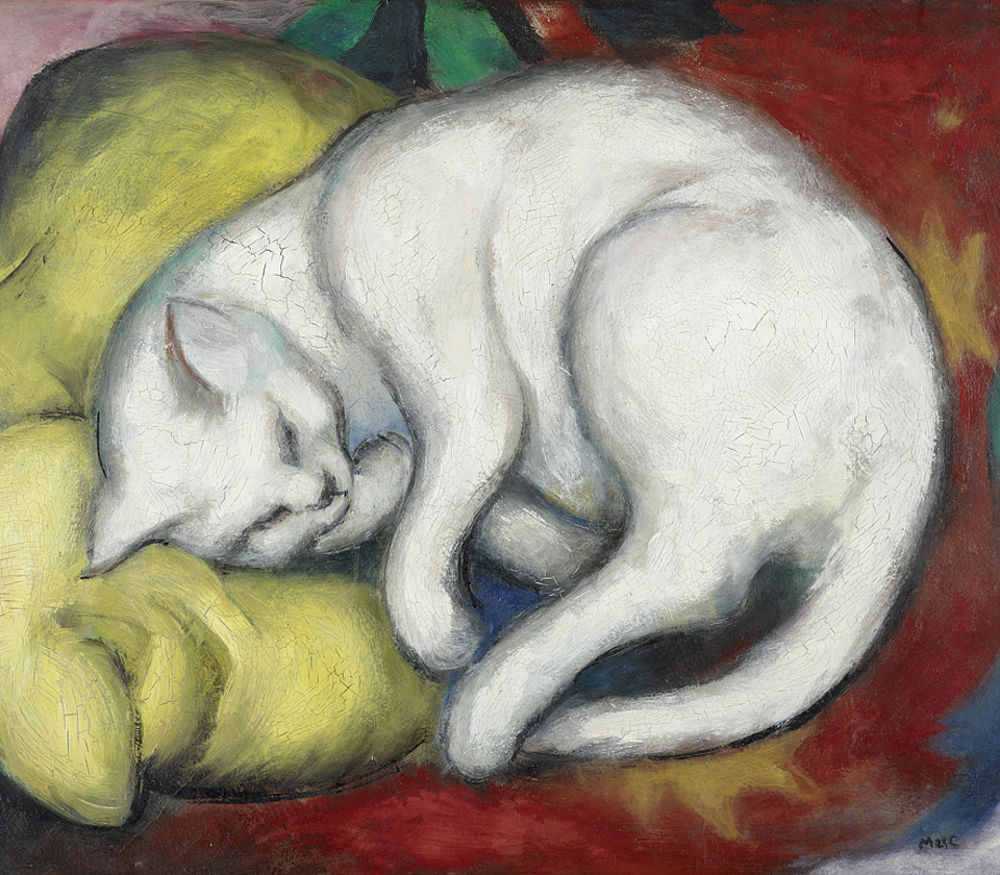
9. Cat on a Yellow Pillow (The White Cat) — Franz Marc, 1912
In Cat on a Yellow Pillow, a white cat curls into a near circle across yellow cushions. Its head tucks inward, limbs disappear into the gathered body, and surrounding planes support the sense of protected sleep. The picture does not need a person to explain why the animal matters. Repose supplies both subject and structure.
The Kunstmuseum Moritzburg catalogue identifies Marc’s 1912 oil on canvas in its collection and records dimensions of 50 by 60 centimetres.[11] The bilingual title is useful: Kater auf gelbem Kissen describes the cat and its support, while The White Cat foregrounds the pale body that concentrates the composition. Colour is expressive, but the animal remains recognisable through posture. Explore Franz Marc to compare the curves and chromatic relationships he developed across other animal subjects.
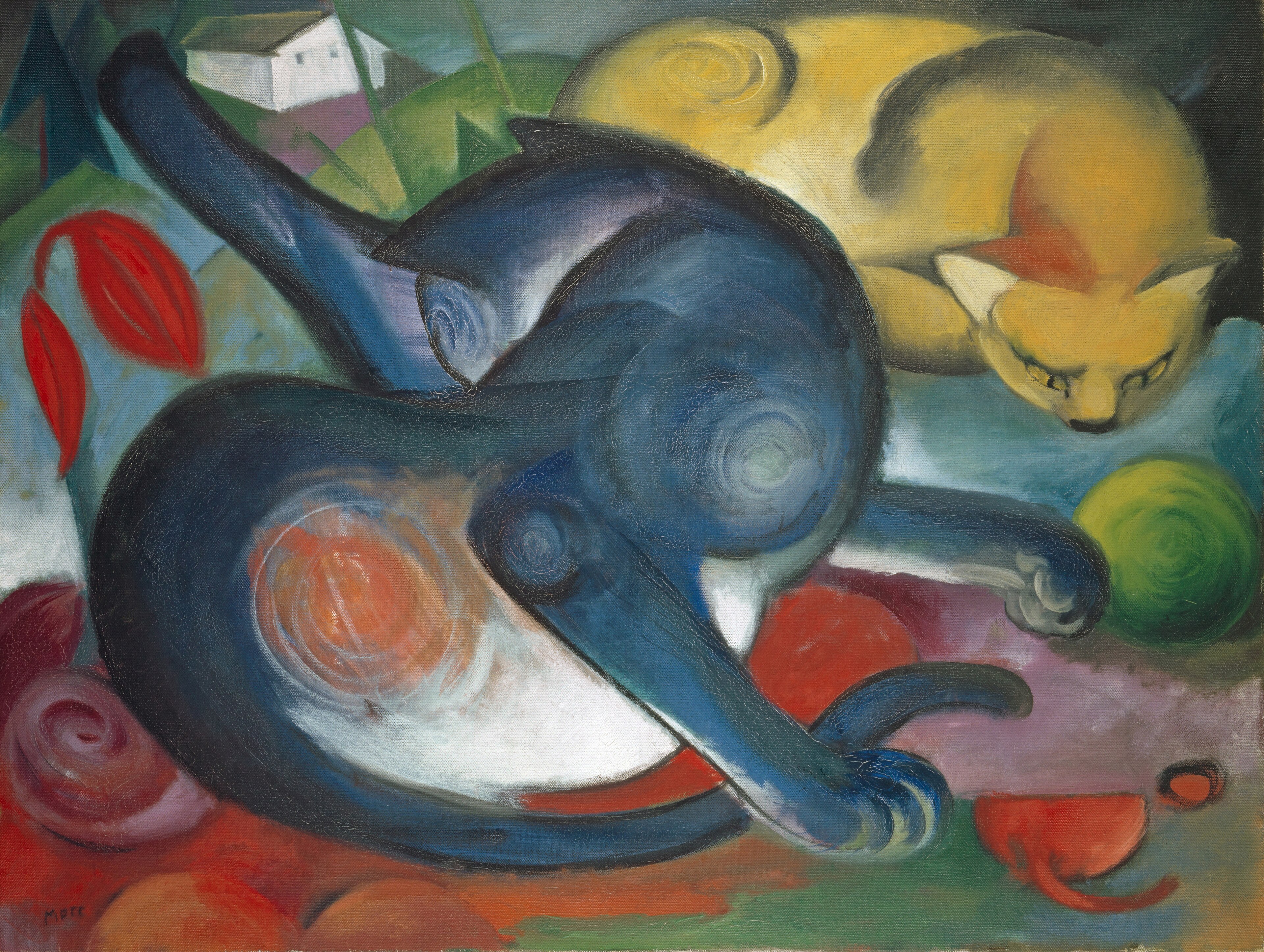
10. Two Cats, Blue and Yellow — Franz Marc, 1912
Two Cats, Blue and Yellow expands from solitary rest to paired form. A blue cat and a yellow cat bend across a field of intense colour. Their bodies overlap with the surrounding geometry, but heads, backs and tails keep the animals legible. The relationship between them is carried less by anecdote than by the way one curve answers another.
Kunstmuseum Basel identifies Two Cats, Blue and Yellow as a 1912 oil on canvas in its collection, inventory 1746, measuring 74 by 98 centimetres.[12] The work closes the sequence because it makes feline form, colour and spatial rhythm sufficient in themselves. It also sharpens the difference from Marc’s sleeping white cat: one compresses attention into a protected coil, while the other spreads two bodies across a broader, more angular field. The specialist guide to Franz Marc’s cats provides the appropriate place to continue that comparison without turning this page into a catalogue of one artist.
How to read a cat within a painting
Across these works, the most reliable questions are practical ones. Where is the cat positioned? What attracts its attention? Does a person hold, threaten or ignore it? Is its body described through close observation, or reorganised through colour and shape? These questions keep interpretation attached to visible relationships.
They also prevent a universal symbol key from flattening very different pictures. Chardin’s hungry intruder, Hunt’s crouching hunter and Manet’s alert black silhouette all introduce tension, but not the same tension. Gainsborough, Renoir and Cassatt place cats inside human touch, yet unfinished family observation, adult affection and a child’s tight embrace produce distinct emotional structures. Marc’s cats demonstrate that the animal can finally occupy the whole subject without losing the independence that made earlier appearances so vivid.
Cats matter in these paintings because they are familiar but never completely compliant. Painters can use that quality to disturb an arrangement, expose a relation of power, complicate an embrace or organise a field of colour. Reading begins with the individual work, then grows through comparison. The result is not a single history of what cats mean, but a clearer account of what ten painters enabled cats to do.
Frequently Asked Questions
Annibale Carracci’s Two Children Teasing a Cat, dated to about 1590 by the Metropolitan Museum of Art, begins the sequence. [1]
The title points to one creature being used to perform another’s dangerous task. Landseer shows a monkey forcing a cat’s paw towards roasting chestnuts. [4]
The registry and provenance evidence supports the responsible location description ‘private collection’; it does not establish a more specific current custodian. [9]
Both date from 1912, but one concentrates on a sleeping white cat while the other builds a wider composition from two interlocking cats in blue and yellow. [12]
Discussion
Use this work-led guide as a starting point for close looking rather than a universal key to what cats mean.
Share an observation about how a cat’s placement, posture or relationship with a figure changes one of these paintings.
Reader Insights
Which cat’s posture most strongly redirects your attention within its painting?
How does human touch change the role of the cats painted by Gainsborough, Renoir and Cassatt?
Where should interpretation stop when a visible detail supports more than one plausible reading?
Join the Conversation
Add your reading below, keeping observations specific and evidence clear.
References
- The Metropolitan Museum of Art, “Two Children Teasing a Cat”.
- Museo Nacional Thyssen-Bornemisza, “Still-Life with Cat and Rayfish”.
- The National Gallery, “The Painter’s Daughters with a Cat”.
- Minneapolis Institute of Art, “The Cat’s Paw”.
- Google Arts & Culture / Tate, “The Awakening Conscience”.
- Musée d’Orsay, “Olympia”.
- National Gallery of Art, “Woman with a Cat”.
- Smithsonian Institution, “Sara Holding a Cat”.
- Christie’s, “Mary Cassatt, Sara Holding a Cat”.
- Wikimedia Commons, “Sara Holding a Cat” reproduction record.
- Kunstmuseum Moritzburg, Wege der Moderne: Kunst in Deutschland im 20. Jahrhundert.
- Kunstmuseum Basel, collection guide including Two Cats, Blue and Yellow.