


Fish do not play one stable role in painting. A fish carried through a sacred story differs from one laid on a table, hauled from the sea or watched through glass. It can connect a figure to a narrative, give weight and sheen to a still life, register the risks of labour, or become an intense point of colour in a modern interior.
This guide follows ten fish paintings in chronological order, from Filippino Lippi’s Tobias and the Angel to Paul Klee’s Around the Fish. It asks where the fish appears, whether it is living or dead, who observes it, and how scale, surface and colour direct attention. Those questions reveal continuities without forcing very different paintings into a universal symbolism.
The wider Paintings hub organises subjects, genres and major works, while Famous Paintings serves a broader masterpiece directory. Readers seeking the history of Still Life, Genre Painting or Marine Art can follow those dedicated guides. Studies made with line rather than paint belong with Fish Drawings. Here the focus remains tightly on what fish contribute to ten individual paintings.
Attribute, food and still-life substance
The first four works move from story to display. Lippi gives the fish a place in an unfolding journey. Chardin suspends a rayfish above a table where food, vessels and an alert cat compete for attention. Manet and Bazille then make fish the dense material centre of modern still lifes. Across these pictures, the same broad motif changes because its physical condition and its relationship to the surrounding space change.
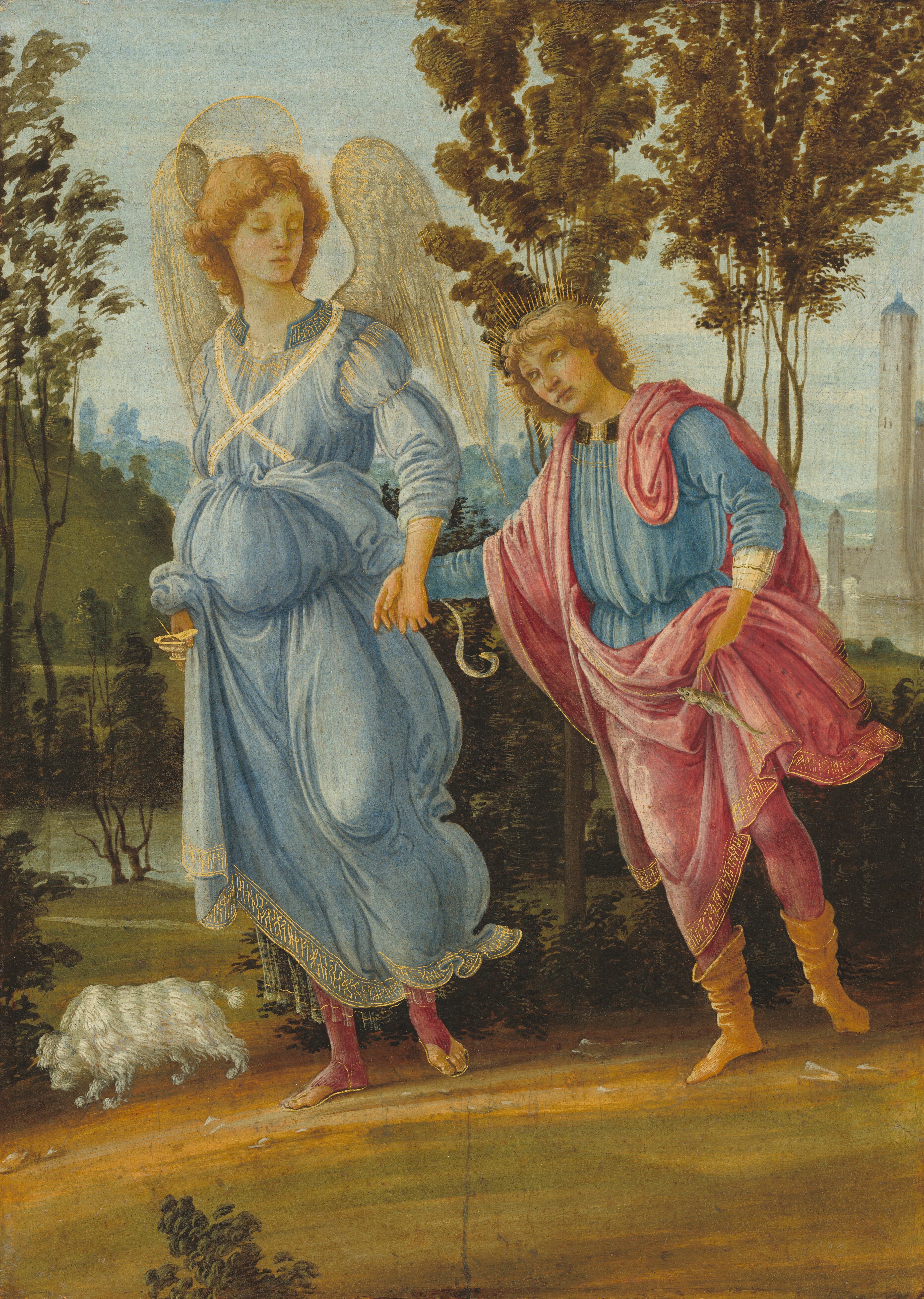
1. Tobias and the Angel — Filippino Lippi, c. 1475/1480
In Tobias and the Angel, Tobias walks beside a taller angel while holding a fish. A small dog accompanies them. The figures advance together across a landscape, so the fish is neither an isolated specimen nor food waiting to be prepared. It is an object being carried inside a narrative, and the action of carrying it helps identify the young traveller’s purpose.
The National Gallery of Art dates the work to about 1475/1480 and identifies the medium as oil and tempera on poplar panel. The painted surface measures 32.7 by 23.5 centimetres; the overall panel is 34.45 by 25.4 centimetres, accession 1939.1.229.[1] At that intimate scale, the fish is small but legible. Its pale body and diagonal position make it noticeable beside the rhythm of robes and walking feet.
Look first at the relationships rather than at the fish alone. Tobias’s grip connects the object to his body, the angel’s gesture gives direction to the pair, and the dog reinforces their forward movement. The fish matters because it travels with them. That distinction establishes an important starting point for the whole sequence: subject is created through action and context, not simply through the presence of an animal. Explore Filippino Lippi for the painter’s wider treatment of sacred narrative and expressive figures.
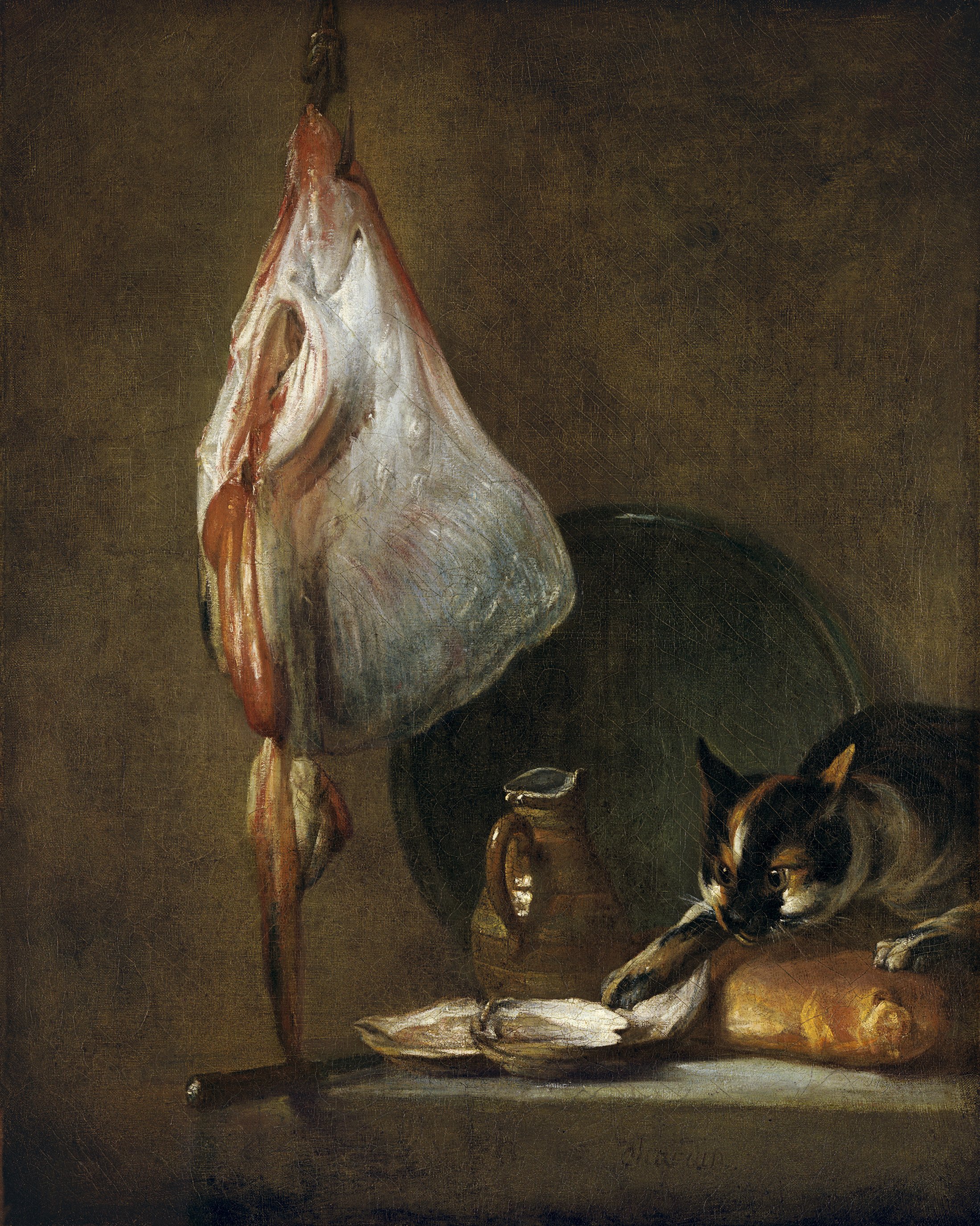
2. Still-Life with Cat and Rayfish: appetite at the table — Jean-Baptiste-Siméon Chardin, 1728
Chardin’s Still-Life with Cat and Rayfish transforms fish into an emphatic display of food and texture. The rayfish hangs vertically, its pale opened body set against a dark background. Below it, fish, oysters, vessels and cloth spread across the table, while a cat peers toward the arrangement from one side. The animal’s alertness introduces appetite and potential movement into a composition built from objects that cannot move themselves.
The Museo Nacional Thyssen-Bornemisza records the 1728 oil on canvas as inventory 120 (1986.6), measuring 79.5 by 63 centimetres.[2] The vertical format suits the suspended rayfish, whose shape joins the upper and lower parts of the picture. Its exposed underside is visually unlike the hard shells, metal vessel, fabric and fur around it. Comparing those surfaces is more revealing than treating the work as a simple catalogue of provisions.
The cat also changes the viewer’s position. We are not the only observers of the table; another living creature is already intent on it. The tension between displayed food and watchful appetite prevents the still life from feeling inert. Chardin uses the fish to organise height, weight and bodily response, turning an arrangement of kitchen matter into a scene of restrained drama. See Chardin for more paintings in which ordinary things acquire presence through carefully judged relationships.
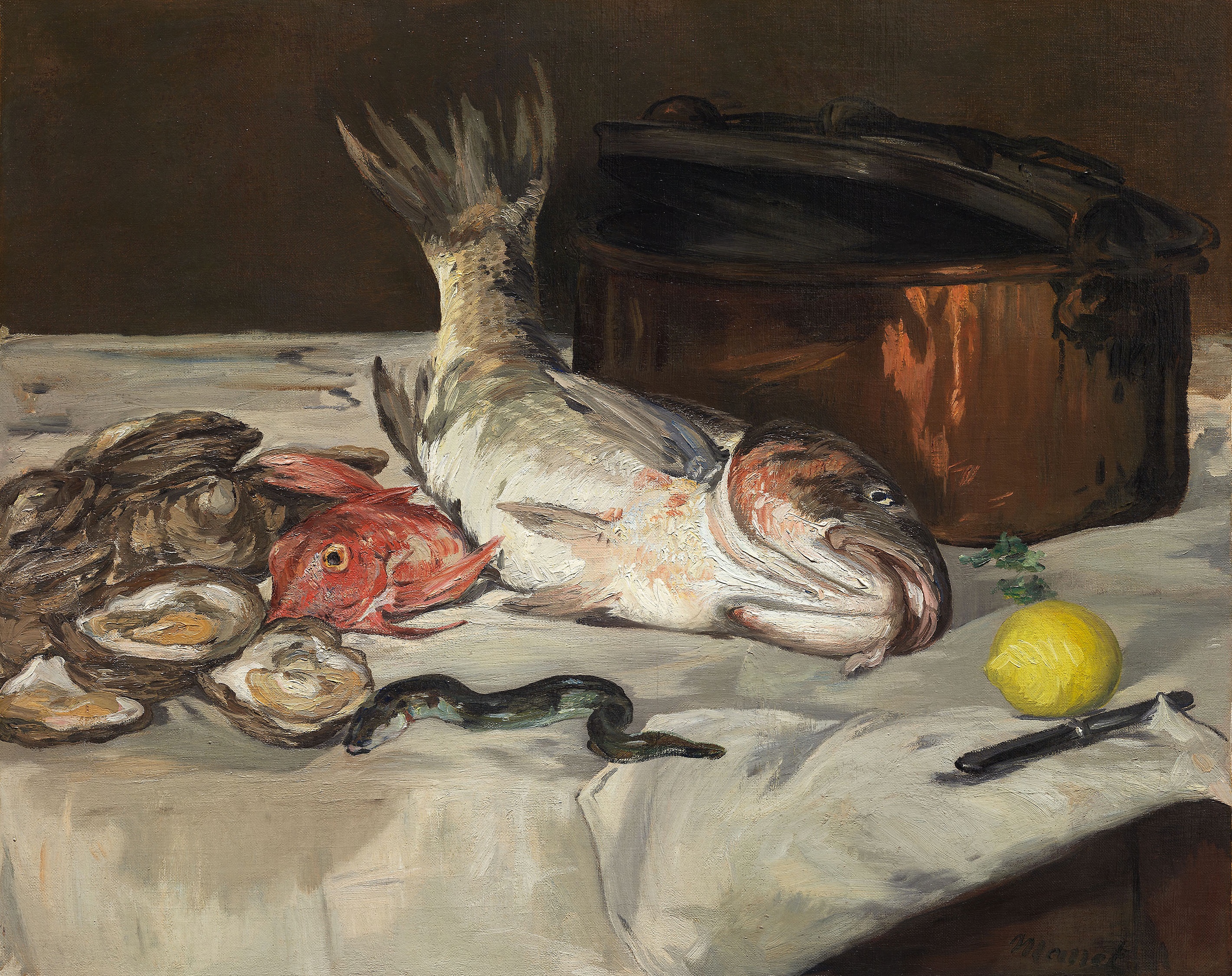
3. Fish (Still Life) — Édouard Manet, 1864
Fish (Still Life) brings the catch close to the front edge. Fish and oysters lie across a white cloth beside a copper pot and a ceramic vessel. Bodies overlap rather than aligning neatly, and the folds beneath them create an uneven ground. Reflections on metal, wet skin, shell and glazed pottery turn the table into a concentrated exercise in how paint can separate substances.
The Art Institute of Chicago records the work as an 1864 oil on canvas, object 1942.311, measuring 73.5 by 92.4 centimetres. Its scholarly catalogue uses the title Fish (Still Life) and documents the painting as a fully considered work rather than a casual kitchen notation.[3] The horizontal canvas gives the objects room to press against one another, while the dark setting makes the illuminated pile feel immediate.
Manet does not need a cat or human figure to activate the arrangement. Direction comes from the fish bodies, the cloth’s diagonals and the alternating rounded forms of pot, shell and vessel. The painting invites a double response: recognition of edible things and attention to paint as a material that can suggest dampness, hardness and softness. That tension between depicted substance and painted surface is central to its modern force. Visit Édouard Manet to place this still life beside his portraits and scenes of contemporary life.
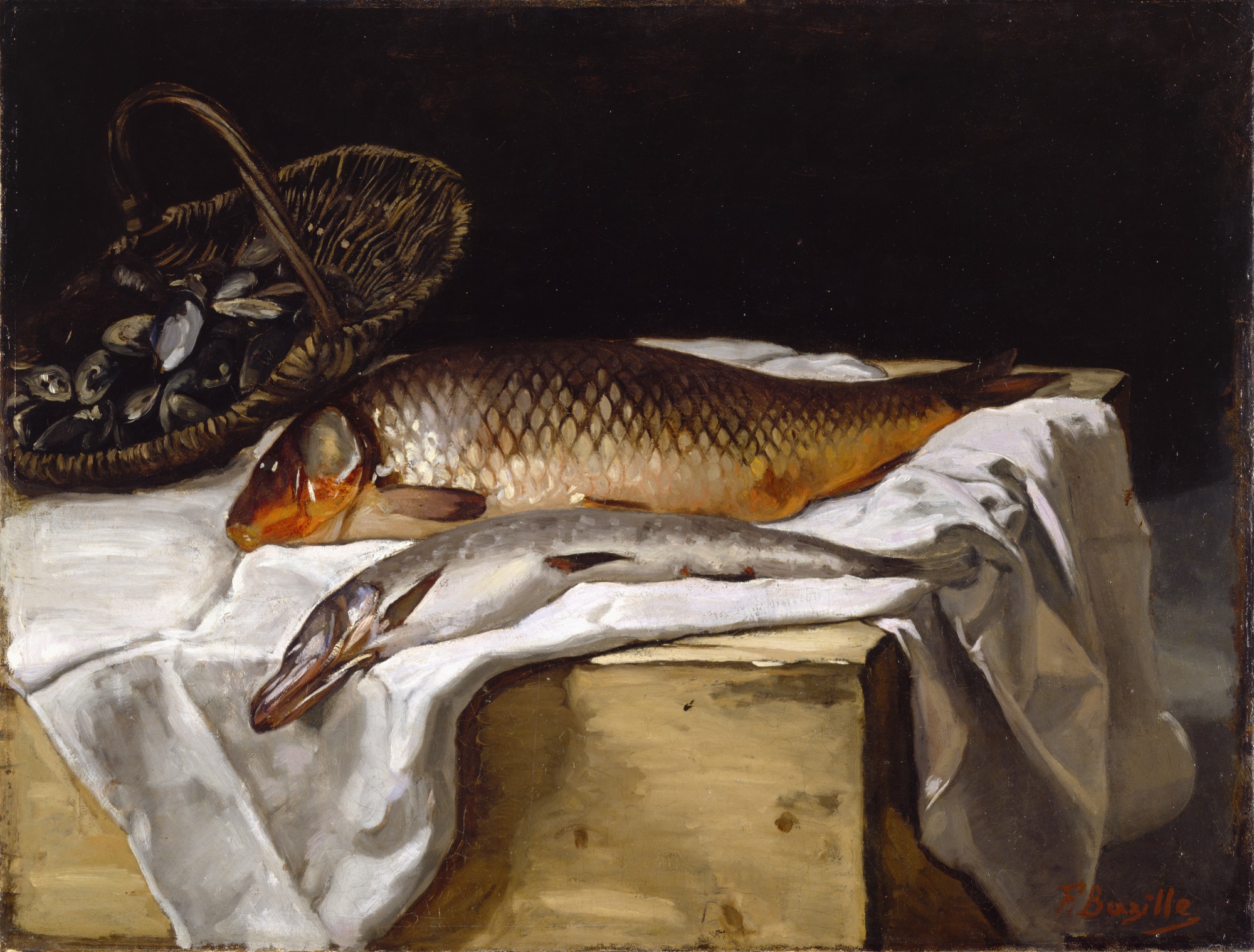
4. Still Life with Fish — Frédéric Bazille, 1866
Frédéric Bazille’s Still Life with Fish reduces the spread to a tighter encounter. Two fish lie on a white cloth near a wicker basket and dark vessels. The table rises steeply, compressing depth and making the objects appear stacked into a shallow pictorial space. Compared with Manet’s crowded abundance, Bazille’s fewer forms seem heavier and more isolated.
The Detroit Institute of Arts identifies the painting as an 1866 oil on canvas, accession 1988.9, measuring 63.5 by 81.9 centimetres.[4] That exact identity matters because the work can otherwise disappear into the generic label “fish still life.” Its particular interest lies in the balance between recognisable provisions and a composition that is increasingly direct. The pale cloth does not merely support the fish; it creates the brightest shape and sharpens their darker contours.
Look at how little narrative is needed. No one has entered the room, and no meal is shown in preparation. Yet the angled surface, cropped edges and differences between scale-like skin, woven basket and folded fabric keep the eye moving. Bazille uses reduction to intensify comparison. Read more about Frédéric Bazille and the still lifes, figures and outdoor scenes through which he tested modern arrangements before his short career ended.
Catch, labour and social consequence
The next three paintings shift attention from displayed fish to the work surrounding them. Homer places the viewer in an unstable boat with fishermen and a heavy net. Sorolla brings the consequences of dangerous labour into the vessel itself. Chase returns to the studio table, but his brisk handling makes the catch a demonstration of painterly labour. Fish now connect bodily effort at sea with bodily action at the easel.
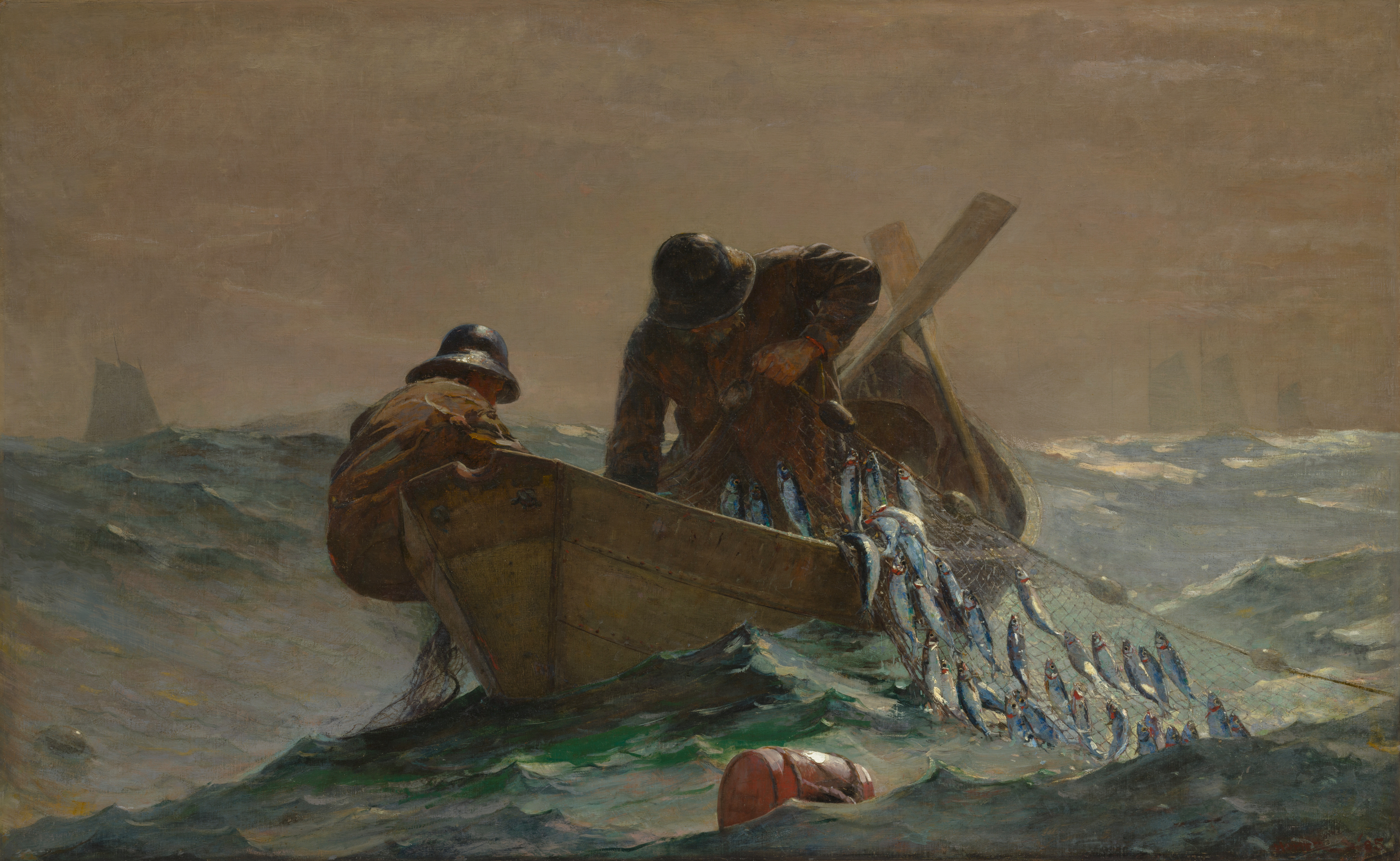
5. The Herring Net — Winslow Homer, 1885
In The Herring Net, two fishermen occupy a small boat surrounded by open water. One leans toward a net dense with fish while the other helps manage the catch. Their low position and the boat’s narrow width make balance feel precarious. The silvered mass of herring is valuable, but it also adds weight at the point where the men must work against sea and gear.
The Art Institute of Chicago records The Herring Net as an 1885 oil on canvas, object 1937.1039, measuring 76.5 by 122.9 centimetres.[5] The broad format accommodates boat, bodies, net and horizon without granting any one element complete independence. The fishermen’s bent postures repeat the curve of the boat, and the net draws attention down toward the waterline.
This is not a scenic account of marine leisure. Fish are visible as catch, but the painting’s force comes from the difficult relationship among catch, workers and conditions. The open sea gives no stable vertical against which to measure the men, while the close boat denies them room to step back. The viewer is prompted to notice how value and danger arrive together. Browse Winslow Homer for other works in which coastal labour and the physical character of water shape human action.
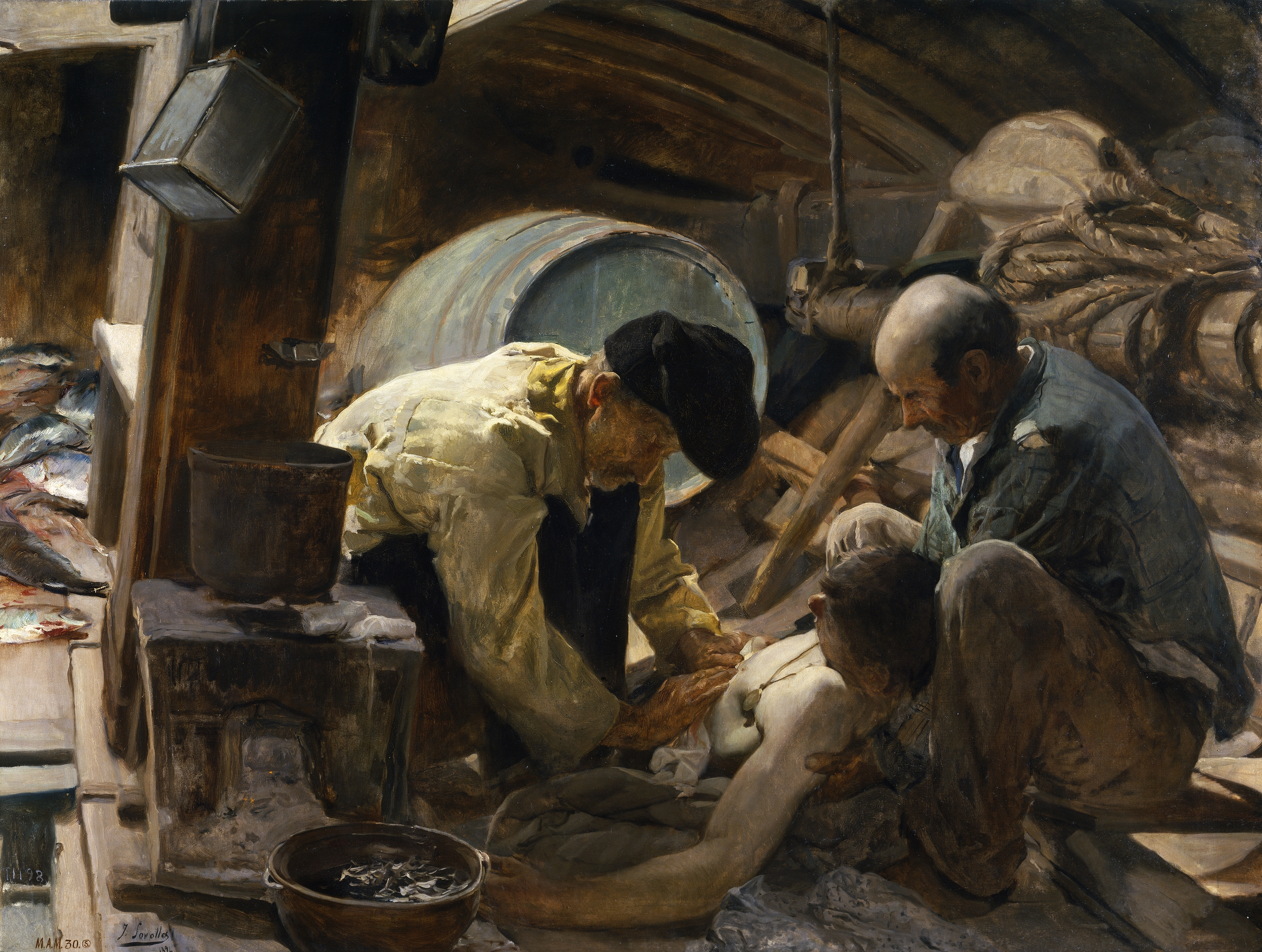
6. And They Still Say Fish Is Expensive! — Joaquín Sorolla, 1894
Sorolla’s And They Still Say Fish Is Expensive! moves from difficult work to its human cost. Inside a fishing boat, two older men attend to an injured young fisherman. Fish lie nearby, but the catch no longer commands the scene. The youth’s body, the helpers’ gestures and the confined interior redirect attention from commodity to consequence.
The Museo Nacional del Prado identifies the work as an 1894 oil on canvas, inventory P004649, measuring 151.5 by 204 centimetres.[6] Its large scale and horizontal spread give the episode gravity. The title explicitly frames the picture as an answer to anyone who sees only the market price of fish and not the risk borne by those who supply them.
Several kinds of looking operate at once. The fishermen focus on the injured figure; the viewer sees them within a workplace still marked by catch and equipment. Fish therefore remain essential even when they are not the visual centre. They explain why these bodies are together in the boat and what economic activity lies behind the accident. The painting’s social argument emerges from that concrete setting rather than from an abstract emblem. Explore Joaquín Sorolla for a wider view of his figures, seascapes and luminous coastal subjects.
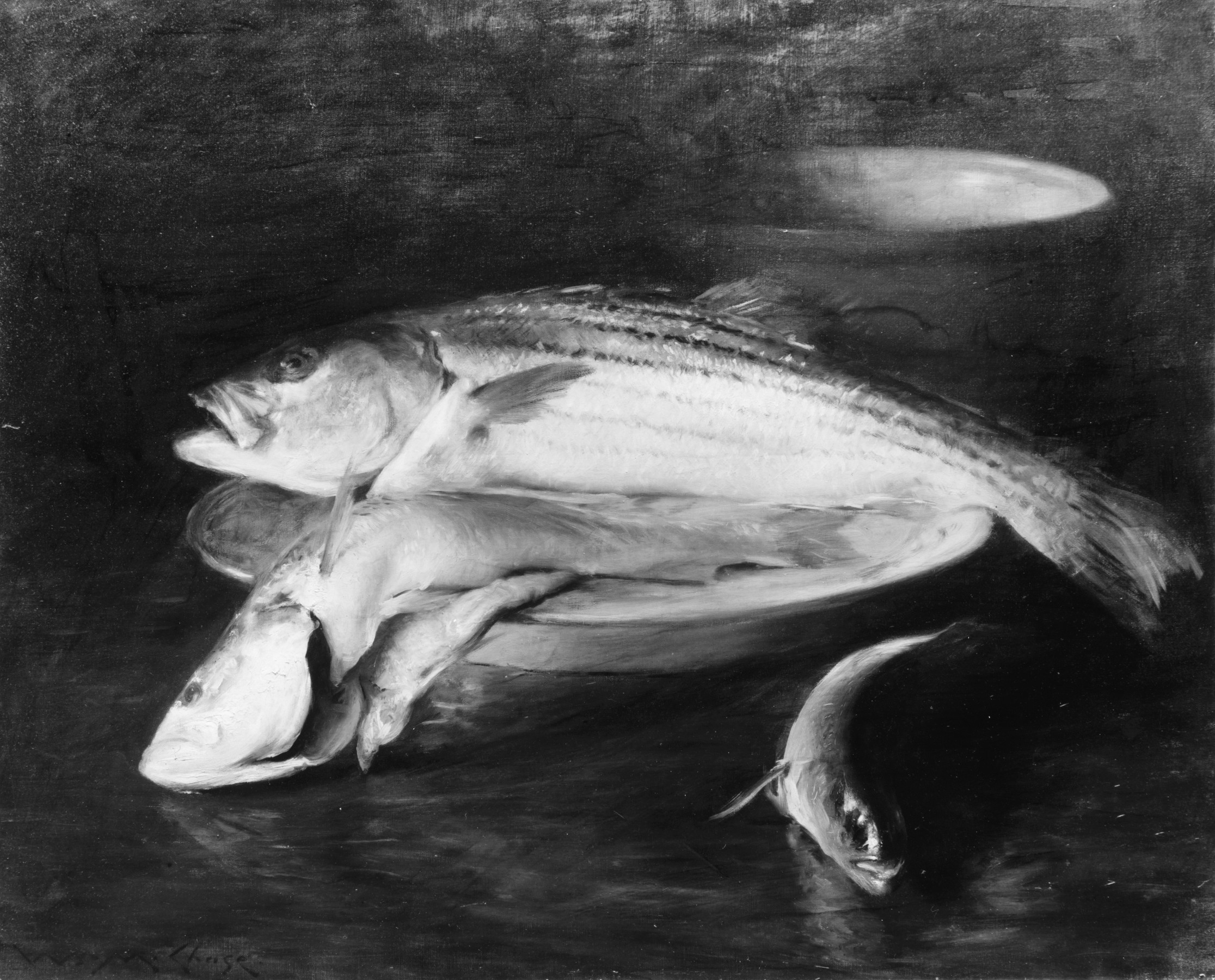
7. Fish — William Merritt Chase, by 1910
William Merritt Chase’s Fish brings three fish back to a dark studio ground. Their bodies overlap in a loose diagonal, with little surrounding furniture to explain or domesticate them. The narrow tonal range of the surviving museum image directs attention to silhouette, sheen and the differing directions of heads and tails.
The Metropolitan Museum of Art dates the oil on canvas to “by 1910” and records it as accession 25.131, measuring 73.7 by 91.4 centimetres. The museum classifies both the work and its primary image as public domain under its Open Access programme.[7] The restrained object list distinguishes Chase’s approach from Manet’s combination of fish, oysters, pots and cloth. Here, the catch itself provides nearly all the structure.
Speed should not be confused with carelessness. Broad handling can make the fish seem freshly observed because edges, highlights and dark intervals are stated without excessive polishing. The subject gives Chase a compact test of control: each body must remain distinct even though all three occupy the same compressed field. See William Merritt Chase for portraits, interiors and still lifes in which assured handling becomes part of what the viewer notices.
Aquarium, interior and modern symbol
Matisse and Hassam replace caught fish with living goldfish observed indoors. Their bowls organise acts of looking while connecting interior space to garden colour and light. Klee then removes the fish from ordinary scale and setting, placing it at the centre of a dark field of signs. These three works make vision itself increasingly conspicuous: the fish is watched, framed and finally transformed into an enigmatic pictorial focus.
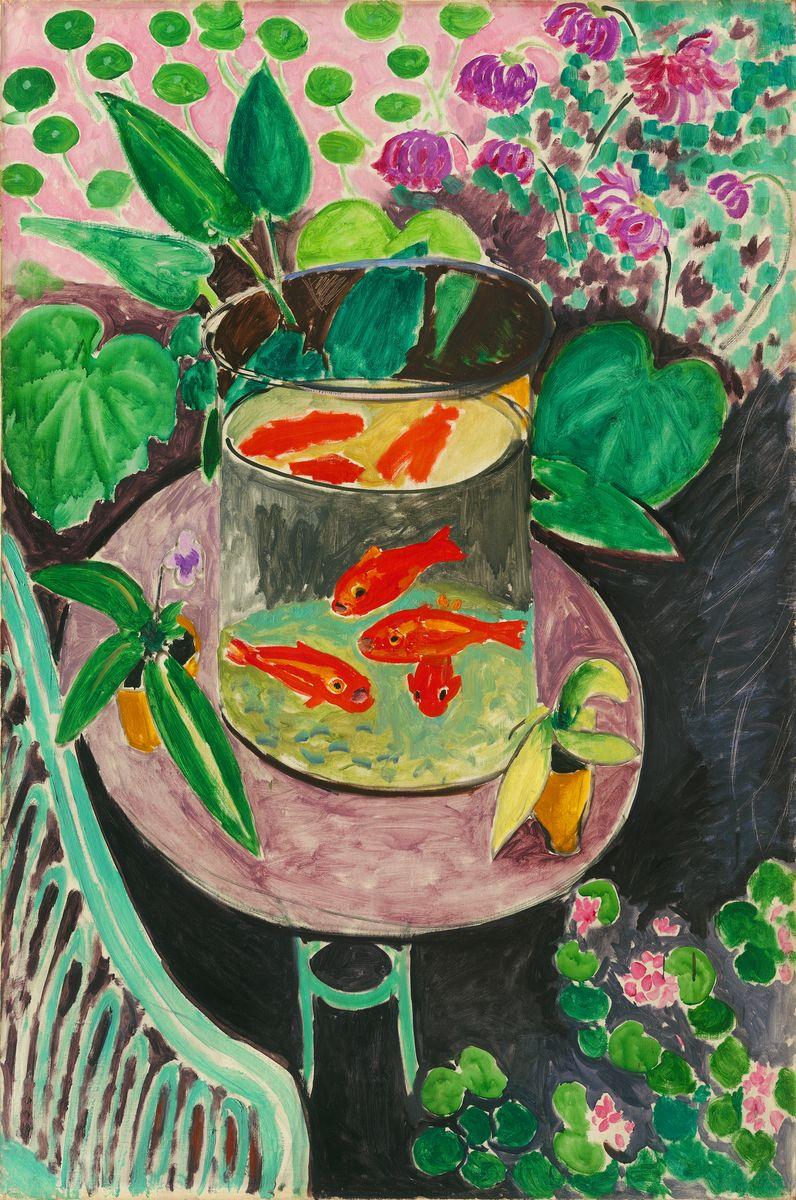
8. Gold Fish — Henri Matisse, 1912
In Henri Matisse’s Gold Fish, bright orange fish circle inside a cylindrical glass bowl. Green foliage crowds the surrounding space, and pieces of studio furniture appear at shifting angles. The bowl is transparent, reflective and curved, so it does not offer a neutral view. Fish, water, glass and room overlap, making the act of seeing part of the subject.
The Pushkin State Museum of Fine Arts uses the English title Gold Fish for the 1912 oil on canvas, inventory Ж-3299, measuring 140 by 98 centimetres.[8] The familiar one-word title Goldfish is often used elsewhere, but the museum’s form identifies this exact object. Its tall proportions let the bowl act as a pivot between the lower tabletop and the dense plants above.
Colour establishes relationships that conventional perspective leaves unsettled. Orange fish stand apart from green leaves, yet curves of bowl and table repeatedly redirect the eye. It is difficult to decide whether the room opens outward or folds toward the central vessel. The goldfish remain small within the canvas, but their saturation makes them impossible to overlook. They are both living creatures and recurring colour accents around which the interior is organised. Visit Henri Matisse for further experiments with charged colour, compressed rooms and the boundary between object and pattern.
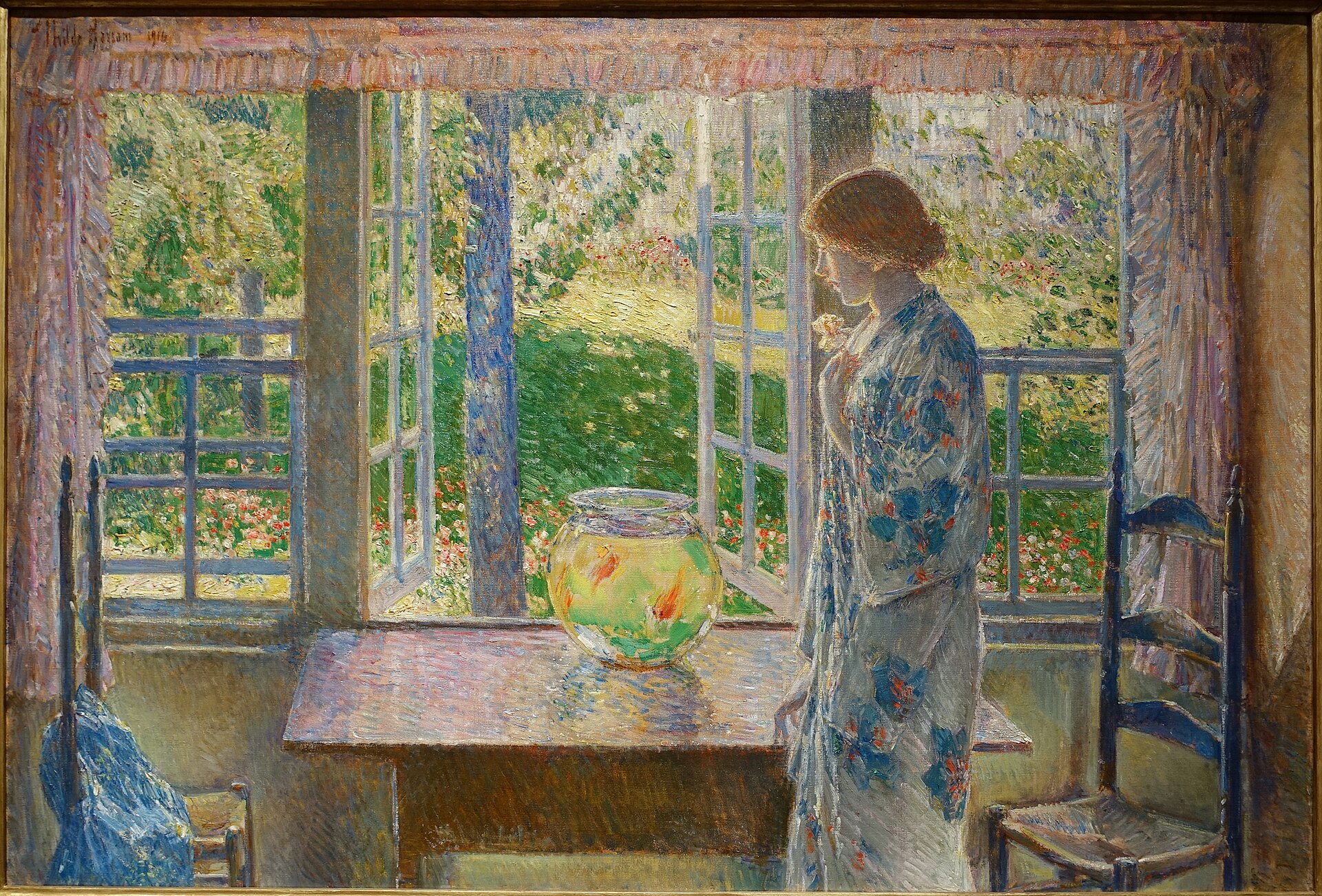
9. The Goldfish Window — Childe Hassam, 1916
Childe Hassam’s The Goldfish Window places a round bowl on a table before open windows. A woman stands beside it, while a bright garden fills the view beyond. Fish, figure, interior and exterior occupy a linked chain of framed spaces: the bowl contains water, the window contains the garden view, and the painted canvas contains them all.
Authoritative exhibition documentation identifies the 1916 oil on canvas as a Currier Museum of Art work measuring about 87.3 by 128.6 centimetres.[9] The museum’s own publication records accession 1937.2 and the work’s place in its collection.[10] These records anchor the exact object, while the composition explains why “window” belongs in the title as much as “goldfish.”
The bowl is not simply a decorative accessory. Its curved glass offers a small, concentrated world beside the broad rectangles of the window. The woman’s downward gaze encourages viewers to move from her face to the fish and then outward into the garden. Light passes through every stage, but each frame changes it. Hassam therefore turns a domestic encounter into a study of nested looking. Explore Childe Hassam for paintings in which rooms, windows and sunlit outdoor spaces meet through patterned colour.
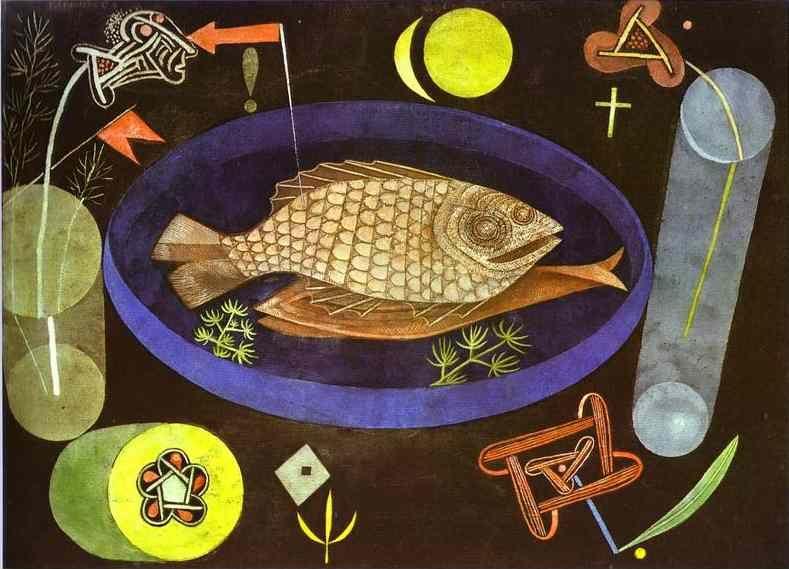
10. Around the Fish — Paul Klee, 1926
Paul Klee’s Around the Fish centres a pale fish in a dark, nocturnal field. Coloured shapes, lines and signs gather around it without resolving into a single ordinary setting. The fish is recognisable, but scale is uncertain. It might be an animal, an image within an image, or the organising form around which the rest of the painted world has assembled.
The Museum of Modern Art records the 1926 work as oil and tempera on canvas mounted on cardboard, object 271.1939, measuring 46.3 by 64.1 centimetres.[11] Its modest physical size contrasts with the spatial reach suggested by the surrounding darkness. Bright accents appear like isolated signals, while the central body gives the eye a stable form to return to.
Interpretation should remain open. The arrangement invites symbolic thought, but no universal dictionary can settle what each sign means. What the painting makes directly visible is hierarchy: the fish is larger, lighter and more continuous than many adjacent forms. Everything else is encountered in relation to it. Klee’s achievement is to preserve recognition while loosening context. Browse Paul Klee for more works in which familiar objects enter constructed systems of line, colour and ambiguous signs.
How to compare fish paintings
Begin by asking whether the fish is alive, caught, displayed or carried. That condition changes the human relationship around it. Lippi’s Tobias carries a fish through a story; Chardin’s cat anticipates consumption; Homer’s fishermen struggle with a net; Matisse and Hassam present living fish as objects of sustained attention. The motif does not supply meaning by itself. Action and setting do.
Next, notice what space the fish creates. A hanging rayfish makes Chardin’s still life vertical. Manet’s and Bazille’s fish pull the eye across shallow tables. Homer’s net draws attention toward the boundary between boat and sea. Glass bowls in Matisse and Hassam complicate vision through curvature and reflection. Klee’s fish provides orientation where space otherwise resists measurement.
Surface offers another comparison. Fish test contrasts between wet and dry, reflective and matte, soft flesh and hard vessel. These contrasts matter in still life, the silvered catch of The Herring Net, and the glass-and-water layers of the goldfish paintings. Technique remains connected to the subject.
Finally, consider who is allowed to look. Sometimes the viewer appears to face the fish directly, as in Chase’s studio arrangement. Elsewhere a painted observer mediates the encounter: Chardin’s cat watches the table, Sorolla’s fishermen attend to their companion, and Hassam’s woman looks toward the bowl. These figures prevent the fish from becoming a neutral specimen. They show desire, work, care or contemplation taking place around it.
Together, the ten paintings trace a shift without claiming a complete history. Fish pass from narrative attribute to food, catch, commodity, living interior presence and modern sign. Yet the sequence also loops back: bodies, vessels, human attention and the problem of representing a glistening surface recur across centuries. The most useful question is therefore not “What does a fish always mean in art?” but “What is this fish doing in this painting?” Exact answers begin with the work in front of us.
Frequently Asked Questions
Filippino Lippi’s Tobias and the Angel, dated about 1475/1480, begins the sequence with a fish carried through a sacred narrative. [1]
No. Homer places fish within dangerous labour at sea, while Sorolla uses the catch to frame the human cost of that labour. [5]
Matisse and Hassam depict living fish inside glass bowls, making observation, reflection and interior space part of the subject. [8]
No single interpretation settles the surrounding signs; the fish is most clearly the light, stable form that organises the dark field. [11]
Discussion
Use this work-led guide as a starting point for close looking rather than a universal key to what fish mean.
Share an observation about how setting, handling or the viewer’s gaze changes the role of fish in one of these paintings.
Reader Insights
Which painting makes the fish’s surface most tangible, and which surrounding objects create that effect?
How does the subject change when fish move from a carried attribute or catch to living creatures watched through glass?
Where should interpretation stop when the fish or surrounding signs support more than one plausible reading?
Join the Conversation
Add your reading below, keeping observations specific and evidence clear.
References
- National Gallery of Art, “Tobias and the Angel”.
- Museo Nacional Thyssen-Bornemisza, “Still-Life with Cat and Rayfish”.
- Art Institute of Chicago, “Fish (Still Life)” in Manet Paintings and Works on Paper at the Art Institute of Chicago.
- Detroit Institute of Arts, “Still Life with Fish”.
- Art Institute of Chicago, “The Herring Net”.
- Museo Nacional del Prado, “And They Still Say Fish Is Expensive!”.
- The Metropolitan Museum of Art, “Fish”.
- Pushkin State Museum of Fine Arts, “Gold Fish”.
- Pennsylvania Academy of the Fine Arts, The Artist’s Garden exhibition record.
- Currier Museum of Art, 2015 annual report.
- Museum of Modern Art, “Around the Fish”.