


 by Tom Gurney
Tom Gurney BSc (Hons) is an art history expert with over 20 years experience
Published on June 19, 2020 / Updated on September 27, 2026
Email: tomgurney1@gmail.com / Phone: +44 7429 011000
Fish, flowers and a clock in the dark
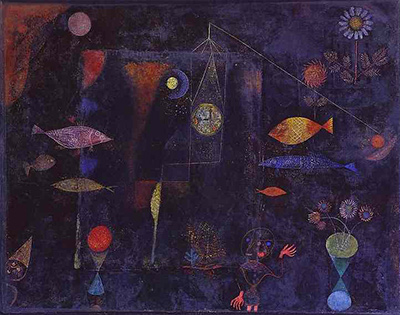
Several brightly coloured fish appear to swim across the darkness of Paul Klee’s Fisch Zauber (Fish Magic). Yet the place around them refuses to stay underwater. Flowers stand at the upper right and grow from a pale vessel below; a clock hangs in a thin tower near the centre; coloured disks and geometric shapes float without a clear horizon. A diagonal line runs from the tower toward the right edge. The picture is inviting because these separate things can be seen at once, but their relationship cannot be resolved into an ordinary scene. Philadelphia Museum of Art, which owns the painting, describes an interplay of aquatic, celestial and earthly elements rather than a single natural setting.[1]
Klee also made the painting’s surface part of this uncertainty. According to Philadelphia, he laid delicate black paint over colours and revealed some of those colours by scratching and scrawling. A square of muslin is glued near the centre. The apparent world of fish and flowers is therefore also a physical arrangement of paint and attached fabric. Looking at its forms and looking at how they were made are connected activities, though a reproduction cannot settle every question about the original surface.[1]
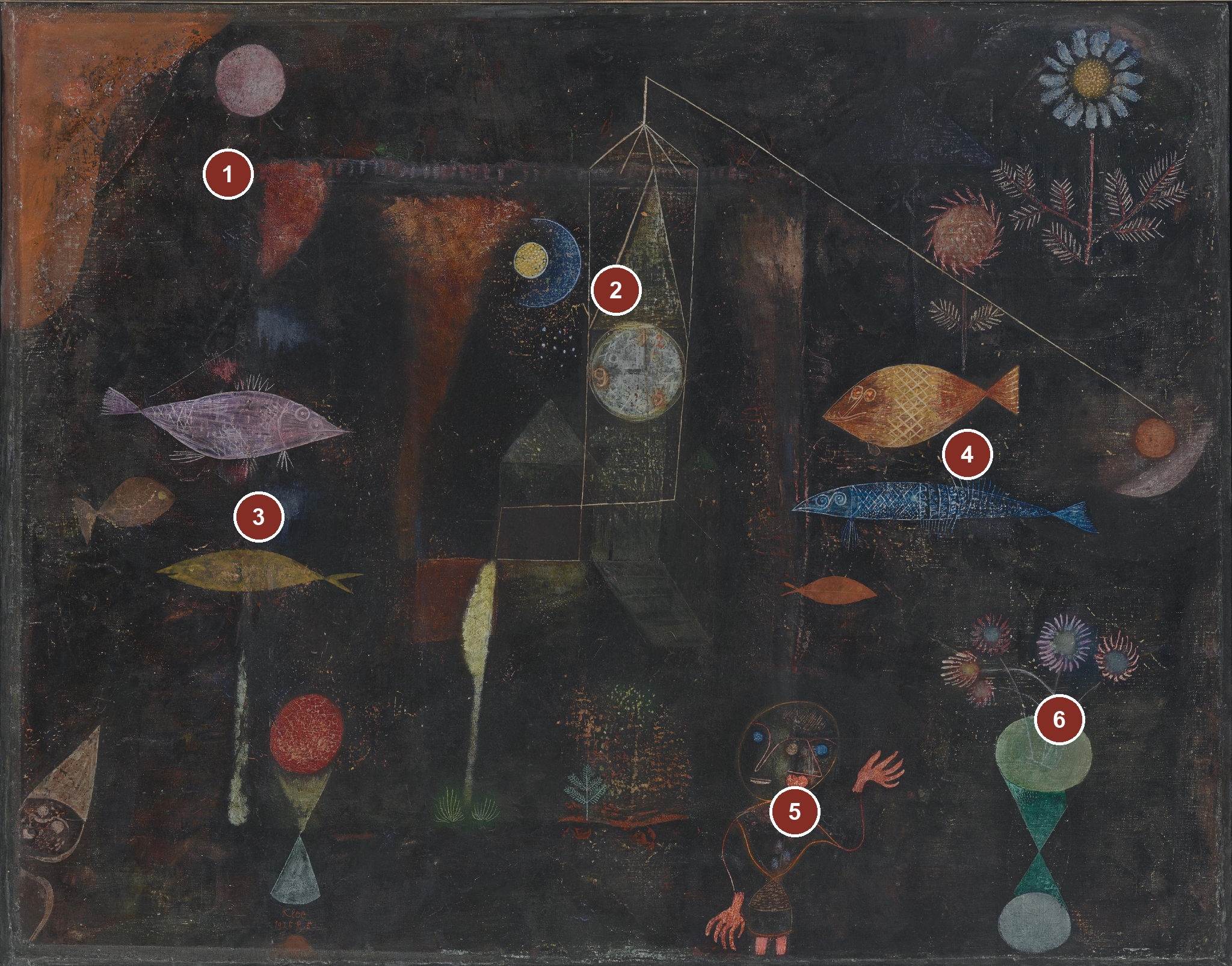
Explore the details of Fish Magic
Select a numbered area to examine its detail at high resolution.
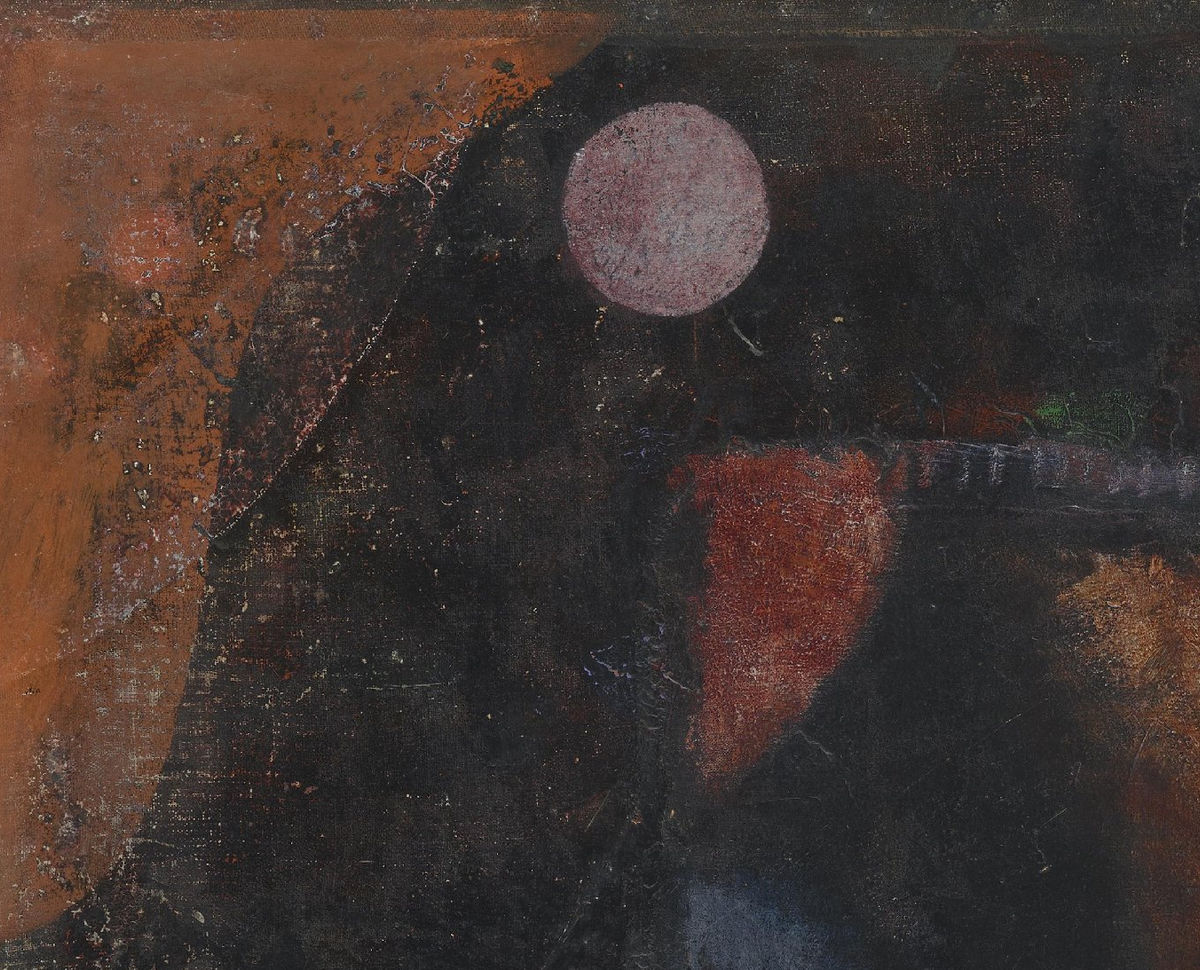
Pink disc and orange field at the upper left
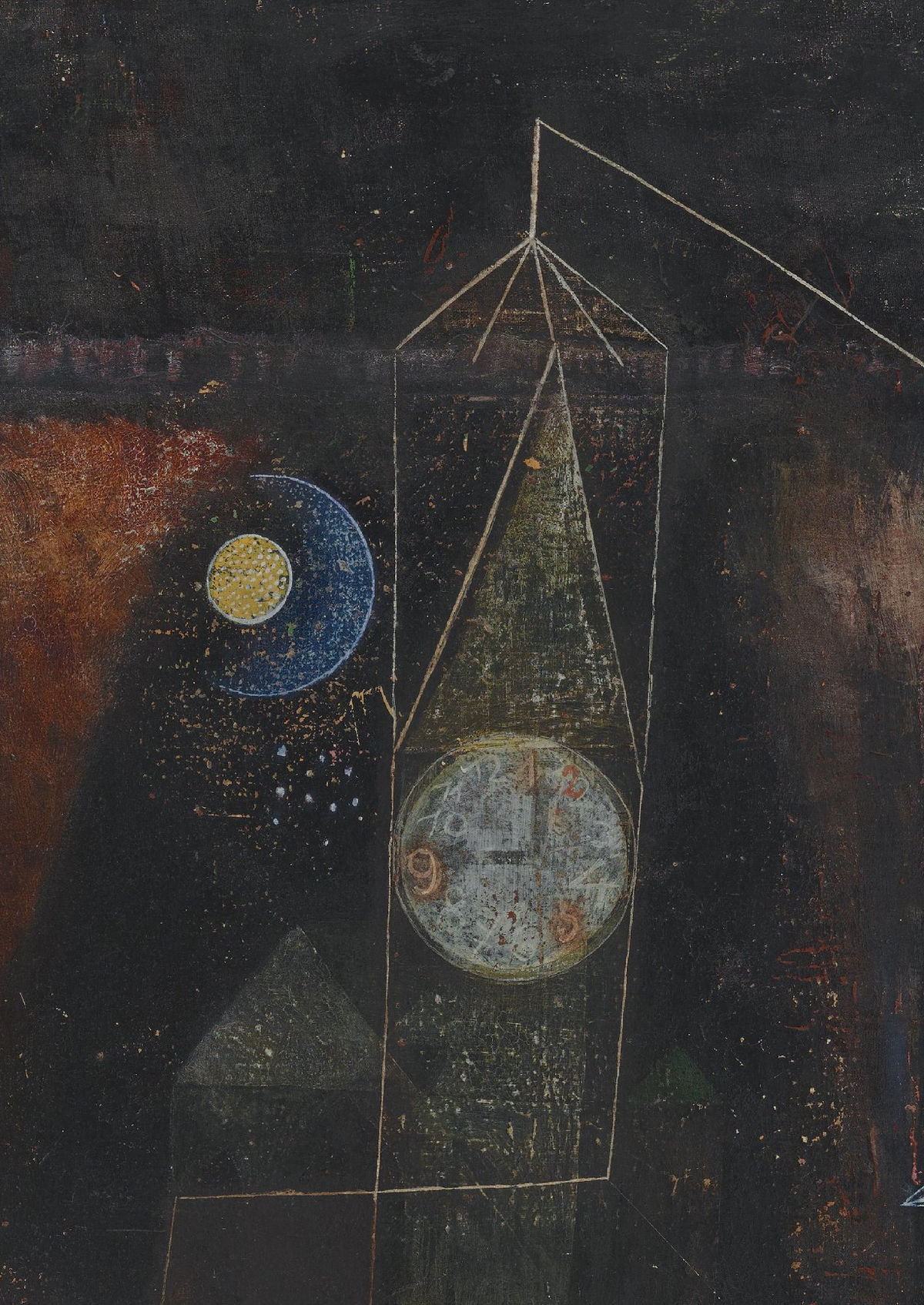
Clock and its fine tower lines
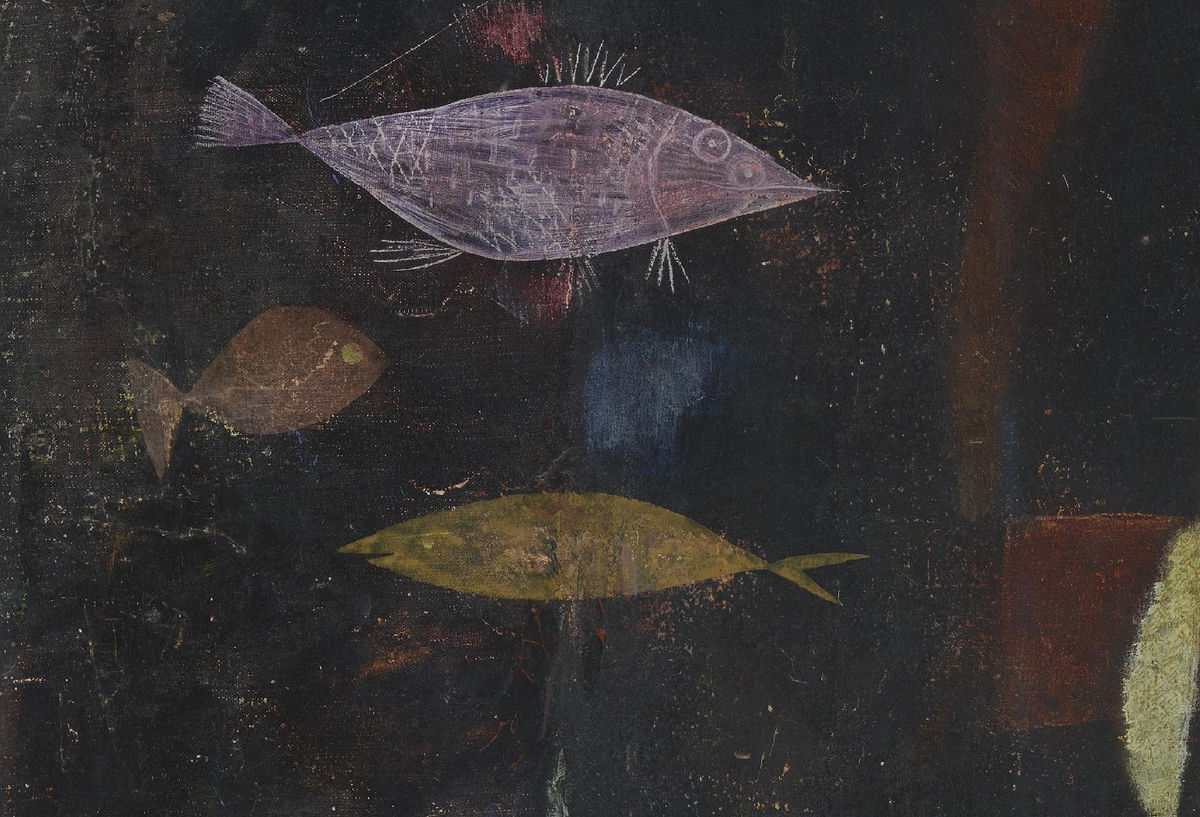
Pink and yellow fish on the left
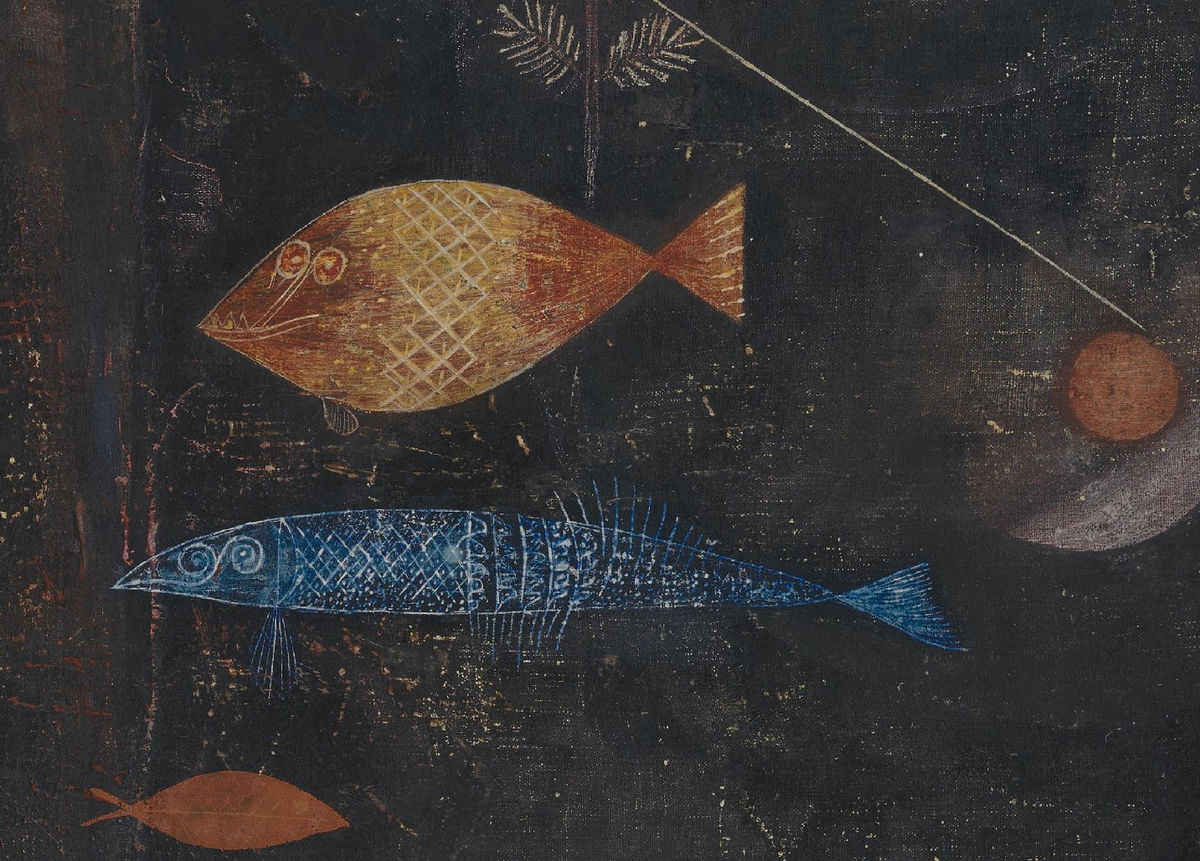
Gold and blue fish on the right
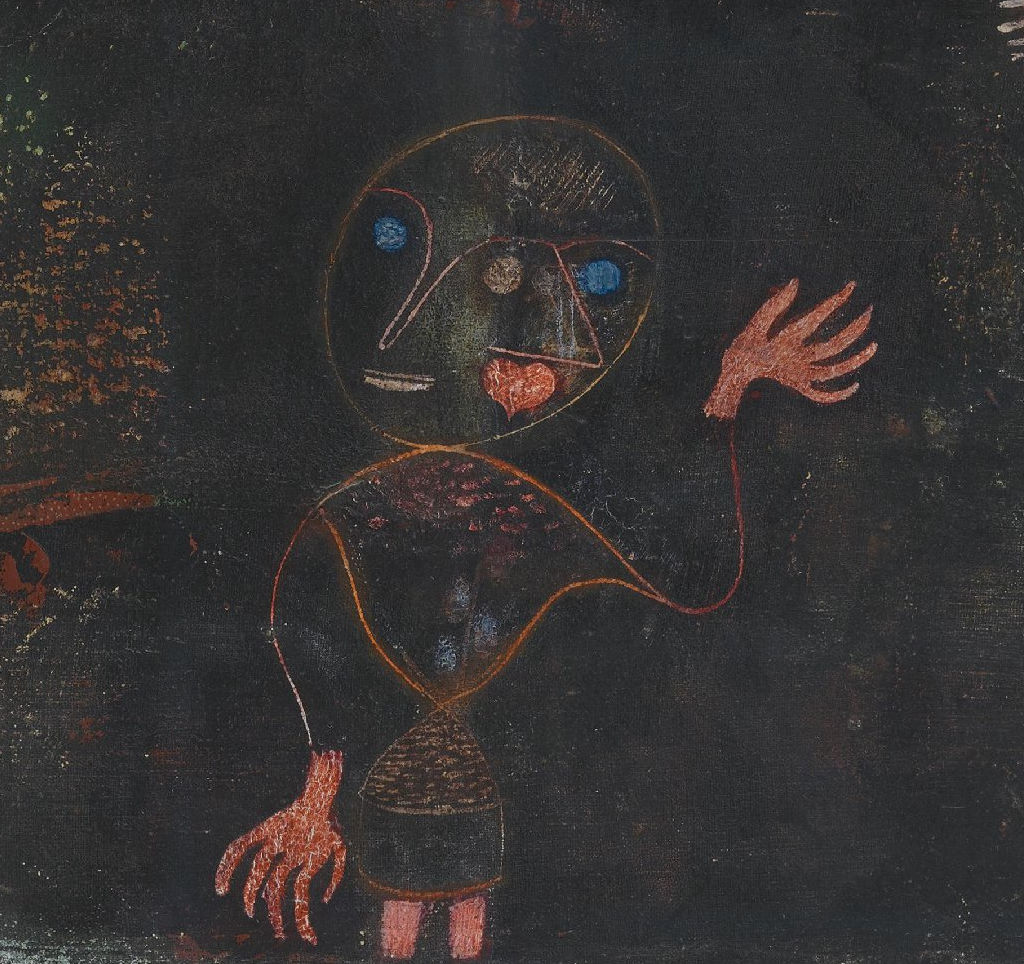
Small figure near the lower edge
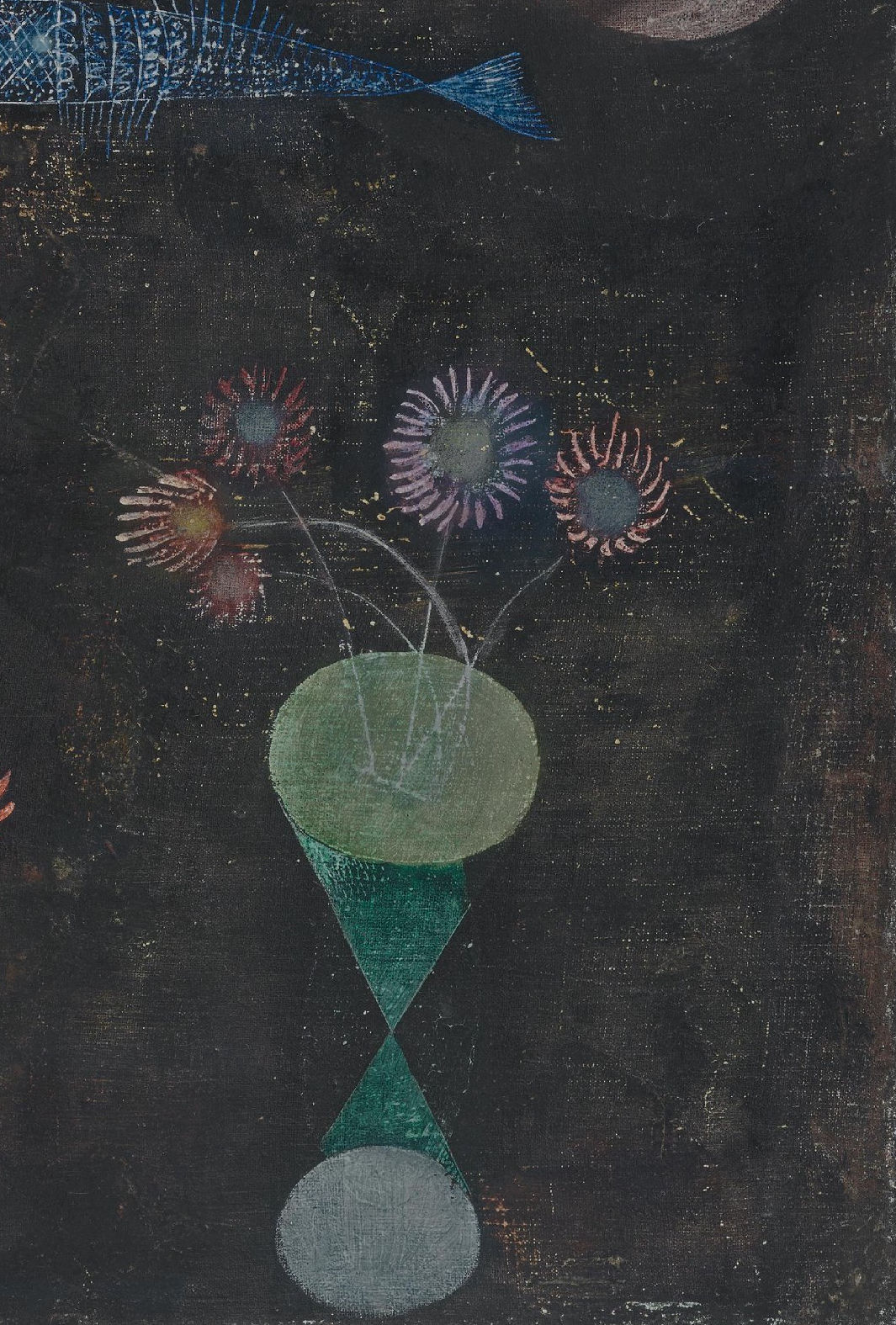
Flowers and pale vessel at the right
Contents
- Identity, materials and size
- A dark surface that reveals colour
- Explore the details of Fish Magic
- The frame around the dark field
- Fish without a fixed body of water
- Magic, dream and Surrealist reception
- Two neighboring 1925 fish paintings
- From Klee to Philadelphia
- Looking again
Identity, materials and size
The work dates from 1925. A German exhibition checklist identifies it as Fisch Zauber, Klee’s annual entry 1925,85, and as catalogue raisonné number 3766. The English title Fish Magic is a translation, while a 1937 Los Angeles exhibition called it Fish Enchantment. These titles point to the same object, now accession 1950-134-112 at the Philadelphia Museum of Art, rather than to separate fish paintings. The accession and its Louise and Walter Arensberg Collection credit appear in Philadelphia’s current embedded collection record.[1][2]
The museum’s present medium line reads oil and watercolour on canvas on panel, with dimensions 77.2 × 98.4 cm. Berlin’s 2008 checklist is more specific about the layered support: oil and watercolour on cotton cloth mounted on cardboard on a stretcher, and 77.5 × 98.3 cm. Its German word Nesseltuch describes a textile support; it should not be mistaken for the smaller, separately attached square of muslin that Philadelphia identifies within the composition. The two institutional descriptions and their slight measurement difference have not yet been reconciled through a conservation report. The safe account is a painting in oil and watercolour on a fabric-based, mounted support, with a distinct small fabric addition, while giving each institution’s exact terms where they matter.[1][2]
The nearly metre-wide format allows the fish to spread across a broad horizontal field. The painting is larger than the immediately adjacent work in Klee’s 1925 sequence, der Goldfisch (The Goldfish), which is 49.6 × 69.2 cm on paper mounted on cardboard. This difference in scale and support matters more than a casual grouping of both under “fish paintings.” Klee chose different physical grounds for two neighboring entries, and their dark fields work differently for the viewer.[2][3]
A dark surface that reveals colour
At first sight, black holds much of Fish Magic together. It encloses the bright fish and flowers, while orange, violet and green patches remain visible beneath or beside it. Philadelphia’s process description explains why some coloured lines seem to emerge from the darkness: a dark layer was applied over colour, then marked so that underlying colour appeared. Scratching is a subtractive action; the delicate drawn and painted lines also add to the surface. The museum’s account supports this broad sequence, but does not name every pigment, map every incision, or prove that every bright line in a digital image was made in the same way.[1]
Detail images derive from the public-domain-marked Commons reproduction of the Philadelphia Museum of Art painting.

That caution improves close looking. The pink fish at left has a pale internal mesh; the long blue fish at right is built from fine, repeated marks; the orange fish above it is more compact. Their marks differ in density and direction. Some edges are sharply outlined, while others dissolve into dark colour. The eye can compare those effects without assigning a tool to each one. A high-resolution reproduction is useful for seeing the marks; examination of the original and a technical study would be needed to distinguish paint exposed by scraping from paint drawn on top in each particular passage.[1]
The added muslin square is especially unusual. Philadelphia describes it as glued to the canvas at the centre. In a reproduction its exact boundary and texture are difficult to isolate, but the owner’s description establishes that the painting is not solely a flat, uninterrupted paint film. A physical piece of fabric interrupts the field. The museum compares the long diagonal descending from the clock tower to a cord that might lift a theatrical curtain. That analogy gives a way to look at the attached square and the line together. It does not prove that Klee intended a particular curtain, performance or narrative moment.[1]
The material structure helps explain why the image can seem both deep and shallow. Fish appear suspended beyond the surface; scratches and the glued fabric pull attention back to that surface. Orange areas near the top left may suggest a glow behind the black, while the black itself can seem like a veil. These are visual effects, not evidence that every dark passage was applied in one operation. Klee allows the viewer to move between an imagined space and a made object.[1]
The frame around the dark field
The work's physical presentation has its own documented history. Conservator Nina Quabeck reports that Philadelphia Museum of Art made a new strip frame for Fish Magic in 2006, using archival photographs; she credits Suzanne Penn of the museum for that information. Quabeck's wider study explains why such simple wooden strips can matter for Klee's panels: they define how a painted surface meets the wall and can be part of the viewing format rather than a neutral decorative border. The 2006 frame is a reconstruction, so it should not be described as Klee's surviving original. Nor does this framing record settle the separate questions of exactly how the dark paint, mounted support and small muslin square were assembled. It adds a precise later chapter to the object's material history.[7]
Fish without a fixed body of water
The larger fish are separated across the picture rather than gathered in a shoal. Pink appears at left; orange and blue dominate the right; smaller yellow and orange fish occupy lower and side spaces. Their scales differ, and their paths do not converge on one obvious destination. They suggest swimming because of their recognizable shapes, but there is no waterline, tank wall or seabed to fix their depth. Darkness functions as a common field for unlike things, more flexible than a naturalistic aquarium.[1]
The flowers make this especially clear. A daisy-like head blooms in the upper right, linked to a long vertical stem and paired leaves. Small blooms rise above the pale green and turquoise form at lower right. They are drawn with the same confident economy as the fish, yet they do not sit in an identifiable shoreline or garden. A viewer can imagine an underwater plant, a night garden or a stage prop. None is given as the one correct setting. The painting’s visible facts are more precise: stalks, petals, fish silhouettes, discs and dark space occupy the same frame.[1]
Small disks add another uncertainty. The pinkish round form at upper left, crescent and yellow dot near the tower, and orange circle at far right can invite words such as moon or planet. The work does not label them, and they are not arranged as a verifiable astronomical diagram. Philadelphia’s phrase about celestial elements is a curatorial reading of their coexistence with fish and plants. It need not become a claim about a particular constellation or a story in which sea, earth and sky are literally joined.[1]
The strongest spatial interruption is the thin central architecture. Lines make a pointed frame, and the pale round clock face sits inside it. Other rectangles and angles below give it a body without creating a solid building. An almost vertical form under the clock suggests a structure or opening, but the dark ground remains visible through much of it. The clock introduces the familiar measurement of time into an image that otherwise has no clear hour, weather or season. Reading its hands as a precise clock time from a reproduction would give a false confidence; its presence as a clock matters more than an exact minute.[1]
Look again at the diagonal leaving the tower. It crosses the upper right area close to a flower and fish, then reaches the edge without defining a perspectival road or shoreline. As Philadelphia suggests, it can be read like a curtain cord. It can also simply hold unlike parts of the composition in tension. It changes the way the eye moves: from the clock at centre, across a fish and toward the coloured disk at right, then back along the line into the dark. The painting supplies relationships of line and placement while leaving their story open.[1]
Magic, dream and Surrealist reception
The word Zauber in Klee’s title means magic or enchantment. It is tempting to take the title as permission to assign a supernatural event to every form. The image is subtler. Its “magic” can be understood as the way fish, flowers, clock and sky-like disks are made to share a field, with familiar scales and habitats loosened. The title points toward that experience without giving the viewer a key to a hidden allegory.[1][2]
The 1925 date also invites a historical connection with Surrealism. The Zentrum Paul Klee’s biography records Klee’s participation in the first Surrealist group exhibition, La peinture surréaliste, at Galerie Pierre in Paris that year. This places his work in a French conversation about dream and unexpected association. It does not establish that Fish Magic itself was displayed in that exhibition, nor that Klee painted it as an illustration of a Surrealist programme. Its title, materials and annual number must be read from the work’s own records.[4][2]
Writing in French in 2020, Georges Bloess offers a sustained reading of Fischzauber as a space in which water and night sky blur. He notices the clock and vegetation as challenges to any simple underwater scene, and brings Klee into conversation with René Crevel’s response to his art. This is valuable evidence of later French interpretation. Bloess also infers that Crevel may have been thinking of this particular picture even though Crevel did not name it; that identification remains conjectural. His printed measurement conflicts with Philadelphia and Berlin, so the owning museum and checklist are stronger authorities for the physical object.[5][1][2]
Klee’s interest in aquariums may have supplied a broader habit of looking at fish, but a specific visit, tank or animal should not be declared the source of Fish Magic without a dated witness or document. The picture’s technical and spatial decisions are visible without an origin anecdote. A real aquarium would have boundaries; this painting gives fish no fixed enclosure and lets a clock and flowers occupy their darkness. Observation and invention can coexist, but they are not the same piece of evidence.[1]
An English-language response from 1957 shows another way the picture was read before the recent museum text and French study. An essay signed J.W.S. in Arts & Architecture attends to the bright fish, enclosed darkness, inner square and clock, then proposes a satirical fish-eye view of human life. Its attention to the composition is useful evidence of mid-century reception; its satire is the critic’s proposal, not a meaning Klee is documented as having assigned. The older caption’s abbreviated medium and measurements are likewise not a substitute for the current owner record.[6][1]
Two neighboring 1925 fish paintings
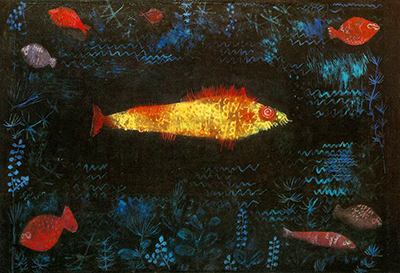
Berlin’s checklist places Fish Magic at 1925,85 and The Goldfish immediately afterward at 1925,86. The sequence makes comparison worthwhile while saying nothing about the day each work was begun, whether one was intended as a companion, or whether one was a study for the other. Fish Magic is a broad, complex field in which several fish share space with a clock, plants and geometric signs. The Goldfish gives one long yellow fish a dominant central position and surrounds it with smaller fish and blue markings.[2][3]
The works’ materials are another check on easy parallels. Philadelphia documents the dark overlayer, scratched revelations and added muslin in Fish Magic. Hamburg records oil and watercolour on paper mounted on cardboard for The Goldfish, without an equally detailed public description of scraping or added fabric. The fish and near-black backgrounds make the two visually related, yet the owner records do not support giving them one identical recipe. Their difference shows Klee returning to a subject while testing another arrangement of size, line and material.[1][2][3]
In The Goldfish, the central animal seems luminous because its yellow and red body is set against dark blue-black water. In Fish Magic, brightness is distributed: fish, flowers, disks, orange patches and the clock compete for attention. The eye roams rather than coming to rest on one fish. Neither comparison requires a fixed symbolic meaning. It begins with where colour, line and scale put our attention.[1][3]
From Klee to Philadelphia
The known later history of Fish Magic runs through European modern art’s movement into American collections. Philadelphia’s provenance note places the painting with Galka E. Scheyer in San Francisco and Los Angeles from 1933 to 1937 and cites her 1933 inventory notebook. Scheyer lent it to a Los Angeles Art Association exhibition in 1937, where the English title was Fish Enchantment. These records show the work circulating and being renamed for American audiences. The available owner note does not settle exactly how it first passed from Klee to Scheyer; a complete chain should not be invented to fill that gap.[1]
The next step is disputed within the museum’s own file. Philadelphia records the Howard Putzel Gallery in San Francisco and a sale to Louise and Walter Arensberg by 1940, possibly as early as 1938. A 1940 exhibition listed Walter Arensberg as lender. Scholar Naomi Sawelson-Gorse inferred a direct purchase from Scheyer in 1938 from a letter mentioning “a large Klee” bought by the Arensbergs. But a later Arensberg archive tax note records purchase through Putzel. Philadelphia includes both lines of evidence. It is reasonable to say that the Arensbergs owned the painting by 1940 and that the precise 1938 transaction path is unresolved, rather than presenting one seller and exact date as settled fact.[1]
Louise and Walter Arensberg gave the painting to the Philadelphia Museum of Art in 1950; its accession is 1950-134-112. The museum’s collection record and provenance bring together its present identity, technical description and American history. The 1937 exhibition title Fish Enchantment is a reminder that a translated title can be a historical trace, not a correction to Klee’s German name.[1]
Looking again
Begin with one fish, then try to locate the conditions that let it “swim.” There is no continuous blue water around it. Follow the pink fish’s interior marks and compare them with the blue fish’s fine lines. Next, move from the upper-right flower down to the paler blooms near the bottom. Their stems and petal patterns are as clear as the fish shapes, but their setting is just as uncertain. Finally trace the diagonal from the clock tower and notice where it stops. These movements reveal a carefully organized field rather than a collection of random dream images.[1]
Fish Magic survives as a particular object, with a numbered place in Klee’s 1925 sequence, a layered fabric and mounted support, an added muslin square, and a documented path through Scheyer and the Arensbergs to Philadelphia. Some details remain open: the precise support language differs between institutions; the early transfer to Scheyer needs archival evidence; the later purchase route has competing records; and no source found so far makes Crevel’s encounter with this exact canvas certain. Those limits still leave a great deal to see. The fish do not need a solved story to make the painting work; its coloured creatures, clock, flowers and dark, worked surface keep changing their relation as we look.[1][2][5]
Continue with The Goldfish for the adjacent 1925 painting, Klee’s materials and techniques for his experiments with supports, and the paintings overview for the wider range of subjects.
Explore selected works from Klee’s much larger oeuvre. Titles without a link have an authenticated catalogue identity but no reviewed article yet.
Artworks directory
| Name | Date | Medium |
|---|---|---|
| A Gate | 1939 | Painting and mixed media |
| A Woman for Gods | 1938 | Watercolour and mixed media |
| Ab Ovo | 1917 | Watercolour and mixed media |
| Above Mountain Summit | 1917 | Drawing and mixed media |
| Abstract Trio | 1923 | Drawing and mixed media |
| Acrobats | 1915 | Watercolour and mixed media |
| Actor's Mask | 1924 | Painting and mixed media |
| Ad Marginem | 1930 | Drawing and mixed media |
| Ad Parnassum | 1932 | Painting and mixed media |
| Adventurer Ship | 1927 | Drawing and mixed media |
| Affected Place | 1922 | Drawing and mixed media |
| After a Sketch from Zurich | 1914 | Watercolour and mixed media |
| After Drawing | 1919 | |
| After The Floods | 1936 | Watercolour and mixed media |
| All Souls' Picture | 1921 | |
| Ancient Harmony | 1925 | Painting and mixed media |
| Angel Applicant | 1939 | Drawing and mixed media |
| Angel Serves the Desired | 1920 | |
| Angel, Still Female | 1939 | Painting and mixed media |
| Angelus Novus | 1920 | Drawing and mixed media |
| Animal Terror | 1926 | Painting and mixed media |
| Arab Song | 1932 | Painting and mixed media |
| Archangel | 1938 | Painting and mixed media |
| Architecture | 1923 | Painting and mixed media |
| Architecture of the Plain | 1923 | Drawing and mixed media |
| Around the Fish | 1926 | Painting and mixed media |
| Arrival of the Air Steamer | 1921 | Drawing and mixed media |
| Asiatic God | 1924 | Painting and mixed media |
| Astrological Fantasy Portrait | 1924 | Drawing and mixed media |
| Athlete's Head | 1932 | Watercolour and mixed media |
| Aufgehender Stern | 1931 | Painting and mixed media |
| Autumn Flower | 1922 | Painting and mixed media |
| Bad Band | 1920 | Drawing and mixed media |
| Baroque Centaur | 1939 | Painting and mixed media |
| Before the Blitz | 1923 | Drawing and mixed media |
| Before the Snow | 1929 | Drawing and mixed media |
| Besessenes Madchen | 1924 | Watercolour and mixed media |
| Bird Garden | 1924 | |
| Bird Wandering Off | 1926 | Watercolour and mixed media |
| Blossoms in the Night | 1930 | Watercolour and mixed media |
| Blue-Bird-Pumpkin | 1939 | Painting and mixed media |
| Boats in the Flood | 1937 | Painting and mixed media |
| Botanical Theatre | 1934 | Drawing and mixed media |
| Boy in Fancy Dress | 1931 | Watercolour and mixed media |
| Broken Key | 1938 | |
| Brother and Sister | 1930 | Watercolour and mixed media |
| But the Red Roof | 1935 | Painting and mixed media |
| C - C = Fisch | 1931 | Watercolour and mixed media |
| Cacti | 1912 | Painting and mixed media |
| Camel (in Rhythmic Landscape with Trees) | 1920 | Drawing and mixed media |
| Captive Pierrot | 1923 | Drawing and mixed media |
| Castle and Sun | 1928 | Drawing and mixed media |
| Cat and Bird | 1928 | Drawing and mixed media |
| Cathedrals | 1925 | Watercolour and mixed media |
| Chalice of the Heart | 1937 | Painting and mixed media |
| Characters in Yellow | 1937 | Painting and mixed media |
| Chosen Site | 1927 | Mixed media |
| Christmas Picture | 1923 | Drawing and mixed media |
| City of Towers | 1916 | Painting and mixed media |
| Clarification | 1932 | Painting and mixed media |
| Collection of Figurines | 1926 | Painting and mixed media |
| Colorful Architecture | 1917 | Painting and mixed media |
| Comedians' Handbill | 1938 | |
| Comic Opera Singer | 1927 | Painting and mixed media |
| Composition | 1939 | Painting and mixed media |
| Composition with Figures | 1915 | Drawing and mixed media |
| Composition with the Yellow Half-Moon and the Y | 1918 | Watercolour and mixed media |
| Conch–Still Life II | 1939 | Watercolour and mixed media |
| Cosmic Composition | 1919 | Painting and mixed media |
| Crystal Gradation | 1921 | Drawing and mixed media |
| Dance of the Grieving Child | 1922 | Painting and mixed media |
| Dancing Girl | 1940 | Painting and mixed media |
| Das Licht und Etliches | 1931 | Mixed media |
| Death and Fire | 1940 | Painting and mixed media |
| Death for the Idea | 1915 | |
| Demon as Pirate | 1926 | Watercolour and mixed media |
| Diana | 1931 | Painting and mixed media |
| Diavolo Player | 1923 | Drawing and mixed media |
| Die Kapelle | 1917 | Watercolour and mixed media |
| Die Vase | 1938 | Painting and mixed media |
| Doctor | 1930 | Drawing and mixed media |
| Dredger and Sailboat | 1931 | Watercolour and mixed media |
| Ein Tor | 1939 | Painting and mixed media |
| Ein Weib fur Gotter | 1938 | Mixed media |
| Embrace | 1939 | Watercolour and mixed media |
| Episode before an Arab Town | 1923 | |
| Equals Infinity | 1932 | Painting and mixed media |
| Eros | 1923 | Drawing and mixed media |
| Error on Green | 1930 | Watercolour and mixed media |
| Evening Figure | 1935 | Drawing and mixed media |
| Falling Bird | 1919 | |
| Fermata | 1932 | Watercolour and mixed media |
| Fire Clown | 1921 | Watercolour and mixed media |
| Fire Full Moon | 1933 | Watercolour and mixed media |
| Fire in the Evening | 1929 | Painting and mixed media |
| Fish in the Harbour | 1916 | Watercolour and mixed media |
| Fish Magic | 1925 | Watercolour and mixed media |
| Flock of Birds | 1917 | Drawing and mixed media |
| Flora on Sand | 1927 | Watercolour and mixed media |
| Flower Myth | 1918 | |
| Flower Stand with Watering Can and Bucket | 1910 | Watercolour and mixed media |
| Flowering Tree (Abstraction with Reference to a Flowering Tree) | 1925 | Painting and mixed media |
| Flowers in Pots | 1923 | |
| Flowers in Stone | 1939 | Painting and mixed media |
| Forest Witch | 1938 | Painting and mixed media |
| Fright of a Girl | 1922 | Drawing and mixed media |
| Fruits on Red | 1930 | Drawing and mixed media |
| Full Moon | 1919 | Mixed media |
| Föhn Wind in Franz Marc's Garden | 1915 | Watercolour and mixed media |
| Garden in St Germain, The European Quarter near Tunis | 1914 | Watercolour and mixed media |
| Ghost Chamber with the Tall Door (New Version) | 1925 | |
| Ghost of a Genius | 1922 | Drawing and mixed media |
| Girl in Mourning | 1939 | Painting and mixed media |
| Glance of a Landscape | 1926 | Watercolour and mixed media |
| Gluht Nach | 1939 | Drawing and mixed media |
| Golden Fish | 1925 | Watercolour and mixed media |
| Goldfish Wife | 1921 | Watercolour and mixed media |
| Green Plant, Blood, Louse | 1924 | Drawing and mixed media |
| Hafenbild | 1918 | Mixed media |
| Hammamet with Mosque | 1914 | Watercolour and mixed media |
| Harbour with Sailing Ships | 1937 | Painting and mixed media |
| Hauptweg und Nebenwege | 1929 | Painting and mixed media |
| Heavenly and Earthly Time | 1927 | Drawing and mixed media |
| Heroic Fiddling | 1938 | Painting and mixed media |
| Heroic Roses | 1938 | Painting and mixed media |
| Heroic Strokes of the Bow | — | Mixed media |
| Highway and Byways | 1929 | Drawing and mixed media |
| Houses near the Gravel Pit | 1913 | Watercolour and mixed media |
| Howling Dog | 1928 | Painting and mixed media |
| In the Current Six Thresholds | 1929 | Painting and mixed media |
| In the Style of Kairouan | 1914 | Drawing and mixed media |
| Individualized Altimetry of Stripes | 1930 | Painting and mixed media |
| Insula Dulcamara | 1938 | |
| Interior with the Clock | 1913 | Watercolour and mixed media |
| Irma Rossa the Animal Tamer | 1918 | Drawing and mixed media |
| Journey in Corsica | 1927 | Drawing and mixed media |
| Landscape with Bluebirds | 1919 | Watercolour and mixed media |
| Legend of the Nile | 1937 | Painting and mixed media |
| Lemon Harvest | 1937 | Watercolour and mixed media |
| Likeness in the Bower | 1930 | Watercolour and mixed media |
| Limits of Reason | 1927 | Painting and mixed media |
| Little Hope | 1938 | Watercolour and mixed media |
| Magdalena before the Conversion | 1938 | Drawing and mixed media |
| Mask of Fear | 1932 | Painting and mixed media |
| May Picture | 1925 | Painting and mixed media |
| Monument in a Cemetery | 1922 | Watercolour and mixed media |
| Monuments at G | 1929 | Watercolour and mixed media |
| Municipal Jewel | 1917 | Watercolour and mixed media |
| Mural from the Temple of Longing Thither | 1922 | |
| Nach der Uberschwemmung | 1936 | Watercolour and mixed media |
| New Harmony | 1936 | Painting and mixed media |
| New House in the Suburbs | — | Mixed media |
| Old Steamboat | 1922 | Drawing and mixed media |
| On the Edge | 1930 | Drawing and mixed media |
| Once Emerged from the Gray of Night | 1918 | Drawing and mixed media |
| One Who Understands | 1934 | Painting and mixed media |
| Oriental Pleasure Garden | 1925 | Painting and mixed media |
| Park of Idols | 1939 | Watercolour and mixed media |
| Passing by Red Pillars | 1928 | Watercolour and mixed media |
| Persian Nightingales | 1917 | Drawing and mixed media |
| Popular Wall Painting | 1922 | Painting and mixed media |
| Prestidigitator | 1927 | Watercolour and mixed media |
| Rainy Day | 1931 | Watercolour and mixed media |
| Red and White Domes | 1914 | Watercolour and mixed media |
| Red Balloon | 1922 | Drawing and mixed media |
| Redgreen and Violet-Yellow Rhythms | 1920 | Drawing and mixed media |
| Refuge | 1930 | Watercolour and mixed media |
| Rhythmic Rythmical | 1930 | Painting and mixed media |
| Saint of the Inner Light | 1921 | |
| Scaffolding of a New Building | 1930 | Painting and mixed media |
| Scholar in Dealing with Stars | 1926 | Watercolour and mixed media |
| Seated Woman | 1930 | Drawing and mixed media |
| Senecio | 1922 | Painting and mixed media |
| Separation in the Evening | 1922 | Drawing and mixed media |
| Sinbad the Sailor | 1923 | Drawing and mixed media |
| Skeptically Smiling | — | Mixed media |
| Small House in the Garden City | 1928 | Watercolour and mixed media |
| Small Portrait of a Girl in Yellow | 1925 | Painting and mixed media |
| Southern Gardens | 1919 | Watercolour and mixed media |
| Static-Dynamic Gradation | 1923 | Drawing and mixed media |
| Still Life | 1927 | Painting and mixed media |
| Still Life with Gladioli | 1932 | Watercolour and mixed media |
| Strange Garden | 1923 | Drawing and mixed media |
| Stricken City | 1936 | Painting and mixed media |
| Strong Dream | 1929 | Watercolour and mixed media |
| Struck from the List | 1933 | Drawing and mixed media |
| Structural I | 1924 | Drawing and mixed media |
| Sumpflegende | 1919 | Painting and mixed media |
| Temple Gardens | 1920 | Drawing and mixed media |
| The Arrow before the Target | 1921 | Drawing and mixed media |
| The Barbed Noose with the Mice | 1923 | Watercolour and mixed media |
| The Flora of the Heath | 1925 | Watercolour and mixed media |
| The Goldfish | 1925 | Watercolour and mixed media |
| The Hour Before One Night | 1940 | Painting and mixed media |
| The Man in Love | 1923 | |
| The Mask with the Flag | 1925 | Mixed media |
| The Pathos of Fertility | 1921 | |
| The Rhine at Duisburg | 1937 | Painting and mixed media |
| The Way to the Citadel | 1937 | Painting and mixed media |
| Three Houses and a Bridge | 1922 | Watercolour and mixed media |
| Tightrope Walker | 1923 | |
| Tomb in Three Parts | 1923 | Watercolour and mixed media |
| Tomcat's Turf | 1919 | Watercolour and mixed media |
| Tower in Orange and Green | 1922 | Drawing and mixed media |
| Tree and Architecture - Rhythms I | 1920 | Watercolour and mixed media |
| Tree and Architecture - Rhythms II | 1920 | Painting and mixed media |
| Tropical Dawn with the Owl | 1921 | Mixed media |
| Tropische Dammerung | 1921 | Painting and mixed media |
| Twittering Machine | 1922 | Drawing and mixed media |
| Variations (Progressive Motif) | 1927 | Watercolour and mixed media |
| Ventriloquist and Crier in the Moor | 1923 | |
| Viaducts Break Ranks | 1937 | Drawing and mixed media |
| Villa R | 1919 | Painting and mixed media |
| Village Carnival | 1926 | Painting and mixed media |
| Vor dem Blitz | 1923 | Drawing and mixed media |
| Wald-Hexen | 1938 | Painting and mixed media |
| Young Forest | 1925 | Drawing and mixed media |
Related artworks
Explore eight other Klee works, beginning with works close in date to this one.
Ancient Harmony
1925
The Goldfish
1925
Actor's Mask
1924
Around the Fish
1926
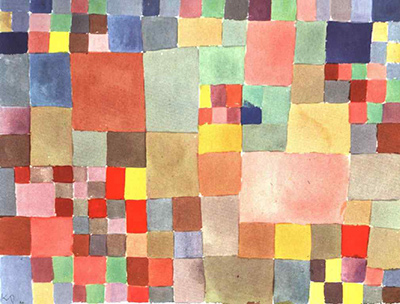
Flora on Sand
1927
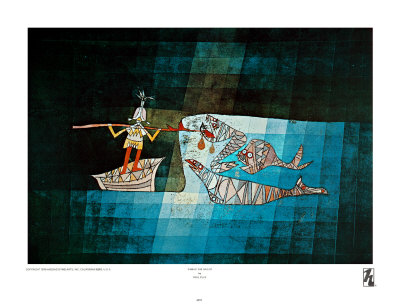
Sinbad the Sailor
1923
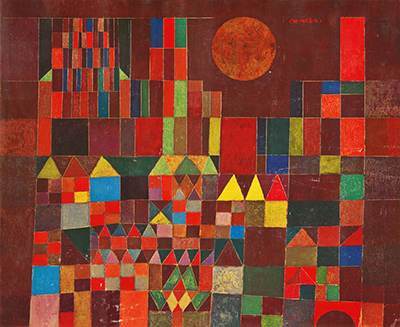
Castle and Sun
1928
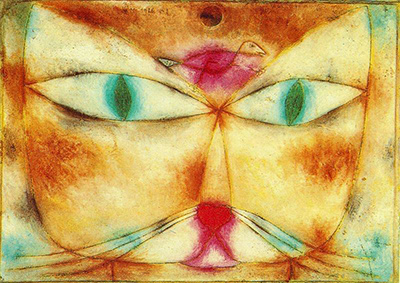
Cat and Bird
1928
Discussion
The fish, flowers, clock and dark surface reward slow looking before we decide what they mean.
Philadelphia's records also leave questions about the support and the painting's journey into the Arensberg collection.
Reader Insights
How does the clock change your sense of the space around the fish?
Which marks seem revealed from the dark surface, and which seem drawn over it?
What archival record could settle the Arensbergs' purchase route?
Join the Conversation
Share what you observe and any source that helps explain the painting.
References
- Philadelphia Museum of Art, “Fish Magic,” accession 1950-134-112, owner collection record, interpretive text, material fields and embedded provenance (English; accessed 26 September 2026), View source.
- Staatliche Museen zu Berlin, Das Universum Klee, exhibition worklist, entries for Fisch Zauber and der Goldfisch (German and English, 2008), p. 5 of PDF, View source.
- Hamburger Kunsthalle, “Der Goldfisch,” HK-2982, collection record and essay (German), View source.
- Zentrum Paul Klee, “Paul Klee Biography,” entry for 1925 participation in La peinture surréaliste (English), View source.
- Georges Bloess, “Puissances du rêve: Paul Klee et les surréalistes français,” Mélusine numérique 2 (French, 2020), discussion of Fischzauber, View source.
- J.W.S., “Fish Magic by Paul Klee,” Arts & Architecture (English, December 1957), p. 14 (PDF p. 16), View source.
- Nina Quabeck, “Change the Frame and You Change the Game? Research and Reevaluation of the Presentation Formats of the Kunstsammlung Nordrhein-Westfalen's Paul Klee Collection,” The Book and Paper Group Annual 31 (English, 2012), note 23, printed p. 80; object-specific information supplied by Suzanne Penn, Philadelphia Museum of Art, View source.