


A collection, a building and a research centre
The three curved roofs of the Zentrum Paul Klee rise from the ground on the eastern side of Bern. They make the institution recognisable before a visitor sees a single Klee work. Inside, however, the experience is more varied than the outline suggests: an exhibition of selected artworks, a public passage, spaces for children and music, and a research archive with access by appointment. The building opened on 20 June 2005. Its purpose was to bring together a large collection and to support the study, conservation and public experience of Klee's work.[1][2]
That distinction matters when planning a visit. The Zentrum holds around 4,000 works by Klee, according to its twentieth-anniversary account; it does not display 4,000 paintings. Most of the holdings are drawings and watercolours, and the exhibition changes because these works are numerous, materially varied and often sensitive to light. The museum's present collection display offers an introduction, not a complete inventory. The archive and library answer different questions and require a separate arrangement.[3][4][5]
Contents
- What can you see at the Zentrum Paul Klee?
- How the collection came together
- Three hills, different uses
- Why the works rotate
- The archive and the nine-volume catalogue
- Planning a visit
What can you see at the Zentrum Paul Klee?
The institution's central exhibition is Kosmos Klee: The Collection. Its current run is listed as 7 October 2023 to 3 October 2027. As described by the museum in September 2026, it presents a broadly chronological selection of about seventy artworks, alongside biographical and archival material; objects rotate regularly. Its nearby Fokus room offers smaller changing exhibitions. The approximate seventy belongs to this installation and date, not to every future gallery arrangement.[4]
That presentation is useful for following a career without assuming that every familiar Klee picture is permanently on the wall. The museum holds a large proportion of his output, but works may be in storage, on loan, undergoing study or resting between displays. A visitor hoping to see a particular painting should check the current exhibition information or ask the museum. An object being in the collection does not prove that it is on view on a chosen day.[3][4]
The galleries can also bring a drawing, a painted sheet and an unusual constructed support into the same historical conversation. Klee made works on paper in many techniques and used card, cloth, grounds, mounts and combined media. Their surfaces and sizes can be very different from the large canvases that often stand for modern art in reproductions. Our materials and techniques guide explains why a support or a drawing transfer matters to the finished image; the artworks directory offers individual object studies.[3][6]
How the collection came together
The collection's founding cannot be described as one donation by one person. After Klee's son Felix died in 1990, Felix's son Alexander Klee told the Bern city and canton authorities that the heirs would make a large part of the estate collection available if a museum dedicated to Paul Klee were created. In 1997, Felix's widow Livia Klee-Meyer gave her inherited portion, nearly 700 works, to those public bodies. In 1998, Alexander promised approximately 850 works on loan and gave family documents. A gift transfers ownership; a loan makes works available under different terms. Collapsing the two into a joint donation obscures the institution's actual formation.[1]
The already existing Paul-Klee-Stiftung, then based at Kunstmuseum Bern, proposed bringing its holdings of about 2,600 works and substantial archives to the new centre. The founding account also records approximately 150 additional loans from private collections. Together these sources brought roughly 40 percent of Klee's overall output into the institution's founding orbit. The proportion refers to works in several media assembled through different forms of ownership and custody. It cannot be restated as 4,000 oil paintings.[1][3]
At first, Bern considered a museum near Kunstmuseum Bern. The project changed after the surgeon Maurice E. Müller and his wife Martha Müller-Lüthi offered land at Schöngrün and substantial construction funding in 1998. Their family foundation took responsibility for the building; the city and canton funded site access; a separate Zentrum Paul Klee foundation was to operate the institution. The Burgergemeinde Bern established another foundation for special projects. These similar names describe distinct roles rather than four competing names for one museum.[1]
The Müller family's proposal also broadened the programme. Their view, recorded in the museum's German founding history, was that Klee's activity as a musician and teacher could not be served fully by a collection gallery alone. Exhibition, research, education, events and children's work all entered the brief. The family directly commissioned Renzo Piano, without an architecture competition. The museum states that the site was expanded with an adjoining public parcel because the first plot was too small. The final building opened in 2005.[1]
The museum's 2025 anniversary account clarifies the often repeated funding shorthand. The Müllers initially offered at least CHF 30 million; their construction contribution later reached CHF 60 million. It reports CHF 18 million from the Bern canton's lottery fund and more than CHF 30 million from business partnerships, with building costs of about CHF 110 million. The museum's current architecture page gives CHF 125 million as project cost. These are differently labelled totals in the institution's own publications; without their underlying accounts, they should not be forced into one supposedly exact construction bill. In 2015, the institution joined Kunstmuseum Bern under an umbrella foundation, another change in governance that should not be confused with the ownership of every artwork.[2][3]
Three hills, different uses
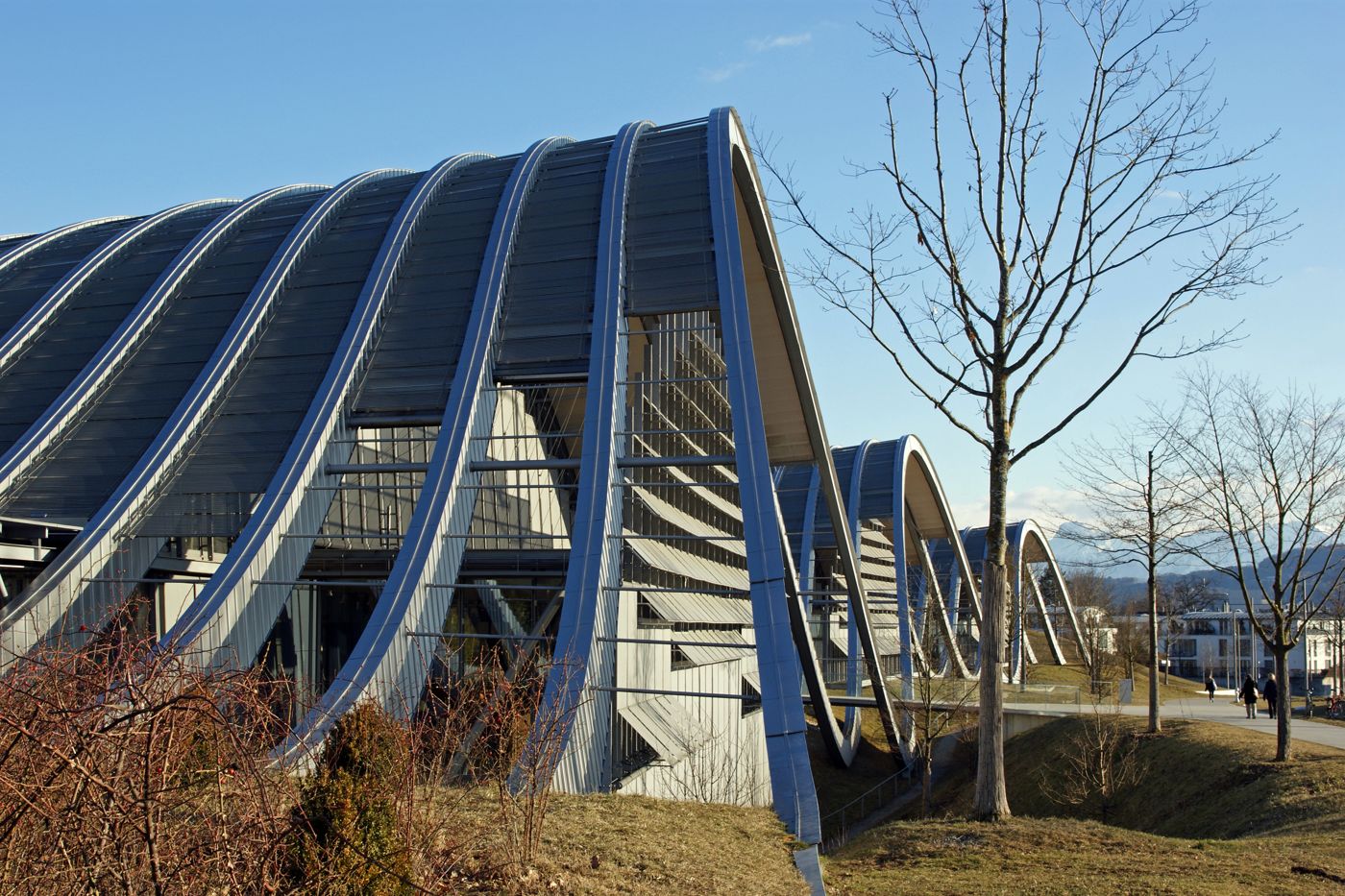
Piano's steel and glass structure reads from a distance as three artificial hills. The architect's own foundation describes the aim as joining the building to the surrounding agricultural landscape while accommodating exhibition, concert, conference, research and children's spaces. Design work is dated 1999–2001, with construction listed as 2002–05 in the architect's project archive. The museum gives 15 October 2001 as the formal start of construction, a differently defined milestone. Renzo Piano Building Workshop worked with Bern's arb Architekten and specialist engineers.[2][7]
The North Hill houses Creaviva's interactive and studio activities, an auditorium and conference facilities. The Centre Hill contains two exhibition rooms, reception and shop. The South Hill includes administration, library and archive, with research access by appointment. A freely accessible Museum Street runs along the hills and joins their functions. It also runs parallel to the nearby motorway, which Piano deliberately addressed in the design. The curving roofs are therefore only one part of the building: the visitor's route, the working rooms and the art stores under the field behind it are equally consequential.[2]
The Zentrum describes about 2,400 square metres of exhibition space. Piano's archive separates roughly 1,650 square metres for the collection exhibition and 800 for temporary display. Those are compatible rounded descriptions of different spaces. The separate North, Centre and South functions also explain why the whole site is larger than the area needed to hang Klee's works alone.[2][7]
Piano explained the building's light in an Italian-language interview shortly before opening. He distinguished a daylight-filled public interior street from artificially lit galleries where light can be controlled for Klee's vulnerable works, often on paper. He described the museum both as protection for fragile objects and as a place for people to meet, listen and learn. This is a much more exact account than saying the glass façade illuminates every painting. His examples of very low light levels for some objects were given in 2005; they should not be mistaken for a single current lighting rule across all rooms and media.[8]
The Italian architectural historian Elena Manzo read the new building through a different question: could an emphatic museum form still let the artwork lead? In her early essay she contrasts the quiet, landscape-linked exterior and restrained galleries with the exposed technical spectacle of Piano's earlier Centre Pompidou. She also places Bern in a line of Piano museums that includes the Menil Collection and Fondation Beyeler. That is a critic's comparison, useful for looking beyond the convenient phrase “three waves.” Her article, however, repeats simplified founding numbers and gives exhibition-area and roof-material descriptions that do not align neatly with the museum's current records. Its interpretation should be credited to Manzo; object counts and building measurements here follow the institution's more precise accounts.[1][2][7][14]
The building photograph below shows the repeated steel curves, glazed front and the way the roof profile continues beyond one pavilion. It is an exterior view from 2010, rather than a photograph of the present exhibition. The main image above remains the site's existing Zentrum graphic; it is not a view of the architecture.[9]
Why the works rotate
The museum says approximately 80 percent of its Klee holdings are drawings and watercolours and about 20 percent are paintings, closely resembling the proportions of Klee's wider output. A rotation is necessary because of the number of objects and the differing conservation demands of light-sensitive papers, inks and colours. The collection team monitors conditions in storage, galleries and transport and researches techniques, materials and provenance. These are continuing professional tasks, not a promise that every work is safe under one fixed exposure setting.[3]
For a visitor, rotation changes the meaning of a “permanent” exhibition. Kosmos Klee provides a continuing framework and a chronological argument, while individual works can come and go. Seeing a different selection on a later visit is part of the institution's model. It is also why an older description of 120–150 works in an earlier arrangement cannot be used as a reliable count for today's roughly seventy-work display.[4][10]
Provenance research forms part of this care. The museum says it can reconstruct the 1933–45 provenance of works from the Klee family estate under the Bern categories, while research on artworks by Klee's artist friends in the collection continues. Its archivists also assist third parties researching works elsewhere. A visitor should not read that statement as a blanket certification of the ownership history of every Klee work in every collection.[3]
The archive and the nine-volume catalogue
The research archive extends well beyond artworks. It holds Klee's diaries, his handwritten work catalogue, Bauhaus teaching notes, correspondence, photographs and personal papers. The artist and Lily Klee's library, natural objects, pigments, tools and other studio material give researchers ways to examine how works were made and recorded. The museum library collects scholarship, exhibition catalogues and reviews. Its specialist holdings include archives of music inspired by Klee, accounts from students and later reception in other media.[5]
The institution says its work database continues the nine-volume printed Catalogue raisonné Paul Klee. It contains basic information and images for works and documents held there, linked to publications. The database is consultable on site by appointment. That is useful to know when an online search does not yield a complete object history: the absence of a freely searchable catalogue entry does not mean the archive lacks one. The separate digital database of Klee's teaching notes is linked from the museum's research page.[5]
This site's Klee pages use museum object records and other directly examined sources. The nine-volume printed catalogue itself has not yet been directly consulted for this project. Annual work numbers cited on individual pages should not be presented as if they were independently checked against every printed entry. A catalogue visit or access to relevant volumes remains an important research task, especially for unresolved inscriptions, provenance and two-stage works.[5]
One smaller group in the Zentrum's holdings shows how family material can reshape a visitor's understanding: Klee made about fifty hand puppets for Felix between 1916 and 1925, and around thirty survive at the Zentrum according to its 2018 exhibition guide. Their heads and costumes used varied materials, including plaster or chalk, gauze, fabric remnants and reused household objects. They are not simply “plastic puppets,” and the 2018 guide does not establish that every puppet is now displayed. Their relation to play, family life and the artist's experiments deserves its own careful treatment.[11]
Planning a visit
The Zentrum is at Monument im Fruchtland 3, 3006 Bern. As checked on 26 September 2026, the official visiting page lists Tuesday to Sunday, 10:00–17:00, with Monday closed and separate holiday exceptions. The museum's live opening-hours and ticket page should control a future trip: gallery installation can change what is accessible and what admission costs. The page currently notes a temporary price reduction during installation, which is why a fixed ticket price here would quickly become misleading.[12]
The museum's arrival directions identify bus 12 from Bern station to the Zentrum Paul Klee terminus as a straightforward public-transport route; the journey is approximately twenty minutes. Timetables and alternatives should be checked before travel. Creaviva offers an interactive exhibition, open studio and family activities, with individual sessions and charges changing by programme. The archive is open to interested researchers by appointment, rather than as a walk-in extension of the exhibition ticket.[5][12][13]
Klee's grave is in the nearby Schosshalden cemetery, outside the museum. It can form part of a wider walk, but it is not another room of the Zentrum. The museum's architecture page identifies the location; any inscription or translated text on the grave should be checked at the site or against a documented original before being quoted.[2]
For an introduction before or after a visit, start with Klee's biography, then follow the Bauhaus teaching, music and materials pages. Those subjects explain why the Bern institution combines galleries, an archive, a concert space and a hands-on studio within one architectural form.
Explore selected works from Klee’s much larger oeuvre. Titles without a link have an authenticated catalogue identity but no reviewed article yet.
Artworks directory
| Name | Date | Medium |
|---|---|---|
| A Gate | 1939 | Painting and mixed media |
| A Woman for Gods | 1938 | Watercolour and mixed media |
| Ab Ovo | 1917 | Watercolour and mixed media |
| Above Mountain Summit | 1917 | Drawing and mixed media |
| Abstract Trio | 1923 | Drawing and mixed media |
| Acrobats | 1915 | Watercolour and mixed media |
| Actor's Mask | 1924 | Painting and mixed media |
| Ad Marginem | 1930 | Drawing and mixed media |
| Ad Parnassum | 1932 | Painting and mixed media |
| Adventurer Ship | 1927 | Drawing and mixed media |
| Affected Place | 1922 | Drawing and mixed media |
| After a Sketch from Zurich | 1914 | Watercolour and mixed media |
| After Drawing | 1919 | |
| After The Floods | 1936 | Watercolour and mixed media |
| All Souls' Picture | 1921 | |
| Ancient Harmony | 1925 | Painting and mixed media |
| Angel Applicant | 1939 | Drawing and mixed media |
| Angel Serves the Desired | 1920 | |
| Angel, Still Female | 1939 | Painting and mixed media |
| Angelus Novus | 1920 | Drawing and mixed media |
| Animal Terror | 1926 | Painting and mixed media |
| Arab Song | 1932 | Painting and mixed media |
| Archangel | 1938 | Painting and mixed media |
| Architecture | 1923 | Painting and mixed media |
| Architecture of the Plain | 1923 | Drawing and mixed media |
| Around the Fish | 1926 | Painting and mixed media |
| Arrival of the Air Steamer | 1921 | Drawing and mixed media |
| Asiatic God | 1924 | Painting and mixed media |
| Astrological Fantasy Portrait | 1924 | Drawing and mixed media |
| Athlete's Head | 1932 | Watercolour and mixed media |
| Aufgehender Stern | 1931 | Painting and mixed media |
| Autumn Flower | 1922 | Painting and mixed media |
| Bad Band | 1920 | Drawing and mixed media |
| Baroque Centaur | 1939 | Painting and mixed media |
| Before the Blitz | 1923 | Drawing and mixed media |
| Before the Snow | 1929 | Drawing and mixed media |
| Besessenes Madchen | 1924 | Watercolour and mixed media |
| Bird Garden | 1924 | |
| Bird Wandering Off | 1926 | Watercolour and mixed media |
| Blossoms in the Night | 1930 | Watercolour and mixed media |
| Blue-Bird-Pumpkin | 1939 | Painting and mixed media |
| Boats in the Flood | 1937 | Painting and mixed media |
| Botanical Theatre | 1934 | Drawing and mixed media |
| Boy in Fancy Dress | 1931 | Watercolour and mixed media |
| Broken Key | 1938 | |
| Brother and Sister | 1930 | Watercolour and mixed media |
| But the Red Roof | 1935 | Painting and mixed media |
| C - C = Fisch | 1931 | Watercolour and mixed media |
| Cacti | 1912 | Painting and mixed media |
| Camel (in Rhythmic Landscape with Trees) | 1920 | Drawing and mixed media |
| Captive Pierrot | 1923 | Drawing and mixed media |
| Castle and Sun | 1928 | Drawing and mixed media |
| Cat and Bird | 1928 | Drawing and mixed media |
| Cathedrals | 1925 | Watercolour and mixed media |
| Chalice of the Heart | 1937 | Painting and mixed media |
| Characters in Yellow | 1937 | Painting and mixed media |
| Chosen Site | 1927 | Mixed media |
| Christmas Picture | 1923 | Drawing and mixed media |
| City of Towers | 1916 | Painting and mixed media |
| Clarification | 1932 | Painting and mixed media |
| Collection of Figurines | 1926 | Painting and mixed media |
| Colorful Architecture | 1917 | Painting and mixed media |
| Comedians' Handbill | 1938 | |
| Comic Opera Singer | 1927 | Painting and mixed media |
| Composition | 1939 | Painting and mixed media |
| Composition with Figures | 1915 | Drawing and mixed media |
| Composition with the Yellow Half-Moon and the Y | 1918 | Watercolour and mixed media |
| Conch–Still Life II | 1939 | Watercolour and mixed media |
| Cosmic Composition | 1919 | Painting and mixed media |
| Crystal Gradation | 1921 | Drawing and mixed media |
| Dance of the Grieving Child | 1922 | Painting and mixed media |
| Dancing Girl | 1940 | Painting and mixed media |
| Das Licht und Etliches | 1931 | Mixed media |
| Death and Fire | 1940 | Painting and mixed media |
| Death for the Idea | 1915 | |
| Demon as Pirate | 1926 | Watercolour and mixed media |
| Diana | 1931 | Painting and mixed media |
| Diavolo Player | 1923 | Drawing and mixed media |
| Die Kapelle | 1917 | Watercolour and mixed media |
| Die Vase | 1938 | Painting and mixed media |
| Doctor | 1930 | Drawing and mixed media |
| Dredger and Sailboat | 1931 | Watercolour and mixed media |
| Ein Tor | 1939 | Painting and mixed media |
| Ein Weib fur Gotter | 1938 | Mixed media |
| Embrace | 1939 | Watercolour and mixed media |
| Episode before an Arab Town | 1923 | |
| Equals Infinity | 1932 | Painting and mixed media |
| Eros | 1923 | Drawing and mixed media |
| Error on Green | 1930 | Watercolour and mixed media |
| Evening Figure | 1935 | Drawing and mixed media |
| Falling Bird | 1919 | |
| Fermata | 1932 | Watercolour and mixed media |
| Fire Clown | 1921 | Watercolour and mixed media |
| Fire Full Moon | 1933 | Watercolour and mixed media |
| Fire in the Evening | 1929 | Painting and mixed media |
| Fish in the Harbour | 1916 | Watercolour and mixed media |
| Fish Magic | 1925 | Watercolour and mixed media |
| Flock of Birds | 1917 | Drawing and mixed media |
| Flora on Sand | 1927 | Watercolour and mixed media |
| Flower Myth | 1918 | |
| Flower Stand with Watering Can and Bucket | 1910 | Watercolour and mixed media |
| Flowering Tree (Abstraction with Reference to a Flowering Tree) | 1925 | Painting and mixed media |
| Flowers in Pots | 1923 | |
| Flowers in Stone | 1939 | Painting and mixed media |
| Forest Witch | 1938 | Painting and mixed media |
| Fright of a Girl | 1922 | Drawing and mixed media |
| Fruits on Red | 1930 | Drawing and mixed media |
| Full Moon | 1919 | Mixed media |
| Föhn Wind in Franz Marc's Garden | 1915 | Watercolour and mixed media |
| Garden in St Germain, The European Quarter near Tunis | 1914 | Watercolour and mixed media |
| Ghost Chamber with the Tall Door (New Version) | 1925 | |
| Ghost of a Genius | 1922 | Drawing and mixed media |
| Girl in Mourning | 1939 | Painting and mixed media |
| Glance of a Landscape | 1926 | Watercolour and mixed media |
| Gluht Nach | 1939 | Drawing and mixed media |
| Golden Fish | 1925 | Watercolour and mixed media |
| Goldfish Wife | 1921 | Watercolour and mixed media |
| Green Plant, Blood, Louse | 1924 | Drawing and mixed media |
| Hafenbild | 1918 | Mixed media |
| Hammamet with Mosque | 1914 | Watercolour and mixed media |
| Harbour with Sailing Ships | 1937 | Painting and mixed media |
| Hauptweg und Nebenwege | 1929 | Painting and mixed media |
| Heavenly and Earthly Time | 1927 | Drawing and mixed media |
| Heroic Fiddling | 1938 | Painting and mixed media |
| Heroic Roses | 1938 | Painting and mixed media |
| Heroic Strokes of the Bow | — | Mixed media |
| Highway and Byways | 1929 | Drawing and mixed media |
| Houses near the Gravel Pit | 1913 | Watercolour and mixed media |
| Howling Dog | 1928 | Painting and mixed media |
| In the Current Six Thresholds | 1929 | Painting and mixed media |
| In the Style of Kairouan | 1914 | Drawing and mixed media |
| Individualized Altimetry of Stripes | 1930 | Painting and mixed media |
| Insula Dulcamara | 1938 | |
| Interior with the Clock | 1913 | Watercolour and mixed media |
| Irma Rossa the Animal Tamer | 1918 | Drawing and mixed media |
| Journey in Corsica | 1927 | Drawing and mixed media |
| Landscape with Bluebirds | 1919 | Watercolour and mixed media |
| Legend of the Nile | 1937 | Painting and mixed media |
| Lemon Harvest | 1937 | Watercolour and mixed media |
| Likeness in the Bower | 1930 | Watercolour and mixed media |
| Limits of Reason | 1927 | Painting and mixed media |
| Little Hope | 1938 | Watercolour and mixed media |
| Magdalena before the Conversion | 1938 | Drawing and mixed media |
| Mask of Fear | 1932 | Painting and mixed media |
| May Picture | 1925 | Painting and mixed media |
| Monument in a Cemetery | 1922 | Watercolour and mixed media |
| Monuments at G | 1929 | Watercolour and mixed media |
| Municipal Jewel | 1917 | Watercolour and mixed media |
| Mural from the Temple of Longing Thither | 1922 | |
| Nach der Uberschwemmung | 1936 | Watercolour and mixed media |
| New Harmony | 1936 | Painting and mixed media |
| New House in the Suburbs | — | Mixed media |
| Old Steamboat | 1922 | Drawing and mixed media |
| On the Edge | 1930 | Drawing and mixed media |
| Once Emerged from the Gray of Night | 1918 | Drawing and mixed media |
| One Who Understands | 1934 | Painting and mixed media |
| Oriental Pleasure Garden | 1925 | Painting and mixed media |
| Park of Idols | 1939 | Watercolour and mixed media |
| Passing by Red Pillars | 1928 | Watercolour and mixed media |
| Persian Nightingales | 1917 | Drawing and mixed media |
| Popular Wall Painting | 1922 | Painting and mixed media |
| Prestidigitator | 1927 | Watercolour and mixed media |
| Rainy Day | 1931 | Watercolour and mixed media |
| Red and White Domes | 1914 | Watercolour and mixed media |
| Red Balloon | 1922 | Drawing and mixed media |
| Redgreen and Violet-Yellow Rhythms | 1920 | Drawing and mixed media |
| Refuge | 1930 | Watercolour and mixed media |
| Rhythmic Rythmical | 1930 | Painting and mixed media |
| Saint of the Inner Light | 1921 | |
| Scaffolding of a New Building | 1930 | Painting and mixed media |
| Scholar in Dealing with Stars | 1926 | Watercolour and mixed media |
| Seated Woman | 1930 | Drawing and mixed media |
| Senecio | 1922 | Painting and mixed media |
| Separation in the Evening | 1922 | Drawing and mixed media |
| Sinbad the Sailor | 1923 | Drawing and mixed media |
| Skeptically Smiling | — | Mixed media |
| Small House in the Garden City | 1928 | Watercolour and mixed media |
| Small Portrait of a Girl in Yellow | 1925 | Painting and mixed media |
| Southern Gardens | 1919 | Watercolour and mixed media |
| Static-Dynamic Gradation | 1923 | Drawing and mixed media |
| Still Life | 1927 | Painting and mixed media |
| Still Life with Gladioli | 1932 | Watercolour and mixed media |
| Strange Garden | 1923 | Drawing and mixed media |
| Stricken City | 1936 | Painting and mixed media |
| Strong Dream | 1929 | Watercolour and mixed media |
| Struck from the List | 1933 | Drawing and mixed media |
| Structural I | 1924 | Drawing and mixed media |
| Sumpflegende | 1919 | Painting and mixed media |
| Temple Gardens | 1920 | Drawing and mixed media |
| The Arrow before the Target | 1921 | Drawing and mixed media |
| The Barbed Noose with the Mice | 1923 | Watercolour and mixed media |
| The Flora of the Heath | 1925 | Watercolour and mixed media |
| The Goldfish | 1925 | Watercolour and mixed media |
| The Hour Before One Night | 1940 | Painting and mixed media |
| The Man in Love | 1923 | |
| The Mask with the Flag | 1925 | Mixed media |
| The Pathos of Fertility | 1921 | |
| The Rhine at Duisburg | 1937 | Painting and mixed media |
| The Way to the Citadel | 1937 | Painting and mixed media |
| Three Houses and a Bridge | 1922 | Watercolour and mixed media |
| Tightrope Walker | 1923 | |
| Tomb in Three Parts | 1923 | Watercolour and mixed media |
| Tomcat's Turf | 1919 | Watercolour and mixed media |
| Tower in Orange and Green | 1922 | Drawing and mixed media |
| Tree and Architecture - Rhythms I | 1920 | Watercolour and mixed media |
| Tree and Architecture - Rhythms II | 1920 | Painting and mixed media |
| Tropical Dawn with the Owl | 1921 | Mixed media |
| Tropische Dammerung | 1921 | Painting and mixed media |
| Twittering Machine | 1922 | Drawing and mixed media |
| Variations (Progressive Motif) | 1927 | Watercolour and mixed media |
| Ventriloquist and Crier in the Moor | 1923 | |
| Viaducts Break Ranks | 1937 | Drawing and mixed media |
| Villa R | 1919 | Painting and mixed media |
| Village Carnival | 1926 | Painting and mixed media |
| Vor dem Blitz | 1923 | Drawing and mixed media |
| Wald-Hexen | 1938 | Painting and mixed media |
| Young Forest | 1925 | Drawing and mixed media |
Discussion
The Zentrum combines a rotating collection display, a research archive and public programmes.
The museum's current pages are the best source for a planned visit.
Reader Insights
Which work or archival object changed how you saw Klee?
How did the building's public route affect your visit?
What would you want to investigate in the archive?
Join the Conversation
Share the observation or source behind your question.
References
- Zentrum Paul Klee, “Gründung des Zentrum Paul Klee,” particularly “Die Schenkungsangebote der Familien Klee und Müller und die Standortfrage” (German), official founding history. The linked longer founding-history PDF is image-based and requires page-by-page reading before detailed financial claims.
- Zentrum Paul Klee, “Architecture,” current institutional account of the hills, spaces, Museum Street, stores and project figures (English), official architecture page, View source.
- Zentrum Paul Klee, “Collection,” holdings by medium, conservation and provenance (English), official collection page; “20 Years Zentrum Paul Klee,” around 4,000 works, 2025 press kit.
- Zentrum Paul Klee, “Kosmos Klee. The Collection,” installation dates, approximate current count, rotations and Fokus room (English), official exhibition page, checked 26 September 2026, View source.
- Zentrum Paul Klee, “Archive & Research,” description of original documents, library, specialist archives, work database and appointment access (English), official research page, View source.
- TheHistoryOfArt.org, researched Klee materials and techniques guide, for work-specific medium and support examples; individual museum object records are cited there, View source.
- Fondazione Renzo Piano, “Zentrum Paul Klee,” project description, dates, areas and collaborator credits (Italian; English version also available), architect's project archive, View source.
- Renzo Piano, interview, “Un luogo per fertilizzare le menti,” SWI swissinfo.ch, 22 April 2005 (Italian), full interview, View source.
- Willy Vogelsang / WillYs Fotowerkstatt, “Bern ZentrumPaulKlee.jpg,” photographed 5 March 2010; Wikimedia Commons source and CC BY 3.0 licence, file and attribution record, licence. Web display is a scaled copy; original 2881 × 1921 px.
- Zentrum Paul Klee, older collection and research archive page, an earlier display description rather than current installation information, View source.
- Zentrum Paul Klee, Cosmos Klee exhibition guide (2018), pp. 3–4, puppet count and materials (English), museum PDF, View source.
- Zentrum Paul Klee, opening hours and tickets and arrival directions (English), checked 26 September 2026.
- Zentrum Paul Klee, Creaviva: children and families (English), activities and changing programme, View source.
- Elena Manzo, “Architettura vs paesaggio. Oltre l'ipermuseo: il Paul Klee Zentrum di Renzo Piano,” Archimagazine (Italian), full essay. The critic's historical comparisons are used as attributed interpretation; her founding and dimensional shorthand is checked against ZPK and the architect's archive, View source.

