 by Tom Gurney
Tom Gurney BSc (Hons) is an art history expert with over 20 years experience
Page Created on August 30, 2026 / Page Updated on November 6, 2026
Email: tomgurney1@gmail.com / Phone: +44 7429 011000
An Estuary in Northern France: Introduction
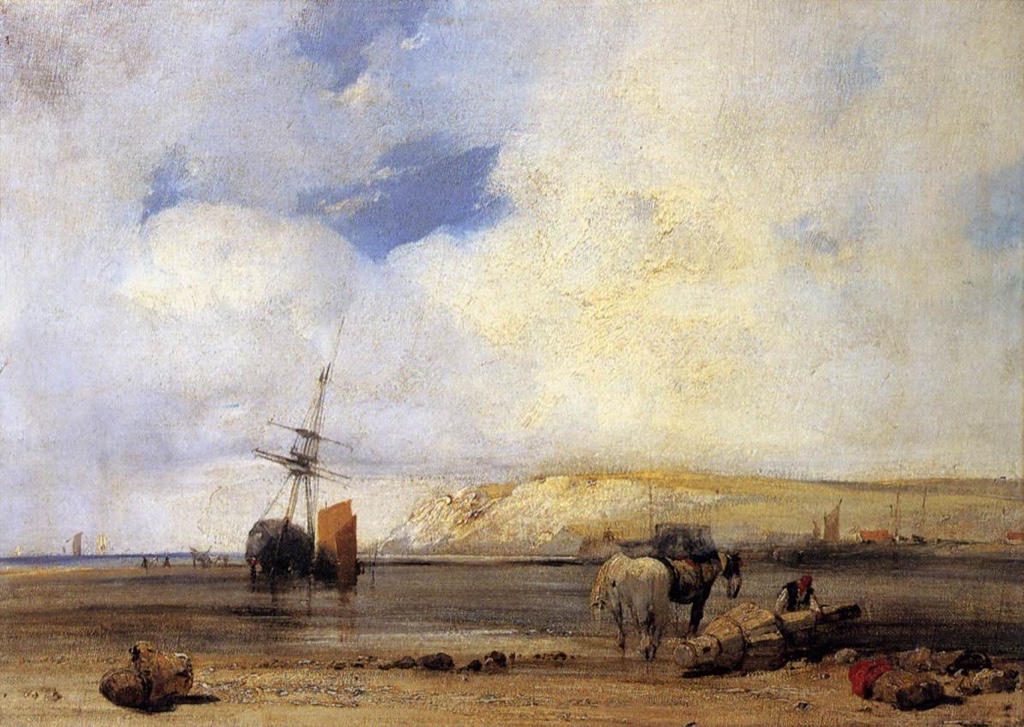
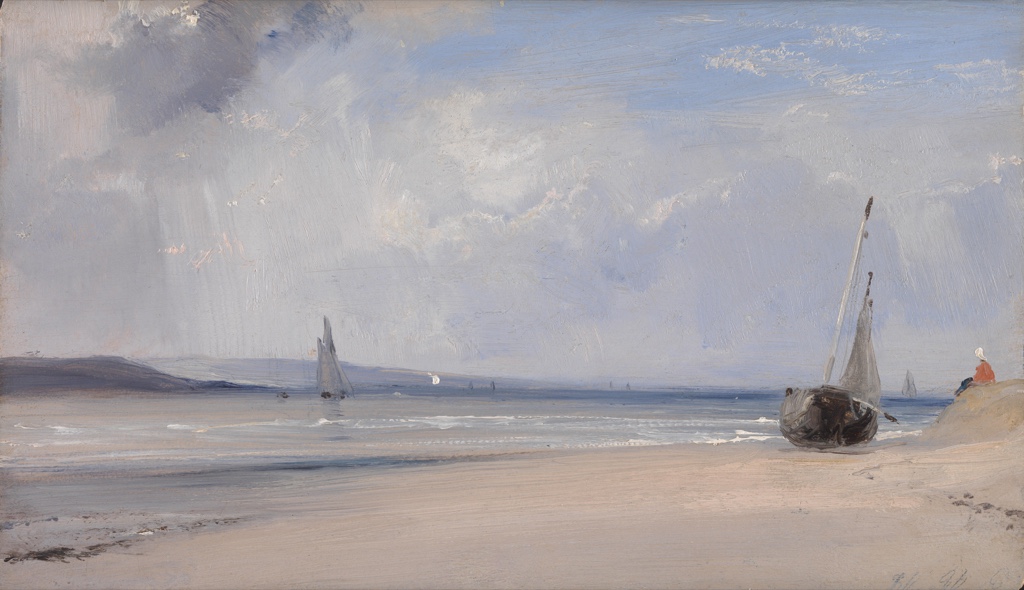
Only 16.7 centimetres high, An Estuary in Northern France opens out through long strokes of sky, shore and water. Its breadth is an effect of painting rather than size. Horizontal sweeps carry the eye across the little board, while shorter vertical marks interrupt the distance with cloud and suggested rain. A few figures and a beached boat provide scale without turning the scene into an anecdote. Richard Parkes Bonington made the work in about 1825–27, probably beside the Somme estuary at La Ferté. What looks spontaneous is also firmly organised: a fast, thinly painted surface in which direction, interval and contrast hold a wide landscape together.[1]
At a Glance
- ArtistRichard Parkes Bonington (1802–1828)
- Full titleAn Estuary in Northern France, possibly that of the River Somme
- Familiar aliasLa Ferté
- DateAbout 1825–27
- Medium and sizeOil on paper-fibre based board, 16.7 × 27.9 cm
- CollectionNational Gallery, London, NG6619[1]
Richard Parkes Bonington in context
Seapiece: Off the French Coast
c. 1823–24An Estuary in Northern France
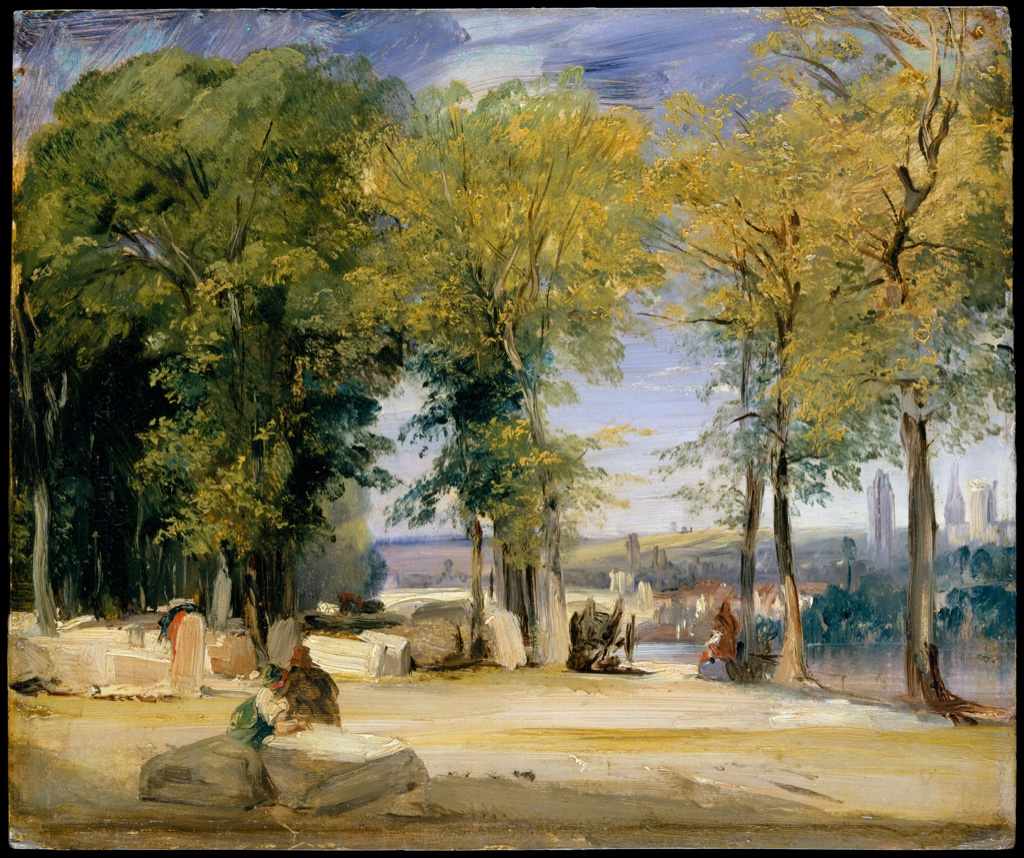
c. 1825–27View near Rouen
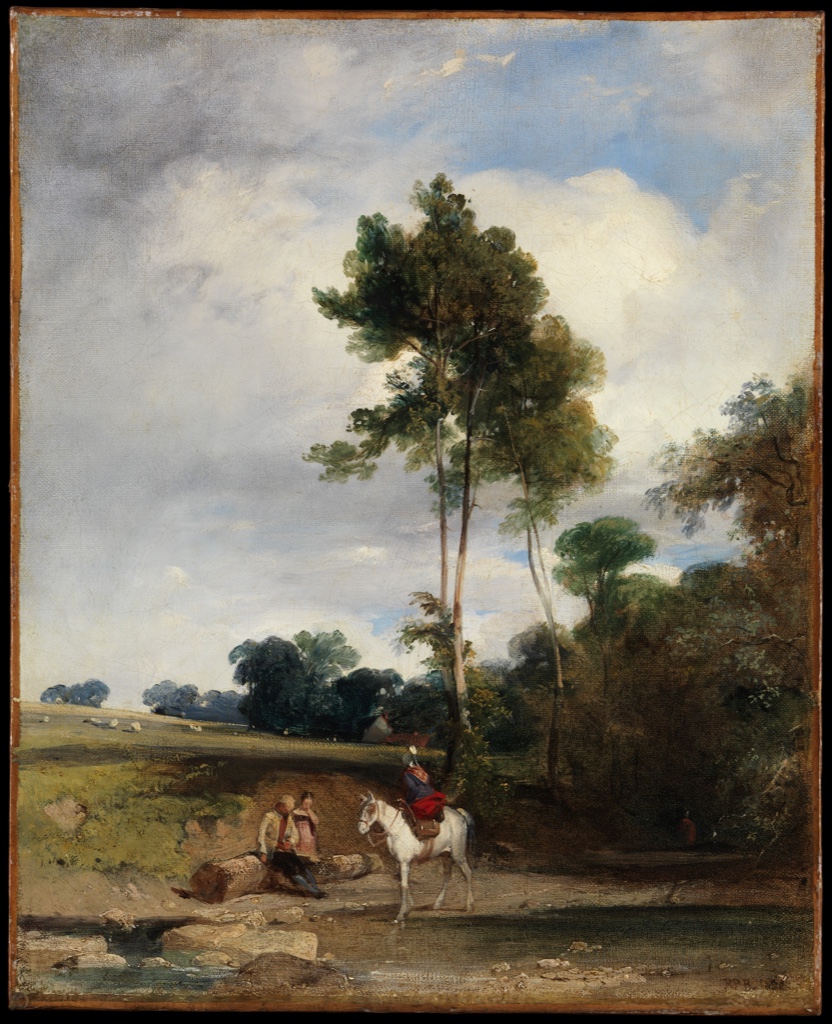
c. 1825Roadside Halt
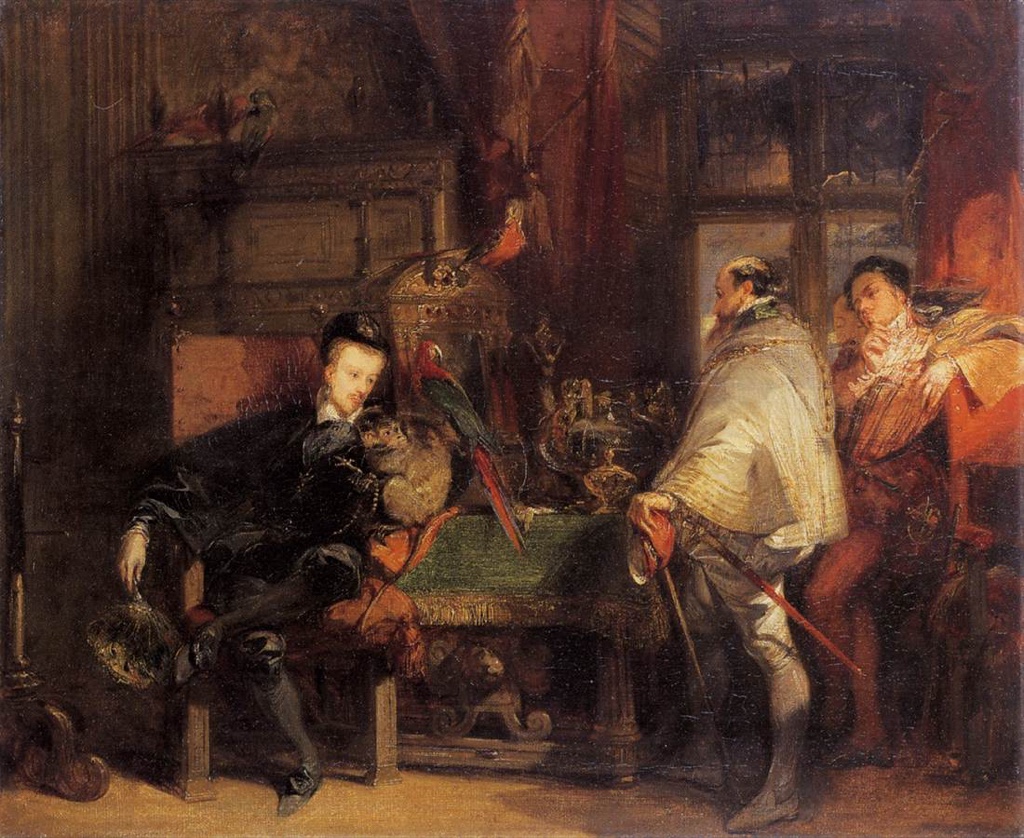
1826Henri III
1828Contents
- Introduction
- A small surface with an expansive structure
- Is this painting the work once called La Ferté ?
- Painted outdoors, then possibly adjusted inside
- Watercolour logic carried into oil
- How the brush directs the eye
- Figures and boat: scale without a fixed narrative
- A portable board and a larger field of experiment
- From private collections to the National Gallery
- Why this painting matters in Bonington's career
A small surface with an expansive structure
The painting's proportions matter. Its width is not extreme, yet the low horizontal bands make it feel panoramic. Much of the board is given to the sky. Beneath it, the far shore runs across the composition as a narrow divider, and the near bank gathers into a darker, irregular mass. The arrangement is spacious but not empty. Every change of direction has a structural role: horizontal strokes extend the landscape, vertical ones activate the atmosphere, and the broken marks around the figures and boat concentrate attention near the right edge.
This is not a scene built by outlining each object and then filling it in. The brush establishes zones, distances and accents together. Thin passages allow the support to participate in the result, so a material normally hidden beneath a finished oil remains visible in places. The National Gallery describes swift, fluid paint that sometimes barely covers the board. The exposed or lightly covered surface helps keep the image luminous, but it also lets us follow the act of construction: broad areas first, sharper incidents within them.[1]
The most useful way to look is therefore to alternate between distance and proximity. From across a room, sky, water, land and foreground settle into a coherent place. Close up, those zones loosen into bristle tracks, streaks, crossings and drops. Bonington does not conceal the difference. The painting depends upon our ability to read both at once.
Is this painting the work once called La Ferté?
Yes. La Ferté is a familiar shorter title for this painting, not the name of a second Bonington work. The National Gallery now expands the name with a cautious northern French location and a possible identification of the River Somme. Its record says the picture was probably made at La Ferté on that estuary, a place Bonington visited repeatedly, but the wording preserves uncertainty rather than presenting the site as proved.[1]
That distinction is important because the painting is observant without functioning like a labelled survey. Its low banks, open water and distant weather convey the character of an estuary, while offering relatively few architectural or topographical markers from which to establish a precise viewpoint. A likely location helps situate the work among Bonington's travels in Normandy and Picardy; it should not harden into an exact identification that the collection itself does not make.
Bonington's family moved from England to France in 1817. After a period in the Paris studio of the history painter Antoine-Jean Gros, he concentrated on landscape and travelled extensively in northern France. La Ferté and nearby Saint-Valery-sur-Somme were among the places he frequented with fellow painters, including Paul Huet.[1] The estuary was therefore part of a practised geography, not an exotic subject encountered once.
Painted outdoors, then possibly adjusted inside
The National Gallery's in-depth account treats the main campaign as outdoor painting on site. Bonington worked wet into wet: instead of waiting for one layer to dry before adding the next, he placed fresh oil colour into paint that was still wet. This method allowed edges and tones to meet quickly, and it retained the immediacy he already knew from watercolour. The mound's edge below the seated figure and the distant land along the horizon are places where the Gallery invites viewers to notice that handling.[1]
Outdoor execution does not mean that every mark had to be made in a single uninterrupted sitting. The Gallery also proposes that some small details, including the seated woman, may have been added later in the studio. The beached boat could belong to that later stage too. These statements are compatible. The principal relationships of sky, shore, water and foreground could be seized before the motif, while a few concentrated accents could be reconsidered after the board was brought inside.[1]
This two-stage possibility helps avoid a misleading choice between “sketch” and “finished picture”. In his 2025 supplement to the catalogue raisonné of Bonington's paintings, Patrick Noon observes that around a third of the 95 oils catalogued in 2008 might be classed as studies or unfinished sketches, but that Bonington's rapid, assured execution often makes the boundary difficult to draw. Noon also describes a habitual movement from a first trial in watercolour or brown wash to a final oil painted in one campaign.[2] Those broader observations do not decide the status of this particular picture. They do explain why speed and completion need not be opposites in Bonington's work.
Watercolour logic carried into oil
Bonington's early experience in watercolour shaped more than the appearance of his oils. It informed how economically he could establish space. A watercolourist must often preserve light by leaving the paper active and by judging translucent washes before they dry. In this oil, the equivalent economy lies in thin paint, unhidden brushwork and a willingness to let the pale board contribute to the total effect. Oil's capacity for wet-into-wet adjustment then gives him another kind of flexibility.
The result is not an oil painting pretending to be a watercolour. Its small deposits and dragged strokes have the substance of oil, and their overlaps remain tangible. Yet the image avoids the slow accumulation of opaque layers and glazes associated with more elaborately finished studio practice. It retains the directness of a sheet worked in liquid colour. This is why the watercolours and drawings are so useful beside the paintings: the relationship is one of working intelligence, not simply shared subject matter.
Noon's account provides a wider technical context. He writes that in London in 1825 Bonington encountered portable, commercially prepared millboard patented by Robert Davy, which enabled him to attempt outdoors in oil what he had already accomplished in watercolour through spontaneous alla prima painting.[2] The National Gallery identifies the support of An Estuary in Northern France more generally as paper-fibre based board.[1] It does not call this particular support Davy millboard, so the broader history should not be converted into a brand identification for NG6619.
How the brush directs the eye
The restricted colour and changing brush directions provide the painting's visual grammar. According to the National Gallery, Bonington laid in broad gradations of white, blue and greyish ochre. He then used white, black and red for sharper details. Thin liquid streaks indicate breaking water; small drops or blobs help form the seated figure.[1] These are descriptions of colours and handling visible in the work, not a list of chemically identified pigments.
Across the sky, broad horizontal strokes expand the space. At the left, short vertical strokes gather into cloud and a suggestion of rain. The contrast prevents the sky from reading as one flat band. On the land and water, long marks reinforce recession and calm extension; around the near bank, shorter crossing strokes roughen the surface. The brush changes course where the spatial task changes.
Bonington also varies how readily a mark becomes an object. A continuous stroke can stand for an edge of shore, whereas a clustered flurry becomes the boat. A pale streak can register simultaneously as material paint and breaking water. This double reading gives the picture its energy. The marks do not disappear into illusion, but neither do they detach from the landscape. Their physical direction makes the depicted space convincing.
The limited palette strengthens that system. With relatively few broad colour families, differences in value, density and direction carry more responsibility. The distant land remains compressed and subdued. Darker accents near the figures supply a nearby focus. Red is used sparingly enough to register as a concentrated incident rather than a competing field. Nothing in this arrangement requires a detailed story about the weather or the people. The painting's main drama is the calibration of open space against a handful of precise interruptions.
Figures and boat: scale without a fixed narrative
The seated woman on the right is small, yet her compact accents prevent the foreground bank from becoming an anonymous shape. Nearby figures and the beached boat make the shore seem inhabited and provide a measure against which the estuary appears broad. Their placement near one side also avoids dividing the scene into equal halves. The open left and centre remain available to sky, water and remote weather.
The Gallery's suggestion that the woman and boat details may have been added in the studio is especially revealing because these motifs are made from such economical marks.[1] Adding them later would not mean disguising a study as a narrative picture. It could instead sharpen scale, weight and rhythm. The boat's scribbled cluster counters the long horizontal passages; the figure's small touches of stronger colour anchor the near bank.
There is no secure basis for assigning names, occupations or a particular incident to these people. They make human presence legible while remaining subordinate to the estuary. That restraint distinguishes the work from Bonington's more developed coastal scenes, where boats and figures can assume a larger compositional role. On the Coast of Picardy offers a useful continuation for that comparison.
A portable board and a larger field of experiment
At 16.7 × 27.9 cm, the board could be carried and handled more readily than a large stretched canvas. Its firm, compact surface supported rapid work while allowing the bristles to leave a visible track. In An Estuary in Northern France, portability is not merely biographical convenience. It helps explain how direct observation could become an oil painting without first being translated into an elaborate studio composition.
The nearby comparison is View near Rouen, dated about 1825 by the Metropolitan Museum of Art. That work is oil on millboard and measures 27.9 × 33 cm; the Met says it was probably painted from the bank of the Seine opposite Rouen in late summer or autumn.[3] It is larger and differently proportioned, and its site is separately identified. The relevant connection is practical: both show how a rigid board could support a concentrated oil response to a northern French place.
Bonington's use of such supports belongs within a broader British and French Romantic exchange. After cross-Channel travel resumed following the Napoleonic Wars, British paintings and prints attracted sustained attention in France. Bonington occupied this exchange in a particular way: English-born, largely trained and professionally active in France, he adapted habits associated with British watercolour to subjects observed on French ground. French colleagues did not encounter a generic “British style” in his work. They saw a specific combination of portable practice, thin oil, exposed touch and atmospheric economy.[1]
The National Gallery records praise from Théophile Gautier for Bonington's colour and from Eugène Delacroix for his lightness of touch.[1] Such testimony establishes contemporary and later admiration; it does not prove a simple line of influence from this small picture to later Impressionism. The stronger claim is close at hand: Bonington showed painters in the 1820s how an oil study could preserve both the speed of observation and the authority of a resolved pictorial structure.
From private collections to the National Gallery
The known ownership history begins with Lord Seymour. The painting appeared in his Paris sale on 13 February 1860 as lot 54 and sold for 280 francs. It subsequently belonged to M. de Guirangaud and M. de Belleyme, and probably entered the collection of the art historian Jean Dieterle early in the twentieth century. Dieterle later sold it to the diplomat Tony Mayer. It passed through Galerie Jacques Dubourg in Paris in 1953, was with the dealer and art historian Adolphe Stein by 1985, and appeared at auction in 1991. Spink-Leger sold it to a private collector in 2000. In 2012 it was accepted by the British government in lieu of inheritance tax and allocated to the National Gallery.[1]
The Gallery flags the work as having incomplete provenance for 1933–45.[1] That notice should remain part of an honest account: a sequence of named owners does not justify filling an undocumented interval by inference. The picture is now inventory number NG6619 in the National Gallery's main collection.
Why this painting matters in Bonington's career
An Estuary in Northern France condenses several of Bonington's most consequential choices into one modest surface. He worked directly from a landscape he knew, used a portable support, carried watercolour economy into oil, and left the motion of the brush available to view. Yet the picture is not shapeless spontaneity. Its long divisions, small-scale crossings and sparse accents produce a stable design.
That balance is its achievement. Broad touch conveys changeable atmosphere without requiring an invented meteorological report; a few additions make the shore inhabited without supplying a fixed plot. The likely Somme setting grounds the work geographically, while the cautious title preserves what cannot be proved. Seen within Bonington's short career, it is a compact demonstration of how observation, material and structure could be made inseparable.
Researched works directory
This searchable directory is an online evidence census assembled from public museum and collection records. It is not a substitute for Patrick Noon’s printed catalogues raisonnés.
| Name | Date | Medium |
|---|---|---|
| A Coast Scene | 1820–1828 | Painting |
| A Cutter and other shipping in a Breeze | 1827–1828 | Watercolour |
| A Distant View of St-Omer | 1824 | Painting |
| A Distant View of St-Omer | c. 1824 | Painting |
| A duel between Frank and Rashleigh | 1828 | |
| A Faun with Pipes | Date unknown | Drawing |
| A Seascape | Date unknown | Drawing |
| A Venetian Scene | c. 1828 | Watercolour |
| A Wooded Stream and a Farmhouse in Normandy | Date unknown | Drawing |
| Abbeville - Vue Pris, de la route de Calais | Date unknown | |
| Abbey St-Amand, Rouen | Date unknown | Watercolour |
| An Estuary in Northern France | c. 1825–1827 | Painting |
| An Italian Town | 1822–1828 | Painting |
| Ancienne Porte a Stirling | 1826 | |
| Ancienne Tour | 1826 | |
| Ancienne Tour Près de Lanark | 1826 | |
| Anne Page and Slender (Shakespeare's Merry Wives of Windsor, Act 1, Scene 1) | 1829 | Artwork |
| Architectural Remains and Fragments: Rouen - Fontaine de la Crosse | 1827 | |
| Architecture du Moyen Age | 1824 | |
| Argyle Castle | 1826 | |
| Argyle Castle | 1828 | |
| At the English Coast | 1825 | Watercolour |
| Beach Scene | c. 1825 | Watercolour |
| Beach Scene with Cart and Horse | 1825 | Painting |
| Beached Vessels and a Wagon, near Trouville, France | c. 1825 | Painting |
| Beauvais - interieur d'une cour | Date unknown | |
| Bergues - La Tour du March, | Date unknown | |
| Bergues: La Tour du marché | 1824 | |
| Boccadasse, Genoa with Monte Fasce in the Background | 1826 | Painting |
| Bologna | 1826–1827 | Drawing |
| Bologna | 1828 | |
| Bonington - Vue de Venise | Date unknown | Watercolour |
| Bothwell Castle | 1826 | |
| Bothwell Castle | 1828 | |
| Boulogne Harbor | 1823 | Watercolour |
| Bracklin-Bridge | 1828 | |
| Brackline | 1826 | |
| Caen - Eglise Saint-Sauveur | 1824 | Drawing |
| Caen - Maison Grande Rue Saint-Pierre | Date unknown | Drawing |
| Calais Jetty, France | c. 1824 | Painting |
| Campos sur les bords du Rio das Velhas | 1827 | |
| Castle on a Scottish Loch | 1822–1828 | Painting |
| Cathedrale Notre-Dame | 1824 | |
| Charles V visits François Ier after the Battle of Pavia | c. 1827 | Watercolour |
| Chateau d'Argyle | 1826 | |
| Chateau de Bothwell | 1826 | |
| Chateau de Bothwell / Bothwell Castle | 1826 | |
| Christ preaching - unfinished | Date unknown | Painting |
| Coast Scene in Picardy, France | 1826 | Painting |
| Coastal Scene with Fishing Boats | 1828 | Painting |
| Croix de Moulin-les-Planches | 1827 | |
| Demetrius de Palatiano | 19 th century | Painting |
| Die adriatische Küste | c. 1820 | Painting |
| Die normannische Küste | 1823–1824 | Painting |
| Dieppe Harbour | Date unknown | Painting |
| Don Quixote | 1825–1826 | Painting |
| Don Quixote in His Study | 1825–1826 | Painting |
| Doune Castle | 1828 | |
| Du Sacristain de Saint Angadresne | c. 1828 | |
| Dutch: Processie in Verona | 1801–1828 | Painting |
| Edimbourg pris de la Chapelle St Antoine | 1826 | |
| Edimbourg vu de Calton-Hill | 1826 | |
| Edimbourg vu de la Chapelle Saint-Antoine | 1826 | |
| Edinbourgh vu de la Chapelle S. Antoine | 1826 | |
| Edinburg from S. Anthony Chapel | 1828 | |
| Edinburgh from St. Anthony Chapel | 1826 | |
| Edinburgh from the Calton Hill | 1828 | |
| Eglise de Saint-Taurin, Evreux | 1824 | |
| Eglise de St. Jean a Lyons | 1824 | |
| Eglise St. Sauveur | 1824 | |
| Embouchure de la Riviere Caxoera | 1827 | |
| Entree de la rade de Rio-Janeiro | 1827 | |
| Entrée de la salle des pas-perdus, Palais de Justice | 1824 | |
| Evening in Venice | 1826–1828 | Painting |
| Façade de l'Eglise de Brou | 1825 | |
| Façade St. Jean | 1824 | |
| Figures on a rocky shoreline | Date unknown | Artwork |
| Fishing Boats in a Calm, Ships at Anchor | 1825 | Painting |
| Fishing Smacks in French Harbour | 1818–1825 | Painting |
| Five Studies of a French Pointer | 1825–1826 | Drawing |
| Fontaine de la Crosse | 1827 | |
| French Coast Scene | 1815–1828 | Painting |
| French Coast with Fishermen | 1825 | Painting |
| French Hulk | 1820–1828 | Painting |
| German: Ein Waldweg | 1825–1826 | Painting |
| Glenfinlas | 1826 | |
| Glenfinlas | 1828 | |
| Glenfinlas Valley (Vallée de Glenfinlas, from Vues Pittoresques de l'Écosse) | 1826 | Artwork |
| Goetz Von Berlichingen Before The Imperial Magistrate | c. 1826 | Drawing |
| Grand Canal, Venice | 1826 | Drawing |
| Greek Armatole (irregular fighter). | 1825 | Painting |
| Half-length Portrait of a Bearded Man in Historical Dress | 1818 | Drawing |
| Henri III | 1828 | Painting |
| Hôtel de Sens : dessin / Richard-Parkes Bonington | 19 th century | Drawing |
| Ile de la Cite | Date unknown | Watercolour |
| In the Forest of Fontainebleau | c. 1825 | Painting |
| Intérieur d'une Cour | 1824 | |
| Jour du Marché | 1824 | |
| L'Eglise de St. Gervais et St. Protais | 1824 | |
| L'espace | c. 1826 | Painting |
| La Conversation | 1826 | |
| La Place du Molard, Geneva | Date unknown | Painting |
| La Prière | 1826 | |
| La Tour du Marché | 1824 | |
| Lac de Killin | 1826 | |
| Lac Lomond | 1826 | |
| Landscape with a Pond | 1825–1826 | Painting |
| Landscape with Castle Ruin | Date unknown | Watercolour |
| Le Château de la Duchesse de Berry | 1823–1825 | Painting |
| Le matin | 1824 | |
| Le Repos | 1826 | |
| Le Retour | 1826 | |
| Le Silence Favorable | 1826 | |
| Les Pendus | 1826 | |
| Les Plaisirs Paternels | 1826 | |
| Les Salinieres near Trouville | 1827–1828 | Painting |
| Lillebonne - Chateau d'Harcourt | 1824 | |
| Lillebonne - Chateau d'Harcourt | Date unknown | |
| Loch Lomond | 1826 | |
| Loch Lomond | 1828 | |
| Loch Tay | 1828 | |
| Lochkillin | 1826 | |
| Low Tide at Boulogne | 1824 | Painting |
| Maison Grande Rue St. Pierre | 1824 | |
| Maison Située Rue St Veronique | 1824 | |
| Man and Woman in a Landscape, possibly Faust and Marguerite | c. 1826 | Drawing |
| Molard-Bonington-1829 | 1829 | |
| Molard-Bonington-1829-cropped | 1829 | |
| Near Honfleur | 1823 | Watercolour |
| Near Jumieges | Date unknown | Watercolour |
| Old Gate Way at Stirling | 1828 | |
| Old Gateway at Stirling | 1826 | |
| Old Tower near Lanark | 1828 | |
| On the Adriatic | c. 1826 | Painting |
| On the Coast of Picardy | 1826 | Painting |
| On the Seine – Morning | 1825 | Painting |
| Palais de Justice, Rouen | Date unknown | Drawing |
| Paris from Pere Lachaise | Date unknown | Watercolour |
| Pays de Caux: Twilight | 1818–1828 | Painting |
| Peasant Women from Ragusa | 1826 | Drawing |
| Pesmes | 1825 | |
| Peveril of the Peak - Julian Peveril and Alice Bridgenorth, surprised by Major Ralph Bridgenorth | c. 1826 | Watercolour |
| Picardy Coast with Children – Sunrise | c. 1826 | Painting |
| Picturesque Views of Scotland: Brackline | 1826 | |
| Pierre de Vaivre | 1827 | |
| Polish: Zdjęcie z krzyża The Descent from the Cross. | 1820 | Painting |
| Portia and Bassanio | c. 1826 | Watercolour |
| 1827 | ||
| print, title-page | 1828 | |
| Processie in Verona | 19de eeuw | Painting |
| Promenade vénitienne (Venetian Promenade) | Date unknown | Artwork |
| Quentin Durward and the Disguised Louis XI (recto); Study of male figure (verso) | 1825–1826 | Drawing |
| Quentin Durward at Liège, Belgium | 1827–1828 | Painting |
| Quentin Durward in Luik, objectnr TA 11006 | 1825 | Drawing |
| Restes et Fragmens d'Architecture du Moyen Age: Église St. Sauveur, Caën | Date unknown | |
| Riva degli Schiavoni, from near San Biagio, Venice, by Richard Parkes Bonington | Date unknown | Painting |
| Road Workers, near Lillebonne | Date unknown | Painting |
| Roadside Halt | 1826 | Painting |
| Robert Dudley, Earl of Leicester and his wife Amy Robsart. | 1820 | Painting |
| Rouen | 1825 | Watercolour |
| Rouen: Entrée de la Salle des Pas Perdus, Palais du Justice | 1824 | |
| Rue du gros-horloge, Rouen | 1824 | |
| Ruines de Chateau d'Arlay | 1827 | |
| Ruines du Château d'Arlay | 1827 | |
| Ruins of the Abbey Saint Bertin | 1824 | Painting |
| Sea Coast, the Dunes | Date unknown | Painting |
| Seapiece: Off the French Coast | c. 1823–1824 | Painting |
| Shipping in a Swell | 1824–1827 | Watercolour |
| Shipping in an Estuary, Probably near Quilleboeuf | 1825–1826 | Watercolour |
| Sketch of a Woman | 1828 | Drawing |
| Street in the Outskirts of Besançon, France | 1827 | |
| Studies for Shylock | 1825 | Drawing |
| Study of a Gentleman in 17th Century Costume, After Van Dyck | 1827–1828 | Drawing |
| Study of a Seated Woman | Date unknown | Drawing |
| Study of a Woman with her Head on her Hand | Date unknown | Drawing |
| Sunset: A Sketch | Date unknown | Painting |
| Sunset in the Pays de Caux | 1828 | Watercolour |
| The Antiquary | Date unknown | Painting |
| The Chibouk | 1826 | Painting |
| The Church of St. Wulfran, Abbeville: The North Door of the West Front | c. 1823 | Drawing |
| The Count of Palatino in the costume of a Palikar | Date unknown | Painting |
| The Doge's Palace, Venice | 1826 | Painting |
| The Escape from Argyle Castle | 1826 | |
| The Escape from Argyle-Castle | 1828 | |
| The Grand Canal | 1826–1827 | Painting |
| The Grand Canal, Venice | 1826–1827 | Painting |
| The Interior of Sant' Ambrogio, Milan | 1826 | Painting |
| The Old Jetty, Boulogne, France | Date unknown | Painting |
| The Pont des Arts, Paris | 1826 | Painting |
| The Proposal (recto); Unfinished drawing of a horse and rider (verso) | 1820 | Drawing |
| The Rialto, Venice | Date unknown | Painting |
| The Salt Marshes near Trouville | 1826 | Watercolour |
| The Use of Tears | 1827 | Watercolour |
| The Use of Tears | Date unknown | Painting |
| Titlepage to Restes et Fragments | Date unknown | |
| Tomb in the Church of Saint-Omer, France | Date unknown | Painting |
| Tombeau de Marguerite de Bourbon, Eglise de Brou | 1825 | |
| Tour aux archives à Vernon | 1824 | |
| Tour du gros horloge, batie sous la domination des Anglais en 1417, Evreux | 1824 | |
| Tour du gros-horloge, Evreux | 1824 | |
| Trees and a Cottage by a River | 1827 | Drawing |
| Untitled (one of three) | Date unknown | |
| Vessels in a Choppy Sea | c. 1824 | Watercolour |
| View in Brittany: Bridge, Cottages and Washerwomen | 1818–1828 | Painting |
| View near Rouen | c. 1825 | Painting |
| View near Sarzana, Val di Magra | 1826 | Painting |
| View of the Rialto Bridge, Venice | c. 1826 | Watercolour |
| View on the Grounds of a Villa near Florence | 1826 | Painting |
| View on the River Seine - Morning | c. 1825 | Painting |
| Voyages pittoresques et romantiques dans l'ancienne France | 1825 | |
| Voyages pittoresques et romantiques dans l'ancienne France, Franche-Comté: Église de l'abbaye de Tournus | 1825 | |
| Voyages pittoresques et romantiques dans l'ancienne France, Franche-Comté: Ruines du château d'Arlay | 1825 | |
| Voyages pittoresques et romantiques dans l'ancienne France, Franche-Comté: Vue d'une rue des faubourgs de Besançon | 1825 | |
| Voyages pittoresques et romantiques dans l'ancienne France, Normandie: Église de Saint Gervais et Saint Protais à Gisors | 1824 | |
| Voyages pittoresques et romantiques dans l'ancienne France, Normandie: Rue du Gros Horloge, Rouen | 1824 | |
| Voyages pittoresques et romantiques dans l'ancienne France, Normandie: Tour aux archives à Vernon | 1824 | |
| Voyages pittoresques et romantiques dans l'ancienne France, Normandie: Tour du Gros-Horloge, Evreux | 1824 | |
| Vue d'une rue des faubourgs de Besançon | 1827 | |
| Vue d'une rue des Faubourgs de Besançon (View of a Street in the Outskirts of Besançon) | 1827 | |
| Vue Generale de l'Eglise de l'Abbaye de Tournus | 1825 | |
| Vue Générale de l'Eglise de St. Gervais et St. Protais, à Gisors | 1824 | |
| Vue Generale des Ruines du Chateau d'Arlay | 1827 | |
| Vue prise à l'entrée du jardin des Plantes. Au premier plan, bâtiment de la minéralogie et à l'arrière, dôme de l'hôpita, D.2182 | 1806–1828 | Drawing |
| Vue Prise de la Route de Calais | 1824 | |
| Vues Pittoresques de l'Écosse | 1826 | |
| Young Woman Writing a Letter | 1820–1828 | Painting |
Frequently Asked Questions
No. La Ferté is the familiar shorter or older name for NG6619. The National Gallery's current title cautiously describes a northern French estuary and presents the River Somme identification as possible. The two names refer to one work.[1]
The National Gallery dates it to about 1825–27 and considers La Ferté on the Somme estuary the likely location. The identification is probable rather than certain, which is why the official full title includes “possibly”.[1]
It is oil on paper-fibre based board, measuring 16.7 × 27.9 cm.[1] Bonington used portable boards for outdoor oil work during this period, but the Gallery does not identify this particular support as Davy millboard.
The principal landscape was painted outdoors on site, according to the National Gallery's in-depth account. Some concentrated details, including the seated woman and possibly the beached boat, may have been added later in the studio.[1]
It shows how Bonington translated the speed and economy of watercolour into oil while maintaining a clear spatial design. Visible bristle tracks, thin wet-in-wet paint and a restricted colour range create atmosphere and distance without hiding how the scene was made.[1]
Discussion
Use this evidence-led guide as a starting point for close looking rather than a final verdict.
Share an observation about An Estuary in Northern France or a source that adds useful context.
Reader Insights
Which passage of paint most changes your reading of An Estuary in Northern France?
How does the support, scale or known setting affect the way you interpret the work?
What remains uncertain when museum evidence is separated from visual inference?
Join the Conversation
Add your reading below, keeping observations specific and evidence clear.
References
- National Gallery, London, “Richard Parkes Bonington, An Estuary in Northern France, about 1825–7,” collection record for NG6619, including overview, in-depth text, key facts and provenance., accessed 30 August 2026.
- Patrick Noon, “A supplement to Richard Parkes Bonington, the Complete Paintings,” Colnaghi Studies Journal, XVII (October 2025), pp. 61–76, especially pp. 61 and 68–69., accessed 30 August 2026.
- Metropolitan Museum of Art, “Richard Parkes Bonington, View near Rouen, ca. 1825,” collection record for 2001.45., accessed 30 August 2026.