 by Tom Gurney
Tom Gurney BSc (Hons) is an art history expert with over 20 years experience
Page Created on August 30, 2026 / Page Updated on November 6, 2026
Email: tomgurney1@gmail.com / Phone: +44 7429 011000
Richard Parkes Bonington Biography: Introduction
Richard Parkes Bonington belonged to Britain by birth and to France by upbringing, training and much of his working life. That double formation was not a decorative detail added to his reputation after his death. It shaped where he travelled, whom he worked beside, how his pictures circulated and the unusual ease with which he moved between British watercolour practice and the Paris art world. His career lasted barely a decade, yet it took him from Nottinghamshire to Calais, Paris, the Channel coast, London, Switzerland and northern Italy. The fullest view of Bonington and his art therefore begins with movement: not a straight journey towards one national school, but repeated crossings through which subjects, materials and professional relationships changed.
At a Glance
- BornArnold, near Nottingham, England, in 1802.[1][2]
- Moved to FranceHis family settled in Calais in 1817 and moved to Paris the following year.[2][3]
- TrainingHe learned from Louis Francia, copied Dutch paintings in the Louvre and entered the studio of Baron Antoine-Jean Gros.[3][4][5]
- Public breakthroughFive marine and coastal oils at the Paris Salon of 1824 brought him a gold medal.[4]
- ItalyHe travelled through Switzerland and northern Italy with Charles Rivet from April to June 1826.[4][5]
- DiedHe died from tuberculosis in London in 1828, aged 25.[5][8]
Richard Parkes Bonington in context
Romanticism
c. 1790–1850British Romanticism
c. 1790–1840French Romanticism
c. 1815–1850Antoine-Jean Gros
1771–1835J. M. W. Turner
1775–1851John Constable
1776–1837Eugène Delacroix
1798–1863Richard Parkes Bonington
1802–1828Paul Huet
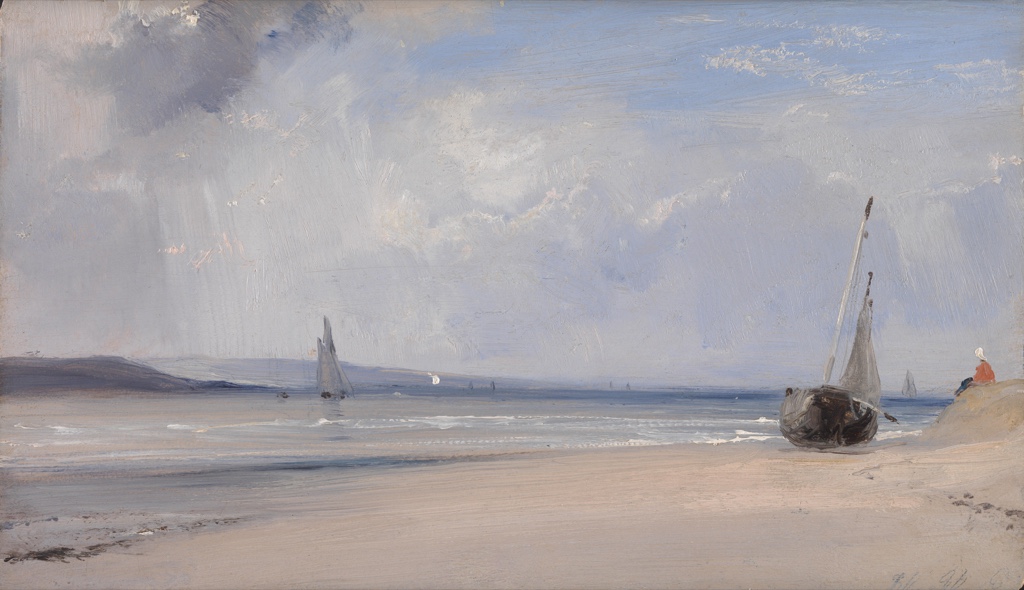
1803–1869Seapiece: Off the French Coast
c. 1823–24An Estuary in Northern France
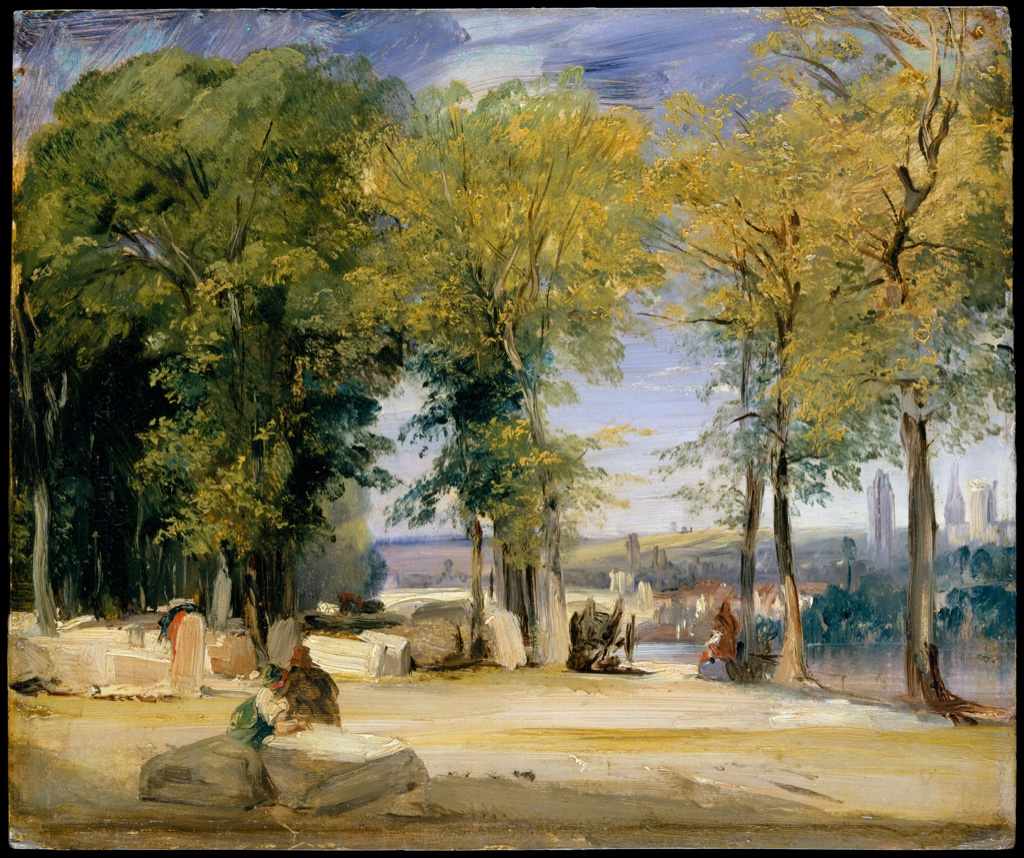
c. 1825–27View near Rouen
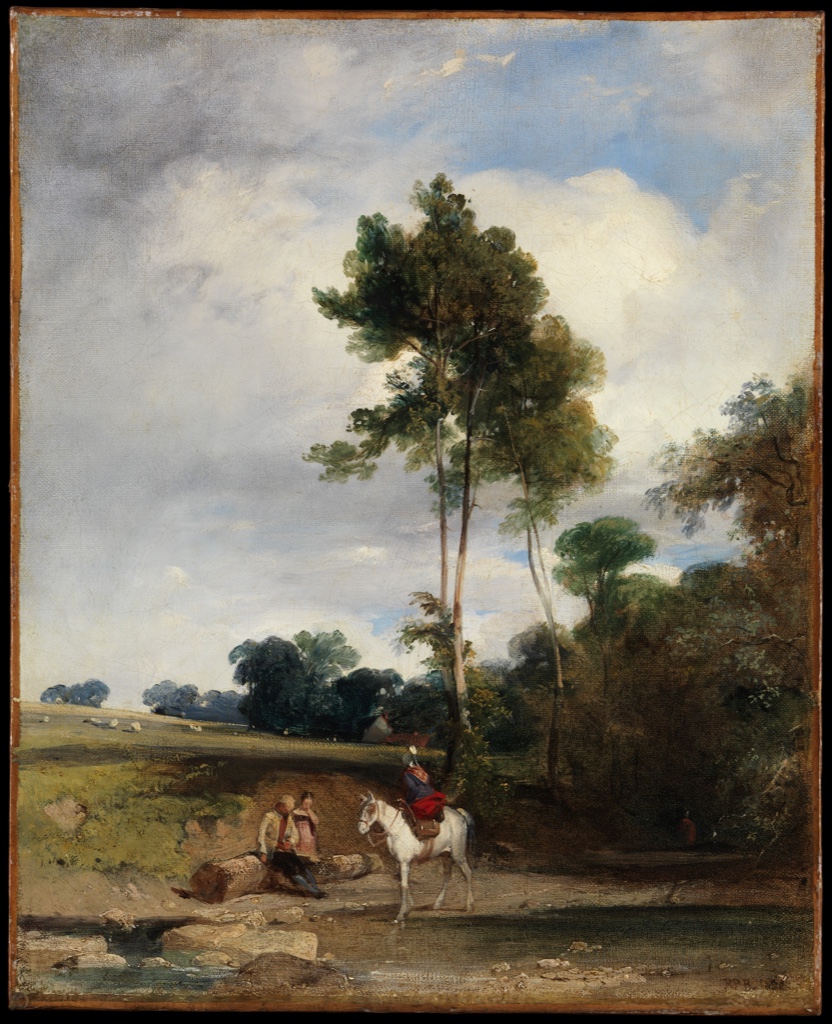
c. 1825Roadside Halt
1826Henri III
1828Contents
- Introduction
- Childhood in Nottinghamshire
- Calais, Francia and a New Coast
- Paris, the Louvre and Gros
- Watercolour, Lithography and the Printed Image
- Normandy, Picardy and Exhibiting from 1822
- The Paris Salon of 1824
- London in 1825 and Artistic Friendships
- Switzerland and Northern Italy, 1826
- Commissions and Widening Subjects, 1827–28
Childhood in Nottinghamshire
Bonington was born in Arnold, near Nottingham, on 25 October 1802. He was the only child of Richard Bonington and Eleanor Parkes. His father worked as an artist, drawing teacher and dealer in prints, while his mother ran a school. These details matter because images were present in the household before formal instruction began. Patrick Noon records that Bonington's father owned a substantial collection of old-master and modern prints, including Rembrandt etchings, which served as teaching models for his son and for other pupils.[2][4]
The surviving evidence does not, however, support the familiar story of an infant genius. Noon notes that very little is securely recorded about Bonington's childhood and rejects later tales of polished drawings made at the age of three as inventions. A few early works were remembered or listed by the family, but they are now untraced. They indicate copying, illustration and an encounter with reproduced art, not the miraculous mastery described by nineteenth-century legend.[4] This distinction is useful: Bonington developed quickly, but his fluency emerged within an environment of instruction, prints and sustained practice.
Nor should Arnold be treated merely as the place he left behind. The print culture available through his father gave the young artist access to compositions far beyond Nottinghamshire. Engravings could compress a famous painting into a portable black-and-white lesson in structure, tone and gesture. That experience of learning through translated images would remain relevant in a career involving watercolours, lithographs and works designed for reproduction. The first stage of his education was already connected to circulation.
Calais, Francia and a New Coast
In 1817 the Bonington family left Nottingham for Calais. A scholarly catalogue published by the National Gallery of Art relates the move to the social and economic disruption affecting Nottingham's lace and hosiery industries; the family established a lace business in the French port before moving on to Paris in 1818.[2] This explanation is more securely grounded than a romantic tale of artistic exile. Bonington was fifteen: old enough for the change of language, coast and professional setting to become formative, but still at the beginning of his training.
Calais placed him beside the Channel rather than simply on the French side of it. Shipping, low beaches, tidal expanses and rapidly shifting weather became recurring subjects. The port also brought him into contact with Louis Francia, a Calais-born watercolourist who had spent many years working in England. Institutional accounts identify Francia as one of Bonington's teachers or early artistic associates.[2][5] Through him, Bonington encountered a British watercolour tradition in France itself. The geography of his education was cross-Channel from the outset.
This helps explain why attempts to assign his early manner wholly to Britain or France are unsatisfactory. Francia could carry British methods into a French coastal setting; Bonington could absorb them while living among French artists and audiences. Place and technique did not map neatly onto nationality. The Channel was both subject and working corridor, a fact that would later make Bonington's exhibitions in Paris and London feel like connected parts of one career rather than separate national episodes.
Paris, the Louvre and Gros
The family's move to Paris in 1818 widened Bonington's field of study. His father directed him to copy Dutch old-master paintings in the Louvre in watercolour and enrolled him in the studio of Antoine-Jean Gros, a leading history painter. The two activities offered very different disciplines. In the museum, Bonington studied how earlier painters organised landscape, atmosphere, architecture and incident. In Gros's academy, he faced the conventional programme of drawing from plaster casts and preparing for the elevated subjects expected of an academically trained painter.[3][4]
Bonington did not remain within that programme. Both the National Gallery and Noon's later account describe his abandonment of academic tuition in favour of landscape. This was not a rejection of learning. Louvre copying continued to matter, and his late historical subjects show that figure painting and old-master art were never simply discarded. What he resisted was a prescribed route in which prolonged cast drawing preceded independent work. Landscape, travel and watercolour offered a more immediate field of enquiry.[3][4]
The decision also placed him among artists for whom work outside the academy could become a shared practice. Paris gave him access to French peers, publishers, collectors and exhibition opportunities while his command of watercolour retained a British inflection. The result was neither an untouched English style transplanted abroad nor a complete absorption into French academic culture. His education proceeded through choices between institutions, media and companions.
Watercolour, Lithography and the Printed Image
Before Bonington returned seriously to oil painting, watercolour and print-related work formed the practical basis of his career. The British Museum describes him as a painter, watercolourist and lithographer and records that he began exhibiting in 1822.[1] Noon characterises the years before the 1824 Salon as productive ones in which Bonington made topographical watercolours for print publishers and literary illustrations for the friendship albums collected in France.[4]
Those activities demanded different kinds of control. A topographical view had to make a place legible; an album illustration had to sustain interest on an intimate scale; a design intended for reproduction had to survive translation into print. Watercolour rewarded economy, since a light reserve or a transparent wash could establish weather and distance without laborious modelling. Lithography, still a relatively new reproductive process, offered another way for drawn information to circulate. The variety of works now connected with his name at the British Museum—drawings, prints, studies and albums—confirms that his practice cannot be reduced to finished oils.[1]
The importance of these years is explored more fully in Bonington's watercolours and drawings. In biographical terms, they established three habits that persisted: working on a portable scale, responding rapidly to a site and thinking about how images would reach viewers beyond the studio. His later oil technique did not replace those habits. It adapted them.
Normandy, Picardy and Exhibiting from 1822
Bonington's landscape education unfolded through travel in northern France. The National Gallery records extensive work in Normandy and Picardy and identifies Paul Huet among the companions with whom he visited places such as La Ferté and Saint-Valery-sur-Somme.[3] The British Museum's concise chronology places the beginning of his exhibiting career in 1822.[1] Together, these facts show an artist developing public visibility while repeatedly testing his methods against particular coasts, rivers, towns and buildings.
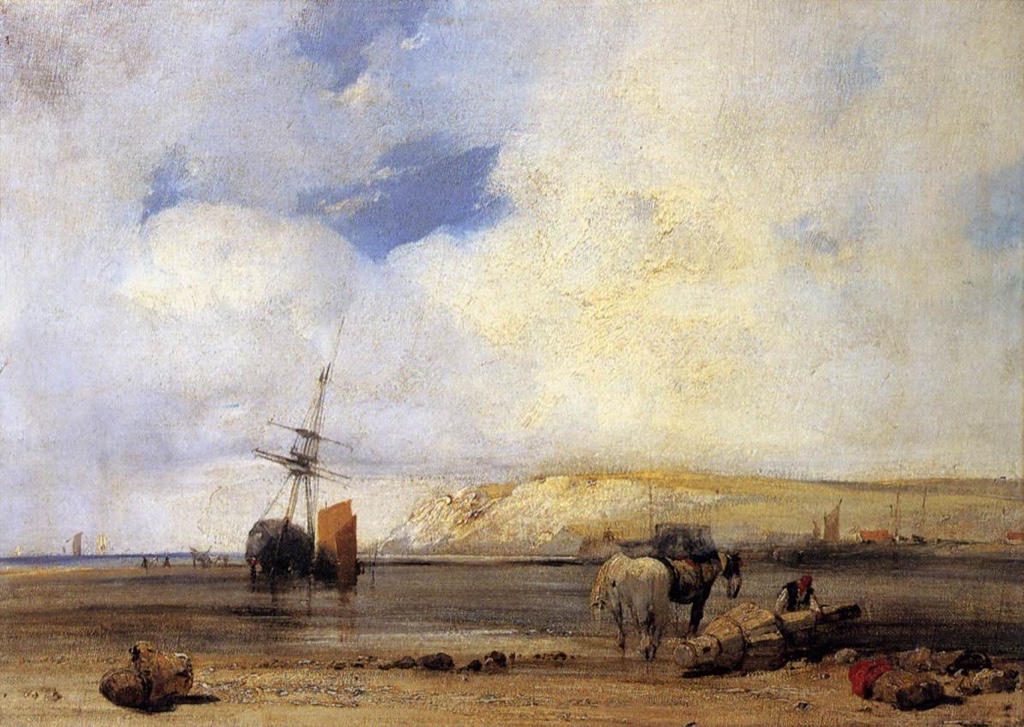
Travel was not an escape from professional life. The views produced or developed from these journeys could serve publishers, private collectors and exhibitions. Ports and estuaries also offered varied motifs within a concentrated area: boats aground or afloat, broad skies, sandbanks, distant buildings and figures working at the water's edge. Bonington did not need grand mountains or violent storms to generate pictorial interest. Modest shifts in tide, cloud and viewpoint were enough.
The National Gallery's account of An Estuary in Northern France shows how the methods formed in watercolour entered oil. Bonington painted that work on a paper-fibre board, using thin, fluid strokes and working directly into wet paint; the museum considers it to have been made outdoors at La Ferté around 1825–27.[3] The example belongs slightly later than his first exhibitions, but it clarifies the direction of travel. The immediacy associated with watercolour became a way of handling oil, not a medium-specific effect left behind.
Normandy and Picardy were therefore more than a list of destinations. They were recurring working territories in which observation, portability and repetition could interact. A cathedral, harbour or stretch of coast might first be drawn or painted in watercolour, reconsidered in another medium, and eventually presented to a metropolitan audience. This practical network of tour, studio and exhibition is central to the British and French Romanticism surrounding Bonington.
The Paris Salon of 1824
The Paris Salon of 1824 transformed Bonington's professional standing. Having spent several years making topographical watercolours and illustrations, he resumed oil painting in preparation for the exhibition. His public debut in oils comprised five marine and coastal views. He received a gold medal, as did the more established British artists John Constable, Copley Fielding and Thomas Lawrence.[4]
The award placed his achievement within an unusually visible Anglo-French moment at the Salon. Yet its significance should not be reduced to the claim that British landscape simply taught France a new way to paint. Bonington had already been living and working in France for years. His exhibits emerged from French coastal travel, Parisian professional networks and techniques shaped partly by British watercolour. The success belonged to exchange rather than one-way transmission.
It also confirmed that marine and coastal subjects could support serious ambition. Bonington did not have to abandon compact landscapes for an academic hierarchy of large figure compositions in order to receive recognition. At the same time, the Salon opened doors that would later permit a wider range of subjects. Success as a landscape painter gave him the professional freedom to move towards Venetian views and historical scenes without severing his earlier practice. An overview of Bonington's paintings makes that widening range especially clear.
London in 1825 and Artistic Friendships
Bonington visited London in the summer of 1825. Noon's account places his meeting with Eugène Delacroix there; the British Museum also associates the journey with Delacroix and Eugène Isabey.[4][5] On returning to Paris, Bonington and Delacroix shared a studio in 1825–26 and discussed travelling to Italy together. Their friendship connected the landscape and figure-painting strands of contemporary Romantic art, but it was also practical: they saw works, worked in proximity and exchanged ideas about old masters, literary subjects and handling paint.
London affected Bonington's materials as well as his relationships. Noon records his discovery there of a commercially prepared millboard patented by Robert Davy. Lightly primed and easy to carry, the board made it practical to take outdoors the rapid oil handling he had already practised in watercolour. The change is visible in small oil studies made around Rouen in 1825, where site, support and speed became closely linked.[4] Material innovation was not an abstract technical advance; it changed what could be carried and attempted during a journey.
The British Museum self-portrait of about 1825–26 gives a quieter glimpse of this period. Bonington shows himself in a broad-brimmed hat, his head supported by one hand, drawn in brown wash with white touches over graphite. The museum warns against treating the pose as a prediction of illness or early death. Supporting the head was a practical way to remain still while moving one's gaze between mirror and drawing, even though the pose also carried established associations with melancholy.[5] Read with that caution, the work presents an artist attending closely to the act of looking rather than staging his future legend.
His relationships extended beyond Delacroix. Paul Huet shared northern French painting territories; Thomas Shotter Boys remained close during Bonington's final illness; Isabey and other artists participated in the movement of people and works between Paris and London.[3][5] This was a network of peers, teachers, patrons and publishers rather than a single decisive influence. It also included admired artists whom Bonington may not have known personally. The Wallace Collection notes that Bonington and J. M. W. Turner saw one another's work through exhibitions and engravings, and describes their relation as one of mutual influence and creative competition.[6]
Switzerland and Northern Italy, 1826
The Italian journey developed from plans made with Delacroix, but Delacroix withdrew because of professional and financial commitments. Bonington travelled instead with his friend and patron Charles Rivet. They left in April 1826 and spent roughly three months crossing Switzerland and northern Italy. The route remained north of Rome and only touched Tuscany. Venice, with its Gothic architecture, Shakespearean associations and paintings by Titian and Veronese, became the journey's principal imaginative centre.[4][5]
The itinerary shows the breadth of Bonington's interests. He did not travel only to locate picturesque scenery. Architecture, church interiors and old-master painting mattered alongside light on water. Drawings made on the tour preserved structures and details; small oil studies tested how colour and illumination could be registered directly; later studio works enlarged Venetian motifs for collectors and exhibitions. The publisher of the companion catalogue of Bonington's drawings, the result of more than twenty-five years of research, specifically highlights works made during this 1826 passage through Switzerland and northern Italy.[8]
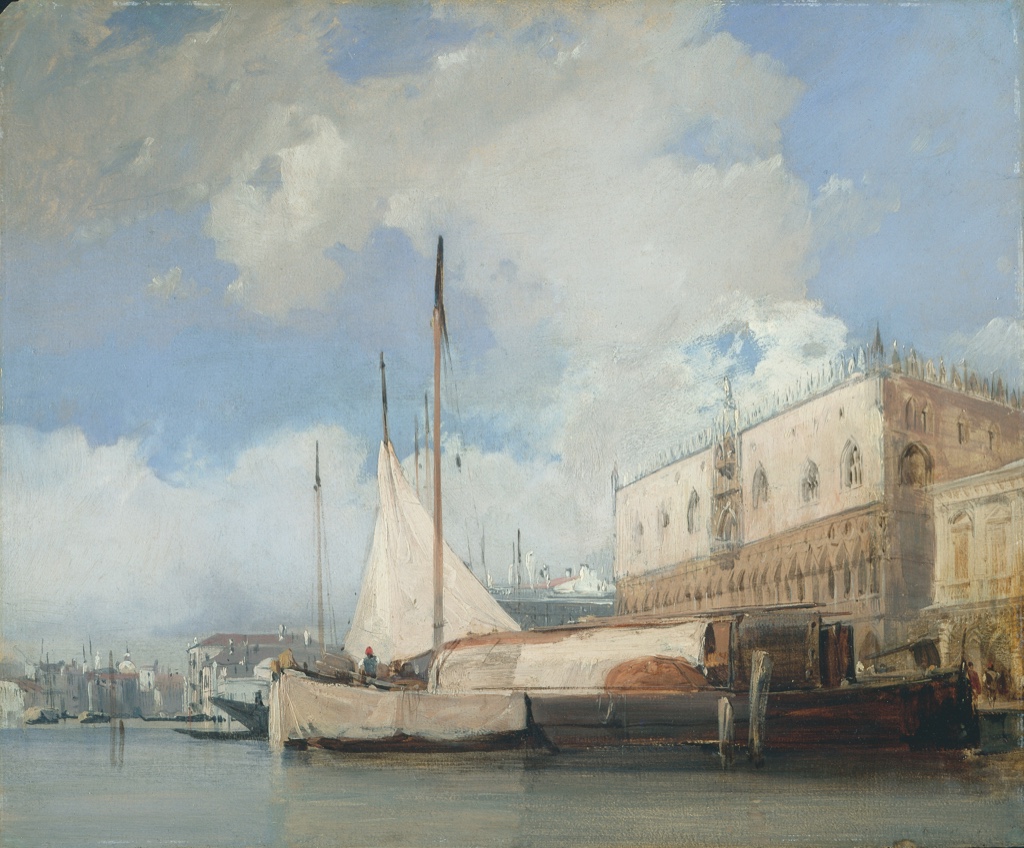
Venice also connected his earlier and later concerns. Its canals and boats extended his experience of coastal and river subjects, while its palaces offered an architectural theatre associated with history, literature and ceremony. The move from a small study to an exhibition picture was not a move from truthful observation to mere invention. It allowed information gathered on site to enter more elaborate compositions. Bonington's Venetian works retain the economy of a traveller's notation even when their scale and finish address a collector's wall.
The journey lasted only a season, but its consequences occupied the remainder of his career. Italian views joined northern French coasts in his repertory, and Venetian architecture helped prepare his expansion towards historical subjects. Rather than treating Italy as the inevitable climax of an artist's education, it is more accurate to see it as another concentrated period of looking whose materials were developed after his return.
Commissions and Widening Subjects, 1827–28
Demand increased rapidly after the 1824 Salon and Bonington's first public appearance in Britain at the British Institution in 1826. Noon describes commissions for oils and watercolours from private collectors, art dealers and publishers of annuals and travel books in both Paris and London.[4] His market was now genuinely international. Exhibitions created recognition, publishers multiplied images and patrons could encounter his work while moving through the same cross-Channel networks as the artist.
Landscape remained central, but it no longer defined the outer limit of his ambition. In the count given by Noon's 2025 supplement, 72 of the oils catalogued in 2008 are landscapes made in France or Italy; the other 23 use figures or literary themes. Those figural works drew on Shakespeare, Walter Scott, Goethe, Cervantes, French history and contemporary poetry.[4]
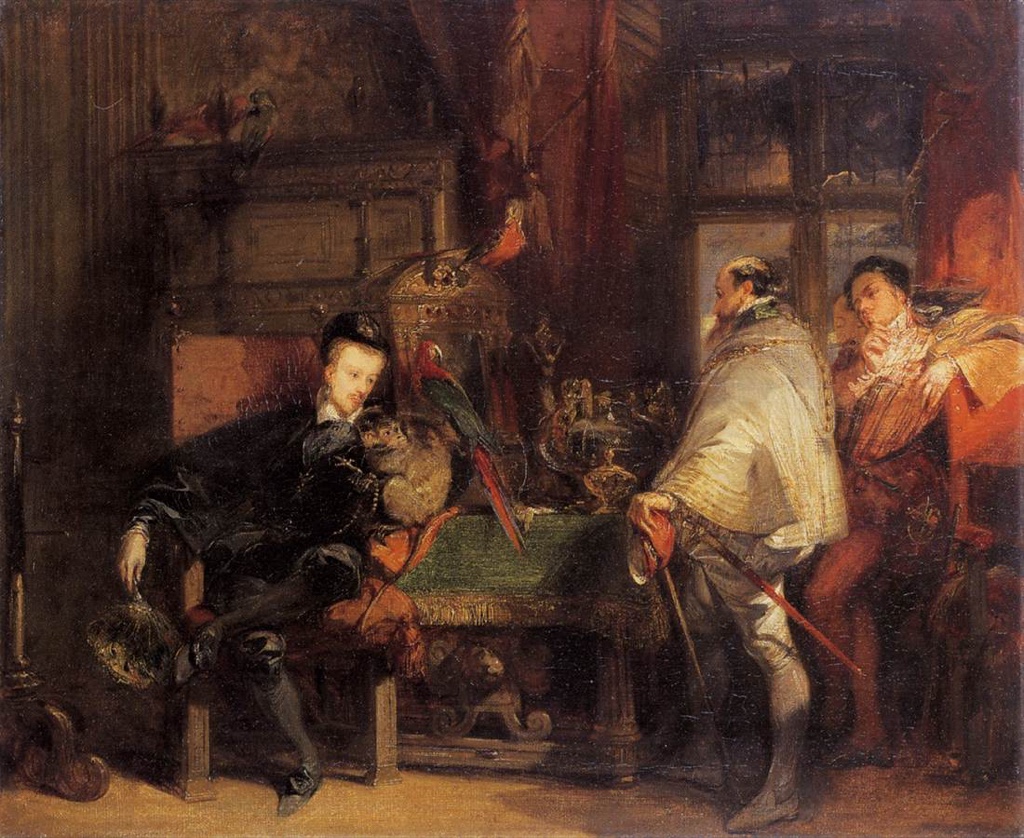
The late history paintings were not a repudiation of the coast. They involved another application of the same visual intelligence: selecting telling detail, balancing broad areas of colour and allowing costume or architecture to carry much of a scene's character. History painting also held greater institutional prestige than landscape. The Wallace Collection places Henri III within that ambition and records that Bonington exhibited it at the Royal Academy shortly before his death.[7] Its subject and exhibition history are considered more closely with Henri III.
This widening of subject matter can easily be mistaken for a planned ascent from watercolour to oil or from landscape to history. The chronology resists that neat ladder. Bonington continued to receive watercolour commissions while painting oils; he returned to landscapes while developing figure scenes; designs circulated through prints as pictures entered elite exhibitions. His career expanded by addition and interchange.
Illness, London and Death
Bonington's health deteriorated in 1828. He returned to London, where he died from tuberculosis in September, still aged twenty-five.[5][8] The exact brevity of his life has often dominated accounts of him, sometimes turning every shadowed portrait or quickly handled landscape into evidence of impending death. The British Museum's discussion of the self-portrait offers a necessary corrective: much of the melancholy attached to his image grew after his death, as admiration hardened into the legend of a doomed Romantic hero.[5]
His final year is better understood through the work and professional demands that continued during it. Major historical pictures were being exhibited, landscape and watercolour commissions remained active, and his reputation operated in both Paris and London.[4][7] Illness ended an expanding practice; it does not supply the meaning of everything that preceded it. The strongest biography keeps mortality in view without allowing it to replace the artist's decisions, materials and working relationships.
Reputation and the Work of Cataloguing
Bonington's reputation grew through several channels after 1828. Friends remembered his skill; prints carried his compositions to new audiences; studio sales dispersed works; and later writers shaped an increasingly romantic image of the young Anglo-French artist. Delacroix recalled the exceptional facility of Bonington's hand, while Turner's admiration was sustained through works seen in exhibitions and engravings. The Wallace Collection interprets Turner's Calais Sands of 1830 as a eulogy to the younger painter.[4][6]
Those tributes should not collapse Bonington into the artists who admired him. His particular importance lies in the way his practice joined circumstances that are often narrated separately: English birth and French training, watercolour and oil, direct outdoor study and studio elaboration, landscape and historical illustration, private album and public Salon. Later French painters valued the freshness of his handling, but calling him merely a forerunner of Impressionism substitutes hindsight for those specific conditions.[3]
Modern cataloguing has also changed what can responsibly be said about the career. Yale University Press issued Patrick Noon's Richard Parkes Bonington: The Complete Paintings for the Paul Mellon Centre in 2008. The publisher presents it as the first catalogue raisonné devoted to the complete known body of Bonington's oils and watercolours, built on twenty-five years of research and about 400 accepted, catalogued and reproduced works.[9] The companion Complete Drawings followed in 2011 and covers more than 400 drawings.[8]
Noon's 2025 supplement demonstrates why cataloguing is an ongoing scholarly activity rather than a final monument. It revisits five oil paintings as new works become available for direct examination and evidence changes.[4] That process matters especially for an artist whose fluid execution inspired copies and whose works were widely dispersed after his death. Bonington's life story is short, but the history of identifying, interpreting and reconnecting his work remains active.
Follow Richard Parkes Bonington's career through four stages
Calais, Paris and Gros
The move from Nottingham to Calais and then Paris placed an English-trained young artist inside French academic and exhibition culture. Watercolour, copying and study under Antoine-Jean Gros shaped the first phase.
Travel, print and the Salon
Normandy tours supplied coasts, rivers and medieval architecture. Lithography carried those subjects into print, while the 1824 Salon established Bonington's public standing in France.
London, millboard and Italy
A London visit brought fresh contact with British painting and portable prepared millboard. Work alongside Delacroix and the 1826 journey through Switzerland and northern Italy widened both subject and method.
Landscape and historical ambition
Bonington continued coastal and Venetian subjects while pursuing larger literary and historical paintings. British exhibitions and the Royal Academy brought this late ambition before a wider public.
Researched works directory
This searchable directory is an online evidence census assembled from public museum and collection records. It is not a substitute for Patrick Noon’s printed catalogues raisonnés.
| Name | Date | Medium |
|---|---|---|
| A Coast Scene | 1820–1828 | Painting |
| A Cutter and other shipping in a Breeze | 1827–1828 | Watercolour |
| A Distant View of St-Omer | 1824 | Painting |
| A Distant View of St-Omer | c. 1824 | Painting |
| A duel between Frank and Rashleigh | 1828 | |
| A Faun with Pipes | Date unknown | Drawing |
| A Seascape | Date unknown | Drawing |
| A Venetian Scene | c. 1828 | Watercolour |
| A Wooded Stream and a Farmhouse in Normandy | Date unknown | Drawing |
| Abbeville - Vue Pris, de la route de Calais | Date unknown | |
| Abbey St-Amand, Rouen | Date unknown | Watercolour |
| An Estuary in Northern France | c. 1825–1827 | Painting |
| An Italian Town | 1822–1828 | Painting |
| Ancienne Porte a Stirling | 1826 | |
| Ancienne Tour | 1826 | |
| Ancienne Tour Près de Lanark | 1826 | |
| Anne Page and Slender (Shakespeare's Merry Wives of Windsor, Act 1, Scene 1) | 1829 | Artwork |
| Architectural Remains and Fragments: Rouen - Fontaine de la Crosse | 1827 | |
| Architecture du Moyen Age | 1824 | |
| Argyle Castle | 1826 | |
| Argyle Castle | 1828 | |
| At the English Coast | 1825 | Watercolour |
| Beach Scene | c. 1825 | Watercolour |
| Beach Scene with Cart and Horse | 1825 | Painting |
| Beached Vessels and a Wagon, near Trouville, France | c. 1825 | Painting |
| Beauvais - interieur d'une cour | Date unknown | |
| Bergues - La Tour du March, | Date unknown | |
| Bergues: La Tour du marché | 1824 | |
| Boccadasse, Genoa with Monte Fasce in the Background | 1826 | Painting |
| Bologna | 1826–1827 | Drawing |
| Bologna | 1828 | |
| Bonington - Vue de Venise | Date unknown | Watercolour |
| Bothwell Castle | 1826 | |
| Bothwell Castle | 1828 | |
| Boulogne Harbor | 1823 | Watercolour |
| Bracklin-Bridge | 1828 | |
| Brackline | 1826 | |
| Caen - Eglise Saint-Sauveur | 1824 | Drawing |
| Caen - Maison Grande Rue Saint-Pierre | Date unknown | Drawing |
| Calais Jetty, France | c. 1824 | Painting |
| Campos sur les bords du Rio das Velhas | 1827 | |
| Castle on a Scottish Loch | 1822–1828 | Painting |
| Cathedrale Notre-Dame | 1824 | |
| Charles V visits François Ier after the Battle of Pavia | c. 1827 | Watercolour |
| Chateau d'Argyle | 1826 | |
| Chateau de Bothwell | 1826 | |
| Chateau de Bothwell / Bothwell Castle | 1826 | |
| Christ preaching - unfinished | Date unknown | Painting |
| Coast Scene in Picardy, France | 1826 | Painting |
| Coastal Scene with Fishing Boats | 1828 | Painting |
| Croix de Moulin-les-Planches | 1827 | |
| Demetrius de Palatiano | 19 th century | Painting |
| Die adriatische Küste | c. 1820 | Painting |
| Die normannische Küste | 1823–1824 | Painting |
| Dieppe Harbour | Date unknown | Painting |
| Don Quixote | 1825–1826 | Painting |
| Don Quixote in His Study | 1825–1826 | Painting |
| Doune Castle | 1828 | |
| Du Sacristain de Saint Angadresne | c. 1828 | |
| Dutch: Processie in Verona | 1801–1828 | Painting |
| Edimbourg pris de la Chapelle St Antoine | 1826 | |
| Edimbourg vu de Calton-Hill | 1826 | |
| Edimbourg vu de la Chapelle Saint-Antoine | 1826 | |
| Edinbourgh vu de la Chapelle S. Antoine | 1826 | |
| Edinburg from S. Anthony Chapel | 1828 | |
| Edinburgh from St. Anthony Chapel | 1826 | |
| Edinburgh from the Calton Hill | 1828 | |
| Eglise de Saint-Taurin, Evreux | 1824 | |
| Eglise de St. Jean a Lyons | 1824 | |
| Eglise St. Sauveur | 1824 | |
| Embouchure de la Riviere Caxoera | 1827 | |
| Entree de la rade de Rio-Janeiro | 1827 | |
| Entrée de la salle des pas-perdus, Palais de Justice | 1824 | |
| Evening in Venice | 1826–1828 | Painting |
| Façade de l'Eglise de Brou | 1825 | |
| Façade St. Jean | 1824 | |
| Figures on a rocky shoreline | Date unknown | Artwork |
| Fishing Boats in a Calm, Ships at Anchor | 1825 | Painting |
| Fishing Smacks in French Harbour | 1818–1825 | Painting |
| Five Studies of a French Pointer | 1825–1826 | Drawing |
| Fontaine de la Crosse | 1827 | |
| French Coast Scene | 1815–1828 | Painting |
| French Coast with Fishermen | 1825 | Painting |
| French Hulk | 1820–1828 | Painting |
| German: Ein Waldweg | 1825–1826 | Painting |
| Glenfinlas | 1826 | |
| Glenfinlas | 1828 | |
| Glenfinlas Valley (Vallée de Glenfinlas, from Vues Pittoresques de l'Écosse) | 1826 | Artwork |
| Goetz Von Berlichingen Before The Imperial Magistrate | c. 1826 | Drawing |
| Grand Canal, Venice | 1826 | Drawing |
| Greek Armatole (irregular fighter). | 1825 | Painting |
| Half-length Portrait of a Bearded Man in Historical Dress | 1818 | Drawing |
| Henri III | 1828 | Painting |
| Hôtel de Sens : dessin / Richard-Parkes Bonington | 19 th century | Drawing |
| Ile de la Cite | Date unknown | Watercolour |
| In the Forest of Fontainebleau | c. 1825 | Painting |
| Intérieur d'une Cour | 1824 | |
| Jour du Marché | 1824 | |
| L'Eglise de St. Gervais et St. Protais | 1824 | |
| L'espace | c. 1826 | Painting |
| La Conversation | 1826 | |
| La Place du Molard, Geneva | Date unknown | Painting |
| La Prière | 1826 | |
| La Tour du Marché | 1824 | |
| Lac de Killin | 1826 | |
| Lac Lomond | 1826 | |
| Landscape with a Pond | 1825–1826 | Painting |
| Landscape with Castle Ruin | Date unknown | Watercolour |
| Le Château de la Duchesse de Berry | 1823–1825 | Painting |
| Le matin | 1824 | |
| Le Repos | 1826 | |
| Le Retour | 1826 | |
| Le Silence Favorable | 1826 | |
| Les Pendus | 1826 | |
| Les Plaisirs Paternels | 1826 | |
| Les Salinieres near Trouville | 1827–1828 | Painting |
| Lillebonne - Chateau d'Harcourt | 1824 | |
| Lillebonne - Chateau d'Harcourt | Date unknown | |
| Loch Lomond | 1826 | |
| Loch Lomond | 1828 | |
| Loch Tay | 1828 | |
| Lochkillin | 1826 | |
| Low Tide at Boulogne | 1824 | Painting |
| Maison Grande Rue St. Pierre | 1824 | |
| Maison Située Rue St Veronique | 1824 | |
| Man and Woman in a Landscape, possibly Faust and Marguerite | c. 1826 | Drawing |
| Molard-Bonington-1829 | 1829 | |
| Molard-Bonington-1829-cropped | 1829 | |
| Near Honfleur | 1823 | Watercolour |
| Near Jumieges | Date unknown | Watercolour |
| Old Gate Way at Stirling | 1828 | |
| Old Gateway at Stirling | 1826 | |
| Old Tower near Lanark | 1828 | |
| On the Adriatic | c. 1826 | Painting |
| On the Coast of Picardy | 1826 | Painting |
| On the Seine – Morning | 1825 | Painting |
| Palais de Justice, Rouen | Date unknown | Drawing |
| Paris from Pere Lachaise | Date unknown | Watercolour |
| Pays de Caux: Twilight | 1818–1828 | Painting |
| Peasant Women from Ragusa | 1826 | Drawing |
| Pesmes | 1825 | |
| Peveril of the Peak - Julian Peveril and Alice Bridgenorth, surprised by Major Ralph Bridgenorth | c. 1826 | Watercolour |
| Picardy Coast with Children – Sunrise | c. 1826 | Painting |
| Picturesque Views of Scotland: Brackline | 1826 | |
| Pierre de Vaivre | 1827 | |
| Polish: Zdjęcie z krzyża The Descent from the Cross. | 1820 | Painting |
| Portia and Bassanio | c. 1826 | Watercolour |
| 1827 | ||
| print, title-page | 1828 | |
| Processie in Verona | 19de eeuw | Painting |
| Promenade vénitienne (Venetian Promenade) | Date unknown | Artwork |
| Quentin Durward and the Disguised Louis XI (recto); Study of male figure (verso) | 1825–1826 | Drawing |
| Quentin Durward at Liège, Belgium | 1827–1828 | Painting |
| Quentin Durward in Luik, objectnr TA 11006 | 1825 | Drawing |
| Restes et Fragmens d'Architecture du Moyen Age: Église St. Sauveur, Caën | Date unknown | |
| Riva degli Schiavoni, from near San Biagio, Venice, by Richard Parkes Bonington | Date unknown | Painting |
| Road Workers, near Lillebonne | Date unknown | Painting |
| Roadside Halt | 1826 | Painting |
| Robert Dudley, Earl of Leicester and his wife Amy Robsart. | 1820 | Painting |
| Rouen | 1825 | Watercolour |
| Rouen: Entrée de la Salle des Pas Perdus, Palais du Justice | 1824 | |
| Rue du gros-horloge, Rouen | 1824 | |
| Ruines de Chateau d'Arlay | 1827 | |
| Ruines du Château d'Arlay | 1827 | |
| Ruins of the Abbey Saint Bertin | 1824 | Painting |
| Sea Coast, the Dunes | Date unknown | Painting |
| Seapiece: Off the French Coast | c. 1823–1824 | Painting |
| Shipping in a Swell | 1824–1827 | Watercolour |
| Shipping in an Estuary, Probably near Quilleboeuf | 1825–1826 | Watercolour |
| Sketch of a Woman | 1828 | Drawing |
| Street in the Outskirts of Besançon, France | 1827 | |
| Studies for Shylock | 1825 | Drawing |
| Study of a Gentleman in 17th Century Costume, After Van Dyck | 1827–1828 | Drawing |
| Study of a Seated Woman | Date unknown | Drawing |
| Study of a Woman with her Head on her Hand | Date unknown | Drawing |
| Sunset: A Sketch | Date unknown | Painting |
| Sunset in the Pays de Caux | 1828 | Watercolour |
| The Antiquary | Date unknown | Painting |
| The Chibouk | 1826 | Painting |
| The Church of St. Wulfran, Abbeville: The North Door of the West Front | c. 1823 | Drawing |
| The Count of Palatino in the costume of a Palikar | Date unknown | Painting |
| The Doge's Palace, Venice | 1826 | Painting |
| The Escape from Argyle Castle | 1826 | |
| The Escape from Argyle-Castle | 1828 | |
| The Grand Canal | 1826–1827 | Painting |
| The Grand Canal, Venice | 1826–1827 | Painting |
| The Interior of Sant' Ambrogio, Milan | 1826 | Painting |
| The Old Jetty, Boulogne, France | Date unknown | Painting |
| The Pont des Arts, Paris | 1826 | Painting |
| The Proposal (recto); Unfinished drawing of a horse and rider (verso) | 1820 | Drawing |
| The Rialto, Venice | Date unknown | Painting |
| The Salt Marshes near Trouville | 1826 | Watercolour |
| The Use of Tears | 1827 | Watercolour |
| The Use of Tears | Date unknown | Painting |
| Titlepage to Restes et Fragments | Date unknown | |
| Tomb in the Church of Saint-Omer, France | Date unknown | Painting |
| Tombeau de Marguerite de Bourbon, Eglise de Brou | 1825 | |
| Tour aux archives à Vernon | 1824 | |
| Tour du gros horloge, batie sous la domination des Anglais en 1417, Evreux | 1824 | |
| Tour du gros-horloge, Evreux | 1824 | |
| Trees and a Cottage by a River | 1827 | Drawing |
| Untitled (one of three) | Date unknown | |
| Vessels in a Choppy Sea | c. 1824 | Watercolour |
| View in Brittany: Bridge, Cottages and Washerwomen | 1818–1828 | Painting |
| View near Rouen | c. 1825 | Painting |
| View near Sarzana, Val di Magra | 1826 | Painting |
| View of the Rialto Bridge, Venice | c. 1826 | Watercolour |
| View on the Grounds of a Villa near Florence | 1826 | Painting |
| View on the River Seine - Morning | c. 1825 | Painting |
| Voyages pittoresques et romantiques dans l'ancienne France | 1825 | |
| Voyages pittoresques et romantiques dans l'ancienne France, Franche-Comté: Église de l'abbaye de Tournus | 1825 | |
| Voyages pittoresques et romantiques dans l'ancienne France, Franche-Comté: Ruines du château d'Arlay | 1825 | |
| Voyages pittoresques et romantiques dans l'ancienne France, Franche-Comté: Vue d'une rue des faubourgs de Besançon | 1825 | |
| Voyages pittoresques et romantiques dans l'ancienne France, Normandie: Église de Saint Gervais et Saint Protais à Gisors | 1824 | |
| Voyages pittoresques et romantiques dans l'ancienne France, Normandie: Rue du Gros Horloge, Rouen | 1824 | |
| Voyages pittoresques et romantiques dans l'ancienne France, Normandie: Tour aux archives à Vernon | 1824 | |
| Voyages pittoresques et romantiques dans l'ancienne France, Normandie: Tour du Gros-Horloge, Evreux | 1824 | |
| Vue d'une rue des faubourgs de Besançon | 1827 | |
| Vue d'une rue des Faubourgs de Besançon (View of a Street in the Outskirts of Besançon) | 1827 | |
| Vue Generale de l'Eglise de l'Abbaye de Tournus | 1825 | |
| Vue Générale de l'Eglise de St. Gervais et St. Protais, à Gisors | 1824 | |
| Vue Generale des Ruines du Chateau d'Arlay | 1827 | |
| Vue prise à l'entrée du jardin des Plantes. Au premier plan, bâtiment de la minéralogie et à l'arrière, dôme de l'hôpita, D.2182 | 1806–1828 | Drawing |
| Vue Prise de la Route de Calais | 1824 | |
| Vues Pittoresques de l'Écosse | 1826 | |
| Young Woman Writing a Letter | 1820–1828 | Painting |
Frequently Asked Questions
He was born in England to English parents, but moved to France at fifteen, trained in Calais and Paris, and spent most of his working life there. The British Museum classifies him as both British and French, so “Anglo-French” describes his formation more clearly than forcing him into one school.[1] The National Gallery of Art's scholarly catalogue relates the family's 1817 move to disruption in Nottingham's lace and hosiery industries. They first established themselves in Calais and moved to Paris the next year.[2]
He learned watercolour from or in close association with Louis Francia in Calais, copied Dutch paintings at the Louvre and enrolled in the Paris studio of Baron Antoine-Jean Gros. He left Gros's academic routine for landscape, but continued learning from museum pictures, travel and fellow artists including Paul Huet and Delacroix.[3][4][5]
It was Bonington's public debut as an oil painter. He exhibited five marine and coastal views and received a gold medal alongside established British artists.[4] The award gave him wider recognition and helped turn an already active career in watercolour and illustration into one supported by collectors, dealers, publishers and exhibitions in both France and Britain.
Bonington and Charles Rivet crossed Switzerland and toured northern Italy between April and June 1826. Their route stayed north of Rome and included Venice, whose architecture, literary associations and old-master paintings became especially important to Bonington's later work.[4][5]
Discussion
Use this evidence-led guide as a starting point for close looking rather than a final verdict.
Share an observation about Richard Parkes Bonington Biography or a source that adds useful context.
Reader Insights
Which work most clearly changes the familiar story of Bonington's short career?
Where does the cross-Channel context explain more than a national label?
Which source or surviving object would you investigate next?
Join the Conversation
Add your reading below, keeping observations specific and evidence clear.
References
- British Museum, “Richard Parkes Bonington,” person record:, accessed 30 August 2026.
- National Gallery of Art, British Paintings of the Sixteenth through Nineteenth Centuries, systematic collection catalogue, “Richard Parkes Bonington”:, accessed 30 August 2026.
- National Gallery, London, “Richard Parkes Bonington: An Estuary in Northern France”:, accessed 30 August 2026.
- Patrick Noon, “A supplement to Richard Parkes Bonington, the Complete Paintings,” Colnaghi Studies Journal XVII (October 2025), pp. 61–76:, accessed 30 August 2026.
- British Museum, “Self-Portrait,” museum no. 1984,1006.28:, accessed 30 August 2026.
- Wallace Collection, “Turner and Bonington”:, accessed 30 August 2026.
- Wallace Collection, “Henri III,” P323:, accessed 30 August 2026.
- Paul Mellon Centre, “Richard Parkes Bonington: The Complete Drawings”:, accessed 30 August 2026.
- Yale University Press London, “Richard Parkes Bonington: The Complete Paintings”:, accessed 30 August 2026.