 by Tom Gurney
Tom Gurney BSc (Hons) is an art history expert with over 20 years experience
Page Created on August 30, 2026 / Page Updated on November 6, 2026
Email: tomgurney1@gmail.com / Phone: +44 7429 011000
On the Coast of Picardy: Introduction
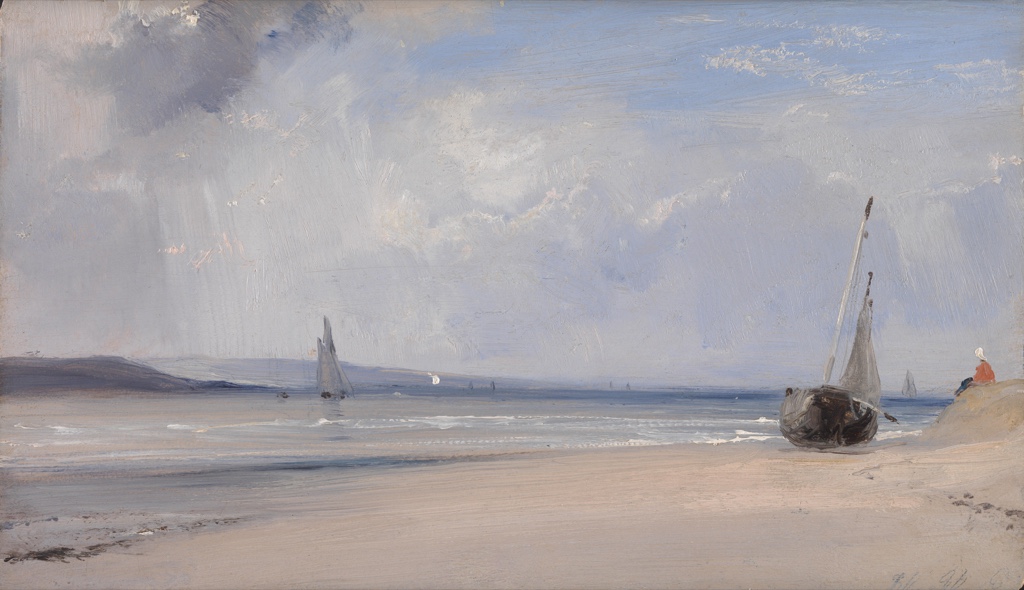
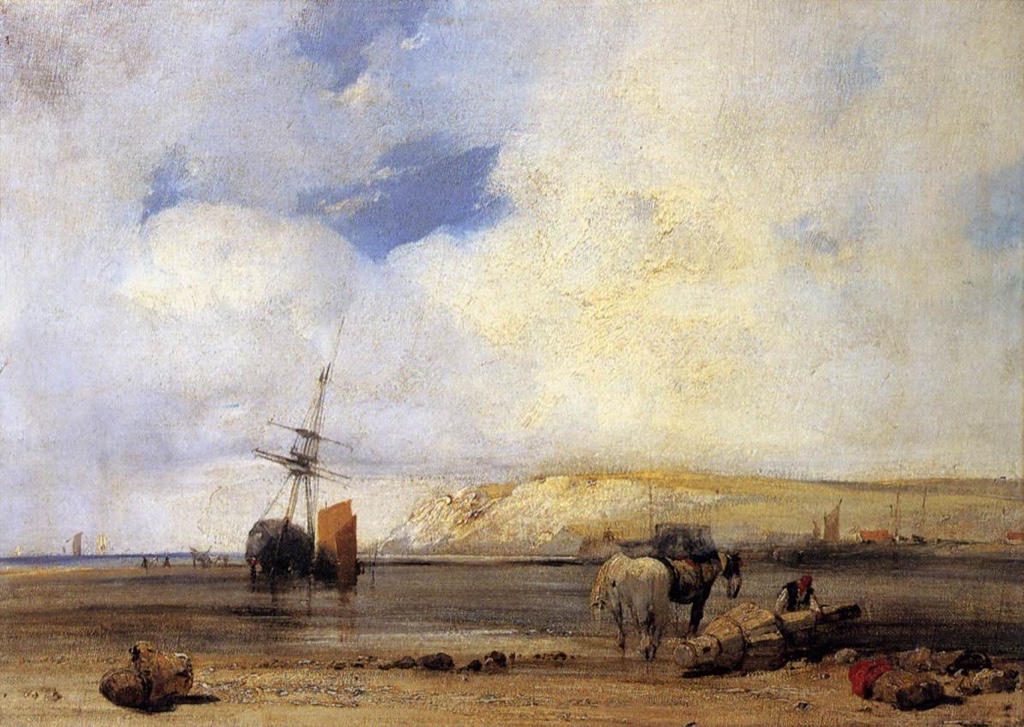
Richard Parkes Bonington’s On the Coast of Picardy makes a large pictorial event from a modest canvas. A low strip of beach, boats and people is held beneath a sky that occupies most of the composition. The setting is active but not crowded: a grounded vessel, a horse, scattered equipment and small figures register coastal work, while distance and light keep the scene open. Painted in 1826, the picture belongs to the Wallace Collection as P341.[1]
Its economy matters. Bonington did not need a named incident or a commanding landmark to give the coast weight. He organised the picture around changing intervals—dark hull against pale distance, upright mast against cloud, compact activity against empty sky—and made the Channel shore feel both observed and composed.
At a Glance
- ArtistRichard Parkes Bonington (1802–1828)
- TitleOn the Coast of Picardy
- Date1826
- MediumOil on canvas
- DimensionsApproximately 36.8 × 50.7 cm
- CollectionThe Wallace Collection, London, P341[1]
Richard Parkes Bonington in context
Seapiece: Off the French Coast
c. 1823–24An Estuary in Northern France
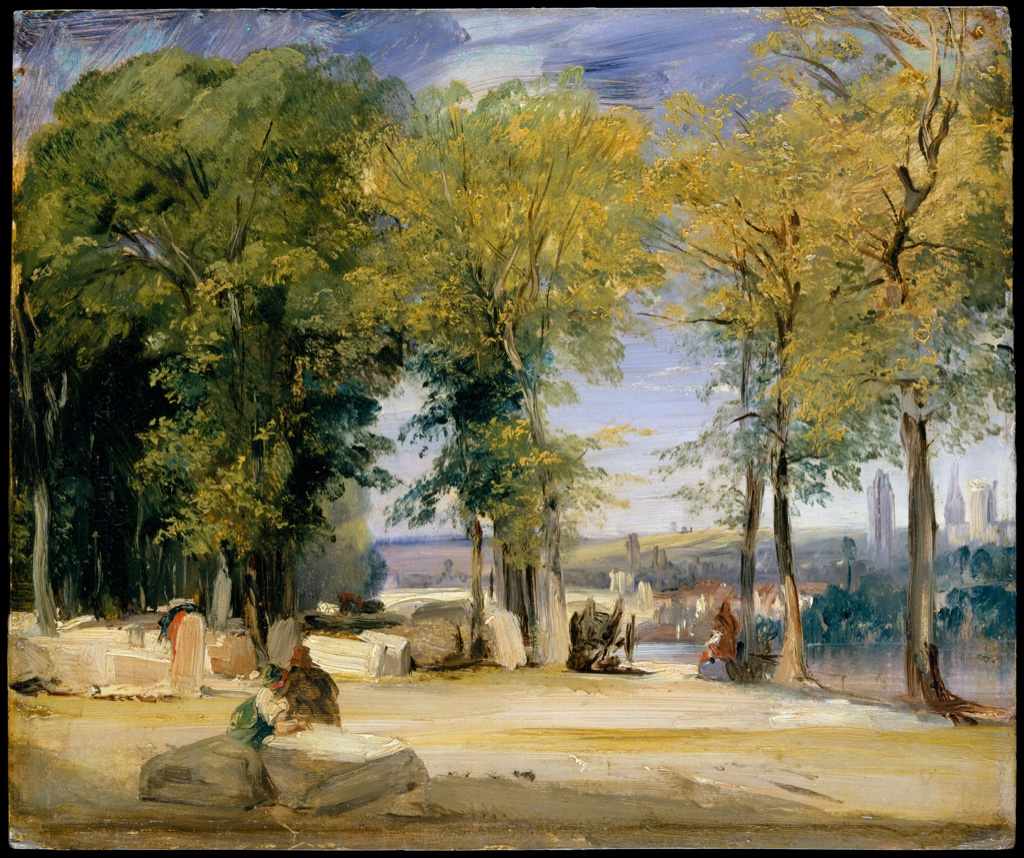
c. 1825–27View near Rouen
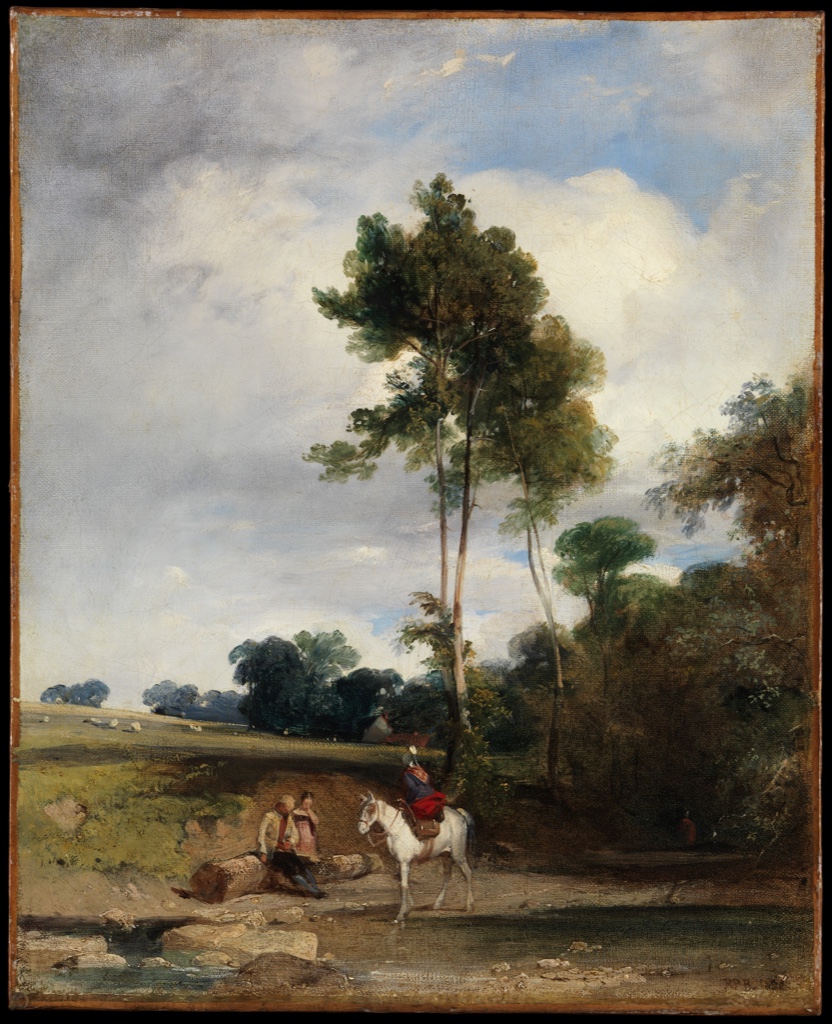
c. 1825Roadside Halt
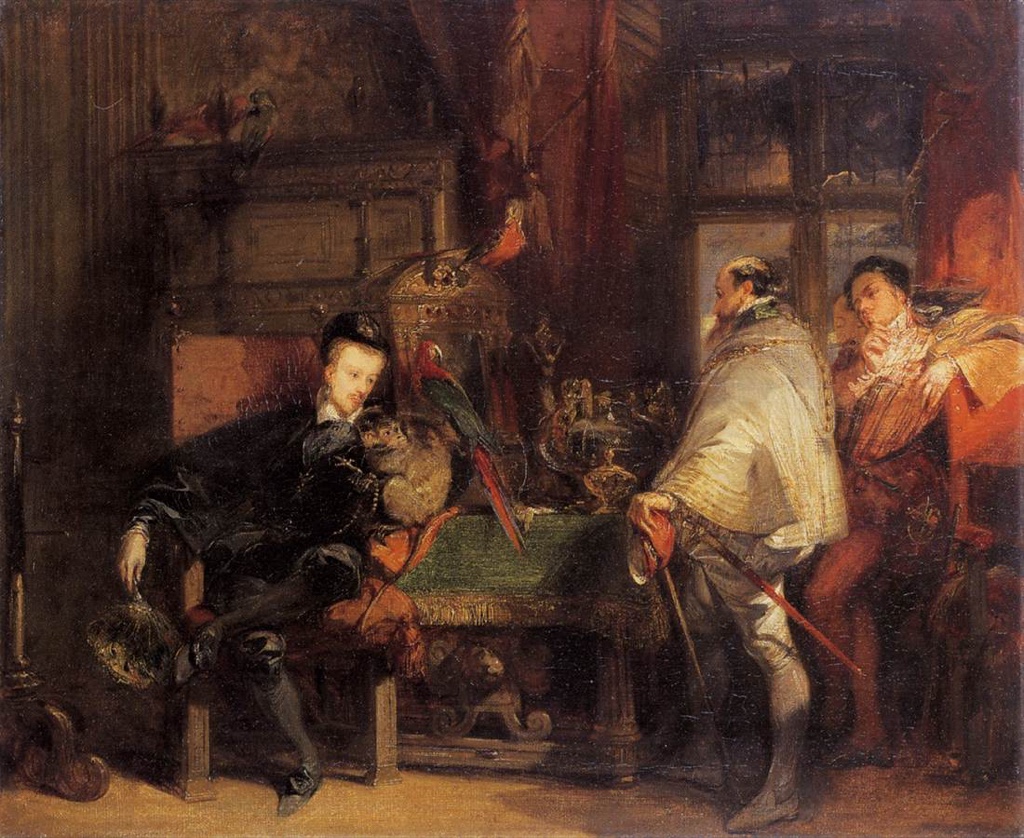
1826Henri III
1828Contents
- Introduction
- A Low Shore Beneath an Expansive Sky
- Picardy as a Working Coast
- Colour and Touch Without Excess Detail
- The Coastal Breakthrough of 1824
- Three Related Pictures, Not One Work
- From Bedford to the Wallace Collection
- A Dialogue with Turner
- A Mature Economy
A Low Shore Beneath an Expansive Sky
The horizon sits low enough for the sky to become the picture’s principal field. Pale cloud spreads across the right and centre, interrupted towards the left by cooler blue-violet openings and denser grey. These shifts do not describe a single, neatly labelled weather condition. Instead, they make the air feel variable. The eye moves through several degrees of brightness before it settles on the narrow land and water below.
Bonington gives that horizontal distance a strong vertical counterweight. Left of centre, the mast and rigging of a dark vessel rise into the cloud. The ship’s compact hull anchors the transition between sea and beach, while its fine upper lines measure the scale of the sky. A long, pale ridge beyond it runs across the middle distance. Farther right, tiny sails and low structures appear as accents rather than fully described objects.
The foreground is broader and darker. Its bands of sand and shallow water draw the gaze laterally, yet the groups are placed asymmetrically. A horse seen mostly from behind stands to the right of centre. Nearby figures bend or stand among a boat and shore equipment; a red note at the far right gives this muted zone a small point of intensity. At the left edge, another low form prevents the foreground from becoming an empty strip. The arrangement suggests work continuing along the tideline without turning any participant into the painting’s hero.
This balance between people and setting is central to Bonington’s paintings. The figures establish scale and occupation, but the coast retains its breadth. They belong to the scene’s rhythm: upright bodies and mast, rounded horse and hull, scattered dark marks across long horizontal bands.
Picardy as a Working Coast
Bonington knew northern France through repeated travel rather than through a single visit. His family moved from England to France in 1817, and he later travelled extensively in Normandy and Picardy.[2] The coast offered mobile subjects—boats, tidal ground, low settlements, workers and changing skies—that could be recombined without losing their local character.
The title On the Coast of Picardy identifies a region, not a securely established viewpoint. That distinction is worth preserving. A later inscription connected with the larger Woburn composition points towards the coast near Calais, but it does not prove that the Wallace picture records one precise site.[3][4] What P341 gives us is a recognisable northern French shore shaped by tides, transport and labour, not a topographical claim that the surviving evidence cannot sustain.
A comparison with An Estuary in Northern France shows how Bonington could vary this coastal vocabulary. The National Gallery’s smaller work is on paper-fibre board and is thought to have been painted at La Ferté, probably on site with fluid oil worked wet into wet.[2] P341, by contrast, is a canvas, and the sources used here do not establish that it was executed outdoors or by precisely the same procedure. The comparison is useful because the pictures share a preference for a low horizon and economical marks, not because one technique should be transferred automatically from one object to another.
The coast also illuminates the cross-Channel setting in which Bonington worked. British watercolour practice, French exhibition culture and direct travel through northern France met in his art, but the result is more specific than the idea of an artist simply “between” two nations. The subject is French, the artist’s formation was divided across languages and institutions, and the work circulated among English patrons. That network is explored further in Bonington and British and French Romanticism.
Colour and Touch Without Excess Detail
P341 depends on a restrained distribution of colour. Cream, grey and muted blue make the sky spacious; ochre and brown hold the beach together; dark accents locate the vessel, figures and equipment. The small red passages near the right edge are effective because they are scarce. They draw attention to human activity without breaking the broad tonal unity.
The handling changes with pictorial function. Long horizontal strokes extend the wet shore and distant coast. Shorter, darker marks condense the working groups. The rigging is finer and more linear, while cloud is carried by larger, softer areas. Bonington therefore creates detail selectively. A viewer can identify a vessel, horse and people, yet much of the picture remains suggestive rather than enumerated.
That selectiveness produces a curious double scale. At roughly half a metre wide, the canvas is intimate, but its sky and lateral distances feel expansive. The effect does not come from adding more information. It comes from allowing relatively few dark forms to set the scale of much larger pale areas. The grounded ship is especially important: its mass makes the surrounding space legible, while the mast connects the working beach to the atmosphere above.
Bonington’s visual shorthand should not be mistaken for carelessness. The distribution of weights is deliberate. Remove the mast and the sky loses its measure; remove the horse and figures and the foreground becomes detached; intensify every distant object and the openness collapses. Pictorial economy here means deciding which marks must remain distinct and which can merge into air, water or sand.
The Coastal Breakthrough of 1824
Coastal painting had brought Bonington public recognition before P341 was made. Patrick Noon’s 2025 supplement records that Bonington returned to oil painting in preparation for the Paris Salon of 1824. His oil debut there comprised five marine and coastal views, and he received a gold medal alongside John Constable, Copley Fielding and Thomas Lawrence.[3]
That history explains why the 1826 canvas belongs to an established line of inquiry rather than an isolated experiment. It does not, however, identify P341 as one of the Salon exhibits. Noon states that only one of Bonington’s five exhibited oils has been securely identified: Tate’s Coast Scene with Fisherfolk.[3] The Wallace picture is dated two years later. Its relation to 1824 is developmental—the same broad class of subject had become central to Bonington’s public reputation—not a claim of exhibition identity.
By 1826, Bonington could compress shore, labour and atmosphere into a composition that reads immediately at a distance and continues to reward close attention. The result feels assured because the principal divisions are clear, not because every part is highly finished. A useful comparison is the different balance of figures and landscape in the same year’s Roadside Halt, where travel unfolds inland rather than along a tidal shore.
Three Related Pictures, Not One Work
The names On the Coast of Picardy and On the Côte d’Opale, Picardy have been attached to three related but physically distinct paintings. Their separation is essential:
- The smaller private picture, On the Côte d’Opale, Picardy, measures 24.2 × 33.1 cm. Noon examined it directly in 2016 and revised his earlier opinion, accepting it as Bonington’s work and dating it to about 1824–25.[3] The auction record documents its separate signature, support, dimensions and ownership history.[4]
- The Wallace Collection picture, On the Coast of Picardy, is P341, dated 1826 and measures approximately 36.8 × 50.7 cm.[1] Noon identifies it as a different oil that the 6th Duke of Bedford purchased from Bonington’s stock during a Paris studio visit in 1826.[3]
- The larger Woburn picture, On the Côte d’Opale, Picardy, measures 66.2 × 99 cm and dates from 1827. Noon considers it likely that Bedford encountered the smaller picture in 1826 and commissioned this larger composition, which was delivered after its exhibition at the Royal Academy the following year.[3]
The proposed sequence therefore runs from the small private treatment, through Bedford’s 1826 purchase of the separate Wallace canvas, to the much larger Woburn commission. “Likely” remains important in describing the commission: it is a scholarly reconstruction, not a documented instruction from patron to artist.[3] The pictures can clarify Bonington’s habit of returning to a coastal idea at different scales, but their titles, dimensions, dates and histories cannot be exchanged.
This distinction also prevents visual evidence from drifting between objects. The signature and technical examination discussed in the auction record concern the smaller private canvas, not P341.[4] Likewise, the 1827 Royal Academy exhibition belongs to the Woburn picture, not to the Wallace painting. P341 has its own identity: a medium-sized 1826 canvas acquired as existing stock.
From Bedford to the Wallace Collection
P341’s collecting history begins with that studio purchase by John Russell, 6th Duke of Bedford. The later auction record states that the 4th Marquess of Hertford bought it at the sale of Bedford’s widow in 1853.[4] It subsequently became part of the Wallace Collection, where its accession number P341 fixes the museum identity now attached to the painting.[1]
The route matters because it joins making and reception. The picture was not merely a private sketch retained in Bonington’s studio: it entered a major English collection during his lifetime, then passed into the Hertford holdings. At the same time, provenance does not change what the object is. Bedford’s later association with the Woburn commission has sometimes encouraged the related compositions to be narrated as one chain. The Wallace canvas was the different work he bought from stock in 1826.[3]
A Dialogue with Turner
Bonington’s coastal art invites comparison with J. M. W. Turner, but the relationship needs careful terms. According to the Wallace Collection, each knew the other’s art from public displays and reproductive prints; the museum frames their exchange as both competitive and mutually influential.[5] Noon’s supplement adds that they probably never met.[3] Admiration is documented; a personal encounter is not.
The connection is especially apt on the Channel shore. Both artists could make low tide, coastal labour and a large sky carry serious pictorial weight. Yet P341 is not a Turner imitation, and shared subject matter does not establish a one-way line of borrowing. Bonington’s compact groups, pale distances and selective accents make their own structure.
Turner’s Calais Sands, Low Water, Poissards Collecting Bait was painted in 1830, after Bonington’s death, and is widely understood as an homage to the younger artist.[3][5] That later work helps show how consequential Bonington’s coastal paintings appeared to a senior contemporary. It does not turn P341 into a preliminary stage on a path towards Turner. The more useful comparison is an active dialogue conducted through visible works: exhibitions, prints, remembered pictures and new responses.
A Mature Economy
On the Coast of Picardy holds together because no single element is asked to carry the entire meaning. The sky creates scale and variability; the grounded vessel gives the distance an anchor; the horse, figures and equipment make the shore a place of work; small colour accents keep the muted foreground alive. Bonington’s achievement lies in coordinating those parts while leaving much of the canvas open.
The picture is therefore neither a mere weather study nor a detailed record of coastal industry. It turns an ordinary shoreline into an exercise in proportion, interval and touch. Its history among related compositions sharpens that reading: Bonington could revisit a subject, alter its scale and reorganise its emphases without treating each return as a duplicate.
Researched works directory
This searchable directory is an online evidence census assembled from public museum and collection records. It is not a substitute for Patrick Noon’s printed catalogues raisonnés.
| Name | Date | Medium |
|---|---|---|
| A Coast Scene | 1820–1828 | Painting |
| A Cutter and other shipping in a Breeze | 1827–1828 | Watercolour |
| A Distant View of St-Omer | 1824 | Painting |
| A Distant View of St-Omer | c. 1824 | Painting |
| A duel between Frank and Rashleigh | 1828 | |
| A Faun with Pipes | Date unknown | Drawing |
| A Seascape | Date unknown | Drawing |
| A Venetian Scene | c. 1828 | Watercolour |
| A Wooded Stream and a Farmhouse in Normandy | Date unknown | Drawing |
| Abbeville - Vue Pris, de la route de Calais | Date unknown | |
| Abbey St-Amand, Rouen | Date unknown | Watercolour |
| An Estuary in Northern France | c. 1825–1827 | Painting |
| An Italian Town | 1822–1828 | Painting |
| Ancienne Porte a Stirling | 1826 | |
| Ancienne Tour | 1826 | |
| Ancienne Tour Près de Lanark | 1826 | |
| Anne Page and Slender (Shakespeare's Merry Wives of Windsor, Act 1, Scene 1) | 1829 | Artwork |
| Architectural Remains and Fragments: Rouen - Fontaine de la Crosse | 1827 | |
| Architecture du Moyen Age | 1824 | |
| Argyle Castle | 1826 | |
| Argyle Castle | 1828 | |
| At the English Coast | 1825 | Watercolour |
| Beach Scene | c. 1825 | Watercolour |
| Beach Scene with Cart and Horse | 1825 | Painting |
| Beached Vessels and a Wagon, near Trouville, France | c. 1825 | Painting |
| Beauvais - interieur d'une cour | Date unknown | |
| Bergues - La Tour du March, | Date unknown | |
| Bergues: La Tour du marché | 1824 | |
| Boccadasse, Genoa with Monte Fasce in the Background | 1826 | Painting |
| Bologna | 1826–1827 | Drawing |
| Bologna | 1828 | |
| Bonington - Vue de Venise | Date unknown | Watercolour |
| Bothwell Castle | 1826 | |
| Bothwell Castle | 1828 | |
| Boulogne Harbor | 1823 | Watercolour |
| Bracklin-Bridge | 1828 | |
| Brackline | 1826 | |
| Caen - Eglise Saint-Sauveur | 1824 | Drawing |
| Caen - Maison Grande Rue Saint-Pierre | Date unknown | Drawing |
| Calais Jetty, France | c. 1824 | Painting |
| Campos sur les bords du Rio das Velhas | 1827 | |
| Castle on a Scottish Loch | 1822–1828 | Painting |
| Cathedrale Notre-Dame | 1824 | |
| Charles V visits François Ier after the Battle of Pavia | c. 1827 | Watercolour |
| Chateau d'Argyle | 1826 | |
| Chateau de Bothwell | 1826 | |
| Chateau de Bothwell / Bothwell Castle | 1826 | |
| Christ preaching - unfinished | Date unknown | Painting |
| Coast Scene in Picardy, France | 1826 | Painting |
| Coastal Scene with Fishing Boats | 1828 | Painting |
| Croix de Moulin-les-Planches | 1827 | |
| Demetrius de Palatiano | 19 th century | Painting |
| Die adriatische Küste | c. 1820 | Painting |
| Die normannische Küste | 1823–1824 | Painting |
| Dieppe Harbour | Date unknown | Painting |
| Don Quixote | 1825–1826 | Painting |
| Don Quixote in His Study | 1825–1826 | Painting |
| Doune Castle | 1828 | |
| Du Sacristain de Saint Angadresne | c. 1828 | |
| Dutch: Processie in Verona | 1801–1828 | Painting |
| Edimbourg pris de la Chapelle St Antoine | 1826 | |
| Edimbourg vu de Calton-Hill | 1826 | |
| Edimbourg vu de la Chapelle Saint-Antoine | 1826 | |
| Edinbourgh vu de la Chapelle S. Antoine | 1826 | |
| Edinburg from S. Anthony Chapel | 1828 | |
| Edinburgh from St. Anthony Chapel | 1826 | |
| Edinburgh from the Calton Hill | 1828 | |
| Eglise de Saint-Taurin, Evreux | 1824 | |
| Eglise de St. Jean a Lyons | 1824 | |
| Eglise St. Sauveur | 1824 | |
| Embouchure de la Riviere Caxoera | 1827 | |
| Entree de la rade de Rio-Janeiro | 1827 | |
| Entrée de la salle des pas-perdus, Palais de Justice | 1824 | |
| Evening in Venice | 1826–1828 | Painting |
| Façade de l'Eglise de Brou | 1825 | |
| Façade St. Jean | 1824 | |
| Figures on a rocky shoreline | Date unknown | Artwork |
| Fishing Boats in a Calm, Ships at Anchor | 1825 | Painting |
| Fishing Smacks in French Harbour | 1818–1825 | Painting |
| Five Studies of a French Pointer | 1825–1826 | Drawing |
| Fontaine de la Crosse | 1827 | |
| French Coast Scene | 1815–1828 | Painting |
| French Coast with Fishermen | 1825 | Painting |
| French Hulk | 1820–1828 | Painting |
| German: Ein Waldweg | 1825–1826 | Painting |
| Glenfinlas | 1826 | |
| Glenfinlas | 1828 | |
| Glenfinlas Valley (Vallée de Glenfinlas, from Vues Pittoresques de l'Écosse) | 1826 | Artwork |
| Goetz Von Berlichingen Before The Imperial Magistrate | c. 1826 | Drawing |
| Grand Canal, Venice | 1826 | Drawing |
| Greek Armatole (irregular fighter). | 1825 | Painting |
| Half-length Portrait of a Bearded Man in Historical Dress | 1818 | Drawing |
| Henri III | 1828 | Painting |
| Hôtel de Sens : dessin / Richard-Parkes Bonington | 19 th century | Drawing |
| Ile de la Cite | Date unknown | Watercolour |
| In the Forest of Fontainebleau | c. 1825 | Painting |
| Intérieur d'une Cour | 1824 | |
| Jour du Marché | 1824 | |
| L'Eglise de St. Gervais et St. Protais | 1824 | |
| L'espace | c. 1826 | Painting |
| La Conversation | 1826 | |
| La Place du Molard, Geneva | Date unknown | Painting |
| La Prière | 1826 | |
| La Tour du Marché | 1824 | |
| Lac de Killin | 1826 | |
| Lac Lomond | 1826 | |
| Landscape with a Pond | 1825–1826 | Painting |
| Landscape with Castle Ruin | Date unknown | Watercolour |
| Le Château de la Duchesse de Berry | 1823–1825 | Painting |
| Le matin | 1824 | |
| Le Repos | 1826 | |
| Le Retour | 1826 | |
| Le Silence Favorable | 1826 | |
| Les Pendus | 1826 | |
| Les Plaisirs Paternels | 1826 | |
| Les Salinieres near Trouville | 1827–1828 | Painting |
| Lillebonne - Chateau d'Harcourt | 1824 | |
| Lillebonne - Chateau d'Harcourt | Date unknown | |
| Loch Lomond | 1826 | |
| Loch Lomond | 1828 | |
| Loch Tay | 1828 | |
| Lochkillin | 1826 | |
| Low Tide at Boulogne | 1824 | Painting |
| Maison Grande Rue St. Pierre | 1824 | |
| Maison Située Rue St Veronique | 1824 | |
| Man and Woman in a Landscape, possibly Faust and Marguerite | c. 1826 | Drawing |
| Molard-Bonington-1829 | 1829 | |
| Molard-Bonington-1829-cropped | 1829 | |
| Near Honfleur | 1823 | Watercolour |
| Near Jumieges | Date unknown | Watercolour |
| Old Gate Way at Stirling | 1828 | |
| Old Gateway at Stirling | 1826 | |
| Old Tower near Lanark | 1828 | |
| On the Adriatic | c. 1826 | Painting |
| On the Coast of Picardy | 1826 | Painting |
| On the Seine – Morning | 1825 | Painting |
| Palais de Justice, Rouen | Date unknown | Drawing |
| Paris from Pere Lachaise | Date unknown | Watercolour |
| Pays de Caux: Twilight | 1818–1828 | Painting |
| Peasant Women from Ragusa | 1826 | Drawing |
| Pesmes | 1825 | |
| Peveril of the Peak - Julian Peveril and Alice Bridgenorth, surprised by Major Ralph Bridgenorth | c. 1826 | Watercolour |
| Picardy Coast with Children – Sunrise | c. 1826 | Painting |
| Picturesque Views of Scotland: Brackline | 1826 | |
| Pierre de Vaivre | 1827 | |
| Polish: Zdjęcie z krzyża The Descent from the Cross. | 1820 | Painting |
| Portia and Bassanio | c. 1826 | Watercolour |
| 1827 | ||
| print, title-page | 1828 | |
| Processie in Verona | 19de eeuw | Painting |
| Promenade vénitienne (Venetian Promenade) | Date unknown | Artwork |
| Quentin Durward and the Disguised Louis XI (recto); Study of male figure (verso) | 1825–1826 | Drawing |
| Quentin Durward at Liège, Belgium | 1827–1828 | Painting |
| Quentin Durward in Luik, objectnr TA 11006 | 1825 | Drawing |
| Restes et Fragmens d'Architecture du Moyen Age: Église St. Sauveur, Caën | Date unknown | |
| Riva degli Schiavoni, from near San Biagio, Venice, by Richard Parkes Bonington | Date unknown | Painting |
| Road Workers, near Lillebonne | Date unknown | Painting |
| Roadside Halt | 1826 | Painting |
| Robert Dudley, Earl of Leicester and his wife Amy Robsart. | 1820 | Painting |
| Rouen | 1825 | Watercolour |
| Rouen: Entrée de la Salle des Pas Perdus, Palais du Justice | 1824 | |
| Rue du gros-horloge, Rouen | 1824 | |
| Ruines de Chateau d'Arlay | 1827 | |
| Ruines du Château d'Arlay | 1827 | |
| Ruins of the Abbey Saint Bertin | 1824 | Painting |
| Sea Coast, the Dunes | Date unknown | Painting |
| Seapiece: Off the French Coast | c. 1823–1824 | Painting |
| Shipping in a Swell | 1824–1827 | Watercolour |
| Shipping in an Estuary, Probably near Quilleboeuf | 1825–1826 | Watercolour |
| Sketch of a Woman | 1828 | Drawing |
| Street in the Outskirts of Besançon, France | 1827 | |
| Studies for Shylock | 1825 | Drawing |
| Study of a Gentleman in 17th Century Costume, After Van Dyck | 1827–1828 | Drawing |
| Study of a Seated Woman | Date unknown | Drawing |
| Study of a Woman with her Head on her Hand | Date unknown | Drawing |
| Sunset: A Sketch | Date unknown | Painting |
| Sunset in the Pays de Caux | 1828 | Watercolour |
| The Antiquary | Date unknown | Painting |
| The Chibouk | 1826 | Painting |
| The Church of St. Wulfran, Abbeville: The North Door of the West Front | c. 1823 | Drawing |
| The Count of Palatino in the costume of a Palikar | Date unknown | Painting |
| The Doge's Palace, Venice | 1826 | Painting |
| The Escape from Argyle Castle | 1826 | |
| The Escape from Argyle-Castle | 1828 | |
| The Grand Canal | 1826–1827 | Painting |
| The Grand Canal, Venice | 1826–1827 | Painting |
| The Interior of Sant' Ambrogio, Milan | 1826 | Painting |
| The Old Jetty, Boulogne, France | Date unknown | Painting |
| The Pont des Arts, Paris | 1826 | Painting |
| The Proposal (recto); Unfinished drawing of a horse and rider (verso) | 1820 | Drawing |
| The Rialto, Venice | Date unknown | Painting |
| The Salt Marshes near Trouville | 1826 | Watercolour |
| The Use of Tears | 1827 | Watercolour |
| The Use of Tears | Date unknown | Painting |
| Titlepage to Restes et Fragments | Date unknown | |
| Tomb in the Church of Saint-Omer, France | Date unknown | Painting |
| Tombeau de Marguerite de Bourbon, Eglise de Brou | 1825 | |
| Tour aux archives à Vernon | 1824 | |
| Tour du gros horloge, batie sous la domination des Anglais en 1417, Evreux | 1824 | |
| Tour du gros-horloge, Evreux | 1824 | |
| Trees and a Cottage by a River | 1827 | Drawing |
| Untitled (one of three) | Date unknown | |
| Vessels in a Choppy Sea | c. 1824 | Watercolour |
| View in Brittany: Bridge, Cottages and Washerwomen | 1818–1828 | Painting |
| View near Rouen | c. 1825 | Painting |
| View near Sarzana, Val di Magra | 1826 | Painting |
| View of the Rialto Bridge, Venice | c. 1826 | Watercolour |
| View on the Grounds of a Villa near Florence | 1826 | Painting |
| View on the River Seine - Morning | c. 1825 | Painting |
| Voyages pittoresques et romantiques dans l'ancienne France | 1825 | |
| Voyages pittoresques et romantiques dans l'ancienne France, Franche-Comté: Église de l'abbaye de Tournus | 1825 | |
| Voyages pittoresques et romantiques dans l'ancienne France, Franche-Comté: Ruines du château d'Arlay | 1825 | |
| Voyages pittoresques et romantiques dans l'ancienne France, Franche-Comté: Vue d'une rue des faubourgs de Besançon | 1825 | |
| Voyages pittoresques et romantiques dans l'ancienne France, Normandie: Église de Saint Gervais et Saint Protais à Gisors | 1824 | |
| Voyages pittoresques et romantiques dans l'ancienne France, Normandie: Rue du Gros Horloge, Rouen | 1824 | |
| Voyages pittoresques et romantiques dans l'ancienne France, Normandie: Tour aux archives à Vernon | 1824 | |
| Voyages pittoresques et romantiques dans l'ancienne France, Normandie: Tour du Gros-Horloge, Evreux | 1824 | |
| Vue d'une rue des faubourgs de Besançon | 1827 | |
| Vue d'une rue des Faubourgs de Besançon (View of a Street in the Outskirts of Besançon) | 1827 | |
| Vue Generale de l'Eglise de l'Abbaye de Tournus | 1825 | |
| Vue Générale de l'Eglise de St. Gervais et St. Protais, à Gisors | 1824 | |
| Vue Generale des Ruines du Chateau d'Arlay | 1827 | |
| Vue prise à l'entrée du jardin des Plantes. Au premier plan, bâtiment de la minéralogie et à l'arrière, dôme de l'hôpita, D.2182 | 1806–1828 | Drawing |
| Vue Prise de la Route de Calais | 1824 | |
| Vues Pittoresques de l'Écosse | 1826 | |
| Young Woman Writing a Letter | 1820–1828 | Painting |
Frequently Asked Questions
The title places the scene on the Picardy coast of northern France, but the surviving evidence does not securely identify one exact viewpoint. A “near Calais” association belongs to evidence surrounding the larger Woburn composition and should not be transferred automatically to P341.[3][4]
The Wallace Collection picture is dated 1826.[1] It comes after Bonington’s coastal success at the Paris Salon of 1824 and before the larger Woburn On the Côte d’Opale, Picardy of 1827.[3]
No. P341 is a canvas of approximately 36.8 × 50.7 cm. The smaller private painting measures 24.2 × 33.1 cm and is dated about 1824–25, while the Woburn picture measures 66.2 × 99 cm and dates from 1827.[1][3]
No evidence identifies it as a Salon work. Bonington exhibited five marine and coastal oils in 1824, but Noon reports that only Tate’s Coast Scene with Fisherfolk has been securely matched to that group.[3] P341 is dated 1826.[1]
Discussion
Use this evidence-led guide as a starting point for close looking rather than a final verdict.
Share an observation about On the Coast of Picardy or a source that adds useful context.
Reader Insights
Which passage of paint most changes your reading of On the Coast of Picardy?
How does the support, scale or known setting affect the way you interpret the work?
What remains uncertain when museum evidence is separated from visual inference?
Join the Conversation
Add your reading below, keeping observations specific and evidence clear.
References
- Wikimedia Commons, “Richard Parkes Bonington (1802–1828) — On the Coast of Picardy — P341 — The Wallace Collection,” Art UK-origin object metadata and public-domain file record,, accessed 30 August 2026.
- National Gallery, London, “Richard Parkes Bonington, An Estuary in Northern France, about 1825–7,”, accessed 30 August 2026.
- Patrick Noon, “A supplement to Richard Parkes Bonington, the Complete Paintings,” Colnaghi Studies Journal XVII, October 2025, pp. 61–76, especially pp. 67–68,, accessed 30 August 2026.
- Christie’s, “Richard Parkes Bonington, On the Côte d’Opale, Picardy,” lot record,, accessed 30 August 2026.
- Wallace Collection, “Turner and Bonington,”, accessed 30 August 2026.