 by Tom Gurney
Tom Gurney BSc (Hons) is an art history expert with over 20 years experience
Page Created on August 30, 2026 / Page Updated on November 6, 2026
Email: tomgurney1@gmail.com / Phone: +44 7429 011000
Richard Parkes Bonington Watercolours and Drawings: Introduction
Richard Parkes Bonington’s works on paper were not a secondary activity beside his oil paintings. Watercolour shaped how he observed weather, distance and architecture; drawing helped him gather, organise and transform visual information; lithography carried his designs into books and portfolios. A single subject might pass through several of these forms, yet no simple sequence explains the whole practice. Some sheets record a place, some prepare another work, and some are highly resolved pictures intended to stand on their own.
At a Glance
- Central mediumBonington established his reputation as a watercolourist before his mature work in oil.[5]
- MaterialsHis sheets combine transparent watercolour with graphite, pen and ink, black chalk, opaque bodycolour or gouache, and sometimes gum arabic.[3][7][9]
- SubjectsCoasts, rivers, medieval buildings, towns, travellers and historical or literary figures all appear on paper.[2]
- TravelTours through Normandy and, in 1826, Switzerland and northern Italy supplied subjects and observations.[1][3]
- Print cultureDrawings could be adapted for lithographs and other reproductive prints in illustrated publications.[3][6]
- CataloguePatrick Noon’s 2011 catalogue raisonné, Richard Parkes Bonington: The Complete Drawings, records and reproduces more than 400 accepted drawings.[1]
Selected works and routes into the drawings
Contents
- Introduction
- Why Watercolour Came First
- Travel and Working from the Motif
- Transparent Wash, Bodycolour and Surface
- Drawing Architecture
- Lithography and Picturesque Publications
- The Italian Sheets of 1826 and After
- Drawing, Watercolour and Oil
- Selected Works and Where to Look
- How to Look at a Bonington on Paper
Why Watercolour Came First
Bonington’s command of watercolour was established during his formation between Britain and France. The British Museum identifies him as a painter, watercolourist and lithographer, and its collection links hundreds of records to him across drawings and prints as well as paintings.[2] That range matters: “Bonington the watercolourist” is accurate, but it should not narrow him to one material or one kind of object.
The earliest mature sheets already show watercolour serving several purposes at once. It could register the broad division of sky, land and water quickly, while graphite and ink secured a skyline, a vessel or the joints of a building. It could also be carried to a degree of finish that made the sheet an independent picture. This dual capacity—rapid enough for travel, rich enough for exhibition or sale—suited an artist whose career developed through repeated movement between Paris, the Channel coast, Normandy and Britain.
Watercolour also offered a visual education different from the figure-centred routines of an academic studio. Its light is often the light of the paper itself, left open beneath thin colour. Darker passages can be built without closing every interval, so air and distance remain active parts of the image. Bonington later brought comparable economy into oil, but that exchange does not make the watercolours rehearsals. His work in oil is best considered alongside, not above, the works on paper; the paintings reveal how freely lessons moved in both directions.
Travel and Working from the Motif
Travel gave Bonington subjects, but it did not require him to complete every picture outdoors. A sheet made before a church, river or harbour could preserve the essential structure of the view: the height of a tower, a sweep of cloud, the relationship between quay and water. Later work could refine, combine or alter that information. The Wallace Collection describes its finished watercolours by Bonington and J. M. W. Turner as studio works based on sketches made during extended study trips.[5]
That distinction helps avoid two opposite mistakes. The first is to imagine every loose wash as an instantaneous transcript of nature. The second is to treat any studio finish as evidence that direct observation no longer mattered. Bonington’s practice joins the two. His travel drawings gave him an observed vocabulary of coastlines, shipping, streets and masonry; selection and reworking gave those observations pictorial order.
The Normandy tours were especially productive. A British Museum view of Rouen from about 1822 is a large sheet in watercolour over graphite, reinforced with pen and brown ink. It was subsequently adapted, with changes, for Bonington’s 1824 lithographic series Restes et Fragmens d’Architecture du Moyen Age.[3] The sheet is therefore both an accomplished view and a “print study” in the museum’s classification. Its identity is not reduced by either term.
Transparent Wash, Bodycolour and Surface
Bonington’s watercolour technique is better understood as a flexible range than as a formula. In transparent passages, diluted colour allows the paper to contribute brightness. Washes can join large zones quickly, particularly in sky, distant town and water. Against them, pen lines or the point of a fine brush can specify masts, figures, rooflines and windows. Graphite may remain visible beneath the colour, functioning as a framework rather than something to conceal.
The Metropolitan Museum of Art’s Rouen, View from Bon-Secours of 1821–22 makes the combination unusually clear. The small sheet uses watercolour with pen and brown ink over graphite. Broad wet washes establish the sunlit atmosphere, while dark accents and fine marks articulate the cathedral, distant masts and tiny figures. The Met also notes that a version of the view was reproduced in aquatint for a Normandy publication issued in 1823–25.[4] A compact watercolour could thus carry both atmospheric breadth and information precise enough to migrate into print.
Bonington also used opaque additions. Bodycolour—water-based pigment made less transparent by a higher pigment load or the addition of white—can place light colour over a darker passage. Gouache provides related opacity. Gum arabic, the binder ordinarily associated with watercolour, can be used in greater concentration to enrich or gloss selected areas. These additions change how a sheet catches light: brightness need not come only from untouched paper, and a dense foreground can answer the visual weight of an oil painting.
The Wallace Collection describes Bonington’s Rouen of about 1825 as using bodycolour and gum arabic to obtain richer effects, especially among the foreground details.[5] This is not evidence that watercolour was trying to become an inferior oil. It shows the medium being extended on its own support. Transparency creates openness; opaque touches provide weight, highlights and texture. Their contrast is part of the design.
Drawing Architecture
Buildings gave Bonington a demanding test of selection. Medieval churches, gates, towers and timbered houses contain more information than any small sheet can comfortably hold. Exact description therefore had to coexist with omission. A few decisive verticals can stabilise a view; an arch or roofline can identify a structure; figures and carts can establish scale without turning the image into an inventory of stonework.
The Rouen drawing in the British Museum demonstrates how this architectural work grew from travel and entered print. The cathedral rises above the riverfront rather than appearing as an isolated monument. Quay, boats, houses and distant tower belong to one urban environment. The museum relates the sheet to Bonington’s 1821 Normandy tour and notes that the lithographed version introduced variations.[3] Translation into print was therefore an act of adjustment, not mechanical copying.
A later work at the Louvre shows another kind of return. Manoir rue Sainte-Véronique à Beauvais, signed and dated 1828, combines black chalk, watercolour and gouache on a sheet measuring 18.2 by 12.2 centimetres. The Louvre explains that Bonington drew on an earlier design associated with his architectural publication but transformed the building and its setting in the later watercolour, opening part of the composition towards a wooded park and using warmer colour in the masonry.[9] The late sheet is neither simply documentary nor merely preparatory: it revisits architectural knowledge to make a new, finished image.
Architecture also connects Bonington’s paper practice to the wider appetite for historic places in the 1820s. Illustrated surveys brought medieval France to readers who might never travel there. His drawings could preserve structures already vulnerable to alteration while also shaping them for picturesque effect. To recognise that shaping is not to dismiss the evidence of place; it is to see the artist choosing what a picture needs.
Lithography and Picturesque Publications
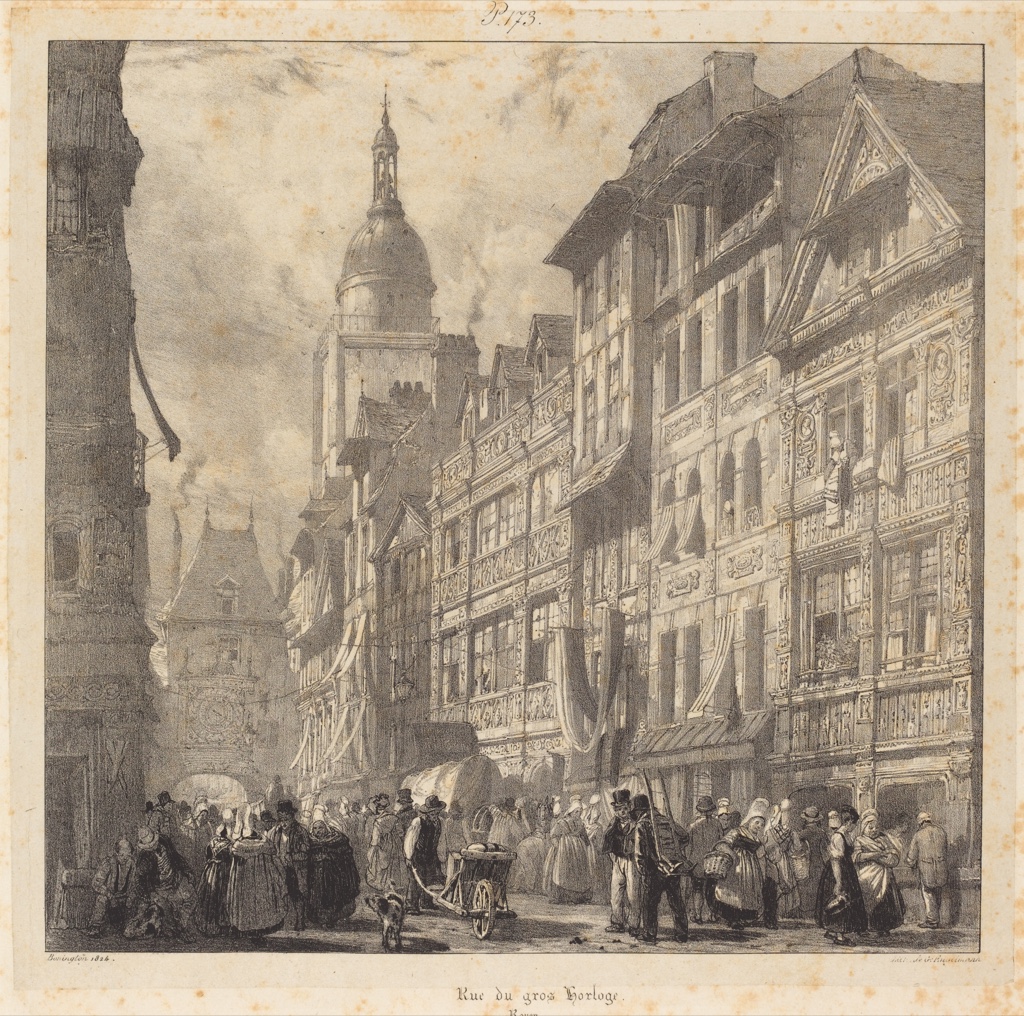
Lithography placed Bonington at the meeting point of drawing, travel and publishing. The British Museum’s Rouen record gives one route into that practice: it classifies the watercolour as a print study and states that Bonington later lithographed the subject with alterations for Restes et Fragmens d’Architecture du Moyen Age.[3] The finished printed image therefore depended on adaptation as well as observation.
Bonington contributed architectural subjects to large picturesque projects and issued designs in his own architectural series. Authorship within such print culture needs careful wording. A print can be drawn on the stone by Bonington, based on another artist’s design, printed by a specialist and published as part of a named series. The Met’s Edimbourg pris de la Chapelle St. Antoine is a useful example: Bonington made the 1826 lithograph after a drawing by François-Alexandre Pernot, the printer was Villain, and the impression belongs to Vues Pittoresques de l’Écosse. The museum identifies it as a lithograph on chine collé and as the second of three states.[6]
That record guards against treating every printed view as direct evidence of Bonington standing before its subject. It also shows that printmaking was not marginal busywork. Through lithography, his handling of architecture and landscape entered repeatable sequences, circulated among readers and participated in a cross-Channel market for picturesque travel. This publishing context is one strand of the broader British and French Romanticism surrounding his work.
The Italian Sheets of 1826 and After
Bonington’s 1826 journey through Switzerland and northern Italy expanded his architecture from northern French churches and houses to Italian streets, squares and lagoon views. The Paul Mellon Centre’s description of Noon's Complete Drawings specifically highlights sheets made during this journey among the more than 400 works catalogued.[1] That publisher’s summary establishes their importance without requiring claims about entries that are not available online.
At the Louvre, La Piazza del Nettuno à Bologne is securely dated 1826 and made with watercolour, gouache and gum arabic on wove paper. The museum records the sheet at only 12.4 by 17.8 centimetres and notes that Bonington and his travelling companion Charles Rivet reached Bologna on 20 May, after leaving Venice the previous day.[7] Its compact scale and mixed water-based materials embody the portability and density that the Italian journey demanded.
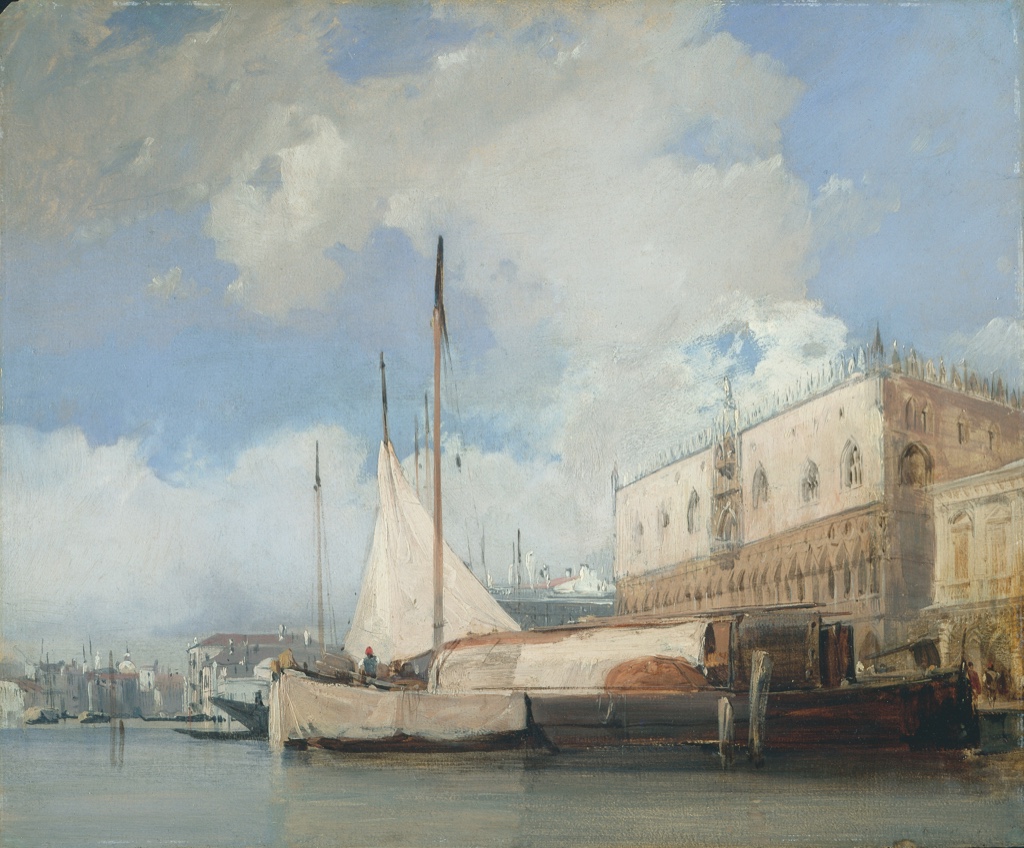
Venice generated a more extended traffic between notation and finished composition. The Louvre preserves a small pen-and-brown-ink drawing, about 10.2 by 16.1 centimetres, showing the Riva degli Schiavoni, the Doge’s Palace and the Piazzetta. The museum identifies it as preparatory to a Louvre painting commissioned from Bonington in 1827 and relates it to a larger version at Tate Britain; it also cross-references the sheet as number 301 in Noon's catalogue of drawings.[8] That number is the Louvre’s bibliographic statement, not a substitute for consulting the catalogue entry itself.
The drawing’s spare means are a reminder that preparation does not always resemble a small coloured copy of the final painting. Pen can fix spatial intervals and the sequence of buildings while leaving colour and surface for another stage. To follow this subject into oil, see The Doge’s Palace, Venice. The relationship is informative precisely because the drawing and painting do different jobs.
Drawing, Watercolour and Oil
Categories in collection records are useful, but Bonington’s process often crosses their borders. A graphite structure may sit beneath transparent colour; a watercolour may be called a drawing because it belongs to a prints-and-drawings collection; a study may already be an impressive picture; an oil may retain the lightness associated with wash. Medium, function and degree of finish answer different questions.
It is therefore safer to ask what a particular object does. Does it test a figure or architectural alignment? Does it preserve observations from travel? Was it adapted for a print? Does it build an autonomous composition through layered washes and opaque accents? Is it related to a painting without being its direct preparatory study? These questions keep differences visible.
They also clarify the exchange with oil. Bonington did not graduate from watercolour and leave it behind. The Wallace Collection’s comparison of Normandy and Venice works describes continued movement between sketching tours, finished studio watercolours and oil painting; its display placed five watercolours of Normandy and Venice in dialogue with Turner, works normally protected from prolonged light exposure.[10] The value of the comparison lies in close technical and compositional choices, not in making Bonington a smaller version of J. M. W. Turner.
Selected Works and Where to Look
A useful first group begins with the two Rouen sheets. The Met’s Rouen, View from Bon-Secours is small, open and atmospheric, whereas the British Museum’s river view is larger, architecturally insistent and directly connected to a later lithograph.[3][4] Together they show why “watercolour” does not describe a single finish.
The Louvre offers a second comparison. The Bologna watercolour uses colour, gouache and gum arabic to compress a public square into a portable format; the Venice study uses only pen and brown ink to organise a celebrated waterfront; the 1828 Beauvais manor returns to an earlier architectural idea with renewed colour and transformation.[7][8][9] One institution thus preserves travel work, preparation and late reinvention.
The Wallace Collection holds an especially important group of finished watercolours, including Normandy and Venice subjects, but such works are not continuously shown because light can damage works on paper. Its 2023–24 display was the first presentation of the group in seventeen years.[10] The British Museum and the Met likewise mark many individual sheets as not on display. Before travelling, consult each museum’s current object record rather than assuming that a work in the collection will be hanging.
How to Look at a Bonington on Paper
Begin with the paper. Where has Bonington allowed it to remain visible, and where has he covered it with wash or bodycolour? Then separate the broad and fine registers: a sky or haze may be made from joined wet passages, while rigging, windows and figures depend on small accents. Look for graphite or ink beneath the colour, especially where a building needs structural clarity.
Next, consider function without deciding too quickly. A sheet related to a print or painting can still be complete as an encounter with line, colour and surface. Compare repeated subjects for changes rather than searching for a single definitive version. Finally, remember that current colour may not reproduce the work’s original balance exactly. Works on paper are sensitive objects, and museum display limits are part of their material history.
Researched works directory
This searchable directory is an online evidence census assembled from public museum and collection records. It is not a substitute for Patrick Noon’s printed catalogues raisonnés.
| Name | Date | Medium |
|---|---|---|
| A Coast Scene | 1820–1828 | Painting |
| A Cutter and other shipping in a Breeze | 1827–1828 | Watercolour |
| A Distant View of St-Omer | 1824 | Painting |
| A Distant View of St-Omer | c. 1824 | Painting |
| A duel between Frank and Rashleigh | 1828 | |
| A Faun with Pipes | Date unknown | Drawing |
| A Seascape | Date unknown | Drawing |
| A Venetian Scene | c. 1828 | Watercolour |
| A Wooded Stream and a Farmhouse in Normandy | Date unknown | Drawing |
| Abbeville - Vue Pris, de la route de Calais | Date unknown | |
| Abbey St-Amand, Rouen | Date unknown | Watercolour |
| An Estuary in Northern France | c. 1825–1827 | Painting |
| An Italian Town | 1822–1828 | Painting |
| Ancienne Porte a Stirling | 1826 | |
| Ancienne Tour | 1826 | |
| Ancienne Tour Près de Lanark | 1826 | |
| Anne Page and Slender (Shakespeare's Merry Wives of Windsor, Act 1, Scene 1) | 1829 | Artwork |
| Architectural Remains and Fragments: Rouen - Fontaine de la Crosse | 1827 | |
| Architecture du Moyen Age | 1824 | |
| Argyle Castle | 1826 | |
| Argyle Castle | 1828 | |
| At the English Coast | 1825 | Watercolour |
| Beach Scene | c. 1825 | Watercolour |
| Beach Scene with Cart and Horse | 1825 | Painting |
| Beached Vessels and a Wagon, near Trouville, France | c. 1825 | Painting |
| Beauvais - interieur d'une cour | Date unknown | |
| Bergues - La Tour du March, | Date unknown | |
| Bergues: La Tour du marché | 1824 | |
| Boccadasse, Genoa with Monte Fasce in the Background | 1826 | Painting |
| Bologna | 1826–1827 | Drawing |
| Bologna | 1828 | |
| Bonington - Vue de Venise | Date unknown | Watercolour |
| Bothwell Castle | 1826 | |
| Bothwell Castle | 1828 | |
| Boulogne Harbor | 1823 | Watercolour |
| Bracklin-Bridge | 1828 | |
| Brackline | 1826 | |
| Caen - Eglise Saint-Sauveur | 1824 | Drawing |
| Caen - Maison Grande Rue Saint-Pierre | Date unknown | Drawing |
| Calais Jetty, France | c. 1824 | Painting |
| Campos sur les bords du Rio das Velhas | 1827 | |
| Castle on a Scottish Loch | 1822–1828 | Painting |
| Cathedrale Notre-Dame | 1824 | |
| Charles V visits François Ier after the Battle of Pavia | c. 1827 | Watercolour |
| Chateau d'Argyle | 1826 | |
| Chateau de Bothwell | 1826 | |
| Chateau de Bothwell / Bothwell Castle | 1826 | |
| Christ preaching - unfinished | Date unknown | Painting |
| Coast Scene in Picardy, France | 1826 | Painting |
| Coastal Scene with Fishing Boats | 1828 | Painting |
| Croix de Moulin-les-Planches | 1827 | |
| Demetrius de Palatiano | 19 th century | Painting |
| Die adriatische Küste | c. 1820 | Painting |
| Die normannische Küste | 1823–1824 | Painting |
| Dieppe Harbour | Date unknown | Painting |
| Don Quixote | 1825–1826 | Painting |
| Don Quixote in His Study | 1825–1826 | Painting |
| Doune Castle | 1828 | |
| Du Sacristain de Saint Angadresne | c. 1828 | |
| Dutch: Processie in Verona | 1801–1828 | Painting |
| Edimbourg pris de la Chapelle St Antoine | 1826 | |
| Edimbourg vu de Calton-Hill | 1826 | |
| Edimbourg vu de la Chapelle Saint-Antoine | 1826 | |
| Edinbourgh vu de la Chapelle S. Antoine | 1826 | |
| Edinburg from S. Anthony Chapel | 1828 | |
| Edinburgh from St. Anthony Chapel | 1826 | |
| Edinburgh from the Calton Hill | 1828 | |
| Eglise de Saint-Taurin, Evreux | 1824 | |
| Eglise de St. Jean a Lyons | 1824 | |
| Eglise St. Sauveur | 1824 | |
| Embouchure de la Riviere Caxoera | 1827 | |
| Entree de la rade de Rio-Janeiro | 1827 | |
| Entrée de la salle des pas-perdus, Palais de Justice | 1824 | |
| Evening in Venice | 1826–1828 | Painting |
| Façade de l'Eglise de Brou | 1825 | |
| Façade St. Jean | 1824 | |
| Figures on a rocky shoreline | Date unknown | Artwork |
| Fishing Boats in a Calm, Ships at Anchor | 1825 | Painting |
| Fishing Smacks in French Harbour | 1818–1825 | Painting |
| Five Studies of a French Pointer | 1825–1826 | Drawing |
| Fontaine de la Crosse | 1827 | |
| French Coast Scene | 1815–1828 | Painting |
| French Coast with Fishermen | 1825 | Painting |
| French Hulk | 1820–1828 | Painting |
| German: Ein Waldweg | 1825–1826 | Painting |
| Glenfinlas | 1826 | |
| Glenfinlas | 1828 | |
| Glenfinlas Valley (Vallée de Glenfinlas, from Vues Pittoresques de l'Écosse) | 1826 | Artwork |
| Goetz Von Berlichingen Before The Imperial Magistrate | c. 1826 | Drawing |
| Grand Canal, Venice | 1826 | Drawing |
| Greek Armatole (irregular fighter). | 1825 | Painting |
| Half-length Portrait of a Bearded Man in Historical Dress | 1818 | Drawing |
| Henri III | 1828 | Painting |
| Hôtel de Sens : dessin / Richard-Parkes Bonington | 19 th century | Drawing |
| Ile de la Cite | Date unknown | Watercolour |
| In the Forest of Fontainebleau | c. 1825 | Painting |
| Intérieur d'une Cour | 1824 | |
| Jour du Marché | 1824 | |
| L'Eglise de St. Gervais et St. Protais | 1824 | |
| L'espace | c. 1826 | Painting |
| La Conversation | 1826 | |
| La Place du Molard, Geneva | Date unknown | Painting |
| La Prière | 1826 | |
| La Tour du Marché | 1824 | |
| Lac de Killin | 1826 | |
| Lac Lomond | 1826 | |
| Landscape with a Pond | 1825–1826 | Painting |
| Landscape with Castle Ruin | Date unknown | Watercolour |
| Le Château de la Duchesse de Berry | 1823–1825 | Painting |
| Le matin | 1824 | |
| Le Repos | 1826 | |
| Le Retour | 1826 | |
| Le Silence Favorable | 1826 | |
| Les Pendus | 1826 | |
| Les Plaisirs Paternels | 1826 | |
| Les Salinieres near Trouville | 1827–1828 | Painting |
| Lillebonne - Chateau d'Harcourt | 1824 | |
| Lillebonne - Chateau d'Harcourt | Date unknown | |
| Loch Lomond | 1826 | |
| Loch Lomond | 1828 | |
| Loch Tay | 1828 | |
| Lochkillin | 1826 | |
| Low Tide at Boulogne | 1824 | Painting |
| Maison Grande Rue St. Pierre | 1824 | |
| Maison Située Rue St Veronique | 1824 | |
| Man and Woman in a Landscape, possibly Faust and Marguerite | c. 1826 | Drawing |
| Molard-Bonington-1829 | 1829 | |
| Molard-Bonington-1829-cropped | 1829 | |
| Near Honfleur | 1823 | Watercolour |
| Near Jumieges | Date unknown | Watercolour |
| Old Gate Way at Stirling | 1828 | |
| Old Gateway at Stirling | 1826 | |
| Old Tower near Lanark | 1828 | |
| On the Adriatic | c. 1826 | Painting |
| On the Coast of Picardy | 1826 | Painting |
| On the Seine – Morning | 1825 | Painting |
| Palais de Justice, Rouen | Date unknown | Drawing |
| Paris from Pere Lachaise | Date unknown | Watercolour |
| Pays de Caux: Twilight | 1818–1828 | Painting |
| Peasant Women from Ragusa | 1826 | Drawing |
| Pesmes | 1825 | |
| Peveril of the Peak - Julian Peveril and Alice Bridgenorth, surprised by Major Ralph Bridgenorth | c. 1826 | Watercolour |
| Picardy Coast with Children – Sunrise | c. 1826 | Painting |
| Picturesque Views of Scotland: Brackline | 1826 | |
| Pierre de Vaivre | 1827 | |
| Polish: Zdjęcie z krzyża The Descent from the Cross. | 1820 | Painting |
| Portia and Bassanio | c. 1826 | Watercolour |
| 1827 | ||
| print, title-page | 1828 | |
| Processie in Verona | 19de eeuw | Painting |
| Promenade vénitienne (Venetian Promenade) | Date unknown | Artwork |
| Quentin Durward and the Disguised Louis XI (recto); Study of male figure (verso) | 1825–1826 | Drawing |
| Quentin Durward at Liège, Belgium | 1827–1828 | Painting |
| Quentin Durward in Luik, objectnr TA 11006 | 1825 | Drawing |
| Restes et Fragmens d'Architecture du Moyen Age: Église St. Sauveur, Caën | Date unknown | |
| Riva degli Schiavoni, from near San Biagio, Venice, by Richard Parkes Bonington | Date unknown | Painting |
| Road Workers, near Lillebonne | Date unknown | Painting |
| Roadside Halt | 1826 | Painting |
| Robert Dudley, Earl of Leicester and his wife Amy Robsart. | 1820 | Painting |
| Rouen | 1825 | Watercolour |
| Rouen: Entrée de la Salle des Pas Perdus, Palais du Justice | 1824 | |
| Rue du gros-horloge, Rouen | 1824 | |
| Ruines de Chateau d'Arlay | 1827 | |
| Ruines du Château d'Arlay | 1827 | |
| Ruins of the Abbey Saint Bertin | 1824 | Painting |
| Sea Coast, the Dunes | Date unknown | Painting |
| Seapiece: Off the French Coast | c. 1823–1824 | Painting |
| Shipping in a Swell | 1824–1827 | Watercolour |
| Shipping in an Estuary, Probably near Quilleboeuf | 1825–1826 | Watercolour |
| Sketch of a Woman | 1828 | Drawing |
| Street in the Outskirts of Besançon, France | 1827 | |
| Studies for Shylock | 1825 | Drawing |
| Study of a Gentleman in 17th Century Costume, After Van Dyck | 1827–1828 | Drawing |
| Study of a Seated Woman | Date unknown | Drawing |
| Study of a Woman with her Head on her Hand | Date unknown | Drawing |
| Sunset: A Sketch | Date unknown | Painting |
| Sunset in the Pays de Caux | 1828 | Watercolour |
| The Antiquary | Date unknown | Painting |
| The Chibouk | 1826 | Painting |
| The Church of St. Wulfran, Abbeville: The North Door of the West Front | c. 1823 | Drawing |
| The Count of Palatino in the costume of a Palikar | Date unknown | Painting |
| The Doge's Palace, Venice | 1826 | Painting |
| The Escape from Argyle Castle | 1826 | |
| The Escape from Argyle-Castle | 1828 | |
| The Grand Canal | 1826–1827 | Painting |
| The Grand Canal, Venice | 1826–1827 | Painting |
| The Interior of Sant' Ambrogio, Milan | 1826 | Painting |
| The Old Jetty, Boulogne, France | Date unknown | Painting |
| The Pont des Arts, Paris | 1826 | Painting |
| The Proposal (recto); Unfinished drawing of a horse and rider (verso) | 1820 | Drawing |
| The Rialto, Venice | Date unknown | Painting |
| The Salt Marshes near Trouville | 1826 | Watercolour |
| The Use of Tears | 1827 | Watercolour |
| The Use of Tears | Date unknown | Painting |
| Titlepage to Restes et Fragments | Date unknown | |
| Tomb in the Church of Saint-Omer, France | Date unknown | Painting |
| Tombeau de Marguerite de Bourbon, Eglise de Brou | 1825 | |
| Tour aux archives à Vernon | 1824 | |
| Tour du gros horloge, batie sous la domination des Anglais en 1417, Evreux | 1824 | |
| Tour du gros-horloge, Evreux | 1824 | |
| Trees and a Cottage by a River | 1827 | Drawing |
| Untitled (one of three) | Date unknown | |
| Vessels in a Choppy Sea | c. 1824 | Watercolour |
| View in Brittany: Bridge, Cottages and Washerwomen | 1818–1828 | Painting |
| View near Rouen | c. 1825 | Painting |
| View near Sarzana, Val di Magra | 1826 | Painting |
| View of the Rialto Bridge, Venice | c. 1826 | Watercolour |
| View on the Grounds of a Villa near Florence | 1826 | Painting |
| View on the River Seine - Morning | c. 1825 | Painting |
| Voyages pittoresques et romantiques dans l'ancienne France | 1825 | |
| Voyages pittoresques et romantiques dans l'ancienne France, Franche-Comté: Église de l'abbaye de Tournus | 1825 | |
| Voyages pittoresques et romantiques dans l'ancienne France, Franche-Comté: Ruines du château d'Arlay | 1825 | |
| Voyages pittoresques et romantiques dans l'ancienne France, Franche-Comté: Vue d'une rue des faubourgs de Besançon | 1825 | |
| Voyages pittoresques et romantiques dans l'ancienne France, Normandie: Église de Saint Gervais et Saint Protais à Gisors | 1824 | |
| Voyages pittoresques et romantiques dans l'ancienne France, Normandie: Rue du Gros Horloge, Rouen | 1824 | |
| Voyages pittoresques et romantiques dans l'ancienne France, Normandie: Tour aux archives à Vernon | 1824 | |
| Voyages pittoresques et romantiques dans l'ancienne France, Normandie: Tour du Gros-Horloge, Evreux | 1824 | |
| Vue d'une rue des faubourgs de Besançon | 1827 | |
| Vue d'une rue des Faubourgs de Besançon (View of a Street in the Outskirts of Besançon) | 1827 | |
| Vue Generale de l'Eglise de l'Abbaye de Tournus | 1825 | |
| Vue Générale de l'Eglise de St. Gervais et St. Protais, à Gisors | 1824 | |
| Vue Generale des Ruines du Chateau d'Arlay | 1827 | |
| Vue prise à l'entrée du jardin des Plantes. Au premier plan, bâtiment de la minéralogie et à l'arrière, dôme de l'hôpita, D.2182 | 1806–1828 | Drawing |
| Vue Prise de la Route de Calais | 1824 | |
| Vues Pittoresques de l'Écosse | 1826 | |
| Young Woman Writing a Letter | 1820–1828 | Painting |
Frequently Asked Questions
They combine expansive, often wet washes with selective precision. Paper can provide luminosity, while graphite, ink and fine brushwork define architecture, shipping and figures. In more highly worked sheets, bodycolour, gouache or gum arabic adds density and surface variation without eliminating the transparency around it.[4][5]
Museum records document watercolour over graphite, pen and brown ink, black chalk, bodycolour or gouache, and gum arabic in different combinations.[3][4][7][9] He also made lithographs. No single mixture applies to every sheet, so the medium line for the individual object is the best guide.
No. Some sheets prepared paintings or prints, and some carried observations gathered while travelling. Others were finished, independent works. Even within a preparatory relationship, the drawing may solve structure in line while the related painting develops colour, scale and surface by different means.[8]
Travel in Normandy and Italy supplied Bonington with churches, town houses, gates, squares and waterfronts. Architecture offered recognisable places and strong compositional frameworks, while illustrated picturesque publications created a readership for historic buildings. His versions balance observed features with selection and, at times, deliberate transformation.[3][9]
Major holdings include the Wallace Collection, British Museum, Louvre and Metropolitan Museum of Art. Display changes frequently because watercolour, ink and paper are light-sensitive. Check the institution’s current record and gallery information before a visit; an online object page may represent a work available only by appointment or kept in storage.[9][10]
Discussion
Use this evidence-led guide as a starting point for close looking rather than a final verdict.
Share an observation about Richard Parkes Bonington Watercolours and Drawings or a source that adds useful context.
Reader Insights
Which material choice best defines Bonington's practice in this group of works?
Where do you see exchange between British and French artistic habits?
Which work would you add to the selected group, and what would it change?
Join the Conversation
Add your reading below, keeping observations specific and evidence clear.
References
- Paul Mellon Centre for Studies in British Art, “Richard Parkes Bonington: The Complete Drawings,” May 2011,, accessed 30 August 2026.
- British Museum, “Richard Parkes Bonington,” person record BIOG20191,, accessed 30 August 2026.
- British Museum, “View of Rouen from the river,” museum number 1859,0709.3251,, accessed 30 August 2026.
- Metropolitan Museum of Art, “Rouen, View from Bon-Secours,” object number 1996.277,, accessed 30 August 2026.
- Wallace Collection, “Turner and Bonington at the Wallace Collection,”, accessed 30 August 2026.
- Metropolitan Museum of Art, “Edimbourg pris de la Chapelle St. Antoine (Edinburgh, from St. Anthony’s Chapel),” object number 23.21.2,, accessed 30 August 2026.
- Musée du Louvre, “La Piazza del Nettuno à Bologne,” RF 808, Recto,, accessed 30 August 2026.
- Musée du Louvre, “Vue de Venise avec le quai des Esclavons, le Palais des Doges, la Piazzetta,” RF 22757, Recto,, accessed 30 August 2026.
- Musée du Louvre, “Manoir rue Sainte-Véronique à Beauvais, 1828,” RF 5614, Recto,, accessed 30 August 2026.
- Wallace Collection, “Turner and Bonington: Watercolours from the Wallace Collection,” 20 September 2023–12 May 2024,, accessed 30 August 2026.