 by Tom Gurney
Tom Gurney BSc (Hons) is an art history expert with over 20 years experience
Page Created on August 30, 2026 / Page Updated on November 6, 2026
Email: tomgurney1@gmail.com / Phone: +44 7429 011000
Richard Parkes Bonington and British and French Romanticism: Introduction
Richard Parkes Bonington belongs to the histories of both British and French Romanticism, but not because he can be neatly divided into an English half and a French half. He was born in England, moved to France while young, trained in Paris, worked on both sides of the Channel and exhibited for audiences in both countries. His art took shape within that pattern of movement. Watercolour practice, academic training, landscape travel, museum study, print culture, exhibitions, friendships and the availability of new painting supports all mattered.
This history is therefore best understood as exchange rather than mixture. Bonington did not simply carry a finished British style into France, nor did French training erase what he had learned from British watercolour. He made something distinctive by testing techniques and subjects in changing circumstances. The Channel in his career was a route repeatedly crossed: by artists, pictures, prints, materials, patrons and reputations.
At a Glance
- National settingBonington was English-born and French-trained, and his work has a substantial place in the art histories of both countries.[1][2]
- Family moveHis English family settled in France in 1817, when he was 15.[1]
- Paris trainingHe entered the studio of the history painter Antoine-Jean Gros before turning decisively towards landscape.[1]
- Salon successIn 1824, five marine and coastal oils brought him a Salon gold medal alongside John Constable, Copley Fielding and Thomas Lawrence.[3]
- Reciprocal lookingA London visit in 1825 exposed him directly to work by Constable and Turner, while his relationships with Eugène Delacroix and Paul Huet developed in France.[1][2][3]
- Turner connectionBonington and Turner probably never met, but each knew and admired the other’s work through exhibitions, engravings and collectors.[3][4]
Contents
- Introduction
- The Channel Reopens After 1815
- An English Artist Formed in French Institutions
- Watercolour as Practice, Not Passport
- The Paris Salon of 1824
- London in 1825: Exchange Becomes Reciprocal
- Delacroix, Huet and Artistic Friendship
- Turner Without a Meeting
- Coasts, Cities and Historical Imagination
- Reception After 1828
The Channel Reopens After 1815
The political date behind Bonington’s artistic geography is 1815. The Napoleonic Wars had sharply restricted travel and cultural contact between Britain and France. After Napoleon’s defeat, movement resumed, and the 1820s brought an especially energetic French interest in British culture. British artists showed at the Paris Salon throughout the decade, while pictures, prints and travellers circulated through a newly accessible network.[1]
Bonington’s family relocation in 1817 placed him inside that reopening rather than at its edge. He was not a mature artist making a short foreign tour. At 15, he entered a French social and educational world during the years in which his practice was being formed. That distinction matters. His English origins remained visible to contemporaries and modern museums, yet France was not an exotic destination added late to an otherwise British career. It was where he studied, found colleagues, exhibited and built much of his professional life.
National labels still help to describe institutions, audiences and traditions. They explain why an English watercolour practice attracted notice in Paris, or why the Salon appearance of British artists could seem consequential. They become misleading only when treated as fixed artistic temperaments. Bonington’s career shows how the categories operated through contact. A fuller chronology of his movements reinforces the important point here: mobility was not background information but one of the conditions of his art.
An English Artist Formed in French Institutions
Bonington entered the Paris studio of Antoine-Jean Gros, a leading history painter. The National Gallery records that he left this academic direction for landscape and travelled extensively in Normandy and Picardy.[1] It would be easy to make that change sound like a clean rejection of French training in favour of a supposedly natural British landscape instinct. His later work resists such a simple opposition.
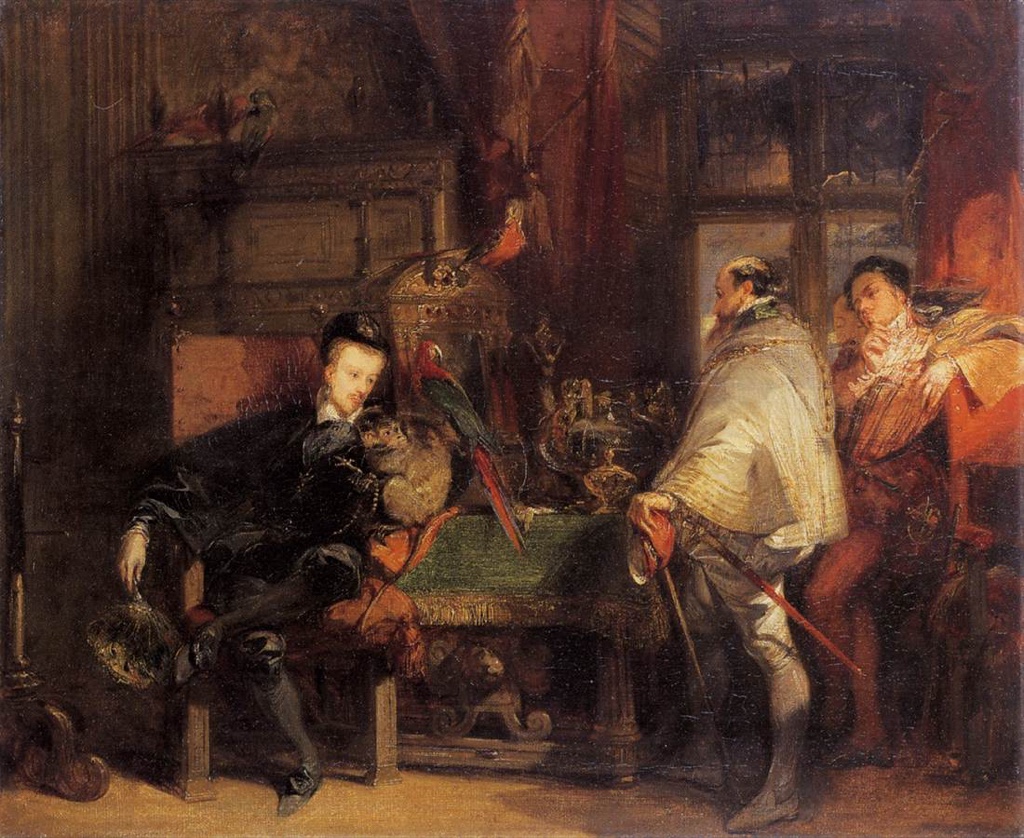
The studio gave him contact with a culture in which ambitious figure composition and public exhibition carried prestige. Landscape travel gave him different problems: how to register a specific riverbank, harbour, cloudbank or wet expanse with speed and clarity. In his final years he also painted literary and historical subjects. Patrick Noon’s 2025 study identifies 95 oils in the 2008 catalogue raisonné: 72 French and Italian landscapes and 23 figural or literary subjects, all made between 1824 and 1828.[3] Those figures identify two sustained strands, not an early landscape phase discarded for history painting.
French institutions and subjects therefore remained active in his career even when his technique drew upon watercolour habits associated with Britain. The useful question is not which nation “owns” the result. It is how different forms of training and expectation met in particular works.
Watercolour as Practice, Not Passport
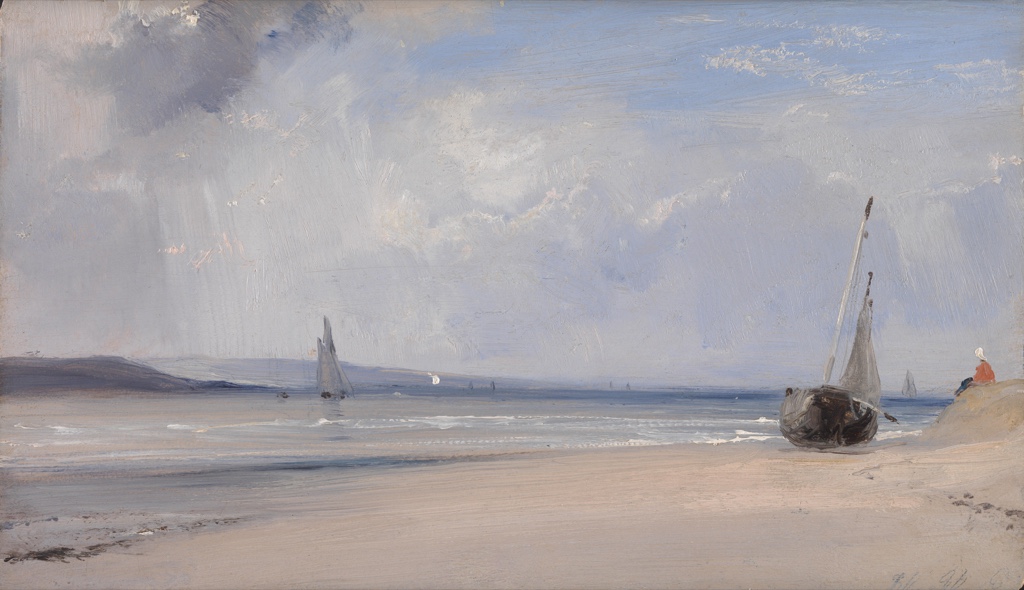
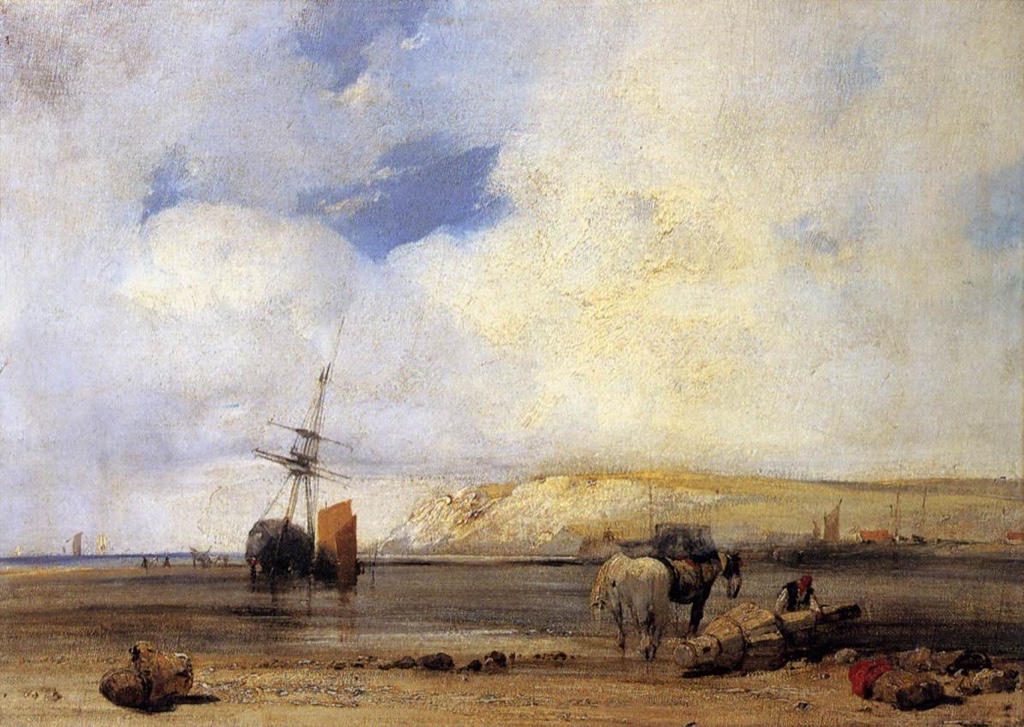
Watercolour was central to Bonington before his mature oils. Noon describes a habitual sequence in which he first tried a composition in watercolour or brown wash and then executed an oil directly, in one campaign.[3] The National Gallery likewise explains that his early experience in watercolour shaped an oil method based on swift, fluid handling, thin paint and visible brushwork. In An Estuary in Northern France, this approach allowed him to carry the immediacy of a watercolour sketch into oil.[1]
That transfer was practical rather than symbolic. Watercolour encouraged economical decisions, a responsive relation between mark and support, and work made before changing effects had disappeared. Bonington did not make oil behave exactly like watercolour, but he used lessons learned in one medium to change the possibilities of another. His watercolours and drawings are thus not a secondary category beside the paintings; they are part of the same experimental practice.
Material availability also altered what he could do. Noon records that during his London visit in 1825 Bonington encountered a portable, commercially prepared millboard patented by Robert Davy. It enabled him to attempt outdoors in oil the spontaneous work he had previously achieved in watercolour.[3] This is a precise mechanism of cross-Channel exchange: a manufactured British support entered a practice developed through French travel and Parisian artistic relationships. The resulting small oils were not expressions of nationality in the abstract. They were made possible by skills, places and objects brought into contact.
The Paris Salon of 1824
The Salon made exchange public. Bonington had spent productive years making topographical watercolours for print publishers and literary illustrations for collectors. He returned to oil in preparation for the 1824 exhibition, where he showed five marine and coastal views. He received a gold medal alongside three more established British artists: Constable, Copley Fielding and Lawrence.[3]
The grouping should not be mistaken for a common programme. Lawrence was a portraitist, Constable a landscape painter with his own methods, and Fielding a prominent watercolourist. Their simultaneous recognition mattered because it placed several forms of British practice before a large French audience. The National Gallery notes that many French artists admired the technical freedom and expressive handling they found in British painting.[1] Bonington’s contribution was distinctive within that attention: compact marine and coastal subjects in which light, weather and handling could be apprehended quickly.
Only one of Bonington’s five exhibited oils has been identified securely by Noon.[3] That limit is worth preserving. The Salon’s importance does not depend upon inventing a complete display. What survives is enough to establish a professional turning point and a shared venue in which artists from different traditions were judged together.
London in 1825: Exchange Becomes Reciprocal
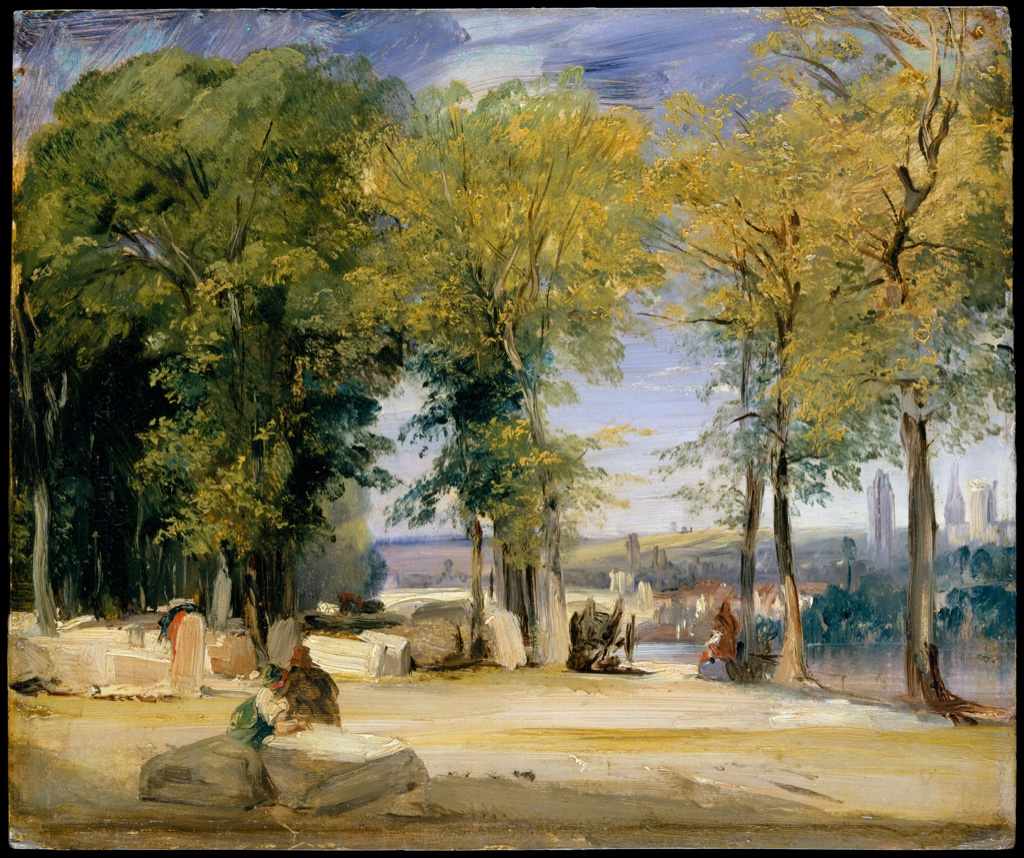
The following year reverses any one-way account of British influence flowing into France. The Metropolitan Museum of Art situates View near Rouen shortly after Bonington returned from London in 1825, where he had engaged closely with the work of Constable and Turner and encountered Delacroix and other French Romantic painters.[2] London was therefore both a place of British artistic discovery and a meeting ground for French colleagues.
Bonington did not need to encounter Constable for the first time as a name: the two had already been recognised at the same Salon. Seeing pictures in London offered another kind of knowledge—scale, surface and handling rather than reputation or reproduction alone. The lesson was not passive absorption. The small oil View near Rouen, painted on millboard from the bank of the Seine, belongs to the period in which the London material discovery and renewed looking were tested against a French site.[2][3]
The same journey deepened Bonington’s contact with Delacroix. Noon records that the two studied a Rembrandt-school painting in London, then shared a Paris studio in 1825–26 and considered travelling to Italy together; Delacroix ultimately withdrew from the journey.[3] Dutch art viewed in Britain, discussed by an English and a French painter, then carried back into Parisian work makes the national map more complicated again. Exchange involved older art and museum looking as much as contemporary style.
Delacroix, Huet and Artistic Friendship
Delacroix’s admiration for Bonington is unusually well documented. The National Gallery describes the two as friends and records Delacroix’s later praise for the lightness of Bonington’s touch, especially in watercolour.[1] Noon’s research adds the shared studio and shows Delacroix looking closely at Bonington’s ability to move from preparatory wash or watercolour to a directly executed oil.[3] Their relationship joined professional intimacy to technical observation.
This does not make Delacroix a follower. His scale, subjects and handling developed according to different ambitions, while Bonington’s own historical and literary pictures participated in interests shared by their Paris circle. The value of the comparison lies in specific encounters: working near one another, studying earlier paintings, discussing travel and observing how a colleague solved a pictorial problem. Readers interested in Delacroix’s separate development can continue with Eugène Delacroix.
Paul Huet belonged to another part of Bonington’s French network. The National Gallery identifies Huet among the companions with whom Bonington visited La Ferté and nearby Saint-Valery-sur-Somme.[1] Here friendship was tied to movement through landscape. Artists could share a destination without producing interchangeable pictures. Their company created opportunities to compare sites, weather, materials and decisions while working.
Together, Delacroix and Huet reveal why “French influence” is too blunt a phrase. One relationship centred on studio proximity, older masters and ambitious subject painting; another included companionship before northern French scenery. Both were reciprocal human connections rather than anonymous national forces.
Turner Without a Meeting
Bonington’s relation to J. M. W. Turner requires particular care. The Wallace Collection describes mutual admiration and says the two artists knew one another’s work through exhibitions and engravings.[4] Noon concludes that they probably never met. His account instead follows works, testimony and a shared collector, H. A. J. Munro of Novar: Paul Huet remembered Bonington’s intense admiration for Turner, while Turner told Munro of his regard for Bonington’s marine paintings seen in London exhibitions.[3]
This is not a weaker history because it lacks a studio encounter. Engravings could carry compositions across distance; exhibitions allowed comparison; collectors placed works into physical and conceptual relation. Munro owned important paintings by both artists, and Noon reports that Turner wanted one of his Venetian views hung beside a view of the Grand Canal by Bonington.[3] The anecdote concerns comparison and esteem, not proof of stylistic dependence.
After Bonington’s death, Turner painted Calais Sands at Low Water—Poissards Collecting Bait in 1830. Both Noon and the Wallace Collection describe it as generally understood as a tribute to the younger artist.[3][4] The coastal setting and glistening low-tide sands make the act of remembrance pictorial. Yet even here, “mutual influence” names a relationship between distinct practices; it does not erase their differences. Bonington’s On the Coast of Picardy gives a focused way to consider his own treatment of the Channel coast, while Turner has a much longer career and artistic trajectory.
Coasts, Cities and Historical Imagination
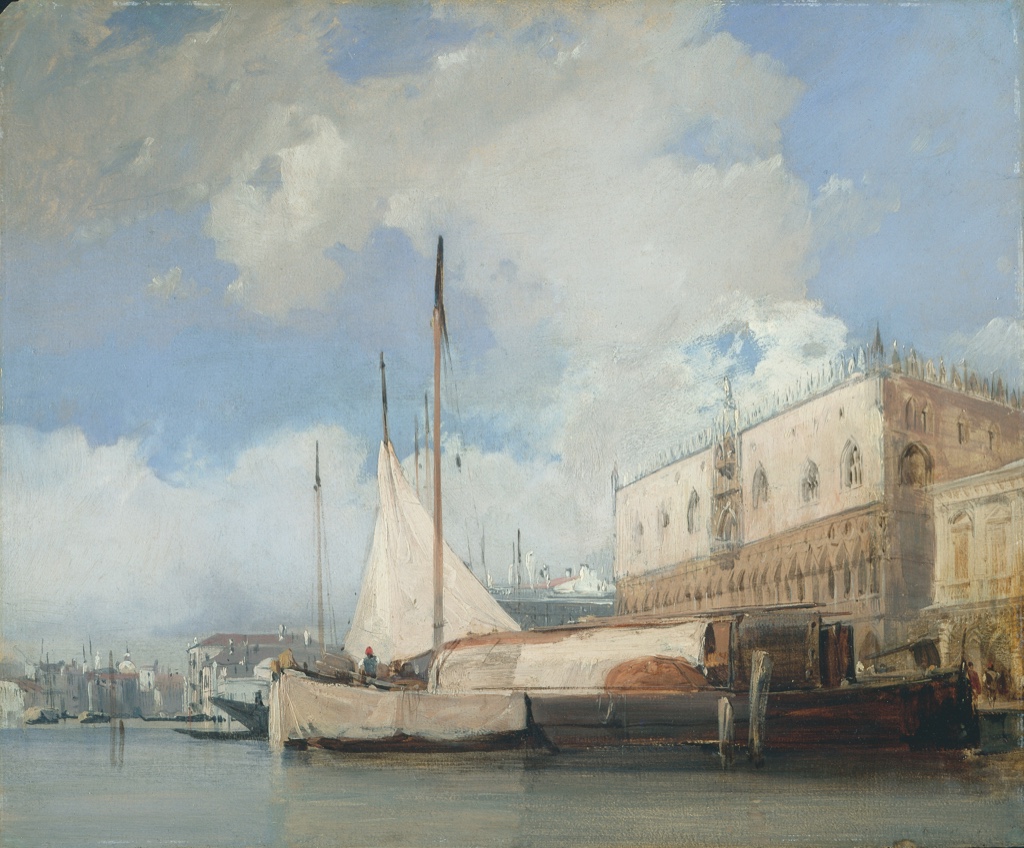
Bonington’s subjects also crossed the boundaries imposed by simplified movement histories. Normandy, Picardy and the Seine supplied landscapes close to routes of travel between Paris and the coast. Venice, reached during his 1826 journey, offered architecture, water and associations with Shakespeare as well as the paintings of Titian and Veronese; Noon identifies these interests as determining his Italian course.[3] Historical and literary scenes drew upon the academic and cultural world in which he had been trained.
The connecting element is not subject matter alone. Across watercolour, oil landscape and figure painting, Bonington valued an economical execution in which selection mattered. A river view need not become a topographical inventory; a historical costume scene need not abandon attention to colour and surface. His practice moved between direct observation, remembered study and imaginative reconstruction. This range prevents the coastal sketches from being treated as his only serious achievement, or the late historical works as a foreign addition to an otherwise “English” identity.
Reception After 1828
Bonington died in 1828, but the cross-Channel life of his work continued. The National Gallery notes that French artists, including Delacroix, admired its freshness and immediacy, and that it was later admired by the Impressionists.[1] Admiration is the important word. It establishes reception without turning Bonington into an Impressionist before Impressionism or claiming a direct line of influence upon every later painter concerned with light and visible handling.
Modern scholarship has also treated British and French Romantic art as an interconnected field. Patrick Noon organised Crossing the Channel: British and French Painting in the Age of Romanticism in 2003 with the Minneapolis Institute of Art, Tate Britain and the Metropolitan Museum of Art.[5] The collaboration does not dissolve national histories; it shows why comparison across collections and institutions is necessary.
Bonington’s own achievement remains more exact than the familiar image of a bridge. He learned within French institutions, carried watercolour habits into oil, absorbed works seen in London, worked beside French painters and reached audiences through exhibitions and reproductions. Those circumstances gave him opportunities, but they do not explain away the judgement visible in each work. Exchange supplied a field of action. Bonington’s distinction lay in what he made from it.
Researched works directory
This searchable directory is an online evidence census assembled from public museum and collection records. It is not a substitute for Patrick Noon’s printed catalogues raisonnés.
| Name | Date | Medium |
|---|---|---|
| A Coast Scene | 1820–1828 | Painting |
| A Cutter and other shipping in a Breeze | 1827–1828 | Watercolour |
| A Distant View of St-Omer | 1824 | Painting |
| A Distant View of St-Omer | c. 1824 | Painting |
| A duel between Frank and Rashleigh | 1828 | |
| A Faun with Pipes | Date unknown | Drawing |
| A Seascape | Date unknown | Drawing |
| A Venetian Scene | c. 1828 | Watercolour |
| A Wooded Stream and a Farmhouse in Normandy | Date unknown | Drawing |
| Abbeville - Vue Pris, de la route de Calais | Date unknown | |
| Abbey St-Amand, Rouen | Date unknown | Watercolour |
| An Estuary in Northern France | c. 1825–1827 | Painting |
| An Italian Town | 1822–1828 | Painting |
| Ancienne Porte a Stirling | 1826 | |
| Ancienne Tour | 1826 | |
| Ancienne Tour Près de Lanark | 1826 | |
| Anne Page and Slender (Shakespeare's Merry Wives of Windsor, Act 1, Scene 1) | 1829 | Artwork |
| Architectural Remains and Fragments: Rouen - Fontaine de la Crosse | 1827 | |
| Architecture du Moyen Age | 1824 | |
| Argyle Castle | 1826 | |
| Argyle Castle | 1828 | |
| At the English Coast | 1825 | Watercolour |
| Beach Scene | c. 1825 | Watercolour |
| Beach Scene with Cart and Horse | 1825 | Painting |
| Beached Vessels and a Wagon, near Trouville, France | c. 1825 | Painting |
| Beauvais - interieur d'une cour | Date unknown | |
| Bergues - La Tour du March, | Date unknown | |
| Bergues: La Tour du marché | 1824 | |
| Boccadasse, Genoa with Monte Fasce in the Background | 1826 | Painting |
| Bologna | 1826–1827 | Drawing |
| Bologna | 1828 | |
| Bonington - Vue de Venise | Date unknown | Watercolour |
| Bothwell Castle | 1826 | |
| Bothwell Castle | 1828 | |
| Boulogne Harbor | 1823 | Watercolour |
| Bracklin-Bridge | 1828 | |
| Brackline | 1826 | |
| Caen - Eglise Saint-Sauveur | 1824 | Drawing |
| Caen - Maison Grande Rue Saint-Pierre | Date unknown | Drawing |
| Calais Jetty, France | c. 1824 | Painting |
| Campos sur les bords du Rio das Velhas | 1827 | |
| Castle on a Scottish Loch | 1822–1828 | Painting |
| Cathedrale Notre-Dame | 1824 | |
| Charles V visits François Ier after the Battle of Pavia | c. 1827 | Watercolour |
| Chateau d'Argyle | 1826 | |
| Chateau de Bothwell | 1826 | |
| Chateau de Bothwell / Bothwell Castle | 1826 | |
| Christ preaching - unfinished | Date unknown | Painting |
| Coast Scene in Picardy, France | 1826 | Painting |
| Coastal Scene with Fishing Boats | 1828 | Painting |
| Croix de Moulin-les-Planches | 1827 | |
| Demetrius de Palatiano | 19 th century | Painting |
| Die adriatische Küste | c. 1820 | Painting |
| Die normannische Küste | 1823–1824 | Painting |
| Dieppe Harbour | Date unknown | Painting |
| Don Quixote | 1825–1826 | Painting |
| Don Quixote in His Study | 1825–1826 | Painting |
| Doune Castle | 1828 | |
| Du Sacristain de Saint Angadresne | c. 1828 | |
| Dutch: Processie in Verona | 1801–1828 | Painting |
| Edimbourg pris de la Chapelle St Antoine | 1826 | |
| Edimbourg vu de Calton-Hill | 1826 | |
| Edimbourg vu de la Chapelle Saint-Antoine | 1826 | |
| Edinbourgh vu de la Chapelle S. Antoine | 1826 | |
| Edinburg from S. Anthony Chapel | 1828 | |
| Edinburgh from St. Anthony Chapel | 1826 | |
| Edinburgh from the Calton Hill | 1828 | |
| Eglise de Saint-Taurin, Evreux | 1824 | |
| Eglise de St. Jean a Lyons | 1824 | |
| Eglise St. Sauveur | 1824 | |
| Embouchure de la Riviere Caxoera | 1827 | |
| Entree de la rade de Rio-Janeiro | 1827 | |
| Entrée de la salle des pas-perdus, Palais de Justice | 1824 | |
| Evening in Venice | 1826–1828 | Painting |
| Façade de l'Eglise de Brou | 1825 | |
| Façade St. Jean | 1824 | |
| Figures on a rocky shoreline | Date unknown | Artwork |
| Fishing Boats in a Calm, Ships at Anchor | 1825 | Painting |
| Fishing Smacks in French Harbour | 1818–1825 | Painting |
| Five Studies of a French Pointer | 1825–1826 | Drawing |
| Fontaine de la Crosse | 1827 | |
| French Coast Scene | 1815–1828 | Painting |
| French Coast with Fishermen | 1825 | Painting |
| French Hulk | 1820–1828 | Painting |
| German: Ein Waldweg | 1825–1826 | Painting |
| Glenfinlas | 1826 | |
| Glenfinlas | 1828 | |
| Glenfinlas Valley (Vallée de Glenfinlas, from Vues Pittoresques de l'Écosse) | 1826 | Artwork |
| Goetz Von Berlichingen Before The Imperial Magistrate | c. 1826 | Drawing |
| Grand Canal, Venice | 1826 | Drawing |
| Greek Armatole (irregular fighter). | 1825 | Painting |
| Half-length Portrait of a Bearded Man in Historical Dress | 1818 | Drawing |
| Henri III | 1828 | Painting |
| Hôtel de Sens : dessin / Richard-Parkes Bonington | 19 th century | Drawing |
| Ile de la Cite | Date unknown | Watercolour |
| In the Forest of Fontainebleau | c. 1825 | Painting |
| Intérieur d'une Cour | 1824 | |
| Jour du Marché | 1824 | |
| L'Eglise de St. Gervais et St. Protais | 1824 | |
| L'espace | c. 1826 | Painting |
| La Conversation | 1826 | |
| La Place du Molard, Geneva | Date unknown | Painting |
| La Prière | 1826 | |
| La Tour du Marché | 1824 | |
| Lac de Killin | 1826 | |
| Lac Lomond | 1826 | |
| Landscape with a Pond | 1825–1826 | Painting |
| Landscape with Castle Ruin | Date unknown | Watercolour |
| Le Château de la Duchesse de Berry | 1823–1825 | Painting |
| Le matin | 1824 | |
| Le Repos | 1826 | |
| Le Retour | 1826 | |
| Le Silence Favorable | 1826 | |
| Les Pendus | 1826 | |
| Les Plaisirs Paternels | 1826 | |
| Les Salinieres near Trouville | 1827–1828 | Painting |
| Lillebonne - Chateau d'Harcourt | 1824 | |
| Lillebonne - Chateau d'Harcourt | Date unknown | |
| Loch Lomond | 1826 | |
| Loch Lomond | 1828 | |
| Loch Tay | 1828 | |
| Lochkillin | 1826 | |
| Low Tide at Boulogne | 1824 | Painting |
| Maison Grande Rue St. Pierre | 1824 | |
| Maison Située Rue St Veronique | 1824 | |
| Man and Woman in a Landscape, possibly Faust and Marguerite | c. 1826 | Drawing |
| Molard-Bonington-1829 | 1829 | |
| Molard-Bonington-1829-cropped | 1829 | |
| Near Honfleur | 1823 | Watercolour |
| Near Jumieges | Date unknown | Watercolour |
| Old Gate Way at Stirling | 1828 | |
| Old Gateway at Stirling | 1826 | |
| Old Tower near Lanark | 1828 | |
| On the Adriatic | c. 1826 | Painting |
| On the Coast of Picardy | 1826 | Painting |
| On the Seine – Morning | 1825 | Painting |
| Palais de Justice, Rouen | Date unknown | Drawing |
| Paris from Pere Lachaise | Date unknown | Watercolour |
| Pays de Caux: Twilight | 1818–1828 | Painting |
| Peasant Women from Ragusa | 1826 | Drawing |
| Pesmes | 1825 | |
| Peveril of the Peak - Julian Peveril and Alice Bridgenorth, surprised by Major Ralph Bridgenorth | c. 1826 | Watercolour |
| Picardy Coast with Children – Sunrise | c. 1826 | Painting |
| Picturesque Views of Scotland: Brackline | 1826 | |
| Pierre de Vaivre | 1827 | |
| Polish: Zdjęcie z krzyża The Descent from the Cross. | 1820 | Painting |
| Portia and Bassanio | c. 1826 | Watercolour |
| 1827 | ||
| print, title-page | 1828 | |
| Processie in Verona | 19de eeuw | Painting |
| Promenade vénitienne (Venetian Promenade) | Date unknown | Artwork |
| Quentin Durward and the Disguised Louis XI (recto); Study of male figure (verso) | 1825–1826 | Drawing |
| Quentin Durward at Liège, Belgium | 1827–1828 | Painting |
| Quentin Durward in Luik, objectnr TA 11006 | 1825 | Drawing |
| Restes et Fragmens d'Architecture du Moyen Age: Église St. Sauveur, Caën | Date unknown | |
| Riva degli Schiavoni, from near San Biagio, Venice, by Richard Parkes Bonington | Date unknown | Painting |
| Road Workers, near Lillebonne | Date unknown | Painting |
| Roadside Halt | 1826 | Painting |
| Robert Dudley, Earl of Leicester and his wife Amy Robsart. | 1820 | Painting |
| Rouen | 1825 | Watercolour |
| Rouen: Entrée de la Salle des Pas Perdus, Palais du Justice | 1824 | |
| Rue du gros-horloge, Rouen | 1824 | |
| Ruines de Chateau d'Arlay | 1827 | |
| Ruines du Château d'Arlay | 1827 | |
| Ruins of the Abbey Saint Bertin | 1824 | Painting |
| Sea Coast, the Dunes | Date unknown | Painting |
| Seapiece: Off the French Coast | c. 1823–1824 | Painting |
| Shipping in a Swell | 1824–1827 | Watercolour |
| Shipping in an Estuary, Probably near Quilleboeuf | 1825–1826 | Watercolour |
| Sketch of a Woman | 1828 | Drawing |
| Street in the Outskirts of Besançon, France | 1827 | |
| Studies for Shylock | 1825 | Drawing |
| Study of a Gentleman in 17th Century Costume, After Van Dyck | 1827–1828 | Drawing |
| Study of a Seated Woman | Date unknown | Drawing |
| Study of a Woman with her Head on her Hand | Date unknown | Drawing |
| Sunset: A Sketch | Date unknown | Painting |
| Sunset in the Pays de Caux | 1828 | Watercolour |
| The Antiquary | Date unknown | Painting |
| The Chibouk | 1826 | Painting |
| The Church of St. Wulfran, Abbeville: The North Door of the West Front | c. 1823 | Drawing |
| The Count of Palatino in the costume of a Palikar | Date unknown | Painting |
| The Doge's Palace, Venice | 1826 | Painting |
| The Escape from Argyle Castle | 1826 | |
| The Escape from Argyle-Castle | 1828 | |
| The Grand Canal | 1826–1827 | Painting |
| The Grand Canal, Venice | 1826–1827 | Painting |
| The Interior of Sant' Ambrogio, Milan | 1826 | Painting |
| The Old Jetty, Boulogne, France | Date unknown | Painting |
| The Pont des Arts, Paris | 1826 | Painting |
| The Proposal (recto); Unfinished drawing of a horse and rider (verso) | 1820 | Drawing |
| The Rialto, Venice | Date unknown | Painting |
| The Salt Marshes near Trouville | 1826 | Watercolour |
| The Use of Tears | 1827 | Watercolour |
| The Use of Tears | Date unknown | Painting |
| Titlepage to Restes et Fragments | Date unknown | |
| Tomb in the Church of Saint-Omer, France | Date unknown | Painting |
| Tombeau de Marguerite de Bourbon, Eglise de Brou | 1825 | |
| Tour aux archives à Vernon | 1824 | |
| Tour du gros horloge, batie sous la domination des Anglais en 1417, Evreux | 1824 | |
| Tour du gros-horloge, Evreux | 1824 | |
| Trees and a Cottage by a River | 1827 | Drawing |
| Untitled (one of three) | Date unknown | |
| Vessels in a Choppy Sea | c. 1824 | Watercolour |
| View in Brittany: Bridge, Cottages and Washerwomen | 1818–1828 | Painting |
| View near Rouen | c. 1825 | Painting |
| View near Sarzana, Val di Magra | 1826 | Painting |
| View of the Rialto Bridge, Venice | c. 1826 | Watercolour |
| View on the Grounds of a Villa near Florence | 1826 | Painting |
| View on the River Seine - Morning | c. 1825 | Painting |
| Voyages pittoresques et romantiques dans l'ancienne France | 1825 | |
| Voyages pittoresques et romantiques dans l'ancienne France, Franche-Comté: Église de l'abbaye de Tournus | 1825 | |
| Voyages pittoresques et romantiques dans l'ancienne France, Franche-Comté: Ruines du château d'Arlay | 1825 | |
| Voyages pittoresques et romantiques dans l'ancienne France, Franche-Comté: Vue d'une rue des faubourgs de Besançon | 1825 | |
| Voyages pittoresques et romantiques dans l'ancienne France, Normandie: Église de Saint Gervais et Saint Protais à Gisors | 1824 | |
| Voyages pittoresques et romantiques dans l'ancienne France, Normandie: Rue du Gros Horloge, Rouen | 1824 | |
| Voyages pittoresques et romantiques dans l'ancienne France, Normandie: Tour aux archives à Vernon | 1824 | |
| Voyages pittoresques et romantiques dans l'ancienne France, Normandie: Tour du Gros-Horloge, Evreux | 1824 | |
| Vue d'une rue des faubourgs de Besançon | 1827 | |
| Vue d'une rue des Faubourgs de Besançon (View of a Street in the Outskirts of Besançon) | 1827 | |
| Vue Generale de l'Eglise de l'Abbaye de Tournus | 1825 | |
| Vue Générale de l'Eglise de St. Gervais et St. Protais, à Gisors | 1824 | |
| Vue Generale des Ruines du Chateau d'Arlay | 1827 | |
| Vue prise à l'entrée du jardin des Plantes. Au premier plan, bâtiment de la minéralogie et à l'arrière, dôme de l'hôpita, D.2182 | 1806–1828 | Drawing |
| Vue Prise de la Route de Calais | 1824 | |
| Vues Pittoresques de l'Écosse | 1826 | |
| Young Woman Writing a Letter | 1820–1828 | Painting |
Frequently Asked Questions
He was born to English parents in England and is commonly identified as British, but he moved to France at 15, trained and worked there, and occupies an important place in both British and French art history.[1][2] “British” describes his origin; it does not make France a minor episode in his formation.
Through several channels: works shown at the Paris Salon, engravings and other reproductions, travelling artists, collectors, friendships and direct study. The 1824 Salon recognition of Bonington, Constable, Fielding and Lawrence made British art especially visible, but exchange continued in studios, exhibitions and travel.[1][3][4]
They were friends, encountered one another in London, shared a Paris studio in 1825–26 and discussed an Italian journey that Delacroix did not ultimately make. Delacroix later praised Bonington’s lightness of touch, while their contact also involved looking together at older art.[1][3]
The evidence differs. Bonington saw and responded to their work in London, and he shared the 1824 Salon medal distinction with Constable.[2][3] He and Turner probably never met, although each admired the other’s art through exhibitions, engravings, testimony and shared collectors.[3][4]
No. He died decades before the first Impressionist exhibition. Later Impressionists admired the freshness and immediacy associated with his work, but that reception does not make him a member of their movement or prove direct influence on each artist.[1] He is better understood within the British–French Romantic culture of the 1820s.
Discussion
Use this evidence-led guide as a starting point for close looking rather than a final verdict.
Share an observation about Richard Parkes Bonington and British and French Romanticism or a source that adds useful context.
Reader Insights
Which work most clearly changes the familiar story of Bonington's short career?
Where does the cross-Channel context explain more than a national label?
Which source or surviving object would you investigate next?
Join the Conversation
Add your reading below, keeping observations specific and evidence clear.
References
- National Gallery, London, “Richard Parkes Bonington, An Estuary in Northern France, about 1825–7.”, accessed 30 August 2026.
- Metropolitan Museum of Art, “Richard Parkes Bonington, View near Rouen, ca. 1825.”, accessed 30 August 2026.
- Patrick Noon, “A supplement to Richard Parkes Bonington, the Complete Paintings,” Colnaghi Studies Journal XVII (October 2025), pp. 61–76., accessed 30 August 2026.
- Wallace Collection, “Turner and Bonington.”, accessed 30 August 2026.
- Minneapolis Institute of Art, “Patrick Noon.”, accessed 30 August 2026.