 by Tom Gurney
Tom Gurney BSc (Hons) is an art history expert with over 20 years experience
Page Created on August 30, 2026 / Page Updated on November 6, 2026
Email: tomgurney1@gmail.com / Phone: +44 7429 011000
Henri III: Introduction
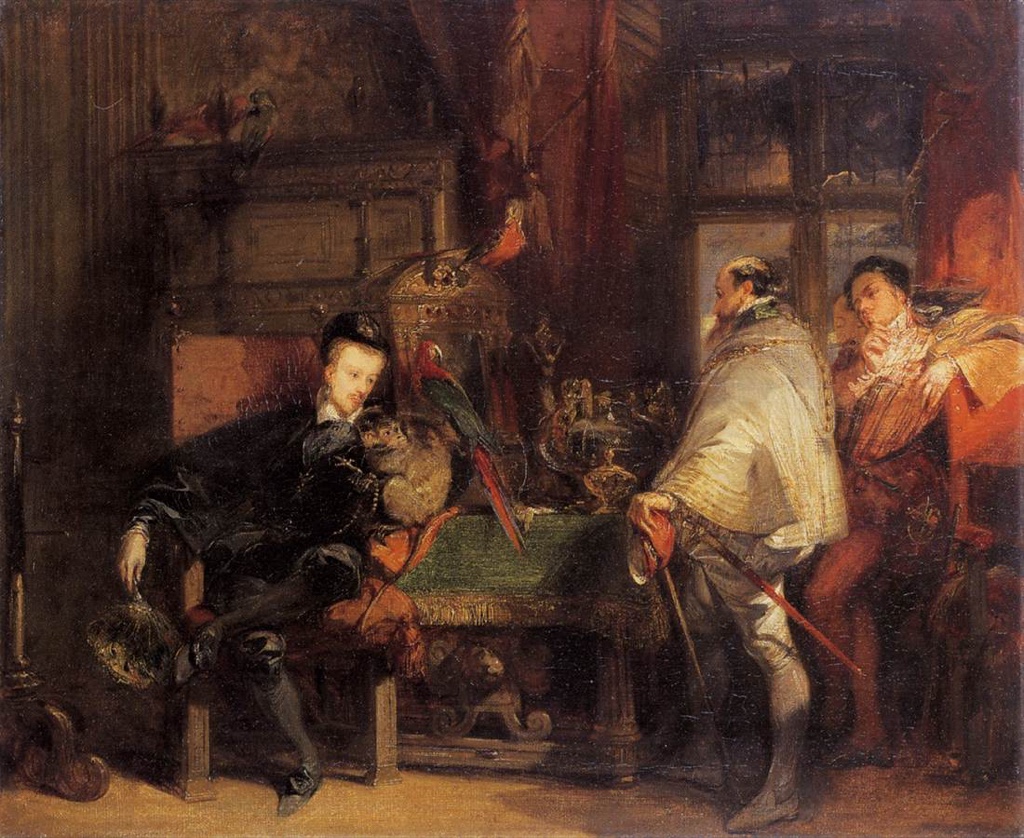
Richard Parkes Bonington’s Henri III turns a courtly reception into a drama of placement, costume and colour. Henri III of France sits at the left, dressed almost entirely in black, while Don John of Austria approaches from the right in a pale, gleaming costume. A green-covered table lies between them; attendants, furnishings and deep red hangings make the room feel richly appointed but close. Painted in 1828 and exhibited at the Royal Academy shortly before Bonington’s death, the picture belongs to the artist’s ambitious late engagement with historical and literary subjects.[1]
This is not a landscape painter merely changing his choice of scenery. In Henri III, Bonington uses the body, the interior and the social ritual of an audience to organise the work. Yet the colour relationships and quick changes of touch that animate his coast and city views remain important. The result is a history painting in which ceremonial detail and painterly fluency depend on one another.
At a Glance
- ArtistRichard Parkes Bonington (1802–1828)
- TitleHenri III
- Date1828
- MediumOil on canvas
- Dimensions54 × 64.4 cm (image size)
- CollectionWallace Collection, London, P323
Richard Parkes Bonington in context
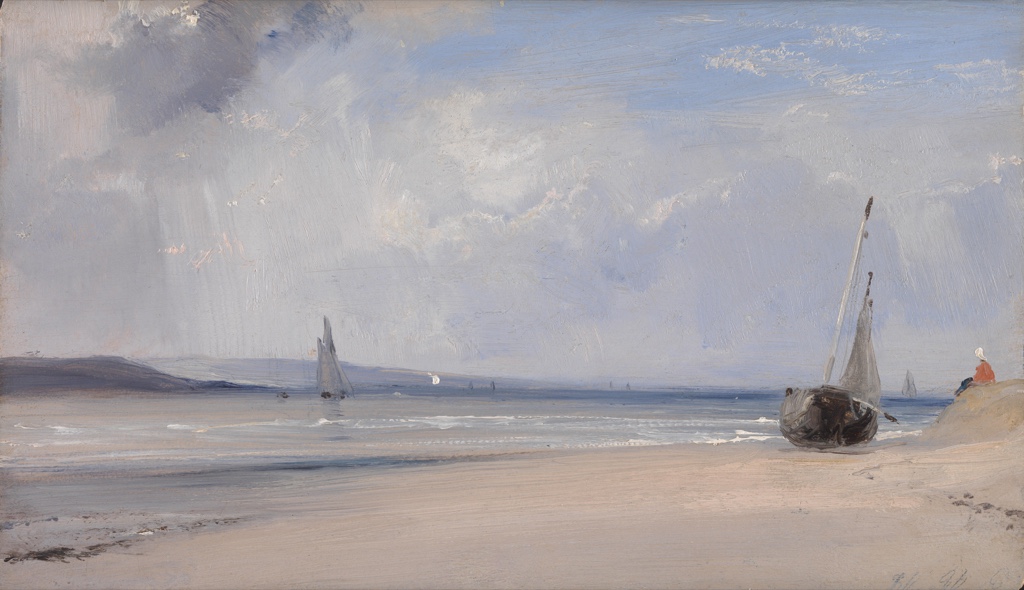
Seapiece: Off the French Coast
c. 1823–24An Estuary in Northern France
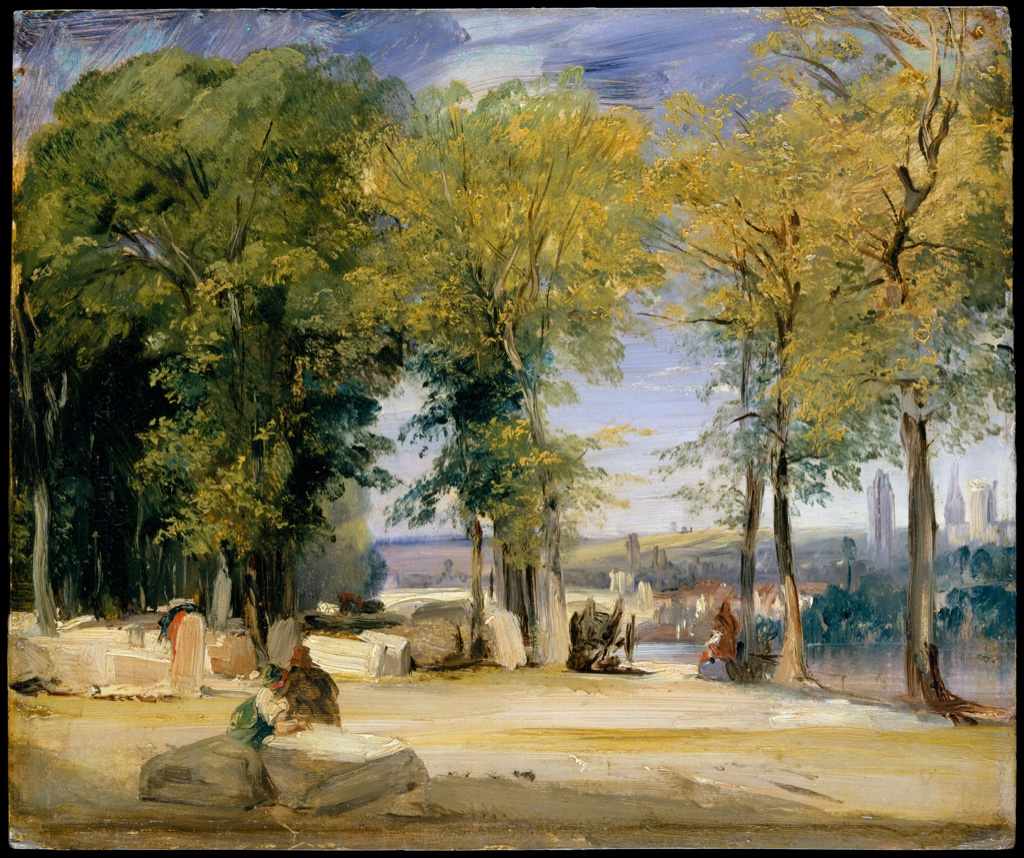
c. 1825–27View near Rouen
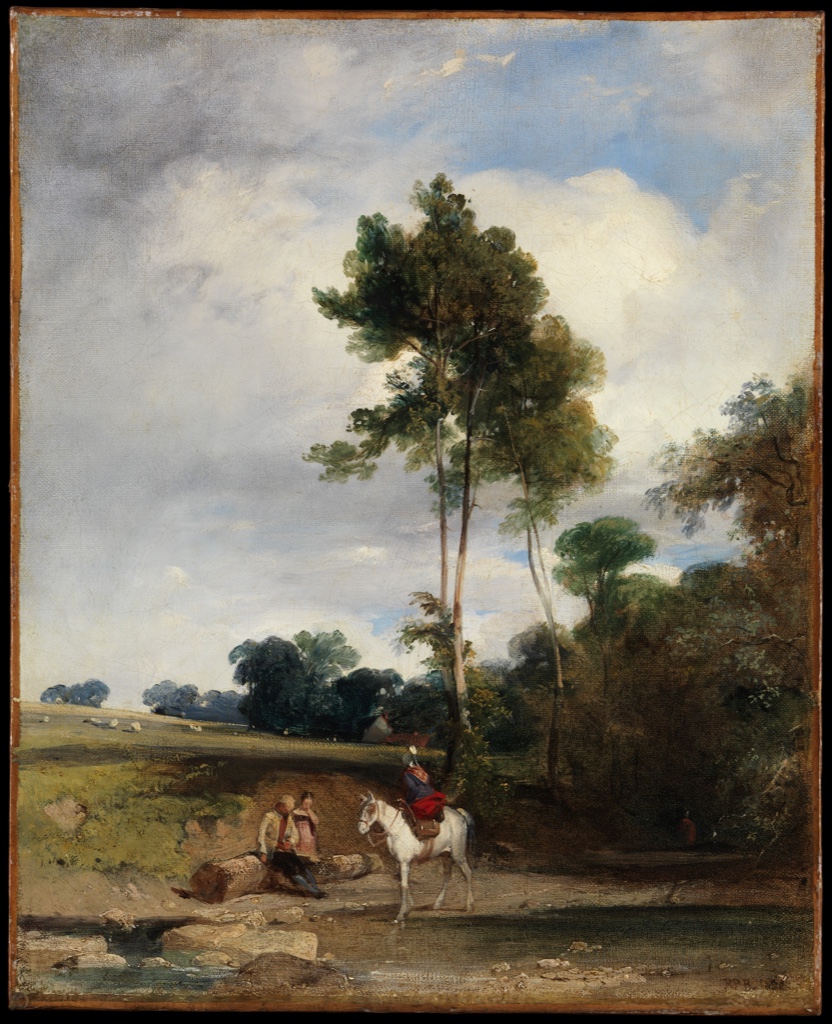
c. 1825Roadside Halt
1826Henri III
1828Contents
- Introduction
- A royal meeting, not an assassination scene
- How the composition stages the encounter
- Costume as historical language
- Why history painting mattered
- Colour, touch and the question of finish
- A late literary and historical mode
- The Royal Academy and Bonington’s final year
- The Wallace Collection record
A royal meeting, not an assassination scene
The Wallace Collection identifies the subject precisely: Henri III, king of France, receives Don John of Austria, the son of Emperor Charles V.[1] That identification matters because nineteenth-century history pictures often drew on episodes involving several similarly named French rulers, ambassadors and court favourites. This scene should not be confused with an episode concerning the assassination of the Duke of Guise, nor with Bonington’s separate Henri IV and the Spanish Ambassador.
Only a small amount of political context is needed to understand the encounter. Henri III, who lived from 1551 to 1589, occupied a pivotal place in the French Wars of Religion. Don John belonged to the Habsburg imperial family. Bonington does not stage a battle or a public ceremony; he chooses the controlled setting of a reception, where rank must be conveyed through who sits, who stands, who approaches and who observes.[1]
The historical subject therefore works through etiquette. Henri remains seated beside an imposing chair, while Don John inclines towards him from across the table. The two men are close enough to register as participants in a direct exchange, but the furniture preserves a formal interval. Nothing in their gestures permits a confident reconstruction of words or private feelings. What can be read is the structure of an audience: a ruler receives; a visitor presents himself; attendants turn a meeting between two people into an event witnessed at court.
How the composition stages the encounter
The painting’s first opposition is unusually clear. Henri forms a dark, low mass at the left. His black clothing joins the shadow around the chair and wall, while his face, collar and hands emerge in smaller patches of light. Don John is higher and brighter. His pale cloak and hose create the largest light shape in the central group, immediately distinguishing the visitor from the seated king. The contrast directs attention without requiring a theatrical spotlight.[1][5]
Between them, the green cloth covering the table provides a middle register. It separates the figures physically, but it also connects their colour fields: the muted green answers the warm brown interior, the red textiles and the flashes of cream and metal. Objects set on and around the table suggest a furnished royal chamber rather than an empty stage. Bonington varies their definition. Some edges and highlights are legible at once; others dissolve into the surrounding brown. This selective emphasis keeps the accessories from competing with the encounter.
The eye moves on a shallow diagonal from Henri’s tilted head and extended arm, across the tabletop, towards Don John’s pale torso and bent stance. Behind him, two attendants create a second, more compressed exchange. Their warm red, orange and white clothing thickens the right side of the painting and prevents Don John’s light costume from appearing isolated. A band of darker architecture above and behind the figures closes the room around them.
Bonington also avoids making the centre mechanically symmetrical. The great chair rises behind Henri, but its vertical form is offset from the canvas’s midpoint. Don John stands to the right of it; the table occupies the lower centre; the background figures press towards the far edge. These unequal weights are held together by repeated warm reds and by the dark horizontal passages across the upper interior. The composition feels ceremonial without becoming static.
Costume as historical language
Costume carries much of the picture’s claim to a past world. Henri’s dark dress, small cap and pale collar set him apart from the brighter visitor. Don John’s light cloak falls in broad planes over his shoulders and back, then gives way to more narrowly described hose and footwear. The attendants add further variations of red, cream and dark cloth. Bonington uses these differences to make rank, role and proximity visible before a viewer knows every detail of the story.
The contrast is not simply black against white. Henri’s clothes contain glints and broken accents, while Don John’s pale costume is crossed by grey, warm beige and reflected colour. Red appears as a recurring note—in drapery, dress and smaller accessories—rather than as one uninterrupted block. The green table covering cools these warm relationships and gives the central space a material density.
This attention to dress places Henri III within Bonington’s wider fascination with earlier European courts and literature. Costume allows a painter to evoke an age through surfaces that are immediately visual: dark and pale fabrics, reflective ornament and embroidered detail can register through changes in colour and brush pressure. The effect need not depend on an inventory of garments. What matters here is how richly varied surfaces make the encounter specific while retaining the speed and liveliness of painting.
Why history painting mattered
The Wallace Collection explains that Bonington, like many contemporaries, was drawn to history painting because it carried greater prestige than landscape or domestic subject matter. He completed and exhibited several major works in the genre despite the brevity of his career.[1] Henri III should therefore be understood as a serious public ambition, not a decorative departure from his better-known coastal and architectural scenes.
Patrick Noon’s 2025 supplement helps place that ambition in proportion. Within the ninety-five oils registered in the 2008 catalogue, he groups seventy-two as French or Italian landscapes and twenty-three as figural or literary pictures. He dates this entire burst of oil painting to the years 1824–28.[2] Landscapes formed the larger group, but the historical and literary pictures were substantial enough to constitute a sustained strand of the artist’s work.
The Wallace record also describes the subject of Henri III as original. Its comparison is exact and limited: Henri IV and the Spanish Ambassador, another Bonington picture in the collection, recast an earlier interpretation, whereas this composition did not.[1] “Original” here does not mean that no European artist had ever represented Henri III or a diplomatic audience. It means that Bonington devised this particular treatment rather than adapting the earlier composition invoked in the comparison.
That distinction sharpens the work’s achievement. Bonington had to make a historical meeting intelligible through his own arrangement of seated and standing figures, the interval of the table, and the density of the room. The painting’s narrative is not delivered by a single emphatic action. It emerges from an original pattern of relative positions.
Colour, touch and the question of finish
At first sight, Henri III appears more densely worked than Bonington’s open-air subjects. The setting contains upholstery, carved furniture, vessels, costume details and architectural shadow. Yet close visual attention reveals considerable variation in finish. Faces and hands receive enough definition to hold the encounter, while surrounding objects are often indicated with abbreviated marks. Broad dark passages establish the room; smaller light touches call out an edge, fold or reflective ornament.[5]
This balance lets the picture suggest abundance without describing every item equally. The brightest light is reserved for the visitor’s costume and for selected flesh tones. Henri’s black dress does not read as a blank silhouette because its surface is interrupted by fine warm and pale accents. At the right, saturated reds enliven the attendants and hanging fabric. Across the centre, the muted green table stops the warm palette from becoming uniform.
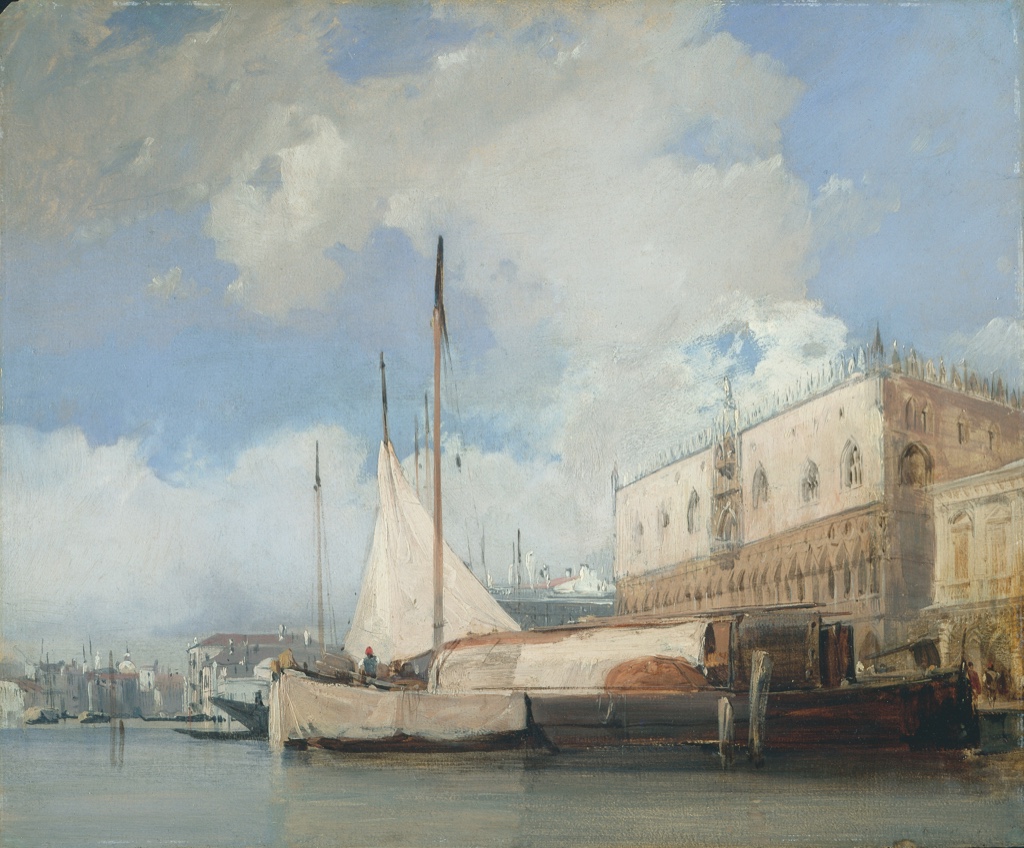
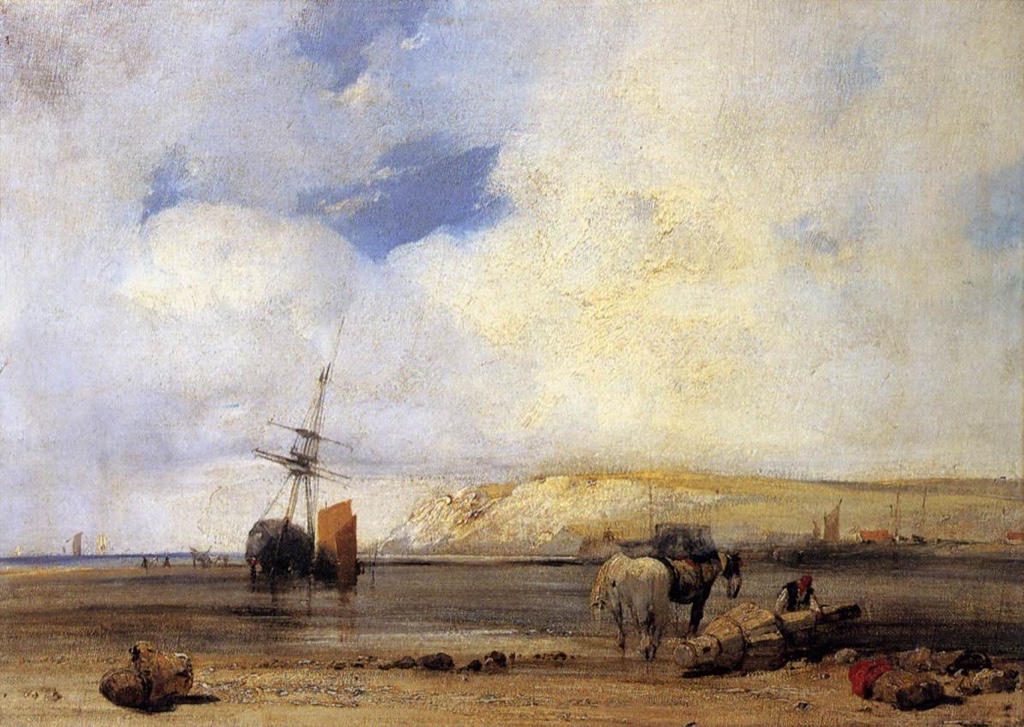
The method links this court interior to the rest of Bonington’s practice. In On the Coast of Picardy, figures and working boats are measured against an expansive coast; here, people and furnishings fill almost the entire visual field. In The Doge’s Palace, Venice, architecture gathers light around a public building; in Henri III, architecture becomes a dark enclosure against which fabric and skin can glow. The subjects differ, but each depends on carefully controlled relations between broad tonal areas and selective detail.
A late literary and historical mode
Harvard Art Museums’ Evening in Venice, painted in 1826–28, provides a useful comparison. That work takes its figures from Shakespeare’s Merchant of Venice: Bassanio and Portia occupy the centre, and Bonington evokes Venetian Renaissance painting through soft colour associated with what he had seen during his Italian travels.[3] The comparison shows that Henri III was not an isolated attempt at figure painting. Both works bring literature or history into an intimate, richly coloured interior.
They differ in their narrative mechanics. Evening in Venice turns on the exchange of a ring and the relationship between a couple. Henri III organises attention through audience protocol and the imbalance between a seated ruler and a standing visitor. One composition uses a recognisable action; the other depends more heavily on posture, rank and spatial distance. Together they reveal how Bonington could alter his pictorial grammar for different stories.
This strand of his work also belongs to the cross-Channel Romantic culture explored in Bonington’s British and French Romanticism. His friendship and artistic exchange with Eugène Delacroix helped connect British techniques and subjects with a Parisian world attentive to literature, history and colour.[3][4] The comparison is most useful when kept specific: Bonington’s historical interiors demonstrate his participation in that shared culture, while their compositions remain his own.
The Royal Academy and Bonington’s final year
The Royal Academy showing gave Henri III a public setting appropriate to the standing of history painting. The Wallace Collection records that it was exhibited there shortly before Bonington died in 1828.[1] This fact should not turn the picture into a premonition or a summary of everything he might have achieved. It does, however, establish that the work reached a major exhibition during his lifetime and that his late historical ambition was visible to a London audience.
Noon’s chronology gives the achievement a striking concentration: the artist’s known oil production described in the supplement falls within only four years, from 1824 to 1828.[2] Readers following that compressed development can place the picture beside the broader account of Bonington’s life and the range surveyed in his paintings. Seen in that context, Henri III is neither an appendix to the landscapes nor evidence of a completed change of direction. It is one of several late works showing how rapidly he enlarged the kinds of subject that oil painting could serve.
The Wallace Collection record
The painting belongs to the Wallace Collection in London, where it carries inventory number P323. The collection records the work as oil on canvas, dated 1828, with an image size of 54 by 64.4 centimetres; its current online record places it in West Gallery II.[1] Those details securely distinguish it from Bonington’s other French royal subjects.
For a wider bibliographic view, Yale University Press issued Patrick Noon’s Richard Parkes Bonington: The Complete Paintings on behalf of the Paul Mellon Centre in 2008. Yale describes the volume as the first catalogue raisonné of Bonington’s oil and watercolour paintings, based on 25 years of research and covering about 400 attributed works.[4]
Henri III ultimately succeeds by making ceremony pictorial. A dark seated king, a pale approaching visitor, a barrier of furniture and a cluster of witnesses turn a reception into a carefully weighted encounter. Bonington’s command of colour and abbreviated touch does not disappear when he enters the prestigious field of history painting. It becomes the means by which rank, material richness and narrative tension remain visible within a small canvas.
Researched works directory
This searchable directory is an online evidence census assembled from public museum and collection records. It is not a substitute for Patrick Noon’s printed catalogues raisonnés.
| Name | Date | Medium |
|---|---|---|
| A Coast Scene | 1820–1828 | Painting |
| A Cutter and other shipping in a Breeze | 1827–1828 | Watercolour |
| A Distant View of St-Omer | 1824 | Painting |
| A Distant View of St-Omer | c. 1824 | Painting |
| A duel between Frank and Rashleigh | 1828 | |
| A Faun with Pipes | Date unknown | Drawing |
| A Seascape | Date unknown | Drawing |
| A Venetian Scene | c. 1828 | Watercolour |
| A Wooded Stream and a Farmhouse in Normandy | Date unknown | Drawing |
| Abbeville - Vue Pris, de la route de Calais | Date unknown | |
| Abbey St-Amand, Rouen | Date unknown | Watercolour |
| An Estuary in Northern France | c. 1825–1827 | Painting |
| An Italian Town | 1822–1828 | Painting |
| Ancienne Porte a Stirling | 1826 | |
| Ancienne Tour | 1826 | |
| Ancienne Tour Près de Lanark | 1826 | |
| Anne Page and Slender (Shakespeare's Merry Wives of Windsor, Act 1, Scene 1) | 1829 | Artwork |
| Architectural Remains and Fragments: Rouen - Fontaine de la Crosse | 1827 | |
| Architecture du Moyen Age | 1824 | |
| Argyle Castle | 1826 | |
| Argyle Castle | 1828 | |
| At the English Coast | 1825 | Watercolour |
| Beach Scene | c. 1825 | Watercolour |
| Beach Scene with Cart and Horse | 1825 | Painting |
| Beached Vessels and a Wagon, near Trouville, France | c. 1825 | Painting |
| Beauvais - interieur d'une cour | Date unknown | |
| Bergues - La Tour du March, | Date unknown | |
| Bergues: La Tour du marché | 1824 | |
| Boccadasse, Genoa with Monte Fasce in the Background | 1826 | Painting |
| Bologna | 1826–1827 | Drawing |
| Bologna | 1828 | |
| Bonington - Vue de Venise | Date unknown | Watercolour |
| Bothwell Castle | 1826 | |
| Bothwell Castle | 1828 | |
| Boulogne Harbor | 1823 | Watercolour |
| Bracklin-Bridge | 1828 | |
| Brackline | 1826 | |
| Caen - Eglise Saint-Sauveur | 1824 | Drawing |
| Caen - Maison Grande Rue Saint-Pierre | Date unknown | Drawing |
| Calais Jetty, France | c. 1824 | Painting |
| Campos sur les bords du Rio das Velhas | 1827 | |
| Castle on a Scottish Loch | 1822–1828 | Painting |
| Cathedrale Notre-Dame | 1824 | |
| Charles V visits François Ier after the Battle of Pavia | c. 1827 | Watercolour |
| Chateau d'Argyle | 1826 | |
| Chateau de Bothwell | 1826 | |
| Chateau de Bothwell / Bothwell Castle | 1826 | |
| Christ preaching - unfinished | Date unknown | Painting |
| Coast Scene in Picardy, France | 1826 | Painting |
| Coastal Scene with Fishing Boats | 1828 | Painting |
| Croix de Moulin-les-Planches | 1827 | |
| Demetrius de Palatiano | 19 th century | Painting |
| Die adriatische Küste | c. 1820 | Painting |
| Die normannische Küste | 1823–1824 | Painting |
| Dieppe Harbour | Date unknown | Painting |
| Don Quixote | 1825–1826 | Painting |
| Don Quixote in His Study | 1825–1826 | Painting |
| Doune Castle | 1828 | |
| Du Sacristain de Saint Angadresne | c. 1828 | |
| Dutch: Processie in Verona | 1801–1828 | Painting |
| Edimbourg pris de la Chapelle St Antoine | 1826 | |
| Edimbourg vu de Calton-Hill | 1826 | |
| Edimbourg vu de la Chapelle Saint-Antoine | 1826 | |
| Edinbourgh vu de la Chapelle S. Antoine | 1826 | |
| Edinburg from S. Anthony Chapel | 1828 | |
| Edinburgh from St. Anthony Chapel | 1826 | |
| Edinburgh from the Calton Hill | 1828 | |
| Eglise de Saint-Taurin, Evreux | 1824 | |
| Eglise de St. Jean a Lyons | 1824 | |
| Eglise St. Sauveur | 1824 | |
| Embouchure de la Riviere Caxoera | 1827 | |
| Entree de la rade de Rio-Janeiro | 1827 | |
| Entrée de la salle des pas-perdus, Palais de Justice | 1824 | |
| Evening in Venice | 1826–1828 | Painting |
| Façade de l'Eglise de Brou | 1825 | |
| Façade St. Jean | 1824 | |
| Figures on a rocky shoreline | Date unknown | Artwork |
| Fishing Boats in a Calm, Ships at Anchor | 1825 | Painting |
| Fishing Smacks in French Harbour | 1818–1825 | Painting |
| Five Studies of a French Pointer | 1825–1826 | Drawing |
| Fontaine de la Crosse | 1827 | |
| French Coast Scene | 1815–1828 | Painting |
| French Coast with Fishermen | 1825 | Painting |
| French Hulk | 1820–1828 | Painting |
| German: Ein Waldweg | 1825–1826 | Painting |
| Glenfinlas | 1826 | |
| Glenfinlas | 1828 | |
| Glenfinlas Valley (Vallée de Glenfinlas, from Vues Pittoresques de l'Écosse) | 1826 | Artwork |
| Goetz Von Berlichingen Before The Imperial Magistrate | c. 1826 | Drawing |
| Grand Canal, Venice | 1826 | Drawing |
| Greek Armatole (irregular fighter). | 1825 | Painting |
| Half-length Portrait of a Bearded Man in Historical Dress | 1818 | Drawing |
| Henri III | 1828 | Painting |
| Hôtel de Sens : dessin / Richard-Parkes Bonington | 19 th century | Drawing |
| Ile de la Cite | Date unknown | Watercolour |
| In the Forest of Fontainebleau | c. 1825 | Painting |
| Intérieur d'une Cour | 1824 | |
| Jour du Marché | 1824 | |
| L'Eglise de St. Gervais et St. Protais | 1824 | |
| L'espace | c. 1826 | Painting |
| La Conversation | 1826 | |
| La Place du Molard, Geneva | Date unknown | Painting |
| La Prière | 1826 | |
| La Tour du Marché | 1824 | |
| Lac de Killin | 1826 | |
| Lac Lomond | 1826 | |
| Landscape with a Pond | 1825–1826 | Painting |
| Landscape with Castle Ruin | Date unknown | Watercolour |
| Le Château de la Duchesse de Berry | 1823–1825 | Painting |
| Le matin | 1824 | |
| Le Repos | 1826 | |
| Le Retour | 1826 | |
| Le Silence Favorable | 1826 | |
| Les Pendus | 1826 | |
| Les Plaisirs Paternels | 1826 | |
| Les Salinieres near Trouville | 1827–1828 | Painting |
| Lillebonne - Chateau d'Harcourt | 1824 | |
| Lillebonne - Chateau d'Harcourt | Date unknown | |
| Loch Lomond | 1826 | |
| Loch Lomond | 1828 | |
| Loch Tay | 1828 | |
| Lochkillin | 1826 | |
| Low Tide at Boulogne | 1824 | Painting |
| Maison Grande Rue St. Pierre | 1824 | |
| Maison Située Rue St Veronique | 1824 | |
| Man and Woman in a Landscape, possibly Faust and Marguerite | c. 1826 | Drawing |
| Molard-Bonington-1829 | 1829 | |
| Molard-Bonington-1829-cropped | 1829 | |
| Near Honfleur | 1823 | Watercolour |
| Near Jumieges | Date unknown | Watercolour |
| Old Gate Way at Stirling | 1828 | |
| Old Gateway at Stirling | 1826 | |
| Old Tower near Lanark | 1828 | |
| On the Adriatic | c. 1826 | Painting |
| On the Coast of Picardy | 1826 | Painting |
| On the Seine – Morning | 1825 | Painting |
| Palais de Justice, Rouen | Date unknown | Drawing |
| Paris from Pere Lachaise | Date unknown | Watercolour |
| Pays de Caux: Twilight | 1818–1828 | Painting |
| Peasant Women from Ragusa | 1826 | Drawing |
| Pesmes | 1825 | |
| Peveril of the Peak - Julian Peveril and Alice Bridgenorth, surprised by Major Ralph Bridgenorth | c. 1826 | Watercolour |
| Picardy Coast with Children – Sunrise | c. 1826 | Painting |
| Picturesque Views of Scotland: Brackline | 1826 | |
| Pierre de Vaivre | 1827 | |
| Polish: Zdjęcie z krzyża The Descent from the Cross. | 1820 | Painting |
| Portia and Bassanio | c. 1826 | Watercolour |
| 1827 | ||
| print, title-page | 1828 | |
| Processie in Verona | 19de eeuw | Painting |
| Promenade vénitienne (Venetian Promenade) | Date unknown | Artwork |
| Quentin Durward and the Disguised Louis XI (recto); Study of male figure (verso) | 1825–1826 | Drawing |
| Quentin Durward at Liège, Belgium | 1827–1828 | Painting |
| Quentin Durward in Luik, objectnr TA 11006 | 1825 | Drawing |
| Restes et Fragmens d'Architecture du Moyen Age: Église St. Sauveur, Caën | Date unknown | |
| Riva degli Schiavoni, from near San Biagio, Venice, by Richard Parkes Bonington | Date unknown | Painting |
| Road Workers, near Lillebonne | Date unknown | Painting |
| Roadside Halt | 1826 | Painting |
| Robert Dudley, Earl of Leicester and his wife Amy Robsart. | 1820 | Painting |
| Rouen | 1825 | Watercolour |
| Rouen: Entrée de la Salle des Pas Perdus, Palais du Justice | 1824 | |
| Rue du gros-horloge, Rouen | 1824 | |
| Ruines de Chateau d'Arlay | 1827 | |
| Ruines du Château d'Arlay | 1827 | |
| Ruins of the Abbey Saint Bertin | 1824 | Painting |
| Sea Coast, the Dunes | Date unknown | Painting |
| Seapiece: Off the French Coast | c. 1823–1824 | Painting |
| Shipping in a Swell | 1824–1827 | Watercolour |
| Shipping in an Estuary, Probably near Quilleboeuf | 1825–1826 | Watercolour |
| Sketch of a Woman | 1828 | Drawing |
| Street in the Outskirts of Besançon, France | 1827 | |
| Studies for Shylock | 1825 | Drawing |
| Study of a Gentleman in 17th Century Costume, After Van Dyck | 1827–1828 | Drawing |
| Study of a Seated Woman | Date unknown | Drawing |
| Study of a Woman with her Head on her Hand | Date unknown | Drawing |
| Sunset: A Sketch | Date unknown | Painting |
| Sunset in the Pays de Caux | 1828 | Watercolour |
| The Antiquary | Date unknown | Painting |
| The Chibouk | 1826 | Painting |
| The Church of St. Wulfran, Abbeville: The North Door of the West Front | c. 1823 | Drawing |
| The Count of Palatino in the costume of a Palikar | Date unknown | Painting |
| The Doge's Palace, Venice | 1826 | Painting |
| The Escape from Argyle Castle | 1826 | |
| The Escape from Argyle-Castle | 1828 | |
| The Grand Canal | 1826–1827 | Painting |
| The Grand Canal, Venice | 1826–1827 | Painting |
| The Interior of Sant' Ambrogio, Milan | 1826 | Painting |
| The Old Jetty, Boulogne, France | Date unknown | Painting |
| The Pont des Arts, Paris | 1826 | Painting |
| The Proposal (recto); Unfinished drawing of a horse and rider (verso) | 1820 | Drawing |
| The Rialto, Venice | Date unknown | Painting |
| The Salt Marshes near Trouville | 1826 | Watercolour |
| The Use of Tears | 1827 | Watercolour |
| The Use of Tears | Date unknown | Painting |
| Titlepage to Restes et Fragments | Date unknown | |
| Tomb in the Church of Saint-Omer, France | Date unknown | Painting |
| Tombeau de Marguerite de Bourbon, Eglise de Brou | 1825 | |
| Tour aux archives à Vernon | 1824 | |
| Tour du gros horloge, batie sous la domination des Anglais en 1417, Evreux | 1824 | |
| Tour du gros-horloge, Evreux | 1824 | |
| Trees and a Cottage by a River | 1827 | Drawing |
| Untitled (one of three) | Date unknown | |
| Vessels in a Choppy Sea | c. 1824 | Watercolour |
| View in Brittany: Bridge, Cottages and Washerwomen | 1818–1828 | Painting |
| View near Rouen | c. 1825 | Painting |
| View near Sarzana, Val di Magra | 1826 | Painting |
| View of the Rialto Bridge, Venice | c. 1826 | Watercolour |
| View on the Grounds of a Villa near Florence | 1826 | Painting |
| View on the River Seine - Morning | c. 1825 | Painting |
| Voyages pittoresques et romantiques dans l'ancienne France | 1825 | |
| Voyages pittoresques et romantiques dans l'ancienne France, Franche-Comté: Église de l'abbaye de Tournus | 1825 | |
| Voyages pittoresques et romantiques dans l'ancienne France, Franche-Comté: Ruines du château d'Arlay | 1825 | |
| Voyages pittoresques et romantiques dans l'ancienne France, Franche-Comté: Vue d'une rue des faubourgs de Besançon | 1825 | |
| Voyages pittoresques et romantiques dans l'ancienne France, Normandie: Église de Saint Gervais et Saint Protais à Gisors | 1824 | |
| Voyages pittoresques et romantiques dans l'ancienne France, Normandie: Rue du Gros Horloge, Rouen | 1824 | |
| Voyages pittoresques et romantiques dans l'ancienne France, Normandie: Tour aux archives à Vernon | 1824 | |
| Voyages pittoresques et romantiques dans l'ancienne France, Normandie: Tour du Gros-Horloge, Evreux | 1824 | |
| Vue d'une rue des faubourgs de Besançon | 1827 | |
| Vue d'une rue des Faubourgs de Besançon (View of a Street in the Outskirts of Besançon) | 1827 | |
| Vue Generale de l'Eglise de l'Abbaye de Tournus | 1825 | |
| Vue Générale de l'Eglise de St. Gervais et St. Protais, à Gisors | 1824 | |
| Vue Generale des Ruines du Chateau d'Arlay | 1827 | |
| Vue prise à l'entrée du jardin des Plantes. Au premier plan, bâtiment de la minéralogie et à l'arrière, dôme de l'hôpita, D.2182 | 1806–1828 | Drawing |
| Vue Prise de la Route de Calais | 1824 | |
| Vues Pittoresques de l'Écosse | 1826 | |
| Young Woman Writing a Letter | 1820–1828 | Painting |
Frequently Asked Questions
It depicts Henri III, king of France, receiving Don John of Austria, the son of Emperor Charles V. The Wallace Collection identifies this specific meeting; it is not the assassination of the Duke of Guise or the subject of Bonington’s Henri IV and the Spanish Ambassador.[1]
The Wallace Collection dates the picture to 1828. Bonington painted it in oil on canvas, and the image measures 54 × 64.4 cm. Its inventory number is P323.[1]
History painting offered greater institutional prestige than landscape or domestic scenes, according to the Wallace Collection.[1] It also gave Bonington opportunities to work with costume, interiors, literature and staged human encounters. Noon's 2025 study counts 23 figural or literary oils among the 95 oils catalogued in 2008, showing that this was a significant part of his practice.[2]
Yes. The Wallace Collection states that Bonington showed the painting at the Royal Academy shortly before his death in 1828.[1] The exhibition places this ambitious history picture within his public career rather than treating it as a private experiment.
It is in the Wallace Collection, Hertford House, London, under inventory number P323. The collection’s online record currently lists it in West Gallery II.[1]
Discussion
Use this evidence-led guide as a starting point for close looking rather than a final verdict.
Share an observation about Henri III or a source that adds useful context.
Reader Insights
Which passage of paint most changes your reading of Henri III?
How does the support, scale or known setting affect the way you interpret the work?
What remains uncertain when museum evidence is separated from visual inference?
Join the Conversation
Add your reading below, keeping observations specific and evidence clear.
References
- Wallace Collection, “Henri III”, P323:, accessed 30 August 2026.
- Patrick Noon, “A supplement to Richard Parkes Bonington, the Complete Paintings”, Colnaghi Studies Journal, XVII (October 2025), pp. 61–76:, accessed 30 August 2026.
- Harvard Art Museums, “Evening in Venice”, 1943.182:, accessed 30 August 2026.
- Yale University Press London, Patrick Noon, Richard Parkes Bonington: The Complete Paintings:, accessed 30 August 2026.
- Wikimedia Commons, “Richard Parkes Bonington - Henri III - WGA02429.jpg”:, accessed 30 August 2026.