 by Tom Gurney
Tom Gurney BSc (Hons) is an art history expert with over 20 years experience
Page Created on August 30, 2026 / Page Updated on November 6, 2026
Email: tomgurney1@gmail.com / Phone: +44 7429 011000
Roadside Halt: Introduction
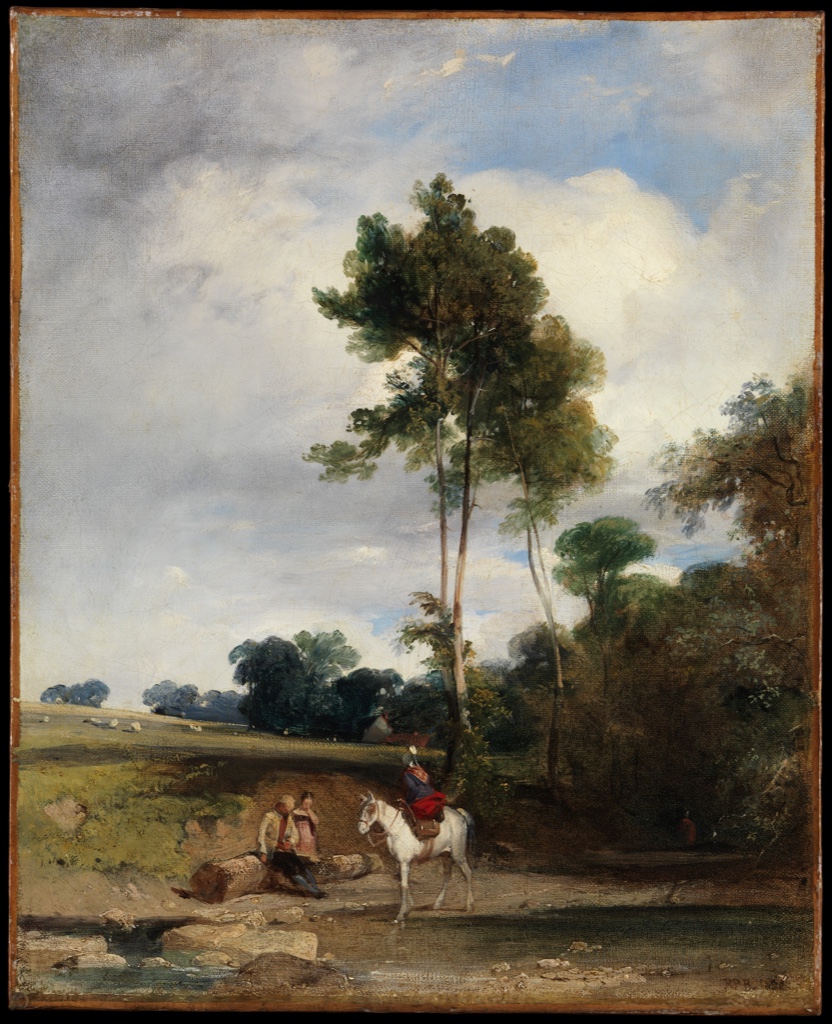
In Roadside Halt, a journey pauses at the shallow edge of a stream. A mounted figure looks down towards two people at the roadside, while a pale horse, tall trees and an immense field of cloud draw the eye upward. Richard Parkes Bonington turns this modest encounter into a study of proportion: human activity occupies the lower margin, yet it gives scale and immediacy to the Normandy landscape around it.
The Metropolitan Museum of Art dates the painting to 1826 and identifies its setting only as Normandy. That restraint matters. The figures invite questions, but neither their names nor their destination is known. What can be examined closely is Bonington's construction of a temporary stop—the contrast between movement and rest, the balance of figures and terrain, and an oil technique whose fluidity the Met compares with watercolour.[1]
At a Glance
- ArtistRichard Parkes Bonington (1802–1828), an English-born painter, watercolourist and lithographer trained largely in France.[5]
- Date1826.[1]
- MediumOil on canvas.[1]
- Dimensions46.4 × 37.8 cm (18 1/4 × 14 7/8 in.).[1]
- SettingNormandy; the museum does not name a more precise location.[1]
- CollectionThe Metropolitan Museum of Art, New York, object 45.146.1; given by Francis Neilson in 1945.[1]
Richard Parkes Bonington in context
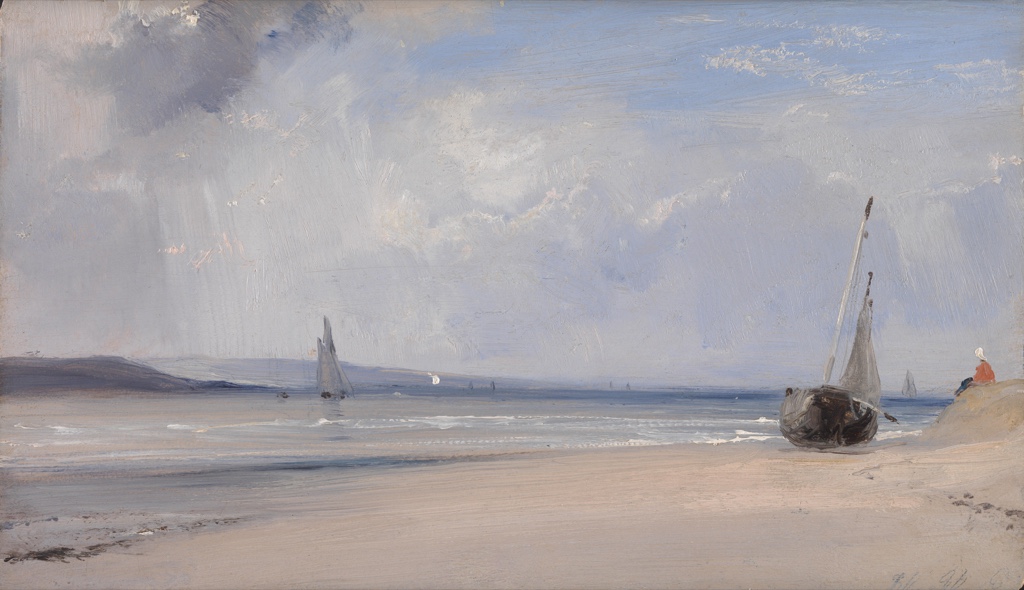
Seapiece: Off the French Coast
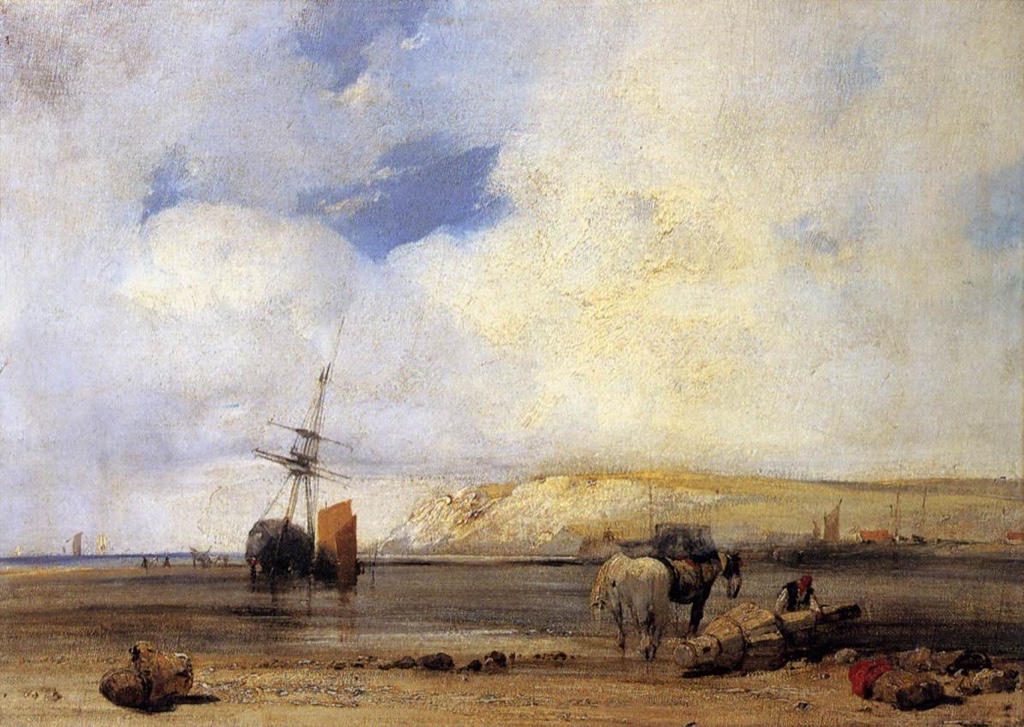
c. 1823–24An Estuary in Northern France
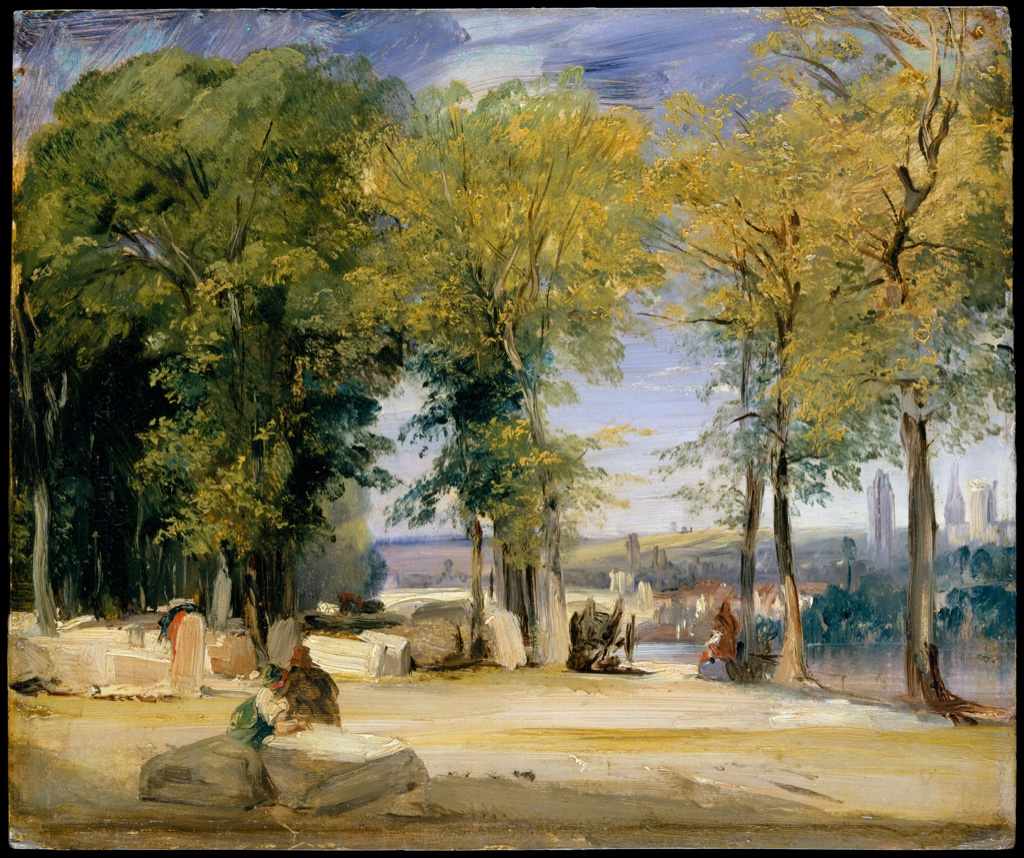
c. 1825–27View near Rouen
c. 1825Roadside Halt
1826Henri III
1828Contents
- Introduction
- A Halt as a Landscape Subject
- Building Upward from the Road
- Fluidity in Oil
- Canvas and Millboard
- Normandy Without a Named Road
- Delacroix and the Career Moment of 1826
- From Private Gift to the Met
A Halt as a Landscape Subject
Nothing in the title promises a major event. A halt is an interval: travel has begun and may soon continue, but for the moment people and horse remain together beside the water. That suspended action gives Bonington a subject that is both narrative and open-ended. We recognise stopping, looking and resting without being told why the group has met or where anyone is going.
The image offers several concrete details. A light-coloured horse stands almost in profile. Its rider, dressed in strong red and blue, forms the most concentrated patch of colour. Two figures gather nearby, beside what appears to be baggage or a bundle. The road crosses the foreground by a narrow stream; pasture and distant trees extend to the left, while dense vegetation rises on the right. These elements establish a journey through cultivated country, but they do not amount to a complete story.
Bonington makes uncertainty productive. The rider's elevated position and the seated pair's proximity create a social exchange, yet the painting does not clarify their relationship. The figures are legible enough to animate the scene and small enough to remain part of its scale. Rather than treating landscape as a background for a fully explained anecdote, he lets a familiar human pause organise the view.
This balance distinguishes Roadside Halt within Bonington's paintings. Its figures matter, but their importance lies partly in how they focus attention on the road, water, trees and changing sky. The represented halt slows our reading of the country without bringing the landscape itself to a standstill.
Building Upward from the Road
At 46.4 centimetres high and 37.8 centimetres wide, Roadside Halt is a compact vertical painting.[1] Bonington uses that upright format decisively. The stream and road occupy a narrow band across the foot of the canvas. Immediately above them, the horse and people make a low cluster. A group of slender trunks then rises from near the centre, carrying the composition into the cloud-filled upper half.
This sequence connects distinct zones without turning them into rigid tiers. The horse's pale body answers the light sky; the rider's red provides a vivid hinge between the darker roadside and the brighter centre. The tallest trees lean and spread irregularly rather than forming an architectural column. Their foliage interrupts the clouds, while the open land to the left prevents the entire scene from becoming enclosed.
The asymmetry is important. Dense trees and shadow collect along the right edge, giving the mounted figure a dark setting. The left opens into lower fields and distant clumps of vegetation. Between them, the central trunks form a permeable screen: branches overlap sky, but gaps preserve air and distance. The eye can move from foreground stones to the horse, up the trunks and out through cloud rather than settling on a single dominant landmark.
Human scale remains the anchor. Without the figures, the height of the trees and breadth of the sky would be harder to judge. Without the upward movement of the trees, the people might read as a self-contained episode. Bonington joins the two. The small group makes the landscape inhabitable; the landscape makes their interruption feel momentary.
Fluidity in Oil
The Met describes the picture as painted with a fluidity and lightness comparable to watercolour, the medium in which Bonington excelled.[1] That comparison does not mean the oil painting imitates every physical property of watercolour. It identifies a shared effect: broad passages remain airy, marks are economical, and detail is concentrated rather than uniformly developed.
The sky makes this clearest. Blue shows through areas of pale cloud, while grey gathers at the left and white swells behind the trees. Boundaries shift between firmer and softer handling. The upper expanse is not filled with incident at every point; open paint and restrained transitions allow it to feel spacious. Below, darker foliage is built from varied touches and masses rather than described leaf by leaf. The horse and figures receive sharper accents because they carry the encounter.
Bonington's marks also change according to their work in the composition. Thin verticals define trunks. Broken, directional strokes suggest branches and foliage. Broader horizontal movements establish the roadway, banks and distant land. Small light touches pick out stones and the rippling edge of the stream. This variety creates clarity without requiring an even finish across the whole surface.
A comparison with An Estuary in Northern France helps to place this approach. The National Gallery describes Bonington using thin, rapidly applied oil and visible brushwork to preserve the immediacy associated with watercolour in that board painting. It also distinguishes between broadly established areas and selected details that may have been added later.[2] That evidence belongs to the National Gallery picture, not automatically to Roadside Halt. It nevertheless demonstrates that the relationship between watercolour practice and oil handling was a sustained technical concern for Bonington. Explore that relationship further through his watercolours and drawings.
The result here is not a claim that the scene was painted quickly, nor proof that it was completed in one sitting. A fluid appearance and a rapid act are not the same thing. The painting's lightness is visible; the exact duration and location of its execution are not recorded by the Met. Bonington could make considered decisions look unforced. That distinction protects the work from a common shortcut in which every lively mark is treated as evidence of speed.
Canvas and Millboard
Roadside Halt is painted on canvas.[1] That support separates it from several of Bonington's small oil views on prepared millboard. The Met's View near Rouen, for example, measures 27.9 × 33 centimetres, is dated to about 1825 and is explicitly recorded as oil on millboard.[3] Patrick Noon's 2025 study explains that Bonington encountered a portable, commercially prepared Davy millboard in London in 1825, enabling him to pursue direct oil studies of natural effects with an immediacy he had previously achieved in watercolour.[4]
The contrast clarifies what can and cannot be inferred. Millboard's portability is relevant to Bonington's practice, and View near Rouen provides a secure example. It does not follow that every fluid oil was made on that support or outdoors. Roadside Halt shows that the light handling associated with his smaller studies could operate on canvas and within a more overtly composed figure-and-landscape scene.
The two Met paintings also use their formats differently. The horizontal View near Rouen spreads a riverside prospect laterally. Roadside Halt stacks near figures, trees and sky in an upright field. One support-and-format combination encourages breadth; the other makes height and compression central. Seen together, they caution against reducing Bonington's oils to a single type of portable landscape sketch.
Normandy Without a Named Road
The Met identifies Normandy as the setting but does not specify a road, town or documented journey.[1] That is enough to connect the painting with Bonington's sustained engagement with northern France without pretending that the landscape has been pinpointed. The British Museum records that he was English-born, brought up and trained in France, began exhibiting there in 1822, and worked across painting, watercolour and lithography.[5]
Normandy in Roadside Halt is therefore observed country rather than generic “Romantic scenery”, but its exact geography remains open. The shallow water, worn route, grazing land and varied trees make a plausible working landscape. There is no ruined monument or dramatic peak to declare the location. Bonington attends instead to the changing relationship between an ordinary route and a large sky.
The work also avoids a simple division between people and nature. The road cuts through the land; the travellers occupy it; the stream interrupts it. Human passage is embedded in the terrain. By keeping distant detail sparse and foreground elements selective, Bonington gives the setting specificity without turning it into a topographical inventory.
For a different northern French balance of water, weather and small figures, see An Estuary in Northern France. The comparison reveals continuity in Bonington's interest in expansive atmosphere, but also a real difference: the estuary opens horizontally towards a broad distance, whereas Roadside Halt closes around a near encounter and then escapes vertically into sky.
Delacroix and the Career Moment of 1826
The Met places Roadside Halt at a striking point in Bonington's development. Its record says that he had been working in oil for only about four years, yet had already achieved effects that impressed Eugène Delacroix.[1] Noon's account refines the chronology without forcing a false exact beginning: after youthful experiments, Bonington resumed oil painting in 1824, when he exhibited five marine and coastal views at the Paris Salon and received a gold medal.[4]
By 1825–26 Bonington and Delacroix shared a studio, and Noon notes Delacroix's admiration for Bonington's ability to test a composition in watercolour or wash before executing an oil with exceptional assurance.[4] The Met quotes Delacroix praising both Bonington's grasp of effects and his facility of execution.[1] That response is especially relevant to Roadside Halt. Its achievement is not confined to subject matter. The orchestration of pale and dark zones, open sky, sharply placed colour and varied brushwork makes the act of painting inseparable from what is represented.
Admiration did not flow through a one-way national “influence”. Bonington's position was cross-Channel: English by birth, trained and professionally active in France, alert to British landscape practice, and in close contact with French artists. The British Museum's dual classification of him as British and French reflects that lived context.[5] The wider story is explored in Bonington and British and French Romanticism.
From Private Gift to the Met
The Met records Roadside Halt as a 1945 gift from Francis Neilson, with accession number 45.146.1.[1] That concise museum history is more secure than filling gaps with an unverified chain of ownership. The work is now in the Department of European Paintings and is identified by the museum as public domain.[1]
Its current setting encourages a particularly useful comparison with View near Rouen. Together, the two paintings show how Bonington could vary support, orientation and the role of figures while sustaining his concern with atmosphere. Roadside Halt is neither an anecdote placed upon a landscape nor a view emptied of human presence. Its pause brings the two into temporary balance.
Researched works directory
This searchable directory is an online evidence census assembled from public museum and collection records. It is not a substitute for Patrick Noon’s printed catalogues raisonnés.
| Name | Date | Medium |
|---|---|---|
| A Coast Scene | 1820–1828 | Painting |
| A Cutter and other shipping in a Breeze | 1827–1828 | Watercolour |
| A Distant View of St-Omer | 1824 | Painting |
| A Distant View of St-Omer | c. 1824 | Painting |
| A duel between Frank and Rashleigh | 1828 | |
| A Faun with Pipes | Date unknown | Drawing |
| A Seascape | Date unknown | Drawing |
| A Venetian Scene | c. 1828 | Watercolour |
| A Wooded Stream and a Farmhouse in Normandy | Date unknown | Drawing |
| Abbeville - Vue Pris, de la route de Calais | Date unknown | |
| Abbey St-Amand, Rouen | Date unknown | Watercolour |
| An Estuary in Northern France | c. 1825–1827 | Painting |
| An Italian Town | 1822–1828 | Painting |
| Ancienne Porte a Stirling | 1826 | |
| Ancienne Tour | 1826 | |
| Ancienne Tour Près de Lanark | 1826 | |
| Anne Page and Slender (Shakespeare's Merry Wives of Windsor, Act 1, Scene 1) | 1829 | Artwork |
| Architectural Remains and Fragments: Rouen - Fontaine de la Crosse | 1827 | |
| Architecture du Moyen Age | 1824 | |
| Argyle Castle | 1826 | |
| Argyle Castle | 1828 | |
| At the English Coast | 1825 | Watercolour |
| Beach Scene | c. 1825 | Watercolour |
| Beach Scene with Cart and Horse | 1825 | Painting |
| Beached Vessels and a Wagon, near Trouville, France | c. 1825 | Painting |
| Beauvais - interieur d'une cour | Date unknown | |
| Bergues - La Tour du March, | Date unknown | |
| Bergues: La Tour du marché | 1824 | |
| Boccadasse, Genoa with Monte Fasce in the Background | 1826 | Painting |
| Bologna | 1826–1827 | Drawing |
| Bologna | 1828 | |
| Bonington - Vue de Venise | Date unknown | Watercolour |
| Bothwell Castle | 1826 | |
| Bothwell Castle | 1828 | |
| Boulogne Harbor | 1823 | Watercolour |
| Bracklin-Bridge | 1828 | |
| Brackline | 1826 | |
| Caen - Eglise Saint-Sauveur | 1824 | Drawing |
| Caen - Maison Grande Rue Saint-Pierre | Date unknown | Drawing |
| Calais Jetty, France | c. 1824 | Painting |
| Campos sur les bords du Rio das Velhas | 1827 | |
| Castle on a Scottish Loch | 1822–1828 | Painting |
| Cathedrale Notre-Dame | 1824 | |
| Charles V visits François Ier after the Battle of Pavia | c. 1827 | Watercolour |
| Chateau d'Argyle | 1826 | |
| Chateau de Bothwell | 1826 | |
| Chateau de Bothwell / Bothwell Castle | 1826 | |
| Christ preaching - unfinished | Date unknown | Painting |
| Coast Scene in Picardy, France | 1826 | Painting |
| Coastal Scene with Fishing Boats | 1828 | Painting |
| Croix de Moulin-les-Planches | 1827 | |
| Demetrius de Palatiano | 19 th century | Painting |
| Die adriatische Küste | c. 1820 | Painting |
| Die normannische Küste | 1823–1824 | Painting |
| Dieppe Harbour | Date unknown | Painting |
| Don Quixote | 1825–1826 | Painting |
| Don Quixote in His Study | 1825–1826 | Painting |
| Doune Castle | 1828 | |
| Du Sacristain de Saint Angadresne | c. 1828 | |
| Dutch: Processie in Verona | 1801–1828 | Painting |
| Edimbourg pris de la Chapelle St Antoine | 1826 | |
| Edimbourg vu de Calton-Hill | 1826 | |
| Edimbourg vu de la Chapelle Saint-Antoine | 1826 | |
| Edinbourgh vu de la Chapelle S. Antoine | 1826 | |
| Edinburg from S. Anthony Chapel | 1828 | |
| Edinburgh from St. Anthony Chapel | 1826 | |
| Edinburgh from the Calton Hill | 1828 | |
| Eglise de Saint-Taurin, Evreux | 1824 | |
| Eglise de St. Jean a Lyons | 1824 | |
| Eglise St. Sauveur | 1824 | |
| Embouchure de la Riviere Caxoera | 1827 | |
| Entree de la rade de Rio-Janeiro | 1827 | |
| Entrée de la salle des pas-perdus, Palais de Justice | 1824 | |
| Evening in Venice | 1826–1828 | Painting |
| Façade de l'Eglise de Brou | 1825 | |
| Façade St. Jean | 1824 | |
| Figures on a rocky shoreline | Date unknown | Artwork |
| Fishing Boats in a Calm, Ships at Anchor | 1825 | Painting |
| Fishing Smacks in French Harbour | 1818–1825 | Painting |
| Five Studies of a French Pointer | 1825–1826 | Drawing |
| Fontaine de la Crosse | 1827 | |
| French Coast Scene | 1815–1828 | Painting |
| French Coast with Fishermen | 1825 | Painting |
| French Hulk | 1820–1828 | Painting |
| German: Ein Waldweg | 1825–1826 | Painting |
| Glenfinlas | 1826 | |
| Glenfinlas | 1828 | |
| Glenfinlas Valley (Vallée de Glenfinlas, from Vues Pittoresques de l'Écosse) | 1826 | Artwork |
| Goetz Von Berlichingen Before The Imperial Magistrate | c. 1826 | Drawing |
| Grand Canal, Venice | 1826 | Drawing |
| Greek Armatole (irregular fighter). | 1825 | Painting |
| Half-length Portrait of a Bearded Man in Historical Dress | 1818 | Drawing |
| Henri III | 1828 | Painting |
| Hôtel de Sens : dessin / Richard-Parkes Bonington | 19 th century | Drawing |
| Ile de la Cite | Date unknown | Watercolour |
| In the Forest of Fontainebleau | c. 1825 | Painting |
| Intérieur d'une Cour | 1824 | |
| Jour du Marché | 1824 | |
| L'Eglise de St. Gervais et St. Protais | 1824 | |
| L'espace | c. 1826 | Painting |
| La Conversation | 1826 | |
| La Place du Molard, Geneva | Date unknown | Painting |
| La Prière | 1826 | |
| La Tour du Marché | 1824 | |
| Lac de Killin | 1826 | |
| Lac Lomond | 1826 | |
| Landscape with a Pond | 1825–1826 | Painting |
| Landscape with Castle Ruin | Date unknown | Watercolour |
| Le Château de la Duchesse de Berry | 1823–1825 | Painting |
| Le matin | 1824 | |
| Le Repos | 1826 | |
| Le Retour | 1826 | |
| Le Silence Favorable | 1826 | |
| Les Pendus | 1826 | |
| Les Plaisirs Paternels | 1826 | |
| Les Salinieres near Trouville | 1827–1828 | Painting |
| Lillebonne - Chateau d'Harcourt | 1824 | |
| Lillebonne - Chateau d'Harcourt | Date unknown | |
| Loch Lomond | 1826 | |
| Loch Lomond | 1828 | |
| Loch Tay | 1828 | |
| Lochkillin | 1826 | |
| Low Tide at Boulogne | 1824 | Painting |
| Maison Grande Rue St. Pierre | 1824 | |
| Maison Située Rue St Veronique | 1824 | |
| Man and Woman in a Landscape, possibly Faust and Marguerite | c. 1826 | Drawing |
| Molard-Bonington-1829 | 1829 | |
| Molard-Bonington-1829-cropped | 1829 | |
| Near Honfleur | 1823 | Watercolour |
| Near Jumieges | Date unknown | Watercolour |
| Old Gate Way at Stirling | 1828 | |
| Old Gateway at Stirling | 1826 | |
| Old Tower near Lanark | 1828 | |
| On the Adriatic | c. 1826 | Painting |
| On the Coast of Picardy | 1826 | Painting |
| On the Seine – Morning | 1825 | Painting |
| Palais de Justice, Rouen | Date unknown | Drawing |
| Paris from Pere Lachaise | Date unknown | Watercolour |
| Pays de Caux: Twilight | 1818–1828 | Painting |
| Peasant Women from Ragusa | 1826 | Drawing |
| Pesmes | 1825 | |
| Peveril of the Peak - Julian Peveril and Alice Bridgenorth, surprised by Major Ralph Bridgenorth | c. 1826 | Watercolour |
| Picardy Coast with Children – Sunrise | c. 1826 | Painting |
| Picturesque Views of Scotland: Brackline | 1826 | |
| Pierre de Vaivre | 1827 | |
| Polish: Zdjęcie z krzyża The Descent from the Cross. | 1820 | Painting |
| Portia and Bassanio | c. 1826 | Watercolour |
| 1827 | ||
| print, title-page | 1828 | |
| Processie in Verona | 19de eeuw | Painting |
| Promenade vénitienne (Venetian Promenade) | Date unknown | Artwork |
| Quentin Durward and the Disguised Louis XI (recto); Study of male figure (verso) | 1825–1826 | Drawing |
| Quentin Durward at Liège, Belgium | 1827–1828 | Painting |
| Quentin Durward in Luik, objectnr TA 11006 | 1825 | Drawing |
| Restes et Fragmens d'Architecture du Moyen Age: Église St. Sauveur, Caën | Date unknown | |
| Riva degli Schiavoni, from near San Biagio, Venice, by Richard Parkes Bonington | Date unknown | Painting |
| Road Workers, near Lillebonne | Date unknown | Painting |
| Roadside Halt | 1826 | Painting |
| Robert Dudley, Earl of Leicester and his wife Amy Robsart. | 1820 | Painting |
| Rouen | 1825 | Watercolour |
| Rouen: Entrée de la Salle des Pas Perdus, Palais du Justice | 1824 | |
| Rue du gros-horloge, Rouen | 1824 | |
| Ruines de Chateau d'Arlay | 1827 | |
| Ruines du Château d'Arlay | 1827 | |
| Ruins of the Abbey Saint Bertin | 1824 | Painting |
| Sea Coast, the Dunes | Date unknown | Painting |
| Seapiece: Off the French Coast | c. 1823–1824 | Painting |
| Shipping in a Swell | 1824–1827 | Watercolour |
| Shipping in an Estuary, Probably near Quilleboeuf | 1825–1826 | Watercolour |
| Sketch of a Woman | 1828 | Drawing |
| Street in the Outskirts of Besançon, France | 1827 | |
| Studies for Shylock | 1825 | Drawing |
| Study of a Gentleman in 17th Century Costume, After Van Dyck | 1827–1828 | Drawing |
| Study of a Seated Woman | Date unknown | Drawing |
| Study of a Woman with her Head on her Hand | Date unknown | Drawing |
| Sunset: A Sketch | Date unknown | Painting |
| Sunset in the Pays de Caux | 1828 | Watercolour |
| The Antiquary | Date unknown | Painting |
| The Chibouk | 1826 | Painting |
| The Church of St. Wulfran, Abbeville: The North Door of the West Front | c. 1823 | Drawing |
| The Count of Palatino in the costume of a Palikar | Date unknown | Painting |
| The Doge's Palace, Venice | 1826 | Painting |
| The Escape from Argyle Castle | 1826 | |
| The Escape from Argyle-Castle | 1828 | |
| The Grand Canal | 1826–1827 | Painting |
| The Grand Canal, Venice | 1826–1827 | Painting |
| The Interior of Sant' Ambrogio, Milan | 1826 | Painting |
| The Old Jetty, Boulogne, France | Date unknown | Painting |
| The Pont des Arts, Paris | 1826 | Painting |
| The Proposal (recto); Unfinished drawing of a horse and rider (verso) | 1820 | Drawing |
| The Rialto, Venice | Date unknown | Painting |
| The Salt Marshes near Trouville | 1826 | Watercolour |
| The Use of Tears | 1827 | Watercolour |
| The Use of Tears | Date unknown | Painting |
| Titlepage to Restes et Fragments | Date unknown | |
| Tomb in the Church of Saint-Omer, France | Date unknown | Painting |
| Tombeau de Marguerite de Bourbon, Eglise de Brou | 1825 | |
| Tour aux archives à Vernon | 1824 | |
| Tour du gros horloge, batie sous la domination des Anglais en 1417, Evreux | 1824 | |
| Tour du gros-horloge, Evreux | 1824 | |
| Trees and a Cottage by a River | 1827 | Drawing |
| Untitled (one of three) | Date unknown | |
| Vessels in a Choppy Sea | c. 1824 | Watercolour |
| View in Brittany: Bridge, Cottages and Washerwomen | 1818–1828 | Painting |
| View near Rouen | c. 1825 | Painting |
| View near Sarzana, Val di Magra | 1826 | Painting |
| View of the Rialto Bridge, Venice | c. 1826 | Watercolour |
| View on the Grounds of a Villa near Florence | 1826 | Painting |
| View on the River Seine - Morning | c. 1825 | Painting |
| Voyages pittoresques et romantiques dans l'ancienne France | 1825 | |
| Voyages pittoresques et romantiques dans l'ancienne France, Franche-Comté: Église de l'abbaye de Tournus | 1825 | |
| Voyages pittoresques et romantiques dans l'ancienne France, Franche-Comté: Ruines du château d'Arlay | 1825 | |
| Voyages pittoresques et romantiques dans l'ancienne France, Franche-Comté: Vue d'une rue des faubourgs de Besançon | 1825 | |
| Voyages pittoresques et romantiques dans l'ancienne France, Normandie: Église de Saint Gervais et Saint Protais à Gisors | 1824 | |
| Voyages pittoresques et romantiques dans l'ancienne France, Normandie: Rue du Gros Horloge, Rouen | 1824 | |
| Voyages pittoresques et romantiques dans l'ancienne France, Normandie: Tour aux archives à Vernon | 1824 | |
| Voyages pittoresques et romantiques dans l'ancienne France, Normandie: Tour du Gros-Horloge, Evreux | 1824 | |
| Vue d'une rue des faubourgs de Besançon | 1827 | |
| Vue d'une rue des Faubourgs de Besançon (View of a Street in the Outskirts of Besançon) | 1827 | |
| Vue Generale de l'Eglise de l'Abbaye de Tournus | 1825 | |
| Vue Générale de l'Eglise de St. Gervais et St. Protais, à Gisors | 1824 | |
| Vue Generale des Ruines du Chateau d'Arlay | 1827 | |
| Vue prise à l'entrée du jardin des Plantes. Au premier plan, bâtiment de la minéralogie et à l'arrière, dôme de l'hôpita, D.2182 | 1806–1828 | Drawing |
| Vue Prise de la Route de Calais | 1824 | |
| Vues Pittoresques de l'Écosse | 1826 | |
| Young Woman Writing a Letter | 1820–1828 | Painting |
Frequently Asked Questions
The Metropolitan Museum of Art dates it to 1826 and says that the scene is set in Normandy.[1] The record does not identify a specific road or town, and it does not state that the canvas was painted outdoors.
Their identities are not established in the Met's record. The visible group includes a mounted figure and two people resting or sitting near the roadside, but their relationship, destination and reason for stopping remain unknown. It is safest to read their actions without inventing a biography for them.
The work is oil on canvas and measures 46.4 × 37.8 centimetres.[1] This distinguishes it from View near Rouen, a smaller oil on millboard, even though both works demonstrate Bonington's economical landscape handling.[3]
The effect comes from visual handling rather than a change of medium. Open areas, fluid transitions, visible directional marks and selectively concentrated detail give Roadside Halt lightness and air. The Met explicitly compares its fluidity with watercolour, but does not claim that the canvas was executed in a single rapid session.[1]
The Met cites Delacroix's admiration for Bonington's understanding of pictorial effects and ease of execution.[1] Noon's research adds that the artists shared a studio in 1825–26 and that Delacroix valued Bonington's assured movement from preparatory watercolour or wash to oil.[4] In Roadside Halt, that assurance is visible in the balance of spare atmosphere, dark foliage and a few precisely placed figures.
Discussion
Use this evidence-led guide as a starting point for close looking rather than a final verdict.
Share an observation about Roadside Halt or a source that adds useful context.
Reader Insights
Which passage of paint most changes your reading of Roadside Halt?
How does the support, scale or known setting affect the way you interpret the work?
What remains uncertain when museum evidence is separated from visual inference?
Join the Conversation
Add your reading below, keeping observations specific and evidence clear.
References
- The Metropolitan Museum of Art, “Richard Parkes Bonington: Roadside Halt”, object 45.146.1:, accessed 30 August 2026.
- The National Gallery, London, “Richard Parkes Bonington: An Estuary in Northern France”, NG6619:, accessed 30 August 2026.
- The Metropolitan Museum of Art, “Richard Parkes Bonington: View near Rouen”, object 2001.45:, accessed 30 August 2026.
- Patrick Noon, “A Supplement to Richard Parkes Bonington, the Complete Paintings”, Colnaghi Studies Journal, XVII (October 2025), pp. 61–76:, accessed 30 August 2026.
- The British Museum, “Richard Parkes Bonington”, person record BIOG20191:, accessed 30 August 2026.