 by Tom Gurney
Tom Gurney BSc (Hons) is an art history expert with over 20 years experience
Page Created on August 30, 2026 / Page Updated on November 6, 2026
Email: tomgurney1@gmail.com / Phone: +44 7429 011000
The Doge's Palace, Venice: Introduction
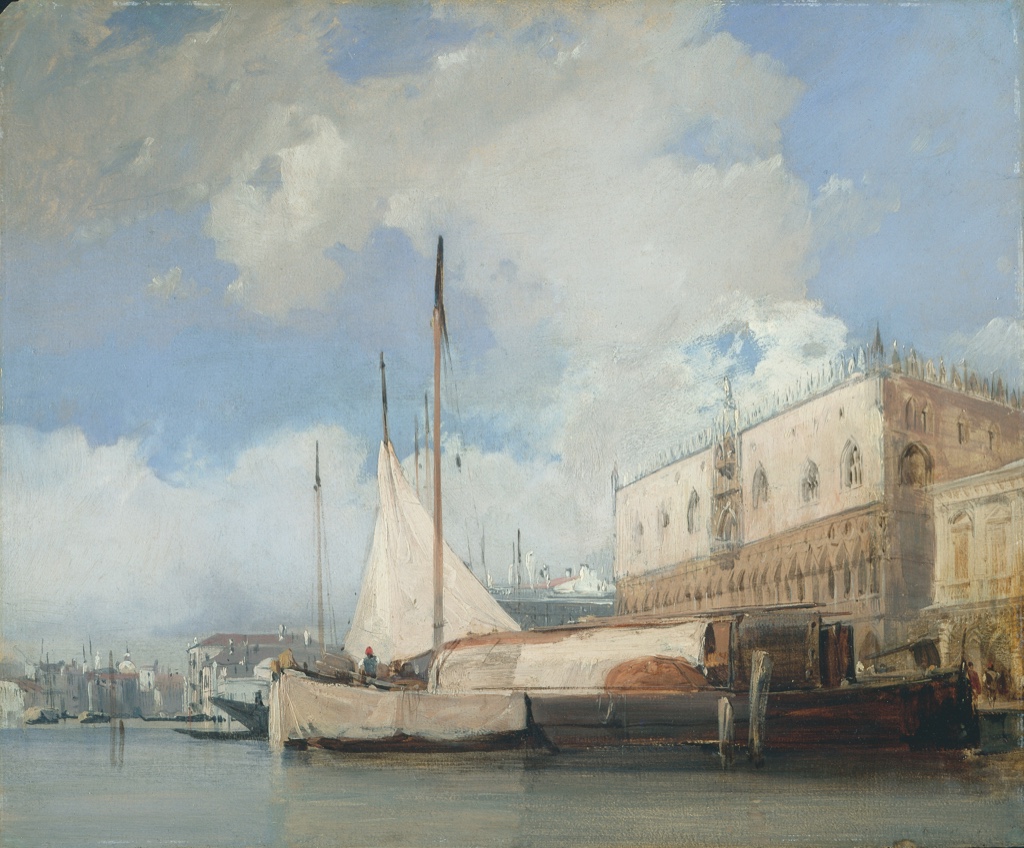
In The Doge's Palace, Venice, Richard Parkes Bonington places a celebrated building within the everyday traffic of the lagoon. The palace rises at the right, its arcades and patterned upper walls recognisable yet lightly stated. Boats occupy the foreground so completely that their masts cross the sky and their hulls hide part of the architecture. Above both is an immense movement of blue, white and grey paint. The result is not a dutiful inventory of Venice's monuments. It is a small, immediate encounter in which stone, sail, water and cloud become different measures of light.
The Cleveland Museum of Art dates the painting to 1826, the year Bonington travelled to Venice, and describes it as a study made from a boat anchored in the lagoon near the palace. It also identifies the rapid method visible on the surface: colours were mixed while the paint remained wet.[1] Those facts help explain why this modest board feels so open. Bonington gives enough architectural information to establish the place, but the passing conditions of seeing it determine the picture.
At a Glance
- ArtistRichard Parkes Bonington (1802–1828)
- TitleThe Doge's Palace, Venice
- Date1826
- Medium and supportOil on millboard
- Dimensions35.5 × 42.7 cm unframed
- CollectionCleveland Museum of Art, John L. Severance Fund, 1985.56[1]
Richard Parkes Bonington in context
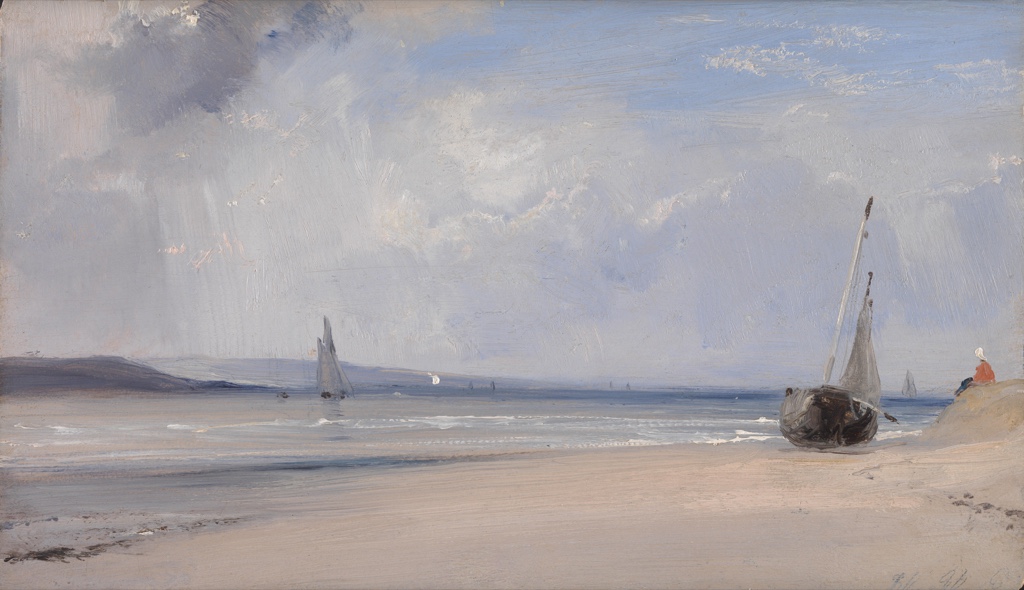
Seapiece: Off the French Coast
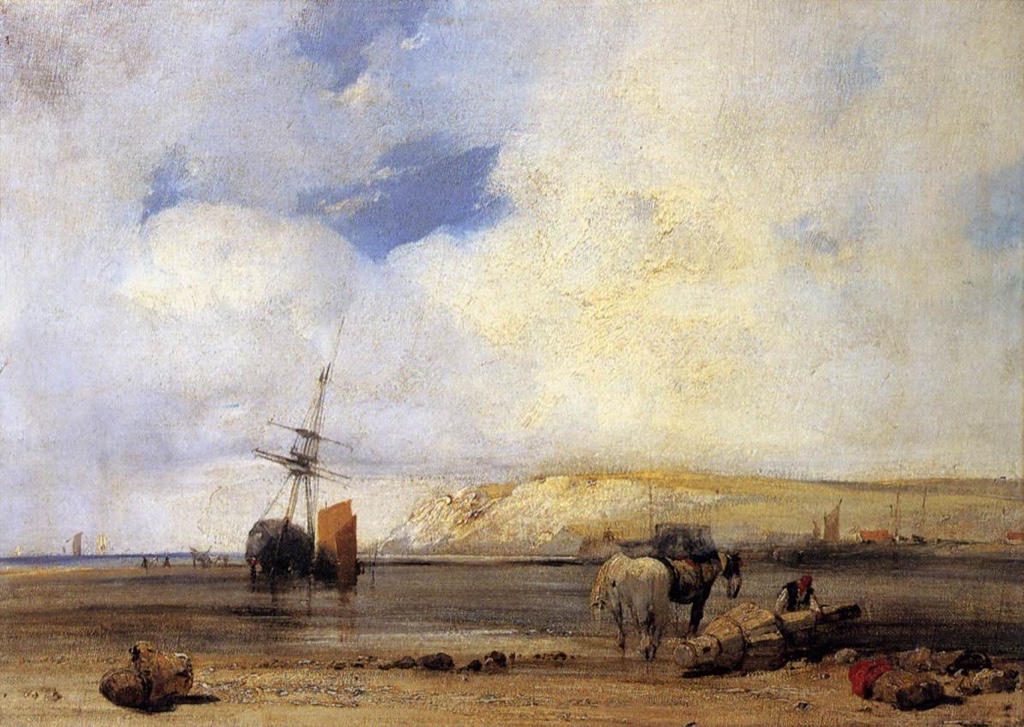
c. 1823–24An Estuary in Northern France
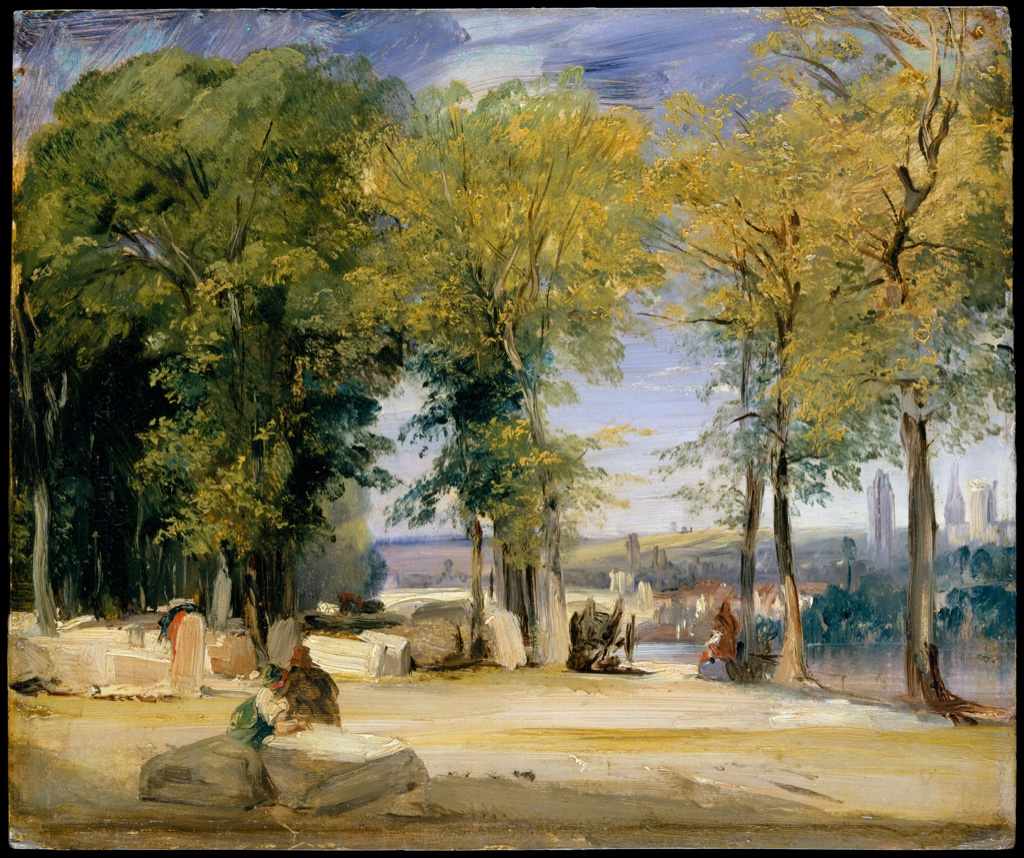
c. 1825–27View near Rouen
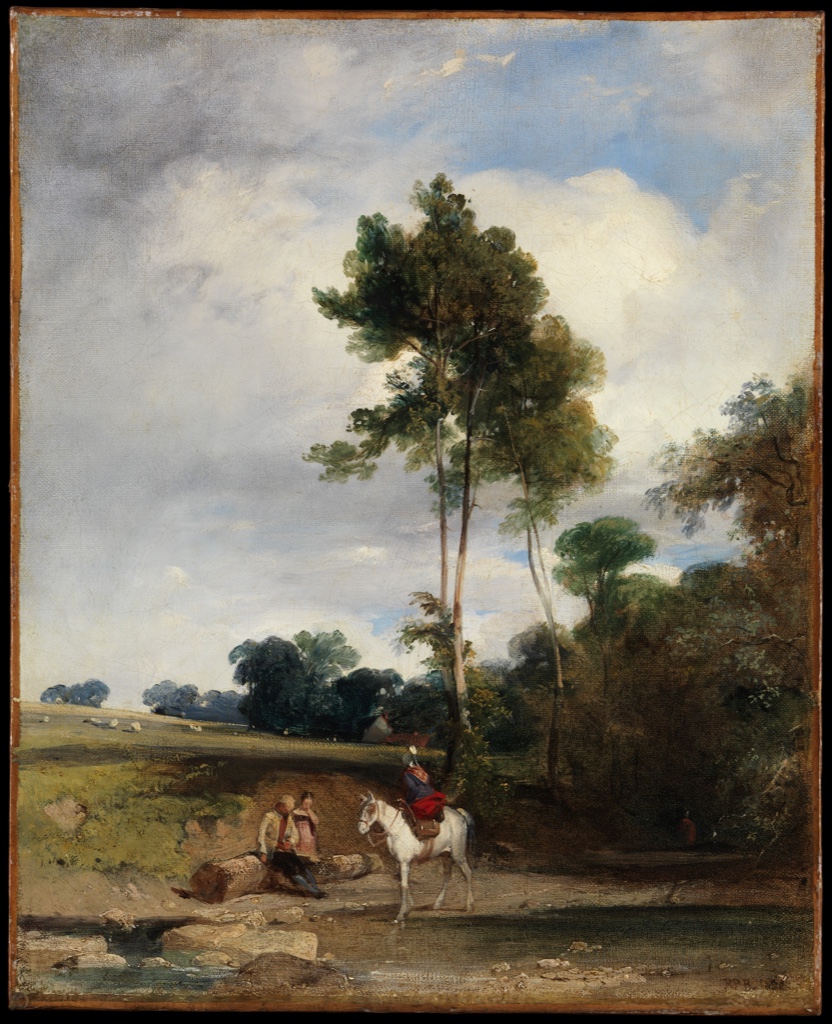
c. 1825Roadside Halt
1826Henri III
1828Contents
- Introduction
- Venice in the Italian Journey of 1826
- A View from the Lagoon
- Architecture, Boats and an Expansive Sky
- Oil on Millboard: Speed Without Carelessness
- What Does “Study” Mean Here?
- A Related Louvre Drawing, Not a Study for This Board
- The Painting's Place in Bonington's Work
Venice in the Italian Journey of 1826
Bonington reached Italy after his successes at the Paris Salon of 1824 and a productive visit to London in 1825. Patrick Noon's 2025 study explains that Bonington and Eugène Delacroix had discussed travelling to Italy while sharing a Paris studio. Delacroix withdrew, and Bonington eventually travelled with his friend and patron Charles Rivet. Their three-month tour of Switzerland and Italy began in April 1826, followed a northerly itinerary and only touched Tuscany rather than continuing to Rome.[2]
Venice was not simply one picturesque stop. Noon identifies several attractions that helped shape the route: Venetian Gothic architecture, the city's associations with Shakespeare, and its paintings by Titian and Veronese.[2] Bonington therefore encountered Venice as architecture, literary history and painterly tradition at once. Yet the Cleveland board turns away from a ceremonious presentation of the ducal palace. Its emphasis is mobile and contemporary: working boats stand before the seat of government, and the changing sky occupies more space than the stone façade.
The museum recounts that persistent rain initially troubled Bonington and that conditions subsequently improved. It also says that he often painted outdoors while seeking immediate impressions of Venetian architecture and sunlight.[1] Nothing in the Cleveland picture requires a precise hour or weather sequence. What it does preserve is an alertness to uneven illumination: the façade, sails and clouds are not uniformly bright, and the scene depends upon shifts between clear blue, soft white and cooler shadow.
For a fuller account of the journey, see Richard Parkes Bonington's biography. His Venetian work also belongs within the wider cross-Channel practice explored in British and French Romanticism.
A View from the Lagoon
The viewpoint determines almost everything. Cleveland locates Bonington aboard a boat moored on the lagoon close to the palace.[1] Accordingly, the water is not a distant strip placed beneath an architectural prospect. It is the painter's position and the picture's foreground. The palace is seen obliquely from below and to one side, while other craft intervene between observer and monument.
This arrangement rejects the clear central axis of an architectural elevation. The palace enters from the right edge and extends towards the middle, where its long façade meets masts, rigging and pale sails. Parts of the building are concealed. The boats have not been moved aside to improve the view; their bulky hulls and vertical spars make the lagoon feel occupied. Venice appears as a place reached and seen through waterborne movement rather than as a set of buildings isolated for inspection.
The low viewpoint also affects scale. A pale vessel stretches across much of the lower picture, while a darker boat presses against the right edge. The palace is larger in reality, but within the composition it must negotiate with forms much nearer to the eye. This creates an active sequence of depth: the dark hull sits closest, the pale sail and boat overlap the middle distance, and the palace recedes behind them. Tiny figures and narrow posts punctuate the edges without competing with those large masses.
Bonington does not erase the palace's distinctive character. The repeating pointed arches of the lower levels, the patterned wall above and the irregular crest of pinnacles establish the building. But they are compressed into a luminous band rather than itemised stone by stone. The viewpoint makes selective description convincing: from a boat on the water, architecture is one element within a field of obstructions, reflections and atmosphere.
Architecture, Boats and an Expansive Sky
The palace occupies the right half of the board, yet the sky governs the whole. Blue opens around a towering cloud whose pale body spreads across the upper centre. Smaller patches of cloud gather lower down, and cooler grey enters towards the left. These broad atmospheric zones establish the painting's scale more forcefully than exact architectural measurements could. A compact support seems to hold a much wider space because the clouds extend beyond its edges.
Bonington then uses the boats to join sky and water. Masts carry dark verticals upward through the blue; the tallest rises in front of the central cloud. The principal sail repeats the cloud's pale colour but gives it a sharp triangular boundary. Below, hulls form horizontal bands of cream, brown and near-black. The picture is therefore built from contrasts between buoyant, irregular paint above and firmer linear accents below.
The palace mediates between those two systems. Its long roofline is stable, but its pinnacles make a broken rhythm against the sky. Its façade is warm beside the blues and blue-greys around it. Arches and windows appear through economical darker touches; at this scale, the building's identity depends less on exhaustive detail than on proportion, silhouette and repeated openings. Bonington's precision lies in choosing which cues matter.
Light does not settle evenly across these forms. The large sail is bright but not blank, and the palace shifts from pale rose and cream towards warmer brown at the right. Dark hulls and openings anchor those high values. The water is quieter, carrying subdued horizontal strokes and a limited reflection of the craft. Rather than mirroring every object, it supplies a calm base for the busier meeting of boats and buildings.
Oil on Millboard: Speed Without Carelessness
The support is essential to the character of the work. Cleveland records oil on millboard, a firm paperboard that was easier to carry than a stretched canvas.[1] Noon explains that in London in 1825 Bonington encountered commercially prepared Davy millboard with an off-white ground. It enabled him to attempt outdoors in oil the spontaneous effects he had previously pursued in watercolour.[2] The Cleveland painting belongs to that practical expansion of his methods.
The museum describes thick swirls of paint and colours mixed while still wet, evidence of rapid working.[1] This wet-into-wet or alla prima handling is especially apparent in the cloud, where blue, white and grey meet without hard enclosing outlines. Some strokes retain the direction of the brush; elsewhere adjacent colours soften into one another. The surface does not disguise its making.
Rapid execution does not mean an absence of structure. The large elements are firmly organised: palace to the right, sail near the centre, open water to the left, cloud above. Dark accents are sparingly positioned at masts, windows, hulls and figures. These marks keep the light areas from dissolving into a general haze. Bonington could work quickly because the composition relies upon a clear hierarchy rather than equal attention everywhere.
His watercolour experience offers a useful way to understand that economy. Both media reward decisions about untouched or lightly covered areas, controlled washes or films of colour, and a few concentrated accents. Oil behaves differently—it can carry more body and allow wet colours to mingle—but Bonington uses it without sacrificing luminosity. The relationship is examined more fully in Bonington's watercolours and drawings, while his paintings place the millboard studies beside larger canvases.
What Does “Study” Mean Here?
Cleveland calls The Doge's Palace, Venice a “particular study” made from the anchored boat.[1] In this context, study should not be treated as a synonym for failed, incomplete or merely preparatory work. It describes a painting closely tied to direct observation and rapid execution. The board has a coherent visual argument of its own: the palace is encountered through boats and weather, and its selective finish is part of that argument.
Bonington's Venetian practice did, however, move between observation and later development. The National Gallery of Art says that during four weeks in Venice he made numerous graphite drawings and nearly thirty works in watercolour and oil. It distinguishes works completed on site from others used as foundations for more complex studio compositions. Its The Grand Canal, dated 1826/1827 and painted on canvas, was made after his return. Technical examination of that separate painting has identified pencil drawing and later additions after an initial paint layer dried.[3]
That comparison cautions against imagining one method for every Venetian work. The Cleveland board's wet handling supports an immediate encounter; the Washington canvas demonstrates that an appearance of spontaneity could also survive staged development. Bonington's achievement lies not in following a rigid rule but in carrying the clarity of first observation through different materials and degrees of completion.
The same distinction helps when looking back to the small oil View near Rouen. In both works portable millboard and selective description allow place and atmosphere to remain inseparable, but Venice introduces a denser collision of monument and traffic.
A Related Louvre Drawing, Not a Study for This Board
The Louvre holds a drawing titled View of Venice with the Riva degli Schiavoni, the Doge's Palace and the Piazzetta, dated about 1827, inventory RF 22757 recto. Its record identifies it as a preparatory study for a painting commissioned from Bonington in 1827 by L. J. A. Coutan and notes a larger version of that view at Tate Britain.[4]
The sheet is valuable evidence for Bonington's continued development of Venetian subjects, but it should not be described as preparatory for the Cleveland painting. The Louvre connects it to a separate commission. This difference matters because similar landmarks recur across his work. A drawing can preserve and reorganise architectural information for a later composition without serving as the origin of every painting that shows the palace.
Together, the objects reveal a flexible practice. Direct studies gathered the relationships of light, water and buildings; drawings could clarify a view; later commissions could expand or rearrange it. The surviving works are related through experience and subject, not necessarily through a single linear chain from sketch to finished picture.
The Painting's Place in Bonington's Work
The Doge's Palace, Venice condenses several of Bonington's central interests: travel, portable materials, architecture, water and rapidly changing light. It also shows why his work resists a simple division into British and French traditions. An English-born artist trained and established in France travelled with a French patron to study northern Italy, carrying a method shaped by watercolour into open-air oil painting.[2]
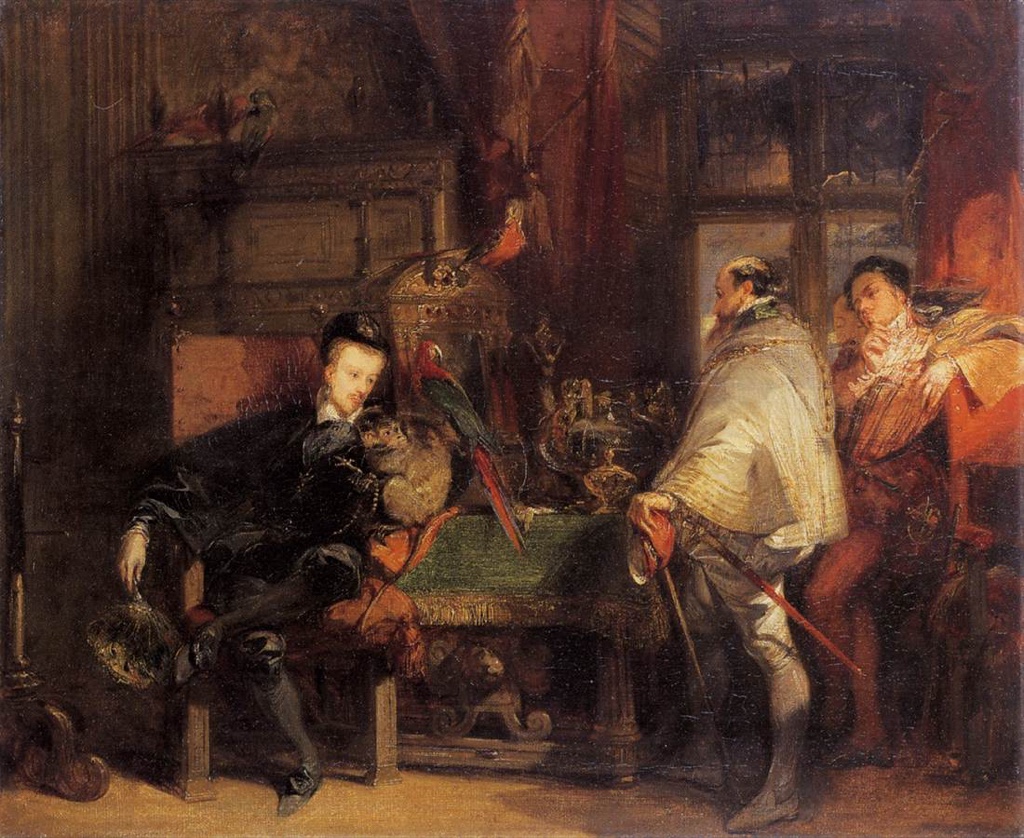
The board is not a culmination from which every later work follows. Bonington continued to vary scale and subject, including ambitious historical pictures such as Henri III. What the Cleveland painting demonstrates with unusual directness is his ability to make the conditions of looking—low viewpoint, intervening boats, unstable light—part of the subject itself.
The Cleveland Museum of Art acquired the work through the John L. Severance Fund; its accession number is 1985.56. The museum lists it in its British Painting and Decorative Arts galleries and makes the image and object data available through its Open Access programme.[1] Its present title, date, authorship, medium and dimensions are securely recorded by the collection.
Researched works directory
This searchable directory is an online evidence census assembled from public museum and collection records. It is not a substitute for Patrick Noon’s printed catalogues raisonnés.
| Name | Date | Medium |
|---|---|---|
| A Coast Scene | 1820–1828 | Painting |
| A Cutter and other shipping in a Breeze | 1827–1828 | Watercolour |
| A Distant View of St-Omer | 1824 | Painting |
| A Distant View of St-Omer | c. 1824 | Painting |
| A duel between Frank and Rashleigh | 1828 | |
| A Faun with Pipes | Date unknown | Drawing |
| A Seascape | Date unknown | Drawing |
| A Venetian Scene | c. 1828 | Watercolour |
| A Wooded Stream and a Farmhouse in Normandy | Date unknown | Drawing |
| Abbeville - Vue Pris, de la route de Calais | Date unknown | |
| Abbey St-Amand, Rouen | Date unknown | Watercolour |
| An Estuary in Northern France | c. 1825–1827 | Painting |
| An Italian Town | 1822–1828 | Painting |
| Ancienne Porte a Stirling | 1826 | |
| Ancienne Tour | 1826 | |
| Ancienne Tour Près de Lanark | 1826 | |
| Anne Page and Slender (Shakespeare's Merry Wives of Windsor, Act 1, Scene 1) | 1829 | Artwork |
| Architectural Remains and Fragments: Rouen - Fontaine de la Crosse | 1827 | |
| Architecture du Moyen Age | 1824 | |
| Argyle Castle | 1826 | |
| Argyle Castle | 1828 | |
| At the English Coast | 1825 | Watercolour |
| Beach Scene | c. 1825 | Watercolour |
| Beach Scene with Cart and Horse | 1825 | Painting |
| Beached Vessels and a Wagon, near Trouville, France | c. 1825 | Painting |
| Beauvais - interieur d'une cour | Date unknown | |
| Bergues - La Tour du March, | Date unknown | |
| Bergues: La Tour du marché | 1824 | |
| Boccadasse, Genoa with Monte Fasce in the Background | 1826 | Painting |
| Bologna | 1826–1827 | Drawing |
| Bologna | 1828 | |
| Bonington - Vue de Venise | Date unknown | Watercolour |
| Bothwell Castle | 1826 | |
| Bothwell Castle | 1828 | |
| Boulogne Harbor | 1823 | Watercolour |
| Bracklin-Bridge | 1828 | |
| Brackline | 1826 | |
| Caen - Eglise Saint-Sauveur | 1824 | Drawing |
| Caen - Maison Grande Rue Saint-Pierre | Date unknown | Drawing |
| Calais Jetty, France | c. 1824 | Painting |
| Campos sur les bords du Rio das Velhas | 1827 | |
| Castle on a Scottish Loch | 1822–1828 | Painting |
| Cathedrale Notre-Dame | 1824 | |
| Charles V visits François Ier after the Battle of Pavia | c. 1827 | Watercolour |
| Chateau d'Argyle | 1826 | |
| Chateau de Bothwell | 1826 | |
| Chateau de Bothwell / Bothwell Castle | 1826 | |
| Christ preaching - unfinished | Date unknown | Painting |
| Coast Scene in Picardy, France | 1826 | Painting |
| Coastal Scene with Fishing Boats | 1828 | Painting |
| Croix de Moulin-les-Planches | 1827 | |
| Demetrius de Palatiano | 19 th century | Painting |
| Die adriatische Küste | c. 1820 | Painting |
| Die normannische Küste | 1823–1824 | Painting |
| Dieppe Harbour | Date unknown | Painting |
| Don Quixote | 1825–1826 | Painting |
| Don Quixote in His Study | 1825–1826 | Painting |
| Doune Castle | 1828 | |
| Du Sacristain de Saint Angadresne | c. 1828 | |
| Dutch: Processie in Verona | 1801–1828 | Painting |
| Edimbourg pris de la Chapelle St Antoine | 1826 | |
| Edimbourg vu de Calton-Hill | 1826 | |
| Edimbourg vu de la Chapelle Saint-Antoine | 1826 | |
| Edinbourgh vu de la Chapelle S. Antoine | 1826 | |
| Edinburg from S. Anthony Chapel | 1828 | |
| Edinburgh from St. Anthony Chapel | 1826 | |
| Edinburgh from the Calton Hill | 1828 | |
| Eglise de Saint-Taurin, Evreux | 1824 | |
| Eglise de St. Jean a Lyons | 1824 | |
| Eglise St. Sauveur | 1824 | |
| Embouchure de la Riviere Caxoera | 1827 | |
| Entree de la rade de Rio-Janeiro | 1827 | |
| Entrée de la salle des pas-perdus, Palais de Justice | 1824 | |
| Evening in Venice | 1826–1828 | Painting |
| Façade de l'Eglise de Brou | 1825 | |
| Façade St. Jean | 1824 | |
| Figures on a rocky shoreline | Date unknown | Artwork |
| Fishing Boats in a Calm, Ships at Anchor | 1825 | Painting |
| Fishing Smacks in French Harbour | 1818–1825 | Painting |
| Five Studies of a French Pointer | 1825–1826 | Drawing |
| Fontaine de la Crosse | 1827 | |
| French Coast Scene | 1815–1828 | Painting |
| French Coast with Fishermen | 1825 | Painting |
| French Hulk | 1820–1828 | Painting |
| German: Ein Waldweg | 1825–1826 | Painting |
| Glenfinlas | 1826 | |
| Glenfinlas | 1828 | |
| Glenfinlas Valley (Vallée de Glenfinlas, from Vues Pittoresques de l'Écosse) | 1826 | Artwork |
| Goetz Von Berlichingen Before The Imperial Magistrate | c. 1826 | Drawing |
| Grand Canal, Venice | 1826 | Drawing |
| Greek Armatole (irregular fighter). | 1825 | Painting |
| Half-length Portrait of a Bearded Man in Historical Dress | 1818 | Drawing |
| Henri III | 1828 | Painting |
| Hôtel de Sens : dessin / Richard-Parkes Bonington | 19 th century | Drawing |
| Ile de la Cite | Date unknown | Watercolour |
| In the Forest of Fontainebleau | c. 1825 | Painting |
| Intérieur d'une Cour | 1824 | |
| Jour du Marché | 1824 | |
| L'Eglise de St. Gervais et St. Protais | 1824 | |
| L'espace | c. 1826 | Painting |
| La Conversation | 1826 | |
| La Place du Molard, Geneva | Date unknown | Painting |
| La Prière | 1826 | |
| La Tour du Marché | 1824 | |
| Lac de Killin | 1826 | |
| Lac Lomond | 1826 | |
| Landscape with a Pond | 1825–1826 | Painting |
| Landscape with Castle Ruin | Date unknown | Watercolour |
| Le Château de la Duchesse de Berry | 1823–1825 | Painting |
| Le matin | 1824 | |
| Le Repos | 1826 | |
| Le Retour | 1826 | |
| Le Silence Favorable | 1826 | |
| Les Pendus | 1826 | |
| Les Plaisirs Paternels | 1826 | |
| Les Salinieres near Trouville | 1827–1828 | Painting |
| Lillebonne - Chateau d'Harcourt | 1824 | |
| Lillebonne - Chateau d'Harcourt | Date unknown | |
| Loch Lomond | 1826 | |
| Loch Lomond | 1828 | |
| Loch Tay | 1828 | |
| Lochkillin | 1826 | |
| Low Tide at Boulogne | 1824 | Painting |
| Maison Grande Rue St. Pierre | 1824 | |
| Maison Située Rue St Veronique | 1824 | |
| Man and Woman in a Landscape, possibly Faust and Marguerite | c. 1826 | Drawing |
| Molard-Bonington-1829 | 1829 | |
| Molard-Bonington-1829-cropped | 1829 | |
| Near Honfleur | 1823 | Watercolour |
| Near Jumieges | Date unknown | Watercolour |
| Old Gate Way at Stirling | 1828 | |
| Old Gateway at Stirling | 1826 | |
| Old Tower near Lanark | 1828 | |
| On the Adriatic | c. 1826 | Painting |
| On the Coast of Picardy | 1826 | Painting |
| On the Seine – Morning | 1825 | Painting |
| Palais de Justice, Rouen | Date unknown | Drawing |
| Paris from Pere Lachaise | Date unknown | Watercolour |
| Pays de Caux: Twilight | 1818–1828 | Painting |
| Peasant Women from Ragusa | 1826 | Drawing |
| Pesmes | 1825 | |
| Peveril of the Peak - Julian Peveril and Alice Bridgenorth, surprised by Major Ralph Bridgenorth | c. 1826 | Watercolour |
| Picardy Coast with Children – Sunrise | c. 1826 | Painting |
| Picturesque Views of Scotland: Brackline | 1826 | |
| Pierre de Vaivre | 1827 | |
| Polish: Zdjęcie z krzyża The Descent from the Cross. | 1820 | Painting |
| Portia and Bassanio | c. 1826 | Watercolour |
| 1827 | ||
| print, title-page | 1828 | |
| Processie in Verona | 19de eeuw | Painting |
| Promenade vénitienne (Venetian Promenade) | Date unknown | Artwork |
| Quentin Durward and the Disguised Louis XI (recto); Study of male figure (verso) | 1825–1826 | Drawing |
| Quentin Durward at Liège, Belgium | 1827–1828 | Painting |
| Quentin Durward in Luik, objectnr TA 11006 | 1825 | Drawing |
| Restes et Fragmens d'Architecture du Moyen Age: Église St. Sauveur, Caën | Date unknown | |
| Riva degli Schiavoni, from near San Biagio, Venice, by Richard Parkes Bonington | Date unknown | Painting |
| Road Workers, near Lillebonne | Date unknown | Painting |
| Roadside Halt | 1826 | Painting |
| Robert Dudley, Earl of Leicester and his wife Amy Robsart. | 1820 | Painting |
| Rouen | 1825 | Watercolour |
| Rouen: Entrée de la Salle des Pas Perdus, Palais du Justice | 1824 | |
| Rue du gros-horloge, Rouen | 1824 | |
| Ruines de Chateau d'Arlay | 1827 | |
| Ruines du Château d'Arlay | 1827 | |
| Ruins of the Abbey Saint Bertin | 1824 | Painting |
| Sea Coast, the Dunes | Date unknown | Painting |
| Seapiece: Off the French Coast | c. 1823–1824 | Painting |
| Shipping in a Swell | 1824–1827 | Watercolour |
| Shipping in an Estuary, Probably near Quilleboeuf | 1825–1826 | Watercolour |
| Sketch of a Woman | 1828 | Drawing |
| Street in the Outskirts of Besançon, France | 1827 | |
| Studies for Shylock | 1825 | Drawing |
| Study of a Gentleman in 17th Century Costume, After Van Dyck | 1827–1828 | Drawing |
| Study of a Seated Woman | Date unknown | Drawing |
| Study of a Woman with her Head on her Hand | Date unknown | Drawing |
| Sunset: A Sketch | Date unknown | Painting |
| Sunset in the Pays de Caux | 1828 | Watercolour |
| The Antiquary | Date unknown | Painting |
| The Chibouk | 1826 | Painting |
| The Church of St. Wulfran, Abbeville: The North Door of the West Front | c. 1823 | Drawing |
| The Count of Palatino in the costume of a Palikar | Date unknown | Painting |
| The Doge's Palace, Venice | 1826 | Painting |
| The Escape from Argyle Castle | 1826 | |
| The Escape from Argyle-Castle | 1828 | |
| The Grand Canal | 1826–1827 | Painting |
| The Grand Canal, Venice | 1826–1827 | Painting |
| The Interior of Sant' Ambrogio, Milan | 1826 | Painting |
| The Old Jetty, Boulogne, France | Date unknown | Painting |
| The Pont des Arts, Paris | 1826 | Painting |
| The Proposal (recto); Unfinished drawing of a horse and rider (verso) | 1820 | Drawing |
| The Rialto, Venice | Date unknown | Painting |
| The Salt Marshes near Trouville | 1826 | Watercolour |
| The Use of Tears | 1827 | Watercolour |
| The Use of Tears | Date unknown | Painting |
| Titlepage to Restes et Fragments | Date unknown | |
| Tomb in the Church of Saint-Omer, France | Date unknown | Painting |
| Tombeau de Marguerite de Bourbon, Eglise de Brou | 1825 | |
| Tour aux archives à Vernon | 1824 | |
| Tour du gros horloge, batie sous la domination des Anglais en 1417, Evreux | 1824 | |
| Tour du gros-horloge, Evreux | 1824 | |
| Trees and a Cottage by a River | 1827 | Drawing |
| Untitled (one of three) | Date unknown | |
| Vessels in a Choppy Sea | c. 1824 | Watercolour |
| View in Brittany: Bridge, Cottages and Washerwomen | 1818–1828 | Painting |
| View near Rouen | c. 1825 | Painting |
| View near Sarzana, Val di Magra | 1826 | Painting |
| View of the Rialto Bridge, Venice | c. 1826 | Watercolour |
| View on the Grounds of a Villa near Florence | 1826 | Painting |
| View on the River Seine - Morning | c. 1825 | Painting |
| Voyages pittoresques et romantiques dans l'ancienne France | 1825 | |
| Voyages pittoresques et romantiques dans l'ancienne France, Franche-Comté: Église de l'abbaye de Tournus | 1825 | |
| Voyages pittoresques et romantiques dans l'ancienne France, Franche-Comté: Ruines du château d'Arlay | 1825 | |
| Voyages pittoresques et romantiques dans l'ancienne France, Franche-Comté: Vue d'une rue des faubourgs de Besançon | 1825 | |
| Voyages pittoresques et romantiques dans l'ancienne France, Normandie: Église de Saint Gervais et Saint Protais à Gisors | 1824 | |
| Voyages pittoresques et romantiques dans l'ancienne France, Normandie: Rue du Gros Horloge, Rouen | 1824 | |
| Voyages pittoresques et romantiques dans l'ancienne France, Normandie: Tour aux archives à Vernon | 1824 | |
| Voyages pittoresques et romantiques dans l'ancienne France, Normandie: Tour du Gros-Horloge, Evreux | 1824 | |
| Vue d'une rue des faubourgs de Besançon | 1827 | |
| Vue d'une rue des Faubourgs de Besançon (View of a Street in the Outskirts of Besançon) | 1827 | |
| Vue Generale de l'Eglise de l'Abbaye de Tournus | 1825 | |
| Vue Générale de l'Eglise de St. Gervais et St. Protais, à Gisors | 1824 | |
| Vue Generale des Ruines du Chateau d'Arlay | 1827 | |
| Vue prise à l'entrée du jardin des Plantes. Au premier plan, bâtiment de la minéralogie et à l'arrière, dôme de l'hôpita, D.2182 | 1806–1828 | Drawing |
| Vue Prise de la Route de Calais | 1824 | |
| Vues Pittoresques de l'Écosse | 1826 | |
| Young Woman Writing a Letter | 1820–1828 | Painting |
Frequently Asked Questions
The Cleveland Museum of Art dates it to 1826, when Bonington travelled through Switzerland and northern Italy with Charles Rivet.[1][2]
Millboard is a dense, portable paperboard used as a painting support. Noon records that Bonington adopted commercially prepared Davy millboard after encountering it in London in 1825, allowing him to pursue immediate outdoor effects in oil.[2]
The museum's account places Bonington in an anchored boat close to the Doge's Palace and links the wet handling to rapid work.[1] That evidence supports an on-site reading, although it does not establish every later touch or an exact duration.
Oil and watercolour remain materially different. Here the connection lies in speed, luminosity and selective description. Wet oil allows colours to mingle with greater body, while Bonington's economical arrangement retains the freshness associated with his watercolour practice.[1][2]
Discussion
Use this evidence-led guide as a starting point for close looking rather than a final verdict.
Share an observation about The Doge's Palace, Venice or a source that adds useful context.
Reader Insights
Which passage of paint most changes your reading of The Doge's Palace, Venice?
How does the support, scale or known setting affect the way you interpret the work?
What remains uncertain when museum evidence is separated from visual inference?
Join the Conversation
Add your reading below, keeping observations specific and evidence clear.
References
- Cleveland Museum of Art, “The Doge's Palace, Venice,” 1985.56:, accessed 30 August 2026.
- Patrick Noon, “A supplement to Richard Parkes Bonington, the Complete Paintings,” Colnaghi Studies Journal XVII (October 2025), pp. 61–76:, accessed 30 August 2026.
- National Gallery of Art, Washington, “The Grand Canal,” 2001.87.1:, accessed 30 August 2026.
- Musée du Louvre, “Vue de Venise avec le quai des Esclavons, le Palais des Doges, la Piazzetta,” RF 22757 recto:, accessed 30 August 2026.