 by Tom Gurney
Tom Gurney BSc (Hons) is an art history expert with over 20 years experience
Page Created on August 30, 2026 / Page Updated on November 6, 2026
Email: tomgurney1@gmail.com / Phone: +44 7429 011000
View near Rouen: Introduction
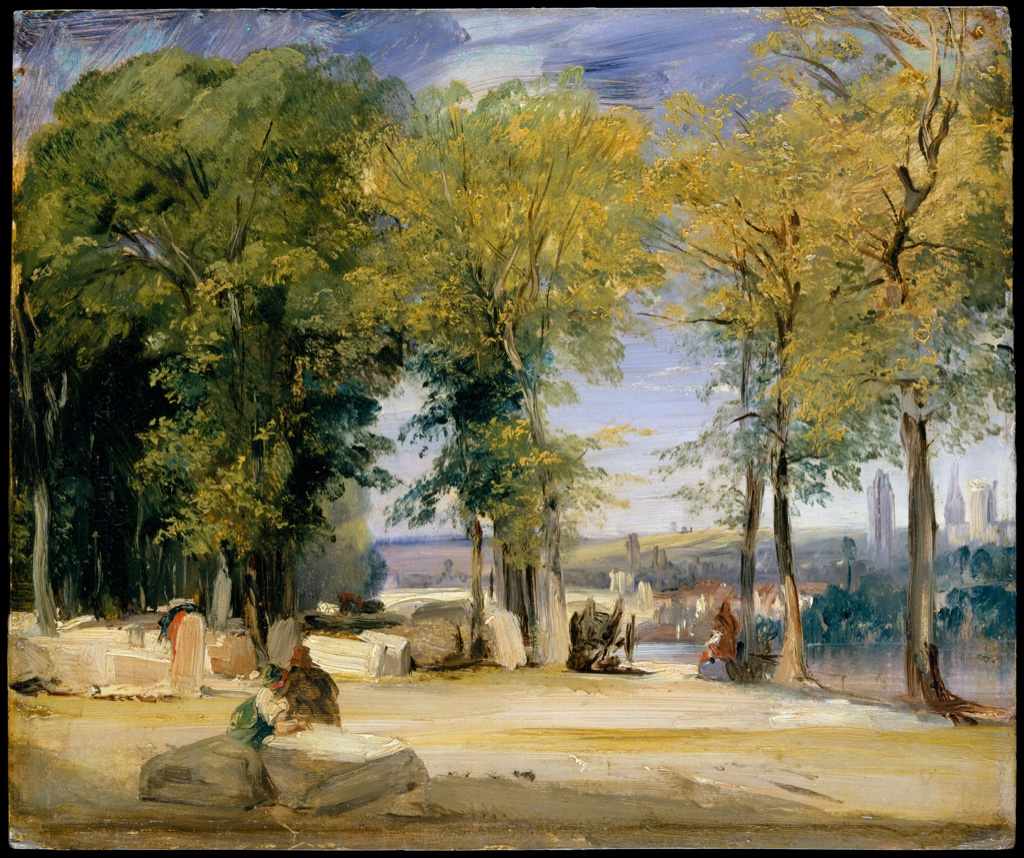
Richard Parkes Bonington's View near Rouen turns a modest place on the Seine into a concentrated account of light, distance and movement. A screen of trees opens towards the river and the city beyond, while a few small figures and scattered forms keep the foreground grounded in everyday life. Nothing depends on a grand event. The interest lies in how quickly and economically the scene has been organised: dark foliage, pale open ground, a narrow band of water and a skyline that seems to emerge through air.
The Metropolitan Museum of Art dates the painting to about 1825 and identifies its support as millboard. It also proposes that Bonington made it from the bank of the Seine opposite Rouen, probably in late summer or autumn of that year.[1] Those qualifications matter. They allow the painting to be read as a particular encounter with a place without turning a well-supported museum interpretation into certainty.
At a Glance
- ArtistRichard Parkes Bonington (1802–1828)
- TitleView near Rouen
- DateAbout 1825; the Met proposes late summer or autumn
- MediumOil on millboard
- Dimensions27.9 × 33 cm (11 × 13 inches)
- CollectionThe Metropolitan Museum of Art, New York, object 2001.45[1]
Richard Parkes Bonington in context
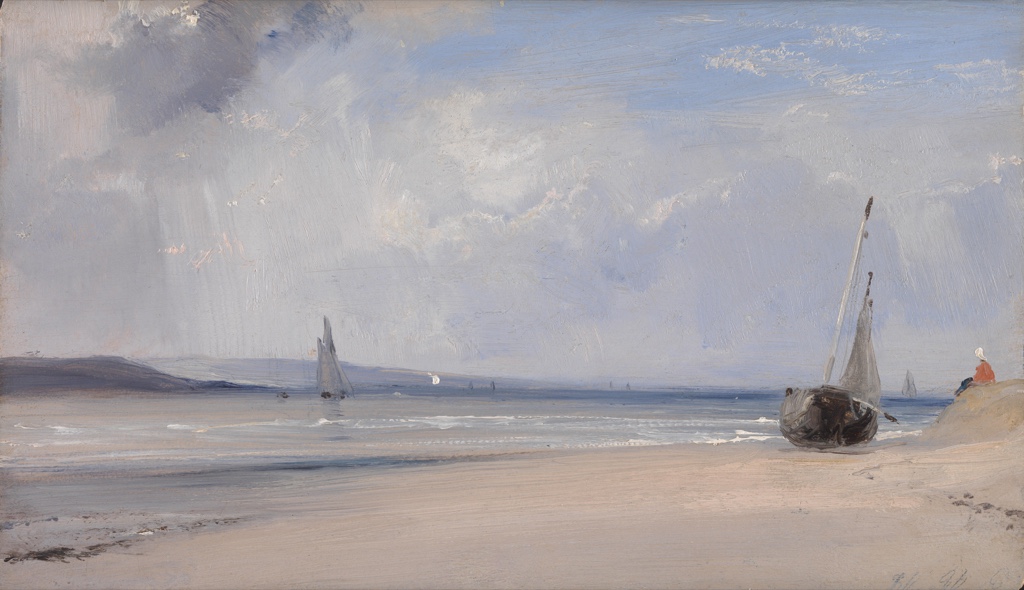
Seapiece: Off the French Coast
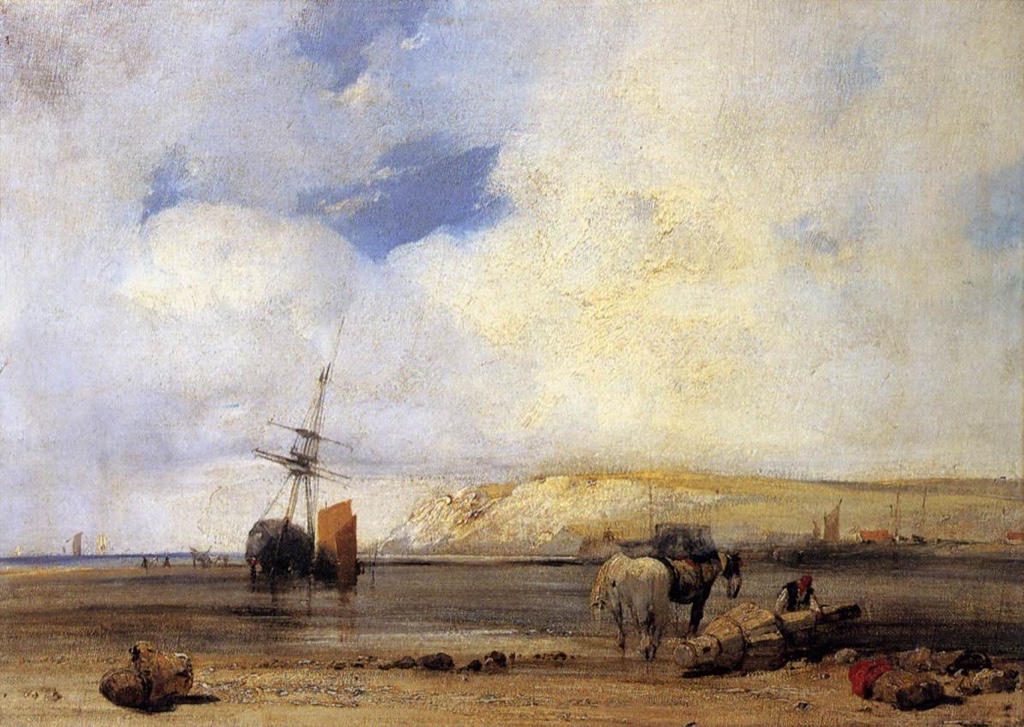
c. 1823–24An Estuary in Northern France
c. 1825–27View near Rouen
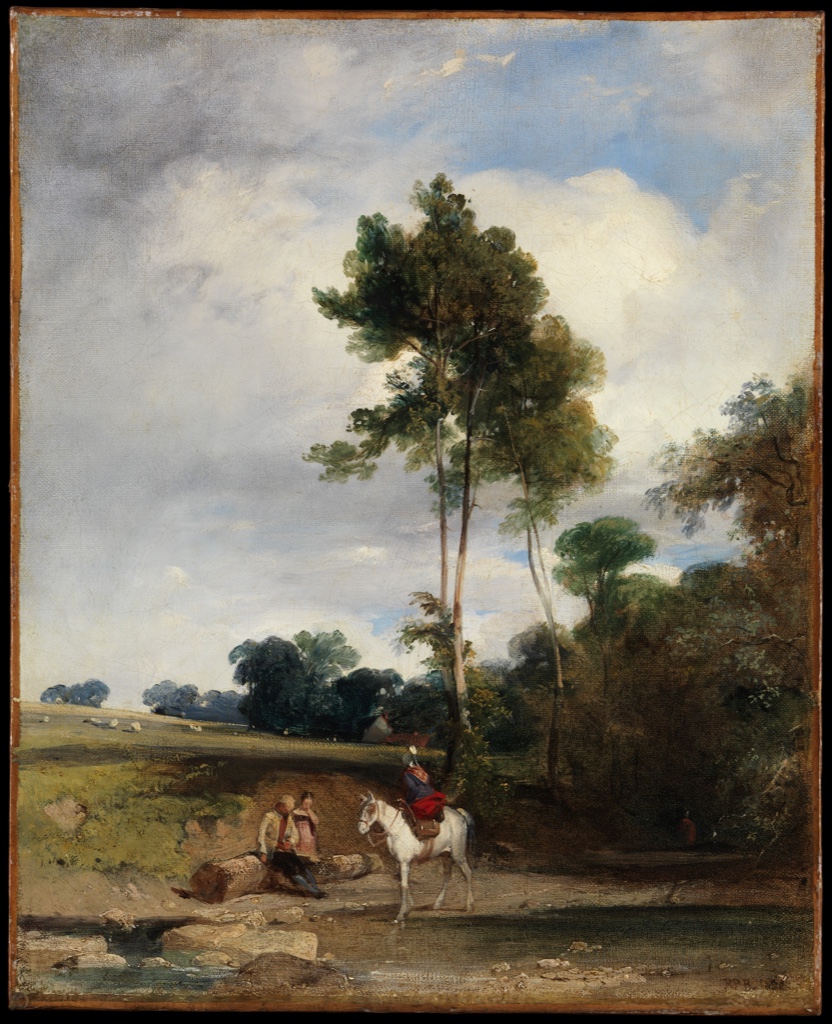
c. 1825Roadside Halt
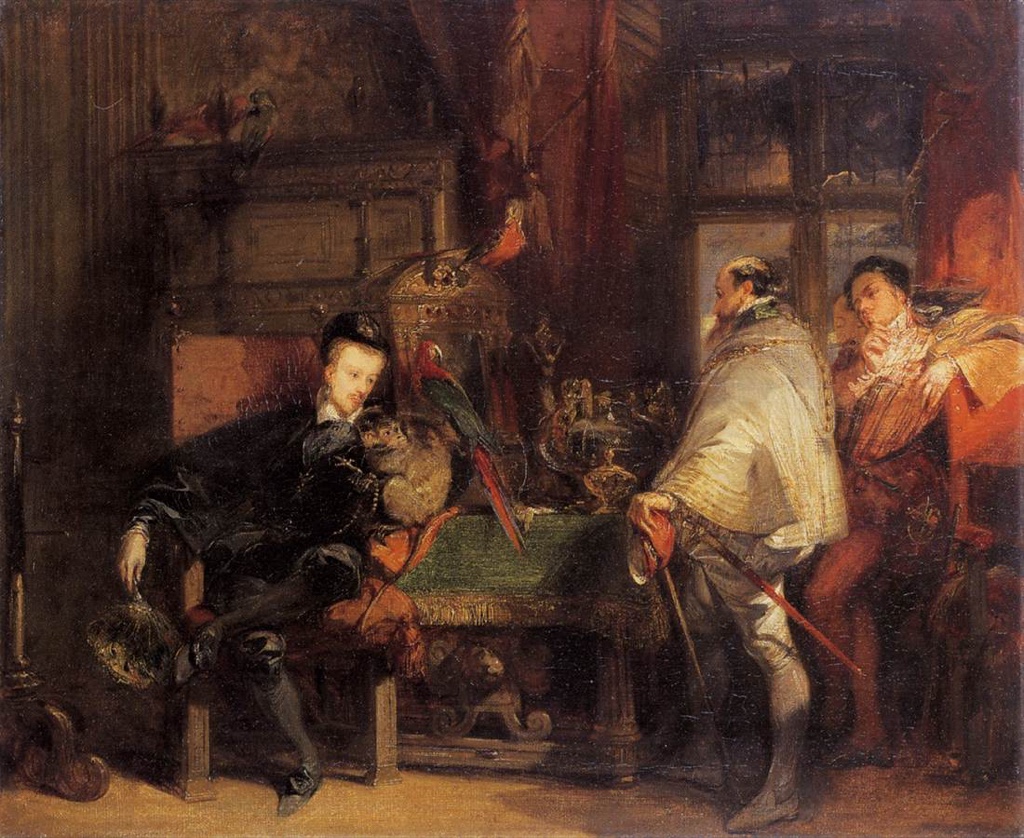
1826Henri III
1828Contents
- Introduction
- Looking across the Seine
- A portable surface for an outdoor painter
- Atmosphere made from economy
- The companion view of Rouen
- London in 1825 and the cross-Channel setting
- Rouen within a travelling practice
- From observation to museum object
Looking across the Seine
The Met locates Bonington on the opposite bank of the Seine from Rouen.[1] Instead of giving the city an uninterrupted panoramic stage, he makes the view work through partial concealment. Trees fill much of the left side and rise in a broken sequence across the picture. Their trunks create a loose rhythm of verticals, but the intervals between them lead the eye towards the pale river and the distant buildings. The city's architecture remains present without becoming an inventory of landmarks.
That choice makes the near bank as important as Rouen itself. Broad, light-toned ground occupies the lower portion of the board. Stones or cut blocks, irregular patches of earth and tiny figures register at different degrees of finish. A seated or crouching figure near the lower edge is substantial enough to establish scale, yet too small to become the subject of a story. Farther back, another cluster of figures is absorbed into the riverside setting. The painting asks us to move from tangible foreground matter to a city softened by distance.
The foliage also prevents the space from becoming mechanically symmetrical. Dense green shadow presses in at the upper left; more open, yellow-green branches cross the centre and right. A strip of blue-grey sky and water appears between them. Rouen's taller forms at the far right answer the foreground trunks, but at a much smaller scale. This repetition joins near and far without erasing the atmospheric interval between them.
The season cannot be read as an exact date from foliage alone. The Met's suggestion of late summer or autumn is more useful as a proposal: it accords with the varied greens, touches of yellow and open light visible in the trees, while leaving room for the uncertainties inherent in a rapidly painted landscape.[1]
A portable surface for an outdoor painter
At 27.9 by 33 centimetres, View near Rouen is compact. The Met records its medium as oil on millboard.[1] Noon's account describes the relevant material of 1825 as a portable, commercially manufactured board with a prepared off-white gesso ground. Its role in his argument is practical: it offered Bonington a surface that could be carried outdoors and used for direct work in oils.[2]
Patrick Noon's 2025 study places Bonington's use of this material within a specific development. During his 1825 visit to London, Bonington encountered a portable, commercially prepared millboard patented by the firm of Robert Davy. Noon argues that this support enabled him to attempt in oils, out of doors, the immediate kind of observation he had already practised in watercolour. He describes an off-white gesso ground and associates the material with spontaneous alla prima handling: painting directly and decisively rather than constructing the image through many separate, dried layers.[2]
The distinction between a general material history and the label for this particular object should be kept clear. The Met records the support of View near Rouen simply as millboard.[1] Noon's discussion supplies the broader 1825 context and treats the Met painting as a plein-air study on millboard, but the museum record does not identify a maker's stamp or present a technical analysis proving that this individual sheet came from Davy. What can be said securely is that portability, a prepared surface and a compact format suited Bonington's practice of working before a changing view.
Atmosphere made from economy
Bonington does not render every leaf, wall or person with equal precision. The picture depends on shifts of density. In the darkest foliage, touches overlap until individual branches are difficult to separate. Elsewhere, thin marks and small openings let the lighter ground participate in the effect. The foreground is laid out in broad horizontal passages, while trunks and distant towers provide vertical accents. A few concentrated darks establish depth without sealing every contour.
This economy is not the same as vagueness. The composition contains enough topographical structure to sustain the Met's identification of the viewpoint. Yet its hierarchy is experiential: what is nearest has weight and texture; the far bank is reduced; the sky and river share cool, light values. The distant city is something seen across intervening air rather than diagrammed building by building.
A comparison with Bonington's An Estuary in Northern France helps define the larger method. The National Gallery describes that picture's thin, swift oil strokes, visible brush tracks and wet-into-wet handling as a way of carrying the immediacy of watercolour into oil.[3] Those technical findings belong to the National Gallery painting, not automatically to every Bonington board. Even so, the visible surface of View near Rouen supports a bounded comparison: here too, varied strokes and selective finish matter more than polished uniformity.
The result is atmospheric because material decisions and spatial decisions work together. The strong foreground is not merely darker; it is more physically articulated. The river and city are not merely smaller; their forms are quieter and less differentiated. Bonington therefore creates distance without relying on a dramatic recession towards a single vanishing point. Air is made legible through the gradual reduction of detail.
The companion view of Rouen
Noon's 2025 article connects the Met picture with Rouen Cathedral, Sunrise, an oil study now at the Minneapolis Institute of Art. He proposes that the two works were probably made on the same day in 1825.[2] This is a scholarly inference, not a documented itinerary, but it is valuable because it presents Bonington as an observer who could reconsider one place through more than one framing.
In Noon's account, Rouen Cathedral, Sunrise concentrates on the sensation of seeing and the act of painterly transcription more than on a fully descriptive record. He estimates that this particular cathedral study may have taken no more than half an hour.[2] That estimate must not be transferred to View near Rouen. No source cited here gives an equivalent duration for the Met painting.
The proposed same-day relationship nevertheless sharpens what is distinctive in the New York work. Its city view is filtered through a tree-lined bank and anchored by foreground activity. It balances rapid notation with an unusually stable arrangement of verticals, open intervals and horizontal bands. If the two boards arose from one excursion, they show that speed did not oblige Bonington to repeat a formula. A change of position or attention could produce a different relationship between motif, atmosphere and support.
London in 1825 and the cross-Channel setting
The Met places the work shortly after Bonington returned from London, where he had renewed his awareness of John Constable and J. M. W. Turner and encountered Eugène Delacroix and other French Romantic painters.[1] That context does not license a search for a borrowed Constable tree or a Turner colour effect. It points instead to a period in which approaches to landscape, watercolour and oil were circulating through exhibitions, travel, friendship and close looking.
The Wallace Collection describes Bonington and Turner as landscape painters whose technical innovation helped raise the status and possibilities of watercolour on both sides of the Channel. It characterises their relationship as one of mutual influence and creative competition, based on works seen in exhibitions and through engravings, even though the artists probably never met.[4] View near Rouen belongs within that active field of exchange, but it remains a specific response to a French river city by an English-born artist trained and professionally established in France.
Bonington's encounter with Delacroix is equally important without turning the landscape into a coded portrait of their friendship. The Met notes their contact around the London visit,[1] while Noon's article places the two artists in a shared Paris studio afterwards.[2] Their association forms part of the wider story explored in Bonington and British and French Romanticism. The painting's significance lies not in proving a single line of influence but in showing how portable materials and mobile artistic networks could meet in one act of looking.
Rouen within a travelling practice
Rouen offered Bonington a combination of river, urban silhouette and wooded banks. The National Gallery records that he travelled extensively in Normandy and Picardy after leaving the academic training of Antoine-Jean Gros for landscape painting.[3] These journeys gave him subjects that could be approached as topographical places while also testing how water, weather and distance alter visibility.
The Seine view should therefore be kept distinct from his coastal and roadside scenes. Roadside Halt places figures and a pause in travel within a more enclosed landscape. An Estuary in Northern France opens towards tidal space. In View near Rouen, the city's presence changes the balance: nature frames an inhabited and historically recognisable place, but the skyline is subordinated to the immediate riverside experience.
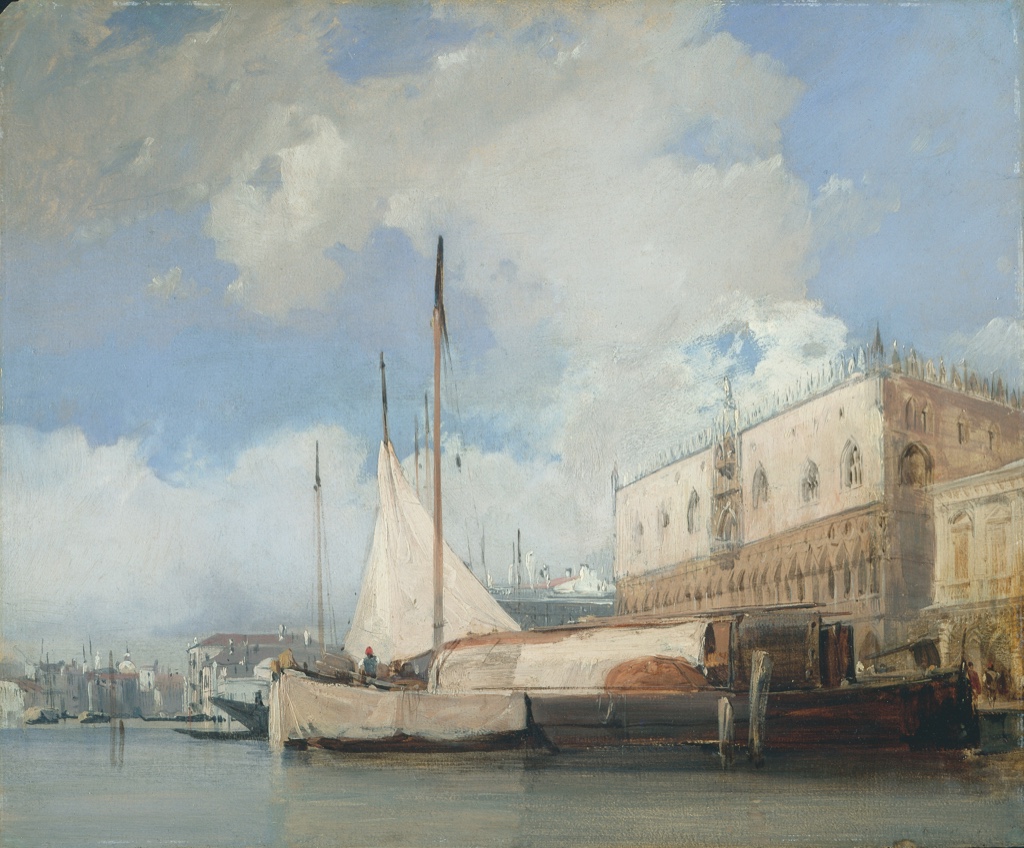
For the wider development of this practice, the paintings overview sets the Normandy boards beside Bonington's coastal and figure subjects. The contrast with The Doge's Palace, Venice is especially revealing. The Italian journey followed in 1826, and the change from a Seine bank to Venice shows how quickly Bonington's field of subjects expanded.[2]
From observation to museum object
The Met acquired View near Rouen in 2001. Its credit line records a purchase made through the exchange of a gift from Joanne Toor Cummings, and the painting carries object number 2001.45.[1] Noon notes that it had formerly belonged to the Earls of Normanton.[2] A longer ownership history is less central here than the unusually direct connection now possible between object and viewer: the Met classifies its image as public domain, allowing the small board's surface to be examined closely as well as seen in the gallery.[1]
Within Bonington's biography, the work occupies a precise moment. It follows his earliest landscape oils of 1824 and coincides with the portable millboard practice Noon associates with 1825.[2] It precedes the Italian journey and the expansion of his subjects in 1826. Yet it is not merely a step towards something larger. Its compactness is integral to its achievement. Trees, bank, river and city have been made mutually dependent, so that an ordinary outlook across the Seine becomes a complete argument about how much a painter needs to say.
Researched works directory
This searchable directory is an online evidence census assembled from public museum and collection records. It is not a substitute for Patrick Noon’s printed catalogues raisonnés.
| Name | Date | Medium |
|---|---|---|
| A Coast Scene | 1820–1828 | Painting |
| A Cutter and other shipping in a Breeze | 1827–1828 | Watercolour |
| A Distant View of St-Omer | 1824 | Painting |
| A Distant View of St-Omer | c. 1824 | Painting |
| A duel between Frank and Rashleigh | 1828 | |
| A Faun with Pipes | Date unknown | Drawing |
| A Seascape | Date unknown | Drawing |
| A Venetian Scene | c. 1828 | Watercolour |
| A Wooded Stream and a Farmhouse in Normandy | Date unknown | Drawing |
| Abbeville - Vue Pris, de la route de Calais | Date unknown | |
| Abbey St-Amand, Rouen | Date unknown | Watercolour |
| An Estuary in Northern France | c. 1825–1827 | Painting |
| An Italian Town | 1822–1828 | Painting |
| Ancienne Porte a Stirling | 1826 | |
| Ancienne Tour | 1826 | |
| Ancienne Tour Près de Lanark | 1826 | |
| Anne Page and Slender (Shakespeare's Merry Wives of Windsor, Act 1, Scene 1) | 1829 | Artwork |
| Architectural Remains and Fragments: Rouen - Fontaine de la Crosse | 1827 | |
| Architecture du Moyen Age | 1824 | |
| Argyle Castle | 1826 | |
| Argyle Castle | 1828 | |
| At the English Coast | 1825 | Watercolour |
| Beach Scene | c. 1825 | Watercolour |
| Beach Scene with Cart and Horse | 1825 | Painting |
| Beached Vessels and a Wagon, near Trouville, France | c. 1825 | Painting |
| Beauvais - interieur d'une cour | Date unknown | |
| Bergues - La Tour du March, | Date unknown | |
| Bergues: La Tour du marché | 1824 | |
| Boccadasse, Genoa with Monte Fasce in the Background | 1826 | Painting |
| Bologna | 1826–1827 | Drawing |
| Bologna | 1828 | |
| Bonington - Vue de Venise | Date unknown | Watercolour |
| Bothwell Castle | 1826 | |
| Bothwell Castle | 1828 | |
| Boulogne Harbor | 1823 | Watercolour |
| Bracklin-Bridge | 1828 | |
| Brackline | 1826 | |
| Caen - Eglise Saint-Sauveur | 1824 | Drawing |
| Caen - Maison Grande Rue Saint-Pierre | Date unknown | Drawing |
| Calais Jetty, France | c. 1824 | Painting |
| Campos sur les bords du Rio das Velhas | 1827 | |
| Castle on a Scottish Loch | 1822–1828 | Painting |
| Cathedrale Notre-Dame | 1824 | |
| Charles V visits François Ier after the Battle of Pavia | c. 1827 | Watercolour |
| Chateau d'Argyle | 1826 | |
| Chateau de Bothwell | 1826 | |
| Chateau de Bothwell / Bothwell Castle | 1826 | |
| Christ preaching - unfinished | Date unknown | Painting |
| Coast Scene in Picardy, France | 1826 | Painting |
| Coastal Scene with Fishing Boats | 1828 | Painting |
| Croix de Moulin-les-Planches | 1827 | |
| Demetrius de Palatiano | 19 th century | Painting |
| Die adriatische Küste | c. 1820 | Painting |
| Die normannische Küste | 1823–1824 | Painting |
| Dieppe Harbour | Date unknown | Painting |
| Don Quixote | 1825–1826 | Painting |
| Don Quixote in His Study | 1825–1826 | Painting |
| Doune Castle | 1828 | |
| Du Sacristain de Saint Angadresne | c. 1828 | |
| Dutch: Processie in Verona | 1801–1828 | Painting |
| Edimbourg pris de la Chapelle St Antoine | 1826 | |
| Edimbourg vu de Calton-Hill | 1826 | |
| Edimbourg vu de la Chapelle Saint-Antoine | 1826 | |
| Edinbourgh vu de la Chapelle S. Antoine | 1826 | |
| Edinburg from S. Anthony Chapel | 1828 | |
| Edinburgh from St. Anthony Chapel | 1826 | |
| Edinburgh from the Calton Hill | 1828 | |
| Eglise de Saint-Taurin, Evreux | 1824 | |
| Eglise de St. Jean a Lyons | 1824 | |
| Eglise St. Sauveur | 1824 | |
| Embouchure de la Riviere Caxoera | 1827 | |
| Entree de la rade de Rio-Janeiro | 1827 | |
| Entrée de la salle des pas-perdus, Palais de Justice | 1824 | |
| Evening in Venice | 1826–1828 | Painting |
| Façade de l'Eglise de Brou | 1825 | |
| Façade St. Jean | 1824 | |
| Figures on a rocky shoreline | Date unknown | Artwork |
| Fishing Boats in a Calm, Ships at Anchor | 1825 | Painting |
| Fishing Smacks in French Harbour | 1818–1825 | Painting |
| Five Studies of a French Pointer | 1825–1826 | Drawing |
| Fontaine de la Crosse | 1827 | |
| French Coast Scene | 1815–1828 | Painting |
| French Coast with Fishermen | 1825 | Painting |
| French Hulk | 1820–1828 | Painting |
| German: Ein Waldweg | 1825–1826 | Painting |
| Glenfinlas | 1826 | |
| Glenfinlas | 1828 | |
| Glenfinlas Valley (Vallée de Glenfinlas, from Vues Pittoresques de l'Écosse) | 1826 | Artwork |
| Goetz Von Berlichingen Before The Imperial Magistrate | c. 1826 | Drawing |
| Grand Canal, Venice | 1826 | Drawing |
| Greek Armatole (irregular fighter). | 1825 | Painting |
| Half-length Portrait of a Bearded Man in Historical Dress | 1818 | Drawing |
| Henri III | 1828 | Painting |
| Hôtel de Sens : dessin / Richard-Parkes Bonington | 19 th century | Drawing |
| Ile de la Cite | Date unknown | Watercolour |
| In the Forest of Fontainebleau | c. 1825 | Painting |
| Intérieur d'une Cour | 1824 | |
| Jour du Marché | 1824 | |
| L'Eglise de St. Gervais et St. Protais | 1824 | |
| L'espace | c. 1826 | Painting |
| La Conversation | 1826 | |
| La Place du Molard, Geneva | Date unknown | Painting |
| La Prière | 1826 | |
| La Tour du Marché | 1824 | |
| Lac de Killin | 1826 | |
| Lac Lomond | 1826 | |
| Landscape with a Pond | 1825–1826 | Painting |
| Landscape with Castle Ruin | Date unknown | Watercolour |
| Le Château de la Duchesse de Berry | 1823–1825 | Painting |
| Le matin | 1824 | |
| Le Repos | 1826 | |
| Le Retour | 1826 | |
| Le Silence Favorable | 1826 | |
| Les Pendus | 1826 | |
| Les Plaisirs Paternels | 1826 | |
| Les Salinieres near Trouville | 1827–1828 | Painting |
| Lillebonne - Chateau d'Harcourt | 1824 | |
| Lillebonne - Chateau d'Harcourt | Date unknown | |
| Loch Lomond | 1826 | |
| Loch Lomond | 1828 | |
| Loch Tay | 1828 | |
| Lochkillin | 1826 | |
| Low Tide at Boulogne | 1824 | Painting |
| Maison Grande Rue St. Pierre | 1824 | |
| Maison Située Rue St Veronique | 1824 | |
| Man and Woman in a Landscape, possibly Faust and Marguerite | c. 1826 | Drawing |
| Molard-Bonington-1829 | 1829 | |
| Molard-Bonington-1829-cropped | 1829 | |
| Near Honfleur | 1823 | Watercolour |
| Near Jumieges | Date unknown | Watercolour |
| Old Gate Way at Stirling | 1828 | |
| Old Gateway at Stirling | 1826 | |
| Old Tower near Lanark | 1828 | |
| On the Adriatic | c. 1826 | Painting |
| On the Coast of Picardy | 1826 | Painting |
| On the Seine – Morning | 1825 | Painting |
| Palais de Justice, Rouen | Date unknown | Drawing |
| Paris from Pere Lachaise | Date unknown | Watercolour |
| Pays de Caux: Twilight | 1818–1828 | Painting |
| Peasant Women from Ragusa | 1826 | Drawing |
| Pesmes | 1825 | |
| Peveril of the Peak - Julian Peveril and Alice Bridgenorth, surprised by Major Ralph Bridgenorth | c. 1826 | Watercolour |
| Picardy Coast with Children – Sunrise | c. 1826 | Painting |
| Picturesque Views of Scotland: Brackline | 1826 | |
| Pierre de Vaivre | 1827 | |
| Polish: Zdjęcie z krzyża The Descent from the Cross. | 1820 | Painting |
| Portia and Bassanio | c. 1826 | Watercolour |
| 1827 | ||
| print, title-page | 1828 | |
| Processie in Verona | 19de eeuw | Painting |
| Promenade vénitienne (Venetian Promenade) | Date unknown | Artwork |
| Quentin Durward and the Disguised Louis XI (recto); Study of male figure (verso) | 1825–1826 | Drawing |
| Quentin Durward at Liège, Belgium | 1827–1828 | Painting |
| Quentin Durward in Luik, objectnr TA 11006 | 1825 | Drawing |
| Restes et Fragmens d'Architecture du Moyen Age: Église St. Sauveur, Caën | Date unknown | |
| Riva degli Schiavoni, from near San Biagio, Venice, by Richard Parkes Bonington | Date unknown | Painting |
| Road Workers, near Lillebonne | Date unknown | Painting |
| Roadside Halt | 1826 | Painting |
| Robert Dudley, Earl of Leicester and his wife Amy Robsart. | 1820 | Painting |
| Rouen | 1825 | Watercolour |
| Rouen: Entrée de la Salle des Pas Perdus, Palais du Justice | 1824 | |
| Rue du gros-horloge, Rouen | 1824 | |
| Ruines de Chateau d'Arlay | 1827 | |
| Ruines du Château d'Arlay | 1827 | |
| Ruins of the Abbey Saint Bertin | 1824 | Painting |
| Sea Coast, the Dunes | Date unknown | Painting |
| Seapiece: Off the French Coast | c. 1823–1824 | Painting |
| Shipping in a Swell | 1824–1827 | Watercolour |
| Shipping in an Estuary, Probably near Quilleboeuf | 1825–1826 | Watercolour |
| Sketch of a Woman | 1828 | Drawing |
| Street in the Outskirts of Besançon, France | 1827 | |
| Studies for Shylock | 1825 | Drawing |
| Study of a Gentleman in 17th Century Costume, After Van Dyck | 1827–1828 | Drawing |
| Study of a Seated Woman | Date unknown | Drawing |
| Study of a Woman with her Head on her Hand | Date unknown | Drawing |
| Sunset: A Sketch | Date unknown | Painting |
| Sunset in the Pays de Caux | 1828 | Watercolour |
| The Antiquary | Date unknown | Painting |
| The Chibouk | 1826 | Painting |
| The Church of St. Wulfran, Abbeville: The North Door of the West Front | c. 1823 | Drawing |
| The Count of Palatino in the costume of a Palikar | Date unknown | Painting |
| The Doge's Palace, Venice | 1826 | Painting |
| The Escape from Argyle Castle | 1826 | |
| The Escape from Argyle-Castle | 1828 | |
| The Grand Canal | 1826–1827 | Painting |
| The Grand Canal, Venice | 1826–1827 | Painting |
| The Interior of Sant' Ambrogio, Milan | 1826 | Painting |
| The Old Jetty, Boulogne, France | Date unknown | Painting |
| The Pont des Arts, Paris | 1826 | Painting |
| The Proposal (recto); Unfinished drawing of a horse and rider (verso) | 1820 | Drawing |
| The Rialto, Venice | Date unknown | Painting |
| The Salt Marshes near Trouville | 1826 | Watercolour |
| The Use of Tears | 1827 | Watercolour |
| The Use of Tears | Date unknown | Painting |
| Titlepage to Restes et Fragments | Date unknown | |
| Tomb in the Church of Saint-Omer, France | Date unknown | Painting |
| Tombeau de Marguerite de Bourbon, Eglise de Brou | 1825 | |
| Tour aux archives à Vernon | 1824 | |
| Tour du gros horloge, batie sous la domination des Anglais en 1417, Evreux | 1824 | |
| Tour du gros-horloge, Evreux | 1824 | |
| Trees and a Cottage by a River | 1827 | Drawing |
| Untitled (one of three) | Date unknown | |
| Vessels in a Choppy Sea | c. 1824 | Watercolour |
| View in Brittany: Bridge, Cottages and Washerwomen | 1818–1828 | Painting |
| View near Rouen | c. 1825 | Painting |
| View near Sarzana, Val di Magra | 1826 | Painting |
| View of the Rialto Bridge, Venice | c. 1826 | Watercolour |
| View on the Grounds of a Villa near Florence | 1826 | Painting |
| View on the River Seine - Morning | c. 1825 | Painting |
| Voyages pittoresques et romantiques dans l'ancienne France | 1825 | |
| Voyages pittoresques et romantiques dans l'ancienne France, Franche-Comté: Église de l'abbaye de Tournus | 1825 | |
| Voyages pittoresques et romantiques dans l'ancienne France, Franche-Comté: Ruines du château d'Arlay | 1825 | |
| Voyages pittoresques et romantiques dans l'ancienne France, Franche-Comté: Vue d'une rue des faubourgs de Besançon | 1825 | |
| Voyages pittoresques et romantiques dans l'ancienne France, Normandie: Église de Saint Gervais et Saint Protais à Gisors | 1824 | |
| Voyages pittoresques et romantiques dans l'ancienne France, Normandie: Rue du Gros Horloge, Rouen | 1824 | |
| Voyages pittoresques et romantiques dans l'ancienne France, Normandie: Tour aux archives à Vernon | 1824 | |
| Voyages pittoresques et romantiques dans l'ancienne France, Normandie: Tour du Gros-Horloge, Evreux | 1824 | |
| Vue d'une rue des faubourgs de Besançon | 1827 | |
| Vue d'une rue des Faubourgs de Besançon (View of a Street in the Outskirts of Besançon) | 1827 | |
| Vue Generale de l'Eglise de l'Abbaye de Tournus | 1825 | |
| Vue Générale de l'Eglise de St. Gervais et St. Protais, à Gisors | 1824 | |
| Vue Generale des Ruines du Chateau d'Arlay | 1827 | |
| Vue prise à l'entrée du jardin des Plantes. Au premier plan, bâtiment de la minéralogie et à l'arrière, dôme de l'hôpita, D.2182 | 1806–1828 | Drawing |
| Vue Prise de la Route de Calais | 1824 | |
| Vues Pittoresques de l'Écosse | 1826 | |
| Young Woman Writing a Letter | 1820–1828 | Painting |
Frequently Asked Questions
The Metropolitan Museum of Art identifies the viewpoint as the bank of the Seine opposite Rouen.[1] The precise spot is not stated in the museum record, so it is safest to understand the work as a view from across the river rather than assign it to a modern street or quay.
The Met dates the painting to about 1825 and suggests that it was probably made in late summer or autumn.[1] Patrick Noon further proposes that it may have been painted on the same day as Rouen Cathedral, Sunrise, but this remains a reasoned scholarly conclusion rather than a documented date.[2]
Millboard is a rigid, compressed paper-based board that could be prepared for painting. Noon explains that Bonington's 1825 access to commercially prepared Davy millboard offered a portable support for working in oils outdoors.[2] The Met describes this particular object as oil on millboard.[1]
Noon calls it a plein-air study on millboard and links it to Bonington's adoption of a support suited to outdoor oil painting.[2] That makes outdoor execution strongly supported. It does not establish the exact length of the sitting, and Noon's half-hour estimate concerns Rouen Cathedral, Sunrise, not the Met work.
The Met situates the painting after Bonington's 1825 London exposure to Constable and Turner.[1] The Wallace Collection also describes a wider relationship of admiration, influence and competition between Turner and Bonington.[4] These contexts help explain the freedom given to atmosphere and handling, but they do not demonstrate that any one motif or mark was copied from either painter.
Discussion
Use this evidence-led guide as a starting point for close looking rather than a final verdict.
Share an observation about View near Rouen or a source that adds useful context.
Reader Insights
Which passage of paint most changes your reading of View near Rouen?
How does the support, scale or known setting affect the way you interpret the work?
What remains uncertain when museum evidence is separated from visual inference?
Join the Conversation
Add your reading below, keeping observations specific and evidence clear.
References
- The Metropolitan Museum of Art, “View near Rouen,” object 2001.45,, accessed 30 August 2026.
- Patrick Noon, “A supplement to Richard Parkes Bonington, the Complete Paintings,” Colnaghi Studies Journal, XVII (October 2025), pp. 61–76,, accessed 30 August 2026.
- National Gallery, London, “Richard Parkes Bonington, An Estuary in Northern France,” NG6619,, accessed 30 August 2026.
- Wallace Collection, “Turner and Bonington,”, accessed 30 August 2026.