 by Tom Gurney
Tom Gurney BSc (Hons) is an art history expert with over 20 years experience
Published on June 19, 2020 / Updated on July 30, 2026
Email: tomgurney1@gmail.com / Phone: +44 7429 011000
Braque Triptych: Introduction
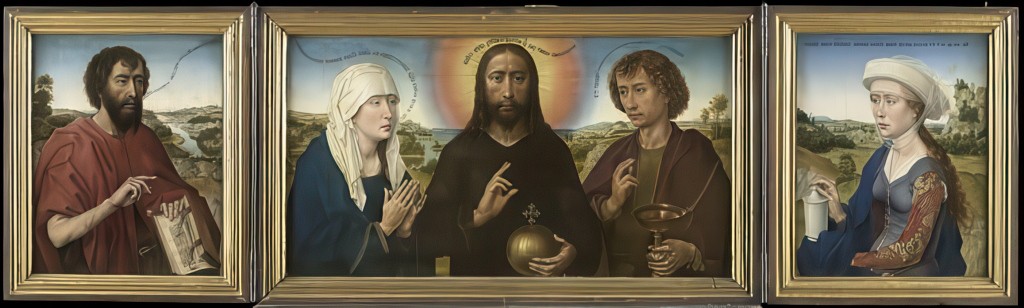
The Braque Triptych is one of Rogier van der Weyden's most intimate surviving works. Unlike the monumental Descent from the Cross, the public ritual world of the Seven Sacraments Altarpiece or the hospital setting of the Beaune Altarpiece, this was a small object for close devotional looking. It brings Christ, the Virgin, Saint John the Evangelist, Saint John the Baptist and Mary Magdalene into a concentrated encounter, then closes into a meditation on death.
The triptych is in the Musee du Louvre, Paris, with the inventory number RF 2063. It is usually dated around 1452 and is associated with the Braque family, probably with Catherine de Brabant after the death of her husband Jehan Braque. [1] [2]
Its value in the Rogier cluster is very high because it shows a different scale of feeling. The Descent from the Cross turns grief into a crowd of bodies. The Braque Triptych turns grief, prayer and memory into a small object that could be opened, closed and revisited.
At a Glance
- ArtistRogier van der Weyden
- TitleBraque Triptych / Braque Family Triptych
- DateAround 1452
- MediumOil on oak panels
- FormatPortable/private triptych
- Current locationMusee du Louvre, Paris
- InventoryRF 2063
- SubjectChrist, Mary, saints and memento mori imagery
Contents
- Introduction
- At a Glance
- Open: Saints Around Christ
- Closed: Skull And Cross
- Catherine De Brabant And Jehan Braque
- Text, Speech And Painted Meaning
- Colour, Surface And Inwardness
- Private Devotion
- Why It Matters
- FAQs
- Discussion
- References
Open: Saints Around Christ
When open, the triptych presents a half-length sacred assembly. John the Baptist appears on one side, Mary Magdalene on the other, and the centre brings Christ together with the Virgin and Saint John the Evangelist. [2]
This is a different kind of sacred space from Rogier's large altarpieces. The figures come forward. They meet the viewer at close range. The scale suggests handling, opening, closing and private looking rather than public display across a chapel.
Half-length figures matter here. They remove much of the narrative setting that would normally explain where the figures stand and what moment is being represented. Rogier instead makes the sacred figures behave almost like presences brought into the owner's room. The viewer is not asked to follow a long biblical story. The viewer is asked to look, remember and pray.
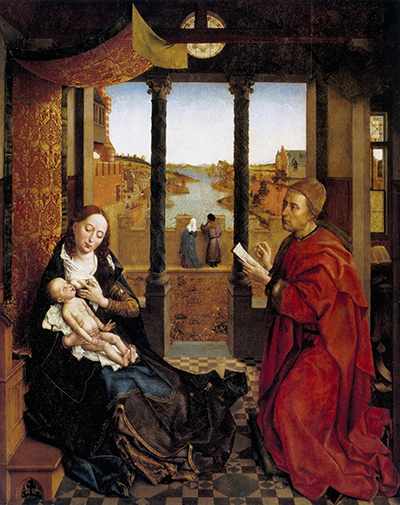
Mary Magdalene is especially important. She belongs to Rogier's wider interest in penitence, feeling and absorbed devotion. Read beside The Magdalen Reading, the Braque Magdalene shows how a saint could carry both emotional intensity and social refinement. Rogier does not make her theatrical. He makes her intensely present.
Closed: Skull And Cross
The closed state is essential. It includes memento mori imagery, especially a skull and cross. [2] This means the object changes its message when shut. Open, it supports devotion through sacred figures. Closed, it confronts the owner or viewer with mortality.
That double identity is one of the triptych's great strengths. The object does not only say "look at holy figures." It also says "remember death." In a private devotional context, that warning would have been intimate, even personal.
The skull also changes how the open interior is understood. The saints and Christ are not decorative companions. They are viewed under the pressure of mortality, memorial prayer and the hope of salvation. The triptych therefore works in two tempos: a visible devotional presence when open, and a blunt reminder of death when closed.
Catherine De Brabant And Jehan Braque
The triptych is often connected with Catherine de Brabant and Jehan Braque. Jehan died in 1452, and the work is commonly interpreted as a devotional object connected with memory, mourning and family identity. [2]
The Braque family connection helps explain the triptych's private devotional character, though any commission claim needs cautious wording. The safest point is that the work's imagery and associated history make memorial devotion a central part of its modern interpretation.
This context also explains why the triptych feels different from a public altarpiece. A work linked to family mourning could carry social identity, prayer for the dead and personal meditation at the same time. Rogier's small-scale works often compress social identity, devotion and memory into highly controlled images.
Text, Speech And Painted Meaning
The Braque Triptych includes inscriptions and speech-like texts that give the figures' presence a verbal dimension. [2] Rogier often uses text as part of the image, not just as an identifying label. Words can float, curve or attach themselves to figures and objects.
This is a good place to connect to the style-and-technique page. Rogier's art is not only emotional. It is literate, structured and rhetorically precise. He composes with bodies, frames, gestures, colours and words.
In a private triptych, this verbal element would have supported slow looking. A viewer could move between figure, text, attribute and memory. The painting becomes a small devotional system rather than a single scene.
Colour, Surface And Inwardness
The triptych's intimacy depends on surface as much as subject. Rogier uses rich colour, carefully controlled flesh tones and precise edges to make the figures feel close but not casual. The viewer is brought near to the saints, yet the figures retain solemn distance.
This balance is central to Rogier's art. He can make an image emotionally available without making it informal. The small scale does not weaken the authority of the figures. Instead, it concentrates it. Every face, hand, attribute and inscription carries more weight because there is little wasted space.
The work also helps readers understand why Rogier's private devotional art should not be treated as a minor side-category. Small format did not mean small ambition. A portable triptych could hold complex theology, family memory, spoken text, bodily presence and a direct reminder of death.
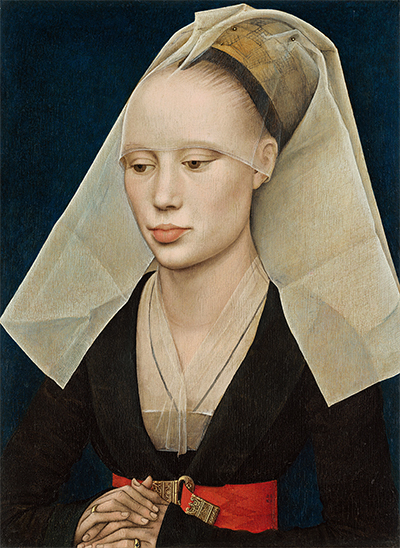
Read beside Portrait of a Lady, the Braque Triptych also shows Rogier's power of restraint. The portrait compresses psychology into posture and costume. The triptych compresses devotion into figures, words and an object's changing states.
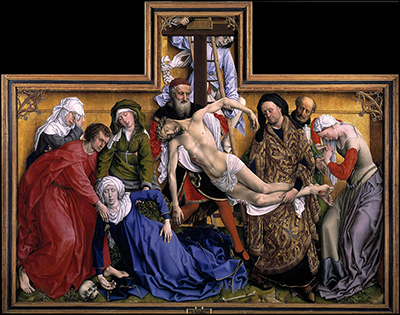
The same restraint links the triptych to Rogier's wider handling of grief. In the Descent from the Cross, grief is visible through falling bodies and shared collapse. In the Braque Triptych, grief is quieter and more meditative. It is built into the object's memorial context, its inscriptions and the mortality imagery on the exterior. This makes the work a crucial counterweight to Rogier's more theatrical Passion images.
Private Devotion
The work is especially valuable because it represents private devotion rather than a large public chapel or institutional altarpiece. It would have been encountered at close range. Its open and closed states could shape repeated acts of prayer, remembrance and reflection.
The triptych format is central to that experience. Opening and closing are not only practical movements. They change the viewer's relationship to the image. Rogier uses that physical structure to move between sacred presence and mortality, consolation and warning.
This is why the work belongs with the Miraflores Altarpiece, Saint Columba Altarpiece and Bladelin Altarpiece, but should not be treated as the same kind of object. Those works organise larger sacred narratives. The Braque Triptych works at a more private scale, where memory and prayer are held in the hands and eyes of one viewer or household.
Why It Matters
The Braque Triptych expands the Rogier cluster by showing another format: a private triptych shaped by death, remembrance and prayer, rather than a public altarpiece or court portrait.
It also clarifies Rogier's range. He could make large works that fill institutions with sacred drama, but he could also make a small devotional object feel psychologically and theologically complete. The triptych's open and closed states make it one of the clearest surviving examples of how fifteenth-century Netherlandish art could combine image, object, text and repeated use.
For readers moving through the cluster, the work is a reminder that Rogier's importance does not rest only on size or spectacle. His authority also appears in portable objects, where the viewer's repeated actions of opening, closing and looking become part of the meaning.
That makes the Louvre triptych especially useful for students of Northern Renaissance devotion. It shows how a single object could combine memorial purpose, sacred presence and moral warning without needing a large public setting.
FAQs
It is in the Musee du Louvre, Paris, with the inventory number RF 2063. [1]
It is associated with the Braque family, especially the memory of Jehan Braque and Catherine de Brabant. [2]
The closed state includes memento mori imagery, including a skull and cross. [2]
It is one of Rogier's key surviving private devotional works and shows how small triptychs could combine prayer, memory, text and mortality.
Discussion
What gives the Braque Triptych its force: memorial purpose, half-length saints, inscription, restrained emotion, or its intimate scale?
Reader Insights
The work feels private because devotion and memory are tightly bound. Its scale invites slow looking rather than spectacle.
Half-length sacred figures can feel unusually direct, as if the viewer is brought close to a devotional conversation.
This page is useful for seeing Rogier beyond the largest public altarpieces, in a mode of concentrated personal remembrance.
Join the Conversation
Have a thought or observation about Braque Triptych? Share it below. Thoughtful responses may be added to this section as the Rogier van der Weyden cluster develops.
References
- Musee du Louvre collection entry for Triptyque Braque, RF 2063, accessed 2026-07-11. https://collections.louvre.fr/en/ark:/53355/cl010061888
- Wikipedia (French), Triptyque Braque, accessed 2026-07-11. https://fr.wikipedia.org/wiki/Triptyque_Braque
- Wikipedia, Braque Triptych, accessed 2026-07-11. https://en.wikipedia.org/wiki/Braque_Triptych
- The National Gallery, London, artist page for Rogier van der Weyden, accessed 2026-07-11. https://www.nationalgallery.org.uk/artists/rogier-van-der-weyden
- Lorne Campbell, Van der Weyden, 2004.