 by Tom Gurney
Tom Gurney BSc (Hons) is an art history expert with over 20 years experience
Published on June 19, 2020 / Updated on July 30, 2026
Email: tomgurney1@gmail.com / Phone: +44 7429 011000
Rogier van der Weyden Biography: Introduction
Rogier van der Weyden was one of the defining painters of the fifteenth-century Netherlands. Born around 1399 or 1400 and active in Tournai and Brussels, he became famous for religious images of extraordinary emotional force, finely controlled portraits and large altarpieces that carried his reputation far beyond the Burgundian Low Countries. The National Gallery, London describes him as one of the most profound and influential painters of the century, known for naturalistic detail and expressive pathos. [1]
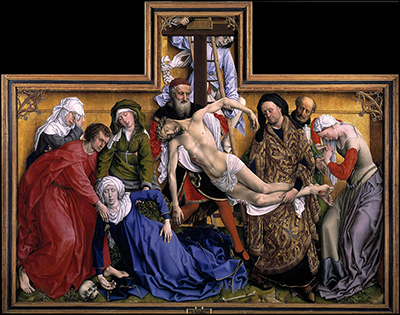
His art is often introduced through The Descent from the Cross, now in the Museo del Prado. That painting shows why Rogier became a central figure of the Northern Renaissance: he could make grief feel sculptural, immediate and spiritually ordered. But his career was broader than one masterpiece. He painted altarpieces for churches and patrons, portraits for courtly and elite circles, devotional images for private or institutional use, and compositions that were copied and adapted long after his death.
Rogier's biography is also a story of names, cities and lost evidence. He was known in French as Roger or Rogier de la Pasture and in Dutch as Rogier van der Weyden. The National Gallery of Art in Washington lists both names and identifies him as Netherlandish, 1399/1400 to 1464. [2] That double identity reflects his movement from Tournai to Brussels and the multilingual world in which he worked.
At a Glance
- NameRogier van der Weyden
- Other nameRogier / Roger de la Pasture
- DatesAbout 1399/1400 to 1464
- Main centresTournai and Brussels
- Training contextAssociated with Robert Campin's Tournai workshop
- Brussels rolePainter to the city of Brussels from the mid-1430s
- Major patrons/contextBurgundian court circles, city, church and foreign patrons
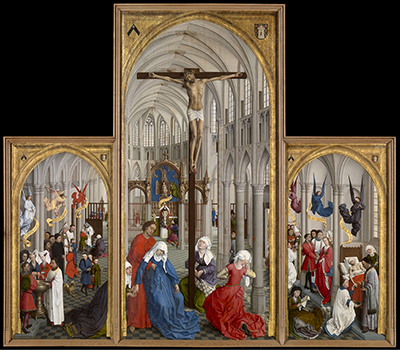
- Key worksThe Descent from the Cross, The Magdalen Reading, Portrait of a Lady, Saint Columba Altarpiece, Beaune Altarpiece, Seven Sacraments Altarpiece
- Artistic identityEarly Netherlandish painter of pathos, devotional intensity, portrait restraint and carefully structured altarpieces
Contents
- Introduction
- At a Glance
- Tournai and the Name de la Pasture
- Robert Campin and Early Netherlandish Realism
- Brussels and the Role of City Painter
- Burgundian and International Patrons
- The Possibility of Italy
- Major Works and Artistic Development
- Portraits and Devotional Psychology
- Workshop, Copies and Influence
- Death and Legacy
- Frequently Asked Questions
Tournai and the Name de la Pasture
Rogier's early life belongs to Tournai, a major artistic centre in the southern Netherlands. His French name, de la Pasture, belongs to that context. Later, after moving into a Dutch-speaking civic environment in Brussels, the name was translated into van der Weyden. The change can feel like a biographical puzzle, but it is better understood as evidence of a multilingual region rather than as a change of artistic identity.
The surviving documentary record for Rogier's early years is limited and has long required careful interpretation by scholars. The broad outline is secure enough: Tournai, Campin, Brussels, international reputation. The fine details of his youth and earliest training require caution.
Rogier's association with Robert Campin is central. The National Gallery states that Rogier was apprenticed to Campin in Tournai from March 1427 to August 1432. [1] Campin, often connected with the Master of Flemalle problem, was one of the founders of the new Netherlandish realism. Rogier's art cannot be reduced to Campin's influence, but the Tournai workshop helps explain his attention to bodies, interiors, fabrics and the emotional weight of sacred events.
The Tournai years also remind us that Rogier did not emerge from nowhere as a Brussels master. He came from a mature workshop culture and entered a world in which painters, patrons and civic institutions were beginning to value panel painting as a powerful vehicle for devotion, memory and public identity.
Robert Campin and Early Netherlandish Realism
Rogier is often discussed with Robert Campin and Jan van Eyck, and the comparison is useful if it is kept precise. Van Eyck is frequently associated with luminous surfaces, optical richness and complex symbolism. Campin is associated with strong forms, domestic interiors and a direct physical realism. Rogier's special contribution lies in emotional construction: he organises figures, gestures and faces so that feeling becomes the structure of the image.
This difference is already visible in works such as The Magdalen Reading. The National Gallery dates that fragment to about 1435 and connects it to a larger altarpiece probably made for a church in Brussels. [3] Magdalene's curved body, absorbed reading and carefully observed interior show Rogier translating sacred devotion into a concentrated, human format.
The same discipline appears on a larger scale in The Descent from the Cross. The Prado records that the painting was made before 1443 for the Great Crossbowmen's guild in Leuven. [4] There, Rogier compresses a group of mourners into a shallow gold-backed shrine space and makes the Virgin's swoon echo Christ's dead body. The emotional idea is also a compositional idea.
Rogier's biography therefore cannot be separated from his style. His career is not merely a sequence of dates. It is the development of a way of making sacred history immediate, bodily and psychologically legible.
Brussels and the Role of City Painter
In 1435, Rogier became painter to the city of Brussels, according to the National Gallery. [1] This was a decisive shift. Brussels was a major political and courtly centre in the Burgundian Netherlands, and the position placed Rogier at the heart of civic, ecclesiastical and elite patronage.
The Brussels role matters because it helps explain both his status and the kinds of images associated with him. He was not only an independent producer of small devotional panels. He worked in a civic environment that valued public imagery, ceremonial identity and elite display.
Some of Rogier's most famous civic works are lost, especially the Justice scenes once made for Brussels Town Hall. Their loss is one of the great gaps in Early Netherlandish painting. They were admired in later accounts, but they no longer survive as panels. This pattern of loss is common in Rogier's career: major works are destroyed, dismembered, copied, reconstructed or known through later testimony.
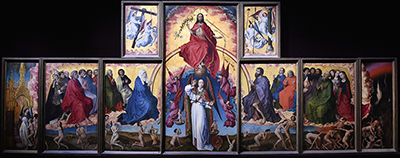
The surviving paintings must therefore carry more than their own visual weight. A fragment like The Magdalen Reading helps us imagine a lost altarpiece. The Prado Descent helps us understand the force of large-scale Passion imagery. The Saint Columba Altarpiece helps us see how Rogier handled a more complete triptych sequence. Each surviving work is also evidence for what has vanished.
Burgundian and International Patrons
Rogier's career unfolded under the shadow of Burgundian power. The National Gallery notes that he worked for Philip the Good, Duke of Burgundy, as well as for foreign princes, the city and the church. [1] This range of patrons helps explain why his art circulated so widely.
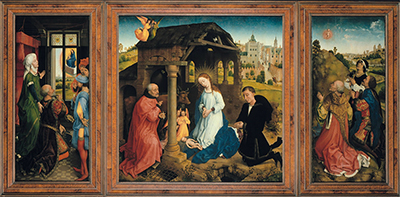
His paintings were not provincial products. They moved through networks of court, church, city and international collection. The Prado Descent from the Cross began in Leuven, passed through Habsburg and Spanish royal contexts, and now anchors one of the Prado's greatest Netherlandish holdings. [4] The Saint Columba Altarpiece was made for a Marian chapel in Cologne and is now in Munich. [5] [6] [7] The Portrait of a Lady passed through German aristocratic collecting, the art market, Andrew W. Mellon and the National Gallery of Art. [8]
These routes show how Rogier's reputation travelled. His art could speak to local devotional communities, civic patrons, Burgundian elites, German church settings, Spanish royal collectors and later museum audiences.
The manuscript page on [Jean Wauquelin Presenting the Chroniques de Hainaut](/rogier-van-der-weyden/jean-wauquelin-chroniques-de-hainaut/) extends that Burgundian context beyond panel painting, showing how Rogier's name also belongs to courtly book culture and the visual politics around Philip the Good.
That pattern reflects the history of the paintings themselves.
The Possibility of Italy
The National Gallery states that Rogier may have travelled to Rome in 1450. [1] The word "may" matters. The possible Italian journey is important, but the wording remains conditional because the surviving evidence is not certain.
Whether or not he personally travelled to Italy, Rogier's art was known beyond the Low Countries. The National Gallery notes that his figure and subject types were repeated across the Netherlands, the Iberian peninsula and Italy until the mid-sixteenth century. [1] This is a stronger and safer claim than building too much around a single journey.
The Italian question is still useful for readers. It places Rogier in a wider fifteenth-century European network, alongside artists and patrons who were interested in Netherlandish oil painting, emotional realism and detailed surfaces. But his style remained fundamentally rooted in the devotional and pictorial culture of the Low Countries.
Rogier does not need an Italian frame to matter. His authority comes first from Tournai, Brussels, the Burgundian Netherlands and the northern devotional tradition.
Major Works and Artistic Development
Rogier's surviving works include monumental religious images, triptychs, portraits, fragments and devotional panels. The exact corpus is shaped by attribution debates, workshop participation and lost originals, so current museum wording controls the final claims.
The Descent from the Cross is the essential flagship. The Prado dates it before 1443, records it as oil on panel and gives its original context as the chapel of the Great Crossbowmen's guild in Leuven. [4] It shows Rogier's genius for compressed grief and sculptural illusion.
The Magdalen Reading, in London, belongs to the early Brussels context. It is a fragment from a larger altarpiece and preserves Rogier's ability to make contemplation visible through geometry, detail and inwardness. [3]
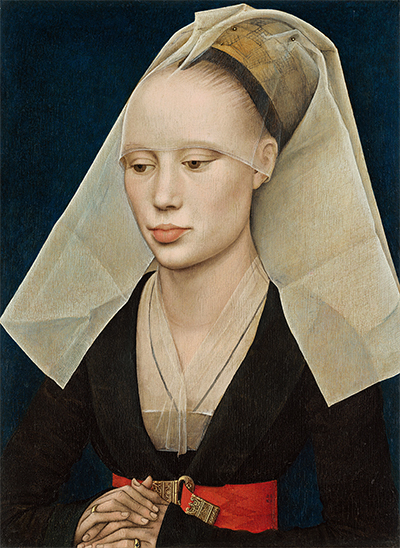
Portrait of a Lady, in Washington, shows his late portrait style. The NGA dates it to about 1460 and presents it as a refined example of the abstract elegance and psychological control of Rogier's portraits. [8]
Portraits and Devotional Psychology
Rogier's portraits are less theatrical than his Passion scenes, but they are not less intense. Portrait of a Lady shows how he could build a whole psychological presence from lowered eyes, clasped hands, a veil, a dark dress and a precisely controlled silhouette. [8]
This portrait language belongs to the same artistic mind as the Descent. In both cases, feeling is disciplined by structure. In the Descent, Christ and the Virgin form parallel arcs of grief. In Portrait of a Lady, the sitter's inwardness is held inside the geometry of veil, face, hands and belt.
Those works can show how secular identity, status and devotion overlapped in the Burgundian and courtly world.
The relationship belongs within a broader Early Netherlandish portrait culture rather than as a simplistic line of influence unless a source specifically supports that claim.
Workshop, Copies and Influence
Rogier's influence is inseparable from workshop practice. The National Gallery's discussion of The Magdalen Reading notes that Rogier and assistants reused several figures from the larger composition, and that Mary herself appears reversed in the Seven Sacraments Altarpiece in Antwerp. [3] This gives a concrete example of how figure types could be preserved and adapted.
The National Gallery artist page also notes the issue of workshop collaboration among Rogier's smaller religious works. [1] That issue is not a weakness in itself. It is part of how fifteenth-century workshops functioned. Masters, assistants, drawings, patterns and copies all shaped the survival and spread of images.
Rogier's influence continued through followers, copyists and later northern artists. Petrus Christus, Jan van Eyck, Bosch, Bruegel and Durer can help build the broader Northern Renaissance corridor where the context is natural.
Later subject links also matter.
Death and Legacy
Rogier died in 1464. [2] By then he had created one of the most influential artistic languages of the fifteenth century. His works were copied, adapted and collected across Europe, and his emotional formulas continued to shape religious painting after his death.
His legacy rests on several achievements. He made grief visible without dissolving composition into chaos. He made portraiture inward without making it vague. He made altarpieces feel both architecturally ordered and emotionally charged. He helped define how Early Netherlandish painting could join material detail, theological meaning and psychological pressure.
Modern readers may meet him first through one image, usually the Descent from the Cross or Portrait of a Lady. The masterpiece, the fragment, the portrait, the triptych, the workshop problem and the international afterlife all need to be seen together.
That is why Rogier van der Weyden deserves more than a short biography. He is one of the artists through whom the Northern Renaissance becomes emotionally legible.
Frequently Asked Questions
He was born around 1399 or 1400. The NGA lists him as Netherlandish, 1399/1400 to 1464. [2]
He was also known as Rogier or Roger de la Pasture. The name van der Weyden reflects the Dutch form used after his move into the Brussels context. [2]
The National Gallery states that he was apprenticed to Robert Campin in Tournai from March 1427 to August 1432. [1]
He is strongly associated with Brussels. The National Gallery records that he became painter to the city of Brussels in 1435. [1]
The National Gallery says he may have travelled to Rome in 1450. The possibility needs to be presented cautiously rather than as a certainty. [1]
He is especially famous for The Descent from the Cross in the Prado, but his portraits, triptychs and devotional fragments are also central to his reputation. [3] [4] [8]
He helped define Early Netherlandish painting through emotional intensity, carefully structured figures, devotional realism and portrait psychology. His types and compositions were repeated across northern Europe and beyond. [1]
Discussion
Which stage of Rogier's life seems most decisive: Tournai training, the Brussels city painter role, Burgundian patronage, or the spread of his workshop models?
Reader Insights
Tournai and Brussels are not just background details. They help explain Rogier's professional identity, language shift and civic position.
The biography is strongest when it separates secure records from attractive but less certain traditions, especially around travel and lost works.
Rogier's life story leads naturally into copies, workshop practice and reception because his reputation travelled through repeatable image types.
Join the Conversation
Have a thought or observation about Rogier van der Weyden Biography? Share it below. Thoughtful responses may be added to this section as the Rogier van der Weyden cluster develops.
References
- The National Gallery, London, artist page for Rogier van der Weyden, accessed 2026-07-11. https://www.nationalgallery.org.uk/artists/rogier-van-der-weyden
- National Gallery of Art, Washington, artist record for Rogier van der Weyden / Rogier de la Pasture, accessed 2026-07-11. https://www.nga.gov/collection/artist-info.1971.html
- The National Gallery, London, The Magdalen Reading, collection record for NG654, accessed 2026-07-11. https://www.nationalgallery.org.uk/paintings/rogier-van-der-weyden-the-magdalen-reading
- Museo Nacional del Prado, The Descent from the Cross, collection record for P002825, accessed 2026-07-11. https://www.museodelprado.es/en/the-collection/art-work/the-descent-from-the-cross/856d822a-dd22-4425-bebd-920a1d416aa7
- Sammlung Pinakothek / Bayerische Staatsgemaeldesammlungen, Columba-Altar: Verkuendigung, WAF 1190, accessed 2026-07-11. https://www.sammlung.pinakothek.de/de/artwork/A0GOlar4dp
- Sammlung Pinakothek / Bayerische Staatsgemaeldesammlungen, Columba-Altar: Anbetung der Koenige, WAF 1189, accessed 2026-07-11. https://www.sammlung.pinakothek.de/de/artwork/jWLpO7nxKY
- Sammlung Pinakothek / Bayerische Staatsgemaeldesammlungen, Columba-Altar: Darbringung im Tempel, WAF 1191, accessed 2026-07-11. https://www.sammlung.pinakothek.de/de/artwork/53470Zmx9e
- National Gallery of Art, Washington, Portrait of a Lady, collection record for 1937.1.44, accessed 2026-07-11. https://www.nga.gov/artworks/51-portrait-lady
- Dirk de Vos, Rogier van der Weyden: The Complete Works, Harry N. Abrams, 2000.
- Lorne Campbell and Jan Van der Stock, eds., Rogier van der Weyden: 1400-1464. Master of Passions, Leuven, Davidsfonds, 2009.