 by Tom Gurney
Tom Gurney BSc (Hons) is an art history expert with over 20 years experience
Published on June 19, 2020 / Updated on July 30, 2026
Email: tomgurney1@gmail.com / Phone: +44 7429 011000
Seven Sacraments Altarpiece: Introduction
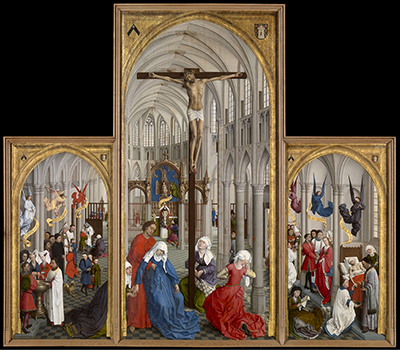
The Seven Sacraments Altarpiece is one of Rogier van der Weyden's strongest major works because it brings together theology, architecture, workshop practice and regional Low Countries authority. Now in the Royal Museum of Fine Arts Antwerp, the triptych turns the seven sacraments of the Church into a staged architectural world. [1]
At its centre is the Crucifixion. Around it unfold baptism, confirmation, confession, Eucharist, ordination, marriage and last rites. The image therefore does something ambitious: it joins Christ's sacrifice to the ritual life of the Church, showing that the sacraments are not separate episodes but a complete spiritual structure.
At a Glance
- ArtistRogier van der Weyden and workshop, with attribution wording to be checked against KMSKA
- TitleSeven Sacraments Altarpiece
- DateUsually placed around 1445-1450
- MediumOil on panel
- FormatTriptych
- Current locationRoyal Museum of Fine Arts Antwerp / KMSKA
- SubjectThe seven sacraments of the Church
- Patron contextOften associated with Jean Chevrot and the Burgundian/Tournai world
Contents
- Introduction
- At a Glance
- A Church Within A Painting
- Annotated Details
- Seven Rituals, One Structure
- The Eucharist And The Crucifixion
- Patronage And Jean Chevrot
- Workshop And Attribution
- Antwerp, Tournai And Regional Authority
- The Central Crucifixion
- Colour, Scale And Legibility
- Restoration And Looking Again
- Why It Matters
A Church Within A Painting
Rogier sets the sacraments inside a Gothic church interior. The architecture is not background decoration. It organizes the viewer's understanding. The sacraments happen within a sacred institution, and the building itself becomes an image of order.
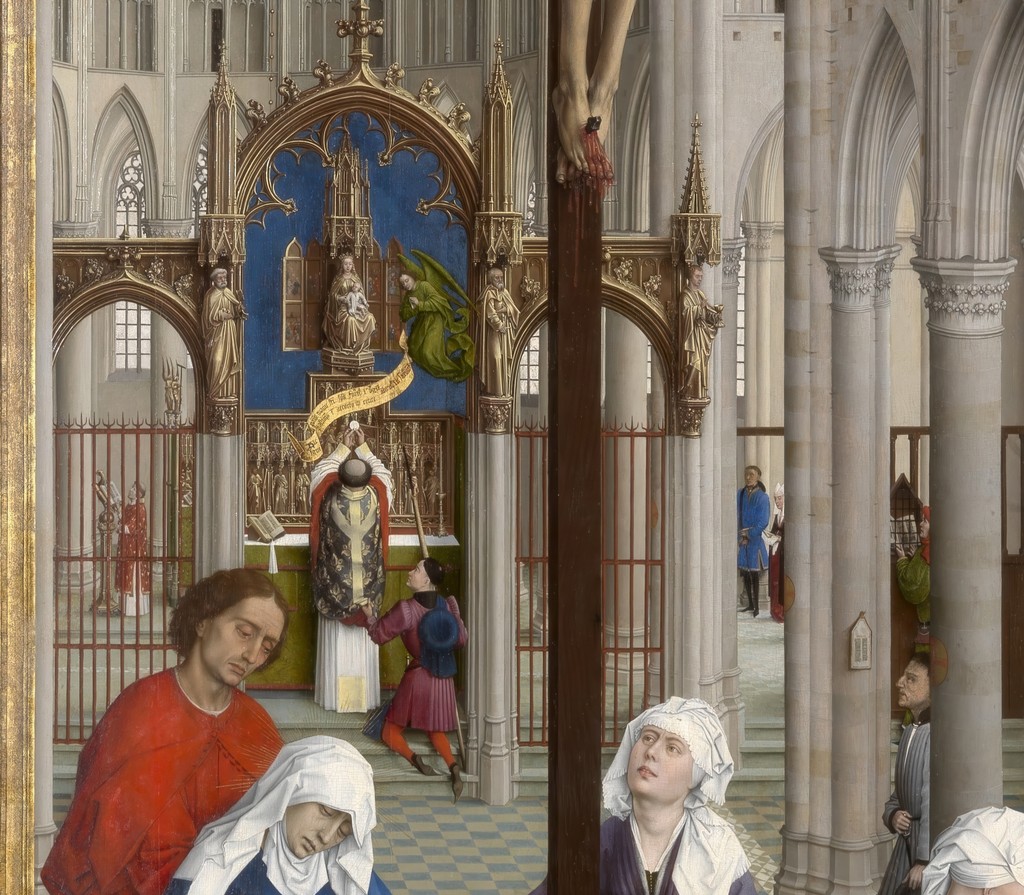
The central panel is dominated by the Crucifixion, while the Eucharist is visible in the liturgical space behind it. This is a crucial design choice. The viewer sees Christ's death and the sacramental repetition of that sacrifice within the same field. Rogier makes the theology visible by placing event and ritual together. [1]
The side panels extend the life of the Church outward: baptism, confirmation and confession on one side; ordination, marriage and last rites on the other. The triptych becomes a map of Christian life from entrance into the Church to final preparation for death.
The building also controls scale. Some figures are monumental because they belong to the central Passion drama. Others are smaller because they belong to the repeated life of the Church. Rogier does not flatten these moments into equal illustrations. He creates a hierarchy of meaning. The Crucifixion anchors the whole structure, while the sacraments show how that central sacrifice reaches different moments of human life.
This is why the altarpiece works so well beside the Beaune Altarpiece. Both paintings think institutionally. Beaune places judgement inside a hospital foundation; the Antwerp triptych places salvation inside the Church's sacramental order. In both cases, Rogier makes a large theological system readable through bodies, architecture and carefully staged action.
Annotated Details from Seven Sacraments Altarpiece
These details show how Rogier binds the seven rites of the Church to the central Crucifixion, arranging sacred ritual, architecture and everyday observation within one continuous painted interior.
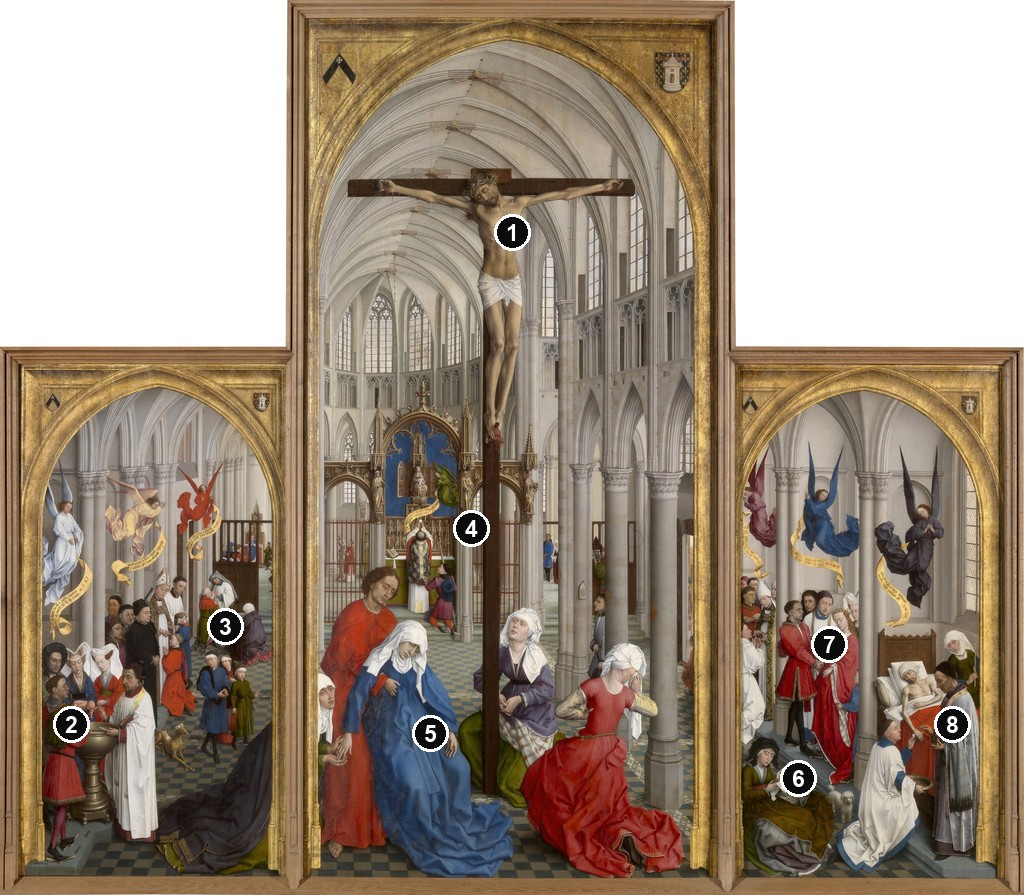
Details from SEVEN SACRAMENTS ALTARPIECE
Close looking reveals how architecture and ritual organise the triptych.
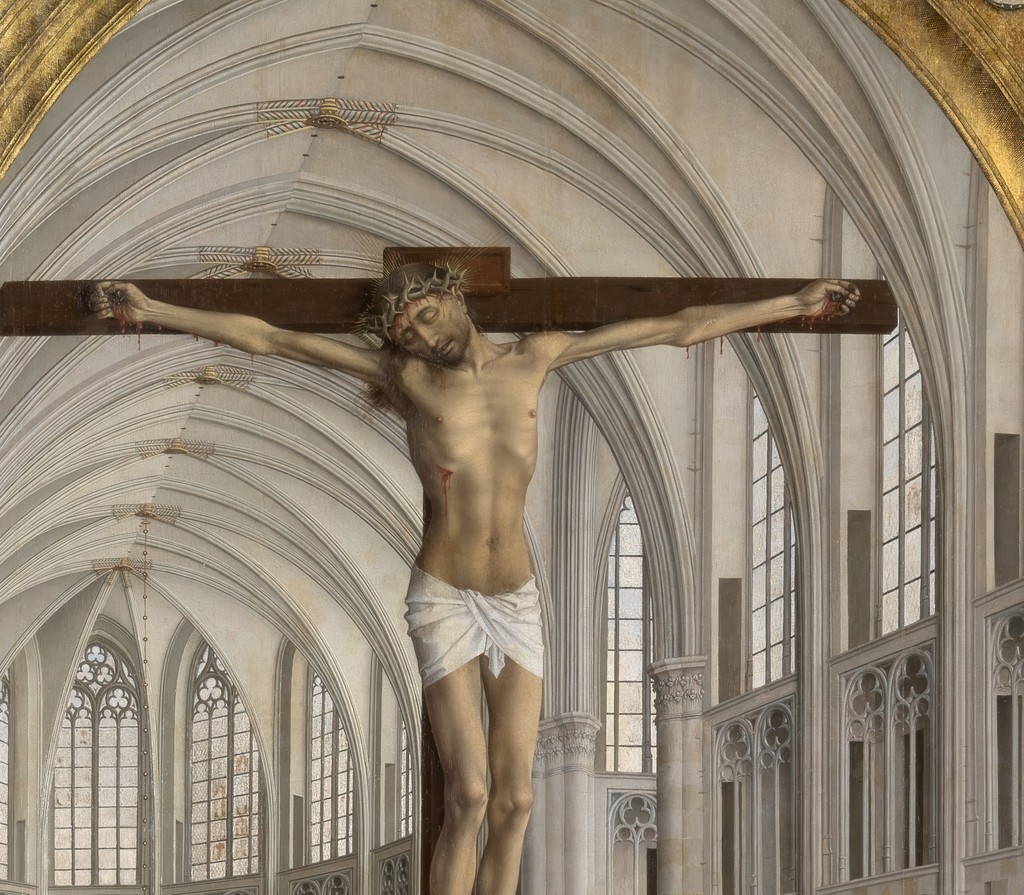
Christ and the soaring nave
The Crucifixion rises through the central panel and aligns Christ's sacrifice with the church interior.
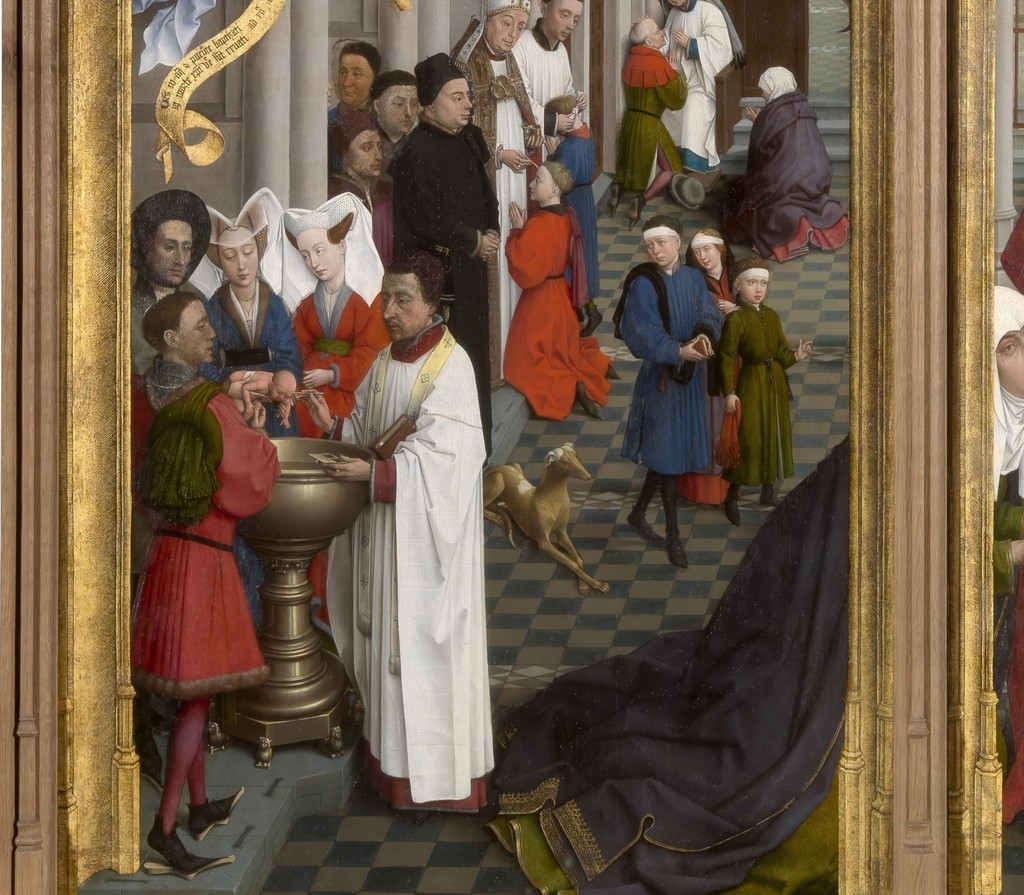
Baptism at the font
At lower left, baptism begins the sacramental sequence at a prominent font.
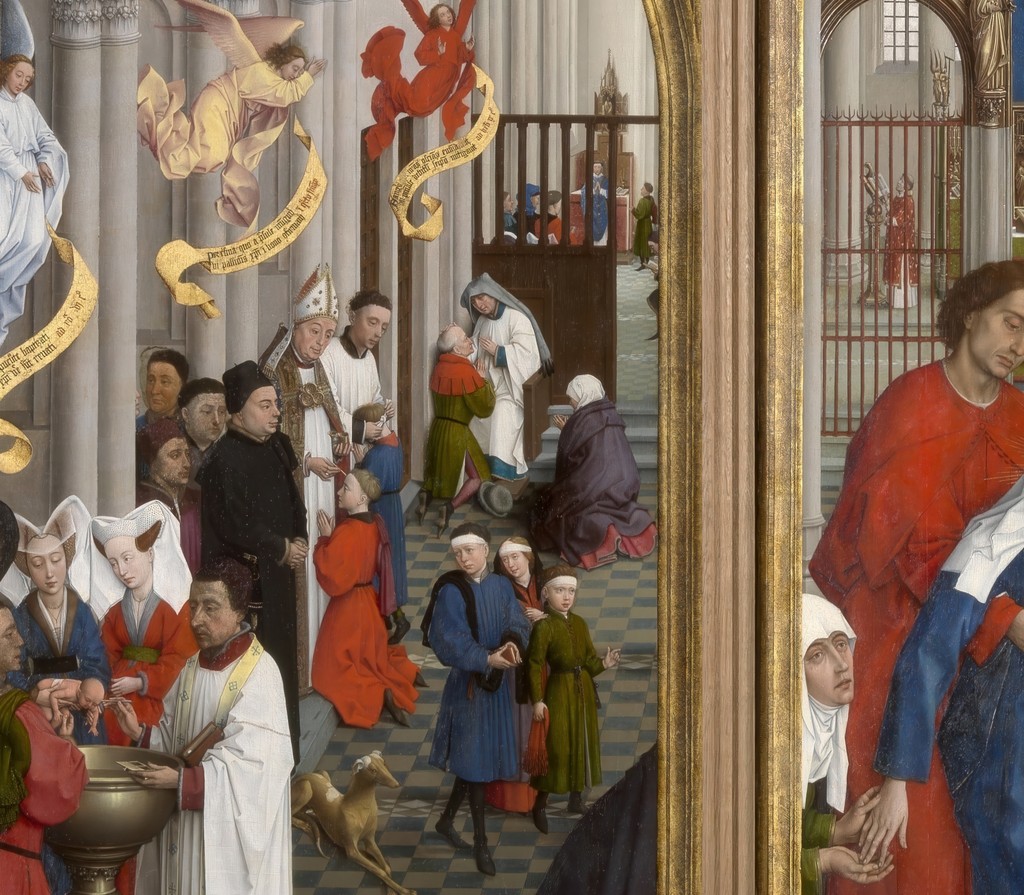
Confirmation before the bishop
Clergy and gathered witnesses turn doctrine into a carefully observed communal rite.
The Eucharist at the high altar
The elevated altar anchors the painted church and links the Mass to the Crucifixion above.
The Virgin's swoon beneath the Cross
Mary's collapsing blue form brings bodily grief into the monumental central axis.
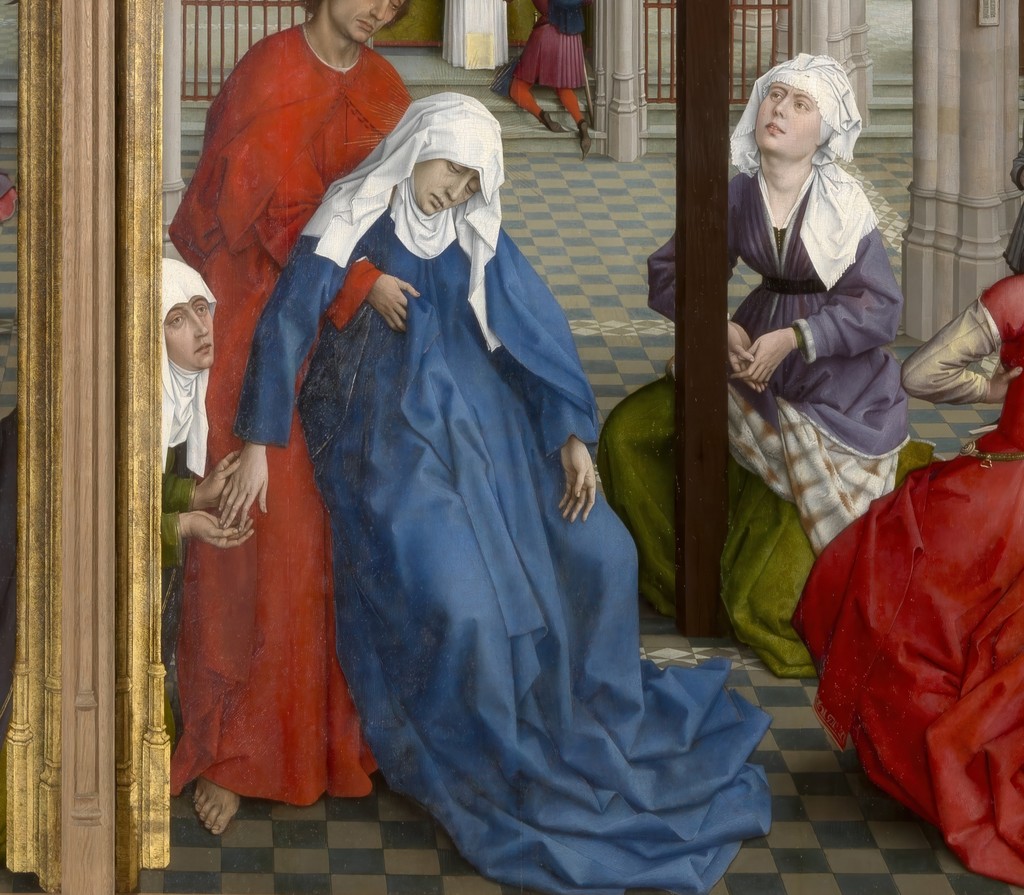
Ordination in the right aisle
Vesture, gesture and books distinguish the rite within the busy aisle.
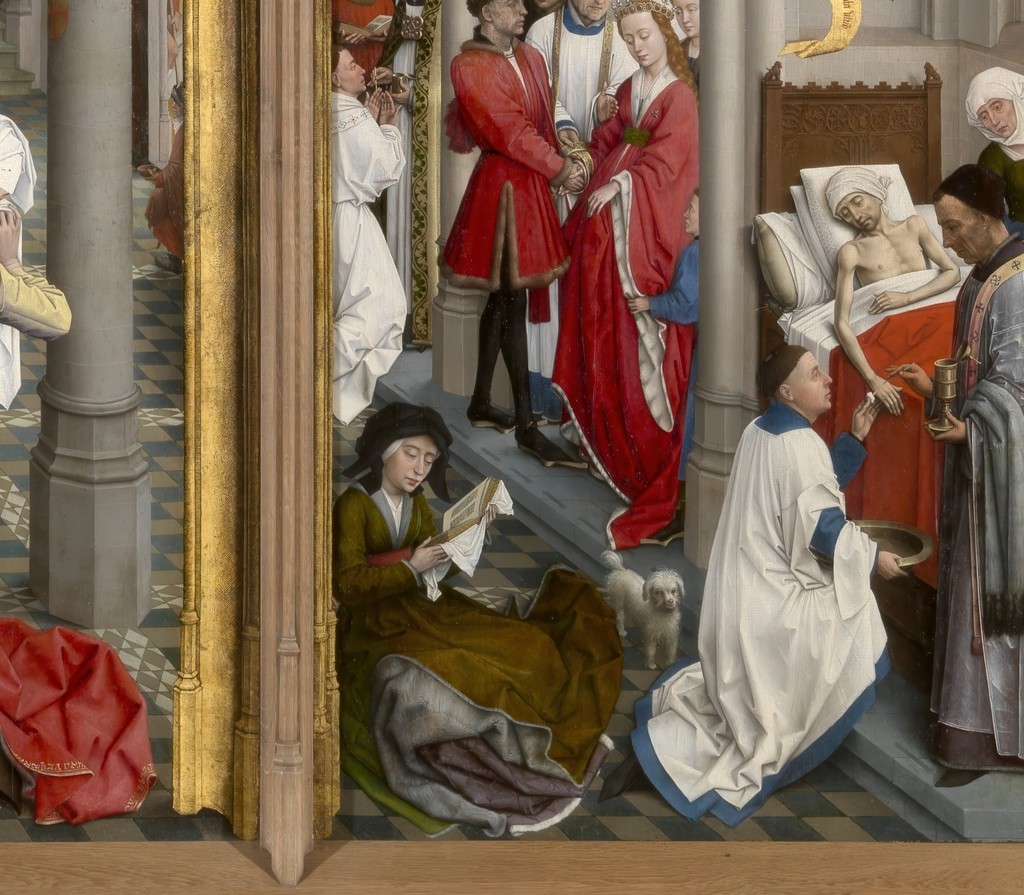
Marriage and joined hands
The couple's joined hands make the sacrament legible through a small, precise gesture.
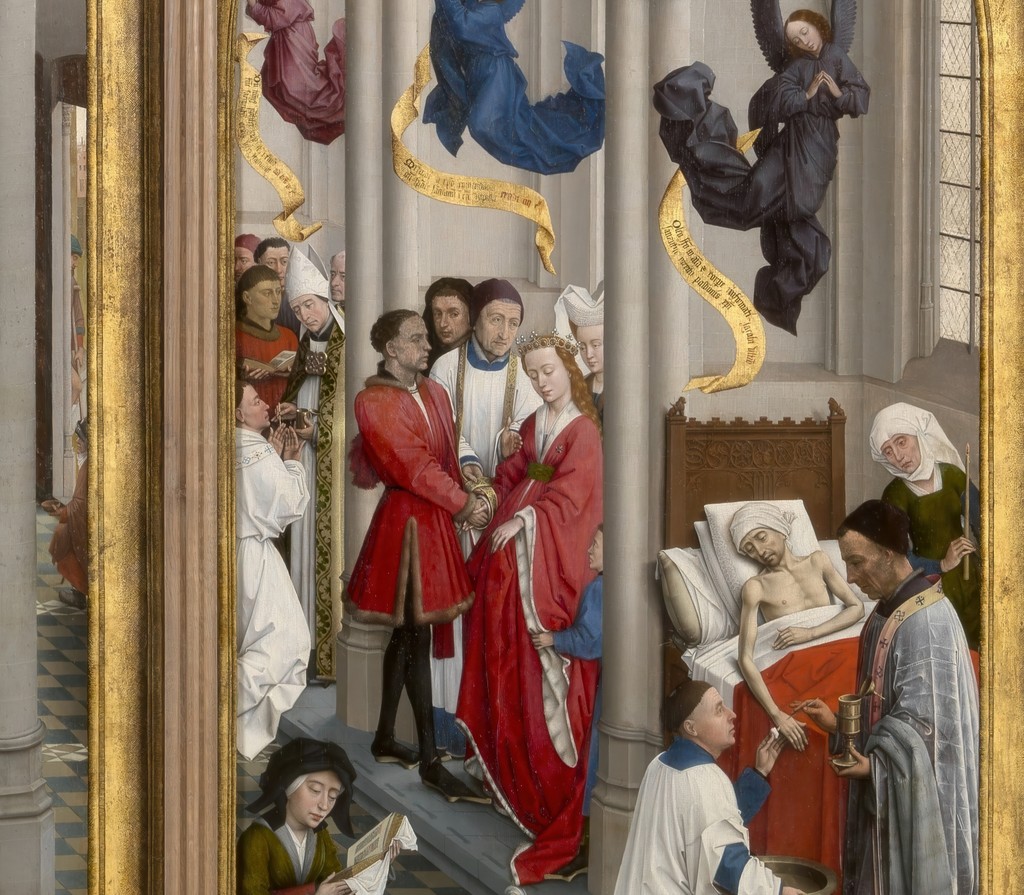
Last rites at the bedside
The intimate bedside scene closes the life-cycle sequence on the far right.
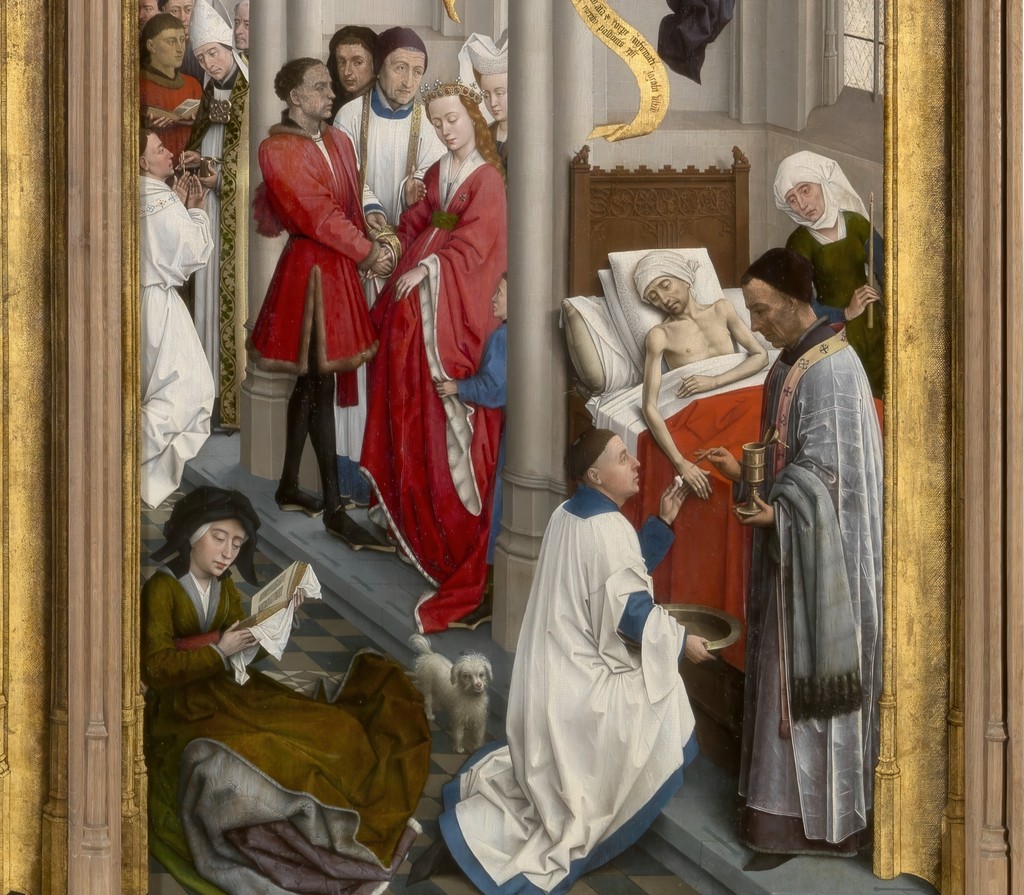
Seven Rituals, One Structure
The painting is the subject. Each sacrament matters because Rogier gives it a visual position.
Baptism marks entry. Confirmation strengthens. Confession restores. Eucharist occupies the centre because it is tied to the sacrifice shown in the Crucifixion. Ordination establishes priestly authority. Marriage sanctifies social life. Last rites bring sacramental care to the edge of death.
It links directly to the Beaune Altarpiece, where hospital, death and judgement are central, and to the Magdalen Reading, where a figure type reappears in another sacramental/devotional context.
The outer sacraments also prevent the central Crucifixion from becoming only an image of the past. The viewer sees Christ's death, but also sees contemporary ritual life unfolding around it. That simultaneity is the point. The Passion is not treated as a remote historical episode. It is the source from which the Church's sacramental life flows.
Rogier's figures help keep the rituals legible. The gestures are clear: water at the font, the bishop's hand, confession, priestly ordination, joined hands in marriage and care for the dying. Each action can be understood quickly, yet the entire triptych remains visually complex. This balance between clarity and density is one reason the work deserves more than a brief catalogue entry.
The Eucharist And The Crucifixion
The Eucharist is the theological hinge of the composition. By placing liturgical action near the Crucifixion, Rogier creates a direct relation between the sacrifice of Christ and the sacrament of the altar. This is not decorative parallelism. It is the central claim of the picture.
The image therefore asks the viewer to see the Mass through the Cross and the Cross through the Mass. The church interior becomes a place where sacred history and present ritual occupy the same visual space. That idea would have been especially powerful for viewers accustomed to seeing altarpieces in active liturgical settings, not as isolated museum objects.
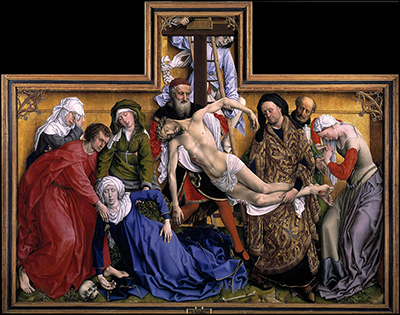
The result is different from the Descent from the Cross. The Prado painting concentrates on the emotional aftermath of Christ's death. The Antwerp triptych concentrates on what that death means for the institutional life of the Church. Both are Passion images, but they use the Passion for different devotional purposes.
Patronage And Jean Chevrot
The altarpiece is often linked with Jean Chevrot, Bishop of Tournai and a figure close to the Burgundian world. [1] The connection is important but must be handled with care if the final object record uses cautious wording.
The Chevrot context is valuable for the site because it connects Rogier to Tournai, Burgundy, ecclesiastical patronage and the Low Countries corridor. It also helps explain why this painting should receive regional-source emphasis. Antwerp and the Belgian/Flemish context are central to his world and reception.
Workshop And Attribution
The Seven Sacraments Altarpiece is also important because it raises workshop questions. The work is often described as involving Rogier and his workshop, with the central panel sometimes treated differently from the side passages in discussions of authorship. [1]
The name "Rogier van der Weyden" can mean different kinds of evidence: autograph invention, workshop execution, later copies and works after lost originals.
Instead, the attribution issue can teach trust. Rogier's workshop was part of his artistic power, not an embarrassment to hide.
For readers, this matters because the word "workshop" is often misunderstood. It does not automatically mean a weak or secondary object. Large fifteenth-century commissions could involve assistants, repeated patterns and carefully managed execution. The central question is how the museum and current scholarship describe the work, and how much of the design, invention and execution can be connected with Rogier himself.
The safest public language is therefore exact rather than vague. If a source says "Rogier van der Weyden and workshop," that phrase should not be simplified into "entirely by Rogier." If a source emphasizes Rogier's invention or central involvement, that should also not be weakened into uncertainty for its own sake. The work helps readers understand attribution as a spectrum of evidence.
Antwerp, Tournai And Regional Authority
The KMSKA record gives this page special value for the Rogier cluster because it anchors the work in a major Belgian collection. Rogier's career belongs to the southern Netherlandish and Burgundian world, so regional sources are not decorative extras. They help keep the interpretation close to the geography and institutional history of the art.
The Chevrot connection also matters in this regional frame. Jean Chevrot was Bishop of Tournai, a city central to Rogier's early identity as Rogelet de la Pasture before his Brussels career. Even when patronage details need careful wording, the altarpiece sits naturally within the ecclesiastical and Burgundian networks that shaped Rogier's commissions.
This regional emphasis is useful for internal linking. The work belongs near Rogier's biography, the workshop-and-influence page, the Beaune Altarpiece and the paintings hub. It also creates a bridge toward related Early Netherlandish artists whose work moved through churches, courts, workshops and copied compositions.
The Central Crucifixion
The central Crucifixion gives the triptych its emotional and theological gravity. Mary collapses or grieves at the foot of the Cross, Saint John responds, and the sacramental action behind them connects Christ's death with the Mass.
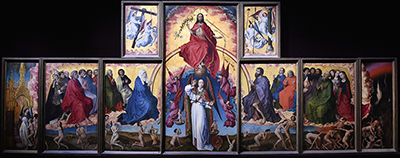
Rogier repeatedly returns to the Passion, but he changes the structure each time. The Descent compresses grief into a shallow sculptural space. The KHM triptych makes the Crucifixion devotional and donor-facing. The Seven Sacraments turns the Crucifixion into the axis of Church life.
That axis gives the painting its unusual power. The Crucifixion is not one scene among seven rituals. It is the source that makes the sacramental scenes intelligible. Rogier's design asks the viewer to see baptism, confession, marriage, ordination and last rites as parts of one sacred economy rather than as separate acts scattered across a church.
The emotional language remains Rogier's. Even in a painting built around doctrine, bodies still carry meaning. The figures beneath the Cross show grief and response, while the sacramental figures show action, participation and ritual order. The triptych holds sorrow and structure together.
Colour, Scale And Legibility
A painting with so many episodes could easily become confusing. Rogier prevents that by using architecture, figure scale and repeated areas of action to guide the eye. The viewer can move from the central Cross to the surrounding rites without losing the whole design.
Colour also helps separate the sacred drama from the smaller rituals, while the church space ties them back together. The result is not a crowded illustration of seven topics. It is a single theological environment, with Christ's death at the centre and the Church's life arranged around it.
This visual order is one reason the work is useful for understanding Rogier's intelligence as a designer. He did not only make emotionally memorable figures. He could organize a complex doctrinal subject so that ordinary viewers could follow it through architecture, gesture and hierarchy.
Restoration And Looking Again
The painting has modern restoration history, including work in the 2000s that drew attention to condition, varnish and technical questions. [1] The restoration history is useful when kept focused. A full conservation chronology is not necessary, but restoration can change how a major old-master painting is seen and interpreted.
Why It Matters
It makes the Church itself visible as a sacramental machine of salvation. It is therefore not only a famous triptych, but a complete visual theology.
It is also one of the clearest places to explain Rogier's ability to join feeling and structure. The figures are emotional, but the design is systematic. The architecture is complex, but the rituals remain readable. The attribution is nuanced, but the visual invention remains powerful. Those qualities make the Seven Sacraments Altarpiece a core work for any serious Rogier cluster.
FAQs
It is in the Royal Museum of Fine Arts Antwerp, also known as KMSKA. [1]
It shows the seven sacraments of the Church within a Gothic church interior, with the Crucifixion and Eucharist at the centre. [1]
The safest wording is to follow the current museum record. The work is commonly discussed in relation to Rogier and his workshop, so attribution language should remain exact.
It connects Christ's Passion with the ritual life of the Church, making theology visible through architecture, figures and sacramental scenes.
Discussion
How does the Seven Sacraments Altarpiece organise theology, church space, ritual and Passion imagery into one visual system?
Reader Insights
The church interior is not just a setting. It lets Rogier place sacramental life and Crucifixion devotion inside one ordered space.
The page is strongest when it helps readers see the sacraments as lived events rather than labels around an image.
Pair it with Beaune and the Descent to see three different versions of large-scale sacred order: judgement, ritual and grief.
Join the Conversation
Have a thought or observation about Seven Sacraments Altarpiece? Share it below. Thoughtful responses may be added to this section as the Rogier van der Weyden cluster develops.
References
- Koninklijk Museum voor Schone Kunsten Antwerpen / KMSKA collection entry, The Seven Sacraments, accessed 2026-07-11. https://kmska.be/en/masterpiece/the-seven-sacraments
- Wikipedia, Seven Sacraments Altarpiece, accessed 2026-07-11. https://en.wikipedia.org/wiki/Seven_Sacraments_Altarpiece
- CODART restoration/reference entry for Rogier van der Weyden restoration at KMSKA, accessed 2026-07-11. https://www.codart.nl/
- The National Gallery, London, artist page for Rogier van der Weyden, accessed 2026-07-11. https://www.nationalgallery.org.uk/artists/rogier-van-der-weyden
- Lorne Campbell and Jan Van der Stock, eds., Rogier van der Weyden: 1400-1464. Master of Passions, Leuven, 2009.