


 by Tom Gurney
Tom Gurney BSc (Hons) is an art history expert with over 20 years experience. Updated September 24, 2026.
Utamaro: portraits, books and print culture
Kitagawa Utamaro (喜多川歌麿, circa 1753/54–1806) made some of the most searching portraits in Japanese woodblock printing. A face may turn only slightly, yet a tilted hand, a reflected profile or the tension between two figures changes the whole encounter. His prints of celebrated women circulated widely in Edo, but portraiture is only one part of his achievement. He also designed illustrated poetry books filled with insects, birds, shells and plants; made playful scenes of domestic life; and worked across single sheets, book pages and painting. The Metropolitan Museum's insect-book object [4] and the National Diet Library's catalogue [3] make this wider range difficult to overlook.
This page is a guide to those different kinds of work. It connects individual images to the books, publishers, poems, named sitters and printing decisions that shaped them. The familiar phrase “Utamaro's beauties” can make hundreds of distinct designs seem interchangeable. They are not. A named waitress, a Yoshiwara geisha, a woman imagined in a domestic scene and a figure in a poem book occupied different social positions and served different pictorial purposes. Even two impressions of one design may differ in lettering, colour, surface or state. The first useful question is therefore not simply whether a print is by Utamaro, but which object and which version we are looking at. The Chiba City Museum of Art's account of Three Beauties of the Present Day [10] documents a particularly revealing change of names between editions.
Contents
- Utamaro: portraits, books and print culture
- Utamaro’s journey in context
- A career visible through objects
- How to look at an Utamaro portrait
- Three women, several different “Three Beauties”
- Physiognomy, mirrors and experiments in seeing
- A day in Yoshiwara: twelve hours as a series
- The book as a collaborative artwork
- Yamauba and Kintarō: intimacy outside the named portrait
- Publishers, censorship and the limits of a simple story
- Working from actual impressions
- Utamaro in context: artists, poems and print culture
- What to explore next
- Selected works and series
At a glance
- When did he live?Around 1753 or 1754 to 1806. The NDL authority record [1] uses 1753–1806 for identification, but that does not establish an exact birthday.
- Where did he work?His documented print and book career belongs to Edo's late eighteenth- and early nineteenth-century publishing culture. His birthplace and much of his youth are not securely documented.
- What was he known for?Portrait-format images of women, notably half-length and large-head compositions; illustrated poetry books; print series and paintings.
- Who helped make the work?Designers worked with publishers, poets, block cutters and printers. Toriyama Sekien was an evidenced teacher; Tsutaya Jūzaburō was an important publisher, though not his only one.
- Where should I begin?Compare a portrait such as Three Beauties of the Present Day with a spread from Picture Book of Crawling Creatures. Then look at a sheet from Twelve Hours of the Yoshiwara to see how a series creates narrative.
Utamaro’s journey in context
Ukiyo-e publishing during Utamaro’s career
Working context, circa 1775–1806; not movement datesFull-colour print production
From the 1765 technical milestone through Utamaro’s lifetimeKano-trained Sekien’s shared artistic circle
Utamaro’s early network; approximate contextToriyama Sekien — teacher
1712–1788; 1786 collaboration documentedTorii Kiyonaga — contemporary
1752–1815; visual comparison, no claimed collaborationKitagawa Utamaro
circa 1753/54–1806; birth uncertainChōbunsai Eishi — contemporary
1756–1829; separately credited in a shared bookThree-artist collaborative print
1786; Met 2022.312Picture Book of Crawling Creatures
1788; NDL WA32-8Gifts of the Ebb Tide
probably 1789; Met 2013.897Three Beauties of the Present Day
1793 Chiba impressionTwelve Hours of the Yoshiwara
circa 1794–95; different museum impressionsStanding Courtesan Reading a Letter
circa 1805–06; British Museum paintingA career visible through objects
Utamaro's private life is unusually hard to reconstruct. Library name records and museum summaries disagree even over whether to give his birth year as 1753 or about 1754. An exact birthplace, childhood story and family history should not be inferred from a confident modern anecdote. The surviving objects tell a more reliable, though still incomplete, story of training, collaboration and change. A 1786 surimono in the Metropolitan Museum [2] credits Toriyama Sekien with a screen painting, Utamaro with figures and Sekien's fellow pupil Toriyama Sekichūjo with cherry branches. It is an unusually precise record of three artists' contributions. It supports the pupil relationship, but it does not fix a date at which Utamaro first entered Sekien's orbit.
By 1788, the published Picture Book of Crawling Creatures (Ehon mushi erami, 画本虫撰) joined delicate designs of small living things to poems chosen by Yadoya no Meshimori and issued by Tsutaya Jūzaburō. The NDL's 1788 book record [3] describes fifteen designs, each pairing two creatures and two poems; the Met's first-edition discussion [5] explains the two-volume, double-page structure. A leaf seen alone on a museum website is a useful image, but it was made to be read in sequence within a bound publication. This was neither a zoology textbook nor an isolated preliminary exercise before “real” portraiture. The interplay of fine observation, patterned page and witty verse is itself one of the major achievements of his career.
Related books extended the experiment. Gifts of the Ebb Tide (Shiohi no tsuto, 潮干のつと) turns to shore life and shells; the Met's accordion album [6] is catalogued as probably 1789 and specifies ink, colour, mica and gold leaf. Myriad Birds (Momo chidori kyōka-awase, 百千鳥狂歌合) connects birds with comic verse. The Tokyo National Museum's exhibition list [8] dates displayed copies around 1790, while the Met's two-volume object [7] is dated 1791. A single year in a museum record may describe a particular copy or cataloguing judgement; it should not be transferred automatically to every edition. Together these works reveal a designer who could make a book opening feel expansive, working with poetry and costly printing effects as part of the image.
In the early 1790s, Utamaro and several publishers developed the portrait images for which he is now especially famous. The NDL's Tsutaya exhibition [9] describes how an emphasis on a woman's upper body and minute expression made these images striking beside the full-length beauties that had long dominated the market. Mica-rich backgrounds could turn the empty field behind a face into a luminous surface. These were decisions shared across design and production: Utamaro drew the design, while a publisher financed and marketed it and skilled makers translated drawing into blocks and coloured impressions. Different surviving sheets need to be examined individually before assigning them the same effect or edition.
The final years did not reduce his work to one format. A British Museum painting of a courtesan reading a letter [18], dated about 1805–06, shows that he continued to work in brush and ink as well as printed images. A separate British Museum historical print [17] anchors discussion of the 1804 censorship episode. Neither object authorises a neatly dramatic story in which one punishment caused a sudden artistic or physical collapse. The surviving record is more complex than that.
How to look at an Utamaro portrait
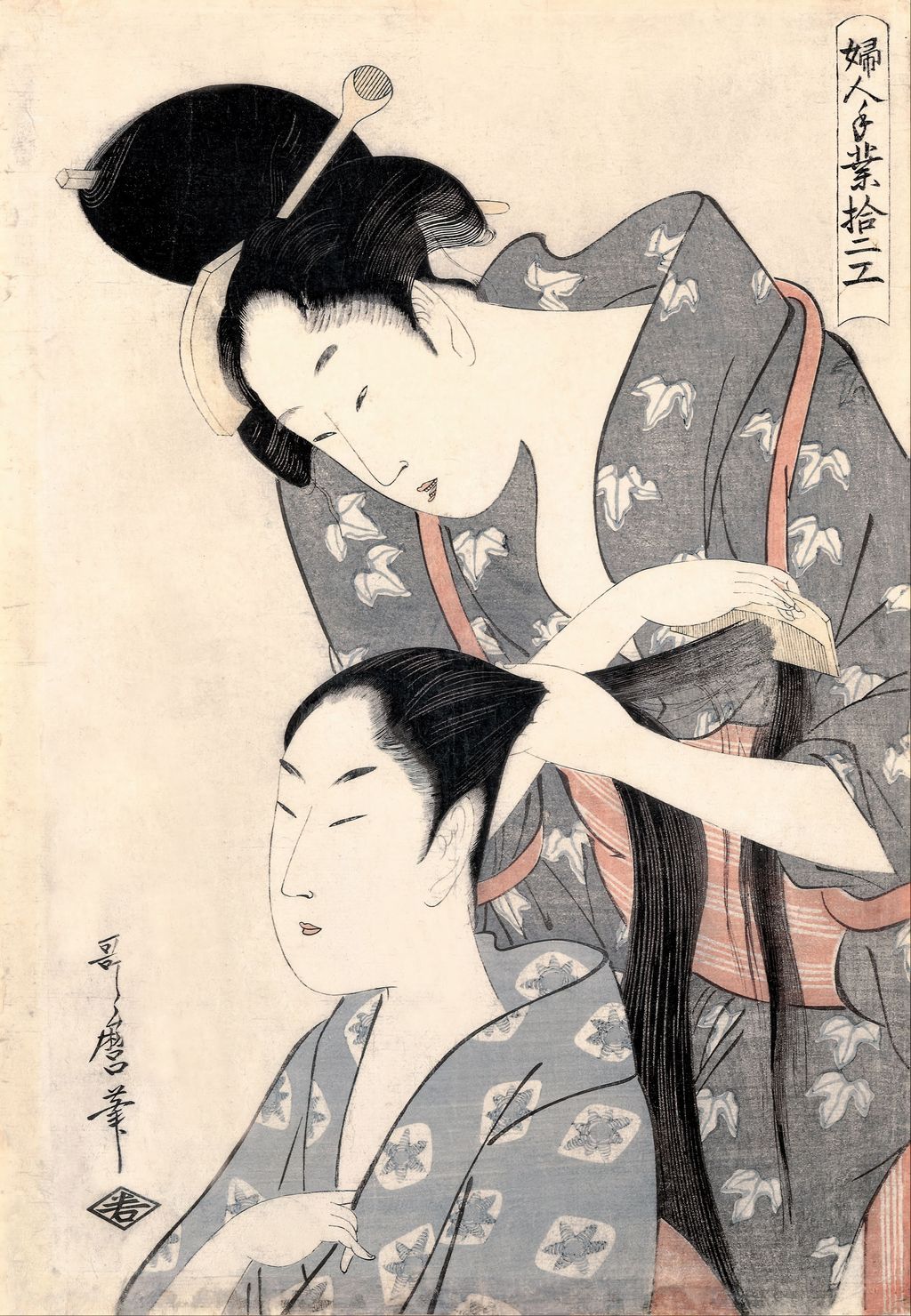
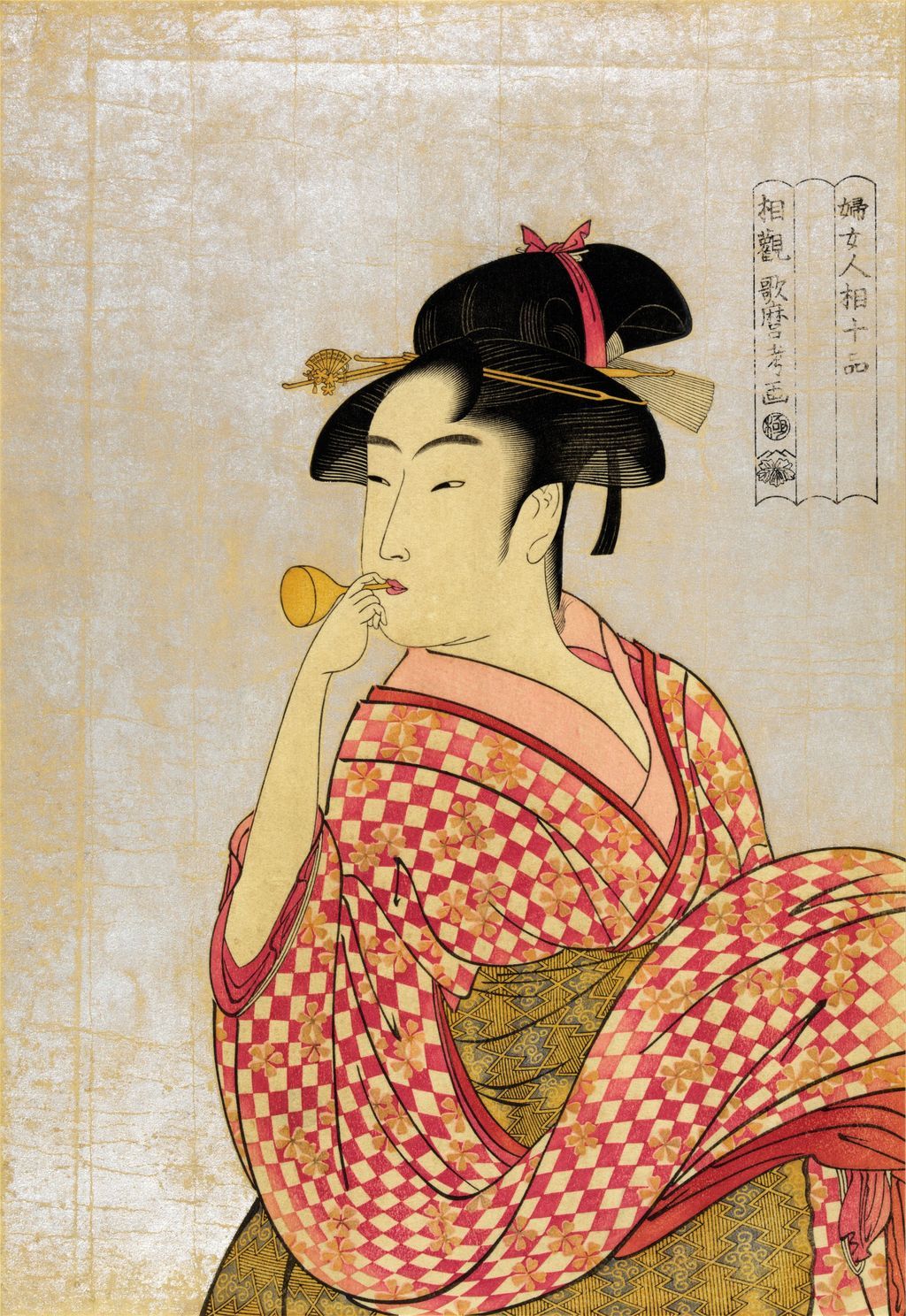
Begin with the composition, not with a claim that the image reveals its sitter's personality. In a half-length portrait, the face, neck, sleeve and hand occupy much of the sheet. Small changes therefore carry unusual weight: the direction of a glance; whether one hand holds a pipe, letter, fan or mirror; whether a sleeve cuts diagonally across the body; whether the eyes meet another person or turn away. The viewer often sees an action halfway through rather than a posed, static likeness. Such attention is one reason the term “large-head picture” (ōkubi-e) helps describe a format. It is not a guarantee that every design was meant as a modern psychological portrait.
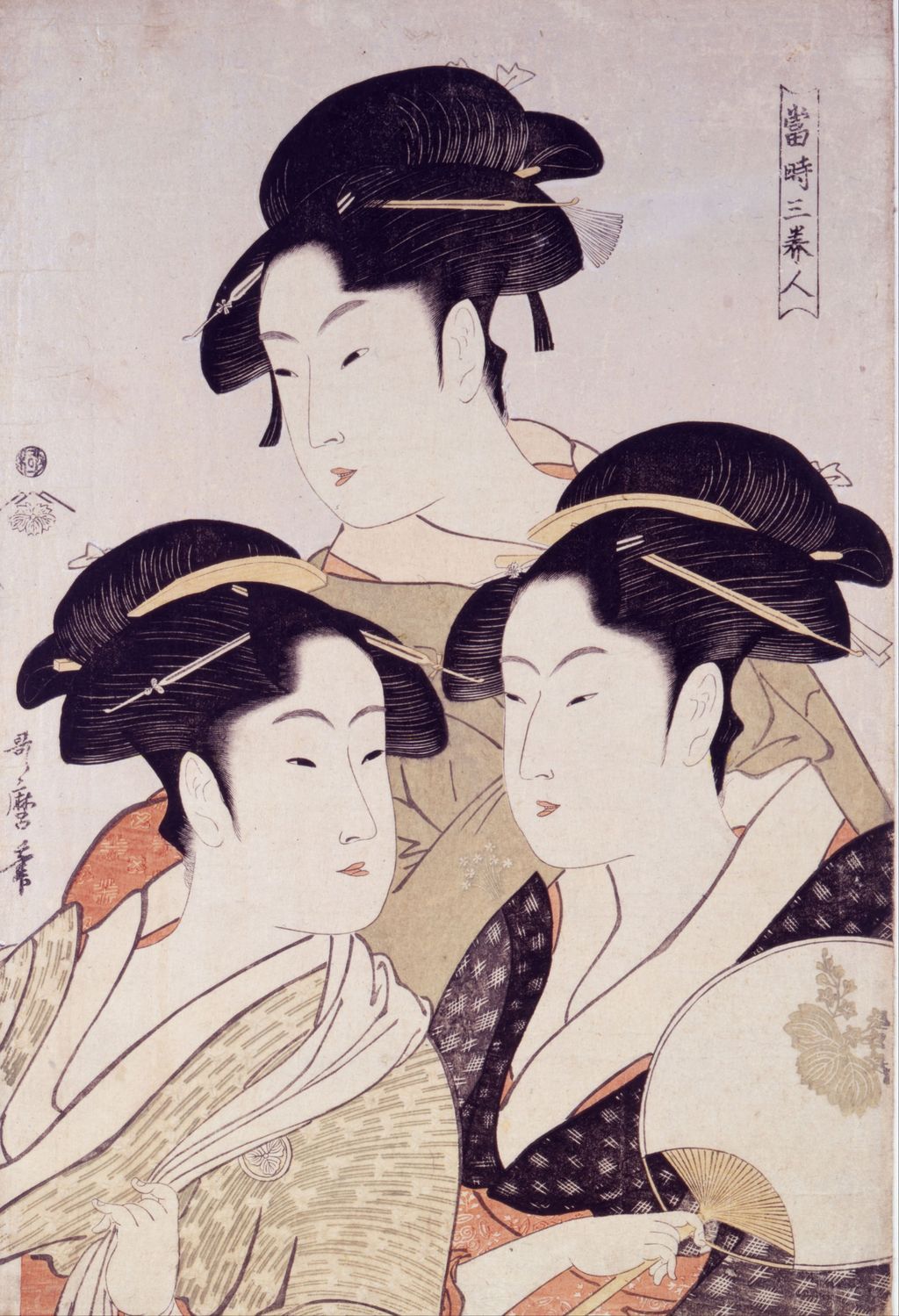
The social identity of the sitter also matters. Chiba's catalogue of Three Beauties of the Present Day [10] identifies Tomimoto Toyohina as a Yoshiwara geisha; Naniwaya Okita and Takashima Ohisa were associated with tea houses. The British Museum's separate Ohisa portrait [13] describes her as a rice-cake shop proprietor's daughter. Calling all three “courtesans” erases distinctions visible in the museum research. Their fame was produced through a commercial print culture that could publish a named woman and her identifying sign to a far wider audience than the people who met her.
Their images were also manufactured objects. A colour woodblock print usually required a key block and separate blocks for colours, careful registration and a publisher willing to pay for the intended finish. Mica, embossing or finely modulated colour cannot be understood from title and artist alone. Repeated printing wears blocks; publishers can change inscriptions; later impressions can look different from earlier ones. A particularly dark ground in one reproduction might reflect its actual impression, a later edition, altered pigments, lighting or digital processing. Captions on this site therefore identify a museum's object number when using its file and avoid claiming that an owner-supplied image represents an exact museum impression without a demonstrated match.
Three women, several different “Three Beauties”
One of the best starting points is Three Beauties of the Present Day (Tōji san bijin, 当時三美人). The Chiba City Museum of Art's 1793 sheet [10] places Toyohina above, Okita lower right and Ohisa lower left. Chiba identifies emblems associated with each woman and describes a later state in which “Present day” and the women's names were removed after restrictions on naming women other than courtesans in colour prints. Those changes are not a footnote to a fixed masterpiece: they reveal how a publisher revised a public image to circulate under new conditions. If a name-bearing and name-free pair is eventually shown together, both physical objects and the particular change must be identified.
The English title “Three Beauties” is especially treacherous. The Met's Three Beauties of the Kwansei Period [11] carries a different Japanese inscription and an earlier catalogue date of around 1791. Side-by-side inspection shows the same arrangement of three figures as the owner-supplied Present Day image, but the Met sheet is a separate physical impression; its precise state relationship to Chiba's 1793 object [10] is not established by these records. The Art Institute of Chicago's Three Beauties of Yoshiwara [12] is another separately catalogued object whose design needs its own comparison. English titles alone cannot identify a printing or edition.
The named sitters are neither interchangeable symbols nor transparent windows into private lives. The arrangement of faces, hairstyles, clothing and emblems could help a contemporary viewer recognise each woman, while the print's scale and patterned surface made them objects of collecting and display. Chiba's state information also reminds us that what a viewer could know depended on which version was bought. A person who sees an uninscribed sheet today may need a museum's comparison and historic catalogue before identifying the figures. That is a better reason for annotations than guessing emotions from a slight smile.
Physiognomy, mirrors and experiments in seeing
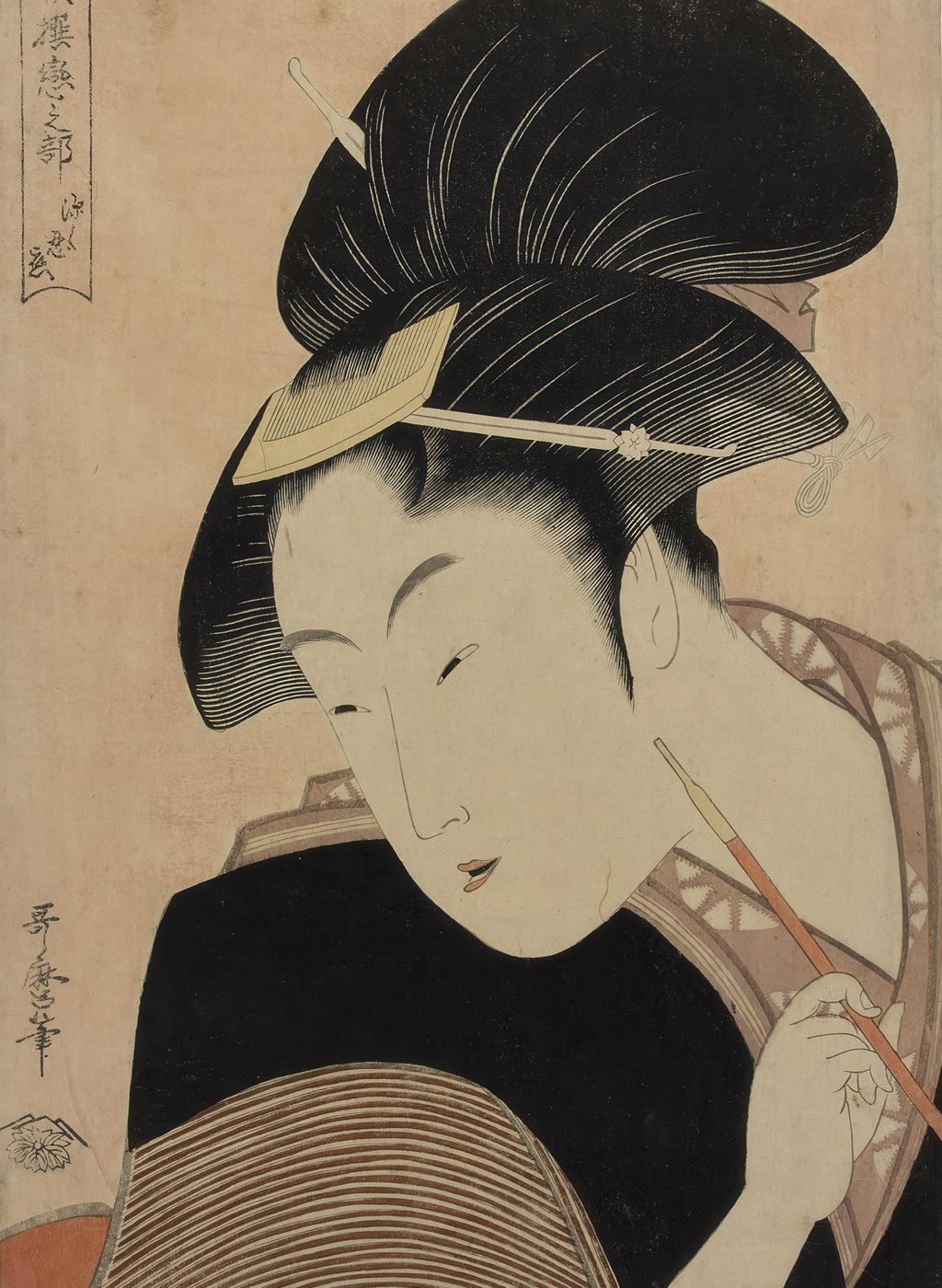
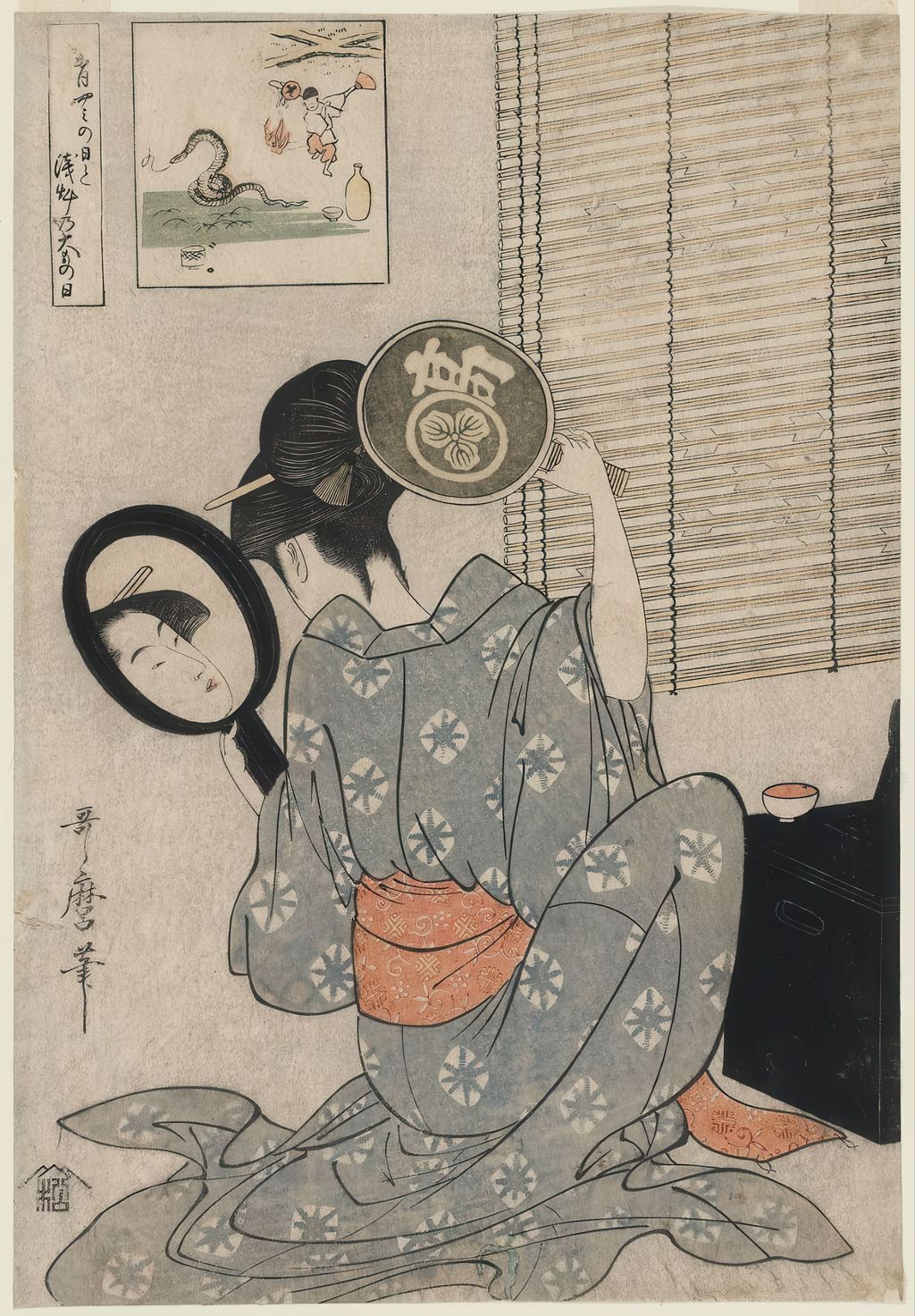
Utamaro's portrait titles sometimes invoke physiognomy, the reading of character through outward appearance. Series names such as Ten Types in the Physiognomic Study of Women should be read as part of a late-Edo print and publishing culture, rather than treated as scientific classifications. The titles may offer a playful or knowing promise to viewers: can a type be recognised by an expression, and can the viewer see past that label? It would be risky to turn the title into a verdict that the real sitter was fickle, jealous, reserved or otherwise psychologically knowable. A description can instead point to the printed words, the composition and the gap between them.
Mirrors make that gap visible. In works such as Takashima Ohisa Using Two Mirrors to Observe Her Coiffure, a reflected view may show a face or hairstyle unavailable from the figure's direct position. The image is about arranging and viewing an appearance as well as representing a woman. Another mirror image may invite the viewer into an intimate-looking scene, but intimacy in a print is carefully staged through cropping and sight lines. It is worth asking where the mirror is, which surface is being reflected, and whether the viewer is put in the position of an observer, a customer or a participant. Those questions describe what is on the sheet without pretending we have overheard a historical moment.
The Tokyo National Museum's Tsutaya chronology [23] places Utamaro's portrait experiments within a competitive print market. Their effects depended on publishers willing to commission eye-catching formats and on craftsmen able to achieve them. Some publishers used names of women already recognised in Edo. These conditions explain why “the same style” is not a complete account of the work: titles, identities, edition changes and material finish were part of its appeal.
A day in Yoshiwara: twelve hours as a series
Explore the twelve hours and identified impressions in the dedicated series guide.
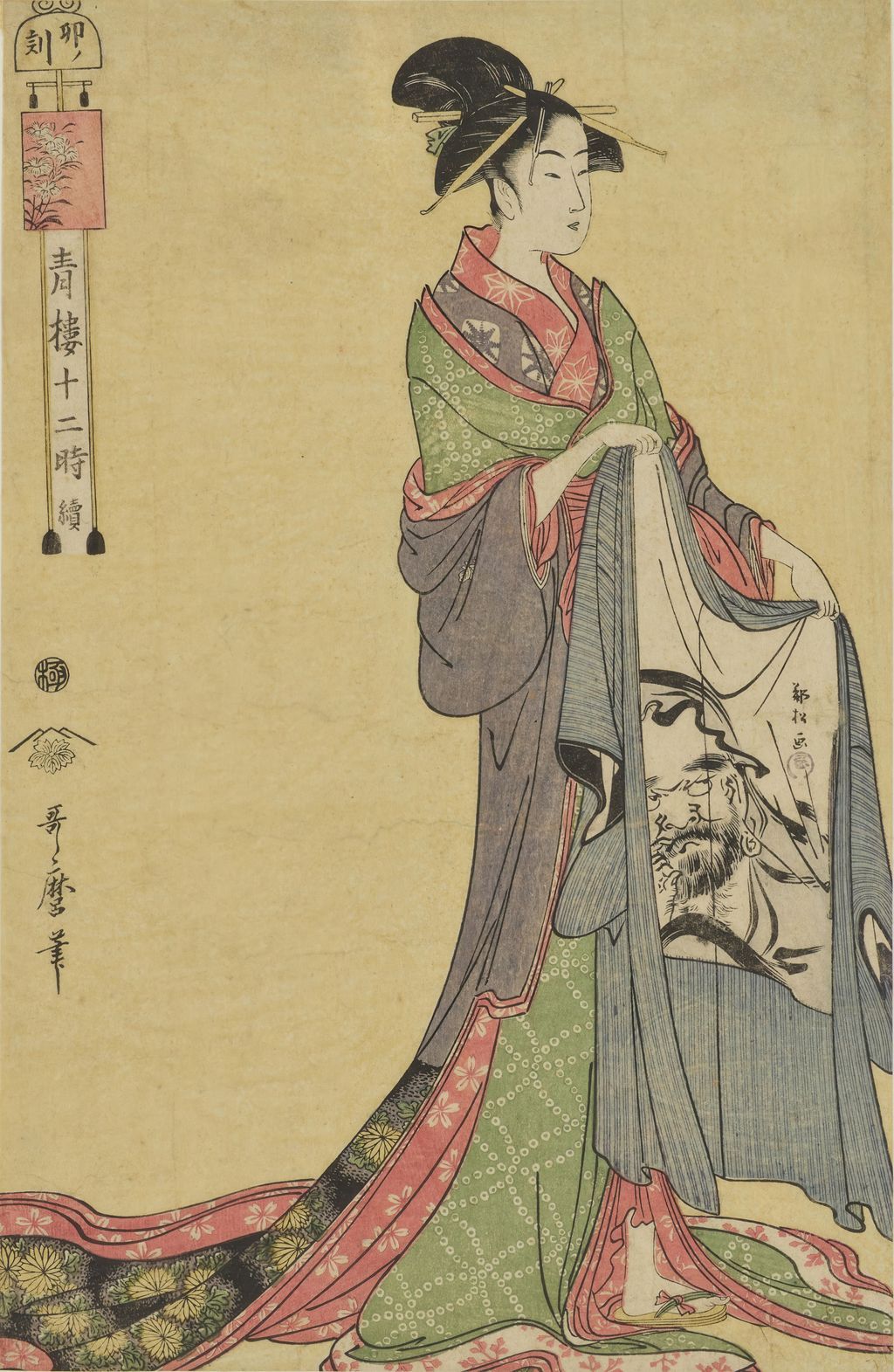
Twelve Hours of the Yoshiwara (Seirō jūni toki tsuzuki, 青楼十二時 続) takes a different route to character. Rather than collecting single celebrities, it sets scenes around twelve zodiacal hours. The Art Institute of Chicago catalogues twelve separate Utamaro sheets [15], each with an hour title; the British Museum's Hour of the Horse [14] shows the hour title arranged within a stylised lantern clock. In that sheet, a courtesan, a teenage apprentice and a child attendant gather around a letter and hair arrangement. The figures' relative positions and work make the scene legible, but the picture is a produced image of life in Yoshiwara, not a diary entry from one woman's day.
The AIC dates its group to around 1794; the British Museum dates its Horse impression around 1795. “About 1794–95” is a prudent series-level description while exact first issue and individual states remain under review. The twelve sheets are individual museum objects, not one complete bound book. Their zodiacal sequence can be shown without assuming accession-number order equals publication order. AIC's Rat-hour record includes a bracketed “12pm” gloss, which conflicts with the customary midnight Rat interval; the local page will avoid repeating that unverified clock conversion.
Titles resembling “hours” do not automatically identify this series. The British Museum's Hour of the Rat, the Mistress [16] belongs to Customs of Beauties Around the Clock, another Utamaro series. A reader seeking twelve images should see the Japanese series wording and object record for every sheet rather than a mixture assembled from superficially similar titles. The proposed dedicated series article will use the AIC set as an institutional starting point and add other impressions only where their catalogue identities are independently clear.
The book as a collaborative artwork
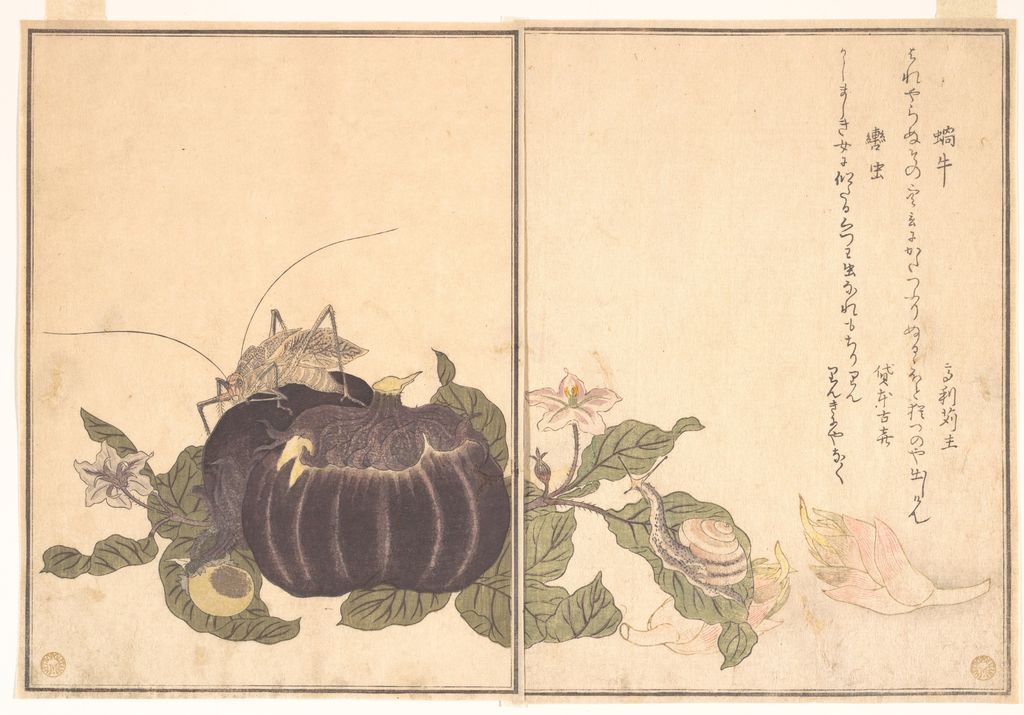
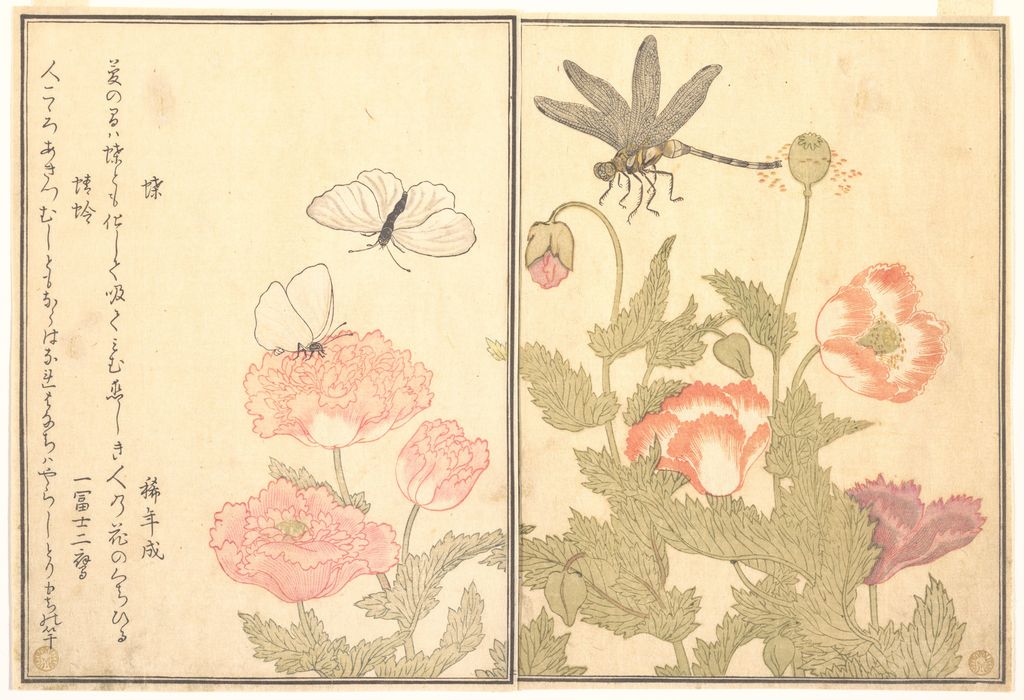
The nature and poetry books resist the idea of a lone genius producing a finished object without other makers. Picture Book of Crawling Creatures was designed for page turns and facing images. Its poems were selected by Yadoya no Meshimori; the publisher Tsutaya financed and issued it. The Met's Songs of the Garden publication [5] describes fifteen double-page designs in the original two volumes and reproduces a first-edition copy at approximately its original scale. The NDL's object description [3] warns that later printings and variant editions exist. Isolating a butterfly or dragonfly from its verse may bring the drawing closer, but it also removes part of the original experience.
The parallel albums work differently. The Met's Gifts of the Ebb Tide [6] is an accordion-style album with a shore-life theme and luxurious materials; its format allows an image to unfold through successive leaves. The bird book appears in Met cataloguing [7] as two volumes. These are not interchangeable “nature prints.” Their titles, subjects, formats and documented copies give three different ways of arranging images and verse. The National Diet Library's 2018 Kodansha bibliographic record [20] identifies a modern scholarly book that transcribes and studies this three-book group; it is a useful companion, but it must not be confused with an eighteenth-century edition of any of the books.
The small forms reward slow looking. A shell's patterned edge, the direction of a stem or the interval between two insects can carry the visual rhythm of an entire opening. The humour or allusion in a kyōka poem may depend on words a non-Japanese reader does not immediately recognise. Where this site illustrates a page, it should retain the Japanese text in the image and give a cautious, sourced explanation of its subject rather than supplying an invented English translation. Utamaro's observation of nature is exacting, but its point is not simply to label a species. It gives the poet and reader a composition in which the pictured creature, seasonal setting and written verse can work together.
Yamauba and Kintarō: intimacy outside the named portrait
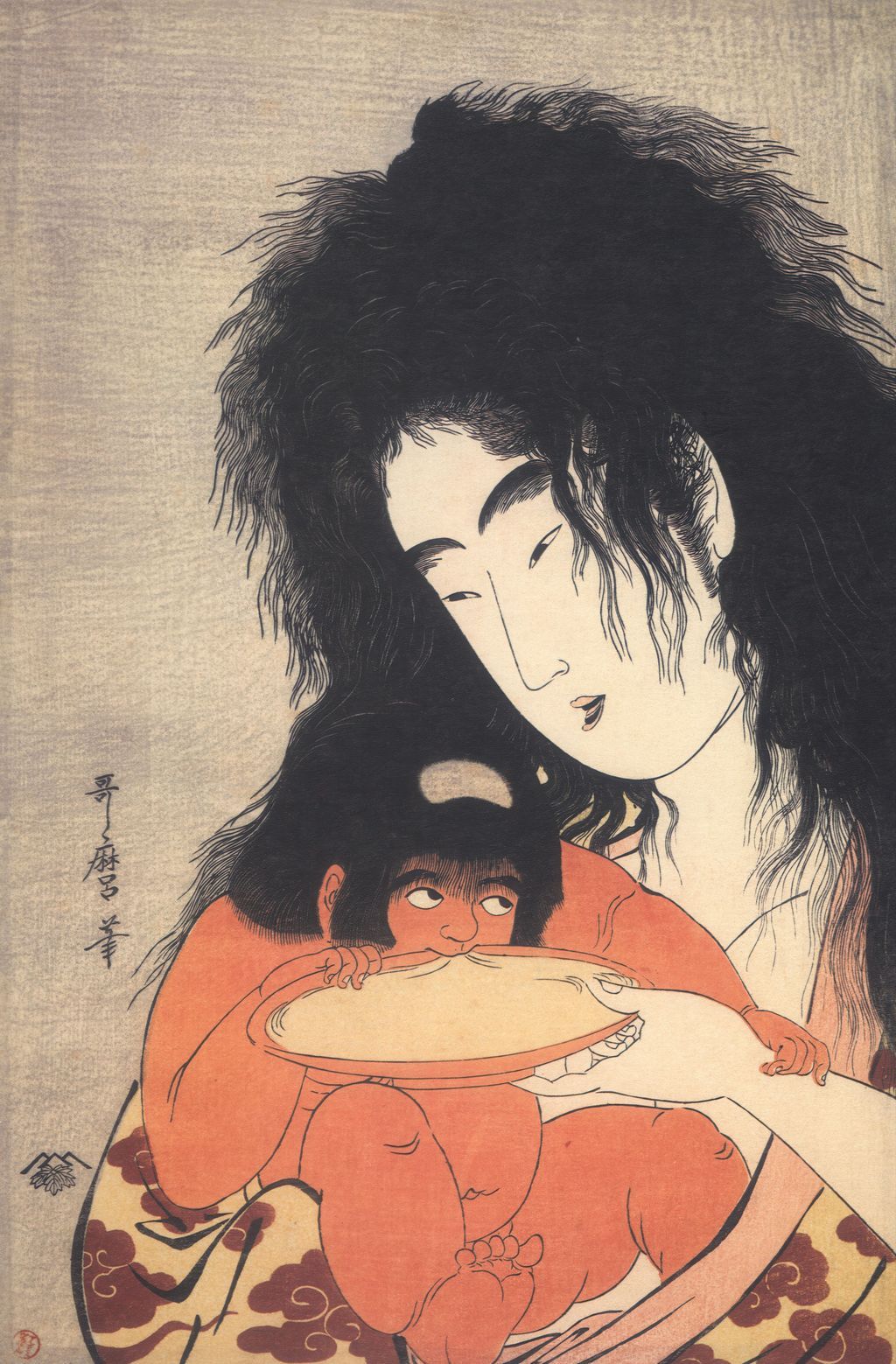
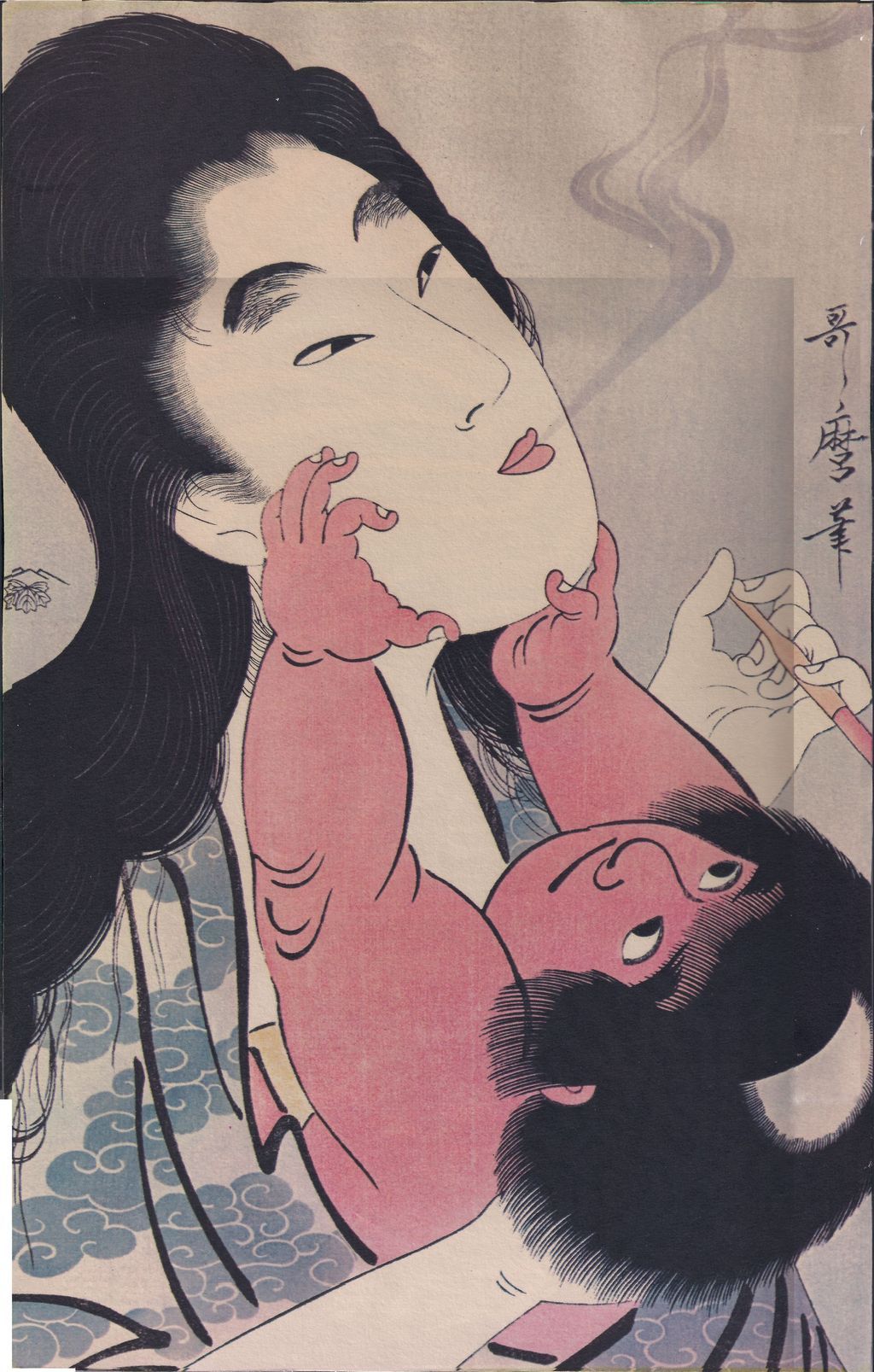
Another group of designs makes the label “beauty print” especially inadequate. The Metropolitan Museum's Yamauba and Kintarō sheet, JP980 [24], is dated about 1795 and identifies the pair as the mountain woman Yamauba and the wild boy Kintarō, her adoptive son in the story. The museum notes that Utamaro made many images of them. This is a legendary subject, not a portrait of an Edo tea-house celebrity. The closeness of a mother and child may invite a modern viewer to see the image as a scene observed from life, yet the names and narrative tradition matter. Utamaro could make a familiar story feel immediate through the bodily relation between two figures without turning it into documentary portraiture.
The design in the owner-supplied image on this page shows a child held near a woman whose darkened teeth, hair and gestures become part of the scene's meaning. Those features should be described from this file rather than silently mapped onto the Met's physically different JP980 impression. The image can support a close reading of contact, scale and expression; the Met's record establishes the broader subject and a dated comparison. A separate Kintarō page would need to compare particular designs and their Japanese titles before claiming what a given attribute means. The same discipline used for named sitters applies here: the figure's narrative identity is documented, while a guess about the artist's own mother or child is not.
The print also clarifies the range of Utamaro's early-to-middle 1790s production. At roughly the same time as publishers issued portraits of recognisable women and clock-titled Yoshiwara scenes, he could draw a mythic child and caregiver. Subjects overlap in tenderness and closely cropped human interaction, but they do not share the same social evidence. A woman given a contemporary name and crest in a print can be researched through public records; Yamauba and Kintarō belong to story and performance traditions. Placing both on an artist homepage lets the reader see a formal interest carried across categories without flattening them into one kind of portrait.
Publishers, censorship and the limits of a simple story
Tsutaya Jūzaburō was central to Utamaro's book and portrait career. The NDL's publisher holdings list [19] records his editions across multiple genres, including Utamaro's 1788 insect book, and the NDL exhibition [9] situates the later portraits within his publishing programme. That does not make Tsutaya the publisher of every Utamaro print. A British Museum sheet from around 1803–04 [17], for example, names Moriya Jihei. The publisher line on the specific sheet should govern its caption.
Two censorship episodes are often compressed into one. In 1791, Tsutaya and the writer Santō Kyōden faced punishment over publications; this was not Utamaro's 1804 case. The NDL's Tsutaya exhibition [9] gives the publisher context. In 1804, Utamaro was punished in connection with historical subjects associated with the banned Ehon Taikōki. The British Museum's research on a surviving print [17] distinguishes a later written account from the actual illustrated source and discusses which image may have triggered the penalty. That is evidence for careful wording, not a licence to repeat every lurid version of the story.
Nor can the punishment be made the sole explanation for the late work. A museum date on a 1805–06 painting demonstrates continued activity; it does not tell us how the artist felt about the event or when a particular change in health began. Other late prints and books circulated through different publishers. The British Museum's Standing Courtesan Reading a Letter [18] offers a strong visual counterpoint to a printed portrait, precisely because the medium and circumstances of its making differ. A detailed biography can examine the legal episode and surviving evidence at length without turning a museum caption into an invented personal memoir.
Working from actual impressions
Woodblock printing makes an image both repeatable and variable. A design could be issued, reprinted, altered or copied. Museum catalogues describe physical impressions that have travelled through collections, sometimes with uncertain edition histories. Even when the composition is instantly recognisable, the paper, margins, inscriptions and colour of a particular sheet deserve their own record. This is why this site's illustrated pages will keep a source link, accession number, Japanese title, date range, dimensions when recorded, rights statement and original uncropped file for each institutional image. Owner-supplied public-domain images can be used without a displayed credit at the owner's request, but an impression-level museum identification will not be attached to them without proof.
The distinction matters especially when a page annotates an image. An enlarged hand or hairstyle is persuasive because the detail appears to be evidence. If the base has been upscaled, retouched, cropped or derived from a different impression, the detail may look stronger than the original sheet warrants. Annotations should therefore use the best available documented base, preserve the unedited original, and explain the feature under the image rather than implying that the crop is a new artwork. For the separate Three Beauties page, a state comparison will be added only when the two underlying objects and their publication permissions are established. This homepage can already show several representative designs while marking the exact status of each file.
Utamaro in context: artists, poems and print culture
The Met's 1786 collaborative print offers a better model of artistic context than a list of speculative “influences.” Sekien was Utamaro's teacher and made one element of that print; Sekichūjo, another pupil, made its cherry branches. Their contributions are separately credited. Tsutaya's relationship was a publishing one, not an apprenticeship. Meshimori selected poems and wrote a preface for the insect book; he was not the cutter of its blocks or the author of every poem. These roles are given in the Met object records [2] and in the NDL catalogue [3]. They can be displayed as connections without pretending every participant influenced Utamaro in the same direction.
Contemporary artists help clarify what was shared and what was distinctive. Torii Kiyonaga's full-figure beauties offer a useful comparison with the large-head portrait format, though a visual comparison alone does not prove personal contact. Chōbunsai Eishi worked in the same broader print world, and the Met catalogues a multi-artist printed book [22] in which both are credited. A shared publication is a documented connection at the object level; it does not establish a meeting or direct stylistic debt. The homepage's interactive map should therefore label teacher, fellow pupil, publisher and poetry collaborator precisely, and its timeline should use broad, defensible spans for artistic movements rather than inventing exact start and end years for ukiyo-e.
Utamaro belongs to a larger history of Edo images moving between the street, shop, theatre, pleasure district and household. Full-colour single-sheet printing had been established decades before the best-known portraits; the Met's history of ukiyo-e printing [21] dates the emergence of multicolour nishiki-e to 1765. That date is a technical milestone, not the birth of ukiyo-e. His work took advantage of an existing medium and changed what a publisher could make of a woman's face, a series title or an illustrated book opening. The Japanese cultural setting is essential, but no single “period style” label can replace looking at the actual object.
What to explore next
Start with the biography for the evidence and uncertainties behind the life story. The works directory will provide a bounded list of documented designs rather than a claim to catalogue all surviving Utamaro objects. Three Beauties of the Present Day (planned) explores named women and edition changes. The physiognomy prints (planned) and Poppin o Fuku Musume (planned) consider portrait titles and viewing habits. Twelve Hours of the Yoshiwara (planned) follows one series across a daily cycle, while the illustrated nature and poetry books (planned) return to images meant to be read beside verse. These routes belong to the agreed cluster plan and should become live links only as their local pages are built.
For now, the most revealing comparison is simple: put a face beside a book opening. In the portrait, an enlarged gesture and a luminous ground ask the viewer to read a small social action. In an insect or shore-life spread, small bodies, poems and the turning page make time and scale work differently. The same artist addressed viewers through both. That range makes Utamaro more interesting than any single picture of “beauty” can convey.
Selected works and series
Twenty-two reviewed entries tied to museum objects or book records. The Twelve Hours parent series and its twelve sheets are related entries, not thirteen unrelated designs. This is not a count of all Utamaro works.
| Name | Date | Medium |
|---|---|---|
| Sekien, Sekichūjo and Utamaro collaborative surimono | 1786 | Privately commissioned woodblock print |
| Picture Book of Crawling Creatures (Ehon mushi erami) | 1788 | Illustrated woodblock book |
| Gifts of the Ebb Tide (Shiohi no tsuto) | probably 1789 | Illustrated woodblock book |
| Myriad Birds (Momo chidori kyōka-awase) | circa 1790–91; copies differ | Illustrated woodblock book |
| Three Beauties of the Present Day (Tōji san bijin) | 1793, Chiba impression | Colour woodblock print |
| Three Beauties of the Kwansei Period (Met JP1528) | circa 1791, Met catalogue | Colour woodblock print |
| Twelve Hours of the Yoshiwara (Seirō jūni toki tsuzuki) | circa 1794–95 | Colour woodblock print series |
| Twelve Hours of the Yoshiwara: Hour of the Rat | circa 1794, AIC catalogue | Colour woodblock print |
| Twelve Hours of the Yoshiwara: Hour of the Ox | circa 1794, AIC catalogue | Colour woodblock print |
| Twelve Hours of the Yoshiwara: Hour of the Tiger | circa 1794, AIC catalogue | Colour woodblock print |
| Twelve Hours of the Yoshiwara: Hour of the Hare | circa 1794, AIC catalogue | Colour woodblock print |
| Twelve Hours of the Yoshiwara: Hour of the Dragon | circa 1794, AIC catalogue | Colour woodblock print |
| Twelve Hours of the Yoshiwara: Hour of the Snake | circa 1794, AIC catalogue | Colour woodblock print |
| Twelve Hours of the Yoshiwara: Hour of the Horse | circa 1794, AIC catalogue | Colour woodblock print |
| Twelve Hours of the Yoshiwara: Hour of the Sheep | circa 1794, AIC catalogue | Colour woodblock print |
| Twelve Hours of the Yoshiwara: Hour of the Monkey | circa 1794, AIC catalogue | Colour woodblock print |
| Twelve Hours of the Yoshiwara: Hour of the Cock | circa 1794, AIC catalogue | Colour woodblock print |
| Twelve Hours of the Yoshiwara: Hour of the Dog | circa 1794, AIC catalogue | Colour woodblock print |
| Twelve Hours of the Yoshiwara: Hour of the Boar | circa 1794, AIC catalogue | Colour woodblock print |
| Yamauba and Kintarō | circa 1795, Met impression | Colour woodblock print |
| Mashiba Hisayoshi historical print | circa 1803–04, BM impression | Colour woodblock print |
| Standing Courtesan Reading a Letter | circa 1805–06, BM catalogue | Hanging-scroll painting |
View the institution records behind these entries
- Sekien, Sekichūjo and Utamaro collaborative surimono — Met 2022.312
- Picture Book of Crawling Creatures (Ehon mushi erami) — NDL WA32-8
- Gifts of the Ebb Tide (Shiohi no tsuto) — Met 2013.897
- Myriad Birds (Momo chidori kyōka-awase) — Met JIB43
- Three Beauties of the Present Day (Tōji san bijin) — Chiba 2943024
- Three Beauties of the Kwansei Period (Met JP1528) — Met JP1528
- Twelve Hours of the Yoshiwara (Seirō jūni toki tsuzuki) — BM 1935,1214,0.8; AIC twelve-object set
- Twelve Hours of the Yoshiwara: Hour of the Rat — AIC 1925.3062 (sheet within Twelve Hours)
- Twelve Hours of the Yoshiwara: Hour of the Ox — AIC 1925.3051 (sheet within Twelve Hours)
- Twelve Hours of the Yoshiwara: Hour of the Tiger — AIC 1925.3052 (sheet within Twelve Hours)
- Twelve Hours of the Yoshiwara: Hour of the Hare — AIC 1925.3053 (sheet within Twelve Hours)
- Twelve Hours of the Yoshiwara: Hour of the Dragon — AIC 1925.3054 (sheet within Twelve Hours)
- Twelve Hours of the Yoshiwara: Hour of the Snake — AIC 1925.3055 (sheet within Twelve Hours)
- Twelve Hours of the Yoshiwara: Hour of the Horse — AIC 1925.3056 (sheet within Twelve Hours)
- Twelve Hours of the Yoshiwara: Hour of the Sheep — AIC 1925.3057 (sheet within Twelve Hours)
- Twelve Hours of the Yoshiwara: Hour of the Monkey — AIC 1925.3058 (sheet within Twelve Hours)
- Twelve Hours of the Yoshiwara: Hour of the Cock — AIC 1925.3059 (sheet within Twelve Hours)
- Twelve Hours of the Yoshiwara: Hour of the Dog — AIC 1925.3060 (sheet within Twelve Hours)
- Twelve Hours of the Yoshiwara: Hour of the Boar — AIC 1925.3061 (sheet within Twelve Hours)
- Yamauba and Kintarō — Met JP980
- Mashiba Hisayoshi historical print — BM 1942,0124,0.13
- Standing Courtesan Reading a Letter — BM 2014,3048.1
Frequently asked questions
Yes. Museum objects, published books and library records establish a documented artist active in late-Edo print culture. His birth is usually placed around 1753 or 1754, while his death is recorded in 1806; the exact birth year and place are uncertain.
No. His illustrated books include insects, shells, birds, plants and poetry. His output also includes other print subjects and paintings. The 1788 Picture Book of Crawling Creatures is a central work, not an exception to be ignored.
In the Chiba City Museum of Art's 1793 object, the women are identified as Toyohina, Okita and Ohisa. Chiba documents a later edition from which names were removed. Other prints translated as “Three Beauties” must be checked separately.
He designed images, but published colour woodblock prints depended on publishers, block cutters and printers. The credit line of a specific object is the best starting point for identifying known participants.
He was punished in connection with prints of historical subjects linked to the Ehon Taikōki ban. This is separate from Tsutaya Jūzaburō's 1791 punishment over other publications. The surviving evidence does not support a simplified claim that the 1804 event ended Utamaro's artistic activity.
They may show the same composition but different physical impressions, editions or later copies. The museum object number, title inscription, dimensions, condition and file source help distinguish them.
Discussion
Choose a specific Utamaro print or illustrated book and look closely at its format, design and surviving impression.
Reader Insights
Which small differences in pose or expression distinguish the figures?
How do publisher, series and edition details affect the way you identify the object?
What changes when Utamaro’s design is encountered across a book opening rather than on one sheet?
Join the Conversation
Include the collection or accession number when sharing an observation about a particular impression.
References
- National Diet Library, Kitagawa Utamaro authority record.
- Metropolitan Museum of Art, collaborative 1786 surimono, object 2022.312.
- National Diet Library, Picture Book of Crawling Creatures, 1788, WA32-8.
- Metropolitan Museum of Art, insect-book leaf JP1046.
- Metropolitan Museum of Art, Utamaro: Songs of the Garden.
- Metropolitan Museum of Art, Gifts of the Ebb Tide, object 2013.897.
- Metropolitan Museum of Art, Myriad Birds, object JIB43.
- Tokyo National Museum, Tsutaya Jūzaburō exhibition object list.
- National Diet Library, Tsutaya Jūzaburō exhibition.
- Chiba City Museum of Art, Three Beauties of the Present Day, no. 2943024.
- Metropolitan Museum of Art, Three Beauties of the Kwansei Period, JP1528.
- Art Institute of Chicago, Three Beauties of Yoshiwara, object 23883.
- British Museum, Takashima Ohisa print, object 1927,0613,0.6.
- British Museum, Hour of the Horse, object 1935,1214,0.8.
- Art Institute of Chicago, Hour of the Hare, object 23953.
- British Museum, Hour of the Rat, the Mistress, separate series.
- British Museum, historical print, object 1942,0124,0.13.
- British Museum, Standing Courtesan Reading a Letter, object 2014,3048.1.
- National Diet Library, Tsutaya Jūzaburō publications list.
- National Diet Library, 2018 Kodansha study of Utamaro's three poetry books.
- Metropolitan Museum of Art, history of ukiyo-e woodblock printing.
- Metropolitan Museum of Art, multi-artist printed book, object 2013.793.
- Tokyo National Museum, Tsutaya Jūzaburō exhibition press material.
- Metropolitan Museum of Art, Yamauba and Kintarō, JP980.
