


 by Tom Gurney
Tom Gurney BSc (Hons) is an art history expert with over 20 years experience. Updated September 24, 2026.
Introduction
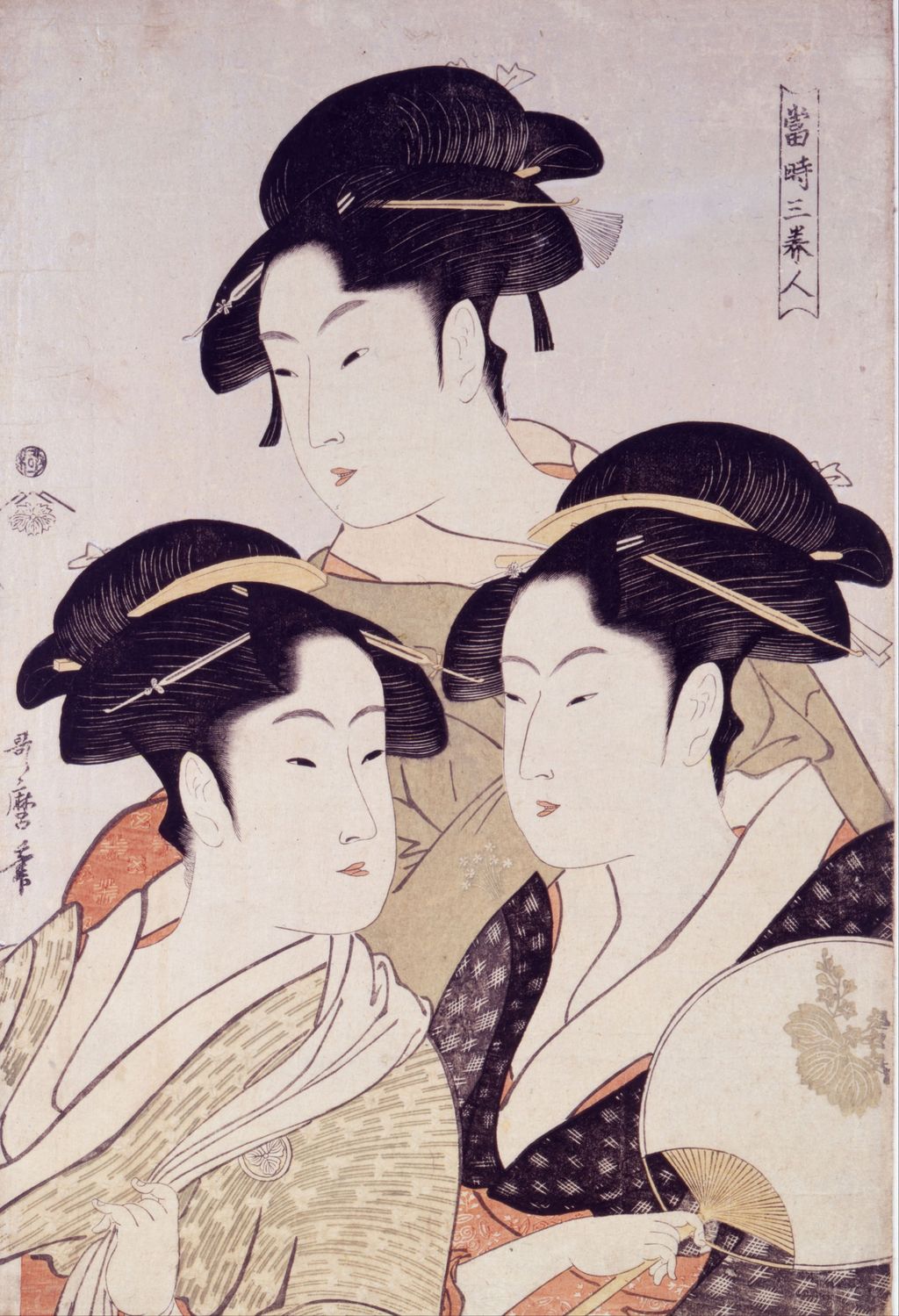
Three women fill nearly the whole sheet. One looks down from behind the other two; the women in front turn towards each other across the print's narrow central gap. Utamaro needs no street, shop front or theatrical setting to establish that they belong together. Hair ornaments, textiles, hands and a fan give each a distinct place in an arrangement that is immediately memorable. The design usually called Three Beauties of the Present Day (Tōji san bijin, 当時三美人) is also an unusually revealing case study in how a famous print can change as it is issued and described. The Chiba City Museum of Art's 1793 sheet [1] names the sitters and describes a later edition from which part of the title and their names were removed. Other institutions preserve closely related impressions whose wording, format and dates do not line up perfectly.
The women in Chiba's named impression are Tomimoto Toyohina at the top, Naniwaya Okita at lower right and Takashima Ohisa at lower left. Toyohina was a Yoshiwara geisha associated with Tomimoto music. Okita worked at a teahouse near Asakusa's Zuishin Gate. Ohisa was the daughter of a confectionery or rice-cake shop proprietor in the Ryōgoku area. These are distinct public identities, not three unnamed courtesans. The three occupy the same positions in the high-resolution image supplied for this page. Its colours and lettering may, however, come from a different physical impression or reproduction; it is not labelled as Chiba's own sheet.
Contents
- Introduction
- Explore four details of the print
- Three names, three positions
- A triangle of glances and hands
- What the print says: title, names and signs
- Three collections, a shared composition and open questions
- Famous women and the print market
- Why “the Kansei three beauties” needs a qualifier
- The craft behind a repeatable image
- Portraits beside the trio
- Why dates and titles differ
- How the images on this page were chosen
The page lets the viewer identify the sitters, examine the print's surface and compare three documented presentations of the composition. It also asks a larger question: what happens to a portrait of a recognisable person when her name disappears from the printed object? A visual comparison makes the issue concrete, while the limits of our evidence remain visible.
At a glance
- Artist and designKitagawa Utamaro, a colour woodblock print of three contemporary women.
- Named womenToyohina above, Ohisa lower left, Okita lower right, as identified in Chiba's catalogue.
- DateChiba dates its medium-size sheet to 1793; the Met gives about 1791 for its differently inscribed sheet; Cleveland gives about 1794 for its impression. These are object-catalogue dates, not a proven sequence of editions.
- PublisherToledo's large-format impression names Tsutaya Jūzaburō. Do not transfer that attribution to every sheet without checking its marks and catalogue.
- Material differenceChiba describes a later edition without
当時and the women's names; the Met's三婦艶inscription and Cleveland's near-unlettered image require separate object comparison. - How to lookStart with the positions and crests, then compare title and name inscriptions, sheet size, colour and surface.
Explore four details of the print
Choose a numbered point, then open its enlarged detail below. Crops come from the retained 2732 × 4000 pixel, 300dpi original.
The three women and the title
Choose a numbered point, then open its enlarged detail below. Crops come from the retained 2732 × 4000 pixel, 300dpi original.
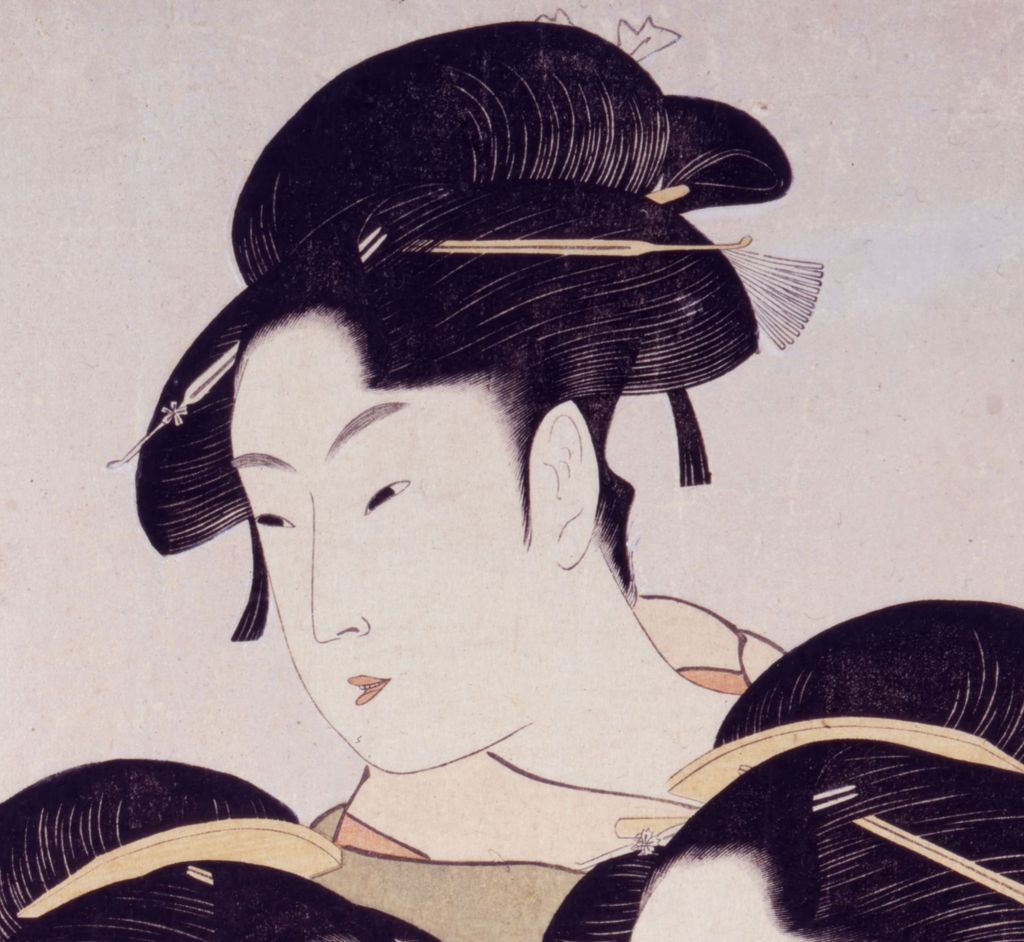
Upper figure: Tomimoto Toyohina
The primrose emblem and upper position identify Toyohina in Chiba’s account.
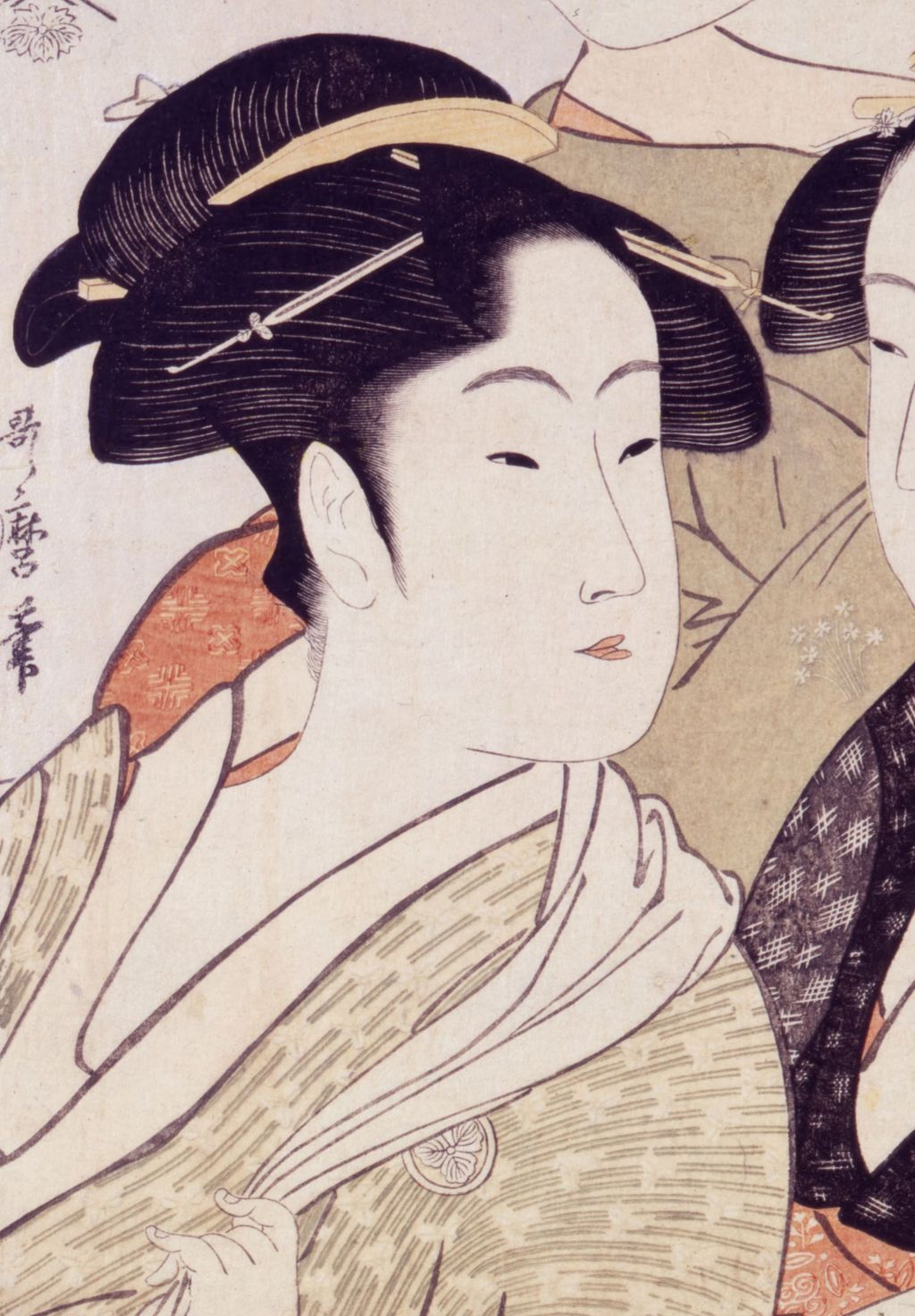
Lower left: Takashima Ohisa
Her three-oak sign and pale sleeve mark the lower-left position.
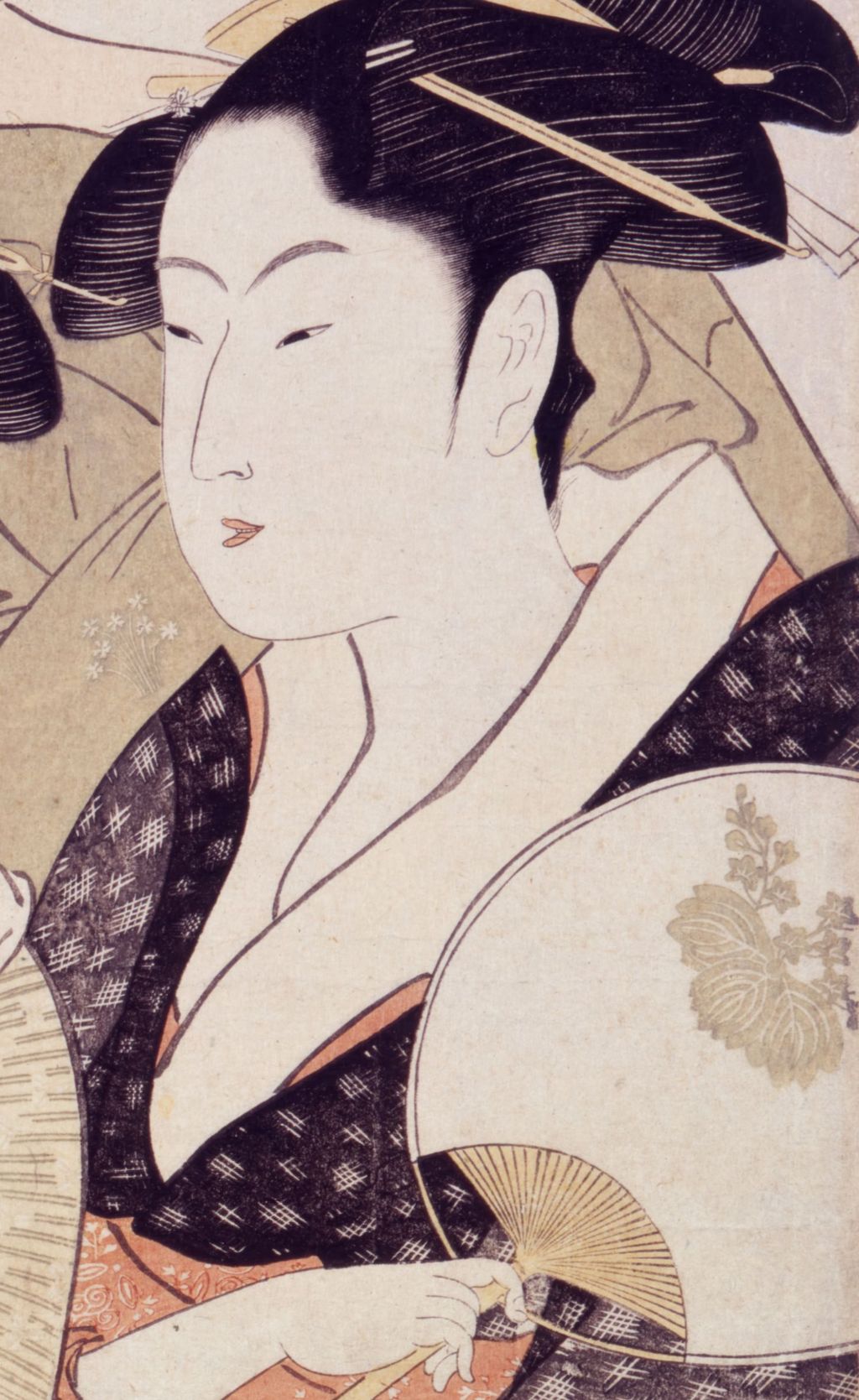
Lower right: Naniwaya Okita
Look for the paulownia on her fan, which balances the darker dress.
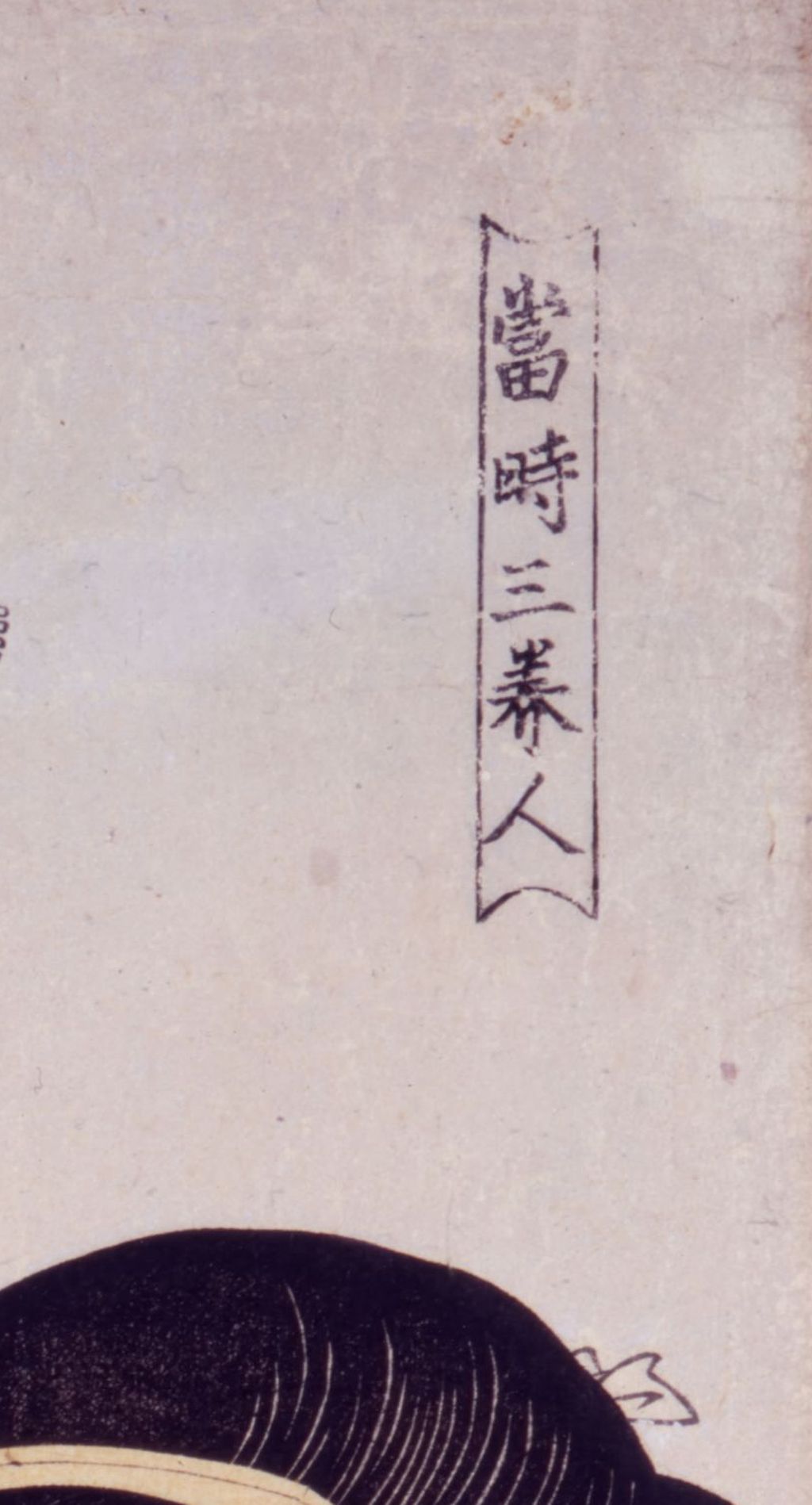
Title inscription at upper right
The owner image has a vertical title. Its physical impression remains unidentified.
Three names, three positions
Chiba's description is unusually helpful because it does more than apply a general English label to the whole print. It points to the identifying signs within the composition. The upper woman's primrose emblem belongs to Toyohina; the fan at lower right bears Okita's paulownia sign; and the three-oak motif identifies Ohisa at lower left. Those details are more dependable for this design than an attempt to infer character from faces that share Utamaro's idealised portrait language. The crests, printed names and relative positions work together. If one is lost in a later impression, the others may still lead back to the sitters, but the evidence is different.
Tomimoto Toyohina was not simply a generic “beauty of Edo.” The Ōta Memorial Museum's Utamaro collection note [5] places her among the famed women portrayed by the artist and identifies her as a Yoshiwara geisha skilled in Tomimoto music. Chiba adds that she belonged to the Tamamuraya establishment. Her name joins an artistic or performance identity to a recognisable print figure. A Met print titled The Lady Tomimoto Toyohina Reading a Letter [6], dated 1790, provides a separate portrait in which the name is printed. The two pictures are evidence of a recurring named sitter in Utamaro's work; they are not two views of one photographic face or proof of a particular private biography.
Naniwaya Okita's identity was tied to a particular place and kind of work. Chiba locates her at a water teahouse beside Asakusa's gate. The Met's Okita of the Naniwa-ya Teahouse [7] describes her carefully carrying a celadon cup on a black lacquer stand in a separate print around 1793. It explains that such teahouses hired young women who could draw customers and identifies Okita as a celebrated attendant. This object adds an occupational cue absent from the tightly cropped trio. It is tempting to imagine that the fan in Three Beauties and the tea service in the single portrait reveal Okita's personality. More securely, they show different design choices by which a public audience could recognise her.
Takashima Ohisa is the third member of Chiba's print, at lower left. Chiba ties her to a confectionery seller in the Yagenbori or Yonezawa-chō part of Ryōgoku. The British Museum's separate Ohisa portrait [8] calls her the daughter of a rice-cake shop owner; that designation should not be inflated into a precise business history without further records. In the trio, the three-oak emblem provides an identifying sign. A later Met sheet, Takashima Ohisa Using Two Mirrors to Observe Her Coiffure [9], dated around 1795, shows how Utamaro could make a named woman the centre of a quite different action. A fan, two mirrors and a crest are not interchangeable clues: each belongs to its specific print.
A triangle of glances and hands
The placement of the three heads gives the design its architectural force. Toyohina's tall hairstyle forms the upper point. Ohisa and Okita make the lower span, with Ohisa looking across to the right and Okita tilting left. Utamaro leaves a narrow opening between their faces, then joins them through sleeves, fan and hand. The viewer moves from the top face down one diagonal and up the other, noticing how the three figures almost touch without merging. The format converts individual portraits into one social arrangement.
The faces are close in general proportions: long ovals, small mouths, fine brows. Yet the direction of each head and eye is different. Calling the women “identical” misses what the composition does, while calling the print a modern psychological portrait asks it to reveal what it cannot. The Toledo Museum of Art's object record [4] describes a large-format version with mica dust and names Tsutaya as publisher. A glittering background can set off the faces and hair, although the presence and condition of mica must be judged on a given sheet, not assumed from a digital image of another impression. The faces were meant to work with material effects and a publisher's print-market choices, not only with Utamaro's drawn outlines.
Ohisa's robe and gesture create a broad pale field at lower left. Okita's darker dress and round fan balance it on the right. Toyohina's sleeve runs behind them, a visual connection that does not require a depicted room. The apparent simplicity is achieved through careful overlaps. At the edges, the artist's signature and publisher marks remind us that the print is a made and sold object. Our annotated image draws attention to the three positions, the identifying emblems and the title area, using crops from the retained high-resolution owner file. Those details can be enlarged without pretending that an enlarged digital reproduction reveals the exact original pigments or paper.
What the print says: title, names and signs
The Japanese phrase 当時三美人 may be rendered “Three Beauties of the Present Day” or “Three Beauties of the Time.” 当時 matters. It makes the print's claim immediate: these women were presented as beauties known in the artist's own present. Chiba's full object title adds the three names, 富本豊ひな 難波屋きた 高しまひさ. The spelling in catalogues can vary, including 豊雛 for Toyohina and おきた or おひさ in other records. We retain an institution's spelling when discussing its object and use consistent romanised names in the explanatory text. The written words are evidence, not a decorative afterthought.
Chiba says that after a 1793 prohibition on writing names of women other than courtesans in colour prints, a second edition was made with 当時 and the women's names removed, leaving simply 三美人. This is a specific statement about that design's publishing history. It establishes that the loss of names could be a deliberate revision associated with a rule, not merely the result of a cropped museum photograph. It does not by itself identify every surviving name-free sheet as that exact second edition. A change of cartouche, a recut block, a later impression from altered blocks and an independent copy can all require different evidence. This page therefore distinguishes Chiba's account from observations about other museums' actual files.
The owner-supplied image used here has the three figures and a vertical title at the upper right. The lettering resembles 当時三美人 when enlarged, but the physical print from which this file was made is unknown. Some name inscriptions reported by Chiba are not obvious in the supplied reproduction. That absence is not a reason to call it Chiba's later edition: the file might represent a different version, crop or reproduction. The retained 2732 × 4000 pixel, 300dpi source gives us an excellent base for visual details, but increased pixel count cannot supply its missing provenance.
Three collections, a shared composition and open questions
Compare two identified impressions
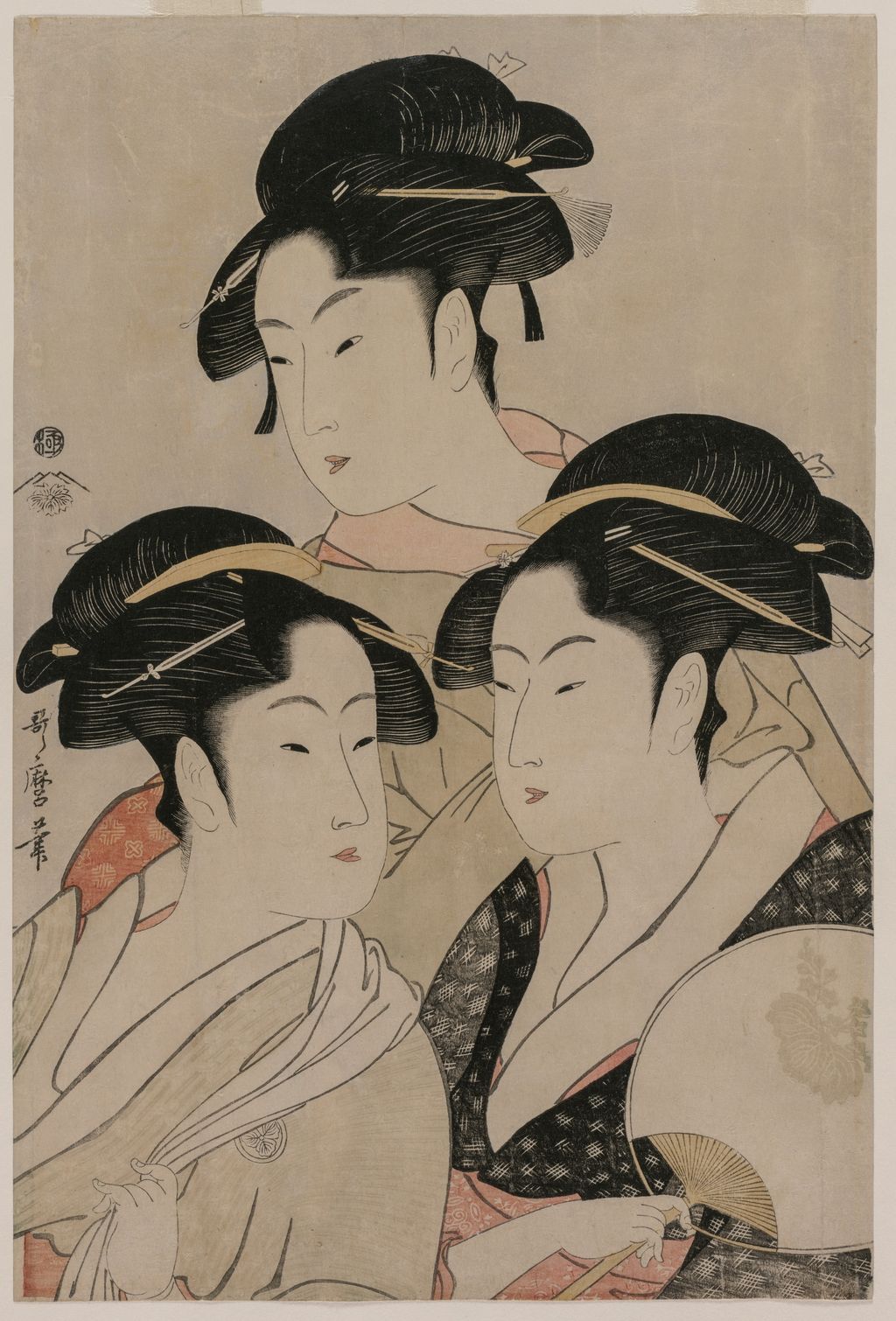
The Met image carries 三婦艶; the same upper-right area in Cleveland’s open image has no comparable title. The figures match, but a precise relationship to Chiba’s documented second edition remains unverified.
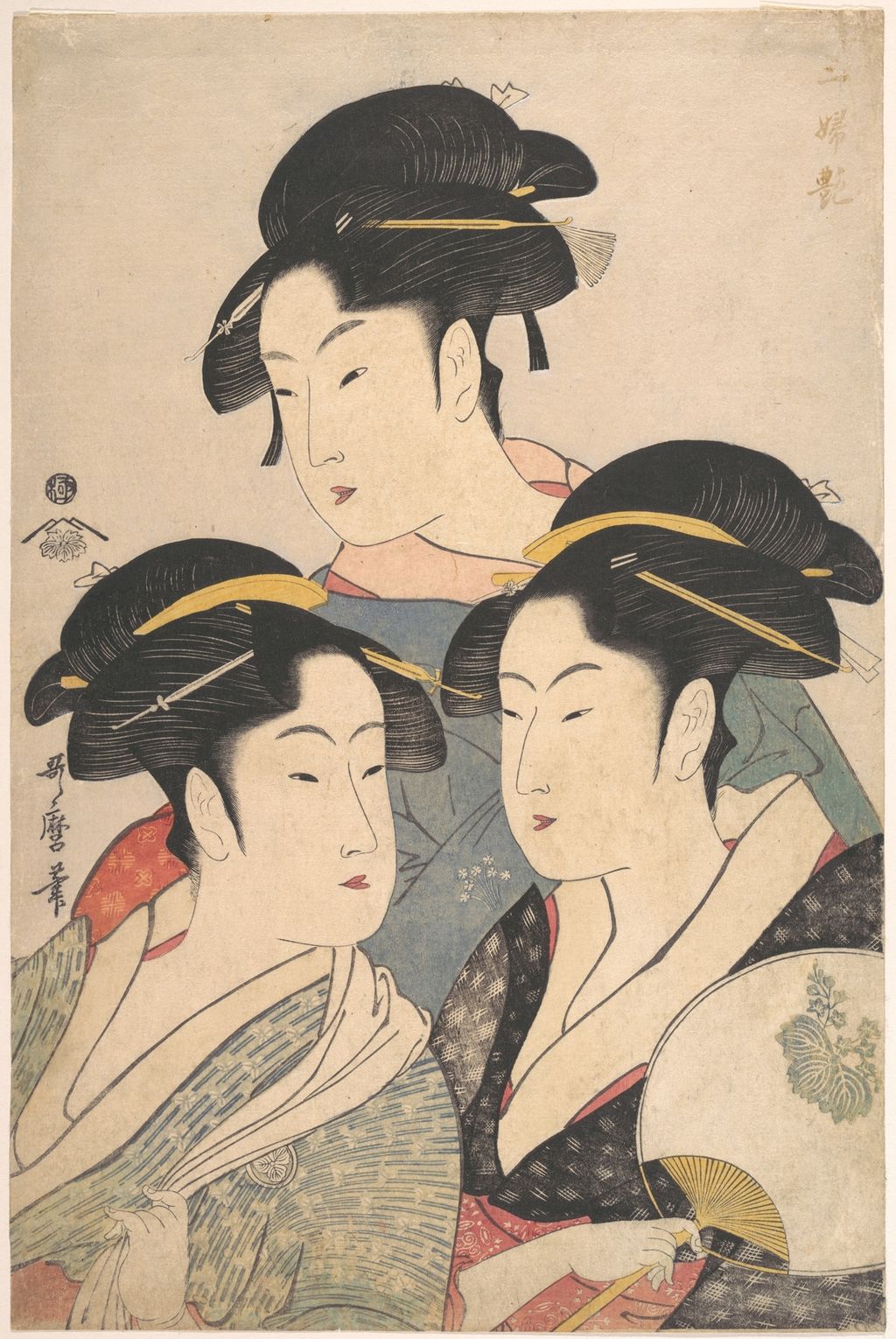
The Metropolitan Museum of Art's JP1528 [2] is catalogued as Three Beauties of the Kwansei Period and records the Japanese inscription 三婦艶. Its date is around 1791 and its sheet measures 38.7 × 25.7 cm. Side-by-side viewing with the owner image shows the same arrangement of Toyohina above, Ohisa at left and Okita with the fan at right. This is a meaningful visual match of composition, even though the title cartouche is different. The Met's date and Japanese inscription should be quoted as its catalogue data. They do not prove that JP1528 preceded Chiba's 1793 sheet or that one title was changed into the other in a particular sequence.
The Cleveland Museum of Art's impression, 1916.1158 [3], shows the same three figures but no title cartouche in the position occupied by the owner and Met titles. Its record gives around 1794 and a sheet size of 37.5 × 25.4 cm; the museum makes its image available as CC0. In that file, identifying emblems remain useful even as the names are not prominent. It is a valuable visual comparison with the lettered images. We do not call it Chiba's specific “second edition” because Cleveland's record does not establish that state relationship. A scholarly comparison of blocks, paper, inscriptions and margins would be needed.
Size complicates a simple three-step chronology. Chiba's named sheet is an aiban print of 32.0 × 21.6 cm. Its commentary notes a larger, mica-printed version of the same subject and suggests the smaller format may have been a less expensive issue. Toledo's sheet, measuring 38.7 × 26.2 cm, is catalogued around 1793 as a colour print with mica dust and Tsutaya as publisher. The Met and Cleveland sheets are also close to large-format dimensions, yet their labels and dates differ. A small Chiba sheet is not automatically a reduced photograph of the same large sheet; print format belongs to the physical publication history. Conversely, an English caption that calls all of them “Three Beauties” cannot erase an actual difference in lettering.
The most honest diagram is thus a set of observed features, not an invented family tree: Chiba documents a named 1793 aiban object and reports a later edition; the owner image preserves a title but lacks identified provenance; the Met has 三婦艶; Cleveland's open file has no comparable title cartouche; Toledo records a larger mica sheet. Shared figures support a relationship among these images at the level of composition. The exact order, publisher blocks and state identities remain an object-level research question.
Famous women and the print market
What would an Edo purchaser have recognised? For a viewer who knew the three women's names, businesses or performance roles, the picture could work as a public image of living celebrities. A crest could act as a visual shorthand even when an inscription was absent. For someone outside those circles, the triangle of faces, elegant hair and textiles could make the sheet desirable without personal knowledge of any sitter. This is an inference from the print's identifiable signs and composition, not a surviving testimony from a particular buyer. The National Diet Library's exhibition on Tsutaya Jūzaburō [10] helps place Utamaro's portraits within a publisher's commercial world, while Toledo identifies Tsutaya on one particular large-format object.
The named sitters should not be flattened into one social category. Toyohina's work as a geisha in the Yoshiwara, Okita's teahouse employment and Ohisa's association with a shop made their public reputations different. Nor did a portrait make the women autonomous authors of the print. Utamaro designed, a publisher issued, and block cutters and printers materialised a sheet for sale. The print projected their names and signs to strangers. It cannot tell us whether any sitter approved a particular publication, how she experienced that fame or what she thought of her own likeness. Treating those unanswered questions as questions respects the limits of an alluring object.
The fact that Chiba records a revision after rules about women's printed names shows that identity had value and risk for the publisher. Removing names changes what a purchaser could verify immediately on the sheet, even when hairstyles and poses remain. Modern catalogues can restore identities through comparison, but the physical difference between a named and an unnamed object remains. The question is less whether we can supply a name today than how the image worked under the conditions in which each version circulated.
Why “the Kansei three beauties” needs a qualifier
The expression “Kansei three beauties” is frequently treated as a fixed list of three women. It is safer to distinguish a print's depicted trio from every historical use of a phrase. Chiba's catalogue establishes Toyohina, Okita and Ohisa for its sheet. The Edo-Tokyo Museum library's reference answer [11] and the National Diet Library's collaborative reference record [12] show that accounts of celebrated women of the period did not always use the same roster. Kikimoto Ohan can appear where a casual modern explanation would expect Toyohina. That variation does not overturn the identification in Chiba's object; it warns against turning an object caption into a universal definition of an era's celebrity culture.
Native titles also deserve more care than a single English phrase invites. The Tokyo National Museum's Tsutaya exhibition list [13] records an 江戸三美人 print around 1793–94 and a separately listed 高名三美人 around 1793. Those catalogue entries are useful evidence that related subjects circulated under more than one wording. They do not, without their object images and full records, prove that each item is a state of Chiba's 当時三美人. The safest editorial practice is to quote the Japanese title, cite the holding institution and compare the people and printed words before joining records. This matters for anyone searching in English: “Three Famous Beauties,” “Three Beauties of Edo” and “Three Beauties of the Kansei Period” can refer to differently catalogued objects.
The craft behind a repeatable image
It is easy to look at a high-quality digital file and imagine a single stable original. Colour woodblock printing worked through a reproducible set of blocks and skilled decisions about paper, registration, pigment and finish. The key lines provide the drawing's structure; different blocks or applications supply coloured areas. A special background effect such as mica could change the way a surface caught light in a room, an effect flattened by a screen and changed again by museum photography. A new title or omitted name could require a change to printing material, while the figures stayed recognisable. These are general consequences of the medium; determining exactly which blocks were changed for a particular surviving sheet calls for direct print study.
Consider what our three whole-sheet images can and cannot show. The owner image and the Met file agree in the positions of the faces and clothing, but the upper-right inscriptions differ. The Cleveland file retains the figures without a comparable cartouche. Different colour in the garments may be visible, yet colour alone cannot isolate a state because a sheet can fade, be photographed under different light or undergo a later reproduction process. Even the apparent precision of a line in a JPEG depends on image resolution and sharpening. Our comparison therefore begins with high-confidence observable features—figures and text—and stops before the file becomes evidence for a block lineage it cannot establish.
The British Museum and Chiba City Museum of Art's 1995 exhibition catalogue, The Passionate Art of Kitagawa Utamaro [15], is an appropriate route for deeper print-by-print scholarship. The catalogue's documented existence and institutions justify recommending it; this article does not claim to have read a specific page or to reproduce an unpublished state diagram from it. The bibliographic record for Julie Nelson Davis's Utamaro and the Spectacle of Beauty [14] likewise identifies a substantial study of portraiture and the market, without making its contents a substitute for the museum records cited here. Printed scholarship and online object records have different roles: one can frame a broad argument, while the other ties an image to an accession and current description.
Portraits beside the trio
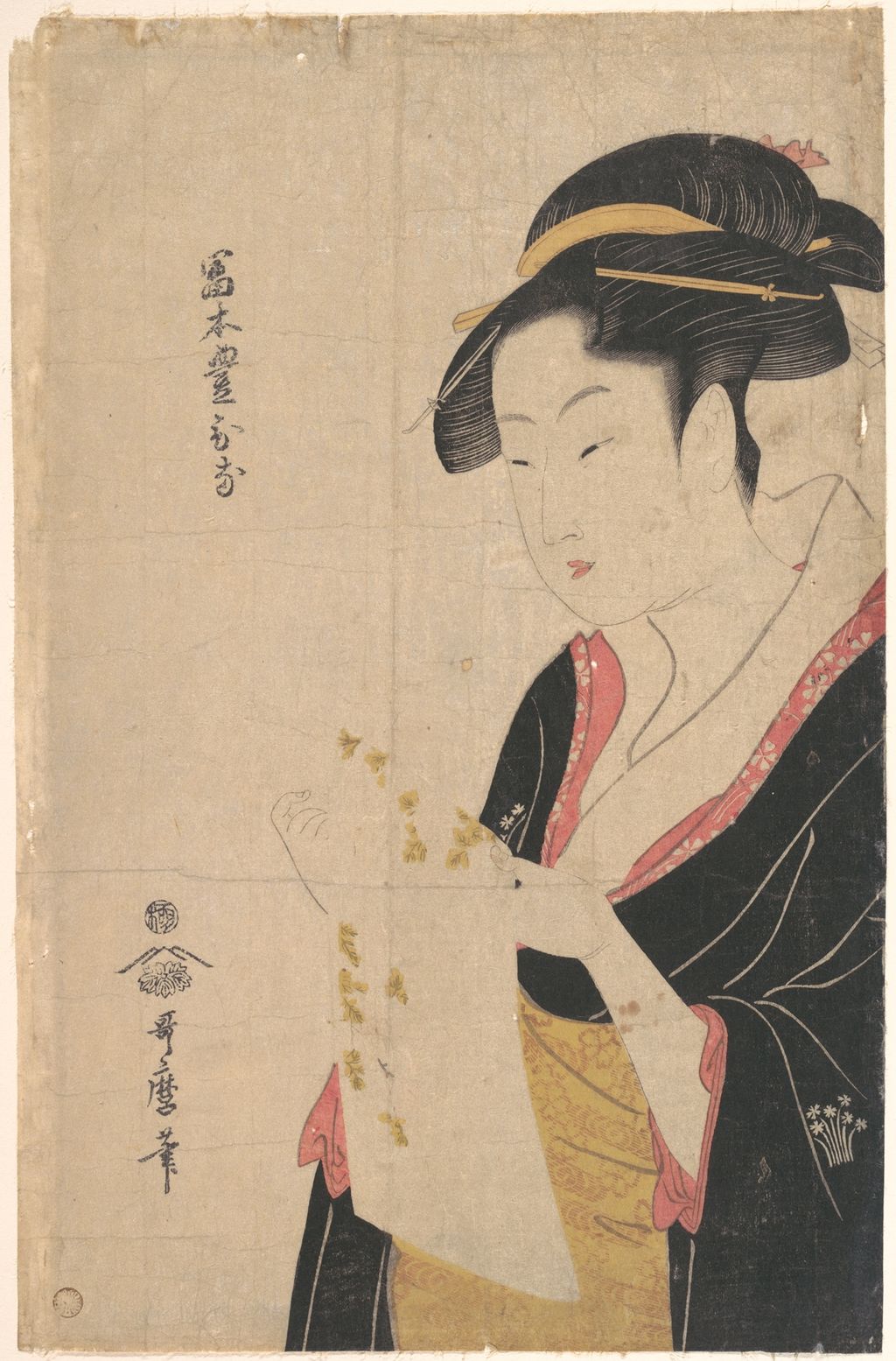
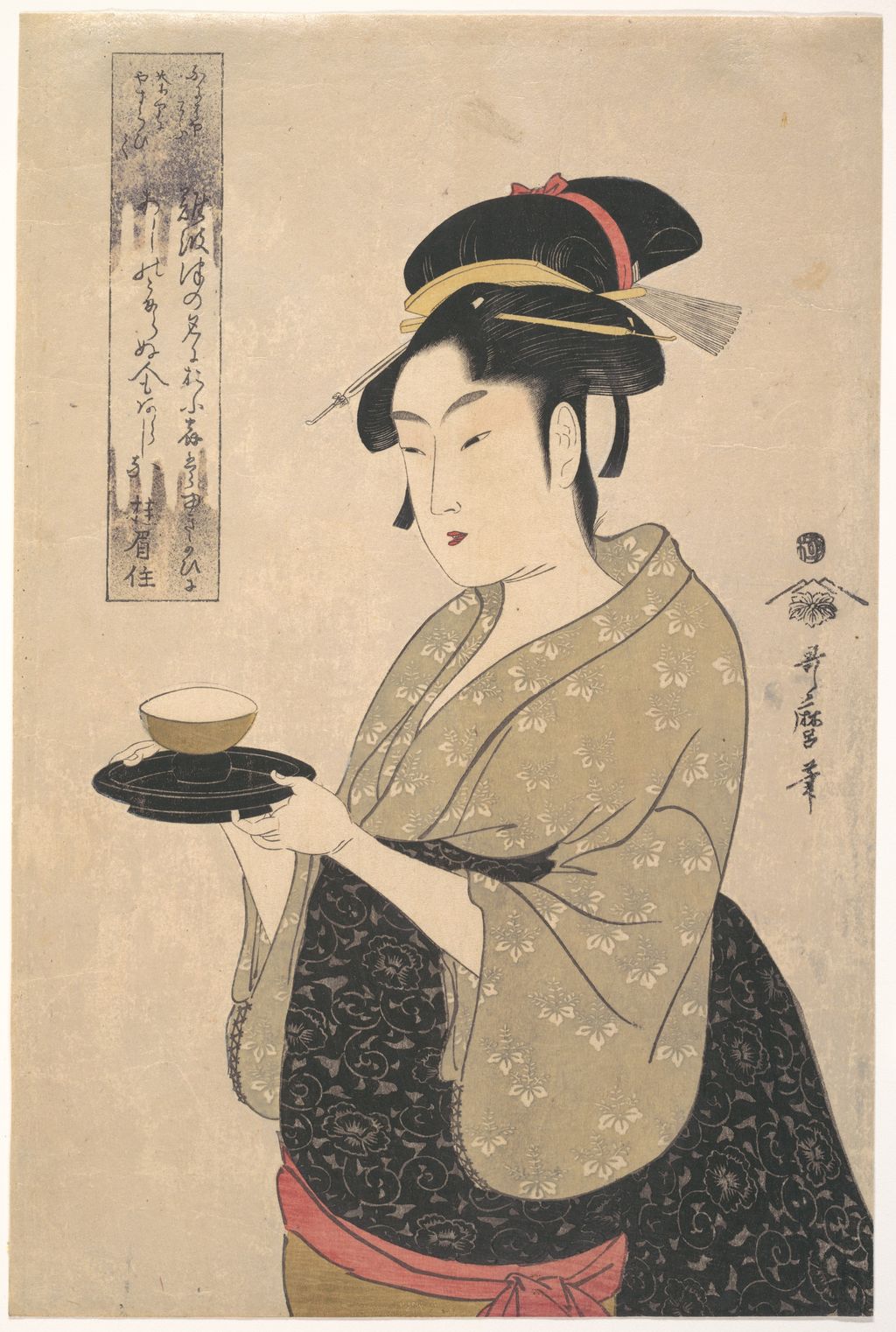
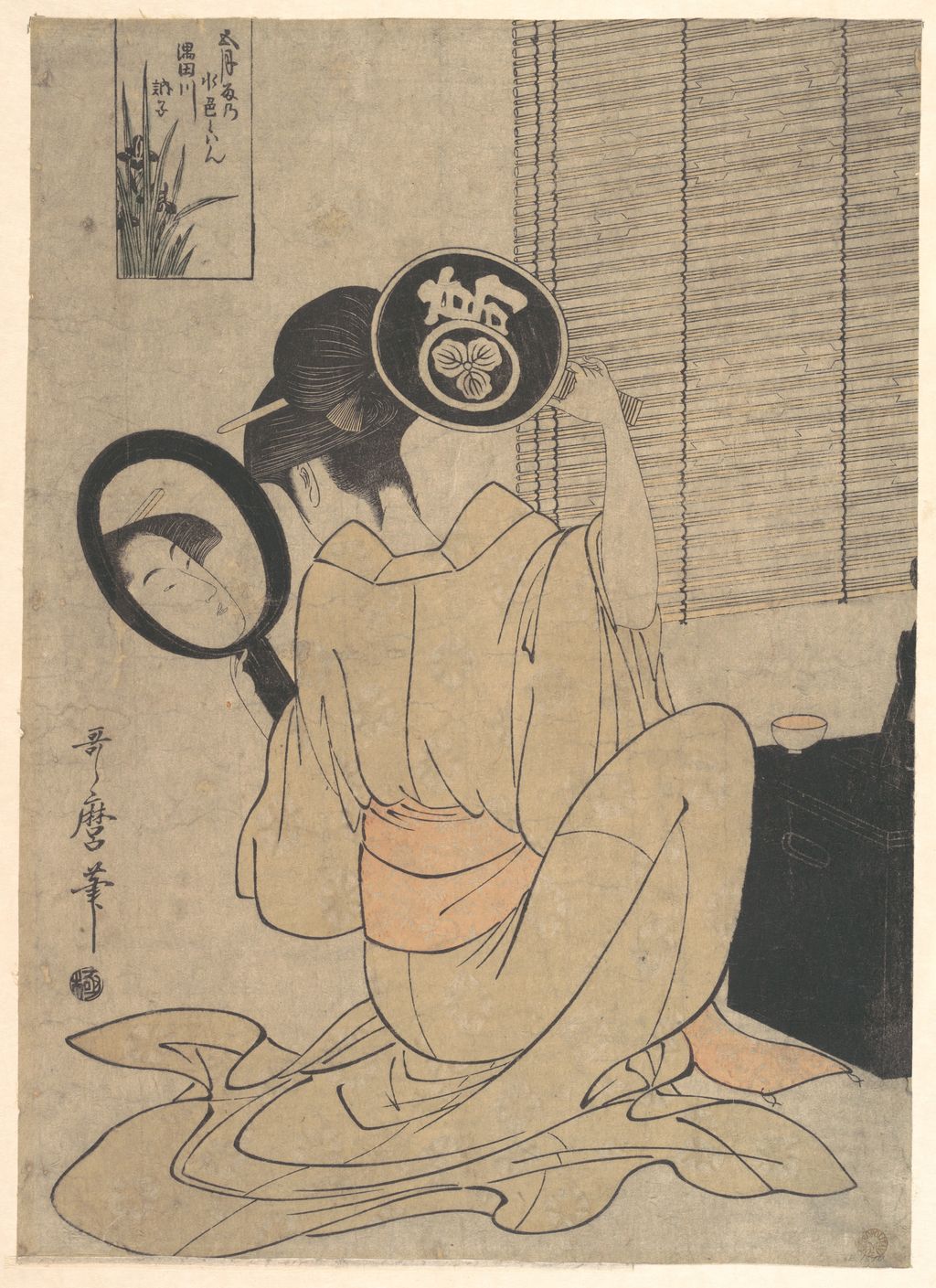
The three single-sitter images shown here are not parts cut from the trio. They are separate Met objects, each with its own number and date. Toyohina reading a letter, JP1392, is dated 1790. Okita serving a cup, JP1668, is dated around 1793. Ohisa with two mirrors, JP145, is dated around 1795. Placing them beside the group print shows Utamaro repeatedly finding different ways to make a recognisable figure visible. The comparison does not imply that the three were drawn on the same day or that each face was transcribed from life.
Toyohina's letter turns the spectator towards a partly hidden act of reading. Okita's cup and tray bring the labour of a teahouse into view even as the Met describes her presentation as an admired ideal. Ohisa's pair of mirrors allows a design about looking at oneself to become a picture looked at by others. Those actions are absent from the trio. There, the three women are known principally through their collective arrangement, signs and names. The single portraits shift the frame from a ranked, triangular public grouping to a distinct gesture and prop. This difference gives the accompanying images a purpose beyond decoration.
The Met's descriptions also show how cautiously we should use the word “likeness.” Utamaro made the sitters legible through names, attributes, fashions and subtle differences, within a shared visual language of ideal beauty. A viewer cannot verify whether an eye or nose corresponds to a biological person. We can identify the subject of a print when the object record and inscriptions support it; we need not claim photographic individuality to appreciate the design. Similarly, seeing mica on one recorded sheet cannot prove the texture of an owner-supplied reproduction. Historical explanation begins with what a particular object carries.
Why dates and titles differ
Museum dates for Japanese prints often express considered estimates. Chiba's 1793 may refer to its name-bearing sheet; the Met's “ca. 1791” is the Met's judgement for JP1528; Cleveland's “c. 1794” belongs to 1916.1158. Those three numbers do not themselves provide a documented release schedule. A design may be issued, reissued, altered or copied; a museum may date an impression or its likely design. A comparative catalogue raisonné can test paper, pigments, key lines and censorship marks. This article reports the recorded dates without making the apparent order into a proven story of cause and effect.
The same restraint applies to titles. “Three Beauties of the Present Day” is a useful English title for the 当時三美人 record. “Three Beauties of the Kwansei Period” is the Met's chosen English title for JP1528, with 三婦艶 in its inscription field. Cleveland names the three sitters in its catalogue title. Toledo uses the familiar English title. These names support discovery but are not all literal transcriptions of text printed on the sheets. When two English museum pages share “Three Beauties,” consult the Japanese wording and the photograph before asserting that they describe identical states. When two photographs share a composition, consult their inscriptions and object records before asserting that they came from identical blocks.
How the images on this page were chosen
The main image was supplied by the site owner as public-domain material and retained at its original 300dpi resolution for the detail study. The site JPEG is 1024 pixels wide, saved at quality 80 with 144dpi metadata; the three enlarged details were made from that source, rather than the smaller web JPEG. Its original uncropped file remains in the image ledger. No institutional credit is attached to it because it has no identified museum source and the owner has asked that supplied images appear without a credit line.
The Met's JP1528 and three single-sitter objects are separately identified, public-domain, open-access files. Cleveland's 1916.1158 carries a CC0 statement. Those institutional images receive visible object links and numbers. The Chiba and Toledo records support the research and comparison, but their museum photographs are not republished here without an explicit production-image reuse decision. This may look like an unusually careful distinction for a familiar picture. It is what lets a reader tell a documented object from a visually similar version and keeps the annotated details honest.
The annotated view highlights Toyohina above, Ohisa at lower left, Okita's fan at lower right and the title inscription at upper right. It is an aid to looking, not a claim that our file represents the print's first issue. The comparison panel then returns to whole sheets from the Met and Cleveland. Looking back and forth between local detail and institution-linked image is a better way to learn this work than memorising a single uncertain “definitive” date or repeating a caption stripped of its accession number.
Frequently asked questions
In Chiba's named 1793 object, they are Tomimoto Toyohina above, Takashima Ohisa lower left and Naniwaya Okita lower right. The crests and names reported by the museum support that identification for this composition.
The Met's JP1528 shows the same arrangement of figures as the owner-supplied Present Day image, but carries 三婦艶 and an earlier catalogue date. It is a separate physical object. A precise edition or block-state relationship to Chiba 2943024 has not been established here.
Its published image shows the shared figures without an upper-right title cartouche. Chiba documents a later edition without 当時 and the women's names, but Cleveland's record does not identify its sheet as that specific edition. The visual resemblance is a lead for further print scholarship.
No. The museum records distinguish a Yoshiwara geisha, a teahouse attendant and a shopkeeper's daughter. They were known in different settings and should not be given one occupational label.
References
- Chiba City Museum of Art,
当時三美人 富本豊ひな 難波屋きた 高しまひさ, collection 2943024. - Metropolitan Museum of Art, Three Beauties of the Kwansei Period, JP1528.
- Cleveland Museum of Art, Tomimoto Toyohina, Takashimaya Ohisa, and Naniwaya Okita, 1916.1158.
- Toledo Museum of Art, Three Beauties of the Present Day, 1951.290.
- Ōta Memorial Museum of Art, Utamaro collection notes.
- Metropolitan Museum of Art, The Lady Tomimoto Toyohina Reading a Letter, JP1392.
- Metropolitan Museum of Art, Okita of the Naniwa-ya Teahouse, JP1668.
- British Museum, Utamaro portrait of Takashima Ohisa, 1927,0613,0.6.
- Metropolitan Museum of Art, Takashima Ohisa Using Two Mirrors to Observe Her Coiffure, JP145.
- National Diet Library, Tsutaya Jūzaburō exhibition.
- Edo-Tokyo Museum library, reference on the Kansei three beauties.
- National Diet Library, collaborative reference on the Kansei three beauties.
- Tokyo National Museum, Tsutaya Jūzaburō exhibition object list (Japanese PDF).
- Julie Nelson Davis, Utamaro and the Spectacle of Beauty, Smithsonian Libraries bibliographic record.
- British Museum and Chiba City Museum of Art's 1995 exhibition catalogue, The Passionate Art of Kitagawa Utamaro
