


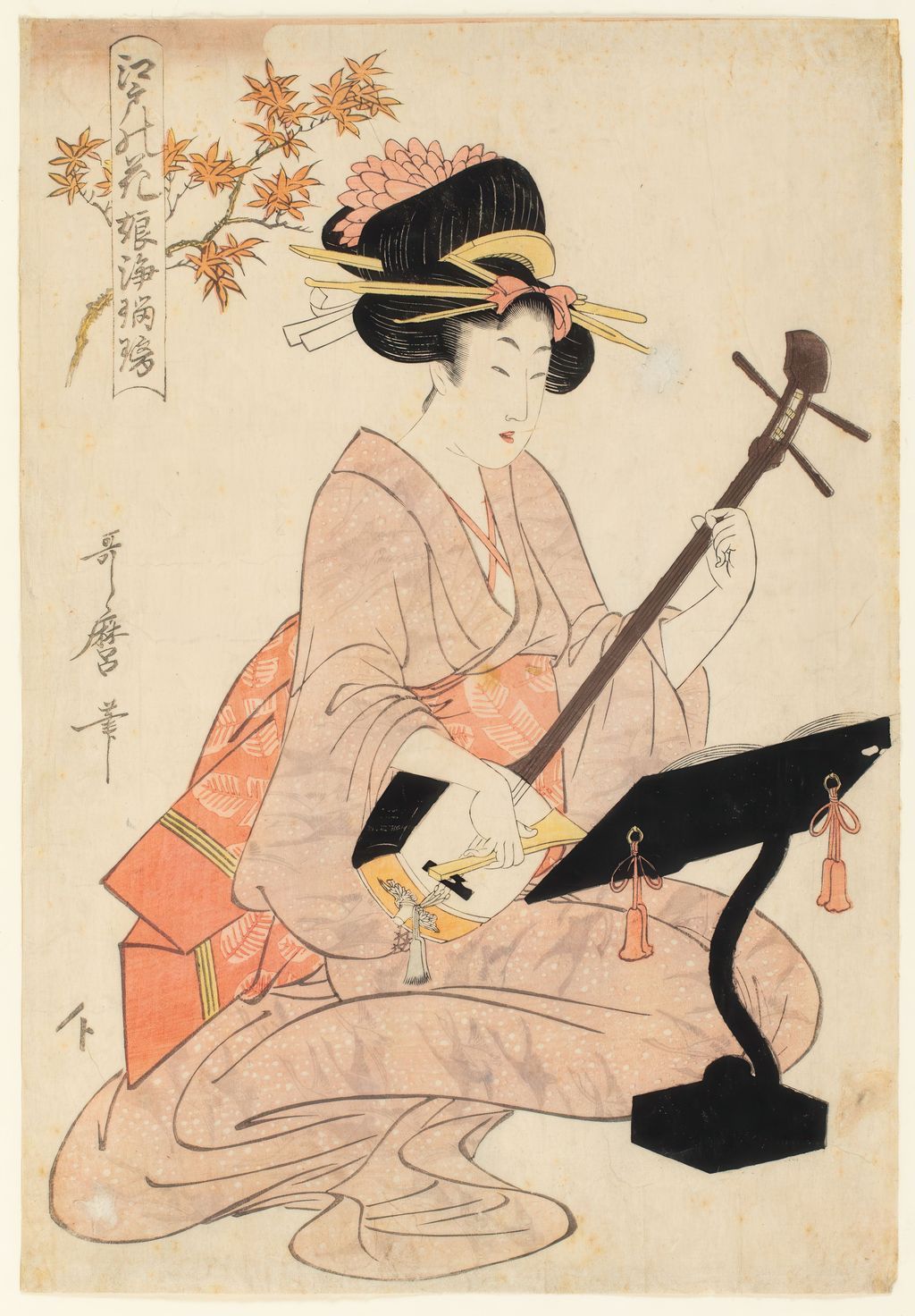
 by Tom Gurney
Tom Gurney BSc (Hons) is an art history expert with over 20 years experience. Updated September 24, 2026.
Utamaro’s life through dated objects
Kitagawa Utamaro (喜多川歌麿, circa 1753/54–1806) became one of Edo's most inventive makers of illustrated books and colour woodblock prints. His women looking into mirrors, adjusting hair, reading letters or sharing a moment with a child still feel immediate. Their apparent intimacy can be misleading as biographical evidence: a printed scene is a designed, published image, not a record of the artist's personal encounters. The more reliable story of his life comes from books with dates and contributors, surviving prints and paintings, publisher records, name forms, and the careful distinctions made by museums and libraries. The National Diet Library's artist authority [1], the Met's collaborative 1786 print [3] and the NDL's 1788 insect-book record [4] provide such anchors.
This biography follows his work through five broad periods: an incompletely documented youth and early print career; training and collaboration around Toriyama Sekien; poetry and nature books in the 1780s; large-head portraits and series in the 1790s; and continued production through the censorship dispute of 1804 and his death in 1806. A period label is only a way to organise evidence. Utamaro did not stop making one kind of art the day he began another. The record is also uneven: a famous print may be well catalogued while a year of his life remains silent. Each section therefore separates a securely dated object from an inference about what the artist may have been doing around it.
Contents
- Utamaro’s life through dated objects
- Utamaro’s journey in context
- Early life: what is known and what is missing
- Toriyama Sekien and a documented artistic network
- The 1780s: books, nature and kyōka
- Around 1791–93: the close portrait and a wider audience
- Series, daily time and later 1790s production
- Legendary families and ordinary gestures
- The two censorship episodes, 1791 and 1804
- Final work, painting and death in 1806
- Chronology, edition and the possibility of change
- How the biography changes the way we see the work
- What readers can verify
- Selected works and series
At a glance
- BirthAround 1753 or 1754. Place and exact date uncertain. NDL [1] standardises 1753–1806 as an authority form; the Dayton Art Institute [2] notes birthplace uncertainty.
- Early name
豊章(Toyōaki / Toyoaki in different romanisations) appears in the NDL name authority [1]. Dating every name change needs more than an authority heading. - TeacherToriyama Sekien. The Met's 1786 surimono [3] records a joint work and identifies Utamaro as his pupil.
- Major publisherTsutaya Jūzaburō published major books and portraits. Other publishers also issued Utamaro work, including Moriya Jihei on a British Museum 1803–04 print [21].
- Main mediaIllustrated books, colour woodblock prints and paintings. Physical impressions and later reprints must be distinguished.
- Legal episodePunished in 1804 over historical print subjects linked to the Ehon Taikōki ban; not the same as Tsutaya and Santō Kyōden's 1791 punishment.
- Death1806. A British Museum painting [24] is dated about 1805–06, showing continued late activity.
Utamaro’s journey in context
Ukiyo-e publishing during Utamaro’s career
Working context, circa 1775–1806; not movement datesFull-colour print production
From the 1765 technical milestone through Utamaro’s lifetimeKano-trained Sekien’s shared artistic circle
Utamaro’s early network; approximate contextToriyama Sekien — teacher
1712–1788; 1786 collaboration documentedTorii Kiyonaga — contemporary
1752–1815; visual comparison, no claimed collaborationKitagawa Utamaro
circa 1753/54–1806; birth uncertainChōbunsai Eishi — contemporary
1756–1829; separately credited in a shared bookThree-artist collaborative print
1786; Met 2022.312Picture Book of Crawling Creatures
1788; NDL WA32-8Gifts of the Ebb Tide
probably 1789; Met 2013.897Three Beauties of the Present Day
1793 Chiba impressionTwelve Hours of the Yoshiwara
circa 1794–95; different museum impressionsStanding Courtesan Reading a Letter
circa 1805–06; British Museum paintingEarly life: what is known and what is missing
The most honest sentence about Utamaro's beginnings is that an exact birth story is not established. The National Diet Library's standardised dates are useful for identifying the artist among records; they do not make his birthday a documented event. Museum artist summaries often place the birth around 1753 or 1754. The Dayton Art Institute [2] explicitly describes the birthplace as uncertain. Claims that he was born in a specific household, married a named woman or had a child should remain outside a public biography until checked against a primary or well-supported specialist source. The absence of such claims is an editorial decision shaped by the evidence, not a judgment that his private life was unimportant.
The NDL authority record [1] lists 豊章 among his earlier name forms. This helps explain why an early print can appear under a name other than the later, famous 歌麿. It does not, by itself, specify the day or year when he changed his name. The Dayton artist record [2] discusses early book-cover work around 1775 as well as actor prints and book illustration. “Early” is more defensible here than “first”: surviving objects and catalogue attributions can change, and a dated surviving work is not automatically the first design an artist made. The early printing world was a training ground in page composition and the requirements of publication, even when the underlying life story is thin.
An artist's later fame can distort this first period. It is tempting to write that Utamaro began as a modest illustrator waiting to discover the large-head portrait. Yet the evidence points to a career in several formats from an early stage, and the illustrated books of the 1780s are major works in their own right. Actor images, literary publications and privately commissioned verse prints addressed overlapping but different audiences. A coloured single sheet bought from a print seller had different constraints from a book commissioned around poetry. An account that measures every early experiment only by its distance from a 1790s portrait tells readers too little about why these objects were made.
Toriyama Sekien and a documented artistic network
Toriyama Sekien (1712–1788) is the strongest named teacher in the surviving evidence. The Metropolitan Museum's 1786 surimono [3] gives a rare chance to see relationships embodied in one object. Sekien contributed a painted screen, Utamaro the figures, and Toriyama Sekichūjo the cherry branches. The museum identifies both younger artists as pupils. Sekichūjo's role should not be swallowed into a generic phrase such as “Sekien's studio”: she is a separately named maker on this impression. Nor should her Toriyama school name be treated as proof of a family relationship without a separate document.
The print demonstrates collaboration at a particular date. It does not show exactly when instruction began, how often the artists met, or that every later motif was inherited from Sekien. Surimono, often made for a restricted circle and linked to poetry, also differ from mass-market colour sheets. The 1786 object suggests that Utamaro worked within networks of art and verse before the better-known beauty prints. Its split credit is a useful reminder that even an image with one famous name can have multiple hands and intentions. Later publisher, poet and printer relationships are best mapped in the same way: by a documented role on a specific book or sheet, not by an arrow labelled “influenced.”
Sekien's later written connection to Utamaro's insect book appears in the Met's Songs of the Garden publication [5], while the NDL's catalogue of a 1788 copy [4] notes a variant arrangement that places Sekien's postscript at the beginning. This is a subtle bibliographic point. Different surviving editions can rearrange the surrounding text, so a photograph of one opening cannot stand for every historical copy. As biographical evidence, the text establishes an artistic connection and later esteem; it does not tell us an intimate story of their daily life.
The 1780s: books, nature and kyōka
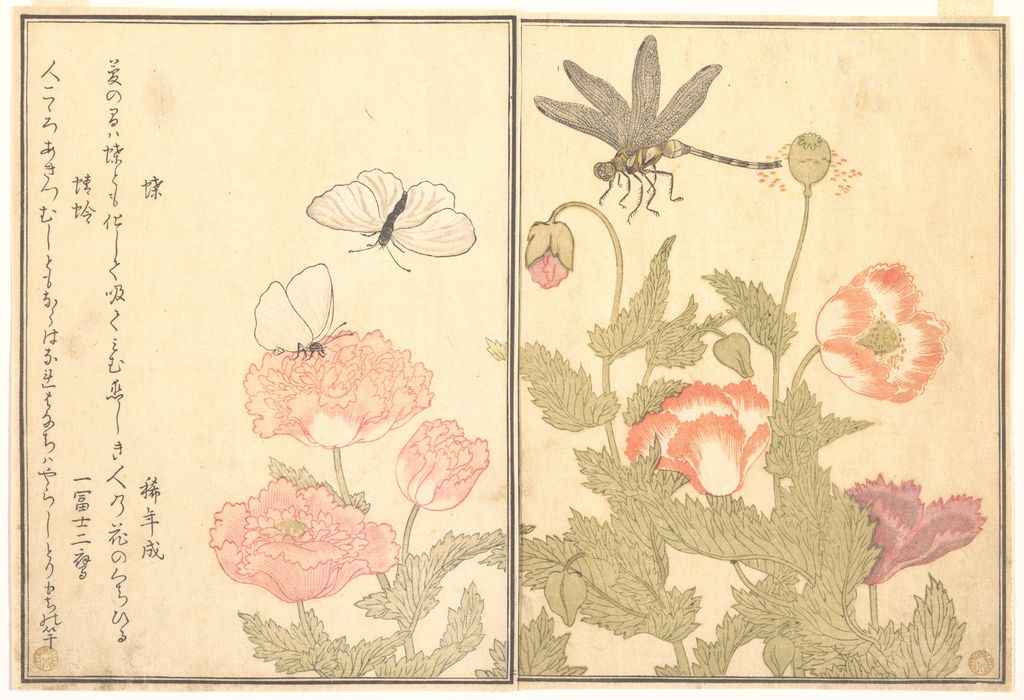
The 1788 publication of Picture Book of Crawling Creatures (Ehon mushi erami, 画本虫撰) is one of the strongest dated landmarks in Utamaro's career. The NDL record for WA32-8 [4] names Tsutaya Jūzaburō as publisher and describes fifteen designs, each pairing two creatures and two poems. Yadoya no Meshimori selected the verse and wrote the preface, as the Met's publication [5] explains. The original two volumes were built around facing-page designs. The artist's achievement includes close observation, but the point of the book is not the construction of a scientific specimen collection. Image, comic verse, paper and turning sequence work together.
One Met leaf showing a butterfly and dragonfly [6] can be admired alone for its movement and line. Another leaf showing a land snail and giant katydid [7] has a different visual pace. Both are also pages of a publication. The relation between creature and poem is part of the object, even when a digital gallery initially shows an isolated image. The Met's Songs of the Garden [5] reproduces the fifteen designs from a first-edition museum copy and includes translations of the poems. That makes it a valuable scholarly companion, though its modern page ordering should not be mistaken for an untouched eighteenth-century binding.
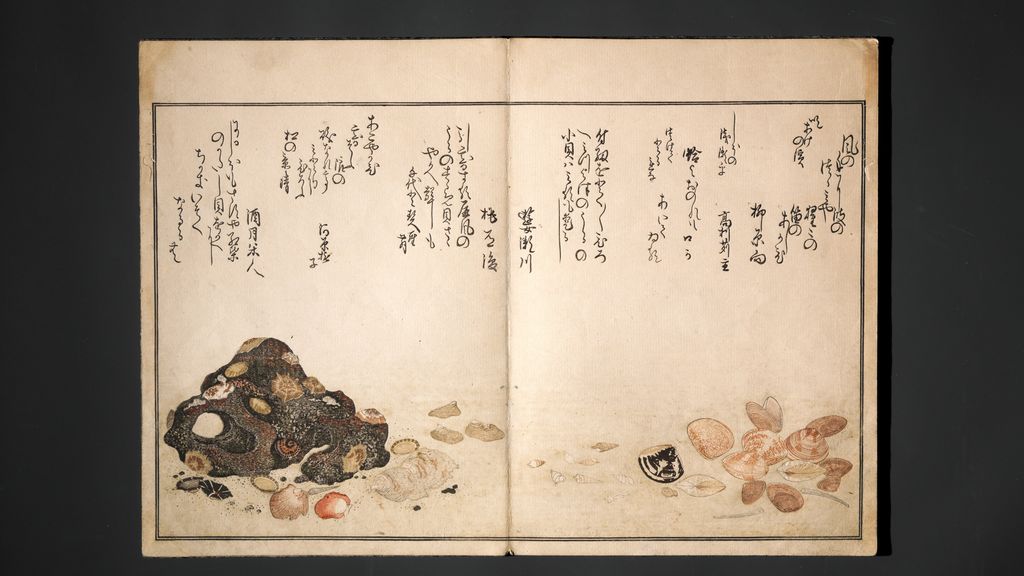
Two related poetry books broadened the subjects. Gifts of the Ebb Tide (Shiohi no tsuto, 潮干のつと) gathers shore creatures and shells. The Met's accordion-style object [8] is dated probably 1789 and records ink, colour, mica and gold leaf. Myriad Birds (Momo chidori kyōka-awase, 百千鳥狂歌合) addresses birds. The Tokyo National Museum's 2025 exhibition list [10] places displayed copies around 1790, while the Met's two-volume copy [9] is dated 1791. The difference should be kept visible as a copy and cataloguing issue until bibliographic research establishes exact edition relationships. The NDL's 2018 Kodansha book record [11] identifies a modern study and transcription of all three, but its publication date is obviously not the date of any original album.
These books also introduce Tsutaya's part in the biography. A publisher selected projects, bore financial risk, brought poets and image makers into a saleable object, commissioned block cutting and printing, and distributed the result. The NDL list of Tsutaya publications [12] situates Utamaro's books among guides, fiction, poetry and other publications. A book can document their association without proving that Utamaro lived in Tsutaya's household or that the publisher directed every artistic decision. Partnership matters; the familiar tale of a publisher “discovering” a fully formed genius says much less.
Around 1791–93: the close portrait and a wider audience
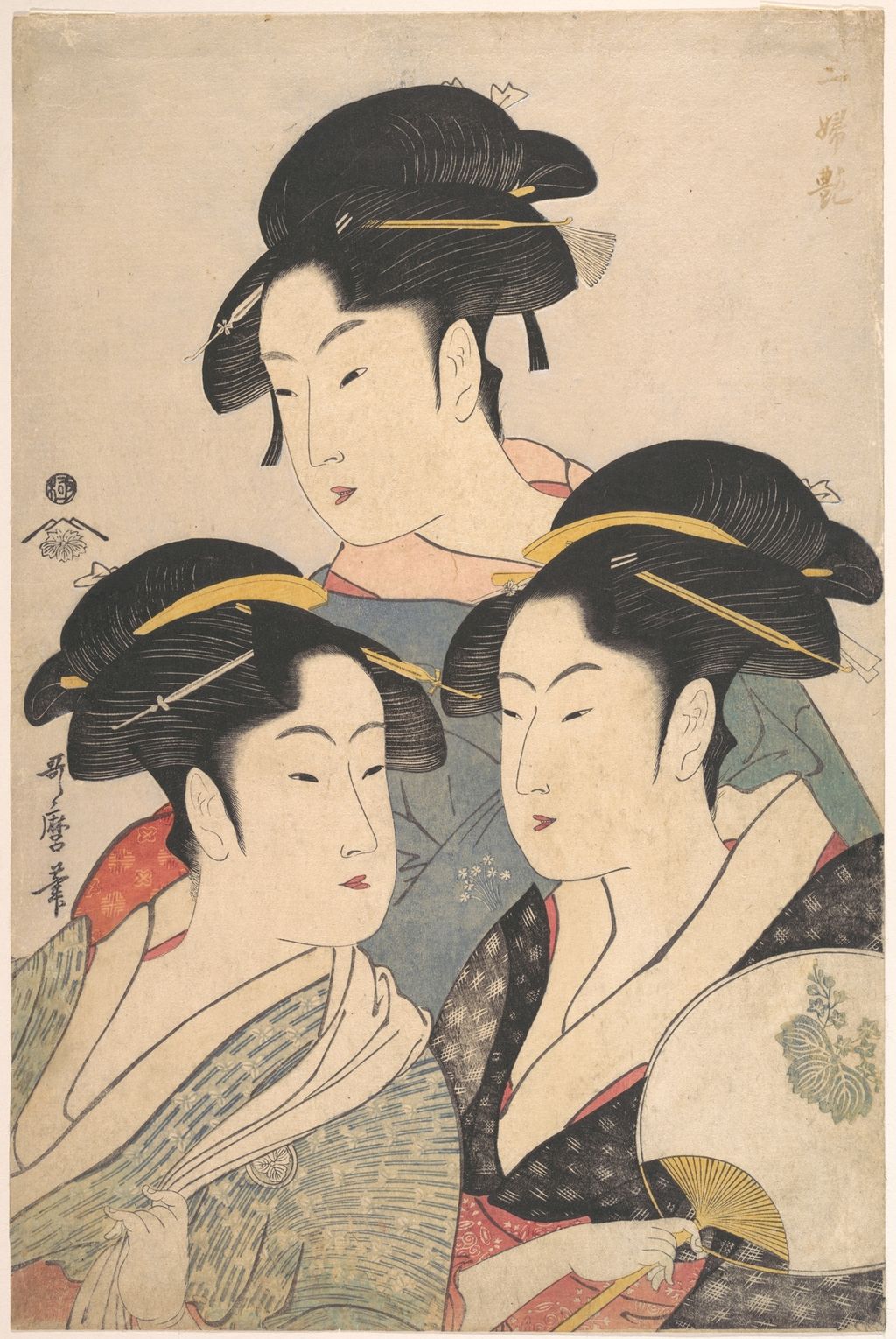
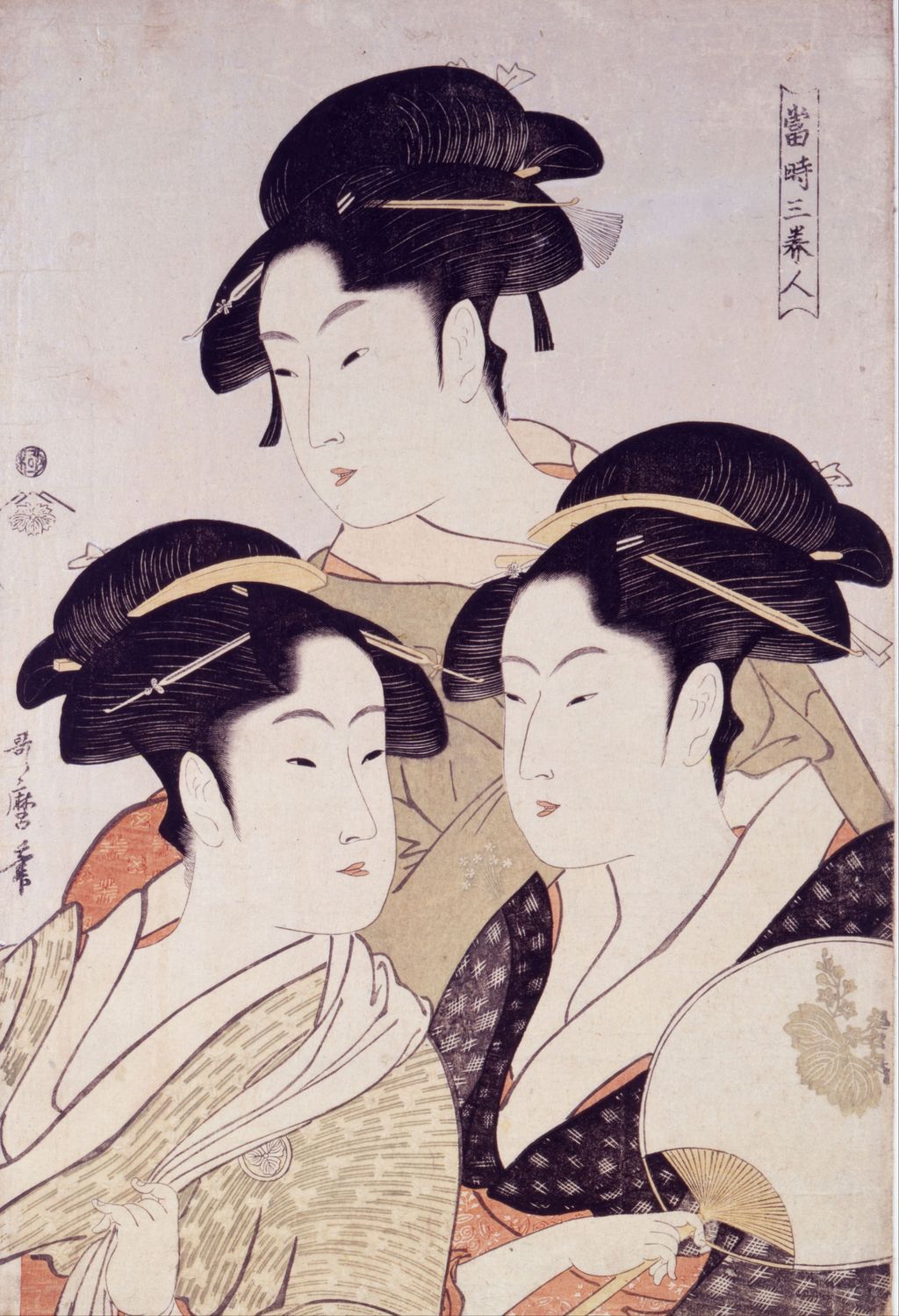
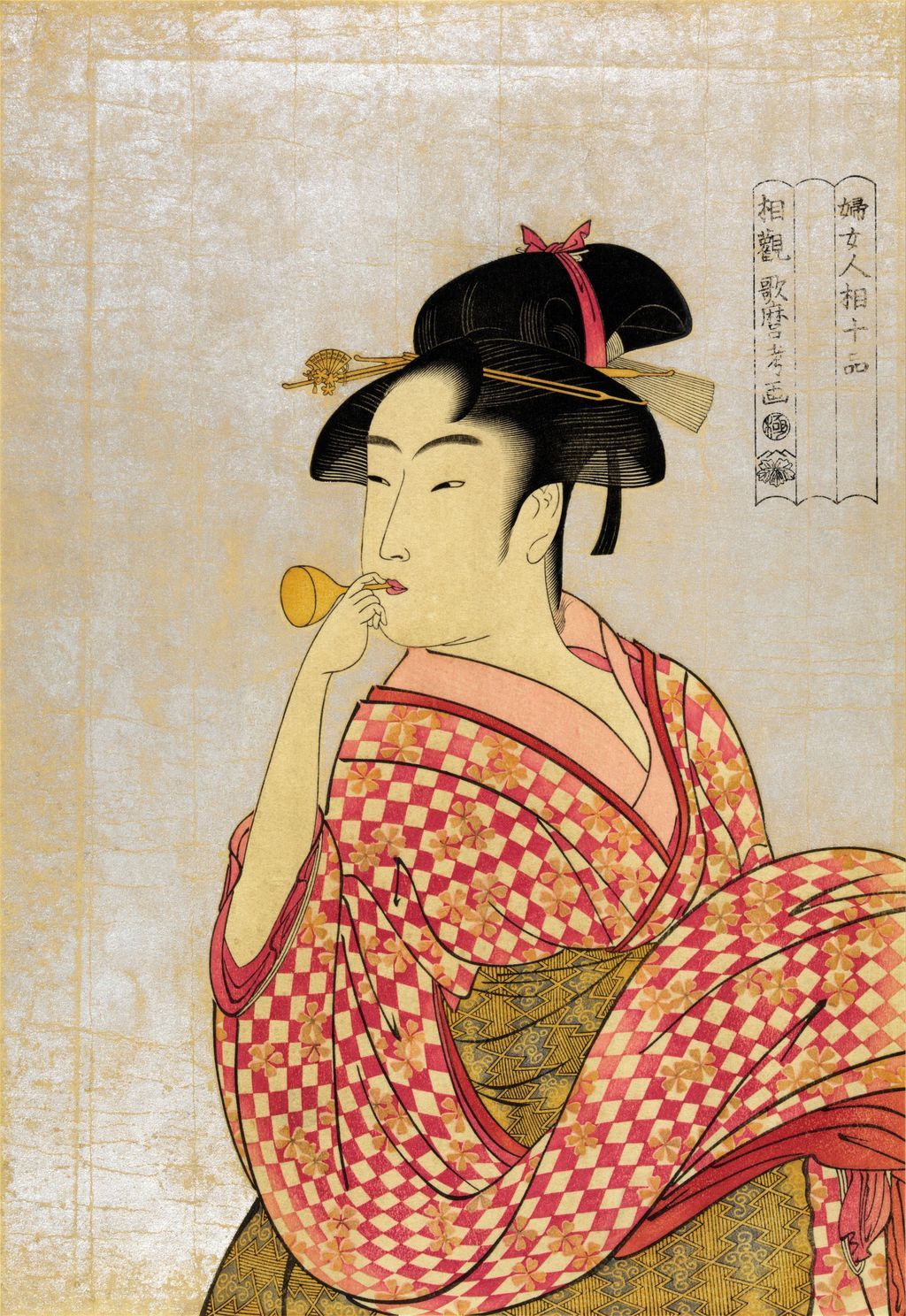
The change most visible to a modern viewer occurs around 1792, when Utamaro's portrait formats made a face and upper body fill more of the sheet. The Tokyo National Museum's Tsutaya chronology [13] places Ten Types in the Physiognomic Study of Women and a related series title in this period. The NDL's Tsutaya exhibition [14] explains how finely differentiated expressions and mica-backed surfaces made his half-length women striking beside the full-length prints familiar to the market. Neither source requires saying that he invented every close-up portrait. The more interesting change is what he did with scale, slight expression, hand position and printing finish within a competitive culture.
Physiognomy titles need careful handling. To group faces under “types” could invite an Edo viewer to test whether appearance disclosed temperament. For a present-day reader, the title is part of the published print, not a scientific finding about a historical person. A woman described as concealing or revealing love in a print title is a designed figure. We may read the gap between her glance and the title, but cannot confirm her private emotion. This distinction is especially important on a biography page: the sitter's imagined thoughts are not biographical facts about the artist either.
Named women became another focus. The Chiba City Museum's Three Beauties of the Present Day [15] dates its impression to 1793 and identifies Tomimoto Toyohina above, Naniwaya Okita lower right and Takashima Ohisa lower left. Chiba also reports a later state in which the names and “Present day” inscription were removed after a restriction on printing names of women other than courtesans. This is object-level evidence of changing public conditions for publishers and sitters. The Met's Three Beauties of the Kwansei Period [16] visibly shares the three-figure arrangement with the owner-supplied Present Day reproduction, but has a different Japanese inscription and catalogue date. The precise printing relationship to Chiba's sheet remains unverified.
The women had differing social positions. The British Museum's Takashima Ohisa portrait [17] calls her a rice-cake shop proprietor's daughter; Toyohina was a Yoshiwara geisha in Chiba's record [15]. Neither was simply the type “courtesan” used as a universal label for women in ukiyo-e. The famous prints participated in making particular people visible to buyers across Edo. Their public identity was part of the publisher's subject, while their private biographies can be recovered only where other evidence survives.
Series, daily time and later 1790s production
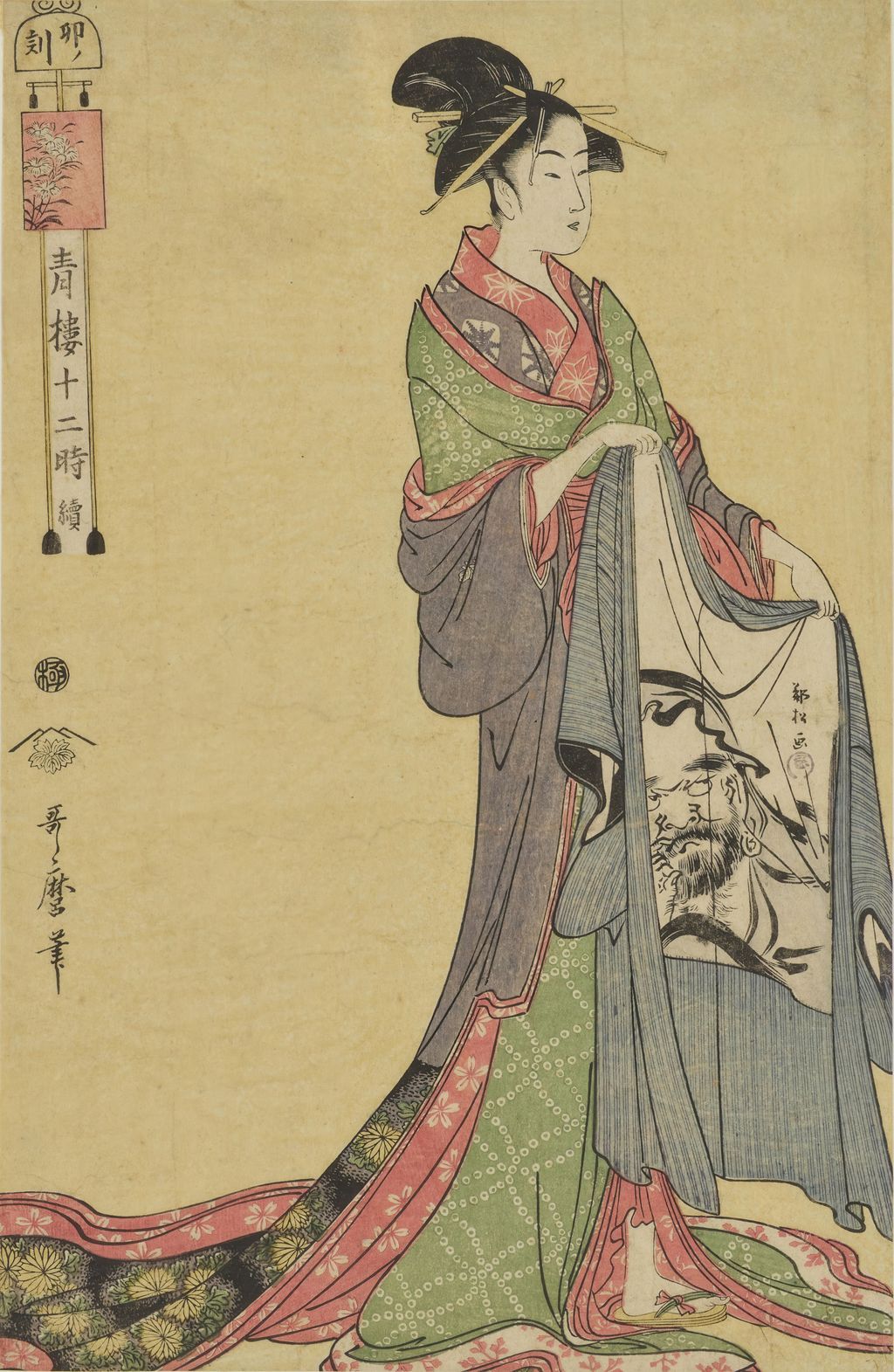
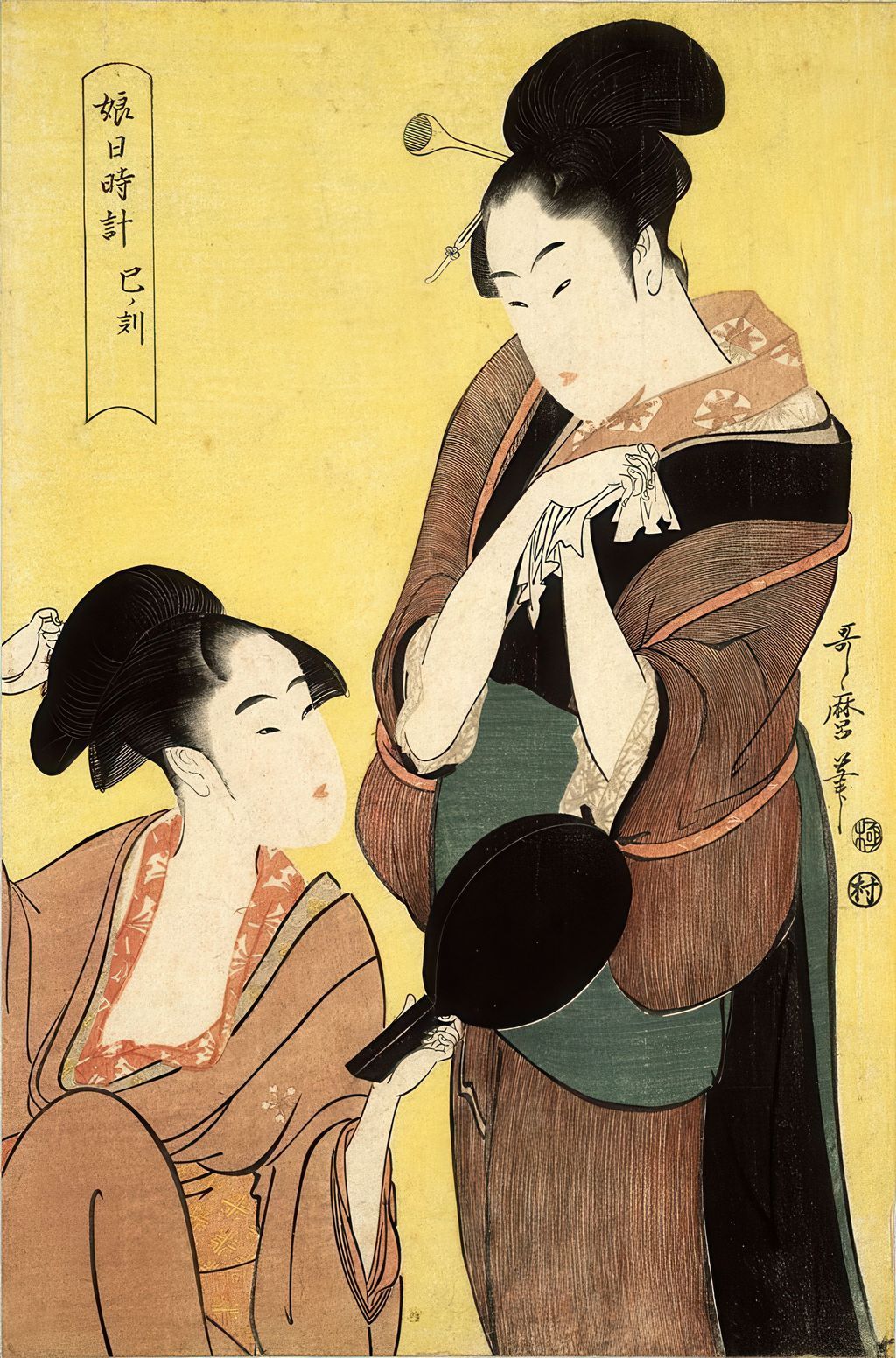
The middle 1790s saw a different kind of sustained project in Twelve Hours of the Yoshiwara (Seirō jūni toki tsuzuki, 青楼十二時 続). The Art Institute of Chicago holds twelve separately catalogued sheets [18] dated around 1794; the British Museum's Horse-hour impression [19] is dated around 1795. The British Museum describes the clock motif carrying the hour name and identifies a courtesan, teenage apprentice and young attendant around a letter and hairstyle in its particular sheet. That is a staged composition of social roles. It does not document the exact daily routine of a named household, even though the hour device makes it seem like a day observed.
As with a book, the series has a logic larger than one image. A viewer can move from one hour to another, recognise familiar props and compare the placement of figures. But each impression is an object with its own state and history. The AIC's adjacent accession numbers help establish a museum set; they do not prove the original sale order. A bracketed clock conversion in one catalogue should not be copied mechanically when it conflicts with customary zodiacal hours. The British Museum catalogues another Utamaro Rat-hour print [20] from a differently titled series. Its presence warns against assembling a supposed set from a search result containing any print with “hour” in the English title.
Tsutaya died in 1797, according to the NDL's publisher exhibition [14] and TNM's chronology [13]. His death was the loss of an important partner, but it did not end Utamaro's print career. The NDL describes increasing work with other publishers. A British Museum 1803–04 historical sheet [21] credits Moriya Jihei. The record is enough to demonstrate that “published by Tsutaya” is not a universal line for every Utamaro object, even when readers associate their names closely. It is not evidence for a psychological crisis after 1797.
Legendary families and ordinary gestures
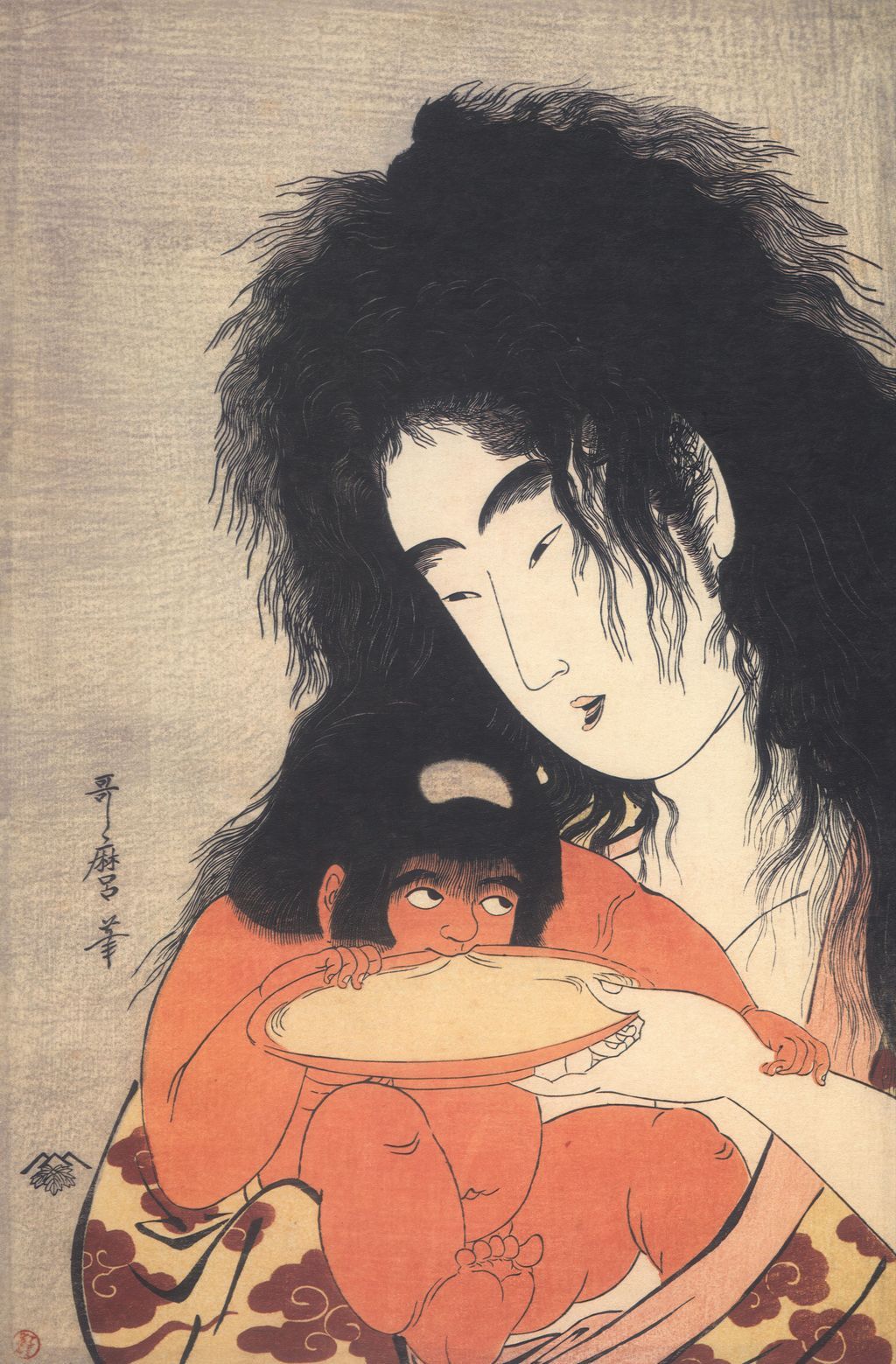
Utamaro's work around the middle 1790s included subjects that cannot be understood through the history of named women alone. The Met's Yamauba and Kintarō, JP980 [25], dated about 1795, depicts a mountain woman and the wild boy Kintarō. Its catalogue identifies him as her adoptive son in the story and notes that Utamaro represented the pair repeatedly. The museum's date situates one surviving impression, but it does not by itself date every Yamauba design. The subject comes from legend, while the physical closeness of the figures can feel as immediate as a domestic encounter. That tension is part of the art: a familiar narrative can be rebuilt around the way a child reaches, rests or looks.
This group adds nuance to a life often narrated as though every image of a woman were made for an adult admirer in the pleasure district. Utamaro's visual interest in hair, hands, cloth and attentive glances crossed subjects. A mother-and-child scene and a geisha portrait can use similar cropping, yet they address different stories and buyers. Where an owner-supplied reproduction shows a Yamauba design, it should not be assigned the Met's accession merely because the names match. An exact impression and state would require comparison of inscriptions, composition and print details. The biography can use the subject to show range while keeping that object-level limit visible.
It would be equally misleading to read the images backwards into the artist's own family life. No securely cited source in this packet identifies Utamaro's mother, partner or child through a particular Yamauba print. The motifs may offer viewers tenderness or humour, but those experiences are not evidence that the artist used a family member as a model. This is a recurring limit in writing about makers of apparently intimate images. The closer a print feels, the more important it becomes to distinguish an observable gesture from an invented biographical scene.
The two censorship episodes, 1791 and 1804
These dates are sometimes blurred in short biographies and must be kept apart. In 1791, the publisher Tsutaya Jūzaburō and the writer Santō Kyōden faced penalties associated with three sharebon books. The NDL's Tsutaya exhibition [14] reports Kyōden's fifty days in handcuffs and the loss of half Tsutaya's assets; the TNM publisher chronology [13] places the same event in the publisher's career. This was not a sentence served by Utamaro. The record belongs in his biography because it shaped the printing world and his major publisher's circumstances, not because the artist and publisher were legally identical.
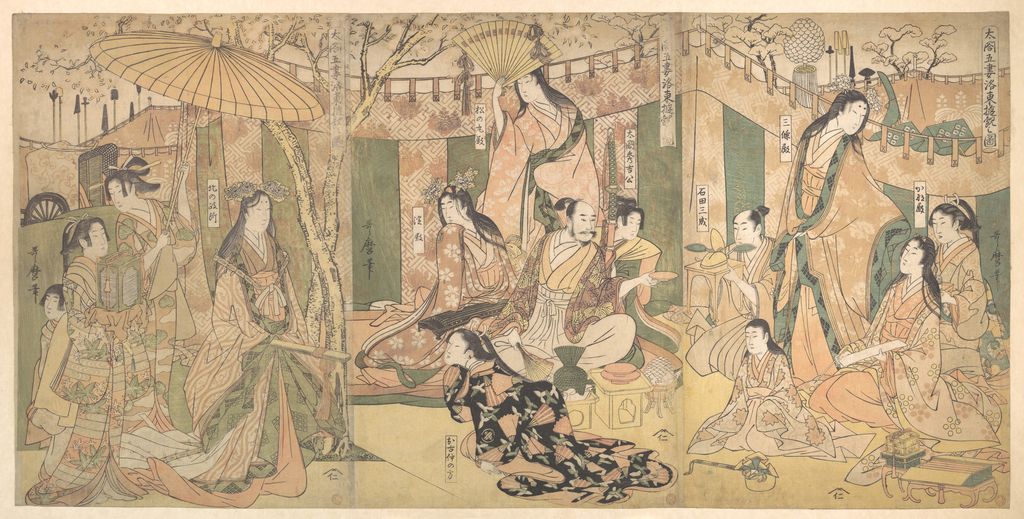
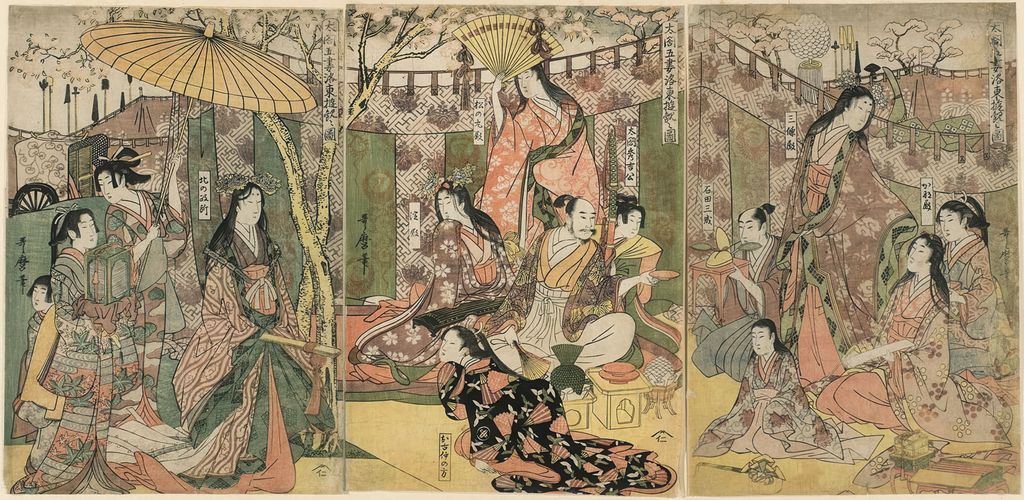
The separate Utamaro episode occurred in 1804 amid restrictions on depictions of historical figures associated with the banned Ehon Taikōki. Ōta Memorial Museum curator Akira Watanabe [22] describes Utamaro among artists penalised and records fifty days in handcuffs. The British Museum's study of Mashiba Hisayoshi [21] examines one surviving 1803–04 sheet and a later written account connecting a scene to punishment. It distinguishes that later account from the content of the illustrated biography itself. The sheet credits Moriya Jihei as publisher. The Met's Hideyoshi triptych [23] is another object linked to the broader subject. These sources support the year and penalty, but not a claim that one exact picture alone caused the entire action.
The history is more specific than a statement that Utamaro drew “the shogun.” Toyotomi Hideyoshi was a sixteenth-century ruler, and the prints used historical narratives, altered names and motifs within a publishing boom that authorities scrutinised. The British Museum's theatrical naming of Mashiba Hisayoshi and discussion of Ishida Mitsunari show why exact inscriptions matter. The Ōta explanation [22] also describes restrictions on representing and naming military leaders. A close account of what an object says and what a later report says is more reliable than a dramatic one-line myth about offence to a contemporary ruler.
The punishment did not erase Utamaro's remaining production. A sheet or painting catalogued in 1805–06 is material evidence of activity after 1804. It cannot tell us whether he suffered a particular illness, felt broken in spirit, or “declined” because of the penalty. Some older narratives turn a legal event into a cause of death or claim a death in the year after the punishment, although the accepted year is 1806. This page treats such stories as unsupported unless a named source and specific record establish them. The case is important enough without a manufactured psychological ending.
Final work, painting and death in 1806
The British Museum's Standing Courtesan Reading a Letter [24], dated about 1805–06, gives the final period a concrete object in another medium. A hanging painting asks the viewer to examine brushwork, hanging format and the figure's relation to blank ground. A colour woodblock print is translated through multiple blocks and impressions; a painting is worked on directly. Both can show Utamaro's sensitivity to a figure reading or absorbed in an action, but their material paths are different. The painting should not be treated as simply an enlarged version of a print.
The same museum record mentions a later historical account that publishers sought imitators as Utamaro became ill. That account is part of later writing about the artist, not direct clinical or personal evidence from his last days. It should be attributed if discussed and not used to assign a particular work by another artist to Utamaro I. He died in 1806, a date consistently present in library and museum records. The exact personal circumstances deserve the same caution as his beginnings. A biography can be substantial without turning undocumented birth and death scenes into a novelistic frame.
One part of the later story is especially consequential: a celebrated name can be reused, imitated or attached to copies. The art-historical task is to separate original design, a lifetime impression, a later state, a recut block, and an attribution to a different artist. A museum may catalogue a specific painting or print as Utamaro, Utamaro II, school of Utamaro or after Utamaro; those are different claims. The exact holder's record, material and provenance guide our captions. Owner-supplied public-domain reproductions may show a famous design beautifully, but they will not be given the accession number of a museum's physically different sheet merely for convenience.
Chronology, edition and the possibility of change
One reason Utamaro's biography is difficult is that a print's date can refer to several different events. A design might first be issued in one year and printed again later from the same blocks. A publisher might remove names or recut an inscription. A collector might bind loose sheets into an album decades after publication. A modern museum date can be an approximate judgement about the design or a specific impression. The Chiba museum's account of a later name-free state of Three Beauties [15] demonstrates how a small visual difference can carry a historical change in rules and marketing. The NDL's record of variant insect-book printings [4] shows a related issue in a book, where paratext can move and later editions exist.
This matters to any claim that Utamaro's style changed suddenly in a given year. A catalogue date for one sheet is not a camera timestamp on the moment of drawing, and a surviving late impression can preserve an earlier design. Several dated objects can make a credible sequence; one anomalous title or edition should not be made into a turning point. The chronology on this page uses approximate bands for that reason. It privileges secure publication years, named contributors and specific museum objects while leaving open the space where evidence has not survived. That makes it possible to see both continuity and change without staging every phase as a clean break.
How the biography changes the way we see the work
The chronology changes three habits of looking. First, the 1780s books belong near the centre of the career rather than as a prelude to the portraits. Their page openings, comic verse and material finish gave Utamaro room to experiment with scale and attention. Second, the 1790s portraits belonged to a public network of sitters and publishers. Named women were recognisable in a market, and edition changes show how that recognition could be restricted or altered. Third, the 1804 penalty should be read through actual prints and official research, not as a tidy explanation for everything afterwards. The painter of an 1805–06 hanging scroll was still working within the evidence that survives.
None of these points diminishes Utamaro's design. The opposite is true: they make the choices more legible. A mirror image can be read as an elegant solution to showing several views of an appearance; an insect spread can be read beside its poems; a twelve-hour sheet can be located within a series; a name removed from a second state can be recognised as a publishing decision with consequences for a sitter's public identity. A life is present through those documented acts of making and circulation, even where intimate biography is absent.
What readers can verify
Museum records may disagree on date because they hold different impressions or use approximate cataloguing. The AIC's Twelve Hours set [18] and the British Museum's Horse sheet [19] illustrate this. The Met's Myriad Birds copy [9] and the TNM's exhibition list [10] provide another example. A responsible chronology gives an approximate range and names the object behind it. It also lets a reader follow the linked source and see whether a catalogue statement refers to the design, a specific surviving copy, a later edition or a modern publication.
The objects used for images need a separate rights decision. The Met's object API records its insect-book leaves as public domain and supplies open-access files. A British Museum object page can be authoritative for biography without automatically granting commercial image reuse. Chiba's exceptionally useful commentary on Three Beauties does not by itself license downloading its photograph for production. This distinction protects the accuracy of the article as well as the site's image practice: the illustrated object can be tied to its own record rather than a similar-looking print from another institution.
Selected works and series
Twenty-two reviewed entries tied to museum objects or book records. The Twelve Hours parent series and its twelve sheets are related entries, not thirteen unrelated designs. This is not a count of all Utamaro works.
| Name | Date | Medium |
|---|---|---|
| Sekien, Sekichūjo and Utamaro collaborative surimono | 1786 | Privately commissioned woodblock print |
| Picture Book of Crawling Creatures (Ehon mushi erami) | 1788 | Illustrated woodblock book |
| Gifts of the Ebb Tide (Shiohi no tsuto) | probably 1789 | Illustrated woodblock book |
| Myriad Birds (Momo chidori kyōka-awase) | circa 1790–91; copies differ | Illustrated woodblock book |
| Three Beauties of the Present Day (Tōji san bijin) | 1793, Chiba impression | Colour woodblock print |
| Three Beauties of the Kwansei Period (Met JP1528) | circa 1791, Met catalogue | Colour woodblock print |
| Twelve Hours of the Yoshiwara (Seirō jūni toki tsuzuki) | circa 1794–95 | Colour woodblock print series |
| Twelve Hours of the Yoshiwara: Hour of the Rat | circa 1794, AIC catalogue | Colour woodblock print |
| Twelve Hours of the Yoshiwara: Hour of the Ox | circa 1794, AIC catalogue | Colour woodblock print |
| Twelve Hours of the Yoshiwara: Hour of the Tiger | circa 1794, AIC catalogue | Colour woodblock print |
| Twelve Hours of the Yoshiwara: Hour of the Hare | circa 1794, AIC catalogue | Colour woodblock print |
| Twelve Hours of the Yoshiwara: Hour of the Dragon | circa 1794, AIC catalogue | Colour woodblock print |
| Twelve Hours of the Yoshiwara: Hour of the Snake | circa 1794, AIC catalogue | Colour woodblock print |
| Twelve Hours of the Yoshiwara: Hour of the Horse | circa 1794, AIC catalogue | Colour woodblock print |
| Twelve Hours of the Yoshiwara: Hour of the Sheep | circa 1794, AIC catalogue | Colour woodblock print |
| Twelve Hours of the Yoshiwara: Hour of the Monkey | circa 1794, AIC catalogue | Colour woodblock print |
| Twelve Hours of the Yoshiwara: Hour of the Cock | circa 1794, AIC catalogue | Colour woodblock print |
| Twelve Hours of the Yoshiwara: Hour of the Dog | circa 1794, AIC catalogue | Colour woodblock print |
| Twelve Hours of the Yoshiwara: Hour of the Boar | circa 1794, AIC catalogue | Colour woodblock print |
| Yamauba and Kintarō | circa 1795, Met impression | Colour woodblock print |
| Mashiba Hisayoshi historical print | circa 1803–04, BM impression | Colour woodblock print |
| Standing Courtesan Reading a Letter | circa 1805–06, BM catalogue | Hanging-scroll painting |
View the institution records behind these entries
- Sekien, Sekichūjo and Utamaro collaborative surimono — Met 2022.312
- Picture Book of Crawling Creatures (Ehon mushi erami) — NDL WA32-8
- Gifts of the Ebb Tide (Shiohi no tsuto) — Met 2013.897
- Myriad Birds (Momo chidori kyōka-awase) — Met JIB43
- Three Beauties of the Present Day (Tōji san bijin) — Chiba 2943024
- Three Beauties of the Kwansei Period (Met JP1528) — Met JP1528
- Twelve Hours of the Yoshiwara (Seirō jūni toki tsuzuki) — BM 1935,1214,0.8; AIC twelve-object set
- Twelve Hours of the Yoshiwara: Hour of the Rat — AIC 1925.3062 (sheet within Twelve Hours)
- Twelve Hours of the Yoshiwara: Hour of the Ox — AIC 1925.3051 (sheet within Twelve Hours)
- Twelve Hours of the Yoshiwara: Hour of the Tiger — AIC 1925.3052 (sheet within Twelve Hours)
- Twelve Hours of the Yoshiwara: Hour of the Hare — AIC 1925.3053 (sheet within Twelve Hours)
- Twelve Hours of the Yoshiwara: Hour of the Dragon — AIC 1925.3054 (sheet within Twelve Hours)
- Twelve Hours of the Yoshiwara: Hour of the Snake — AIC 1925.3055 (sheet within Twelve Hours)
- Twelve Hours of the Yoshiwara: Hour of the Horse — AIC 1925.3056 (sheet within Twelve Hours)
- Twelve Hours of the Yoshiwara: Hour of the Sheep — AIC 1925.3057 (sheet within Twelve Hours)
- Twelve Hours of the Yoshiwara: Hour of the Monkey — AIC 1925.3058 (sheet within Twelve Hours)
- Twelve Hours of the Yoshiwara: Hour of the Cock — AIC 1925.3059 (sheet within Twelve Hours)
- Twelve Hours of the Yoshiwara: Hour of the Dog — AIC 1925.3060 (sheet within Twelve Hours)
- Twelve Hours of the Yoshiwara: Hour of the Boar — AIC 1925.3061 (sheet within Twelve Hours)
- Yamauba and Kintarō — Met JP980
- Mashiba Hisayoshi historical print — BM 1942,0124,0.13
- Standing Courtesan Reading a Letter — BM 2014,3048.1
Frequently asked questions
His exact birthplace is uncertain. His birth is usually placed around 1753 or 1754, but the standardised NDL authority date of 1753 is an identification convention, not a birth certificate.
The Metropolitan Museum of Art identifies Utamaro as Sekien's pupil and documents a 1786 object on which both made separately credited parts. The evidence does not fix a precise starting year for the relationship.
Yes. Picture Book of Crawling Creatures was published in 1788, followed by related shore-life and bird poetry books around 1789–91. They were collaborative designed books, not merely loose print images.
Tsutaya was a major publisher of his books and portraits. He was not the publisher of every Utamaro object; Moriya Jihei is named on a British Museum print from about 1803–04.
Utamaro's punishment belongs to 1804, in connection with historical subjects and the Ehon Taikōki ban. The 1791 case concerned publisher Tsutaya Jūzaburō and writer Santō Kyōden.
No such simple conclusion follows. Museums date works to 1805–06. The punishment is documented, but a claim that it caused an artistic collapse or his death needs evidence the surviving objects do not provide.
References
- National Diet Library, Utamaro name authority.
- Dayton Art Institute, Utamaro artist record.
- Metropolitan Museum of Art, three-artist surimono, 2022.312.
- National Diet Library, Picture Book of Crawling Creatures, 1788, WA32-8.
- Metropolitan Museum of Art, Utamaro: Songs of the Garden.
- Metropolitan Museum of Art, butterfly and dragonfly leaf, JP1046.
- Metropolitan Museum of Art, land snail and katydid leaf, JP1054.
- Metropolitan Museum of Art, Gifts of the Ebb Tide, 2013.897.
- Metropolitan Museum of Art, Myriad Birds, JIB43.
- Tokyo National Museum, Tsutaya exhibition object list.
- National Diet Library, Kodansha study of Utamaro's three poetry books.
- National Diet Library, Tsutaya Jūzaburō publication holdings.
- Tokyo National Museum, Tsutaya Jūzaburō exhibition chronology.
- National Diet Library, Tsutaya Jūzaburō exhibition.
- Chiba City Museum of Art, Three Beauties of the Present Day, 2943024.
- Metropolitan Museum of Art, Three Beauties of the Kwansei Period, JP1528.
- British Museum, portrait of Takashima Ohisa, 1927,0613,0.6.
- Art Institute of Chicago, Hour of the Hare, 23953.
- British Museum, Hour of the Horse, 1935,1214,0.8.
- British Museum, Hour of the Rat, the Mistress, separate series.
- British Museum, historical print Mashiba Hisayoshi, 1942,0124,0.13.
- Ōta Memorial Museum curator Akira Watanabe, historical print censorship.
- Metropolitan Museum of Art, Hideyoshi triptych.
- British Museum, Standing Courtesan Reading a Letter, 2014,3048.1.
- Metropolitan Museum of Art, Yamauba and Kintarō, JP980.
