


 by Tom Gurney
Tom Gurney BSc (Hons) is an art history expert with over 20 years experience. Updated September 24, 2026.
Introduction
The first surprise in Utamaro's so-called insect book is that an insect may not be the largest thing on the page. A pale butterfly crosses a spread of plants and writing; a dragonfly, its body held in delicate lines, occupies another part of the same printed field. Two poems share the composition. Look elsewhere in the volumes and a snail, frog or lizard may appear under the equally broad title 画本虫撰 (Ehon mushi erami). The Metropolitan Museum of Art's edition of the book [1] explains that the fifteen double-page designs were conceived with commissioned kyōka, playful verses, rather than as pictures to which poems happened to be added afterwards.
The book was published in 1788. In the years close to it, Kitagawa Utamaro and his collaborators produced two related achievements: 潮干のつと (Shiohi no tsuto, often called Gifts of the Ebb Tide or the shell book), dated probably 1789 in the Met's accession 2013.897 [6], and 百千鳥狂歌合 (Momo chidori kyōka-awase, Myriad Birds), whose Met JIB43 copy [8] is catalogued 1791. The British Museum's study of another bird-book copy [9] argues from advertisements that publication was likely in 1790 or by spring 1791. This is a small group of books with connected ambitions, not three interchangeable editions of a single work.
Contents
- Introduction
- Compare the three poetry books
- What kyōka ehon means here
- Insects: small creatures, large invention
- Shells: an album between shoreline and close looking
- Birds: a poetry contest in two volumes
- A proposed sequence and what actually appeared
- How to look at a surviving book online
- Questions readers often ask
The familiar label “nature books” helps identify their creatures, but it risks concealing their real complexity. A reader encounters multiple verse writers, compilers, calligraphy, woodblock printing, luxurious materials, physical binding and a publisher with a commercial and social network. The Smithsonian's account of colour-printed Japanese books [10] places Ehon mushi erami within a quick succession of Utamaro books issued through Tsutaya Jūzaburō. It notes that poetry was cut into the image blocks and that special effects including embossing, mica and gold could enrich the colour printing. The result asked buyers to read, handle and compare a designed object. It was neither a loose print album to be treated only as wall art nor an early zoology textbook.
Three works at a glance
| Book | What survives in the cited copy | Safe date | What a spread asks us to notice |
|---|---|---|---|
画本虫撰 (Ehon mushi erami) |
Fifteen double-page compositions arranged in two volumes, each bringing two creatures and two kyōka poems together. The British Museum describes its Hillier copy as an early first-edition printing. | Published 1788. | Living forms, plants, poems and open paper participate in a single layout. |
潮干のつと (Shiohi no tsuto) |
The Met's 2013.897 is an accordion-style book with ink, colour, mica and gold leaf on paper. Its digital sequence includes a shore scene and spreads of shells. | The Met says “probably 1789” for this object. | Coast, shell specimens and verse create a change of scale from place to collected detail. |
百千鳥狂歌合 (Momo chidori kyōka-awase) |
The Met's JIB43 comprises two volumes. The British Museum describes another copy's fifteen bird-and-flower illustrations, a poetry contest and two verses per illustrated spread. | Around 1790–91; JIB43 is catalogued 1791. | Birds appear in contrasting size, posture and feather pattern, with poems as part of the composition. |
Compare the three poetry books
Select a book to compare its format, collaborators and an example illustration.
Insects
Two volumes and fifteen illustrated openings. Yadoya no Meshimori compiled the poems; Tsutaya Jūzaburō published the book in 1788. Creatures beyond modern insects appear.
Shells
An accordion album associated with editor Akera Kankō. Shore scenes and shells accompany poetry. The selected Met object is dated probably 1789.
Birds
Two volumes with fifteen bird-and-flower openings; compiled by Akamatsu (Kikira) Kinkei. Research places publication during 1790 or by spring 1791.
These rows are an orientation, not a claim that every surviving copy preserves exactly the same printing, sequence or dating evidence. A museum's date may describe its own object or a reasoned publication estimate. The British Museum notes [9] that the order of bird illustrations differs among copies. The Met's related shell-book object JIB47 [6] is thought to be a second printing with additional metallic and purple details. Those differences deserve to be kept in view whenever two digital images seem to depict the “same” book.
What kyōka ehon means here
狂歌 (kyōka) is commonly translated “comic” or “playful verse.” The word can make the books sound simply funny, yet the forms reward a more exact description. In the insect volume, the British Museum's curatorial discussion [3] describes a contest among thirty poets whose themes include feelings of love. The insect names are prompts for wit and allusion, not headings in a biological catalogue. The museum sees Yadoya no Meshimori's compilation in relation to earlier insect-poem competitions. The Met's Songs of the Garden [1] adds that Meshimori's preface evokes a group listening to crickets and cicadas near a riverbank. That is evidence for the book's stated poetic origin, though it should not be stretched into an independently witnessed report of exactly how every page was commissioned.
絵本 (ehon) means a picture book. Here “picture book” should not suggest a modern children's book. Its readers encountered verse, written prefaces, colour woodcuts, decorated covers and the pacing of turning or unfolding leaves. The poems were not printed as an appendix detached from the art. On a creature spread, calligraphic columns alternate with areas of plant, insect and unprinted paper; reading and looking happen within the same opening. The Smithsonian's book-history essay [10] notes that the verse was cut into the image blocks in Utamaro's insect volume. This made the relation of word and drawing part of production, not merely a later display choice.
The Japanese publisher is part of that story. The British Museum's object record [3] identifies Tsutaya Jūzaburō as publisher of its Ehon mushi erami copy and suggests he may have taken a central organising role in the whole project. That last point is an interpretation grounded in curatorial research, not a surviving contract listing each person's duties. Meshimori selected or compiled poems and supplied the preface; Utamaro designed images; the publisher connected a fashionable poetry world with costly production and buyers. This is why a page credited simply to “Utamaro, 1788” gives the artist proper recognition but does not yet explain the object.
The books also require attention to handling. An insect spread originally lay across two facing pages within one of two volumes. The Met's modern Songs of the Garden publication [1] reproduces its first-edition designs in a fold-out format for a Western left-to-right reader. That is a valuable scholarly edition, but it is a modern arrangement, not evidence that an eighteenth-century owner read the Japanese book in that direction. The Met's digital shell and bird object viewers explicitly say their image sequences are to be viewed right to left. A website gallery can let readers compare spreads quickly, provided captions say which object and sequence are being reproduced and do not silently reverse the source layout.
Insects: small creatures, large invention
The insect book's title has encouraged the English shorthand The Insect Book. Its contents are more varied. The Met's illustrated object list [1] includes butterflies and dragonflies, snails and katydids, a snake and a lizard, and a frog with a beetle. The British Museum likewise warns [4] that plants, fruits, vegetables and reptiles appear alongside insects. A reader should therefore start with the exact creatures recorded for a particular leaf, not force every pictured animal into modern insect classification.
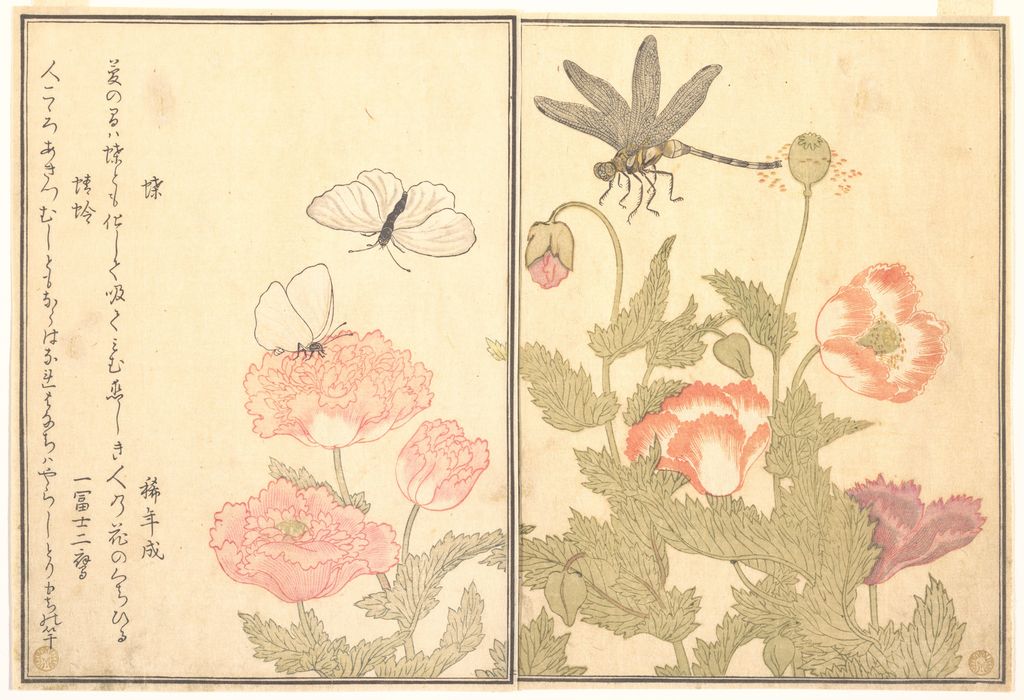
Consider the Met leaf JP1046, “Butterfly; Dragonfly” [5]. The image gives the two named creatures different ways to inhabit a spread: the butterfly's wings make a broad, light shape, while the dragonfly's long body and narrow wings call for a much finer line. Stems and leaves connect their parts of the composition without turning it into a continuous landscape. Much of the paper remains open, so the eye has space to shift from one small form to the other and back to the writing. The paired structure is therefore more than an inventory of two specimens. It is an invitation to compare movement, scale and texture while reading two pieces of verse.
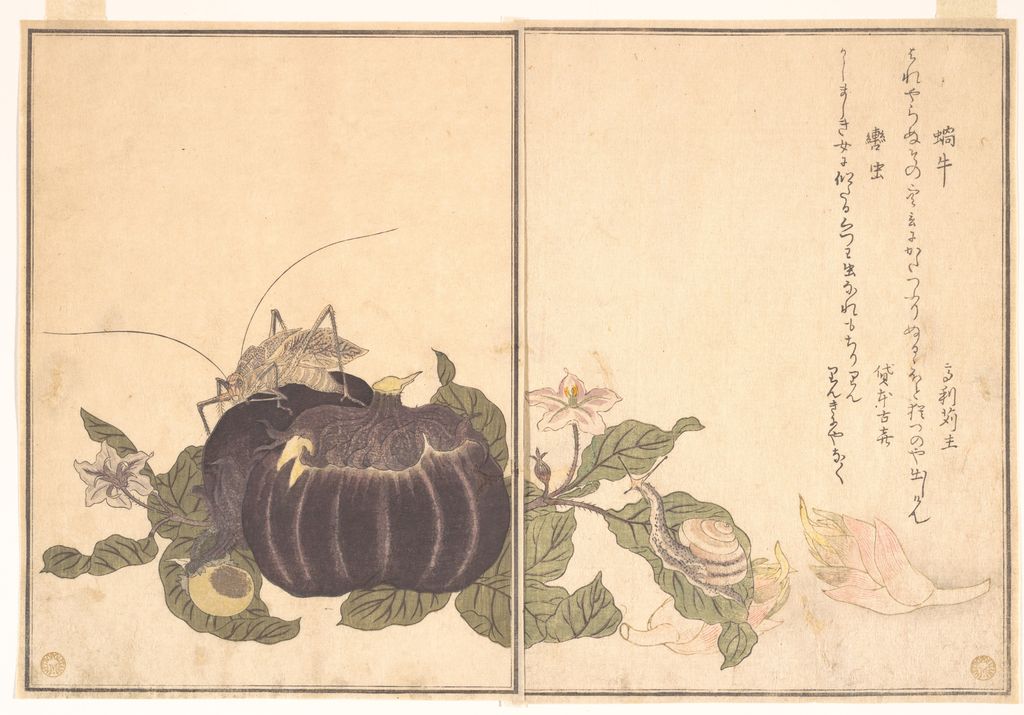
The Met leaf JP1054, “Land Snail; Giant Katydid” [5] sets up another contrast. The snail's shell describes a slow curve near the ground; the katydid's long, angular limbs build a different rhythm. Those observations come from the pictured forms. They do not tell us whether Utamaro drew a living specimen for this particular design, nor do they identify a collector who supplied one. The Met's 1984 publication [1] praises the artist's keen observation and relates it to Japanese and Chinese traditions. Our page can point to what a viewer sees and cite that interpretation; it should not replace scholarship with an imagined account of Utamaro working outdoors.
The insect book's fifteen compositions add up to thirty represented creatures and thirty poems under the scheme described by the Met and British Museum. The match of numbers is structurally useful, but it should not be overread. Two creatures in a composition do not necessarily occupy equal visual weight. A slight leaf, empty space or narrow column of writing may be as important to the design as an enlarged animal. The apparent simplicity is a skilled act of selection. That is one reason the work is an unusually good doorway into colour woodblock printing: it makes different line qualities, colour areas and blank paper easy to compare without the crowded setting of a street or theatre scene.
The museum records also reveal how edition identity affects viewing. The British Museum's former Hillier copy [3] is described as an early printing of the first edition. The Met's publication page includes many separately catalogued 1788 leaves, yet it also links a complete book object catalogued probably 1823, later edition. The later object may be useful in an edition discussion, but it cannot stand as an unqualified reproduction of the 1788 first edition. The gallery for this article therefore takes its insect illustrations from the specifically dated 1788 Met leaves, with the accession attached to each caption.
An intriguing document at the end of the second insect volume points beyond its contents. The Met's Songs of the Garden publication [2] transcribes an advertisement dated the first month of Tenmei 8, or 1788. It invites prospective poets to send love-themed verses for proposed books on birds, animals and fish, to be illustrated by Utamaro and compiled by Meshimori under Tsutaya's publishing enterprise. This is direct evidence of an intended programme, not proof that every announced volume appeared or that the eventual books retained the same editor. The publication's editors say Utamaro never designed the announced animal book and describe the shell book as taking the place of the proposed fish book. The later bird book did appear, but the British Museum identifies a different compiler, Akamatsu (Kikira) Kinkei, for the published volumes. The changing programme is more interesting than a neat but inaccurate claim that the three surviving books were planned as a fixed trilogy.
Shells: an album between shoreline and close looking
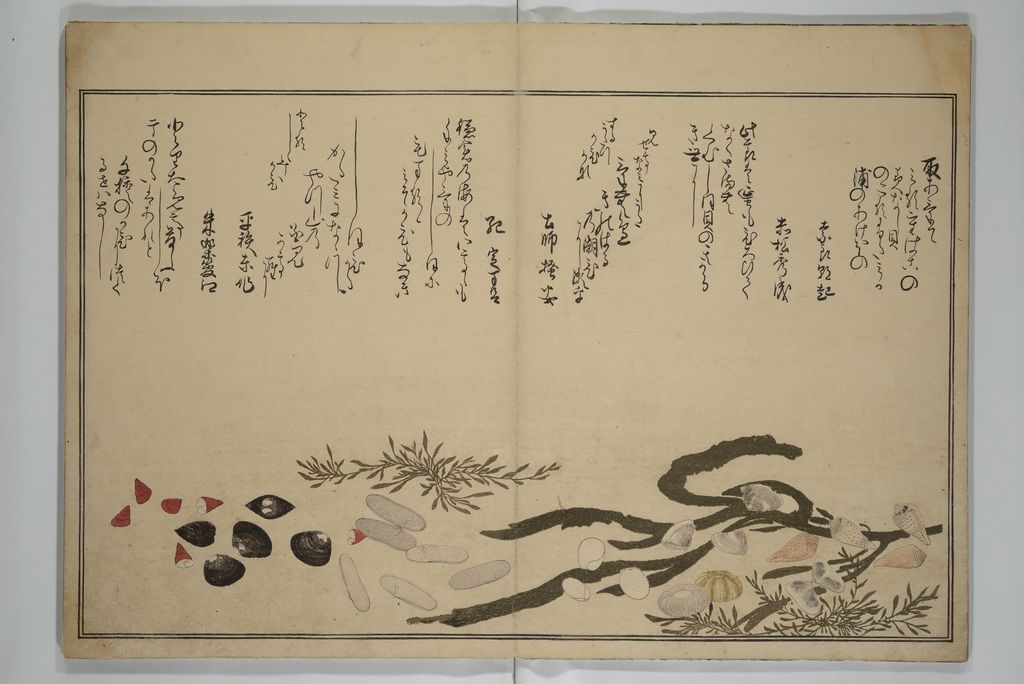
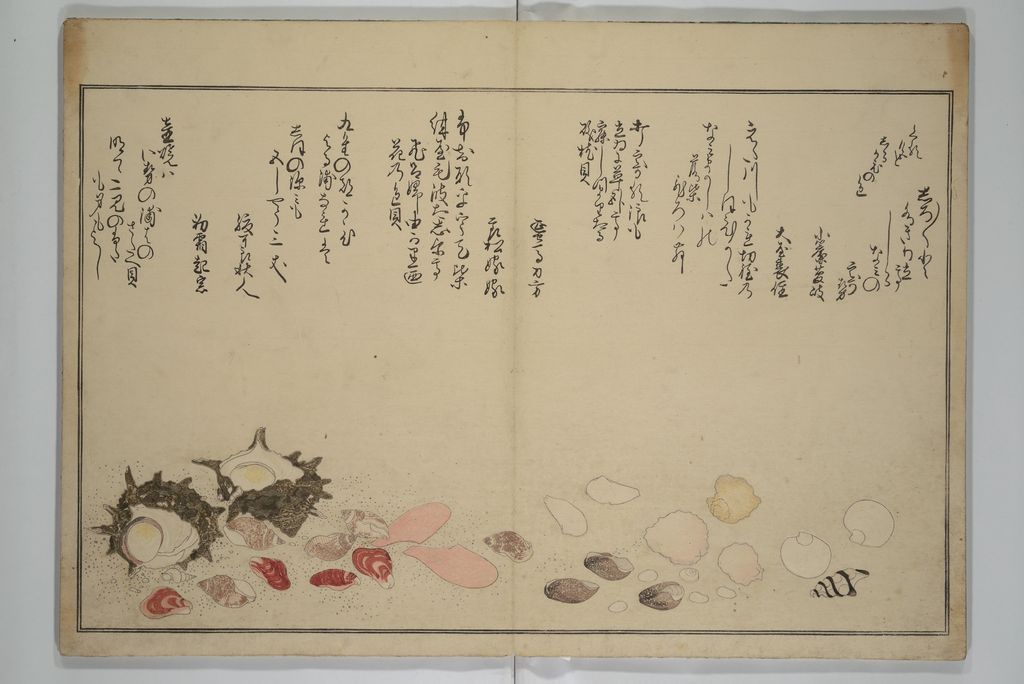
The Met's Shiohi no tsuto 2013.897 [6] is an accordion-style album, or orihon, dated “probably 1789.” Its catalogue specifies ink, colour, mica and gold leaf on paper. The Smithsonian's separate copy [7] identifies Akera Kankō as editor and Tsutaya Jūzaburō as publisher, and lists embossing among the techniques of its own book. These are object-specific descriptions. We should not claim to see a mica sheen or gold leaf clearly in an ordinary screen reproduction, nor silently transfer every feature documented for the Smithsonian accession to every page of the Met album.
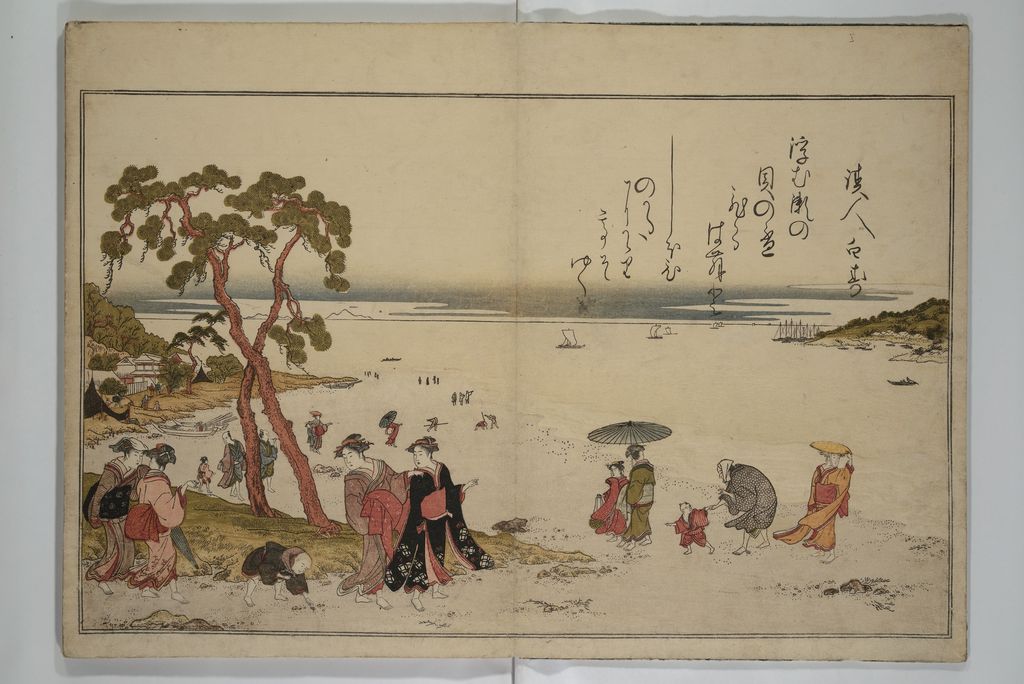
The Met's digital sequence is especially helpful because it shows the change in scale. After the cover and preface, one spread opens onto a shore scene. A large pine at left gives shelter and height, while small people move toward the water, boats lie farther off, and low land bounds the horizon. The coast is more than an introductory backdrop: it gives a place and social activity to the tiny objects that follow. On the next inspected spread, shells occupy small positions low on the page beneath columns of poetry. No single shell dominates the opening. The reader has to slow down and travel across them, comparing curves and colours under the written verses. Those descriptions refer to the Met's 2013.897 image sequence, not to a generic photograph of a different impression.
This interplay of scene and study gives the album a rhythm. The shore scene places people near the tidal margin; the shell page removes them and lets the objects become the focus. The open paper between the small forms works differently from an empty scientific chart. It allows each shell its own space while the verse above invites associations that go beyond physical description. The picture and text work together even for a reader who cannot translate each poem on sight. A close-reading module should provide a reliable transcription or translated excerpt only when one can be sourced; otherwise it should say exactly what is visible and refrain from inventing the poems' meanings.
The object itself has an edition history worth showing. The Met's other shell-book accession, JIB47 [6], is catalogued 1789 and described as probably a second printing. Its museum note says that a horizontal band of metal flakes and a purple wave pattern distinguish it from the first printing. The page also describes thirty-six poems by thirty-six poets on thirty-six shells, with six images and poems per spread. This is strong structural information about the work. It does not mean a screenshot of JIB47 is interchangeable with the photograph of 2013.897 selected for this article; the extra printing effects are exactly why the copies should be compared by accession. A serious gallery can make this difference legible in a caption rather than collapsing the versions under one attractive title.
The British Museum's collection search [13] records another Shiohi no tsuto copy dated 1789 and names a wide roster of poets as well as Tsutaya. The National Museum of Asian Art's book record [7] confirms the editor and publisher for its example. These sources together reinforce that the shell book is a collaborative poetry anthology. They do not, without further collation of copies, establish that every surviving book has precisely the same leaf order, colour state or supplementary material. The article's images and object facts therefore remain attached to the Met's 2013.897; the other records supply comparison and context.
Birds: a poetry contest in two volumes
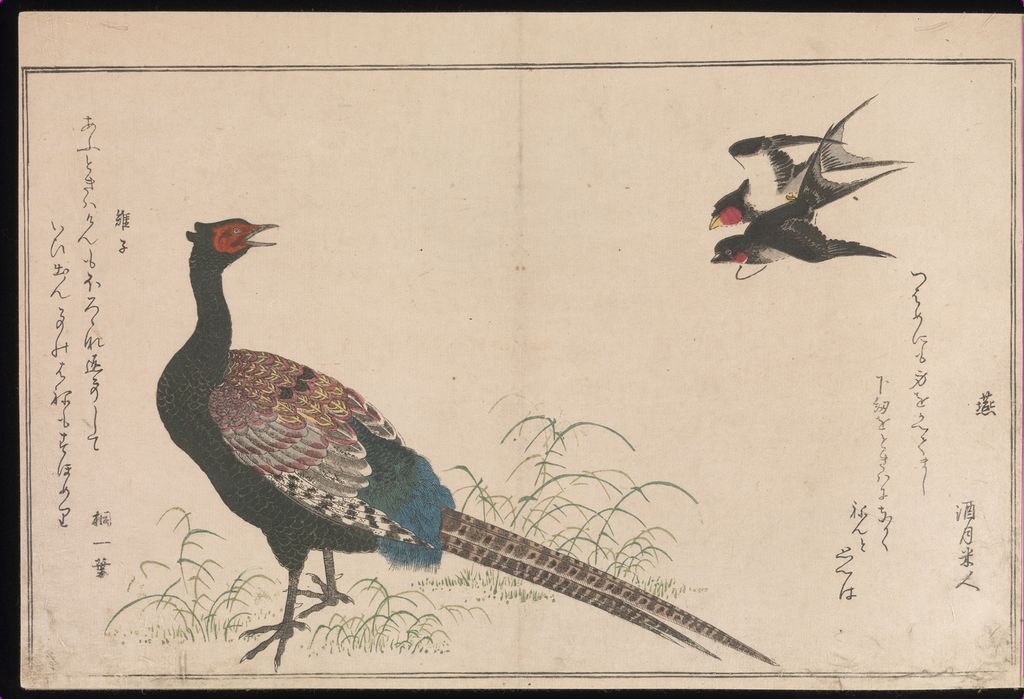
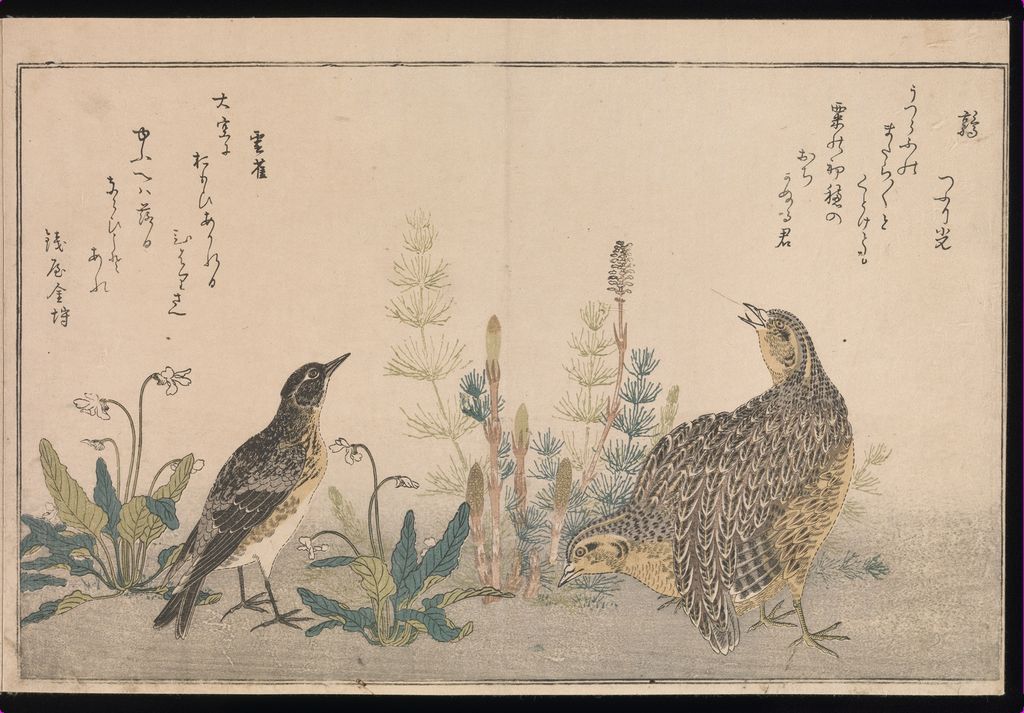
The bird book's title tells us more than its subject. 百千鳥 suggests an abundance of birds; 狂歌合 identifies a gathering or contest of playful poems. The British Museum's detailed record of its second volume [9] identifies the compiler as Akamatsu (Kikira) Kinkei, Tsutaya Jūzaburō as publisher and a two-volume structure with fifteen illustrated openings across the pair. Its catalogue says each illustration carries two poems, giving thirty poems overall. Its description of the leaves names bird-and-flower pairings, prefaces, advertisements and a colophon. This is a designed sequence with textual thresholds and commercial notices, not fifteen independent bird prints later gathered into a convenient set.
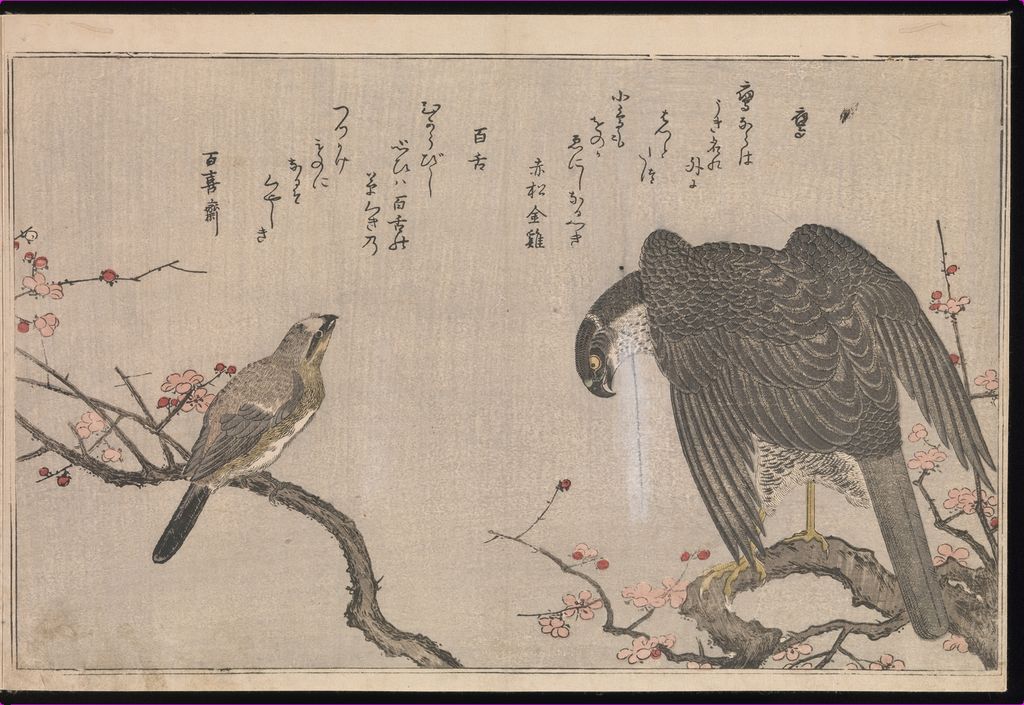
The Met's JIB43 bird-book copy [8] offers a useful sequence for close viewing. Its front cover and preface should be identified as such, then the viewer can move into the illustrated openings. In one inspected spread, a large dark bird with a hooked beak occupies the right and a much smaller bird perches among blossoms at left. The contrast in scale makes the two sides of the book perform differently: dense dark feathers gather weight on one side, while finer branches leave more air around the smaller body on the other. The poems sit above rather than beneath these creatures. The visible image permits that compositional reading. The exact species names and poem meanings require a caption keyed to the original text or a scholarly transcription; resemblance alone is not a safe identification.
Another JIB43 spread balances a long-tailed ground bird at left against two small flying birds at upper right. Their movement draws an oblique line across a broad open centre. A third brings one small standing bird opposite a larger bird among low plants. Each sheet uses paired subjects without settling into a uniform template. This matters for the website gallery: three selected openings teach more than three near-identical close crops, because a reader can see how the artist varies scale, position, plant setting and the relation between poems and image. The Met's photographs are around 1,820 pixels wide. At a 1,024-pixel website width, whole openings retain their basic composition; extreme enlargements of feather details would need honest resolution limits.
The bird volume's publication date is more subtle than a single number on a museum label. The Met dates JIB43 to 1791 [8], and it links a related two-volume object dated 1790. The British Museum's curatorial essay [9], drawing on Asano and Clark, says no copies are known with an explicit publication date. It compares the advertisements in the book with dates from other works and concludes that Momo chidori was probably published during 1790 or by spring 1791. A webpage can put “around 1790–91” beside the title, then give the accession-specific dates where they belong. It should not announce a precise first day or year unsupported by the surviving copies.
The same British Museum research observes that the order of bird illustrations differs from copy to copy, and it identifies a variant form of the title slips. That warning changes how one should use an interactive page: a digital strip of JIB43 photographs is the order of that photographed object, not an unquestioned master sequence for every surviving album. When our page selects three openings, captions can state “from the Met's JIB43 copy” and avoid unexplained page numbers from another institution. A viewer interested in a different copy can follow the linked British Museum record and compare its binding, titles and arrangements.
The 1788 insect-book advertisement makes the bird book feel anticipated, yet its actual authorship shows a changed plan. That advertisement invited contributions for books to be compiled by Meshimori. The British Museum credits Kinkei [9] with the published bird volumes and notes a complex history suggested by differences between their prefaces and shared colophon. We can say the programme evolved from announcement to publication. We cannot infer why Meshimori did not compile this book, or invent a falling-out among poets. The documented change is interesting enough without a speculative drama.
A proposed sequence and what actually appeared
The notice printed in the 1788 insect book names three intended subjects: birds, animals and fish. The Met's scholarly publication [2] reproduces and translates this advertisement, then explains the outcome. A bird book appeared; Utamaro did not design the announced animal volume; the Shiohi no tsuto shell book answered the proposed fish subject with objects from the shore. The contrast is a useful feature for readers because it is based on a surviving publisher's notice and identifiable books, not an invented art-historical progression from “insects to shells to birds.”
Chronology also resists that neat phrase. The insect book is dated 1788. The Met's shell album is “probably 1789.” The bird-book evidence points to around 1790 or early 1791, though older literature sometimes gives 1789. The Tokyo National Museum's exhibition list [11] groups the three and dates the bird book circa 1790. A comparison module should therefore give the announcement and object dates separately. The commercial proposal preceded the final choices; the shell book appears between insect and bird books in the dates used here. An image slider ordered by subject alone would hide that more revealing history.
That history belongs to Tsutaya's larger world of publishing, poets and artist collaboration. The Smithsonian's study of the Pulverer collection [10] places Ehon mushi erami alongside other rapidly issued colour books designed by Utamaro. It also explains that sponsored kyōka verse was integral to the books. We should not infer from that broad account an exact print run, retail price or number of craftsmen for the three examples; the cited records do not provide those figures. What they do show is that several kinds of expertise met on the printed page. The drawing could entice buyers, while named poets gave the book social life and the publisher gave it a material and commercial form.
The Japanese bibliographic record of Kikuchi Yōsuke's 2018 edition [12] is especially valuable at this point. Its contents promise transcriptions of all three works, annotations and an essay on the rise of kyōka ehon and Tsutaya's links with poetry circles. The catalogue identifies Kikuchi as editor, Kodansha as publisher, and the volume as 173 pages in the Sensho Métier series. We have verified that bibliographic information; we have not consulted the book's full text. It belongs in a recommendation module and in the reference list as a route to deeper Japanese reading, not as a source for an uninspected interpretation. The Met's Songs of the Garden [1] and A Chorus of Birds are analogous English-language publication leads; claims on this page rely on the inspected Met object and publication descriptions or quoted passages, not on pages we have not read.
How to look at a surviving book online
Begin by reading the object line, not only the image. “Utamaro” names the artist, but the Met entries also give object numbers JIB43 or 2013.897, a medium, a date wording and a credit line. Those fields distinguish a bound or accordion book from an individual detached leaf. The 1788 butterfly-and-dragonfly sheet [5] has its own accession JP1046; the Met's 2013.897 [6] is a photographed sequence of the shell album. Showing both in one article is valid if the captions retain those differences. A source image and a crop may even be two views of one object, not evidence for two independent copies.
Then look at how words occupy the spread. In the insect leaf, a pair of creature names and verses is worked into the pictorial space. In the shell study, columns of writing claim the upper field while small shells scatter below. In JIB43, birds and blossoms take different proportions of the page and poems sit around them. The repeated device is not a fixed picture frame but a relationship: printed text gives each observed form an additional occasion for wit, comparison or allusion. Readers need not be able to translate classical Japanese to see that organisation. Where an English explanation of a poem is needed, it must be grounded in a published translation or reviewed Japanese reading, with the relevant scholar credited.
Finally, compare material rather than assuming the screen is the book. The Met shell record [6] lists mica and gold leaf, while its JIB47 record [6] discusses a second printing with an added metallic band and purple pattern. A flat JPEG records photographed colour and form, but surface reflectance changes with light and cannot be proved from a small web image alone. Embossed or blind-printed relief may nearly disappear on screen. An in-person object, a high-resolution institutional image and a modern facsimile each answer different questions. Our feature should name those limits, then use the accessible digital files for the close looking they genuinely support.
The books show an Utamaro broader than any single category of portrait print. The Met's Songs of the Garden [1] treats the insect volume as pivotal to his career. Its claim is persuasive in context: the fifteen designs demonstrate exquisite control of line, spacing and tone, while the companion books show that he could adjust that language to coast and bird subjects. Yet the later fame of his women's prints should not be used to turn every earlier work into a “preparation” for them. These books were complete, ambitious achievements for their own poets, publisher and owners. They can be read on their own terms as much as in the story of the artist's career.
Questions readers often ask
Were these three books a planned trilogy?
They are a useful group of related kyōka picture books, but the 1788 advertisement proposed birds, animals and fish after the insect volume. The Met publication says no Utamaro animal book resulted and explains the shell book as the eventual answer to the fish subject. The published bird volume had a different compiler from the one announced. “Trilogy” is therefore a retrospective grouping, not the original plan carried out exactly.
Are all the books dated precisely?
No. The 1788 insect book is securely dated in museum records. The Met calls its shell accession 2013.897 “probably 1789.” Its JIB43 bird-book copy is catalogued 1791, while British Museum research suggests publication during 1790 or by spring 1791. These are distinct levels of evidence.
Why do two museums show different colours or page orders?
They may own different impressions, printings or bound copies, and the books have aged under different conditions. The British Museum notes variant bird sequences; the Met identifies a probable second shell-book printing. A photograph adds its own lighting and colour reproduction. Compare object numbers and catalogue notes before interpreting a difference as a deliberate change by Utamaro.
Can I read the poems here?
The article explains their role in each book and offers links to scholarly records. A complete translation is beyond the scope of this comparative page. The Met's Songs of the Garden includes translations for the insect book, and Kikuchi Yōsuke's Japanese edition transcribes and annotates the three works, according to its library record. Any poem quoted in a future page update must come from a checked edition with an appropriate citation.
Discussion and reader insights
Compare the three books through images, poems and surviving copies.
Reader Insights
Where do the creatures and verses meet?
How does the shore scene change the reading of the shells?
How should differing sequences be compared?
Join the Conversation
Share a documented transcription or another identified copy with its source.
References
- Metropolitan Museum of Art, Utamaro: Songs of the Garden (1984), publication description and linked objects.
- Metropolitan Museum of Art, Songs of the Garden publication text and 1788 advertisement.
- British Museum, Ehon mushi erami, Hillier copy 1979,0305,0.152.2.
- British Museum, Ehon mushi erami, former Banks copy 1915,0823,0.68.
- Metropolitan Museum of Art, butterfly and dragonfly, JP1046 and land snail and giant katydid, JP1054.
- Metropolitan Museum of Art, Shiohi no tsuto, 2013.897 and probable second printing JIB47.
- National Museum of Asian Art, Shiohi no tsuto, FSC-GR-780.324.
- Metropolitan Museum of Art, Momo chidori kyōka-awase, JIB43.
- British Museum, Momo chidori kyōka-awase, 1915,0823,0.67.2 and curatorial bibliography.
- Smithsonian, Pulverer Collection essay on colour-printed illustrated books.
- Tokyo National Museum, Tsutaya Jūzaburō exhibition object list (2025).
- National Diet Library Search, Kikuchi Yōsuke, ed., 歌麿『画本虫撰』『百千鳥狂歌合』『潮干のつと』 (Kodansha, 2018).
- British Museum's collection search
