


 by Tom Gurney
Tom Gurney BSc (Hons) is an art history expert with over 20 years experience. Updated September 24, 2026.
Introduction
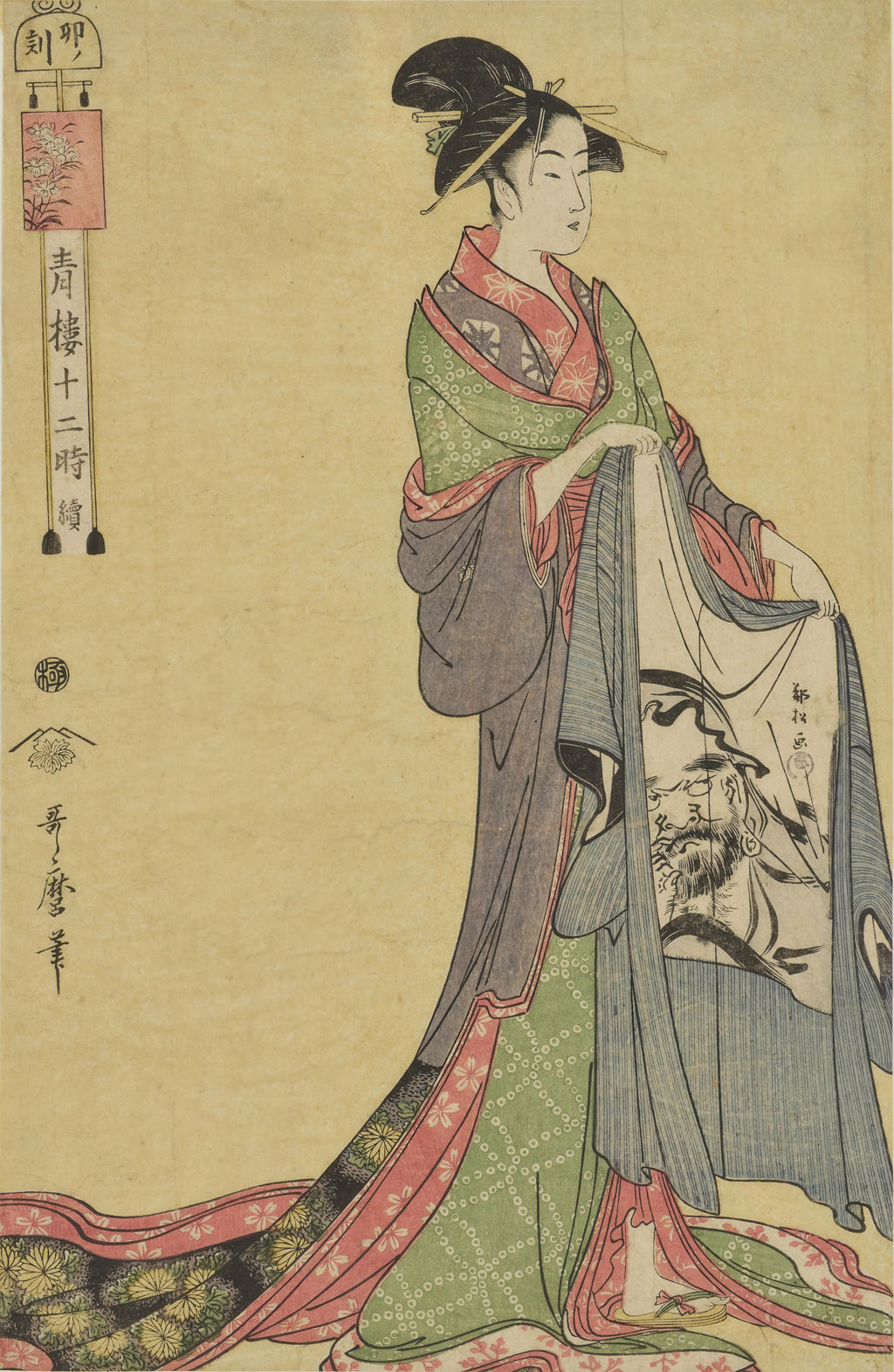
A narrow device hangs beside a woman in Utamaro's Hour of the Hare: a bell-like top marked 卯ノ刻, a little picture below, and two weighted cords flanking the vertical series title 青楼十二時 続. Nothing in the print shows a clock face with moving hands. The ingenious label nevertheless tells a viewer how to place this scene in a larger sequence. In twelve separate colour woodblock prints, Kitagawa Utamaro followed named hours through the licensed Yoshiwara pleasure quarter. The Art Institute of Chicago holds a twelve-sheet object group [2]; the National Diet Library describes the series [1] as a courtesan's day shown one interval at a time.
The English title Twelve Hours in Yoshiwara is a useful convention for readers. The wording printed on the sheets is Japanese, and 続 is part of that wording. Museum catalogues vary in whether they romanise the title Seirō jūnitoki tsuzuki or translate it as a day in the pleasure quarters. The twelve zodiacal labels—Rat through Boar—organise the series more securely than a modern English clock. They invite the viewer to return to the same imagined setting as activities, attendants and states of wakefulness change.
Contents
- Introduction
- Explore five details of the Hare hour
- Read the time device before the scene
- Explore the twelve named hours
- Twelve named hours, twelve separate objects
- Hare: a single figure at the edge of morning
- Ox and Horse: the public image of private hours
- Sheep: fortune telling and the social scale of a group
- Fashion, service and the limits of a printed day
- Related clock series are different works
- What to look for across the sequence
- Questions readers often ask
This is a beautiful and highly managed vision. It shows dressing, letters, small acts of service, rest and other moments that patrons would not ordinarily have witnessed. The British Museum's commentary on its Horse impression [5] calls such moments “supposedly” private. That word matters: Utamaro and the publisher offered the appeal of access, not a literal diary of a documented woman. The Ōta Memorial Museum [8] reminds viewers that Yoshiwara's sumptuous fashion existed alongside harsh circumstances and hierarchy. Reading the prints well means attending to both their formal intelligence and the people represented within a constrained system.
At a glance
- Artist and publisherKitagawa Utamaro designed the series. The Ōta Memorial Museum lists the Hare, Horse and Dog sheets with publisher Tsutaya Jūzaburō.
- DateŌta dates its three examples to around 1794; AIC dates its twelve objects to c.1794; the British Museum dates its Horse to c.1795. These are curatorial estimates for specific impressions.
- FormatAIC identifies its twelve sheets as colour woodblock prints in ōban format. Dimensions vary slightly from sheet to sheet.
- How many hours?Twelve zodiacal intervals complete a conceptual day and night. The AIC group provides twelve separately catalogued objects; its accession order does not establish original printing order.
- Do the labels equal modern clock times?The National Astronomical Observatory gives two-hour equivalents for a fixed-hour system but says zodiacal labels were also used with variable hours. The modern times in this page are approximate guides.
- What can the images document?They document printed designs and surviving impressions. They do not independently document the schedule, feelings or identity of a particular courtesan.
Explore five details of the Hare hour
These details come from the retained 300dpi owner image. Choose a point, then open the enlargement below. Its source impression is unidentified.
Explore five details of the Hare hour
These details come from the retained 300dpi owner image. Choose a point, then open the enlargement below. Its source impression is unidentified.
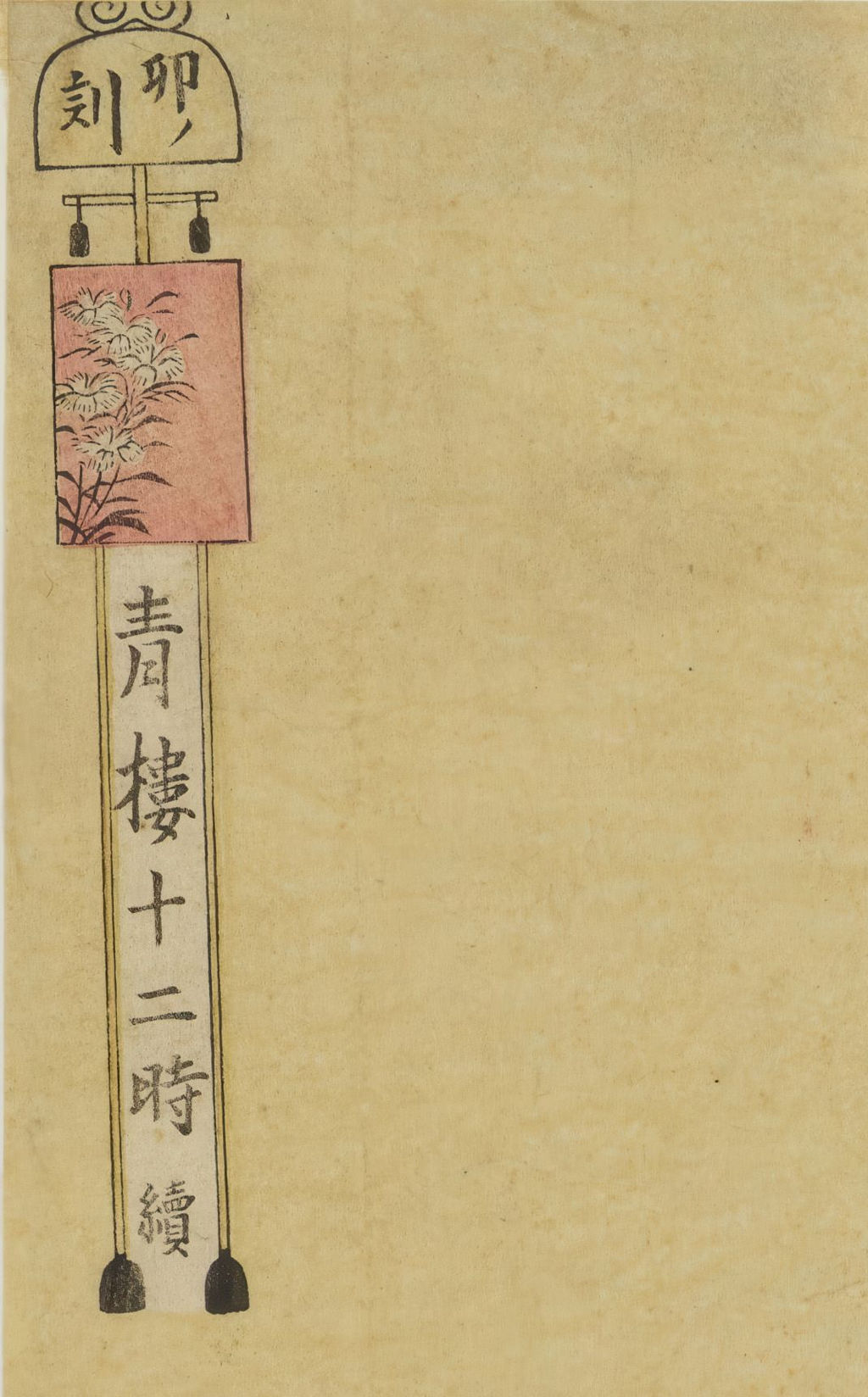
Hare hour device
The branch sits in the bell; the series title descends between two weights.
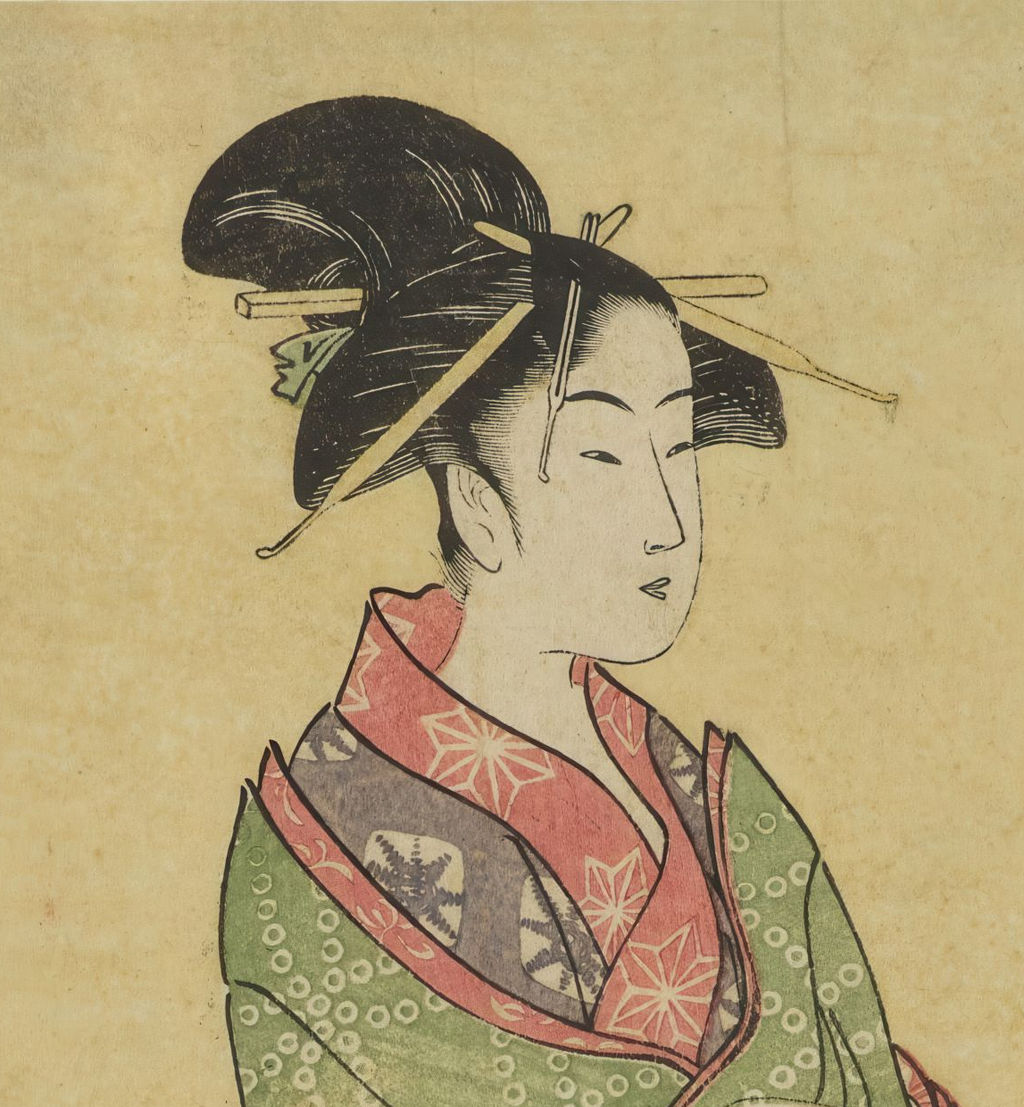
Hair and pins
Fine lines animate the large black hair form, crossed by ornaments.
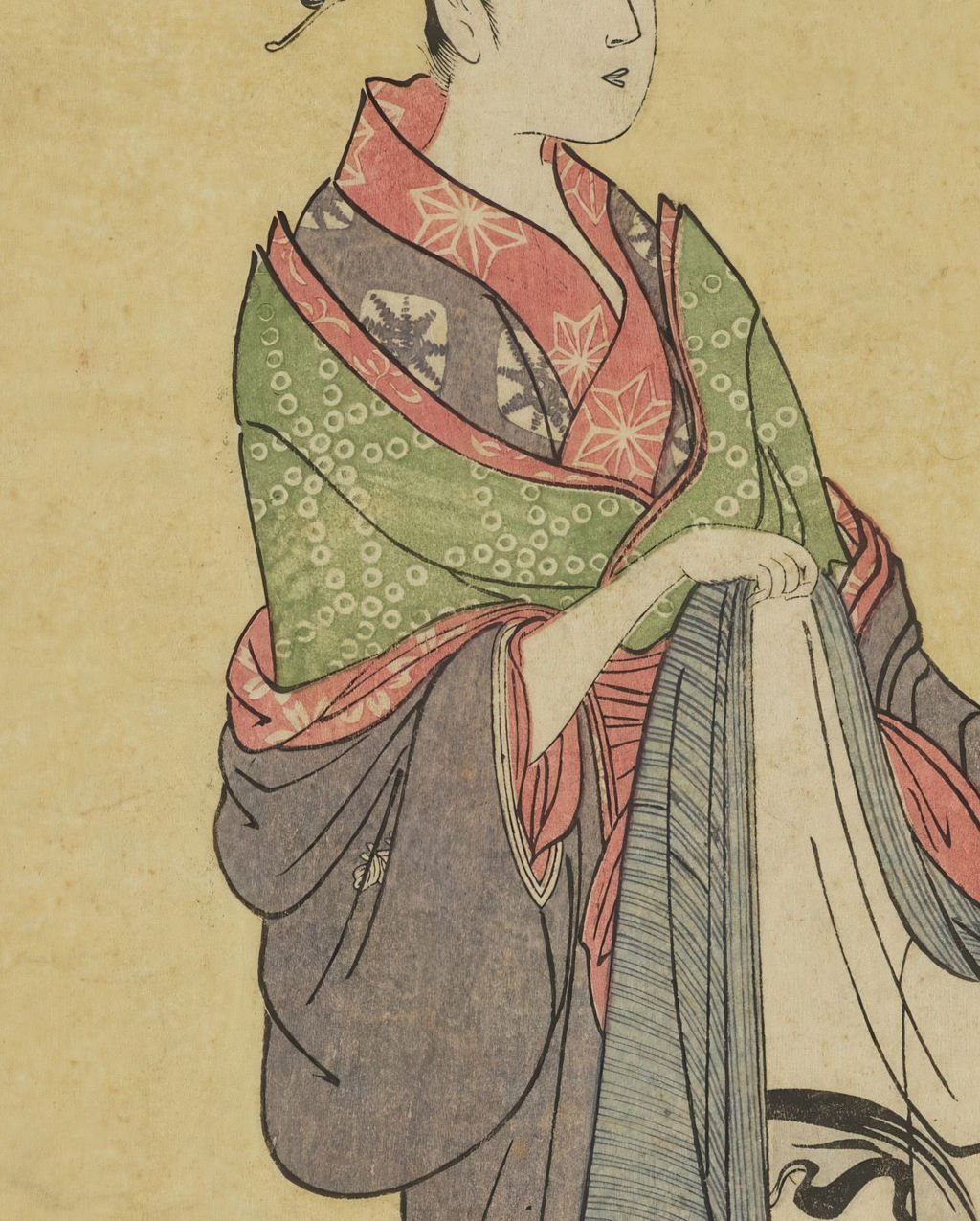
Layered collar
Different colours and patterns turn with the body.
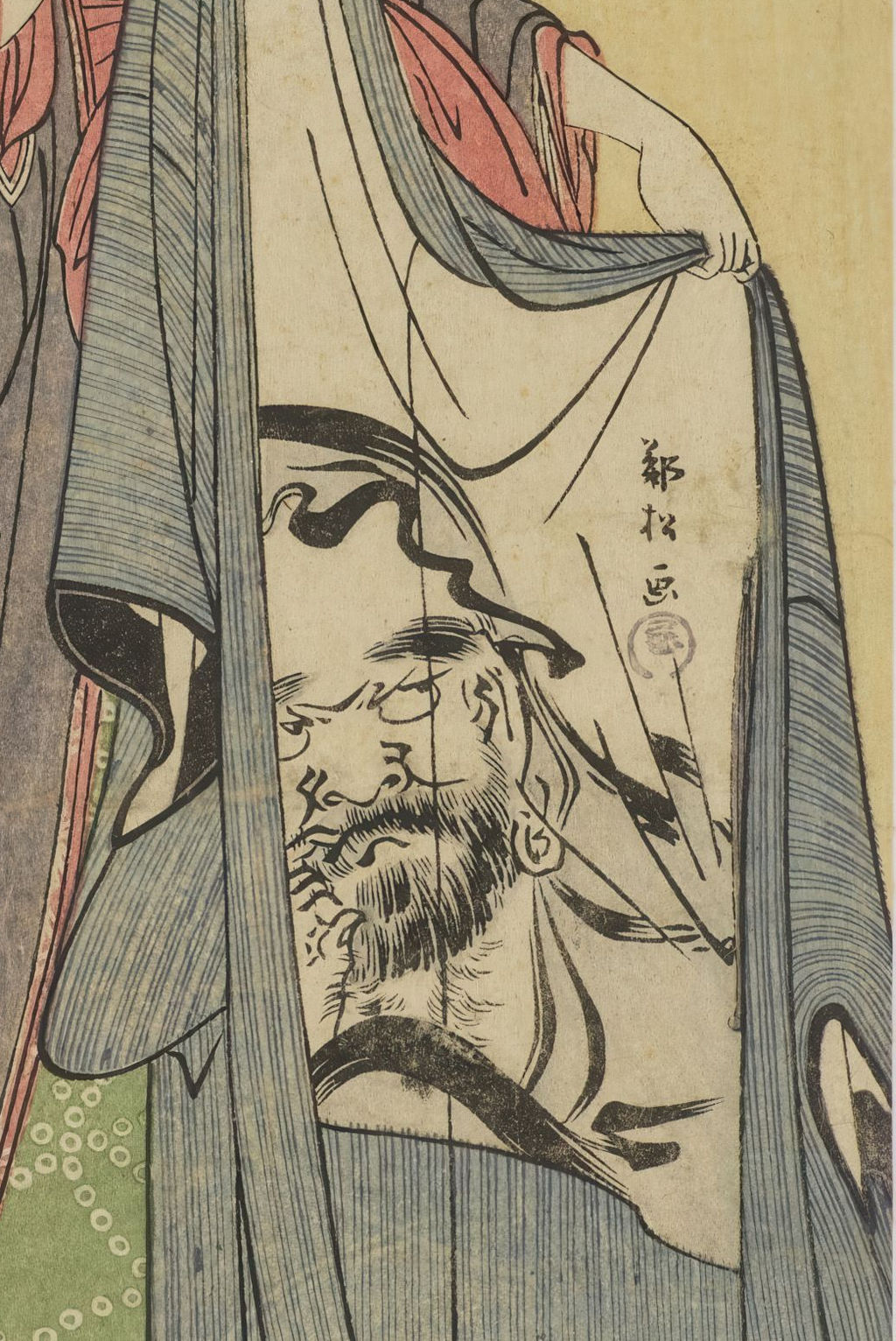
Picture within the cloth
A bearded face appears in the textile. Its specific source is unconfirmed.
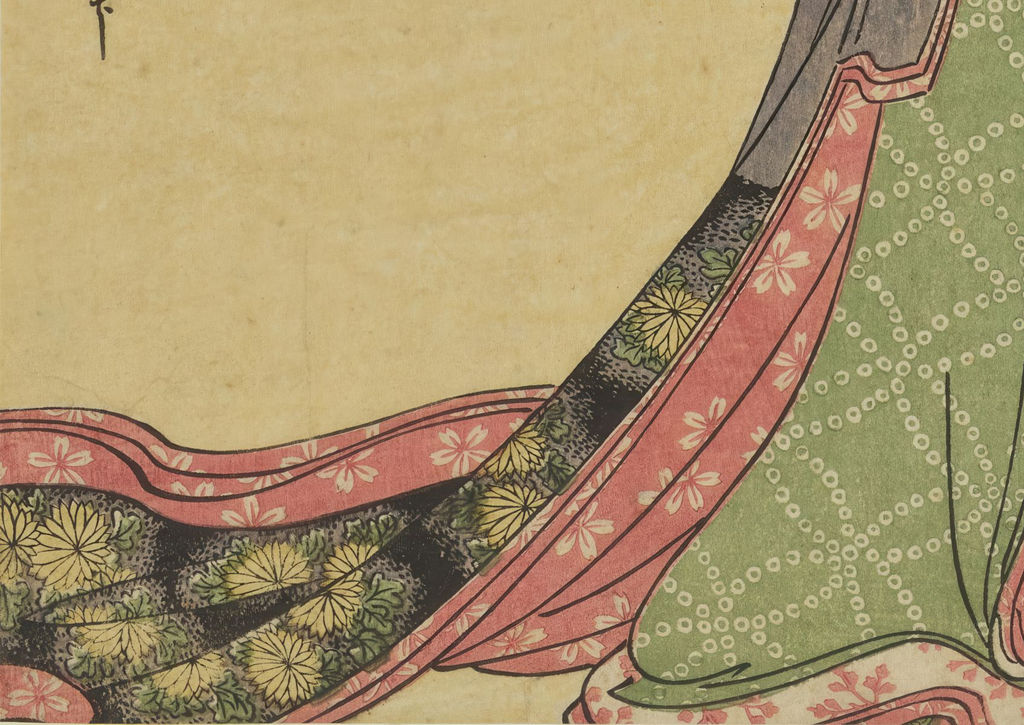
Trailing hem
The garment extends along the lower edge and anchors the tall figure.
Read the time device before the scene
Explore the twelve named hours
Modern clock labels are approximate fixed-hour guides. Edo variable hours also used these branch names.
Rat / 子ノ刻 — around midnight · View the AIC object
In the owner-provided Hare reproduction, the small bell stands at upper left. 卯ノ刻 is placed inside its rounded top, while the title descends between what look like suspended weights. The British Museum describes the corresponding device on its Horse sheet [5] as a stylised lantern clock: the series title runs between the weights and the zodiacal hour appears on the bell. The device is a piece of graphic organisation as much as an object. It marks each sheet as part of a set even when the women, fabrics and activities are entirely different.
Its graphic economy is easy to miss when a reproduction is shown small. A bell, cords, title and compact ornament occupy only a slim edge. The rest of the sheet can be open paper and full-length figure. This lets Utamaro give the hour a name without enclosing the woman inside a drawn room. The repeated device is a hinge between individual close looking and collection-wide reading: one may enjoy a single pose, but the cartouche asks what comes before and after it.
The term 青楼 evokes the “green” or “blue” houses of the pleasure quarter in Japanese literary usage; the printed title does not itself say “Yoshiwara” in modern English letters. English museums commonly give Yoshiwara as the setting or use a conventional translation. On this page, the original title is shown beside the familiar English title, so a reader can find either in museum catalogues. We do not use an English paraphrase as if it were lettering visible on the woodblock print.
The twelve branches offer an apparent precision that can mislead. The National Astronomical Observatory's calendar guide [3] places Rat (子) at 23:00–01:00, Hare (卯) at 05:00–07:00 and Horse (午) at 11:00–13:00 under fixed-hour reckoning. On the same page it warns that the branches also appear in variable-hour reckoning. Edo hours could therefore be tied to shifting daylight and night rather than to twelve immutable modern two-hour blocks. A visual time module can use “around midnight,” “around dawn” and “around noon” as helpful anchors. It should not promise that Utamaro's paper records an exact 06:00 event.
One catalogue anomaly makes that restraint especially important. AIC's Hour of the Rat 1925.3062 [13] carries [12pm] in its English display title. The observatory's Rat interval centres on midnight, not noon; AIC's other labels put the Ox near 2am and the Horse around the middle of the day. This appears to be a time conversion or typing error in the Rat title. We retain the museum's wording when citing its record, while the reader-facing sequence says Rat is around midnight. The correction follows an explicit Japanese timekeeping source, rather than a guessed reading of the image.
Twelve named hours, twelve separate objects
The directory below gives one AIC catalogue object per hour, not a census of every surviving impression in the world. Each link leads to the named museum record. Its approximate modern range follows the observatory's fixed-hour table, with the historical qualification above. It does not claim that every scene happened inside that exact modern range or that AIC's sequence is an original bound set.
| Branch | Hour name | Fixed-hour guide | AIC object |
|---|---|---|---|
| 子 | Rat | about 23:00–01:00 | 1925.3062 [13] |
| 丑 | Ox | about 01:00–03:00 | 1925.3051 [14] |
| 寅 | Tiger | about 03:00–05:00 | 1925.3052 [15] |
| 卯 | Hare | about 05:00–07:00 | 1925.3053 [2] |
| 辰 | Dragon | about 07:00–09:00 | 1925.3054 [16] |
| 巳 | Snake | about 09:00–11:00 | 1925.3055 [17] |
| 午 | Horse | about 11:00–13:00 | 1925.3056 [18] |
| 未 | Sheep | about 13:00–15:00 | 1925.3057 [19] |
| 申 | Monkey | about 15:00–17:00 | 1925.3058 [20] |
| 酉 | Cock | about 17:00–19:00 | 1925.3059 [21] |
| 戌 | Dog | about 19:00–21:00 | 1925.3060 [22] |
| 亥 | Boar | about 21:00–23:00 | 1925.3061 [23] |
The accession numbers are adjacent except that AIC's Rat is last in its acquired run. That pattern helps the museum catalogue these sheets together; it cannot show which design was carved or issued first. Nor do the twelve records prove that every sheet in a buyer's original purchase was physically identical in colour and printing quality to the twelve now in Chicago. A series is a repeated publication design; an impression is one pulled sheet with its own history, paper and present owner. Keeping those levels apart prevents a neat interface from inventing certainty that the objects do not supply.
Hare: a single figure at the edge of morning
The site owner's large Hare reproduction gives this page its closest view. A woman dominates the right half of the sheet. She faces toward the empty paper at left; dark hair and delicately crossing hairpins rise over a restrained face. Multiple layers of clothing fall in long tapering folds. The fabric nearest her hands includes an image of a bearded face, and her rightward gesture holds another trailing edge. It is tempting to invent a story about dressing for a specific appointment, but the image alone does not establish one. The annotation should first show the visible arrangement: the hour mark, the face and pins, overlapping textiles, and the image within the cloth.
Her head and the vertical title are high on the sheet, but the left side remains extensively unfilled. That asymmetry gives the figure presence without a room around her. The garment's long hem extends along the bottom edge, making a horizontal base for the tall posture. The small motif within the carried fabric creates a picture inside a picture and slows the eye. It also complicates a purely documentary reading. Utamaro is not simply listing garments; he arranges surfaces and images to make one hour visually distinct from the others.
The owner file is 2608 × 4000 pixels and bears 300dpi metadata; the user provided it as a public-domain reproduction. Its original historical impression is not identified. AIC has its own Hare 1925.3053 [2], and Ōta lists another Hare sheet [4]. Those records document the design's presence in their collections. They do not license us to attach either museum's accession, measurements or exact photographed colours to the owner-provided file. The page should display that file without a visible credit, as instructed by the owner, and explain its unidentified impression in the scholarly apparatus.
The Hare sheet is a good base for an annotated image because the source has enough pixels to inspect the title and garment before downsampling. One point should enlarge 卯ノ刻 and the bell; another should show 青楼十二時 続 between the weights. A third may examine the hair and pins, a fourth the layered collar, and a fifth the picture within the cloth. Each popup needs the full image detail and a short explanation beneath it, following the site's existing shared annotation structure. No label should turn an uncertain object into a named possession or infer the woman's occupation from hairstyle alone.
Ox and Horse: the public image of private hours
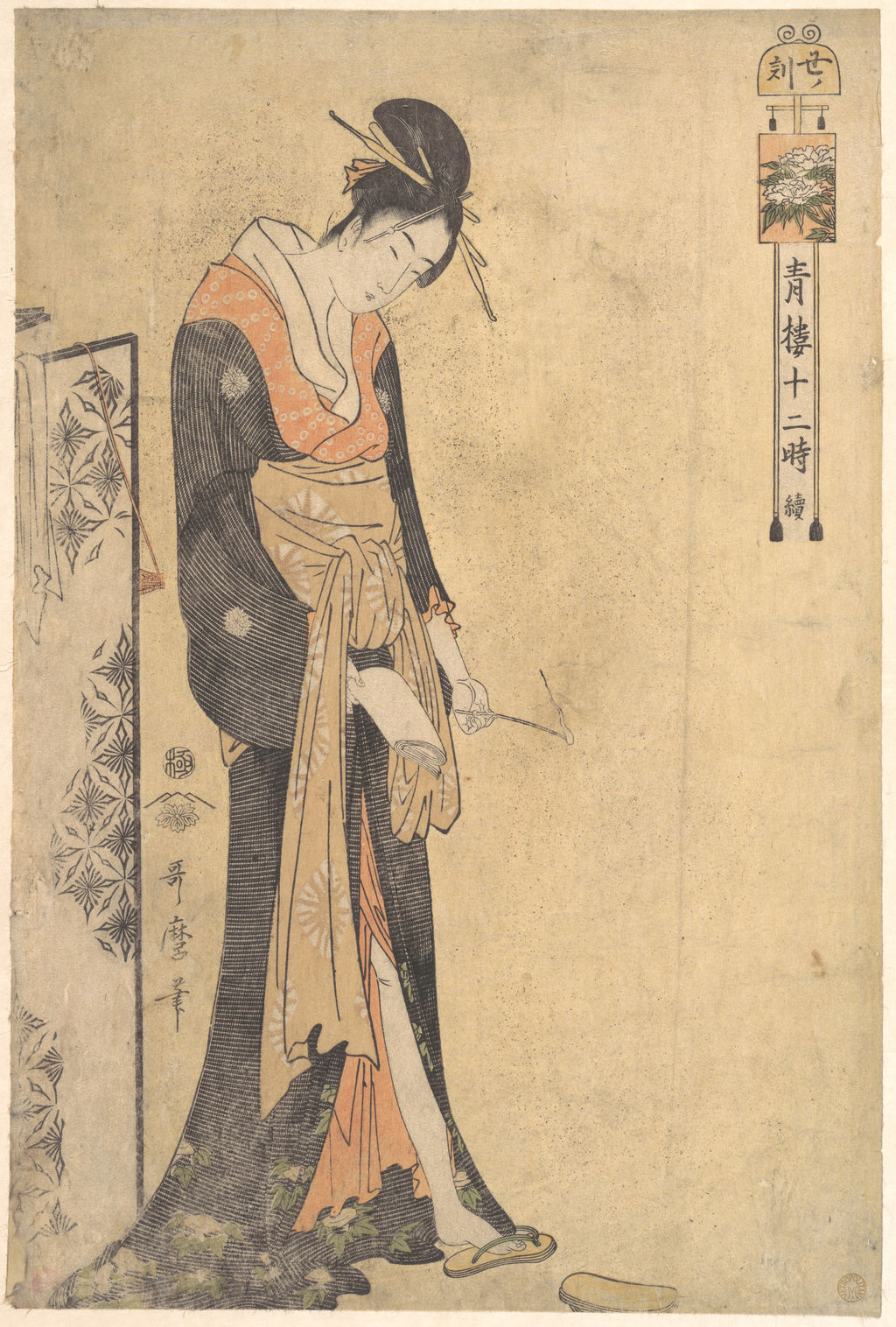
The Metropolitan Museum of Art's Hour of the Ox, JP977 [6], is a distinct physical sheet, dated about 1794 and measuring 37.1 × 24.4 cm. Its title line includes 青楼十二時 続 丑の刻, matching the series and hour. The Met marks its image Public Domain. The National Diet Library's separate illustrated Ox example [1] is interpreted as a sleepy woman with paper and candle on her way to the privy. We can use that description to discuss the series' fascination with low-key routine, but we should not quietly transfer every NDL-observed feature to the Met's JP977 caption without inspecting the Met photograph. The two records concern the same named design, not the same accession.
The Met photograph does make several of those elements visible on its own terms. The woman inclines her head and gathers her clothing with one hand. In the other is a long, thin object with a tiny point at its end, while a loose sandal sits on the floor by her extended foot. A patterned hanging fabric enters from the left, but most of the right half remains plain. The cartouche occupies that otherwise empty field. This composition brings a humble bodily need into an elegant commercial print. It does not ridicule the woman: the long dark robe and small bright orange collar hold the figure with an almost monumental verticality. A useful close view could compare the delicacy of the hand and thin object with the broad rhythm of the robe, showing how the sheet keeps an intimate incident within a carefully balanced design.
The Met image also invites caution about the word sleepy. Her lowered lids and tipped head make that reading reasonable, and NDL uses it for its own example, but a printed face does not reveal actual fatigue or an hour of waking. The print suggests a mood. Its narrative depends on details—a sandal not yet secured, a lifted hem, a small held object—that let the viewer imagine what happens next. When the page describes those details, it can say “visible in JP977”; when it speaks of a privy, it should clearly attribute the interpretation to NDL's Japanese exhibition text. That separation is especially valuable here because the incident might be treated as a colourful fact about a real person's night if the source boundary is lost.
Around the Horse hour, the setting turns toward daytime display. The NDL caption of its Horse image [1] explains 昼見世, a daytime presentation at a street-facing establishment. It sees a courtesan having her hair dressed as she handles a pipe and reads a letter, while a kamuro uses the mirror. The British Museum's Horse, 1935,1214,0.8 [5], describes a courtesan, a teenage shinzō and a child kamuro around a letter and hair arrangement. The two museum readings agree on the scene's elements, while offering slightly different emphases. They support a close reading of preparation, exchange and hierarchy much better than a generic claim that “women enjoy a leisurely morning.”
A letter in a print is a narrative invitation: the viewer cannot read its unseen message, but can watch how attention moves toward it. The mirror lets the child attendant do something of her own within a scene organised around the courtesan. A hairdresser's or attendant's labour sits beside the richly patterned robe. These elements make the scene feel inhabited. They also make it marketable to buyers outside the quarter, who are offered a carefully staged view of a world they may imagine knowing. The print's effect depends partly on the gap between apparent intimacy and deliberate publication.
Sheep: fortune telling and the social scale of a group
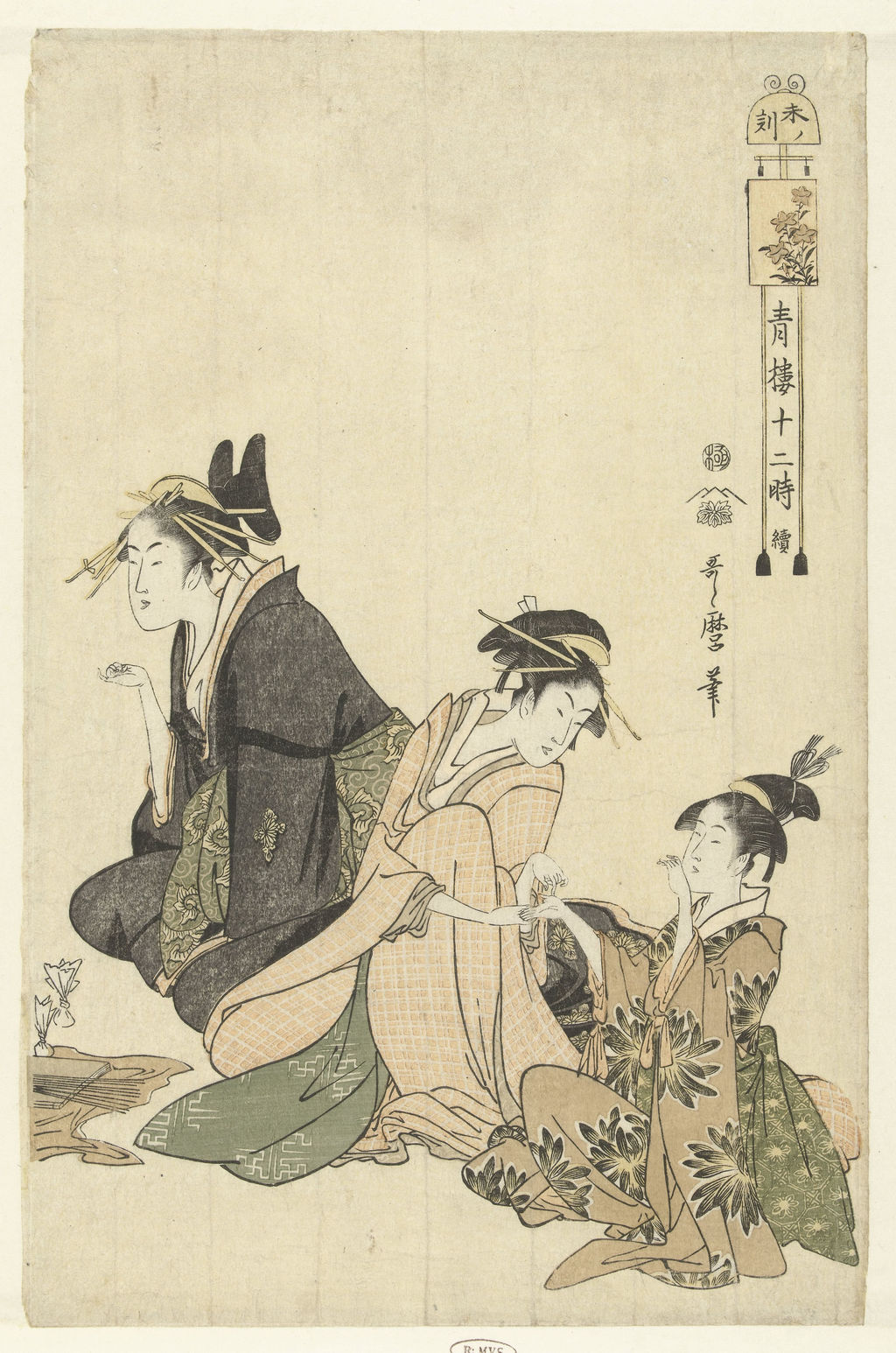
The Rijksmuseum's Hour of the Sheep, RP-P-1965-442 [7] is identified in its Dutch catalogue as a fortune-telling scene. The museum describes a courtesan in an orange checked kimono reading the hand of a girl in a chrysanthemum-patterned robe; another woman in transparent dark clothing sits near divination objects. Here the hour is not defined by a broad exterior landscape. It is marked by a small action among three people. The series' design can therefore alter its cast and composition without losing its repeated clock device.
In the rights-cleared image retained for the site, the figure at left is turned away from the central exchange, her dark robe making a large shape against the pale paper. A middle figure leans toward the seated younger figure at right. The viewer's eye crosses from one face to the next, then returns to the cartouche at upper right. Relative scale makes the group feel conversational rather than monumental. The print offers a fragment of interaction, but it cannot tell us whether a real fortune was told on a particular afternoon. The catalogue's label names the depicted action; it does not turn the print into a transcript.
The Rijksmuseum dates its impression broadly to 1793–97 and gives Tsutaya Jūzaburō as publisher. Its physical sheet is 384 × 245 mm. These fields describe RP-P-1965-442, not Chicago's Sheep 1925.3057 [19]. Side-by-side institutional records can show the same composition under differently bounded dates and with differently aged colour. Without inspecting the paper and printing in person, the safest page text explains the range and keeps each source attached to its own image. Our produced derivative is 1024 pixels wide, quality 80 and 144dpi; the 4088 × 6172 pixel official JPEG is retained as the original asset.
The three Sheep figures also make the role of the blank ground clear. A large upper space gives the clock device a place to stand but supplies no architectural signs of a room. The people, robes and small objects must establish the relationship. Orange checks in the central costume and floral forms on the right-hand garment distinguish the participants, while the darker figure at left frames the exchange. The hour is a repeated title, but the picture works through the movement of hands and faces within an open field. This is a different solution from Hare's solitary tall figure, where fabric extends to the edge and one person's attire carries much of the visual story. Showing both images on the article lets a viewer understand the series as a set of compositional experiments, not twelve near-identical costume portraits.
Fashion, service and the limits of a printed day
Yoshiwara imagery attracts viewers through elaborate hair, layered textiles and subtle expressions, and the series deserves close attention on those terms. Yet the social position of its women should not dissolve into a uniform category of “beauties.” The Ōta Memorial Museum's English exhibition text [8] explains the prestige and skill expected of high-ranking oiran while also recalling that the pleasure quarter was called 苦界—a place of suffering. Its Japanese account [8] distinguishes child kamuro and older shinzō and discusses the attendants surrounding a courtesan. The BM's Horse record uses those terms for the people actually shown. An article should make the relation of their labour visible without claiming that every girl in every print has the same role.
The publisher's viewpoint is important. The Ōta 2025 exhibition list [4] attributes its three Twelve Hours sheets to Tsutaya Jūzaburō, and the Rijksmuseum record [7] agrees for the Sheep. The hour-by-hour structure makes a set collectable: each sheet promises another chapter, another arrangement of clothes, another gesture. The repetition of the clock cartouche is an ordering device and a publishing idea, not merely a decorative flourish. It presents a complete day to a buyer even though no one print can contain a complete lived experience.
Woodblock printing helps explain both the unity and the variation. These were designed images translated into key lines and colour areas by a team of artisans working for a publisher. The recurring text and time emblem tie the sheets together, while each picture has its own arrangement of carved contours and patterned blocks. The AIC lists its sheets as colour woodblock prints in ōban format; that broad category does not mean their measurements must be identical after printing, trimming, mounting and later handling. The Met and Rijks measurements quoted here belong to their individual objects. Nor can the smooth colours of a modern digital file prove how a fresh eighteenth-century impression appeared: pigments, paper, preservation, photography and display all intervene. The safest visual commentary points out observed contrasts rather than ranking unexamined files as early or late pulls.
Even the cartouche may carry evidence that disappears in a casual thumbnail. It contains the branch, a repeated title, a small image and marks that reward enlargement. A builder should ensure the annotated Hare module opens its detail from the retained high-resolution file, so the lettering does not become an enlarged copy of a 1024-pixel page image. The surrounding prose should explain why those elements matter: the branch gives the sheet its place in an imagined day, and the title makes it part of a publishing series. A decorative crop without this explanation would make the feature attractive but leave the historical reading unchanged.
What lies outside the frame matters too. The images do not show contracts, debt, restrictions of movement or the full range of workers in the quarter. The absence of those things from an elegant sheet should not be read as evidence they were absent from Yoshiwara. Conversely, it would be unfair to treat every elegant gesture as empty deception: the prints preserve highly specific visual ideas about dress, social roles and the appeal of private activity. A careful page can explain the source's selectivity while still helping viewers see why Utamaro's compositions were powerful.
The book A Courtesan's Day: Hour by Hour, catalogued by the National Diet Library [9], is the most relevant further scholarly lead for this exact series. Its bibliographic description identifies essays by Cecilia Segawa Seigle and others, and the book overview identifies Timothy Clark's descriptions of Utamaro's sheets. The volume has not yet been consulted for this manuscript, so its named chapters and interpretations cannot be used as if read. It belongs in the book recommendation module with correct publisher, year and ISBN, while the page's factual footnotes rely on inspected institutional sources. Cecilia Segawa Seigle's separate Yoshiwara: The Glittering World of the Japanese Courtesan [10] is a useful wider-context book lead from University of Hawai‘i Press, likewise requiring direct consultation before page-specific claims are drawn from it.
Related clock series are different works
Utamaro returned to time-of-day subjects, which makes a vague title dangerous. The British Museum's Hour of the Rat, the Mistress [11] and its Hour of the Boar, Geisha [11] belong to 風俗美人時計, not to 青楼十二時 続. The Ōta 2025 list [4] distinguishes two 娘日時計 sheets from this series by both title and publisher. A zodiac label, Utamaro attribution and fashionable woman are insufficient to place a print in the twelve-sheet directory. The printed series title and an identified museum record must agree.
The Ōta Museum's exhibition [8] also showed a 吉原十二時絵巻 by Chōbunsai Eishi. Its similar temporal theme is interesting for comparison, but it is a different artist's painted scroll. Utamaro's 1804 Seirō ehon nenjū gyōji, documented by the Smithsonian [12], is again different: an illustrated book organised around annual Yoshiwara events. These distinctions let a reader follow a genuine theme across objects without turning every clock or Yoshiwara image into one set.
What to look for across the sequence
Begin with the hour name. Find the bell and weights, then notice whether the device stays to the same side of the composition or has moved. Ask how much room Utamaro gives the figures, and whether the sheet presents one woman or a small group. In Hare the expansive empty paper makes one figure vivid. In Sheep three figures create a chain of looks and gestures. In Horse the letter, hair arrangement and mirror distribute attention across activities. These are visual comparisons grounded in named records, not a claim that we have measured every original sheet under identical conditions.
Then look for work. Hair arranging, holding a mirror, reading or delivering a letter and offering a hand for divination can all be small but consequential actions. The most luxurious garment in a scene may not belong to the person carrying out the practical task. A close reading asks whose activity gives the print its subject, and whose effort makes that activity possible. It also notes where the source is silent: a child's role is easier to understand when a museum identifies a kamuro, but the print cannot supply her voice.
Finally, keep the sequence open rather than forcing a plot. Rat, Ox, Hare, Horse and Sheep name places in a day; they do not identify a single protagonist who appears in every sheet. The surviving object records give the viewer a way to compare time markers, compositions and institutions. They do not provide a documented itinerary for an individual courtesan. The value of the series is partly this tension: it makes a complete day feel imaginable, while each sheet remains a separate, crafted picture.
Questions readers often ask
Are there exactly twelve prints?
The subject is organised into twelve zodiacal hours, and AIC catalogues twelve distinct objects in its set. That does not mean only twelve impressions survive or that every historical state has been identified on this page.
Does Rat mean noon?
No. The National Astronomical Observatory's fixed-hour table [3] places Rat around midnight. AIC's [12pm] wording on one object conflicts with that reference and appears erroneous; the museum's own title is preserved as a quotation when cited.
Is the owner-provided Hare picture the Chicago print?
Its source impression has not been established. It is a public-domain reproduction supplied by the owner; AIC's Hare is a separately catalogued object. The site can show the reproduction and analyse visible features without attaching Chicago's accession to it.
Are these documentary scenes from a real woman's routine?
The images show plausible activities and roles but are designed prints made for circulation. Museum readings help identify what is depicted. They do not establish that a named woman was observed at each hour.
Discussion and reader insights
Compare the hour devices, gestures and identified museum sheets.
Reader Insights
How does variable time affect your reading of the sequence?
Whose actions carry the Horse and Sheep scenes?
Which object details should accompany an image?
Join the Conversation
Share an identified impression or a source that clarifies the sequence.
References
- National Diet Library, Tsutaya Jūzaburō digital exhibition.
- Art Institute of Chicago, twelve individual object records and official collection API.
- National Astronomical Observatory of Japan, 十二支 / zodiacal branches and timekeeping.
- Ōta Memorial Museum, Tsutaya Jūzaburō exhibition object list, 2025.
- British Museum, Hour of the Horse, 1935,1214,0.8.
- Metropolitan Museum of Art, Hour of the Ox, JP977.
- Rijksmuseum, Hour of the Sheep, RP-P-1965-442.
- Ōta Memorial Museum, Fashion in the Yoshiwara Pleasure Quarter and Japanese exhibition text.
- National Diet Library Search, A Courtesan's Day: Hour by Hour bibliographic record.
- University of Hawai‘i Press, Yoshiwara: The Glittering World of the Japanese Courtesan.
- British Museum, Hour of the Rat, the Mistress and Hour of the Boar, Geisha.
- Smithsonian Pulverer Collection, Seirō ehon nenjū gyōji.
- AIC's Hour of the Rat 1925.3062
- 1925.3051
- 1925.3052
- 1925.3054
- 1925.3055
- 1925.3056
- 1925.3057
- 1925.3058
- 1925.3059
- 1925.3060
- 1925.3061
