


 by Tom Gurney
Tom Gurney BSc (Hons) is an art history expert with over 20 years experience. Updated September 24, 2026.
A documented selection of Utamaro works
How many works did Kitagawa Utamaro make? A search engine can produce a number quickly, but the question needs a definition before any number is meaningful. An illustrated book might survive as two volumes in one collection and as separate leaves in another. A triptych might be recorded as one three-sheet object or as three sheets. A celebrated single-sheet design can have several surviving impressions, later states, altered inscriptions and recut copies. Counting every catalogue record as one distinct artistic invention would multiply some designs and miss others altogether. The Art Institute of Chicago's collection API [1] is a good starting point because its objects and attribution fields can be searched precisely; it is one museum's holdings, not a complete inventory of Utamaro's output.
This directory begins with twenty-two reviewed entries tied to an object or book record at a named institution. They include books, individual designs, a series and twelve sheets within that series, so the number is a count of directory entries rather than twenty-two mutually independent inventions. Every displayed row has a source record available beneath the searchable table. This scope is deliberately narrow enough for a reader to verify. It can grow when a new entry has an exact identity, a source object, a defensible date and a clear relationship to any parent book or series. The Met's 1788 insect-book leaf [2], the Chiba City Museum's 1793 Three Beauties [3] and the British Museum's late painting [4] show why one uniform “artwork” field needs explanation.
Contents
- A documented selection of Utamaro works
- How the directory was assembled
- One design, several impressions, and a changed state
- Books and leaves are different units
- A series and its twelve related sheets
- Prints, legends and a painting
- How to use the searchable table
- Images, publishers and the physical print
- Japanese titles and a three-record comparison
- What is not yet represented
- Selected works and series
The selection is arranged for readers, not as a ranking of the “best” twenty-two. It deliberately juxtaposes objects of very different scale. A book gathers many facing images and poems; a single-sheet print can be viewed on its own; a series asks a viewer to compare related sheets; a painting has a different material history. Choosing only the most reproduced portraits would make the resulting table familiar but poor at explaining Utamaro's working range. The small first set also makes error correction practical: every row can be inspected against a source before it is reused across the English and Japanese pages. Additions should preserve that standard rather than being driven by an attractive thumbnail or a title that happens to match a search phrase.
At a glance
- What is listed?Twenty-two reviewed rows: one 1786 collaborative design, three illustrated books, two distinct three-beauties records, the Twelve Hours series and twelve individual AIC sheets, a Yamauba design, a historical print, and one painting.
- Does 22 mean his complete oeuvre?No. The figure includes a parent series and twelve constituent sheets, excludes many documented objects, and depends on a bounded institutional source set.
- Why not publish all 287 AIC objects as works?The AIC's exact-artist object search [1] yielded 287 museum records in this research pass. Different impressions, book leaves and multi-sheet objects need work-level review before a design count can be made.
- What can I search?English titles, Japanese names and stable row identifiers. The table remains ordinary HTML that can be read without filtering.
- Are images free to use?Rights depend on each image source. AIC and Met object rights were checked individually for selected files. Chiba and British Museum records may support research without automatically supplying a production image.
- What does a row link to?Its institution object record in the disclosure below the table. Local article links are added only after the relevant page is built and checked.
How the directory was assembled
The first large dataset was an exact Kitagawa Utamaro query through the Art Institute of Chicago API [1]. It returned 287 distinct object records in three pages. Those records have object IDs, accessions, titles, dates, media, attribution displays, public-domain flags and image IDs. The local research register retains each field. An earlier first-page sample of one hundred objects is included within the 287 and must not be added again. A separate exact query for Kitagawa Utamaro II returned a record that was kept outside the Utamaro I set. That is an attribution decision, not an image-rights decision. The number 287 describes AIC holdings returned by that exact search at the time it ran; it is neither 287 unique designs nor a worldwide oeuvre total.
Within that institutional set, 281 records had a public-domain flag and 279 had an image ID during the research pass. Those fields help choose image leads, but neither flag proves a record is a distinct design, and the lack of an image does not make the object ineligible for a text row. The AIC API documentation [1] explains how to retrieve object and image information. The public table uses a much smaller, reviewed group. Each row has a stable work identifier and a field saying whether it is a design, a book, a series, a series sheet, an impression or a painting. The underlying object record stays attached even when several records are eventually grouped under one design.
The seed expands beyond Chicago. The National Diet Library's 1788 book record [5] establishes a publication object and named publisher. The Met's accordion-style shell album [6], its bird-book volumes [7] and its 1786 collaborative surimono [8] establish different kinds of evidence. Chiba's Three Beauties [3] gives unusually important information about a named composition and later state. British Museum records [4] show a late painting and a separately published historical print. The directory is strongest when the institution is named, the specific record is retained, and an editorial row says precisely which kind of entity it represents.
One design, several impressions, and a changed state
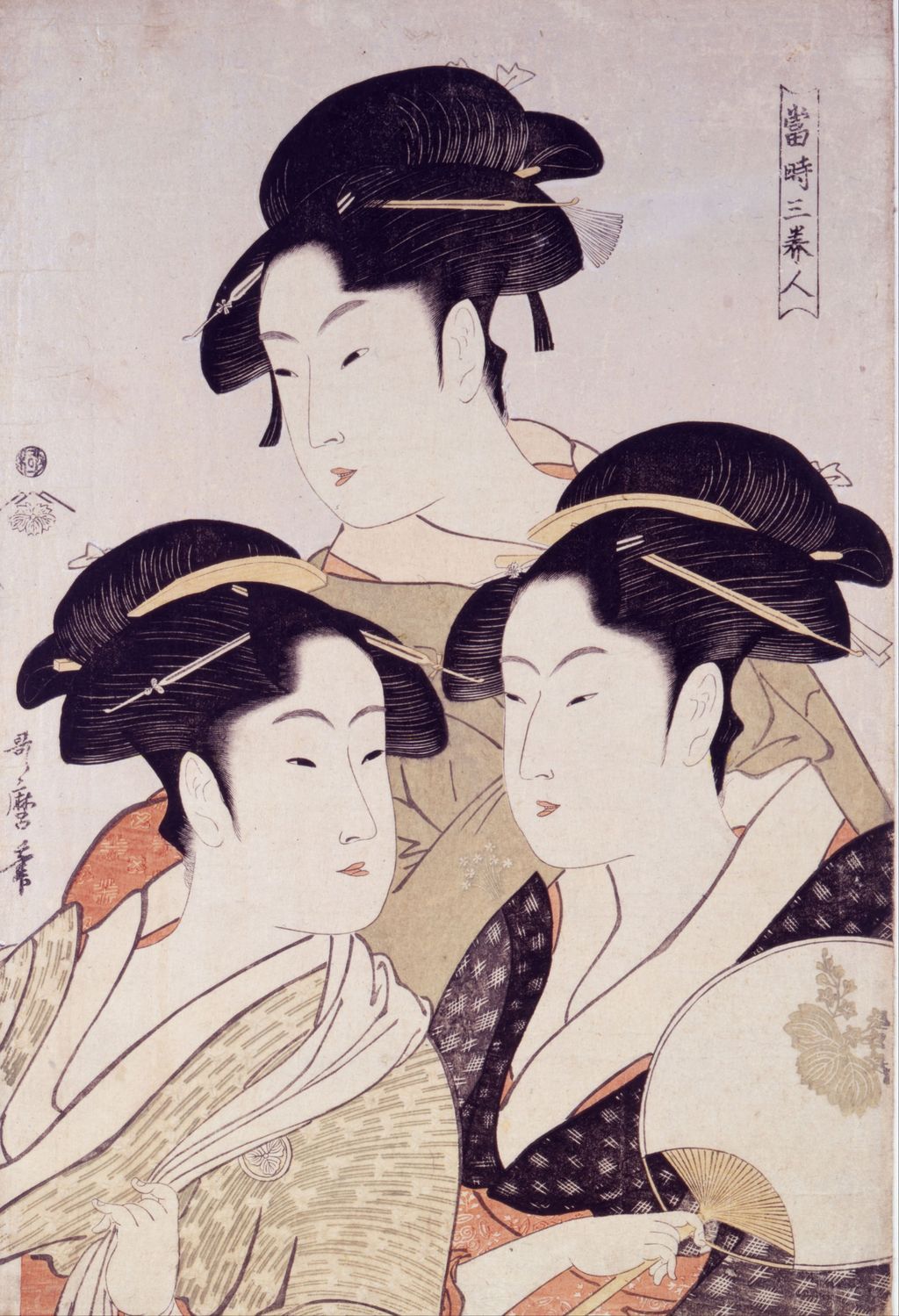
For a single-sheet woodblock print, a design is the planned composition; an impression is an individual sheet printed from blocks. Many impressions may come from the same blocks, and surviving sheets can vary in colour, inscriptions, margins and wear. A later state may change a name or other component of the design. The distinction is more than cataloguing tidiness. A caption claiming that an owner-supplied image is “the Chiba impression” would identify a physical object that has not been matched. This directory can discuss Chiba's design while the site's owner-supplied picture remains labelled as an unassigned impression. The physical source of each image is kept in a separate rights and provenance ledger.
The Chiba City Museum's Three Beauties of the Present Day [3] shows why a state can matter historically. Its 1793, name-bearing object identifies Toyohina, Okita and Ohisa. Chiba describes a later edition in which “Present day” and the women's names were removed following restrictions on naming women other than courtesans in colour prints. Those words can be crucial to how an Edo buyer recognised the sitters. A future comparison of two states would need two documented physical objects and permission for both images. The table currently has one row for the named design, with the state issue explained in article text. It does not fabricate a second row from an unmatched file.
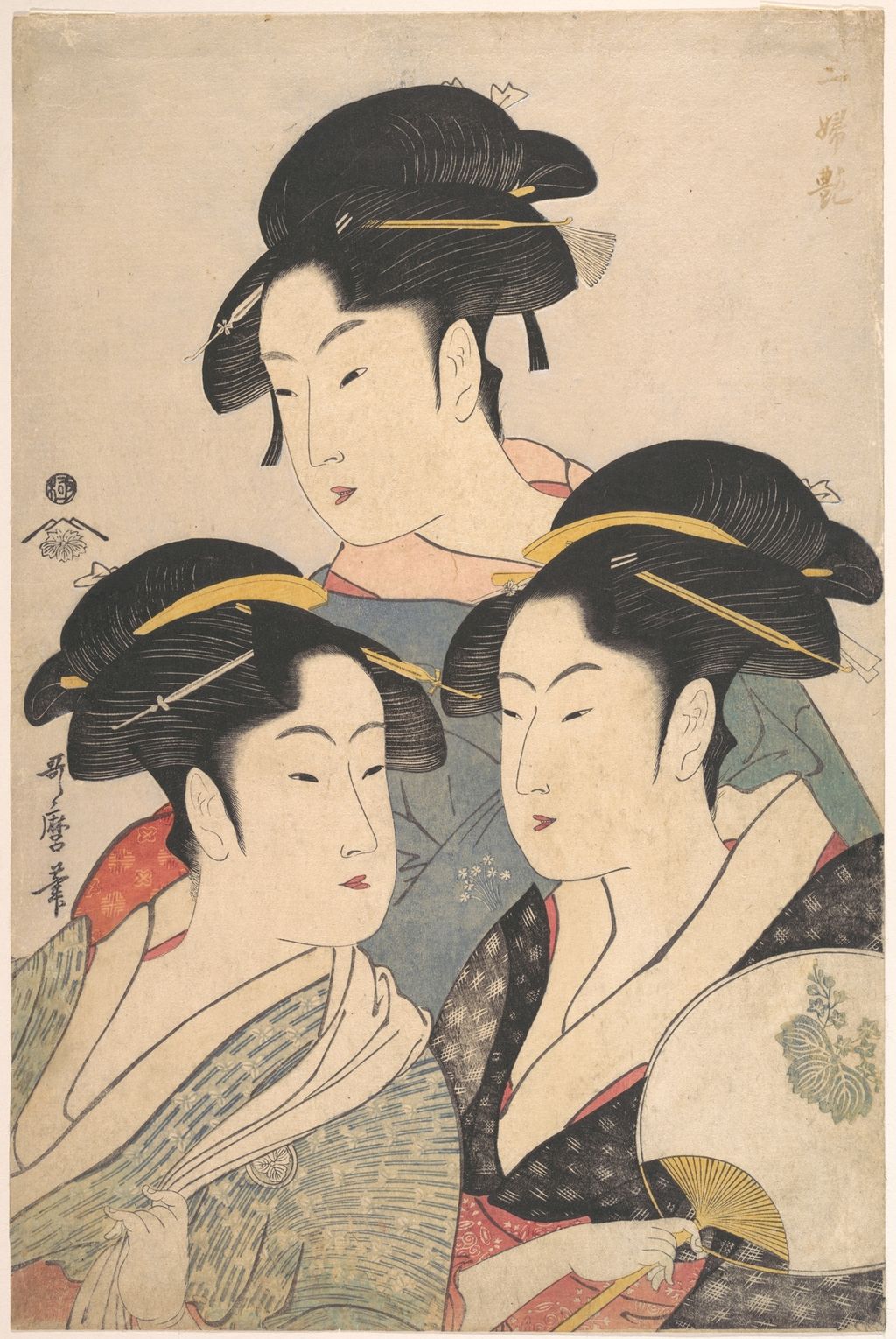
The Met's Three Beauties of the Kwansei Period [9] is a separate object row because its Japanese inscription and catalogue date differ from Chiba's. Visual comparison with the owner-supplied Present Day reproduction shows the same three-figure arrangement, but neither museum record establishes whether the Met sheet is Chiba's later state. The AIC's Three Beauties of Yoshiwara [10] is yet another separately named object. It remains in the research register pending design-level comparison rather than being silently merged or used to fill the Chiba row. A reader can therefore tell exactly which object supports each statement.
Books and leaves are different units
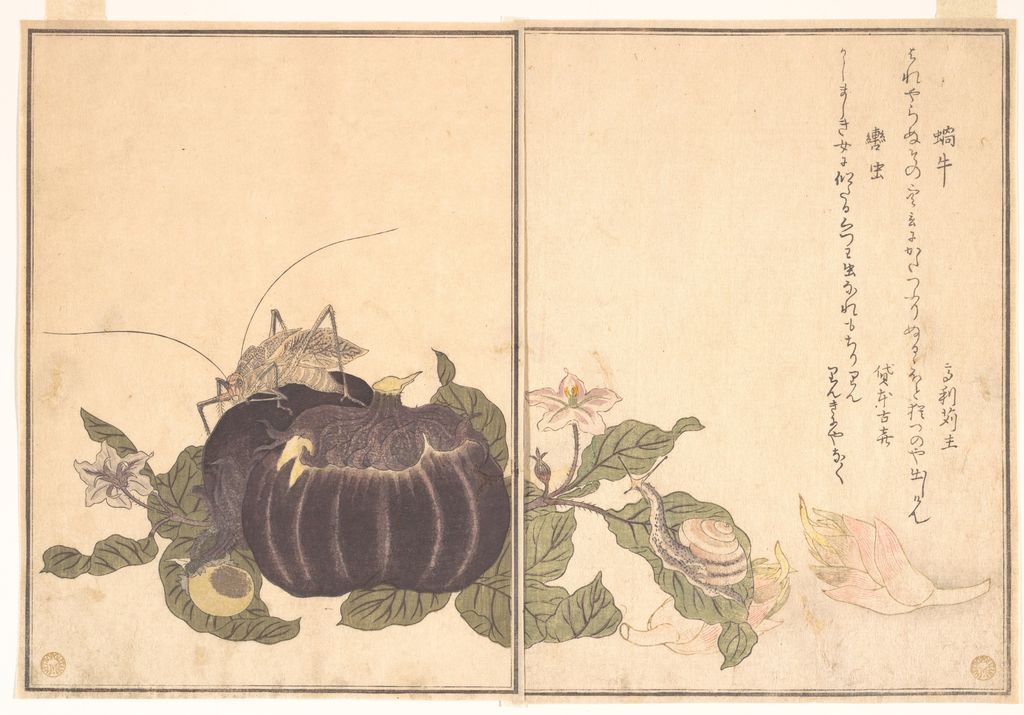
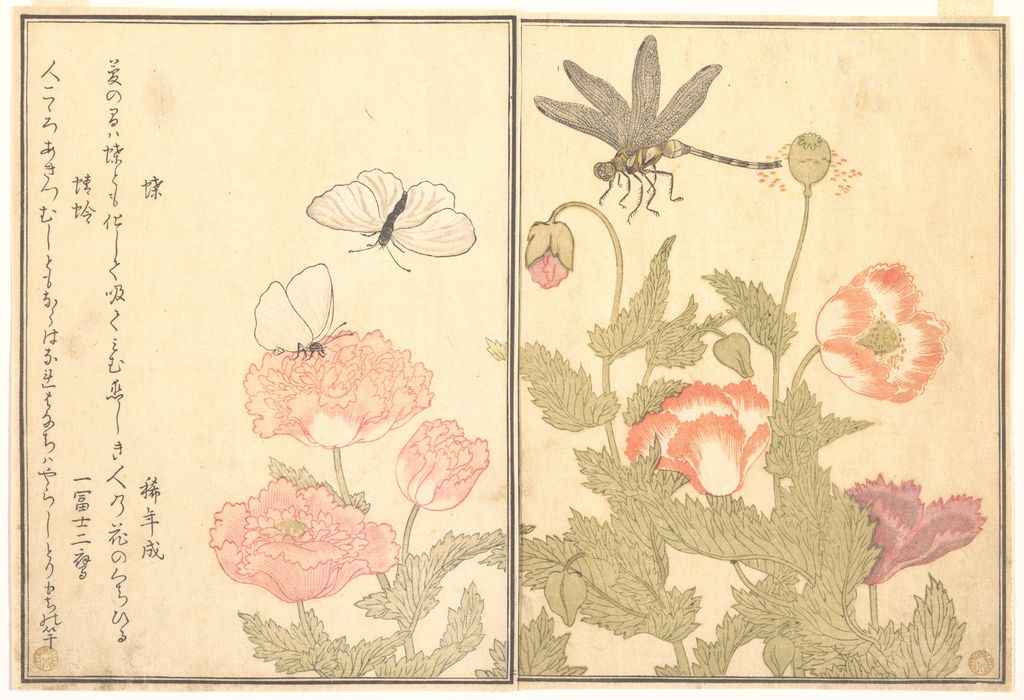
The 1788 Picture Book of Crawling Creatures (Ehon mushi erami, 画本虫撰) is listed as a book, not as fifteen unrelated artworks. The NDL catalogue [5] describes fifteen designs, each combining creatures with two poems; Met objects for a butterfly and dragonfly leaf [2] and a snail and katydid leaf [11] show how a museum can separately catalogue pages. These leaves are excellent evidence for the book and useful subjects for close viewing. They do not automatically become two new standalone page topics or two extra book publications. A reader looking for the book should be led to its structure, collaborators and surviving copies.
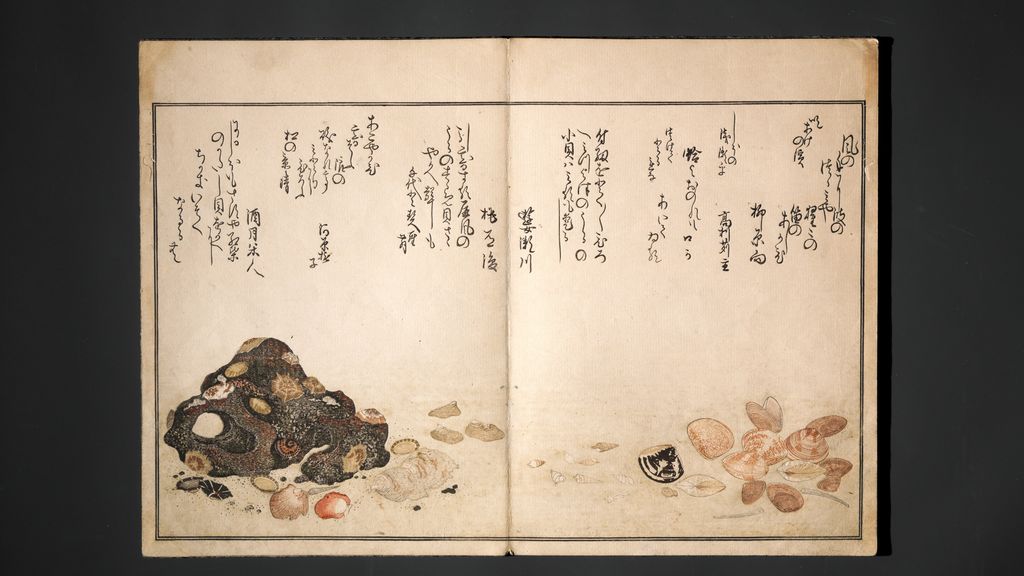
The same principle applies to Gifts of the Ebb Tide (Shiohi no tsuto, 潮干のつと). The Met's object 2013.897 [6] is an accordion-style album with multiple images. The directory gives the publication one row; it does not count each photographed spread as an independent artwork. The Met's two-volume Myriad Birds [7] receives one book-level entry too. Its object date of 1791 sits beside a circa-1790 date in the Tokyo National Museum's exhibition list [12]. The row says “circa 1790–91; copies differ” rather than making a false single first-edition year. Exact bibliographic relationships can be studied in the 2018 Kodansha study recorded by the NDL [13].
The book examples also resist a common visual error. A museum thumbnail might show the first page, a cover, a later volume or one decorated opening, depending on how the collection system selects its lead image. The title Myriad Birds does not tell us which spread appears in a particular thumbnail. Any future book image gallery should preserve the full original, the object and image identifiers, right-to-left reading order where relevant and a caption naming the chosen page. Enlarging a bird alone can help a viewer see Utamaro's line, but the album was made for poetry and page sequence. Directory granularity should follow the publication object even when an image crop is used for explanation.
A series and its twelve related sheets
Explore the twelve hours and identified impressions in the dedicated series guide.
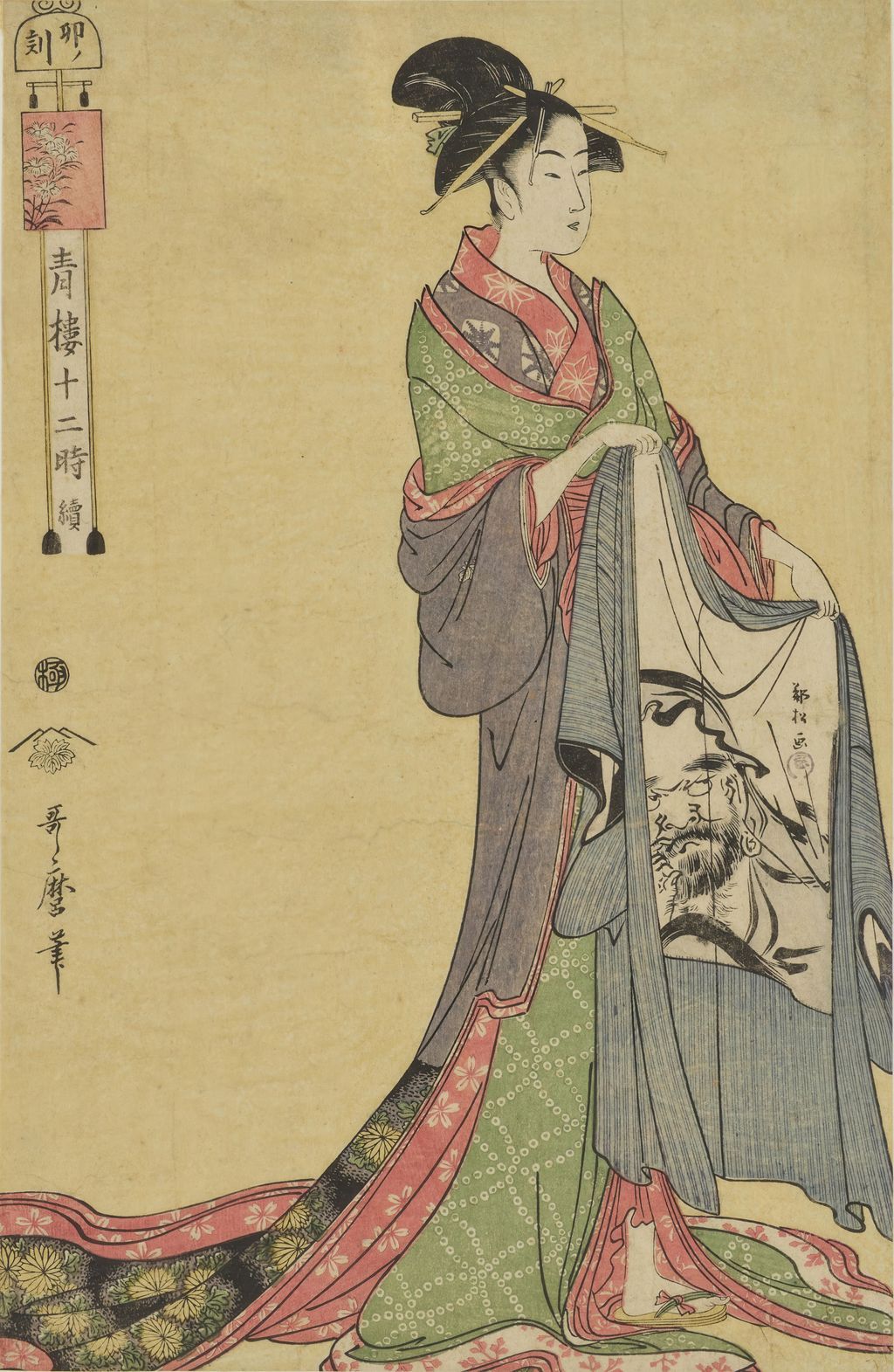
The Twelve Hours of the Yoshiwara (Seirō jūni toki tsuzuki, 青楼十二時 続) is the clearest example of a parent-child relationship in this table. The series has one parent row. Beneath it are twelve AIC object-based sheet rows for Rat, Ox, Tiger, Hare, Dragon, Snake, Horse, Sheep, Monkey, Cock, Dog and Boar. These are twelve separate museum records attributed to Utamaro and identified in AIC's collection [14]. The table shows thirteen directory entries because a series and its components answer different questions; it does not say Utamaro made thirteen separate time-series designs. Each sheet's exact AIC accession and object link are available in the disclosure below the table.
The AIC describes the sheets as around 1794. A British Museum Hour of the Horse [15] is dated around 1795 and shows the hour name within a stylised clock motif. An approximate 1794–95 series range acknowledges both records without assuming that every surviving sheet was pulled in one session or one year. The AIC's Rat record includes a bracketed English “12pm” conversion even though the Rat interval belongs around midnight in the usual zodiacal clock. The directory deliberately preserves the Japanese hour name and omits that problematic conversion until an authoritative reconciliation is found.
There are other clock-titled works by Utamaro. The British Museum's Hour of the Rat, the Mistress [16] belongs to Customs of Beauties Around the Clock, a differently named series. It has no row among the twelve Seirō jūni toki tsuzuki sheets. The title of a series, the printed mark on an object and the holding museum's catalogue all matter more than a broad English search for “Utamaro hour.” A future dedicated page can offer a closer reading of all twelve AIC sheets while keeping other impressions and series distinct.
Prints, legends and a painting
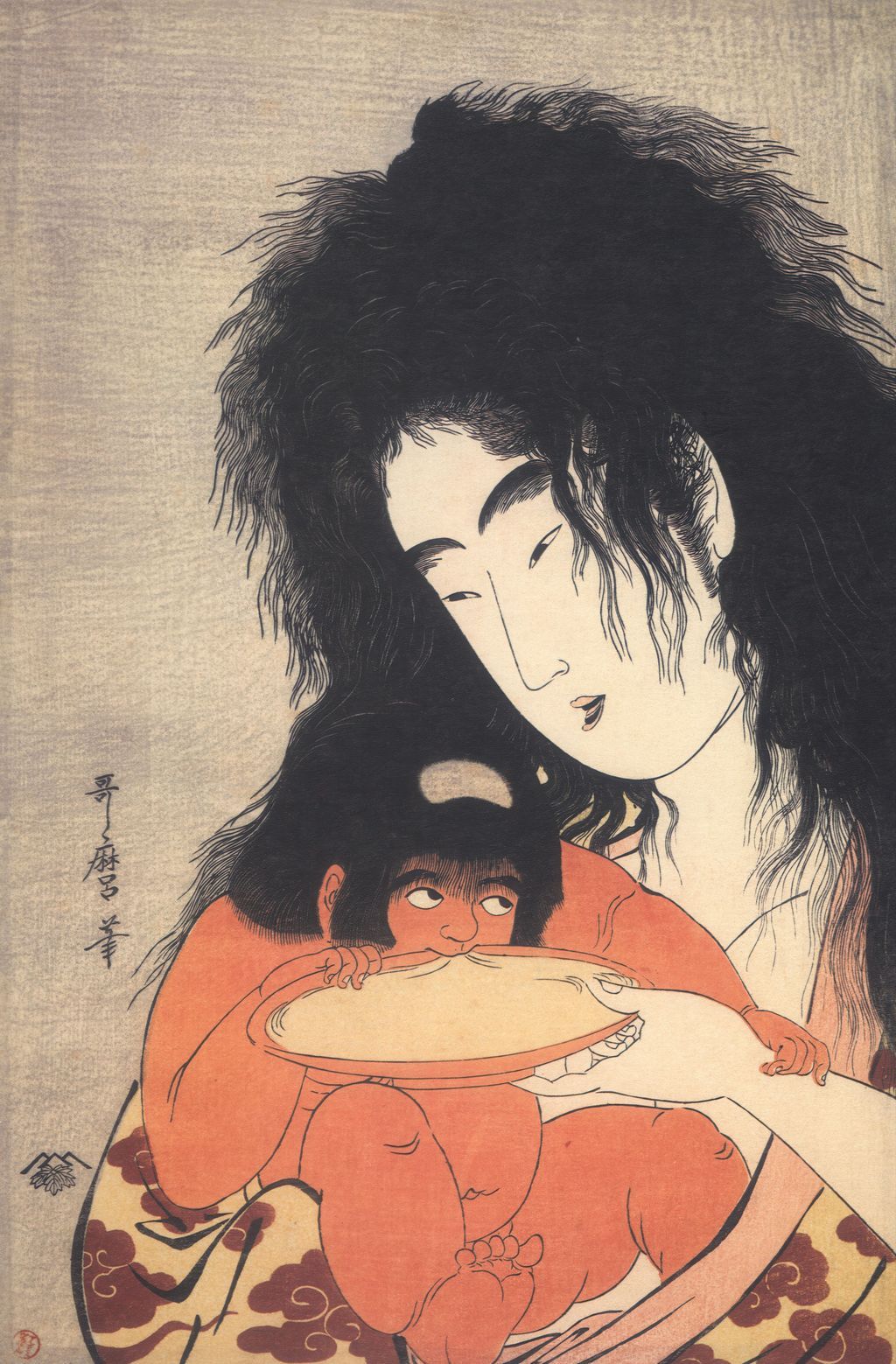
The directory reaches beyond named women. The Met's Yamauba and Kintarō [17] is a circa-1795 impression of a legendary mountain woman and boy. The museum notes many Utamaro images of this pair. The listed row is tied to Met JP980; it does not claim that all such designs are one work. A separately supplied image of another Yamauba and Kintarō composition is useful for showing the subject, but no unverified accession is attached. This difference between a recurring subject and an identical design is one of the most important limits in any artist-wide directory.
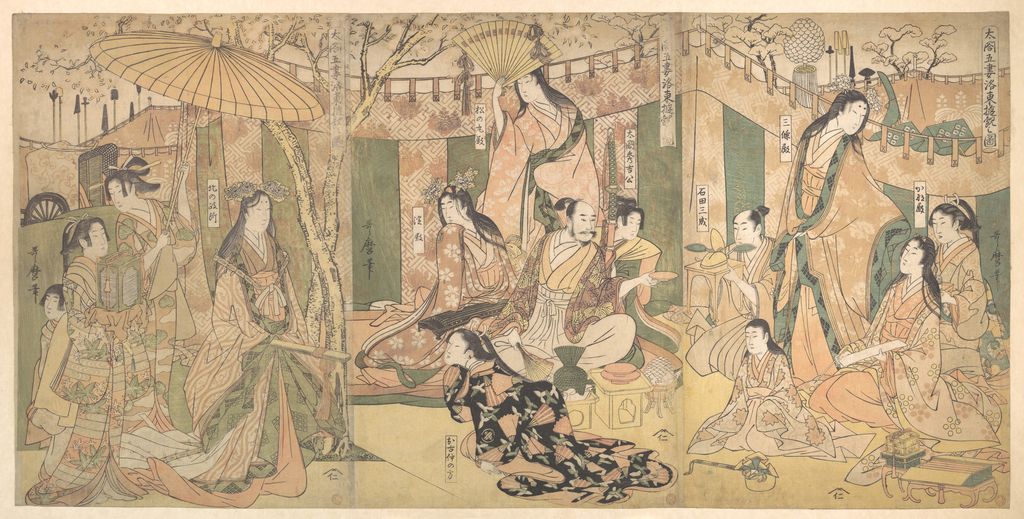
The British Museum's Mashiba Hisayoshi [18] is included as one historical print linked to the 1804 censorship discussion. Its catalogue names Moriya Jihei as publisher and analyses a later account of the case. A row for this object does not turn one sheet into the sole cause of the punishment or merge the print with the Met's separate Hideyoshi triptych [19]. Different compositions, publishers and editions must retain their own identities. The British Museum's Standing Courtesan Reading a Letter [4], dated about 1805–06, supplies the directory's first painting. Its hanging-scroll medium is displayed as such; a filter can isolate painting without mislabelling woodblock prints as drawings merely to fill a menu.
Those examples expose the danger of an attractive but inaccurate count. The directory has twenty-two entries, of which thirteen concern one series and its sheets. It has only one Yamauba impression although the subject recurs. It lists three books but does not multiply them by photographed leaves. It includes a painting despite the page's print-heavy start. A count can be useful only when the units and institutional boundaries are beside it. Future expansion should add newly reviewed designs, documented paintings and books from Japanese, British and American collections, then reconcile overlaps with the present rows.
How to use the searchable table
The table follows this explanation, before the FAQ. It is ordinary HTML: all twenty-two entries and their dates and media are in the page even before scripts run. The search field narrows by English title, Japanese title or stable identifier; a medium filter appears because a verified painting and print/book entries coexist. Reset restores the complete reviewed set. The institution-source disclosure beneath the table gives an object link for each row, including the twelve hour sheets. Those external links lead to a museum or library record; they are not substitutes for an unbuilt local article. Local work-page links can be added after each corresponding page is researched, illustrated and checked.
One entry's medium is not a universal template for every object with a related title. The three books are shown as illustrated woodblock books, the 1786 collaborative object as a surimono, the time-series sheets and named portraits as colour woodblock prints, and the late courtesan as a hanging-scroll painting. A date remains approximate where its source record says so. Some Japanese names have orthographic variants, such as 楼 and 樓 or 続 and 續 in the Twelve Hours title; the search aliases can accommodate those without creating false extra works. The stable identifier is for this site's editorial record, not a claim that the institution recognises a single global work ID.
For a visual route, begin with three units of different sizes: the book Picture Book of Crawling Creatures, one sheet such as Hour of the Hare, and the whole Twelve Hours series. Their records answer different questions about one artist's work. Then compare the owner-supplied Three Beauties reproduction with the physically distinct Met impression: the arrangement repeats, but the title inscription changes. This route teaches more than scrolling through 287 thumbnails under one artist name: it shows what a work is, what a record is, and where the gaps remain.
Images, publishers and the physical print
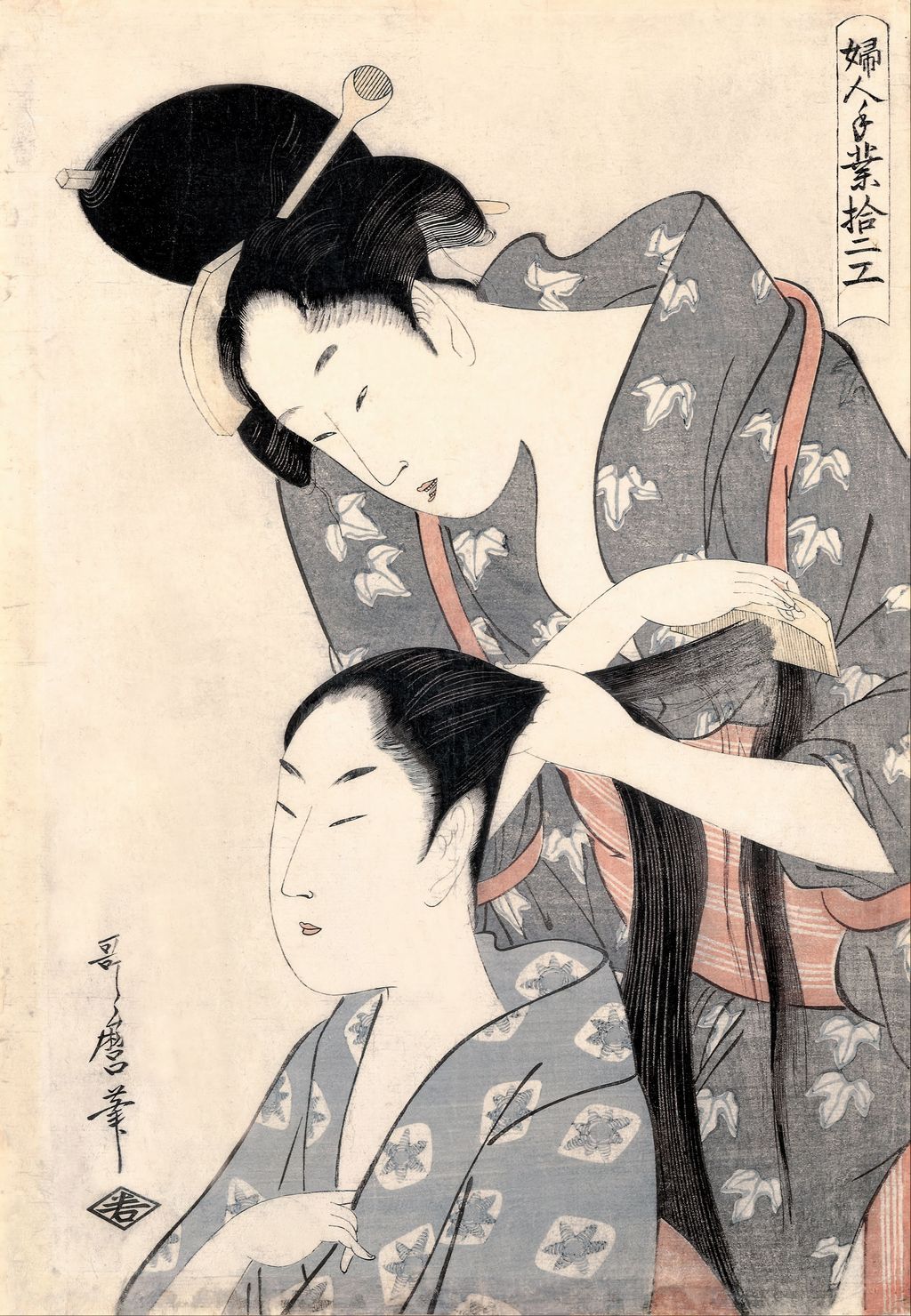
A directory built from images alone would miss the production history behind the pictures. The AIC's Artist, Block Carver, Applying Sizing, object 36175 [23], is a triptych attributed to Utamaro and catalogued at about 1803. Its subject is the labour of making prints. It belongs in the research register as a strong candidate for a future article or a production explainer, but this first public table has not yet resolved the complete triptych against related sheets and publication details. Even as a source lead, it is a reminder that the drawn composition had to be turned into cut blocks, registered colours and a finished sheet. A digital reproduction often hides that division of work behind one familiar artist name.
Publisher information should be treated as object-specific in the same way. Tsutaya Jūzaburō issued the NDL's 1788 insect book [5] and was central to the portrait programme described in the NDL's exhibition [24]. The British Museum's Mashiba Hisayoshi [18], however, names Moriya Jihei. An artist-wide metadata field simply labelled “publisher: Tsutaya” would therefore misdescribe at least one row in this small selection. A source record needs publisher at the object or publication level, with uncertainty where an impression does not carry a clear mark. The same applies to date, technique and dimensions.
The distinction between an image file and a physical object is especially sharp for prints. The file may be an institutional scan of a particular sheet, a photograph of a mounted album leaf, or an owner-supplied public-domain reproduction that has been enlarged for better display. A pixel count tells us about the digital copy, not the original sheet's size, ink or state. The site's production files are scaled to 1024 pixels wide, JPEG quality 80 and 144 dpi for efficient article display; the original uncropped museum file and any 300 dpi annotation working base are kept separately. Those export settings make a page consistent, but they cannot turn an uncertain reproduction into a proven first impression. The accession, Japanese inscription, title and source rights have to accompany the image decision.
This is why a table row can be ready before its illustration is. The Chiba museum's record [3] supplies an exact named composition and an unusually valuable state explanation. That supports a verified textual entry. It does not, by itself, grant the right to place Chiba's photograph on a commercial site. The British Museum painting record [4] is equally valuable for identifying a late work without being treated as an automatic image licence. Met and AIC open-access files can be used when the particular object's public-domain status and the actual downloaded file are checked. Separating identity from reuse rights lets the directory grow on the strength of scholarship without encouraging an unverified image shortcut.
Japanese titles and a three-record comparison
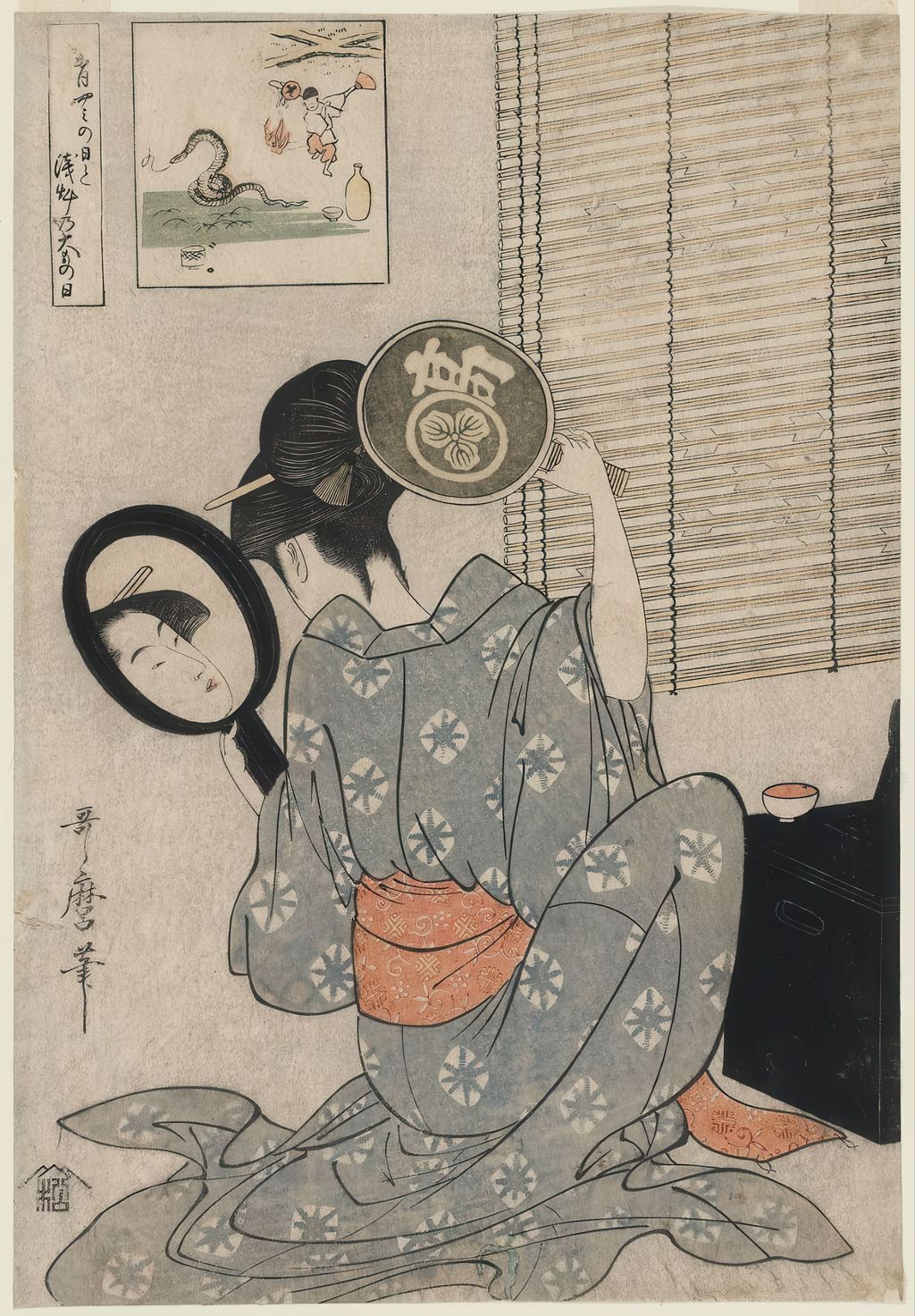
The Japanese title is often the first clue that two English labels should remain apart. Chiba's 当時三美人 includes the sense of “present day” and identifies three named women on its documented sheet. The Met's Three Beauties of the Kwansei Period [9] records the inscription 三婦艶, not the same printed wording; its three figures occupy the same positions as those in the owner-supplied reproduction. The AIC's Three Beauties of Yoshiwara [10] has another catalogue identity. A work-level directory should retain their separate accession numbers and Japanese words, distinguish a shared composition from a proven edition relationship, and treat English translation as an aid to discovery rather than an authority over an inscription.
Even a Japanese name can vary between sources. 青楼十二時 続, 青樓十二時 續 and spaced or unspaced versions can refer to the same named series in museum catalogues. The Tokyo National Museum's 2025 object list [12] and its collection exhibition listing for the Ox hour [25] show why historical characters and modernised type need to be read rather than mechanically normalised. Search aliases can include 楼 and 樓 without creating two series rows. Conversely, a different series title should stay distinct even if both titles contain “hour.” The goal is to make searches forgiving while keeping the record exact.
The three-beauties comparison also illustrates why subject identity and work identity are different. Toyohina can appear alone in a print and within a three-woman design. A face that a museum names in both objects does not mean the sheets are states of one design. AIC's individually catalogued Tomimoto Toyohina [26] is a source lead for a named-sitter route, while the Chiba group print is a source for a compositional and publication-state route. A directory could link both under the same sitter in a future relationship field, but it should count the print designs separately. A robust site map may therefore have three layers: the person depicted, the design or series, and the physical museum object. Flattening them into one search row would make the site appear simpler at the cost of wrong identifications.
The same logic applies to books with several leaves: one person can be involved in many images, and one publication can hold many images. A well-labelled relationship is more useful than an artificially inflated total. It lets an English reader and a Japanese reader start from different title forms and still reach the same object evidence. It also makes later correction possible. If an institution revises an attribution or dates a copy differently, the accession-level source can be updated without erasing the editorial distinction between a book, a design and an impression.
What is not yet represented
This first table omits many accepted Utamaro objects. The AIC exact-artist set alone contains hundreds more records. AIC's Women watching fireworks at Sumida River, object 110740 [20], is a triptych requiring a design-level treatment; its three-sheet form should be checked as a whole rather than added as a vague single “Fireworks” row. Its Yamauba with Kintarō Holding a Toy Mask, object 3568 [21], is another design from the recurring subject, not automatically the Met JP980 print. A three-left-sheet fragment of a five-sheet New Year cleaning design, object 21687 [22], raises a different problem: the museum object does not show the whole original composition. These are valuable candidates, not grounds for disguising an incomplete object as a complete work.
Paintings remain especially under-represented because source images and rights differ from the plentiful public-domain print files. The British Museum's late hanging scroll is one secure textual entry. More paintings should be compared against specialist catalogues, Japanese museum records, attribution language and file permissions. Likewise, the historic source trail for early actor images and books under earlier names needs review before their inclusion as exact Utamaro I rows. Attribution to Utamaro II, a follower, a copyist or “after Utamaro” belongs outside the accepted-work table unless clearly marked as a different category. Similar appearance is not enough to override the object's attribution.
The source register will keep expanding, but it should not quietly increase the public count each time a museum record is found. A new accession may be a second impression of an existing design, a book leaf from a listed title, or one sheet from a known triptych. Before adding a row, the editor should ask: What is the unit? Is the artist Utamaro I? Is there a parent work? Does the Japanese title identify the same design? Which date belongs to this object? What can be linked and illustrated? The answers turn a catalogue scrape into a trustworthy guide.
Selected works and series
Twenty-two reviewed entries tied to museum objects or book records. The Twelve Hours parent series and its twelve sheets are related entries, not thirteen unrelated designs. This is not a count of all Utamaro works.
| Name | Date | Medium |
|---|---|---|
| Sekien, Sekichūjo and Utamaro collaborative surimono | 1786 | Privately commissioned woodblock print |
| Picture Book of Crawling Creatures (Ehon mushi erami) | 1788 | Illustrated woodblock book |
| Gifts of the Ebb Tide (Shiohi no tsuto) | probably 1789 | Illustrated woodblock book |
| Myriad Birds (Momo chidori kyōka-awase) | circa 1790–91; copies differ | Illustrated woodblock book |
| Three Beauties of the Present Day (Tōji san bijin) | 1793, Chiba impression | Colour woodblock print |
| Three Beauties of the Kwansei Period (Met JP1528) | circa 1791, Met catalogue | Colour woodblock print |
| Twelve Hours of the Yoshiwara (Seirō jūni toki tsuzuki) | circa 1794–95 | Colour woodblock print series |
| Twelve Hours of the Yoshiwara: Hour of the Rat | circa 1794, AIC catalogue | Colour woodblock print |
| Twelve Hours of the Yoshiwara: Hour of the Ox | circa 1794, AIC catalogue | Colour woodblock print |
| Twelve Hours of the Yoshiwara: Hour of the Tiger | circa 1794, AIC catalogue | Colour woodblock print |
| Twelve Hours of the Yoshiwara: Hour of the Hare | circa 1794, AIC catalogue | Colour woodblock print |
| Twelve Hours of the Yoshiwara: Hour of the Dragon | circa 1794, AIC catalogue | Colour woodblock print |
| Twelve Hours of the Yoshiwara: Hour of the Snake | circa 1794, AIC catalogue | Colour woodblock print |
| Twelve Hours of the Yoshiwara: Hour of the Horse | circa 1794, AIC catalogue | Colour woodblock print |
| Twelve Hours of the Yoshiwara: Hour of the Sheep | circa 1794, AIC catalogue | Colour woodblock print |
| Twelve Hours of the Yoshiwara: Hour of the Monkey | circa 1794, AIC catalogue | Colour woodblock print |
| Twelve Hours of the Yoshiwara: Hour of the Cock | circa 1794, AIC catalogue | Colour woodblock print |
| Twelve Hours of the Yoshiwara: Hour of the Dog | circa 1794, AIC catalogue | Colour woodblock print |
| Twelve Hours of the Yoshiwara: Hour of the Boar | circa 1794, AIC catalogue | Colour woodblock print |
| Yamauba and Kintarō | circa 1795, Met impression | Colour woodblock print |
| Mashiba Hisayoshi historical print | circa 1803–04, BM impression | Colour woodblock print |
| Standing Courtesan Reading a Letter | circa 1805–06, BM catalogue | Hanging-scroll painting |
View the institution records behind these entries
- Sekien, Sekichūjo and Utamaro collaborative surimono — Met 2022.312
- Picture Book of Crawling Creatures (Ehon mushi erami) — NDL WA32-8
- Gifts of the Ebb Tide (Shiohi no tsuto) — Met 2013.897
- Myriad Birds (Momo chidori kyōka-awase) — Met JIB43
- Three Beauties of the Present Day (Tōji san bijin) — Chiba 2943024
- Three Beauties of the Kwansei Period (Met JP1528) — Met JP1528
- Twelve Hours of the Yoshiwara (Seirō jūni toki tsuzuki) — BM 1935,1214,0.8; AIC twelve-object set
- Twelve Hours of the Yoshiwara: Hour of the Rat — AIC 1925.3062 (sheet within Twelve Hours)
- Twelve Hours of the Yoshiwara: Hour of the Ox — AIC 1925.3051 (sheet within Twelve Hours)
- Twelve Hours of the Yoshiwara: Hour of the Tiger — AIC 1925.3052 (sheet within Twelve Hours)
- Twelve Hours of the Yoshiwara: Hour of the Hare — AIC 1925.3053 (sheet within Twelve Hours)
- Twelve Hours of the Yoshiwara: Hour of the Dragon — AIC 1925.3054 (sheet within Twelve Hours)
- Twelve Hours of the Yoshiwara: Hour of the Snake — AIC 1925.3055 (sheet within Twelve Hours)
- Twelve Hours of the Yoshiwara: Hour of the Horse — AIC 1925.3056 (sheet within Twelve Hours)
- Twelve Hours of the Yoshiwara: Hour of the Sheep — AIC 1925.3057 (sheet within Twelve Hours)
- Twelve Hours of the Yoshiwara: Hour of the Monkey — AIC 1925.3058 (sheet within Twelve Hours)
- Twelve Hours of the Yoshiwara: Hour of the Cock — AIC 1925.3059 (sheet within Twelve Hours)
- Twelve Hours of the Yoshiwara: Hour of the Dog — AIC 1925.3060 (sheet within Twelve Hours)
- Twelve Hours of the Yoshiwara: Hour of the Boar — AIC 1925.3061 (sheet within Twelve Hours)
- Yamauba and Kintarō — Met JP980
- Mashiba Hisayoshi historical print — BM 1942,0124,0.13
- Standing Courtesan Reading a Letter — BM 2014,3048.1
Frequently asked questions
No. It is a twenty-two-entry reviewed selection with a deliberately stated institutional source set. It includes a series and its twelve sheets, so it is not a count of twenty-two independent designs or Utamaro's complete output.
One row identifies the parent series and twelve rows identify twelve separate sheets in an AIC set. They are labelled as related units; the parent is not an extra print.
No. A design is a planned image; an impression is a physical sheet printed from blocks. Several impressions, states or later copies may correspond to a recognisable design. The row's granularity and the linked institution record show what is actually documented.
Chiba, the Met and AIC catalogue differently titled and inscribed objects. The Met image shares the owner image's arrangement, but that alone does not establish an edition or state relationship to Chiba's sheet.
The object links are research and identification sources, not a blanket image licence. The rights and exact image file need to be checked at each holding institution before production use.
An entry gains a local link when its dedicated article exists and passes editorial, image and route review. Until then the institution record remains available under the table, and the HTML row remains searchable.
References
- Art Institute of Chicago, public API documentation.
- Metropolitan Museum of Art, insect-book butterfly and dragonfly leaf, JP1046.
- Chiba City Museum of Art, Three Beauties of the Present Day, 2943024.
- British Museum, Standing Courtesan Reading a Letter, 2014,3048.1.
- National Diet Library, Picture Book of Crawling Creatures, 1788, WA32-8.
- Metropolitan Museum of Art, Gifts of the Ebb Tide, 2013.897.
- Metropolitan Museum of Art, Myriad Birds, JIB43.
- Metropolitan Museum of Art, collaborative surimono, 2022.312.
- Metropolitan Museum of Art, Three Beauties of the Kwansei Period, JP1528.
- Art Institute of Chicago, Three Beauties of Yoshiwara, 23883.
- Metropolitan Museum of Art, snail and katydid insect-book leaf, JP1054.
- Tokyo National Museum, Tsutaya exhibition object list.
- National Diet Library, 2018 Kodansha book on Utamaro's three poetry books.
- Art Institute of Chicago, Hour of the Hare, 23953.
- British Museum, Hour of the Horse, 1935,1214,0.8.
- British Museum, Hour of the Rat, the Mistress, other series.
- Metropolitan Museum of Art, Yamauba and Kintarō, JP980.
- British Museum, Mashiba Hisayoshi, 1942,0124,0.13.
- Metropolitan Museum of Art, Hideyoshi triptych, JP992.
- Art Institute of Chicago, Women watching fireworks at Sumida River, 110740.
- Art Institute of Chicago, Yamauba with Kintarō Holding a Toy Mask, 3568.
- Art Institute of Chicago, New Year cleaning fragment, 21687.
- Art Institute of Chicago, Artist, Block Carver, Applying Sizing, 36175.
- National Diet Library, Tsutaya Jūzaburō exhibition.
- Tokyo National Museum, Twelve Hours Ox-hour exhibition entry.
- Art Institute of Chicago, Tomimoto Toyohina, 89349.
