 by Tom Gurney
Tom Gurney BSc (Hons) is an art history expert with over 20 years experience
Published on June 19, 2020 / Updated on November 6, 2026
Email: tomgurney1@gmail.com / Phone: +44 7429 011000
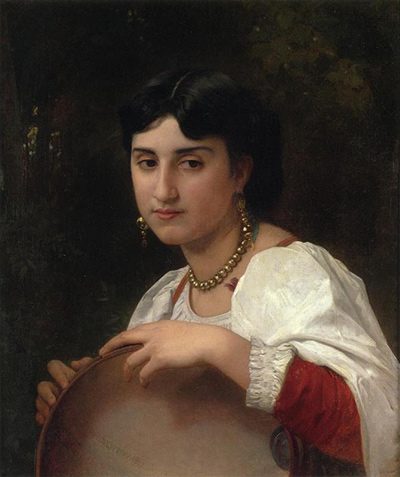
Italian Woman with Tambourine by William-Adolphe Bouguereau
William-Adolphe Bouguereau's Italian Woman with Tambourine presents a young woman at half length, looking towards the viewer while resting her hands on a large circular instrument. The tambourine is quiet. There is no visible dance, audience or moment of performance. Instead, the instrument helps establish a pose, a setting of associations and a strong shape across the lower part of the canvas.
The work is also catalogued under the French title Italienne au tambourin. Sotheby's identifies the 1869 painting as an oil on canvas measuring 64.1 by 54.2 centimetres, signed and dated on the tambourine. This is the comparatively small, half-length composition, which should be distinguished from other paintings of Italian girls or women holding similar instruments. [1]
At a Glance
- Date1869
- MediumOil on canvas
- CatalogueSotheby’s, 2013, lot 16
Works in context
Contents
The face and the encounter with the viewer
The woman's face occupies the upper central area of the picture, framed by dark hair and the subdued background. Her head is slightly turned, so the encounter is not a perfectly symmetrical confrontation. The eyes nevertheless meet the viewer closely enough to make the image feel like an individual presence rather than a figure observed from a distance.
Bouguereau builds that presence through small differences of tone around the eyelids, nose and mouth. The face does not need an emphatic expression to hold attention. Its relative stillness allows the surrounding details—the earrings, necklace, white fabric and red sleeve—to acquire importance without competing with an overt narrative gesture.
The distinction between a depicted person and an identified sitter is essential. The painting offers a convincing likeness, but that does not supply a documented name, personal history or profession. Neither the title nor the tambourine establishes that this woman actually earned her living as a musician. The visible pose can be discussed without inventing the circumstances in which a model lived.
A composition built around the tambourine
The instrument's broad circle gives the lower half of the image a clear organising shape. Its curved rim answers the gentler curves of shoulders, sleeves and hands while contrasting with the upright format of the canvas. Because the tambourine extends beyond the bottom edge, the viewer encounters it as an object close to the picture plane.
The placement of the hands makes that proximity persuasive. One hand rests across the upper edge, while the other helps establish the instrument's position. The fingers do not simply point towards it as an identifying attribute. They describe contact: the relationship between a body's weight and the object that supports or receives it.
This is a useful place to consider the painting's lack of sound. An instrument conventionally promises movement and music, yet here its most immediate function is structural. The woman's pause becomes more noticeable because the tambourine could have been active. Bouguereau gives the object enough descriptive clarity to make that suspended possibility legible.
White cloth, red sleeves and dark surroundings
The blouse is one of the brightest parts of the picture. Its folds and gathered edges create a sequence of small changes in light, drawing attention to the shoulder and the wrist. The white is not uniform. Warm and cool variations suggest the turning of fabric, while deeper folds keep it from becoming a flat patch.
The red sleeves supply a more concentrated colour. They anchor the lower sides of the figure and help distinguish the clothing from the skin and instrument. The dark background then allows these colour relationships to remain clear. It suggests an outdoor setting through restrained indications rather than through a fully described landscape.
Comparing the different surfaces reveals how deliberately the picture is organised. Skin, woven fabric, jewellery and the tambourine do not reflect light in the same way. Bouguereau makes those differences visible while maintaining an unusually smooth overall effect. The viewer can recognise the materials without being distracted by conspicuous, isolated brush marks.
The Italian figure as a nineteenth-century subject
The title places the woman within a category familiar to nineteenth-century European art: an Italian figure presented through distinctive dress, appearance and an associated activity. Such images belong to a history of artistic travel, studio models and an audience interested in regional costumes and idealised everyday life.
The Musée de Grenoble's discussion of Dominique Papety's Italian tambourine subject places Bouguereau's 1869 composition within a broader tradition that also included Léopold Robert. The comparison is valuable because it establishes that the subject was shared among artists; the presence of a tambourine does not make every such image a variation of one Bouguereau painting. [2]
At the same time, the category needs to be read critically. A costume can make a figure seem representative of a place while concealing the particulars of the person who posed. What appears to be an uncomplicated glimpse of local life may be a carefully constructed studio image. The painting's descriptive skill and its idealisation should be considered together.
An object history beyond the studio
Sotheby's records the work's early passage through Holloway, Goupil and Barbedienne in December 1869, followed by its presence in the collection of the American financier James Buchanan Brady. Later sale records form part of its history as a collected object. These documents help distinguish the painting from other works with similar titles. [1]
They do not, by themselves, explain the woman's expression or the meaning of every detail. Provenance and interpretation answer different questions. A chain of ownership can establish where a canvas has been recorded; close looking addresses how its surface and composition affect the viewer.
The distinction also prevents a past auction location from being mistaken for a permanent museum home. The work's recorded appearance in a sale catalogue establishes that transaction or offering, not a current public display location. A responsible account should retain the documented history without supplying an unsupported present owner.
Restraint within an academic finish
Bouguereau's highly controlled finish is sometimes treated as though it removes all tension from a painting. This work shows why that is too simple. Its polished surface supports a series of contrasts: a direct look and a reserved expression, an instrument and silence, an apparently casual posture and a tightly organised design.
The face is the main point of contact, but the picture's stability depends on the tambourine and hands. The bright blouse attracts attention, but it remains effective because of the surrounding darkness. Each apparently attractive detail has a compositional role.
The work is therefore best approached through those relationships rather than through a general claim that it is lifelike. Its illusion of presence is selective. Bouguereau gives viewers just enough setting, costume and gesture to make the woman seem near, while withholding a definite story about what she is thinking or what will happen next.
Artworks and records
Selected documented works and records relevant to this article; this is not a complete catalogue.
| Name | Date | Record |
|---|---|---|
| Italian Woman with Tambourine | 1869 | Painting |
| Mignon Pensive | 1869 | Painting |
| Mignon Pensive — print after Bouguereau | Nineteenth century |
Discussion
Share a reading of the figures, materials or relationships discussed in this article.
Reader Insights
Which detail most affects your reading?
Which comparison would you like to explore further?
Join the Conversation
Share a detail, comparison or question about Italian Woman with Tambourine by William-Adolphe Bouguereau below.
References
- Sotheby's, William Bouguereau, Italienne au tambourin, 19th Century European Art, 2013, lot 16: signature, date, dimensions and provenance. View source.
- Musée de Grenoble, Dominique Papety, Femme italienne jouant du tambourin, discussion of the Italian tambourine subject. View source.
- Marius Vachon, W. Bouguereau, Paris, 1900, contemporary biography and catalogue of the artist's work. View source.
- Christie’s, Mignon Pensive, 1869. View source.