 by Tom Gurney
Tom Gurney BSc (Hons) is an art history expert with over 20 years experience
Published on June 19, 2020 / Updated on August 29, 2026
Email: tomgurney1@gmail.com / Phone: +44 7429 011000
Overview
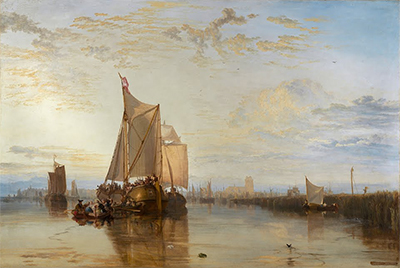
J. M. W. Turner's Dort, or Dordrecht: The Dort Packet-Boat from Rotterdam Becalmed is an 1818 oil painting in the Yale Center for British Art, Paul Mellon Collection, accession B1977.14.77.[1] The work measures 62 x 92 inches, or 157.5 x 233.7 cm, and belongs to the period when Turner was translating continental travel, Dutch precedent and British exhibition ambition into large public canvases.[1]
The painting shows Dordrecht from the water, with a large Rotterdam vessel held in a calm river setting. The scene is becalmed, but it is not empty. Boats, passengers, supplies, distant buildings, broad water and golden light create a dense social panorama. Yale's interpretation connects the painting to Turner's 1817 journey to continental Europe, when he passed through Dordrecht and began studies for a composition of boats at rest.[1]
The work should be approached as both a river picture and a statement about artistic inheritance. Turner looks toward Dutch marine and river painting, especially the luminous tradition associated with Aelbert Cuyp, but he does not simply imitate a seventeenth-century model. He makes the subject larger, richer in colour, more crowded with incident and more pointedly tied to the postwar world of 1817-1818.
For clarity, this article uses Dort after the full Yale title has been established. That shortened form is common, but it should not blur the object with other Dutch subjects by Turner, other Dordrecht views, or other images of boats in calm water.
At a Glance
- ArtistJoseph Mallord William Turner
- Full titleDort, or Dordrecht: The Dort Packet-Boat from Rotterdam Becalmed
- Date1818
- MediumOil on canvas
- Dimensions157.5 x 233.7 cm
- CollectionYale Center for British Art
- Collection groupPaul Mellon Collection
- AccessionB1977.14.77
- ExhibitedRoyal Academy, London, 1818
- Display statusNot on view at source verification; check before visiting
Contents
- Overview
- Object Identity
- Dordrecht and the 1817 Journey
- A Becalmed Scene Filled with Incident
- Dutch Marine Painting and Cuyp
- Light, Colour and River Space
- The Central Vessel
- Royal Academy Ambition
- Patronage and Provenance
- The Dordrechts Museum Return
Object Identity
The Yale Center for British Art identifies the painting as a work by Joseph Mallord William Turner, British, 1775-1851, dated 1818.[1] Its medium is oil on canvas, and the Yale record used here gives the dimensions as 62 x 92 inches, equivalent to 157.5 x 233.7 cm.[1] Those measurements matter. This is not a small travel study enlarged in reputation after the fact; it is a major exhibition-scale painting.
The accession number is B1977.14.77, and the holder is the Yale Center for British Art, Paul Mellon Collection.[1] The Mellon association is part of the painting's modern identity. Turner made the canvas for a British exhibition culture shaped by patronage and competitive display; it now belongs to one of the most important Turner holdings outside Britain.
Display status needs date-sensitive wording. Yale's collection data consulted for this project identified the work as not on view, while Yale's 2025 exhibition materials included it among the museum's selected Turner works, and the Dordrechts Museum presented it in Water & Light from 8 February to 14 June 2026.[2][3] Ownership, loan history and present visibility are different questions, so a prospective visitor should check Yale's current entry before planning a visit.
The title also carries interpretive weight. "Dort" is an older English form of Dordrecht, while the longer wording names a Rotterdam boat held in still conditions. The title therefore joins place, movement and delay: a vessel associated with one city is seen becalmed at another, giving Turner a subject about travel paused inside a river landscape.
That title discipline also protects the painting from a common problem in Turner's Dutch subjects. A broad phrase such as "Dutch river scene" would miss the specific relation between Dordrecht, Rotterdam, river service and postwar travel. The painting's facts are not a dry preface to looking; they shape what looking can responsibly notice. The city is named, the vessel's origin is named, and the condition of stillness is named. Turner then turns those three elements into a scene of suspended movement.
Dordrecht and the 1817 Journey
Yale's interpretive text places the origins of the painting in Turner's 1817 travel to continental Europe, two years after the end of the Napoleonic wars.[1] In Dordrecht, a port city in Holland, Turner began planning a composition of boats at rest and made several sketches in a leather-bound notebook.[1] The finished canvas followed in 1818.
That sequence is important because it ties the painting to direct travel without reducing it to direct transcription. Turner saw the city, studied its boats and river setting, then transformed those notes into a large Royal Academy canvas. The work is therefore both observed and constructed. Its calm is based on real visual experience, but its scale, arrangement and colour belong to Turner's studio intelligence.
Dordrecht had strong artistic associations before Turner arrived. The city's rivers, harbours and low horizons had been central to Dutch painting, especially through artists who treated water, clouds, boats and golden light as serious pictorial subjects. Turner encountered that tradition not as a museum exercise but in a place where river life and historical image-making overlapped.
The 1817 date also matters historically. Continental travel had reopened after the Napoleonic wars, and British artists could again engage directly with European places and collections. Yale's account explicitly frames the journey in relation to the postwar moment.[1] Dort is not a battlefield painting, but it belongs to the same broader European aftermath. Peace, travel and exchange are part of its subject.
That postwar context helps explain why the painting's calm feels purposeful rather than merely pleasant. A river filled with boats and passengers could signal continuity after interruption. It could also signal a restored possibility of artistic travel: Turner was once again able to test himself against continental scenery and continental painting at first hand. The finished canvas carries that renewed mobility into the Royal Academy setting.
Dordrecht itself offered an unusually rich subject for that purpose. It was a real working river city and a place already charged by Dutch art. Turner could therefore see contemporary life and art history at once. The painting is strongest when those two levels remain together: the vessels belong to practical river movement, while the atmosphere belongs to a painter consciously measuring himself against an older tradition.
A Becalmed Scene Filled with Incident
The word "becalmed" can make the painting sound static, but Yale's description works against that simplification. The central river scene is peaceful, yet it contains passengers, boats, supplies and carefully distributed activity.[1] The calm water is a condition that lets the viewer see more, not a sign that nothing is happening.
The central vessel is crowded with life. Figures gather near its edges, and surrounding craft add smaller episodes across the water. Supplies and movement among the boats make the river legible as a working space. Turner balances stillness with incident: the air may be calm, but the human world continues.
This balance is one of the painting's strongest qualities. A storm painting often makes drama obvious through danger, wind and breaking water. Dort creates drama through delay and density. The eye has time to move among figures, sails, reflections and distant buildings because the weather does not force the scene into crisis.
The river becomes a stage for social observation. Turner gives the viewer enough activity to sense travel, trade and local life, but he does not isolate one anecdote as the whole meaning of the painting. The scene remains panoramic. Individual incidents matter because they contribute to the larger experience of a harbour world suspended in luminous calm.
That is why the painting should not be described merely as tranquil. It is tranquil and busy. The surface of the water slows movement, while the details keep the image alert. Turner makes the calm productive: a pause that reveals the social and visual richness of the river.
The composition also avoids making the central vessel the only subject. It is the largest and brightest presence, but it needs the surrounding world. Smaller boats provide scale; distant buildings provide location; figures supply human rhythm; reflections join the whole field. If any of these elements were isolated, the painting would lose its breadth. Turner makes a crowded image feel spacious by letting incident spread across a broad, calm surface.
This is one reason the painting rewards sustained attention. At first, the eye may register the golden sail and the still water. After that, the image opens into smaller observations: people on board, neighbouring craft, gentle intervals between hulls, and the way the river creates a shared atmosphere. The calm does not reduce complexity; it gives complexity time to appear.
Dutch Marine Painting and Cuyp
The Dutch connection in Dort should be kept specific. Yale's 2025 large-print exhibition text describes the painting as a demonstration of Turner's attempt to outdo celebrated Dutch predecessors, and it names Aelbert Cuyp's The Maas at Dordrecht as a compositional reference point.[2] The Dordrechts Museum likewise placed Cuyp within the historical chain leading from seventeenth-century Dutch painting to Turner.[3]
Cuyp matters because he offered a model of golden light, broad water, low horizons and calm river grandeur. Turner absorbed that inheritance, but he intensified it. Yale's exhibition text emphasizes not only diffuse light but also Turner's richer colour and greater luminosity.[2] The painting is therefore an act of rivalry as well as admiration.
This is different from saying that Turner painted in a vague "Dutch style." The inheritance is not decorative. It concerns the whole construction of the image: the breadth of the river, the poised boats, the atmospheric unity, the balance of stillness and animation, and the way warm light binds the scene. Turner uses Dutch precedent to ask how a modern British painter could match and exceed an admired continental tradition.
Riding and Johns's Turner & the Sea is useful here because it places Turner within a wider marine culture rather than treating water subjects as isolated views.[4] Dort is not a sea storm, but it belongs to the same broad field of maritime and river imagery in which Turner tested boats, weather, light and human vulnerability. Its calm is one end of a range that also includes wrecks, gales and coastal danger.
The painting also prepares the ground for comparison with Dutch Boats in a Gale, but it should not be folded into that later discussion. Dort is a Dordrecht river picture tied to 1817 travel, Cuyp, Royal Academy display and Yale's Paul Mellon Collection. Dutch Boats in a Gale has its own title, date, collection and Van de Velde framework. The two works share Dutch marine inheritance, but they do not make the same argument.
In Dort, the Dutch inheritance is especially bound to sunlight and river breadth. Turner is not staging a violent test of sailors and boats. He is testing whether calm water, abundant light and everyday river movement can support a major canvas. Cuyp's example made that ambition possible, but Turner's answer is not submissive. The scale is assertive, the colour is heightened, and the river world is crowded with modern social detail.
That distinction matters because influence can easily be misunderstood as dependence. Turner learned from Dutch art, but he used learning competitively. The painting asks viewers to recognize the admired predecessor and then notice what Turner changes: the intensity of the light, the scale of the public canvas, the density of incident and the postwar British exhibition context in which the work appeared.
Light, Colour and River Space
The first visual impression of Dort is often its light. Warm illumination spreads across the large sail, the water and the distant city. The light does not simply make the scene attractive; it organizes the whole painting. It gives the large vessel prominence, pulls smaller incidents into relation, and turns the wide river into a luminous field.
Colour is equally important. Yale's 2025 exhibition text emphasizes Turner's richness of colouring and the luminosity that results.[2] Those qualities distinguish the painting from a restrained topographical view. Turner wants the viewer to feel the radiance of the river atmosphere, not only identify buildings and boats.
The large sail acts as a bright plane within the composition. It catches the eye before releasing it outward across water and distance. Around it, smaller shapes create an intricate pattern of masts, hulls, figures and reflections. The result is not a single empty expanse but a carefully populated space.
The water carries much of this visual structure. It reflects light, separates boats, connects foreground and distance, and gives the painting its measured tempo. The calm surface allows Turner to build a wide image without losing coherence. Everything appears held in one atmosphere.
The distant city is important because it gives the scene its place. Dordrecht is not merely a backdrop. Its low profile and river relation make the painting recognisably Dutch. Yet Turner does not harden the distance into architectural inventory. The city remains partly atmospheric, seen through water, light and air.
The sky completes that structure. It gives the river its sense of openness and allows the sail, water and distance to breathe. Turner does not need a dramatic storm bank to animate the scene. Subtle shifts of brightness and haze are enough. The sky acts with the water, making the whole space feel continuous.
This continuity is what lets the large canvas avoid heaviness. A work of these dimensions could become ponderous if every detail were equally emphatic. Turner instead varies the density of attention. Some passages are crowded and descriptive, while others are open and atmospheric. The viewer experiences the river as both full and expansive.
The Central Vessel
The central vessel is the painting's social and compositional engine. It gives the broad river a focus without becoming a portrait of a single craft. Its crowded deck, large sail and relation to surrounding boats let Turner combine human activity with expansive landscape.
Because the vessel is becalmed, it cannot simply speed through the scene. It must be looked at. Its paused condition allows passengers, goods and surrounding craft to become visible. Delay becomes a pictorial advantage. Turner turns the absence of wind into an opportunity for complexity.
The vessel also mediates between Rotterdam and Dordrecht. The full title names a boat from Rotterdam in the harbour world of Dordrecht, so the image implies connection between cities rather than isolated local scenery. River transport, commercial exchange and social movement are all present in the title and in the visual arrangement.
At the same time, Turner avoids reducing the vessel to economic illustration. It is not a diagram of transport. It is a grand, light-filled subject in which practical river life becomes part of a larger artistic ambition. The everyday world of boats and passengers is elevated through scale and colour.
That elevation is central to the painting's power. Turner does not need mythology or disaster to make the scene monumental. A river vessel at rest can carry the weight of a major painting because the artist treats light, human presence and pictorial inheritance as fully serious subjects.
The vessel's stillness also changes the viewer's relation to time. In a gale or shipwreck, time feels urgent. In Dort, time stretches. The viewer can imagine waiting for wind, for departure, for the next stage of a journey. That extended moment suits Turner's wider purpose. It allows a practical delay to become a meditation on travel, commerce, peace and pictorial memory.
The painting therefore turns a pause into structure. Everything depends on the fact that movement has slowed: the sail can glow, reflections can settle, figures can be observed, and the distant city can emerge gradually. Turner makes becalming an artistic condition, not just a maritime circumstance.
Royal Academy Ambition
Yale's interpretive material states that Turner completed the painting after his studies and exhibited it at the Royal Academy in London in 1818.[1] That exhibition setting matters. The canvas was made for public competition, not only for private recollection. Its large size, crowded detail and brilliant light all belong to a painter seeking attention in a demanding exhibition room.
The 1818 Royal Academy showing also places the painting beside Turner's broader postwar concerns. Yale notes that it was exhibited alongside a painting of the aftermath of Waterloo, and contrasts that destruction with the peaceful abundance of Dort.[1] The pairing helps show that Turner's postwar imagination was not limited to ruin or violence. Calm, prosperity and resumed movement could also carry historical meaning.
This does not make Dort naive. Its peace is earned by context. In a Europe emerging from long conflict, a busy river scene filled with well-kept boats, passengers and glowing light could appear as more than pleasant scenery. It could stand for renewal, trade and artistic continuity after disruption.
Butlin and Joll remain important for anchoring the painting within Turner's painted oeuvre, exhibition history and provenance.[5] The museum and exhibition texts provide accessible object evidence, while the catalogue tradition helps situate the work in the larger sequence of Turner's oils.
The painting's public ambition also helps explain its finish. Turner gives the image enough detail to reward close inspection, enough scale to command attention and enough light to distinguish it from more muted rivals. It is a painting designed to be seen across a room and then studied at close range.
The Royal Academy context also clarifies why Turner would make a Dutch river subject so grand. He was not treating Dordrecht as a minor travel souvenir. He was using it to demonstrate range: knowledge of European painting, command of marine and river subjects, mastery of light, and the ability to make contemporary observation stand beside older traditions. The painting's ambition is therefore both artistic and professional.
Seen in that light, the canvas belongs to Turner's larger pattern of competitive reference. He repeatedly measured himself against earlier masters, but he did so through new situations, new scales and new effects. Dort is not a copy of Cuyp. It is a public claim that Turner's own century could remake the Dutch river subject with equal seriousness and greater radiance.
Patronage and Provenance
The Yale object identity places the painting in the Paul Mellon Collection, but its earlier history is also important.[1] Butlin and Joll provide the standard catalogue framework for the work's ownership and exhibition history.[5] The painting has long been associated with serious collecting, not merely with later museum fame.
Turner's relationship with patrons shaped many major works of this period. Dort emerged from travel and exhibition culture, but it also entered a collecting world in which ambitious landscape painting could circulate among knowledgeable owners. That afterlife affected how the painting was preserved, studied and eventually made available to public collections.
The Mellon afterlife is especially significant. Yale's 2025 exhibition described the museum's Turner holdings as unequaled in North America and named Dort among its most acclaimed oil paintings.[2] That statement is not only praise; it locates the painting within a collection where Turner's range can be studied across oils, watercolours, prints and sketchbooks.
The Dordrechts Museum exhibition added another chapter by returning the painting to Dordrecht in 2026.[3] That loan had symbolic force because the work's subject and its place of inspiration were reunited more than two centuries after Turner's visit. The painting's modern history therefore includes both Yale's collection identity and a temporary return to the city it depicts.
This movement from Dordrecht inspiration to London exhibition, private collection, Yale ownership and later loan history is part of the painting's meaning. Dort is about travel in its subject, and it has also travelled through cultural memory.
The painting's provenance also helps explain why it has remained visible in Turner scholarship. Large exhibition oils often survive not only because they are admired, but because they enter networks of ownership, cataloguing and institutional care. Yale's stewardship gives the work a stable modern identity, while loans and exhibitions allow it to be reconsidered in new settings.
That modern afterlife should not distract from the painting, but it does affect how the work is encountered. A viewer at Yale sees it within a British art collection shaped by Paul Mellon's interests. A viewer in Dordrecht in 2026 saw it near the river culture and local art history that informed the subject. Both contexts are valid, and each one brings out a different aspect of Turner's achievement.
The Dordrechts Museum Return
The Dordrechts Museum presented Turner's painting in Water & Light, an exhibition built around Turner works from the Yale Center for British Art and contemporary work by Nicky Assmann.[3] The museum described the show as beginning on 8 February 2026, with public listings giving 14 June 2026 as the end date.[3] On the current project date of 23 August 2026, that exhibition has ended.
This matters because the painting's visibility has recently changed. It was included in Yale's 2025 Turner exhibition, then traveled to Dordrecht for a 2026 presentation, and should not be assumed to remain on display there after the listed end date.[2][3] Its stable catalogued home is Yale's British art museum, where it carries inventory number B1977.14.77 in the Mellon collection.[1]
The Dordrecht return also sharpened the painting's historical resonance. Dordrechts Museum emphasized that Turner visited Dordrecht in 1817 and was moved by water, light and the harbour atmosphere.[3] Those impressions, according to the museum, formed the basis for one of his most celebrated paintings.[3] This framing aligns with Yale's account of Turner's 1817 studies while giving the subject a local modern reception.
The exhibition also paired Turner with the longer Dutch fascination with water and light. Dordrechts Museum connected seventeenth-century painters such as Cuyp to Turner and then to contemporary installation practice.[3] That is a broad curatorial claim, but it suits Dort because the painting is already about continuity and transformation. Turner looks backward to Dutch precedent while creating a modern exhibition picture.
For the painting itself, the temporary return to Dordrecht does not change the title, date, medium, dimensions or accession. It changes the recent viewing context. A work long housed at Yale was briefly seen in the city that shaped its subject, then returned to the changing cycle of loans and display. That is why current visibility should always be checked separately from collection ownership.
The return also underlines a useful distinction between subject and holding. The painting depicts a Dutch place and was recently shown there, but its collection identity remains Yale. That distinction prevents a misleading assumption that the work now belongs to a Dutch museum or that its display in Dordrecht is permanent. The work's historical imagination is Dutch and British at once; its present catalogued home is Yale.
How to Look at Dort
Begin with the full identity: Turner, 1818, oil on canvas, Yale Center for British Art, Paul Mellon Collection, B1977.14.77.[1] Those facts keep the painting distinct from other Dutch and marine subjects. Then move from identity to looking.
Start with the large vessel and its sail. Notice how it gives the composition a centre without closing the scene. It is bright, crowded and still, but the eye keeps moving from it to smaller boats, river surface and distant city.
Next, study the water. The calm river is not passive. It holds reflections, creates intervals between boats and sets the visual pace. Turner uses still water to create complexity rather than emptiness.
Then look at the activity. Passengers, supplies and boats add incident across the painting. The details should be read as part of a busy river world, not as isolated anecdotes. The more slowly the eye moves, the more active the painting becomes.
After that, consider the Dutch inheritance. The warm light, low horizon, broad water and Dordrecht subject recall Cuyp and Dutch river painting, but Turner's colour and scale push beyond quotation.[2] The work is an act of competitive transformation.
Finally, hold calm and ambition together. Dort is peaceful in mood, but it is bold in scale and intent. Turner turns a becalmed vessel into a public statement about river life, postwar peace, artistic rivalry and the power of light.
One useful way to look is to move from stillness to evidence of life. The painting first offers repose, but it gradually discloses work, waiting, transport and exchange. This shift prevents the image from becoming sentimental. The light is warm, but the scene remains grounded in a real river economy.
Another way is to compare the painting's different kinds of distance. The central vessel is close enough to feel inhabited; the city is far enough to become atmospheric; the Dutch past is distant in time but close in artistic memory. Turner holds all three distances together. The result is a painting that feels expansive because it operates spatially, historically and culturally at once.
Why the Painting Matters
Dort matters because it is one of Turner's major early nineteenth-century exhibition oils and one of the clearest demonstrations of his engagement with Dutch river and marine painting. It shows Turner working through admired precedent while asserting his own colour, scale and complexity.
It also matters because it complicates the idea that Turner's greatness depends only on storm, disaster or late dissolution. Here the drama is calm. The painting is grand because Turner makes stillness dense with life, not because he relies on violent weather.
The work is important for Turner's travel history. Yale links its development to his 1817 journey and his studies in Dordrecht.[1] The finished 1818 canvas shows how quickly travel observation could become an ambitious public painting.
It matters within Yale's collection as well. Yale's 2025 Turner exhibition identified the museum's Turner holdings as exceptional in North America and named Dort among the most acclaimed oil paintings in that group.[2] The painting is therefore a key work for understanding Turner's international afterlife.
Finally, Dort matters because it joins ordinary river life with high artistic ambition. Boats, passengers and supplies become part of a luminous composition that speaks to peace, exchange and the renewal of European travel after war. Turner makes a working river appear monumental without stripping it of human detail.
The painting also matters because it shows Turner's confidence before the better-known late works. He is already using light as more than illumination. He is using it as a way to organize history, place and artistic competition. The river shines because Turner wants calm to carry significance.
For that reason, Dort deserves attention alongside Turner's storms and disasters. It proves that his maritime imagination was not confined to danger. Calm water could be just as demanding if the painter wanted to make stillness active, social and historically charged. In this canvas, Turner turns quiet weather into one of his most ambitious statements about seeing.
Frequently Asked Questions
J. M. W. Turner painted it. Yale identifies the artist as Joseph Mallord William Turner, British, 1775-1851.[1]
It is an oil painting on canvas.[1]
Yale gives the dimensions as 62 by 92 inches, or 157.5 by 233.7 cm.[1]
It is held by Yale, where it is catalogued under accession number B1977.14.77 in the Paul Mellon Collection.[1]
Yes. Dordrechts Museum presented it in Water & Light, listed from 8 February to 14 June 2026.[3]
Yale's 2025 exhibition text connects the painting to Turner's effort to rival Dutch predecessors and specifically names Aelbert Cuyp's The Maas at Dordrecht as a compositional point of reference.[2]
Discussion
How does Turner make a becalmed river scene feel both tranquil and densely active?
Reader Insights
How does the paused vessel change the painting's sense of time?
Where does warm illumination organize the river space?
How does Turner transform Cuyp's Dutch river tradition?
Join the Conversation
Share a close observation or a source-based question for other readers.
References
- Yale Center for British Art, "Dort or Dordrecht: The Dort Packet-Boat from Rotterdam Becalmed." https://interactive.britishart.yale.edu/critique-of-reason/353/dort-or-dordrecht-the-dort-packet-boat-from-rotterdam-becalmed
- Yale Center for British Art, "J. M. W. Turner: Romance and Reality" and large-print exhibition label, 2025. https://britishart.yale.edu/exhibitions-programs/j-m-w-turner-romance-and-reality
- Dordrechts Museum, "Water & Light." https://www.dordrechtsmuseum.nl/english/water-and-light/
- Christine Riding and Richard Johns, eds., *Turner & the Sea*, Thames & Hudson / National Maritime Museum, 2013.
- Martin Butlin and Evelyn Joll, *The Paintings of J. M. W. Turner*, revised edition, Yale University Press, 1984.