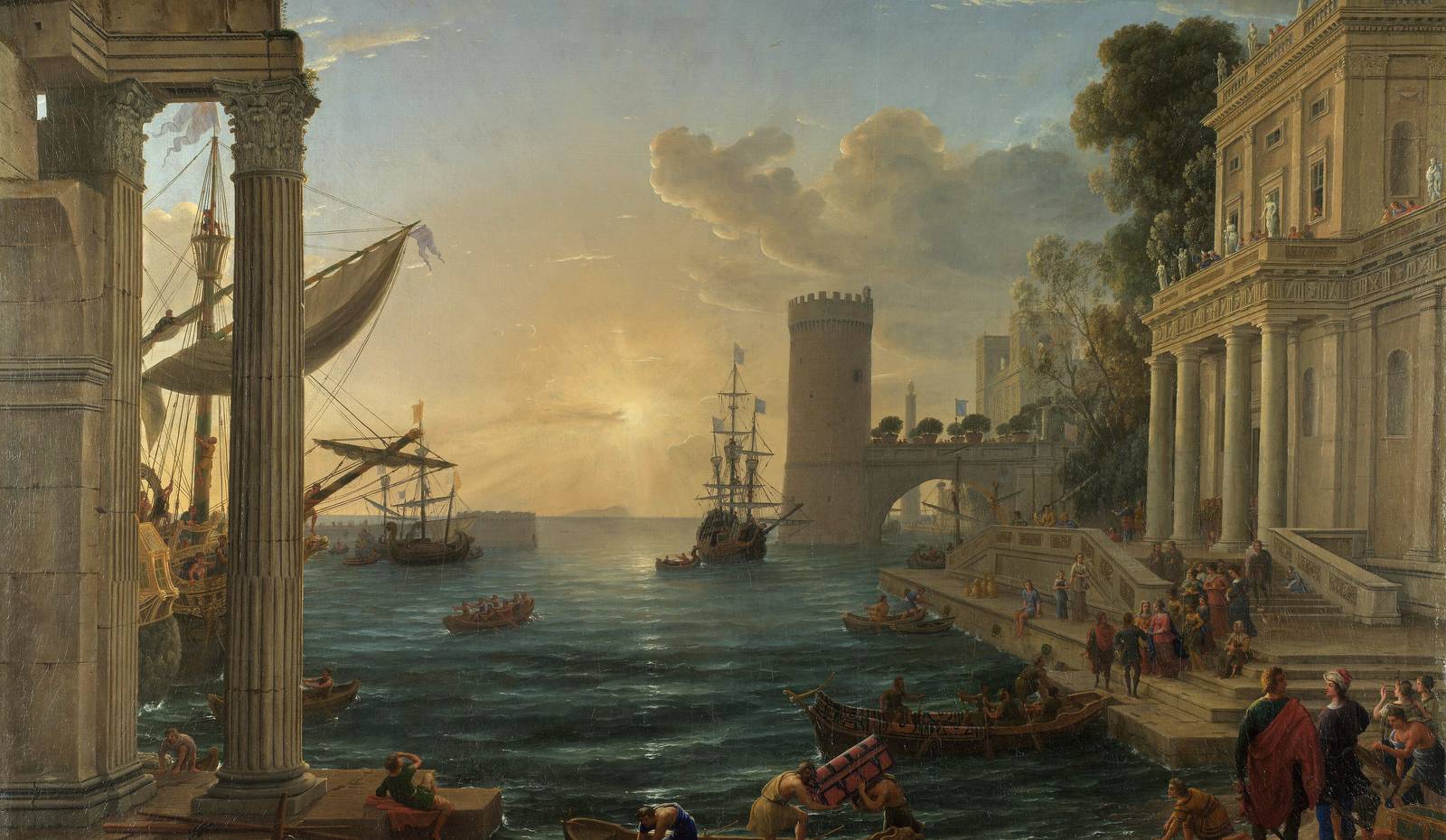
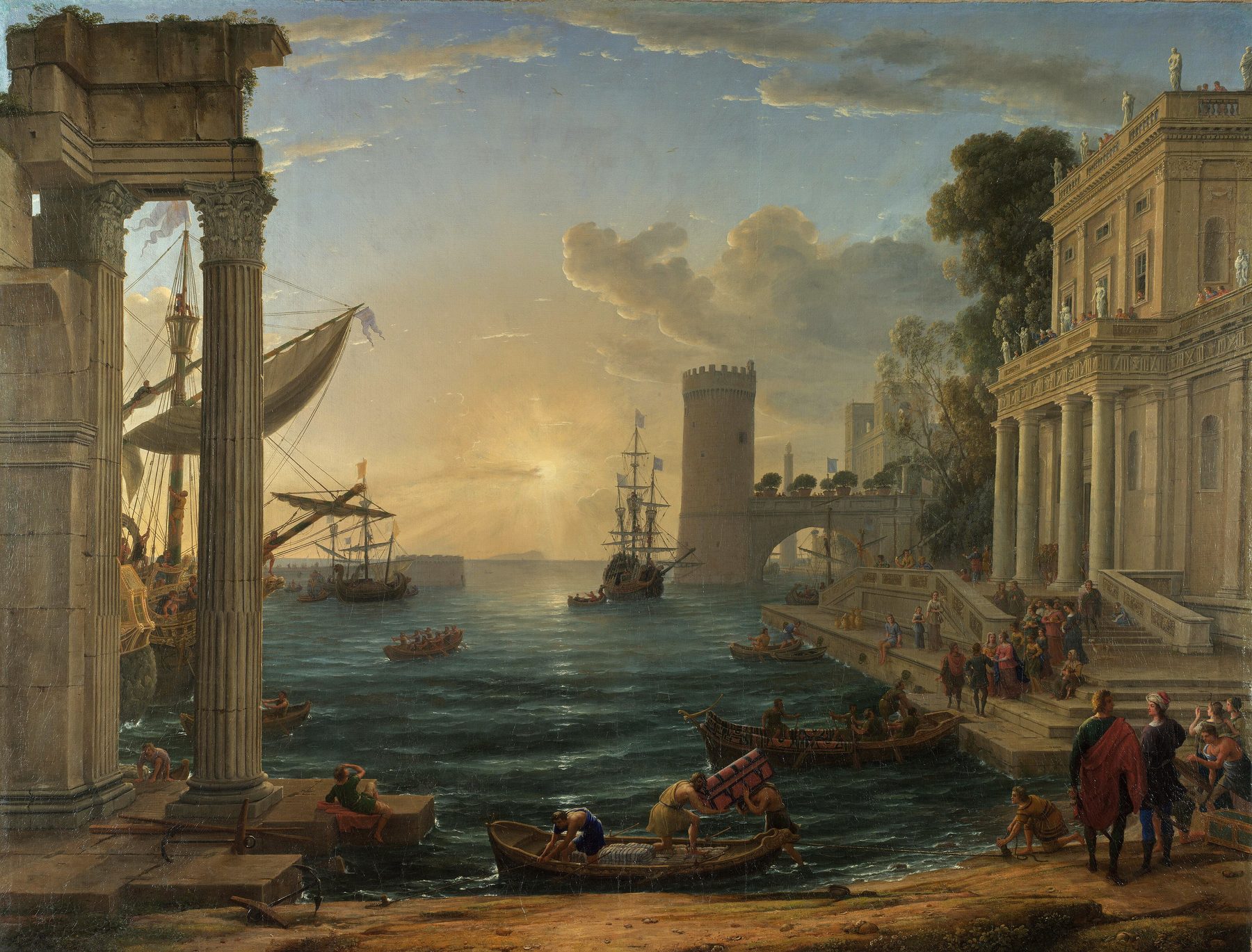
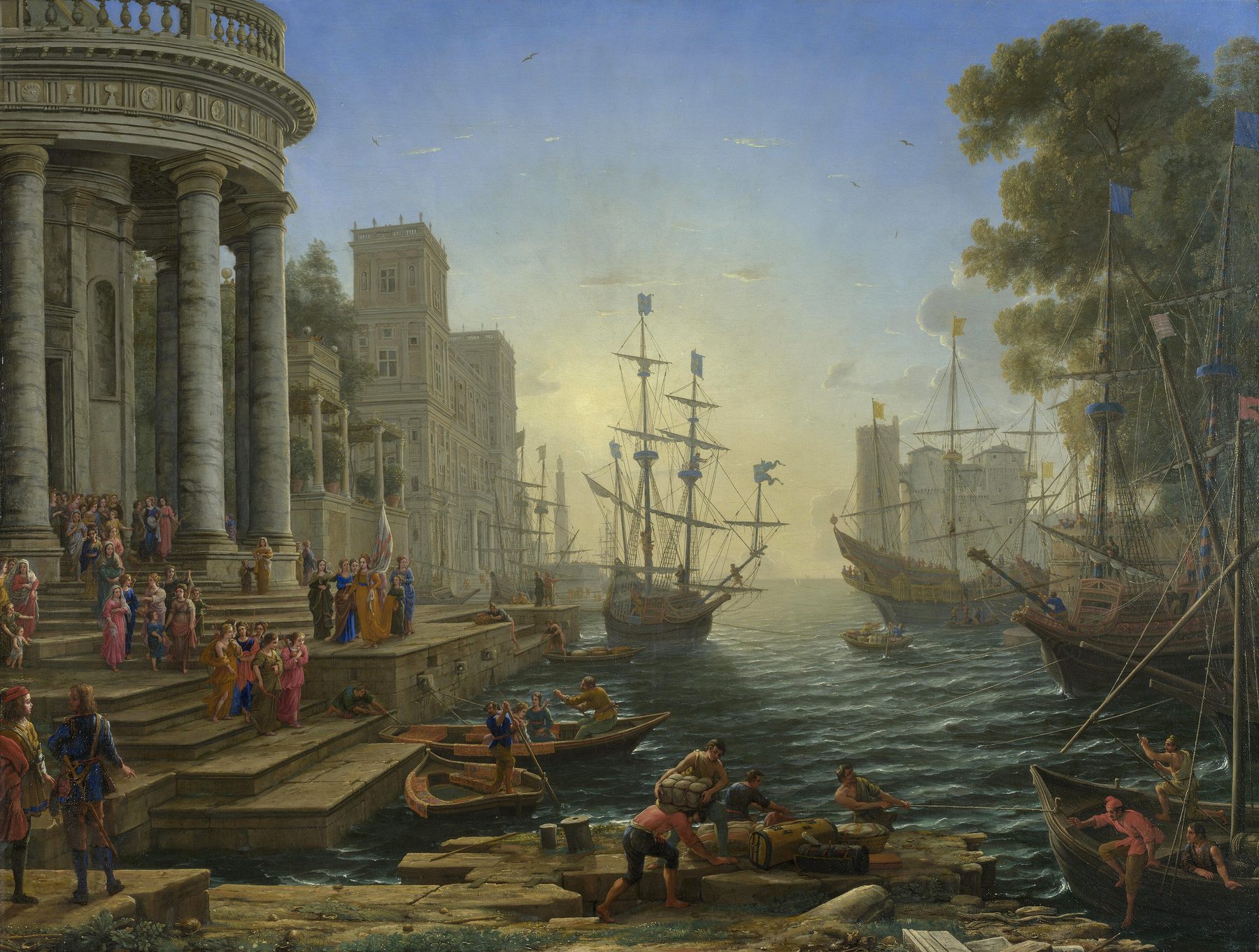
Image reference: Claude Lorrain, Seaport with the Embarkation of the Queen of Sheba.
At a Glance
- Core periodapproximately the 1580s to the late seventeenth century
- NationalityItalian and French, within a wider European field
- Principal centresBologna · Rome · Paris
- Known foridealised bodies · controlled composition · rhetorical gesture · history painting · composed landscape
- Key artistsAnnibale Carracci · Reni · Domenichino · Poussin · Claude · Le Brun
- Important distinctiona retrospective art-historical category, not a formal movement with fixed membership
Contents
- Where Baroque Classicism fits
- Why the label is useful—and dangerous
- The Carracci reform
- Annibale Carracci in Rome
- Guido Reni
- Poussin in Rome
- Claude Lorrain
- From Rome to French Classicism
- How to recognise Baroque Classicism
- Artists to know
Where Baroque Classicism fits
Annibale Carracci
Principal careerAgostino Carracci
Principal careerLudovico Carracci
Principal careerGuido Reni
Principal careerDomenichino
Principal careerFrancesco Albani
Principal careerAndrea Sacchi
Principal careerNicolas Poussin
Principal careerClaude Lorrain
Principal careerElisabetta Sirani
Principal careerCharles Le Brun
Principal careerCarlo Maratta
Principal careerBaroque Classicism names a classical current within the art of seventeenth-century Europe. It is not the title of a society, manifesto or single school. The phrase helps connect painters who sought idealised form, intelligible action and measured composition while working inside the religious, courtly, competitive and theatrical culture normally called Baroque. Its principal line runs from the Carracci in Bologna and Rome through Guido Reni, Domenichino and Andrea Sacchi to Nicolas Poussin and Claude Lorrain, then into French academic and royal art under Charles Le Brun.
The apparent contradiction in the name is productive. “Classical” can refer to the art and culture of Greece and Rome, but in later art it also describes idealisation, compositional stability and forms treated as exemplary. [1] “Baroque” evokes movement, spectacle, emotional address and spatial complexity. Annibale Carracci's Farnese Gallery is classical and Baroque at once: its gods recall antique sculpture, its bodies have been studied from life, its stories derive from Ovid, and its painted architecture converts a ceiling into an unstable theatre of frames, openings and feigned statues. Order is not the absence of energy. It is the means by which energy becomes legible.
Why the label is useful—and dangerous
Seventeenth-century artists and writers certainly discussed imitation, beauty, decorum, expression, drawing, colour and the authority of antiquity. They did not all call themselves Baroque Classicists. The category was shaped later as historians tried to describe a current distinct from the forceful naturalism of Caravaggio or the expansive illusionism associated with Pietro da Cortona and Rubens. Used too rigidly, it produces a false choice between calm Classicism and passionate Baroque.
The paintings resist that division. Reni's Massacre of the Innocents is geometrically controlled but depicts panicked mothers and murdered children. Poussin's bacchanals are learned reconstructions of antiquity and sensuous celebrations of intoxicated movement. Claude's landscapes are balanced inventions filled with glowing air. Le Brun could defend the intellectual status of drawing while orchestrating colour, sculpture, gilding and architecture for royal spectacle. Versailles itself acknowledges that his practice was attached to “Baroque colours” as well as classical design. [43]
The category is therefore best understood as a question: how did artists make elevated stories clear, beautiful and emotionally persuasive after the Renaissance, when nature, antiquity and living experience no longer seemed easy to reconcile? Different answers generated a family of classicisms rather than one formula.
The Carracci reform in Bologna
In the 1580s Ludovico Carracci, his cousins Annibale and Agostino, and their circle challenged the sophisticated artificiality of late Mannerist painting in Bologna. Their response was not a return to simplicity. They proposed a new synthesis: observation from life, close drawing, the colour of Titian and Veronese, the movement and tenderness of Correggio, and the compositional authority of Raphael. The Metropolitan Museum describes this fusion of naturalism, classical form and northern Italian colour as a decisive entrance into Baroque art. [2] [4]
The Carracci established an academy generally known as the Accademia degli Incamminati, the Academy of those progressing on a path. The traditional date is around 1582, though names and institutional form developed over time. It was not a modern art school with a permanently documented syllabus. It was a collaborative workshop, teaching environment and intellectual gathering where drawing from the model, anatomy, perspective, literature and discussion acquired new importance. Prado accounts emphasise study from the living model and the world surrounding the students. [3] [7]
The three founders were not interchangeable. Ludovico remained most closely tied to Bologna and cultivated religious intensity. In The Agony in the Garden, solid triangles organise Christ, the angel and sleeping apostles, but the geometry serves a dark emotional pressure. Christ's isolation and the slope of the mount make structure a vehicle of distress. [11] Agostino was a painter, printmaker and learned intermediary whose engravings helped circulate works and visual ideas. Annibale possessed extraordinary range, moving from genre scenes and caricature to altarpieces, landscapes and monumental fresco.
Drawing was the connective tissue. Annibale's sheets include quick observations, searching figure studies, landscapes, compositional trials and caricatures. They demonstrate that “nature” did not mean mindless copying. A line could test the weight of a body, isolate a gesture, remember a face or reorganise a scene. The National Gallery of Art catalogue makes the diversity of these graphic procedures visible. [6] Selection occurred through repeated looking.
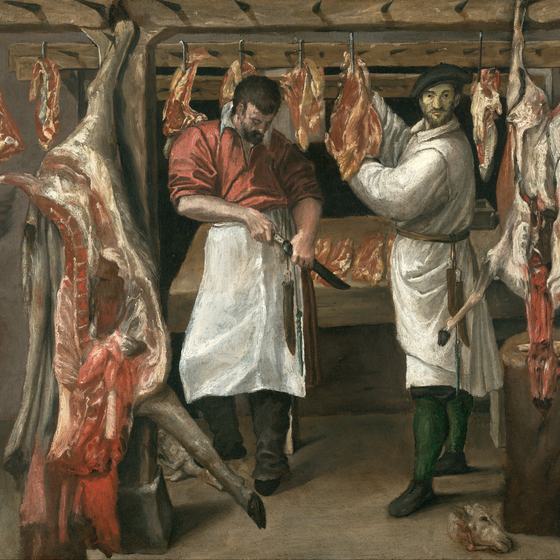
This combination also challenges the idea that Classicism was socially elevated from the beginning. Annibale painted butcher's shops and ordinary eaters with unsparing physical presence. His broken brushwork could catch light and movement. The later ideal bodies of Rome grew from an artist already committed to the awkward facts of human appearance. Classical selection did not erase that experience; it transformed it.
Annibale Carracci in Rome
Cardinal Odoardo Farnese called Annibale Carracci to Rome in the 1590s. Encounter with antique sculpture, Michelangelo and Raphael intensified his art, but the move did not simply replace Bolognese naturalism with Roman rule. The Farnese Gallery ceiling, largely completed around 1600, fuses the two. It became one of the most influential decorative ensembles in European painting. [2] [3]
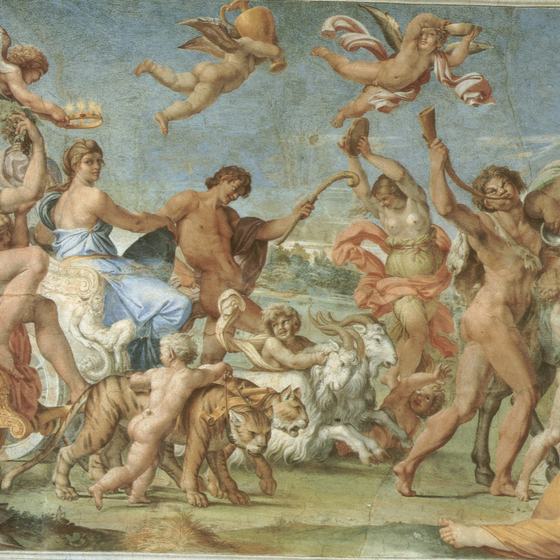
The gallery celebrates stories of divine and human love drawn chiefly from classical mythology. Its central Triumph of Bacchus and Ariadne moves like a procession: bodies turn, lean, carry, dance and ride across the ceiling. Antique sarcophagi and Renaissance precedents inform the frieze-like organisation, yet the flesh has variety and weight. Satyrs, putti, gods and mortals do not look like repetitions of one purified type.
Around the main narratives, Annibale constructs a fiction of framed pictures, medallions, bronze reliefs, marble architecture and nude youths. Some bodies appear to sit in front of the frames; others inhabit painted openings. The eye must decide what is image, sculpture, architecture or living presence, then abandon the distinction as each layer changes. That game belongs fully to the Baroque. At the same time, every energetic element is fitted into an intelligible whole. The gallery proves that classical coherence can intensify illusion rather than suppress it.
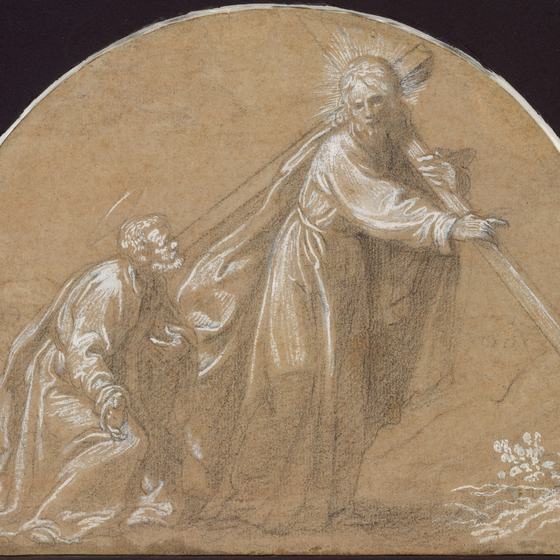
Annibale's smaller Roman pictures show a related compression. Christ appearing to Saint Peter on the Appian Way, or Domine, Quo Vadis?, is less than a metre high but feels monumental. Christ strides toward the viewer carrying the cross; Peter recoils, hands raised, as his flight from martyrdom is exposed as cowardice. X-radiography shows that Annibale revised Peter from a more static profile to the present emotional turn. Primary colours glow against a cool, receding landscape, and references to Michelangelo and Raphael coexist with an urgent private devotion. [8]
Christ appearing to Saint Anthony Abbot is painted on copper. Demons press around the hermit at a cave mouth while Christ appears above. Diagonals, light and the small reflective support make an intricate fantasy readable at a glance. Bellori later admired the work, evidence that the critical construction of Annibale as an ideal painter could include monsters, fear and theatrical lighting. [9] Technical work on the related Montalto Madonna likewise reveals process and material adjustment beneath the apparently complete Roman manner. [10]
Annibale's influence spread through collaborators and pupils including Domenichino, Albani, Reni, Lanfranco and, more indirectly, Guercino. The group did not repeat one style. Lanfranco pushed ceiling illusion toward expansion; Domenichino pursued distributed narrative clarity; Reni made ideal beauty increasingly weightless; Albani favoured graceful mythologies and landscapes. What they inherited was a method of reinvention, not a recipe.
Guido Reni: beauty under pressure
Guido Reni trained first with the Flemish painter Denys Calvaert, then entered the Carracci environment in the 1590s. Bologna's prosperous ecclesiastical and civic culture, shaped by the Counter-Reformation, demanded images that could be doctrinally intelligible and affectively powerful. Reni learned drawing from life, printmaking and modelling, then encountered Raphael, antique sculpture and Caravaggio's dramatic naturalism in Rome. His classical language was made through all these pressures. [12] [13] [14]
The early Roman works contain strong darkness and physical immediacy. Later paintings increasingly favour clear contours, noble heads, restrained gesture and pale, silvery colour. The change is often described as a search for the bello ideale, ideal beauty. That ideal was not mere prettiness. It attempted to make sacred and tragic figures worthy of contemplation, separating them from ordinary accident without making them emotionally empty.
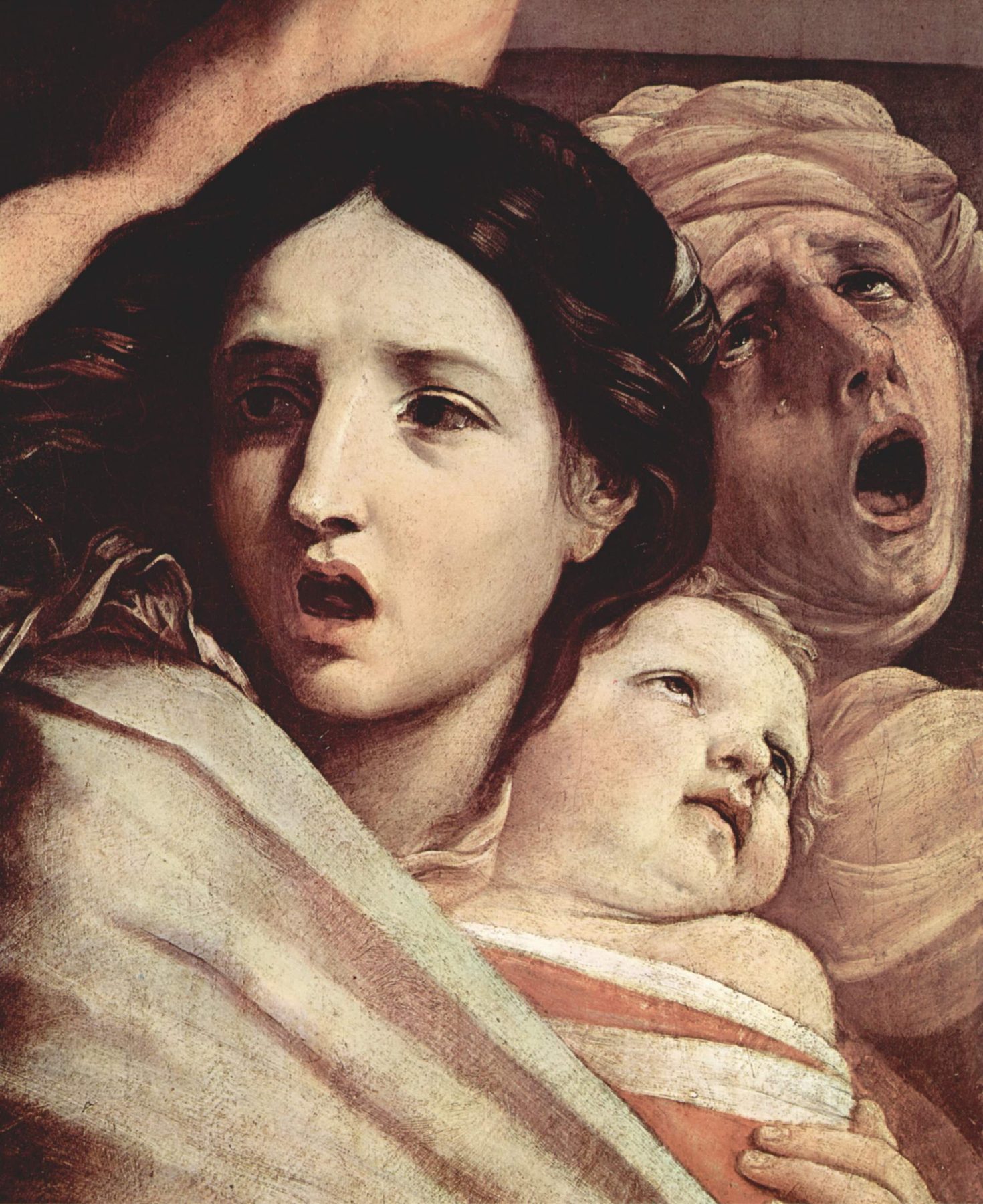
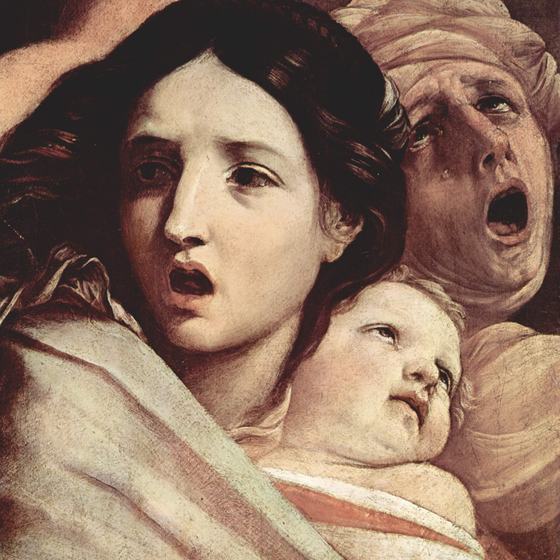
The Massacre of the Innocents of 1611 tests the method against an almost unbearable subject. Two groups of mothers and executioners balance on either side of the canvas. A raised dagger stands near the central axis. Architecture behaves like a shallow stage, while two angels above hold palms of martyrdom. The symmetry lets the viewer grasp several actions immediately: pursuit, resistance, grief and the horrifying stillness of dead children in the foreground. [15]
Reni studied the antique group of Niobe and her children for the kneeling mother at the right. Classical reference elevates her gesture, but it also raises an ethical question. Does beauty dignify suffering or make violence too easy to behold? Early writers admired the paradox of horror joined to beloved children. The painting does not resolve it. Its frozen instant suspends action between anticipation and consequence, forcing attention on the form through which terror has been made visible. [15]
Reni's civic religious art could answer immediate catastrophe. The great votive banner commonly called the Plague Altarpiece rises from a dark view of Bologna devastated by epidemic toward the luminous Virgin and protective saints. Its clear vertical movement carries collective pain, intercession and gratitude. The composition is idealised, but its function is anchored in urban memory and ritual. [16]
Reni's later reputation became unstable. Celebrated in his lifetime as “the divine Guido,” he later appeared too sweet or academic for tastes formed by Romanticism and modernism. A major twentieth-century revival and recent Prado research restored the technical experiment, commercial intelligence and emotional range hidden by the stereotype. [12] [13]
Domenichino and the labour of narrative
Domenico Zampieri, called Domenichino, also emerged from the Carracci circle and went to Rome at Annibale's invitation. His art is often opposed to Reni's: learned and laborious rather than graceful and inspired. Seventeenth-century criticism helped build that contrast, eventually treating the two as modern versions of the ancient rivals Apelles and Protogenes. Bologna research shows how prints and Bellori's writing fixed their supposed complementary identities. [19]
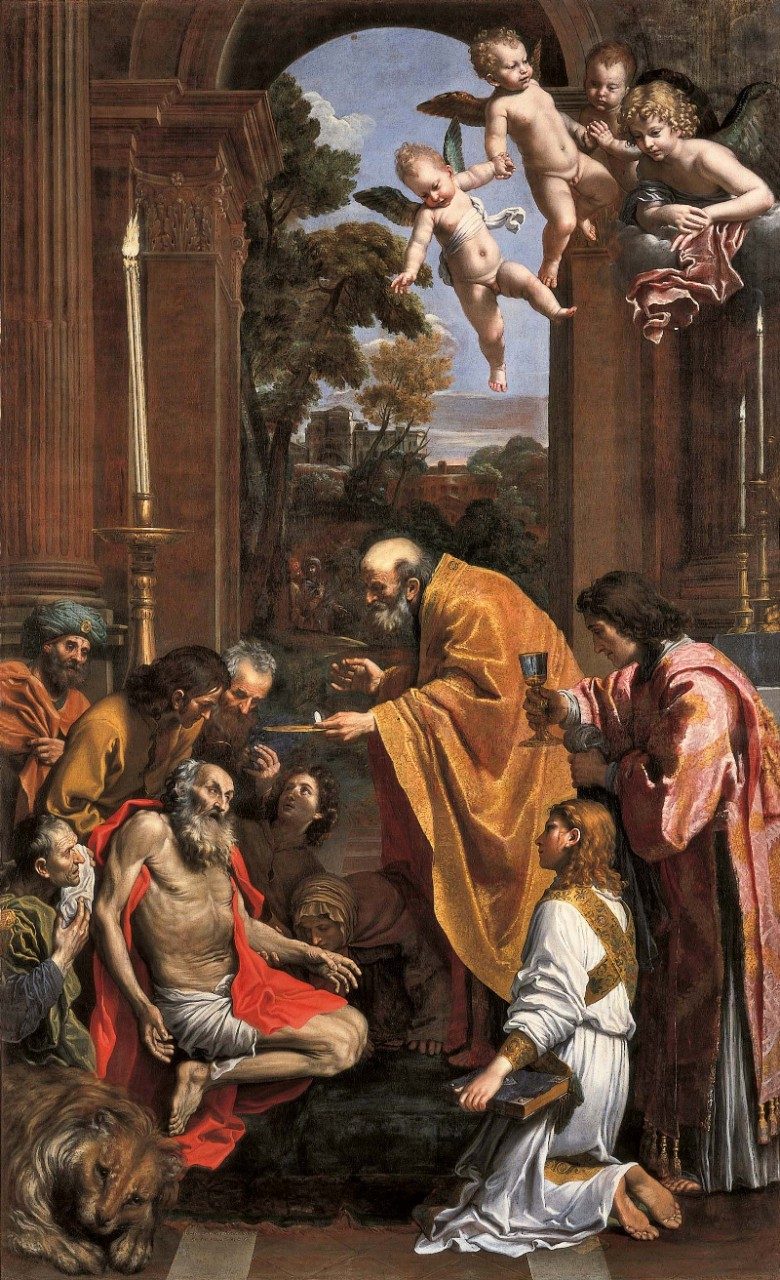
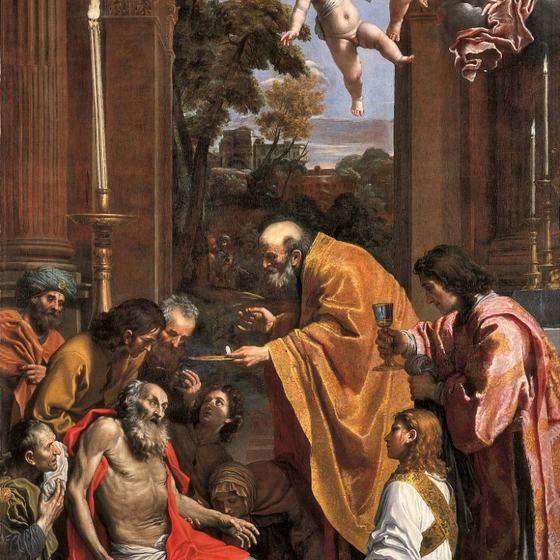
The Last Communion of Saint Jerome, painted between 1611 and 1614, was Domenichino's first major Roman success. The dying saint receives the Eucharist while disciples and Saint Paula support, watch and respond. Gesture distributes attention from Jerome's thin body to the priest, vessels, books and faces around him. The architecture keeps the action legible without emptying it of tenderness. [17]
The painting was based in part on an altarpiece of the same subject by Agostino Carracci, producing an enduring accusation of plagiarism. In seventeenth-century practice, imitation could signal rivalry, homage and improvement rather than simple theft. Domenichino reorganised the precedent for a new commission and audience. The controversy reveals a central tension in classicist practice: artists were expected to learn from exemplary works but also to transform them sufficiently to establish invention.
Domenichino's interests extended beyond solemn arrangement. His Saint Agnes altarpiece includes precisely observed musical instruments, reflecting an intense concern with music, and his frescoes could carry small incidents and expressive detail through complex cycles. [18] Learned composition was a form of labour, not lack of feeling.
Other Italian classicisms
Francesco Albani developed small mythological scenes in which graceful figures inhabit ordered landscapes. Andrea Sacchi argued for fewer principal figures and clearer dramatic concentration, a position later contrasted with Pietro da Cortona's abundant ceiling populations. Carlo Maratta carried a softened Roman classicism into the later century and helped secure the academic prestige of Raphael, Carracci and Poussin.
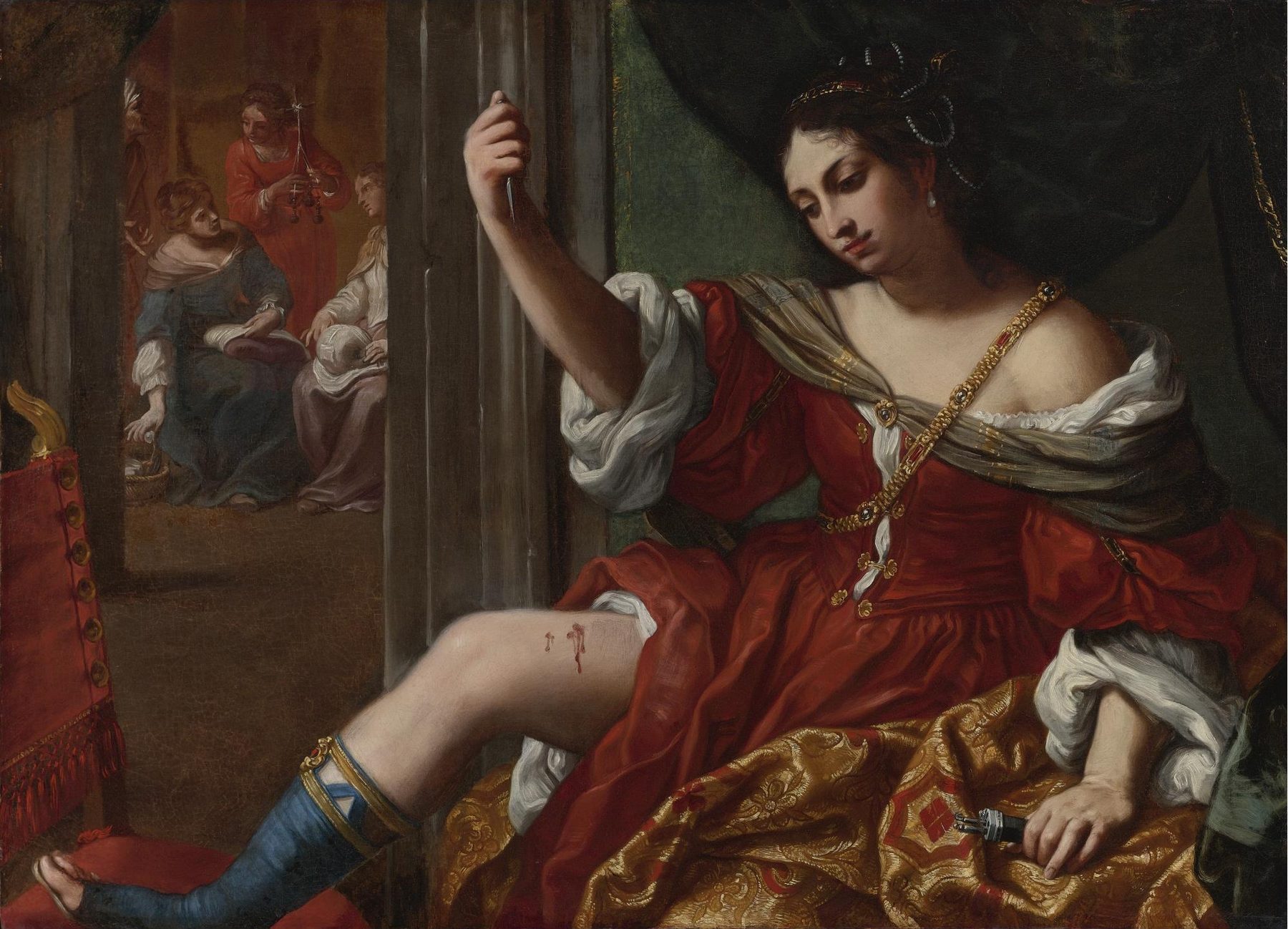
The Bolognese legacy also included women who worked within restrictive institutions. Elisabetta Sirani became a prolific painter, workshop head and teacher, adapting Reni's ideal language to a highly visible professional career before her early death. The Pinacoteca identifies her as a female interpreter of Reni's classicism. [14] [20] Her success does not prove that access was equal. It demonstrates what could be achieved despite guild, academy, workshop and reputational structures largely controlled by men.
Guercino sits at the border of the category. His early works use dense shadow, abrupt light and muscular emotion; later paintings move toward clearer, more idealised forms under Reni's influence. Classifying one phase as Baroque and another as classical risks hiding the continuity of his drawing and storytelling. Such boundary cases are evidence that Baroque Classicism is a lens, not a box.
Essential works
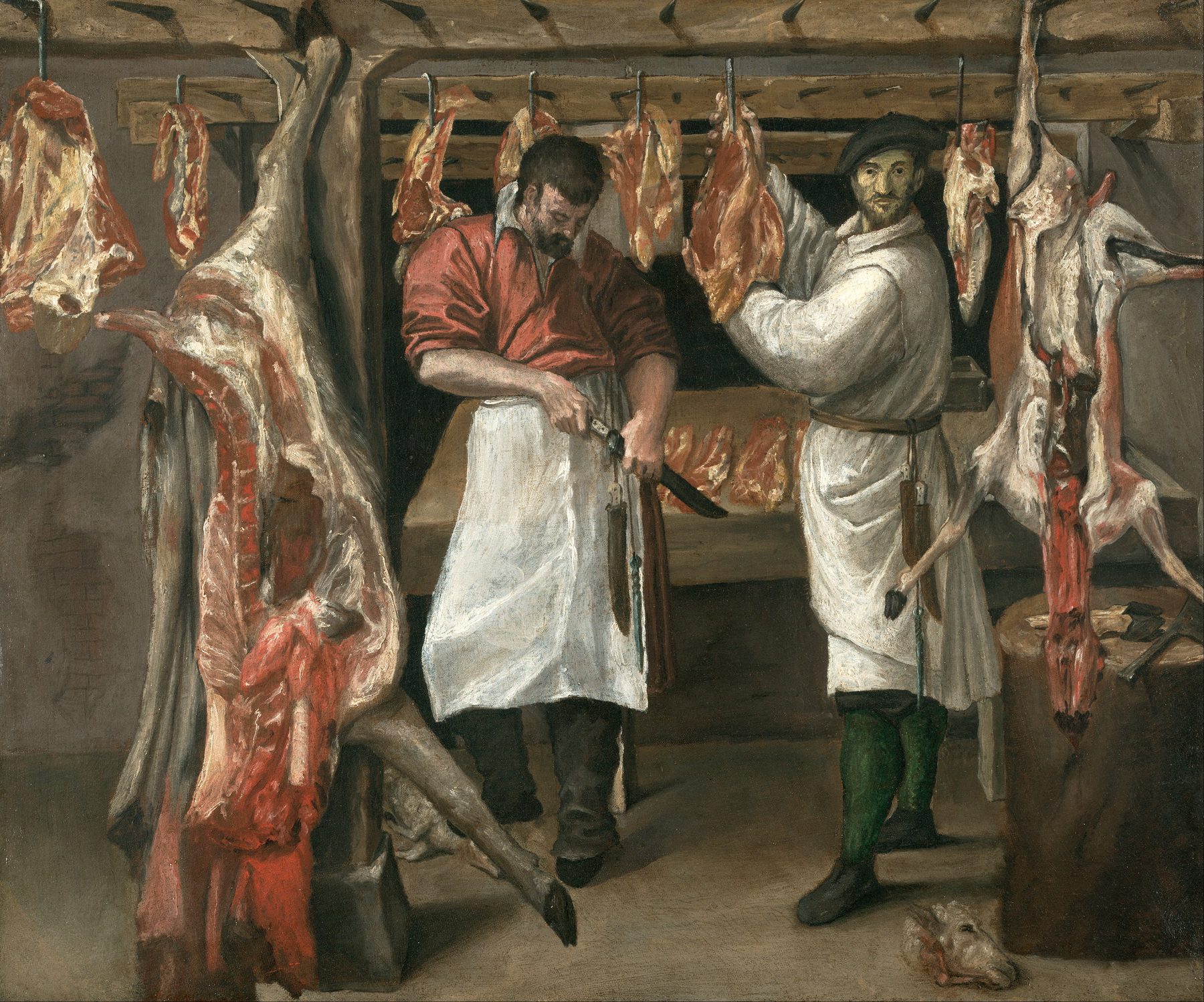
The Butcher's Shop
Annibale Carracci, c. 1583
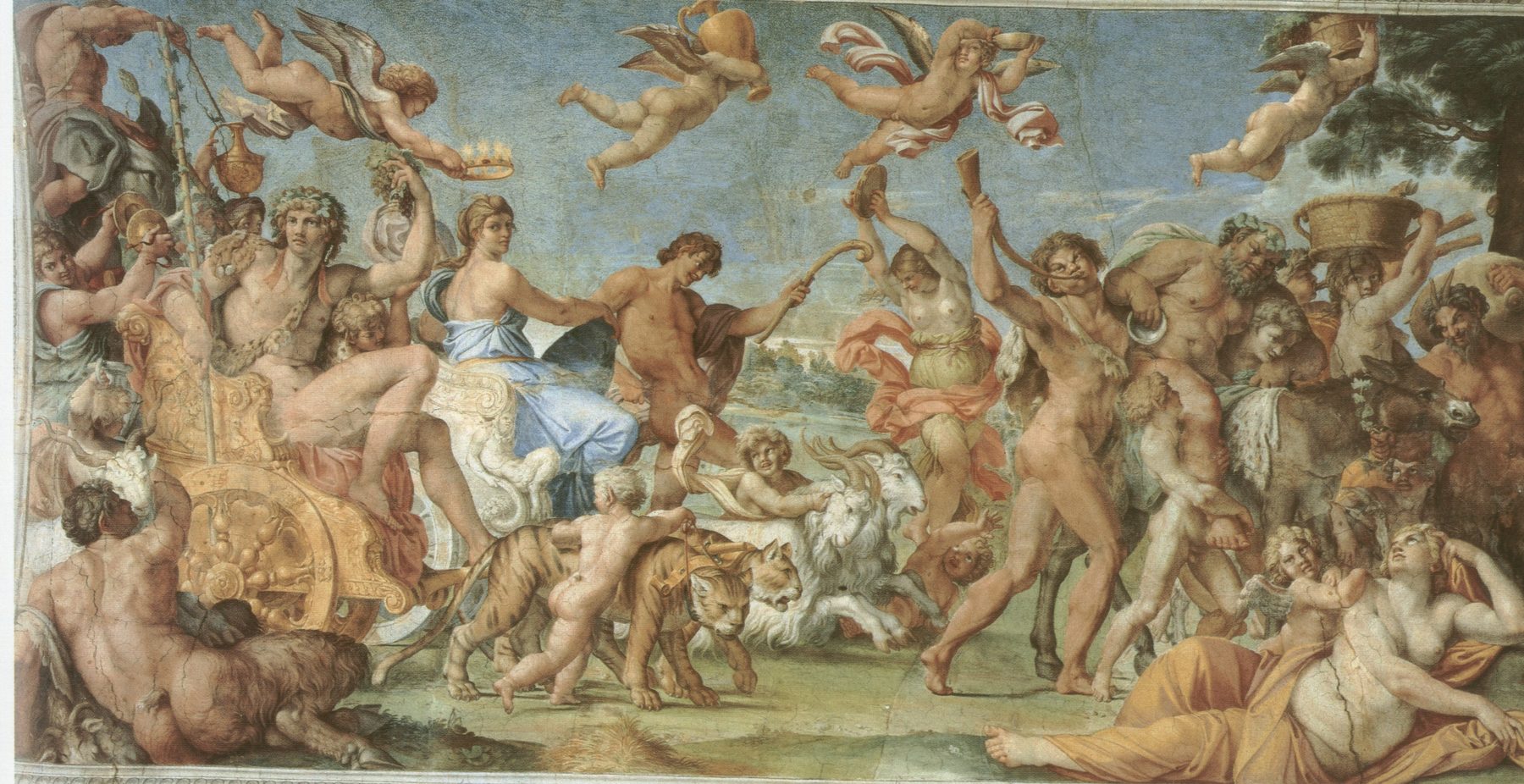
The Triumph of Bacchus and Ariadne
Annibale Carracci, 1597–1602
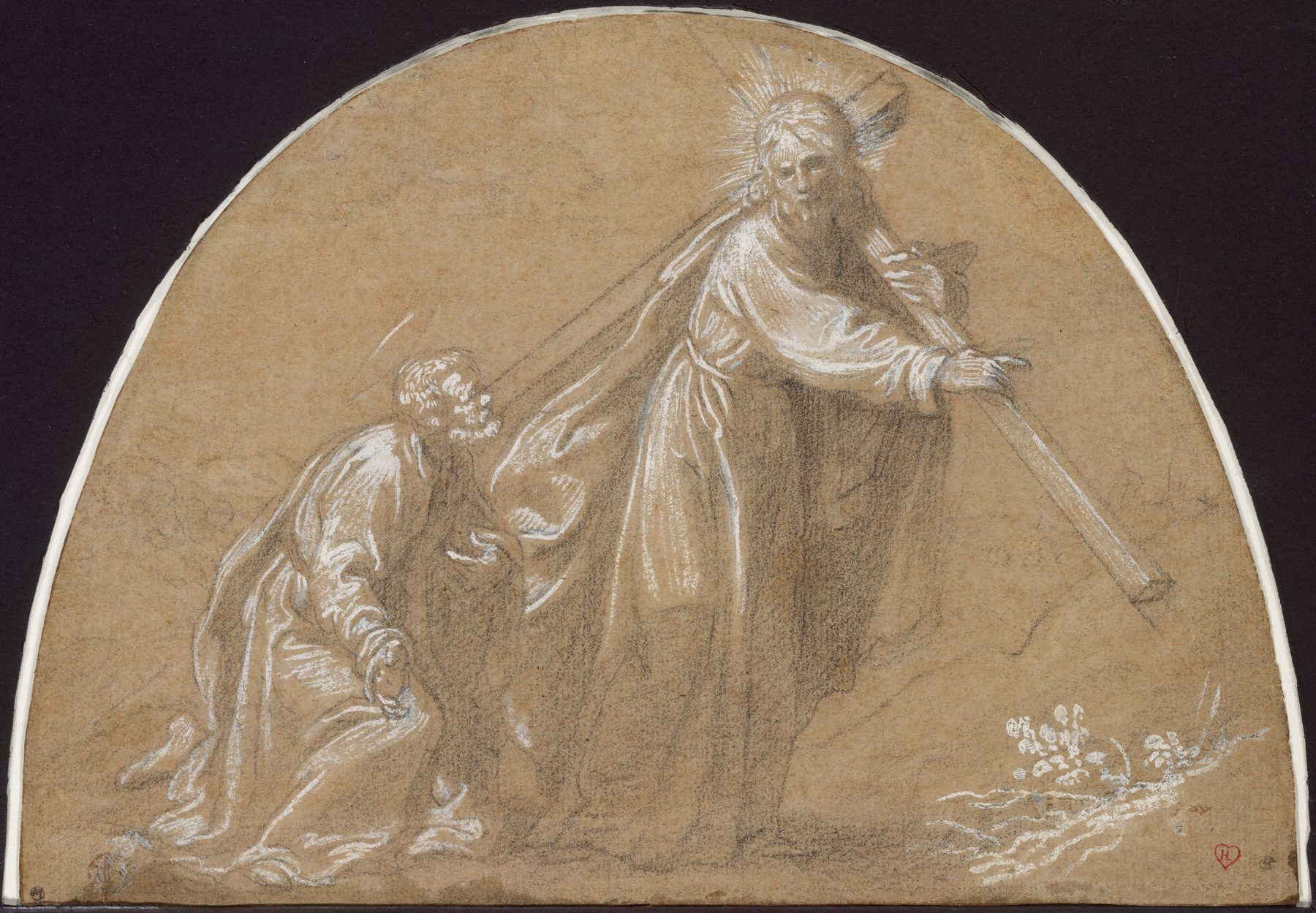
Christ Appearing to Saint Peter on the Appian Way
Annibale Carracci, 1601–02
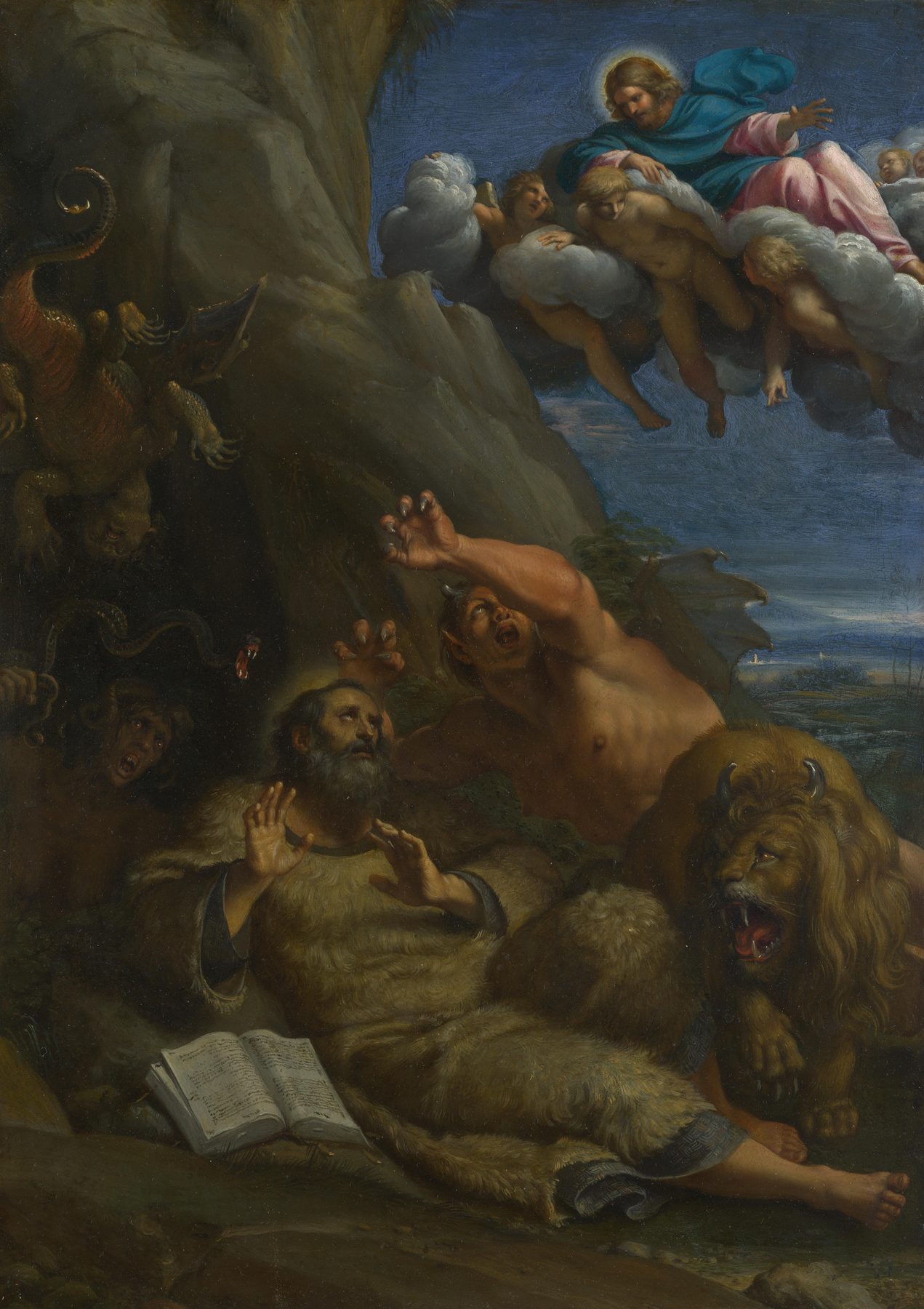
Christ Appearing to Saint Anthony Abbot
Annibale Carracci, c. 1598
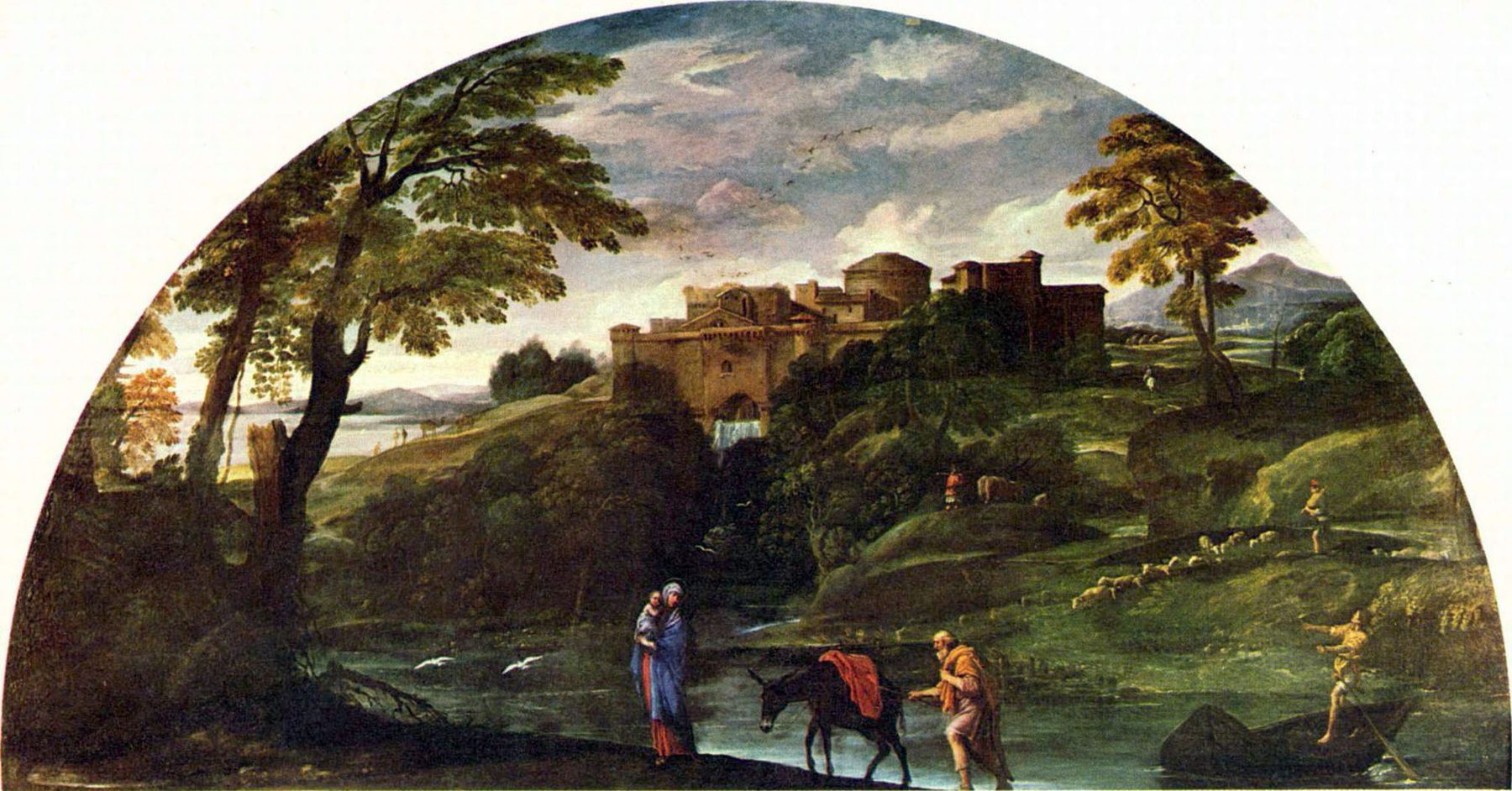
Landscape with the Flight into Egypt
Annibale Carracci, c. 1604
Poussin in Rome
Nicolas Poussin was born in Normandy, worked in Paris and reached Rome in 1624. Except for an unhappy return to France from 1640 to 1642, he remained there for the rest of his career. He studied antique remains and Raphael, absorbed Venetian painting, read Ovid and ancient history, and worked within the intellectual circle of Cassiano dal Pozzo. Cassiano's interests in archaeology and natural philosophy gave Poussin access to objects, texts and patrons. [21] [22] [23]
Poussin's Roman career did not begin as a serene triumph. His large Martyrdom of Saint Erasmus, his only papal commission, received a cool response. He lost another church commission and recognised that the vast public machinery of Counter-Reformation Rome did not suit his greatest strengths. He built instead a market among private collectors for relatively modest history paintings, mythologies and landscapes whose subjects rewarded sustained looking. [21]
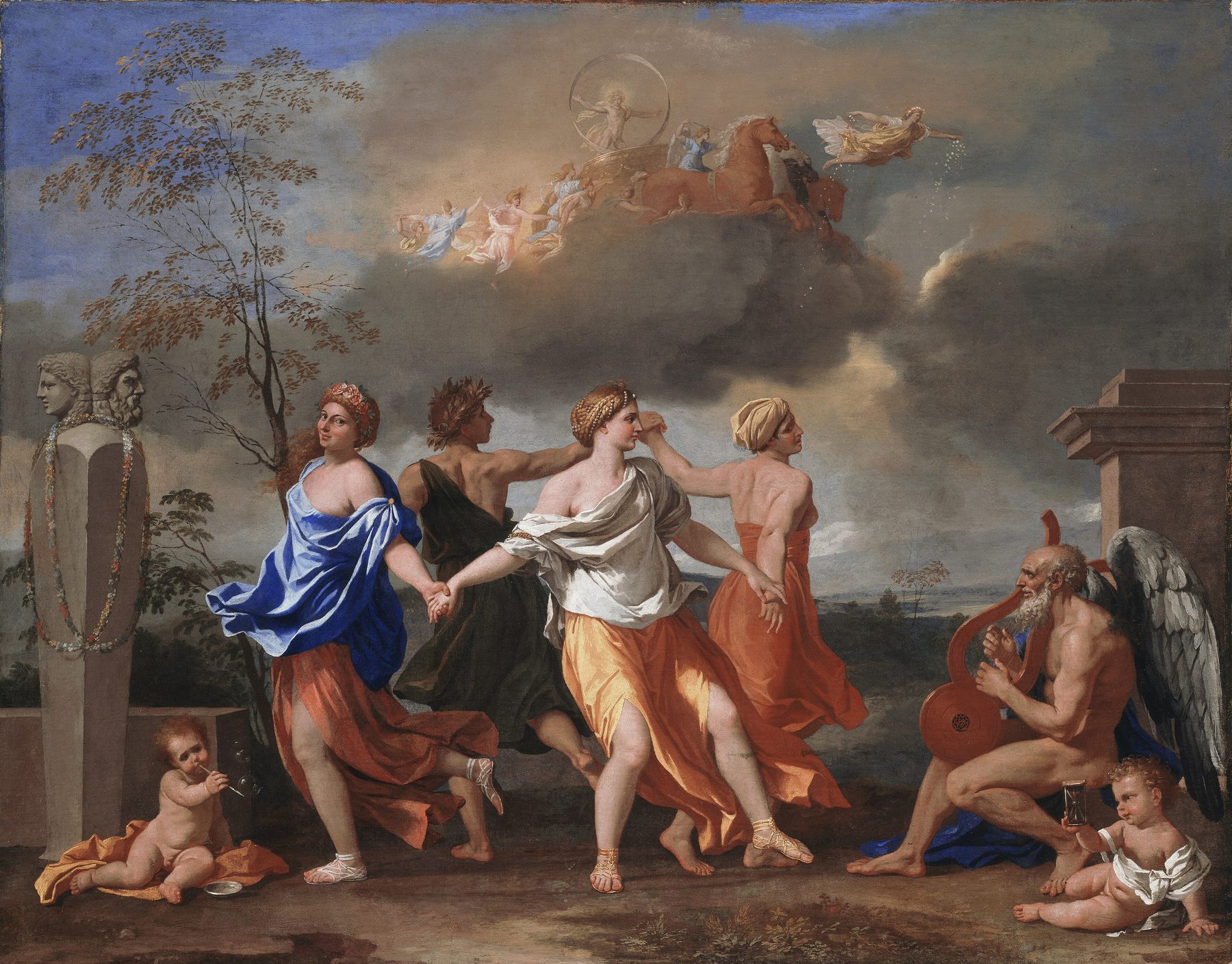
That choice helped create the image of Poussin as a solitary intellectual opposed to Baroque spectacle. It contains truth but easily becomes caricature. His early pictures can be lush with Venetian colour. His bacchanals whirl with dance, intoxication and desire. The National Gallery's Poussin and the Dance project reconstructed his use of chalk, ink, paint and wax figurines arranged on a model stage. Deliberate composition did not replace movement; it enabled the artist to test how bodies would turn, overlap and balance. [24]
In the bacchanalian pictures, ancient sarcophagus reliefs provide frieze-like sequences while Titian supplies colour and sensual atmosphere. The Triumph of Silenus crowds nymphs, satyrs and centaurs across a wooded stage. Conservation and technical analysis disclosed changes that weakened the older claim that the work must be only a copy after a lost Poussin. The example warns against turning uneven finish into automatic evidence of inauthenticity. [25]
Poussin's classicism is therefore not one temperature. He adjusted gesture, colour, handling and density to subject. A sacred history requires different emotional conduct from a revel; a civic tragedy differs from a pastoral myth. Later writers associated this practice with the musical “modes,” but the analogy should not become a rigid chart in which each key or palette guarantees one emotion. Poussin's surviving letters and observations come through edited documentary traditions, and claims of a complete private theory need caution. [28] [30]
Poussin: clarity, catastrophe and unstable meaning
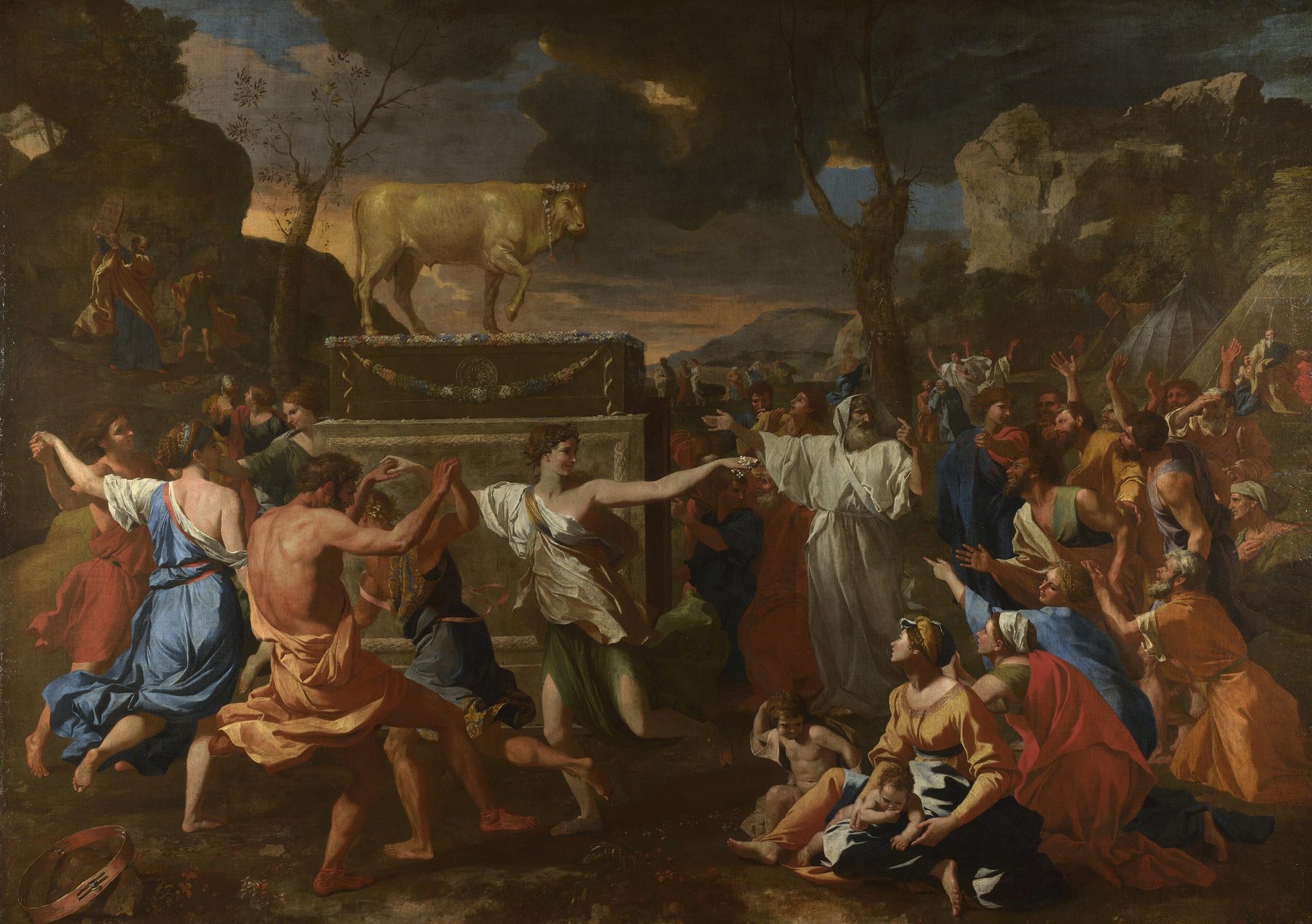
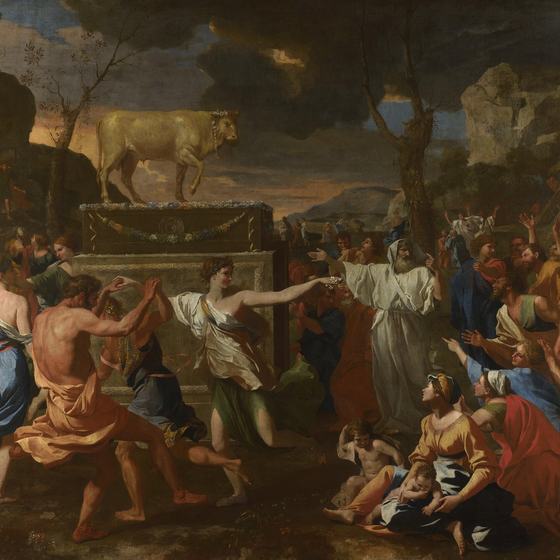
The Adoration of the Golden Calf shows how order can intensify moral instability. The Israelites dance in a ring around the idol while Moses descends in anger. The dance is beautiful, its rhythm almost contagious, yet it celebrates betrayal. Poussin makes viewers understand the collective action before they judge it. His classicism does not dictate virtue through static poses; it can give seductive form to error.
Architecture and tonal control often create distance. In The Adoration of the Shepherds, verticals and horizontals establish a constructed world behind the picture plane. Colours and values avoid both absolute glare and impenetrable dark, keeping the action available to reflective looking. [26] This distance is not emotional indifference. It allows gestures to speak in relation: a hand, turned head or kneeling body gains force because surrounding forms do not shout over it.
Late works can be severe and brilliantly coloured together. In The Annunciation of 1657, Mary sits cross-legged with arms extended while the angel stands like a statue across a raised stone floor. Their poses and drapery recall antiquity, but yellow, red and coloured wings shimmer in the light. The uncertain commission and unusual iconography caution against treating every formal decision as a transparent code. [27]
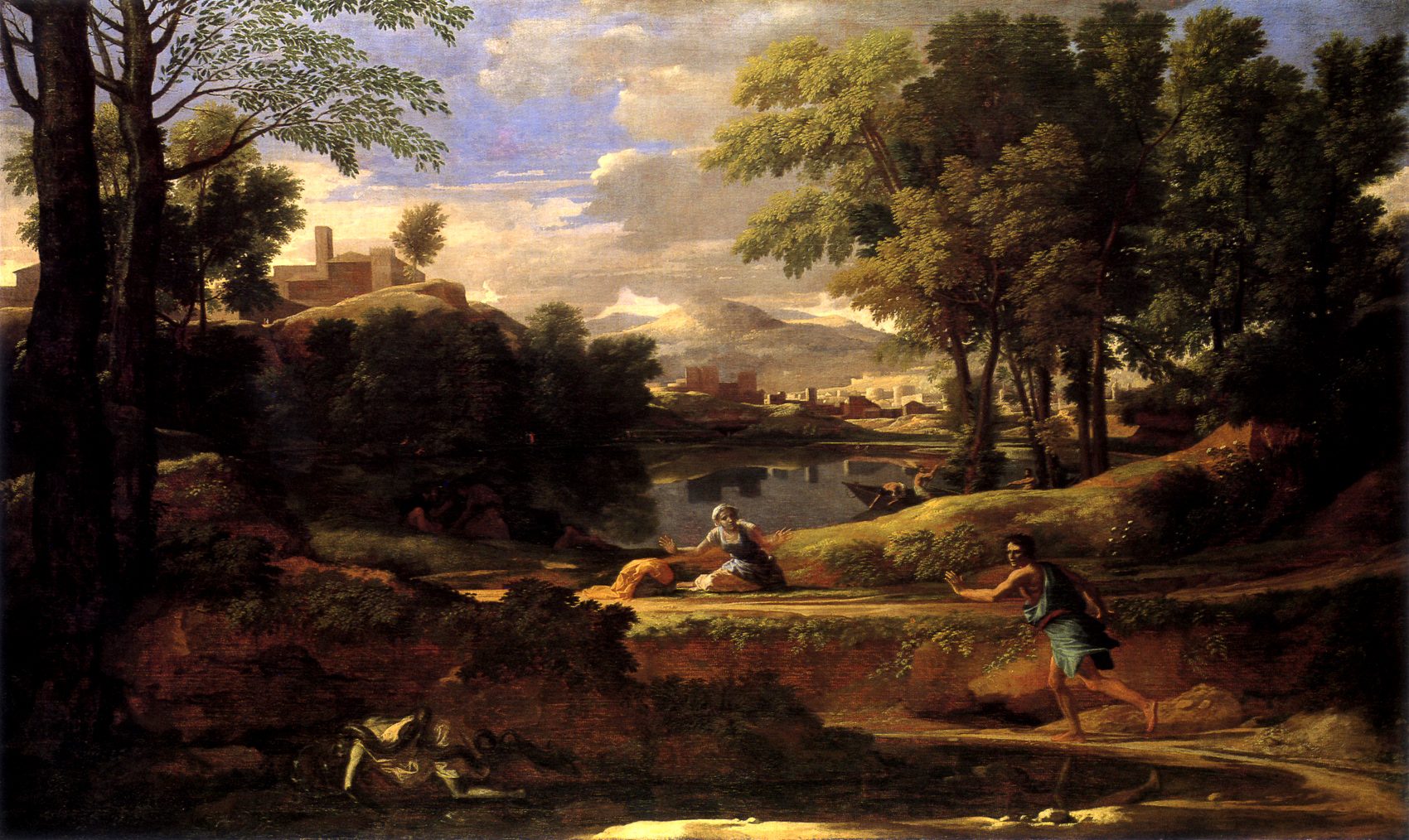
Landscape gradually took a larger role. Poussin sketched in the Roman Campagna, sometimes alongside Claude, then constructed histories in which weather, geology, water and vegetation could exceed human control. Landscape with a Man Killed by a Snake distributes shock across a chain of figures: a body entangled by the serpent, a fleeing man, a washerwoman who turns, a distant city unaware. The ordered landscape does not comfort. It shows how catastrophe spreads through sight while much of the world continues untouched.
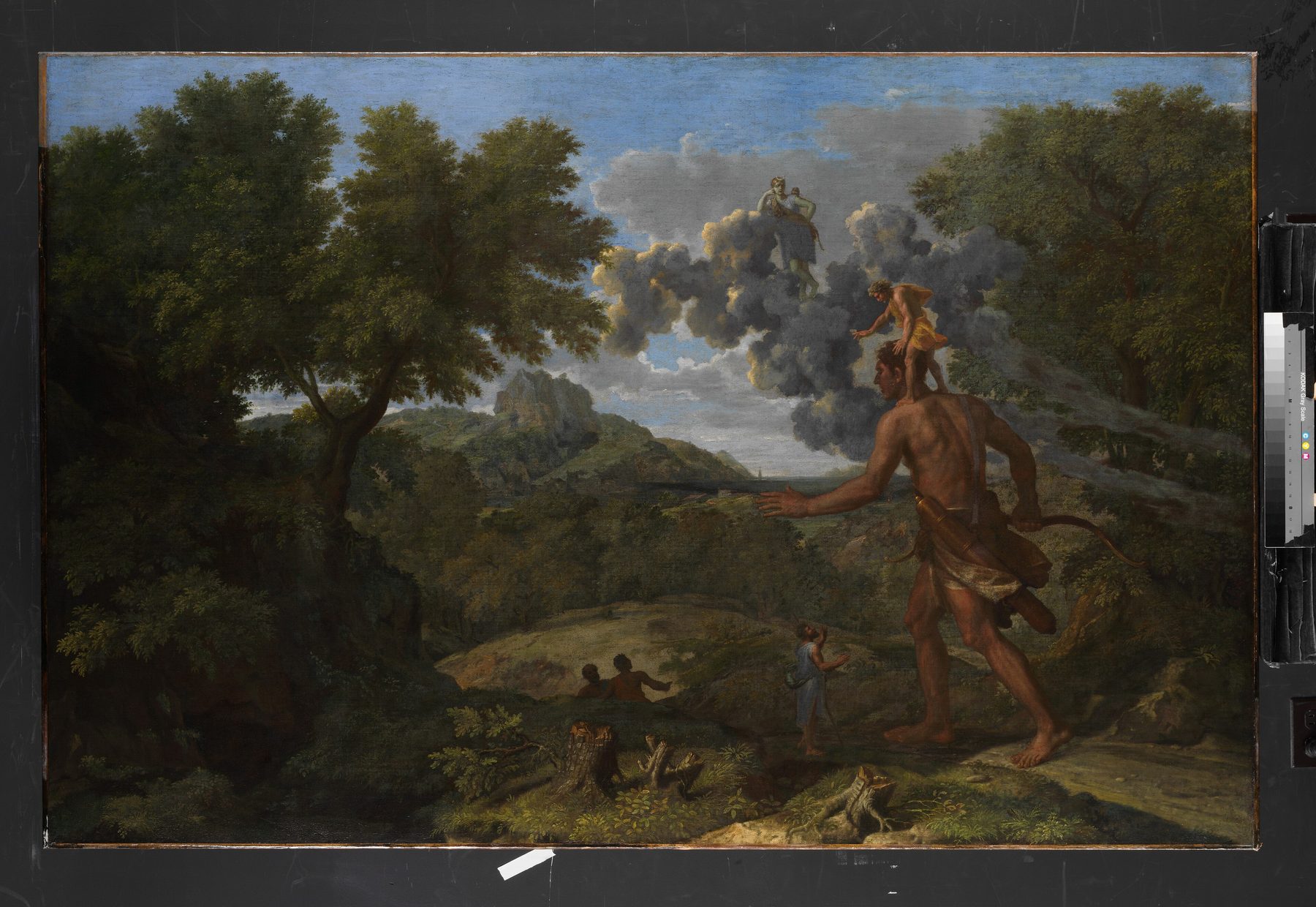
In Blind Orion Searching for the Rising Sun, a giant crosses a vast, humid world carrying the small Cedalion, who guides him toward restored sight. Diana stands in cloud; myth is joined to a contemporary meteorological interpretation. Orion's scale is immense, yet blindness makes him vulnerable. Plants, vapour and terrain feel older and more powerful than the human story. The painting's balance seems intuitive rather than diagrammatic, evidence that Poussin's late order could admit uncertainty. [21] [29]
The four Seasons made for the duc de Richelieu combine landscape, biblical narrative and stages of natural time. Winter, or The Flood, reduces humanity to desperate survivors amid dark water and rock. No classical architecture contains the disaster. If Classicism means only stable human mastery, the painting escapes it. If it means selecting a form adequate to a grave subject, its austerity becomes classical precisely through catastrophe.
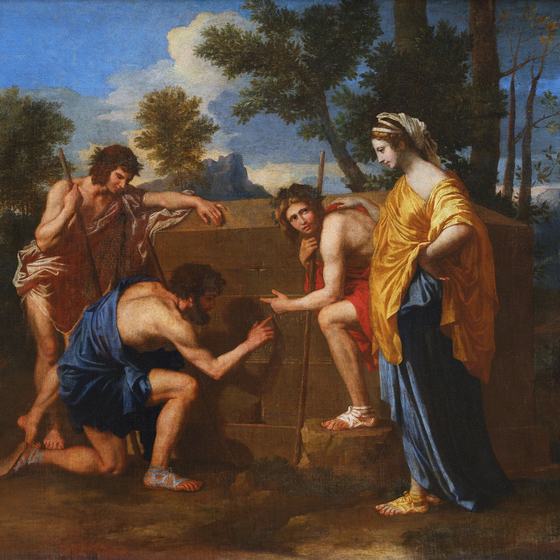
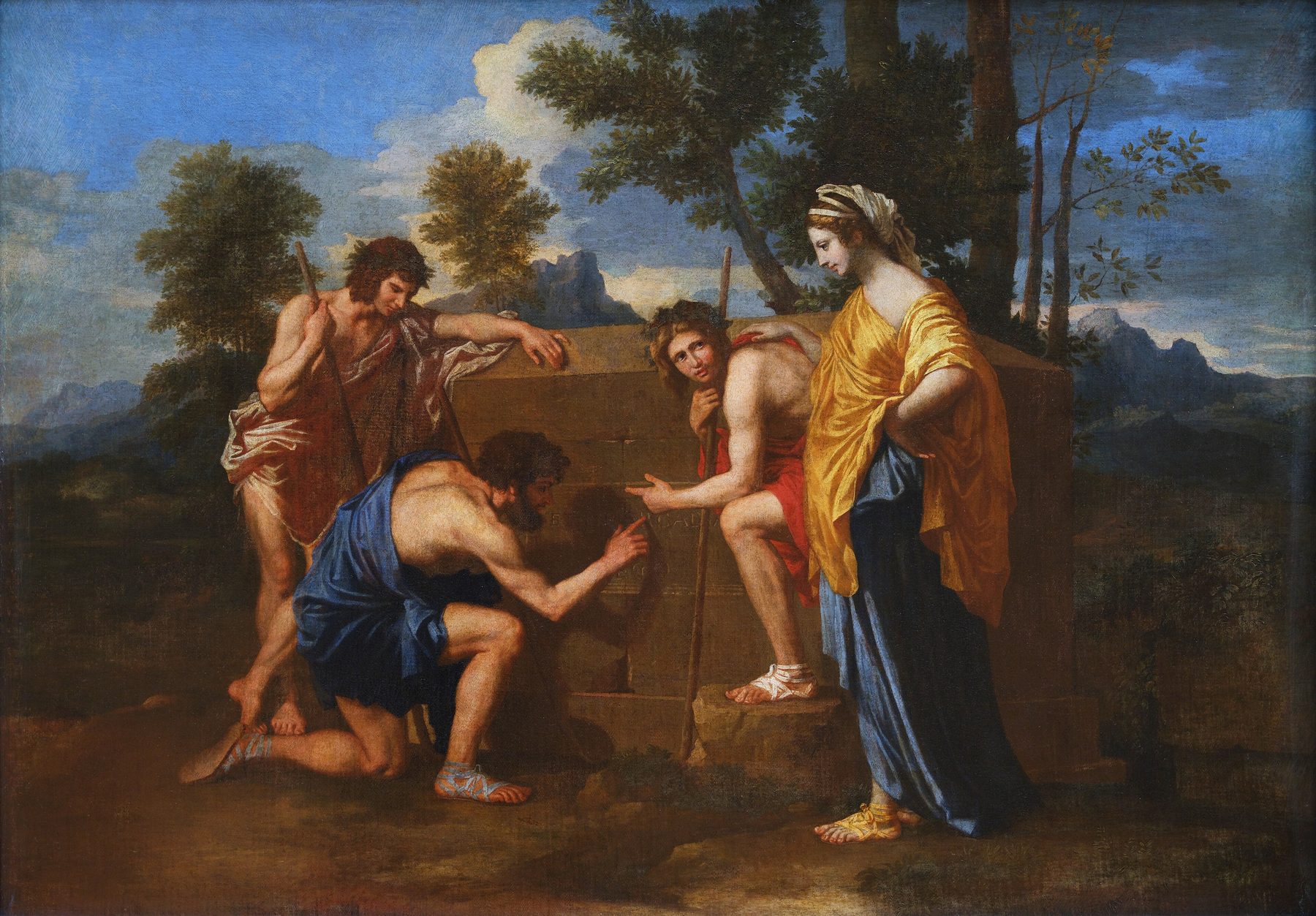
Poussin's Et in Arcadia ego has generated an interpretive industry around the shepherds, the tomb and the Latin inscription. It is often paraphrased as “I too was in Arcadia,” making death the implied speaker, but the grammar and voice remain debatable. The important visual fact is that the shepherds and woman read, point and measure. Meaning emerges through collective interpretation inside the picture, mirroring the viewer's activity outside it. The work does not offer a puzzle with one password. It turns mortality into an act of looking.
Poussin's fame after death encouraged the stereotype of the painter-philosopher. The idea protected his seriousness but could drain the pictures of sensuality and craft. Museum scholarship instead presents a marriage of poetry and reason, with influence extending to David, Cézanne and Picasso. [21] [28] Those later artists did not inherit one doctrine. Each found a different Poussin: republican severity, durable construction, erotic dance or the pressure of bodies within a frame.
Claude Lorrain and the invention of classical landscape
Claude Lorrain, born Claude Gellée in Lorraine, settled permanently in Rome around 1628 after travel and training. He drew outdoors in the city and Campagna, studying trees, valleys, buildings, weather and light. His oil paintings were composed and finished in the studio. The distinction matters. Claude's landscapes feel observed because their elements have been intensely studied, yet the complete places are invented. [32] [33]
Annibale Carracci and Domenichino had helped establish the balanced classical landscape in which foreground trees and architecture frame a receding world. Claude transformed that inheritance through light. A harbour opens toward sunrise; a river receives evening gold; distant hills dissolve into atmosphere. Figures and stories are often small, giving title and historical resonance to a world that seems to exist beyond them. [32]
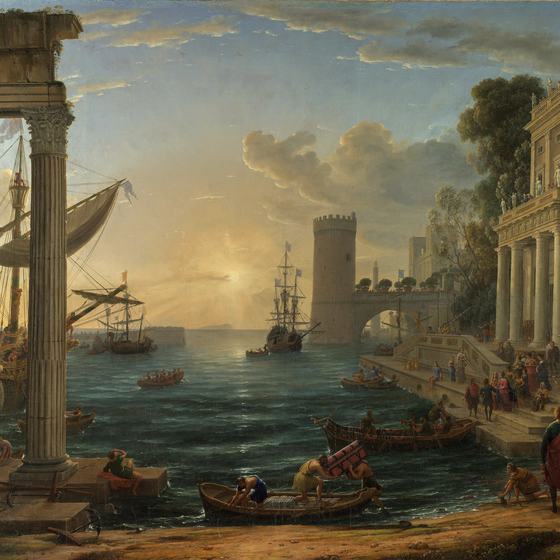
Seaport with the Embarkation of the Queen of Sheba of 1648 is built around an impossible luminous port. Tall classical buildings balance either side, steps and ships carry the eye toward the sun, and the Queen descends in red amid busy workers. The biblical text sends her to Solomon by camel; Claude sends her by sea. The Duc de Bouillon's name and tower emblem connect the unusual episode to the patron. Ideal landscape is invention shaped by ownership, genealogy and political imagination. [34]
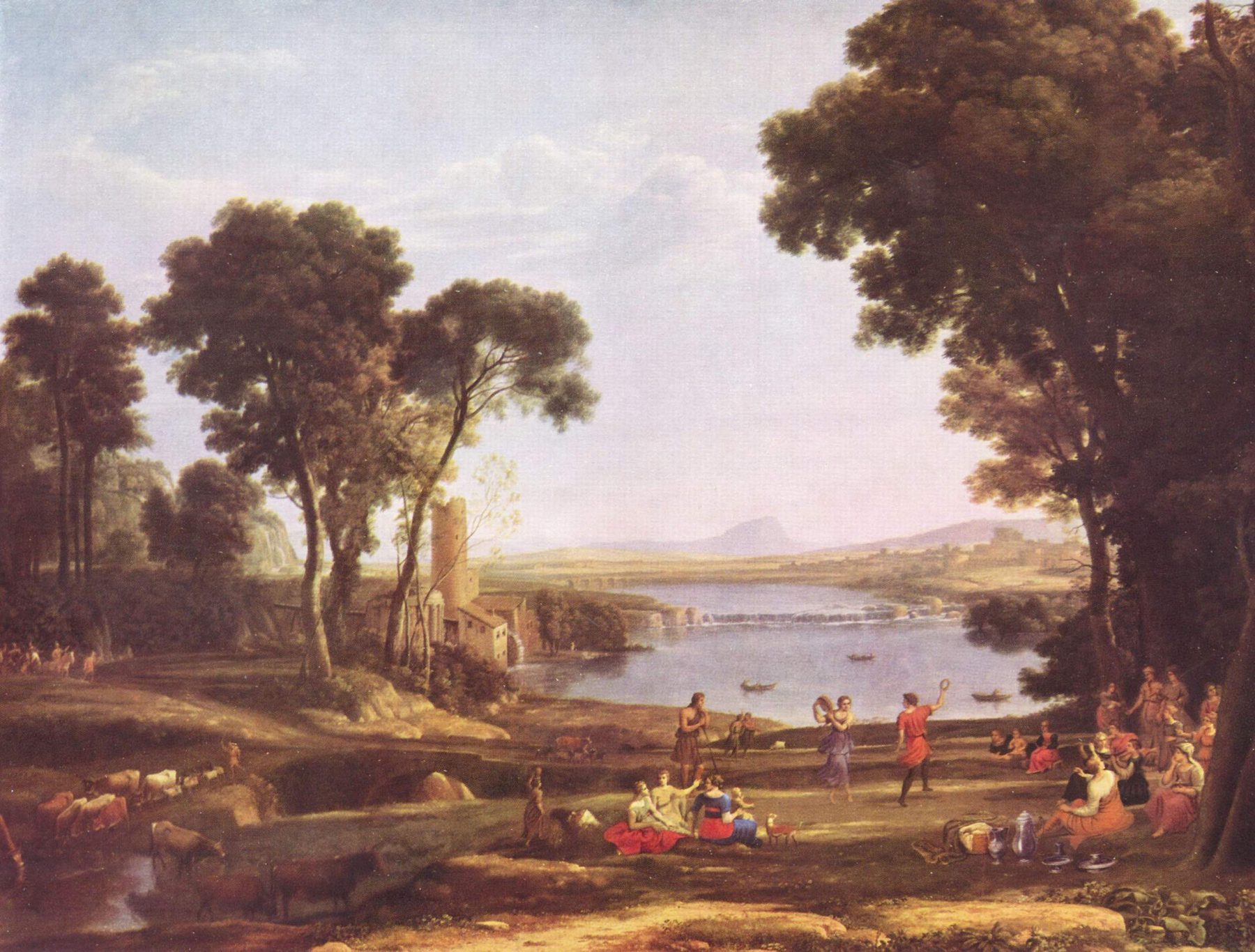
The painting was paired with Landscape with the Marriage of Isaac and Rebecca. A broad river and dancing figures replace the harbour, but both pictures organise movement toward radiant distance. They entered the National Gallery with the Angerstein collection in 1824. Their pairing demonstrates that classical unity could extend beyond one canvas through complementary times, spaces and stories. [35]
In Seaport with the Embarkation of Saint Ursula, architecture, trees and ships frame another moment before a journey. The martyrdom to come is signalled through weapons, yet the scene itself glows with calm. Barberini emblems and patronage are woven into the port. [36] Claude's apparent timelessness repeatedly rests on very specific clients and seventeenth-century power.
Light is both subject and organising material. It strikes water, silhouettes rigging, warms clouds and separates planes without reducing them to a hard diagram. The sun is sometimes visible, daring the painter to make brightness from pigment. Present appearance is not identical to original effect: technical research into blanching and surface alteration shows how varnish, moisture and conservation history can change tonal relationships. [37]
From about 1635 Claude made record drawings of his paintings in the album now called the Liber Veritatis, or Book of Truth. The British Museum holds 195 drawings, often with notes identifying patrons and dates. The album helped protect Claude's reputation against pastiches and supplied a memory of compositions that had left the studio. [38] [40]
These drawings were not necessarily preparatory. The record related to the Marriage of Isaac and Rebecca reflects differences among finished versions and may have been made after dispatch by consulting paintings, earlier studies and memory. [39] The Liber therefore documents a market as well as a method: authorship had value, copies circulated, and a successful landscape formula could be requested again.
Claude's afterlife became unusually visible in Britain. Turner admired and competed with him, eventually requiring two of his own paintings to hang beside Claude's Queen of Sheba and Marriage of Isaac and Rebecca. [35] [41] John Ruskin, committed to Turner's truth to nature, attacked Claude as fundamentally inaccurate. [42] The conflict reveals that an “ideal landscape” can be praised as poetic synthesis in one period and condemned as false scenery in another.
Follow the movement through four stages
–1600
The Carracci reform
Bologna’s Carracci circle joins drawing from life to the colour of northern Italy, the authority of Raphael and antique form, then carries that experiment into Rome.
–1630
Roman classicisms take shape
Annibale’s legacy divides into distinct practices as Reni, Domenichino, Albani, Sacchi and Guercino test beauty, narrative clarity, illusion and emotional pressure.
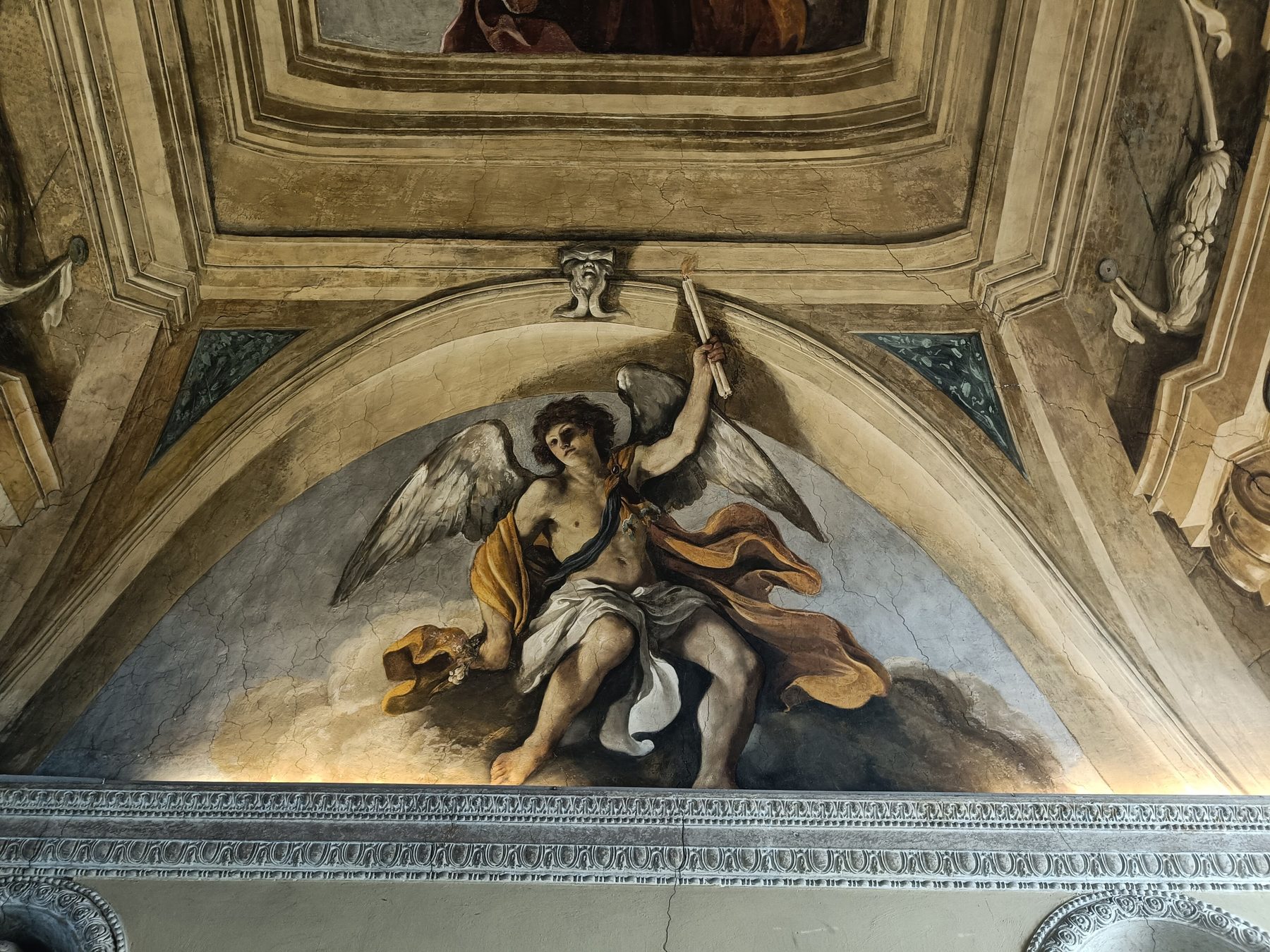
–1665
Poussin, Claude and the classical picture
Two French artists in Rome transform private history painting and composed landscape, making learned construction compatible with dance, catastrophe, weather and light.
–1700
Academies, monarchy and afterlives
French institutions turn classical authority into teaching, hierarchy and royal spectacle, while Sirani and later Roman painters reveal a broader and less uniform field.
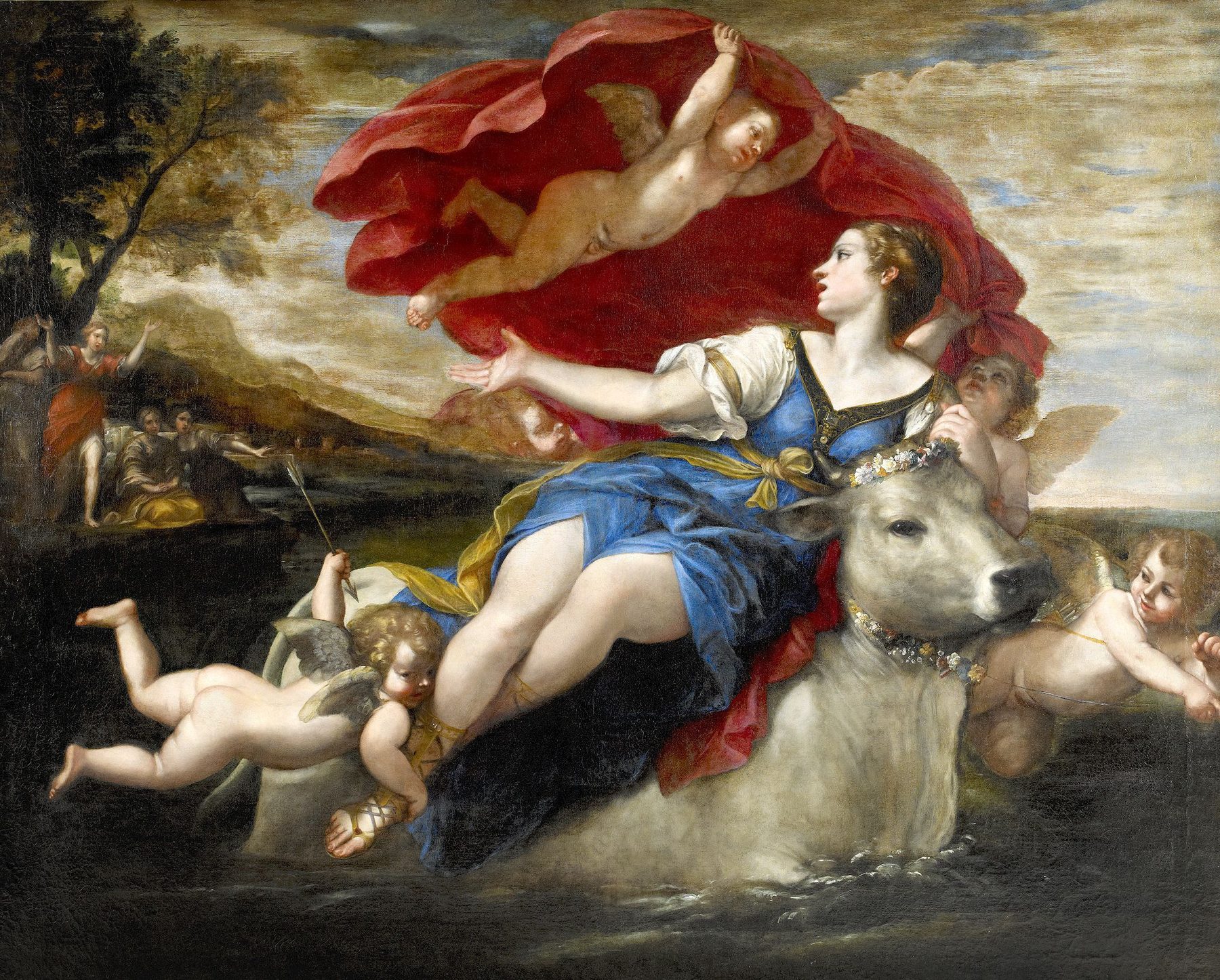
From Rome to French Classicism
Seventeenth-century French art cannot be reduced to Poussin and Claude, both of whom spent most of their lives in Rome. Paris contained court portraiture, church painting, decorative enterprises, print culture and strong encounters with Flemish and Italian art. A broad survey of France's Golden Age places classical and Baroque impulses within the same field rather than offering one national style. [31]
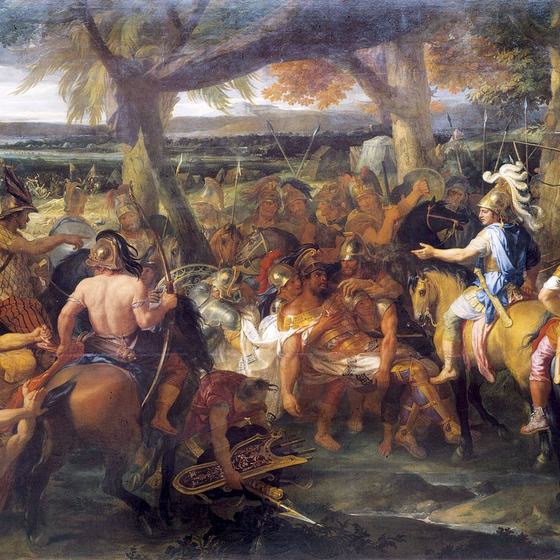
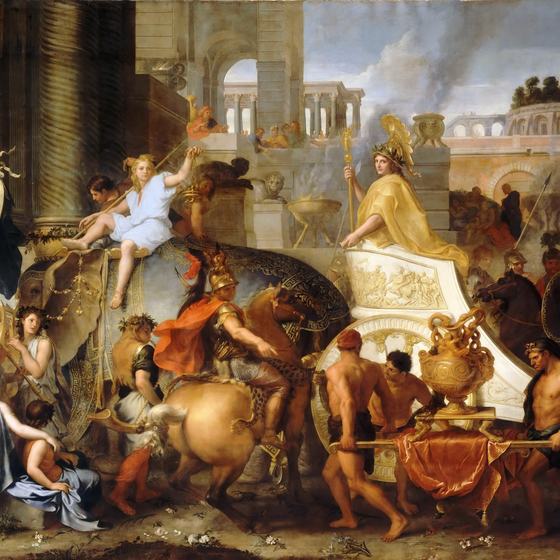
Charles Le Brun embodies the mixture. He trained with Simon Vouet, whose Parisian art drew on Italian Baroque drama, then travelled to Rome with Poussin in 1642. Back in France he became a founding member of the Académie royale de peinture et de sculpture, director of the Gobelins manufactory and First Painter to Louis XIV. His authority extended across painting, tapestry, furniture and large decorative teams. [43] [49]
The Royal Academy was established in 1648 independently of the powerful master painters' guild. Its foundation elevated the claim that painting and sculpture were liberal, intellectual arts rather than only manual trades. In 1666 Le Brun and Colbert helped establish the French Academy in Rome, making study of antiquity and Italian art part of a state-supported system. [44] These institutions created opportunities, rankings and shared theory, but also controlled access and reputation.
At the Louvre, the Galerie d'Apollon coordinated painting, stucco, sculpture and architecture under Le Brun's designs. Apollo, the sun, seasons, planets and parts of the day made cosmic order an image of Louis XIV's good government. [45] A surviving project for Apollo's chariot reveals the iconographic density and large scale planned for the unexecuted centre. [46] Classical mythology here served not private reflection but dynastic legitimacy.
The Hall of Mirrors at Versailles changed the emphasis. Le Brun's ceiling of 1680–84 abandoned a wholly mythological narrative to celebrate recent acts of Louis XIV's government and war. The king appears as conqueror, pacifier and maker of European order. [47] Allegory turns contested history into apparent inevitability. The clarity of the programme is political: it tells viewers how power wishes to be understood.
Le Brun's system is sometimes described as rational control opposed to colour. His actual paintings and decorations are more complicated. Versailles notes that he addressed intelligence through design while remaining attached to Baroque colour. [43] The academic quarrel over drawing and colour in the 1670s made that instability explicit. Defenders of drawing argued that line addresses the mind and establishes durable form; colourists insisted that colour's truth and sensory force were fundamental to painting. Charles de La Fosse studied Poussin, Venetian masters, Rubens and Rembrandt, carrying the debate into a brilliant decorative practice. [48]
French Classicism was therefore never a single cold official taste. It contained Poussin's private meditations, Le Brun's state spectacle, Claude's Roman light, Philippe de Champaigne's restraint and La Fosse's colour. Rome supplied models, but Paris reorganised them through monarchy, institutions, manufactories and debates.
Theory, reputation and the making of a canon
Giovanni Pietro Bellori's biographies and theory gave lasting form to the classical story. The artist should observe nature but select its finest parts, forming an Idea more perfect than any single body. Annibale, Domenichino and Poussin could then appear as restorers of art after decline. Giovanni Battista Agucchi helped develop related arguments in the Roman circles that supported Bolognese painting.
Such writing did not merely describe a movement. It ranked artists and supplied a genealogy. Reni and Domenichino became opposed exemplars; Caravaggio could be treated as excessively bound to unselected nature; Annibale became the founder of renewal. French writer André Félibien read and transformed Bellori while constructing a national history centred on Poussin. INHA research makes this Rome–Paris exchange explicit. [50]
The canon had social consequences. History painting, with biblical, mythological or ancient subjects, occupied the highest status because it supposedly required invention, learning and command of the human body. Landscape gained prestige when joined to elevated story, as Claude's career demonstrates. Portrait, still life and genre were ranked below. Artists who lacked access to life drawing, classical education, travel and official patronage faced structural barriers. Sirani's achievements are important partly because they expose those barriers.
Bodies, expression and decorum
The human body was the movement's most consequential instrument. History painting required artists to turn a text into visible action without speech. A bent knee might indicate surrender, a raised arm warning, a turned torso fear. Viewers trained in biblical and classical stories could recognise the event, but composition had to guide those who did not know every source. Gesture worked like syntax.
This helps explain the importance of drawing from a live model. An observed body supplied weight, balance and unexpected tension. The finished saint, god or hero could then be adjusted toward an ideal: limbs lengthened, awkward detail removed, profiles related to antique sculpture. The process was neither direct copying nor invention from nothing. It selected from multiple bodies and inherited forms.
Decorum governed those selections. In theory, form and expression should suit subject, person and setting. An apostle should not behave like a comic servant; sacred grief required nobility; ancient rulers needed authority. Yet decorum was flexible enough to create dispute. How much pain could an altarpiece show? Should a murdered child's body be beautiful? Could a bacchanal display erotic disorder while remaining learned art? Reni, Domenichino and Poussin gave different answers.
The Carracci's study of ordinary life remains crucial here. Knowledge of real movement made ideal gesture convincing. In Quo Vadis?, Peter's hands are rhetorically clear, but the backward recoil feels physically specific. In Reni's Massacre, the mothers' poses refer to sculpture yet the tension of arms around children remains bodily. Classicism does not ask viewers to choose between a symbol and a person; its power often comes from sustaining both.
Expression theory could also become regulation. Le Brun's academy lectures analysed the visible signs of passions, mapping eyebrows, eyes, mouths and head positions. Such systems promised intelligibility across large decorative schemes and student training. They also risked turning emotion into repeatable type. The best paintings exceed the diagram: a face works through colour, placement, relation and narrative time, not its features alone.
Order, violence and what the picture excludes
Classical clarity is never politically innocent. To organise violence is to decide whose suffering receives attention and how long it remains bearable to see. The Massacre of the Innocents gives mothers monumental dignity, but martyr palms above convert murdered children into a providential Christian story. Poussin's ancient histories can make abduction, battle and civic sacrifice exemplary. Le Brun's Versailles ceilings turn war into a sequence of achievements under wise rule.
This does not make the paintings simple propaganda. Patron, artist, site and viewer do not share one mind. Reni's compositional beauty can intensify rather than neutralise horror because the eye cannot escape into confusion. Poussin's order may reveal the fragility of civic virtue. Claude's ports can be admired as light-filled inventions while prompting questions about the wealth, shipping and territorial imagination that their patrons brought to them.
The imaginary port deserves particular scrutiny. It combines Roman palaces, distant ships, labouring dock figures and a biblical queen into a world available to elite possession. The tiny workers keep the harbour active while the titled traveller and luminous atmosphere define its meaning. Classical landscape can universalise a patron's view by making historically specific wealth look like natural order.
Royal decoration works at a larger scale. In the Galerie d'Apollon, the beneficial sun stands for good government. In the Hall of Mirrors, the king's actions become cosmic and historical sequence. Collaborative splendour absorbs the labour of painters, sculptors, stucco workers, gilders, weavers and builders into the name of Le Brun and the image of Louis XIV. A modern account should restore that production without pretending the First Painter worked alone.
The same issue appears in the academy. Declaring painting a liberal art protected artists from guild restrictions and affirmed intellectual ambition. It also established hierarchies of genre, education and access. The nude model was essential to history painting but not equally available to women. Royal commissions could stabilise careers while tying art to state priorities. Classicism's institutions created knowledge and exclusion together.
Classicism across media
Painting dominates the surviving movement story, but the classical current travelled through drawing, prints, sculpture, tapestry, architecture and interior design. Agostino Carracci's engravings distributed compositions beyond their original sites. Prints after Reni made his ideal figures available to workshops and collectors across Europe. The Pinacoteca's reconstruction of print volumes shows how later connoisseurs organised artistic lineage through reproducible images. [19]
Drawings could serve observation, invention, teaching, contract and memory. Annibale's rapid studies differ from Le Brun's carefully scaled project for the Galerie d'Apollon; Claude's Liber drawings record paintings already made. Treating every sheet as a spontaneous first thought obscures these functions.
At Gobelins, Le Brun's designs became tapestries, furniture and objects through coordinated labour. Classical order therefore entered rooms as an environment rather than a framed picture. Apollo, Alexander and royal history could surround bodies, structure ceremony and display control over materials. The integration is thoroughly Baroque in ambition, even when its iconography claims classical measure.
Architecture and sculpture also helped paintings think. Poussin studied reliefs and statues, but he did not merely insert archaeological quotations. A sarcophagus rhythm became moving dance; a statue's weight became a living hesitation. Annibale painted feigned sculpture beside flesh to test the difference. In Baroque Classicism, the classical past was not a storehouse of fixed answers. It was a set of forms made active through translation.
Patronage shaped form at every stage. The Farnese ceiling glorified a cardinal's palace; Reni's banner answered civic plague; Poussin's small histories served learned private collectors; Claude embedded patrons' emblems in imagined ports; Le Brun coordinated royal propaganda. Baroque Classicism did not float above politics. Its clarity could make devotion persuasive, collection distinguished and conquest orderly.
Baroque Classicism and Neoclassicism
Baroque Classicism is not another name for Neoclassicism. The eighteenth-century Neoclassical movement developed through new archaeology, Enlightenment debate, changing institutions and different political cultures. Yet Raphael, Carracci, Poussin and Claude acted as conduits through which ideals of harmony, proportion and antique authority remained available. [1]
The afterlife was selective. David found civic gravity and compositional discipline in Poussin. British collectors made Claude a standard of landscape beauty; Turner competed with him. Academic students copied Carracci, Reni and Le Brun. Later modernists could reject academic rules while admiring Poussin's construction. Influence did not flow through an unbroken classical essence. Each period remade the usable past.
The National Gallery of Art's exhibition archive for Correggio and the Carracci demonstrates how modern exhibitions themselves reconstruct regional continuities, bringing dispersed frescoes, paintings and drawings into a new argument. [5] Museum rooms and movement pages continue this work. The responsible approach is to display the category's usefulness while keeping its seams visible.
How to recognise Baroque Classicism
Begin with action. Can you understand what is happening through pose, gesture and gaze? Classical compositions often distribute information clearly, even when many figures are present. In Reni's Massacre, the central dagger and balanced groups organise terror. In Domenichino's Last Communion, bodies and looks carry attention toward Jerome.
Next examine idealisation. Faces and bodies may draw on antique sculpture or Raphael, but look for departures from perfect type: age, strain, weight, sudden movement. Annibale's Christ is monumental, yet Peter's recoil is awkwardly immediate. Idealisation and observation are not mutually exclusive.
Study the frame. Trees, columns, steps and bodies can build stable intervals. Frieze-like sequences recall sarcophagi; triangles bind devotional scenes; foreground wings open toward landscape distance. In ceiling decoration, painted frames may become deliberately unreliable. A classical vocabulary can support Baroque illusion.
Then look at colour and light. Reni's pale late surfaces differ from Annibale's Venetian richness, Poussin's saturated reds and blues, Claude's atmospheric gold and Le Brun's royal splendour. There is no single classical palette. Colour may clarify ranks and action, create mood or compete with outline.
Finally identify the audience and site. Is this an altarpiece, palace ceiling, private cabinet picture, academy demonstration or royal gallery? Scale and patronage change what order does. The same formal clarity can sustain prayer, philosophical reflection, family prestige or absolutist history.
Artists to know
Annibale Carracci
Annibale joined observed life, Renaissance precedent and antique form, then made their synthesis newly theatrical in Rome. His range—from butcher shops to the Farnese ceiling—makes him the current’s decisive starting point. [2] [3]
Nicolas Poussin
Poussin made antiquity, colour, dance and catastrophe available to reflective looking. His Roman cabinet pictures remain the richest test of how classical construction can contain unstable meaning. [21] [24]
Claude Lorrain
Claude transformed outdoor observation into invented worlds of harbour, journey and luminous distance, establishing the classical landscape as both poetic synthesis and marketable form. [32] [38]
A wider Italian and French field
The label crosses workshops, cities and institutions rather than defining a fixed membership. This directory brings together the Carracci inheritance, Roman classicists, composed landscape and the French academic and royal tradition while keeping those boundaries visible.
Major artists directory
| Name | Nationality | Key Works |
|---|---|---|
| Agostino Carracci | Italian | The Last Communion of Saint Jerome, Portraits and prints |
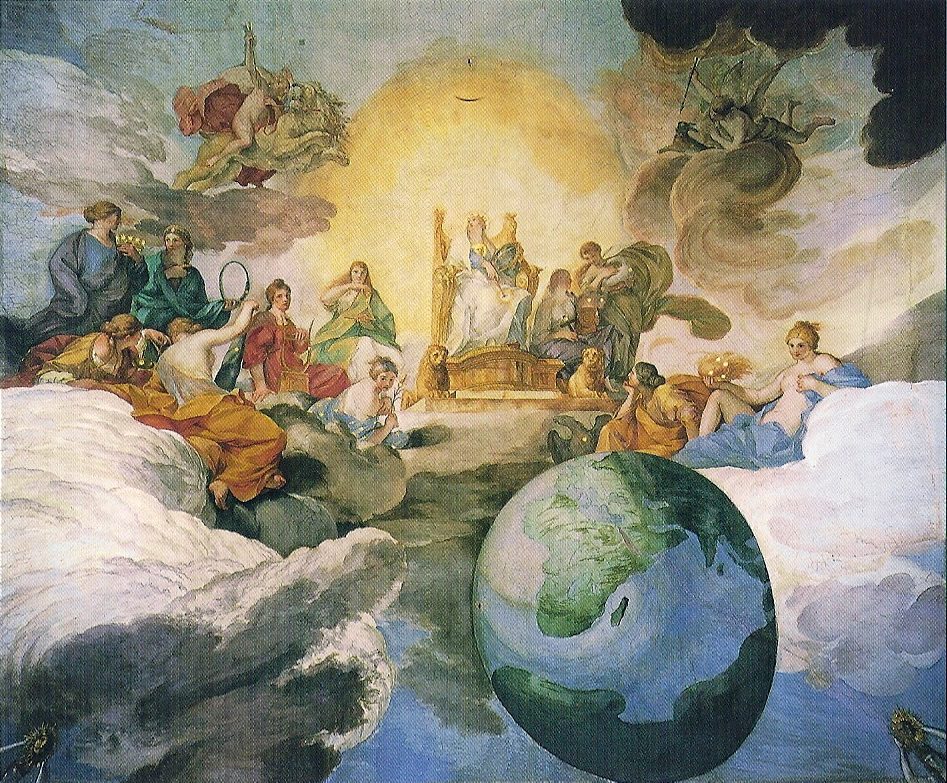
| Andrea Sacchi | Italian | Allegory of Divine Wisdom |
| Annibale Carracci | Italian | The Butcher's Shop, The Triumph of Bacchus and Ariadne, Christ Appearing to Saint Peter on the Appian Way, Christ Appearing to Saint Anthony Abbot, Landscape with the Flight into Egypt |
| Carlo Maratta | Italian | The Virgin Appearing to Saint Philip Neri, Portrait of Andrea Sacchi |
| Charles de La Fosse | French | The Sacrifice of Iphigenia, The Apotheosis of Hercules |
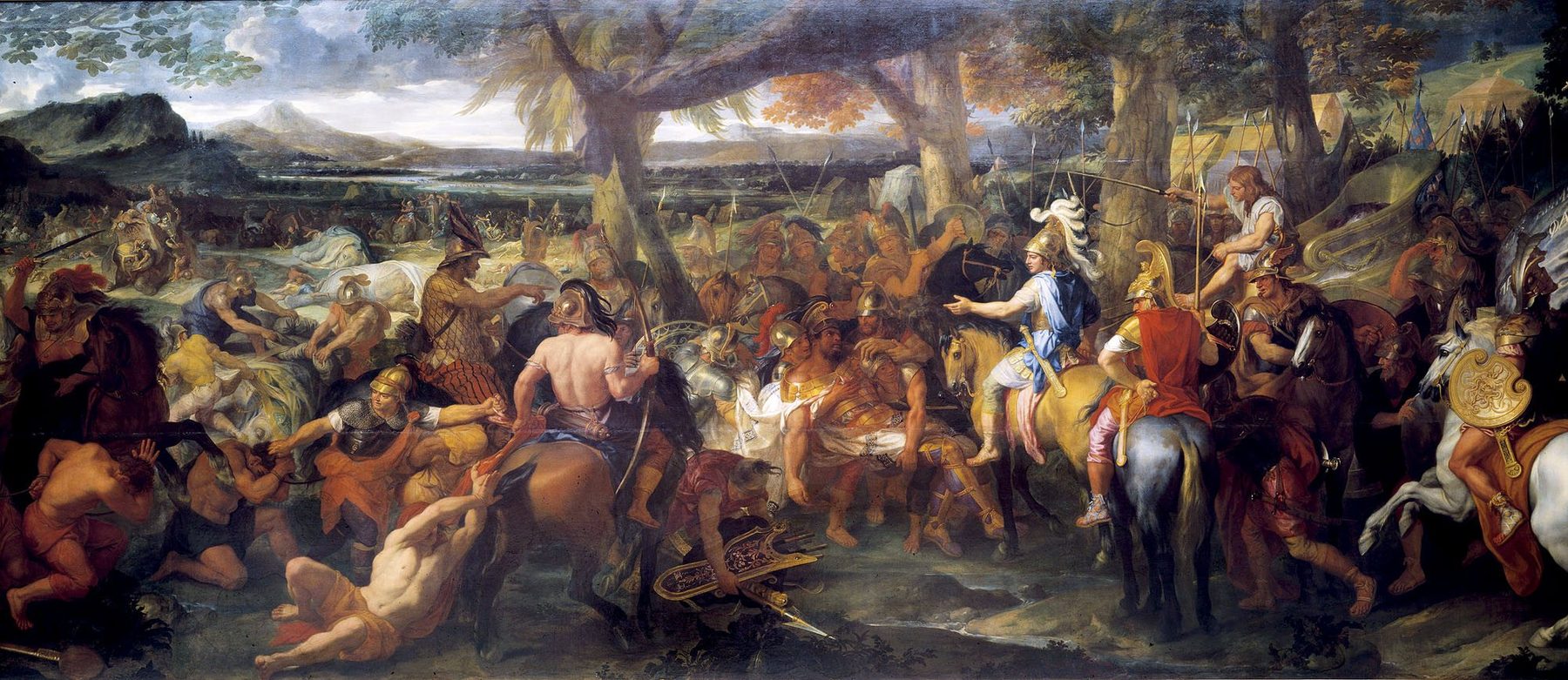
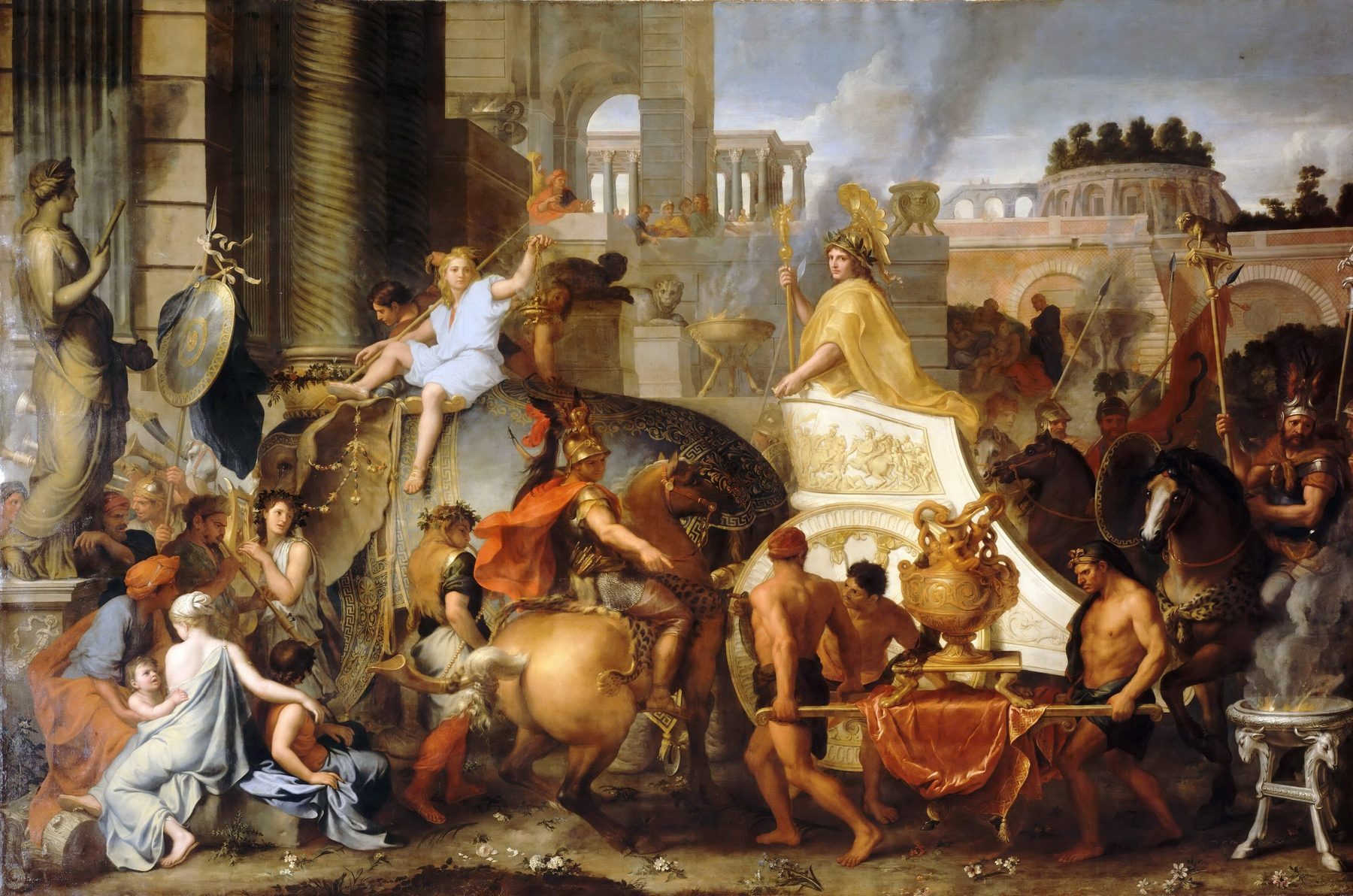
| Charles Le Brun | French | Alexander and Porus, The Entry of Alexander into Babylon |
| Claude Lorrain | French | Seaport with the Embarkation of the Queen of Sheba, Landscape with the Marriage of Isaac and Rebecca, Seaport with the Embarkation of Saint Ursula |
| Domenichino | Italian | The Last Communion of Saint Jerome, Diana's Hunt |
| Elisabetta Sirani | Italian | Portia Wounding Her Thigh |
| Eustache Le Sueur | French | The Muses Clio, Euterpe and Thalia, Saint Paul Preaching at Ephesus |
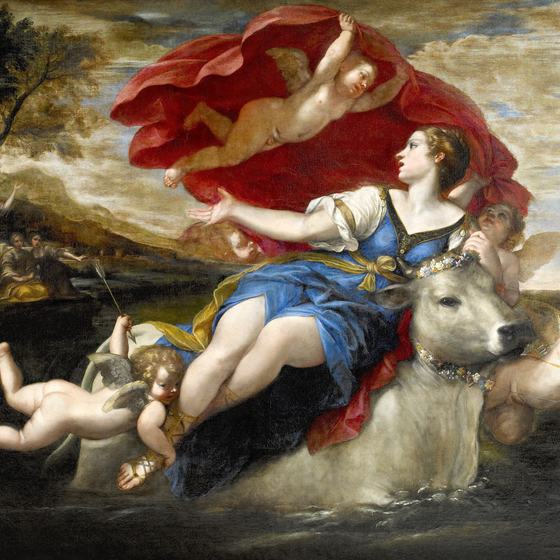
| Francesco Albani | Italian | Europa |
| Giovanni Lanfranco | Italian | The Assumption of the Virgin, The Ecstasy of Saint Margaret |
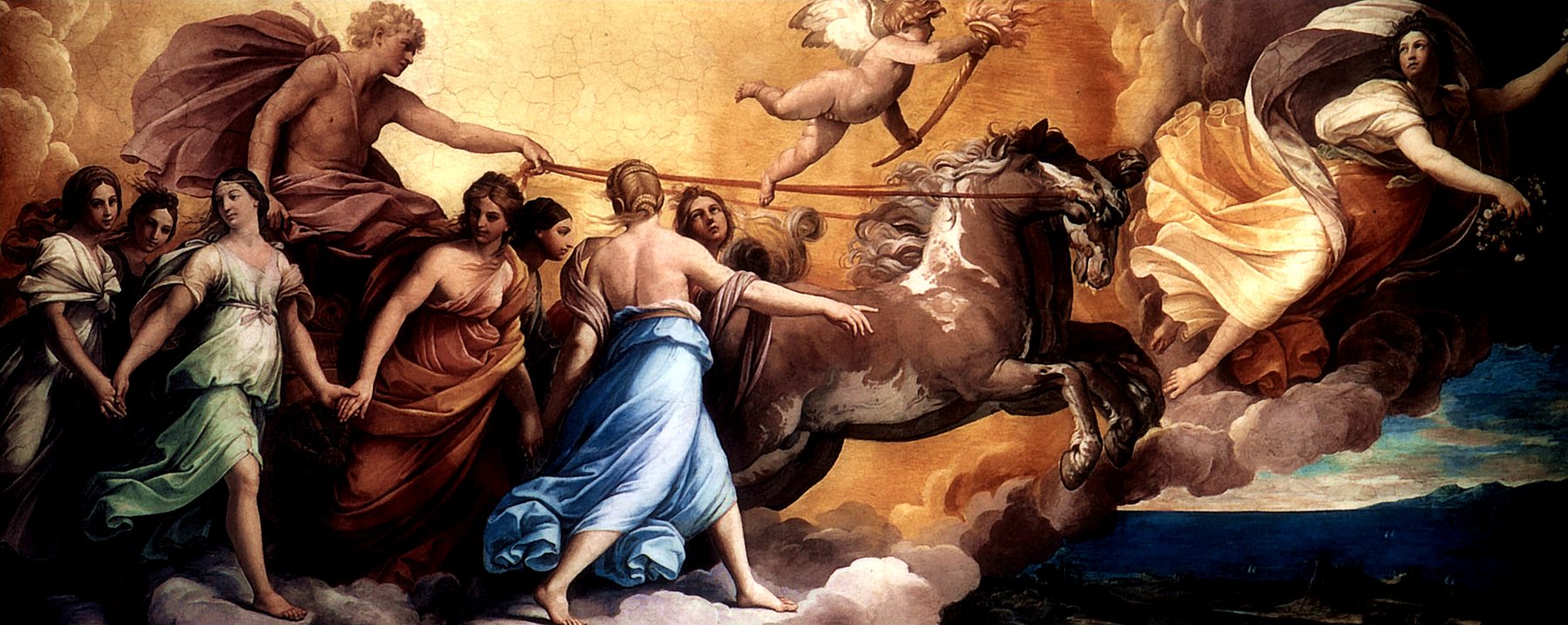
| Guercino | Italian | Aurora |
| Guido Reni | Italian | Massacre of the Innocents, Aurora, Atalanta and Hippomenes |
| Ludovico Carracci | Italian | The Agony in the Garden, The Conversion of Saint Paul |
| Nicolas Poussin | French | The Adoration of the Golden Calf, Et in Arcadia ego, Landscape with a Man Killed by a Snake, A Dance to the Music of Time, Blind Orion Searching for the Rising Sun |
| Philippe de Champaigne | French | Triple Portrait of Cardinal de Richelieu, Ex Voto de 1662 |
Where to see Baroque Classicism
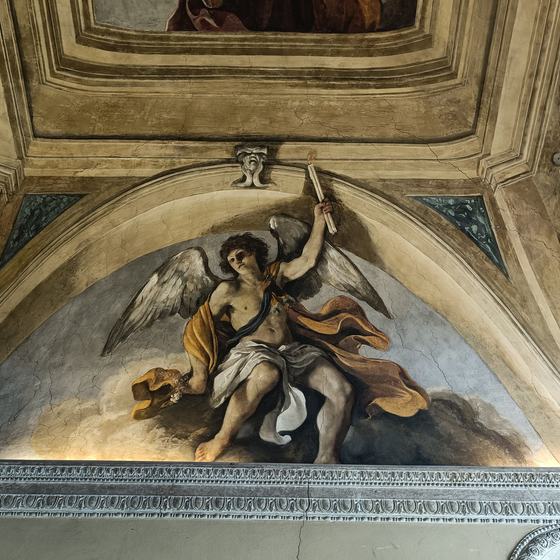
Rome remains essential. The Farnese Gallery reveals Annibale's ensemble at architectural scale; Vatican collections preserve Domenichino's Last Communion; Palazzo Barberini and churches show the rivalry of Sacchi, Cortona, Reni and Domenichino. Claude and Poussin are best understood after encountering the Roman landscape and antique remains that their paintings transform.
Bologna's Pinacoteca Nazionale provides the deepest concentration of Reni and the Carracci legacy, including the Massacre of the Innocents. Its rooms allow viewers to compare ideal beauty across generations rather than treating “the Bolognese school” as uniform. [20]
The Louvre and National Gallery London hold exceptional groups of Poussin and Claude. The Louvre's Galerie d'Apollon makes French royal decoration tangible, while Versailles expands that programme into architecture and state ceremony. Madrid's Prado shows how Italian and French classicisms circulated through Spanish royal collecting.
Where to see Baroque Classicism
The strongest encounters join concentrated collections to the palaces, churches and galleries for which this art was made. Displays, loans and access conditions change, so check current information before travelling.
Pinacoteca Nazionale di Bologna
Bologna, Italy
The deepest public concentration of the Carracci legacy and Guido Reni, including the Massacre of the Innocents and major Bolognese altarpieces.
Carracci, Reni and the Bolognese schoolOfficial collection informationLouvre Museum
Paris, France
Poussin, Claude and the Galerie d’Apollon connect private cabinet pictures, composed landscape and French royal decoration.
Poussin, Claude and Le BrunOfficial collection informationNational Gallery
London, United Kingdom
Exceptional groups of Poussin and Claude sit beside Carracci, Reni and their rivals, with unusually rich conservation and collection research.
Poussin, Claude and comparative contextOfficial collection informationVatican Museums
Vatican City
Domenichino’s Last Communion of Saint Jerome anchors the movement inside the religious and monumental culture of seventeenth-century Rome.
Domenichino and Roman history paintingOfficial collection informationPalazzo Farnese
Rome, Italy
The Farnese Gallery must be experienced at architectural scale: Annibale’s painted frames, feigned sculpture and mythological bodies form one inseparable ensemble.
Annibale’s foundational ceilingOfficial collection informationMuseo Nacional del Prado
Madrid, Spain
Spanish royal collecting created a strong route through Reni, Carracci, Poussin and Claude and reveals how Italian and French classicisms circulated across courts.
Reni and royal collectingOfficial collection informationPalace of Versailles
Versailles, France
Le Brun’s Hall of Mirrors and wider decorative programme show classical myth, recent history, architecture and collaborative labour serving Louis XIV’s monarchy.
Le Brun and royal spectacleOfficial collection informationMetropolitan Museum of Art
New York, United States
Paintings, drawings and publications by Carracci, Poussin, Claude and their circles support comparisons between invention, landscape and academic afterlives.
Works and research across mediaOfficial collection information
Landmark Baroque Classicism exhibitions
Five exhibitions that reshaped the current through regional reform, classical landscape, royal decoration and new readings of Poussin and Reni.
The Age of Correggio and the Carracci
Bologna, Washington and New York
A landmark survey reconstructed Emilian painting across two centuries and made the Carracci reform visible through dispersed paintings and drawings.
Nature and the Ideal: Landscape in Rome, 1600–1650
Grand Palais, Paris
Carracci, Poussin, Claude and their contemporaries were brought together around the emergence of composed landscape in seventeenth-century Rome.
Charles Le Brun: The Painter of the Sun King
Louvre-Lens
The first major Le Brun retrospective in more than fifty years reconsidered the painter beyond academic rigidity and royal propaganda.
Poussin and the Dance
National Gallery, London, and J. Paul Getty Museum
Paintings, drawings, antiquities and reconstructed wax models reframed Poussin as a choreographer of bodies in motion.
Guido Reni: The Beauty of the Divine
Städel Museum and Museo del Prado
Nearly one hundred works restored technical experiment, commercial intelligence and emotional range to a painter long reduced to ideal sweetness.
Frequently Asked Questions
It is a retrospective term for artists and institutions that pursued idealised form, legible narrative and classical models within seventeenth-century Baroque culture.
No. It had no single manifesto or membership. It connects related practices in Bologna, Rome and France.
Baroque spectacle and classical order are not opposites. A work can use ideal bodies and balanced composition while also creating movement, emotion and illusion.
The Carracci reform in Bologna and Annibale Carracci's Roman work are the strongest starting points. Later artists developed distinct answers rather than copying them.
The Carracci combined observation with selective study of Renaissance and antique art. Caravaggio placed greater pressure on immediate models and dramatic light. The contrast is real but not absolute; Reni and others learned from both.
He studied antiquity and Raphael, constructed intelligible narratives and adjusted form to subject. His art also contains vivid colour, sensual dance, grief and catastrophic nature.
It is a composed landscape shaped by balanced framing, ideal distance and an elevated biblical or mythological subject. Claude built such pictures from outdoor study and studio invention.
He drew extensively outdoors, but his oil paintings were composed and finished in the studio rather than copied from one topographical view.
It was Claude's album of 195 record drawings of paintings, often annotated with patrons and dates. It helped document his output and protect his authorship from copies.
Founded in 1648, it promoted painting and sculpture as intellectual professions, organised teaching and debate, and became closely connected to royal cultural power.
No. French Classicism is an important part of the story, but the broader current begins in Italy and includes artists based in Rome from several regions.
No. Neoclassicism arose later under different archaeological, intellectual and political conditions, though it drew heavily on Poussin and the earlier classical tradition.
Discussion
Which work best unsettles the idea that Classicism must be calm: Annibale's illusionistic Farnese ceiling, Reni's measured violence, Poussin's dancing bacchanals or Claude's luminous but invented world?
Reader Insights
Trace how hands, glances and turning bodies distribute a story. Clarity often carries the movement’s strongest emotion rather than calming it.
Look for the points where naturalism, theatrical illusion or brilliant colour resist the expectation that classical art must be cool and static.
Consider whether composition supports devotion, private reflection, collection, academy teaching or royal power—and whose labour it absorbs.
Join the Conversation
Which work best unsettles the idea that Classicism must be calm: Annibale’s illusionistic Farnese ceiling, Reni’s measured violence, Poussin’s dancing bacchanals or Claude’s luminous but invented world?
References
- “Classical,” National Gallery London, nationalgallery.org.uk. View Source
- “Annibale Carracci (1560–1609),” Metropolitan Museum of Art, metmuseum.org. View Source
- “Annibale Carracci,” Museo Nacional del Prado, (in Spanish). View Source
- “Sixteenth-Century Painting in Emilia-Romagna,” Metropolitan Museum of Art, metmuseum.org. View Source
- The Age of Correggio and the Carracci, National Gallery of Art, nga.gov. View Source
- The Drawings of Annibale Carracci, National Gallery of Art, nga.gov. View Source
- “Italian Masterpieces from Spain's Royal Court: The Legacy of the Carracci,” Museo Nacional del Prado, museodelprado.es. View Source
- “Christ appearing to Saint Peter on the Appian Way,” National Gallery London, nationalgallery.org.uk. View Source
- “Christ appearing to Saint Anthony Abbot,” National Gallery London, nationalgallery.org.uk. View Source
- “Annibale Carracci's Montalto Madonna,” National Gallery London, nationalgallery.org.uk. View Source
- “Ludovico Carracci: The Agony in the Garden,” National Gallery London, nationalgallery.org.uk. View Source
- “Reni, Guido,” Museo Nacional del Prado, (in Spanish). View Source
- “Guido Reni,” Museo Nacional del Prado, (in Spanish). View Source
- “Room 24: Guido Reni,” Pinacoteca Nazionale di Bologna, (in Italian). View Source
- “Massacre of the Innocents,” Pinacoteca Nazionale di Bologna, pinacotecabologna.beniculturali.it. View Source
- “Plague Altarpiece,” Pinacoteca Nazionale di Bologna, pinacotecabologna.beniculturali.it. View Source
- “Domenichino, Communion of Saint Jerome,” Vatican Museums, museivaticani.va. View Source
- “Room 29: Large Size Altarpieces,” Pinacoteca Nazionale di Bologna, pinacotecabologna.beniculturali.it. View Source
- “Stampe di Guido Reni e romane di Simone Cantarini,” Pinacoteca Nazionale di Bologna, (in Italian). View Source
- Guido Reni and the Seicento visitor guide, Pinacoteca Nazionale di Bologna, (in Italian). View Source
- “Nicolas Poussin (1594–1665),” Metropolitan Museum of Art, metmuseum.org. View Source
- “Nicolas Poussin,” National Gallery London, nationalgallery.org.uk. View Source
- “Poussin, Nicolas,” Museo Nacional del Prado, (in Spanish). View Source
- “Get to know Poussin,” National Gallery London, nationalgallery.org.uk. View Source
- “The Triumph of Silenus,” National Gallery London, nationalgallery.org.uk. View Source
- “The Adoration of the Shepherds: an artist's perspective,” National Gallery London, nationalgallery.org.uk. View Source
- “The Annunciation,” National Gallery London, nationalgallery.org.uk. View Source
- Nicolas Poussin, Metropolitan Museum of Art Bulletin, resources.metmuseum.org. View Source
- Greek Art from Prehistoric to Classical: “Blind Orion” entry, Metropolitan Museum of Art, resources.metmuseum.org. View Source
- “Poussin and documentary bibliography,” Institut national d'histoire de l'art, (in French). View Source
- France in the Golden Age, Metropolitan Museum of Art, resources.metmuseum.org. View Source
- “Claude (1604/5?–1682),” National Gallery London, nationalgallery.org.uk. View Source
- Le Lorrain: Master of Landscape Painting, Musée du Louvre, presse.louvre.fr. View Source
- “Seaport with the Embarkation of the Queen of Sheba,” National Gallery London, nationalgallery.org.uk. View Source
- “Landscape with the Marriage of Isaac and Rebecca,” National Gallery London, nationalgallery.org.uk. View Source
- “Seaport with the Embarkation of Saint Ursula,” National Gallery London, nationalgallery.org.uk. View Source
- “Some Observations on Blanching in the Paintings of Claude,” National Gallery London, nationalgallery.org.uk. View Source
- “Liber Veritatis frontispiece and album,” British Museum, britishmuseum.org. View Source
- “Liber Veritatis record for the Marriage of Isaac and Rebecca,” British Museum, britishmuseum.org. View Source
- The Adele and Arthur Lehman Collection, Metropolitan Museum of Art, resources.metmuseum.org. View Source
- “Turner Inspired: In the Light of Claude,” National Gallery London, nationalgallery.org.uk. View Source
- “Ruskin on Claude,” National Gallery London, nationalgallery.org.uk. View Source
- “Charles Le Brun,” Château de Versailles, (in French). View Source
- “Histoire,” Académie des Beaux-Arts, (in French). View Source
- “Sun and Gold: The Galerie d'Apollon,” Musée du Louvre, louvre.fr. View Source
- “Apollon sur son char,” Musée du Louvre, (in French). View Source
- “La galerie des Glaces,” Château de Versailles, (in French). View Source
- “Charles de La Fosse and the colour debate,” Château de Versailles, (in French). View Source
- Charles Le Brun exhibition press release, Musée du Louvre, presse.louvre.fr. View Source
- “Félibien reader of Bellori and the classical ideal,” Institut national d'histoire de l'art, (in French). View Source
- Image references 51–74: open-access reproductions and institutional collection records.
View 24 image sources
01 · commons.wikimedia.org02 · commons.wikimedia.org03 · commons.wikimedia.org04 · commons.wikimedia.org05 · commons.wikimedia.org06 · commons.wikimedia.org07 · commons.wikimedia.org08 · commons.wikimedia.org09 · commons.wikimedia.org10 · commons.wikimedia.org11 · commons.wikimedia.org12 · commons.wikimedia.org13 · commons.wikimedia.org14 · commons.wikimedia.org15 · commons.wikimedia.org16 · commons.wikimedia.org17 · commons.wikimedia.org18 · commons.wikimedia.org19 · commons.wikimedia.org20 · commons.wikimedia.org21 · commons.wikimedia.org22 · commons.wikimedia.org23 · commons.wikimedia.org24 · commons.wikimedia.org