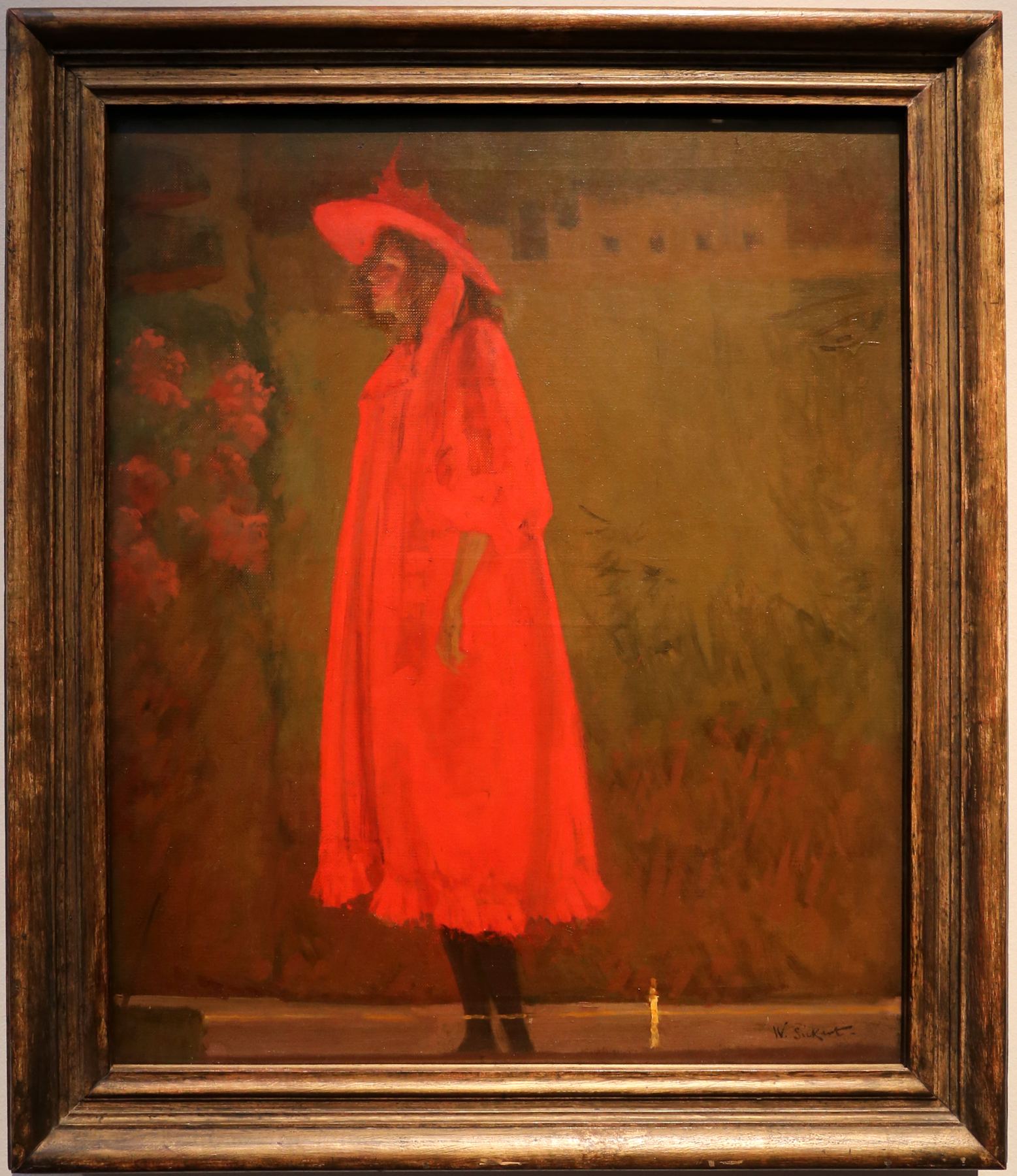
Image reference: Minnie Cunningham at the Old Bedford by Walter Sickert.
At a Glance
- Core dates1911–12 as a formal exhibiting society; a wider network from about 1907 to 1913
- Primary centreNorth and central London, especially Camden Town and Fitzroy Street
- Key figuresWalter Sickert, Spencer Gore, Harold Gilman, Charles Ginner, Robert Bevan and Lucien Pissarro
- Principal subjectsUrban interiors, music halls, cafés, streets, parks, workers, horses, suburbs and landscapes
- Known forModern everyday subjects, strong colour, emphatic surfaces and artist-led exhibition networks
- Important contextThe group admitted sixteen men and excluded women from formal membership
- Related developmentsThe New English Art Club, Allied Artists’ Association, Fitzroy Street Group, Post-Impressionism and London Group
- What it was notOne unified brushstroke, a Sickert-only movement, a social-reform programme or a synonym for every related British painting made after 1912.
Contents
- Where it fits
- Society and network
- Fitzroy Street
- Three exhibitions
- Walter Sickert
- Artists to know
- Women and exclusion
- How it looked
- London Group and afterlife
- Where to study it
Where the Camden Town Group fits
Walter Sickert
Key career periodSpencer Gore
Key career periodHarold Gilman
Key career periodCharles Ginner
Key career periodRobert Bevan
Key career periodLucien Pissarro
Key career periodMalcolm Drummond
Key career periodEthel Sands
Key career periodIn Malcolm Drummond’s painting of 19 Fitzroy Street, pictures are stacked, propped and hung across Walter Sickert’s cramped rooms. The studio is neither a polished commercial gallery nor a private refuge. It is a working place temporarily converted into an exhibition, where artists and visitors can look, argue and perhaps buy. That improvised setting captures the social machinery from which the Camden Town Group emerged. Before it became a named society, it was a habit: painters meeting on Saturdays, comparing canvases and trying to create an audience outside the established institutions.
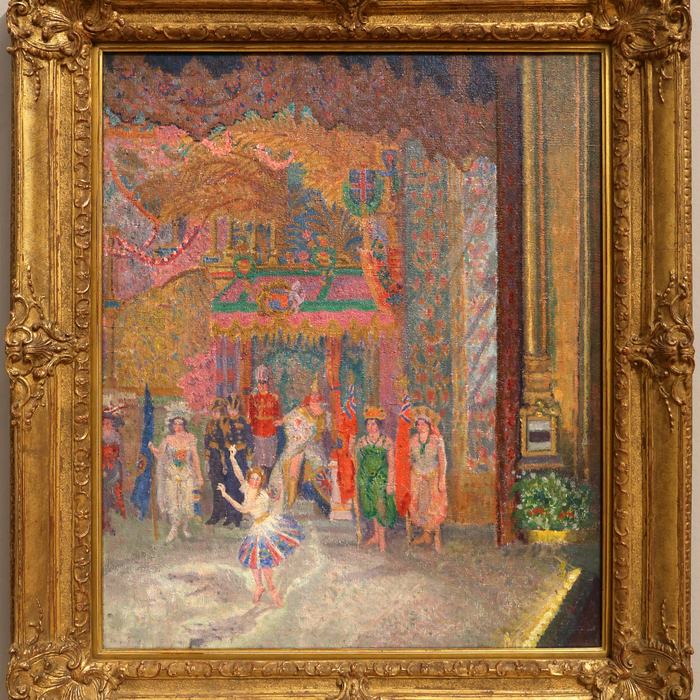
The formal Camden Town Group was founded in 1911 and gave three exhibitions at the Carfax Gallery before it ceased to exist in 1912. Its sixteen members were men, and its best-known painters included Sickert, Spencer Gore, Harold Gilman, Charles Ginner and Robert Bevan. Their pictures ranged across rented bedrooms, music halls, cafés, city gardens, horse markets, suburban streets and rural fields. They did not share one technique, programme or political position. What held them together was a conviction that ordinary contemporary experience could sustain serious painting, and that modern art in Britain could be made through selective, sometimes argumentative engagement with France.[1]
This brevity matters. “Camden Town Group” is often used loosely for an entire artistic circle extending from Sickert’s return to London in 1905 until the First World War, or even for a recognisable strain of British figurative painting long afterwards. The useful history is more exact. The Fitzroy Street Group provided the open weekly network from 1907; the Camden Town Group became a selective exhibiting body in 1911–12; and the London Group brought several networks together from 1913. Tate’s collection and research place the named society inside this wider web rather than treating its dates as the beginning and end of every relevant friendship or idea.[2]
A society inside a network
The most productive way to understand the Camden Town Group is to hold two scales in view. At the small scale, it was a club with officers, elections, a numerical limit and a short exhibition record. At the larger scale, it was one temporary arrangement within a cosmopolitan London ecology of studios, art schools, galleries, periodicals, private salons and friendships. The Tate research project reflects that larger field through biographies, object entries, technical studies and social-history essays, making the group a case study in how twentieth-century British modernism emerged rather than a sealed stylistic category.[3]
The distinction also corrects a familiar retrospective illusion. Because Sickert, Gore, Gilman, Ginner and Bevan now appear together in collections, their association can seem inevitable. It was not. They differed in age, income, education, temperament and artistic ambition. Some had trained in Paris; some came through the Slade or Westminster; some were deeply involved in Sickert’s teaching; some were elected partly to widen the society’s prestige. Their interests overlapped, but friendships broke, alliances shifted and the most radical artists soon moved elsewhere. The formal group was therefore less a movement marching towards a common destination than a platform on which several versions of modern painting briefly stood together.[4]
That platform occupied a strategic middle ground. The painters challenged academic finish, sentimental narrative and the genteel separation of high art from supposedly unworthy urban subjects. Yet most remained committed to recognisable places, objects and bodies when Cubism and abstraction were becoming visible in London. Their work could look advanced beside conservative exhibition painting and cautious beside the coming Vorticist avant-garde. This position was not simply timidity. It enabled sustained experiments in how colour, structure and material paint might transform observed life without abandoning it.[5]
Fitzroy Street: pictures, talk and direct contact
The prehistory began in the circle around Sickert and Gore. After years in Dieppe and Venice, Sickert returned to London with deep knowledge of French practice and a gift for attracting younger painters. From 1907, the rented rooms at 19 Fitzroy Street became a recurring Saturday meeting place. Artists brought recent work; pictures could be set against the walls; invited visitors encountered several painters at once. This was sociability, criticism and modest commerce combined.
Fitzroy Street addressed a practical problem. Progressive artists needed visibility, but established exhibiting societies brought juries, annual schedules and institutional etiquette. Commercial galleries could be costly or conservative. A regularly opened studio created a low-budget alternative, bringing work into direct contact with patrons while allowing artists to test it before knowledgeable peers. The Carfax Gallery, which later hosted the Camden Town exhibitions, belonged to the small but important London gallery culture through which modern British artists attempted to reach new publics.[6]
The arrangement was informal, but it was not casual. Gore was a tireless organiser, placing pictures and keeping the room active. Sickert supplied authority, conversation and provocation. Regular participants included Gilman, Ginner, Bevan and Malcolm Drummond, with Lucien Pissarro and James Bolivar Manson joining the network. Patrons and fellow artists came through. The room converted looking into an event and criticism into a collective practice. It also made artistic identity partly performative: visitors encountered painters not as isolated names on a wall but as a self-organised modern circle.
Malcolm Drummond’s 19 Fitzroy Street is therefore more than a group portrait. Its crowded walls show how portable paintings changed a domestic room into an alternative institution. Figures lean, sit and look; the fire and furniture keep the setting recognisably inhabited. The picture offers no heroic assembly or formal declaration. Modernism appears as recurring labour—carrying canvases, making tea, hanging work, inviting people and sustaining conversation. The later exhibiting society depended upon those mundane acts.
In spring 1911, members of the circle discussed a more selective body. The decision created sharper boundaries: election now mattered, the number of members was capped, and public exhibitions would appear under one collective name. The first Camden Town Group exhibition opened at the Carfax Gallery in June 1911. Its title gave a local identity to painters whose subjects and careers ranged far beyond Camden itself.[7]
Formation, membership and three exhibitions
Spencer Gore became the first president and J. B. Manson served as secretary. Sickert was the principal catalyst, but the organisational work should not be reduced to him. Gore’s energy helped turn a studio network into an exhibiting body; Manson managed correspondence and administration. Tate’s archive records his friendship with Lucien Pissarro, their attendance at Fitzroy Street and his continued secretarial role when the London Group was formed in 1913.[8]
The core artists most consistently associated with the Camden Town achievement were Sickert, Gore, Gilman, Ginner, Bevan and Drummond. The elected membership was broader. Walter Bayes, Henry Lamb, Augustus John, Wyndham Lewis, J. D. Innes, Lucien Pissarro, J. B. Manson, Maxwell Gordon Lightfoot, William Ratcliffe and John Doman Turner brought different reputations and degrees of commitment. Lists vary when resignations, replacement elections and exhibition participation are compressed into one static roll. That complexity is itself revealing: membership was negotiated, and belonging to the society did not mean accepting a single visual creed.
The sixteen-man maximum has sometimes been explained as a practical attempt to keep exhibitions manageable. Whatever its administrative logic, it also made election competitive and exclusion structural. Letters preserved in Manson’s archive concern exhibitions, sales and internal relations, reminding us that a movement’s history is made through invitations, refusals, money and workload as much as through finished pictures.[9]
The group held only three exhibitions: two in 1911 and one in 1912, all at the Carfax Gallery. They were not dramatic commercial triumphs. Yet the repeated collective presentation gave critics and viewers a way to recognise a new formation in British painting. Small pictures, familiar modern subjects and visibly worked surfaces could be seen together, allowing difference as well as affinity to emerge. The group’s identity was produced by the exhibitions; it did not exist fully formed before them.
The name “Camden Town” had several advantages. It connected the society to Sickert’s studios and to north London, sounding local rather than grandly doctrinal. It suggested the modern metropolis without claiming all of London. It also distinguished the body from societies whose names announced a technique or manifesto. But it can mislead if taken literally. Members painted Westminster gardens, Leicester Square, the Thames, Letchworth, Sussex, Devon, Norway and France. Camden was a base, a social geography and a reputational label, not a fence around permissible subjects.
Sickert: catalyst, teacher and dissenter
Walter Sickert was older than the central Camden Town generation and brought an unusually mobile artistic identity. Born in Munich, raised in Britain and active for long periods in France and Italy, he had worked as an actor before turning to painting. He learned from James McNeill Whistler and developed close contact with Edgar Degas. This training helped make him an intermediary, but not a neutral transmitter. He selected and transformed what he learned, then argued his positions through teaching, journalism and example.[10]
Sickert opposed the idea that painting should conceal its material construction beneath polished illusion. He encouraged work from drawings and studies, the repeated return to a subject, and the gradual building of the image in the studio. His modernity did not depend on painting everything quickly before the motif. Degas mattered particularly as a model of composition and method: observation could be reorganised, figures cropped, viewpoints displaced and theatre treated as a system of spectatorship rather than a display of isolated stars. Art UK’s biography stresses that Sickert was interested in the poetry of overlooked places—lodging rooms, back streets and popular entertainment—while remaining a forceful teacher and organiser.[11]
French institutional records are useful here because they resist making Sickert wholly insular. The Musée d’Orsay catalogues him within a transnational field and preserves French documentation of his work. His career moved across the Channel repeatedly; Dieppe was not a decorative interlude but a working centre. “French influence” in Camden Town therefore means lived contact, friendships, exhibitions and methods, not the passive reception of reproductions in London.[12]
Sickert could also make titles behave like fragments of plays. A room with two figures might be called What Shall We Do for the Rent? or linked to the notorious Camden Town murder, changing the viewer’s expectations without fixing a single narrative. William Rough’s study of Sickert and contemporary drama situates this theatricality within a culture of performance and popular storytelling. The pictures do not simply illustrate a script. Their psychological pressure arises because gesture, distance and title imply events while withholding confirmation.[13]
Music halls and the architecture of spectatorship
Sickert had painted music halls well before 1911, but these works provided the Camden Town circle with a durable model of modern subject and modern construction. Music halls mixed classes, commodities, lighting, celebrity and collective attention. They were sometimes dismissed as vulgar, which made them useful tests of what serious painting could include.
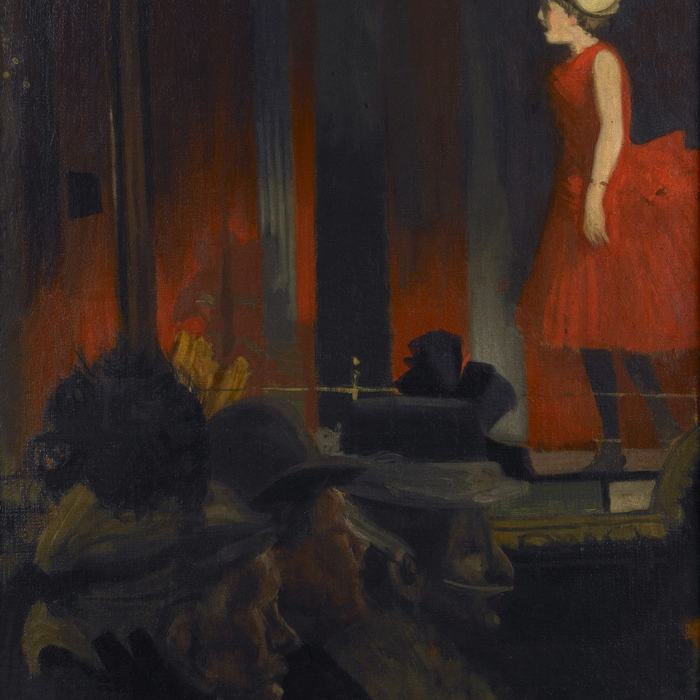
In Minnie Cunningham at the Old Bedford, the performer appears from the audience’s position. The original title quoted one of her songs, binding visual experience to a remembered voice and public persona. The subject was not an anonymous dancer imported from Paris but a recognisable entertainer within Camden’s popular culture.[14] Yet Sickert did not simply document the act. Balconies, mirrors, shadows and spectators interrupt the view, making the audience’s desire to see part of the painting.
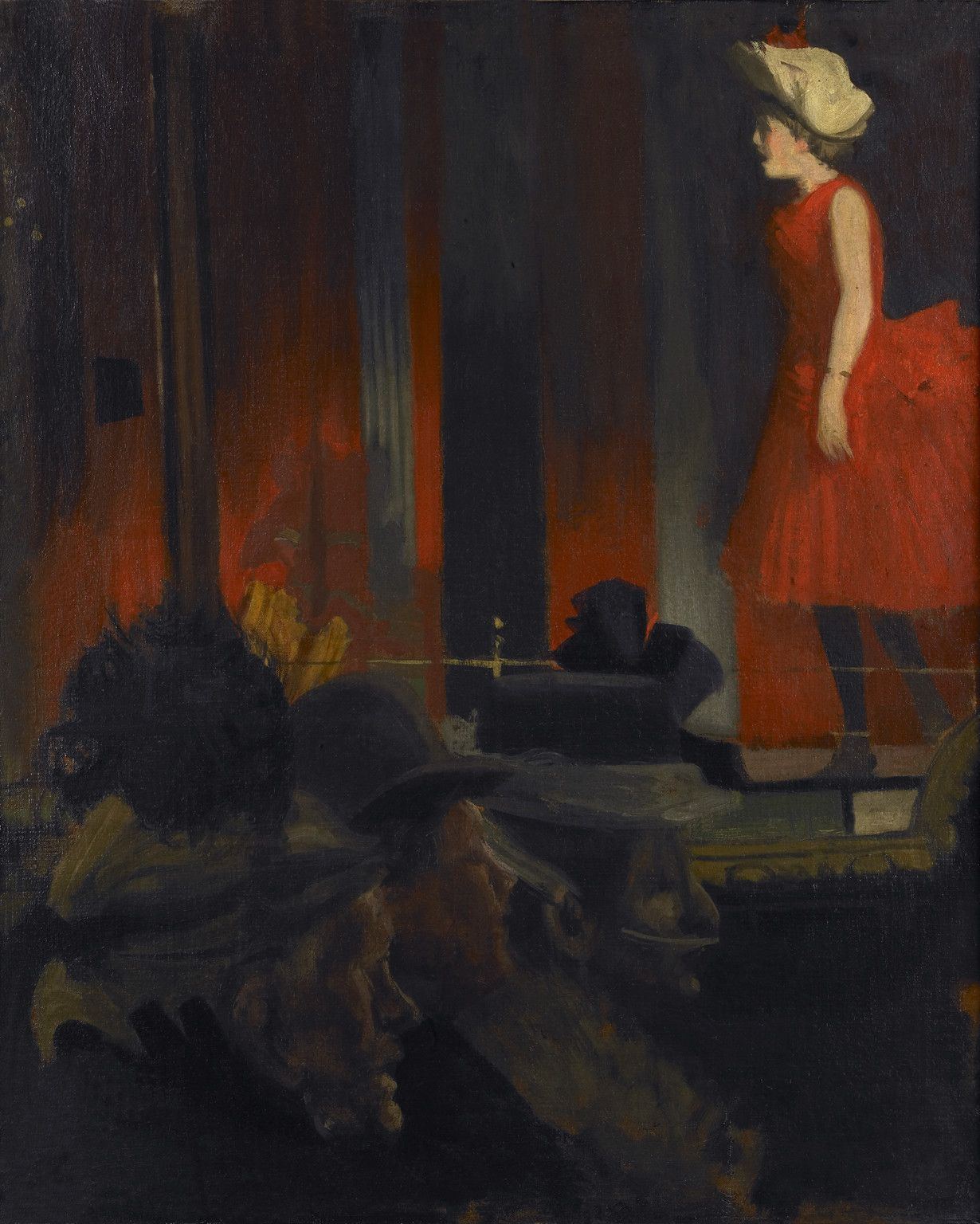
The P.S. Wings in the O.P. Mirror is deliberately hard to read. Spectators face the stage, but the red performer visible to us is a reflection in a side mirror. The title supplies theatrical coordinates while the composition separates what the painted audience sees from what the viewer sees.[15] Such works explain why the Camden Town artists’ realism cannot be defined as transparent reporting. Modern life reaches the canvas through memory, framing, reconstruction and paint.
The 2022 Tate and Petit Palais exhibition placed Sickert’s theatre, music hall, press imagery, nudes and later photographic sources within one extended investigation of popular visual culture. Its French presentation also underscores how much his reputation belongs to dialogue between British and continental histories.[16] The accompanying French catalogue, Walter Sickert: Peindre et transgresser, made transgression a question of pictorial boundaries as well as provocative subject: theatre and domestic interior, public event and private room, painting and mass image repeatedly exchange roles.[17]
The Camden Town nudes: looking, naming and power
Sickert’s furnished-room nudes are among the group’s most difficult and consequential images. Their models occupy iron beds, rumpled blankets and narrow rooms rather than timeless studio space. Flesh, wallpaper and cheap furniture share a dense, often abrasive material presence. The paintings reject the polished ideal nude, but rejection of idealisation does not automatically produce equality. The viewer still confronts an asymmetry between the male artist, the paying audience and a woman whose name may be absent.
Titles associated with the 1907 murder of Emily Dimmock intensified that asymmetry. Sickert did not paint an eyewitness account of the crime, and the interiors should not be treated as forensic evidence. He reused poses and compositions and gave related works different titles. The murder reference operated through publicity, suggestion and contemporary fear. It could turn an ambiguous interaction into an imagined scene of violence. Responsible looking must therefore distinguish what is actually painted from the story attached to it, while recognising that the chosen title is itself an artistic and commercial act.
The nudes reveal a contradiction at the centre of Camden Town modernity. The group was willing to represent unidealised bodies, rented rooms and sexual implication that respectable exhibition culture often displaced. Yet its institutional structure excluded women, and some of its most daring images made working women available to male looking. Modern subject matter did not dissolve Edwardian hierarchies. At times it exposed them; at others it used them.
Camden Town Group artists to know
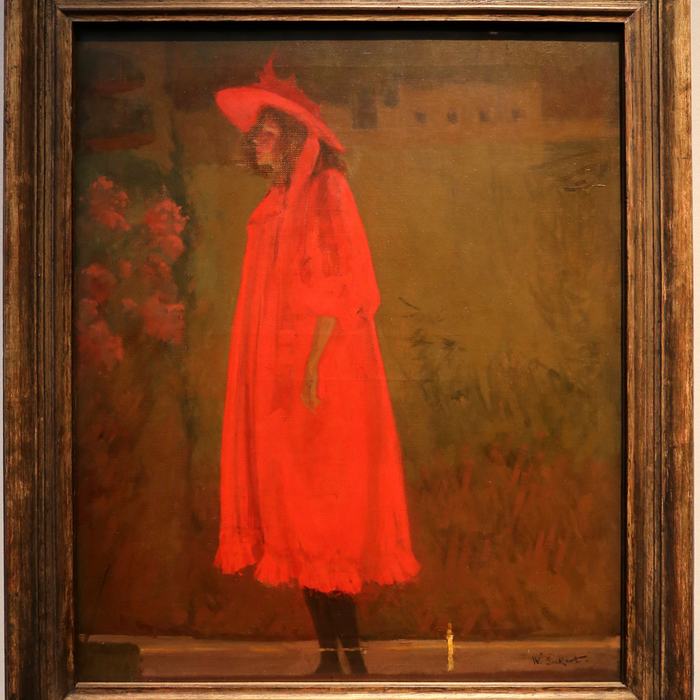
Walter Sickert
Sickert was the senior catalyst and teacher, but his repeated studies, theatrical viewpoints and provocative titles remain one distinctive practice inside a deliberately varied group.
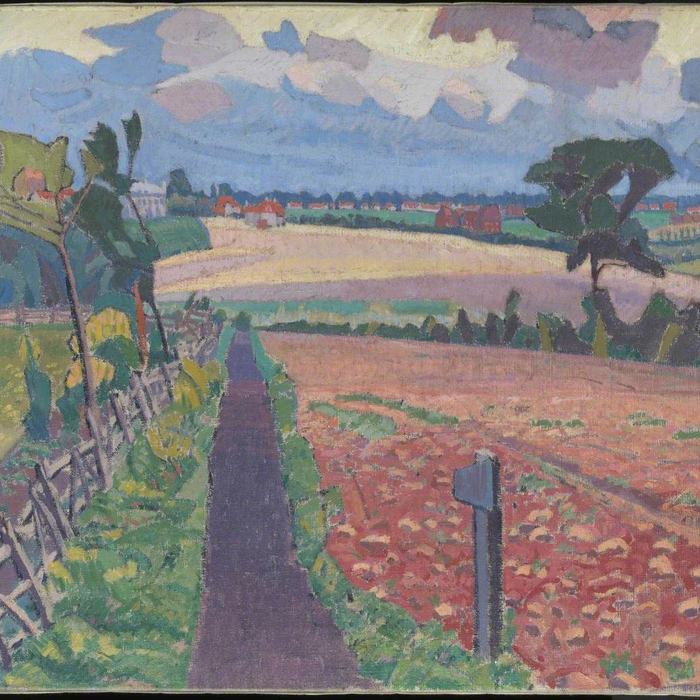
Spencer Gore
Gore's presidency and practical labour were central. His theatres, parks, interiors and Letchworth landscapes turn ordinary settings into taut arrangements of diagonal movement and colour.
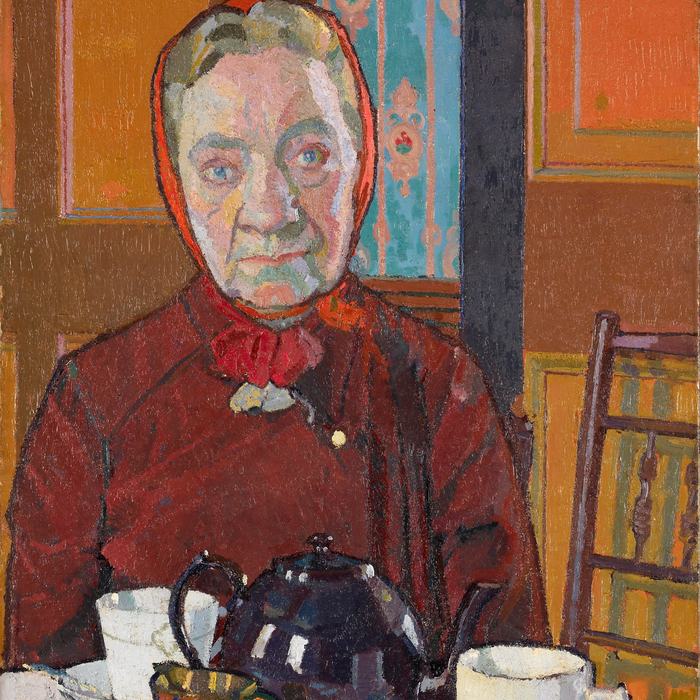
Harold Gilman
Gilman's strongest rooms often postdate the formal society. Named sitters, patterned walls and intense colour make his career a vital warning against treating 1911–12 as a rigid stylistic container.
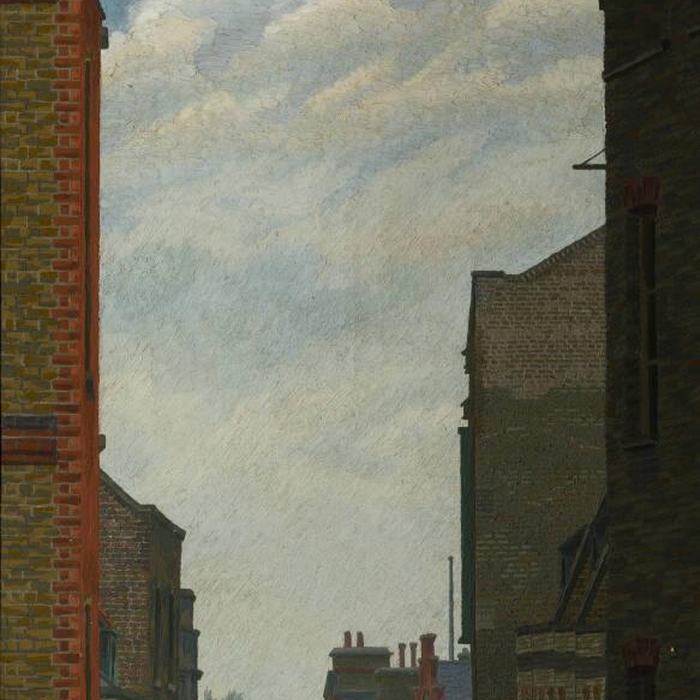
Charles Ginner
French upbringing and architectural training informed Ginner's cumulative separate touch, but his streets and gardens remain exact, carefully rebuilt encounters with British place.
Robert Bevan
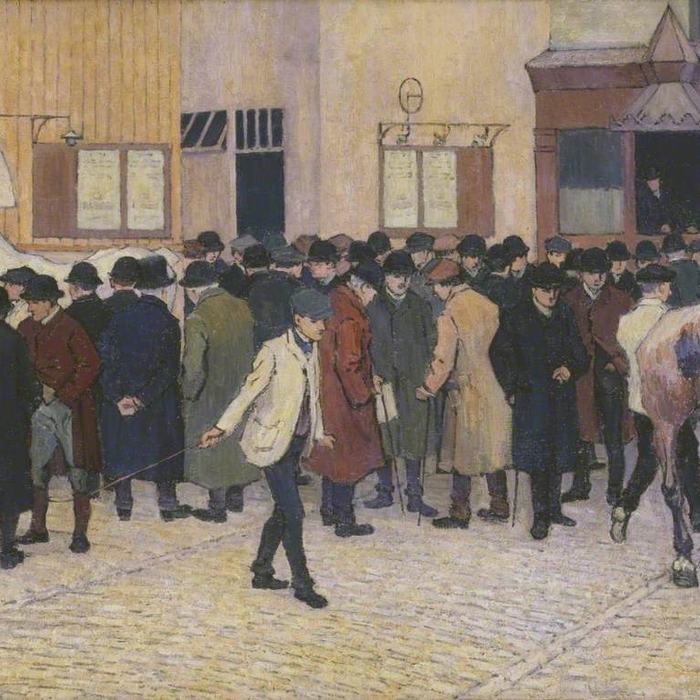
Bevan joined Paris, Brittany and Polish experience to London trades and cultivated landscape, organising animals, workers, rails and fields through clear contour and rhythmic colour.
Lucien Pissarro
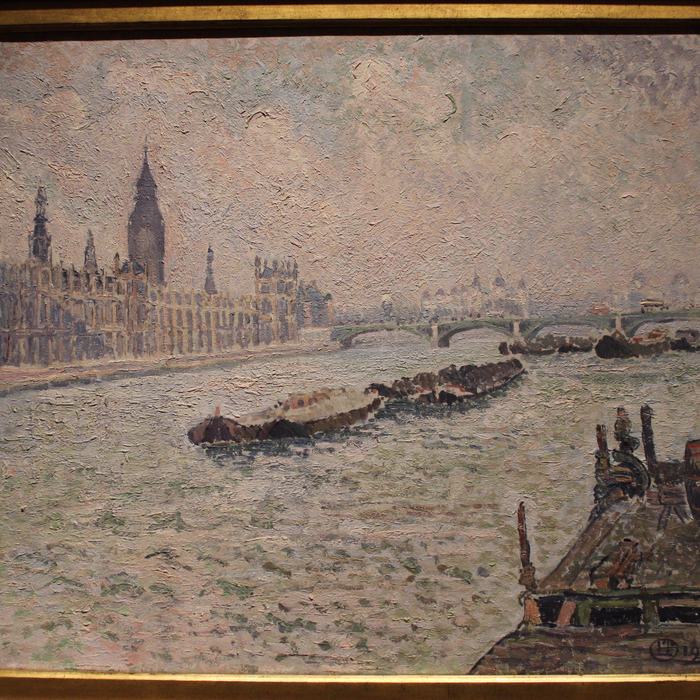
Pissarro was a painter and printmaker whose long English residence made him a Channel artist, not simply a family stamp of French authenticity.
Spencer Gore: organisation, colour and inhabited space
Spencer Gore’s importance is larger than his short life and smaller surviving reputation might suggest. Trained at the Slade, he met Sickert and Lucien Pissarro in northern France and absorbed Impressionist practice before responding to the stronger colour and simplified forms shown in London’s Post-Impressionist exhibitions. He helped found the Fitzroy Street circle, served as the Camden Town Group’s first president and died of pneumonia in 1914 at thirty-five.[18]
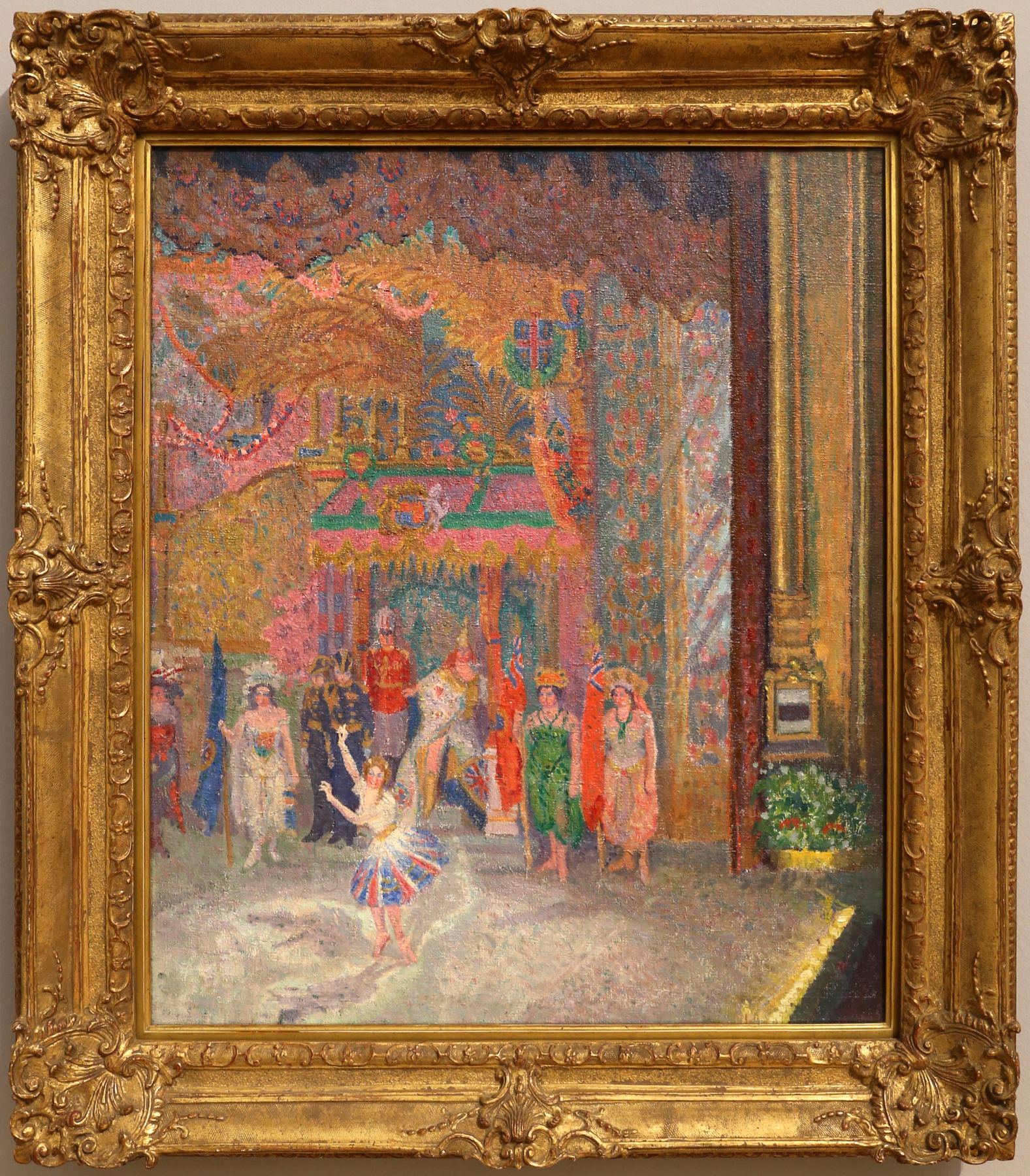
Gore painted music halls, domestic rooms, London parks and landscapes. His compositions often convert familiar places into taut arrangements of diagonals and colour zones. Figures do not merely populate settings; they establish scale, rhythm and psychological distance. His park scenes can make municipal leisure look both ordinary and strangely designed, as paths, lawns and railings organise movement across the surface.
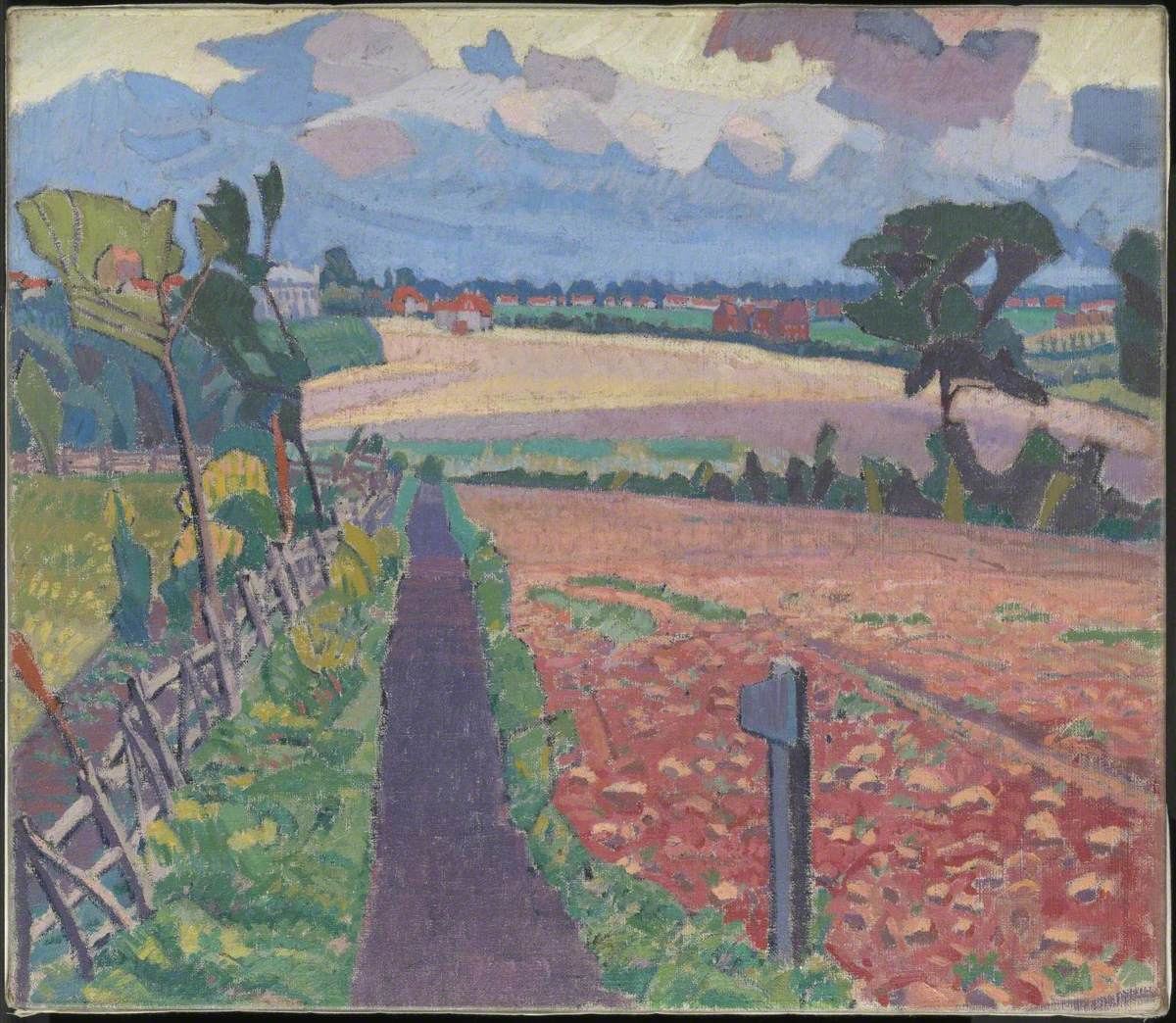
In 1912 Gore stayed in Letchworth Garden City, the planned settlement that attempted to join urban amenities to rural surroundings. The Cinder Path gives its marginal landscape high-key pinks, blues and greens. The route, fields and buildings are recognisable, but colour makes them newly unstable. Tate identifies Gore as first president and notes that his 1913 Brighton exhibition of English Post-Impressionists, Cubists and others clarified an emerging division between the figurative modernism of his circle and the harder avant-garde soon associated with Vorticism.[19]
Gore’s work prevents Camden Town from becoming a history only of dim bedrooms. His gardens and landscapes show that modernity could be found in planned suburbs, public recreation and the changing edge between city and country. They also demonstrate that bright colour did not require an exotic subject. A cinder track or municipal lawn could become a testing ground for structure.
Charles Ginner: the pressure of particulars
Charles Ginner arrived in London in 1910 after an upbringing and artistic education in France. Born in Cannes to British parents, he first trained in architecture and then studied painting in Paris. To British colleagues he could appear especially knowledgeable about continental art. He became a key participant in the Fitzroy Street, Camden Town and Cumberland Market groups. In 1914 he and Gilman published a statement on “Neo-Realism,” arguing for an intensely personal response to observed fact rather than either academic imitation or formulaic abstraction.[20]
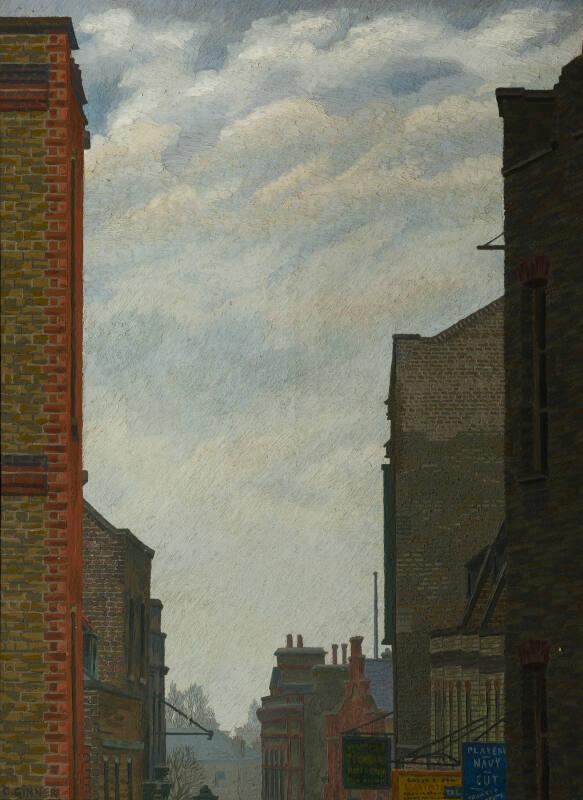
Ginner’s mature surfaces are often built from small, separate touches of thick paint. Brick, foliage, paving and roof tiles acquire equal insistence. This does not flatten the world into decoration; it makes seeing feel laborious and cumulative. His streets and gardens are densely specified, but their clarity is not photographic. Each feature has been translated through an ordered touch.
In Victoria Embankment Gardens a woman sits amid emphatic greenery while Westminster’s architecture and busy city recede behind her. The park is both refuge and urban construction. Ginner’s French education informed the high colour and surface, yet the specific London geography resists generic “continental” styling.[21] The picture makes leisure inseparable from municipal planting, traffic, monuments and the stratified life of the capital.[22]
Later works such as View of Hampstead show how exact location and constructed pictorial order could coexist. The Government Art Collection notes that the distant prospect may combine observations from different positions. That possibility is instructive: Ginner’s fidelity was to an experienced place rebuilt as a coherent painting, not to the mechanical record of one optical instant.[23]
Harold Gilman: rooms made by colour
Harold Gilman shared Ginner’s seriousness but developed a different relation between colour and interior space. After study at the Slade and periods in Spain and Scandinavia, he joined Sickert’s circle. The Post-Impressionist exhibitions intensified his interest in saturated colour, especially after encounters with van Gogh and Gauguin. His later paintings place figures within rooms whose wallpapers, tablecloths, doors and patches of light form powerful structures.
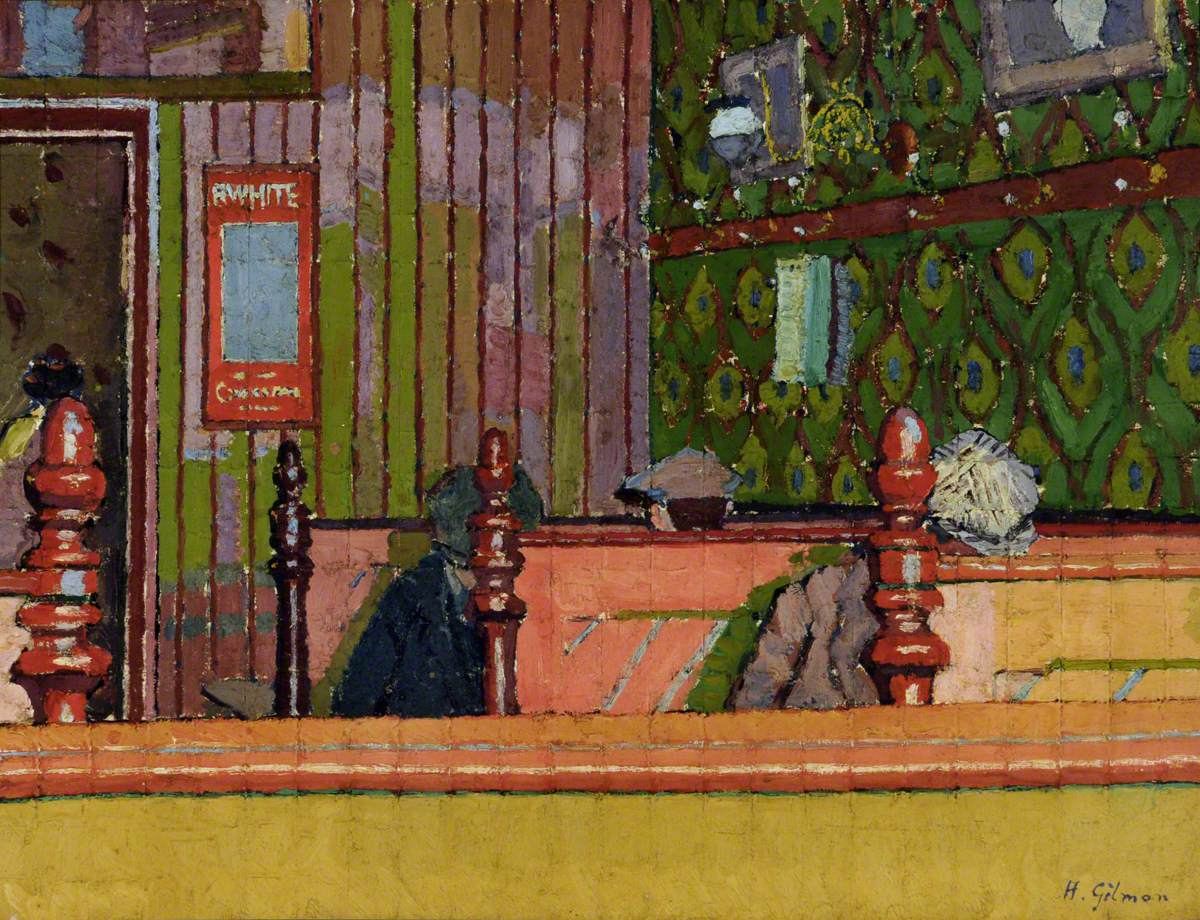
Pallant House Gallery’s retrospective framing “Beyond Camden Town” is valuable because Gilman’s strongest work continued after the society ended. Pictures such as The Shopping List, Tea in the Bedsitter, An Eating House and the Mrs Mounter interiors turn modest domestic or commercial settings into concentrated colour fields.[24] To call them Camden Town pictures is historically understandable, but their dates also warn against using the group name as a rigid container.
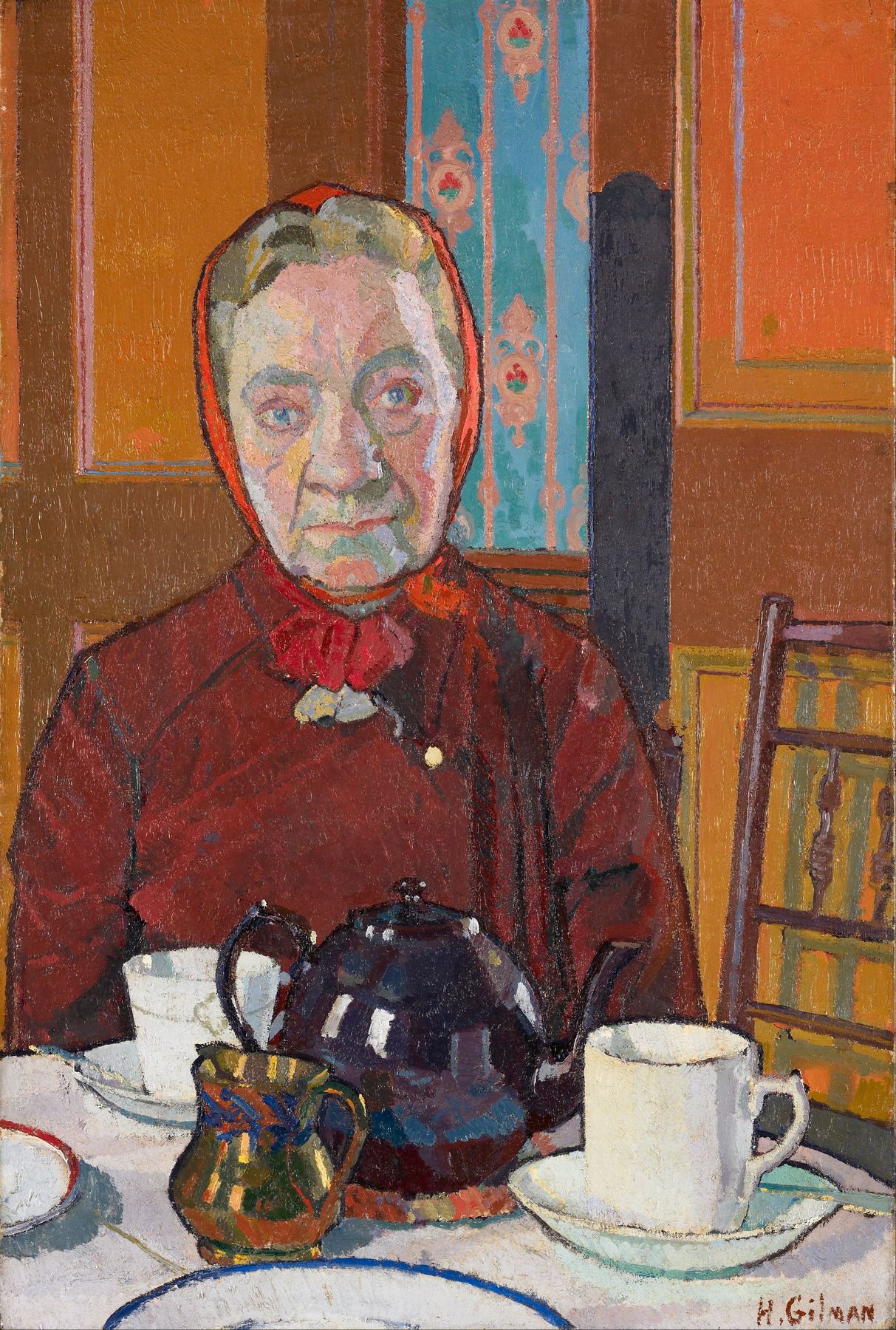
Mrs Mounter was Gilman’s landlady and cleaner, not an invented type. In the Walker Art Gallery portrait she sits at a breakfast table among teapot, cup, jug, plate and patterned wall. The strong colours and flattened pattern announce a dialogue with Post-Impressionism, but the picture’s force also comes from the sitter’s contained presence. Institutional interpretation describes the likeness as frank and penetrating while identifying her domestic role.[25] Naming her helps prevent social history from disappearing into formal analysis.
Gilman’s colour is sometimes compared directly with Vincent van Gogh. The comparison is useful when it directs attention to separate strokes, complementary contrast and the emotional temperature of rooms. It becomes misleading if it turns Gilman into an English copy. His interiors are cooler in construction, often enclosing figures within repeated rectangles of door, wall, picture and table. A Courtauld technical investigation of a work after Gilman shows how material study—grounds, pigments, layering and comparison—can separate resemblance from authorship and recover the practical decisions behind a recognisable style.[26]
Robert Bevan: horses, roads and rural rhythm
Robert Bevan was older than Gore, Gilman and Ginner and brought another international route into the group. He studied in Paris, worked in Brittany, knew Paul Gauguin and spent time in Poland, the homeland of his wife, the painter Stanisława de Karłowska. His art moved between London trades and cultivated landscapes, using clear contour, divided colour and strong design.[27]
De Karłowska matters in her own right. She exhibited with progressive societies and became a founder member of the London Group. Describing her only as Bevan’s wife repeats the gendered narrowing that kept women outside the Camden Town membership. Tate’s account of Bevan notes both his relationship with Gauguin and de Karłowska’s artistic career, placing household, travel and exchange within his development.[28]
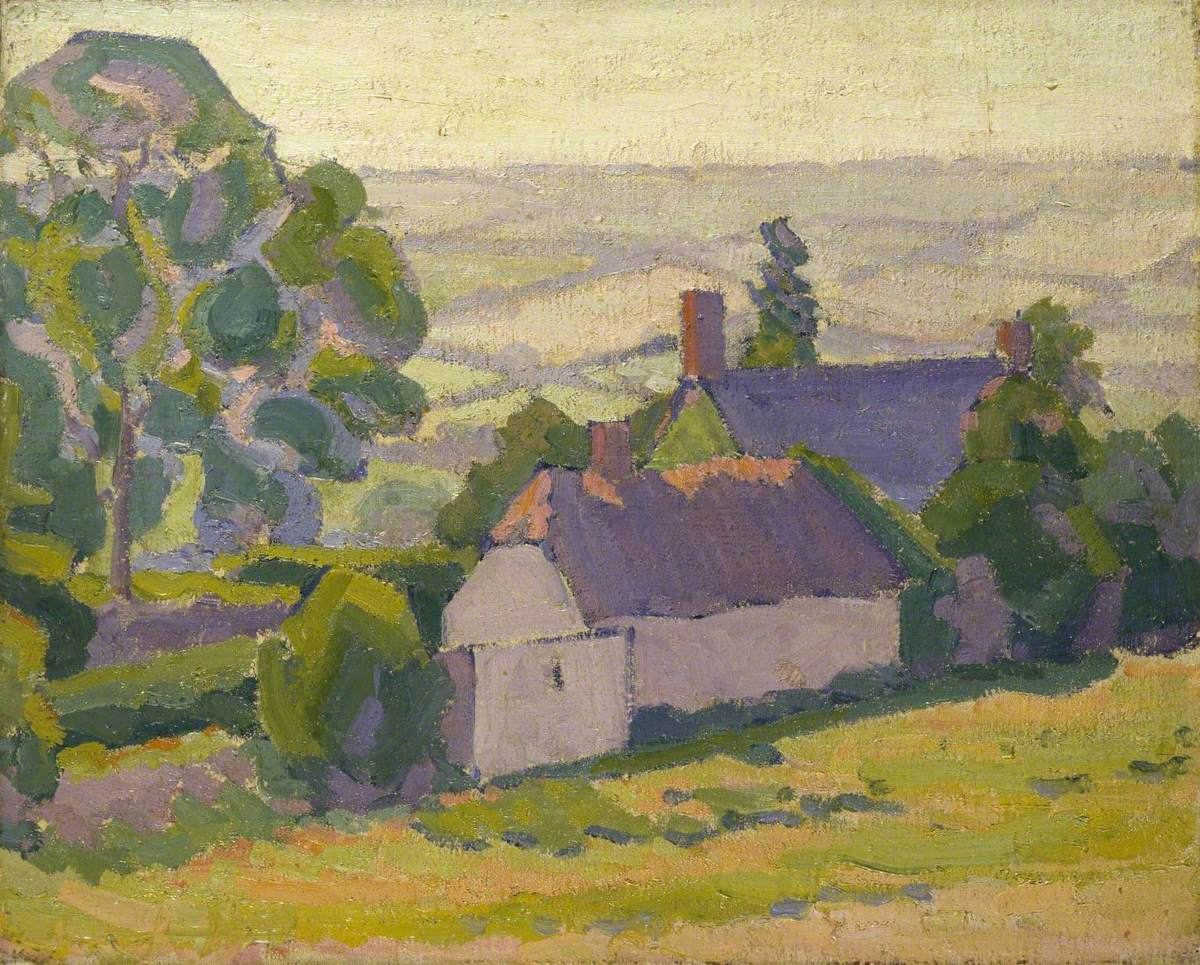
Rural painting was equally central. Haze over the Valley, made during a group stay near the Devon–Somerset border, sets cottage roofs against divided fields in heavy impasto. Tate describes the geometric pattern, colour and rhythm that organise the view.[29] The picture overturns a simple opposition between radical city and conservative countryside. Bevan’s rural landscape could be as formally experimental as an urban interior.
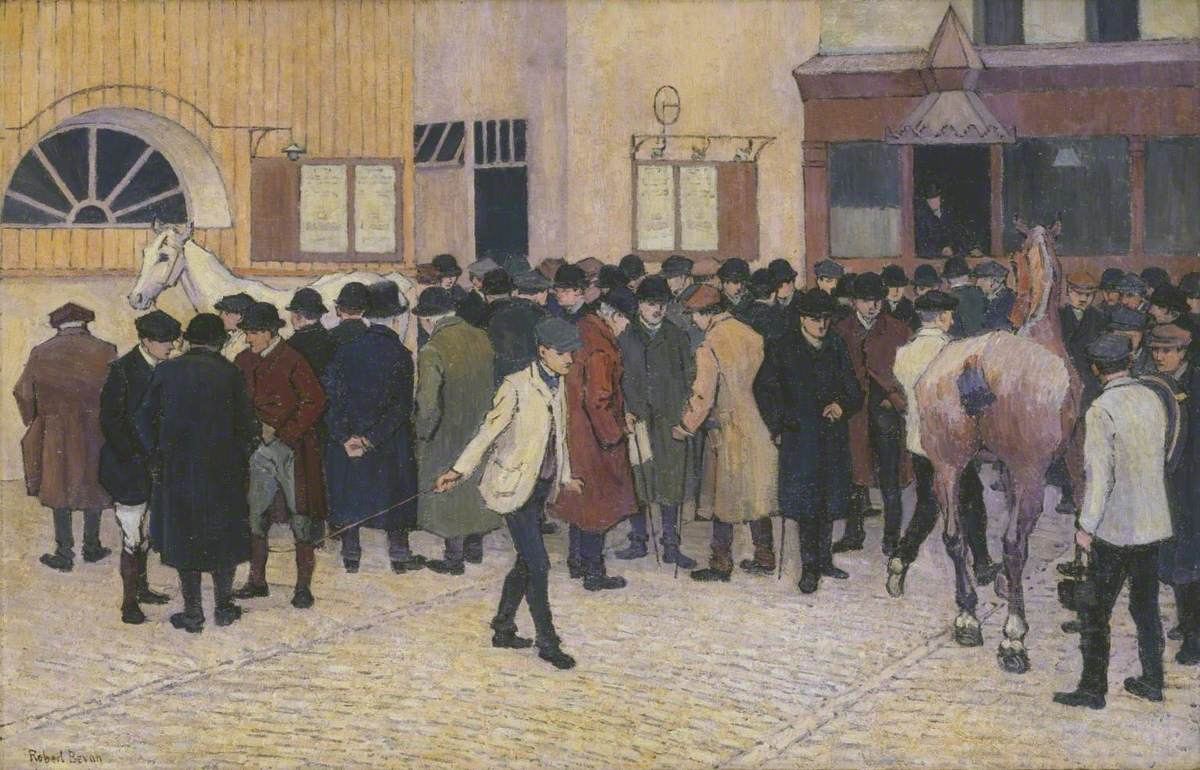
Bevan was fascinated by horses at the moment when motor traffic was changing their place in London. He drew cab yards and sales at Tattersall’s, Aldridge’s, the Barbican and Ward’s Repository. These were not picturesque remnants chosen after their disappearance; they were active workplaces whose decline he witnessed. A memoir cited in the history of Horse Dealers at the Barbican recalls visits with his children and conversations with drivers and handlers. The picture’s order—animals, rails, hats and human movement—translates observation into a compressed social choreography.[30]
Lucien Pissarro: a Channel painter
Lucien Pissarro connected the London circle to Impressionism through family, practice and personal friendship. The eldest son of Camille Pissarro, he settled in England in 1890 and later became a British citizen. French documentation at the Musée d’Orsay identifies his activity in painting and decorative arts and preserves his place in both national histories.[31]
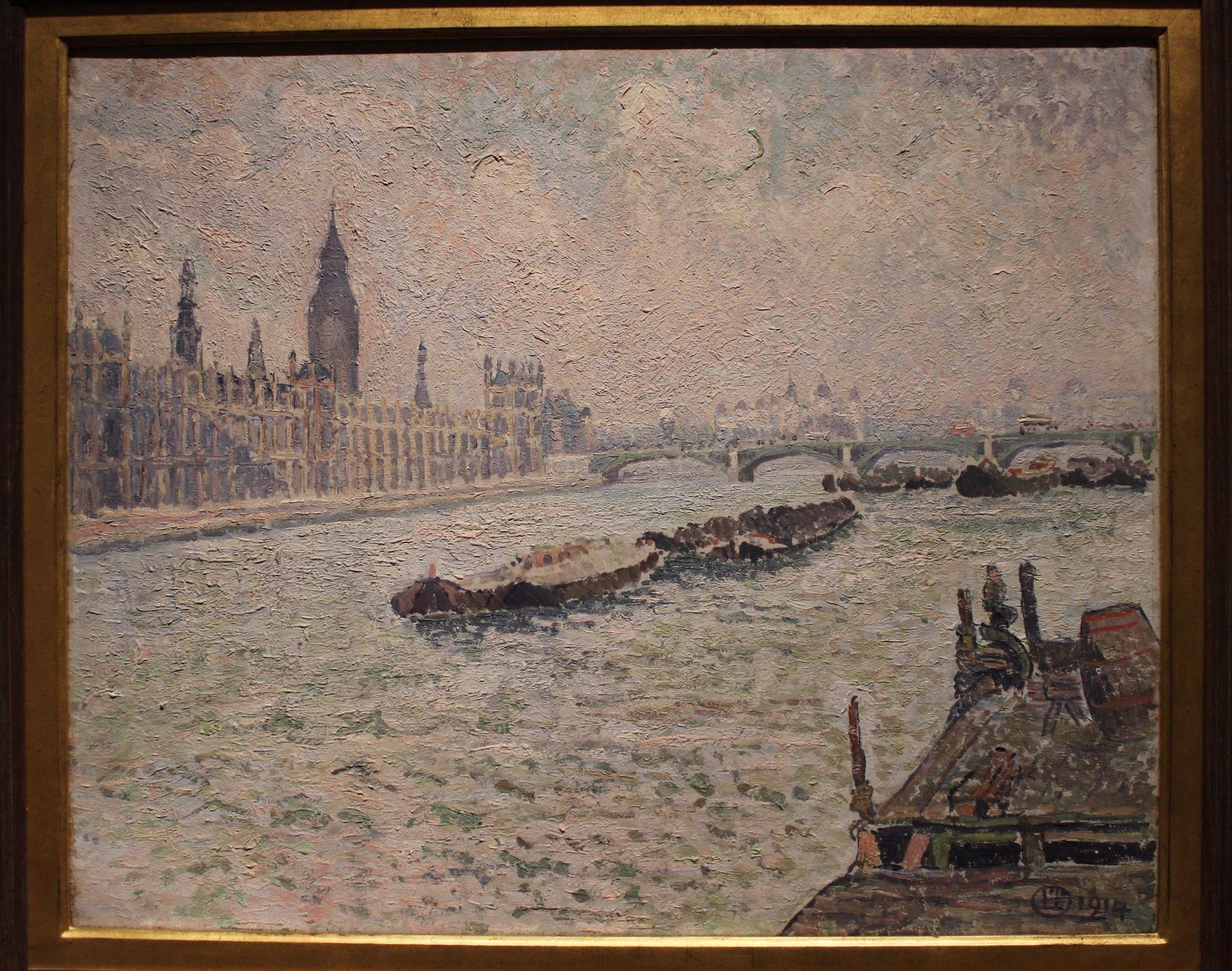
His landscapes attend closely to weather, season and cultivated terrain. Ivy Cottage, Coldharbour: Sun and Snow records a Surrey village at sunset, using small touches to register snow and coloured light. Tate notes that he called himself a “Channel painter,” an apt phrase for an artist whose work and relationships crossed rather than merely connected two national schools.[32]
Pissarro’s role within Camden Town was not to certify a direct lineage from French Impressionism. His own career included painting, printmaking and the Eragny Press, and his quiet landscapes differed from Sickert’s urban drama. His presence demonstrated that international exchange occurred through households, letters and long residence. Camille Pissarro himself had worked in London during the Franco-Prussian War and maintained connections with British artists; later he engaged with Neo-Impressionism before returning to a freer touch.[33] Lucien carried that complex inheritance without simply repeating it.
Women in and outside the room
The statement that the Camden Town Group was all male is not a minor footnote. Women artists participated in the Fitzroy Street network, supported careers, hosted gatherings, bought pictures and helped form the London Group, yet were denied membership in the 1911 society. If the history follows only the official roll, it reproduces the founders’ decision as an art-historical boundary.
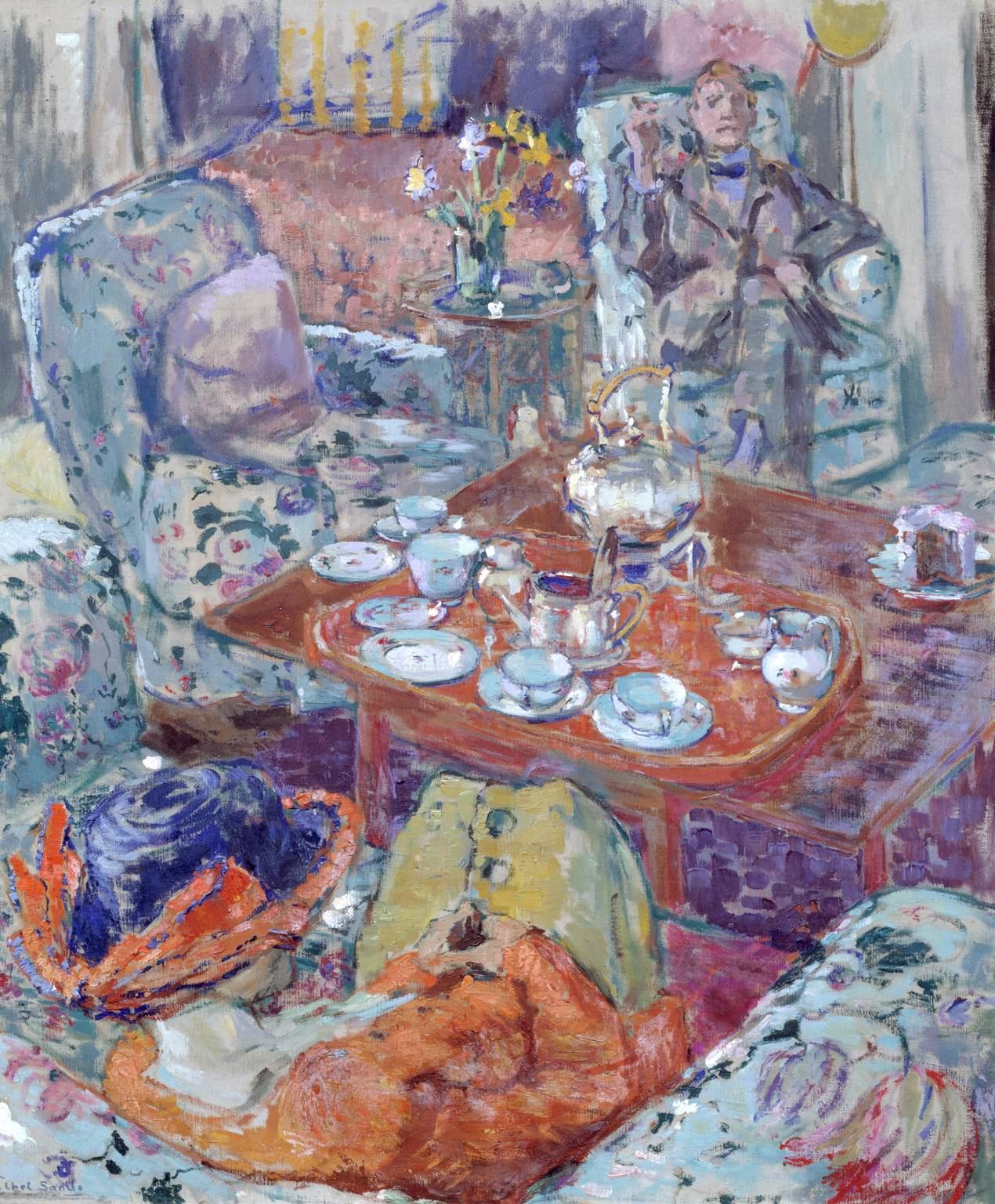
Ethel Sands and her partner Anna Hope “Nan” Hudson were artists, patrons and hosts. Sands had studied in Paris and exhibited internationally. She joined the Fitzroy Street circle at Sickert’s invitation in 1907, and both women belonged to the wider modern network. In Tea with Sickert, Hudson and Sickert sit around a table laid for three; Sands’s implied position behind the easel turns absence into authorship. Tate describes her as an important artist-hostess and later founder member of the London Group.[34]
Sylvia Gosse, Marjorie Sherlock and de Karłowska likewise belonged to the extended field of teaching, printmaking, exhibiting and friendship. Their exclusion was especially pointed because Sickert’s circle depended on women’s labour and patronage. Recovering them does not mean retroactively declaring them Camden Town members. It means distinguishing the society’s official structure from the cultural work that made it possible.
The gender problem extends into subject matter. Camden Town painters represented actresses, models, servants, landladies, café customers and women at home. Some sitters are named; many are not. The modern claim to depict “ordinary life” can obscure the unequal conditions under which one person is paid to pose and another controls the image. Art UK’s critical account joins the group’s modernity to its misogyny, examining how exclusion and the representation of women coexist.[35] That connection should not flatten every picture into the same accusation, but it should change the questions viewers ask.
What did the Camden Town Group look like?
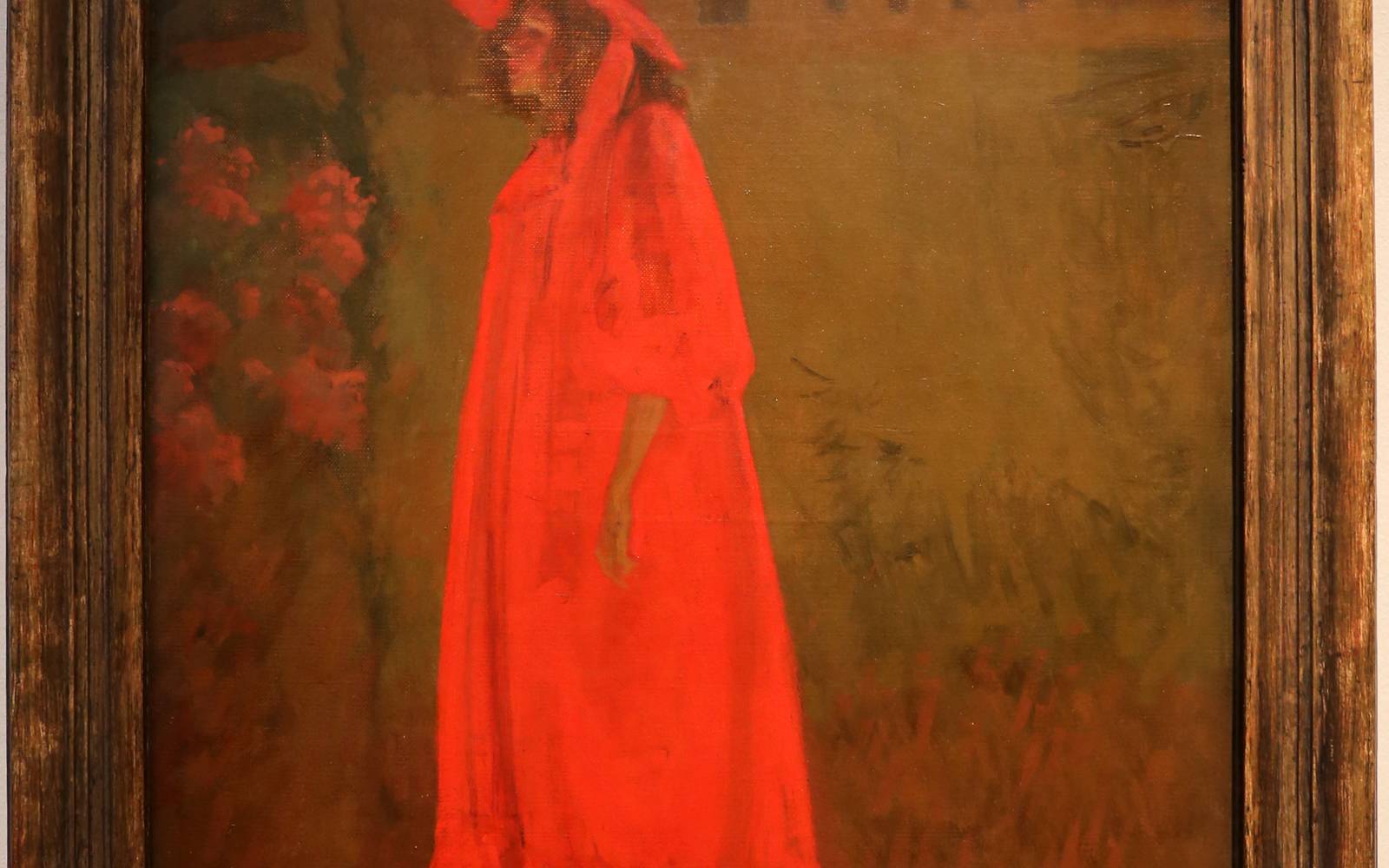
There is no single Camden Town brushstroke. Sickert often built subdued, rubbed or broken surfaces from preparatory studies. Gore increasingly used broad, high-colour shapes. Gilman’s late work intensified complementary colour and patterned enclosure. Ginner developed dense, separate touches that give every surface pressure. Bevan moved between divided colour and strong planar design. Pissarro retained a more intimate landscape notation. Their common ground lies less in identical appearance than in the conviction that painting should be visibly made and contemporary experience structurally remade.
Several recurring features nevertheless help recognition:
- Everyday scale: many pictures are easel-sized and close to ordinary rooms rather than monumental public history.
- Constructed viewpoints: mirrors, balconies, windows, doors and cropped figures make looking part of the subject.
- Material paint: surfaces remain active; brushwork or impasto prevents the image from pretending to be a transparent window.
- Heightened colour: especially in Gore, Gilman, Ginner and Bevan, colour can describe, organise and disturb at once.
- Specific places: streets, parks, rooms, cafés and markets are often identifiable, even when composition combines observations.
- Psychological incompletion: figures share space without yielding a complete story; titles may intensify rather than solve ambiguity.
Drummond’s painting of Fitzroy Street supplies a useful model for these differences. The studio was not a factory producing one style. It was a comparison machine. Pictures leaned beside one another; viewers could notice disagreement. Art UK’s study of the work reconstructs Sickert’s studio and the Saturday gathering, keeping the social activity visible within the painted interior.[36]
Follow the Camden Town Group through four stages
–10
Fitzroy Street creates a working network
Sickert's return, Gore's organisation and weekly studio displays join criticism, sociability, teaching, patron contact and modest direct sale before a formal group exists.
–12
Three exhibitions make a selective society public
Gore's presidency, Manson's administration and a changing sixteen-place male roll create the Camden Town Group at Carfax while differences of colour, subject and method remain visible.
–19
Artists diverge and networks recombine
The London Group widens membership and aesthetic range; Gore's Brighton exhibition exposes new divisions while war and early deaths prevent one continuous Camden Town trajectory.
–2020s
Collections and research reconstruct an uneven legacy
Later careers, museum gifts, retrospective exhibitions, archives and technical study recover the group while separating post-1912 masterpieces and excluded associates from its brief official life.
Modern London without a simple social programme
The group’s London is neither a panoramic imperial capital nor a consistent document of poverty. Its artists usually chose fragments: a woman at a table, a café corner, a theatre balcony, a cab yard, a garden path. This scale suited their suspicion of grand narrative and their interest in immediate experience. It also meant that empire, finance, migration and organised labour—the systems sustaining Edwardian London—often remain outside the frame even when their effects are present.
Recent scholarship on Edwardian art has challenged the idea of a dull interval between Victorian culture and the wartime avant-garde. The Camden Town network reveals a period in which exhibition structures, gender roles, mass entertainment, urban development and international artistic exchange were being renegotiated together.[37] Its pictures become richer when seen as agents within that culture rather than illustrations of a prewritten march towards modernism.
London supplied density and difference. The core painters ranged across Camden, Fitzrovia, Soho, Westminster, Hampstead and the northern suburbs. A café could become an interior of anonymous proximity; a park could stage class, gender and leisure; a horse market could register technological transition. The city’s complexity, explored in Literary London’s study of the group, helps explain why no single icon defines Camden Town as the Eiffel Tower might define Parisian modernity.[38]
Yet these painters were not united social reformers. Their attention to working-class or lower-middle-class subjects did not necessarily amount to political advocacy. Respectful observation, aesthetic fascination, theatrical ambiguity and class distance could occupy the same canvas. To call every dim room compassionate would be as simplifying as calling every urban picture exploitative. The viewer must ask how composition positions a person, what the title contributes, and which social facts the image reveals or withholds.
France translated in London
Roger Fry’s 1910 exhibition Manet and the Post-Impressionists gave London viewers a contested collective label for recent French painting. A second exhibition followed in 1912. Camden Town artists responded unevenly. Gore’s colour and simplification shifted; Gilman absorbed lessons from van Gogh and Gauguin; Ginner resisted fashionable formulas while using a touch formed through Parisian training; Bevan’s French and Breton experience long predated Fry; Sickert remained more closely aligned to Degas’s construction and to Whistler than to the new label.
The phrase “British Post-Impressionism” is therefore convenient but incomplete. It identifies a historical moment of reception, not a technique shared equally by sixteen men. It can also make London sound belated, as if the artists merely diluted continental invention. Their real achievement lay in translation: French approaches were tested against British exhibition culture, northern light, cheap furnished rooms, music halls, municipal gardens and local trades.
This translation produced argument. Wyndham Lewis briefly belonged to the group but moved towards a more angular, confrontational art. The city imagined by emerging Vorticism emphasised machines, crowds and hard geometric energy, while Camden Town painting often retained the bodily, local and observed. Literary London’s comparison shows that both formations claimed modern urban life while disagreeing about what modern form required.[39]
The split should not be drawn too neatly. Gore’s 1913 Brighton exhibition placed Post-Impressionists and Cubists within one event even as it exposed divergence. Ginner could reject abstraction yet make surfaces strikingly autonomous. Sickert’s old-fashioned subjects could be radically uncertain in composition. Camden Town was not the last stop before “real” modernism. It was one contested answer to the same problem: how could painting remain adequate to modern experience?
Class, commerce and the artist-led public
The group’s alternative structures were also market experiments. Fitzroy Street offered direct encounter; the Carfax exhibitions created a brand; periodicals circulated images and arguments; teaching generated income and followers. These activities complicate the romantic picture of uncompromising artists rejected by a monolithic establishment. They were building a small public and negotiating how modern art could be sold.
Their supposedly anti-commercial realism still depended on money: rent for studios, models’ fees, framing, transport, gallery commission and patrons’ purchases. Ethel Sands’s wealth and social connections supported modern artists; Lucien Pissarro’s networks opened other routes; Manson balanced painting with institutional employment. The group’s history belongs as much to the economics of cultural work as to iconography.
Modern themes could themselves become a market identity. A buyer might recognise a Sickert room or a Ginner street as serious precisely because it seemed unpolished and urban. Corbett’s scholarship on modern themes stresses that subject matter and form worked together within debates over British art.[40] “Everyday life” was not raw material outside culture; it was selected, framed and exhibited for viewers with particular expectations.
Dissolution and the London Group
By 1912 the Camden Town arrangement had exhausted its limited form. Three exhibitions had not established strong financial security, and artistic alliances were changing quickly. The society did not simply expand under the same rules. In 1913, members of Camden Town, Fitzroy Street and the Cumberland Market circle joined younger avant-garde artists to form the London Group. The new body was larger, more diverse and more durable.
This transition altered gender boundaries. Sands and de Karłowska became founder members of the London Group, though wider inequality did not disappear. It also created room for artists such as Jacob Epstein, David Bomberg and Lewis, whose work moved beyond the Camden painters’ dominant figurative languages. Manson continued as secretary, providing administrative continuity, but the new group should be understood as a recombination rather than a renamed Camden Town Group.
The First World War transformed the world in which these networks operated. Gore died in 1914; Gilman died in the influenza pandemic in 1919; artists served, taught, travelled or changed direction. Sickert’s career extended for decades, and Ginner, Bevan and Pissarro continued to develop. Later works should not be forced back into 1911 merely because the artists once exhibited together.
The Getty Foundation’s account of Tate’s online catalogue shows why the afterlife of the group now exceeds a conventional movement summary. Historical film, music-hall audio, correspondence, sketches and technical evidence allow pictures to be reconnected to sounds, places and working methods.[41] The digital form mirrors the networked history: no single sequence can contain every artist or context.
Technical study also revises visual assumptions. Paintings that reproduce as uniformly dark or bright may contain pigments and layered decisions invisible in small images. Patrick Baty’s discussion of “family colours” demonstrates how material analysis can connect pictures, makers and inherited studio knowledge.[42] The Camden Town story is not only who influenced whom; it is also what grounds, pigments, tools and revisions made particular surfaces possible.
Manson’s later career at Tate offers another kind of afterlife. The secretary of a small oppositional group became an institutional figure, eventually directing the gallery. His biography complicates any simple division between avant-garde and establishment.[43] Networks that begin outside institutions may later enter archives, collections and canons through the work of their own participants.
The London Group survived through changing generations, and Tate’s record of its 1964 jubilee exhibition marks the consolidation of a much longer narrative of modern British art.[44] By then Camden Town could appear as an origin story. That story remains useful only if origins do not become inevitabilities.
Reputation, rediscovery and limits
For much of the mid-twentieth century, Camden Town painting occupied an uncertain place. Its commitment to observation could look conservative beside abstraction; its colour could seem restrained beside Fauvism; its urban subjects could be overshadowed by later British realisms. Renewed scholarship and exhibitions from the 1960s onward recovered individual artists, while Tate’s 2008 exhibition presented the group as a major collective episode.
The revival brought its own risks. A coherent exhibition needs a legible story, but the historical group was uneven. Some elected members participated marginally; key women were excluded; several canonical “Camden Town” masterpieces were painted after 1912. Studio International’s review of the 2008 exhibition emphasised both the short life and long influence of the group, especially its ambiguous narratives and continuing effect on British figurative painting.[45]
The most convincing legacy is not a single lineage from Sickert to every later painter of a room. It is a cluster of possibilities: artist-led organisation, serious attention to ordinary subjects, psychologically unresolved figuration, transnational exchange, and paint that remains materially present. Camden Town also leaves a caution. A group can be formally progressive and socially restrictive at once. Its history becomes more—not less—significant when that contradiction is made visible.
How to look at a Camden Town painting
Begin with the threshold
Look for doors, windows, mirrors, curtains, balcony rails and picture frames. These devices often divide the scene and determine who can see whom. In a Sickert theatre, the best view may be indirect. In a Gilman room, one doorway can turn domestic space into a sequence of colour fields. A Ginner street may be framed as carefully as a stage.
Separate place from pictorial construction
Identify the location if possible, but do not stop there. Ask what has been cropped, tilted, compressed or combined. The Camden Town painters valued observed particulars, yet observation was reorganised. Topographic accuracy and formal invention are not opposites.
Follow the paint
Move close enough to distinguish surface. Is colour rubbed thin, laid in separate strokes or built in heavy impasto? Does one touch describe brick, flesh and foliage alike, or do materials receive different handling? Reproduction often makes Camden Town works seem more uniform than they are.
Treat titles as evidence, not proof
A title may name a place, quote a song, suggest a crime or introduce dialogue. Ask when it was attached and what it makes you imagine. Do not assume that a dramatic title records an event shown literally.
Ask who works in the picture
Servants, landladies, performers, cab drivers, handlers and models sustain the represented world. Look for signs of labour: utensils, uniforms, furniture, rails, instruments and gestures. When a sitter is known, use the name.
Notice who is absent
The official group portrait is male. The wider network was not. Consider the artists, partners, patrons and hosts excluded by the membership rule, and distinguish their actual contribution from the society’s official boundary.
Compare differences
Place a Sickert interior beside a Gilman interior, or a Gore landscape beside a Bevan landscape. Shared subjects do not erase distinct structures. Comparison is closer to the experience of Fitzroy Street than the search for one representative style.
Essential Camden Town Group works
Minnie Cunningham at the Old Bedford
Walter Sickert · c. 1892 · Performer, audience position, shadow and reflected architecture make popular entertainment a problem of seeing rather than a simple record of the act.
The P.S. Wings in the O.P. Mirror
Walter Sickert · 1888–89 · The mirror separates the stage seen by the painted audience from the reflected performer available to us, turning spectatorship into the picture's structure.
The Cinder Path
Spencer Gore · 1912 · High-key colour and simplified zones transform Letchworth's planned suburban edge without surrendering its exact route, fields and buildings.
Mrs Mounter
Harold Gilman · 1916 · A named working sitter, patterned room and saturated complementary colour prevent domestic labour from disappearing into formal design.
Eating House
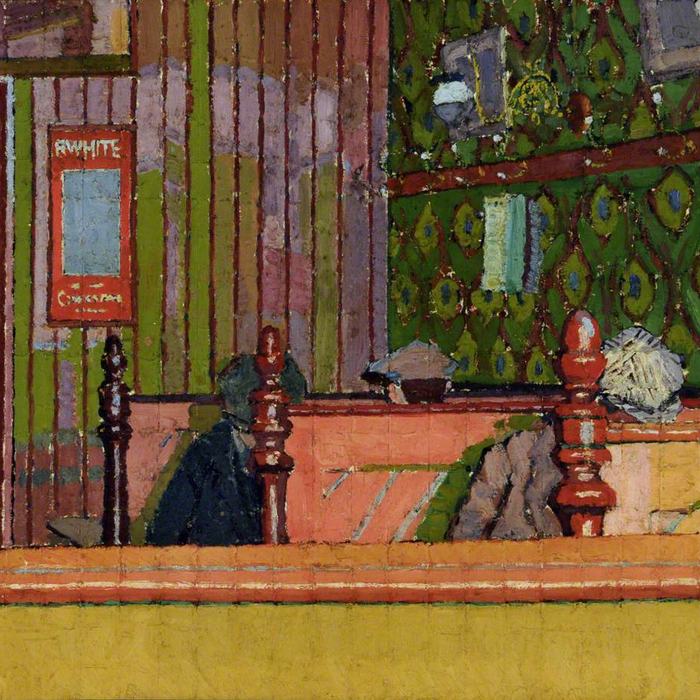
Harold Gilman · c. 1913–14 · Gilman encloses anonymous proximity within tables, doors and colour fields, making an ordinary commercial interior pictorially ambitious.
Horse Sale at the Barbican
Robert Bevan · 1912 · Animals, handlers, rails and hats compress a working market into rhythmic design at the moment motor traffic was changing the trade.
Haze over the Valley
Robert Bevan · 1912 · Heavy impasto, roofs and divided fields show that the group's rural landscapes could be as structurally experimental as its London interiors.
Tea with Sickert
Ethel Sands · 1911–12 · Hudson and Sickert sit at a table laid for three while Sands's implied position behind the easel turns apparent absence into authorship.
The Thames at Lambeth
Lucien Pissarro · 1907 · Pissarro's London river view makes the Channel relationship a matter of residence, weather, touch and sustained practice rather than borrowed style.
Flask Walk, Skyline
Charles Ginner · c. 1930s · Ginner's emphatic separate touch rebuilds recognisable Hampstead topography through persistent material attention.
Where to see and study Camden Town Group art
Displays, loans, archive access and gallery opening arrangements change. Check current information before travelling.
- 01
Tate Britain
Tate holds the largest public concentration of Camden Town Group art and archives, including major works by Sickert, Gore, Gilman, Ginner and Bevan. Its online research catalogue remains an unusually deep route into objects, artists and contexts.
London, England
Collection and research guideVisit official resource - 02
National Galleries of Scotland
The collection offers useful examples by Sickert and Gore and a concise movement history that connects Fitzroy Street, Post-Impressionism and the London Group.
Edinburgh, Scotland
Collection and research guideVisit official resource - 03
Walker Art Gallery
Gilman’s Mrs Mounter is a central destination for studying the relation between strong colour, domestic space and a named working sitter.
Liverpool, England
Collection and research guideVisit official resource - 04
Ashmolean Museum
The Bevan Gift and related holdings make the Ashmolean important for Robert Bevan, Stanisława de Karłowska and the wider circle, as well as for versions of Gilman’s Mrs Mounter interiors.
Oxford, England
Collection and research guideVisit official resource - 05
Pallant House Gallery
Its modern British collection and Gilman exhibition history help extend the story beyond the formal dates of Camden Town.
Chichester, England
Collection and research guideVisit official resource - 06
Leeds Art Gallery
The collection includes Sickert and related British modernism, offering comparison between theatre, interior and later figurative traditions.
Leeds, England
Collection and research guideVisit official resource - 07
Southampton City Art Gallery
Strong British modern holdings include work by Bevan and support study of the Cumberland Market and London Group continuities.
Southampton, England
Collection and research guideVisit official resource - 08
The Courtauld Gallery and Research Forum
The collection and technical research provide context for French modernism, British reception and the practical study of Gilman’s technique and attribution.
London, England
Collection and research guideVisit official resource
Landmark Camden Town Group exhibitions
Four exhibitions that created, recovered or critically reframed this short-lived society and its artists.
The first Camden Town Group exhibition
Carfax Gallery, London
The June exhibition made a selective studio network publicly legible as a named body and established the membership, reception and exhibition economy against which later accounts must be tested.
Modern Painters: The Camden Town Group
Tate Britain, London
The major survey renewed attention to the group's modern subjects and ambiguous narratives while also exposing the difficulty of turning its short, uneven history into one coherent style.
Harold Gilman: Beyond Camden Town
Pallant House Gallery, Chichester
The retrospective made chronological correction part of its title, showing that Gilman's strongest colour and interior paintings cannot be contained within 1911–12.
Walter Sickert: Painting and Transgressing
Tate Britain and Petit Palais, Paris
The Anglo-French exhibition placed theatre, furnished rooms, mass imagery, nudity and later practice inside a genuinely cross-Channel reassessment of Sickert's long career.
Suggested books
Perfect Moderns: A History of the Camden Town Group — Wendy Baron
The fullest single narrative history of the society and its circle. Baron’s long engagement with Sickert and the group makes this the best starting point for chronology, membership and relationships.[46]
Modern Painters: The Camden Town Group — edited by Robert Upstone
Published for Tate Britain’s 2008 exhibition, this well-illustrated catalogue connects the painters to changes in London and British society and is especially useful for comparing works at exhibition scale.[47]
The Camden Town Group in Context — edited by Helena Bonett, Ysanne Holt and Jennifer Mundy
An open online scholarly catalogue rather than a conventional printed book, but the most extensive research resource: artist biographies, object entries, technical studies, maps, documents and thematic essays can be followed independently.[48]
Walter Sickert — Emma Chambers
The 2022 Tate monograph places Sickert’s Camden years within his longer engagement with theatre, newspapers, photography, celebrity and the material act of painting. It is valuable for resisting a group-only view of the artist.[49]
Sickert: Paintings and Drawings — Wendy Baron
A major catalogue reference for dates, titles, versions and attribution. It is especially important when discussing the furnished-room pictures, whose names and relationships are often simplified in popular accounts.[50]
Artists in and around the Camden Town Group
This contextual directory distinguishes the changing formal roll from the wider Fitzroy Street and London Group networks. The women listed here were important associates, artists, patrons or later London Group founders; they were not members of the all-male 1911 society.
| Name | Nationality | Key Works |
|---|---|---|
| Walter Sickert | British | Minnie Cunningham at the Old Bedford · The P.S. Wings in the O.P. Mirror · Ennui |
| Spencer Gore | English | The Cinder Path · Rule Britannia · The Balcony at the Alhambra |
| Harold Gilman | English | Mrs Mounter · Eating House · Tea in the Bedsitter |
| Charles Ginner | British | Victoria Embankment Gardens · View of Hampstead · Flask Walk, Skyline |
| Robert Bevan | English | Horse Sale at the Barbican · Haze over the Valley · Morning over the Ploughed Fields |
| Malcolm Drummond | English | 19 Fitzroy Street · Portrait of Charles Ginner · In the Cinema |
| Lucien Pissarro | French-British | Ivy Cottage, Coldharbour: Sun and Snow · The Thames at Lambeth |
| J. B. Manson | English | Still Life · Sussex landscape |
| Walter Bayes | English | The Underworld · The Concert |
| Augustus John | Welsh | The Smiling Woman · Dorelia in a Black Dress |
| Henry Lamb | British | Lytton Strachey · Death of a Peasant |
| J. D. Innes | Welsh | Arenig Fawr · North Wales landscapes |
| Wyndham Lewis | British | The Crowd · Workshop |
| Maxwell Gordon Lightfoot | English | The Music Room · Portraits and interiors |
| William Ratcliffe | English | The Coffee House · Clarence Gardens |
| John Doman Turner | English | Walberswick railway series · London scenes |
| Duncan Grant | Scottish | The Tub · Interior at Gordon Square |
| Ethel Sands | American-British | Tea with Sickert · A Dressing Room |
| Nan Hudson | American-British | Harbour and landscape paintings · Domestic interiors |
| Stanisława de Karłowska | Polish-British | Swiss Cottage · Fried Fish Shop |
| Sylvia Gosse | English | The Printer · Women in interiors |
| Marjorie Sherlock | English | London lithographs · Street and market scenes |
Frequently Asked Questions
It was a British exhibiting society formed in 1911 by painters associated with Walter Sickert and the Fitzroy Street circle. It held three exhibitions at the Carfax Gallery and ended in 1912.
The name referred to the north London area associated with Sickert’s studios and several members. It gave the society a modern local identity, although its artists worked across London and far beyond Camden.
Sickert was the catalyst, senior teacher and strongest public personality, but Spencer Gore was the first president and J. B. Manson the secretary. The group depended on collective organisation.
Membership was capped at sixteen men. Changes and replacements make one fixed list misleading, while several elected members were much less involved than the core painters.
No. Women were excluded from formal membership, although Ethel Sands, Nan Hudson, Stanisława de Karłowska, Sylvia Gosse and others were active in the wider networks of painting, patronage, teaching and exhibition.
Its painters engaged strongly with French modern art and some adopted heightened colour or simplified form, but they did not share one Post-Impressionist technique. Sickert, Gore, Gilman, Ginner, Bevan and Pissarro drew different lessons from France.
Music halls, rented rooms, cafés, performers, landladies, streets, public gardens, horses, markets, suburbs and landscapes. Their common interest was the serious pictorial potential of contemporary ordinary experience.
No. Camden was a social and reputational centre, not a geographical rule. Members painted elsewhere in London, in the suburbs, across rural Britain and in France, Norway and Poland.
They are Sickert furnished-room paintings whose titles evoke the 1907 murder of Emily Dimmock. They are constructed studio images, not eyewitness records, and titles vary across related compositions.
Its exhibitions were not sufficiently successful to sustain the format, while members’ artistic directions and alliances were changing. In 1913 several joined a broader coalition in the London Group.
No. It inherited members and administrative experience from Camden Town but brought together several circles and more radical tendencies. It also admitted women founders and continued for generations.
It made artist-led exhibition, contemporary British subjects, transnational exchange and materially assertive figurative painting visible at a decisive moment. Its exclusions also reveal the social limits of supposedly progressive modernism.
Discussion
Reader Insights
Decide whether the evidence belongs to Fitzroy Street, the formal 1911–12 society or the later London Group before using Camden Town as a general label.
Put Sickert’s rubbed construction beside Gore’s colour zones, Gilman’s patterned rooms, Ginner’s separate touch and Bevan’s planar rhythm rather than searching for one group brushstroke.
Ask who works, who looks, who buys and who was excluded; modern subject matter does not automatically remove Edwardian hierarchies.
Join the Conversation
Which Camden Town painting most changes your idea of Edwardian London—and does its modernity lie chiefly in the subject, the paint, the way it positions the viewer, or the social history it leaves partly outside the frame?
References
- Camden Town Group, National Galleries of Scotland, View Source
- Camden Town Group, Tate, View Source
- The Camden Town Group in Context, Jennifer Mundy Helena Bonett Tom Furness Diane Hall Ysanne Holt Alex Pilcher / Tate via Northumbria University, View Source
- The Camden Town Group in Context review, Pamela Fletcher / The Art Bulletin, View Source
- The Camden Town Group British art of the early twentieth century, Tretyakov Gallery Magazine, View Source
- Carfax Gallery, Pamela Fletcher / Bowdoin College London Gallery Project, View Source
- The first exhibition of the Camden Town Group, Helena Bonett / Tate Research Publication, View Source
- J B Manson archive, Tate Archive, View Source
- Letters relating to the Camden Town Group, Tate Archive, View Source
- Walter Richard Sickert, National Galleries of Scotland, View Source
- Walter Sickert, Art UK, View Source
- Walter Richard Sickert, Musée d'Orsay (French; consulted in French), View Source
- Walter Sickert and Contemporary Drama, William Welsh Rough / University of St Andrews and Tate, View Source
- Minnie Cunningham at the Old Bedford, Tate, View Source
- The P.S. Wings in the O.P. Mirror, Tate, View Source
- Walter Sickert Painting and Transgressing, Petit Palais Paris Musées, View Source
- Walter Sickert Peindre et transgresser, Paris Musées Collections (French; consulted in French), View Source
- Spencer Gore, National Galleries of Scotland, View Source
- The Cinder Path, Tate, View Source
- Charles Ginner, British Museum, View Source
- Charles Ginner 1878–1952, Helena Bonett / Tate Research Publication, View Source
- Victoria Embankment Gardens, Tate, View Source
- View of Hampstead, Government Art Collection, View Source
- Harold Gilman Beyond Camden Town, Pallant House Gallery, View Source
- Mrs Mounter, Walker Art Gallery via Google Arts & Culture, View Source
- Interior Scene after Harold Gilman technical report, Courtauld Institute of Art, View Source
- Robert Bevan 1865–1925, Nicola Moorby / Tate Research Publication, View Source
- Morning over the Ploughed Fields, Tate, View Source
- Haze over the Valley, Tate, View Source
- Horse Dealers at the Barbican, Christie's with R A Bevan memoir evidence, View Source
- Lucien Pissarro, Musée d'Orsay (French; consulted in French), View Source
- Ivy Cottage Coldharbour Sun and Snow, Tate, View Source
- Camille Pissarro, Musée d'Orsay (French; consulted in French), View Source
- Ethel Sands Tea with Sickert, Tate, View Source
- The Camden Town Group modernity and misogyny, Nicola Moorby / Art UK, View Source
- Malcolm Drummond's 19 Fitzroy Street, David Buckman / Art UK, View Source
- Introducing Edwardian Art and its Legacies, David Peters Corbett and Lara Perry, View Source
- The most wonderful and complex city in the world London and the Camden Town Group, Literary London Society, View Source
- The Camden Town Group and London Vorticism and the City, Literary London Society, View Source
- Modern Themes in Camden Town Painting, David Peters Corbett / University of East Anglia, View Source
- Projects at a Glance The Camden Town Group in Context, Getty Foundation, View Source
- Family colours, Patrick Baty / Tate, View Source
- James Bolivar Manson 1879–1945, Tom Furness / Tate Research Publication, View Source
- London Group Jubilee Exhibition archive record, Tate Archive, View Source
- Modern Painters The Camden Town Group, Studio International, View Source
- Perfect Moderns A History of the Camden Town Group, Wendy Baron / Open British National Bibliography, View Source
- Modern Painters The Camden Town Group, Robert Upstone / WorldCat (French; consulted in French), View Source
- The Camden Town Group in Context, Helena Bonett Ysanne Holt Jennifer Mundy / Tate, View Source
- Walter Sickert, Emma Chambers / Abrams and Tate, View Source
- Sickert Paintings and Drawings, Wendy Baron / Yale University Press bibliography, View Source
- Camden Town Group image records, Wikimedia Commons: Minnie Cunningham at the Old Bedford (CC BY 3.0; Walter Sickert, Minnie Cunningham at the Old Bedford, c. 1892; photograph by Sailko, Wikimedia Commons, CC BY 3.0; cropped and compressed.), The P.S. Wings in the O.P. Mirror (Public domain; Walter Sickert, The P.S. Wings in the O.P. Mirror, 1888–89; Wikimedia Commons public-domain reproduction; cropped and compressed.), The Cinder Path (Public domain; Spencer Gore, The Cinder Path, 1912; Tate / Art UK via Wikimedia Commons, public domain; cropped and compressed.), Rule Britannia (CC BY 3.0; Spencer Gore, Rule Britannia, 1910; photograph by Sailko, Wikimedia Commons, CC BY 3.0; cropped and compressed.), Mrs Mounter (Public domain; Harold Gilman, Mrs Mounter, 1916; Walker Art Gallery / Google Art Project via Wikimedia Commons, public domain; cropped and compressed.), Eating House (Public domain; Harold Gilman, Eating House, c. 1913–14; Sheffield Museums / Art UK via Wikimedia Commons, public domain; cropped and compressed.), Horse Sale at the Barbican (Public domain; Robert Bevan, Horse Sale at the Barbican, 1912; National Gallery / Art UK via Wikimedia Commons, public domain; cropped and compressed.), Haze over the Valley (Public domain; Robert Bevan, Haze over the Valley, 1912; Tate / Art UK via Wikimedia Commons, public domain; cropped and compressed.), Tea with Sickert (Public domain; Ethel Sands, Tea with Sickert, 1911–12; Tate / Art UK via Wikimedia Commons, public domain; cropped and compressed.), The Thames at Lambeth (CC BY-SA 4.0; Lucien Pissarro, The Thames at Lambeth, 1907; photograph by Miguel Hermoso Cuesta, Wikimedia Commons, CC BY-SA 4.0; cropped and compressed.), Flask Walk, Skyline (Public domain; Charles Ginner, Flask Walk, Skyline, c. 1930s; Aberdeen Archives, Gallery and Museums via Wikimedia Commons, public domain; cropped and compressed.).