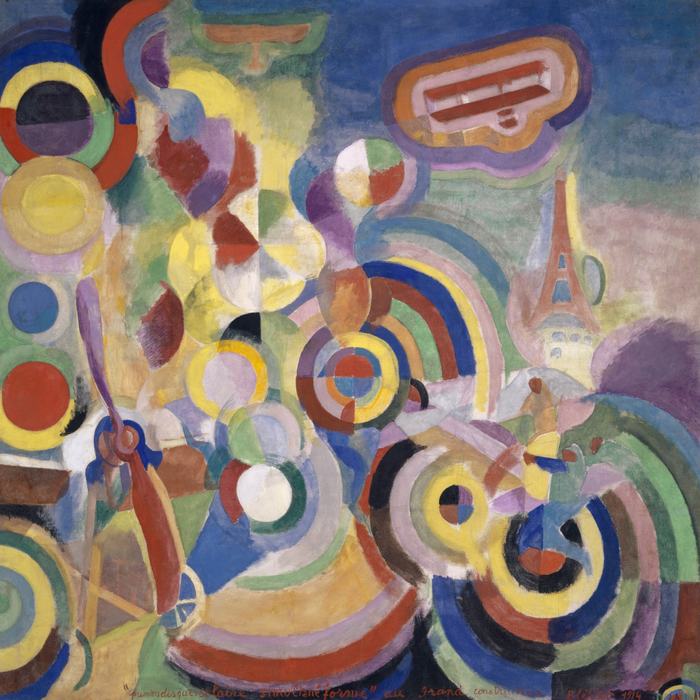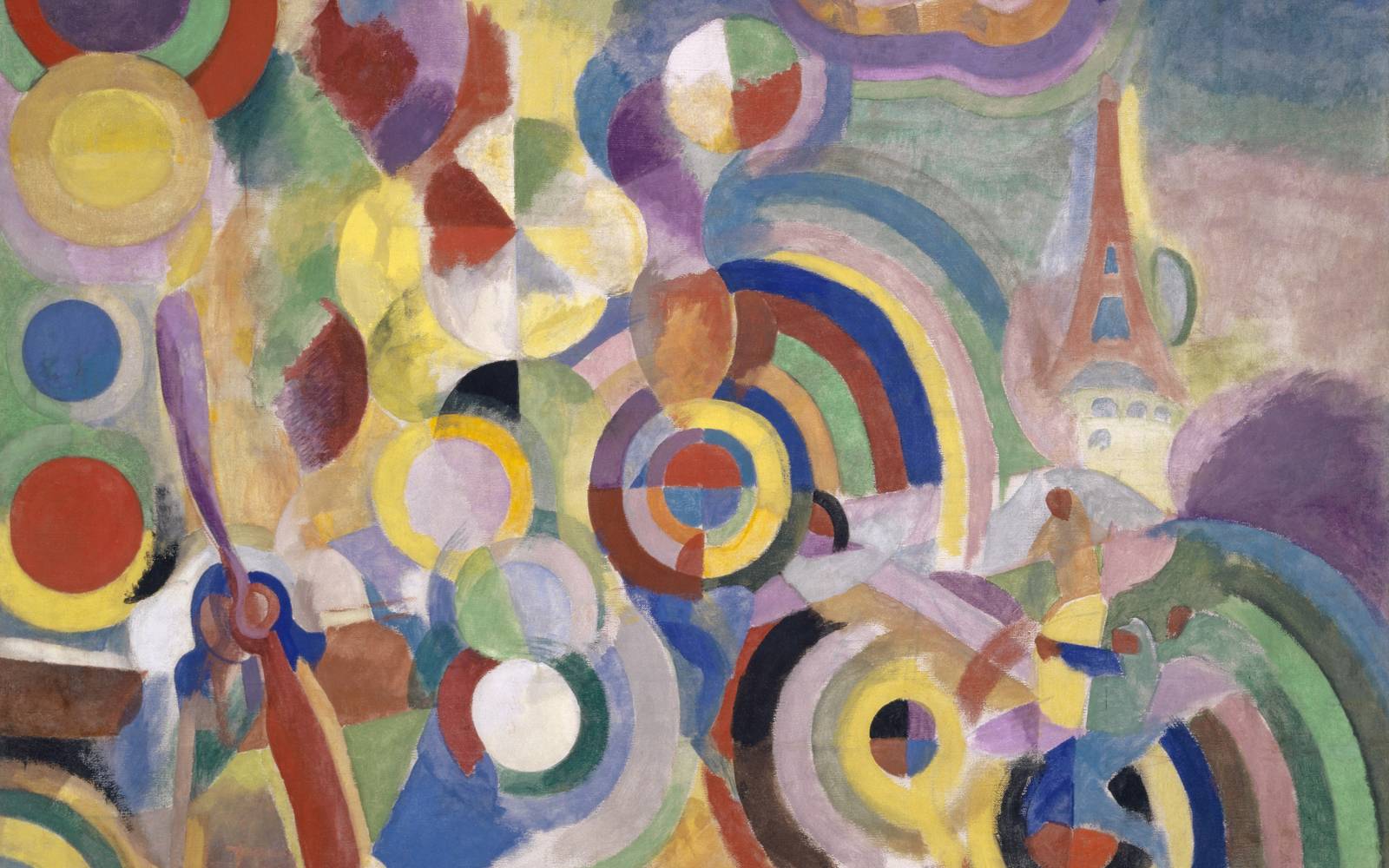
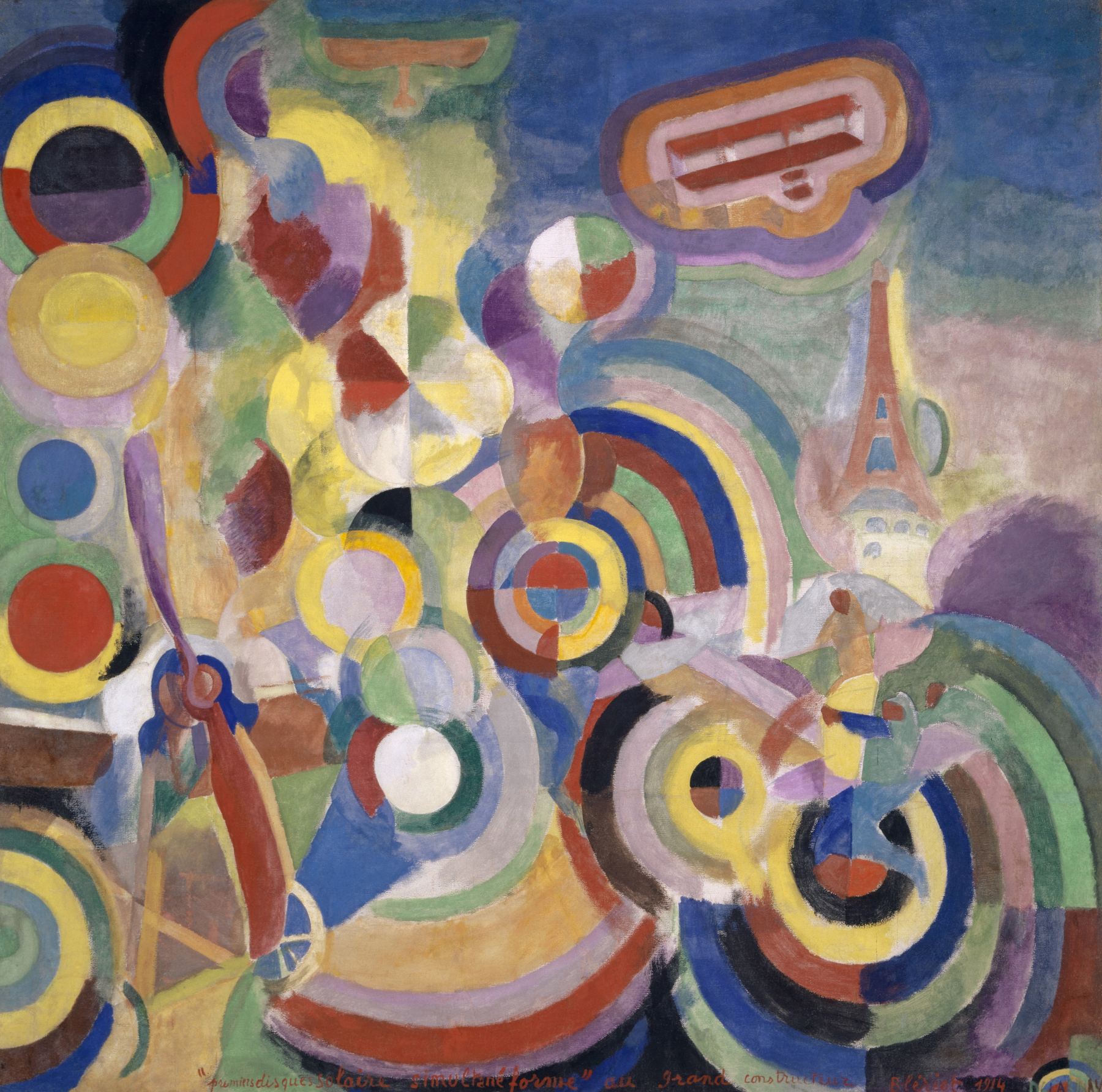
Image reference: Hommage à Blériot.
At a Glance
- Core momentapproximately 1912–1914, with roots from about 1909 and important afterlives into the 1920s and 1930s
- Principal centreParis, especially the salons, studios and Puteaux networks
- Name coined byGuillaume Apollinaire
- Central artistsRobert Delaunay, Sonia Delaunay and František Kupka
- Closely connectedFrancis Picabia; in Apollinaire's shifting accounts, Marcel Duchamp and Fernand Léger
- Known forsimultaneous colour contrast, prismatic light, circular and rhythmic forms, modern-city motifs and musical analogy
- Key distinctionOrphism was Apollinaire's critical category; Simultanism was the Delaunays' term for colour relations perceived together
- Related but differentCubism, Fauvism, Neo-Impressionism, Futurism and Synchromism
- Mediapainting, drawing, print, illustrated books, textiles, clothing, interiors, theatre and monumental decoration
Contents
- Where it fits
- Naming the movement
- Colour-built form
- Four stages
- Artists to know
- Colour in public
- Essential works
- How to look
- Where to see
- Suggested books
Where Orphism fits
Robert Delaunay
Key career periodSonia Delaunay
Key career periodFrantišek Kupka
Key career periodFrancis Picabia
Key career periodGuillaume Apollinaire
Key career periodOrphism is less a movement with borders than a name placed over several experiments in seeing. In Paris around 1912, painters were asking whether colour could construct a picture without depending on the outline of an object, whether light could make still paint feel temporal, and whether visual rhythm could possess the autonomy of music. Robert and Sonia Delaunay, František Kupka and Francis Picabia answered differently. Their differences are the history.
The poet and critic Guillaume Apollinaire supplied the name. He invoked Orpheus, the legendary poet and musician whose art could transform the world, to describe painting that appeared lyrical, self-generating and newly independent of imitation. Recent Guggenheim research treats Orphism as a transnational Paris-centred field shaped by colour, form, motion, dance, music and poetry, rather than a closed French club.[1] That breadth is useful if it does not erase the artists' own terms.
Robert and Sonia Delaunay usually called their shared research Simultanism. Kupka did not accept membership in any movement. Picabia moved through related abstraction toward other avant-gardes. “Orphism” is therefore best used as a historical question: what connections did Apollinaire see, what did colour enable, and how far can one category stretch before it conceals more than it reveals?
A movement named from outside
MoMA offers the concise modern definition: a Cubist-influenced style developed around 1912 by Robert and Sonia Delaunay and Kupka, using abstraction to explore colour and light.[2] It identifies the core without pretending that the three painters shared a studio, manifesto or exact method. Orphism had no membership card, official exhibition series or agreed declaration.
Apollinaire's terminology emerged amid the Section d'Or exhibition of 1912 and his wider defence of the new painting. His book Les Peintres cubistes: Méditations esthétiques was published in Paris in 1913.[3] It was the critic's attempt to describe an avant-garde still changing as he wrote. Categories such as scientific, physical, instinctive and Orphic Cubism overlap awkwardly; painters move between them; Sonia Delaunay and Kupka do not receive the stable places later histories might expect.
In the French primary text, Apollinaire defines Orphic Cubism through elements not borrowed from visual reality but created by the artist and endowed with their own force. He links artistic pleasure to meaningful structure and a sublime reach.[4] This is not a technical checklist. It is a poet's claim that a painting might create a new reality rather than analyse an existing object.
Why Orpheus? The mythic musician offered a model of art that did not need to depict something in order to move an audience. Poetry and music could be ordered, affecting and intelligible without imitating a chair or landscape. Apollinaire's own writing jumped among street signs, conversation, memory, ancient myth and new machines. The Centre Pompidou describes him as a defender of young painters who coined both the coloured Cubism of the Delaunays and, later, “Surrealism”.[5]
The name can mislead if it suggests that these painters illustrated Orpheus, followed ancient mystery religion or translated musical notes into hues. Their canvases rarely show the myth. Music operated as an analogy for autonomous structure, duration, harmony and dissonance. A painted red does not literally sound, and no reliable score converts its frequency into a violin note.
Recent scholarship has recovered the category's productive instability. A Guggenheim gallery guide notes that the connected painters came from France, present-day Ukraine, Bohemia and mixed French-Spanish backgrounds. It also states plainly that the Delaunays initially used simultanisme while Kupka considered himself unaffiliated.[6] Those facts change the narrative from the birth of one French style into a set of translations among mobile artists.
From Cubist structure to colour-built form
Orphism would not exist without Cubism, but it changed Cubism's priorities. Georges Braque and Picasso had fractured objects, multiplied viewpoints and weakened conventional depth while usually restricting their palette. The Orphic field retained division and simultaneity but made colour a primary constructor rather than an addition to structure. MoMA situates this transformation beside Rayonism and other distinct routes that carried Cubist principles into abstraction.[7]
Three earlier colour traditions mattered. Neo-Impressionists separated pigment so optical mixture occurred in the viewer's eye. Fauvist painting released hue from local description. The chemist Michel-Eugène Chevreul's nineteenth-century law of simultaneous contrast explained that adjacent colours alter one another: red intensifies green, blue activates orange, yellow changes violet. The Delaunays treated colour as relational rather than isolated.
They did not simply illustrate Chevreul. A laboratory statement about perception cannot explain why a painter chose an Eiffel Tower, a dance hall, a market or the sun. Scientific vocabulary entered a world of sensation, symbolism, memory, advertising and electric light. “Simultaneous” meant that colours were perceived together and changed one another at once; it also resonated with a modern experience in which trains, newspapers, radio, crowds and illuminated streets compressed distance and time.
Musical language answered a different problem. Once a picture no longer represented a recognisable scene, how could it remain ordered rather than arbitrary? Fugue, rhythm, harmony and dissonance offered models of internal relation. Wassily Kandinsky and Paul Klee also explored relations between music and painting, but their work does not become Orphist merely because a title sounds musical. Similar questions produced distinct visual systems.
What simultaneity means in a still image
“Simultaneity” sounds self-explanatory: everything in a painting is present at once. That is true of almost any picture, so the Delaunays' insistence on the word needs a sharper account. Their simultaneity describes an active dependence. No coloured area has a stable effect by itself. Place violet beside yellow and each appears to intensify; enlarge one field and the balance changes; interrupt a circle and apparent speed alters. The viewer perceives a network of events rather than a collection of separately named things.
This is different from showing successive instants. A Futurist may repeat a leg, wheel or animal to suggest movement through time. In a simultaneous painting, movement can arise without repeated figures. The eye is pulled among contrasts whose effects coexist and compete. Red seems to advance, then a brighter neighbouring yellow draws it back into the surface. A blue arc appears deep until a dark green beside it flattens the relation. Time belongs to the viewer's changing attention.
Nor does simultaneity abolish sequence. A book must be unfolded, a dress encountered from different sides, and a series viewed painting after painting. The term instead proposes that multiple orders can remain available during that sequence. In La Prose du Transsibérien, a reader follows words line by line while retaining awareness of the tall colour field. On a moving body, one sees changing folds while recognising a repeating textile. Simultaneity is an aspiration to hold difference together, not a magical instant in which everything is understood.
Photography, film, radio, telegraphy and the railway made the concept culturally urgent. Distant information arrived more quickly; urban advertising competed with architecture; artificial lights extended the day. The Orphic painters did not produce neutral records of these technologies. They turned a modern difficulty—too many signals arriving together—into a constructive principle. Harmony was possible, but it had to be continually remade from pressure and interruption.
The word also carried disagreement. Robert sometimes described simultaneous contrast as an objective law of vision. Sonia demonstrated that colour changes with material, body and setting. Apollinaire expanded simultaneity toward poetic juxtaposition. Kupka pursued duration through rhythm without adopting the Delaunays' term as an identity. A useful definition must therefore remain practical: look for relations that become perceptible together and alter one another, then ask how a particular artist constructed them.
Follow Orphism through four stages
–11
City, colour and fractured vision
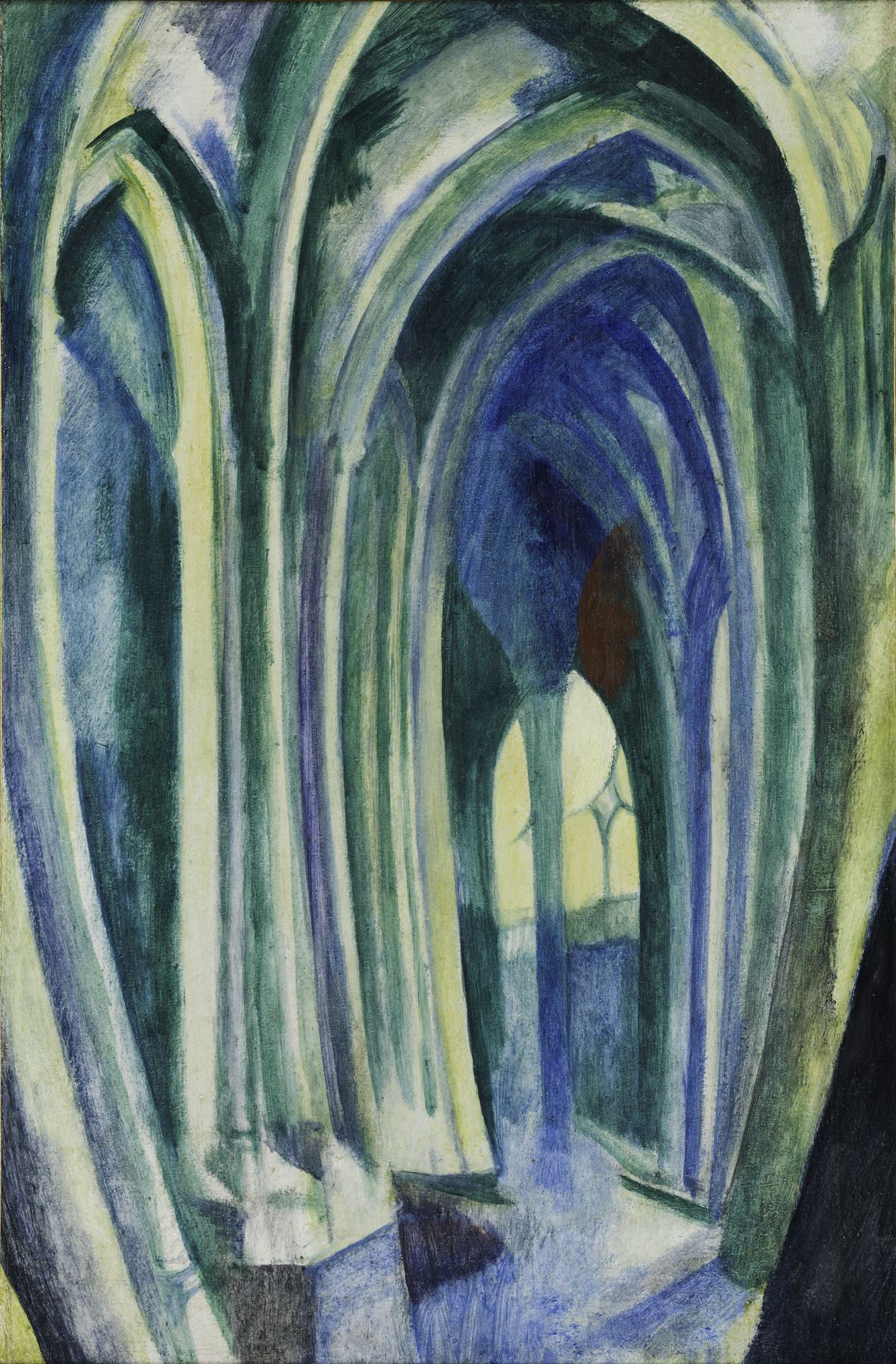
Saint-Séverin, Paris and Eiffel Tower series let architecture become unstable under repeated viewpoints, divided colour and changing light.
Orphism is named
The Section d'Or moment, Apollinaire's criticism, Windows, simultaneous contrast and Kupka's Amorpha bring several independent experiments into comparison.
–14
Colour crosses media and borders
Circular forms, Picabia's monumental canvases, Sonia's book and electric-light work, aviation and international exhibitions expand the field beyond easel painting.
–30
Dispersal and separate afterlives
War breaks the concentrated Paris moment; the Delaunays work in Iberia, Sonia develops design enterprises, and the artists continue along distinct routes.
Robert Delaunay: a city broken by light
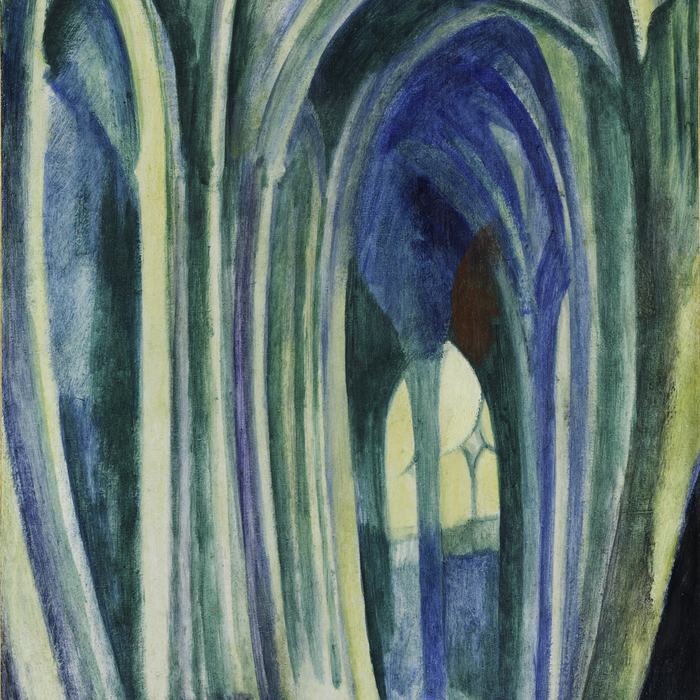
Robert Delaunay did not leap from a conventional city view to a coloured disc. His series make the transition visible. Saint-Séverin's Gothic interior, city panoramas and Eiffel Tower paintings let architecture become unstable under repeated viewpoint and light. In a 1911 drawing of The Tower, iron arches, platforms and trusses appear from above, below, front and side. MoMA explains that these incompatible perspectives converge to convey the dizzying sensations of modern urban life.[8]
The Eiffel Tower was more than a landmark. Built for the 1889 Exposition Universelle, it had become a radio transmitter and a sign of communication across borders. Guggenheim teaching materials record that Delaunay painted it at least thirty times, first around his 1909 engagement to Sonia Terk, and associated it with a Europe transformed into a more global community.[9] The tower's iron openness also allowed sky and structure to interpenetrate.
Early versions remain solid enough to dominate the canvas. Later ones bend, fragment and appear to fall. Delaunay called this his “destructive” phase, but destruction was preparatory: fixed architecture breaks so colour and light can reconstruct the field. The paintings do not condemn the tower. They make its modern promise exhilarated and precarious at once.
The Windows
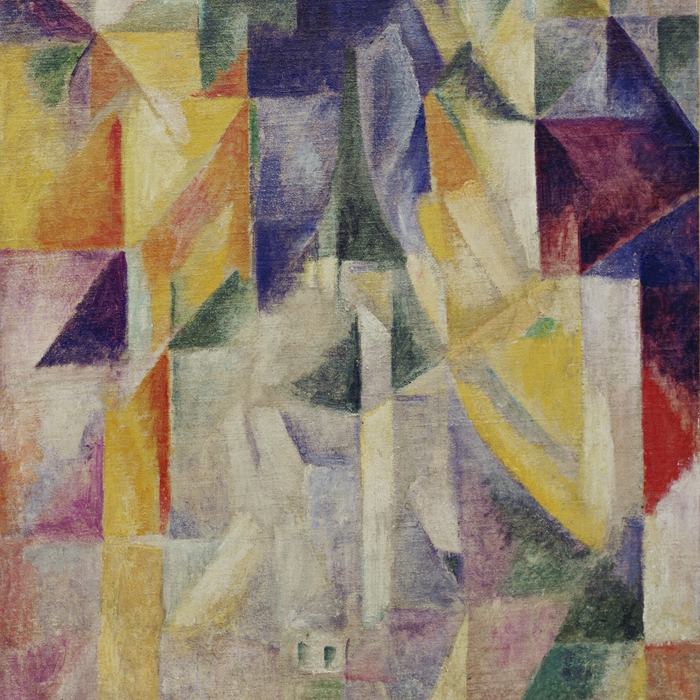
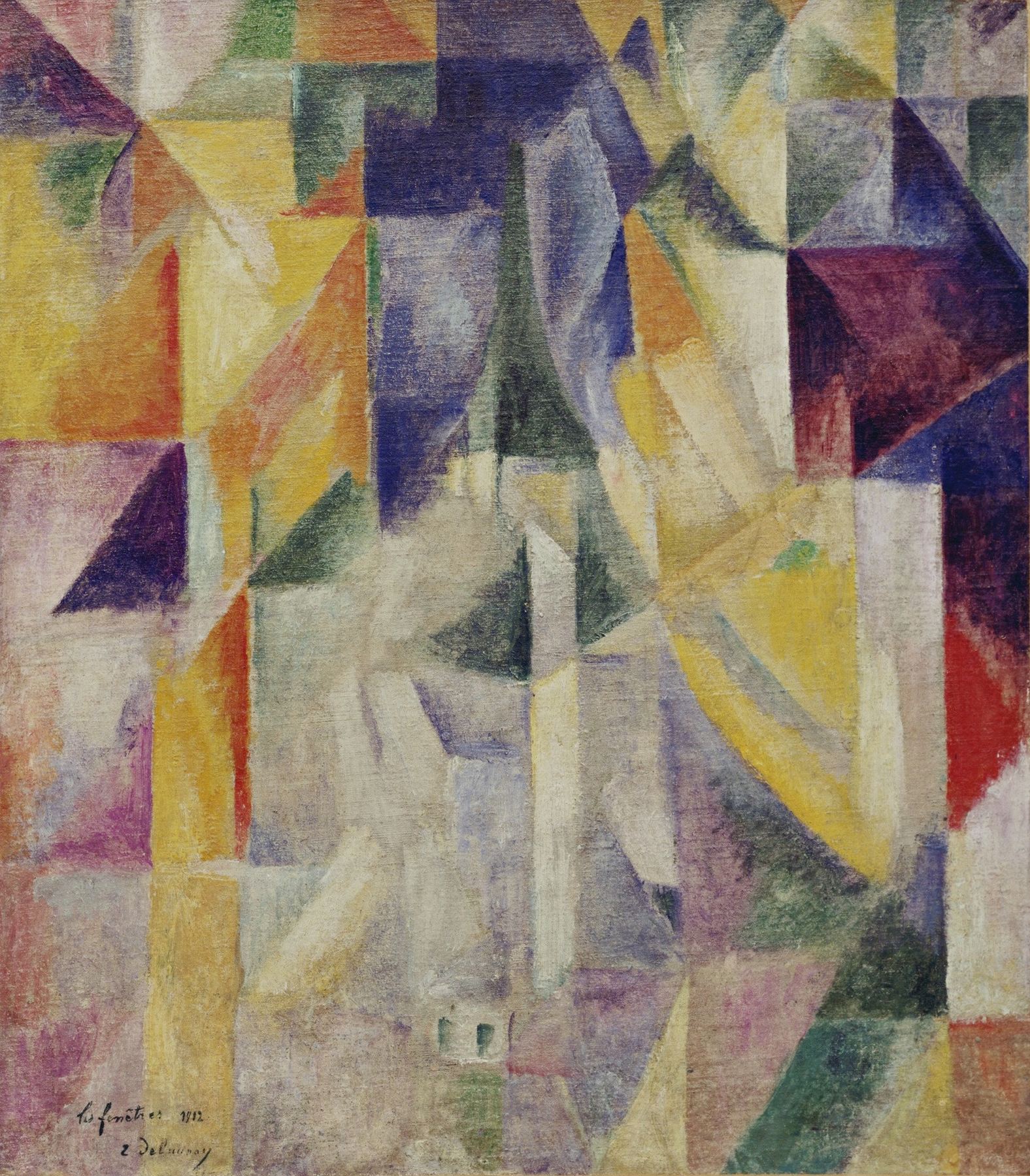
Between April and December 1912, Delaunay made a sequence of twenty-two Windows. The title invokes the Renaissance idea that a painting is a transparent opening onto an imaginary world. Delaunay reverses it. The painted surface does not disappear; translucent wedges and planes record the process of seeing. MoMA identifies light, uneven measures and colour contrast as the subjects that set his move into abstraction in motion.[10]
Look slowly and motifs remain. A pale Eiffel Tower crosses the centre of Une fenêtre; a wheel or circular light intersects it. The Centre Pompidou relates the work to Apollinaire's poem “Les Fenêtres” and to the claim that movements of light are grasped simultaneously.[11] Calling the image pure abstraction too quickly removes the productive threshold where city, eye and colour still meet.
The planes do not fit into a stable grid. Warm colours advance, cool ones recede, then an adjacent hue reverses the effect. Wax mixed with oil changes opacity. Narrow green or orange slivers can appear brighter because complementary neighbours press against them. The eye does not travel from foreground object to distant view; it circulates among contrasts.
Sun, Moon and the circular form
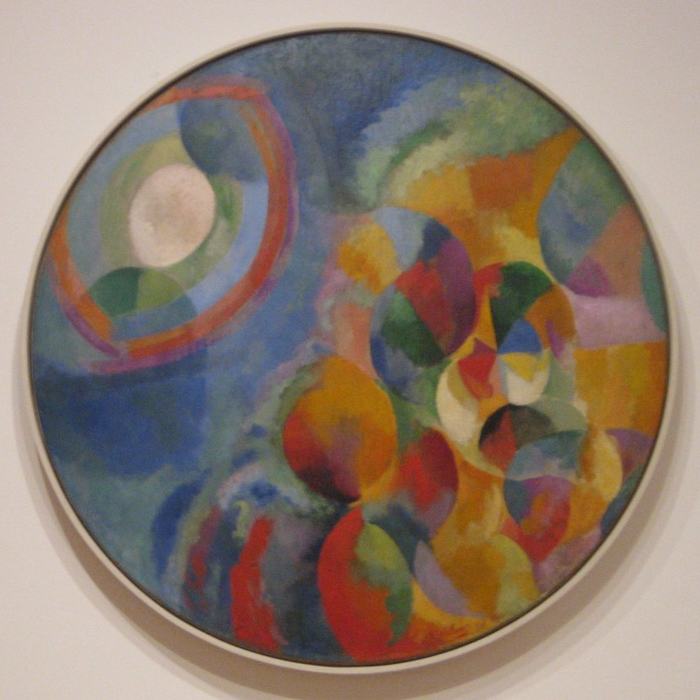
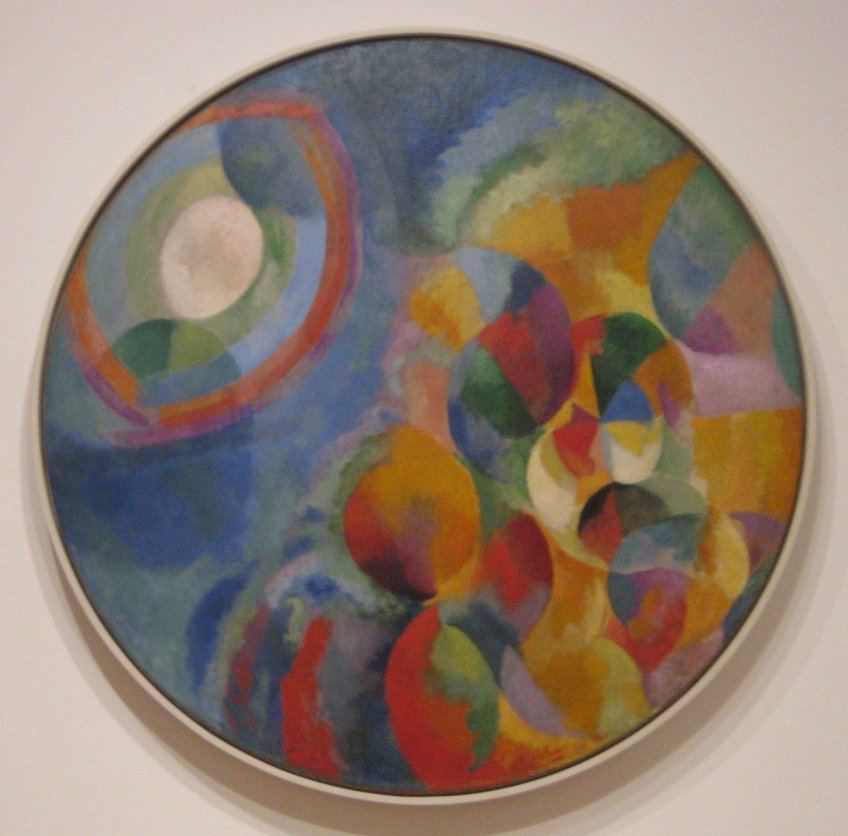
In Simultaneous Contrasts: Sun and Moon, arcs turn around a circular support. Red meets green, blue meets orange, yellow meets violet, and pale intervals prevent saturation from becoming one continuous roar. MoMA connects the title to Chevreul and Apollinaire's Orpheus, explaining how scientific analysis became a belief in colour's capacity to create harmony within modern chaos.[12]
The circle is not neutral geometry. It can be sun, moon, eye, wheel, disc, clock or colour diagram without settling into one identity. Its turning makes the still surface feel durational. The circular canvas intensifies the effect because there is no privileged top, bottom or rectangular corner to stop the motion.
A historical MoMA catalogue places Orphism's height in 1912–14 and stresses light's capacity to decompose subject, create colour and establish spatial-temporal interaction.[13] That account remains useful, but “pure” painting should not become a ladder on which every trace of subject counts as failure. Delaunay repeatedly moved back toward recognisable modern motifs.
Rugby, advertising and flight
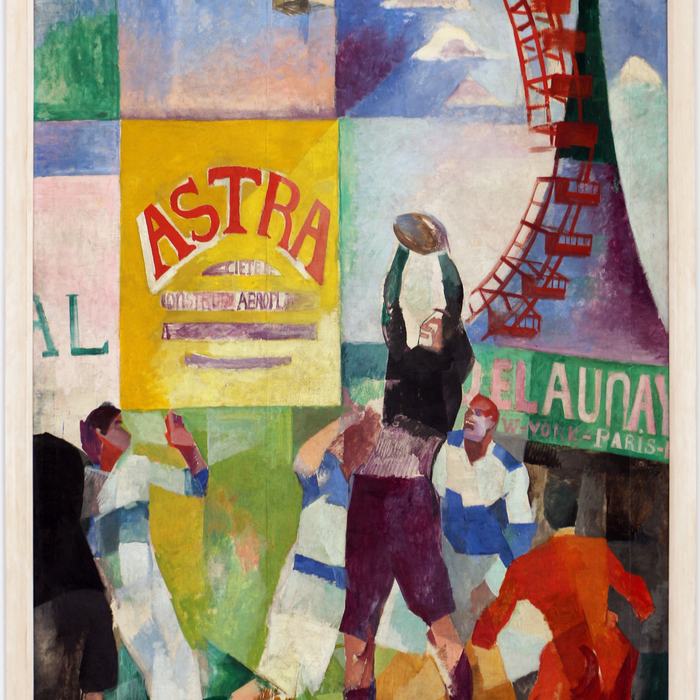
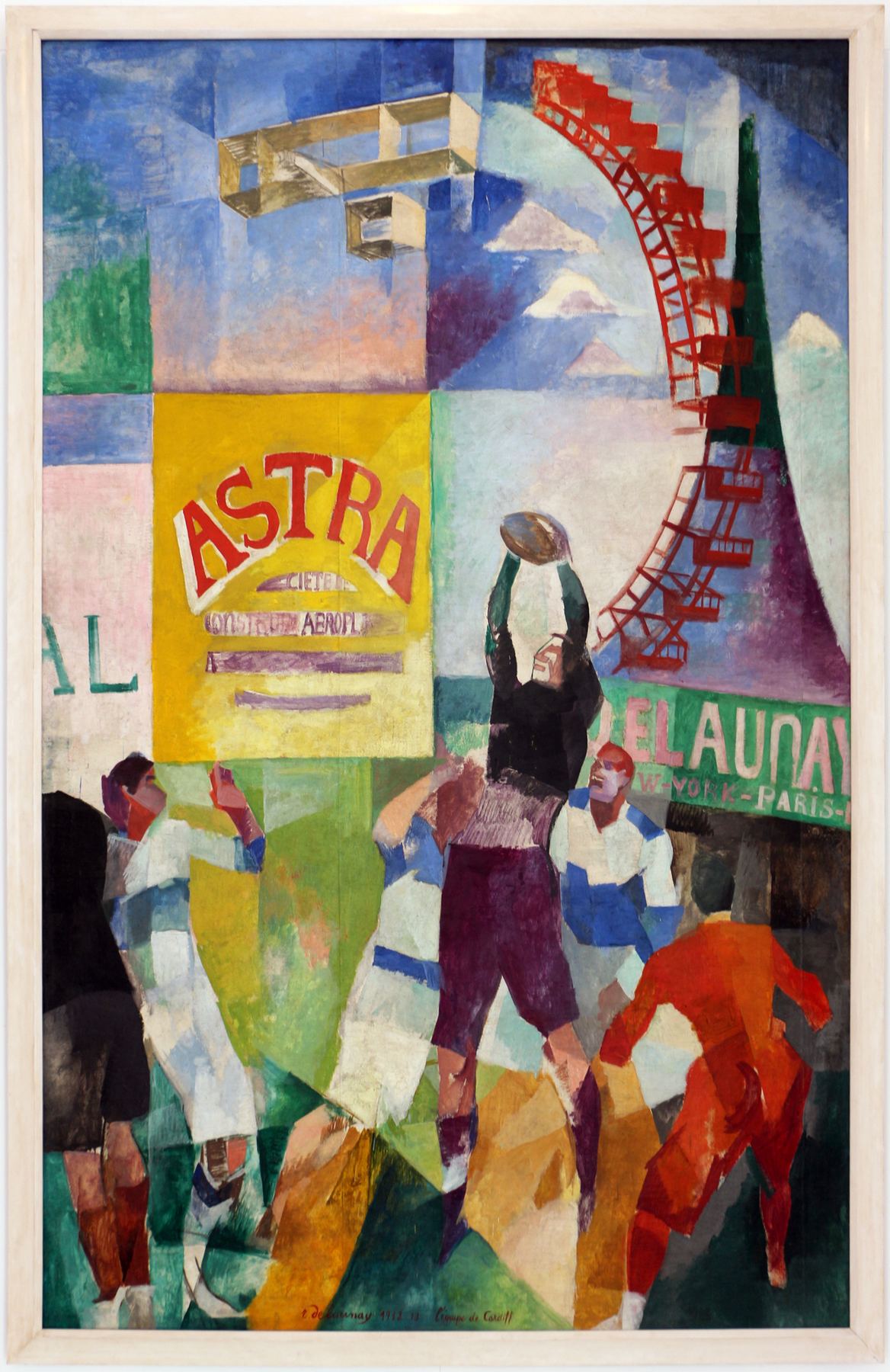
The Cardiff Team combines rugby players, a Ferris wheel, Eiffel Tower, aircraft and advertising words. These elements do not occupy one rational location. They arrive as a modern field in which spectacle, sport, commerce and technology are apprehended together. The painting is simultaneous not because it shows successive poses like a motion study, but because different registers compete in one present.
Hommage à Blériot pushes this combination toward a manifesto. Circular suns and propellers overlap a grounded aircraft, mechanics, the Eiffel Tower and Louis Blériot's plane. A MoMA catalogue identifies electric aureoles and ascending machines in the composition.[14] The work celebrates flight while dissolving the machine into the same colour energy as atmosphere. Technology does not master light; it enters its instability.
The Centre Pompidou's French Delaunay dossier follows these series from Windows through circular forms, sports and aviation, then into stage design and later “endless rhythms”.[15] Series allowed Delaunay to test a problem repeatedly. Orphism was not one sudden invention but a sequence of revisions in which subject disappeared, returned and changed function.
Sonia Delaunay: simultaneity enters life
Sonia Delaunay was not the person who carried Robert's painting into lesser decorative media. She co-developed simultaneous colour and tested it in situations Robert rarely addressed: a book held and unfolded, fabric cut and worn, a room inhabited, a costume moving under stage light. MoMA's artist study describes a practice extending across painting, drawing, print, illustration, textiles, furnishings, clothing and accessories, built from complementary contrasts.[16]
She was born in 1885 in what is now Ukraine, raised partly in St Petersburg, educated in Germany and active chiefly in France. The National Gallery of Art identifies her as a painter, illustrator, printmaker and designer who co-founded Orphism.[17] Her Jewish, Ukrainian, Russian, German and French contexts should not be compressed into the convenient label “French designer”.
The first simultaneous book
In 1913 Sonia worked with Blaise Cendrars on La Prose du Transsibérien et de la Petite Jehanne de France. The accordion-fold object opens to almost two metres. Cendrars's poem runs in shifting typefaces and colours on one side; Delaunay's pochoir shapes descend beside it. MoMA explains that it can be apprehended at once while also evoking an imaginary rail journey across Russia, Siberia, China and back toward an Eiffel Tower in Paris.[18]
The collaboration is neither a poem with illustrations nor an abstract painting with captions. Blank paper, coloured type and painted form cross the centre without merging. A reader can follow lines sequentially, scan both columns or stand back to see a vertical whole. Folding converts long journey into handheld object; unfolding turns private reading into bodily movement.
The BnF records four sheets, inventive typography and colour described by the makers as explicitly non-illustrative. It also notes that the work began when Cendrars sent Sonia an early version of the poem.[19] “Simultaneous” did not mean everything was visible with equal clarity. It meant different temporal and sensory orders remained active together.
Fabric is not canvas
Sonia's textiles changed the question again. Repeat, touch, drape, seam, wear and manufacture enter. A Cooper Hewitt study of Tissu simultané no. 46 shows the same block-printed pattern behaving differently on silk and cotton: colour sits brightly on silk but is absorbed by cotton. Delaunay distinguished painting from textiles while treating them as equal fields of creation.[20]
That equality matters. If design is discussed only as the “application” of fine-art discoveries, the fabric's own intelligence disappears. A dress reorganises coloured units when the wearer walks, sits or turns. A textile repeat has no single privileged centre. A garment meets social codes, bodies, labour and sale. These are not problems an easel painting solves.
Her Atelier Simultané in the 1920s made clothing, textiles and objects for private and commercial clients. Cooper Hewitt's Color Moves research follows painting into graphics, interiors, theatre, film, fashion and textiles for the Amsterdam store Metz & Co.[21] Entrepreneurship brought creative reach and economic necessity together. Sonia supervised production and built a recognisable public identity, but the workers who printed, sewed and sold the objects also belonged to their material history.
Electric streets and Iberian markets
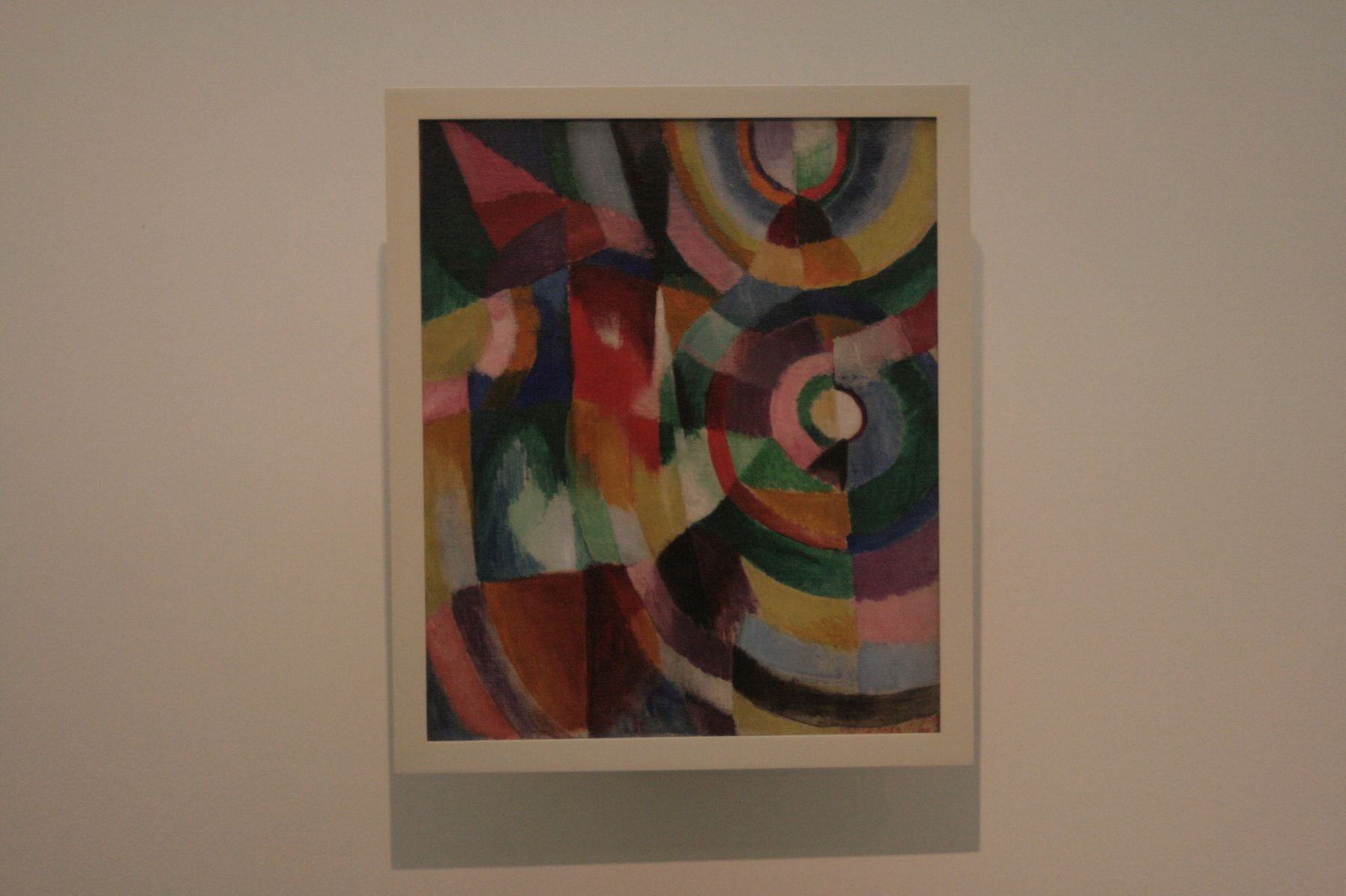
Electric Prisms responds to new street lamps. Overlapping rings suggest halos that pulse around artificial light, while dark intervals prevent the surface from becoming uniformly bright. A MoMA curator describes the painting as exemplary of the Delaunays' theory that colour and contrast develop over time while being perceived in one moment.[22] The paradox—duration apprehended at once—is central to Simultanism.
World War I found the Delaunays outside France. They lived in Spain and Portugal, where Sonia remembered a light that made colour vibrate without Paris's grey veil. Portuguese Market of 1915 retains fruit, produce and stalls, but bands of saturated oil and wax make colour the protagonist. MoMA's object study connects the work to Valença do Minho and the couple's wartime travel.[23]
The painting rebukes a simple narrative from representation to abstraction. Sonia could recover objects without abandoning simultaneous contrast. Iberian light also activated memories of Ukrainian colour and craft. Place entered the work through recollection as much as direct description.
Sonia designed costumes for the revived Ballets Russes production of Cleopatra in London in 1918, while Robert designed sets. A Metropolitan Museum record preserves her watercolour costume designs.[24] Stage colour belonged to fabric, body, choreography, music and illumination. The Delaunays shared a project without producing identical work.
The Centre Pompidou's history of the Sonia and Charles Delaunay donation describes both artists moving from geometric deconstruction to form reconstructed by colour, and records how the family gift shaped the museum's holdings.[25] That collection history matters: Sonia was also an advocate and organiser of Robert's legacy, while her own cross-media career required later scholarship to escape the category of decoration.
Orphist artists to know
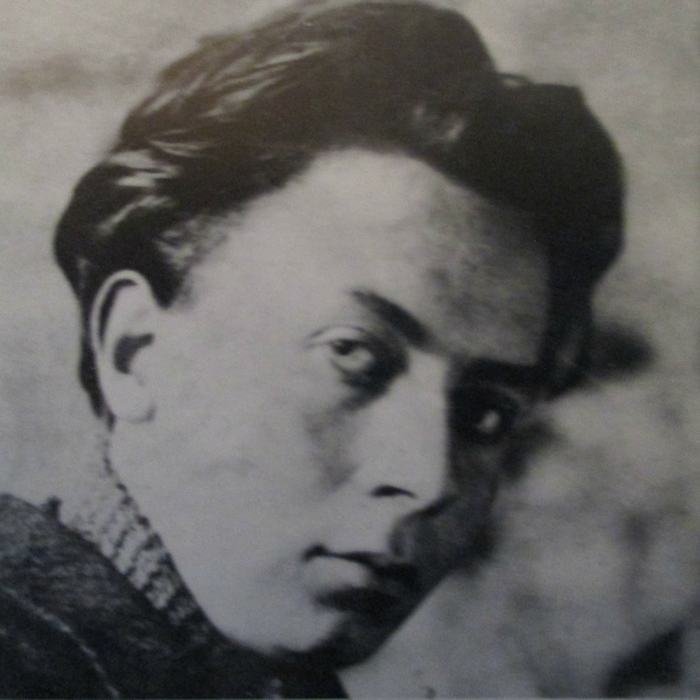
Robert Delaunay
Delaunay moved from the fractured city through Windows and circular forms, making colour and light the constructive forces of a modern picture.
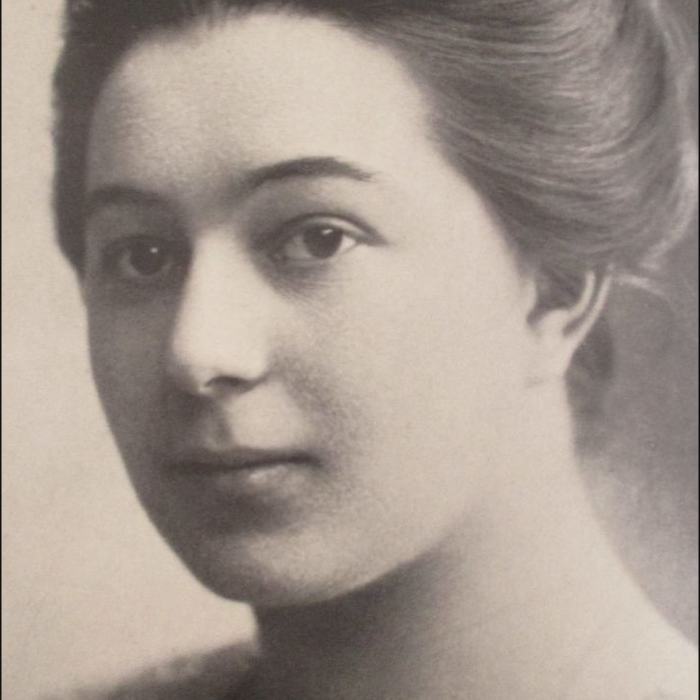
Sonia Delaunay
Delaunay co-developed Simultanism and tested colour relations across painting, the unfolding book, fabric, dress, interior and moving stage.
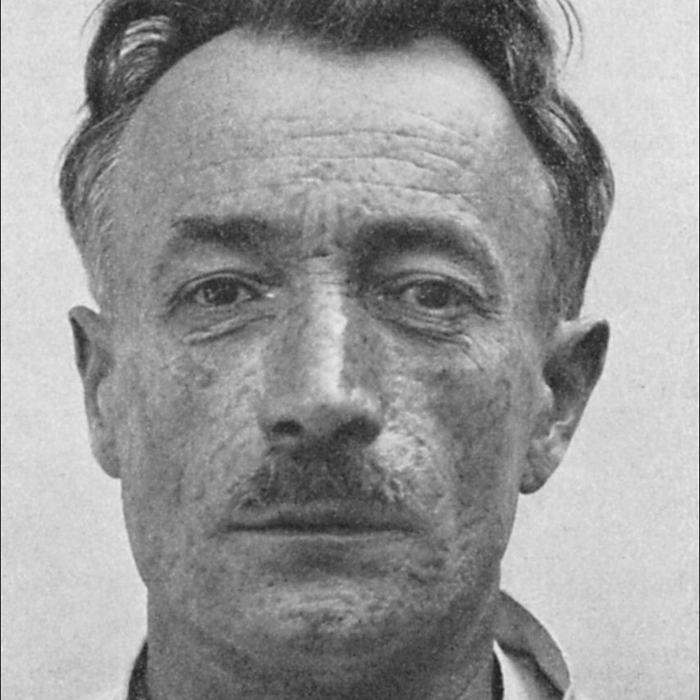
František Kupka
Kupka reached non-objective painting through Symbolism, observed movement, colour science, spiritual inquiry and musical structure while rejecting movement membership.
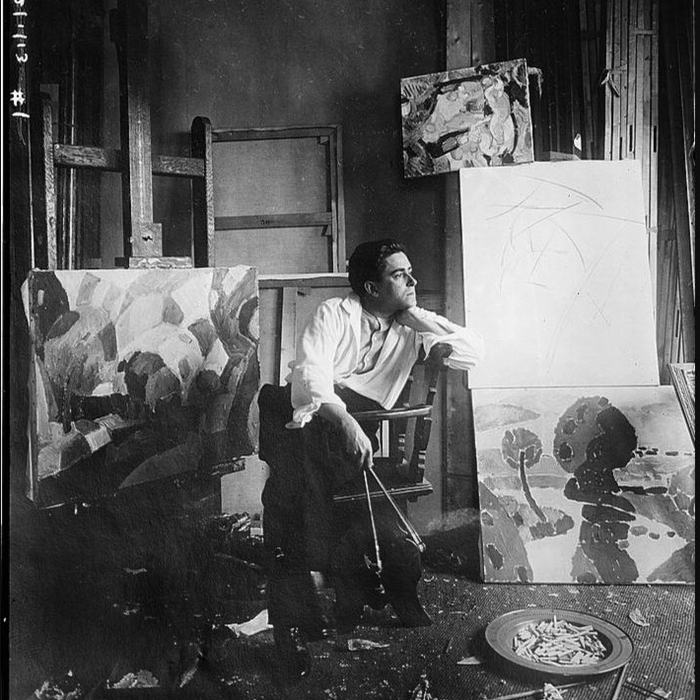
Francis Picabia
Picabia's vast 1913 abstractions transformed dance, memory, machine form and sensory analogy before his work moved rapidly toward other avant-gardes.
Colour in public
Orphism is often illustrated with museum paintings against white walls, yet many of its decisive encounters occurred in crowded public spaces. Salon pictures were surrounded by competing canvases, arguments and newspaper commentary. Dance halls mixed dresses, electric bulbs, mirrors and moving partners. The railway book could hang at full length like a strip of urban signage. Theatre placed painted colour under artificial light and beside music. Publicness did not merely distribute the art; it helped determine its forms.
The Bal Bullier, a popular Paris dance hall visited by the Delaunays, offered a living demonstration of broken perception. Turning couples were glimpsed between shoulders and hats; clothing colours met and separated; lamps created halos and reflection; no spectator controlled a single viewpoint. Sonia's simultaneous dress could participate in that field rather than depict it. The wearer became a mobile relation among pattern, fabric, body and crowd.
This mobility unsettles the traditional division between an artwork and its surroundings. A framed painting can still be carried and rehung, but its internal arrangement travels with it. A garment changes shape on every wearer. An interior joins furniture, daylight and use. A printed textile can be cut into multiple objects. Sonia's practice did not simply enlarge Orphism's list of media. It revealed that colour's effect is always conditional.
The condition included commerce. Department-store production, fashion commissions and theatre work connected abstraction to markets that avant-garde rhetoric sometimes treated with suspicion. Repetition could spread an artistic language widely, but it could also turn it into a brand. Sonia navigated this tension as a working artist supporting a household. Her designs prove that economic use does not automatically cancel experimentation, just as an easel painting's rarity does not automatically guarantee radical thought.
Authorship becomes more complex in these media. Cendrars wrote, typesetters and printers produced, and Sonia designed and applied colour to the simultaneous book. Fabric involved manufacturers, block cutters, printers, seamstresses, models and clients. Theatre depended on dancers, costume workshops, lighting and performance. To credit these systems does not diminish Sonia's authorship. It clarifies what kind of authorship a cross-media avant-garde required.
Robert also pursued public scale. Sports paintings incorporated advertising; theatre designs surrounded performers; later exhibition murals addressed crowds. His recurring Eiffel Tower already belonged to a structure that combined engineering, tourism, broadcasting and national display. Orphism's claim to “pure painting” therefore coexisted with extraordinarily impure sites. Colour could be autonomous in its pictorial relations while remaining entangled with modern institutions.
This contradiction is central to the movement's value. Orphism sought a visual language liberated from copying objects, then tested that freedom in books, markets, machines, clothes and architecture. It did not escape life. It reorganised how life's fragments could appear together.
Kupka: an independent fugue
František Kupka lived near Puteaux and exhibited Amorpha: Fugue in Two Colors at the 1912 Salon d'Automne, but proximity does not make him a Delaunay follower. National Gallery Prague holds a rare sequence from his early figurative work through major abstractions, including Amorpha.[26] His route joined Viennese Symbolism, satire, physiology, astronomy, spiritual philosophy, observed motion and sustained technical study.
A Czech National Gallery teaching dossier traces music and movement through paintings of a girl with a ball and piano imagery before the 1912 abstractions. It stresses that colour shifts and simplified observed form preceded the disappearance of objects.[27] The circular sweep of Amorpha therefore has bodily ancestry even when no body remains visible.
Fugue without a score
Red and blue arcs rotate around pale openings in Amorpha. The title borrows “fugue”, a musical form in which voices enter, repeat and transform. It does not mean Kupka assigned red to one instrument and blue to another. The analogy concerns structured recurrence, counterpoint and time perceived through a fixed field.
In Ordonnance sur verticales en jaune, graded vertical bands create another type of rhythm. A French Centre Pompidou study relates its syncopated sequence to Bach while distinguishing Kupka's colour-only architecture from Delaunay's contemporary Orphism.[28] Kupka could share a musical problem without joining the same solution.
The Centre's oil study for Amorpha documents the work's 1911–12 development and long exhibition history.[29] Preparatory studies matter because they disprove the fantasy that non-objective painting arrived as an unmediated spiritual flash. Kupka tested rotation, interval and balance through drawings and painted variations.
Newton, science and the invisible
Disks of Newton names a scientific source. Circular bands cover a spectrum, but they do not reproduce a physics diagram. A Centre Pompidou educational dossier connects the work to Newton's colour disc and to Kupka's wider interest in microscopy, telescopes and X-rays.[30] Science expanded the imaginable world beyond ordinary sight; painting converted that expansion into form.
Kupka's abstraction also retained Symbolist and spiritual ambitions. The English Grand Palais guide locates his development in Central European philosophy and describes geometry as a bridge between visible and invisible.[31] This differentiates him from a story in which all Parisian abstraction follows Cubism. It also prevents scientific interest from being mistaken for positivist certainty.
Kupka later participated in Abstraction-Création and continued non-figurative work for decades. Calling all of it Orphism would turn a brief critical connection into a lifelong identity he did not claim. Orphism is most useful around the shared 1912 problem, least useful as a permanent surname.
Picabia: dance, machine and unstable language
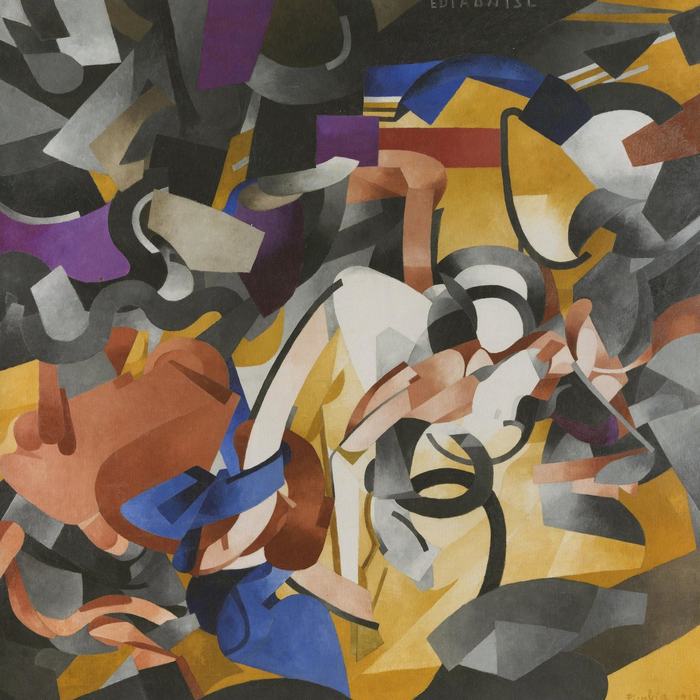
Francis Picabia brought another kind of simultaneity. Udnie was prompted by memories of the Polish dancer Stacia Napierkowska performing aboard the liner that carried him to the United States in 1913. The nearly three-metre canvas converts dance into centrifugal abstract form, metallic reflection and machine-like energy. The Centre Pompidou links its dynamism to Futurism and its “musicalism” to sensory correspondence.[32]
The title may echo Jean d'Udine, a theorist who related music, colour and dance through rhythm. Picabia carried “Udnie” into later works. MoMA's I See Again in Memory My Dear Udnie mixes repeated piston-like and bodily openings; its title adapts a phrase taken from a dictionary source.[33] Memory becomes mechanical, erotic and verbal at once.
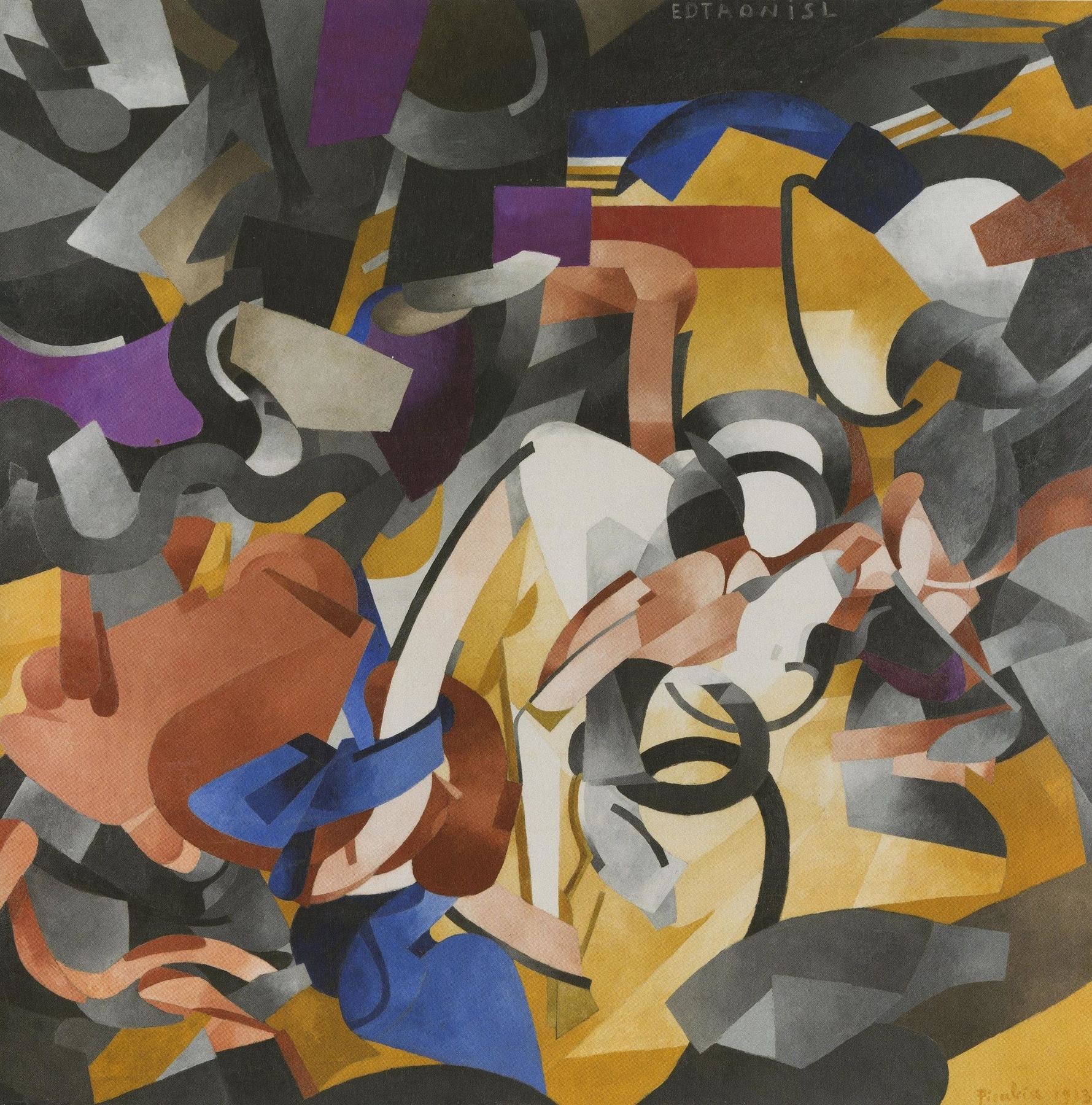
Edtaonisl was painted as a pendant of the same enormous scale. Its invented word interlaces letters from French terms for star and dance. A MoMA audio study explains how the viewer can become physically lost among ribbons of paint and how title and image resist decoding together.[34] Orphism here is not radiant harmony alone. It is disorientation.
Picabia also complicates any tidy membership story. He helped finance the 1912 Section d'Or exhibition, belonged to the Puteaux milieu and was classified by Apollinaire, but his career moved through Dada, machines, transparency, popular imagery and repeated stylistic refusal. The Met's modern-art index presents him as painter, poet, editor and international impresario rather than loyal representative of one school.[35]
Material history further unsettles lyrical language. Technical study found vivid cobalt violet and metallic pigment in Edtaonisl. Rolled and folded storage produced horizontal cracking and losses; Picabia and Christine Boumeester repaired the canvas after its rediscovery in the 1940s.[36] Rhythm is carried by vulnerable oil, commercial paint and canvas, not by immaterial colour alone.
Who else belongs?
The answer depends on whether “belongs” means Apollinaire named an artist, a work shared formal concerns, or a later exhibition found a useful relationship. The Puteaux circle and Section d'Or included Duchamp, Picabia, Kupka, Jacques Villon, Raymond Duchamp-Villon, Albert Gleizes and others. A French Centre Pompidou dossier shows Apollinaire applying several Cubist subcategories across this field.[37]
Fernand Léger made colour, machine and urban simultaneity central to his own work, yet his tubular figures and later social modernism require more than the Orphist label. Duchamp's motion studies and Picabia's sensory machines touch the field while leading quickly elsewhere. Amadeo de Souza-Cardoso, Marc Chagall and later Mainie Jellett can illuminate transnational reception without becoming members of a non-existent organisation.
The term also entered decorative history. A Metropolitan Museum account calls Orphism an early French nonrepresentational movement and connects its abstract colour to later Art Deco culture.[38] The connection is real, but it should not revive the hierarchy Sonia's work challenged: a patterned dress is not simply a lesser Orphist canvas.
Synchromism offers the clearest boundary test. American painters Morgan Russell and Stanton Macdonald-Wright developed “synchronies” in Paris around the same time, building form through colour and invoking music. A Met catalogue identifies Delaunay's Orphism as an important structural source for their theory.[39] Influence did not erase competition, distinct terminology or their attention to sculptural mass. Synchromism is a neighbour, not a synonym.
War, dispersal and the long Orphist frame
The First World War ended the concentrated salon moment. Travel, mobilisation and exile fractured Parisian networks. Robert and Sonia worked in the Iberian Peninsula; economic circumstances pushed Sonia further into theatre, interiors and fashion. Picabia crossed the Atlantic and approached Dada. Kupka served with Czech volunteers and then returned to long independent research.
The movement did not continue as a coherent group until 1930. That later date belongs to a useful contemporary reassessment. A Guggenheim press release describes Orphism as a deliberately generous and elastic category that includes Delaunays, Kupka and Picabia alongside a wider set of connected artists, and incorporates conservation research.[40] This frame follows consequences rather than continuous membership.
Robert returned repeatedly to circular “endless rhythms” and designed monumental work for the 1937 Paris exhibition. Sonia built a business, collaborated across poetry, stage and film, and later renewed large-scale abstraction. Kupka developed vertical, circular and biomorphic series. Their later work shows that the pre-war question survived after the name ceased to organise a shared moment.
Orphism's strongest legacy is not a rainbow palette. It is the proposition that colour can create form, depth, interval and time through relation. Its most valuable warning is the opposite: shared colour does not make different artists the same.
Modernity without a single verdict
Airplanes, towers, electric lamps, sport and railways make Orphism appear confidently celebratory. The paintings undoubtedly share the exhilaration of new speed and illumination, but celebration is not their only effect. Delaunay's Tower seems to rise and collapse at once. Picabia's dance paintings turn bodily excitement into vertigo. Cendrars's railway journey is fractured by memory, anxiety, violence and impossible geography. Modern simultaneity could overwhelm as well as liberate.
The years immediately before war give this instability historical weight. International salons and print networks connected artists across borders, while nationalism and military rivalry intensified. The Eiffel Tower could promise global radio communication and stand as an emblem of French technological prestige. An aeroplane could signify human flight and rapidly become a weapon. Orphist form holds these contradictions without resolving them into political allegory.
Colour itself is double. Complementary contrast can create a momentary balance, but it does so by preserving opposition. Red and green do not blend into a common neutral; each becomes more forceful beside the other. Harmony therefore need not mean calm agreement. The Guggenheim exhibition's phrase “harmony and dissonance” captures a structure already present in the pictures: unity produced from elements that remain visibly unlike.
This makes the movement more than a cheerful branch of Cubism. Its brightness can be difficult, its circles unstable and its repeated contrasts tiring to the eye. A viewer may experience pleasure, motion or strain. Apollinaire's lyrical promises and the artists' modern subjects should not dictate one response. The paintings construct conditions for perception, then leave the experience open.
The same openness explains why Orphism travelled. A poet could understand simultaneous juxtaposition differently from a textile designer. An American Synchromist could adopt colour construction and seek greater bodily mass. A later abstract painter could inherit the disc without the Eiffel Tower or Chevreul. Influence occurred when a problem was reformulated, not when a visual recipe was copied exactly.
Orphism's brevity was therefore generative. Because it never hardened into an academy, it could disperse into separate careers. The price is historical ambiguity: the label must be rebuilt each time it is used. That burden is productive if it keeps comparison precise.
The problem of reproducing colour
Orphism is unusually vulnerable to reproduction. A screen changes with brightness and colour profile; a printed page compresses saturated pigment into a smaller gamut; varnish, age and gallery light alter an original. Two online images of the same painting may produce different complementary relations. Because the movement makes relation its subject, these shifts are not merely cosmetic.
Scale also changes rhythm. A circular form that surrounds peripheral vision in a gallery becomes a tidy emblem on a phone. Picabia's huge fields lose their bodily disorientation; the Trans-Siberian book becomes a vertical thumbnail rather than an object that must be unfolded. Textile photography freezes drape and removes touch. Digital access is invaluable, but it should prompt questions about what the translation excludes.
When looking remotely, compare several institutional images and attend to dimensions, medium and conservation notes. Notice whether wax makes a Delaunay surface matte, whether metallic paint changes with angle, or whether paper colour has warmed. When standing before an original, move closer and farther away. From a distance, discs and contrasts may organise a whole; close up, brush direction, overlap, repair and uneven pigment interrupt that unity.
This material attention does not oppose Orphic ideas of light and rhythm. It makes them concrete. Colour occurs through pigment, binder, fibre, paper, illumination and eye. Simultaneity is never an abstract law floating above an object; it is an event reconstructed under particular viewing conditions.
Essential Orphist works
Hommage à Blériot
Robert Delaunay · 1914 · Sun discs, propellers, aircraft and the Eiffel Tower turn technological flight into unstable simultaneous colour.
Saint-Séverin No. 5
Robert Delaunay · 1909–10 · The Gothic interior bends into a rhythmic field, making architecture a starting point for the later experiments in fractured light.
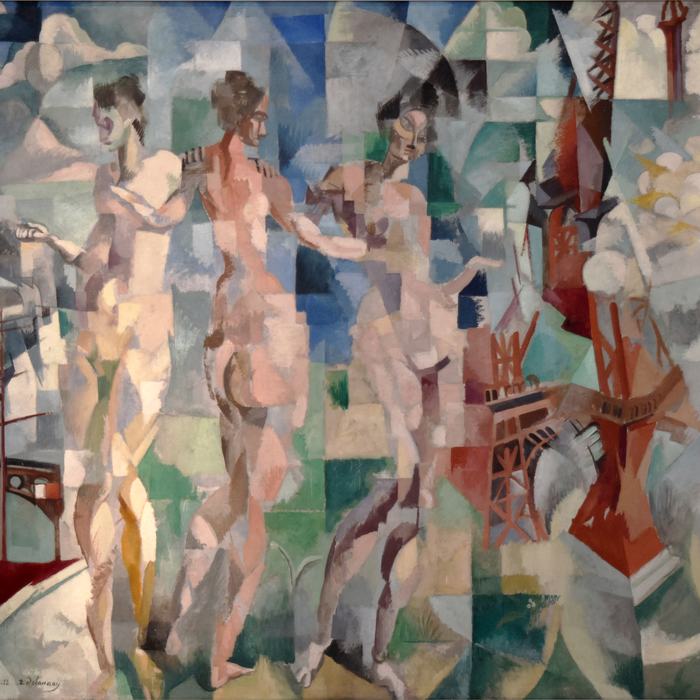
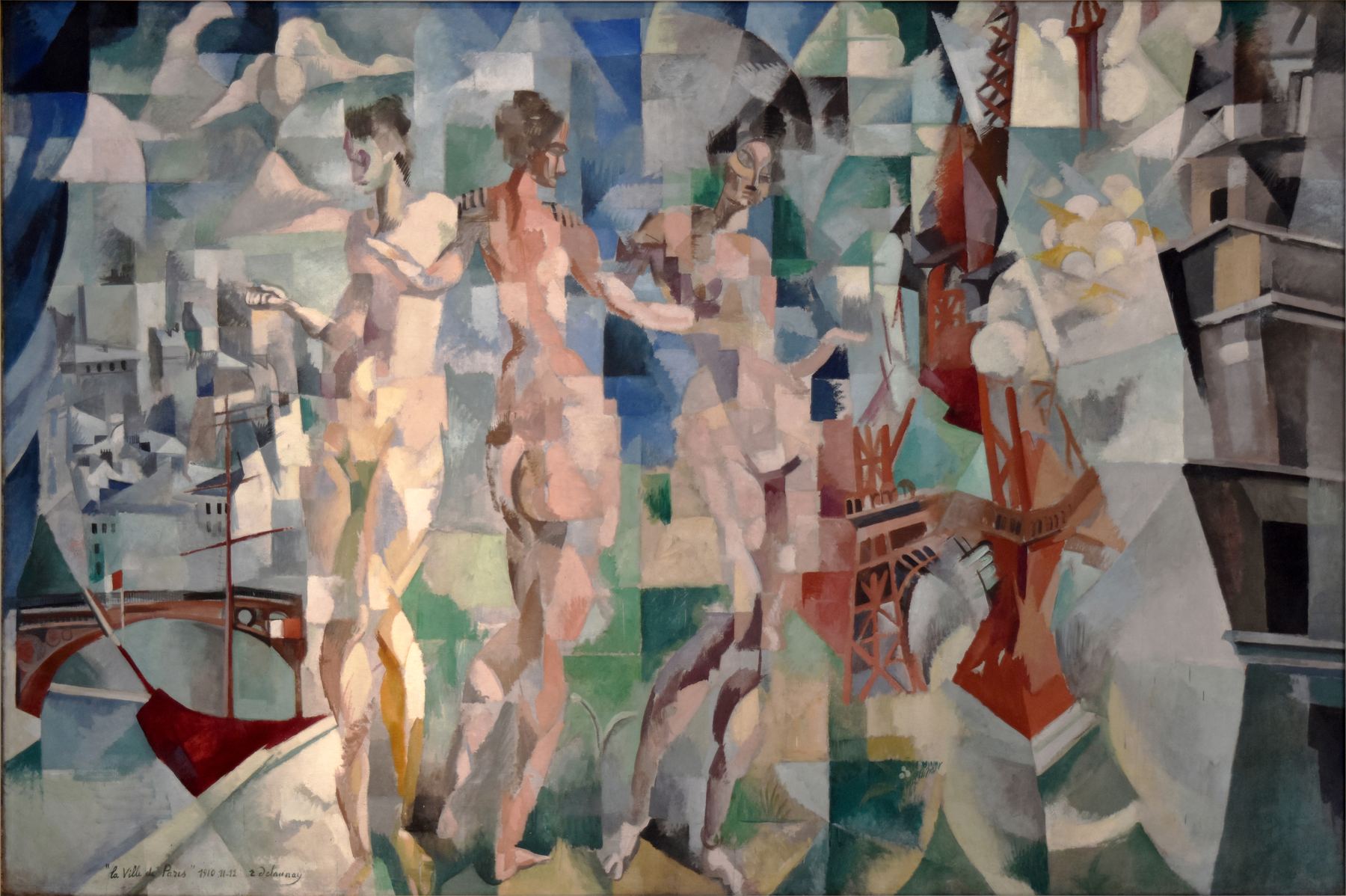
La Ville de Paris
Robert Delaunay · 1910–12 · Monumental scale, multiple viewpoints and urban emblems show Delaunay moving beyond conventional Cubist analysis toward colour-built modernity.
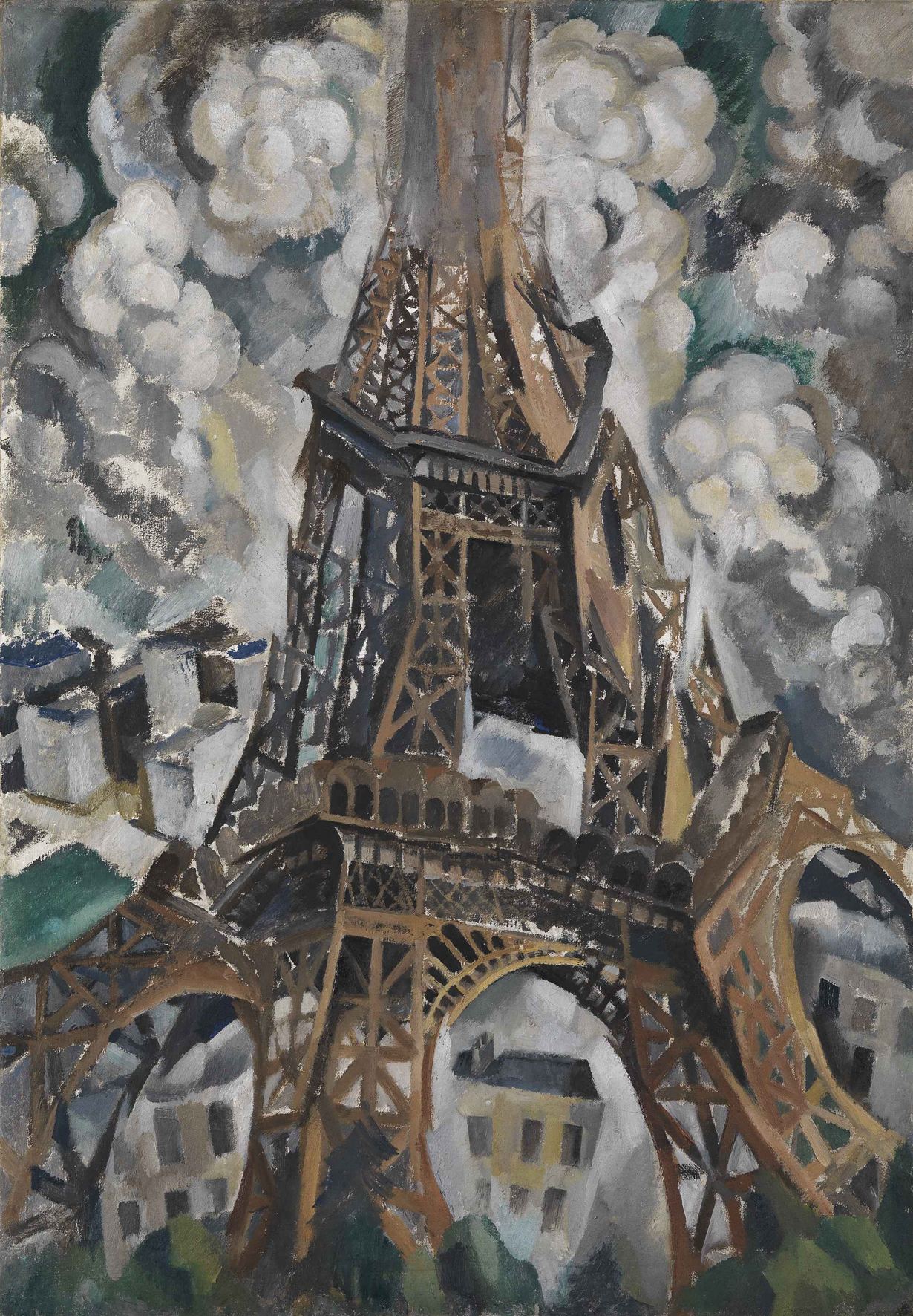
The Eiffel Tower
Robert Delaunay · 1909–11 · The iron landmark is seen from incompatible angles, turning modern Paris, radio-age communication and visual instability into one structure.
Windows
Robert Delaunay · 1912 · Tower and wheel fragments survive inside translucent colour planes, holding observation and abstraction in productive tension.
Simultaneous Contrasts: Sun and Moon
Robert Delaunay · 1912–13 · Complementary arcs rotate across a circular support, creating duration and pressure without a mechanically fixed colour code.
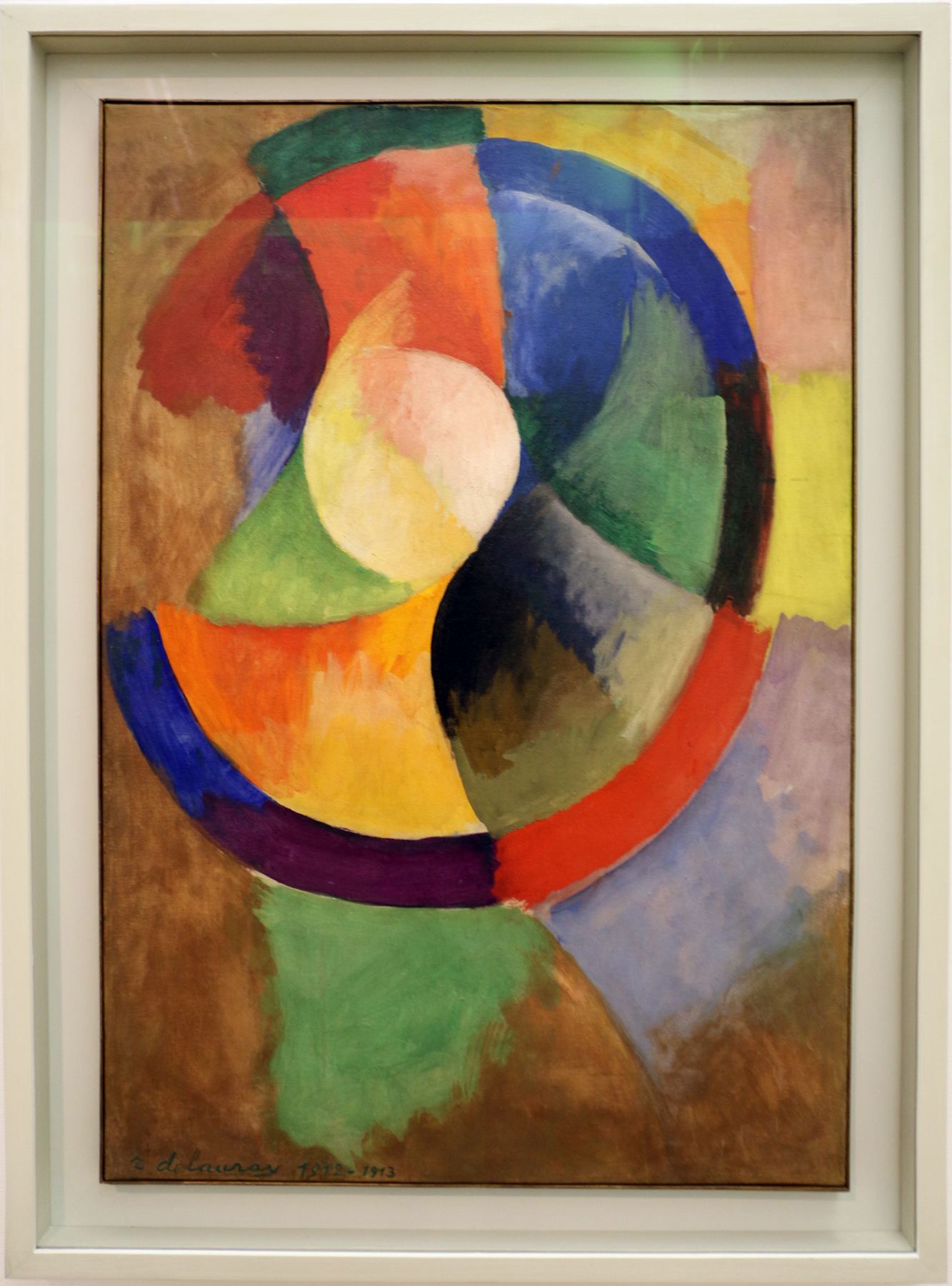
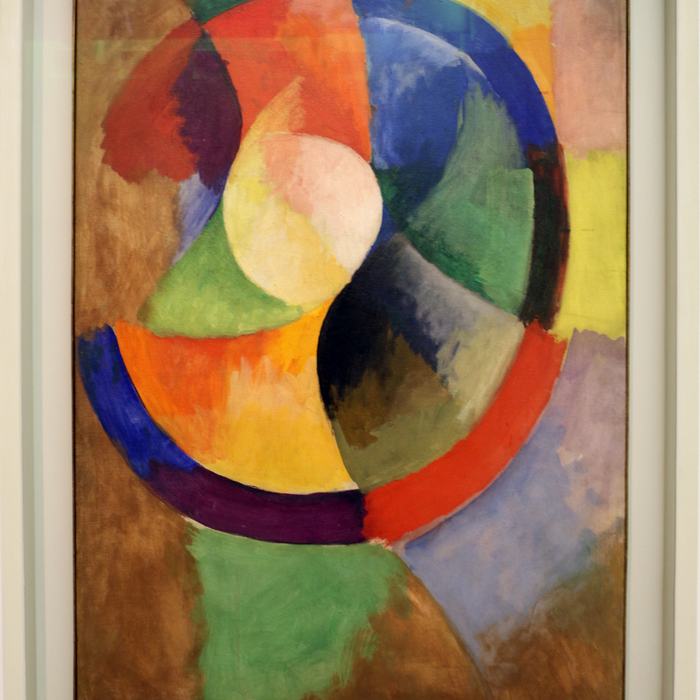
Circular Forms, Sun No. 2
Robert Delaunay · 1912–13 · The disc can suggest sun, wheel, eye or colour diagram while remaining an autonomous construction of unequal contrasts.
The Cardiff Team
Robert Delaunay · 1912–13 · Rugby, advertising, aircraft, Ferris wheel and Eiffel Tower compete within a single modern field rather than a rational scene.
Electric Prisms
Sonia Delaunay · 1914 · Overlapping rings translate electric street lighting into a visual pulse whose contrasts unfold while remaining present together.
Edtaonisl (Ecclesiastic)
Francis Picabia · 1913 · Picabia's monumental canvas joins dance, metallic pigment, machine-like energy and an invented title that resists final decoding.
How to look at Orphism
- Begin with the title and date. A window, fugue, market or invented word changes how abstraction operates.
- Find any surviving motif. Tower, wheel, body, fruit, aircraft or electric lamp may be half-visible.
- Look at adjacency. Ask what happens where complementary or unequal colours touch.
- Follow the rhythm. Do arcs turn, verticals pulse, or repeated units accelerate and pause?
- Separate simultaneity from sequence. Is motion shown in stages, or produced by relations perceived together?
- Attend to scale and medium. A ten-foot canvas, folding book and dress make different demands on the body.
- Test the musical analogy. Look for recurrence, counterpoint and duration, not a hidden note-to-colour code.
- Question the label. Ask whether the artist claimed Orphism, was named by Apollinaire or was connected retrospectively.
Where to see Orphism
Displays change. Check current gallery and access information before travelling.
- 01
Centre Pompidou, Paris
The strongest single destination for the movement's French field. Its collection index brings together dozens of works associated with Orphism, including Delaunay, Kupka and Picabia.[41] The depth makes comparison more valuable than any one icon.
Paris, France
Exceptional depth in Delaunay, Kupka and PicabiaVisit official website - 02
Museum of Modern Art, New York
MoMA holds Robert Delaunay's Windows, Tower studies, circular forms and The Cardiff Team, as well as Sonia Delaunay, Kupka and Picabia. Its Robert Delaunay index reveals the continuity among series.[42]
New York, USA
Major Tower, Windows, circular-form and Cardiff holdingsVisit official website - 03
Solomon R. Guggenheim Museum, New York
The museum's Delaunay holdings include major Eiffel Tower paintings, while its recent Harmony and Dissonance exhibition assembled the broadest modern reassessment of Orphism. Displays change, so check current galleries before visiting.
New York, USA
Delaunay holdings and the major modern reassessmentVisit official website - 04
National Gallery Prague
The essential destination for Amorpha: Fugue in Two Colors and for seeing Kupka as a Czech-born artist with a long independent career. The national collection prevents him from appearing only as a supporting figure in a Paris movement.
Prague, Czechia
The essential national context for Kupka and AmorphaVisit official website - 05
Museum Kampa, Prague
Its permanent Kupka exhibition presents more than seventy works across seven chronological chapters, including Amorpha: Warm Chromatic and The Cathedral.[43] Studies make his gradual process unusually visible.
Prague, Czechia
A deep chronological Kupka displayVisit official website - 06
Philadelphia Museum of Art
The Arensberg collection includes Kupka's Disks of Newton. The museum explains how its bands incorporate the complete spectrum and white.[44] It is particularly useful for comparing scientific reference with painterly vibration.
Philadelphia, USA
Kupka's Disks of NewtonVisit official website - 07
Art Institute of Chicago
Picabia's monumental Edtaonisl belongs here.[45] Its near three-metre square scale and metallic passages cannot be understood from a reproduction, although it may not always be displayed.
Chicago, USA
Picabia's monumental EdtaonislVisit official website - 08
Kunstmuseum Basel
Robert Delaunay's Hommage à Blériot is a major destination for the modernity strand: aircraft, propeller, sun and Eiffel Tower held in one simultaneous field. Check display status before travelling.
Basel, Switzerland
Robert Delaunay's Hommage à BlériotVisit official website
Suggested books
Harmony and Dissonance: Orphism in Paris, 1910–1930, edited by Vivien Greene
The most current broad reassessment, combining transnational history, colour, music, dance, poetry, gender and conservation. Its expanded frame is most useful when read as a curatorial argument rather than a fixed membership roll.[46]
Visions of Paris: Robert Delaunay's Series, by Mark Rosenthal and Matthew Drutt
An object-rich study of Saint-Séverin, City, Eiffel Tower and Windows series. The catalogue also includes Delaunay's “La Lumière”, letters to Kandinsky, Marc and Macke, and poetry by Apollinaire, Cendrars, Aragon and Huidobro.[47]
The New Art of Color: The Writings of Robert and Sonia Delaunay, edited by Arthur A. Cohen
Translated essays, lectures, letters and notebooks let both artists speak across painting, colour, fashion and modern life.[48] It is the best primary-text companion, though retrospective recollection should still be checked against dated objects.
Sonia Delaunay, edited by Anne Montfort and Cécile Godefroy
Produced for the major retrospective shown in Paris and at Tate Modern, this extensively illustrated volume treats painting, book art, textiles, fashion, theatre and collaboration as one serious career.[49]
Kupka: Pionnier de l'abstraction, edited by Brigitte Léal, Markéta Theinhardt and Pierre Brullé
This French-language, 304-page catalogue follows Kupka from Symbolism and satire through science, colour, organic imagery and geometric abstraction.[50] It is the strongest antidote to reducing him to an Orphist episode.
Frequently Asked Questions
Orphism is Apollinaire's name for early-1910s painting in Paris that used colour, light and rhythmic form to move beyond conventional representation. Robert and Sonia Delaunay and František Kupka form its core in most histories, with Picabia and others connected more variably.
Usually. “Orphic Cubism” preserves the movement's emergence from Cubist debate, while “Orphism” became the shorter art-historical term. Neither identifies a formally organised group.
No. Simultanism was the Delaunays' term for colour contrasts and modern experiences apprehended together. Apollinaire's Orphism was broader and could include artists who did not share their method. The terms overlap most closely around Robert and Sonia's 1912–14 work.
Orpheus symbolised poetry, music and art's power to transform. Apollinaire used the association to suggest painting with autonomous rhythm and lyrical force. The artists were not required to depict the myth or follow ancient Orphic religion.
There was no founding meeting. Apollinaire coined and promoted the category; Robert and Sonia Delaunay jointly developed Simultanism; Kupka and Picabia pursued related but independent experiments. “Founded by” is less accurate than “named and connected by”.
Chevreul explained that adjacent colours alter one another perceptually. The Delaunays used complementary contrast to intensify hue and build movement, depth and form. They transformed the theory through modern subjects and artistic judgement rather than copying a scientific diagram.
Some approach or achieve non-objectivity, including Delaunay's circular forms and Kupka's Amorpha. Others retain towers, wheels, markets, dancers, aircraft or words. Orphism is about what colour and relation do, not a purity test based on removing every object.
She was a painter, printmaker, book artist, textile and fashion designer, costume and interior designer, entrepreneur and theorist. Fashion was a major creative and economic field, not evidence that her work mattered less than Robert's painting.
Apollinaire and later historians connected his 1912 abstraction to Orphism, but Kupka considered himself unaffiliated. His science, spirituality, music and Central European formation produced an independent route. The label is useful for comparison, not as his permanent identity.
Futurists often represented successive phases of movement and promoted an explicitly Italian revolutionary programme. Orphist simultaneity generally arises from colour relations perceived together. The movements exchanged ideas, and Picabia borrowed Futurist dynamism, but their aims and organisations differed.
Synchromism was the separate colour movement developed by Americans Morgan Russell and Stanton Macdonald-Wright in Paris. It learned from Delaunay and shared musical language, but pursued its own theory, exhibitions and concern with colour-built mass.
The concentrated historical moment ended with World War I. The artists continued related work, and later effects can be traced through the 1920s and 1930s. A 1910–30 Orphist survey is a modern interpretive frame, not proof of one continuous organised movement.
Discussion
Reader Insights
Ask whether an artist claimed Orphism, was named by Apollinaire or was connected retrospectively by later historians.
Look at what neighbouring colours do to one another before assigning fixed meanings to a single hue.
Compare how simultaneity behaves in a canvas, folding book, textile, moving dress or theatre costume.
Join the Conversation
When does a broad movement label reveal a productive connection, and when does it absorb an artist's independence? Compare one work by a Delaunay with one by Kupka or Picabia. Does “Orphism” sharpen what you can see, or does the individual route matter more?
References
- Harmony and Dissonance Orphism in Paris 1910-1930, Solomon R Guggenheim Museum, View Source
- Orphism, Museum of Modern Art, View Source
- Les peintres cubistes bibliographic record, Bibliothèque nationale de France (French; consulted in French), View Source
- Les Peintres Cubistes, Guillaume Apollinaire (Project Gutenberg; consulted in Project Gutenberg), View Source
- Guillaume Apollinaire poète de la modernité, Centre Pompidou (French; consulted in French), View Source
- Harmony and Dissonance high gallery guide, Solomon R Guggenheim Museum, View Source
- Before and Beyond Cubism, Museum of Modern Art, View Source
- The Tower, Museum of Modern Art, View Source
- Robert Delaunay Great Upheaval teaching materials, Solomon R Guggenheim Museum, View Source
- Windows, Museum of Modern Art, View Source
- Une fenêtre, Centre Pompidou (French; consulted in French), View Source
- Simultaneous Contrasts Sun and Moon, Museum of Modern Art, View Source
- Contrasts of Form geometric abstract art 1910-1980, Museum of Modern Art, View Source
- European Master Paintings from Swiss Collections, Museum of Modern Art, View Source
- Robert Delaunay Rythmes sans fin, Centre Pompidou (French; consulted in French), View Source
- Sonia Delaunay, Museum of Modern Art, View Source
- Sonia Delaunay, National Gallery of Art, View Source
- La Prose du Transsibérien, Museum of Modern Art, View Source
- La Prose du Transsibérien original edition, Bibliothèque nationale de France (French; consulted in French), View Source
- Painterly Effects, Cooper Hewitt Smithsonian Design Museum, View Source
- Color Moves Art and Fashion by Sonia Delaunay, Cooper Hewitt Smithsonian Design Museum, View Source
- Crossovers A Journey to Paris and London, Museum of Modern Art, View Source
- Portuguese Market, Museum of Modern Art, View Source
- Costume Designs for Cleopatra, Metropolitan Museum of Art, View Source
- Robert et Sonia Delaunay Donation Sonia et Charles Delaunay, Centre Pompidou (French; consulted in French), View Source
- Collection of Modern Art, National Gallery Prague, View Source
- Kupka study material for teachers, National Gallery Prague (Czech; consulted in Czech), View Source
- Ordonnance sur verticales en jaune, Centre Pompidou (French; consulted in French), View Source
- Etude pour Amorpha Fugue à deux couleurs, Centre Pompidou (French; consulted in French), View Source
- Cercles et Carrés educational dossier, Centre Pompidou (French; consulted in French), View Source
- Kupka Pioneer of Abstraction visitor guide, Grand Palais Rmn, View Source
- Udnie, Centre Pompidou (French; consulted in French), View Source
- I See Again in Memory My Dear Udnie, Museum of Modern Art, View Source
- Edtaonisl audio guide, Museum of Modern Art, View Source
- Francis Picabia modern art index, Metropolitan Museum of Art, View Source
- Francis Picabia materials and techniques, Museum of Modern Art, View Source
- Le Futurisme à Paris Section d'Or, Centre Pompidou (French; consulted in French), View Source
- French Art Deco, Metropolitan Museum of Art, View Source
- American Art the Lowenthal Collection, Metropolitan Museum of Art, View Source
- Harmony and Dissonance press release, Solomon R Guggenheim Museum, View Source
- Orphisme collection search, Centre Pompidou (French; consulted in French), View Source
- Robert Delaunay, Museum of Modern Art, View Source
- František Kupka Master of World Art, Museum Kampa, View Source
- Disks of Newton, Philadelphia Museum of Art, View Source
- Edtaonisl Ecclesiastic, Art Institute of Chicago, View Source
- Harmony and Dissonance Orphism in Paris 1910-1930, Vivien Greene Guggenheim Museum, View Source
- Visions of Paris Robert Delaunay's Series, Mark Rosenthal and Matthew Drutt Guggenheim Museum, View Source
- The New Art of Color the Writings of Robert and Sonia Delaunay, Arthur A Cohen Viking Press, View Source
- Sonia Delaunay exhibition book, Anne Montfort and Cécile Godefroy Tate Publishing, View Source
- Kupka Pionnier de l'abstraction, Brigitte Léal Markéta Theinhardt and Pierre Brullé Grand Palais Rmn (French; consulted in French), View Source
- Orphism image records, Wikimedia Commons: Hommage à Blériot (Public domain; Kunstmuseum Basel / Wikimedia Commons), Saint-Séverin No. 5 (Public domain; Moderna Museet / Wikimedia Commons), La Ville de Paris (Public domain; Musée national d'art moderne / Wikimedia Commons), The Eiffel Tower (Public domain; Staatliche Kunsthalle Karlsruhe / Wikimedia Commons), Windows (Public domain; Museum of Modern Art / Wikimedia Commons), Simultaneous Contrasts: Sun and Moon (Public domain; Museum of Modern Art / Wikimedia Commons), Circular Forms, Sun No. 2 (CC BY-SA 4.0 photograph of a public-domain work; Sailko / Wikimedia Commons), The Cardiff Team (Public domain; Musée d'art moderne de Paris / Wikimedia Commons), Electric Prisms (CC BY-SA 4.0; Aerra Carnicom / Wikimedia Commons), Edtaonisl (Ecclesiastic) (Public domain; Art Institute of Chicago / Wikimedia Commons), Robert Delaunay (Public domain; Wikimedia Commons), Sonia Delaunay (Public domain; Wikimedia Commons), František Kupka (Public domain; Umění / Wikimedia Commons), Francis Picabia (No known copyright restrictions; Library of Congress / Wikimedia Commons).