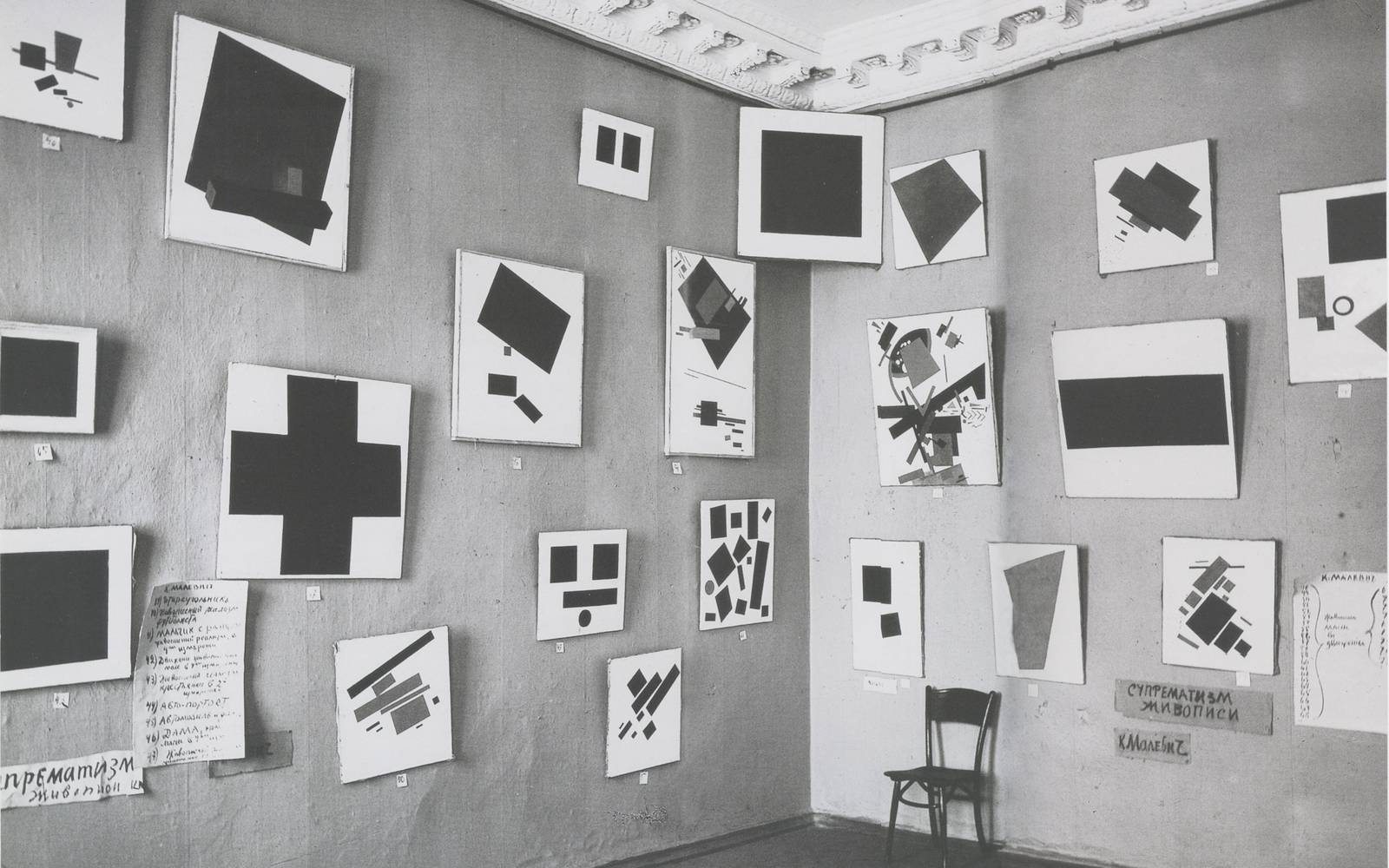
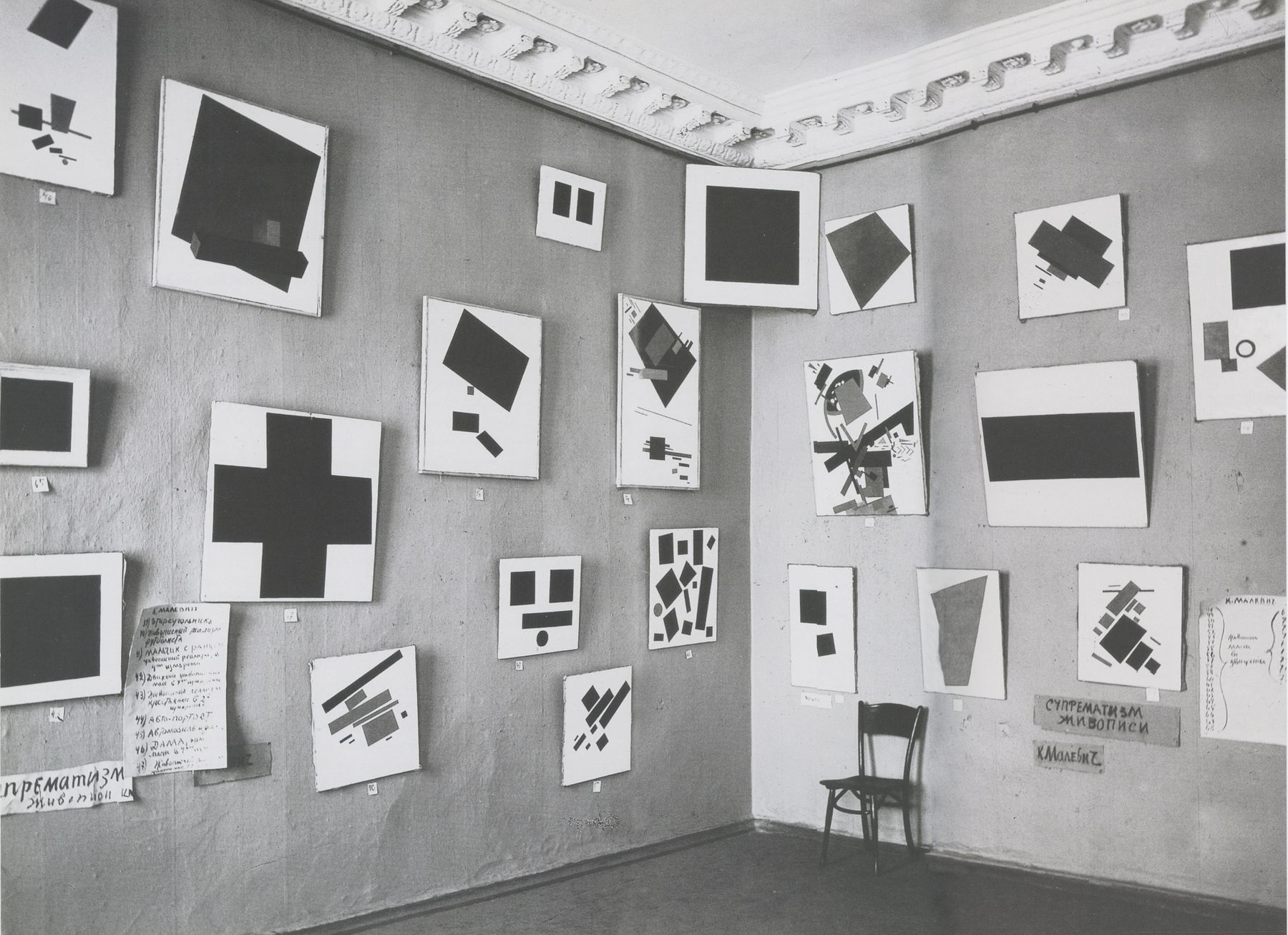
Image reference: Malevich’s paintings at the 0.10 exhibition.
At a Glance
- Foundedpublicly introduced in December 1915
- Founding exhibition0.10: The Last Futurist Exhibition of Paintings, Petrograd
- Core periodapproximately 1915–22, with Malevich’s later architectural and figurative developments continuing into the 1930s
- Principal theoristKazimir Malevich
- Key artistsOlga Rozanova, Liubov Popova, Ivan Kliun, Nadezhda Udaltsova, Ivan Puni, Alexandra Ekster, El Lissitzky, Ilya Chashnik, Nikolai Suetin, Vera Ermolaeva and Nina Kogan
- Major centresPetrograd, Moscow and Vitebsk, with important extensions through Kyiv, Smolensk, Warsaw, Berlin and the Bauhaus
- Core vocabularysquare, circle, cross, rectangle, bar, pure colour and active white space
- Important groupsSupremus and UNOVIS
- Applied fieldsbooks, typography, street decoration, textiles, porcelain, exhibition design and architectural models
- Essential distinctionSuprematism is a historically specific theory and network, not a synonym for all geometric abstraction
Contents
- Where it fits
- Feeling and non-objectivity
- Before the square
- 0.10
- Four stages
- Artists to know
- Three painterly phases
- Essential works
- How to look
- Artist directory
Where Suprematism fits
Ivan Kliun
Key career periodKazimir Malevich
Key career periodNadezhda Udaltsova
Key career periodOlga Rozanova
Key career periodLiubov Popova
Key career periodEl Lissitzky
Key career periodNikolai Suetin
Key career periodIlya Chashnik
Key career periodSuprematism made colour, shape and interval sufficient subjects for painting. A tilted red rectangle could feel lighter than a black square. A cluster of bars could appear to accelerate across white space. A pale quadrilateral, barely distinguishable from its ground, could still turn, press forward and disturb the stability of the canvas. These pictures do not illustrate a hidden scene. Their apparent weight, movement and tension are the event.
Kazimir Malevich publicly introduced the new art in Petrograd in December 1915. He named it for the “supremacy” of pure artistic feeling over the representation of objects. The system began with squares, circles, crosses and bars, yet it was not a neutral geometry lesson. Malevich imagined non-objective painting as a transformation of consciousness and, eventually, of the designed environment. A major Guggenheim survey accordingly defines Suprematism as a system developed from 1915 into the early 1930s, moving through painting, drawing, objects and architectural models.[1]
The movement is inseparable from Malevich but larger than him. Olga Rozanova used its reduction to release colour. Liubov Popova made overlapping planes feel materially constructed. Ivan Kliun, Nadezhda Udaltsova, Ivan Puni, Alexandra Ekster and others took part in the proposed Supremus group without following one doctrine. At Vitebsk after the Revolution, UNOVIS turned the black square into a collective sign and applied abstract forms to books, streets, textiles and porcelain.
Suprematism also resists a simple national label. Malevich was born in Kyiv to a Polish family, grew up amid Ukrainian language and folk culture, worked in Moscow and Petrograd, taught in Vitebsk and later Kyiv, and participated in Russian Imperial and Soviet institutions. French museum scholarship connects his search for a supreme reality beyond objects to theatre, writing, teaching and the ritual he planned for his own funeral.[2] Ukrainian scholarship records a mixed Polish-Ukrainian formation and formative contact with village art.[3] These contexts overlap; none owns the movement alone.
Feeling and non-objectivity
Malevich’s word “feeling” does not mean that each shape corresponds to a named emotion. A black square is not automatically sorrow, and a red one is not simply anger. Feeling describes the direct perceptual force of painted relations before they are organised into a story about people or things. The viewer registers pressure, distance, intensity, pause and movement without translating them into a scene.
“Non-objective” is more precise here than “abstracted.” An abstracted image may simplify a tree, body or machine while remaining derived from it. A non-objective composition claims that its planes do not need such an origin. The painting is not an incomplete version of visible reality; it proposes another kind of reality made from colour and form.
Smarthistory’s movement study explains this “new realism” through two linked ideas: the actual reality of paint, surface, colour and texture, and a metaphysical reality beyond ordinary appearances.[4] Malevich could therefore speak about the concrete components of painting while also invoking infinity, intuition and a transformed consciousness. Later interpreters sometimes separate the formal and spiritual readings. His theory repeatedly holds them together.
The claim to universality was ambitious and vulnerable. Elementary shapes might cross languages more easily than a historical scene, but no viewer arrives without cultural memory. A cross can evoke religion; red can acquire revolutionary significance; the square’s position can recall an icon. Suprematism attempts to escape reference, then discovers that forms gather meaning through display, title and use.
Zero is likewise active rather than vacant. Malevich wanted to pass through a “zero of form,” eliminating inherited representation so that creation could begin without copying nature. Zero names a threshold. The many paintings produced after Black Square show that reduction was meant to generate a language, not declare that art had nothing left to do.
Before the square: dismantling the object
Malevich did not begin as an abstract painter. His early work passed through Impressionism, Symbolism, Fauvism, Neo-Primitivism and compact images of peasants. By the early 1910s, he was breaking bodies and tools into dense angular structures within Cubo-Futurism, the Russian synthesis of Cubist fragmentation and Futurist motion.
The Western sources were important but transformed. The example of Georges Braque and Parisian Cubism showed how an object could be split and recombined. Futurism offered speed, machinery and simultaneous action. Russian icons, popular lubok prints and village crafts supplied frontal force, compressed space and strong colour. Malevich’s route was neither a provincial copy nor an untouched national essence.
Smarthistory’s account of his Cubo-Futurism uses A Private of the First Division to show this transitional condition. The 1914 image contains a recognisable military moustache and cross among flattened planes, collage-like lettering and dislocated fragments.[5] Representation has not disappeared; it has ceased to organise the whole picture.
Alogism and the irrational image
Malevich and his Futurist collaborators called another strategy “alogism.” Words, fragments and objects meet without ordinary causal connection. An Englishman in Moscow offers a fish, candle, ladder, sabre, spoon and printed language in a field that refuses to become a stable place. Irrational combination was not random decoration. It attacked the expectation that a painting should explain the world through coherent resemblance.
Stedelijk Museum research into a rediscovered drawing for An Englishman in Moscow identifies the alogical work as a missing link toward non-representation.[6] An archive can therefore modify a famous origin story: the leap to Suprematism was radical, but preparatory thinking survives in drawings, theatre and semi-abstract paintings.
Centre Pompidou scholarship similarly describes alogism as a passage out of the Cubo-Futurist impasse. Geometric and figurative signs remain present, but their dissociation begins to release painted forms from things.[7] Malevich would later write as if pure creation had appeared with decisive clarity. The works show a less tidy process of testing and retrospective explanation.
Victory over the Sun and the problem of beginnings
In 1913 Malevich designed scenery and costumes for Victory over the Sun, a Cubo-Futurist opera by composer Mikhail Matiushin and poet Aleksei Kruchenykh, with a prologue by Velimir Khlebnikov. Its strongmen capture the sun, overturn ordinary time and speak in zaum, a transrational language that breaks words free from conventional reference.
One set design contains a square divided diagonally into black and white. Malevich later treated this as the origin of the black square. The claim is meaningful without proving that the 1915 canvas already existed in 1913. Theatre had allowed him to imagine a world without familiar gravity and natural light. Centre Pompidou’s French account connects the square motif to the opera, then distinguishes it from the first public group of Suprematist paintings at 0.10.[8]
This distinction matters because four things are often collapsed: the first square-like motif, the conception of non-objectivity, the painting now called Black Square, and its public exhibition. They need not share one date. Malevich frequently dated works according to his account of discovery rather than straightforward execution.
0.10: painting reaches zero
The exhibition title 0.10 suggested an ending and a beginning: the reduction of Futurism to zero, followed by a new group of artists. In fact, more than ten people participated, and the show revealed rivalry rather than unity. Vladimir Tatlin displayed corner reliefs that projected real materials into space. Malevich filled one wall with geometric paintings whose forms seemed to float free of the world.
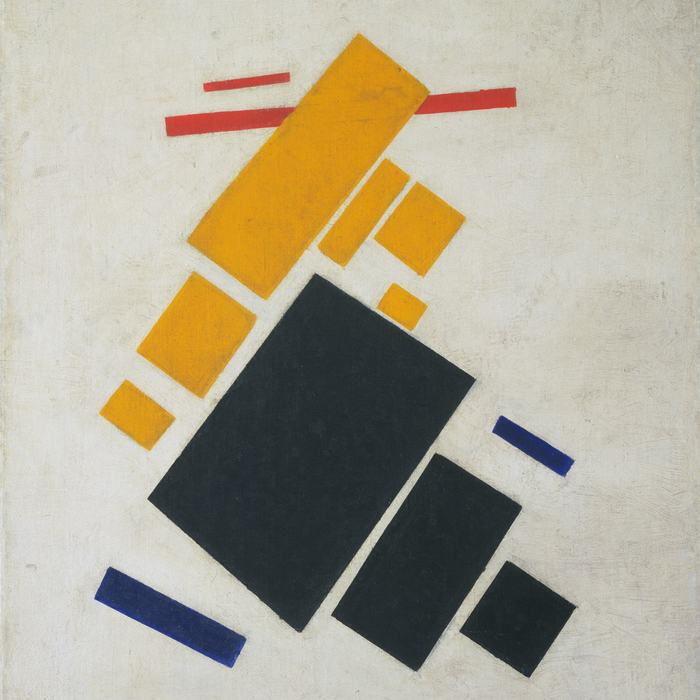
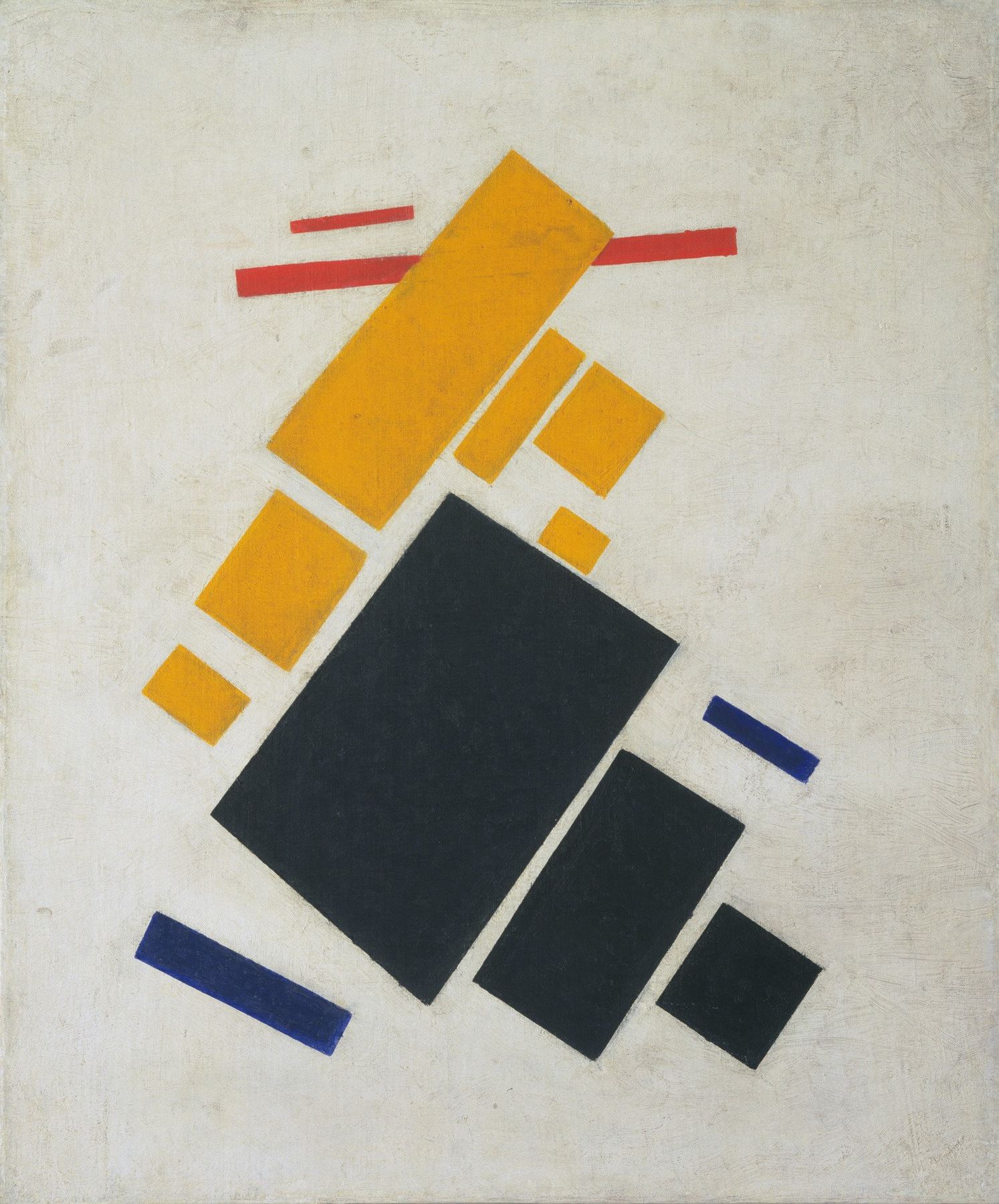
MoMA’s record for Suprematist Composition: Airplane Flying identifies the December 1915 debut and explains Malevich’s “new painterly realism”: line, colour, plane and brushwork were real components rather than illusions standing for external objects.[9] To reach zero was not to cease painting. It was to remove its inherited obligation to describe things.
The icon corner
Malevich hung Black Square high across the meeting of two walls. In a Russian Orthodox home, that elevated “beautiful corner” traditionally held an icon. The placement gave a plain painted quadrilateral exceptional authority and made the installation inseparable from the work’s initial meaning.
The gesture has been called blasphemous, mystical, nihilist and revolutionary. None is adequate alone. The square rejects a sacred image while borrowing its site. It can announce an art beyond organised religion while retaining the expectation that painting should transform consciousness. It also establishes Malevich’s new sign above the other works, complicating later claims to collective equality.
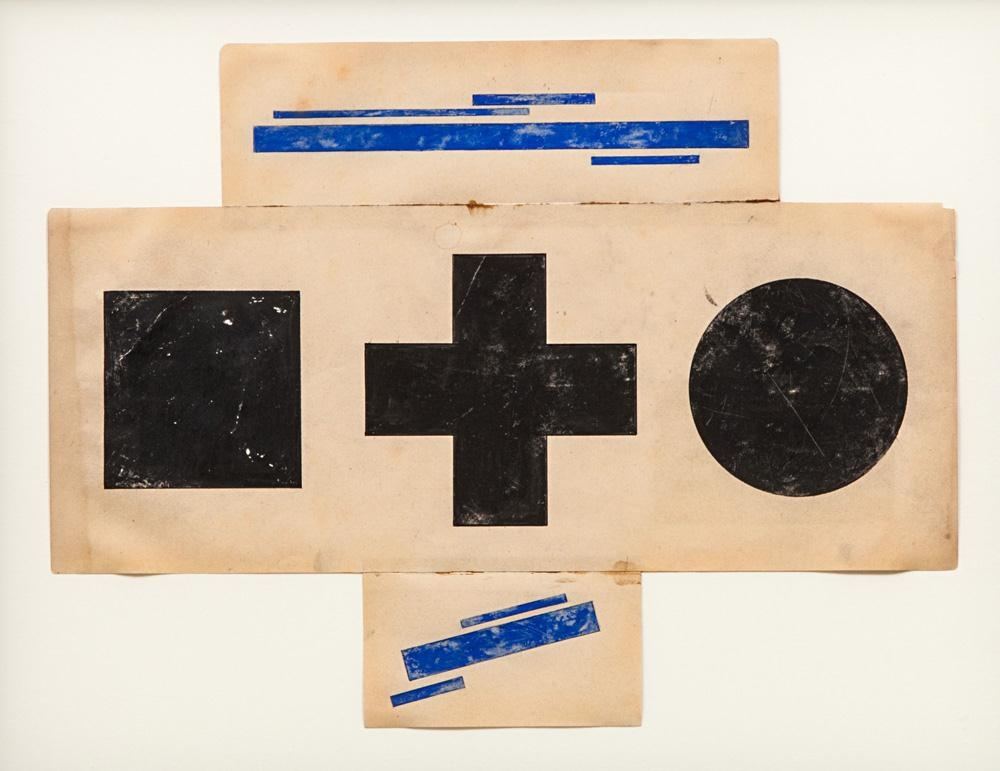
Centre Pompidou has matched damage and contour in photographs to confirm that Black Cross also appeared at 0.10, where about forty Malevich paintings formed part of a 154-work exhibition. Its French analysis explains the cross as two bars derived from division and rotation of the square.[10] Square, circle and cross were not a fixed symbolic code; they were operations that generated further forms.
Was it the first abstract painting?
Malevich was one of several artists to make non-representational work in the early twentieth century. Wassily Kandinsky, Hilma af Klint, František Kupka and others reached abstraction by different routes. Some work remained unknown for decades; artists also disagreed about what counted as abstraction.
Smarthistory’s historiographic review finds no firm evidence for a completed pure abstract Black Square in 1913 beyond related theatre designs. The 1915 painting, exhibition and manifesto provide a secure public threshold.[11] Calling it “first” turns a complex field into a race. Its more defensible importance lies in the force with which Malevich made one abstract work an emblem, theory and movement.
Black Square: not nothing, and not mechanically perfect
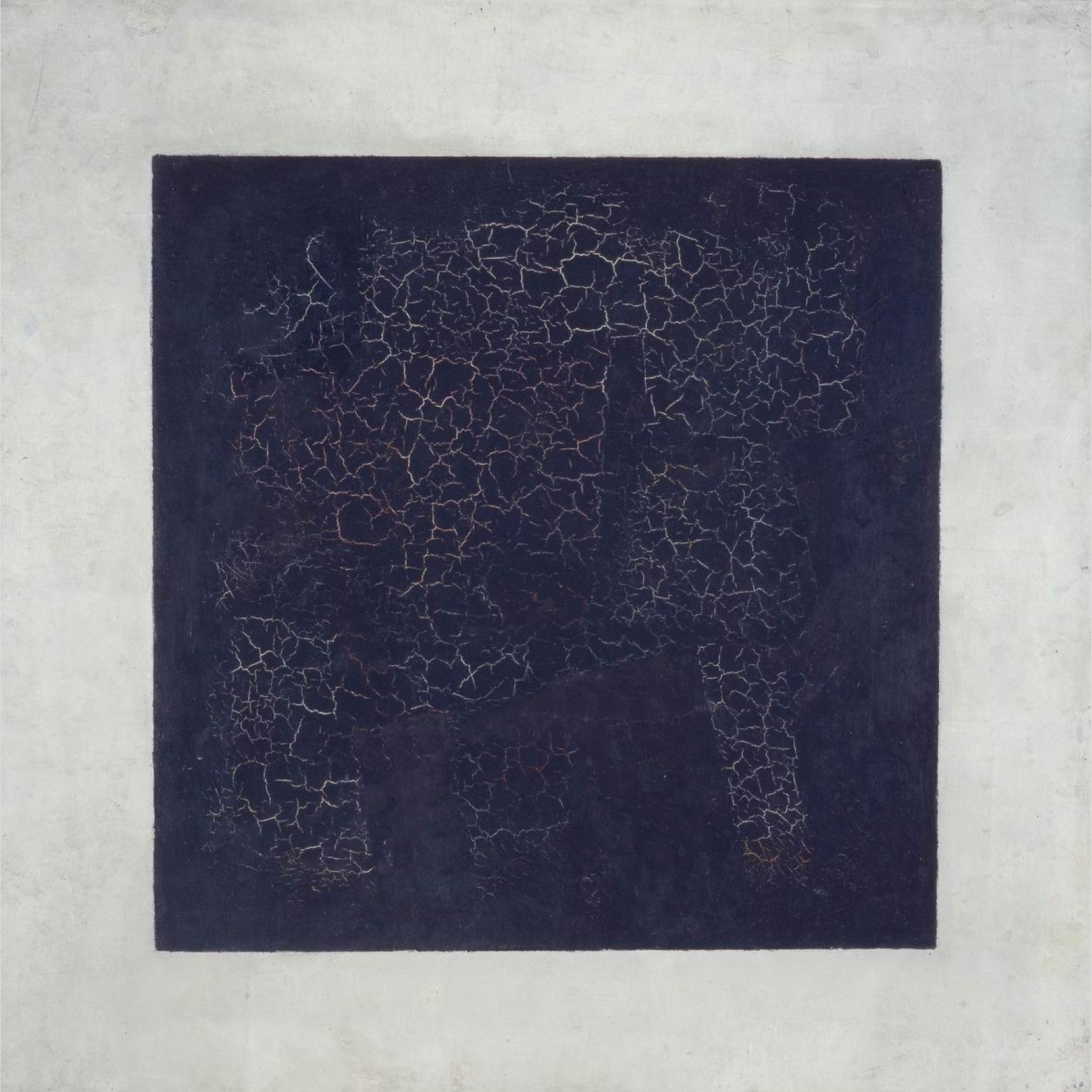
The original Black Square is neither a flawless square nor a smooth black void. Its sides are slightly irregular. A white border remains. Brushwork and cracking interrupt the surface. Time has made the object more visibly material than the absolute sign in reproductions.
That difference between object and icon is essential. A digital black square can be generated instantly, but Malevich’s painting was built through pigment, ground, hand and correction. Its black is optically varied. Its imperfect contour tests the eye against the expectation of geometric exactness.
Modern interpretation has followed the painting across movements and continents, tracing how artists treated its reduction as a universal visual language.[12] Influence should not erase the original historical friction. At 0.10 the square confronted icons, Cubism, Futurism, war and the convention that a picture must show something recognisable.
The State Russian Museum describes it as a persistently radical art object even after nearly a century of reproduction.[13] Familiarity has not made agreement easy. Viewers still alternate between seeing an endpoint, a beginning, a joke, a sacred sign, a political zero and a stubbornly handmade painting.
How Malevich painted geometry
Technical evidence prevents the myth of effortless purity. Conservation research shows that Malevich sometimes drew shapes on the ground, painted white up to their edges and then added colours. A card could guide a straight boundary. Paint applied before lower layers dried produced raised edges and cracking; neighbouring or underlying colours intensified one another.[14]
The sequence means white is not simply untouched canvas surrounding finished forms. It can be a deliberately painted field, constructed around reserves and adjusted. The coloured plane and the apparent void are materially interdependent.
Malevich’s colour was equally deliberate. Red may appear lighter and more active than black. Blue can recede. Yellow can seem to radiate. A small intense form can balance a larger dark one. Suprematism does not abolish perception; it makes perception its principal drama.
Titles that refuse to disappear
Early Suprematist works often retain titles such as Airplane Flying, Painterly Realism of a Peasant Woman in Two Dimensions or Painterly Realism of a Boy with a Knapsack—Colour Masses in the Fourth Dimension. These names sit awkwardly beside claims to escape objects.
The awkwardness is productive. MoMA’s Boy with a Knapsack contains a red square and a black one against white, with no depicted child or bag. Its “realism” belongs to colour masses, line and brushwork, while the title carries a sensation or memory from the external world.[15] Malevich’s non-objectivity was not always wordless purity. Language remained able to launch an association that the picture declined to illustrate.
Follow Suprematism through four stages
–15
Theatre, alogism and the zero of form
Victory over the Sun, alogical images and Cubo-Futurist fragmentation prepare the break with objects before 0.10 makes non-objectivity public.
–18
Squares, dynamic colour and white on white
Malevich, Rozanova, Popova and the proposed Supremus network test elementary forms, visual weight, intense colour and increasingly reduced contrast.
–22
UNOVIS and the applied sign
At Vitebsk the black square becomes a collective mark while books, streets, porcelain and Proun extend the language beyond easel painting.
–35
Architektons, dispersal and survival
Architectural models, the 1927 Western exhibition, teaching and later figurative work preserve and transform Suprematism under growing institutional pressure.
Three painterly phases
Suprematism is often explained through black, coloured and white phases. The sequence is useful if treated as a map rather than a law.
Elemental black forms
The black square, circle and cross establish elementary shape against white. They feel static only in comparison with later flights. Irregular edges, unequal margins and the pressure of dark pigment already create instability.
Dynamic colour
From 1915–17, rectangles, trapezoids and curves rotate, overlap and change scale. Suprematist Painting at MoMA gives object evidence for this multicolour phase.[16] A large blue form may drift behind a narrow red bar; small yellow or green units punctuate the field; diagonal axes prevent the canvas from settling into architectural grid.
The white interval makes forms appear near or distant without conventional perspective. Airborne titles and wartime aerial photography encouraged readings of flight, but the picture does not offer one fixed viewpoint. The spectator supplies motion by comparing angles and weights.
Robert Delaunay had also used pure colour to generate movement, and Piet Mondrian would build a different geometry from vertical, horizontal and relational balance. These comparisons clarify rather than merge the systems. Suprematist diagonals float in an apparently limitless field; De Stijl’s orthogonal structure binds form to the picture’s edges.
White on white
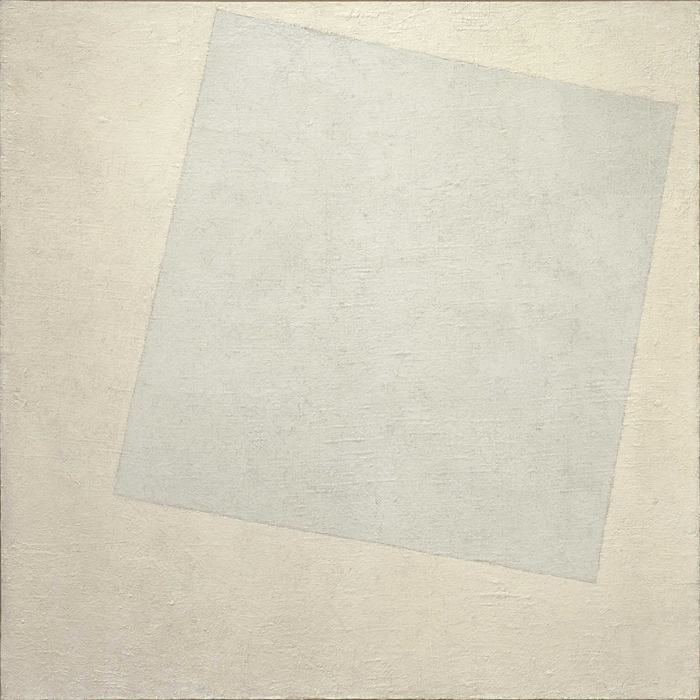
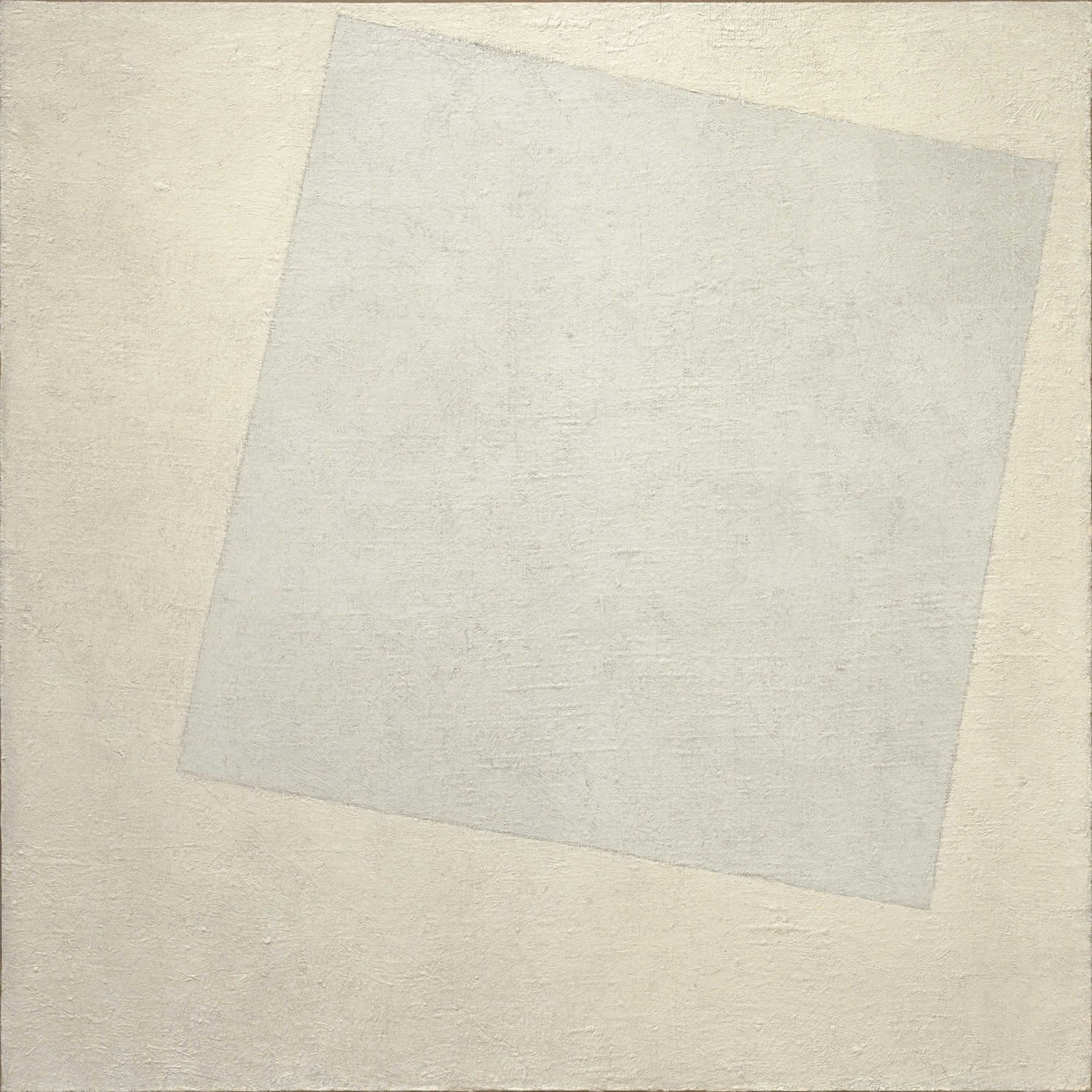
In 1918 Malevich reduced the contrast. White on White places a cooler tilted quadrilateral within a warmer white field. The inner plane is still detectable through hue, edge and brush direction. It neither vanishes nor rests squarely inside the support.
MoMA describes the work as one of the earliest paintings to propose that art need not refer beyond itself, while using geometry to suggest movement and limitless space.[17] Reduction has not reached emptiness. A slight difference now carries an extraordinary perceptual burden.
White painting also provoked rivals. In the post-Revolutionary non-objective community, some artists suspected Malevich’s language of mysticism and his claim to supremacy. MoMA scholarship reconstructs the Tenth State Exhibition of 1919 as a contested field rather than a united avant-garde.[18]
Alexander Rodchenko’s Black on Black series answered Malevich. Where the white field implied immaterial infinity, Rodchenko varied black textures and finishes to emphasise the physical surface. MoMA interprets this as a direct challenge to Suprematist principles.[19] The exchange helped sharpen the path toward Constructivism: material, construction and production against transcendental feeling.
Suprematist artists to know
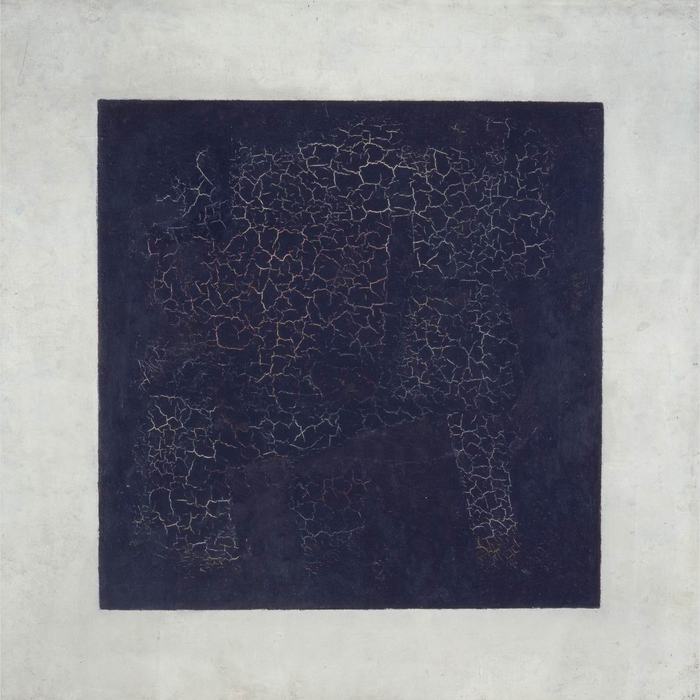
Kazimir Malevich
Malevich made non-objectivity a named system, moving from the square through multicolour painting, white-on-white, teaching, publication and Architektons while repeatedly revising his own chronology.
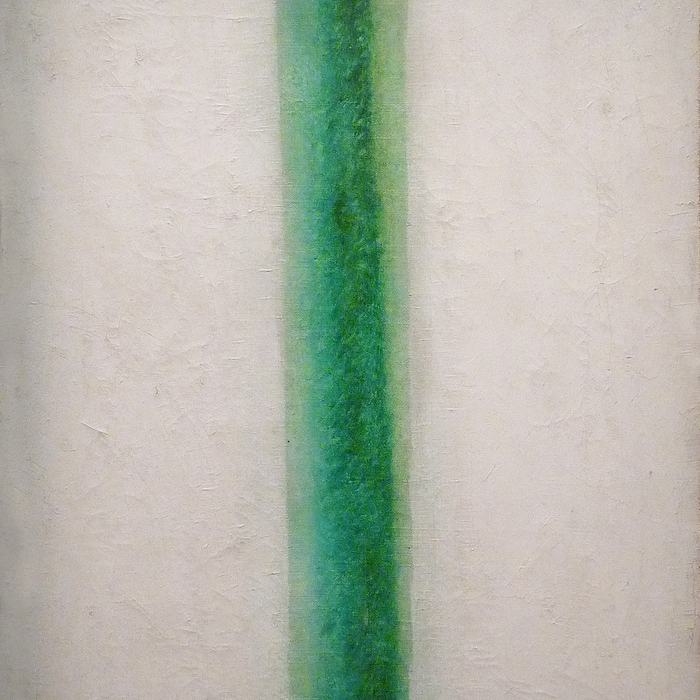
Olga Rozanova
Rozanova used reduction to intensify colour rather than reproduce one master's doctrine. Her painting, book work and applied designs make Supremus visible as a field of distinct practices.
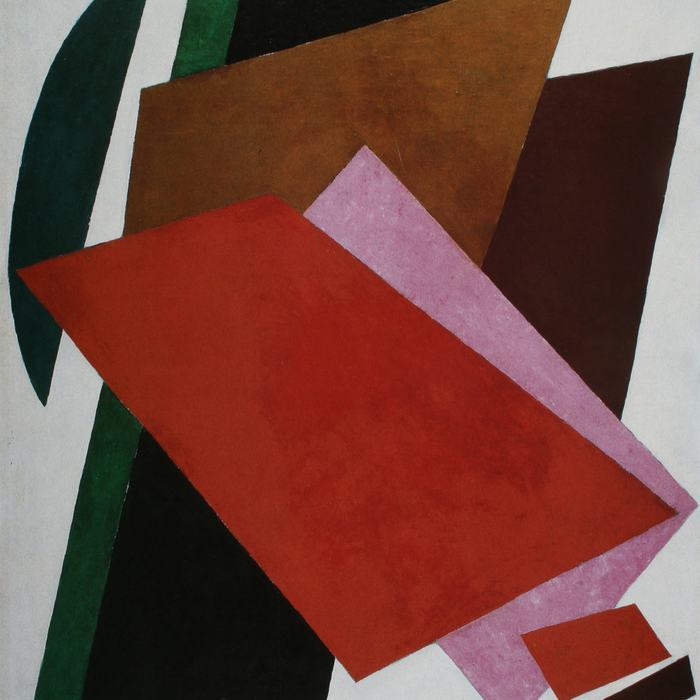
Liubov Popova
Popova's overlapping planes retain weight, facture and structural pressure. Her movement beyond Suprematism also clarifies why the term should not absorb Constructivism.
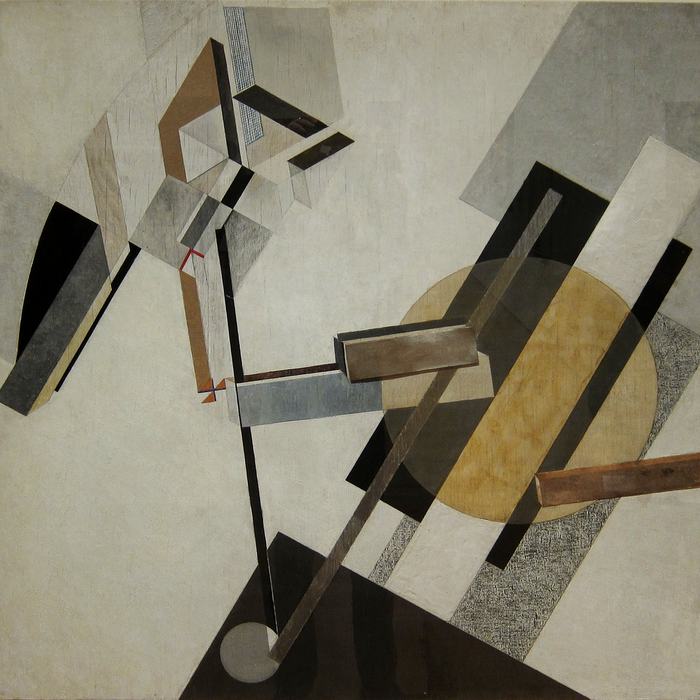
El Lissitzky
Lissitzky treated Proun as a station between painting and architecture, carrying the movement through Vitebsk, publishing, exhibition design and European exchange.
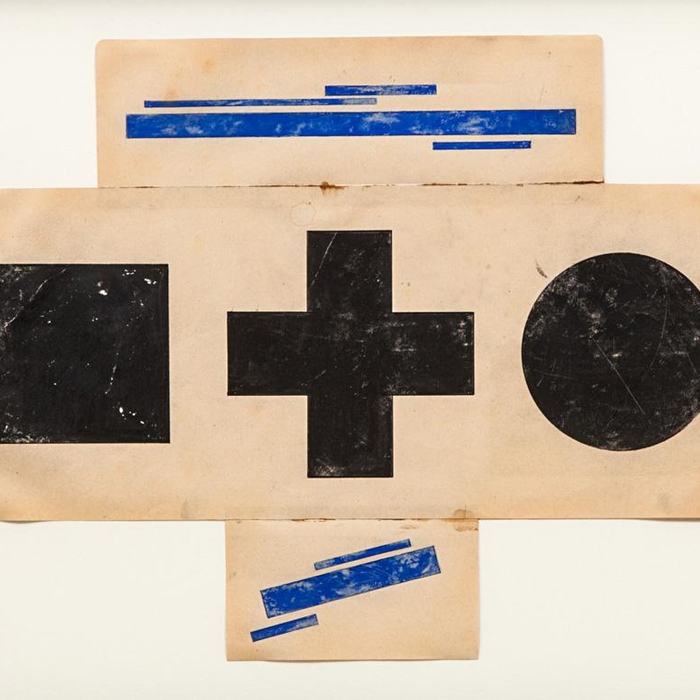
Ilya Chashnik
Chashnik developed concentrated black-and-white compositions and applied Suprematist forms to porcelain, showing how the Vitebsk network moved between autonomous art and useful surfaces.
Supremus was not a school of copies
In 1916 Malevich planned a journal called Supremus. The title named both publication and circle. Proposed contributors included Rozanova, Popova, Kliun, Udaltsova, Puni, Ekster, Ksenia Boguslavskaya and others. The journal did not appear as intended, but designs, essays and paintings reveal a laboratory of disagreement.
Olga Rozanova and colour painting
Rozanova brought an intense independent colour practice to non-objectivity. Her Green Stripe of 1917–18 is radically simple: a vertical green band crosses a light field, its edge and internal modulation making it seem to flare beyond its shape. The stripe is not a neutral diagram. Colour feels concentrated, luminous and almost atmospheric.
The Rostov Kremlin Museum calls the painting an original departure from Malevich’s system and an early landmark of minimal reduction.[20] Rozanova died in 1918 at thirty-two. Her compressed career makes it especially misleading to present her as a follower whose importance lies in proximity to Malevich.
Her term tsvetopis—colour painting—shifted emphasis from stable geometric elements to colour’s autonomous energy. A stripe can expand psychologically even while remaining materially narrow. The white around it is irradiated rather than empty.
Liubov Popova and painterly architectonics
Popova’s Painterly Architectonics crowd the field with overlapping wedges, bars and planes. Forms press against one another and the frame. Rather than floating in an infinite void, they appear built, layered and load-bearing.
MoMA reads this language as a synthesis of Malevich’s coloured geometry and Tatlin’s relief-based construction.[21] Popova had studied in Tatlin’s studio and encountered Cubism in Paris. Her abstraction therefore formed at an intersection, not along a single line of discipleship.
The Thyssen-Bornemisza Museum makes a broader point: members of Supremus treated Suprematism as an impulse toward individual directions rather than a manual.[22] Kliun explored volume and light; Udaltsova retained compact Cubist tensions; Puni moved between geometric reduction and object-based experiment.
Popova did not share Malevich’s metaphysical emphasis. Moderna Museet distinguishes her materially projected “architectonics” from his non-objective reality.[23] She described painting as construction through colour and line, then moved further into stage design, textiles and production.
Women, workshops and Ukrainian artels
The usual group photograph is incomplete without the networks that turned designs into textiles. Natalia Davydova, Alexandra Ekster and Nina Genke-Meller organised collaborations with rural women’s embroidery cooperatives in villages within present-day Ukraine. The Metropolitan Museum’s research shows that geometrically abstract scarf and bag designs circulated through artels and exhibitions before and during Suprematism’s emergence.[24]
This history complicates the hierarchy of fine art and craft. Male artists later canonised as theorists supplied some designs; women organised production and executed demanding embroidery. Folk practice was not merely visual raw material. It was labour, expertise and an economic programme intended partly to alleviate rural poverty.
Popova’s small works and later applied designs belong within the revolutionary ambition to remake the environment. The Met places her in the Suprematist group with Malevich, Ekster and Puni while stressing the urge to create a new world.[25] That ambition did not dictate one medium.
By 1921 Popova had joined colleagues renouncing easel painting in favour of socially engaged production. MoMA’s retrospective traces her from Suprematist-stimulated abstraction toward theatre, teaching and design.[26] This was not a simple rejection of earlier painting. Her stage sets made colour, plane, motion and body operate together in real time.
Revolution: opportunity without equivalence
Suprematism was publicly launched two years before the October Revolution. It cannot be described as a product of Bolshevik rule. Yet Malevich supported the new political order and believed it could clear space for a transformed culture. Avant-garde artists initially received teaching, museum and administrative roles amid civil war and institutional collapse.
The alliance was unstable. Malevich’s spiritual non-objectivity did not fit easily with Marxist materialism. Constructivists increasingly argued that the autonomous artwork should give way to useful production. Government support was uneven, and the later Soviet demand for ideologically legible representation would turn experimental abstraction into “formalism.”
Suprematism is not Constructivism
The two movements shared artists, exhibitions, geometry and revolutionary circumstances, which makes them easy to merge in hindsight. Their central questions differed. Suprematism asked how colour and plane could create a non-objective world of feeling. Constructivism asked how real materials, technical organisation and social production might replace inherited art objects.
Tatlin’s corner reliefs at 0.10 provide the clearest early contrast. Sheet metal, wire and wood occupied the actual corner rather than depicting space on canvas. Their tension arose from weight, fastening and the building. Malevich’s planes remained painted, even when they appeared to float beyond gravity.
The boundary was never sealed. Popova’s architectonics joined painted colour to a constructive sense of pressure. Lissitzky carried the plane toward architecture and typography. Chashnik and Suetin placed Suprematist relations on manufactured objects. Rodchenko answered Malevich through paintings before renouncing painting. These crossings are evidence of live debate, not proof that the words meant the same thing.
Productivism sharpened the material challenge after the Revolution. It called for artists to enter factories, design useful goods and participate in economic production. Malevich also wanted to transform the environment, but he did not accept that practical utility should be art’s ultimate measure. His Architektons remain speculative precisely where a Productivist object would need a defined function.
The distinction protects both movements from a generic “Soviet geometry.” It also explains why collaborators separated. A universal sign, a propaganda poster, a theatre machine and a porcelain cup may resemble one another formally while making incompatible claims about contemplation, communication and use.
UNOVIS: the black square becomes collective
Malevich arrived at Marc Chagall’s art school in Vitebsk in 1919. Students and teachers formed UNOVIS, commonly translated as Affirmers or Champions of New Art. Members included Vera Ermolaeva, El Lissitzky, Ilya Chashnik, Nikolai Suetin, Nina Kogan, Lazar Khidekel and Lev Yudin.
The group signed some works collectively and used a small black square as its mark. Individual authorship was meant to yield to a laboratory producing the new environment. Posters, ration cards, street decorations, lecture platforms, books and festival designs carried geometric signs into a city transformed by revolution and civil war.
Collectivity did not eliminate hierarchy. Malevich supplied the emblem, theory and pedagogical authority. Students developed individual practices, and Lissitzky’s departure eventually exposed competing directions. The black square could signify shared work while also branding the master’s system.
Porcelain and the useful surface
At Vitebsk, Chashnik studied under Malevich before following him with Suetin to Petrograd. British Museum research records Chashnik’s restricted black, grey and white palette on porcelain and his connection to the state factory.[27] A cup or plate changed the geometry: a line crossed a curved surface, disappeared around an edge and returned as the object turned in a hand.
Porcelain was attractive because its whiteness resembled the Suprematist field, while its production connected artists to a nationalised industry. The All-Russian Decorative Art Museum identifies Malevich, Chashnik and Suetin among artists who tested their theories through the material’s whiteness and shine.[28]
Suetin’s dish designs demonstrate how factory manufacture could carry non-objective form into use.[29] Yet a decorated service also exposes contradiction. Suprematism claimed escape from objects, then made objects visually new. Limited production and elite display could further weaken the promise of everyday transformation.
Books, signs and anonymous voice
Publications were among UNOVIS’s most successful works. A page already supplies a white field, edges and sequential movement. Typography can become geometric form; turning pages introduces time. MoMA’s history of the Russian avant-garde book describes UNOVIS publications, the table of symbols and a shift from individual expression toward collective creativity.[30]
A 1920 manifesto placed the black square beneath a declaration of what “we want.” Yale’s archive exhibition shows the emblem operating within revolutionary public culture.[31] It was at once a non-objective sign, a group signature and a demand for institutional power.
El Lissitzky and Proun
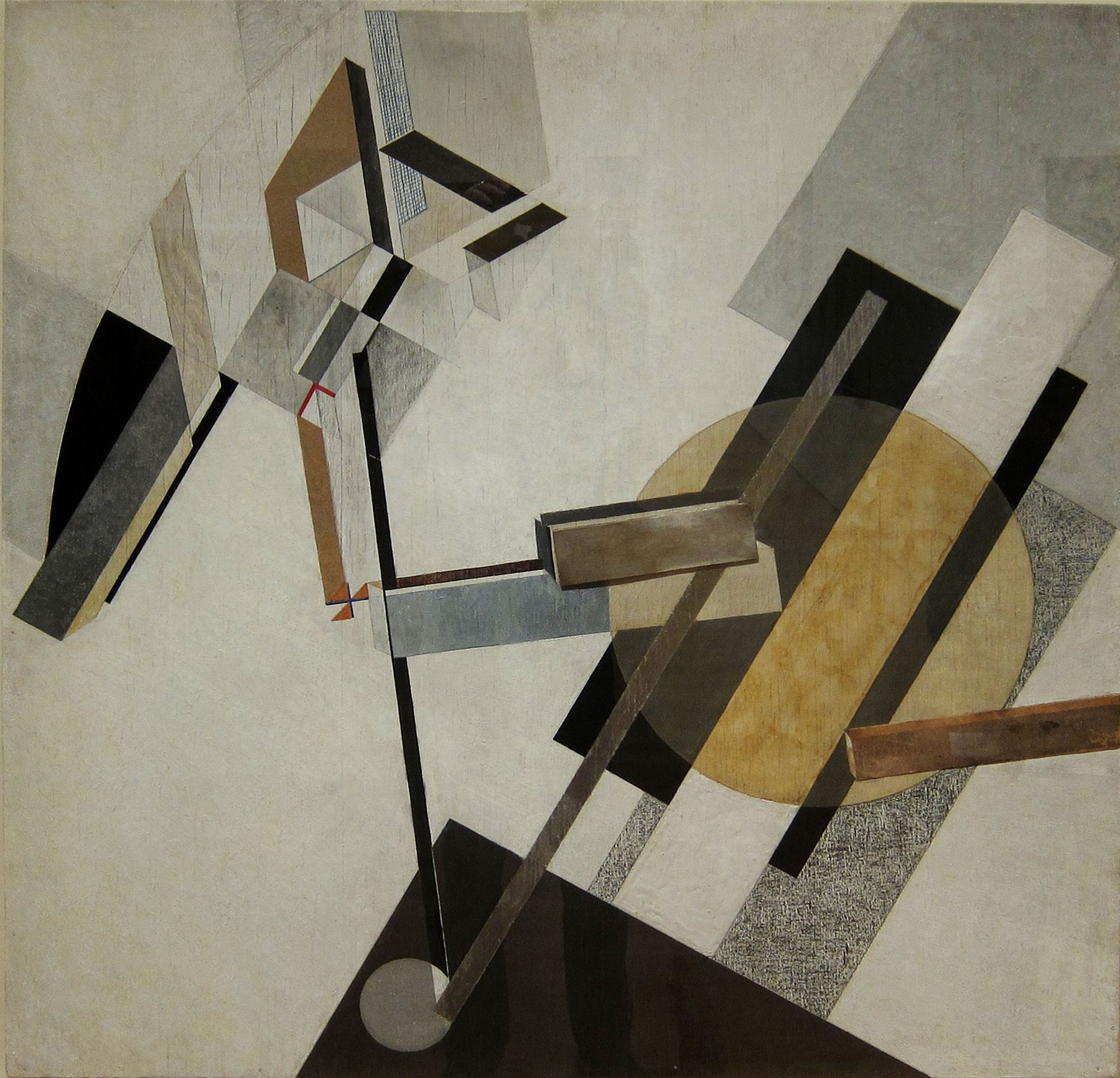
El Lissitzky brought training in architecture and graphic design to Vitebsk. His Prouns—an acronym usually expanded as “Project for the Affirmation of the New”—rotate geometric bodies through ambiguous space. Axonometric views deny one fixed up or down. A flat composition can look like a plan, machine, city or structure without becoming any one of them.
MoMA’s study of Proun 19D treats UNOVIS as stylistically diverse and traces a split between socially engaged Productivism and a philosophical Suprematist direction by 1922.[32] Proun belongs to that unsettled crossing. It is neither a conventional picture nor a practical blueprint.
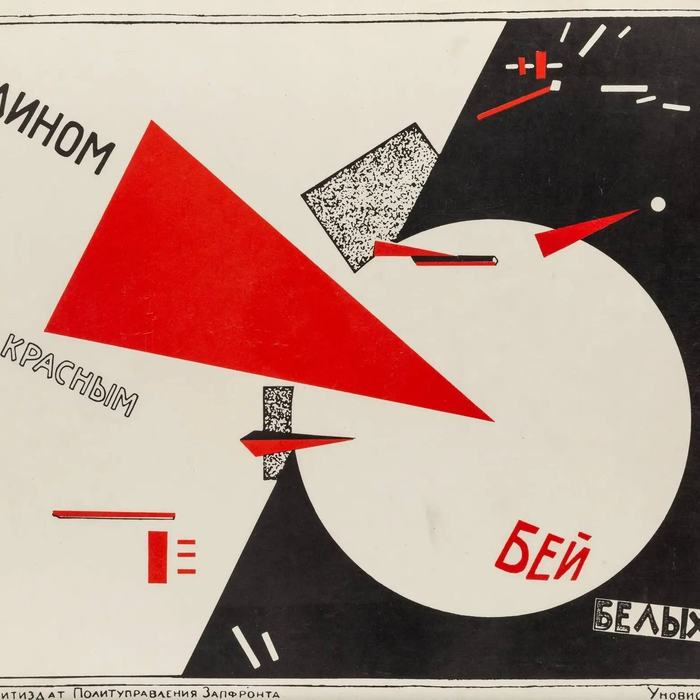
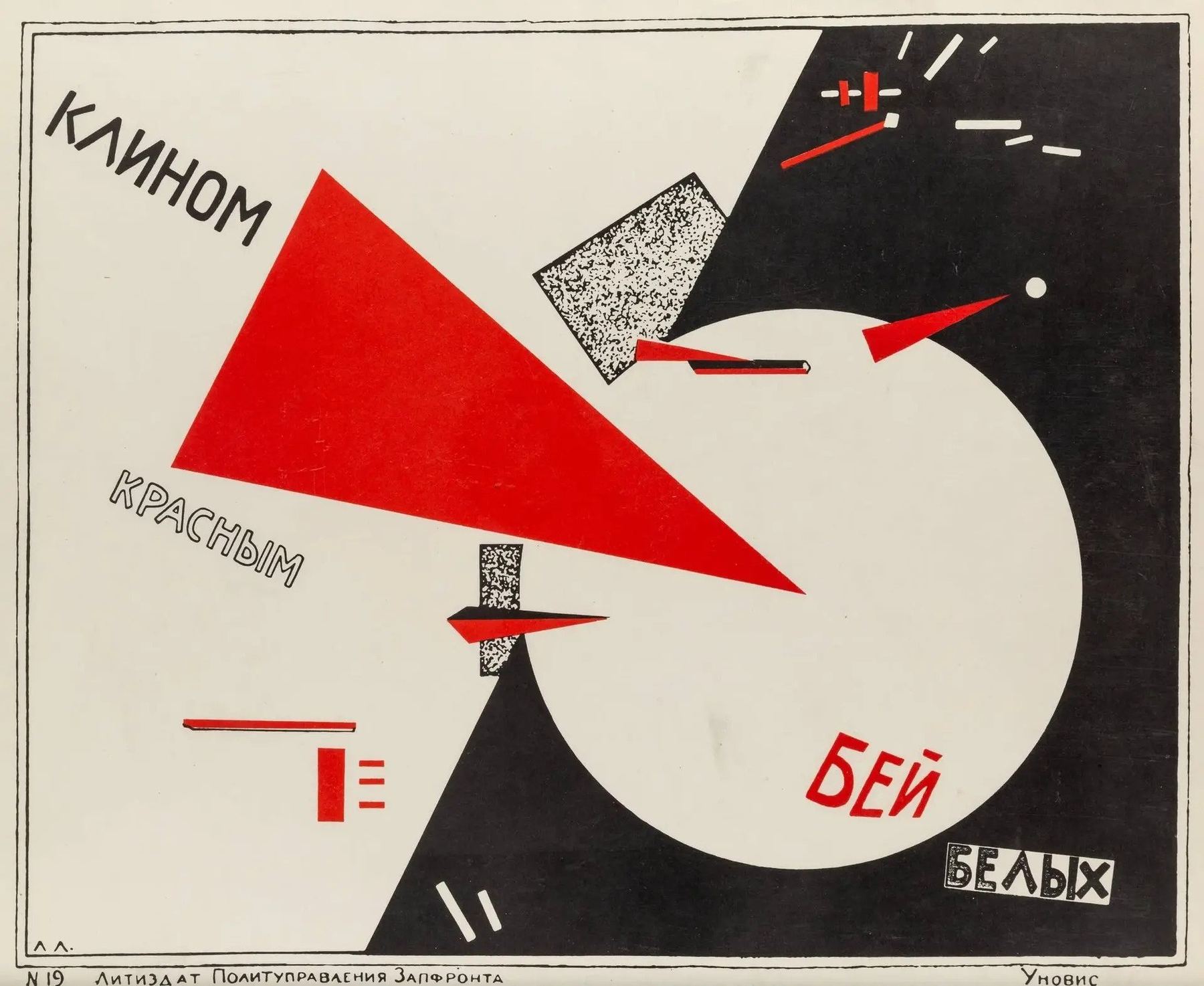
Lissitzky’s Beat the Whites with the Red Wedge made the language more legible. A red triangle penetrates a white circle in support of the Red Army during the civil war. Smarthistory identifies the poster as a practical transformation of Suprematist form into political information.[33] Colour and shape no longer avoid external reference; they become a compressed narrative of conflict.
This application may appear to betray pure non-objectivity, but Malevich accepted social deployment. The deeper tension is that a supposedly universal feeling required historical colour coding and words to become propaganda.
Malevich’s Suprematism: 34 Drawings served as visual textbook. Published at Vitebsk in 1920, probably printed with El Lissitzky’s involvement, it presented elementary forms, combinations and dynamic space through lithography.[34] A system first revealed as secret paintings had become reproducible pedagogy.
From Vitebsk toward Poland and spatial construction
UNOVIS was a network rather than one school building. Władysław Strzemiński established a branch at Smolensk and maintained ties with Malevich while teaching Cubism and Suprematism. MoMA research follows his movement toward applied graphics and organisation.[35]
Strzemiński and Katarzyna Kobro later became central to Polish Constructivism. Kobro’s early suspended structures combined geometric elements so that open space entered the work. Culture.pl connects these experiments to Suprematism and to her work with Strzemiński in a UNOVIS environment.[36]
Their later theories of Unism and spatial composition were independent developments. Influence here means a problem inherited—how to distribute mass, interval and movement—not a permanent stylistic allegiance.
Planits and Architektons
From around 1919, Malevich translated painted relations into imagined architecture. Planits were drawings for habitations or spatial formations; Architektons were white plaster models assembled from rectilinear blocks. Some rise vertically like towers; others extend horizontally like cities, ships or stations.
They lack conventional doors, windows, scale and engineering detail. Calling them buildings can therefore mislead. They are studies of mass in space, intended to free architecture from historical style and familiar function. The Peggy Guggenheim Collection places this architectural work alongside Malevich’s Vitebsk teaching and later career.[37]
French museum scholarship describes the Architektons as utopian models that materialised theories of space, while also connecting Suprematism to Puni and Malevich’s later return to peasant figures.[38] Their whiteness recalls the paintings’ infinite ground, but gravity and shadow make immateriality impossible. Every block has weight.
Modern architects found precisely this ambiguity productive. The models could inspire massing and urban imagination without prescribing construction. They also reveal a limit of universality: a city is inhabited by bodies, economies and weather, none of which a pure plaster relation resolves.
Malevich’s geography and identity
Kazimir Malevich is commonly called Russian because his mature career unfolded mainly in the Russian Empire and Soviet Union and because he helped define the Russian avant-garde. That historical description is useful but incomplete.
He was born in Kyiv, then within the Russian Empire, to a Polish family. Childhood in Ukrainian regions exposed him to village houses, embroidery, icon painting and peasant labour. He worked and wrote in Russian, maintained Polish connections, returned to teach in Kyiv and described identity differently at different moments.
The National Art Museum of Ukraine records his later invitation to the Kyiv Art Institute, where Suprematism was taught as supranational art beside Mykhailo Boichuk’s very different national-monumental programme.[39] The encounter shows that “universal” abstraction entered an institution actively debating Ukrainian modernism.
A Ukrainian-language Culture.pl study reconstructs Malevich’s Polish lineage, Ukrainian upbringing and multilingual environment.[40] The responsible label is therefore explanatory rather than possessive: Kyiv-born artist of Polish family and Ukrainian formation, active chiefly in Russian and Soviet avant-garde institutions.
Vitebsk adds a Belarusian location to the story, even though its school operated within the early Soviet state and attracted artists from elsewhere. Suprematism’s geography is Imperial, revolutionary and transnational. Modern borders help identify places; they should not be projected backward as exclusive ownership.
Dispersal, pressure and survival
In 1927 Malevich travelled to Warsaw and Berlin, exhibited a large body of work and arranged publication of The Non-Objective World through the Bauhaus. Recalled to the USSR, he left paintings, drawings and models in Germany. He never recovered them.
That accident profoundly shaped the canon. Works left in the West entered museums and remained visible while avant-garde art was suppressed in the Soviet Union and threatened as “degenerate” in Nazi Germany. Malevich was arrested in 1930. He returned to figurative painting, often placing peasants in simplified fields whose colour blocks and blank faces carry the memory of Suprematism.
The late figures are not a simple recantation. Some have cylindrical heads or faces without features, bodies divided into vertical bands and fields reduced to horizontal colour. They recall the peasant subjects of Malevich’s early career, but the intervening experience of non-objectivity has changed how a body occupies the canvas. A torso can become an architectonic stack; clothing becomes a relation of rectangles.
Political pressure forms part of this change, especially as collectivisation devastated rural life and official culture demanded legible, affirmative subjects. Yet it is too easy to treat every figure as a coded protest or every Renaissance echo as compliance. Malevich was reconstructing his own history under danger, sometimes assigning earlier dates to newly painted works and signing pictures with a small black square.
That signature makes the abstract emblem survive inside representation. The square no longer fills the canvas, but it continues to certify the artist and recall the movement. Suppression changed where Suprematism could appear; it did not erase its visual memory.
The National Gallery of Art’s 1990 retrospective reunited seventy-seven paintings, ninety drawings, twenty-three mixed-media works and four plaster models from Soviet, European and US collections.[41] Such exhibitions do not merely display a settled oeuvre. They reconstruct one dispersed by political rupture.
Collectors and archivists were equally important. Nikolai Khardzhiev preserved Malevich manuscripts, Vitebsk material, drawings and avant-garde ephemera when official demand was low. The Metropolitan Museum’s research describes this archive as evidence of the route from alogism to Suprematism.[42] George Costakis likewise assembled works that later formed a major collection in Thessaloniki.
Ownership histories remain complex. Works were left with custodians, moved across borders, sold under pressure and later negotiated with heirs. Museum labels should make provenance visible rather than presenting dispersal as a neutral route to global fame.
Tate Modern’s 2014 retrospective returned Black Square to the centre of a full career narrative after decades when the work had been hidden or inaccessible.[43] The modern audience often meets a pristine symbol first. Retrospectives restore the peasant paintings, theatre, teaching, applied designs, late figures and political vulnerability around it.
Influence without a straight line
Suprematism affected Bauhaus teaching, typography, exhibition design, Polish Constructivism, later monochrome painting, Minimalism and architecture. But a square is not automatically Suprematist. Later artists may quote the form while rejecting Malevich’s metaphysics, revolutionary hope or concept of painting.
Richard Serra’s Delineator translates the black cross into two steel plates on floor and ceiling. MoMA records Serra’s explicit Malevich reference and his intention to disturb bodily orientation.[44] The legacy is spatial and physical, not merely visual resemblance.
László Moholy-Nagy titled a 1923 painting Q 1 Suprematistic and acknowledged the movement’s liberation of colour, light and form from traditional perspective.[45] The Bauhaus helped spread these ideas through teaching and print, alongside the related but distinct practices of Paul Klee and others.
Later monochromes can turn the ideal square toward silence, material fact, grief, irony or institutional critique. Suprematism remains influential because its forms are simple enough to be reused and its contradictions difficult enough never to be exhausted.
Essential Suprematist works
Black Square
Kazimir Malevich · 1915 · The first exhibited Black Square makes a handmade, cracked and slightly irregular painting carry the force of an emblem, threshold and argument about non-objective art.
Suprematist Composition: Airplane Flying
Kazimir Malevich · 1915 · Tilted bars and planes activate the white field without depicting an aircraft, demonstrating how title, speed and visual weight can remain suggestive after the object disappears.
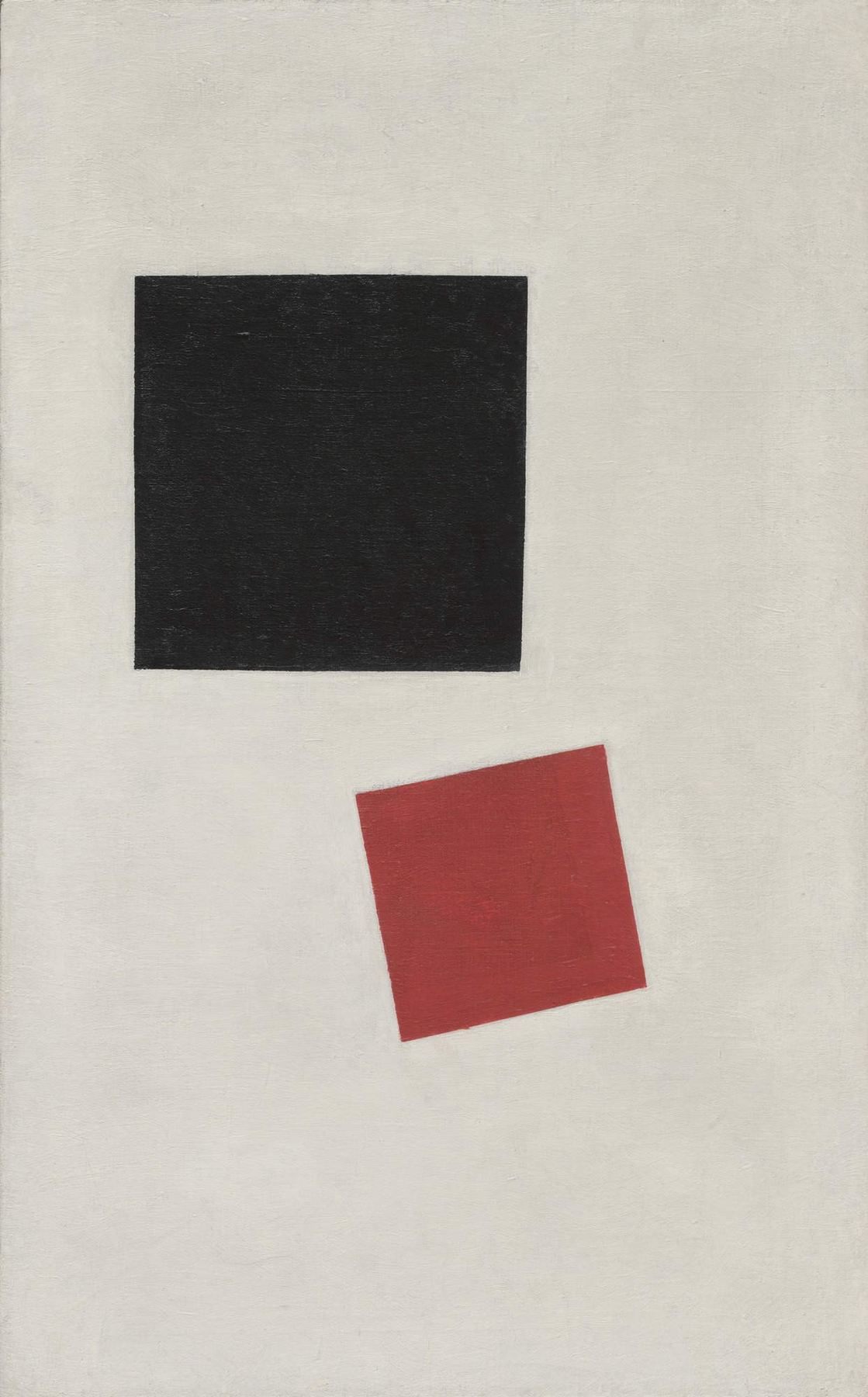
Painterly Realism of a Boy with a Knapsack
Kazimir Malevich · 1915 · A black square and red quadrilateral acquire unequal weight and direction, while the title tests how far memory of a body can persist without illustration.
Red Square
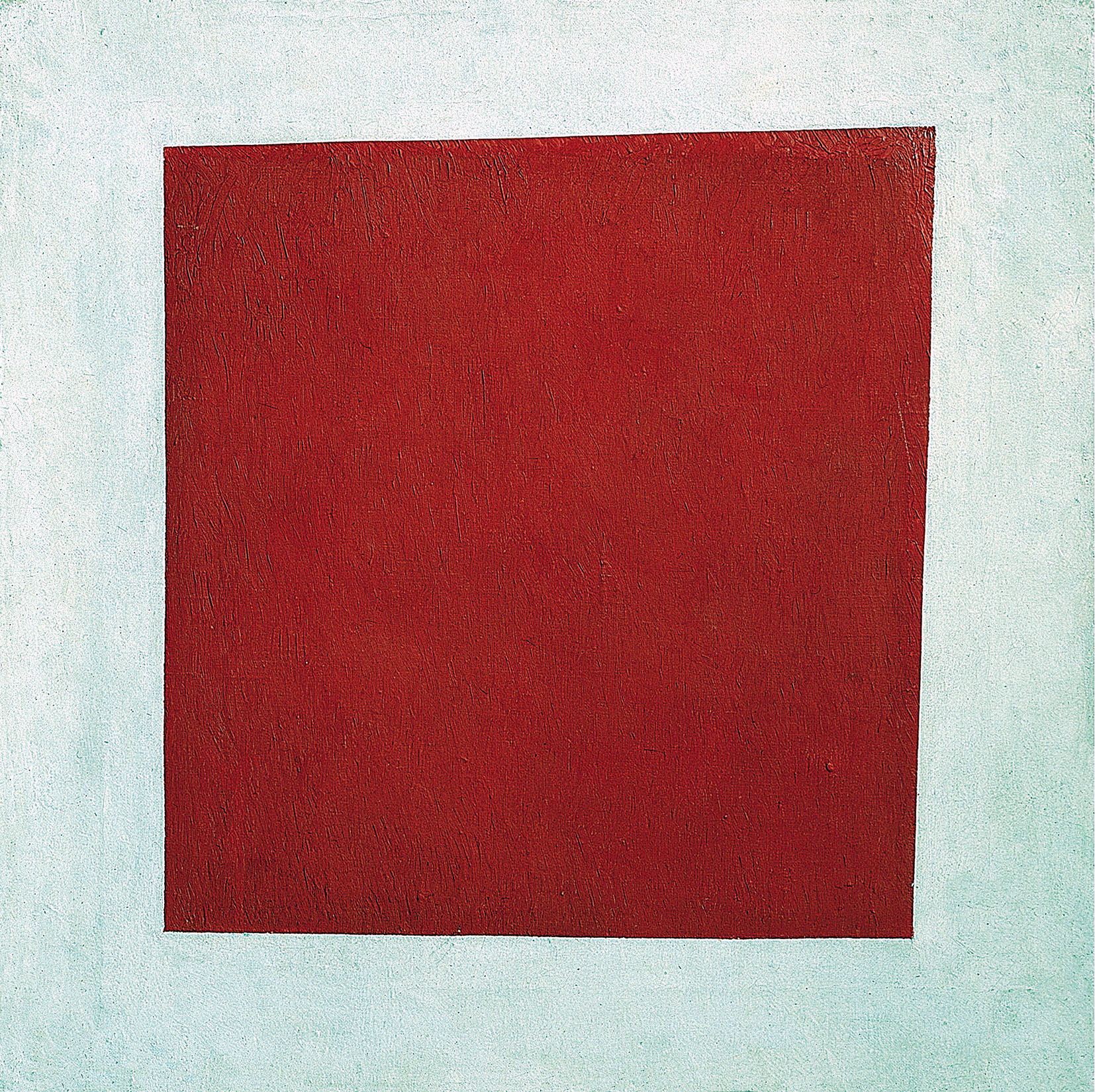
Kazimir Malevich · 1915 · Malevich's red quadrilateral is neither perfectly square nor mechanically fixed; its skew and painted edge make colour feel active rather than diagrammatic.
Suprematist Composition: White on White
Kazimir Malevich · 1918 · A pale tilted form presses against a warmer white ground, reducing contrast while preserving interval, rotation and the material difference between painted whites.
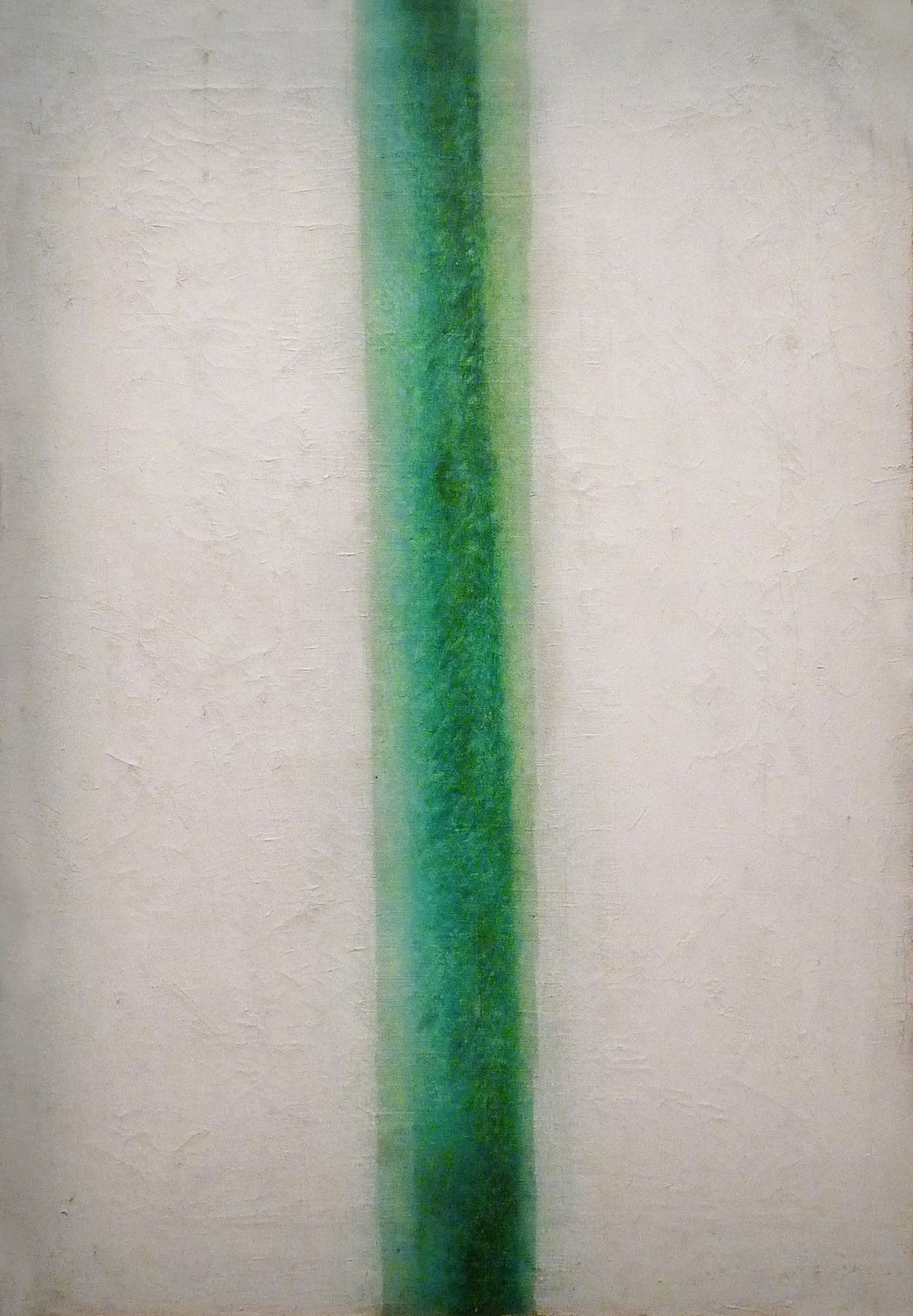
Green Stripe
Olga Rozanova · 1917–18 · Rozanova's narrow vertical colour concentrates intensity into a luminous interval, pushing Suprematist reduction toward colour painting rather than imitation of Malevich.
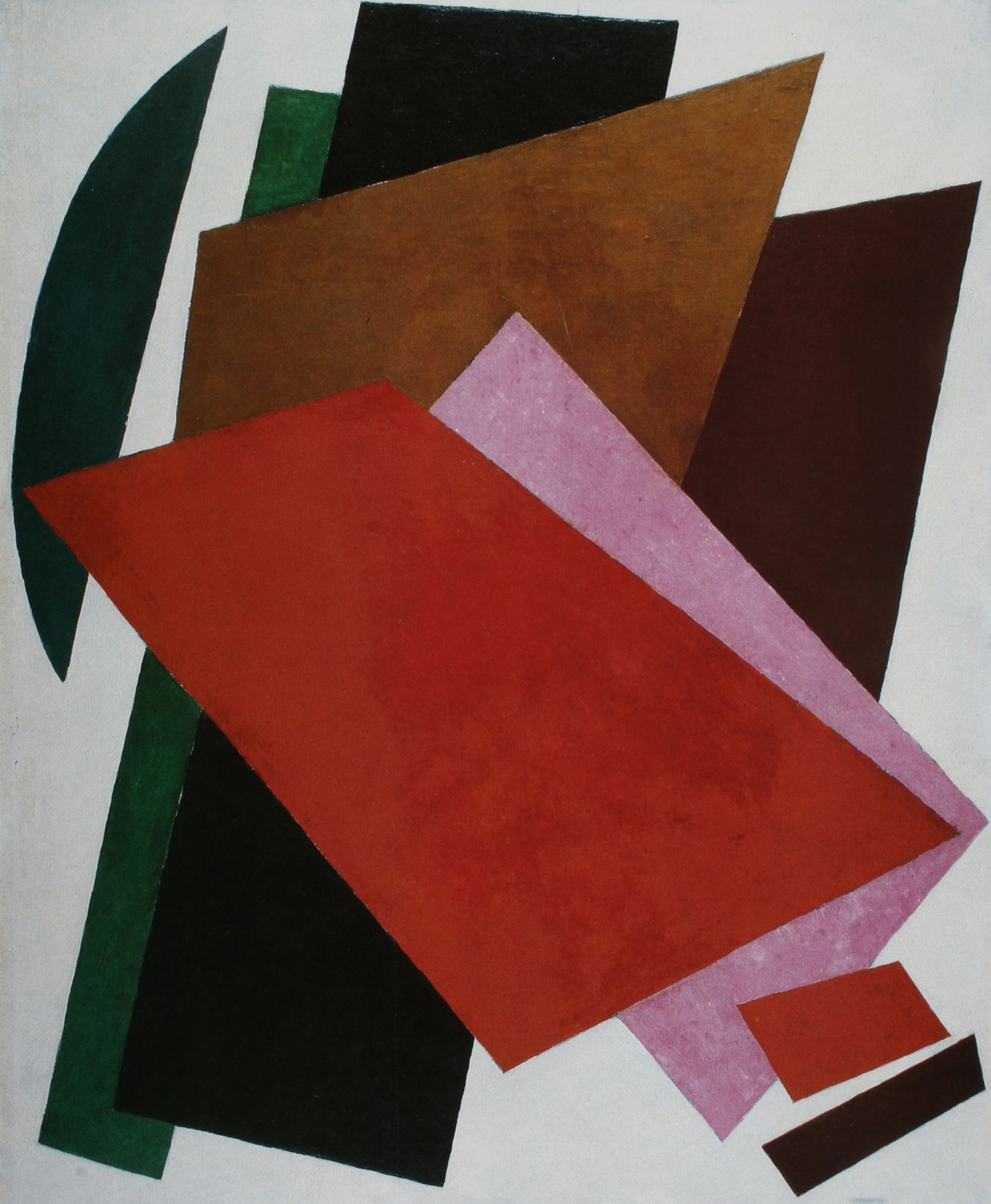
Painterly Architectonic
Liubov Popova · 1917 · Popova overlaps coloured planes so that construction, surface and pressure remain palpable, distinguishing her architectonic logic from a weightless copy of Malevich.
Proun 19D
El Lissitzky · 1920 or 1921 · Lissitzky turns Suprematist elements toward an imagined spatial station between painting and architecture, allowing axes and planes to imply rotation and construction.
Beat the Whites with the Red Wedge
El Lissitzky · 1919 · The red triangle transforms non-objective economy into a legible political graphic, showing both the reach of Suprematist vocabulary and the change produced by applied purpose.
Suprematist Pattern
Ilya Chashnik · 1922 · Chashnik adapts the square, bar and circle to a repeatable applied design, revealing how UNOVIS artists carried the language onto porcelain and useful surfaces.
How to look at a Suprematist work
1. Check the attribution
Determine whether the work is by Malevich, a Supremus colleague, an UNOVIS member or a later artist. Similar geometry can conceal very different theories.
2. Identify the version and date
Malevich repeated squares and sometimes assigned retrospective dates. Exhibition history, materials and provenance may be more reliable than an inscription alone.
3. Activate the white
Treat white as painted space. Compare margins, intervals and temperature. Ask whether forms float, press, recede or dissolve within it.
4. Compare visual weights
A small red square may balance a larger black plane through intensity. Tilt, scale and colour alter apparent gravity.
5. Inspect the hand
Look for brush direction, cracking, corrected edges and uneven pigment. These are paintings, not perfect computer diagrams.
6. Read the title without illustrating it
An airplane or knapsack may name a sensation, rhythm or memory rather than a depicted object. Let the contradiction remain active.
7. Change media mentally
Imagine the design on a page, cup, textile, street or plaster model. Ask what use and curvature do to non-objective form.
8. Keep revolution and chronology separate
The movement appeared in 1915, before the Bolshevik Revolution. Its later political applications arose from changing opportunities and conflicts, not from one original party programme.
Where to see Suprematism
Displays and access can change, and fragile works may not always be on view. Check current conditions before travelling.
- 01
State Tretyakov Gallery, Moscow
Holds the original 1915 Black Square and major works by Malevich and Rozanova. Display is sensitive to the fragile condition of the square, so verify what is on view.
Moscow, Russia
The original 1915 Black SquareVisit official website - 02
State Russian Museum, St Petersburg
Essential for Malevich’s multicolour Suprematist paintings, Red Square, applied designs and the wider Russian avant-garde.
St Petersburg, Russia
Malevich and the Russian avant-gardeVisit official website - 03
Museum of Modern Art, New York
The strongest compact public sequence outside Europe for Airplane Flying, Boy with a Knapsack, White on White, later dynamic work, Popova and Rodchenko.
New York, USA
A compact international sequenceVisit official website - 04
Stedelijk Museum, Amsterdam
A major Malevich collection and the Khardzhiev archive make this a centre for provenance, drawings and the Western survival of works left after 1927.
Amsterdam, Netherlands
Malevich and the Khardzhiev archiveVisit official website - 05
Centre Pompidou, Paris
Holds Black Cross, drawings, a black square object and related Russian avant-garde material. Its collection is especially helpful for comparing painting and architectural thought.
Paris, France
Painting and architectural thoughtVisit official website - 06
MOMus–Museum of Modern Art–Costakis Collection, Thessaloniki
George Costakis’s collection preserves Rozanova, Popova, Kliun, UNOVIS material and many less familiar participants beyond Malevich.
Thessaloniki, Greece
Suprematism beyond MalevichVisit official website - 07
All-Russian Decorative Art Museum, Moscow
The Soviet porcelain collection reveals how Suetin, Chashnik and Malevich adapted non-objective geometry to cups, plates and factory production.
Moscow, Russia
Suprematist porcelainVisit official website - 08
Peggy Guggenheim Collection, Venice
Malevich’s work appears within an international modernist collection, making comparison with Constructivism, De Stijl and later abstraction especially productive.
Venice, Italy
International modernist comparisonVisit official website
Suggested books
Aleksandra Shatskikh, Black Square: Malevich and the Origin of Suprematism
Shatskikh uses archives and contemporary evidence to challenge Malevich’s retrospective dating and many repeated origin myths.[46] It is the strongest choice for readers who want to understand how the 1915 painting, theatre design, manifesto and exhibition relate without collapsing into one event.
John Milner, Kazimir Malevich and the Art of Geometry
Milner examines proportion, measurement, physics, mathematics and the cultural meanings of geometry.[47] The book helps recover the calculated visual relations beneath an art too often described as either effortless simplicity or pure mysticism.
Matthew Drutt, ed., Kazimir Malevich: Suprematism
This catalogue brings paintings, drawings, objects, architectural models, documents and essays on philosophy, religion and the Supremus circle into one movement-focused study.[48] It is the most useful broad reference for seeing Suprematism beyond Black Square.
Achim Borchardt-Hume, ed., Malevich
Produced for the Stedelijk, Bundeskunsthalle and Tate retrospective, this catalogue places the Suprematist breakthrough inside Malevich’s full career.[49] Early peasant pictures, theatre, pedagogy and late figures prevent the abstract years from becoming a detached legend.
T. J. Clark, Farewell to an Idea: Episodes from a History of Modernism
Clark’s demanding account places Malevich and Lissitzky within the promises and failures of revolutionary modernism.[50] It is especially valuable for readers interested in why apparently immaterial paintings became entangled with collective politics and historical catastrophe.
Major artists associated with Suprematism
| Name | Nationality | Key Works |
|---|---|---|
| Kazimir Malevich | Polish-Ukrainian | Black Square · Airplane Flying · White on White |
| Olga Rozanova | Russian | Green Stripe · Non-Objective Composition · Suprematist book designs |
| Liubov Popova | Russian | Painterly Architectonics · Spatial Force Construction |
| Ivan Kliun | Russian | Suprematist compositions · Spherical Suprematism |
| Nadezhda Udaltsova | Russian | Suprematist Construction · Cubo-Futurist compositions |
| Ivan Puni | Russian-Swiss | Suprematist compositions · 0.10 exhibition work |
| Alexandra Ekster | Ukrainian-French | Suprematist studies · theatre and textile designs |
| Ksenia Boguslavskaya | Russian | Suprematist textiles · applied designs |
| El Lissitzky | Russian | Proun 19D · Beat the Whites with the Red Wedge · About Two Squares |
| Ilya Chashnik | Russian | Suprematist Pattern · porcelain designs |
| Nikolai Suetin | Russian | Suprematist porcelain · architectural and exhibition designs |
| Vera Ermolaeva | Russian | UNOVIS book illustration · colour and teaching studies |
| Nina Kogan | Russian | Suprematist Ballet · UNOVIS compositions |
| Lazar Khidekel | Belarusian | aero-city projects · Suprematist architectural studies |
| Lev Yudin | Russian | UNOVIS drawings · abstract compositions |
| Władysław Strzemiński | Polish | Suprematist compositions · architectural and typographic work |
| Katarzyna Kobro | Polish-Russian | spatial constructions · abstract sculpture |
| Natalia Davydova | Ukrainian | Suprematist embroidery designs · Verbivka artel work |
| Nina Genke-Meller | Ukrainian | Suprematist applied designs · Verbivka artel work |
| Mikhail Matiushin | Russian | Victory over the Sun · colour and spatial research |
Frequently Asked Questions
Suprematism is the non-objective art theory and movement introduced by Kazimir Malevich in 1915. It uses elementary geometric forms and colour to prioritise artistic feeling over the depiction of external objects. The movement later extended into teaching, books, porcelain, textiles and architectural models.
Malevich used the name to claim the supremacy of pure feeling or perception in painting. It also asserted leadership within a competitive avant-garde. “Supreme” does not mean that the shapes are objectively better than other art; it names his philosophical priority.
He was one of several early pioneers. Kandinsky, Hilma af Klint, Kupka and others developed non-representational work through different routes. Malevich’s distinctive achievement was to make radical geometric reduction into a public exhibition, theoretical system, emblem and group movement.
Malevich dated it 1913 and connected it to his Victory over the Sun design. The surviving first canvas and its secure public debut belong to 1915. It is safest to say that the square motif developed from the 1913 theatre project and became a Suprematist painting by 1915.
The high corner was traditionally associated with an icon in a Russian home. Malevich used that culturally charged location to give his new sign exceptional status. The placement can imply confrontation with religion, spiritual ambition and artistic authority simultaneously.
No. Its border is uneven, its pigment varies and its cracked surface records a particular painting process. It was also installed among many other works and accompanied by theory. A reproduction conveys the idea but not the object’s material tension.
An elemental black phase established square, circle and cross; a dynamic multicolour phase rotated and layered planes; a white phase reduced contrast toward near-dissolution. The sequence describes Malevich usefully but should not be imposed rigidly on every associated artist.
They worked within the Supremus network and responded strongly to his system, but each developed an independent direction. Rozanova intensified autonomous colour, while Popova combined geometric abstraction with material and architectural construction. “Colleague” is usually more informative than “disciple.”
UNOVIS was a collective formed at the Vitebsk art school around 1920. Teachers and students used the black square as a sign, promoted collective authorship and applied new art to publications, posters, street decoration, textiles and objects. Internal differences eventually divided the group.
Suprematism began from non-objective feeling and painted relations in imagined infinite space. Constructivism increasingly emphasised actual materials, spatial construction and socially useful production. Artists moved between the fields, and Popova or Lissitzky show their overlap, but their priorities were not identical.
Architektons are Malevich’s white plaster assemblies of rectilinear volumes. They explore how Suprematist relations might enter three-dimensional space and architecture. Because they lack ordinary doors, windows, scale and engineering, they are better understood as experimental spatial models than ready-to-build structures.
Late-1920s and 1930s political pressure made avant-garde abstraction increasingly dangerous, but the return was not simple surrender. His blank-faced peasants and Renaissance-like portraits retain Suprematist colour, geometry and signs. They combine memory, coded continuity and a changed public environment.
Discussion
Which Suprematist work feels least “empty” when you attend to its material surface, title, original installation or later use on an object? Share the shape or interval that changed your reading, and say whether it suggested weight, flight, spiritual space, political design or something harder to name.
Reader Insights
Treat the ground as painted space that presses against, separates and suspends each coloured plane.
Look for brushwork, cracking, drawn guides and adjusted edges before reducing the work to a perfect digital diagram.
Keep 1915 painting, post-Revolutionary UNOVIS practice and later Constructivist use distinct even when their vocabularies overlap.
Join the Conversation
Which Suprematist work most strongly turns apparently simple geometry into an active visual event?
References
- Kazimir Malevich Suprematism, Solomon R Guggenheim Museum, View Source
- Kasimir Malévitch, Centre Pompidou (French; consulted in French), View Source
- Malevich Kazimir, Encyclopedia of Ukraine, View Source
- Suprematism Part I Kazimir Malevich, Smarthistory, View Source
- Kazimir Malevich and Cubo-Futurism, Smarthistory, View Source
- Unique Malevich Drawing Discovered, Stedelijk Museum, View Source
- Dame, Centre Pompidou (French; consulted in French), View Source
- Le Monochrome, Centre Pompidou (French; consulted in French), View Source
- Suprematist Composition Airplane Flying, Museum of Modern Art, View Source
- Focus sur Croix noire, Centre Pompidou (French; consulted in French), View Source
- Who Created the First Abstract Artwork, Smarthistory, View Source
- Kazimir Malevich Black Square 1915, Smarthistory, View Source
- The Adventures of Malevich's Black Square, State Russian Museum (Russian; consulted in Russian), View Source
- Conservation Research 1996–1997 Malevich Painting Technique, National Gallery of Art, View Source
- Painterly Realism of a Boy with a Knapsack, Museum of Modern Art, View Source
- Suprematist Painting 1916–17, Museum of Modern Art, View Source
- Suprematist Composition White on White, Museum of Modern Art, View Source
- The Subject of Nonobjective Art, MoMA post, View Source
- Non-Objective Painting no 80 Black on Black, Museum of Modern Art, View Source
- Green Stripe Olga Rozanova, Rostov Kremlin Museum Reserve (Russian; consulted in Russian), View Source
- Painterly Architectonic Liubov Popova, Museum of Modern Art, View Source
- Painterly Architectonic, Museo Nacional Thyssen-Bornemisza, View Source
- The Second Museum of Our Wishes Lyubov Popova, Moderna Museet, View Source
- Natalia Mikhailovna Davydova, Metropolitan Museum of Art, View Source
- Untitled Lyubov Popova, Metropolitan Museum of Art, View Source
- Liubov Popova, Museum of Modern Art, View Source
- Plate Ilya Chashnik, British Museum, View Source
- Gallery of Soviet Porcelain, All-Russian Decorative Art Museum, View Source
- Dish Suprematism by Nikolai Suetin, Virtual Russian Museum, View Source
- The Russian Avant-Garde Book 1910–1934, Museum of Modern Art, View Source
- Art Protest and the Archives, Yale Beinecke Library, View Source
- The Many Lives of El Lissitzky's Proun 19D, MoMA post, View Source
- Suprematism Part II El Lissitzky, Smarthistory, View Source
- Suprematism 34 Drawings, Museum of Modern Art, View Source
- Engineer Agitator Constructor preview, Museum of Modern Art, View Source
- Katarzyna Kobro, Culture.pl, View Source
- Kazimir Malevich, Peggy Guggenheim Collection, View Source
- Centre Pompidou Russian Avant-Garde Guide, Centre Pompidou (French; consulted in French), View Source
- Boichuk and Malevych Two Messiahs of the Kyiv Art Institute, National Art Museum of Ukraine, View Source
- Kazimir Malevich at the Intersection of Two Identities, Culture.pl (Ukrainian; consulted in Ukrainian), View Source
- Kazimir Malevich 1878–1935, National Gallery of Art, View Source
- Nikolai Khardzhiev, Metropolitan Museum of Art, View Source
- Tate Modern Programme 2014, Tate, View Source
- Richard Serra's Delineator Comes to MoMA, Museum of Modern Art, View Source
- Q 1 Suprematistic László Moholy-Nagy, Museum of Modern Art, View Source
- Black Square Malevich and the Origin of Suprematism, Aleksandra Shatskikh Yale University Press, View Source
- Kazimir Malevich and the Art of Geometry, John Milner Yale University Press, View Source
- Kazimir Malevich Suprematism, Matthew Drutt Guggenheim Museum, View Source
- Malevich, Achim Borchardt-Hume Tate Publishing, View Source
- Farewell to an Idea, T J Clark Yale University Press, View Source
- Suprematism image records, Wikimedia Commons: Malevich's paintings at 0.10 (Public domain; Central State Archives of Cinema, Photo and Phono Documents of Saint Petersburg / Wikimedia Commons), Black Square (Public domain; Wikimedia Commons), Suprematist Composition: Airplane Flying (Public domain; Museum of Modern Art record / Wikimedia Commons), Painterly Realism of a Boy with a Knapsack (Public domain; Museum of Modern Art record / Wikimedia Commons), Red Square (Public domain; Wikimedia Commons), Suprematist Composition: White on White (Public domain; Museum of Modern Art record / Wikimedia Commons), Green Stripe (Public domain; Ji-Elle / Wikimedia Commons), Painterly Architectonic (Public domain; Wikimedia Commons), Proun 19D (Public domain; Wikimedia Commons), Beat the Whites with the Red Wedge (Public domain; Wikimedia Commons), Suprematist Pattern (Public domain; Wikimedia Commons).