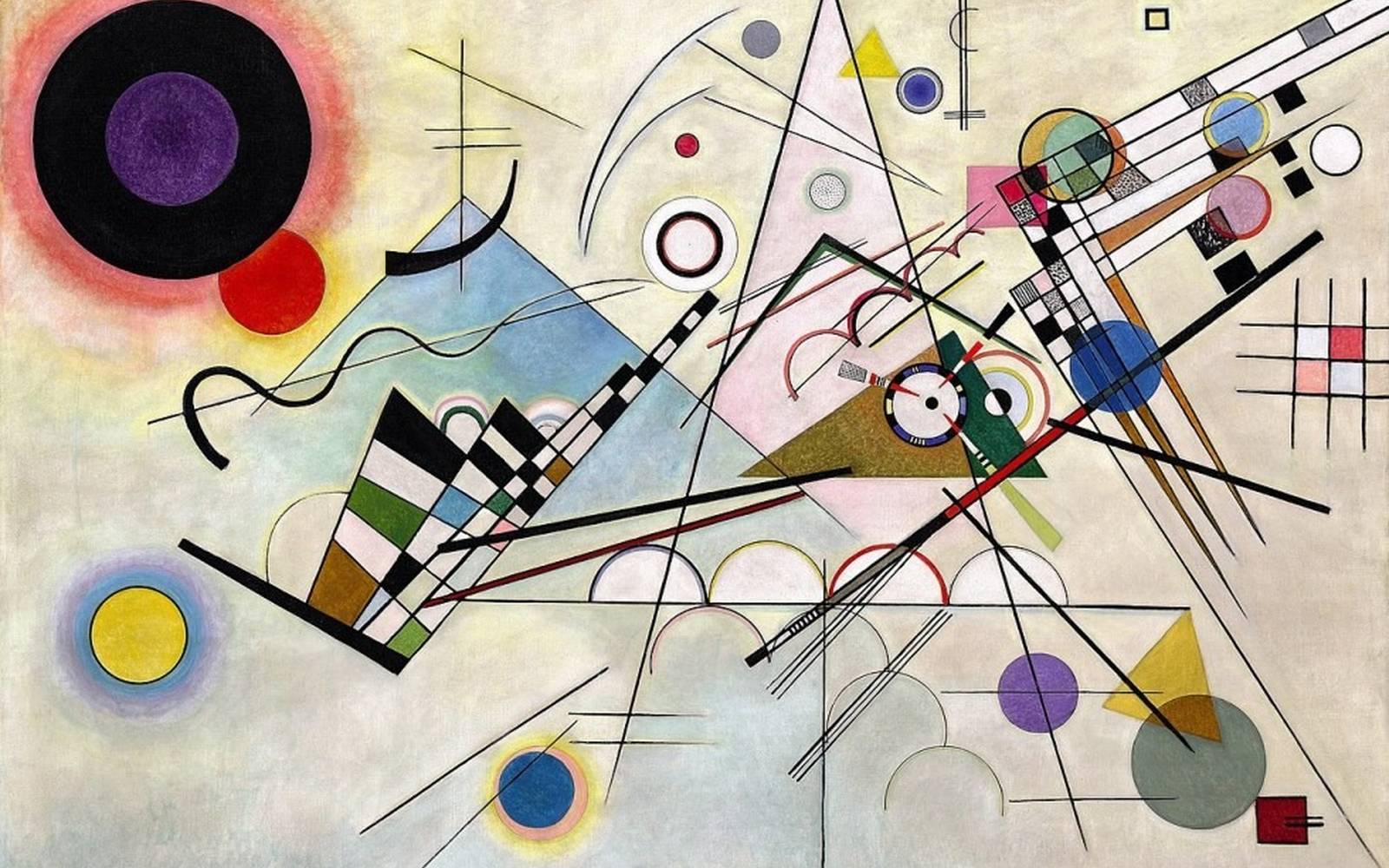
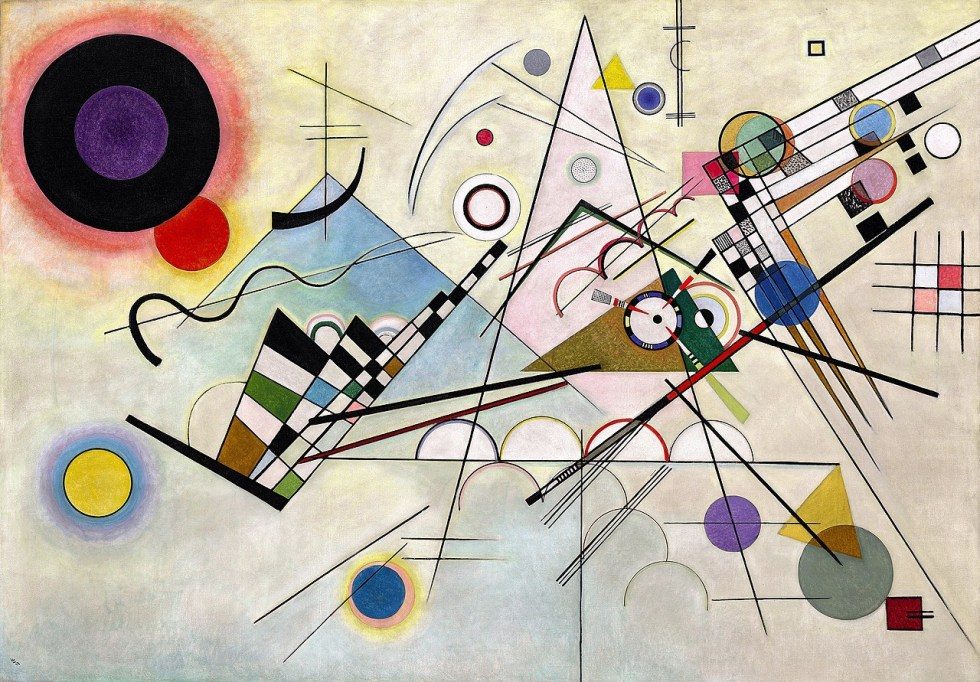
Image reference: Wassily Kandinsky's Composition 8, 1923.
At a Glance
- Core periodAbout 1910–1939, with major postwar legacies
- Principal centresParis, Moscow and Petrograd, Munich, Weimar, Dessau, Berlin, Zurich and the Netherlands
- Common elementsLines, circles, rectangles, grids, colour planes, modules, shallow space and nonobjective composition
- Major currentsOrphism, Suprematism, Constructivism, De Stijl, Bauhaus abstraction and concrete art
- Important mediaPainting, relief, sculpture, textiles, typography, photography, film, stage design, furniture and architecture
- Central questionHow can visual relations carry meaning without depending upon naturalistic representation?
- Key figuresWassily Kandinsky, Piet Mondrian, Kazimir Malevich, Robert Delaunay, Paul Klee and Sophie Taeuber-Arp
Contents
- Where it fits
- What the term means
- The plane becomes an event
- Kandinsky
- Four stages
- Artists to know
- Essential works
- Bauhaus laboratory
- Where to see
- Artist directory
Where geometric abstraction fits
Piet Mondrian
Principal activityWassily Kandinsky
Principal activityPaul Klee
Principal activityKazimir Malevich
Principal activityRobert Delaunay
Principal activityLiubov Popova
Principal activityTheo van Doesburg
Principal activitySophie Taeuber-Arp
Principal activityGeometric abstraction gave the simplest visual elements unusually large ambitions. A line could suggest force without outlining a body. A square could become an emblem of a world freed from imitation. A grid could promise equilibrium, while a repeated module might organise a textile, room, photograph or book. From the 1910s onward, artists used circles, bars, planes and measured intervals to ask what art could do when resemblance was no longer its first obligation.
Yet geometric abstraction was never one movement. It is an umbrella placed over rival programmes that emerged in different cities and political circumstances. Suprematists pursued nonobjective feeling; Constructivists treated form as material and social organisation; De Stijl artists searched for an equilibrium of verticals, horizontals and colour; Bauhaus teachers turned geometry into one part of a broad laboratory; concrete artists insisted that line and plane were realities in themselves. Their works may share rectangles and circles, but their ideas do not collapse into a common creed.[1] [4] [45]
Nor is geometry necessarily impersonal. Painted edges tremble. A broad white field acquires pressure from one tilted bar. Woven threads give a grid softness and resistance. A diagonal can make the eye accelerate, and a red rectangle can hold a quiet composition in suspense. The most rewarding works replace narrative description with another kind of drama: weight against buoyancy, repetition against interruption, order against play.
What does geometric abstraction mean?
In its broad modern sense, geometric abstraction uses hard-edged, linear or systematically organised forms in place of conventional illusion. The category includes fully nonrepresentational pictures, but it also includes works in which a window, figure, landscape or machine remains faintly legible beneath a structure of planes. “Abstract” therefore describes a spectrum rather than an on-off switch.[1] [2]
Three terms are often confused. An artist may abstract from a visible subject by simplifying it. A nonobjective work need not refer to an external object at all. Concrete art, a term advanced by Theo van Doesburg in 1930, goes further: it argues that colour, line and plane are not abstractions from reality but concrete realities already present before the viewer. The wording matters because it changes a picture from the reduced image of something else into a constructed object with its own laws.[3]
Geometry itself is far older than modern art. Pattern, architecture, diagrams, Islamic ornament, weaving and systems of proportion long preceded the avant-garde. Nineteenth-century design education and children's learning systems also made basic forms into tools of analysis; Frank Lloyd Wright, for example, later recalled the importance of Froebel gifts to his spatial imagination.[44] Modern geometric abstraction did not invent the square. Its historical novelty lay in making formal relations a principal subject and in arguing publicly about what that independence might mean.
The familiar word “geometric” can also mislead. Many works were not calculated to mathematical precision, and few were manufactured without a hand. Mondrian adjusted lines and fields through prolonged looking. Malevich's painted quadrilateral is not a faultless digital square. Taeuber-Arp's repeated units change when they pass from gouache to wool, wood or architecture. Geometry supplied a vocabulary, but touch, scale, material and setting gave that vocabulary a voice.
The plane becomes an event
Cubism provided one decisive foundation. Beginning around 1907, Pablo Picasso and Georges Braque dismantled Renaissance perspective and broke objects into overlapping facets. Analytic Cubism still referred to figures, guitars and tables, but its shallow space made the canvas newly evident as a plane. Synthetic Cubism added pasted papers, flat signs and constructional relations. A fragment could be both part of a depicted object and a physical piece attached to a surface.[3] [45]
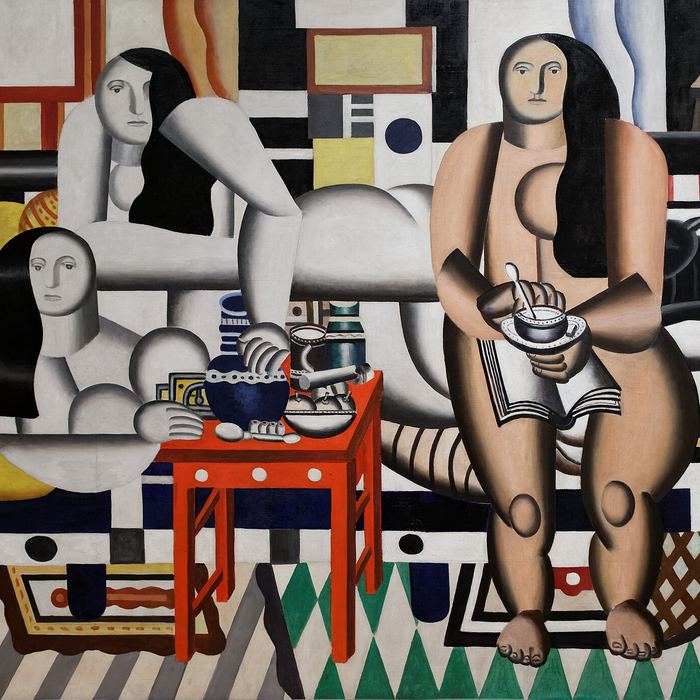
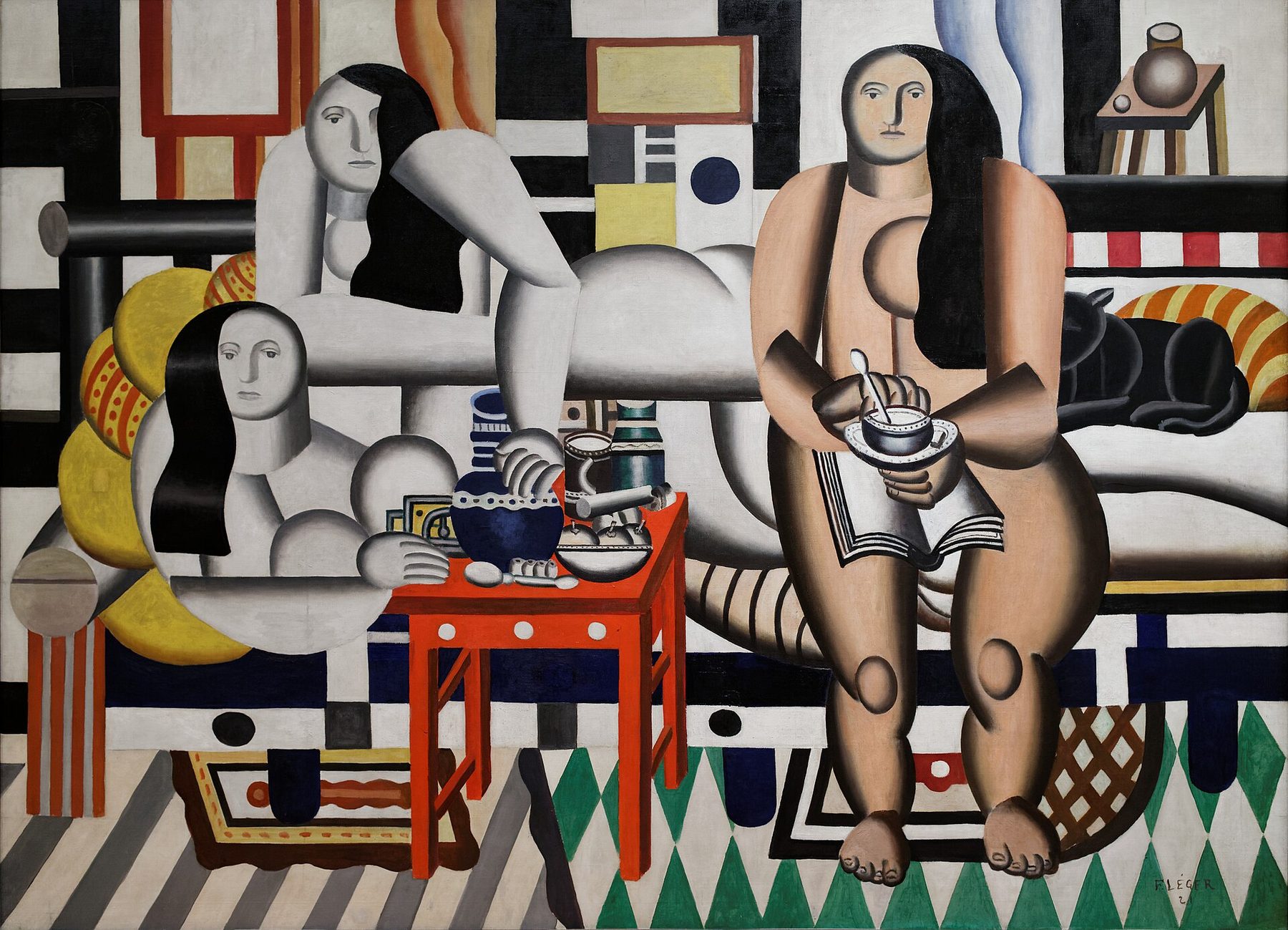
This change was not an automatic march toward “pure” abstraction. Cubist artists continued to value recognizable motifs, and later painters selected different lessons from their work. Some took the grid, some collage, some the fusion of viewpoints, and others the freedom to let a shape operate independently. Fernand Léger retained bodies and objects while turning them into weighty cylinders, disks and mechanical contrasts. In Three Women, domestic figures become monumental assemblies without ceasing to be people.[39] Geometry could reorganise representation rather than abolish it.
Geometry, the machine and modern life
The city made abstraction plausible in ways that had little to do with escaping the world. Electric signs, railway diagrams, factory components, window displays, aerial views and illustrated magazines trained people to read compressed forms rapidly. Photographs cut bodies and buildings into unexpected fragments. Printed type changed size and direction across posters. In such surroundings, a red disk or black bar could belong at once to formal experiment and to ordinary modern vision.
Léger's work occupies this productive border. Cylinders resemble pipes, limbs and machine housings, but their meaning comes from contrast: curved against straight, dark against pale, patterned against blank. In Three Women, cups, furniture and bodies lock into a shallow architecture. Repeated oval heads give the group a manufactured kinship, while hands and glances preserve human presence. The work is not an apology for replacing people with machines. It tests how modern bodies might remain monumental within an environment of standardised parts.[39]
Other artists made the passage in the opposite direction. A mechanical subject could dissolve into nonobjective rhythm, while an abstract scheme could later become a poster, stage or architectural plan. The boundaries among autonomous art, design and commercial imagery were porous even when artists argued fiercely about them. The twenties brought geometric devices into fashion, cinema, advertising and Art Deco interiors, where their association with speed and luxury did not necessarily preserve the utopian programmes of Constructivism or De Stijl.[40]
Scale changed interpretation as decisively as subject. A small gouache invites close, private inspection; the same arrangement enlarged across a theatre wall directs a crowd. A motif repeated on fabric submits to seams and moving bodies. A typographic diagonal can determine the order in which a political message is read. Geometric abstraction became historically powerful not because every object looked alike, but because a limited family of relations proved adaptable to very different situations.
This adaptability created suspicion among some advocates. If an abstract vocabulary could decorate a fashionable shop as easily as it could announce social transformation, was its meaning being emptied out? The question never received one answer. Mondrian accepted particular design collaborations but resisted uses he believed reduced Neoplasticism to a motif. Constructivists tested mass production, where artistic control met factory reality. Bauhaus makers negotiated prototypes, manufacturers and consumers. Modern geometry lived between ideal system and practical compromise.
It is therefore worth asking of every apparently autonomous picture where else its forms operated. Did the artist teach them, print them, weave them, build them or stage them? Was the work made for a collector, exhibition, school, theatre, worker or mass market? Those questions reconnect formal analysis to the material systems that carried abstraction into public life.
Ideas travelled through more than paintings. Exhibitions, photographs, manifestos, music, dance, poetry, private collections and correspondence connected artists across Europe. The 1910s were a network of translations and misunderstandings, not a relay race in which one inventor handed abstraction to the next. MoMA's later Inventing Abstraction project made those connections visible as a web, a useful correction to single-file histories.[37]
One reason the period feels so concentrated is that artists gave related forms divergent purposes almost simultaneously. In Munich and later at the Bauhaus, Kandinsky made line and colour agents of inner tension. In Paris, the Delaunays used chromatic contrast to evoke simultaneous perception. In Russia, Malevich placed elemental forms in apparently limitless white fields, while Popova made planes behave like pieces under pressure. In the Netherlands, Mondrian developed an asymmetrical vertical-horizontal equilibrium. Their proximity is historically important, but agreement should not be invented where none existed.[5]
There were also paths that contemporary institutions scarcely saw. Hilma af Klint created large geometric and organic cycles within an esoteric spiritual practice. Much of the work was not intended for immediate public display, and its later visibility has unsettled the customary question of who made the “first” abstract painting.[11] The better historical questions concern access, intention, exhibition and reception: who saw a work, what was it called, how did it circulate, and why did later museums recognise some experiments earlier than others?
Geometric abstraction artists to know
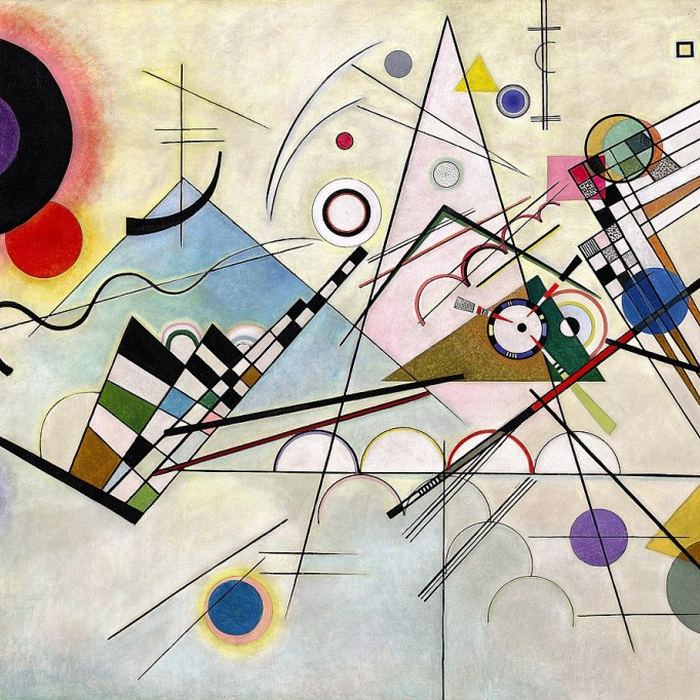
Wassily Kandinsky
Kandinsky treated line, colour and elementary form as agents of tension, rhythm and inner necessity rather than as neutral diagram.
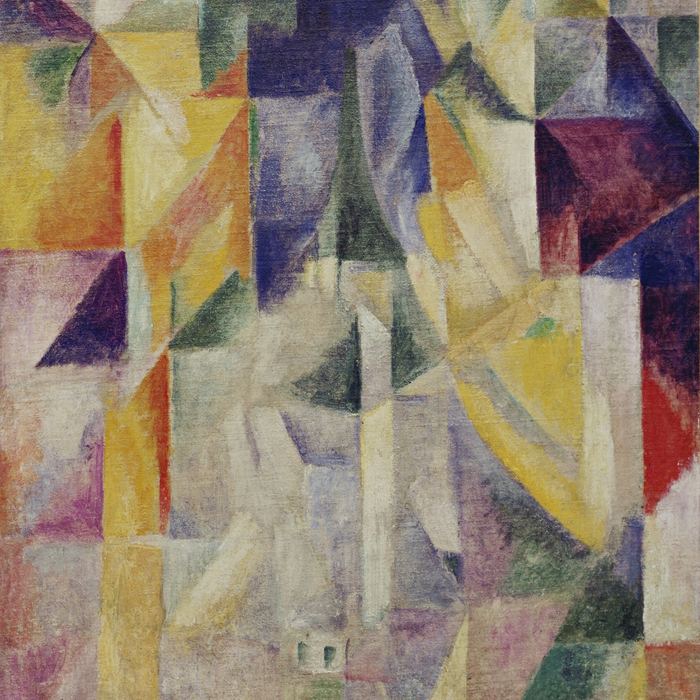
Robert Delaunay
Delaunay used adjacent colour to make light and perception structural, often keeping modern motifs visible inside abstraction.
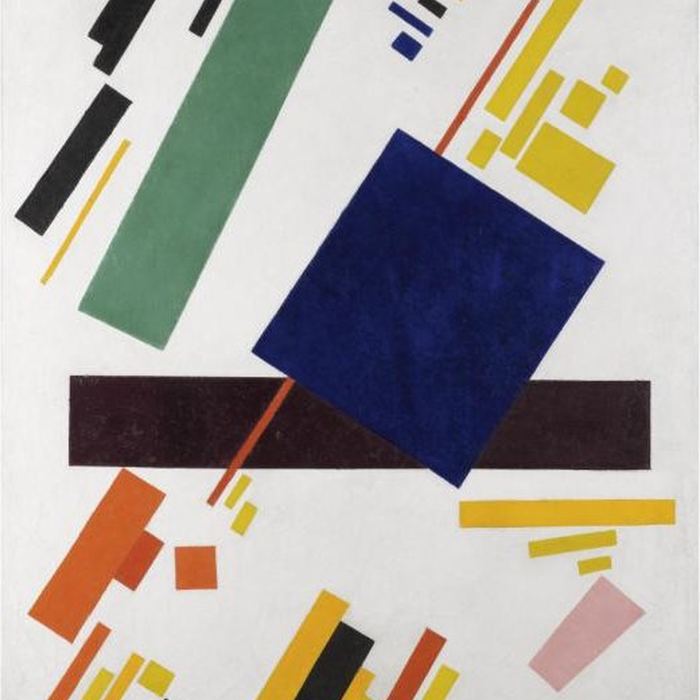
Kazimir Malevich
Malevich set elemental forms into apparently unbounded white fields and gave geometric abstraction one of its most absolute claims.
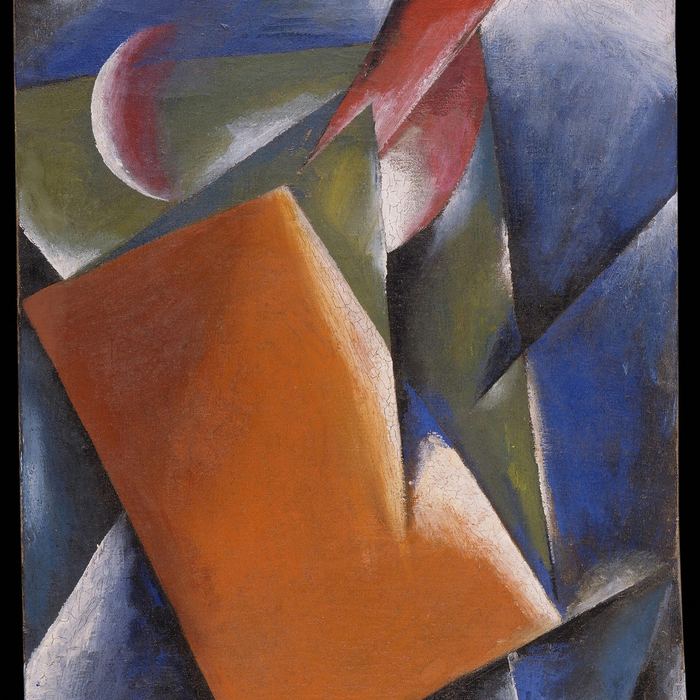
Liubov Popova
Popova made planes behave as material forces before carrying geometric organisation into theatre, textiles and graphic design.
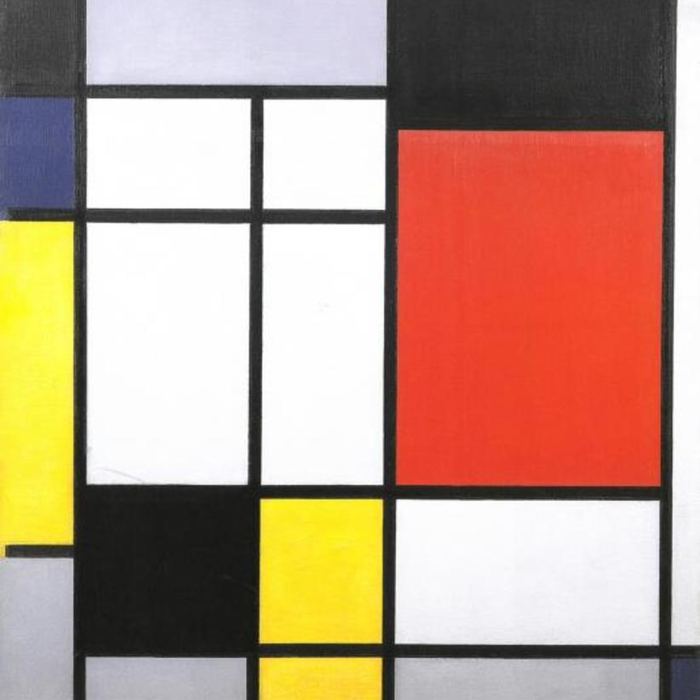
Piet Mondrian
Mondrian developed asymmetrical balance through verticals, horizontals, primary colours and carefully differentiated intervals.
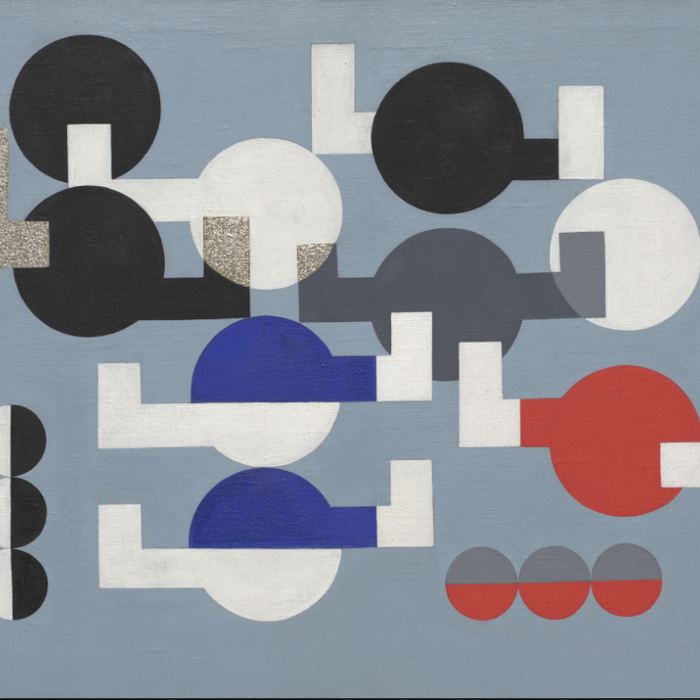
Sophie Taeuber-Arp
Taeuber-Arp joined precise modular thinking to bodily movement and worked across media that older histories wrongly separated.
Kandinsky: geometry that still feels
Wassily Kandinsky is often associated with free, improvisatory colour before the First World War. His essays argued that a line or hue could act without serving descriptive resemblance, much as sound operates without picturing a visible object. When his paintings became more geometric in the 1920s, the change did not extinguish emotion. Circles, triangles and measured lines offered a more analytical grammar for tensions he continued to understand as expressive and spiritual.[7] [9]
His Bauhaus teaching made such relations discussable. Students compared the perceived weight, direction and temperature of forms and colours. They analysed drawings to uncover structural forces rather than merely copy contours. The famous associations among triangle, square, circle and particular hues were exercises within a broader method, not a universal code that every viewer must decode identically.[32]
Composition 8, 1923
At first glance, Composition 8 resembles an immaculate celestial chart or an engineer's diagram. The large dark-edged circle near the upper left gives the eye a temporary anchor, but almost everything around it resists rest. Thin diagonals shoot across the pale field. Small circles gather like satellites. A checkerboard, arc, triangle and irregular quadrilaterals create changes of scale and density. The picture never becomes a stable machine because its parts do not submit to one centre.[6] [10]
Direction does much of the expressive work. Acute diagonals imply speed and collision. Circles concentrate attention and suggest recurrence rather than arrival. A heavy black form near the lower right acts as ballast, yet an upward diagonal prevents it from closing the composition. Empty pale areas are carefully proportioned intervals through which the eye moves. The painting feels precise and precarious at once.
This is geometry as orchestration. Kandinsky distinguished calm from aggressive elements, but the viewer experiences their interaction rather than a dictionary of meanings. Minute adjustments of size, colour and position keep an apparent diagram alive. The picture answers the cliché of cold abstraction with wit, suspense and rhythmic variety.
Kandinsky's position also clarifies why formal resemblance cannot establish philosophical identity. Malevich used circles, crosses and rectangles, but his Suprematist field and idea of nonobjective feeling developed from other claims. A Guggenheim comparison of the two artists emphasises the difference between their uses of apparently similar forms.[8] Geometry is the shared language; intention, surface and spatial relation are the argument.
Robert and Sonia Delaunay: colour in simultaneity
For Robert Delaunay, colour did not simply fill an outlined form. Complementary contrasts could produce light, movement and structure. Scientific writing by Michel-Eugène Chevreul and Ogden Rood offered a vocabulary for describing how adjacent hues intensify one another, but the resulting paintings are not demonstrations copied from a textbook. They turn perception into a changing event.[21]
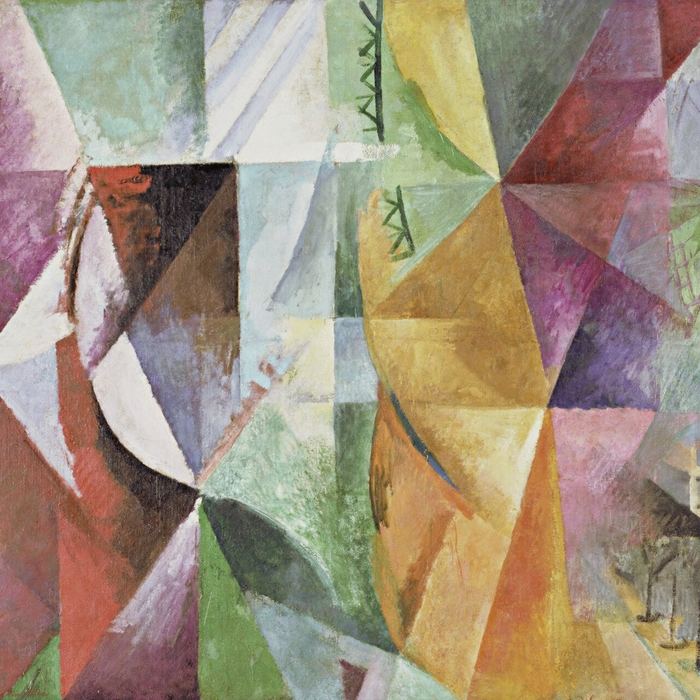
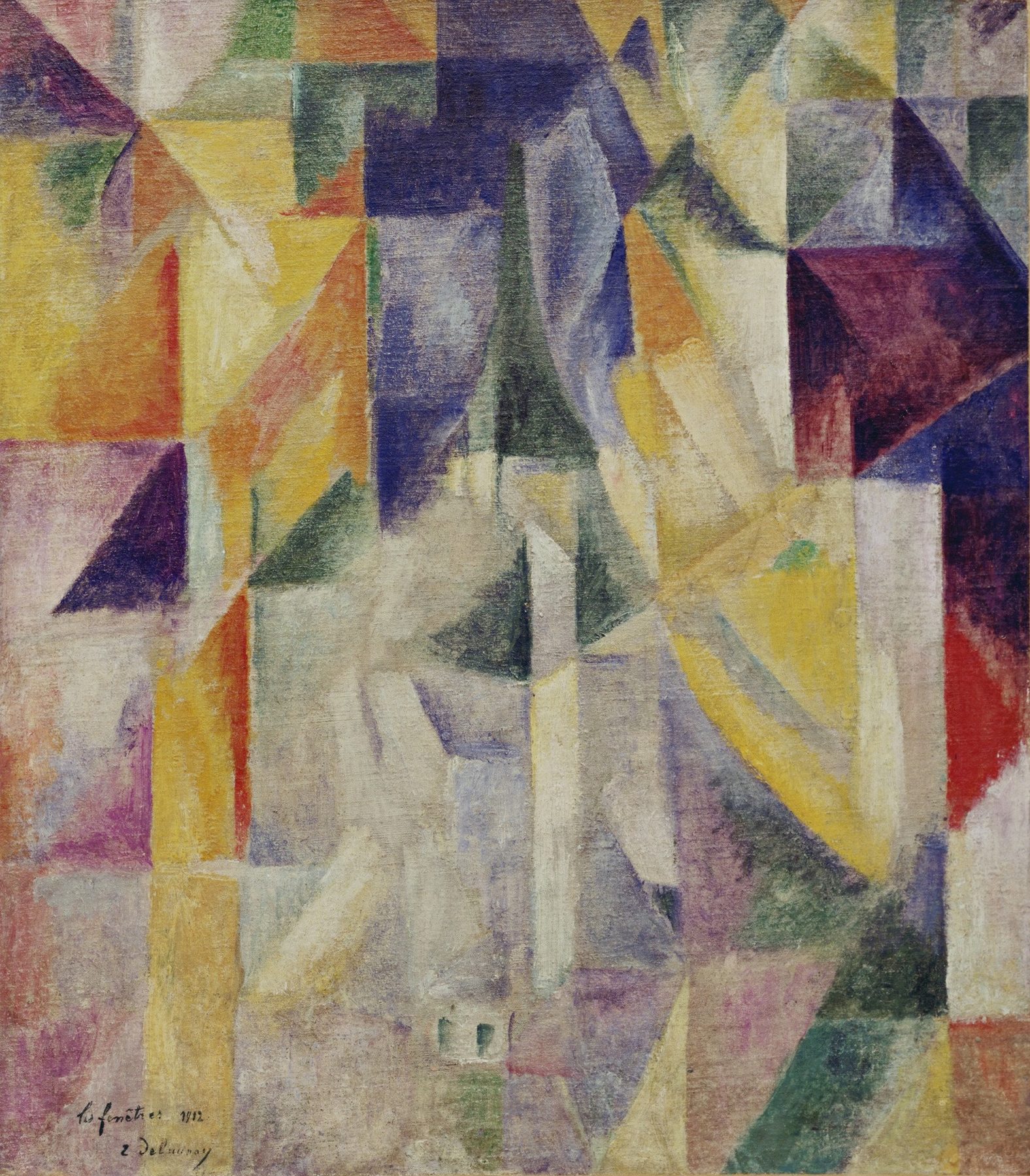
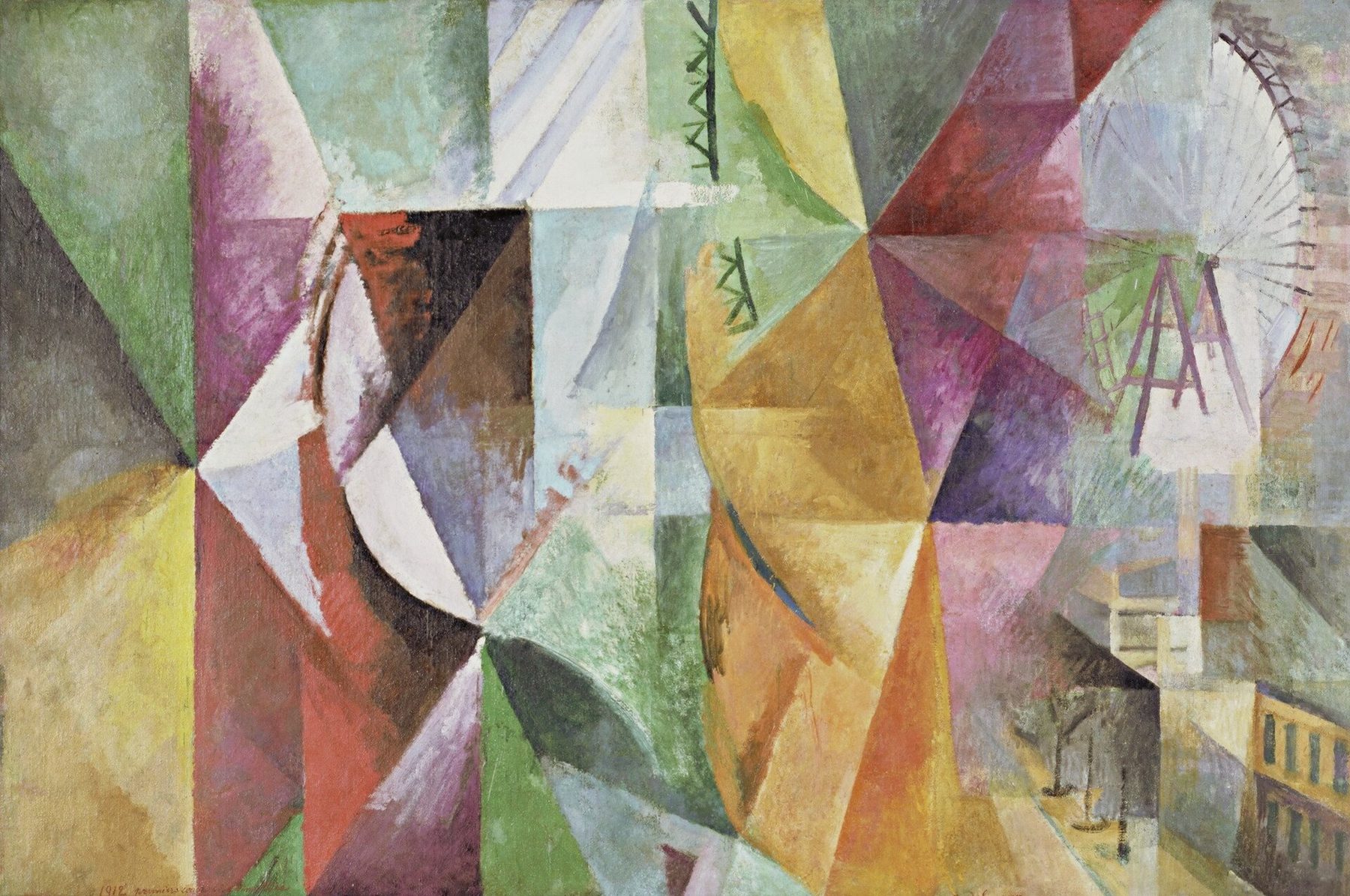
Windows, 1912
The Windows series occupies the threshold between motif and autonomy. Blocks of yellow, green, blue, orange and red overlap like panes flooded by shifting light. Fragments of the Eiffel Tower survive in some versions, as does the idea of a window framing the city, but colour repeatedly interrupts the object. The eye reconstructs and loses the view in the same passage.[18] [20]
Delaunay was challenging the old metaphor of a painting as a transparent window onto a coherent world. His surface behaves less like clear glass than like light refracted through coloured layers. Warm and cool planes advance and withdraw without conventional shading. Because their boundaries are relational, no single shape owns the space. The subject becomes the viewer's attempt to see several chromatic events together.
In Simultaneous Contrasts: Sun and Moon, circular sectors replace the vertical city scaffold. Repeated arcs suggest orbit, clock, disc and turning wheel without settling into a literal diagram. Opposed colours pulse across the round support; day and night occupy one simultaneous field.[21] Guillaume Apollinaire used “Orphism” for this lyrical current, but the label should not disguise the specificity of the Delaunays' research or turn every coloured circle into membership of a formal group.
Sonia Delaunay developed simultaneity as an independent and remarkably mobile practice. Paintings, book bindings, textiles, clothing, furniture and interiors allowed colour to meet bodies and daily movement. In Portuguese Market, bright zones compress stalls, signs and figures while retaining a memory of place.[22] [23] Representation and abstraction are collaborators, not opponents.
The distinction is important for gender as well as medium. Histories centred on easel painting once cast Sonia as Robert's assistant or as a decorator who applied “his” colour theory. Her work demonstrates instead that a dress, poem-book, room and painting can test related visual problems in different material conditions. Fabric folds, a walking body changes the pattern, and print reaches readers beyond a gallery. Geometric abstraction expanded because it crossed these boundaries.
Robert likewise moved between recognisable modern subjects and abstraction throughout his career.[19] The Eiffel Tower, football, aeroplane and monumental decorative schemes show that colour autonomy did not require permanent withdrawal from modern life. A history that treats abstraction as a one-way purification misses these returns and exchanges.
Follow geometric abstraction through four stages
–1914
The plane becomes an event
Cubism fractures illusionistic space while Kandinsky, the Delaunays, Klee and others allow line, colour and interval to operate with growing independence.
–1917
Nonobjective form acquires rival meanings
Spiritual systems, simultaneous colour and Suprematism give circles, bars and open fields incompatible but equally ambitious purposes.
–1929
Geometry enters production and environment
Constructivism, De Stijl and Bauhaus workshops carry planes and modules into textiles, typography, theatre, furniture, photography and architecture.
–1939
International networks and concrete art
Paris groups and concrete-art arguments connect a diverse field as authoritarian repression and migration disrupt the institutions that sustained it.
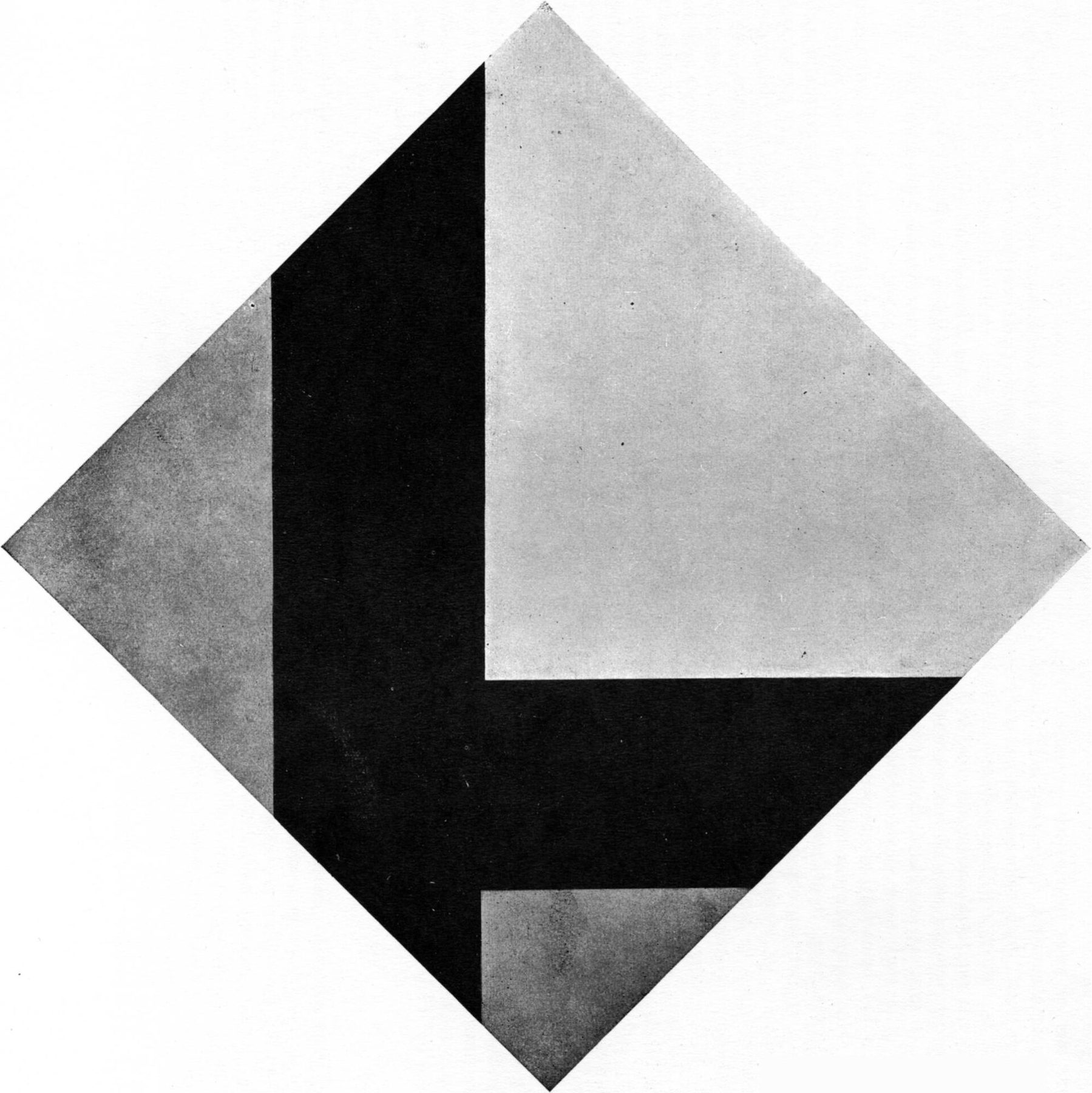
Malevich: forms in an unbounded field
Kazimir Malevich announced Suprematism publicly in the charged setting of the 0.10 exhibition in Petrograd in 1915. Black Square occupied the upper corner of the room, a position associated in Russian homes with an icon. The placement made an audacious claim for a new image, but the work was not merely a secular replacement for religion. It condensed arguments about zero, nonobjective feeling, artistic creation and a world no longer organised by depicted things.[17]
Suprematist works radically altered the behaviour of pictorial space. Rectangles, bars, crosses and circles float against white. Conventional horizon and gravitational ground disappear. Tilt gives a form direction, while unequal intervals make it seem to approach, recede or hover. White is not leftover canvas; it is an active, apparently unbounded field.
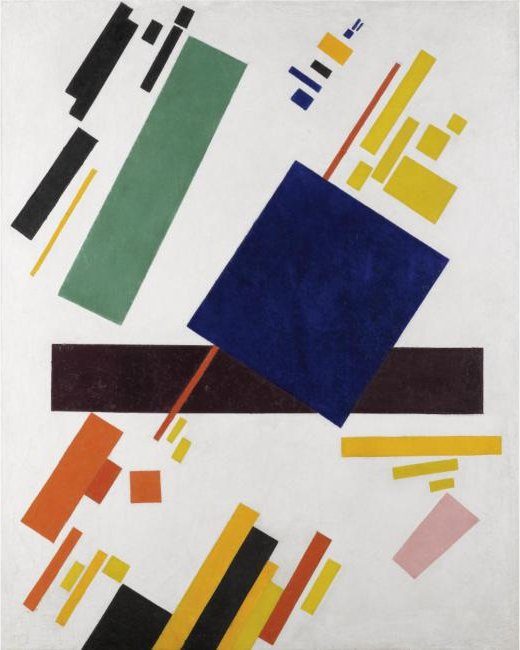
Suprematist Painting, 1916–17
MoMA's Suprematist Painting places coloured quadrilaterals and bars at changing angles. Their hues are clear but not mechanically uniform, and the paint surface keeps them bodily. Some shapes overlap; others remain separated by white. The viewer senses weight and flight without being shown an aircraft or landscape.[16]
The tension lies between material fact and imagined infinity. Every plane is pigment on a finite rectangular canvas, yet the white spaces imply that the visible forms are only a temporary constellation extending beyond it. Titles and contemporary discussions sometimes invoked aerial views or a “fourth dimension,” but literal illustration would reduce the painting. Its force comes from making orientation uncertain.
Malevich's pursuit of an absolute differs from Mondrian's equilibrium and from Constructivist production. His own later return to the human figure also warns against treating abstraction as a completed evolutionary stage. Artists changed under personal, institutional and political pressure. A geometric language could be abandoned, revised and remembered without invalidating its earlier claims.
Popova and Constructivism: geometry becomes material and social
Liubov Popova encountered Cubist and Futurist art, worked in Vladimir Tatlin's circle and joined the Supremus group around Malevich. Her Painterly Architectonics do not simply blend those influences into a neutral style. They make the very act of construction visible.[47] [49]
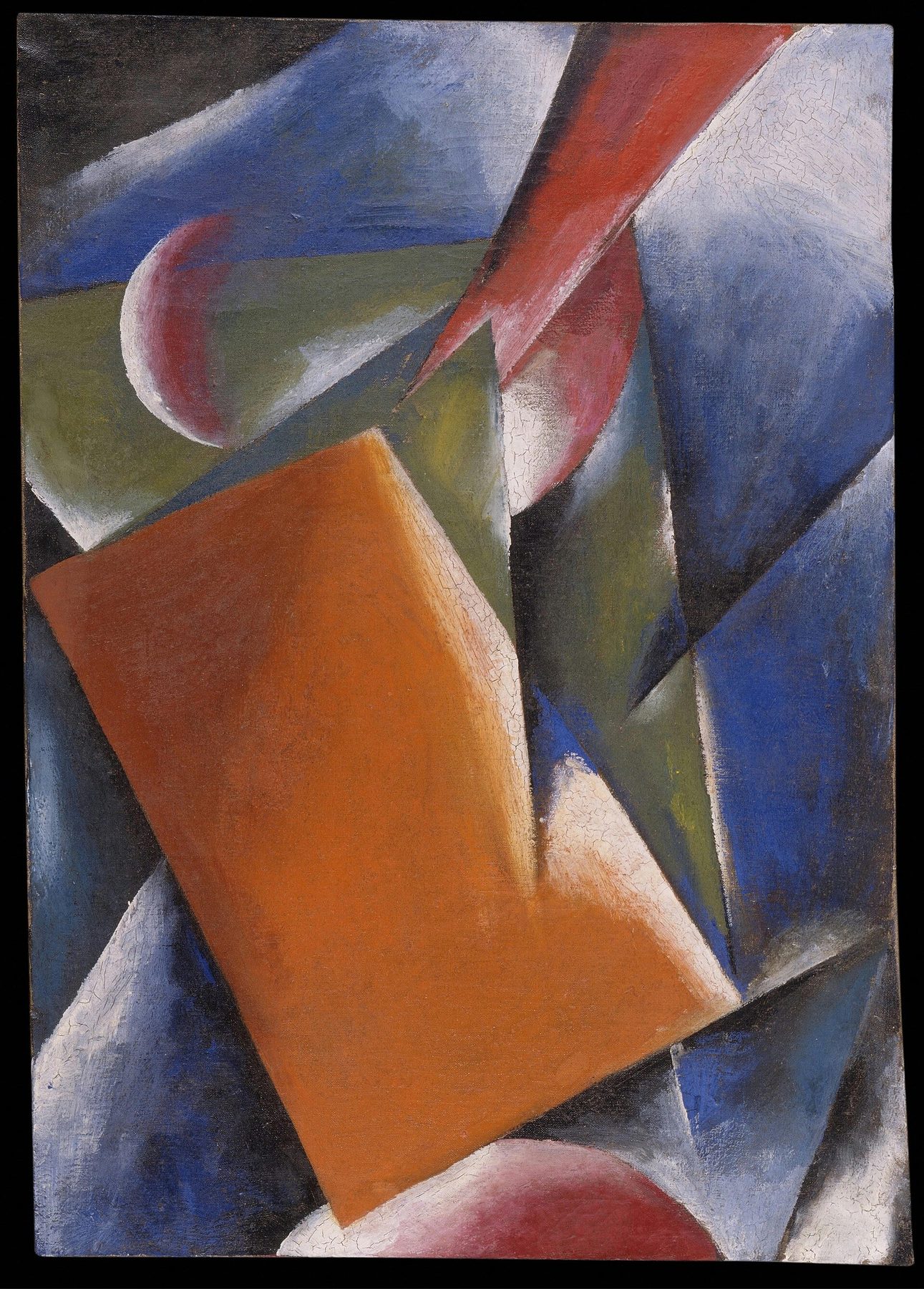
Painterly Architectonic, 1917
In MoMA's painting, red, pink, grey, black and white planes overlap in a taut, shallow field. Most edges slant. A curved grey underside suggests that one plane bends or lifts, while an acute red wedge appears to drive between neighbouring parts. The forms seem simultaneously painted flat and assembled like material sheets.[46]
Popova's term “architectonic” directs attention to relation and load. The composition has no building to represent, yet it feels built. A plane gains identity from the pressure it applies to another. Surface variation and carefully worked paint—what Russian artists discussed as faktura—keep the picture from becoming a frictionless graphic emblem. Geometry has density.
The Russian Revolution changed the stakes of construction. Artists debated whether autonomous studio painting could serve a transformed society. Constructivists increasingly described themselves as organisers, engineers or producers and turned toward industrial materials, typography, exhibitions, theatre, clothing and mass manufacture.[48] Similarity to Suprematist painting did not mean ideological continuity: weightless absolute space and socially useful construction could point in opposing directions.
Popova's path is especially instructive. She developed stage sets and costumes for Vsevolod Meyerhold, then designed printed fabrics with Varvara Stepanova. Repetition now met bodies, labour, machinery, cost and distribution. Stepanova and Aleksandr Rodchenko likewise moved among textiles, books, posters, photography and spatial structures. Their careers make it impossible to confine geometric abstraction to framed canvases.[47] [50]
The promise of social utility should not be romanticised. Factory production imposed practical limits, state cultural priorities changed, and ambitious designs did not automatically transform everyday life. Yet the attempt altered the meaning of abstract form. A stripe on cloth was not a smaller painting: it entered movement, wear, manufacturing and public visibility.
Mondrian and De Stijl: equilibrium without symmetry
Piet Mondrian did not arrive at vertical black lines and primary colours by erasing nature in a single decision. His path passed through Dutch landscape, trees, dunes, Cubist analysis and increasingly spare oval compositions. Between about 1915 and 1920, he developed Neoplasticism as a restricted language capable, he believed, of balancing universal order and individual particularity.[14] [45]
Restriction created choices rather than eliminating them. Lines differ in thickness and length. Some stop before the edge or meet another band unevenly. White areas occupy distinct proportions. Red, blue and yellow appear selectively, not according to a repeating grid. The work depends on judgement at every junction.
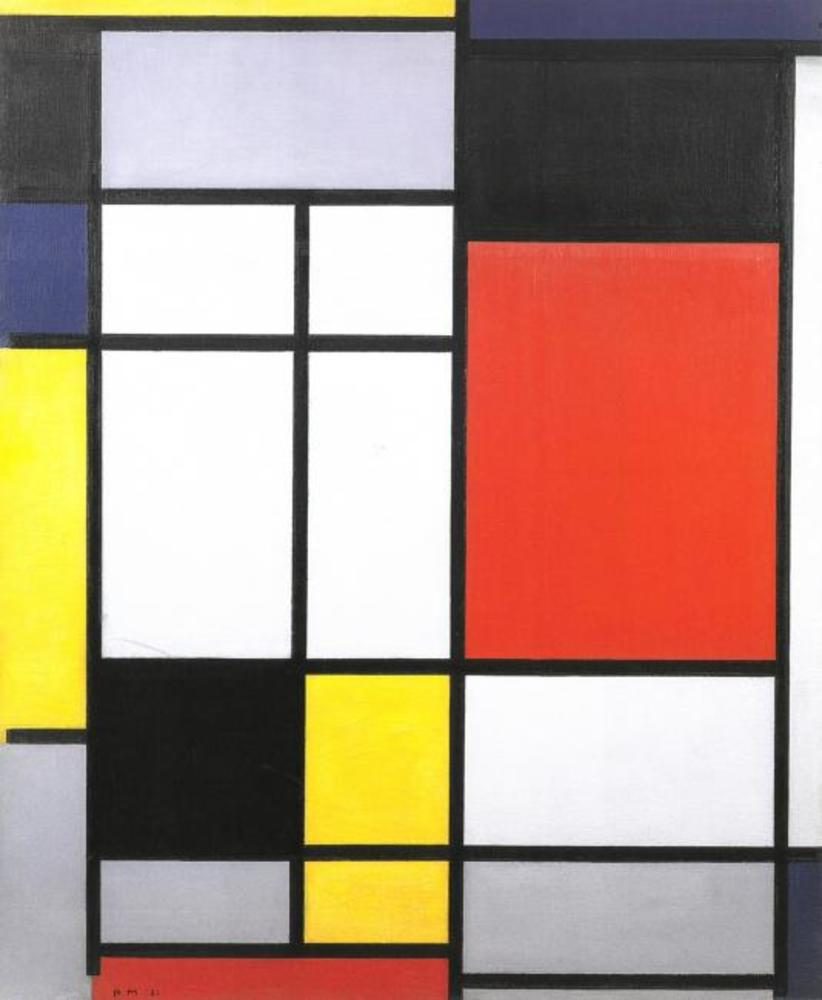
Composition with Red, Blue, Black, Yellow, and Gray, 1921
In the 1921 composition at MoMA, a large pale field initially looks empty, but the surrounding bands continually rebalance it. A red block has greater visual weight than a much smaller yellow interval. Blue settles into another sector, while black becomes both line and compact area. No axis mirrors the other.[12]
The picture achieves equilibrium through inequality. If one coloured field were enlarged, or a black line extended, the pressure of the whole would change. This is why Mondrian's art is poorly served by generic “Mondrian-style” merchandise made from regular grids and arbitrarily coloured boxes. His compositions are particular solutions, not wallpaper algorithms.
Close inspection also reveals a made surface. Paint density changes; edges have been adjusted; supposedly identical whites are inflected by neighbouring colour and material history. The eye should move from reproduction to object, testing how the canvas activates a room and the viewer's body.
De Stijl, founded around a journal in 1917, carried related principles beyond Mondrian's studio. Theo van Doesburg, Bart van der Leck, Vilmos Huszár, Gerrit Rietveld and others developed typography, stained glass, furniture, architecture and interiors. Vertical-horizontal planes could divide a window or room as readily as a canvas.[31] Rietveld's furniture made colour and line into a structure one could occupy.
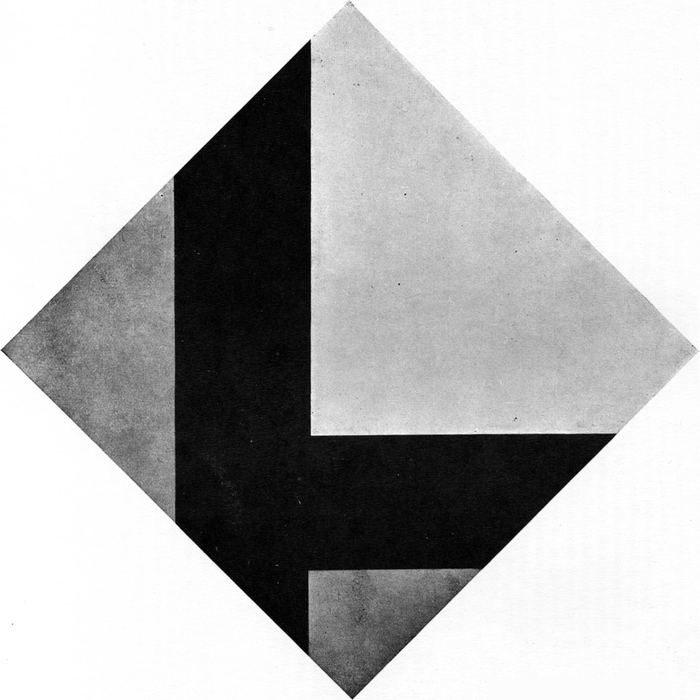
The group was never perfectly unified. Van Doesburg's adoption of diagonals in Elementarism clashed with Mondrian's vertical-horizontal commitment. Collaborative interiors also revealed the difficulty of coordinating painterly ideas with architectural function. Such arguments are not failures around a pure style; they are evidence that geometry carried contested views of space and life.
Mondrian continued to revise his language. Later compositions changed their density and rhythm, and works made across European displacement record long processes of adjustment. Trafalgar Square, begun before or during his time in London and revised after his move to New York, preserves the history of migration in tape, colour and altered intersections.[15] Another late composition shows that the grid remained developmental rather than fixed.[13]
Bauhaus: geometry as a laboratory
The Bauhaus is frequently reduced to white modern buildings and neat circles, triangles and squares. In reality, it changed greatly between its foundation in Weimar in 1919, its Dessau period and its final Berlin months before closure in 1933. Its faculty and workshops disagreed about expression, craft, industry, spirituality, standardisation and social purpose.[33] [43]
Geometry was valuable because it could be analysed, repeated and transferred. Preliminary courses asked students to examine material, colour, contrast and composition before entering workshops. Kandinsky built exercises around directional forces and shape-colour relations. Klee investigated how a point becomes a line, how lines generate planes and how growth or movement can be constructed rather than copied.[25] [32]
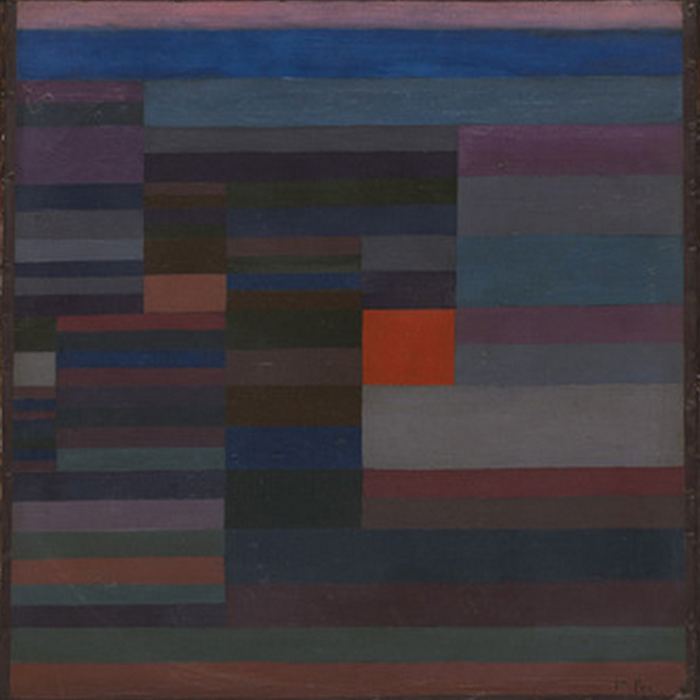
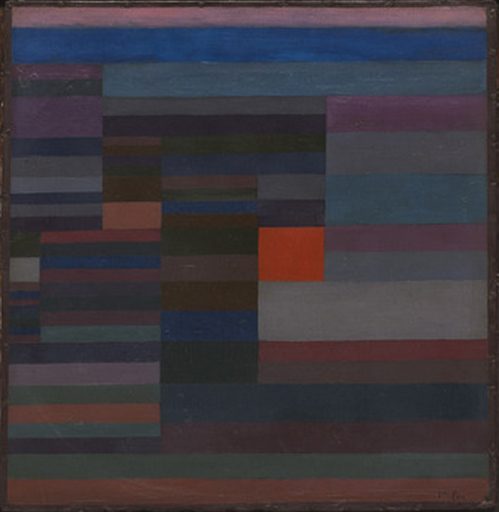
Klee's Fire in the Evening, 1929
Paul Klee arranged Fire in the Evening as horizontal bands of muted violet, ochre, blue-grey and brown crossed by one glowing red rectangle. Its geometry appears severe until the colour intervals begin to suggest soil, river, horizon and heat. Memories of Klee's Egyptian journey and cultivated fields inform the work without turning it into a topographical view.[24]
The red form is small but decisive. It interrupts a low, lateral rhythm and gives the surrounding muted hues a different temperature. Because it sits within rather than above the bands, it can feel like sun, fire, doorway or purely chromatic event. The painting does not require a choice between landscape and abstraction. It demonstrates how remembered nature can survive as relation.
Klee repeatedly resisted closed systems. Natural growth, music, mathematics, children's marks and microscopic structures supplied processes rather than motifs to copy. His experience in Tunisia intensified his confidence in colour, while his later teaching and works ranged across oil, watercolour, drawing and unusual supports.[26] [27] The Bauhaus did not make him a doctrinaire geometer.
László Moholy-Nagy expanded the laboratory toward modern media. Photograms used light without a camera to make objects register as luminous traces. Typography organised reading through scale, direction and white space. Film, kinetic structures and reflective materials transformed geometry over time.[35] His so-called telephone pictures, ordered through specifications rather than painted directly by his hand, also tested authorship and industrial mediation.
Weaving was just as consequential. Women were often steered into the textile workshop despite the school's claims of open access, an institutional bias that should not be disguised as free choice. Anni Albers, Gunta Stölzl and their colleagues nevertheless made the loom a sophisticated site of modern research. The grid arose from warp and weft as material structure, not as a painted sign. Fibre absorbed light, carried touch and answered the demands of architecture and manufacture.
Stage design, furniture, metalwork, photography and architecture further altered geometric form. A circle cut into a costume changes as a performer moves. A tubular chair must bear weight. A typeface must guide attention. The Bauhaus contribution was therefore not one look but a culture in which basic relations could be tested across practical and perceptual situations.[40]
Sophie Taeuber-Arp: precision, movement and play
Sophie Taeuber-Arp exposes the weakness of any history that ranks painting above craft, design and performance. Trained in textile design, she understood modular structure through thread, repetition and reversal. As a dancer in Zurich Dada, she made abstract form bodily. Her marionettes turned cylinders, joints and painted planes into characters whose movement could be comic, awkward or uncanny.[28] [29]
The Aubette entertainment complex in Strasbourg brought Taeuber-Arp, Jean Arp and Theo van Doesburg into a vast collaborative interior during the late 1920s. Colour and geometry surrounded visitors in cafés, stairways and rooms rather than waiting within frames. People crossed the composition, sat inside it and changed it through social use.
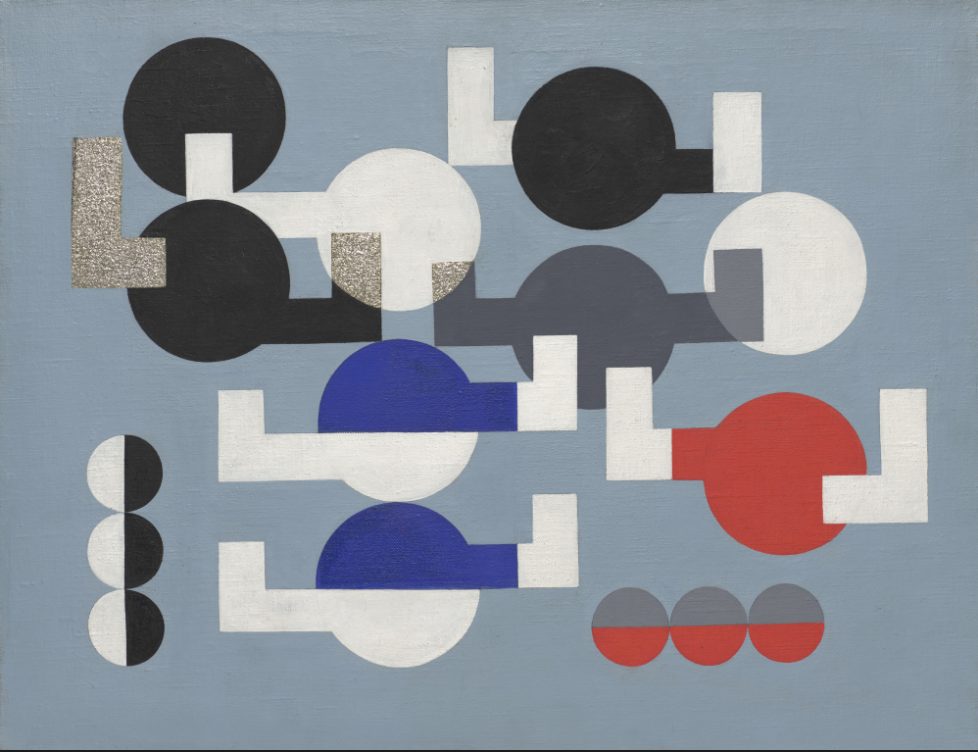
Her 1930 Composition and related works reward slow attention to interval and personality. Rectangles and circles appear exact enough to imply order, yet shifts of scale and placement prevent mechanical repetition. Later reliefs introduce projecting parts and curved forms. Precision becomes a condition for surprise, not an enemy of it.[30]
Taeuber-Arp joined Cercle et Carré and Abstraction-Création and helped edit the multilingual review Plastique/Plastic. An early MoMA retrospective contributed to her museum recognition, but it also reveals how long applied work had been treated as peripheral to a painting-centred canon.[41] Recent scholarship presents the textile, dance, interior, relief and painting as one connected practice rather than a climb from craft to fine art.
Paris networks and the claim of concrete art
Paris in the 1930s offered a meeting place for artists displaced by war, revolution, new borders and limited opportunities at home. Cercle et Carré organised a journal and 1930 exhibition around abstraction. Abstraction-Création followed in 1931 as a larger international association, publishing portfolios and countering Surrealism's public dominance.[5] [30]
These groups were coalitions, not movements with identical aesthetics. Their members included artists committed to grids, biomorphic curves, optical rhythm, relief and sculpture. František Kupka, Auguste Herbin, Jean Hélion, Joaquín Torres-García, Taeuber-Arp and others brought different histories. The organisational frame mattered because it enabled exhibition, publication and exchange when abstract work lacked a secure market.
Van Doesburg's concrete-art formulation sharpened one philosophical position: a work should be conceived from visual elements and constructed before execution, without naturalistic or symbolic reference. His provocative assertion that nothing is more concrete than line, colour and plane reversed the assumption that abstract art is remote from reality.[3] But the term did not retroactively describe every geometric painting. Klee's remembered landscape, Kandinsky's inner necessity and Malevich's absolute each preserve claims concrete art was designed to reject or redefine.
The 1930s also connected Europe to a much broader future. Artists and ideas circulated into Britain, the United States and Latin America. Joaquín Torres-García returned to Montevideo in 1934 and developed Constructive Universalism from European networks and American cultural thinking. That later history deserves its own geographical depth. Here it is enough to recognise that European geometric abstraction did not simply export a finished style; it entered new intellectual, political and material conversations.
Politics, repression and migration
No shape has a stable politics. A red rectangle can appear in revolutionary propaganda, spiritual painting, commercial textile or an elite collector's interior. Geometry supported visions of universal harmony and industrial efficiency, but it could also be detached from those visions and marketed as fashionable decoration. Interpretation must recover institution and use rather than assign morality to form.
Russian artists confronted this problem directly. Constructivist commitment to production linked abstraction to a revolutionary society, yet state priorities and cultural authority narrowed the field during the 1920s and 1930s. Some artists moved into photography or design; others revised, concealed or abandoned earlier experiments. MoMA's Russian avant-garde display records how the artists' own understanding of painting changed before later American museums collected the works as autonomous masterpieces.[50]
In Germany, the Nazi regime attacked modernist practices, removed works, persecuted artists and closed the Bauhaus in 1933. Faculty and students dispersed. Josef and Anni Albers went to Black Mountain College; Moholy-Nagy founded the New Bauhaus in Chicago in 1937; others travelled through Britain, Switzerland and the Americas.[34] Migration spread teaching and form, but “influence” should not make forced displacement sound like a frictionless success story.
Kandinsky settled in France. Mondrian moved from Paris to London and then New York. Taeuber-Arp and Jean Arp repeatedly relocated before her accidental death in 1943. Political borders, language, visas, institutions and patronage affected what could be made and seen. The international history of geometric abstraction is inseparable from interrupted lives.
The story museums told
Alfred H. Barr Jr.'s 1936 exhibition Cubism and Abstract Art gave the public one of modern art's most memorable diagrams. Arrows connected movements and sources in a branching genealogy. The exhibition helped establish abstraction as a coherent historical subject and placed Cubism at a crucial junction.[36]
The diagram remains useful, but its clarity carries a cost. It can make change look inevitable, as though art naturally purified itself from representation toward abstraction. It privileges named movements and visually traceable influence. Textiles, dance, commercial design, spiritual privacy, collaborative environments and artists outside the museum's collection become harder to plot.
Later exhibitions have revised rather than simply discarded that account. MoMA's 1985 Contrasts of Form traced geometric art across seven decades and an international collection.[4] Inventing Abstraction replaced the family tree with a dense network of artists, writers, composers and intermediaries.[37] Collection searches now make hybrid and neglected positions easier to see, though every database still reflects decisions about category and acquisition.[38]
Robert Delaunay's changing museum reception illustrates the process. Formalist narratives celebrated colour becoming a subject in itself.[42] That insight remains valuable, but it can isolate colour from urban technology, collaboration with Sonia, exhibitions and decorative commissions. Likewise, museum recovery of Taeuber-Arp helps correct exclusion only if her textiles and interiors are treated as intellectually central rather than colourful preliminaries to painting.
A good history needs both map and resistance to the map. Movement names make a complicated field navigable. Objects then reveal where the names fail.
After 1940: inheritance without a single succession
The prewar vocabulary did not end when its European institutions were broken. It was redistributed. Teachers carried workshop methods into new schools; émigré artists entered unfamiliar exhibition systems; reproductions and museum displays supplied younger makers with partial genealogies. The result was not one successor movement. Concrete-art groups in Europe and Latin America, American Abstract Artists, Brazilian and Venezuelan constructive practices, hard-edge painting, Op art and Minimalism each selected different problems from the earlier field.[4] [34] [45]
Some artists intensified optical instability, making repeated units flicker or swell. Others reduced colour and shape to test the objecthood of painting or sculpture. Latin American artists developed kinetic, participatory and architectural forms within local debates that cannot be explained as European style travelling unchanged. Even the supposedly impersonal square acquired new relations to serial production, corporate space, embodiment and the museum.
This later history also changed the way prewar works were seen. Once Minimalism had made industrial boxes familiar, Tatlin and Rodchenko could look like its ancestors; after Op art, Delaunay's chromatic pulses seemed newly predictive. Such comparisons can illuminate formal possibilities, but hindsight should not turn early artists into people waiting for later movements. Their works addressed the wars, revolutions, spiritual debates, technologies and institutions of their own period first.
Geometric abstraction endures because it is a reusable visual problem rather than a closed period costume. Every revival must decide anew whether order will be handmade or industrial, universal or situated, contemplative or participatory. The vocabulary is limited; its historical meanings are not.
How to look at geometric abstraction
Begin with the smallest active unit. Is it a line, band, square, circular segment, woven module or piece of relief? Notice whether the unit repeats exactly or changes. Repetition establishes expectation; one altered interval can then become the event.
Next study direction and weight. Horizontal forms tend to stabilise a field, while diagonals can accelerate it, but placement and colour may overturn that tendency. A tiny saturated red can balance a much larger grey area. Ask where the eye pauses and which form pulls it onward.
Examine the space. Malevich's forms float in open white, Popova's planes press into shallow layers, Mondrian's bands hold colour at the surface, and an Aubette interior surrounds a moving body. Calling all four “flat” loses the different experiences they construct.
Look for the hand and material. Painted edges may have ridges, corrections or underlayers. A loom fixes one axis through warp and develops another through weft. Wood relief casts a shadow that changes with light. Photograms depend on exposure and object placement. Precision is an achieved effect, not evidence that the object escaped making.
Then test the relation to the visible world. Does a city tower remain inside Delaunay's colour? Does Klee's banded picture retain fields and sunset? Does Léger's body become machine-like without disappearing? Abstraction from a motif and nonobjective invention can coexist within one career or even one work.
Finally, reconstruct the claim. The same grid may seek spiritual order, rational design, social production or visual play. Labels should open inquiry: they should never replace looking.
Essential works of geometric abstraction
Composition 8
Wassily Kandinsky · 1923 · Circles, arcs and diagonals create a field of forces whose precision never becomes emotionally cold.
Windows
Robert Delaunay · 1912 · Coloured planes repeatedly reveal and dissolve the Eiffel Tower and window structure, making perception itself the event.
The Three Windows, the Tower and the Wheel
Robert Delaunay · 1912 · Tower, wheel and panes remain legible while chromatic contrast pushes the motif towards autonomy.
Suprematist Composition
Kazimir Malevich · 1916 · Tilted colour planes appear weightless inside an active white field without relying on a depicted horizon.
Painterly Architectonic
Liubov Popova · 1917 · Overlapping planes behave like material parts under pressure, joining flatness to visible construction.
Composition with Yellow, Blue, Black, Red and Gray
Piet Mondrian · 1921 · Unequal fields and varied bands produce dynamic equilibrium rather than a decorative or mechanical grid.
Fire in the Evening
Paul Klee · 1929 · Horizontal bands and one red interval allow remembered landscape and geometric structure to coexist.
Composition
Sophie Taeuber-Arp · 1930 · Measured rectangles and circles combine precision with shifts of rhythm, scale and play.
Counter-Composition VIII
Theo van Doesburg · 1924 · Diagonal structure makes De Stijl's internal arguments visible and breaks with Mondrian's vertical-horizontal restriction.
Three Women
Fernand Léger · 1921 · Human figures, furniture and cups become monumental geometric volumes without losing their representational identity.
Where to see geometric abstraction
Museum of Modern Art, New York
MoMA's collection places Malevich, Mondrian, Popova, the Delaunays, Klee, Léger and later abstraction in unusually direct conversation. Its historic exhibitions also make the museum itself part of the story: viewers can compare the objects with the canon that Barr and his successors constructed.[36] [38]
Solomon R. Guggenheim Museum, New York
The Guggenheim's origins in the Museum of Non-Objective Painting and its major Kandinsky holdings make it essential. Composition 8 can be studied as a physical surface and at a scale that online diagrams cannot convey.[6] [10]
Centre Pompidou, Paris
The collection is especially strong for Robert and Sonia Delaunay, Kupka, Kandinsky, Mondrian and the Paris networks. French-language research records help connect objects to the exhibitions and terminology through which abstraction circulated.[5] [20] [22]
Kunstmuseum Den Haag, The Hague
The museum's exceptional Mondrian holdings allow a visitor to follow the journey from landscape and trees to grids and late rhythms. That continuity is the best antidote to the idea that his mature language appeared fully formed.
Stedelijk Museum Amsterdam
De Stijl, international abstraction, design and postwar responses meet in a collection where painting can be compared with furniture, typography and architecture. The setting makes the Dutch movement wider than one celebrated artist.
Bauhaus-Archiv / Museum für Gestaltung, Berlin
Workshop objects, photographs, plans, textiles and teaching material reveal the institutional variety concealed by the phrase “Bauhaus style.” The collection is invaluable for understanding geometry as education and practical experiment.[33] [43]
Zentrum Paul Klee, Bern
Klee's works and pedagogical archive support an unusually deep view of how geometry, nature, music and material process interact. The breadth also demonstrates how selective it is to call him simply a geometric abstractionist.[25] [27]
Tate Modern, London
Tate displays geometric abstraction within international modernism, often placing painting beside sculpture, photography and political history. Its Malevich holdings and exhibition scholarship illuminate the specific claims and later reception of Suprematism.[17]
Where to see geometric abstraction
Displays rotate and some works travel or remain in storage. Check the current collection display before travelling.
- 01
Museum of Modern Art
New York, USA
Malevich, Mondrian, Popova, the Delaunays, Klee and Léger can be compared with the influential histories the museum itself constructed.
Core works and movement historiographyVisit collection website - 02
Solomon R. Guggenheim Museum
New York, USA
The museum's nonobjective origins and major Kandinsky holdings make it indispensable for studying Composition 8 and its broader context.
Kandinsky and nonobjective artVisit collection website - 03
Centre Pompidou
Paris, France
Robert and Sonia Delaunay, Kupka, Kandinsky, Mondrian and the Paris networks are represented across painting, design and archival research.
Colour abstraction and Paris networksVisit collection website - 04
Kunstmuseum Den Haag
The Hague, Netherlands
Exceptional Mondrian holdings trace the long transition from landscape and trees to Neoplastic grids and late rhythms.
Mondrian in depthVisit collection website - 05
Stedelijk Museum Amsterdam
Amsterdam, Netherlands
De Stijl, international abstraction, furniture and design reveal how geometric form crossed from canvas into the environment.
De Stijl and international abstractionVisit collection website - 06
Bauhaus-Archiv / Museum für Gestaltung
Berlin, Germany
Workshop objects, textiles, photographs, plans and teaching materials replace the myth of one Bauhaus style with an evolving institution.
Bauhaus workshops and teachingVisit collection website - 07
Zentrum Paul Klee
Bern, Switzerland
Klee's art and pedagogical archive show how geometry, nature, music and material experiment remained interdependent.
Klee's art and teachingVisit collection website - 08
Tate Modern
London, UK
International displays and Malevich scholarship connect geometric painting to sculpture, politics and the specific claims of Suprematism.
Suprematism and international modernismVisit collection website
Suggested books
Inventing Abstraction, 1910–1925: How a Radical Idea Changed Modern Art, edited by Leah Dickerman
This expansive catalogue replaces the myth of a few isolated inventors with a network of painters, writers, dancers, musicians and publishers. It is the strongest single introduction to abstraction as exchange across cities and media.
Kandinsky Compositions, by Magdalena Dabrowski
Dabrowski's close study of Kandinsky's major series connects theory, drawings and physical development. It is particularly useful for understanding why geometric structure in the 1920s did not erase expressive purpose.
Painting as Model, by Yve-Alain Bois
Bois offers demanding, influential readings of Mondrian and other modernists. The book rewards readers who want to move beyond the idea that abstract pictures are diagrams of theories and instead examine how each painting thinks through its material relations.
The De Stijl Environment, by Nancy J. Troy
Troy follows De Stijl into architecture and interior design, where artistic ideals encountered patrons, rooms, collaboration and use. It provides a necessary counterweight to histories centred only on Mondrian's canvases.
Sophie Taeuber-Arp: Living Abstraction, edited by Anne Umland, Walburga Krupp and Charlotte Healy
This richly illustrated study integrates textiles, beadwork, dance, marionettes, interiors, reliefs, painting and publishing. It makes a persuasive case that media hierarchy has distorted the history of geometric abstraction.[29]
Major artists associated with geometric abstraction
| Name | Nationality | Key Works |
|---|---|---|
| Aleksandr Rodchenko | Russian | Pure Red Color, Pure Yellow Color, Pure Blue Color · Spatial Construction |
| Anni Albers | German-American | Wall Hanging · Ancient Writing |
| Auguste Herbin | French | Le Cygne · Union |
| Bart van der Leck | Dutch | Composition 1918 · The Storm |
| Fernand Léger | French | Three Women · The City |
| František Kupka | Czech | Amorpha: Fugue in Two Colors · Vertical Planes |
| Georges Braque | French | Violin and Palette · Fruit Dish and Glass |
| Gerrit Rietveld | Dutch | Red and Blue Chair · Schröder House |
| Gunta Stölzl | German | Slit Tapestry Red-Green · Five Choirs |
| Hilma af Klint | Swedish | The Ten Largest · Altarpieces |
| Jean Arp | French-German | Collage with Squares Arranged According to the Laws of Chance · Configuration |
| Joaquín Torres-García | Uruguayan | Constructive Composition · América Invertida |
| Josef Albers | German-American | Homage to the Square · Variant/Adobe |
| Kazimir Malevich | Russian | Black Square · Suprematist Composition |
| Liubov Popova | Russian | Painterly Architectonic · Space-Force Construction |
| László Moholy-Nagy | Hungarian | A 19 · Light-Space Modulator |
| Pablo Picasso | Spanish | Ma Jolie · Guitar |
| Paul Klee | Swiss-German | Fire in the Evening · Castle and Sun |
| Piet Mondrian | Dutch | Composition with Red, Blue, Black, Yellow, and Gray · Trafalgar Square |
| Robert Delaunay | French | Windows · Simultaneous Contrasts: Sun and Moon |
| Sonia Delaunay | Ukrainian-French | Portuguese Market · Electric Prisms |
| Sophie Taeuber-Arp | Swiss | Composition · Aubette interiors |
| Theo van Doesburg | Dutch | Counter-Composition VIII · Arithmetic Composition |
| Varvara Stepanova | Russian | The Results of the First Five-Year Plan · Textile designs |
| Vladimir Tatlin | Russian | Corner Counter-Relief · Monument to the Third International |
| Wassily Kandinsky | Russian | Composition VIII · Several Circles |
Frequently Asked Questions
Geometric abstraction emphasises regular or constructed units such as bands, angles, circles and grids. Organic abstraction favours irregular curves and growth-like shapes. Artists frequently combine the two, so the distinction is descriptive rather than an absolute border.[30]
Discussion
Choose one work and ignore its title for a minute. Where does your eye stop, accelerate or change direction? Then restore the title, medium and historical claim. Does that knowledge confirm the visual experience, or reveal that the same geometry could have meant something quite different to another artist?
Reader Insights
Begin with the active element—a line, band, circle, plane, woven module or relief—and notice how repetition creates expectation.
Ask whether forms float, press into layers or surround the body, then look for ridges, corrections, woven texture and joins.
The same grid can serve spiritual order, rational design, social production or play; form alone never supplies the whole history.
Join the Conversation
Choose one work and ignore its title for a minute. Where does your eye stop, accelerate or change direction—and what changes when you restore its history?
References
- Geometric Abstraction. Museum of Modern Art. View Source
- Abstraction. Museum of Modern Art. View Source
- Art Terms C. Museum of Modern Art. View Source
- Contrasts of Form: Geometric Abstract Art 1910–1980. Museum of Modern Art. View Source
- Cercles et Carrés. Centre Pompidou (French; consulted in French). View Source
- Permanent Collection Teaching Materials. Solomon R. Guggenheim Museum. View Source
- Kandinsky in Context. Solomon R. Guggenheim Museum. View Source
- The Geometry of Kandinsky and Malevich. Solomon R. Guggenheim Museum. View Source
- Wassily Kandinsky. Museum of Modern Art. View Source
- Composition 8. Solomon R. Guggenheim Museum. View Source
- Hilma af Klint. Museum of Modern Art. View Source
- Composition with Red, Blue, Black, Yellow, and Gray. Museum of Modern Art. View Source
- Composition No. II with Red and Blue. Museum of Modern Art. View Source
- Piet Mondrian. Museum of Modern Art. View Source
- Trafalgar Square. Museum of Modern Art. View Source
- Suprematist Painting. Museum of Modern Art. View Source
- Kazimir Malevich: Suprematism. Tate. View Source
- Windows. Museum of Modern Art. View Source
- Robert Delaunay. Museum of Modern Art. View Source
- Une fenêtre. Centre Pompidou (French; consulted in French). View Source
- Simultaneous Contrasts: Sun and Moon. Museum of Modern Art. View Source
- Contrastes simultanés. Centre Pompidou (French; consulted in French). View Source
- Portuguese Market. Museum of Modern Art. View Source
- Fire in the Evening. Museum of Modern Art. View Source
- Paul Klee: Pedagogical Sketchbook. Bauhaus-Archiv / Museum für Gestaltung (German and English; consulted in German and English). View Source
- Paul Klee. Metropolitan Museum of Art. View Source
- Klee the Abstract. Metropolitan Museum of Art. View Source
- Sophie Taeuber-Arp. Museum of Modern Art. View Source
- Sophie Taeuber-Arp: Living Abstraction. Museum of Modern Art. View Source
- Masterpieces from the Swiss Collections. Museum of Modern Art. View Source
- Was hat Bleiglas mit Bauhaus zu tun?. Bauhaus-Archiv / Museum für Gestaltung (German; consulted in German). View Source
- Classes by Wassily Kandinsky. Bauhaus Kooperation (German and English; consulted in German and English). View Source
- Das Bauhaus. Bauhaus-Archiv / Museum für Gestaltung (German; consulted in German). View Source
- The Bauhaus after 1933. Bauhaus-Archiv / Museum für Gestaltung. View Source
- Sensing the Future: László Moholy-Nagy. Bauhaus-Archiv / Museum für Gestaltung. View Source
- Cubism and Abstract Art. Museum of Modern Art / Alfred H. Barr Jr.. View Source
- Inventing Abstraction 1910–1925. Museum of Modern Art. View Source
- Abstraction in the Collection before 1938. Museum of Modern Art. View Source
- Three Women. Museum of Modern Art. View Source
- The Art of the Twenties. Museum of Modern Art. View Source
- Sophie Taeuber-Arp. Museum of Modern Art. View Source
- Modern Masters: Manet to Matisse. Museum of Modern Art. View Source
- Bauhaus-Archiv Press Kit. Bauhaus-Archiv / Museum für Gestaltung. View Source
- Frank Lloyd Wright. Museum of Modern Art. View Source
- Geometric Abstraction. Metropolitan Museum of Art / Magdalena Dabrowski. View Source
- Painterly Architectonic. Museum of Modern Art. View Source
- Liubov Popova. Museum of Modern Art. View Source
- Constructivism. Museum of Modern Art. View Source
- Liubov Popova. Museum of Modern Art. View Source
- New in the Galleries: The Russian Avant-Garde. Museum of Modern Art. View Source
- Geometric abstraction image records. Wikimedia Commons: Composition 8 (Public domain; Wikimedia Commons public-domain reproduction), Windows (Public domain; Museum of Modern Art; Wikimedia Commons), The Three Windows, the Tower and the Wheel (Public domain; Museum of Modern Art; Wikimedia Commons), Suprematist Composition (Public domain; Wikimedia Commons public-domain reproduction), Painterly Architectonic (Public domain; Wikimedia Commons public-domain reproduction), Composition with Yellow, Blue, Black, Red and Gray (Public domain; Wikimedia Commons public-domain reproduction), Fire in the Evening (Public domain; Museum of Modern Art; Wikimedia Commons), Composition (Public domain; Wikimedia Commons public-domain reproduction), Counter-Composition VIII (Public domain; Wikimedia Commons public-domain reproduction), Three Women (Public domain; Wikimedia Commons public-domain reproduction).