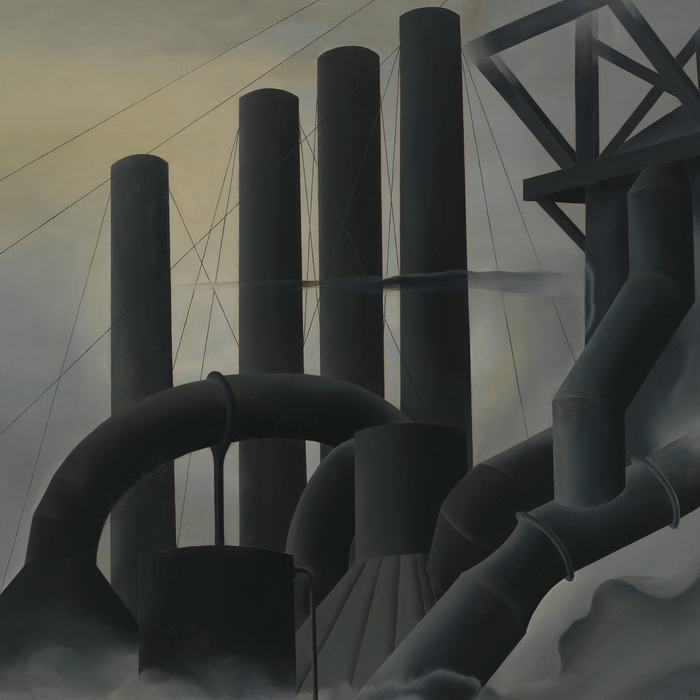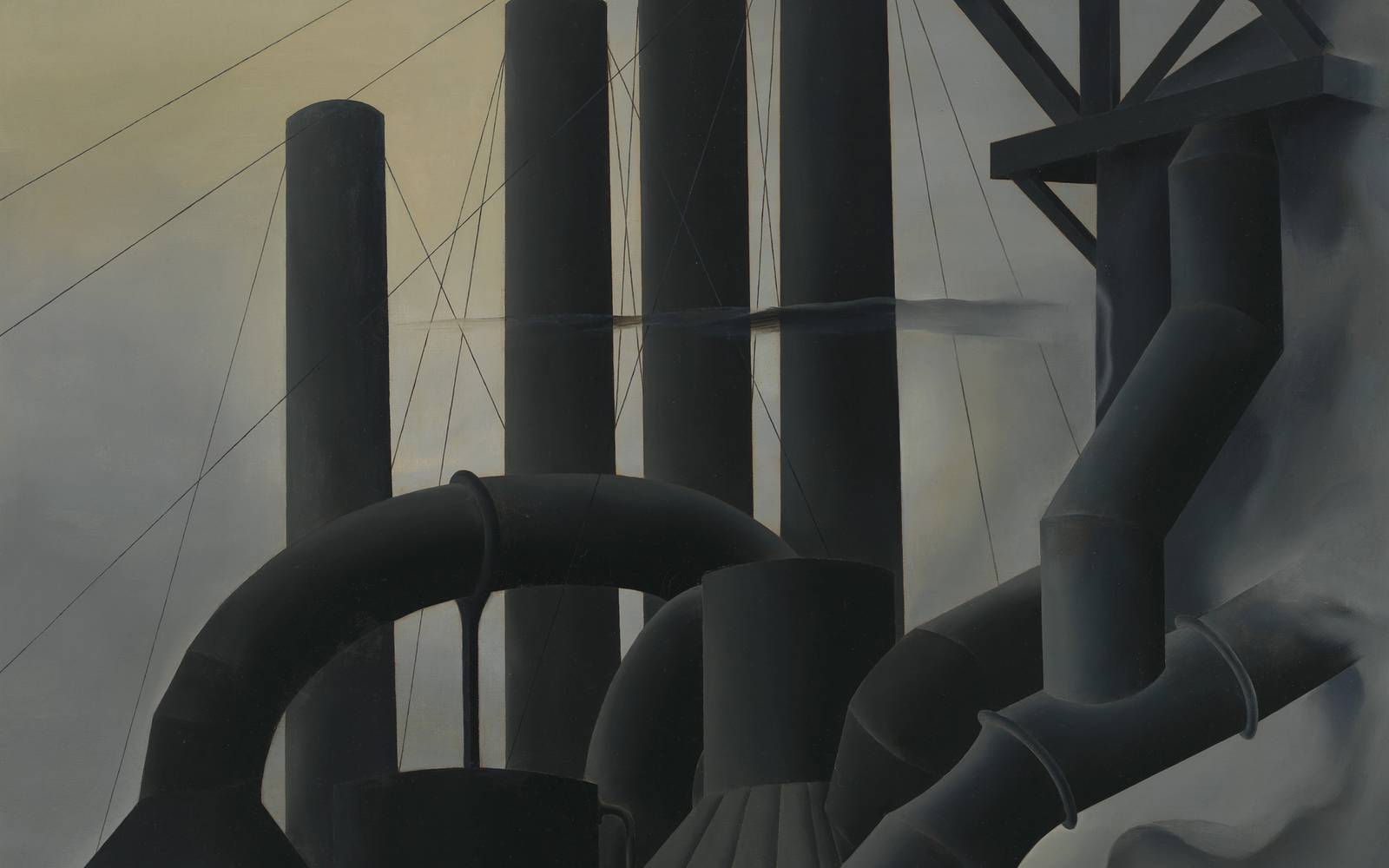
Image reference: Pittsburgh.
At a Glance
- Core periodapproximately 1915–1941, with its strongest concentration in the 1920s and 1930s
- Principal countryUnited States, especially New York, Pennsylvania, Michigan and other industrial or urban centres
- Statusa later umbrella term, not a formal society or manifesto movement
- Central artistsCharles Sheeler and Charles Demuth
- Major associated artistsGeorge Ault, Francis Criss, Niles Spencer, Preston Dickinson, Louis Lozowick, Ralston Crawford and Elsie Driggs
- Selectively connectedGeorgia O’Keeffe, Morton Schamberg, Gerald Murphy, Joseph Stella and several photographers
- Known forhard edges, reduced detail, smooth surfaces, strong cropping, geometric structure and recognisable American subjects
- Subjectsfactories, machinery, grain elevators, bridges, skyscrapers, streets, barns, domestic interiors and commercial objects
- Mediapainting, watercolour, drawing, lithography, photography and experimental film
- Related but distinctCubism, Purism, Futurism, Constructivism, American Realism, Social Realism and Regionalism
Contents
- Where it fits
- Naming Precisionism
- Sources and translations
- Four stages
- Major artists
- Charles Sheeler
- Essential works
- How to look
- Where to see
- Suggested books
Where Precisionism fits
Charles Sheeler
Key career periodCharles Demuth
Key career periodElsie Driggs
Key career periodRalston Crawford
Key career periodLouis Lozowick
Key career periodGeorge Ault
Key career periodPrecisionism made American modernity look unnaturally still. Factories lose their roar, skyscrapers become interlocking planes, grain elevators rise like monuments and bridges hold themselves in immaculate tension. Human figures are often absent. Brushwork recedes. Yet these pictures are not neutral records made by an emotionless eye. Their silence, cropping, geometry and polish are choices, and those choices can make the machine age appear magnificent, estranging, fragile or all three at once.
The artists now called Precisionists never formed an organisation or issued a manifesto. From around 1920, several painters, photographers and printmakers developed controlled ways of joining recognisable subjects to abstraction. The Metropolitan Museum of Art identifies recurring features—simple shapes, underlying geometry, clear contours, limited detail and smooth surfaces—while stressing that the artists were associated by style and subject rather than formal membership.[1] Precisionism is therefore a useful field of comparison, not a club whose roll can be reconstructed.
Charles Sheeler and Charles Demuth stand at its centre. Elsie Driggs, Ralston Crawford, Louis Lozowick, Preston Dickinson, Niles Spencer, Francis Criss and George Ault disclose how much variety the name contains. Parts of Georgia O’Keeffe’s and Gerald Murphy’s work enter the conversation without making either artist a permanent member. Precisionism’s history lies in these distinctions: between camera and canvas, monument and workplace, city and barn, celebration and unease.
A name applied after the fact
No artist woke one morning and signed a Precisionist declaration. The term gathered force through critics, exhibitions and later art history. Even Charles Sheeler, whose work became almost synonymous with the style, avoided attaching names too firmly to art. A National Gallery of Art study of Classic Landscape concludes that Precisionism works best as an umbrella: attempts to decide precisely who is or is not a Precisionist soon become trapped by exceptions.[2] That warning should govern the whole subject.
The names used around the work reveal the difficulty. “Immaculates” emphasised seemingly untouched surfaces; “Cubist-Realists” named the fusion of modern geometry and visible subject; “Precisionists” suggested exactness. A French Larousse account records these alternatives and places Demuth, Sheeler, O’Keeffe, Spencer, Ault and Crawford within a broad attempt to join French formal lessons to distinctly American appearances.[3] None of the labels covers every medium, date or motivation.
Nor does the familiar 1915–1941 span describe an official lifespan. It begins with precursors such as Morton Schamberg and ends broadly around wartime changes in art and technology. Within it, individual careers enter and leave the precisionist mode. A photograph may belong where a flower watercolour does not; one O’Keeffe skyscraper may illuminate the field while a New Mexico bone painting demands other histories.
The range of subjects is equally important. Factories and bridges dominate popular memory, but barns, vernacular houses, Shaker furniture, still lifes and rural structures also mattered. The Fine Arts Museums of San Francisco’s Cult of the Machine project sets industrial modernity beside an interest in the agrarian and colonial past, showing that both could be interpreted through efficiency, function and simplified form.[4] Precisionism did not merely paint the new. It used modern vision to reorder competing ideas of America.
Recent scholarship has replaced the old story of uncomplicated machine worship with a more demanding one. The Cult of the Machine catalogue frames Precisionism as a reconciliation of realism and abstraction shaped by excitement, tension and ambivalence about industrialisation.[5] That combination is visible before a viewer knows an artist’s politics. A factory’s clarity may be seductive, while its locked barriers and absent workers make the same clarity strange.
European sources and American translations
The 1913 International Exhibition of Modern Art, soon known as the Armory Show, gave many American viewers their first major encounter with European avant-garde art. It opened in New York and travelled to Chicago and Boston. The Smithsonian’s archive records its unprecedented scale and the primary documents through which its contentious reception can still be studied.[6] Cubist fragmentation, Futurist speed and the radical simplifications of modern painting became public problems rather than distant rumours.
Precisionism absorbed those lessons selectively. Cubism offered planar construction, multiple viewpoints and a way to make a depicted object answer to the flat picture surface. French Purism supplied lucid, ordered forms; Futurism supplied machinery and dynamic modern subjects. Fernand Léger made pipes, pistons, figures and signs into forceful visual units, and his mechanical compositions provide an illuminating European comparison. Yet American artists did not simply place European styles over local scenery.
The United States already contained competing modernisms. Alfred Stieglitz’s 291 gallery, Gertrude Vanderbilt Whitney’s studios, the Arensberg circle, the Société Anonyme, commercial galleries, magazines and new museums created overlapping routes for art. The National Gallery describes early American modernism as eclectic and institutionally plural, with artists trying to reconcile European knowledge, independent expression and claims for an indigenous culture.[7] Precisionism emerged from this argument, not from one teacher or school.
Its transformation of imported form can be seen in Sheeler’s Delmonico Building. The skyscraper remains identifiable, but its setbacks, blank walls and upward viewpoint become an arrangement of angles and tonal masses. MoMA describes the work as an example of “Cubist-Realism,” later called Precisionism, and relates its unusual viewpoint to Sheeler’s experiments in film.[8] Geometry does not replace the city; it selects the forces through which the city is seen.
Photography was as important as painting. Sharp focus, high or low viewpoints, cropped edges and dramatic light could disclose abstraction already present in an ordinary structure. The camera also carried a claim to mechanical exactitude that painters could imitate, question or transform. Precisionist surfaces may look photographic, but a painting takes time, combines observations and can suppress or invent far more than a single exposure.
Follow Precisionism through four stages
–19
Modernist sources and precursors
The Armory Show, photography, Cubist structure and Schamberg's machine forms establish ways of seeing American subjects through reduction, cropping and exact geometry.
–28
The central precisionist experiment
Sheeler, Demuth, Driggs and their contemporaries join recognisable buildings, signs and industrial forms to controlled surfaces and increasingly monumental scale.
–39
Expansion, labour and doubt
The Depression changes the machine's meanings as artists widen the field through lithography, workers, barriers, declining industrial sites and politically charged urban views.
–50
Wartime fracture and afterlives
Ault's nocturnal order and Crawford's wartime experience show precisionist devices persisting as confidence in technological progress becomes harder to sustain.
Charles Sheeler: house, city and factory
Sheeler’s route to industrial painting began with older buildings. Trained in Philadelphia, he travelled in Europe, learned photography and shared an eighteenth-century stone house near Doylestown with Morton Schamberg. The Metropolitan Museum traces his work from that vernacular architecture through Manhatta, city imagery, the River Rouge commission and Upper Deck, where his ambitions across media converged.[9] The modernity of his vision did not require a modern subject.
A city organised in time
In 1920 Sheeler asked Paul Strand to collaborate on a filmed portrait of Manhattan. Released in 1921, Manhatta follows a notional day from commuters arriving by ferry to sunset over the Hudson. MoMA calls it the first American avant-garde film and explains how non-narrative vignettes, Whitman intertitles, extreme angles and rapid changes of scale make the city both documentary place and abstract construction.[10]
People appear in the film, sometimes as moving masses seen from above. Their repeated hats, shoulders and paths become patterns, but they also restore labour and circulation to a visual world later paintings often empty. Skyscrapers dwarf individual bodies; smoke, water, streets and ships produce a changing rhythm. The city is not one clean composition but a sequence assembled by editing.
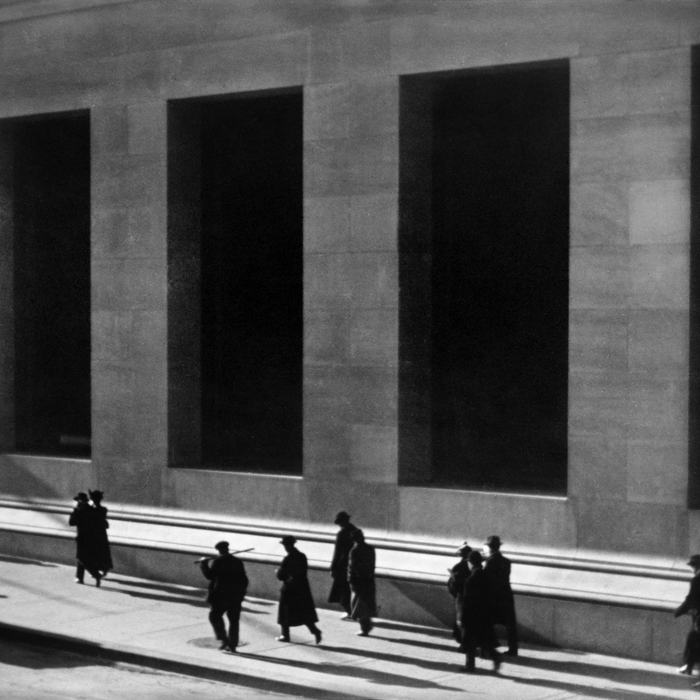
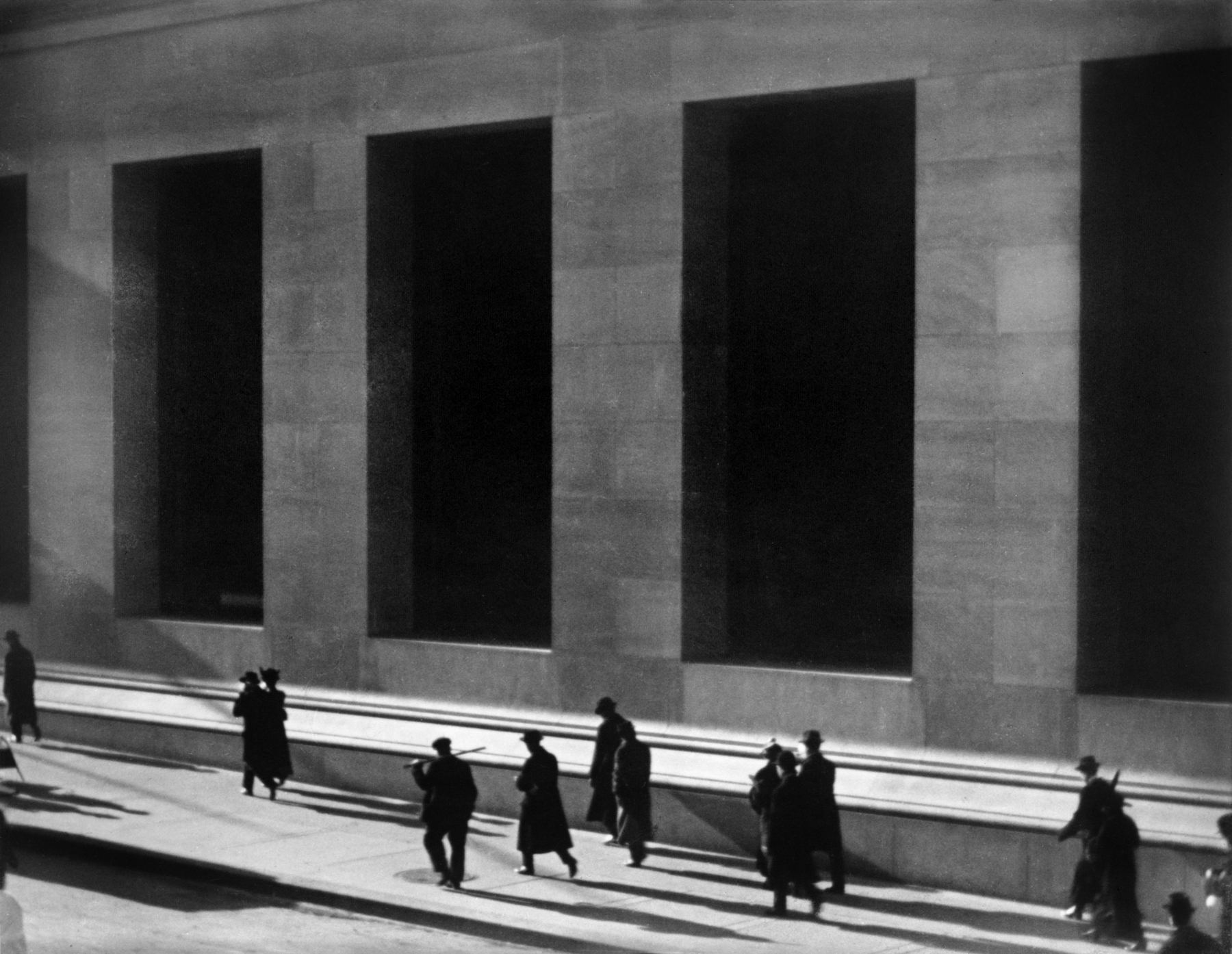
Strand’s presence matters. His direct photographs of New York had already transformed Wall Street’s architecture and pedestrians into forceful relations of darkness, scale and movement. Stieglitz presented these experiments within a wider campaign for photography as modern art. National Gallery research on the Stieglitz “Key Set” situates Strand’s 1915–16 New York images inside this changing dialogue between camera, city and abstraction.[11]
Doylestown and functional form
Sheeler’s Doylestown photographs offer a quieter experiment. In Doylestown House—Open Window, the thick wall, open frame and dark interior are sharply divided by light. The Met describes the vernacular farmhouse as an ideal subject for an artist seeking modern vision through stark geometry.[12] Nothing industrial is present, yet the image’s economy and functional construction anticipate later factories.
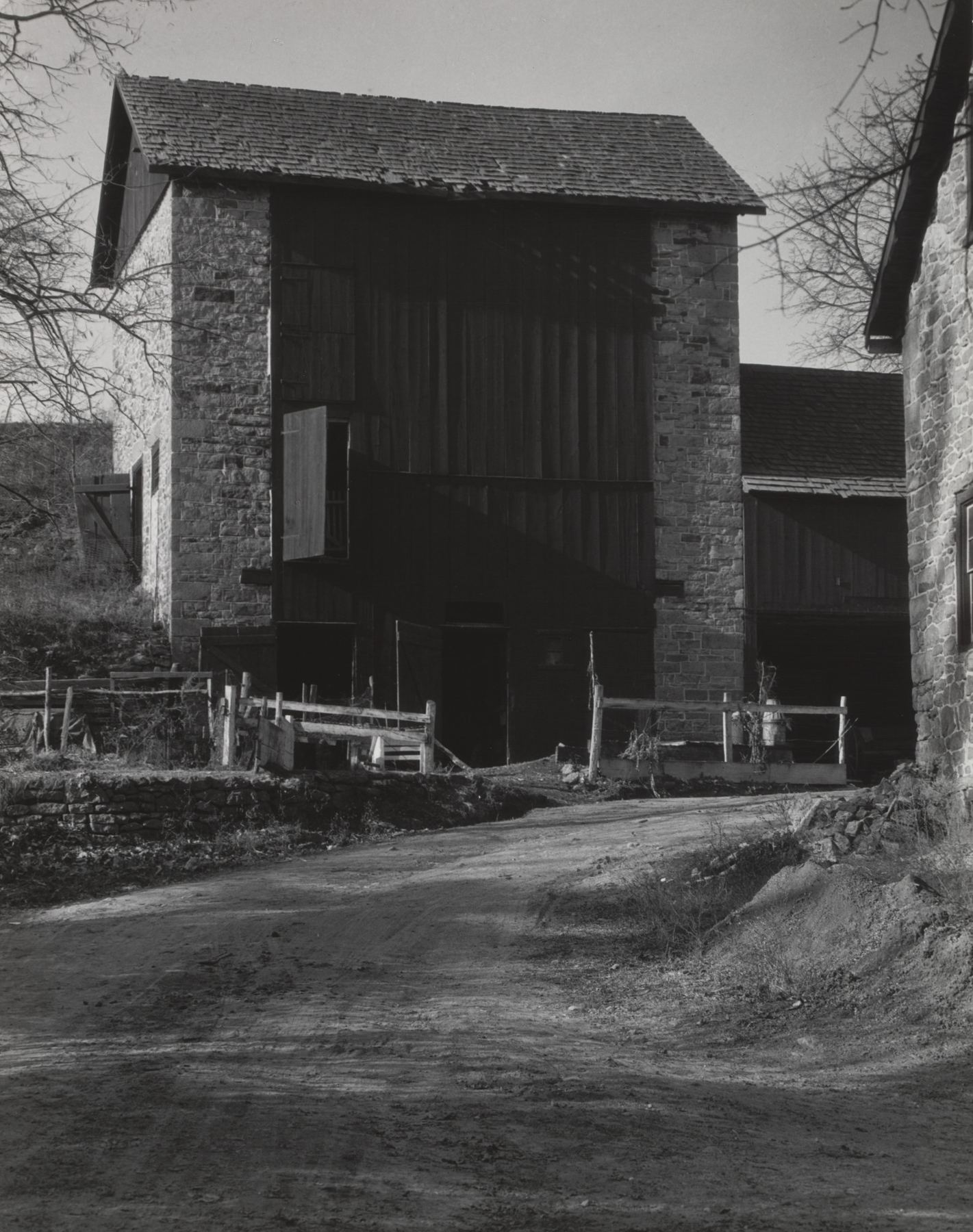
This attraction was not simple nostalgia. Sheeler admired barns and houses whose shapes followed use rather than stylistic display. Their builders had not necessarily intended works of art. The artist’s cropping could nevertheless make door, beam, stair and stove into formal relations. Old workmanship became evidence that clarity and efficiency had an American history before the assembly line.
The same tension appears in Americana. Shaker furniture, woven rugs, a backgammon board and domestic objects fill an apparently exact room, but the floor tilts and perspectives conflict. The Met reads the painting as both national pride in home and craftsmanship and a photographically informed modern distortion.[13] Precision is not the same as spatial truth. The objects appear stable while the room subtly refuses to settle.
Sheeler repeatedly moved an image between media. The Open Door, a 1932 Conté crayon drawing, returned to a photograph made around 1917. He changed the crop and tonal emphasis while testing how much exactitude the dry drawing medium could achieve.[14] The later object is not a hand-rendered copy. It is a second decision about what the earlier photograph contained.
River Rouge and the manufactured landscape
The decisive industrial commission arrived in 1927, when Ford’s advertising agency hired Sheeler to photograph the River Rouge complex near Detroit for the introduction of the Model A. The Whitney notes that the assignment generated celebrated photographs and a sustained series of paintings and drawings.[15] Corporate work and independent art became inseparable: the factory paid for its image, but Sheeler kept reworking what the assignment allowed him to see.
Classic Landscape depicts a part of the complex where waste products from car manufacture became cement. Silos, tracks, warehouses and a chimney are organised with the clarity of a classical architectural view. The National Gallery connects Sheeler’s title to both the typical industrial landscape and a comparison with ancient design, reinforced by contemporary admiration for functional American factories and grain elevators.[16]
The title is audacious. It replaces mountain, river and tree with a closed system of storage and production. It also raises a question: has industry become the new classical order, or is the word “classic” so deliberately grand that it exposes the painting’s constructed ideal? The picture’s measured proportions support both reactions.
American Landscape uses another portion of the Rouge plant. Water, ships, rail lines, smokestacks and rectilinear buildings stretch across horizontal bands. MoMA observes that the hard-edged arrangement makes industrial innovation visible while the absence of the workforce may disclose ambivalence about industrial change.[17] The tiny or missing human is not an error in perspective. It is part of the image’s meaning.
That absence becomes clearer when measured against the site. River Rouge occupied roughly two thousand acres, contained scores of buildings and pursued vertical integration from raw material to finished vehicle. Detroit Historical Society records 75,000 employees during the plant’s expansion and the later violent conflict over union organising.[18] Sheeler’s silent factory was never an empty place.
The people excluded were not an undifferentiated workforce. Black migration helped transform Detroit, and Ford became one of the city’s largest employers of African Americans. The Henry Ford’s labour history explains that many Black employees worked in the hottest and most dangerous foundry and blast-furnace jobs, even while some held skilled or supervisory positions.[19] These facts should not be turned into an intention Sheeler never stated. They establish what pictorial order leaves outside its frame.
Photography is not only preparation
It is tempting to treat Sheeler’s camera as a device for gathering material before the “real” painting began. His exhibition history contradicts that hierarchy. The Met’s survey follows major photographic series from Doylestown through Manhattan, the body and River Rouge, and identifies Manhatta as an independent experimental achievement.[20] The photographs circulated, were exhibited and shaped modern industrial photography in their own right.
The relationship among commission, photograph, drawing and painting was also reciprocal. Sheeler could crop a corporate negative into an autonomous print, translate it into Conté crayon, alter it in oil and later recombine photographic sources through multiple exposure. Art Institute research describes the River Rouge photographs as both commercial images of a smoothly functioning plant and works of art, while the later paintings further abstracted and distanced the site’s material realities.[21]
This does not make the art dishonest. Every image selects. Precisionism makes selection unusually visible because its surfaces appear so complete. The best way to look is therefore to ask what had to be removed, moved or simplified before the scene could appear inevitable.
Charles Demuth: signs, friends and Lancaster monuments
Demuth’s precision was more prismatic than Sheeler’s. Diagonal rays cross buildings; transparent planes overlap; words and numerals enter. His late oils are only part of a practice that included delicate watercolours, theatre and literary imagery, still life and portraits. Industry became powerful because it joined personal place and symbolic language.
A portrait made from a number
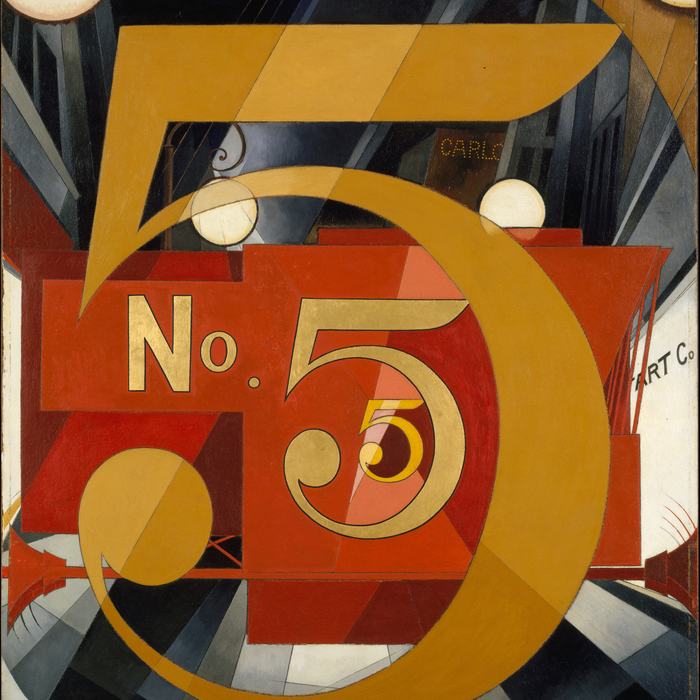
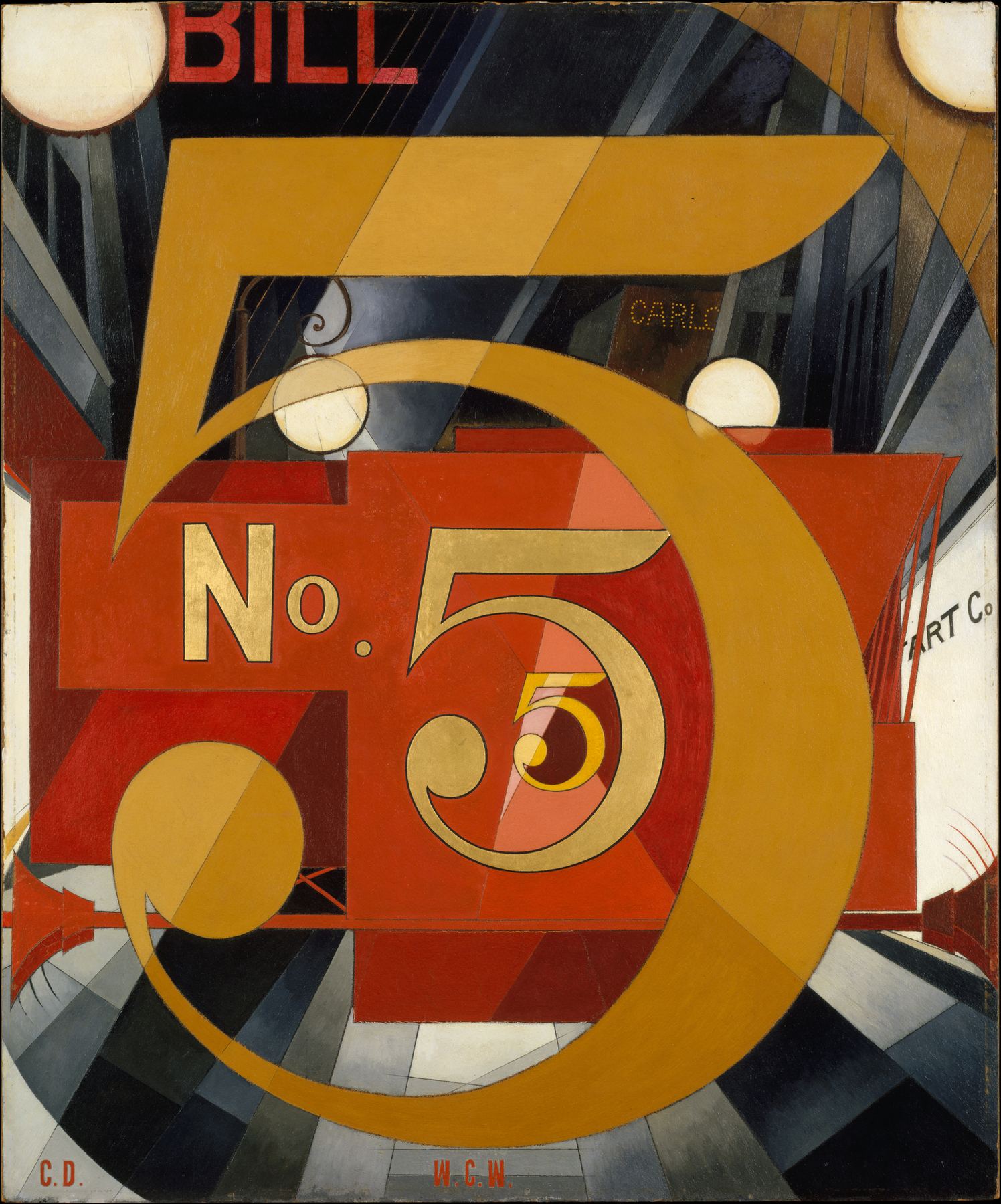
I Saw the Figure 5 in Gold was inspired by William Carlos Williams’s poem “The Great Figure,” in which a gold numeral flashes past on a red fire engine through rain and city noise. Demuth repeats the 5 at diminishing scale, cuts it with red and black planes, and adds fragments of “BILL,” “CARLOS,” initials and the number of the fire company. A Met study shows how the numerals both insist on the flat surface and recede into depth.[22]
The work belongs to Demuth’s “poster portraits,” images of friends assembled from emblems rather than facial likeness. Advertising, street lettering, poetry and private affection meet. The picture is precise without being detached: its clang, rain, friendship and motion are compressed into typography. Later artists such as Jasper Johns and Robert Indiana could find in it a precedent for making public signs carry personal and pictorial weight.
My Egypt
My Egypt presents two grain-elevator cylinders and attached industrial buildings in Lancaster, Pennsylvania. Seen from below, they appear enormous. Diagonal rays turn the structure into a revelation, yet grey concrete and a thin plume of smoke keep the atmosphere cool. The Whitney explains that the title compares the local elevator to ancient pyramids while also opening possible associations with slave labour, dehumanisation, mortality and Demuth’s own serious illness.[23]
No one reading cancels the others. “My” makes the monument intimate: this is Demuth’s home town, his modern antiquity and perhaps his confinement. “Egypt” confers duration while recalling bondage and tombs. The painting can honour technological scale and remain anxious about the cost of monumental systems.
Demuth’s biography deepens that doubleness. He returned repeatedly to the family home in Lancaster, travelled widely and participated in avant-garde circles in New York and abroad. The Demuth Museum now foregrounds his life as a gay man and his connections to queer as well as artistic communities, while also stressing his mastery of watercolour and his contribution to American modernism.[24] His late factories should not erase the more mobile, intimate and bodily art around them.
Illness shaped working conditions but did not supply a master key to every symbol. Diabetes confined Demuth for long periods, and mortality could sharpen his identification with Lancaster structures. Yet the pictures are not medical documents. Their power comes from the way public architecture, private attachment and formal experiment remain unresolved.
Barbara Haskell’s retrospective study is especially valuable because it reconstructs those continuities across watercolour, literary illustration, poster portraits and late architectural oils.[25] Precisionism becomes one demanding phase within Demuth’s career rather than the explanation for everything he made. That wider view also guards against treating the public monument as more important than the intimate body merely because the former fits an established movement story.
Elsie Driggs: looking from outside
Elsie Driggs exposes how access shaped the industrial image. She achieved professional recognition in the 1920s, studied Renaissance art in Italy and participated in the early Whitney Biennials. Later, after marriage and a move to rural New Jersey, she turned toward murals, watercolour and other subjects; feminist scholarship helped recover the early work. The Whitney’s biography places her within Precisionism without reducing her long career to it.[26]
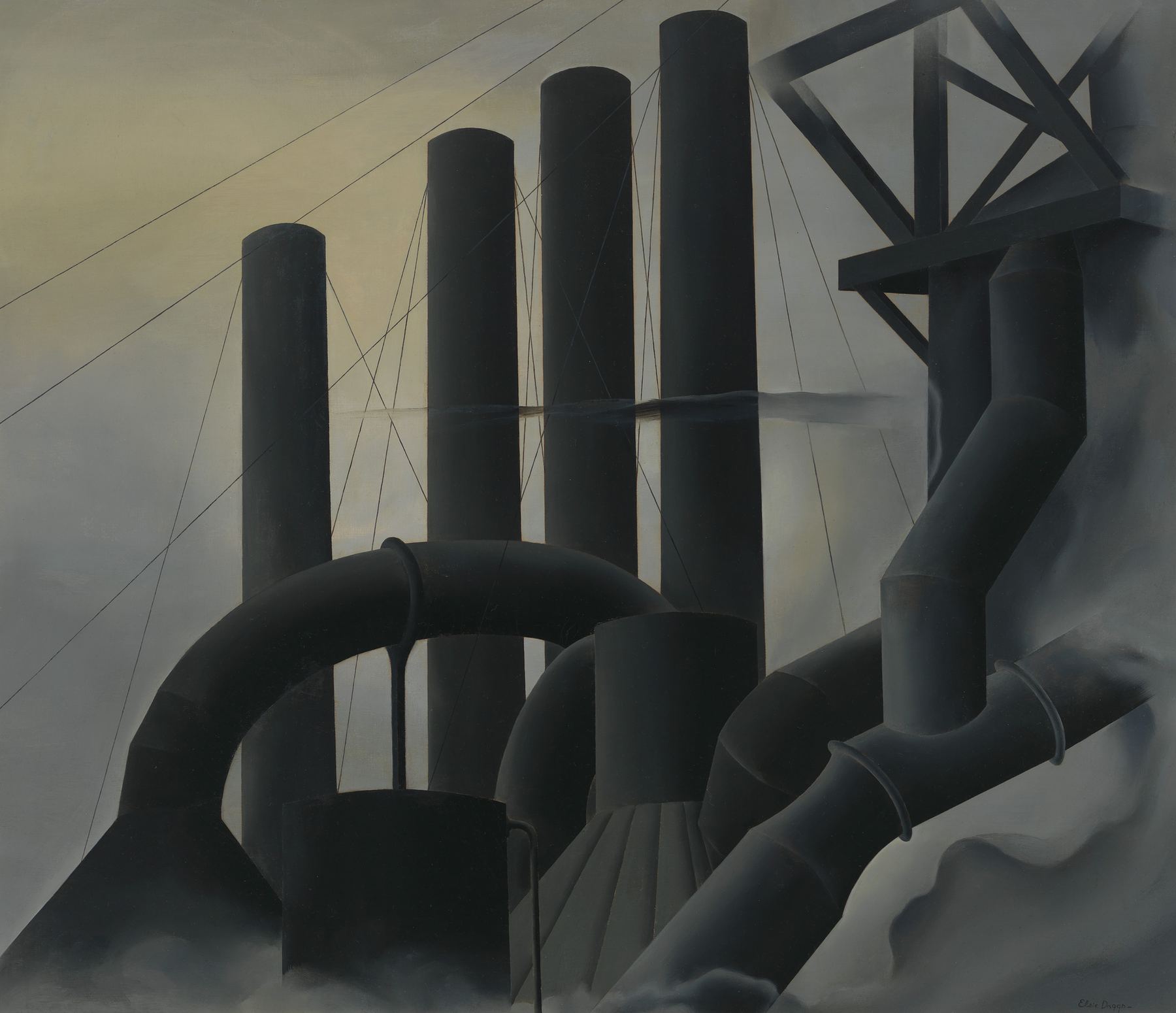
Pittsburgh
Driggs remembered steel mills from a childhood train journey through western Pennsylvania. When she returned as an adult, the old smoke-producing process had changed and management denied her access to the factory interior. She drew the structures from an elevated position outside. In Pittsburgh, tall stacks rise through grey haze above blocklike buildings, their scale devotional and threatening.
Driggs called the painting her “Piero della Francesca,” honouring the Renaissance artist’s structure, order, simplicity and strength. The Whitney records how remembered sulphurous colour, reconstructed smoke and exclusion from the mill entered the final image.[27] Precision here is openly composite. Childhood memory, later sketches and an inaccessible workplace are reorganised into a scene that never existed in one instant.
The work is sometimes read as an environmental warning, but Driggs did not describe an oppositional programme. She remembered industrial soot and also found the mills beautiful. Her Archives of American Art interview preserves that divided experience, her awareness of prejudice against ambitious women and her later engagement with social subjects while working for the WPA.[28] The painting’s haze is stronger when it is not forced to testify for one position.
Denied entry because she was a woman and possibly suspected as a labour agitator or spy, Driggs could not adopt the commanding inside view available through a corporate commission. Her distance became composition. Pipes and furnaces appear as mass, atmosphere and obstruction. The encounter reminds us that “the artist’s eye” always occupies a social position.
Georgia O’Keeffe and the limits of membership
Georgia O’Keeffe’s New York paintings share Precisionism’s emphatic cropping, simplified architecture and polished form. The Shelton with Sunspots, N.Y. looks upward as round spots and a brilliant interruption seem to bite into the skyscraper’s edge. A Spanish-language Art Institute resource connects the work to O’Keeffe’s “New Yorks” of 1925–30 and to her observation of how towers and gaps shaped the sky.[29]
The painting does not make a building into a neutral diagram. Sunspots, smoke and organic curves disturb its hard edge; the low viewpoint records bodily experience at street level. O’Keeffe’s method of selection and emphasis could move between flower, city and landscape without requiring a single movement identity.
The National Gallery is explicit: O’Keeffe did not belong to a particular movement beyond her association with Stieglitz’s circle, although aspects of her work can be related to Surrealism, Regionalism and Precisionism.[30] That formulation is more useful than permanent classification. It permits close comparison where form warrants it and releases the rest of her career from a label designed around different artists.
Her presence also challenges the idea that Driggs was a lone woman in an otherwise male field. The issue is not to enlarge a membership list for balance. It is to examine how art history made certain associations central, treated design and organic imagery differently from industry, and allowed a flexible label to behave rigidly when women’s careers crossed its boundaries.
Major Precisionist artists
| Name | Nationality | Key Works |
|---|---|---|
| Charles Sheeler | American | American Landscape; Classic Landscape; Americana |
| Charles Demuth | American | I Saw the Figure 5 in Gold; My Egypt |
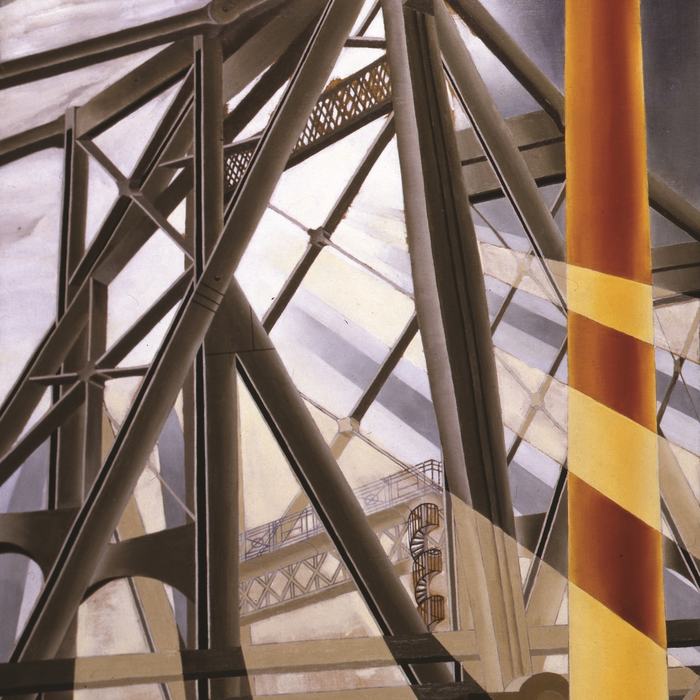
| Elsie Driggs | American | Pittsburgh; Queensborough Bridge |
| Ralston Crawford | Canadian-American | Steel Foundry, Coatesville, Pa.; Buffalo Grain Elevators |
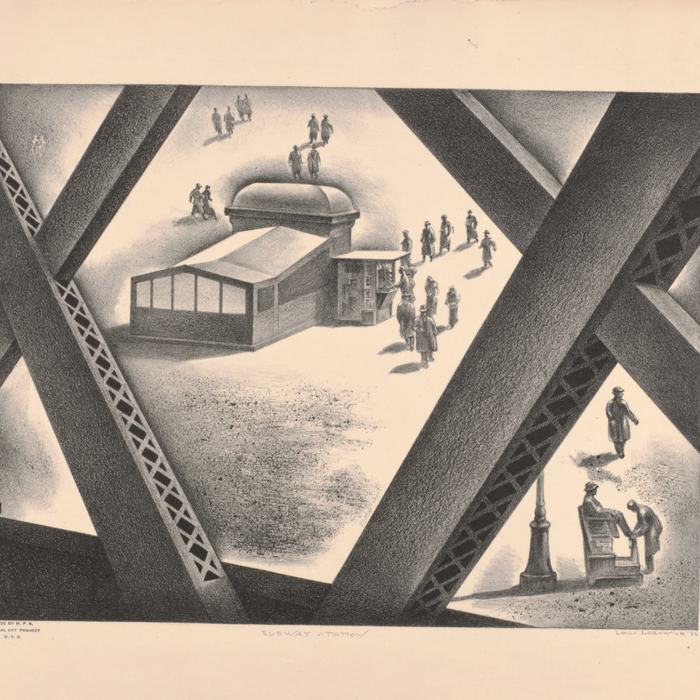
| Louis Lozowick | Ukrainian-American | New York; Corner of Steel Plant; Subway Station |
| Preston Dickinson | American | Industry; Harlem River |
| Niles Spencer | American | Seventh Avenue; The Dormer Window |
| Francis Criss | American | Astor Place; Melancholy Interlude |
| George Ault | British-American | Bright Light at Russell's Corners; January Full Moon |
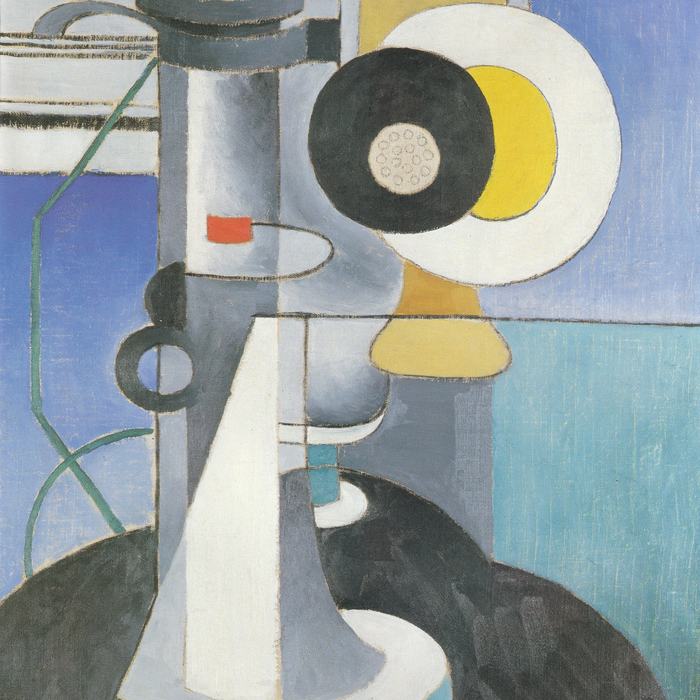
| Morton Schamberg | American | Telephone; View of Rooftops |
| Gerald Murphy | American | Wasp and Pear; Cocktail |
| Georgia O’Keeffe | American | The Shelton with Sunspots, N.Y.; Radiator Building—Night, New York |
| Joseph Stella | Italian-American | Brooklyn Bridge; Voice of the City of New York Interpreted |
| Paul Strand | American | Wall Street, New York; Manhatta |
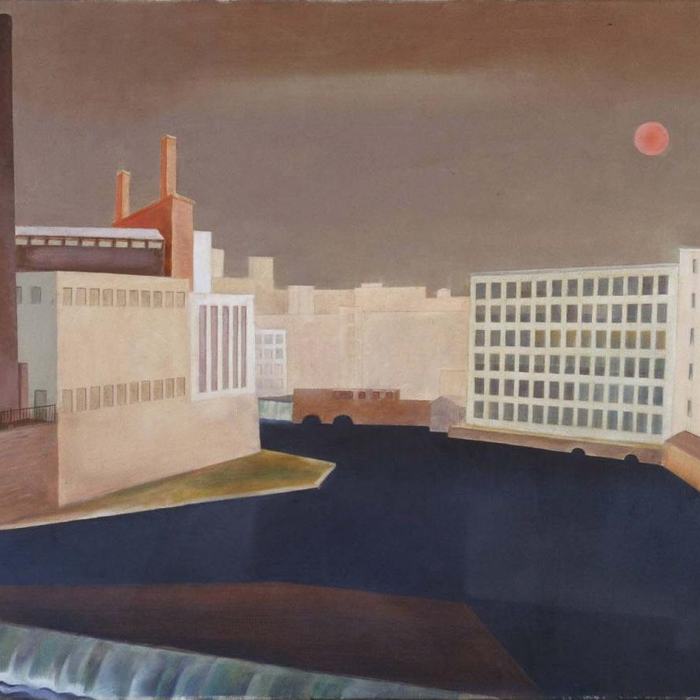
| Stefan Hirsch | German-American | Mill Town; Northern Minnesota Mine |
Beyond the central pair
Precisionism becomes richer when its supporting cast stops functioning as a row of minor imitations. Each artist changed the relation between exact form and modern subject.
Ralston Crawford: order near its limit
In Steel Foundry, Coatesville, Pa., a severe industrial building sits behind layered fences and telephone poles. Crawford flattens the foundry into dark planes and closes it off from the viewer. The Whitney places the work in the Depression, when images of highways, elevators and factories could still carry faith in technology; its barriers and human absence nevertheless make the complex loom rather than welcome.[31]
Buffalo Grain Elevators is brighter but no simpler. A blue sky interlocks with white storage forms, turning negative space into a solid participant. The Smithsonian notes that Buffalo’s importance as a grain-transfer centre was already declining after new freight routes opened. Crawford’s chill colour and raking light can therefore monumentalise the elevators while marking an ending.[32]
Crawford belonged to a younger generation than Sheeler and Demuth. World War II altered his language. He served in the Army Air Forces, made weather-division graphics and later witnessed an atomic-bomb test at Bikini. A Whitney account relates these experiences to fractured postwar abstractions that resemble shattered remains of his earlier flat order.[33] Technology had changed from industrial promise into destructive revelation.
His biography was never purely national or stationary. Born in Canada, he sailed on working ships, studied in the United States and Europe, travelled repeatedly and later photographed New Orleans jazz culture. The Smithsonian records his presence at the 1946 atomic test and his continuing movement among painting, print and photography.[34] “American” describes a cultural field, not an untouched national essence.
Louis Lozowick: immigrant geometry and political change
Lozowick was born in present-day Ukraine, studied in Kyiv, emigrated to New York and later encountered avant-garde circles in Berlin. In his lithograph New York, skyscrapers, elevated tracks, bridges, tanks and factories overlap in black and grey. The Whitney connects his urban geometry to Russian Constructivism and his conviction that the American industrial city was the necessary subject of modern art.[35]
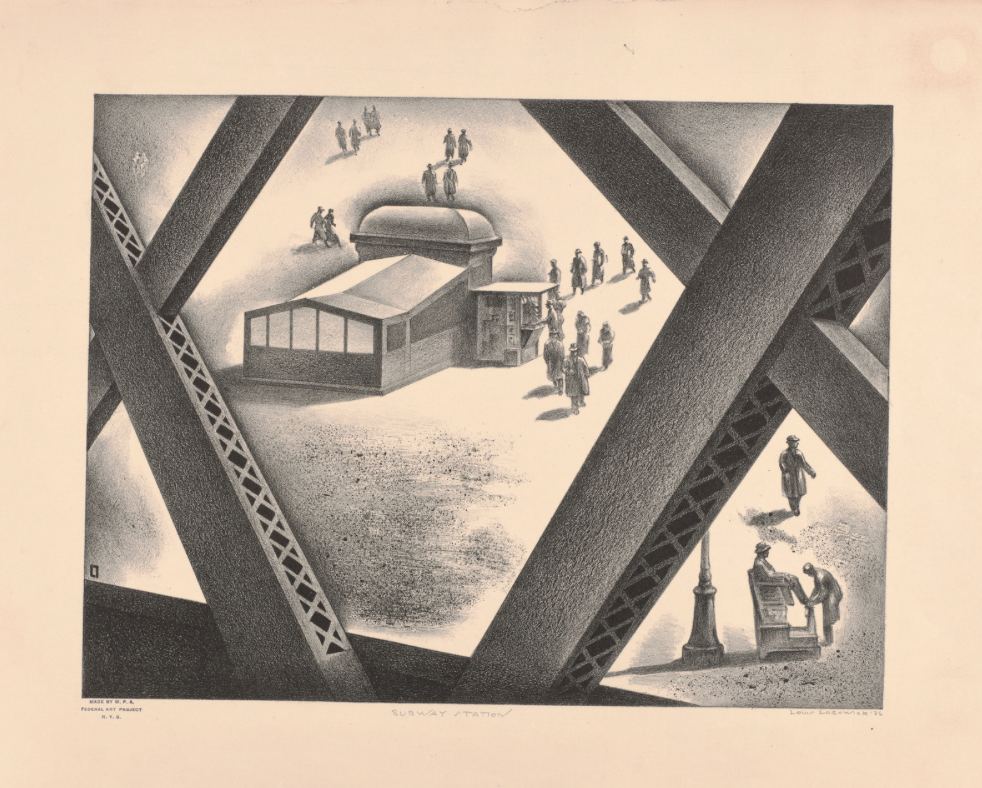
Lithography was not merely a cheaper substitute for painting. Corner of Steel Plant exploits the medium’s range from pale grey to deep black and the texture supplied by the stone. Pipes curve around rectilinear tanks; tonal pressure makes the machinery both volumetric and diagrammatic. The Whitney records Lozowick’s own appreciation of lithography’s material range and relates it to the rational order he encountered in Constructivism, Bauhaus and De Stijl.[36]
His politics did not remain outside the image. Lozowick exhibited machine drawings in the 1927 Machine-Age Exposition, where artworks appeared beside engines, propellers, gears and industrial objects. During the Depression he increasingly included labourers and addressed unemployment and class. Yale research places later prints such as Steel Valley near Social Realism rather than treating his earlier technological optimism as permanent.[37]
That shift accords with a wider life. The Smithsonian traces Lozowick’s Berlin contacts with László Moholy-Nagy and El Lissitzky, his return to New York, participation in New Masses and the American Artists Congress, and his sustained reputation for geometric urban prints.[38] Precisionist clarity could become a political instrument without ceasing to be formally exact.
Dickinson, Spencer and Criss
Preston Dickinson’s Industry crowds chimneys, water tanks, rooftops and equipment into a tall view. The Whitney dates the oil to about 1923, when industrial imagery was becoming a central modernist language.[39] Unlike Sheeler’s broad horizontal calm, Dickinson’s stacked city seems compressed, its near and far structures difficult to separate.
Dickinson’s career crossed more subjects than the title suggests. He studied in New York and France, painted Manhattan and the Harlem River, made rural landscapes and still lifes, and struggled economically. The Smithsonian records his move to Spain in 1930 and his death from pneumonia soon afterward.[40] His short life makes him a key contributor rather than a follower whose mature development can be presumed.
Niles Spencer’s Seventh Avenue refuses the idea that Precisionist cities are always empty. Rooftops, signs, transport and small pedestrians occupy separate layers. Commercial lettering is not an impurity attached to architecture; it is part of the city’s structure. The Whitney’s record preserves the painting’s 1927 date and its early place in Gertrude Vanderbilt Whitney’s collection.[41]
Francis Criss pushes order toward the uncanny. His urban paintings use clear edges and streamlined forms, but their perspectives can slip and unlikely figures can appear in deserted spaces. The Whitney connects this dreamlike displacement to Surrealism as well as Precisionism and notes his later commercial work.[42] Clean rendering does not guarantee rational space.
George Ault and wartime darkness
George Ault’s exact buildings often emerge at night under a single streetlight or moon. In the Russell’s Corners paintings, roads, poles, barns and wires form a small, enclosed order surrounded by darkness. The Smithsonian’s To Make a World exhibition places these works within the Depression and wartime home front, interpreting their precision as fragile composure made against crisis.[43]
Ault demonstrates why 1941 is a porous boundary. His best-known exact paintings belong to the 1940s, after the classic machine-age phase. The geometry remains, but confidence drains away. Order becomes a personal act of containment rather than an impersonal promise of progress.
Morton Schamberg as precursor
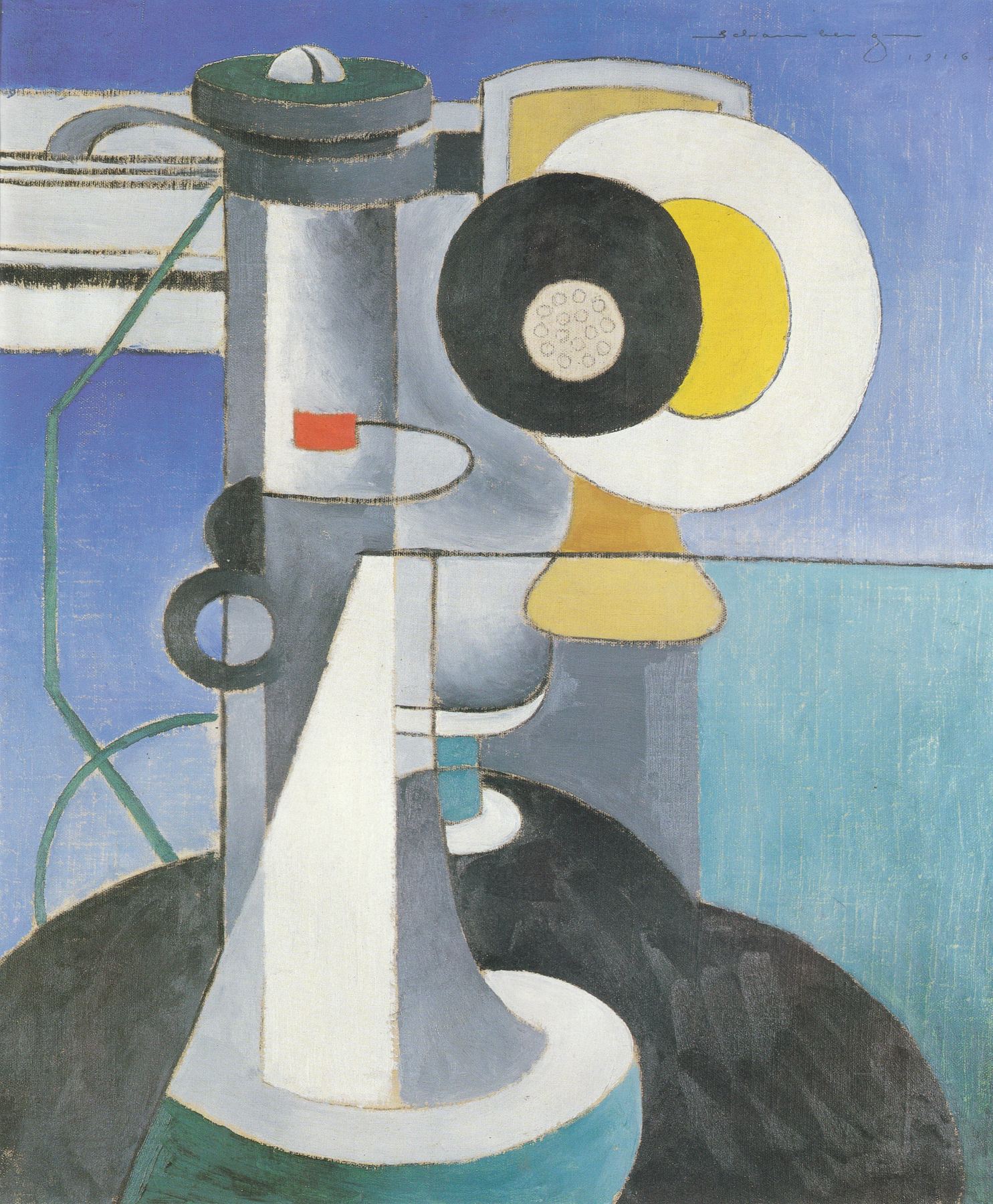
Morton Schamberg turned from near-abstraction toward objective machine forms around 1915. His rooftop photography uses an elevated position and severe cropping to make New York appear almost wholly geometric. The Met describes this cool urban vision and notes that Sheeler, his closest friend, long owned the unique print.[44] Schamberg’s death in the 1918 influenza pandemic ended a career just as the precisionist field was forming.
Calling him a precursor does not make his work incomplete. It identifies a historical limit: he could not respond to the interwar factory, Depression or institutional category that later defined Precisionism. His machine imagery shows that the mode’s sources preceded the label.
Gerald Murphy and diagrammatic pleasure
Gerald Murphy worked chiefly as an American expatriate in France and painted for only a few years. Wasp and Pear joins a stylised insect, fruit, leaf and honeycomb to overlapping planes. MoMA relates the image to Cubist painting and to the large technical classroom charts of fruit and insects Murphy remembered from military training.[45] Scientific-looking exactness becomes decorative invention rather than scientific illustration.
In Cocktail, a glass, shaker, corkscrew, cigar box, lemon and related objects overlap with immaculate detail. The Whitney identifies affinities with French Cubism and American Precisionism while emphasising the painting’s autobiographical references, expatriate social ritual and Prohibition context.[46] It is not an industrial landscape, but its consumer objects are machined, branded and culturally charged.
Murphy’s selective inclusion proves the value of flexible language. His work can clarify Precisionism’s relation to Purism, advertising and diagram without being absorbed into a movement he did not join. Comparison should increase difference, not erase it.
Machine worship, machine doubt
Precisionism is often described as a celebration of technology because its factories are monumental and clean. That interpretation fits some works and fails when made universal. A smooth surface can convey admiration for function, suppress the artist’s hand in sympathy with mechanised production, or create a distance so complete that the factory becomes inaccessible.
Commission matters. Sheeler’s Rouge photographs served Ford publicity; later paintings circulated in fine-art institutions. Driggs approached Pittsburgh without corporate access. Lozowick’s prints could address a broader market and later include labour. Crawford painted Depression-era sites that already carried signs of closure. The same hard edge changes meaning with its economic situation.
So does emptiness. A workerless scene may universalise structure, protect the image from anecdote, imitate an architectural photograph or make human disappearance disturbing. Viewers should resist turning absence into proof before examining evidence.
The rural subject further complicates “machine worship.” A barn’s functional beams could resemble a factory’s engineering. Shaker furniture could embody economy and disciplined construction. Yet celebrating a selective colonial past during an era of immigration restriction and racial hierarchy could also serve exclusionary ideas of national identity. The visual language of efficiency was never politically innocent.
International reception and changing media
Precisionism was described as distinctively American, but its making and reception were transnational. Artists travelled; reproductions crossed borders; European visitors admired American grain elevators; immigrant artists such as Lozowick transformed Central and Eastern European knowledge in New York. The national claim was constructed through exchange.
French art history identifies Sheeler as the exemplary Precisionist and relates works such as Upper Deck to French Purism, while also stressing his combined photographic and industrial exactitude.[47] This reception is valuable precisely because it reveals that “American” modernity was legible through a European comparison rather than sealed from it.
A Spanish Museo Thyssen-Bornemisza study of Sheeler’s later Wind, Sea and Sail similarly emphasises photographic framing, overlapping planes, smooth handling and what Sheeler called a polyphonic study of form.[48] The work’s date, 1948, shows precisionist habits persisting after the conventional movement period. A label can describe continuity without pretending that the 1920s group still existed.
This international circulation did not settle the movement’s ideology. The Whitney’s Machine Age interpretation preserves celebration, alienation and critique as competing possibilities and notes how artists could move between fine art and commercial work.[49] That is a stronger conclusion than assigning the same confidence to every smokestack. Precisionism’s polished surface crossed national and institutional borders precisely because it could support different readings of order.
Across the wider field, photography, film and print were not supporting media. They shaped the movement’s viewpoint, distribution and apparent impersonality. Lithography made industrial blacks reproducible; film made geometric city vision sequential; commercial photography placed avant-garde cropping inside corporate image-making. Painting borrowed from all three while retaining colour, scale and slow manual revision.
Afterlives
World War II altered the machine’s cultural charge. Crawford’s atomic-test work, Ault’s wartime night scenes and the mobilisation of industry made pristine technology harder to detach from destruction. Some artists moved toward abstraction, Social Realism, commercial work or different subjects. There was no meeting at which Precisionism ended.
Its devices remained active. Hard-edge abstraction could inherit the authority of clean geometry without industrial subject matter. Architectural and corporate photography extended the monumental machine view. Pop artists returned to Demuth’s numerals, Murphy’s magnified products and the public sign. Later painters of empty streets and factories could draw on the mode’s estrangement without repeating its interwar nationalism.
Influence should be described precisely. A repeated number does not prove direct descent; a crisp factory is not automatically Precisionist. What survives most strongly is a problem: how can an image be recognisable and abstract, seductively clear and ideologically unsettled at the same time?
Exactness is made from materials
Precisionist images can look as though technique has disappeared, but their exactness depends on physical decisions. Oil can be thinned until brushwork becomes difficult to see, or laid over graphite that keeps architectural edges disciplined. Demuth combined paint, drawing media and gold leaf. Driggs used atmospheric greys to make hard structures recede. Sheeler sharpened Conté crayon repeatedly and exploited its tonal range. Lozowick drew on lithographic stone so pressure, grain and printing became part of the industrial image.
Scale changes the effect. A grain elevator occupying most of a canvas confronts the body like a building; reduced on a screen, it risks becoming a neat logo. Black-and-white reproduction can make Sheeler’s tonal control look more photographic while erasing the warm and cool colours that separate planes. A glossy book may intensify Driggs’s smoke or flatten the distinction between haze and solid stack.
Look for corrections, underdrawing, changes in opacity and edges that are slightly less mechanical than they first appear. These details do not expose a failure of precision. They reveal precision as labour. The apparent absence of the artist’s hand was produced by a hand, often through repeated translation from looking to photograph, drawing, print or paint.
Essential Precisionist works
Pittsburgh
Elsie Driggs · 1927 · Hard geometry and reconstructed smoke make industrial order beautiful, obstructed and menacing at once.
I Saw the Figure 5 in Gold
Charles Demuth · 1928 · Numerals, names and fractured planes translate poetry, street lettering and friendship into a poster portrait.
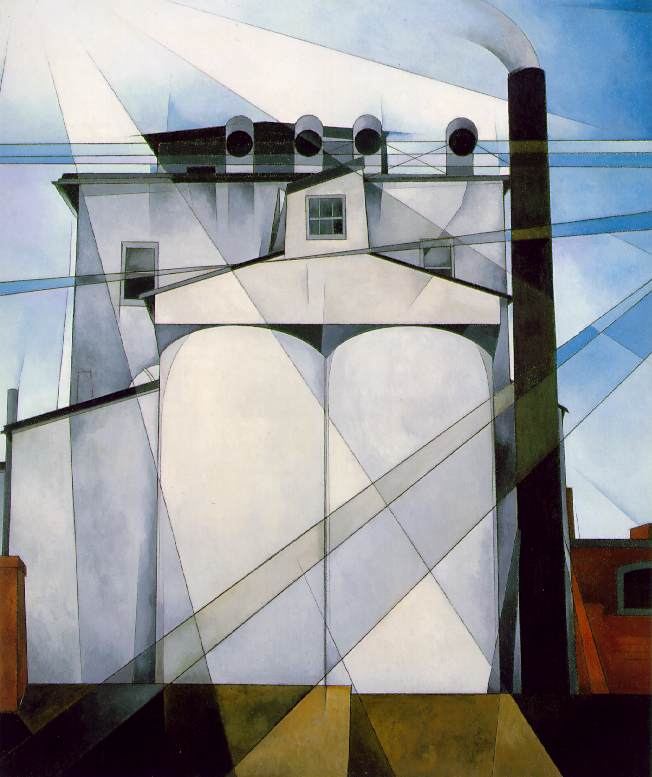
My Egypt
Charles Demuth · 1927 · Lancaster grain elevators become a modern monument whose title holds pride, mortality, bondage and anxiety together.
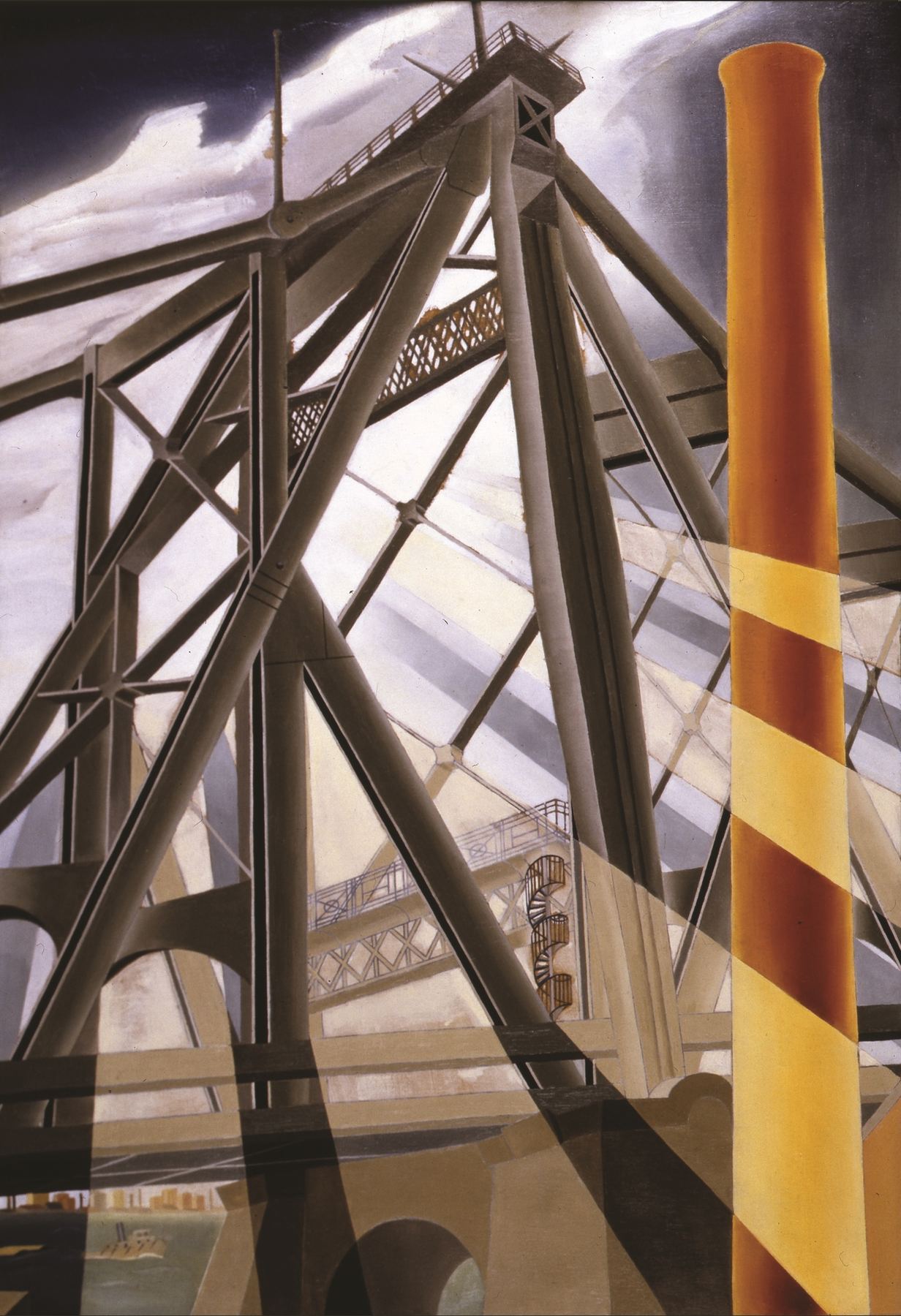
Queensborough Bridge
Elsie Driggs · 1927 · A close-cropped bridge study turns engineering into an exact structure of cables, arcs and compressed space.
Bucks County Barn
Charles Sheeler · 1914–17 · A vernacular barn shows how functional American construction supplied precisionist form before the factory commissions.
Telephone
Morton Schamberg · 1916 · A familiar machine becomes an objective arrangement of cylinders, planes and connections at the movement's threshold.
Wall Street, New York
Paul Strand · 1915 · Architecture and pedestrians become relations of shadow, scale and movement in a foundational modern photograph.
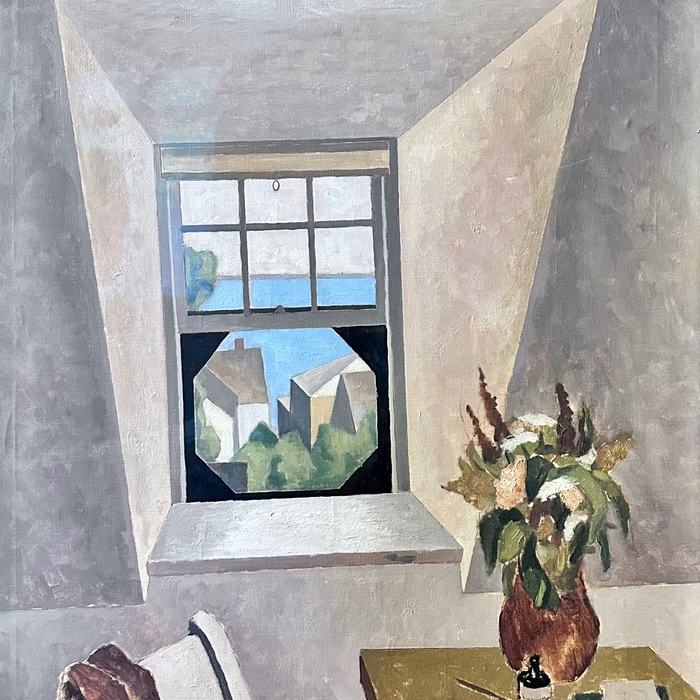
The Dormer Window
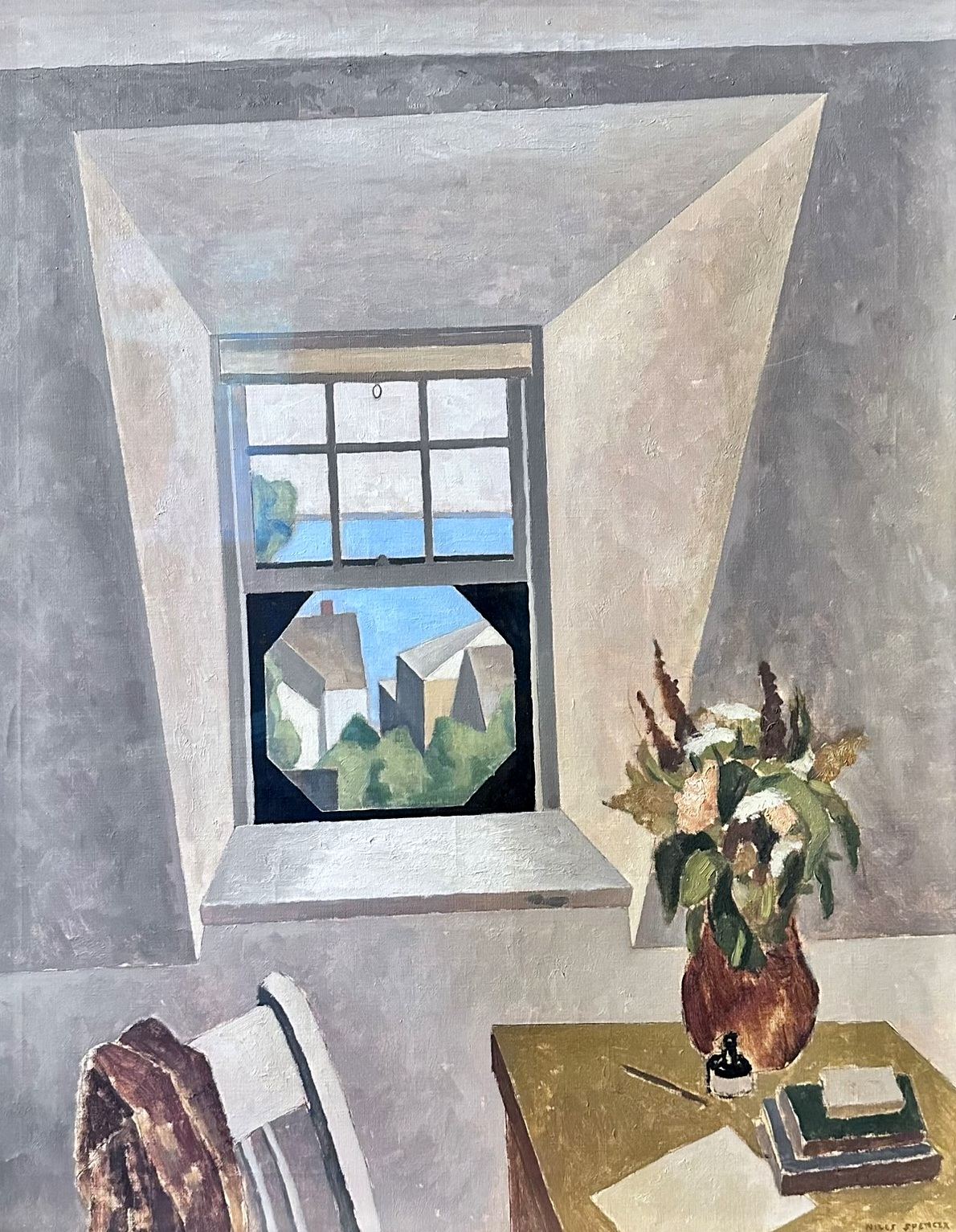
Niles Spencer · 1927 · An ordinary interior opening is reduced to clear edges, controlled light and spatial tension.
Mill Town
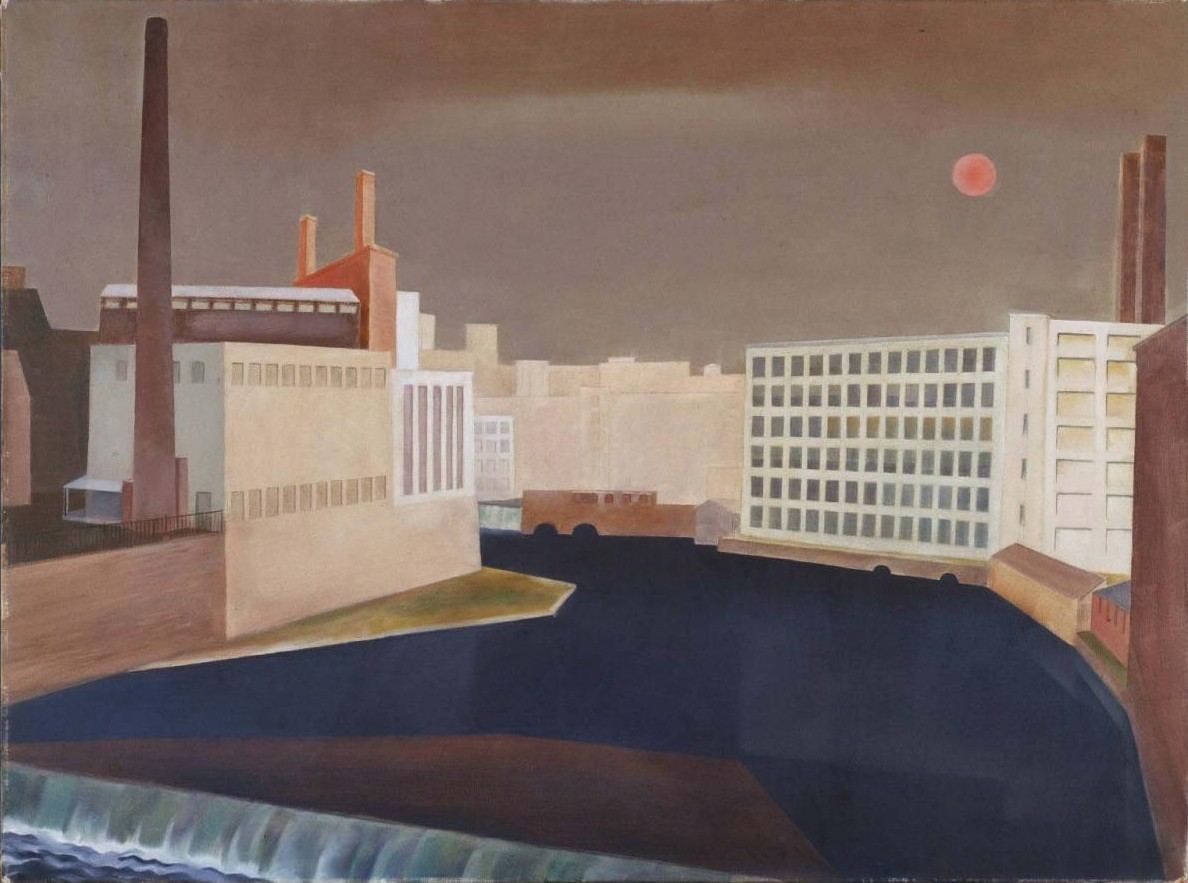
Stefan Hirsch · 1925 · Factory roofs and surrounding land show that the precisionist field extended beyond its best-known central figures.
Subway Station
Louis Lozowick · 1936 · Lithographic blacks and greys turn infrastructure, depth and urban movement into a reproducible machine-age image.
How to look at Precisionism
- Identify the subject before admiring the geometry. Is this a factory, barn, interior, bridge, sign, consumer object or imagined composite?
- Check the date and commission. A Ford publicity photograph and an independent Depression-era lithograph carry different conditions.
- Look for the crop. Ask what sits beyond the edge and whether the viewpoint comes from street, roof, hill, ship or photograph.
- Follow the largest shapes first. Precisionist pictures often organise sky, wall and shadow as active planes rather than backgrounds.
- Search for people and traces of people. A missing workforce matters differently from a tiny pedestrian, parked vehicle or used object.
- Inspect the surface. Smooth paint, gold leaf, graphite, Conté crayon and lithographic black produce different kinds of exactness.
- Compare title and image. Words such as American, Classic, My Egypt and Industry guide interpretation but may also introduce irony.
- Hold admiration and unease together. Do not decide too early whether a machine is being praised or criticised.
Where to see Precisionism
Displays change. Check current gallery and access information before travelling.
- 01
Whitney Museum of American Art, New York
The Whitney holds an unusually concentrated group: Demuth’s My Egypt, Driggs’s Pittsburgh, Sheeler’s River Rouge Plant, Crawford’s Steel Foundry, Spencer, Lozowick and others. Collection installations change, so check what is on view.
New York, USA
Demuth, Driggs, Sheeler, Crawford, Spencer and LozowickVisit official website - 02
Museum of Modern Art, New York
MoMA’s American Landscape, Manhatta, Delmonico Building and Murphy’s Wasp and Pear make it possible to compare painting, print and film. The collection also supplies the European and photographic contexts from which Precisionism developed.
New York, USA
American Landscape, Manhatta, Delmonico Building and MurphyVisit official website - 03
Metropolitan Museum of Art, New York
Demuth’s I Saw the Figure 5 in Gold, Sheeler’s Americana, Doylestown photographs and drawings, and Schamberg material reveal the movement beyond factories. The Stieglitz Collection is especially important.
New York, USA
Figure 5, Americana, Doylestown photographs and SchambergVisit official website - 04
National Gallery of Art, Washington
Sheeler’s Classic Landscape anchors a deep research environment for American modernism and photography. The Gallery’s online editions are valuable even when related works are not displayed.
Washington, USA
Classic Landscape and deep American-modernism researchVisit official website - 05
Fine Arts Museums of San Francisco, de Young
The de Young organised Cult of the Machine, a major revisionist Precisionism exhibition. Its collections and digital interpretation are particularly useful for machine, rural and design contexts.
San Francisco, USA
Cult of the Machine research and collection contextVisit official website - 06
Art Institute of Chicago
The Art Institute’s Sheeler and Stieglitz research, along with O’Keeffe’s The Shelton with Sunspots, helps connect photography, city observation and selective affiliation.
Chicago, USA
Sheeler, Stieglitz and O'Keeffe contextsVisit official website - 07
Demuth Museum of Art, Lancaster
Demuth’s family home and studio provide the most direct encounter with the Lancaster setting behind his late industrial paintings. The museum also presents his watercolour, queer history and wider modernist networks.
Lancaster, USA
Demuth's home, studio, watercolours and Lancaster settingVisit official website - 08
Detroit Institute of Arts and the Ford Rouge context
The DIA’s Detroit Industry murals offer a powerful comparison with Sheeler’s empty Rouge. Diego Rivera placed bodies, labour and machinery together. A visit to the region’s industrial-history resources makes the gap between factory life and factory image tangible.
Detroit, USA
Rivera's Detroit Industry and the Ford Rouge comparisonVisit official website
Suggested books
Cult of the Machine: Precisionism and American Art
Emma Acker, Sue Canterbury, Adrian Daub and Lauren Palmor’s exhibition catalogue is the strongest recent broad reassessment. It connects painting, photography, film, design and industrial culture while refusing a simple pro-machine verdict.
Precisionism in America, 1915–1941: Reordering Reality
This Montclair Art Museum survey remains fundamental for chronology, artist range and the relation between modern industry, photography, folk culture and applied art.[50] Its broad frame is most useful when read as a research construction rather than an official movement lifespan.
Charles Sheeler: Across Media
Charles Brock’s National Gallery catalogue follows the movement of images among photography, film, drawing and painting. It is particularly valuable for understanding why a photograph is neither merely preparatory nor simply copied into oil.
Charles Demuth
Barbara Haskell’s Whitney retrospective catalogue gives Demuth’s watercolours, poster portraits, literary relationships and late industrial oils their full career setting. It prevents My Egypt and the gold 5 from becoming isolated icons.
To Make a World: George Ault and 1940s America
Alexander Nemerov’s study extends the precisionist question into wartime. Its treatment of Ault’s exact, nocturnal architecture shows how clarity can become a shelter against disorder rather than a celebration of progress.
Frequently Asked Questions
Precisionism is an art-historical name for a loose field of mainly American interwar art characterised by controlled geometry, clear contours, reduced detail and recognisable subjects. It often depicts modern architecture or industry, but also includes barns, interiors, still life, photography, print and film.
No. The artists did not form a society, agree a manifesto or maintain a membership list. Critics and historians grouped them through shared visual traits and subjects. That is why individual works should be compared without assuming every associated artist held the same beliefs.
Charles Sheeler and Charles Demuth are the central figures. George Ault, Elsie Driggs and Ralston Crawford are important associated artists; so are Louis Lozowick, Preston Dickinson, Niles Spencer and Francis Criss. Georgia O’Keeffe, Morton Schamberg and Gerald Murphy belong selectively rather than absolutely.
About 1915–1941 is a useful survey span. The strongest concentration falls in the 1920s and 1930s. These are not official dates: precursor works appear earlier, precisionist strategies continue later, and individual artists changed direction at different times.
The name draws attention to controlled edges, smooth handling and apparent exactness. “Immaculates” and “Cubist-Realists” were related historical labels. The origin and scope of “Precisionism” are less tidy than a single coinage story suggests, and many artists did not use it for themselves.
Cubism offered planar construction, simplified geometry, multiple viewpoints and a stronger awareness of the flat surface. Precisionists usually retained recognisable architecture, machinery or objects and often adopted smoother handling and sharper contours than analytic Cubism.
Sometimes, but not uniformly. Industrial efficiency and engineering could be admired. The same pictures can feel silent, inaccessible or menacing. Commission, title, date, viewpoint and omission must be examined before deciding whether a work praises, questions or simply studies technology.
Human absence focuses attention on structure and can echo architectural or corporate photography. It can also estrange the scene and conceal labour. Emptiness has no single meaning; comparison with the actual workforce and production conditions shows how thoroughly the image has been constructed.
Yes. Photography supplied sharp focus, dramatic light, cropping and unusual viewpoints, but it was also an independent modern art. Sheeler’s photographs and his film with Paul Strand are essential works, not merely preparations for paintings.
Not in the sense of formal membership, because no such membership existed and she did not identify with the movement. Some New York paintings and sharply simplified works reward precisionist comparison. Her broader career also belongs to abstraction, organic imagery, landscape and the Stieglitz circle.
Realism is a much wider category. Precisionism typically makes geometric organisation, hard edges and reduced detail unusually prominent. Edward Hopper also painted empty modern spaces, but a work such as House by the Railroad uses light, narrative suggestion and psychological tension differently from Sheeler’s industrial classicism.
Depression politics, labour conflict, World War II and atomic technology altered the machine’s meanings. Artists moved toward abstraction, Social Realism, commercial work or new subjects. Precisionist devices continued in photography, hard-edge art and Pop, but the interwar field ceased to function as a useful contemporary concentration.
Discussion
Reader Insights
Ask whether an image began as a corporate commission, independent painting, photograph, print or film.
Compare the immaculate structure with the workers, noise, heat and conflict that may sit outside the frame.
Notice how paint, graphite, Conté crayon, lithographic stone and photography create different kinds of exactness.
Join the Conversation
When a Precisionist factory removes its workers, do you experience the result as admiration for structure, a troubling absence, or a deliberate uncertainty between the two? Which visual clue—title, viewpoint, surface, scale or context—most strongly shapes your answer?
References
- Precisionism, Metropolitan Museum of Art, View Source
- Classic Landscape online edition, National Gallery of Art, View Source
- Precisionism ou Immaculates, Larousse (French; consulted in French), View Source
- Cult of the Machine digital story, Fine Arts Museums of San Francisco, View Source
- Cult of the Machine Precisionism and American Art, Yale University Press, View Source
- About the 1913 Armory Show, Smithsonian Institution, View Source
- Building the Collection Multiple Modernisms, National Gallery of Art, View Source
- Delmonico Building, Museum of Modern Art, View Source
- Charles Sheeler 1883-1965, Metropolitan Museum of Art, View Source
- Manhatta, Museum of Modern Art, View Source
- The Key Set 1902-1917, National Gallery of Art, View Source
- Doylestown House Open Window, Metropolitan Museum of Art, View Source
- Americana, Metropolitan Museum of Art, View Source
- The Open Door, Metropolitan Museum of Art, View Source
- Charles Sheeler, Whitney Museum of American Art, View Source
- Classic Landscape, National Gallery of Art, View Source
- American Landscape, Museum of Modern Art, View Source
- Ford Rouge Complex, Detroit Historical Society, View Source
- African American Workers at Ford Motor Company, The Henry Ford, View Source
- The Photography of Charles Sheeler, Metropolitan Museum of Art, View Source
- Charles Sheeler themes, Art Institute of Chicago, View Source
- American Painting Figure 5 study, Metropolitan Museum of Art, View Source
- My Egypt, Whitney Museum of American Art, View Source
- Charles Demuth, Demuth Museum of Art, View Source
- Charles Demuth by Barbara Haskell, Whitney Museum Library, View Source
- Elsie Driggs, Whitney Museum of American Art, View Source
- Pittsburgh, Whitney Museum of American Art, View Source
- Oral history interview with Elsie Driggs, Archives of American Art Smithsonian Institution, View Source
- Georgia O Keeffe una mirada mas cercana, Art Institute of Chicago (Spanish; consulted in Spanish), View Source
- Georgia O Keeffe, National Gallery of Art, View Source
- Steel Foundry Coatesville Pa, Whitney Museum of American Art, View Source
- Buffalo Grain Elevators, Smithsonian American Art Museum, View Source
- About this artist Ralston Crawford, Whitney Museum of American Art, View Source
- Ralston Crawford, Smithsonian American Art Museum, View Source
- New York, Louis Lozowick and Whitney Museum of American Art, View Source
- Corner of Steel Plant, Whitney Museum of American Art, View Source
- Louis Lozowick Style and Politics, Yale University Press, View Source
- Louis Lozowick, Smithsonian American Art Museum, View Source
- Industry, Whitney Museum of American Art, View Source
- Preston Dickinson, Smithsonian American Art Museum, View Source
- Seventh Avenue, Whitney Museum of American Art, View Source
- Francis Criss, Whitney Museum of American Art, View Source
- To Make a World George Ault and 1940s America, Smithsonian American Art Museum, View Source
- View of Rooftops, Metropolitan Museum of Art, View Source
- Wasp and Pear, Museum of Modern Art, View Source
- Cocktail, Whitney Museum of American Art, View Source
- Charles Sheeler, Larousse (French; consulted in French), View Source
- Viento mar y vela Charles Sheeler, Museo Nacional Thyssen-Bornemisza (Spanish; consulted in Spanish), View Source
- America Is Hard to See Machine Age, Whitney Museum of American Art, View Source
- Precisionism in America 1915-1941 Reordering Reality, Montclair Art Museum and Abrams, View Source
- Precisionism image records, Wikimedia Commons: Pittsburgh (Public domain in the United States; faithful reproduction of a two-dimensional work published before 1931; Wikimedia Commons / Whitney Museum of American Art and Fine Arts Museums of San Francisco records), I Saw the Figure 5 in Gold (Public domain; work published before 1931; Wikimedia Commons / Metropolitan Museum of Art record), My Egypt (Public domain; work published before 1931; Wikimedia Commons / Whitney Museum of American Art record), Queensborough Bridge (Public domain in the United States; work published before 1931; Wikimedia Commons), Bucks County Barn (Public domain in the United States; work published before 1931; Wikimedia Commons / Museum of Modern Art record), Telephone (Public domain; Wikimedia Commons / Columbus Museum of Art record), Wall Street, New York (Public domain in the United States; published in 1916; Library of Congress via Wikimedia Commons), The Dormer Window (Public domain; Wikimedia Commons / Phillips Collection record), Mill Town (Public domain; Wikimedia Commons / Phillips Collection record), Subway Station (Public domain in the United States; WPA Federal Art Project work; Wikimedia Commons / Museum of Modern Art record).