


 by Tom Gurney
Tom Gurney BSc (Hons) is an art history expert with over 20 years experience
Published on June 19, 2020 / Updated on October 23, 2026
Email: tomgurney1@gmail.com / Phone: +44 7429 011000
A cattle stable organised by light
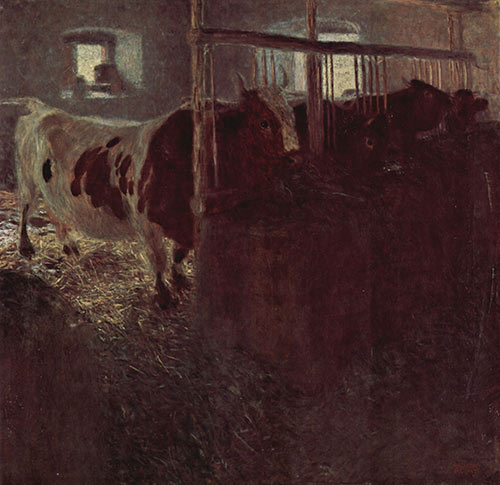
Gustav Klimt's Cows in the Barn, also translated as Cows in the Stable, is the painting catalogued by Lentos Kunstmuseum Linz as Kuhstall "Kühe im Stall", inventory 168. It is an oil on canvas measuring 75 × 76.5 cm. The museum records Klimt's signature at the lower right and dates the painting to 1900, while noting the 1900/01 dating used by Novotny and Dobai.[1]
The most immediately recognisable animal stands on the left, its pale, brown-spotted flank catching the light. Darker cattle occupy the middle and right, partly merging with the timber structure around them. A small window shines through the rear wall, and narrow upright divisions break up the space above the animals. Below, illuminated straw gives way to a much darker foreground.
This is a rural interior rather than an open landscape. Yet the relation between light and space makes it more than a record of livestock. Klimt gives the eye just enough information to travel into the stable, while allowing large areas to remain difficult to distinguish. The contrast between the visible and the half-seen is the painting's organising principle.
Why the painting is also dated 1899
The Lentos date is not the only convention in circulation. The Klimt Foundation dates the same painting to 1899 and connects it with Klimt's summer stay in Golling near Hallein with the Flöge family. It discusses the stable alongside A Morning by the Pond, another work associated with that stay, as an early example of Klimt's preference for a square format.[2]
Those differences concern the date of one painting, not two versions called Barn and Stable. The museum's dimensions also show that the canvas is nearly square rather than mathematically square. For an initial identification, the current holder's 1900 date is useful; the Foundation's 1899 account explains why an earlier year appears in specialist discussion. Neither convention identifies a precise barn or the position from which Klimt worked.
The connection with A Morning by the Pond is most revealing at the level of format and light. One picture encloses animals within a dark building; the other opens a view across water. The stable does not need to be treated as an Attersee scene simply because Klimt later painted there so often. The attributed Golling account belongs to an earlier summer setting.
The spotted cow and the darker herd
The left-hand cow provides the clearest route into the composition. Its broad side is turned towards the viewer, while its head faces more towards the right. Brown patches interrupt the pale hide, producing a pattern that is visible before the smaller details of the animal become clear. Its body is a substantial light area within a painting otherwise dominated by browns and deep shadows.
That brightness does not make the animal look detached from the building. Its lower legs become harder to distinguish as they meet the floor, and parts of its head and neck approach the darkness of the surrounding cattle. Klimt makes the animal most legible across its flank, then allows its outline to lose certainty elsewhere. The result connects the illuminated body with the shadowed enclosure instead of presenting it as a cut-out silhouette.
The other cattle establish a different rhythm. Their heads, backs and ears emerge through small changes in tone, sometimes interrupted by the verticals of the partition. Recognising one dark head helps the eye discover another shape beside it. The animals therefore do not all arrive at the same degree of clarity. The painting asks the viewer to adjust to the stable's darkness rather than providing an equally lit account of every creature.
This uneven visibility is more persuasive than a detailed inventory of the herd would be. It conveys bodies occupying a shared space, close enough to overlap and obscure one another. There is no need to assign an emotional exchange to an animal's eye or to imagine a confrontation between cattle and humans. The distribution of light already explains why one animal commands attention while the others recede.
Windows timber and the depth of the room
The small rear window is a bright rectangle, but it offers little view of the world outside. Its role is chiefly to establish a source and limit of illumination. Light reaches into the enclosure without dissolving it. The wall around the opening remains substantial, and the animals still occupy an interior whose depth must be understood through overlap and changes in tone.
The timber structure adds a second system of shapes. A strong horizontal rail crosses the upper part of the picture, while narrower uprights divide the area beneath it. These straight lines contrast with the rounded cattle. They also prevent the dark bodies from becoming one undifferentiated mass: a post or bar can briefly establish an edge where the animal's own contour is difficult to follow.
The floor produces another kind of recession. Short, irregular strokes describe straw in the light near the left cow, then become less distinct across the foreground. That transition brings the viewer close to the scene without introducing a figure to occupy the space. The floor is not simply empty beneath the animals; its changes in brightness connect the near edge of the painting to the more legible forms further back.
The nearly square canvas keeps these competing directions tightly enclosed. The cattle extend laterally, the posts rise vertically and the floor leads inward. None can expand into a panorama. Instead, the painting's breadth and height remain closely balanced, making the stable feel like a selected portion of a larger environment rather than a complete architectural description.
Colour and the limits of a reproduction
Although the painting is dark, its effect is not produced by black alone. Brown, reddish and greyish passages vary across the animals and the building. Against them, the pale flank and scattered straw carry much of the image's brightness. The small window offers a different kind of light: compact and concentrated, unlike the broader illumination spread over the cow's side.
The handling of the straw is especially useful to compare with the larger forms. Small directional marks suggest its uneven surface, whereas the animal's mass is understood through broader areas of colour and tone. Klimt can therefore distinguish textures without giving every part of the room equal detail. The busy floor, spotted hide and comparatively plain dark passages perform different tasks within the same confined space.
Digital reproductions can make these relationships harder to judge. A darker version may swallow the distinctions between the cattle on the right; a brighter one may exaggerate forms that are subtler in the painting. Those differences do not establish separate painted states or changes in Klimt's materials. The secure material identification remains oil on canvas, and the visual analysis should not be mistaken for a pigment or conservation report.
A private sale at the Secession
The painting's early exhibition history brings this quiet rural subject into Klimt's public career. The Klimt Foundation identifies Cows in the Stable among the works sold to private collectors at his 1903 collective exhibition at the Vienna Secession. The account does not name the purchaser of this canvas.[3]
The sale is a useful reminder that Klimt's exhibited work was not limited to portraits and large allegories. An enclosed stable could belong in the same public presentation of his art without becoming an allegory itself. The cattle painting's interest lies in its particular arrangement of animals, architecture and light, not in a hidden programme that must be borrowed from his more explicitly symbolic subjects.
The 1903 sale is also only one point in the ownership history. It does not by itself explain how the painting reached its later owner, Elisabeth Glanville, also known as Elisabeth Gotthilf. Linking those names into an uninterrupted chain would require evidence beyond the fact of an early private purchase.
Elisabeth Glanville and the 1958 museum purchase
Tobias G. Natter's 2023 study of Church in Unterach records a separate, specific fact about the cattle painting: Elisabeth Glanville sold it to the Linz museum in 1958. At her request, Fritz Novotny had brought it to the museum's attention in July of that year. Natter cites a letter from Novotny to Walter Kasten dated 12 July 1958.[4]
This account fits the Lentos inventory's entry date of October 1958, while distinguishing the approach to the museum from the later accession. It does not supply the painting's entire earlier history. In particular, the wartime questions surrounding Church in Unterach cannot simply be transferred to another canvas because both belonged to Glanville.
Lentos's October 2019 provenance-research report lists inventory 168, Kuhstall, with the acquisition year 1958 among the works researched. That table is evidence that the painting was included in the museum's research programme, not a complete ownership chain or a finding that it had been seized or restituted. The report's wider discussion of the Gurlitt collection does not make every work in the table a documented Gurlitt possession.[5]
Seeing the painting today
The painting later appeared as Cows in the Stable, no. 87, in the worklist for the Tokyo Metropolitan Art Museum's 2019 exhibition Gustav Klimt: Vienna–Japan 1900. That record gives the date as 1899 and credits Lentos as the collection, providing another dated example of the earlier chronology.[6]
The Japanese exhibition was a past presentation, not the painting's current location. As checked on 23 October 2026, the governing collection record remains Lentos inventory 168. It does not provide a verified current gallery placement, so visitors should confirm the hanging with the museum rather than assume that an older exhibition listing describes present access.
Within Klimt's landscapes and rural subjects, Cows in the Barn offers a distinctive experience: the countryside is encountered from inside a building, through a lighted flank, scattered straw, timber divisions and animals that gradually emerge from shadow. Its strongest effects are quiet and specific. They reward looking into the darker passages as carefully as at the conspicuous spotted cow.
References
- Lentos Kunstmuseum Linz. Kuhstall "Kühe im Stall", inventory 168. Current collection record. Accessed 23 October 2026. View source.
- Klimt Foundation. Cradle of Modernism, First Landscapes, section on Klimt's first square landscapes. Specialist account. Accessed 23 October 2026. View source.
- Klimt Foundation. The Golden Knight and Femmes Fatales, 1903 collective exhibition, sales. Exhibition account. Accessed 23 October 2026. View source.
- Tobias G. Natter. "Das Gemälde Kirche in Unterach am Attersee von Gustav Klimt. Zur Biografie eines Meisterwerks," in Gustav Klimt: Kirche in Unterach am Attersee, Heidi Horten Collection / Verlag für moderne Kunst, 2023, p. 38, note 56. Catalogue PDF. Accessed 23 October 2026. View source.
- Lentos Kunstmuseum Linz. Provenienzforschung am Lentos Kunstmuseum Linz: Zwischenbericht, October 2019, pp. 3–4, research-results table. Museum report. Accessed 23 October 2026. View source.
- Tokyo Metropolitan Art Museum. Gustav Klimt: Vienna–Japan 1900, List of Works, 2019, no. 87. Exhibition worklist. Accessed 23 October 2026. View source.