


 by Tom Gurney
Tom Gurney BSc (Hons) is an art history expert with over 20 years experience
Published on June 19, 2020 / Updated on October 23, 2026
Email: tomgurney1@gmail.com / Phone: +44 7429 011000
One Sheet and Two Anatomical Studies
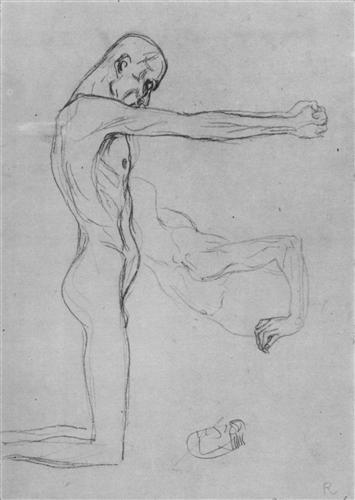
Gustav Klimt's Kneeling Male Nude with Extended Arms, Male Torso places a sharply defined kneeling figure beside a lighter, incomplete body study. The current Albertina catalogue dates the drawing to 1901 and identifies it as black chalk on paper, measuring 44.5 × 31.5 centimetres. Its identifiers are GKZ763 and Strobl 763. These locate the work in the catalogue; they do not mean that the Albertina owns the sheet, which is recorded in a private collection.[1]
The German title, Kniender Männerakt mit ausgestreckten Armen, männlicher Oberkörper, describes both elements. “Extended” or “outstretched” is more precise than the familiar English “sprawled out”: the main figure's arms are held in a remarkably controlled horizontal direction. The second torso introduces a different arrangement of body and arm rather than completing a scene around him.
A Body Organised around the Arms
The long reach towards the right is the drawing's strongest axis. From the shoulder, the arms narrow through elbow and wrist towards the hands, which gather close together near the edge of the paper. Their near-horizontal alignment creates a firm upper boundary against which the rest of the body bends and withdraws.
The head does not continue that forward movement. It inclines downwards, bringing the face close to the shoulder and interrupting the upright neck that a more assertive pose might require. Small dark marks around the eye, cheek and jaw concentrate attention in this tilted shape. They give the head definition without turning it into a finished portrait.
Below, the narrow torso curves towards the hips. Short internal marks describe the ribs and the hollow beneath them, while longer contours establish the outer back and abdomen. The figure is not built from a uniform network of shading. Klimt chooses a few lines that make the anatomy legible, then allows substantial areas of paper to remain open.
The bent legs supply another change of direction. The lower limbs turn back towards the left along the bottom of the sheet, answering the arms' reach to the right. The pose therefore depends on opposing movements: the upper body extends, while the kneeling base folds underneath. Without that lower return, the arms might seem to pull the entire figure out of balance.
The Lighter Torso at the Right
The second study is much less emphatic. It stretches across the lower-right area, with a bent arm descending towards a hand near the edge. Its outline crosses the open space beside the kneeling figure, but it does not acquire a complete head, legs or setting. The difference in completeness is one of the sheet's most useful features.
It is tempting to make the two studies into successive frames of an action, as though the first man were about to turn into the second. The drawing does not require that reading. The full pose investigates a body supported by its knees and reaching outward; the fragment concentrates on a different relationship between trunk, shoulder and bent arm.
The catalogue preserves Alice Strobl's comparison of this torso with a wrestler connected with Medicine.[1] That is a scholarly observation about resemblance, not proof that the fragment belongs to a second commission completed during the same sitting. It is most useful as a reminder that the sheet holds more than the single gesture named first in its title.
The darker and lighter passages also create a hierarchy for looking. The complete figure can be understood quickly, then revisited through the less resolved form beside it. The second study remains available without competing equally for attention. Blank paper separates some parts and lets others overlap, accommodating distinct enquiries within one surface.
A Study for the Beethoven Frieze
The main figure's purpose is not merely a guess based on the pose. The catalogue identifies it as a study for the man in The Sufferings of Weak Humanity, part of the Beethoven Frieze.[1] Its 1901 dating belongs to preparation for the work presented the following year, rather than to a separate allegory painted on this sheet.
Klimt made the frieze for the Vienna Secession's fourteenth exhibition, held from 15 April to 27 June 1902. The exhibition combined architecture, sculpture and painting around Max Klinger's Beethoven statue. The painted sequence draws on Richard Wagner's interpretation of the Ninth Symphony and the human longing for happiness.[2] That setting gives the kneeling man's gesture an allegorical function beyond anatomical exercise.
The extended arms are especially important to that transformation. On the sheet, they test the body's proportions and balance. In the larger work, a gesture has to remain intelligible at a distance and in relation to neighbouring figures. The clear contrast between the long reach and the contracted body supplies a structure capable of carrying that meaning.
Yet the study is not a reduced copy of the complete frieze. It does not contain the surrounding figures, the architecture or the whole symbolic journey. Its attention is narrower: how a shoulder leads into an arm, how a lowered head changes the silhouette, and how a kneeling body can convey dependence without becoming physically shapeless.
A Related Drawing Is Not the Same Object
The Albertina also publishes a separate Kneeling Male Nude with Outstretched Arms, likewise dated 1901 and made in black chalk. That museum-owned drawing measures 44.8 × 31.7 centimetres.[3] The closely related subject makes the distinction easy to overlook, especially when English titles omit the additional male torso that characterises this private sheet.
The few millimetres of difference are not a reason to average the measurements or combine the collection histories. Each record belongs to its own drawing. Here, the whole-sheet relationship between the kneeling man and the lighter anatomical fragment is central; the museum's rights credit and ownership cannot be transferred simply because another study shares the pose.
In its discussion of the frieze studies, the Albertina describes the related kneeling figure through humility and asceticism, while emphasising the strength of its contours and modelling. More generally, it explains how Klimt aligned gestures with the geometry of the exhibition architecture.[4] These observations help place the present sheet's tension between anatomical specificity and formal discipline.
They should not become a diagnosis of the unnamed model. Prominent ribs, a narrow abdomen and an inclined head are visible features. They do not establish his health, diet or personal emotional state. The suffering attached to the figure is its role within an artistic programme, not a biography recovered from bodily appearance.
Black Chalk and Selective Definition
The distinction between chalk and pencil matters because this drawing is often described loosely as a pencil sketch. The current specialist record specifies black chalk.[1] Within that medium, the reproduced sheet shows substantial variation: firmer outer edges, short dark accents and passages so lightly indicated that the body is only just held together.
Repeated or nearby lines around the limbs prevent the contour from looking mechanically fixed. At the same time, the large arrangement is clear. The extended arms, curved back and bent legs form an intelligible structure despite the local variations. Precision here does not depend on enclosing every part with a single unbroken line.
The two studies demonstrate different amounts of definition rather than a simple opposition between finished and worthless material. The fuller man can carry a legible gesture, while the fragment keeps a more limited anatomical question open. Describing the entire sheet as merely rough would obscure that distinction; calling it a finished illustration would obscure its exploratory character.
The catalogue records an oval lower-right name inscription, Gustav | Klimt, and a separate R.[1] Those marks should be distinguished from the drawn anatomy. The name does not tell us that the two bodies were produced in one session, and the letter alone does not explain an ownership transfer. They are features of this particular sheet, not instructions for reconstructing its whole history.
Collectors and Documented Exhibitions
The published provenance lists Carl Reininghaus, August Lederer, Erich Lederer and a private collection, followed by Sotheby's London on 6 February 2007, lot 127. It then gives a private New York collection, citing the 2007–08 Neue Galerie catalogue.[1] The sequence identifies important recorded associations without supplying every transaction or its circumstances.
The familiar collectors' names do not make the drawing's history identical to that of the frieze. Its paper support remained a separate object. The political and legal history of the wall painting cannot supply missing dates, a particular deprivation mechanism or a restitution decision for this sheet. Nor does the auction reference identify the current beneficial owner.
The catalogue records appearances in the Museum Folkwang's 1976 Klimt drawings exhibition in Essen and as D42 in Gustav Klimt: The Ronald S. Lauder and Serge Sabarsky Collections. Neue Galerie's archive confirms that the latter exhibition ran from 18 October 2007 to 30 June 2008.[1][5] These are documented opportunities to encounter the drawing, not evidence of continuous museum display.
As of 23 October 2026, the catalogue retains a private-collection designation; its New York provenance credit derives from the earlier exhibition publication. No current public installation of this sheet is confirmed. The surviving frieze and the preparatory drawing therefore offer different kinds of access: one can be approached as a large spatial work, while the other is known through its own collection, exhibition and photographic record.
Looking at the Sheet as a Whole
The most rewarding comparison is internal. Follow the long upper arms first, then return along the back and knees before examining the quieter torso. The main pose makes extension and contraction simultaneous; the fragment changes the angle and the amount of information. Together they show how an emphatic gesture can emerge from attentive, selective work on the body.
This is the drawing's distinct contribution within Klimt's works on paper. It does not need the frieze's entire narrative to become interesting. The relation is more precise: a recognisable human form is tested until it can function as a clear sign of need, while another anatomical possibility remains visible beside it.
References
- ALBERTINA Digitale Publikationen, Kniender Männerakt mit ausgestreckten Armen, männlicher Oberkörper, GKZ763 / Strobl 763, record last edited 27 April 2026; exact title, date, medium, dimensions, inscriptions, image, study relationship, quoted Strobl comparison, exhibition history and qualified published provenance. . Accessed 23 October 2026. View source.
- Vienna Secession, Beethovenfries, exhibition history and programme; 1902 dates, Klinger/Hoffmann setting and Wagner/Ninth Symphony relation, distinct from the drawing's history. . Accessed 23 October 2026. View source.
- ALBERTINA Museum, Kneeling Male Nude with Outstreched Arms, museum-authored Google Arts & Culture object record; separate 1901 museum drawing, black chalk and 44.8 × 31.7 cm measurements. . Accessed 23 October 2026. View source.
- ALBERTINA Museum, Klimt's Studies for the Beethoven Frieze, museum-authored Google Arts & Culture essay; related figure's ascetic/humble character, contour/modelling and architecture/gesture context. . Accessed 23 October 2026. View source.
- Neue Galerie New York, Gustav Klimt: The Ronald S. Lauder and Serge Sabarsky Collections, exhibition archive; 18 October 2007–30 June 2008 dates and context. . Accessed 23 October 2026. View source.