


 by Tom Gurney
Tom Gurney BSc (Hons) is an art history expert with over 20 years experience
Published on June 19, 2020 / Updated on October 23, 2026
Email: tomgurney1@gmail.com / Phone: +44 7429 011000
A reclining study for the Beethoven Frieze
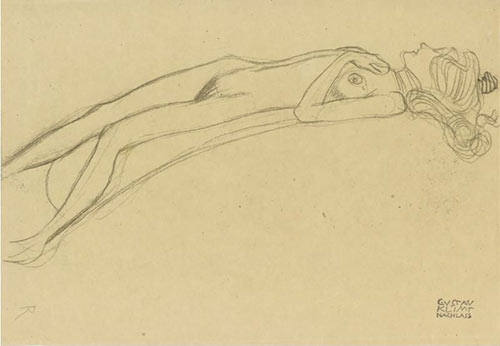
Gustav Klimt's Lying Girl Nude on her Back is a black-chalk drawing from 1901, identified in the Albertina's digital catalogue as GKZ746 and in Alice Strobl's catalogue as number 746. The sheet measures 31 × 44.5 cm. Its fuller German title also specifies the right hand visible above the head: a small detail that helps distinguish this particular figure from Klimt's many other reclining nudes.[1]
The body stretches across the upper part of the paper, with the head towards the right and the legs reaching left. The figure's tipped-back face, bent arm and loosely gathered hair interrupt the long sweep of the torso. Below her lies an extensive area of almost empty paper. There is no elaborately described bed or surrounding room to make this a domestic scene. The drawing gives its attention to the body's outline and to the way its different parts can be made to flow together.
That arrangement has a larger purpose. The study belongs with Klimt's preparations for the Beethoven Frieze, created for the Vienna Secession's fourteenth exhibition in 1902. The exhibition ran from 15 April to 27 June and brought painting, sculpture and architecture together around Max Klinger's monument to Beethoven. A figure observed in the studio could become part of an imagined world extending across the walls.[2]
The long diagonal across the paper
The pose is not simply a horizontal body laid parallel to the edges. Its principal direction rises from the legs at the left towards the shoulders and head at the right. This slight incline makes the body seem to traverse the sheet rather than settle heavily into it. The two long sides of the figure lead the eye in broadly the same direction, but they never become rigid parallel rails.
Along the upper outline, a change of angle at the knee interrupts the approach to the hip. The torso then lengthens towards the shoulder, where the arm produces a tighter knot of shapes. Along the lower side, the contours of the legs and waist make a different sequence of bends. Their unequal rhythms prevent the figure from becoming a simple elongated oval. Even with very little surrounding description, the pose remains particular and physically complicated.
The arm across the chest is especially important. Its bent elbow and returning forearm introduce a smaller angular structure within the body's longer outline. The rounded breast and the darker marks nearby concentrate attention in this upper section. These details establish an internal rhythm without requiring a continuous account of every muscle or change of plane.
The second hand appears beyond the head, close to the right edge. Because it is so small beside the long torso, it can be overlooked at first. Once noticed, it makes the pose less easily read as a single uninterrupted stretch. Head, hand, forearm and shoulder are differently directed elements held within one compact area. The title's reference to the hand therefore identifies a compositional feature, not just an incidental anatomical detail.
The hair offers another kind of movement. Its looping strands gather below and around the head, creating a denser, more intricate passage beside the relatively open body. The contrast is readily visible even in a modest reproduction. Long, sparing outlines carry the figure across the page; the clustered curves of the hair slow the eye at one end of that movement.
Black chalk and selective modelling
The governing catalogue describes black chalk, not pencil. The distinction matters because the drawing should not be assigned the materials of Klimt's later, differently catalogued studies. Here the visual effect depends on changes between firm contours, lighter searching lines and small areas of shading. It does not depend on colour filling the body or on a fully modelled background.[1]
Some passages appear almost weightless, while the darker outline along the body holds the figure together. Around the upper torso, short strokes and denser patches suggest turns in the form. These are local accents. They do not build up the evenly graduated light and shadow that would make the entire body appear as a solid object under a single, consistently described light source.
The paper remains active within the figure as well as outside it. Much of the torso is left open, so the viewer connects a small number of marks into a continuous body. The breast, waist and elbow act as points of recognition. Between them, unmarked areas can carry a considerable distance. That economy makes the outline feel more consequential: each bend has to do work that a more heavily shaded drawing might distribute across a broad surface.
The upper half of the sheet is busier than the lower half. This unequal distribution gives the body room without enclosing it in a conventional setting. In the image as it survives, the blank area provides a quiet field against which the closely grouped lines remain legible. The figure can be followed from end to end without competing with a fully described setting. Its bends and extensions supply most of the movement.
From a studio pose to a floating figure
Strobl connected this sheet with studies for the floating figures of the Beethoven Frieze. That is a more precise relationship than calling it simply an erotic sketch, but it is not the same as identifying an exact enlarged outline transferred unchanged to a wall.[1]
The distinction helps explain the strange balance between rest and movement. The model is represented reclining, yet the lack of a firmly described support allows the body to be imagined apart from the furniture or platform on which a real pose would depend. The long diagonal and extended limbs can become a direction of travel. What looks like lying down in one setting can suggest suspension in another.
The Albertina's account of the frieze studies stresses the importance of contour and the different degrees of stylisation Klimt used for different figures. It relates the flowing line of the repeated floating pair to the frieze's theme of longing for happiness. Its illustrated draped studies are separate works, but they clarify the kind of transformation with which this nude study is associated.[3]
The present figure is useful to consider before the addition of a robe, surrounding ornament or a repeated neighbour. Her knees, chest and lifted chin remain recognisable parts of an observed body. At the same time, their alignment already offers a sustained linear movement. The interest lies in the meeting of those two demands: keeping the pose bodily convincing while making it serviceable within a larger decorative rhythm.
This is a different problem from the emphatic outward gesture of Klimt's kneeling male study. Looking between such drawings reveals that preparation for one commission need not produce a uniform graphic language. A concentrated diagonal, an extended arm or a fragile contour can each give a different figure its particular role.
An unnamed model and a precise title
The model is not named in the current object record. Nor does the descriptive word Girl establish a documented age. The visible pose can be discussed without turning it into a portrait of a known companion or an episode from Klimt's private life. The closed eyes and upturned head are features of the represented body; they do not disclose what the person thought or felt during a sitting.
Titles describing reclining women are particularly easy to confuse. The Leopold Museum's Female Nude Lying on Her Back from the Right with Bent Legs is a separate drawing, dated 1914/15 and made in pencil on Japanese paper. Its commentary does not assign it to a particular painting. Similar posture does not make it another version of this 1901 black-chalk sheet or give the two works the same preparatory purpose.[4]
The catalogue numbers are consequently more useful than a shortened English label alone. They keep the present drawing attached to its own scale, material and study relationship. They also prevent a comparison with later nudes from quietly becoming an assertion that all Klimt's reclining figures share one date or intended destination.
Collecting marks and later exhibitions
Two small marks help distinguish the physical sheet from an unmarked reproduction. The catalogue records an R at the lower left and an estate stamp at the lower right. The latter is not an autograph signature. Neither mark dates the sequence of individual strokes or proves when Klimt considered the drawing complete.[1]
The published ownership record names Klimt's estate, Carl Reininghaus, August and Erich Lederer, and a private collection before recording Sotheby's London, 6 February 2007, lot 122. It subsequently gives a private New York collection, citing the 2007/08 Neue Galerie catalogue. The intervening transfers are not all dated. These names should not be expanded into an invented sale, wartime seizure or restitution account for this particular sheet.[1]
The drawing's later public appearances are more securely dated. It was included in the Neue Galerie's Gustav Klimt exhibition of 18 October 2007–30 June 2008. The museum's exhibition archive confirms those dates, while the specialist object record identifies this drawing within the show.[5]
It also appears in the Albertina's linked checklist for Gustav Klimt: In Search of the Total Artwork at the Hangaram Art Museum, Seoul Arts Center, from 1 February to 15 May 2009. These appearances show that the sheet has been accessible through temporary exhibitions; they are not evidence of permanent museum ownership.[6]
Seeing the drawing today
As checked on 23 October 2026, the current catalogue retains the private New York collection credit, with its historical source identified. That is not an independently confirmed present address or a promise of public display. A visitor should not assume that an Albertina catalogue entry means the original is hanging at the Albertina.[1]
The reproduction nevertheless preserves the drawing's central visual achievement. A body described through a limited set of lines occupies the paper with remarkable extension. The small hand and intricately looped hair anchor one end; the legs lead away at the other. Between them, Klimt tests how the weight of an individual body can coexist with the possibility of floating movement.
References
- ALBERTINA Digitale Publikationen, Auf dem Rücken liegender Mädchenakt, die Rechte über dem Kopf sichtbar, GKZ746 / Strobl 746. Current object fields, image, study relation, provenance and exhibition record; last edited 4 May 2026. Accessed 23 October 2026. View source.
- Vienna Secession, Beethovenfries. Exhibition setting, dates and programme. Accessed 23 October 2026. View source.
- ALBERTINA Museum, Klimt's Studies for the Beethoven Frieze, Google Arts & Culture. Contour, stylisation and floating-figure studies. Accessed 23 October 2026. View source.
- Leopold Museum Online Collection, Female Nude Lying on Her Back from the Right with Bent Legs, inventory 1315. Separate 1914/15 drawing, Strobl 2398. Accessed 23 October 2026. View source.
- Neue Galerie New York, Gustav Klimt: The Ronald S. Lauder and Serge Sabarsky Collections. Exhibition archive, 18 October 2007–30 June 2008. Accessed 23 October 2026. View source.
- ALBERTINA Digitale Publikationen, Gustav Klimt. In search of the Total Artwork. Seoul exhibition record and linked GKZ746 checklist entry, 1 February–15 May 2009. Accessed 23 October 2026. View source.