


 by Tom Gurney
Tom Gurney BSc (Hons) is an art history expert with over 20 years experience
Published on June 19, 2020 / Updated on October 23, 2026
Email: tomgurney1@gmail.com / Phone: +44 7429 011000
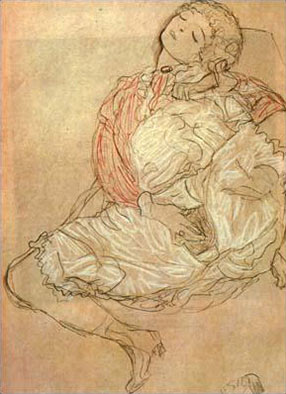
A seated woman in red and white drapery
Mulher Sentada means Seated Woman in Portuguese. The drawing reproduced here is more precisely identified as Sitzende Frau mit gespreizten Schenkeln, or Seated Woman with Spread Thighs, catalogued as Strobl 2967 and dated 1916/17. IMAGNO's illustrated record describes pencil, red coloured pencil and white heightening, and places the sheet in a private collection. The Portuguese words describe the pose; they are not the woman's name.[1]
The figure occupies a tall sheet, yet her body folds into a surprisingly compact shape. Her head tips backwards near the upper right. Below it, clothing billows across the chest and gathers around the bent legs, while a bare lower leg descends into the quieter space near the bottom. Red accents and extensive white passages make this more than an exercise in dark outlines. Much of its character comes from the contrast between the restless garment and the smoother intervals of exposed skin.
The woman is not identified in the published image record. Her tilted head and closed eyes help organise the pose, but neither feature supplies a personal history. The drawing's individuality is visible in the particular arrangement of her features, hands and clothing, without requiring her to be a named patron or a figure from mythology.
How the seated pose fills the paper
The principal movement runs diagonally. From the head, the eye follows the shoulders down towards the left-hand spread of fabric, then returns along the lower contours. The bent leg at the right interrupts that movement with a more upright mass. Instead of arranging the figure around a straight central axis, Klimt balances unequal shapes: the relatively small head, the broad clothing across the middle, and the much narrower lower leg and foot.
The face remains comparatively clear within this complicated arrangement. Short marks distinguish the eyelids, nose and lips, while small curls describe the hair. The chin tilts away from the chest, opening a pale interval at the neck. Around this quieter passage, the lines describing the collar and shoulder turn and overlap. The contrast directs attention towards the face without giving it the dominant scale of a conventional portrait.
Clothing makes the posture more complex to read. Some folds run in the same direction as a limb; others cut across it or conceal its junction with the torso. A ruffled edge can momentarily seem like an anatomical contour before declaring itself as fabric. Looking slowly, rather than trying to separate every part immediately, reveals how Klimt uses those changes of direction to hold the whole shape together.
The chair is much less fully described. A few straight and angled lines behind the upper body suggest support, but there is no carefully furnished room. The light surround allows the figure's outer edges to remain prominent. Although the pose requires a place to sit, Klimt gives that place only as much definition as the arrangement needs. The person and the drapery carry the image, not an inventory of domestic possessions.
What red and white add to the pencil lines
Red is concentrated around the upper body rather than spread evenly across the drawing. It follows the garment's edges and folds, producing a loose enclosure around the shoulders. These marks differ from a flat area of painted colour: the underlying paper remains visible between them. Their uneven density adds activity to the clothing while preserving the drawing's open texture.
White performs a different task. It picks out the swelling and crumpling fabric, making passages of cloth appear brighter than the surrounding support. The term white heightening describes that addition of light accents. It should not be confused with the colour of the paper itself. Here the brighter marks create a second network inside the darker contours, so a fold can be suggested by a light stroke as well as by an enclosing line.[1]
The exposed lower leg is comparatively spare. Its long outline and lightly described foot provide a pause after the numerous turns in the clothing above. This difference in density matters as much as the choice of colours. If the limb were worked as insistently as the ruffles, the compact middle would lose some of its visual weight; if the garment were reduced to a few pale edges, its enveloping volume would be less convincing.
The drawing therefore asks the viewer to notice different kinds of description at once. A dark contour establishes an edge, a red passage draws attention to a fold, and white heightening lifts another part forward. The pale spaces between them remain active. The effect is built through selection, not through an equally complete rendering of every visible surface.
An intimate subject without an invented biography
The woman's hand at her lap and the separation of her legs establish the drawing's erotic subject. In its discussion of this work, the Fondation Beyeler treated the image as a depiction of female sexuality outside the more familiar social settings of bathing or dressing. Its exhibition notes also questioned the position of the male artist and spectator. That is an interpretation of the represented relationship between figure and viewer, rather than testimony about this particular woman's experience.[2]
Her eyes do not meet ours. The backward inclination of the head turns the face away from a direct exchange, while the gathered clothing focuses attention lower down. Those choices create a sense of absorption. They do not allow an observer to reconstruct the sitting, determine the model's feelings or turn the scene into an episode from Klimt's relationships. The distinction leaves the subject explicit without making the woman into a fictional character.
The empty surroundings contribute to that effect. There is little to suggest a particular hour, household or sequence of events. The body is shown in a specific position, but the image supplies very little narrative around it. This concentration can make the scene seem unusually immediate, even though its arrangement is highly selective. The intimacy belongs to the drawing's presentation, not to privileged knowledge of the person depicted.
A drawing that does not need a painted destination
In its account of other erotic drawings from 1913–17, the ALBERTINA emphasises the relationship between close observation and deliberate organisation across the sheet. It discusses contrasting line strengths, densely articulated drapery and the contribution of unmarked areas. Those observations provide a useful comparison for the red-and-white seated woman: the folds and bare intervals are not separate effects, but parts of one arrangement.[3]
This also helps explain why calling every Klimt drawing a preliminary sketch can be misleading. A drawing may explore a pose and still possess a complete visual balance of its own. The Klimt Foundation distinguishes autonomous nude drawings from the studies incorporated into an allegorical painting such as The Bride. The shared interest in the body does not make each surviving sheet a design for that painting.[4]
No specific painted destination is established for Strobl 2967 by the illustrated record cited here. The drawing can be understood through what it achieves on paper: its contrasting marks, contained movement and selective description. Its red and white passages are part of that achievement, rather than evidence that Klimt intended to repeat the composition in oil. Nor does its intimate subject by itself place it inside a hidden sketchbook.
Within Klimt's wider drawings, this sheet offers a particularly clear encounter between clothing and the seated body. The fabric neither simply conceals the figure nor serves as an ornamental background. It determines the breadth of the middle, redirects the contours and makes the comparatively sparse leg more conspicuous. The result is a composed image in which the apparent looseness of individual strokes coexists with a carefully balanced whole.
Exhibition history and the private original
The drawing's later public presentation is documented by the Fondation Beyeler's Eros in Modern Art room guide, which discusses Sitzende Frau mit gespreizten Schenkeln, dated 1916/17, as its eleventh selected work. The exhibition ran at Riehen, near Basel, from 8 October 2006 to 18 February 2007. This is a specific exhibition anchor, not evidence that Beyeler owned the drawing or that it remains there.[2][5]
The published private-collection credit likewise does not identify a current owner or city. As checked on 23 October 2026, the records cited here do not establish a present public display. A past loan and the circulation of a photograph make the image accessible, but they are different from permanent museum ownership or a promise that the original can currently be visited.
Reproduction also changes the encounter with its materials. At a small scale, the dense garment may appear almost like a single white shape, while faint pencil strokes can become difficult to distinguish. A closer view restores the separate curves and interruptions through which that mass is constructed. The drawing rewards attention to those modest means: a backward-tilting head, a folded body, coloured accents and enough open paper to let each part register.
References
- IMAGNO/Austrian Archives, via Austria-Forum. Sitzende Frau mit gespreizten Schenkeln, AS 2967, 1916/17, media 00507046. Illustrated record. Accessed 23 October 2026. View source.
- Fondation Beyeler. Eros in Modern Art: Information Sheets, note 11, Sitzende Frau mit gespreizten Schenkeln, 1916/17. English translation by John Gabriel. Exhibition notes. Accessed 23 October 2026. View source.
- ALBERTINA Museum. Klimts autonome erotische Aktzeichnungen (1913–1917). Institutional online exhibition, Google Arts & Culture; German text. Drawings commentary. Accessed 23 October 2026. View source.
- Klimt Foundation. The Final Years, Drawings and Eroticism in Klimt's Oeuvre. Specialist account. Accessed 23 October 2026. View source.
- Fondation Beyeler. EROS in der Kunst der Moderne, 8 October 2006–18 February 2007. Exhibition archive. Accessed 23 October 2026. View source.