


 by Tom Gurney
Tom Gurney BSc (Hons) is an art history expert with over 20 years experience
Published on June 19, 2020 / Updated on October 23, 2026
Email: tomgurney1@gmail.com / Phone: +44 7429 011000
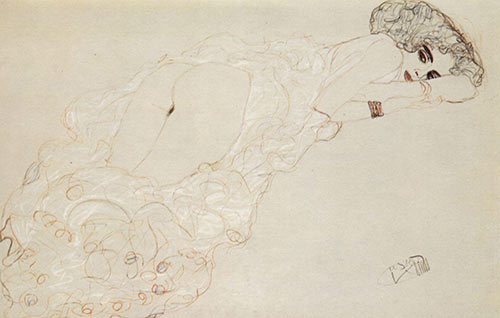
A signed drawing of a woman looking back
Reclining Woman is catalogued as Auf dem Bauch liegender Akt nach rechts, or Nude Lying on Her Stomach Facing Right. Kornfeld dates it to 1910 and identifies it as Strobl 1968. Measuring 37.1 × 56.2 centimetres, the drawing is signed within an oval at the lower right. Its partly undressed figure turns her face towards the viewer.[1]
This small drawing has two very different centres of attention. The eyes, eyebrows and lips are strongly marked, making the face immediately conspicuous. Across the opposite corner, loose coils of fabric spread into a much larger, more lightly defined mass. The exposed body connects these unequal concentrations. Its relative quietness is essential: the sheet is not uniformly detailed, and its most arresting effects depend on the distance between dark facial features and almost weightless contours.
The face returns the viewer's gaze
The head occupies the upper right, turned back from the direction suggested by the body. One cheek approaches the bent forearms, while the hair forms a restless enclosure above it. Klimt gives the eyes a force that exceeds their physical size within the composition. Their dark marks interrupt the otherwise delicate drawing, drawing attention past the broad hip and towards the face. The tilted head also prevents the gaze from becoming a stiff, frontal portrait.
It is tempting to translate this look into a complete personality. The figure might strike one viewer as amused and another as watchful. Neither response establishes what a particular model felt. The available catalogue descriptions do not name her, and an expression is not proof of embarrassment, invitation or a private relationship with the artist. What the drawing establishes is a visual exchange: unlike a figure absorbed in sleep, she appears to look outward, making the viewer conscious of looking back.
The forearms help frame that exchange. They form a narrow horizontal support beneath the face, contrasting with the body's longer diagonal. A small banded wrist ornament provides another dark accent close to the eyes. Rather than filling the entire sheet with equally emphatic marks, Klimt groups a few of them near the head. The eye can move between these accents before following the much fainter shoulder and back. The ornament's appearance does not identify its material or maker.
A long diagonal through a nearly empty field
Seen largely from behind, the body rises from the lower left towards the head. The back, exposed hip and upper thigh make a broad pale area within the more irregular cloth. There is little continuous shading to explain their volume. Instead, changes of direction along the outer contour suggest weight, curvature and the turn of the torso. The drawing asks the viewer to connect selected marks rather than supplying every transition between one bodily surface and another.
A small darker passage near the meeting of the thighs is especially effective against this sparseness. Because so much of the adjacent body remains lightly defined, even a limited tonal accent can register strongly. It does not require an elaborate system of cast shadows. Elsewhere, the shoulder can almost disappear into the surrounding paper while remaining readable through its relationship to the arm and face. Strong definition in one place allows Klimt to leave another remarkably open.
The pose is extended but not rigid. The hips turn differently from the head, and the bent arms introduce an opposing direction at the end of the body's diagonal. These shifts keep the figure from becoming a simple tapering shape. They also complicate the distinction between rest and movement. The woman is recumbent, yet the act of turning back gives the arrangement a moment of alertness. That is an effect of the represented pose, not evidence of how quickly the artist worked.
The largest open area lies below and to the right of the figure. It gives the upper-right head room to remain distinct from the fabric gathering at the opposite corner. The isolated signature occupies this quieter field without supplying a floor, a wall or a furnished room. A detailed setting would change the balance considerably. Here the bodily turn and the growing mass of cloth are sufficient to establish the sheet's principal directions.
Red and blue lines in the drapery
The materials are more varied than the pale reproduction might initially suggest. The Fondation Beyeler's 2010 caption identifies pencil, blue and red coloured pencil, and white heightening; Kornfeld specifies simili-Japan paper. Colour remains selective rather than covering the whole body or background. The sheet belongs to drawing, despite the broader range of materials. White heightening should not automatically be renamed gouache, since that would identify a more specific substance than these records establish.[1][2]
At the lower left, the garment becomes a tangle of loops, arcs and short connecting strokes. Some describe gathered cloth, while others resemble patterns carried by it. Their overlap makes it difficult to divide the fabric neatly into isolated folds. This uncertainty is visually productive. The cloth seems abundant even though it is not rendered as a solid, shaded mass. Its complexity is produced by repeated movement of line rather than by filling each section with a different colour.
The drapery also changes character along the body. Near the head and shoulder it is more closely tied to the figure's position. Towards the lower left, its expanding curves begin to function almost as an independent decorative field. The eye can follow one coil into another without continually checking its anatomical location. This gives the drawing a second rhythm beside the long, comparatively calm contour of the exposed body. Neither rhythm entirely absorbs the other.
Colour reinforces that distinction without turning the garment into a fully specified costume. Red lines can be seen particularly clearly in the lower-left gathering, while cooler and paler marks complicate its edges. Their effect is different from an opaque painted dress. Open intervals remain visible between the strokes. A reproduction may make the red more prominent or suppress the fainter marks, so the balance of colours should not be treated as a precise measurement taken from the original.
Different drawings behind similar titles
The descriptive name Reclining Woman is not enough to distinguish this sheet from all Klimt's other recumbent figures. The Staatsgalerie Stuttgart, for example, owns a different Liegende Frau, inventory C 1951/325, dated 1904. Its woman lies on her back with closed eyes. That is not the turned, viewer-facing figure in this 1910 drawing. The Stuttgart sheet's documented book illustration and collection history should likewise remain attached to that separate object.[3]
The distinction is equally important beside Reclining Female Nude, whose raised leg and reaching arm form a compact enclosure. Here the figure follows a longer diagonal, and the eyes are open. These differences provide a more useful comparison than speculation about shared models. No particular painting is identified as the destination of the present design in Kornfeld's entry. Its concentrated face and selective body contours can be appreciated without assigning them an unsupported allegorical role.
From a private collection to public exhibitions
Kornfeld's current provenance runs from August Lederer to Erich and then Elisabeth Lederer by inheritance, followed by Elisabeth's gift to Eberhard W. Kornfeld in March 1987. It also records Kornfeld's collector's stamp on the reverse. That mark is distinct from the artist's front signature.[1]
The drawing's later public appearances include Essen in 1976, Brussels in 1981 and ALBERTINA exhibitions in 2008–09 and 2012. Its place in the Fondation Beyeler's Wien 1900 exhibition is independently documented by the museum's caption and collection credit. That exhibition ran from 26 September 2010 to 16 January 2011. The historical E.W.K. Bern credit records a lender at that time; it is not a statement of where the sheet can be visited now.[1][2]
Beyeler's accompanying discussion observes that a woman's direct gaze towards the viewer is comparatively unusual in Klimt's erotic drawings. This makes the present figure particularly interesting within the larger group. Her outward look introduces a different relationship from the more self-contained poses often associated with his nudes. The comparison need not become a rule about every Klimt woman, or a claim to read an actual model's thoughts. It draws attention to a choice visible in this particular face.[2]
Kornfeld records CHF 410,000 at the hammer on 12 September 2025, without naming the buyer. This is a historical sale result, not a current valuation. The available record establishes no public viewing location on 23 October 2026. Modern reproductions remain distinct from the signed original.[1]
For a viewer exploring Klimt's drawings, the sheet offers an unusually clear contrast between degrees of emphasis. The face is insistently present, the exposed body is economical, and the garment expands into a field of coloured movement. Looking across those transitions is more revealing than treating the image as a coded confession. Its intimacy comes from a precisely organised encounter between the figure, the paper and the person looking at it.
References
- Galerie Kornfeld, “Auf dem Bauch liegender Akt nach rechts,” 1910, Strobl 1968, lot 60, 12 September 2025; current online object, materials, signature, provenance, exhibitions and hammer-price record. . Accessed 23 October 2026. View source.
- Fondation Beyeler, Wien 1900 Klimt Schiele und ihre Zeit, 2010 press dossier; exhibition dates, drawing caption 07, materials, historical E.W.K. collection credit and discussion of the viewer-facing gaze. . Accessed 23 October 2026. View source.
- Staatsgalerie Stuttgart, “Liegende Frau,” C 1951/325, 1904; separate drawing and publication history, used only to distinguish the title collision. . Accessed 23 October 2026. View source.