


 by Tom Gurney
Tom Gurney BSc (Hons) is an art history expert with over 20 years experience
Published on June 19, 2020 / Updated on October 23, 2026
Email: tomgurney1@gmail.com / Phone: +44 7429 011000
Two poses on one sheet
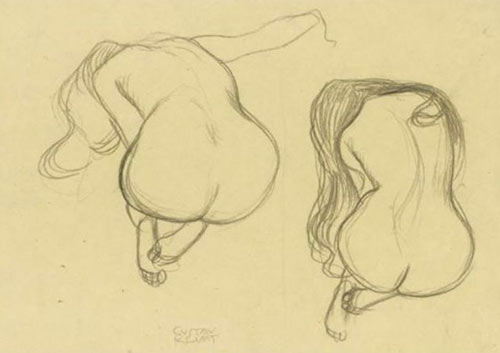
The drawing often called Studies of a Seated Nude from Behind with Long Hair belongs to the J. Paul Getty Museum, which titles it Two Studies of a Seated Nude with Long Hair. Made about 1901–02, it brings two rear views together on one horizontal sheet. Its accession number is 2009.57.2. The figures are related studies, not a pair of separately framed originals.[1]
The sheet offers more than an unfinished image waiting to become a painting. It lets two versions of a bodily arrangement coexist. The larger figure rises towards the upper left; the smaller one settles lower on the right. Each bends forward, leaving the back and rounded hips exposed, but their placement changes the balance of body, hair and surrounding paper. Repetition becomes a way of looking more closely rather than simply doing the same thing twice.
The larger figure and the extended arm
At the left, an arm reaches across the upper area and opens the figure beyond the compact mass of her torso. The long, lightly described limb contrasts with the emphatic curve around the hips. It makes the pose less self-contained: part of the body extends into otherwise empty paper, while the folded legs gather beneath the heavier central form.
The head bends away and is largely obscured by hair. Long strands sweep down towards the left, then turn outwards in loose, overlapping arcs. The hair is neither a solid black shape nor a collection of individually finished hairs. Its repeated lines establish direction and weight while allowing the paper to remain visible between them.
The strongest contour travels around the lower body. Several close lines reinforce it, whereas the interior of the back contains much slighter indications. This difference creates volume without conventional shading across the whole torso. A dark boundary can make the body seem substantial even when the enclosed area is barely worked.
Below, the feet are compact and intricate. Small loops and changes of direction contrast with the generous curves above them. They establish how the body folds into its position without becoming a fully described anatomical exercise. The drawing moves between scales of attention: broad sweep, slight interior mark and tightly gathered extremity.
The smaller figure and the fall of the hair
The right-hand study has a more enclosed outline. Without the other figure's long extended arm, its movement is concentrated in the narrowing back and widening hips. The body reads as an uneven hourglass, though the asymmetry prevents it from becoming a decorative diagram. One side turns sharply inward; the other follows a more continuous outer sweep.
Hair falls along the left side of this figure and trails down towards the folded legs. At the top, shorter loops gather near the shoulder. These differences give the hair more than one rhythm. It can descend in long strands, double back upon itself and partly conceal the body beneath. The distinction between hair and skin remains clear even though both are described with the same dark drawing medium.
The blank interval between the two studies is important. It separates the poses while allowing their curves to answer one another. The figures do not share a floor, chair or enclosing room. Their relationship is made by scale and placement on the sheet, not by an invented scene in which two women sit together.
The Getty identifies them as studies of the same model.[2] That makes their differences especially revealing. A related pose can be opened by an arm, tightened by a contour or altered through the fall of the hair. No personal name is established for the model, and the hidden faces do not justify attaching a familiar Klimt sitter's identity to her.
Black chalk and red pencil
Getty records black chalk with red pencil, and gives the unframed sheet's measurements as 31.7 by 45.2 centimetres.[1] The black medium supplies the bodies, hair and selective internal marks. Its repeated contours can look soft in one passage and much more insistent in another. The effect depends on variation rather than a uniform outline drawn once around every form.
The open interiors should not be confused with a lack of observation. The transition from shoulder to back, the turn into the waist and the weight of the lower body remain legible through relatively few decisions. Adding an even layer of shading everywhere would change the drawing's balance. Here the pale paper does much of the work that a more continuously modelled figure would assign to tone.
The two colours also have different functions. Getty explains the faint red indications around the right-hand figure as cropping instructions for a photographer.[2] They are not a second version of the body, a decorative red surround intended for the painting, or evidence that Klimt marked one model as his final choice. Their purpose belongs to the drawing's later reproduction.
A study for Goldfish
The sheet prepared the foreground nude in Goldfish. Getty points out a consequential difference: in the finished oil the woman keeps the rear-facing pose but turns her head to look back over her shoulder.[2] The studies therefore help explain the body's arrangement without supplying every feature of its final expression.
That change alters the viewer's relation to the figure. In the drawing, the hidden head directs attention towards the back, hips and falling hair. In the oil, the backward glance adds an encounter. The body can remain broadly related while the head gives the painted figure another kind of presence. Preparation does not have to mean an exact miniature of the finished result.
Getty associates the flowing contours and hair with Klimt's imagery of women and water.[2] That is a reading of the forms and their connection to the painting, not evidence that the model posed underwater. On this sheet there is no fish, pool or fully described aquatic setting. The connection is made through the body's subsequent pictorial role and the movement suggested by its lines.
The drawing's appearance within Getty's discussion of the Beethoven Frieze can also cause confusion. It belongs to the same period, but the specific preparatory target is Goldfish. The exhibition's thematic grouping does not relocate these figures into the frieze or make the sheet a study for one of its named personifications. The exact relationship matters more than the heading under which a reproduction happens to appear.
The figure published in Ver Sacrum
The ALBERTINA catalogue locates the reproduction of the right-hand figure in the tenth issue of Ver Sacrum for 1902, on page 159.[3] The printed selection did not reproduce both poses as one complete sheet. It offered one figure to readers of the Vienna Secession's periodical.
Cropping changes the experience of the image. On the original, the right-hand study can be compared with its larger neighbour; in isolation, its own outline must carry more of the visual weight. The decision makes a preparatory figure available as an independent printed image. It also explains why a familiar reproduction may not show everything present in the museum drawing.
The original marks and the published image remain physically different things. A photographed and printed line can preserve the shape of a chalk contour without reproducing the chalk itself, the paper's scale or the full distribution of marks across the sheet. Klimt's prints and reproductions need this distinction: publication does not mean that he carved a printing block or redrew the figure directly on a plate.
Signature and collecting history
Klimt signed the drawing below the figures. A separate turned R appears at the lower left; it is a collection mark, not another artist signature. The ALBERTINA catalogue identifies the sheet as GKZ862, also Strobl862, and records Carl Reininghaus's purchase from Klimt in 1903. August Lederer acquired it from Reininghaus in 1915. The published chain then passes by inheritance to Erich Lederer, who held it until 1985.[3]
The signature and publication complicate the idea of a disposable working sketch. The sheet had a practical relationship to another artwork, but that did not exhaust its value. Two poses, spare interiors and visible searching contours could be preserved and collected rather than discarded when the oil was complete. Its usefulness in the studio and its appeal as a drawing are compatible.
ALBERTINA subsequently lists an Austrian private collection from 1985, Sotheby's London lot120 on 6 February 2007, Le Claire Kunst in Hamburg in 2009, and Getty in that year.[3] These are the recorded ownership and market anchors. They do not supply an auction buyer's identity, a purchase price or every intervening movement.
The Lederer name needs particular care. Getty's account of the family's Nazi-era losses illustrates this drawing, but its detailed seizure, storage and return narratives concern three other objects: a panel painting, a glazed jar and a bronze elephant.[4] Their documented movements cannot be assigned to the Klimt sheet simply because it once belonged to the same family. Its own published chain should remain distinct from the wider history of persecution.
Exhibition and present access
The drawing has been discussed and displayed as a work in its own right. The ALBERTINA record includes the 1928 Klimt memorial exhibition and the 1976 presentation at Essen's Museum Folkwang.[3] Getty's Zeitgeist exhibition, held from 10 February to 17 May 2015, also included this exact sheet under its current title and materials.[5] Those are historical presentations, not promises of permanent display.
There is a further distinction in its presentation: Getty describes the drawing's frame as a facsimile of a frame designed by Klimt.[1] That reconstructed surround is not part of the paper and should not be mistaken for an original surviving frame merely because the design has an artistic connection. The drawing and the object used to exhibit it have separate material histories.
On 23 October 2026, Getty's collection record stated that the sheet was not currently on view.[1] Its online image still permits close study of the paired poses, but a museum collection address is not a guarantee that the original can be seen on a particular visit. The work's lasting interest lies in the different forms of attention it has supported: working out a figure, selecting an image for publication and returning to the complete sheet as a collected drawing.
References
- J. Paul Getty Museum, Two Studies of a Seated Nude with Long Hair, accession 2009.57.2, current object fields, photograph, frame and access status. Accessed 23 October 2026. View source.
- J. Paul Getty Museum, Gustav Klimt The Magic of Line, Beethoven Frieze, exact drawing discussion, same-model identification, Goldfish relation and photographic cropping. Accessed 23 October 2026. View source.
- ALBERTINA, Zwei Studien eines sitzenden Rückenaktes mit langem Haar, GKZ862/Strobl862, publication, exhibition and provenance records, updated 8 January 2026. Accessed 23 October 2026. View source.
- Ashley Medina, Getty, The Lederer Collection Lost and Found, 31 May 2016, exact drawing caption and the limits of the other objects' reconstructed histories. Accessed 23 October 2026. View source.
- J. Paul Getty Museum, Zeitgeist Art in the Germanic World 1800–1900, 2015 exhibition dates and exact drawing entry. Accessed 23 October 2026. View source.