 by Tom Gurney
Tom Gurney BSc (Hons) is an art history expert with over 20 years experience
Published on June 19, 2020 / Updated on July 19, 2026
Email: tomgurney1@gmail.com / Phone: +44 7429 011000
John Singer Sargent Public Commissions: Introduction
John Singer Sargent's public commissions reveal the part of his career that cannot be explained by fashionable portraiture alone. He became famous by painting people who wanted to be seen: society women, collectors, artists, actors, presidents, soldiers, and children in charged interiors. Yet some of his most sustained ambitions belonged to places rather than sitters. In Boston, Cambridge, and wartime Britain, Sargent turned toward murals, civic decoration, memorial imagery, and paintings meant for repeated public encounter.
These projects mattered because they changed the conditions of viewing. A portrait might begin with one sitter and one patron, even if it later entered exhibition culture. A mural cycle belongs to a building. A museum rotunda addresses visitors as they move through architecture. A library memorial asks how an institution remembers its dead. A war painting such as Gassed turns bodies into a public image of collective injury. Sargent did not abandon his gift for pose, surface, and theatrical presence in these works. He redirected it toward rooms, institutions, allegory, and memory.
The public commissions also help explain why Boston was so important to Sargent. The Museum of Fine Arts, Boston describes the city as his American home in an artistic sense, and it is there, or nearby, that all three of his major decorative cycles for public buildings can be seen: the Boston Public Library, the Museum of Fine Arts, and Harvard University's Widener Library [1], [2]. The result is a public Sargent very different from the painter of drawing rooms. It is an artist working with civic pride, religious narrative, museum purpose, memorial grief, and the difficult afterlife of images made for shared space.
At a Glance
- Main public sitesBoston Public Library, Museum of Fine Arts, Boston, and Harvard University's Widener Library [1], [3]
- Major Boston Public Library cycleTriumph of Religion, conceived from 1890 and installed in stages between 1895 and 1919 [4], [5]
- MFA projectRotunda and Colonnade decorations, with the MFA commission beginning in 1916 and works installed in 1921 and 1925 [6], [7]
- Harvard projectWorld War I memorial murals for Widener Library, commissioned in 1920 [1], [8]
- Related late public workGassed, commissioned through British wartime art sponsorship and now a central image of First World War memory [9], [10]
- Key ideaSargent's public works show how a portraitist's command of bodies, surface, and display could expand into architecture, institution, and collective remembrance [1]
Contents
- Introduction
- Boston As Sargent's American Public Center
- From Portrait Fame To Mural Ambition
- The Boston Public Library And Triumph Of Religion
- Religion, Public Space And Unease
- The MFA Rotunda And The Museum As Subject
- Harvard's Widener Memorial And World War I
- Drawings, Models And Architectural Thinking
- Gassed And Public Memory
- Related Works And Where To Go Next
Boston As Sargent's American Public Center
Sargent was born in Florence, trained in Paris, and spent much of his professional life in London, but Boston repeatedly pulled his career into American view. The MFA's account of his Boston ties emphasizes that he considered the city his American home, maintained close relationships there, and painted many of its important figures: society leaders, artists, musicians, and collectors [1]. Boston was not merely a place where his work was later collected. It was a setting in which his career was exhibited, supported, commissioned, and preserved.
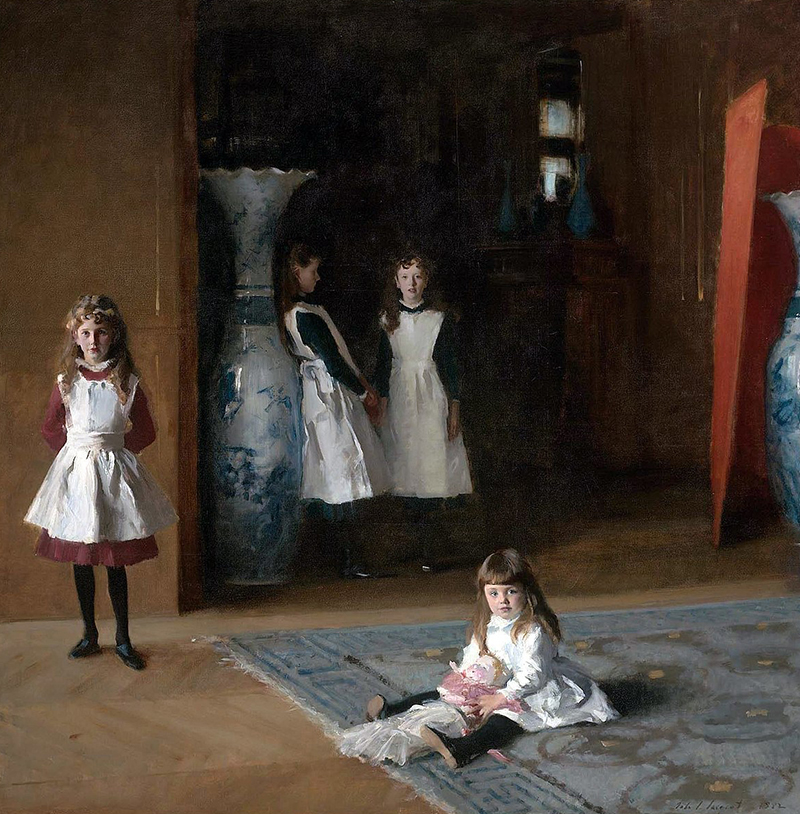
His first solo exhibition took place at Boston's St. Botolph Club in 1888. That event included works now central to his reputation, among them The Daughters of Edward Darley Boit and portraits connected to Boston patrons [1]. The city also linked him to Isabella Stewart Gardner, Sarah Choate Sears, the Fairchilds, and the architectural circle around Charles Follen McKim and Stanford White. The MFA biography notes that Sargent's friendships with McKim and White helped lead to his appointment in 1890 as muralist for the new Boston Public Library [3].
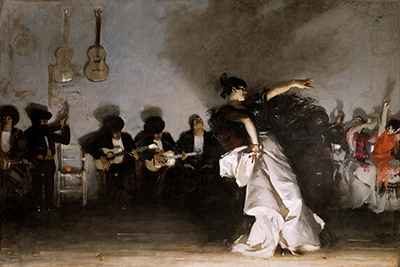
That appointment changed the scale of Sargent's American career. He had already made large and ambitious easel paintings, including El Jaleo and The Daughters of Edward Darley Boit, but a library mural cycle was different. It placed him inside a public building and asked him to think about visitors, architecture, sequence, and historical meaning. The commission connected private patron networks to civic space.
Boston also became the place where Sargent's afterlife would be studied. The MFA holds paintings, murals, watercolors, drawings, sculpture, correspondence, photographs, and archive material related to him [2], [11]. Its Sargent Archive includes papers, letters, inventories, photographs, scrapbooks, and research material that reveal the working life behind the public image [11]. That matters because public commissions are not only finished decorations. They are projects made through letters, committees, studios, sketches, travel, installations, and later preservation.
From Portrait Fame To Mural Ambition
Sargent's public commissions answered a problem created by success. By the 1890s, he was one of the most sought-after portraitists on both sides of the Atlantic. The MFA biography describes his 1890s career as dominated by portraiture and murals, and notes that by the mid-1890s he was in such demand that he was painting several sitters in a day [3]. That demand gave him fame and income, but it also narrowed public expectations. Patrons wanted likeness, glamour, rank, and social force. Sargent wanted to be more than a supplier of memorable faces.
Murals carried a different artistic prestige. The MFA object record for Architecture, Painting and Sculpture Protected by Athena from the Ravages of Time explains that, beginning in the late 1870s, Americans decorated public buildings in emulation of admired European examples. Committees often turned to celebrated easel painters because few American artists had formal mural training [6]. For Sargent, the Boston Public Library commission offered a chance to enter a tradition associated with Renaissance and Baroque public art, the very tradition he had studied through European museums and Old Master painting.
That tradition mattered to him. Portraiture can be modern, public, and psychologically powerful, but it is often tied to a transaction: sitter, family, institution, or patron. A mural cycle promised a wider field. It allowed Sargent to compose bodies without depending on individual likeness. It let him work with allegory, myth, religion, and civic purpose. It also required him to coordinate painting with a room. A mural does not simply hang on a wall; it participates in the wall.
This is why Sargent's public commissions should not be treated as a late detour. They belong to the same artistic intelligence that made the portraits so alive. In both cases, he studied how bodies become visible. The difference is audience and scale. In a portrait, a hand, dress, uniform, or gaze defines a person under social pressure. In a mural, a figure must carry meaning across distance and within architecture. Sargent's public work translated the theatre of the portrait into the theatre of a building.
The Boston Public Library And Triumph Of Religion
The Boston Public Library project was Sargent's most extended public commission. The BPL describes the Sargent Gallery as a skylit third-floor hall in the McKim Building, originally serving as the lobby for nearby special libraries, and containing his mural cycle Triumph of Religion [4]. Sargent first discussed the project with Charles Follen McKim in 1890. He then painted panels in England and traveled with them to Boston for four installations between 1895 and 1919 [4].
The length of that work is itself striking. The BPL's sketches account describes Triumph of Religion as an ambitious project that Sargent began conceiving in 1890 and installed in stages across nearly three decades [5]. Unlike a portrait commission, which might be completed after sittings and revisions, the library murals unfolded across changing years, changing priorities, and changing public response. The planned final installation remained unfinished when Sargent died in 1925 [4].
Sargent treated the project as more than painted panels. BPL material notes that he thought carefully about how people would experience the space, even building a scale model of the gallery in his studio. His attention extended to gold molding, light fixtures, and bookcases [4]. This is one of the clearest signs of his architectural ambition. The public commission asked him to imagine a viewer moving through a room, not just standing before a canvas.
The subject was equally ambitious. BPL describes Triumph of Religion as depicting a broad range of moments and imagery from early Egyptian and Assyrian belief systems, Judaism, and Christianity [4]. The cycle aimed at historical and religious breadth, but it was shaped by Sargent's own views and has been the subject of criticism and controversy [4]. That complicated reception is part of the work's public meaning. A private patron might accept or reject an image for personal reasons. A public library contains many viewers, many histories, and many communities. The murals had to live with interpretations beyond the artist's intent.
The BPL sketches help show the labor beneath the installation. Newly digitized studies for Triumph of Religion reveal Sargent working through figure placement, drapery, overlapping limbs, hands, and poses [5]. Some sketches relate closely to finished panels; others are more exploratory. The drawings make the murals less remote. They show a famous painter thinking through how bodies might carry spiritual and historical meaning on a public wall.
Religion, Public Space And Unease
The Boston Public Library murals also show why public art is vulnerable in ways private art is not. Triumph of Religion was placed in a civic library, not a church. Viewers did not encounter it as members of one congregation or as guests in a private house. They encountered it in a public institution devoted to learning, access, and civic culture. That setting made the cycle's treatment of religious history especially charged.
BPL's own visitor material acknowledges that the paintings are shaped by Sargent's views of the traditions he represented and that they have drawn criticism and controversy [4]. The point is not to reduce the cycle to controversy alone. It is to understand that public commissions keep speaking after their first unveiling. Their meanings change as viewers change. A mural fixed to a building can become a point of pride, discomfort, debate, instruction, and re-interpretation across generations.
For Sargent, the risk came from ambition. He wanted to work with grand themes: ancient religions, Judaism, Christianity, salvation, prophecy, mystery, and historical succession. These were subjects at the scale of old public art. But a modern civic building in Boston was not an old European chapel or palace. The audience was plural, modern, and alert to how imagery assigns dignity or defeat. The same desire that made the project grand also exposed it to serious objection.
That tension makes the BPL murals central to any honest account of Sargent's public work. They show him reaching beyond portraiture into a tradition of symbolic decoration, but they also show the limits of inherited visual narratives when placed before modern public audiences. The murals ask viewers to think not only about Sargent's skill, but about who is being represented, who is asked to identify with the story, and who may feel misrepresented by it.
The MFA Rotunda And The Museum As Subject
The Museum of Fine Arts commission gave Sargent a different kind of public theme. Instead of a history of religions in a library, he was asked to decorate a museum building. The MFA's object record for Architecture, Painting and Sculpture Protected by Athena from the Ravages of Time states that the trustees approached Sargent in 1916 to decorate the Huntington Avenue building. He was first invited to contribute lunettes over doorways, but he persuaded the trustees to let him redesign and redecorate the entire rotunda [6].
That expansion is revealing. Sargent did not simply accept a small assignment and fill it. He imagined a larger environment that joined architecture, sculpture, and painting. The MFA describes the result as a sophisticated program using classical mythology to honor the arts [6]. In Architecture, Painting and Sculpture Protected by Athena from the Ravages of Time, three figures represent the fine arts while Athena shields them from Father Time. The allegory validates the museum's purpose: to collect, guard, and preserve art [6].
The work also shows how Sargent adapted technique for public scale. The MFA notes his strong outlines, soft color scheme, and flat unvarnished surfaces, effects that from a distance evoke Italian fresco cycles [6]. This differs from the broken sparkle of many portraits and watercolors. In a rotunda, clarity matters. Figures have to read from below and across space. Surfaces must answer architecture rather than only the eye at easel distance.
The physical site mattered as well. Architecture, Painting and Sculpture Protected by Athena from the Ravages of Time was the first painting visitors would see after climbing to the top of the museum's grand staircase [6]. That placement turns the work into a threshold image. It greets the visitor with an argument about what a museum does. Art enters the building under the protection of wisdom and against decay.
The MFA project occupied Sargent into his final years. MFA material states that he intended to travel from London to Boston on April 16, 1925, to oversee installation of final museum murals, but he died in his sleep before departure [1]. In November of that year, the MFA honored him with a memorial exhibition and unveiled the final works he had completed [1]. Public commission, museum memory, and artist memorial became intertwined.
Harvard's Widener Memorial And World War I
Harvard's Widener Library commission brought Sargent's public work into direct relation with war remembrance. MFA's Boston account notes that Harvard commissioned him in 1920 to create a World War I memorial at Widener Library [1]. The Met's record for Study for "Death and Victory" identifies the project more specifically: in 1921, Sargent accepted a commission for a pair of mural panels for the stairway of Harvard University's Widener Memorial Library, commemorating alumni who fought and died in the First World War [8].
The Met study shows the memorial problem in condensed form. In the composition, a soldier clutches the rising figure of Victory while being weighed down by Death [8]. The work is allegorical, but its subject is modern grief. The soldier is not just a heroic type. He is pulled between public honor and bodily loss. The composition had to suit an architectural setting, and the Met notes that the study was designed to fit into an architectural rendering of the library [8].
Harvard Art Museums preserves another related study, Studies for Wounded Soldier for "Death and Victory," Widener Library, Harvard University, a 1921-22 charcoal drawing given by Sargent to the Fogg Art Museum in 1922 [12]. That sheet matters because it returns the mural to drawing. The final public image depends on studies of bodily pressure, weight, and injury. Sargent was still solving the old problem of the body, but the emotional register had changed.
Widener also links Sargent's Boston-area public work to his wartime experience. The memorial murals came after the war artist commission that produced Gassed. Both ask how a painter known for brilliance and social presence could serve a grieving public. The answer was not simple. Sargent used allegory at Harvard and eyewitness-based procession in Gassed, but both works treat public art as a way to hold death before viewers without reducing it to private anecdote.
Drawings, Models And Architectural Thinking
Sargent's public commissions required extensive preparation. The BPL material on Triumph of Religion emphasizes sketches, figure studies, and the scale model he made to think through the gallery [4], [5]. The MFA's Sargent Archive also preserves the documentary world around the artist: correspondence, photographs, inventories, scrapbooks, and papers connected to works in progress, travel, exhibitions, patrons, and institutions [11].
This evidence helps correct the idea of Sargent as an artist of effortless surface alone. His public works could not be improvised by touch and charm. A mural cycle requires coordination across years. It must answer measurements, lighting, installation, committee expectations, and the movement of viewers. Drawings and models allowed Sargent to test whether a figure would remain legible at scale and whether a sequence would make sense in a room.
The Harvard Art Museums publication on the restoration of the Boston Public Library murals notes that the 2003-04 conservation project revealed new evidence of Sargent's experimentation. Its summary describes his use of preparatory sketches and three-dimensional models, and notes that the murals involved oil paint as well as plaster, papier-mache, gilt, glass gems, and embossed and gilded Victorian wallpaper [13]. That range of materials is important. Sargent was not only painting pictures for walls. He was designing visual environments.
The same pattern appears in the Sargent drawings essay. Late studies connected to mural and allegorical projects show him working through bodies, drapery, gestures, and figure groups. Public art did not cancel drawing; it made drawing more necessary. A hand or shoulder that might define a portrait could also support a symbolic figure across a hall.
Gassed And Public Memory
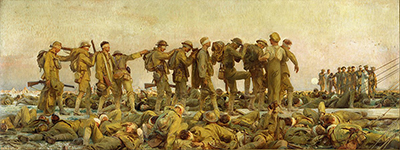
Gassed was not a Boston mural, but it belongs in the public-commissions story because it shows the moral end point of Sargent's public ambition. Imperial War Museums identifies the painting as a 1919 work connected with his role as an official war artist and with British wartime art sponsorship [9], [10]. It was associated with the British War Memorials Committee's unrealized Hall of Remembrance, a project intended to memorialize the war through major paintings [10].
The painting therefore began as a public commission, not a private battlefield recollection. Sargent had been asked to make an image for a national memorial context. The subject he finally chose, gas-blinded soldiers being led after a mustard gas attack, transformed that commission into one of the great images of collective injury. Instead of a triumphal military scene, he painted aftermath: bandaged eyes, linked bodies, men guided toward treatment, and other soldiers lying nearby [9], [14].
The connection to his mural work is structural. In the Boston Public Library and MFA projects, Sargent arranged allegorical bodies across architectural space. In Gassed, he arranged wounded bodies across a vast canvas. The procession of soldiers has the order of a frieze, but its meaning is not triumph. It makes vulnerability monumental. [1], [3]
That late turn changes the way the public commissions are read. Sargent's murals can look backward toward old traditions of civic and religious decoration. Gassed belongs to modern war and public grief. Together, they show an artist repeatedly asking how painting should address audiences larger than a patron or sitter. Sometimes the answer is allegory. Sometimes it is a decorated room. Sometimes it is a line of blinded men whose injured sight makes the viewer's own looking feel ethically charged.
Related Works And Where To Go Next
Sargent's public commissions are best read with his biography, which explains how Boston, murals, watercolors, and war art widened his career beyond portraiture. The paintings essay places murals and Gassed among his larger oil-painting range. The drawings essay shows the studies, figure problems, and works on paper behind large public projects.
For individual works, Gassed is the essential late public image. The Daughters of Edward Darley Boit and El Jaleo help show how Sargent had already used scale, staged space, and public exhibition before the murals. The portraits essay explains the success he was trying to exceed. Style and technique belongs nearby because the murals required a different handling of outline, surface, color, material, and distance.
Public Commission Timeline
- 1890Sargent began the Boston Public Library mural project after the Boston network around Charles Follen McKim and Stanford White helped bring him into the commission. [3]
- 1895-1919Triumph of Religion was installed in stages in the Boston Public Library, while the final planned installation remained unfinished at Sargent's death. [4], [5]
- 1916The Museum of Fine Arts, Boston approached Sargent for the Huntington Avenue building, leading to the Rotunda and Colonnade decorations. [6]
- 1918-1919Gassed emerged from wartime art sponsorship and a projected public memorial context before entering Imperial War Museums. [9], [10]
- 1920-1922Harvard commissioned Sargent's Widener Library memorial murals, with related studies for Death and Victory preserved by the Met and Harvard Art Museums. [1], [8], [12]
Frequently Asked Questions
Sargent's major public commissions include the Boston Public Library mural cycle Triumph of Religion, decorations for the Museum of Fine Arts, Boston, and World War I memorial murals for Harvard University's Widener Library. Gassed also belongs to his public work because it was made through wartime art sponsorship for a memorial context. [1], [3]
The Boston murals show Sargent working beyond private portraiture. They connect him to public buildings, civic institutions, architecture, allegory, and repeated public viewing. They also made Boston one of the central places for understanding his American legacy.
Triumph of Religion is Sargent's mural cycle at the Boston Public Library. He began conceiving it in 1890, painted the panels in England, and installed them in stages between 1895 and 1919. The cycle treats a broad range of religious imagery and remains unfinished.
Yes. Boston Public Library visitor material notes that the cycle has been criticized and debated, especially because of how it represents religious traditions. That controversy is part of its public history and shows how civic art continues to be interpreted by later viewers.
For the Museum of Fine Arts, Boston, Sargent made a decorative program for the Rotunda and Colonnade. Works such as Architecture, Painting and Sculpture Protected by Athena from the Ravages of Time use classical mythology to present the museum as a guardian of the arts. [1], [3]
Harvard commissioned Sargent to create World War I memorial murals for Widener Library. The Met's Study for "Death and Victory" and Harvard Art Museums' related wounded-soldier study show him working through allegorical imagery of sacrifice, victory, and death. [8]
Gassed was created after Sargent served as an official war artist and was connected to a planned Hall of Remembrance. It extends his public art from civic and allegorical settings into collective wartime memory.
No. Portraiture remained central to his fame, but murals and public works gave him another kind of artistic identity. They allowed him to work with architecture, allegory, institutions, and shared memory rather than only likeness and patronage.
Discussion
Sargent's public commissions ask how far a painter of social presence can move into shared space. Do the murals and memorial works feel like an escape from portraiture, or do they depend on the same gift for arranging bodies under pressure?
Reader Insights
What is the first detail that shapes your reading of John Singer Sargent Public Commissions: pose, setting, light, costume, brushwork or historical context?
Which small visual decision begins to matter more after a longer look, and how does it change the mood of the page?
Which comparison helps most: another Sargent portrait, a travel subject, a public commission, or a work by one of his contemporaries?
Join the Conversation
Share a thoughtful comment below about what you notice, question or compare when looking at this page.
References
- Museum of Fine Arts, Boston, Ties that Bind: Boston & John Singer Sargent https://www.mfa.org/news/sargent-boston-ties
- Museum of Fine Arts, Boston, John Singer Sargent gallery https://www.mfa.org/gallery/john-singer-sargent
- Museum of Fine Arts, Boston, John Singer Sargent Biography https://www.mfa.org/news/sargent-bio
- Boston Public Library, Central Library Points of Interest, Sargent Gallery https://www.bpl.org/central-library-points-of-interest/
- Boston Public Library, John Singer Sargent's Sketches for His Triumph of Religion Murals https://www.bpl.org/blogs/post/john-singer-sargents-sketches-for-his-triumph-of-religion-murals/
- Museum of Fine Arts, Boston, Architecture, Painting and Sculpture Protected by Athena from the Ravages of Time https://collections.mfa.org/objects/31934
- Museum of Fine Arts, Boston, architectural history https://www.mfa.org/about/architectural-history
- Metropolitan Museum of Art, Study for "Death and Victory" https://www.metmuseum.org/art/collection/search/12030
- Imperial War Museums, Gassed object record https://www.iwm.org.uk/collections/item/object/23722
- Imperial War Museums, How the British Government Sponsored the Arts in the First World War https://www.iwm.org.uk/history/how-the-british-government-sponsored-the-arts-in-the-first-world-war
- Museum of Fine Arts, Boston, John Singer Sargent Archive finding aid https://www.mfa.org/collections/americas/the-john-singer-sargent-archive/finding-aid
- Harvard Art Museums, Studies for Wounded Soldier for "Death and Victory," Widener Library, Harvard University https://harvardartmuseums.org/collections/object/306063
- Harvard Art Museums, John Singer Sargent's Triumph of Religion at the Boston Public Library: Creation and Restoration https://shop.harvardartmuseums.org/products/john-singer-sargent-s-triumph-of-religion-at-the-boston-public-library-creation-and-restoration
- Imperial War Museums, Gassed by John Singer Sargent https://www.iwm.org.uk/gassed-by-john-singer-sargent