 by Tom Gurney
Tom Gurney BSc (Hons) is an art history expert with over 20 years experience
Published on June 19, 2020 / Updated on July 19, 2026
Email: tomgurney1@gmail.com / Phone: +44 7429 011000
John Singer Sargent Watercolors: Introduction
John Singer Sargent's watercolors show the painter at his most mobile. Away from the formal portrait studio, he used paper, graphite, wash, untouched white, quick dark accents, and brilliant color to answer changing light before it disappeared. The results can look casual, but they are not slight. A Sargent watercolor is often a record of decision: what to seize, what to leave blank, what to define with a line, and what to let dissolve into glare, shadow, or moving air.
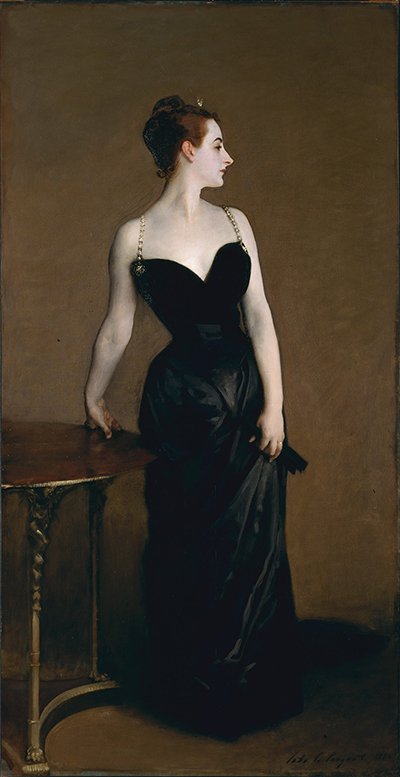
The watercolors matter because they widen the familiar image of Sargent. Portraiture made him famous, murals carried his public ambition, and great oils such as Madame X, El Jaleo, Carnation, Lily, Lily, Rose, and Gassed anchor his reputation. Yet the works on paper reveal another rhythm. They show Sargent looking at Venice, Spain, North Africa, Alpine and European travel sites, architecture, water, costume, landscape, and figures who did not arrive as named sitters expecting a grand likeness.
Watercolor gave Sargent freedom, but not freedom from discipline. The medium rewards speed and punishes hesitation. In oil, a painter can scrape back, revise, and build a surface across time. In watercolor, a wash may settle once, exposed paper may become the brightest light, and an overworked passage can lose its force. Sargent's achievement was to make that risk look pleasurable. His watercolors are among the clearest signs that his famous ease was a trained form of attention.
Contents
- Introduction
- Watercolor As Freedom From The Portrait Studio
- Paper, Graphite And The Discipline Of Selection
- Venice: Streets, Canals And Moving Light
- Spain: Old Masters, Performance And Place
- North Africa And The Ethics Of Travel Looking
- Alps, European Travel And Outdoor Work
- Watercolor, Oil Painting And Drawings Together
- Collections And The Afterlife Of The Watercolors
- How To Look At Sargent Watercolors
- Related Works And Where To Go Next
Watercolor As Freedom From The Portrait Studio
Sargent's watercolors cannot be separated from the fatigue of portrait success. By the 1890s he was one of the most sought-after portrait painters in Britain and America. That success gave him fame, income, and access, but it also created a narrow public expectation. Sitters wanted likeness, social command, fabric, glamour, rank, and tact. Sargent could deliver all of that, but repetition became a burden.
Watercolor offered a different kind of encounter. A formal portrait required negotiation with a sitter and often with a family, institution, or patron. A watercolor required a sheet, a place, materials light enough to carry, and the alertness to know when a visual fact had been caught. It did not need to flatter anyone. It did not need to make a social identity permanent. It could value a canal reflection, a wall of sunlight, a figure passing through a street, a mountain edge, or a patch of paper left bare for glare.
This freedom was not a retreat from serious art. It was another expression of Sargent's central gift: making presence visible. In a portrait, presence belongs to a sitter under social pressure. In a watercolor, presence may belong to a city, a body glimpsed in motion, water catching light, or a wall that turns white under sun. The difference is not between important and unimportant work. It is between two kinds of attention.
The biography and homepage both stress that Sargent spent much of his mature career trying to remain larger than the role of society portraitist. Murals, travel subjects, drawings, prints, and war art all took him beyond the commission cycle [1], [2]. Watercolor was one of the most agile of those alternatives. It let him keep working when the studio felt too scripted.
Watercolor also suited Sargent's international life. He had been born in Florence to American parents, trained in Paris, worked in London, and remained tied to Boston. His career was already made from movement. Watercolor turned that movement into method. The artist who knew how to stage a sitter in a drawing room also knew how to stage his own looking in transit.
Paper, Graphite And The Discipline Of Selection
Sargent's watercolor practice begins with paper. The National Portrait Gallery's research on his materials connects him with French drawing paper, Ingres paper bought from Roberson in 1892 and 1906, sketchbooks from many suppliers, and outdoor equipment suited to travel and work beyond the studio [3]. Such details matter because they make the watercolors physical. They were not floating impressions. They were made from paper stock, graphite, pigment, brushes, sketchbooks, easels, and decisions made under changing conditions.
The boundary between drawing and watercolor is often porous in Sargent. Many works on paper use graphite underneath or beside color. A line can establish the architecture before wash supplies light. A contour can hold a figure while color makes heat or shadow. A sheet may be listed as watercolor and graphite because the work of drawing and the work of color are inseparable.
This overlap connects the watercolors to Sargent's drawing practice. The drawings essay shows him using line for travel notes, figure studies, portrait preparation, mural problems, and charcoal likenesses. Watercolor adds another pressure: color and light have to be selected quickly. A graphite study can search; a watercolor often has to decide.
Selection is the key word. Sargent's watercolors are powerful because he did not explain everything. Blank paper could become a burst of sun or the flash of a white wall. A few strokes could secure a gondola, a figure, a doorway, a sail, or a mountain mass. Dark accents could hold the structure while washes supplied air. The viewer senses the omitted parts, but the omission is active. It lets the image breathe.
That economy corrects a familiar misunderstanding of Sargent. His speed was real, but it was not emptiness. It was trained reduction. He knew which facts a sheet needed and which facts would slow it down. In watercolor, that judgment becomes unusually visible because every extra touch risks dulling the freshness.
The National Portrait Gallery's evidence for portable equipment also matters. Hook easels and jointed poles, recorded in purchases from 1906 to 1910, belong to the same larger world of outdoor work and continental travel [3]. Even when the watercolors seem immediate, they depend on practical preparation. Mobility had a material infrastructure.
Venice: Streets, Canals And Moving Light
Venice is one of the central places for understanding Sargent's watercolors. It offered water, reflected light, dark interiors, narrow streets, bridges, thresholds, boats, stone, fabric, and figures moving through compressed space. The city could have been reduced to famous monuments. Sargent often chose a different kind of subject: smaller passages, working spaces, side canals, doorways, shadows, and figures caught in urban movement.
Street in Venice, now in the National Gallery of Art, helps define that world even though it is an individual travel work rather than a broad survey [4]. The picture is valuable because it shows Sargent thinking of the city as a social and pictorial space. Walls, street depth, women, movement, and shadow matter as much as recognizable architecture. Venice becomes a set of conditions for looking, not a postcard inventory.
The Metropolitan Museum of Art's Venice watercolor record and RISD Museum's Rio di Santa Maria Formosa, Venice extend this field [5], [6]. These records place Sargent's Venetian subjects within works on paper where water and architecture become inseparable. A canal is not only a subject; it is a device for breaking and returning light. A facade may be less important as architecture than as a plane struck by brightness and shadow.
The Gardner Museum's Venice watercolor record adds another Boston connection [7]. Sargent's Venetian subjects belong not only to the artist's travel but also to the collecting networks through which his work entered American museums. That matters because Venice was both an experienced place and a cultural idea prized by collectors and viewers. Sargent's best Venetian works hold the two together: actual looking and the later life of the object in collections.
Venice also reveals the relation between figures and setting in Sargent's travel art. He rarely loses interest in people, even outside portraiture. But the figures in Venetian works often remain unnamed, seen through movement, posture, or placement rather than biography. A woman in a street or a figure near water is not treated as a formal sitter. The figure becomes part of the city's rhythm.
This is one reason the Venetian watercolors are so important to Sargent's career. They let him keep a portraitist's sensitivity to bodies while releasing him from portrait identity. People matter, but the scene does not have to turn them into social emblems. The street, wall, canal, and reflected light are equal partners.
Spain: Old Masters, Performance And Place
Spain gave Sargent more than picturesque subjects. The National Gallery of Art's Sargent and Spain material presents his Spanish engagement across more than three decades and across oils, watercolors, and drawings, including landscapes, marine scenes, architecture, everyday life, and people he encountered [8]. That breadth is essential. Spain was not only El Jaleo, and it was not only Velazquez. It was a recurring field of study.
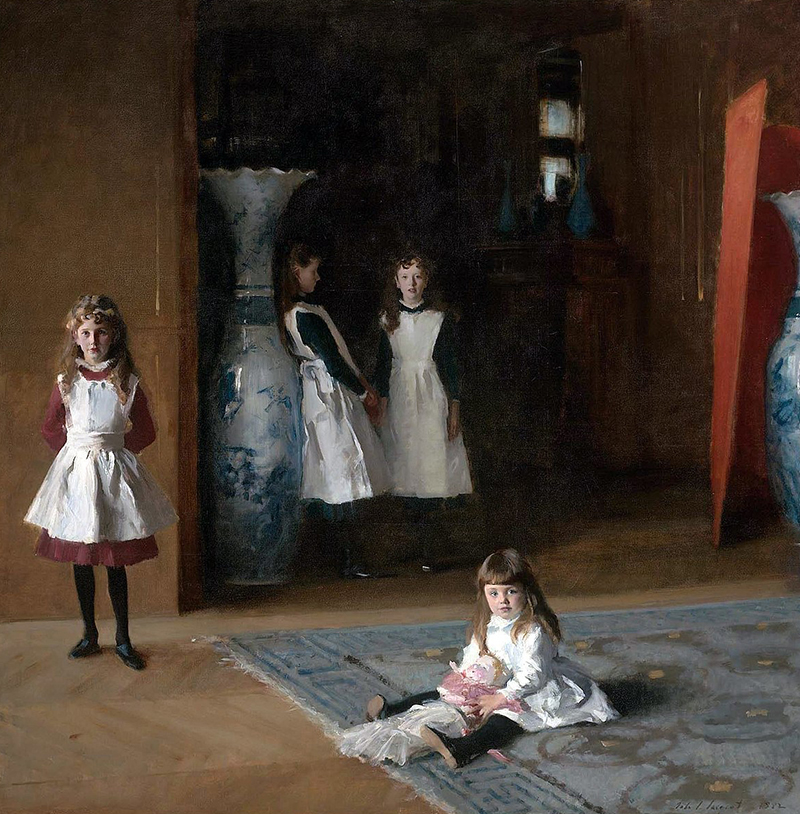
Velazquez mattered deeply. Sargent studied him at the Prado and absorbed lessons in tonal breadth, dark space, restraint, and figure authority. Those lessons are visible in major oils such as The Daughters of Edward Darley Boit and El Jaleo, but they also shape how the watercolors should be read. A Spanish watercolor may look quick, yet the eye behind it had been trained by old-master discipline.
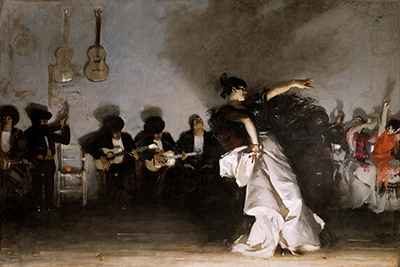
Spain also brought performance, music, and movement into Sargent's art. El Jaleo grew from drawings made during his 1879 travels in southern Spain, and the National Gallery of Art's focus exhibition later brought the painting together with related paintings, forty drawings and watercolors, and books on the Spanish dance theme [9], [10]. That study environment shows how seriously Sargent developed the subject. He did not simply turn a travel memory into spectacle. He worked through bodies, instruments, shadows, and rhythm.
The watercolors within the Spanish field likely offered a faster and more varied way to think through place. The National Gallery of Art material emphasizes architecture, landscapes, marine subjects, everyday scenes, and people, which prevents the Spanish group from shrinking into one theatrical image [8]. Sargent returned to Spain as a painter of many problems: old-master memory, modern performance, coastal light, built surfaces, regional subjects, and the challenge of representing cultural difference for foreign audiences.
That last point needs care. Nineteenth-century artists and viewers often approached Spain through romance, spectacle, and a desire for difference. Sargent's Spanish works can be admired for their intelligence, but they are not outside that history. The strongest readings keep skill and context together. Spain helped Sargent think with darkness, music, architecture, water, and light; it also entered international art through assumptions about region, performance, and identity.
Watercolor intensifies this complexity because the medium can make travel seem immediate. A sheet may appear to say, "I saw this." But seeing is never neutral. Sargent selected what to frame, what to omit, and how to transform a place into art. The Spanish watercolors are strongest when treated as acts of trained looking rather than transparent documents.
North Africa And The Ethics Of Travel Looking
North African subjects form one of the most delicate parts of Sargent's travel art. The Met's Beyond the Portrait Studio material includes Spanish and Moroccan studies, with architectural views such as Moorish buildings and courtyards in Tetuan [11]. A Street in Algiers also belongs to this larger travel field. Such works extend the watercolor story beyond Venice and Spain into a world shaped by nineteenth-century European travel, colonial power, and Orientalist expectation.
That context does not cancel Sargent's observational skill. It changes the questions viewers should ask. A North African street, courtyard, or figure may be painted with remarkable control of light and structure. But the conditions that made such subjects available to European and American artists were unequal. Travel art often turned places and people into images for outsiders. Modern viewing has to acknowledge that imbalance.
Sargent's value in this area lies partly in his ability to avoid some obvious forms of theatrical overstatement. He often attends to architecture, shadow, passage, and ordinary movement. Yet even quiet observation can carry the assumptions of its time. A street scene is not neutral simply because it is visually restrained. [12]
The biography anchor puts the issue clearly: North African subjects, including A Street in Algiers, belong to Sargent's travel practice and to a nineteenth-century culture of looking shaped by colonial power and Orientalist expectations [1], [8]. That double belonging should guide the watercolors. They can be read for paper, light, composition, and travel method, while also being read as products of a historical gaze.
This makes North African material important for the whole Sargent set. Without it, the travel story becomes too easy: a celebrated artist escapes society portraiture and discovers light abroad. The more responsible account is richer and less comfortable. Sargent's mobility was real artistic freedom, but it was also a privilege. His watercolors make that privilege visible through the places and people he could turn into art.
Alps, European Travel And Outdoor Work
Sargent's travel practice began early. The Met's Beyond the Portrait Studio material included sketchbooks from family travel in Switzerland in 1869 and 1870, before Sargent's mature public career had begun [11], [13]. That youthful habit matters. Travel drawing was not a late hobby added to a portraitist's life. It was part of how he first learned to see.
The Alpine and European travel works show a Sargent interested in form as well as charm. Mountains, snow, water, villages, boats, and architecture give different problems from portraiture. A mountain edge asks for mass and atmosphere. Snow asks for white that is not empty. A wall in sun asks how much paper can remain untouched. A boat or figure asks for enough description to anchor scale without slowing the sheet.
The style-and-technique essay connects these works to equipment and practical conditions. Sargent's papers and sketchbooks came from many places, and his later outdoor work relied on portable supports, materials, and habits that let him work across summers on the Continent [3]. Travel art may look improvisational, but it depends on readiness. The artist has to arrive with the means to answer the motif.
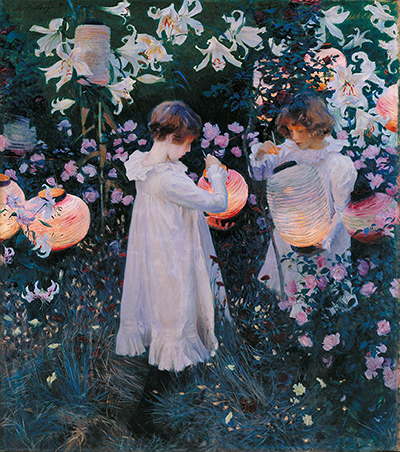
Outdoor work also links watercolor to Sargent's engagement with Impressionism without making him simply an Impressionist. Claude Monet Painting by the Edge of a Wood shows Sargent looking at Monet as an artist working outdoors, and Carnation, Lily, Lily, Rose shows him pursuing a fleeting light effect in oil across repeated sessions [12], [14]. The watercolors belong beside these works because they show the same appetite for light under more portable conditions.
Yet the medium changes the tempo. Carnation, Lily, Lily, Rose required repeated evenings, studies, scraping back, flowers grown in pots, and revisions. A watercolor often records a shorter burst of looking. That contrast is useful. Sargent did not have one way of painting light. He had several, each shaped by medium, setting, and purpose.
Watercolor, Oil Painting And Drawings Together
Sargent's watercolors should not be isolated from his oils or drawings. They belong to a larger practice of thinking across media. A graphite line might underlie watercolor. A watercolor might help him think about a later painting. An oil might pursue an effect that watercolor could capture quickly but not revise. A drawing might isolate the structure before color enters.
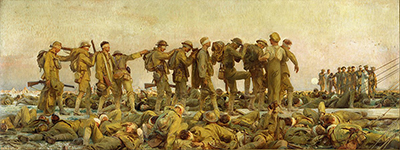
The war material makes this especially clear. While preparing for Gassed, Sargent made watercolors and studies near the Western Front, including works the Met connects to the final painting [15], [16]. Some were not exhibited during his lifetime. They were records of searching, attempts to understand what kind of image war could produce. The monumental oil did not emerge from an untouched idea. It developed around looking, drawing, and watercolor.
The El Jaleo group also shows media crossing. The Gardner and NGA material connects the oil painting to drawings and watercolors around Spanish dance, musicians, and performance [9], [10]. In that field, watercolor is not a lesser cousin of oil. It is one of the ways Sargent tested movement, costume, and visual rhythm.
The drawings essay offers another connection. Many Sargent works on paper combine graphite with watercolor, gouache, or other media [13]. This means that medium categories are useful but imperfect. A sheet may be a drawing in one sense and a watercolor in another. The important question is not only what material was used, but what kind of seeing the material made possible.
Oil painting gave Sargent density, scale, revision, and public presence. Drawing gave him structure, line, and testing. Watercolor gave him speed, light, exposed paper, and the drama of irreversible choice. His career needs all three. The watercolors are therefore not an escape from the "real" Sargent. They are one of the places where the real Sargent is easiest to see.
Collections And The Afterlife Of The Watercolors
Sargent's watercolors also matter because museums have made them central to how his career is now understood. The MFA's overview of his work places watercolors, drawings, murals, archive material, and paintings together, rather than treating the watercolors as charming extras [17], [18]. The Met's holdings and publication history make the same argument from the side of works on paper: hundreds of sheets and sketchbook pages allow viewers to follow Sargent's eye across decades, places, and subjects [13].
This collecting history changes the story. If only the most famous oil portraits survived in public memory, Sargent would look narrower: a painter of glamorous sitters, dramatic scandals, and occasional public commissions. The watercolors show the pressure points around that reputation. They reveal how often he worked without a formal sitter, how strongly travel shaped his art, and how much of his intelligence depended on speed, omission, and paper.
Museum records for Venetian sheets at the Met, RISD, and the Gardner Museum are especially useful because they give readers concrete objects through which to understand the larger pattern [5], [6], [7]. The National Gallery of Art's Spanish material does the same for Spain by gathering oils, watercolors, and drawings into one sustained field [8]. Together, these holdings keep the watercolor practice visible as a major part of Sargent's achievement.
How To Look At Sargent Watercolors
Begin with the paper. In watercolor, what is untouched may be as important as what is painted. Look for areas where the sheet itself becomes light: a wall, sky, garment, sail, reflection, or glare. Sargent often lets blankness do active work.
Then look for the drawing. Even when color dominates, a graphite line or dark accent may hold the structure. Architecture may depend on a few quick edges. A figure may be secured by contour and posture before the wash around it settles into atmosphere.
Next, follow the whites and darks. Sargent understood white from portraiture and garden painting, but watercolor changes the problem. White is not always pigment. It may be reserved paper. Dark may arrive as a small but decisive note: a doorway, hair, boat edge, window, shadow line, or clothing accent.
After that, ask what the sheet refuses to explain. A watercolor may leave a face vague, a building incomplete, or a surrounding space barely indicated. The omission is often the point. Sargent is telling the viewer where attention belongs.
For Venice, watch reflections, walls, canals, and figures inside narrow urban space. For Spain, watch the relation between old-master memory, architecture, performance, and light. For North Africa, admire the handling while keeping the history of outsider looking in view. For Alpine and travel subjects, look for how quickly mass, air, and weather are established.
Above all, do not treat freshness as lack of seriousness. In Sargent, freshness is often the result of knowing when to stop.
Related Works And Where To Go Next
For the full life story behind the watercolors, begin with Biography. For oil painting as a medium, use Paintings; for line, sketchbooks, studies, and works on paper, use Drawings; for materials and handling, use Style and Technique.
For individual works and close comparisons, move to Street in Venice, A Street in Algiers, A Parisian Beggar Girl, and A Gust of Wind. For Spanish performance and related studies, use El Jaleo. For watercolor within wartime process, use Gassed.
For wider art-historical context, Diego Velazquez helps explain Sargent's Spanish looking, while Claude Monet helps frame outdoor painting without reducing Sargent to Impressionism.
Watercolor And Travel Routes
Use these active Sargent pages as concrete routes into the travel, paper, light and ethics questions discussed above.
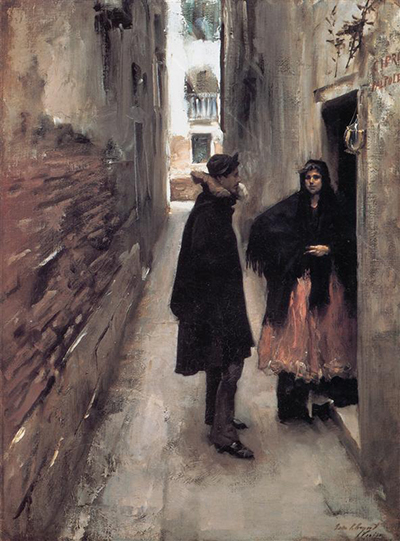
Street in Venice
Venice as a compressed social and pictorial space.
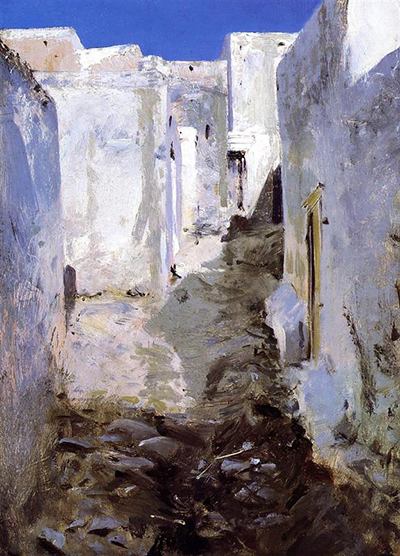
A Street in Algiers
North African travel looking with necessary historical care.
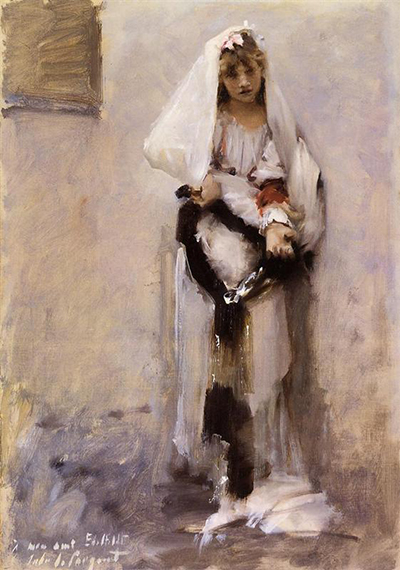
A Parisian Beggar Girl
A city figure seen outside the formal portrait economy.
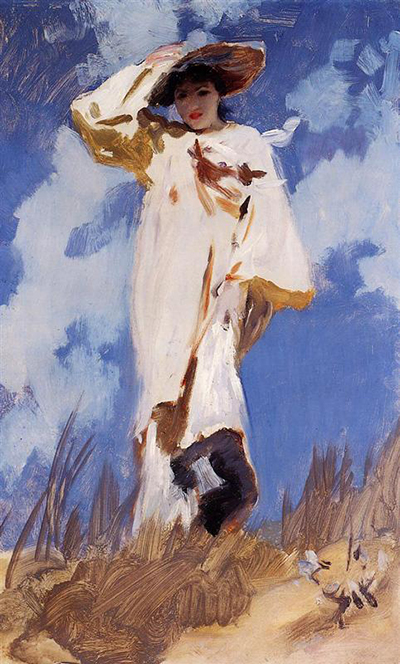
A Gust of Wind
Movement, weather and a fleeting outdoor effect.
Frequently Asked Questions
They show Sargent outside the formal portrait studio, working with speed, paper, light, travel, architecture, landscape, and omission. They also form a major body of work: the MFA summarizes his output as including about 2,000 watercolors. [1], [17]
His watercolor subjects include Venice, Spain, Morocco, North Africa, Alpine and European travel, architecture, canals, marine views, gardens, figures, costumes, landscapes, and wartime studies.
No. Some sheets are exploratory or closely tied to drawing, but many stand as finished works of art. Even when they look quick, they show disciplined choices about paper, wash, line, exposed white, and what to leave out.
The categories often overlap. Drawings emphasize line, tone, and structure, while watercolors add color, light, wash, and reserved paper. Many Sargent sheets combine graphite and watercolor, so the difference is often a matter of emphasis rather than a strict boundary.
Venice gave him canals, reflected light, narrow streets, doorways, figures, and buildings that could be broken into light and shadow. Works connected with the Met, RISD, Gardner Museum, and National Gallery of Art records show the importance of Venetian subjects in his travel practice. [2], [8]
Sargent returned to Spanish art and subjects for more than three decades. The National Gallery of Art's Sargent and Spain material links him to Velazquez, Spanish architecture, landscapes, marine scenes, everyday life, dance, music, oil paintings, drawings, and watercolors. [2], [8]
They should be read with both admiration and care. Sargent's handling of light, architecture, and figures can be powerful, but these works also belong to a nineteenth-century European and American culture of travel shaped by colonial power and Orientalist expectations.
The relationship moved both ways. Watercolor sharpened Sargent's eye for selection, light, and omission, while oil painting gave him scale, density, and revision. Major works such as El Jaleo, Carnation, Lily, Lily, Rose, and Gassed are best understood beside drawings and watercolors rather than apart from them.
Sargent learned from Impressionist friends and painted outdoors, but he was not simply an Impressionist. His watercolors also depend on old-master study, drawing, travel observation, portrait discipline, and a highly personal sense of when an image has enough information.
Discussion
Sargent's watercolors ask how little a painter needs to make a place feel seen: a line, a wash, a blank sheet catching light, and the courage to stop before freshness disappears.
Reader Insights
What is the first detail that shapes your reading of John Singer Sargent Watercolors: pose, setting, light, costume, brushwork or historical context?
Which small visual decision begins to matter more after a longer look, and how does it change the mood of the page?
Which comparison helps most: another Sargent portrait, a travel subject, a public commission, or a work by one of his contemporaries?
Join the Conversation
Share a thoughtful comment below about what you notice, question or compare when looking at this page.
References
- Museum of Fine Arts, Boston, John Singer Sargent biography https://www.mfa.org/news/sargent-bio
- National Gallery of Art, John Singer Sargent retrospective https://www.nga.gov/exhibitions/john-singer-sargent
- National Portrait Gallery, "John Singer Sargent's suppliers of artists' materials" https://www.npg.org.uk/collections/research/programmes/artists-their-materials-and-suppliers/john-singer-sargents-suppliers-of-artists-materials
- National Gallery of Art, *Street in Venice* https://www.nga.gov/artworks/46428-street-venice
- Metropolitan Museum of Art, Venice watercolor record https://www.metmuseum.org/art/collection/search/12459
- RISD Museum, *Rio di Santa Maria Formosa, Venice* https://risdmuseum.org/art-design/collection/rio-di-santa-maria-formosa-venice-42223
- Isabella Stewart Gardner Museum, Venice watercolor record https://www.gardnermuseum.org/experience/collection/10880
- National Gallery of Art, *Sargent and Spain* https://www.nga.gov/research/publications/sargent-and-spain
- Isabella Stewart Gardner Museum, *El Jaleo* https://www.gardnermuseum.org/experience/collection/13259
- National Gallery of Art, *John Singer Sargent's El Jaleo* https://www.nga.gov/exhibitions/john-singer-sargents-el-jaleo
- Metropolitan Museum of Art, *John Singer Sargent Beyond the Portrait Studio* https://www.metmuseum.org/exhibitions/listings/2000/john-singer-sargent
- Tate, *Claude Monet Painting by the Edge of a Wood* https://www.tate.org.uk/art/artworks/sargent-claude-monet-painting-by-the-edge-of-a-wood-n04103
- Metropolitan Museum of Art, *American Drawings and Watercolors in The Metropolitan Museum of Art: John Singer Sargent* https://www.metmuseum.org/fr/met-publications/american-drawings-and-watercolors-in-the-metropolitan-museum-of-art-john-singer-sargent
- Rebecca Hellen and Elaine Kilmurray, "Carnation, Lily, Lily, Rose and the process of painting" https://britishartstudies.ac.uk/issues/02/sargent-conservation
- Metropolitan Museum of Art, "John Singer Sargent and World War I: Public Art and Personal Loss" https://www.metmuseum.org/es/perspectives/john-singer-sargent-world-war-i
- Metropolitan Museum of Art, *Two Soldiers at Arras* https://www.metmuseum.org/art/collection/search/751623
- Museum of Fine Arts, Boston, John Singer Sargent gallery https://www.mfa.org/gallery/john-singer-sargent
- Museum of Fine Arts, Boston, John Singer Sargent Archive finding aid https://www.mfa.org/collections/americas/the-john-singer-sargent-archive/finding-aid