 by Tom Gurney
Tom Gurney BSc (Hons) is an art history expert with over 20 years experience
Published on June 19, 2020 / Updated on July 19, 2026
Email: tomgurney1@gmail.com / Phone: +44 7429 011000
John Singer Sargent Style and Technique: Introduction
John Singer Sargent's style is often described as effortless, but the effect is misleading. His best paintings, drawings, and watercolors look swift because he learned how to place the important decisions early: the relation of dark to light, the angle of a head, the pressure of a hand, the structure of a dress, the weight of a figure, the quality of paper, and the exact moment when a passage should be left alive rather than polished dead.
The famous brushwork is only part of the story. Sargent's art depends on training, materials, staging, studies, travel, old-master memory, and practical equipment. His portraits often seem to arrive in a few strokes, yet they are built from hard choices about pose, costume, gesture, and surface. His garden paintings look spontaneous, yet technical research shows scraping back, revision, altered lanterns, studied flowers, and carefully managed pigments. His watercolors look mobile and fresh, yet they rest on drawing, paper, and an eye trained by museums and travel.
Sargent's real technique is therefore not speed alone. It is controlled freshness. He made paint look alive without letting structure collapse. He could make white fabric, a black dress, a red robe, a Spanish stage, a child's face, a hand, a lily, a lantern, or a line of blinded soldiers feel immediate, but the immediacy was earned. To understand Sargent's style is to look past glamour toward the discipline that allowed it.
Contents
- Introduction
- Paris Training and Direct Painting
- Materials, Suppliers and Working Equipment
- Drawing Before Paint
- Brushwork, Surface and Controlled Freshness
- Edges, Omission and the Viewer
- Portrait Staging, Hands and Costume
- Spanish Looking and Old-Master Memory
- Watercolor, Travel and Outdoor Work
- Conservation Evidence and Revision
- Public Scale and Late Composition
- Related Works And Where To Go Next
Paris Training and Direct Painting
Sargent's technique begins with Paris. In 1874, he entered the atelier of Carolus-Duran, a portraitist whose teaching emphasized directness before the model. The method asked students to think in large relations: the main darks, lights, planes, and accents before small detail. This was not a rejection of discipline. It was discipline moved to the first decisions. [1], [2]
The importance of that training can be felt throughout Sargent's career. A sitter's head may seem brushed into existence with astonishing ease, but the face rests on the larger orchestration of the figure. A white dress may look loosely handled, but it sits inside a tonal structure that gives the body weight. A hand may be painted with economy, but its angle completes the pose. The apparent dash depends on seeing the whole before finishing the part.
Carolus-Duran also pushed students toward the painterly old masters. Sargent studied painters such as Velazquez, Hals, Van Dyck, Rembrandt, and Reynolds, not as a list of names to quote, but as a practical education in how bodies and status could be organized by paint. From Velazquez he learned restraint, dark design, and the authority of space. From Hals he could absorb animation of touch. From Van Dyck and Reynolds he found models for full-length pose and aristocratic image-making.
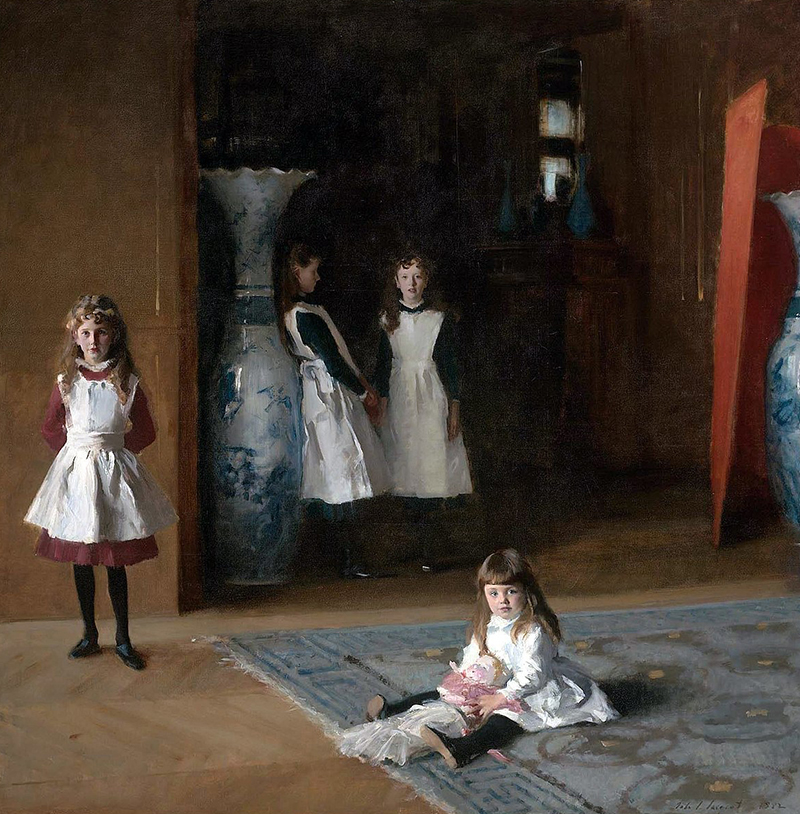
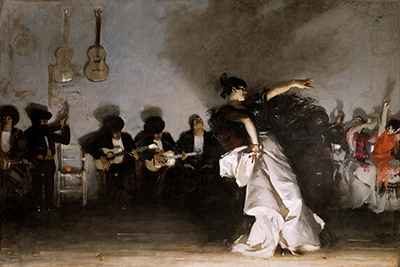
This old-master memory gave Sargent a way to be modern without severing himself from tradition. Madame X is severe and contemporary, yet its tall figure, dark dress, pale flesh, and withheld setting carry the authority of portrait tradition. The Daughters of Edward Darley Boit is an unusual modern family image, yet its relation to Velazquez and deep room space gives it historical depth. El Jaleo turns performance into a stage of shadow and light, a structure as calculated as it is vivid.
The key lesson is that Sargent's style is not a single surface manner. It is a system of decisions learned from training, exhibition pressure, and museum looking. He could paint with breadth because he knew where the breadth had to land.
Materials, Suppliers and Working Equipment
The National Portrait Gallery's research on Sargent's suppliers gives unusual access to the physical basis of his art. It notes that Sargent developed a taste for French canvas and French drawing paper during his Paris years. It also shows how difficult it can be to document every support or pigment, since many canvases connected with his work carry no supplier marks. The gaps are important: Sargent's technique is partly visible in objects, partly reconstructed from account books, labels, letters, and surviving studio material. [3]
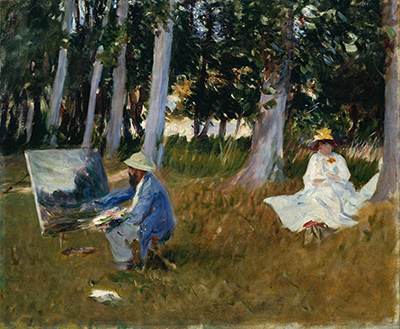
In France, he used or is connected with leading suppliers such as Hardy-Alan and, in the orbit of Monet, Vieille & Troisgros. The canvas for Claude Monet Painting by the Edge of a Wood bears a Vieille & Troisgros stencil, a telling detail because Monet used that supplier. Sargent may have received the support through Monet or on Monet's recommendation. The object therefore joins friendship, outdoor painting, and material choice in one practical fact.
In London, Sargent's suppliers included Roberson, Lechertier Barbe, James Newman, Winsor & Newton, and Henri Meunier. The NPG research records purchases of paints, papers, easels, and canvas, and notes a particularly interesting professional link with Meunier, a London supplier of French origins. It also records Sargent's use of Marble Medium from Roberson in significant quantities between 1902 and 1913. Such details help move discussion of style away from vague brilliance. The finish of a painting depends on substances as well as talent. [3]
Paper mattered just as much. Sargent preferred French drawing paper in many works on paper, judging from watermarks, and he bought Ingres paper from Roberson in 1892 and 1906. His sketchbooks came from many suppliers across Italy, Germany, Paris, and London. The list is more than a shopping record. It shows a mobile artist whose looking was supported by portable materials: sketchbooks, paper, graphite, watercolor, and equipment that could travel with him.
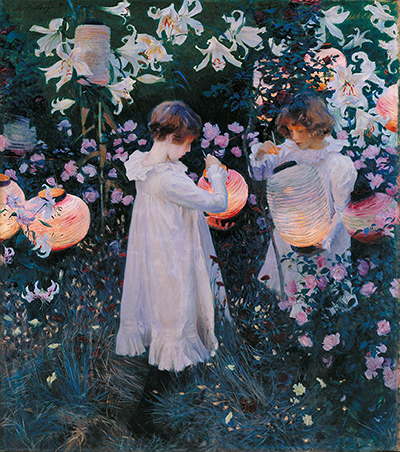
Outdoor equipment is equally revealing. The NPG page traces Sargent's purchases of Hook easels and jointed poles between 1906 and 1910, at the same moment that he was painting outdoors on the Continent each summer. The Hook easel allowed large canvases to be held outside at adjustable angles and heights. British Art Studies connects such equipment to the making of Carnation, Lily, Lily, Rose, where a photograph shows Sargent working outdoors with a light, flexible support system. The airy result depended on practical mechanics. [3], [4]
This material evidence changes how we read the brushwork. Sargent's surface is not simply the visible sign of personality. It comes from chosen supports, imported canvas, paper, pigment, medium, brushes, easels, and repeated travel. The physical life of the studio and the road sits underneath the brilliance.
Drawing Before Paint
Drawing is one of the clearest ways to see Sargent's thinking. The finished oils often conceal effort behind dazzling surface, but the studies show problems being solved: profile, hands, figure weight, flower stems, stage arrangement, and the relation between one body and another.
The Met's graphite study for Madame X shows Sargent working out Virginie Gautreau's pose before the final oil fixed her into one of the most severe images of modern portraiture. Another Met record, Madame Gautreau Peering over the Top of a Piano, preserves a quick ink drawing inside a letter. The drawing is witty and slight compared with the finished portrait, but it reveals how intensely Sargent was circling the sitter's image. The famous profile did not simply appear. It was pursued through sketches, letters, angles, and repeated looking. [1], [2]
The studies for Carnation, Lily, Lily, Rose make the same point in a different mode. Sargent studied the girls, their arms, and the flowers separately. The final image depends on a small action: children lighting lanterns. For that action to feel natural, the arms had to be convincing. A weak gesture would have broken the whole painting. The flower studies are just as important. A lily in the final work is not filler. It is a structural form that helps carry light and rhythm.
For El Jaleo, drawings and related works reveal how Sargent isolated the machinery of performance. The dancer's movement matters, but so do the seated musicians, guitarists, shadows, and shallow stage space. The final painting looks like sound and movement made visible, yet it depends on drawn preparation.
Drawing also supported late public works and war art. Studies for Gassed and for mural projects show Sargent working through bodily support, procession, drapery, allegory, and large-scale legibility. The line remains active even when the finished work becomes monumental. Drawing was not a student habit abandoned by success. It stayed at the core of how Sargent decided.
Brushwork, Surface and Controlled Freshness
Sargent's brushwork can look astonishingly free. Sleeves, satin, hair, flowers, stone, and water may be made from strokes that seem barely to have settled before becoming image. But the freedom is not careless. It works because the painting has already found its main structure.
In portraiture, this means the figure is usually held by a few decisive relations. The head turns at the right angle. The shoulders create a readable block. The hands carry pressure or display. The dress, robe, or coat establishes the figure's shape before the details arrive. Sargent can then leave some passages loose because the essential order is already secure.
White is a useful test. Sargent painted white dresses, lilies, collars, cuffs, and fabric with remarkable variety. In Carnation, Lily, Lily, Rose, the whites of dresses and flowers are not one color. They shift under dusk, lantern glow, reflected green, and the changing temperature of the scene. In society portraits, white fabric can become status, freshness, glare, softness, or theatrical contrast. The color is never simply blank.
Black is another test. Madame X depends on the black dress as a structure, not merely a costume. The black holds the body into a severe shape and makes the exposed skin more charged. In Venetian street scenes and Spanish pictures, dark passages can create compressed space, sharpen movement, or make a lit figure suddenly flare. Sargent's darkness often has color and air inside it.
The word "bravura" is useful only if it does not become an excuse to stop looking. Sargent's bravura is a means of attention. A passage may be broad because it should not compete with the face. A hand may be sharper because it tells us how the sitter occupies the room. A fabric edge may dissolve because light matters more than contour. The painting feels alive because finish is distributed unevenly but intelligently.
That uneven finish is central to Sargent's style. He often lets the viewer feel the difference between decision and suggestion. Some areas carry precise information; others remain open. The result is not incompletion in the weak sense. It is a hierarchy. Sargent tells the eye where to work hardest.
Edges, Omission and the Viewer
One of Sargent's most powerful technical habits is knowing what not to explain. His paintings often depend on edges that change their behavior across the surface. A face may be held firmly while a sleeve loosens. A hand may sharpen while the chair dissolves. A dress may be structured by a few strokes and then allowed to shimmer where the exact fold no longer matters. The viewer senses detail without receiving equal detail everywhere.
This is not negligence. It is visual economy. Sargent understood that a painting becomes more alive when the eye has work to do. If every passage is finished to the same degree, the image may become inert. If too much is left unresolved, the figure weakens. His best works hold the exact tension between the two. They give enough structure to believe the body, room, costume, or landscape, and enough openness for the surface to remain active.
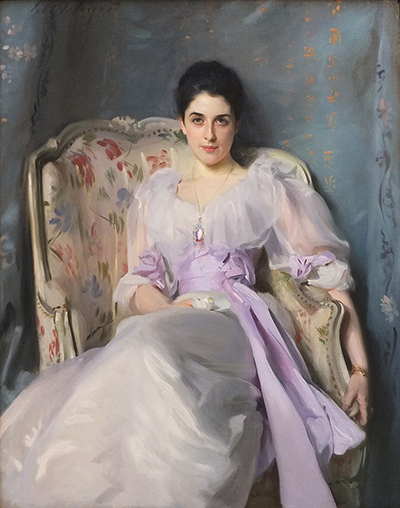
The method is especially visible in garments. A satin dress may be made from long strokes and broken highlights, but the body underneath remains convincing because the key edges have been chosen. In Lady Agnew of Lochnaw, the relaxed pose is supported by the chair, fabric, and direct gaze; some areas of dress and setting can remain broad because the sitter's presence is secure. In Madame X, by contrast, the edge between black dress and pale skin must stay severe. The painting's drama depends on that sharpness. [1], [2]
Omission also shapes Sargent's works on paper. A drawing may leave large areas blank because the pose or contour has already been secured. A watercolor may reserve paper for light instead of filling the sheet. Such decisions make the viewer aware of selection. Sargent does not merely show what he saw. He shows what mattered enough to keep.
This explains why his technical confidence can feel conversational. He does not spell out every fact; he trusts the viewer to complete the visual thought. The painter's authority lies partly in stopping at the right moment.
Portrait Staging, Hands and Costume
Sargent's technique includes directing the sitter. He did not only copy what stood before him. He arranged pose, clothing, props, and gesture so that the sitter's image could become more forceful. The Met's writing on Sargent's theatrical use of dress notes his interest in textiles gathered during travel and his habit, at times, of asking subjects to wear items he wanted to paint. [1], [2]
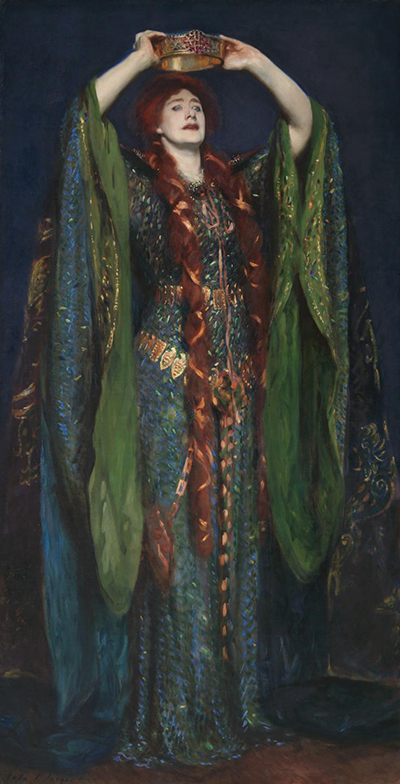
Costume could shape meaning as much as likeness. Dr. Pozzi at Home turns red into a total pictorial event. Ellen Terry as Lady Macbeth transforms an actor into a monumental stage presence through costume, raised arms, and role. Lady Agnew of Lochnaw uses dress, chair, and silk hanging to make seated ease feel like authority. Madame X uses a black gown and pale profile to create a public image sharpened almost to danger.
Hands are a smaller but equally telling part of the method. The Met's essay on Sargent's portrayal of hands emphasizes how often he used unusual finger positions and gestures to animate sitters. A hand can reveal tension, elegance, fatigue, concentration, social ease, or theatrical command. In a Sargent portrait, hands are rarely decorative accessories. They complete the body's argument. [1], [2]
This is why Sargent's portraits feel staged without feeling merely artificial. The sitter may be real, but the image is made through a negotiation. The person brings face, body, reputation, clothing, and expectation. Sargent brings fabric, pose, furniture, angle, touch, and the painter's authority to decide what should be visible.
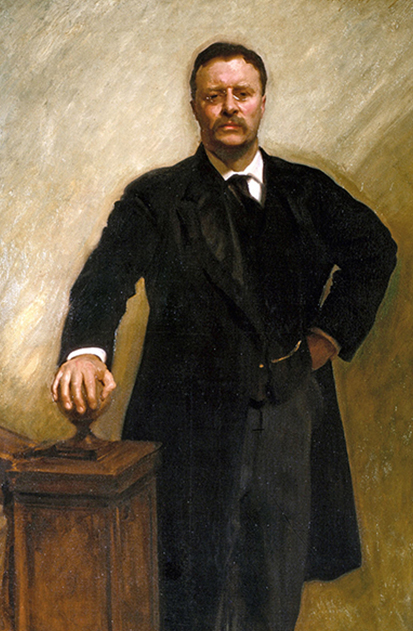
Staging also explains why his portraits can feel modern. They understand identity as something performed in front of an audience. A society sitter, actor, president, child, artist, or military figure is not simply represented. Each is shown under conditions of appearance. Sargent's technique is the technique of making those conditions visible.
Spanish Looking and Old-Master Memory
Spain gave Sargent both subjects and a way of seeing. The National Gallery of Art's Sargent and Spain material emphasizes his repeated engagement with Spanish places, architecture, music, dance, and everyday life, as well as his intense attention to Velazquez at the Prado. That combination matters: Spain was not only travel, and Velazquez was not only influence. Together they shaped Sargent's sense of dark space, restrained palette, figure presence, and theatrical light. [5], [6]
The link is visible in El Jaleo. The painting is not a literal copy of any old master, but its shallow stage, dominant shadow, lit figure, and rhythmic group arrangement show Sargent making Spanish performance into a painterly problem. The dancer's skirt, the row of musicians, and the strong shadow turn movement into design. The scene feels immediate, yet it is composed with calculated force.
The Spanish lesson also enters portraiture. Velazquez helped Sargent understand how a figure could dominate space without excessive detail. The Daughters of Edward Darley Boit is the most obvious case, with its large room, dark recession, frontal child, and memory of Las Meninas. But the lesson extends more widely. Sargent often lets emptiness, darkness, or a restrained setting make the sitter more commanding.
Spanish looking did not isolate Sargent from France or Britain. It gave him another tool inside a cosmopolitan practice. He could bring Parisian direct painting, Spanish old-master memory, London portrait demand, and American patronage into the same career. That mixture is one reason his style resists a narrow movement label.
The Spain material also requires careful modern viewing. Sargent's Spanish and travel subjects belong to a nineteenth-century taste for performance, regional identity, and visual difference. The strongest readings admire the skill while also recognizing the setting in which such images were made and viewed. Sargent's technique is never separate from the cultural frame that made subjects available to him.
Watercolor, Travel and Outdoor Work
Sargent's watercolor technique extends the same discipline into another medium. Watercolor rewards speed, but it punishes uncertainty. A wash, exposed paper, or sharp dark stroke has to be placed with confidence because it cannot be endlessly revised like oil. Sargent's late travel sheets look free because they depend on selection: what to reserve, what to wash, what to define, and what to leave open.
The Met's Beyond the Portrait Studio exhibition framed Sargent's drawings and watercolors as central to his work beyond society portraiture. Its holdings include large groups of watercolors, drawings, sketchbooks, travel sheets, and studies, ranging from early family travel to Spain, Morocco, Venice, the Alps, North America, and the Western Front. This makes the works on paper essential evidence for method. [1], [2]
The NPG supplier research gives this travel practice a physical frame. Sargent's papers and sketchbooks came from many places, and his outdoor equipment included Hook easels and jointed poles. Such objects mattered because Sargent was not only moving through places; he was working in them. A sketchbook, paper stock, portable paint, or outdoor support shaped what could be seen and captured. [3]
Watercolor also changes how Sargent handles finish. An oil portrait may build social presence through layers, costume, and surface. A watercolor often has to do more with less. A white area of untouched paper can become light. A few dark accents can secure architecture. Graphite can hold the drawing underneath a wash. The medium reveals Sargent's confidence in omission.
This is why the watercolors should not be treated as a pleasant late escape from serious art. They are a sharpened version of his looking. They show the same artist choosing where attention belongs, but in a medium where hesitation leaves a mark and overwork can flatten the effect.
Conservation Evidence and Revision
The richest technical evidence for Sargent's working process comes from Carnation, Lily, Lily, Rose. British Art Studies shows that the painting's freshness was the result of study, revision, and material control. Sargent worked outdoors, returned to the motif over two seasons, made figure and flower studies, changed the composition, and adjusted the painting as the image developed. [4]
Technical examination revealed altered lanterns, changed flowers, and surface decisions that are not visible in ordinary viewing. One lantern was first different in shape before being changed. Some flowers shifted identity. Details near the edges show the effect of framing and late changes. The picture that now feels inevitable was not born that way. It became itself through correction.
The pigment evidence is equally important. British Art Studies describes strong pigments, chromatic darks, glazing in red and purple passages, and careful concern for surface. The reds of carnations and roses work against green not simply by light and dark, but by color contrast. The whites of lilies and dresses carry the whole light structure. The lanterns glow because pigment, surface, and viewing conditions are brought into balance. [4]
The article also discusses Sargent's concern with the painting's temperature and finish. He knew that the work changed under different light. That fact is central to his technique. He did not paint light as a fixed symbol. He painted a relation: between natural dusk, lantern glow, pigment, surface, and the actual conditions in which the viewer sees the work.
This conservation evidence is valuable because it corrects the myth of effortless genius. Sargent may have wanted the final image to breathe, but he did not simply accept the first solution. He scraped, reconsidered, revised, and managed materials. The surface lives because the process underneath it was demanding.
Public Scale and Late Composition
Sargent's technique also had to expand to large public works and late war painting. Murals for Boston institutions required figure design, allegorical clarity, architectural awareness, and a different kind of finish from a private portrait. A mural must read across space and belong to a building. It cannot depend only on the intimacy of a sitter's face.
The same sense of large-scale order appears in Gassed. The painting's central procession of blinded soldiers depends on rhythm, repetition, bodily support, and the ability to make a large canvas clear without making it simple. Sargent's long experience with hands, bodies, fabric, light, and staging becomes morally altered by the subject. Technique remains, but it is placed under historical pressure.
This late work shows why Sargent's method matters beyond elegance. The skills that made a society portrait shimmer could also organize bodies after war. The skills that made a garden glow could build a mural or a public memorial image. Sargent's style is not a decorative skin over different subjects. It is a flexible system for making presence visible at many scales.
Related Works And Where To Go Next
For the full artist overview, begin with John Singer Sargent and Biography. For oil painting as a medium, use Paintings; for sitter staging and identity, use Portraits; for line, studies, and works on paper, use Drawings; for travel, paper, and outdoor color, use Watercolors.
For major technique case studies, move to Portrait of Madame X, Carnation, Lily, Lily, Rose, El Jaleo, and Gassed. For old-master context, Diego Velazquez is especially important. For outdoor practice and artistic friendship, Claude Monet gives useful context without making Sargent simply an Impressionist.
Technique Case Studies
These active pages give concrete examples of Sargent's handling of preparation, light, space, movement, outdoor looking and public scale.
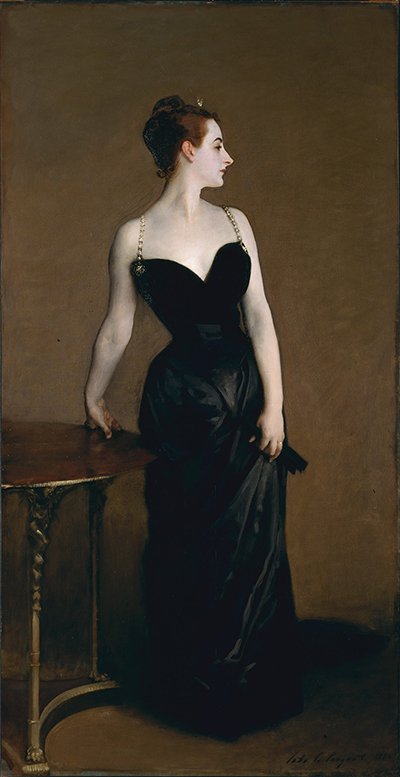
Portrait of Madame X
Pose, revision, black satin and social pressure.
Carnation, Lily, Lily, Rose
A fragile light effect built through repeated decisions.
The Daughters of Edward Darley Boit
Space, scale and Velazquez memory.
El Jaleo
Rhythm, shadow and performance composition.
Claude Monet Painting
Outdoor painting as method and friendship.
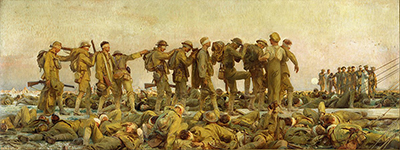
Gassed
Public scale, procession and injured bodies.
Frequently Asked Questions
Sargent combined direct painting, strong tonal structure, old-master study, exact drawing, bold surface handling, and careful staging. His work often looks fast, but the speed rests on disciplined decisions about pose, light, material, and finish.
He was trained in a direct method that valued freshness, and many passages look as if they were placed with great immediacy. But his major works also show studies, revisions, scraping back, and layered decisions. It is better to describe his method as controlled directness rather than reduce it to a single formula.
Sargent's most important Paris teacher was Carolus-Duran. He also attended drawing classes at the Ecole des Beaux-Arts and learned from old masters through museum study, especially Velazquez, Hals, Van Dyck, Rembrandt, and Reynolds.
They look alive because pose, hands, clothing, gaze, and paint handling work together. Sargent often decided where finish should be sharp and where it should remain open, allowing the viewer's eye to complete parts of the image while the main figure stays firmly structured.
Documented materials include French canvas and drawing paper, Ingres paper, sketchbooks from many suppliers, paints and mediums from London firms such as Roberson, Newman, Winsor & Newton, and others, plus outdoor equipment such as Hook easels. Not every painting's materials are fully documented, but the surviving evidence is rich.
Yes. Studies for works such as Madame X, Carnation, Lily, Lily, Rose, El Jaleo, and Gassed show him working through pose, figure arrangement, flowers, hands, procession, and composition before or around the finished works.
Sargent learned from Impressionist friends and painted outdoors, especially in works connected to Monet and travel. But he was not simply an Impressionist. His art also depends on portrait tradition, old-master study, exhibition painting, staged figures, and public commissions.
They reveal his power of selection. Watercolor forced him to choose quickly what to reserve, wash, define, or omit. The medium makes visible the same confidence that appears in his oils, but with fewer chances to correct.
Look for the hierarchy of finish. Ask which passages are sharp, which are broad, which are left open, and why. Then look at hands, edges, whites, blacks, reflected light, and how clothing or setting helps construct the figure.
Discussion
Sargent's technique asks a simple question that keeps becoming more complex: how much work is needed to make a moment look alive?
Reader Insights
What is the first detail that shapes your reading of John Singer Sargent Style and Technique: pose, setting, light, costume, brushwork or historical context?
Which small visual decision begins to matter more after a longer look, and how does it change the mood of the page?
Which comparison helps most: another Sargent portrait, a travel subject, a public commission, or a work by one of his contemporaries?
Join the Conversation
Share a thoughtful comment below about what you notice, question or compare when looking at this page.
References
- The Metropolitan Museum of Art, *Virginie Amelie Avegno Gautreau, Study for "Madame X"* https://www.metmuseum.org/art/collection/search/12328
- The Metropolitan Museum of Art, *Madame Gautreau Peering over the Top of a Piano* https://www.metmuseum.org/art/collection/search/919018
- National Portrait Gallery, "John Singer Sargent's suppliers of artists' materials" https://www.npg.org.uk/collections/research/programmes/artists-their-materials-and-suppliers/john-singer-sargents-suppliers-of-artists-materials
- Rebecca Hellen and Elaine Kilmurray, "Carnation, Lily, Lily, Rose and the process of painting" https://britishartstudies.ac.uk/issues/02/sargent-conservation
- National Gallery of Art, *Sargent and Spain* https://www.nga.gov/research/publications/sargent-and-spain
- National Gallery of Art, "John Singer Sargent" https://www.nga.gov/artists/1858-john-singer-sargent