 Buy Art Prints Now
from Amazon
* As an Amazon Associate I earn from qualifying purchases.
Image reference [image]
 by Tom Gurney
Tom Gurney BSc (Hons) is an art history expert with over 20 years experience
Published on August 14, 2026 / Updated on August 14, 2026
Email: tomgurney1@gmail.com / Phone: +44 7429 011000
Tristram and Isolde: Introduction
The cup between Tristram and Isolde is small enough to hold in one hand and large enough to redirect two lives. John William Waterhouse does not paint the lovers' long affair, separation or deaths. He selects the threshold on the ship to Cornwall, when a drink passes between them and duty becomes inseparable from desire.
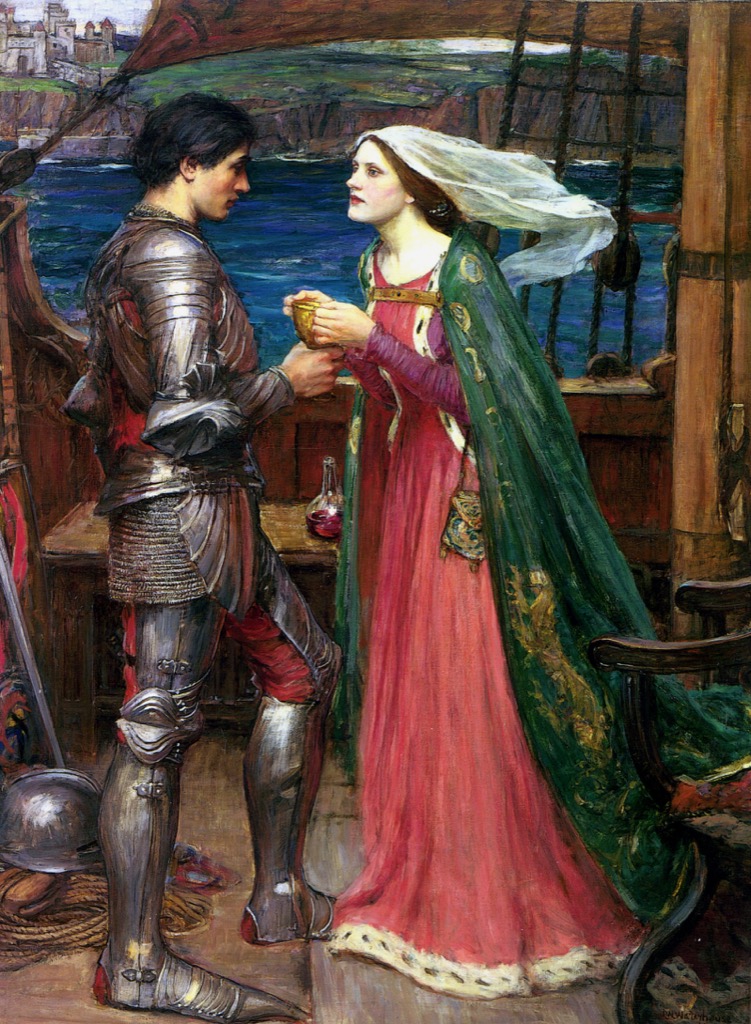
Painted in 1916 and exhibited posthumously at the Royal Academy in 1917, Tristram and Isolde belongs to Waterhouse's last group of Arthurian and literary works. The signed oil shows Isolde in pale drapery offering or holding a chalice beside the armoured Tristram. Their hands and bodies draw close while sea, vessel and destination make the journey visible. [1] [2]
At a Glance
- ArtistJohn William Waterhouse (1849–1917)
- TitleTristram and Isolde [1]
- Date1916; signed and dated [1]
- MediumOil on canvas [1]
- Dimensions42½ × 31½ inches, approximately 108 × 80 cm [1]
- OwnershipPrivately owned; no permanent public collection is documented in the sources used here [1]
- ExhibitedRoyal Academy, London, 1917, posthumously [1]
- SubjectTristram and Isolde aboard the ship carrying Isolde to Cornwall, at the fatal drink [2] [3]
- Literary traditionThe medieval Tristan legend, familiar in Britain through versions including Thomas Malory's Le Morte Darthur and transformed for the nineteenth century by Richard Wagner [3] [4]
- Essential distinctionThe potion episode changes across retellings. Malory's pair accidentally drink a love potion intended for Isolde and King Mark; the poison-for-love-potion exchange stressed by Christie's follows the Wagnerian dramatic pattern [3] [4] [5]
Contents
- Introduction
- The Instant around the Cup
- Tristram's Mission and Isolde's Divided Future
- One Legend, Several Potion Stories
- Armour, Drapery and Touch
- The Ship as a Moral Threshold
- A Late Waterhouse and Posthumous Exhibit
- Provenance and Modern Visibility
The Instant around the Cup
Waterhouse brings the two figures close within a vertical canvas. Tristram stands or steps at the left in armour and a red cloak. Isolde, taller in effect because of her pale veil and long drapery, occupies the right. Between them is the cup.
Their clothing establishes contrast before expression is examined. Metal armour articulates Tristram's body through hard plates and edges; Isolde's gown and veil move in soft, continuous folds. Red carries warmth and danger across the knight, while her paler fabric gathers the changing light.
The contrast is not a simple division between active man and passive woman. Isolde controls the chalice in the represented moment. Her arm reaches into the narrow interval; Tristram's hand approaches hers. The vessel makes their relation reciprocal because it must be offered, accepted and shared.
Their faces are close enough for intense attention but do not dissolve into an embrace. Waterhouse chooses anticipation and recognition. The emotional force comes from a boundary about to fail.
Behind them, the ship and sea turn the encounter into a journey rather than a timeless medieval interior. A distant coast or castle suggests Cornwall, where Isolde is expected to marry Tristram's uncle, King Mark. Destination is therefore visible as obligation.
The deck is a transitional place. Ireland, Isolde's home, lies behind; Cornwall and marriage lie ahead. The lovers cannot establish a stable household here. Their bond begins in the narrow interval between political arrangements.
The cup is visually modest. It does not glow or produce a supernatural apparition. Waterhouse makes enchantment operate through ordinary gestures: fingers, lips, exchanged gaze and the acceptance of a drink.
That restraint keeps the scene human even when its mechanism is magical. The potion does not remove the tragedy of choice; it makes desire impossible to separate from fate.
Tristram's Mission and Isolde's Divided Future
The Tristan story developed through medieval poems and prose romances in several languages. Names vary—Tristan or Tristram, Iseult, Isolde or Isoud—and so do events. Waterhouse's English title uses “Tristram,” the spelling familiar from Sir Thomas Malory. [3]
In Malory's Le Morte Darthur, Tristram is a Cornish knight and nephew of King Mark. He travels to Ireland, where Isolde heals him after a poisoned wound. Later he wins a boon from King Anguish and asks not to marry Isolde himself but to take her to King Mark as the king's bride. [3]
The mission binds service and loss. Tristram is not carrying an unknown princess towards a neutral alliance. Earlier contact, healing and admiration already complicate the voyage. Malory says that Isolde's father would have preferred Tristram to wed her, but the knight insists upon his promise to Mark. [3]
Isolde likewise becomes the object of negotiations conducted between men, yet she is not emotionally blank. Across the tradition she possesses knowledge, anger, healing skill and desire. Waterhouse gives her the active cup-bearing gesture at the decisive point.
The future marriage makes every movement between the pair ethically charged. Tristram's armour identifies service and knightly identity, but the mission those values require is also bringing Isolde to another man. Duty prepares the conditions of its own breach.
King Mark does not appear. His absence is structurally powerful. Castle, coast and destination carry his claim into the picture without adding a third body. The lovers' privacy is already occupied by a marriage that has not yet occurred.
The tale does not end with the potion. Isolde marries Mark; she and Tristram sustain a forbidden relationship amid concealment, suspicion, separation and repeated danger. Different versions resolve their lives and deaths differently. Waterhouse compresses that long narrative into the instant when the governing contradiction becomes irreversible.
The painting is often called Arthurian because Malory incorporates Tristram among the knights associated with Arthur's world. The romance, however, has roots and versions beyond the central Arthurian cycle. Calling it only a scene from Le Morte Darthur would hide the tradition's plurality.
One Legend, Several Potion Stories
The potion is famous, but there is no single detail common to every influential retelling. Distinguishing versions is essential to interpreting Waterhouse's cup.
In Malory's Book VIII, Isolde's mother prepares a love drink intended for Isolde and King Mark on their wedding day. The drink is entrusted to Bragwaine and Gouvernail. During the sea journey, Tristram and Isolde become thirsty, mistake the golden flask for wine, drink to one another and fall into a love that lasts through joy and sorrow. [3]
Malory's scene is accidental. Neither lover intends poison, and the potion was not meant for them. The act begins in thirst, laughter and misrecognition.
Wagner's Tristan und Isolde, first performed in 1865, constructs the scene differently. Isolde intends a death draught for herself and Tristan rather than arrival under King Marke's authority. Her attendant Brangäne substitutes a love potion. The pair drink expecting death and awaken to overpowering love. [4]
Christie's 2022 presentation of Waterhouse's painting describes Isolde offering Tristram a chalice containing poison so they will not be forced to part, with a love potion substituted. [5] That reading clearly follows the Wagnerian form. It fits the ceremonial chalice and the pair's grave intensity better than Malory's casual discovery of a flask.
Yet the painting does not label its liquid. A viewer cannot chemically distinguish poison from love potion by colour, nor see Brangäne making the exchange. Waterhouse may rely on an audience familiar with several versions at once.
This ambiguity is productive. If the lovers expect death, the cup represents a chosen refusal of separation transformed into involuntary passion. If they mistake the liquid for wine, it represents ordinary need transformed into fate. In both, drinking crosses the boundary between service to Mark and a bond that defies him.
The painting should not force Malory and Wagner into one seamless source. The title's spelling points towards British medieval tradition; the poison-substitution scenario points towards Wagner. Late Victorian and Edwardian audiences could encounter the legend through books, opera, poetry, illustration and popular retelling without demanding exclusive fidelity to one text.
Waterhouse's choice may therefore be understood as a visual synthesis, provided synthesis is not mistaken for proof that he followed a documented edition line by line.
Armour, Drapery and Touch
Tristram's armour is more than historical costume. It carries the identity that has brought him aboard: knight, envoy, nephew and servant of a king. Its hard geometry makes his approach towards Isolde look like a yielding of defended space.
The red cloak softens that armour while intensifying it. Cloth passes across metal, allowing warmth and movement to coexist with martial structure. The same figure can be both public knight and private lover.
Isolde's pale garment is expansive. Sleeves and veil catch air, making the ship's exposed setting tangible. Her drapery does not merely signal femininity; it connects body to weather and motion, as though the voyage continues through every fold.
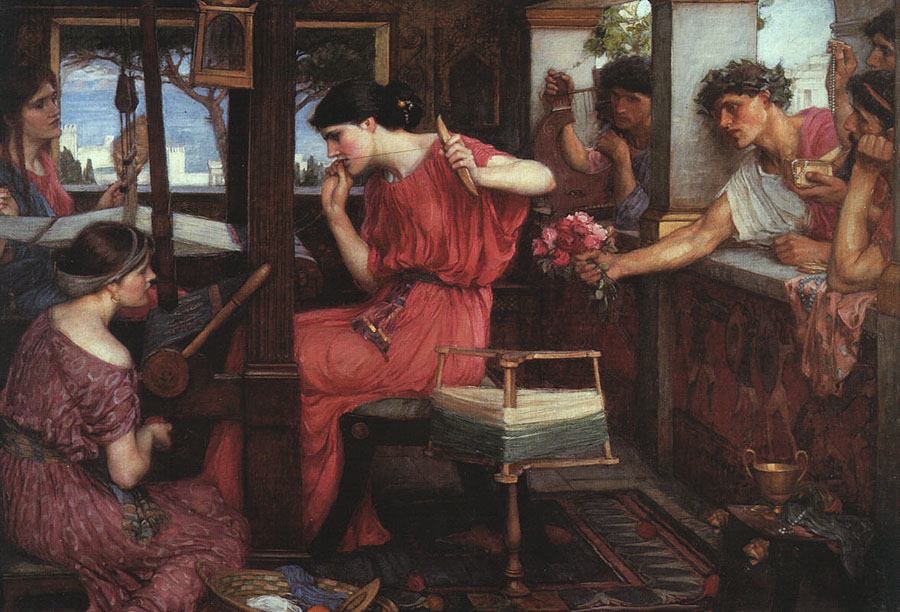
Their hands are the composition's hinge. The cup sits near touch, and touch precedes embrace. Waterhouse repeatedly found emotional drama in hands that approach an object or boundary: Circe offers a cup, Psyche opens a door, Penelope works at a loom and Thisbe presses towards a wall. Here an exchange joins two bodies while redistributing responsibility.
The chalice also resembles a ritual vessel. There is no Christian sacrament in the romance, but the form lends solemnity to shared drinking. A private transgression acquires the visual gravity of a vow.
No crowd witnesses the moment. Sailors, attendants and Brangäne are absent or pushed beyond the represented field. This simplification gives the pair a temporary visual autonomy that their story denies them socially.
The sea provides cool distance behind warm figures. Its horizontal line checks the upward movement of veil, armour and bodies. A destination on the coast prevents the background from becoming boundless freedom.
Waterhouse's colour does not narrate by fixed code. Red can suggest passion, danger or rank; white can suggest bridal expectation, exposure or light. These associations are available, but no contemporary statement fixes a private symbolic scheme.
What is secure is relational: hard and soft, red and pale, contained vessel and open sea. The contrasts converge at the lovers' hands.
The Ship as a Moral Threshold
The ship is sometimes treated as mere scenery needed to locate the potion episode. It does more. It suspends the lovers between jurisdictions, homes and social roles.
In Ireland, Isolde is a princess and healer. In Cornwall, she will be Mark's queen. At sea, she has left one identity without fully entering the next. Tristram is both the agent of transition and the person most endangered by it.
Movement gives the scene urgency even though the figures appear still. Every moment of the voyage reduces the distance to Cornwall. The cup interrupts that timetable but cannot stop the ship.
Waterhouse often encloses women at windows, walls, mirrors and doorways. Tristram and Isolde expands the threshold into an entire vessel. The deck is open to wind and horizon, yet its route has already been assigned.
This combination prevents an easy equation of open landscape with freedom. Sea surrounds the pair, but social destination remains fixed. The lovers can see distance without escaping consequence.
The vessel also turns private feeling into political danger. Isolde's marriage will connect kingdoms and satisfy King Mark's demand. Love between her and the envoy threatens family loyalty, royal authority and chivalric reputation.
The potion can seem to excuse that conflict by removing free choice. Medieval and later versions use enchantment in different ways, sometimes making passion irresistible, sometimes allowing moral blame to return when the potion's term ends. Waterhouse does not adjudicate theology or law. He paints the experience of compulsion becoming intimate.
The lovers' forward movement towards each other is set against the ship's forward movement towards Mark. Two trajectories share one deck and cannot be reconciled.
A Late Waterhouse and Posthumous Exhibit
Waterhouse signed and dated the canvas in 1916. [1] He died on 10 February 1917. The Royal Academy displayed Tristram and Isolde posthumously in its 1917 Summer Exhibition alongside works including The Enchanted Garden, Fair Rosamund and Miranda. [1]
The date makes it one of his final completed major paintings, but “final” should not be turned into a judgement that every feature summarises an entire career. Its Arthurian subject, suspended psychology, richly clothed figures and offered cup continue concerns he had explored for decades.
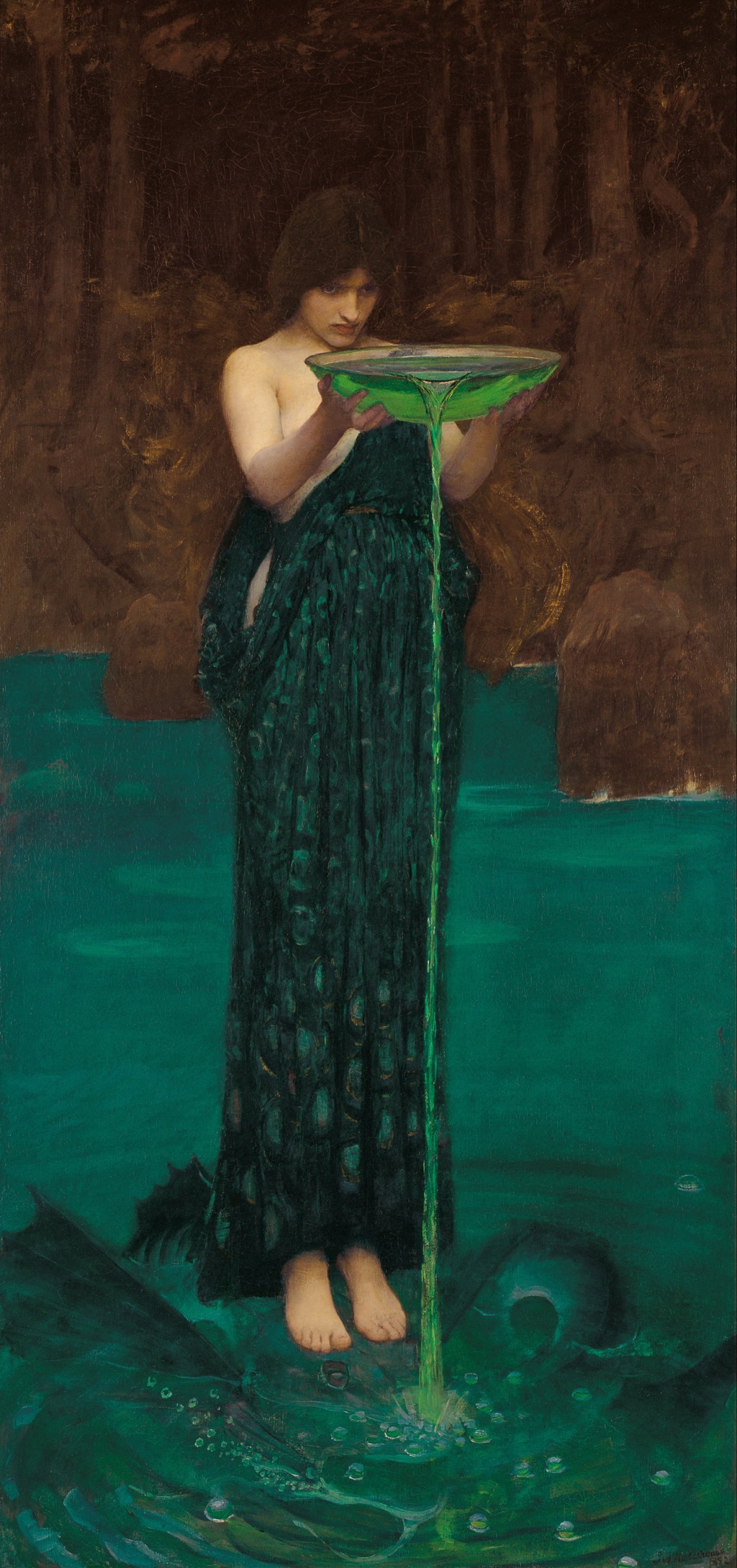
Comparison with Circe Offering the Cup to Ulysses is especially revealing. Circe stands alone at the centre and projects the vessel towards an approaching man reflected behind her. The cup is an instrument of her controlled confrontation. In Tristram and Isolde, the vessel belongs between two figures and binds both to a future neither can command.
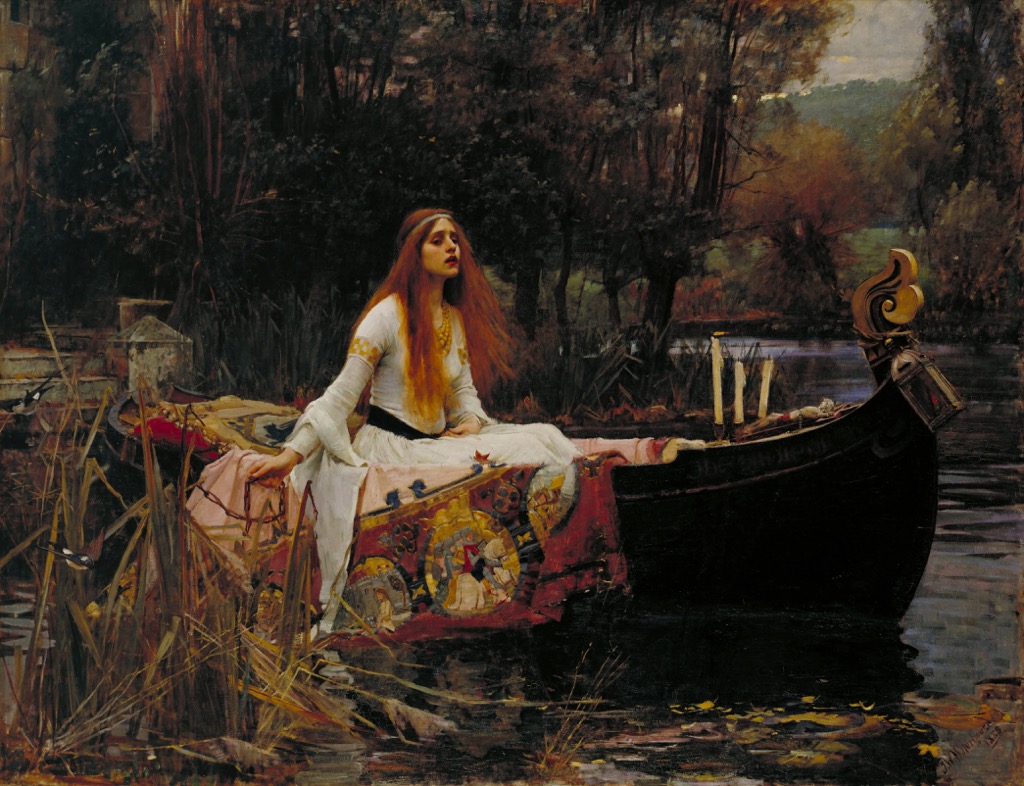
The painting also extends his Lady of Shalott sequence. Both legends concern love, divided loyalties and a journey towards fatal consequence. Yet Isolde is not isolated in a tower. She meets Tristram directly, and the catastrophe begins through reciprocal proximity.
Waterhouse worked during the First World War, and Christie's describes the 1916 picture as carrying undertones of romantic nationalism. [5] The medieval knight, maritime journey and British Arthurian reception would have resonated in wartime. A more specific political allegory cannot be securely assigned without supporting evidence.
The 1917 display changed the picture's reception because audiences encountered it after the artist's death. That circumstance may deepen its emphasis on irreversible transition, but it did not create the medieval tragedy or prove that Waterhouse intended a farewell.
Its finish distinguishes it from The Enchanted Garden, which death left incomplete. The two works show that Waterhouse's late studio contained projects at different stages, not one uniform “last style.”
The posthumous group also corrects a common chronological shortcut. Waterhouse's last lifetime Royal Academy exhibits were the three works of 1916: A Tale from the Decameron, Miranda – The Tempest and “I Am Half-Sick of Shadows,” Said the Lady of Shalott. Tristram and Isolde belongs to the next Academy display even though the signature dates its making to 1916. Date of execution and date of first public exhibition should therefore remain separate.
That distinction matters to interpretation. The painting was conceived within Waterhouse's active studio practice, not assembled as a memorial by others. Its posthumous status describes reception, while the signed canvas records authorship and completion before death.
Provenance and Modern Visibility
The painting remained in Waterhouse's studio and appeared in the artist's studio sale at Christie's on 23 July 1926. The 2022 Christie's catalogue records its purchase there by W. W. Sampson, its later handling by Maples Fine Art Department, a private British collection, ownership by the musician Sir Rod Stewart by 1999, and subsequent American ownership. [1]
It was sold at Sotheby's in London on 28 November 2002. A later Sotheby's catalogue cited that sale while describing the shipboard setting. [2] In 2022 Christie's included the work in The Art of Literature, a loan and selling exhibition devoted to relations between texts and visual art. [1] [5]
These records establish a privately owned picture with a substantial modern exhibition and market history. They do not establish a permanent museum home. Online dealer pages can remain visible after a work is sold, so “currently for sale” or a named current owner should not be asserted without up-to-date confirmation.
The catalogue dimensions are 42½ by 31½ inches, a portrait format large enough for near-life-size presence without the breadth of Waterhouse's multi-figure Boccaccio paintings. [1] Reproduction tends to make its vessel and hand contact more obvious while reducing the bodily scale of the encounter.
Private ownership also affects scholarship. A painting can be famous through images yet difficult for the public to examine directly. Exhibition catalogues, auction records and high-quality photography become unusually important, while technical claims should remain modest unless a conservation study is published.
The provenance gives no support to stories about a named model. Familiar facial types in Waterhouse's late work are not documentation of identity.
The safest account ends where the evidence does: a signed late canvas, shown posthumously, repeatedly documented in major catalogues and presently outside a permanent public collection.
The sequence of sales also explains small discrepancies in online measurements and titles. Catalogues may convert inches differently or round the canvas size, while reproductions sometimes add “with the potion” for search clarity. The signed work documented by Christie's is titled simply Tristram and Isolde. Keeping that title avoids accidentally treating descriptive web labels as separate paintings.
Related Pages
- Paintings: Return to the protected Waterhouse paintings hub.
- Literary and Mythological Sources: Read the literary frame for Waterhouse's medieval romance subjects.
- Technique and Style: Connect the late Tristram and Isolde composition with Waterhouse's mature colour, texture and figure handling.
Frequently Asked Questions
He shows Tristram and Isolde aboard the ship to Cornwall at the exchange of the fatal drink. The cup transforms their relation before Isolde's marriage to King Mark. [2] [3] [5]
That depends on the version. In Malory, they accidentally drink a love potion intended for Isolde and Mark. In Wagner, Isolde orders a death draught and Brangäne substitutes a love potion. Christie's interprets Waterhouse through the latter pattern. [3] [4] [5]
He has undertaken to bring her to his uncle, King Mark, as Mark's bride. [3]
Yes. “Tristram” is the English form used in Waterhouse's title and Malory; “Tristan” is common in other medieval and modern versions.
It is dated 1916 but was exhibited at the Royal Academy in 1917, after Waterhouse's death in February. [2]
It is privately owned rather than assigned to a permanent public museum in the cited records. [1]
The poison-substitution interpretation is Wagnerian, but no source cited here proves that the opera was Waterhouse's exclusive model. The picture belongs to a legend available through multiple literary and theatrical forms.
No model is securely named in the documentary sources used here. Resemblance to other Waterhouse figures is insufficient evidence.
Discussion
1. Does the cup appear to divide the lovers or join them? 2. How do armour and drapery express competing identities without reducing gender to a simple opposition? 3. What changes if the pair expect poison rather than ordinary wine? 4. Why is a ship especially suited to a story about transition and divided loyalty? 5. Does the love potion excuse the lovers, imprison them or make the ethical problem harder? 6. How does King Mark remain present despite being absent from the canvas? 7. Compare this offered cup with Circe's cup. Who appears to control the encounter in each painting? 8. How should the painting's 1917 posthumous exhibition affect—but not determine—its interpretation?
Reader Insights
Which visible detail most changes the way you read this page?
Which source or comparison helps the work feel less familiar and more specific?
What question would you bring back to the painting after reading?
Join the Conversation
Share your reading of this page below.
References
- Main image: John William Waterhouse, Tristram and Isolde with the Potion, c. 1916, public-domain faithful reproduction via Wikimedia Commons.
- Christie's, The Art of Literature catalogue, “John William Waterhouse, R.A., Tristram and Isolde,” 2022, pp. 1 and 12, including signature, date, medium, dimensions and provenance, View source.
- Sotheby's, catalogue note for Edmund Blair Leighton, The Hostage, recording Waterhouse's 1916 Tristram and Isolde aboard the ship to Cornwall and its Sotheby's sale of 28 November 2002, View source.
- Sir Thomas Malory, Le Morte Darthur, Book VIII, Chapter 24, Project Gutenberg, including Tristram's mission and the love drink intended for Isolde and King Mark, View source.
- Richard Wagner, Tristan and Isolda, Act I, Project Gutenberg, English translation and stage directions for the death draught and substituted love potion, View source.
- Christie's, “The Art of Literature Exhibition,” press release, 19 May 2022, including its interpretation of Waterhouse's cup scene, View source.