 by Tom Gurney
Tom Gurney BSc (Hons) is an art history expert with over 20 years experience
Published on November 17, 2026 / Updated on November 17, 2026
Email: tomgurney1@gmail.com / Phone: +44 7429 011000
Lorenzo Ghiberti’s first bronze doors went up in Florence in 1424. While his workshop was making them, he designed cathedral windows, took on two reliefs for Siena and cast monumental saints for the guilds of Orsanmichele. The next doors took until 1452, by which time his workshop had also delivered a bronze shrine for Florence Cathedral. This timeline follows the contracts, payments, letters and installations that date those overlapping jobs. The biography follows his household, career and writing in more depth. [1] [2]
Contents
- c. 1378 – Birth and training in a goldsmith’s household
- 1400 – A painted chamber in Pesaro
- 1401–03 – The Baptistery competition and the first contract
- 1404–07 – The cathedral rose window and revised door terms
- 1412–16 – Two more windows and a bronze Baptist
- 1417–20 – The Siena font, St Matthew and the cathedral dome
- 1422–24 – St Matthew is recast and the first doors go up
- 1425 – A second door commission while Siena waits
- 1427–29 – Siena’s gilding, St Stephen and the Three Martyrs
- 1432–36 – The Zenobius shrine, the Linaioli tabernacle and cathedral designs
- 1437–42 – The Gates castings and the completion of the shrine
- 1443–47 – Four reliefs to finish and a new cathedral window
- 1452 – Gilding and installation of the Gates of Paradise
- 1453–55 – The last surround, the Commentarii and Ghiberti’s death
c. 1378 – Birth and training in a goldsmith’s household
Ghiberti gave 1378 as his birth year in a petition to the Florentine government in 1444. He said his mother, Fiore, had married Cione Paltami Ghiberti at Pelago in 1370. He was defending his eligibility for civic office and had already given a different account in tax declarations from 1427 to 1442. Those declarations put his birth in 1381 and identified him as the son of Bartolo di Michele. The Opera del Duomo gives Pelago as his birthplace, which remains less securely established than Pelago’s place in his account of the marriage. [1] [2]
Bartolo, a goldsmith in Florence, raised and trained Lorenzo. The first door contract would eventually put both men’s names on the same undertaking. The dates of Lorenzo’s training remain uncertain, but the evidence for Bartolo’s role gives a setting for his early work in drawing, modelling and metal. Ghiberti would still identify himself as a Florentine goldsmith when writing to the officials responsible for the Siena font decades later. [1] [3] [4]
1400 – A painted chamber in Pesaro
In the Commentarii, written late in his life, Ghiberti recalls leaving Florence in 1400 during an outbreak of sickness and a period of civic trouble. He says he went with a painter to work on a chamber for the lord of Pesaro, identified by Carlo La Bella as Malatesta IV. Ghiberti leaves the painter unnamed. Letters from friends then brought word that the governors of the Florence Baptistery wanted craftsmen to submit examples of their work. He asked his colleague and patron for leave to return. [1] [5]
The chamber is known through this retrospective account. It gives Ghiberti’s own sequence of events from painting at court to competing for a bronze commission in Florence. His recollection that further painting work was in prospect also places the move back to Florence at a point when he was still pursuing more than one trade. [1] [5]
1401–03 – The Baptistery competition and the first contract
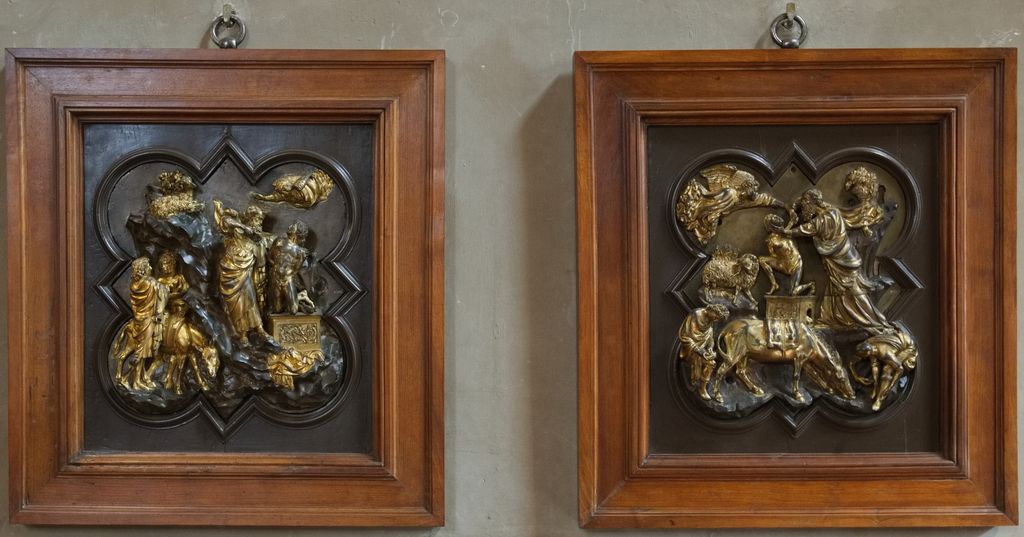
The Arte di Calimala, the merchants’ guild responsible for the Baptistery, held the competition conventionally dated 1401. It asked for a bronze relief of Abraham’s sacrifice of Isaac in a four-lobed frame. Two submissions survive at the Bargello. In Ghiberti’s Sacrifice of Isaac the ridge separates the servants from Abraham and the exposed figure of Isaac. Filippo Brunelleschi concentrates the action around the angel’s physical grasp of Abraham’s wrist. The panels show how differently the two men answered the same brief, including in their use of separately cast pieces. [1] [6]
Ghiberti later remembered a unanimous verdict from a jury of thirty-four. The life of Brunelleschi attributed to Antonio Manetti says the two men were offered the work jointly and Brunelleschi withdrew. Both versions were written after the event. The commission itself has a firmer date. On 23 November 1403 Lorenzo and Bartolo signed the first agreement for the door. The trial subject belonged to the Old Testament, while the door they undertook would carry scenes from the life of Christ, together with the Evangelists and Doctors of the Church. [1] [3] [5]
1404–07 – The cathedral rose window and revised door terms
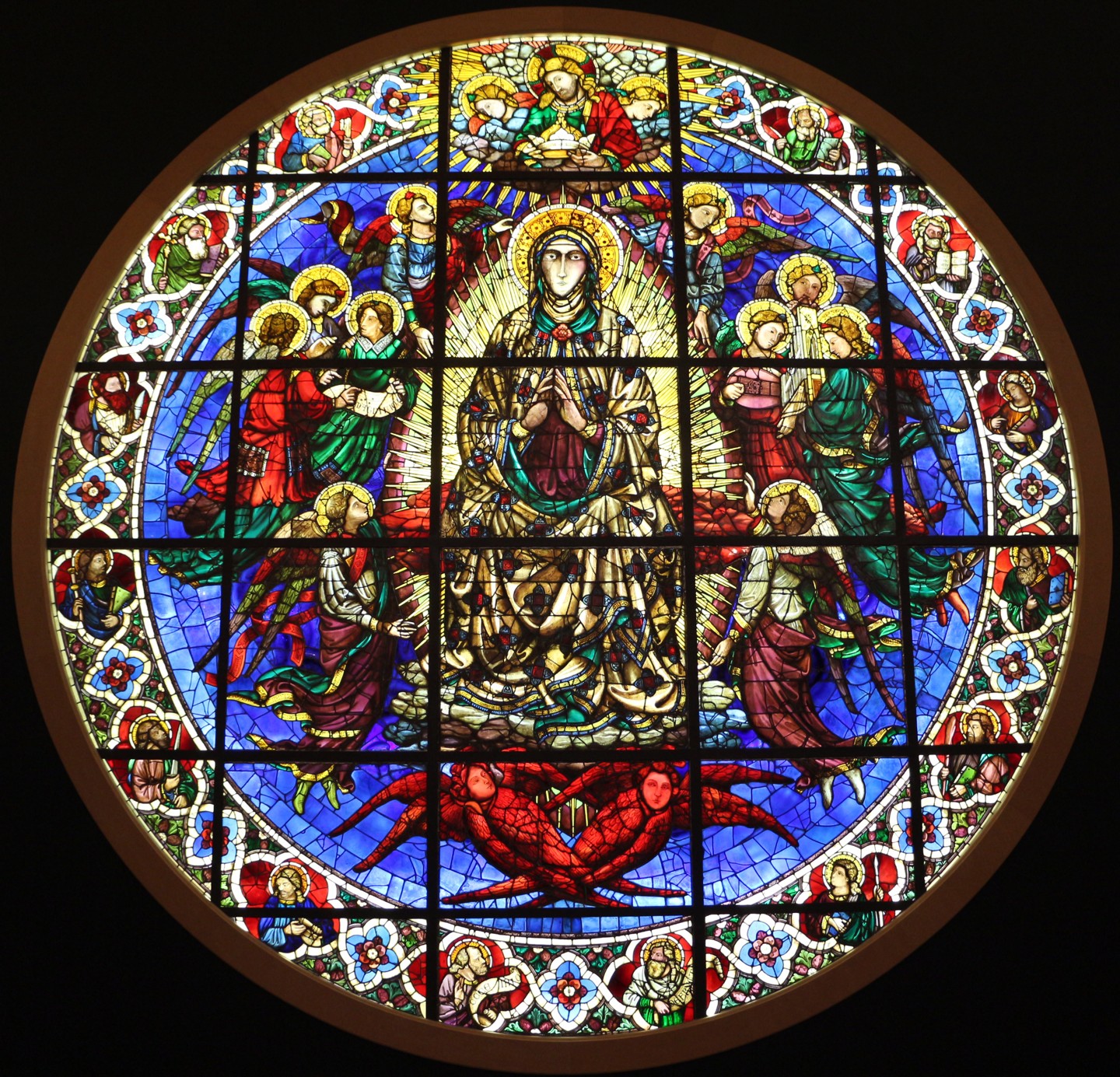
In 1404 Ghiberti drew the design for the Assumption of the Virgin for the central window of Florence Cathedral’s entrance wall. The Opera dates the finished glass to 1405 and names Nicolò di Pietro Tedesco as the glassmaker. The window, more than six metres across, establishes an early division of labour between Ghiberti, who supplied the cartoon, and a specialist who translated it into glass and lead. The two would work together on the flanking windows as well. [2] [7]
On 1 June 1407 Calimala signed a new agreement with Lorenzo alone. It required his personal work on figures, trees and similar details, with the guild retaining oversight of the shop and a say over outside work. The agreement gives a dated point of reference for the organisation of the North Doors. The proposed dates of individual panels have a different basis. For instance, Richard Krautheimer placed the Annunciation and Nativity among the early reliefs, around 1403–07, by comparing their style with other work. The range is a scholarly estimate for the panels. [1] [3]
1412–16 – Two more windows and a bronze Baptist
The Opera dates the making of the circular windows of St Stephen and St Lawrence to 1412–15. Ghiberti supplied the drawings and Nicolò di Pietro Tedesco made the glass. The two enthroned saints went into the openings on either side of the Assumption. The Opera also records alterations in 1423 and 1432, which means that the dates of manufacture describe an earlier state of the windows now in the cathedral. [7]
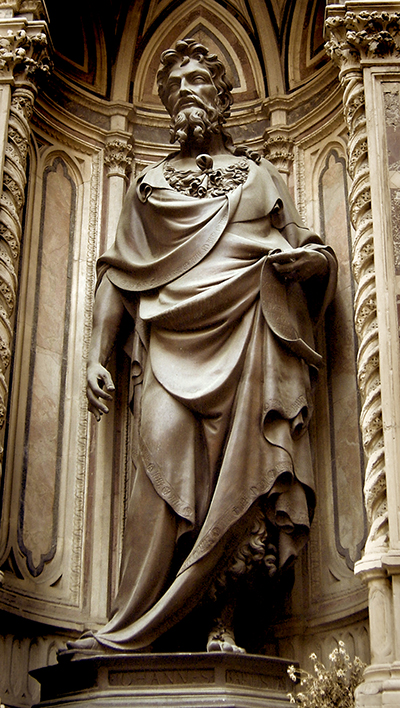
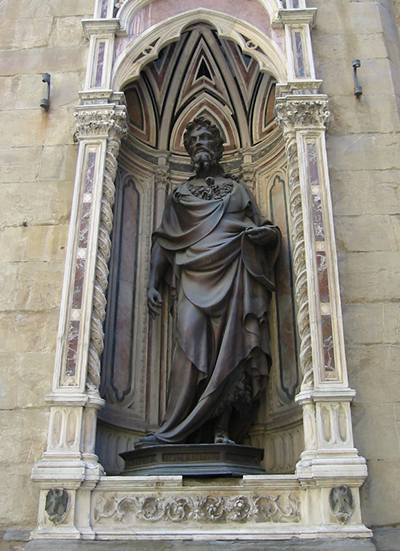
At roughly the same time Calimala commissioned Ghiberti’s St John the Baptist for its street-facing niche at Orsanmichele. The Bargello dates the statue to 1413–16 and the national catalogue gives c. 1414–16. Ghiberti himself assigns its placement to 1414 in his later account. The institutional ranges encompass the making of the bronze, while his recollection names a year for its placement. Cast while the first Baptistery door was still in progress, the Baptist was a separate commission from the same guild. Its relief-worked robe and prominent scroll carried the goldsmith’s attention to detail into a figure meant to be seen from the street. [5] [8]
1417–20 – The Siena font, St Matthew and the cathedral dome
On 21 May 1417 Siena’s cathedral works commissioned Ghiberti to supply two bronze reliefs for the new baptismal font. The contract advanced him 100 florins. He had ten months for the first relief and another ten for the second. The Sienese officials were to inspect the first bronze before and after gilding, then set the price for the pair. Their arrangement depended on seeing a finished example early enough to judge what the second panel should cost and how it should be made. The letters of the following decade show how far the job ran beyond those terms. [4] [9]
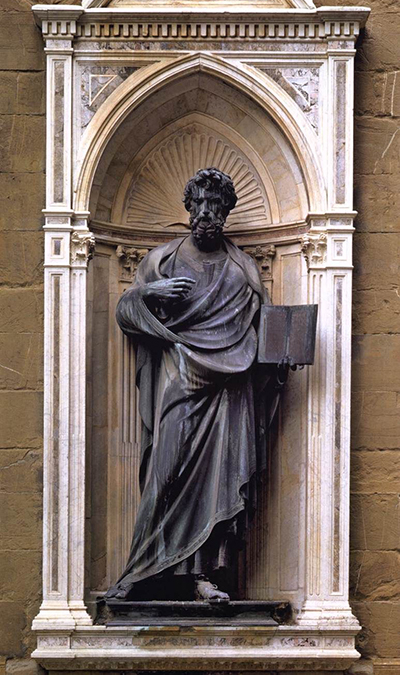
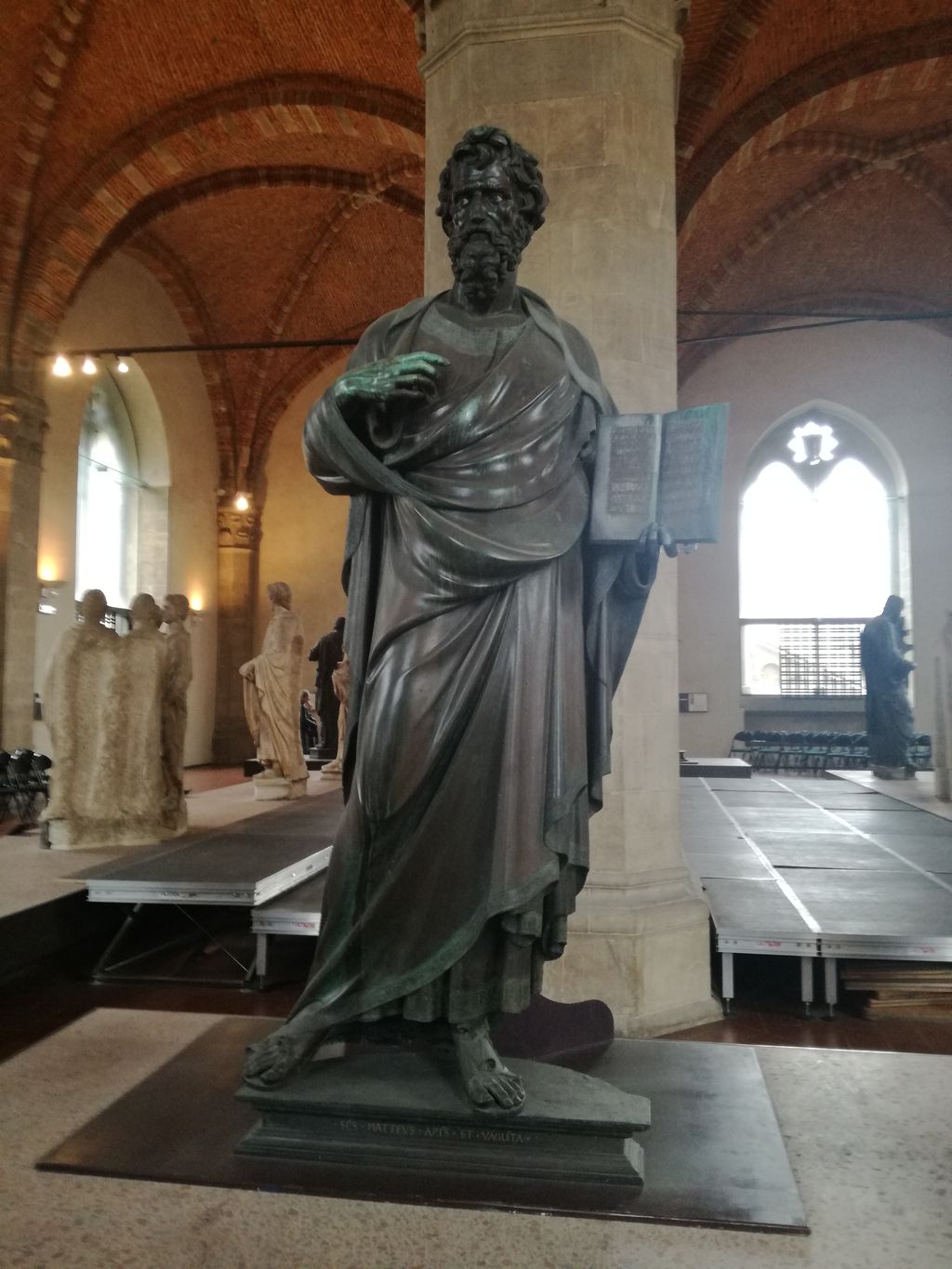
On 23 September 1418 the Florence Opera assigned four labourers to help Ghiberti with his dome model. Its registers record payment for model expenses in August 1419 and his salaried election as one of the dome’s overseers on 16 April 1420. Meanwhile the moneychangers’ guild had commissioned Ghiberti’s St Matthew for Orsanmichele in 1419. The date 1420 on the mantle probably refers to the wax model, according to the national catalogue. The bronze itself required more than one casting attempt. [1] [10] [11]
1422–24 – St Matthew is recast and the first doors go up
A problem in casting St Matthew in 1421 required another pour. La Bella dates the successful casting to 30 January 1422. Chasing followed, and Michelozzo appears among the men working on the commission that January. Stonecutters began work on Ghiberti’s design for the marble tabernacle in May 1422. The statue and its setting thus had separate workforces and timetables. For the sculpture the national catalogue gives about 1419–22, while the Bargello’s visitor guide extends the approximate range to 1423. [1] [11]
The Opera singled out Brunelleschi as the dome’s inventor and principal governor in 1423. Ghiberti’s 1420 appointment records his role in site oversight. [1] [10]
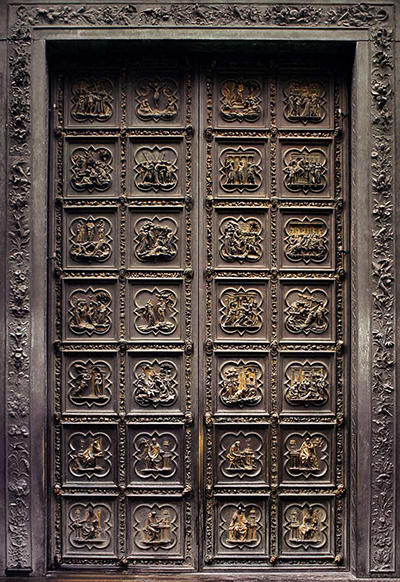
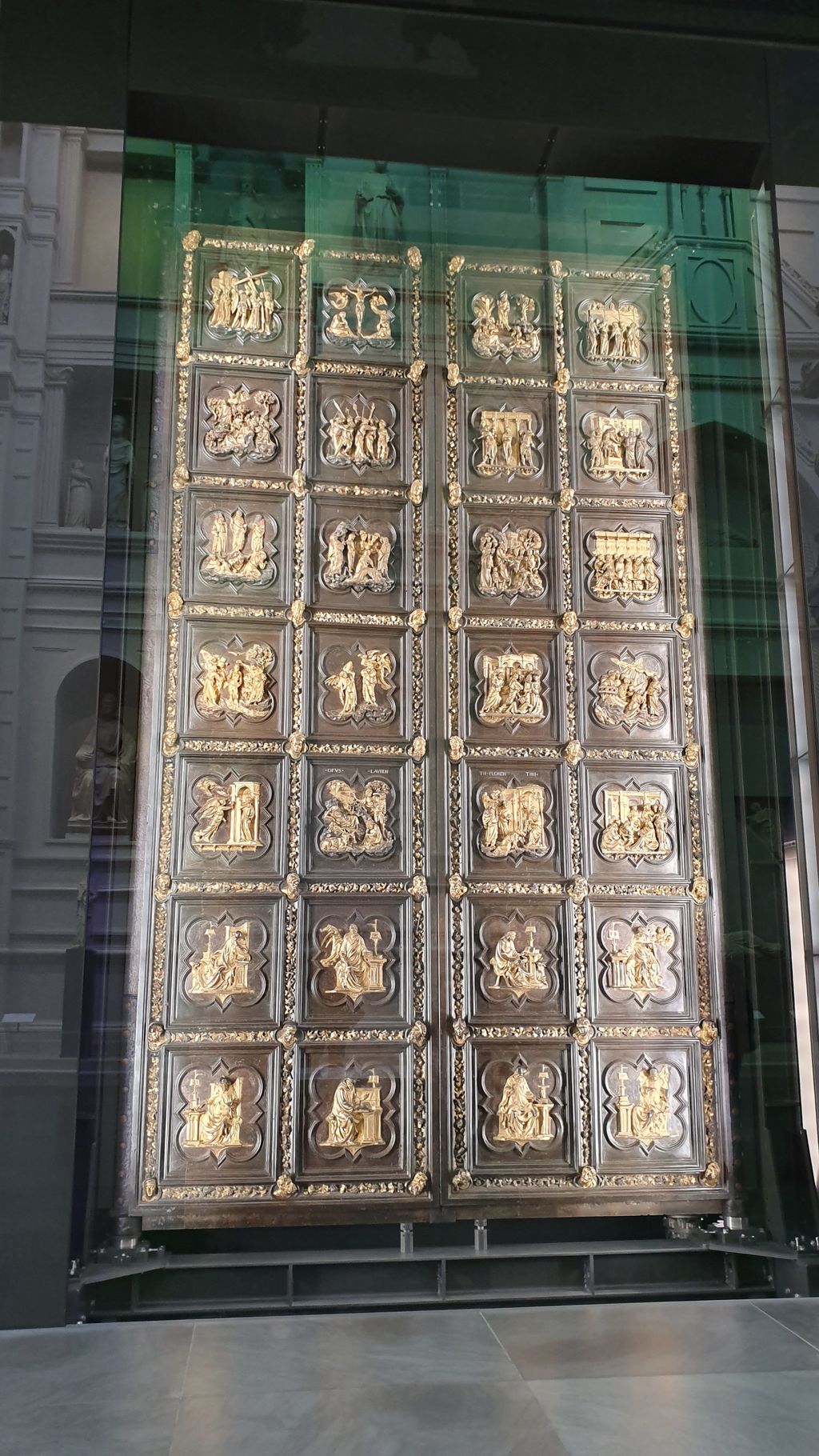
The first Baptistery doors went up on the east side in 1424, opposite the cathedral. The 28 panels could then be seen together, with twenty episodes from the life of Christ above the Evangelists and Doctors of the Church. By installation the workshop had spent about two decades moving from individual bronzes to an assembly of reliefs, structural frames, borders and fittings. The name North Door records its position after a move in 1452. The first installation and the later relocation are both recorded in the Opera’s catalogue. [2] [3]
1425 – A second door commission while Siena waits
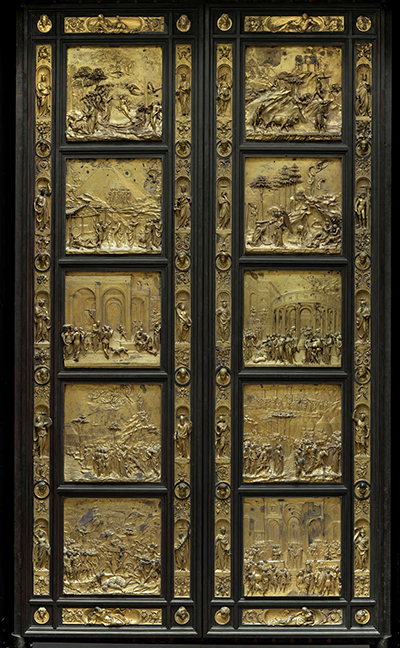
On 2 January 1425 Calimala awarded Ghiberti the Baptistery’s third bronze door without a fresh competition. This was his second set of doors and would become the Gates of Paradise. Leonardo Bruni had proposed an Old Testament programme in 28 compartments. The surviving door has ten broad square reliefs, each able to contain several moments in a story. Ghiberti later said that he had been given latitude over the design. The proposal and the finished bronze bracket a substantial revision whose precise course remains uncertain. [2] [5] [12]
Siena’s archive dates a letter explaining the overdue font work to 10 March 1425. Ghiberti attributed the delay to plague and reported going to Venice. On 16 April he told Giovanni di Turino that Giuliano di Ser Andrea had one relief in hand and he had the other. The letter leaves the subjects unnamed. By 2 August he was asking the Siena Opera to return the Baptism for finishing after it had been sent for inspection. In Florence, a different kind of bronze job appears on 12 October, when the cathedral accounts recorded payment due to Ghiberti for making five bronze fittings for the works at the main tribune. [4] [9] [10]
1427–29 – Siena’s gilding, St Stephen and the Three Martyrs
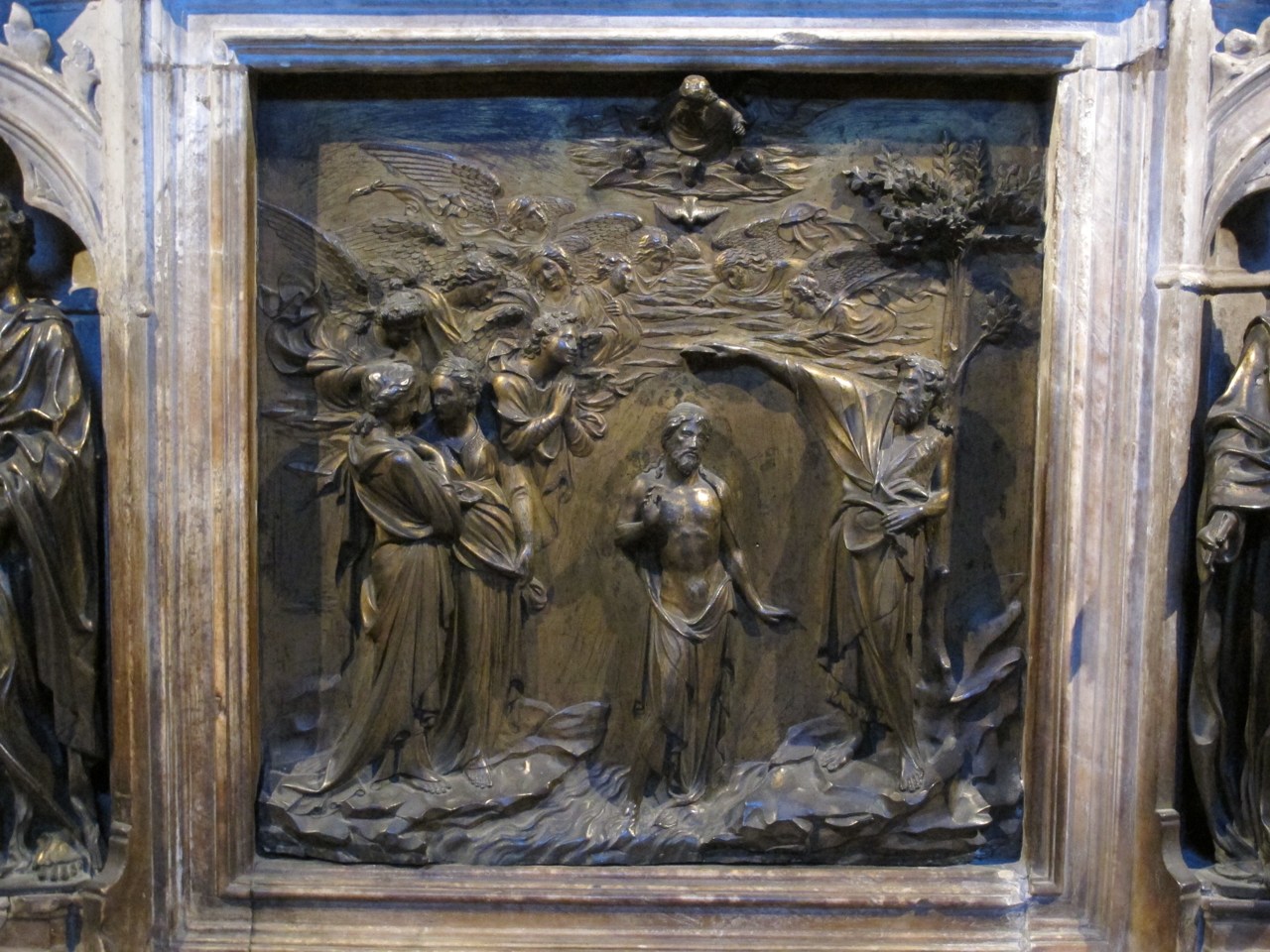
On 12 May 1427 Ghiberti reported that gilding had begun on the Baptism. By 31 May there had been enough gold for one panel, and he wrote that he had borrowed nearly 200 florins from the banker Antonio di Jacopo Pini. A subsequent letter reports both panels finished and ready to collect. The font preserves the Baptism of Christ and the scene of the Baptist brought before Herod. Ghiberti claimed both commissions in his Commentarii. His April 1425 letter documents Giuliano’s participation while leaving the exact division of hands open. Siena’s Opera dates the whole font project to 1417–31. [4] [5] [9]
In Florence, funding for St Stephen was allocated in 1427, and the statue was installed by 1429, according to the national catalogue. It replaced an older marble associated with Andrea Pisano in the wool guild’s niche at Orsanmichele. The catalogue’s approximate production range follows these two documentary limits. Another bronze, the shrine for Saints Protus, Hyacinth and Nemesius, was recorded in Ghiberti’s workshop in 1427 and placed in Santa Maria degli Angeli in 1428. The shrine, made with Medici patronage, is now at the Bargello. Its transfer and the wool guild’s installation date put two other bronze commissions alongside the closing stages of the Siena job. [13]
1432–36 – The Zenobius shrine, the Linaioli tabernacle and cathedral designs
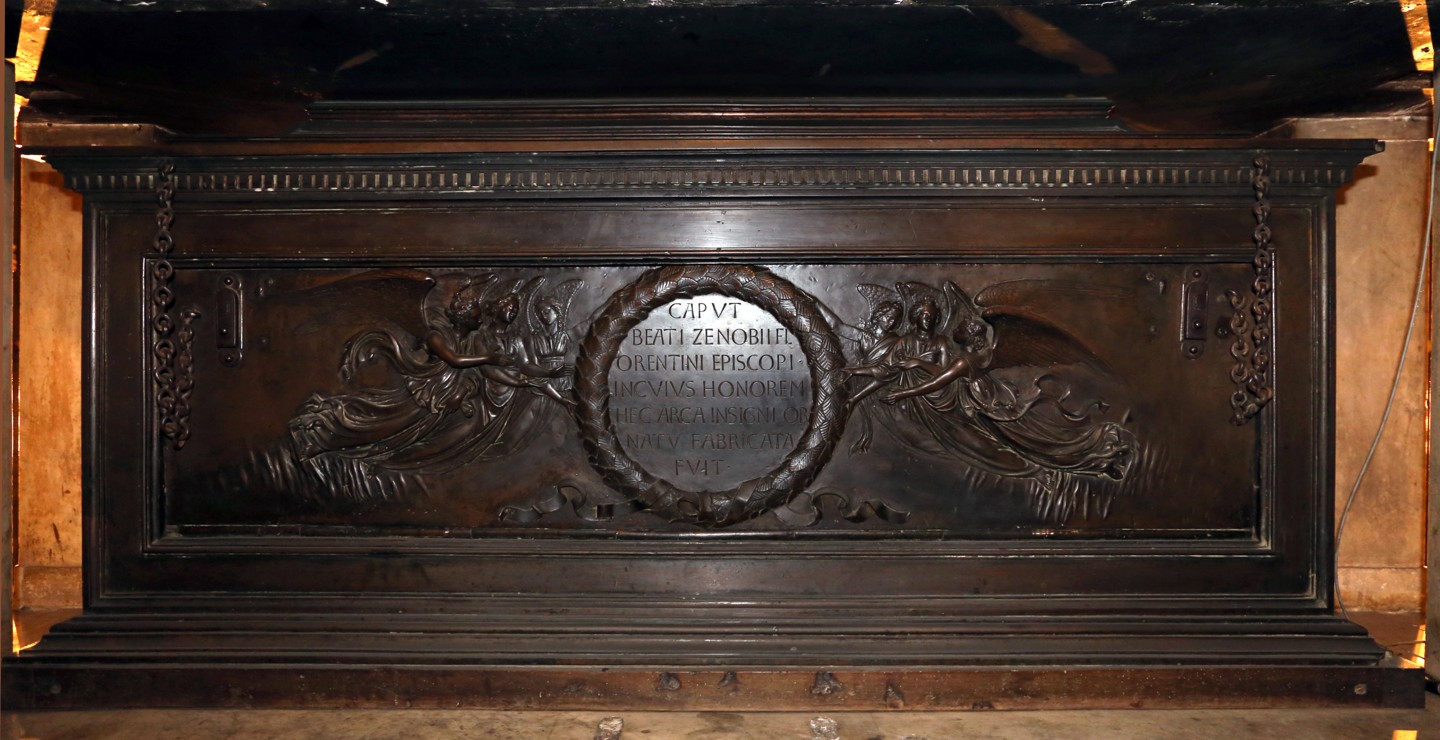
Ghiberti won the competition for the bronze shrine of St Zenobius on 3 March 1432. A surviving draft agreement calls for a chest made to specified dimensions. Deputies were to instruct him on the scenes, the Opera was to pay for materials and assistants, and the master’s own contribution was to be valued after completion. The draft leaves his monthly payment blank. The signed contract dated 8 March, as reported by La Bella, specified three sides with scenes from the saint’s life. Within days the Opera bought surplus bronze from the wool guild, left over from Ghiberti’s St Stephen. [1] [2] [14]
On 29 October 1432 Ghiberti presented a model for the marble frame of the Tabernacle of the Linaioli. Two stonecutters from his workshop carried out the marble work. Fra Angelico received the commission for the painting in 1433. The ensemble, now at the Museo di San Marco, was made for the guild’s audience chamber. [15]
The cathedral continued to pay for designs in other media. Ghiberti received payment in 1435 for a design for a Coronation of the Virgin window in the dome’s drum. The window eventually installed followed Donatello’s design. Ghiberti also submitted a design for the dome’s lantern in August 1436, and Brunelleschi’s was chosen. The design payment and submission date record real work by Ghiberti on two cathedral projects whose finished forms followed other artists’ plans. [1] [16]
1437–42 – The Gates castings and the completion of the shrine
By April 1437, on the chronology followed by the Opera’s door catalogue, the ten principal reliefs for the Gates of Paradise and part of the framing had been cast. The catalogue also records a scholarly dispute over how to read the evidence for early modelling and later progress. A cast bronze still needed chasing and finishing. By July 1439 the catalogue records substantial progress in that work and names a son of Ghiberti and Michelozzo among those working on the door. [1] [12]
On 9 April 1437 the Opera cancelled the Zenobius contract after the deadline passed. Ghiberti received the commission again in March 1439. On 26 April the saint’s bodily relics were transferred to a marble casket in the crypt. In January 1442 the Opera decided to varnish it, and the final payment is dated 30 August 1442. That year the older head reliquary by Andrea Arditi was placed inside the bronze chest. Ghiberti’s front relief depicts the saint restoring a child to life, with other miracles on the short sides. [1] [5] [17]
1443–47 – Four reliefs to finish and a new cathedral window
In July 1443 Ghiberti was granted eighteen months to finish four Gates reliefs. La Bella reads the record as marking six already finished and dates delivery of the remaining four to August 1447. The Opera catalogue reports six complete in 1444 and discusses interpretations that place the modelling of some panels later than Krautheimer proposed. The dated notices describe stages of progress across several years. Benozzo Gozzoli joined the workshop in 1444, during the years when the panels and their setting were still being worked on. [1] [12]
The cathedral catalogue dates the Ascension window in the drum to 1443–44 and credits Ghiberti with the design. Its discussion of the accounts identifies a likely clerical slip in an entry that seems to pay Paolo Uccello for the Ascension. A subsequent entry for Uccello’s second design for the Resurrection supports that reading. Ghiberti’s other designs for the drum include the Presentation in the Temple and the Agony in the Garden. [2] [16]
In 1444, having entered the College of the Twelve the previous year, Ghiberti petitioned the Florentine government after a challenge to his eligibility. The claim that he was born in 1378 comes from that defence. It can be dated to the dispute even though the birth year itself remains approximate. [1]
1452 – Gilding and installation of the Gates of Paradise
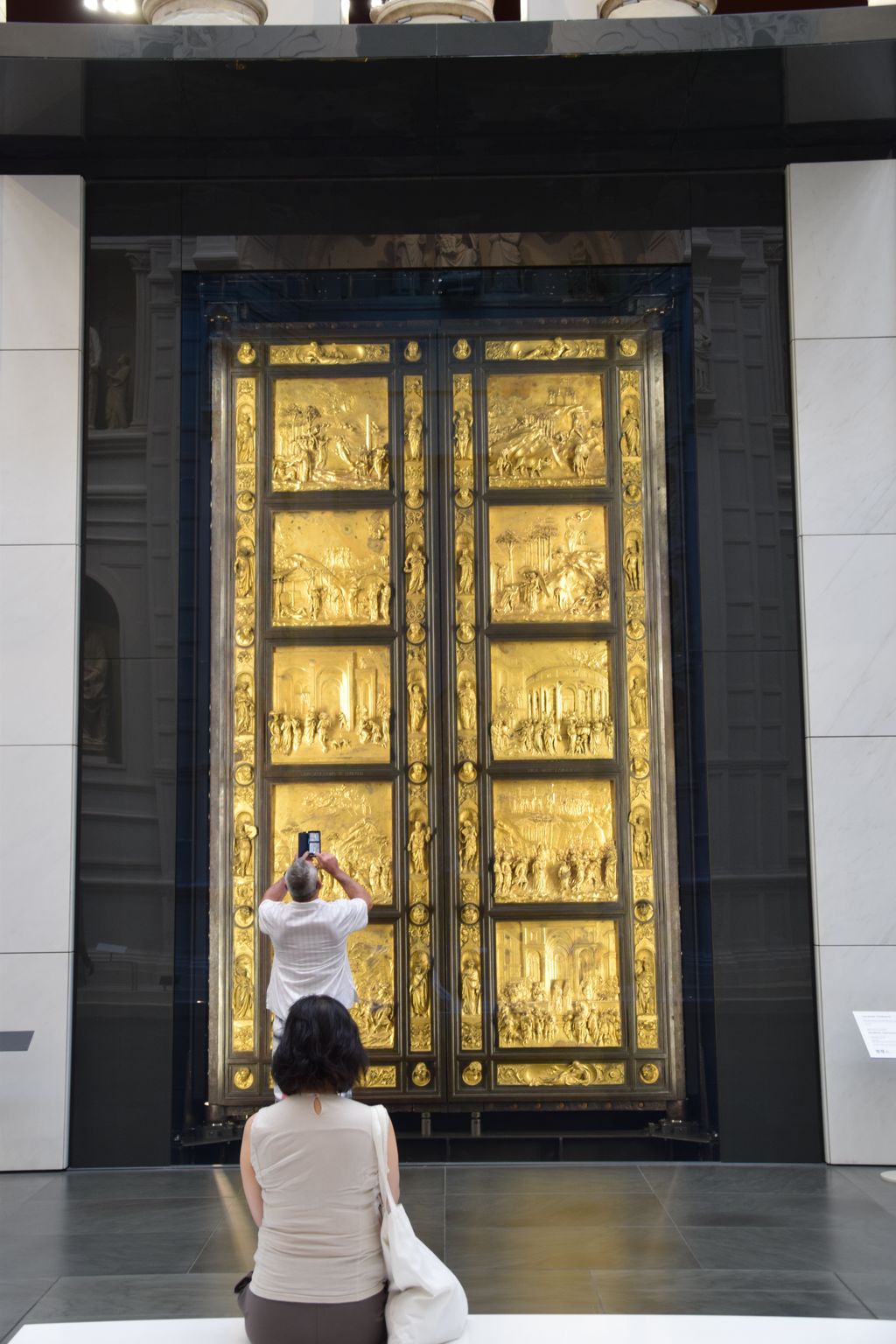
The Opera records the Gates of Paradise as substantially complete by April 1452, with gilding still to do. Lorenzo and his son Vittorio undertook that stage, which was finished by June. On 13 July the consuls of Calimala decided to place the new work at the east entrance, facing the cathedral. Ghiberti’s earlier doors were moved to the north entrance. The two sets of leaves thus acquired the positions by which they are known today. [3] [12]
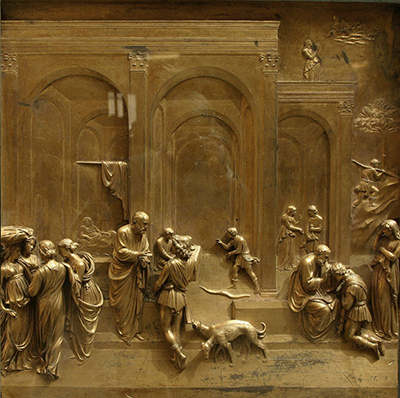
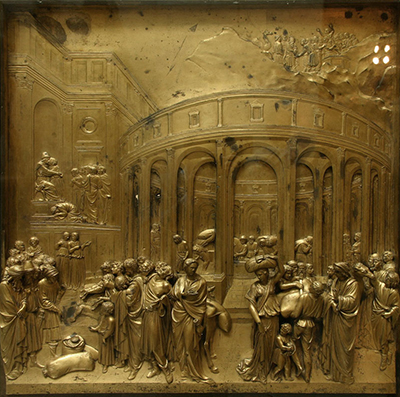
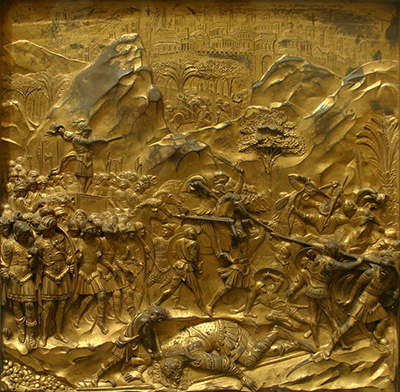
The ten Old Testament fields run from Adam and Eve to Solomon and the Queen of Sheba. The signature stretches across the two leaves and identifies the maker as Lorenzo di Cione Ghiberti. The earlier door had identified him publicly as Lorenzo the Florentine. Both originals can now be seen in the Museo dell’Opera del Duomo, with copies at the Baptistery. [2] [3] [12]
1453–55 – The last surround, the Commentarii and Ghiberti’s death
In February 1453 Lorenzo and Vittorio accepted the commission for a bronze surround for Andrea Pisano’s South Door. The work concerned the frame of a fourteenth-century door. The Opera catalogues the surviving surround under Vittorio’s name and dates it 1453–66. Its foliage, birds and figures continued the workshop’s work around the Baptistery after the installation of Lorenzo’s second set of leaves. [1] [18]
The University of Zurich’s Written Camposanto dates the Commentarii to 1452–55 and identifies the paper manuscript witness in Florence’s Biblioteca Nazionale Centrale. The range is an editorial dating of late writings that include Ghiberti’s recollections of his commissions, accounts of earlier artists and studies of vision. The surviving witness is a copy, and the arrangement of the text in print owes something to its editors. Ghiberti died in Florence on 1 December 1455 and was buried in Santa Croce. [1] [2] [5] [19]
References
- Carlo La Bella, “Ghiberti, Lorenzo”, Dizionario Biografico degli Italiani, vol. 53 (2000). Treccani entry View source.
- Opera di Santa Maria del Fiore, “Lorenzo Ghiberti and the Opera del Duomo of Florence”, institutional account of the doors, cathedral work and death. Opera article 12032 View source.
- Opera di Santa Maria del Fiore, Porta Nord del Battistero, scientific catalogue 3618, historical description and Strozzi archive references, fols. 79–79v. Door record View source.
- Vittorio Lusini, Il San Giovanni di Siena e i suoi restauri (Florence, 1901), appendix no. 3, pp. 96–98, and letters nos. 5–11 and 13, pp. 99–104. Digitised appendix View source.
- Lorenzo Ghiberti, I commentarii, ed. Julius von Schlosser, vol. I (Berlin, 1912), preface, pp. ix–x, and printed pp. 43–51. Editorial preface and career account. View source 1. View source 2.
- Musei del Bargello, “Donatello and the Dawn of Renaissance”, on the two trial reliefs. Bargello itinerary View source.
- Opera di Santa Maria del Fiore, Florence Cathedral façade glazing, records 9064 and 9135. Assumption of the Virgin and Saints Stephen and Lawrence. View source 1. View source 2.
- Musei del Bargello, “Ghiberti, Verrocchio, Giambologna”, and Ministero della Cultura, San Giovanni Battista, national record 0900291908. Bargello exhibition record and national catalogue. View source 1. View source 2.
- Opera della Metropolitana di Siena, Baptistry of San Giovanni, and Stefano Moscadelli, L’Archivio dell’Opera della Metropolitana di Siena. Inventario, pp. 99–100, docs. 52–60. Font account and archive inventory. View source 1. View source 2.
- Opera di Santa Maria del Fiore and Max Planck Institute for the History of Science, Gli anni della Cupola, records o0201074.020f, o0201076.047vf and o0201077.034a, and account o0204009.110f, 12 October 1425. Personnel index and bronze fittings transcription. View source 1. View source 2.
- Ministero della Cultura, San Matteo Evangelista, national record 0900291897, and Musei del Bargello, Orsanmichele guide. National catalogue and museum guide. View source 1. View source 2.
- Opera di Santa Maria del Fiore, Porta del Paradiso, scientific catalogue 1320, historical description and inscriptions. Door record View source.
- Ministero della Cultura, Santo Stefano, national record 0900291899, and Angeli con ghirlanda, shrine of the Three Martyrs, national record 0900014203. St Stephen and shrine. View source 1. View source 2.
- Opera di Santa Maria del Fiore and Max Planck Institute for the History of Science, The Years of the Cupola, draft agreement for the St Zenobius shrine, AOSMF I 1 4, c. 95a, March 1431/32. Transcription o0101004.095a View source.
- Ministero della Cultura, Dio padre, marble surround of the Tabernacle of the Linaioli, national record 0900285990, and Museo di San Marco, essay on Fra Angelico. National catalogue data and museum account. View source 1. View source 2.
- Opera di Santa Maria del Fiore, “Le vetrate istoriate del tamburo della Cupola di Santa Maria del Fiore”, and Ascensione di Gesù, scientific catalogue 5664. Drum glazing account and Ascension record. View source 1. View source 2.
- Alison Harpur, Studies in Visual Culture and the Council of Ferrara-Florence (1438–1445), doctoral thesis (UCL, 2023), vol. I, pp. 64–66. UCL repository copy View source.
- Opera di Santa Maria del Fiore, “Vittorio Ghiberti, Cornice della Porta Sud”, record 9176. South Door surround View source.
- University of Zurich, Written Camposanto, “Lorenzo Ghiberti (1378–1455), Commentari (1452–1455)”, BNCF Fondo Principale II.I.333, fol. 9v, with Lorenzo Bartoli’s edition (Florence, 1998), p. 86. Manuscript identification and excerpt View source.