


 by Tom Gurney
Tom Gurney BSc (Hons) is an art history expert with over 20 years experience
Published on June 19, 2020 / Updated on September 27, 2026
Email: tomgurney1@gmail.com / Phone: +44 7429 011000
The 1920 picture and its later meanings
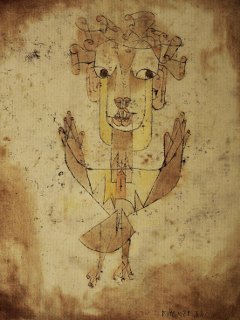
The figure looks straight out at us. Its broad head seems almost too large for its narrow body. Curved marks rise around the face; short arms or wings open at either side; birdlike feet rest below. Its mouth appears parted enough to show teeth. Paul Klee called this small work Angelus novus, a “new angel,” in 1920. Twenty years later Walter Benjamin would describe an “angel of history” looking back at catastrophe while a storm drives him toward the future. Benjamin was looking at Klee’s image, but the historical vision was Benjamin’s. To understand the work, we have to see the 1920 object before reading the 1940 text into every line.[1][2][3]
The picture has a second, less immediately visible life. Its surface is an oil-transfer drawing worked with watercolour. It was mounted over an older printed portrait whose edges still show. It travelled from a Munich dealer to Benjamin’s rooms, into exile, through a disputed wartime custody, to Gershom Scholem and the Israel Museum. Its fragility means that a reproduction has sometimes stood where viewers expected the original. Each part of that story changes what a viewer can reasonably claim to see. None supplies a simple answer to what Klee intended his angel to mean.[1][4][5]
Explore the details of Angelus Novus
Select a numbered area to examine its detail at high resolution.
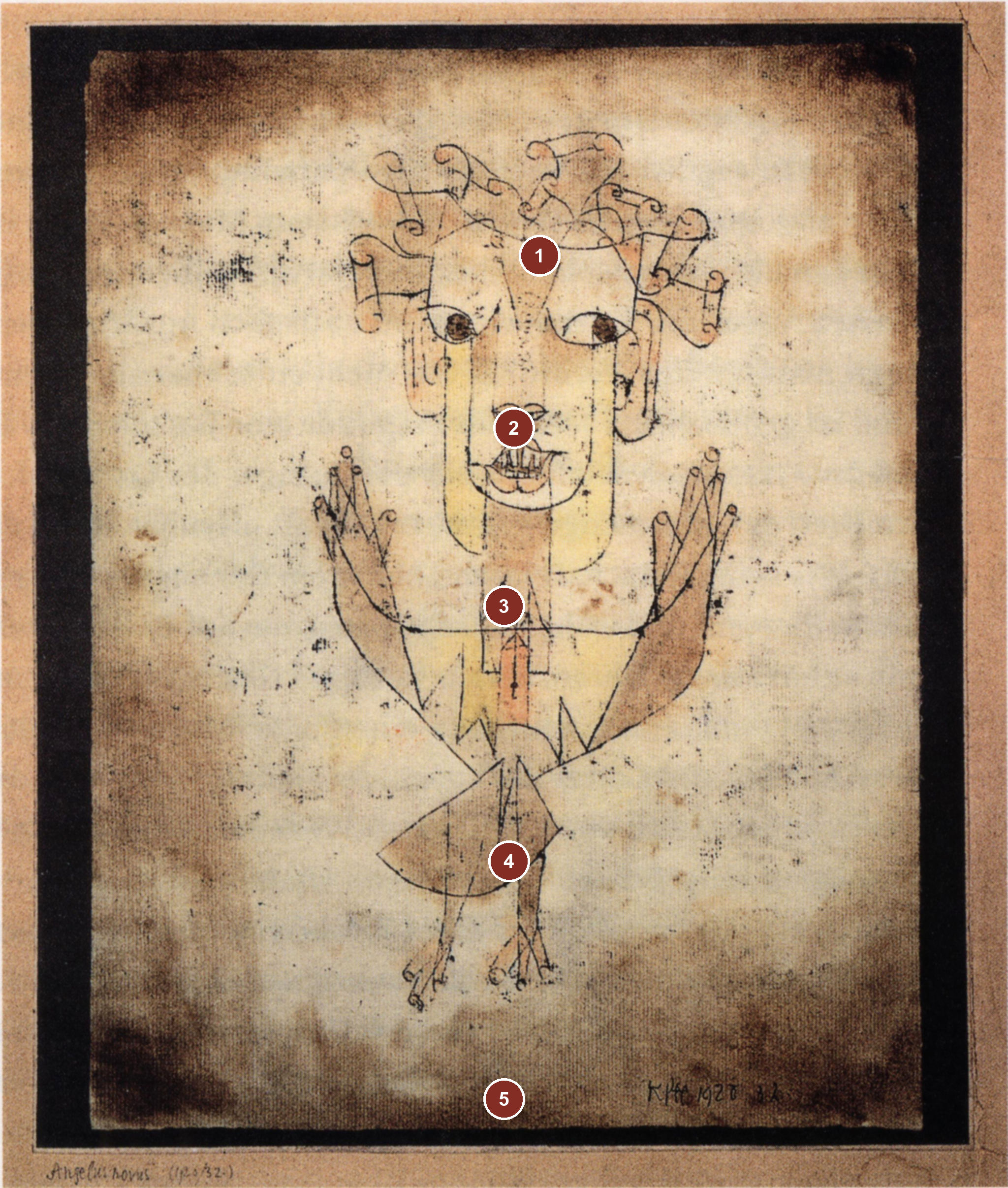
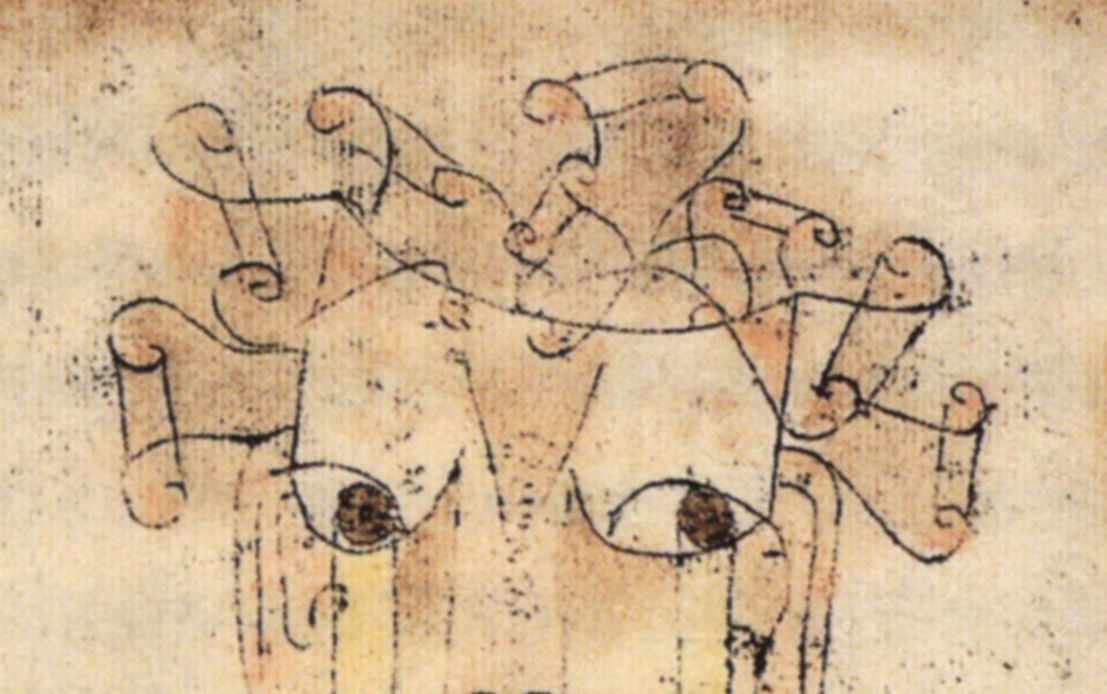
Curled lines above the head
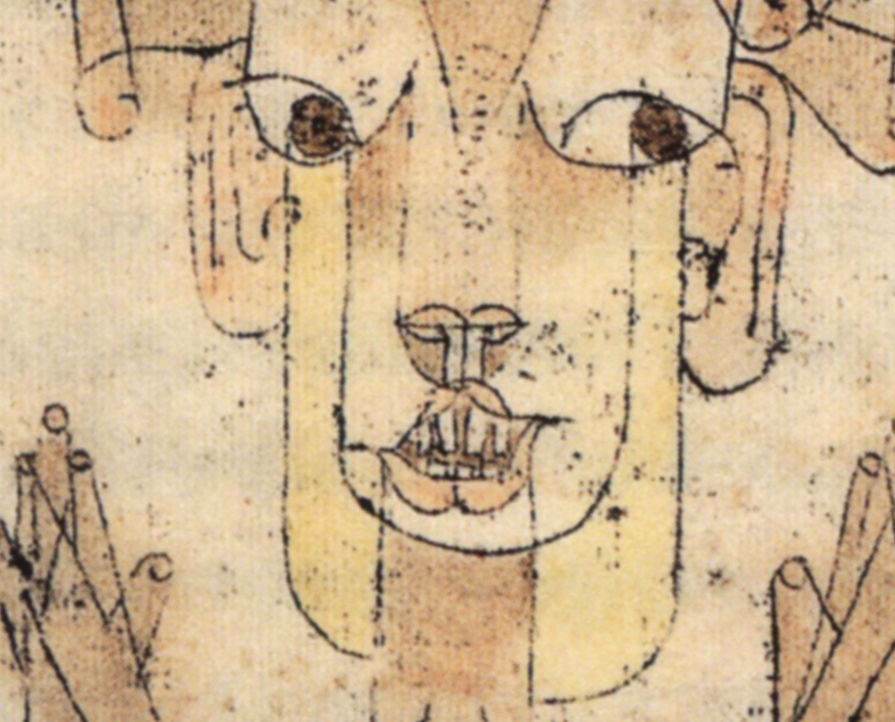
Eyes and central face
Two raised hands
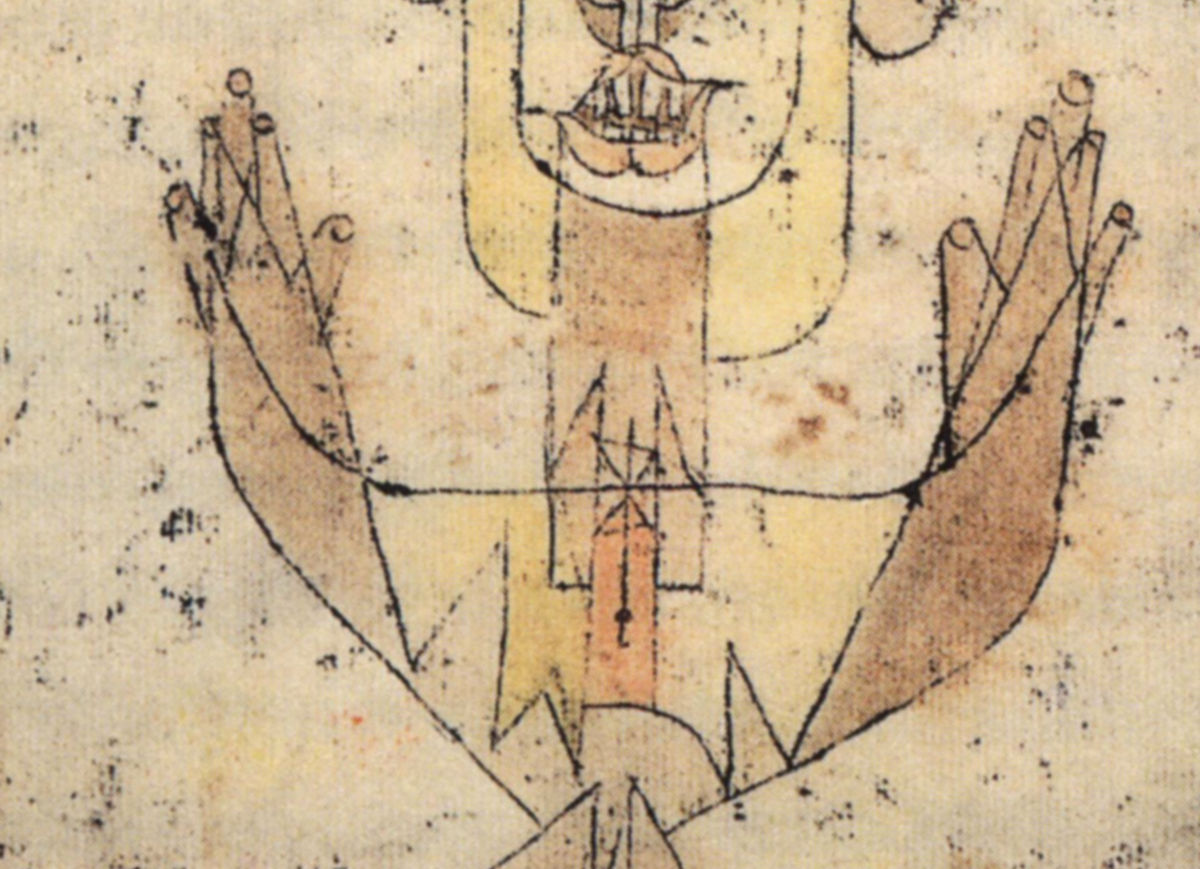
Angular body and feet
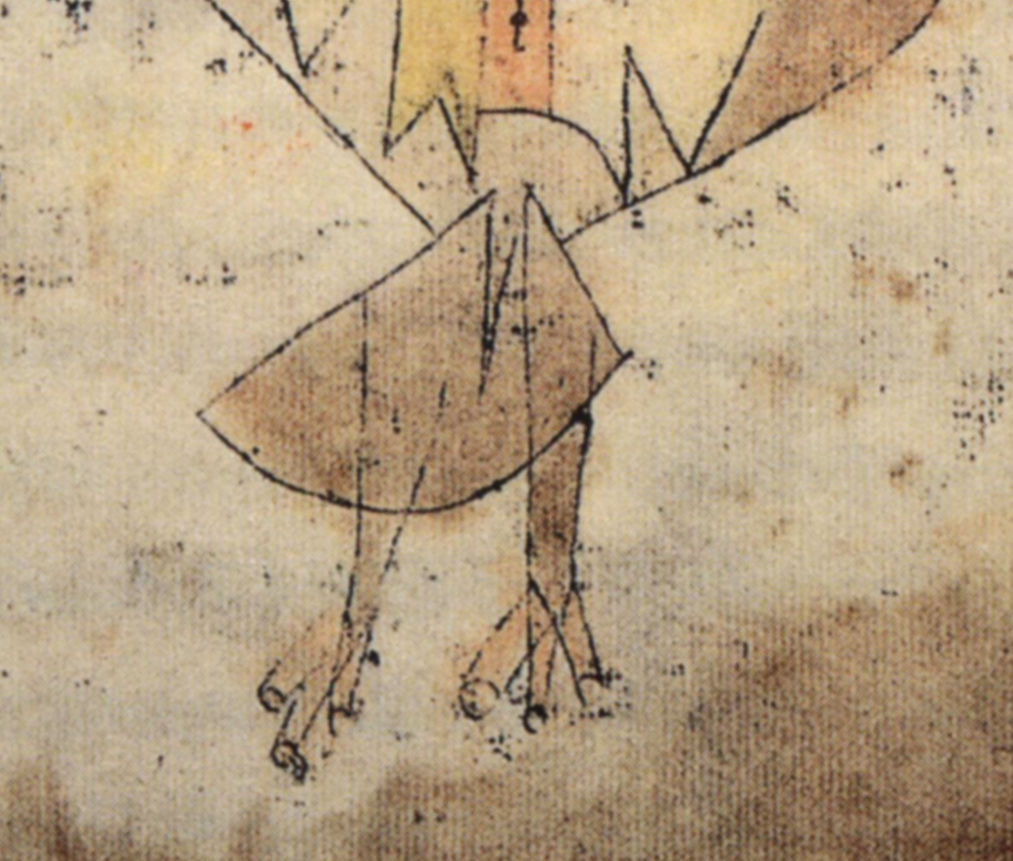
Artist inscription and mount

Contents
- What is the work?
- Look at the angel before giving it a mission
- A portrait concealed in the mount
- Why Benjamin bought it
- The angel of history belongs to 1940
- Exile and a disputed route to Jerusalem
- Originals, facsimiles and changing audiences
- Seeing the picture again
What is the work?
The Israel Museum in Jerusalem identifies the work as oil transfer and watercolour on paper, 31.8 × 24.2 cm, inventory B87.0994. Klee’s annual work designation is 1920, 32, repeated by the Jewish Museum in New York. This is a work on paper, not an oil painting on canvas, nor an edition of prints. The Israel Museum credits its 1987 gift to Fania and Gershom Scholem and additional donors named in the institutional record.[1][6]
Its small scale matters. A visitor does not confront a monumental, winged being across a gallery. The figure occupies a sheet that can be held, mounted, moved and, as Benjamin did, hung in a room. The pale colour does not fill a grand heavenly background. Irregular dark edges and a fairly spare ground keep our attention near the inked form. The Jewish Museum’s audio description notices the wavering black outlines, large head and wings ending in almost handlike points. The visible features invite human and animal comparisons, but do not settle into either anatomy. The feet can seem avian; the wings can also seem raised arms. Teeth complicate any expectation of a serene guardian.[3][6]
Oil transfer explains why the line has a different character from a conventional ink drawing. Klee could place an oil- or ink-coated intermediate sheet between a model and the final support, then trace with a point. Pressure transferred pigment to the paper beneath, making both intended contour and incidental marks possible. Watercolour added another register of colour to the transferred line. This general account of Klee’s method is supported by MoMA’s technical discussion of his transfer drawings; the Israel Museum’s object label fixes the media for this sheet. Without a full object-level conservation report, the exact order and composition of every layer should not be reconstructed as fact.[1][7]
There is a separate pencil drawing of a similar bird-footed creature. In a 2026 lecture description, art historian Annie Bourneuf and the Jewish Museum distinguish that drawing, which Klee kept, from the oil-transfer and watercolour work he sent to an early solo exhibition. The two images are relevant to one another, but they are not two records of the same physical sheet. The famous Angelus novus bought by Benjamin is the watercolour and transfer drawing now held by the Israel Museum.[8]
Look at the angel before giving it a mission
The angel’s face is hard to make stable. Bätschmann describes the proportions as almost childlike and notices the exposed teeth; Bredekamp draws attention to the birdlike feet and scrolls of hair. These are observations and close readings by art historians, not words Klee wrote below the picture. The outline seems at once decorative and unsettled. Where does a wing end and a hand begin? Are the eyes startled, fixed, curious or simply made round by a few lines? The title gives the creature a name but no episode, destination or historical task.[2][3]
Benjamin’s celebrated description selected certain features: eyes, open mouth and spread wings. It did not record the feet, teeth or the paper’s material construction in the same way. His selective act is one reason the image became so productive for philosophy. A viewer can ask what the figure appears to look at, but the sheet does not paint a field of rubble before it. The ruins enter Benjamin’s prose. Likewise, the angel’s direction of travel, its wish to repair what has been destroyed and the storm named “progress” are not mechanically readable from Klee’s watercolour. They are the force of Benjamin’s argument.[2][3][9]
The distinction also protects the art from a retrospective biography of its maker. There is no established evidence that the figure portrays Hitler or records a specific episode of Klee’s depression. A Berlin museum’s 2008 press notice records that one interpretation in an exhibition saw a Hitler allegory; that is evidence of a later reading, without identifying Klee’s intention or supplying proof of a portrait. Klee’s angels can be playful, strange, vulnerable or threatening across his wider practice, and no single character should be imposed on this one without an argument.[2][10]
A portrait concealed in the mount
The dark material seen around the angel is connected to a remarkable physical discovery. Israel Museum conservator Michael Maggen reported that Klee mounted the sheet over another print, leaving only margins visible. Tests with infrared reflectography and thermography did not identify the buried image. The artist R. H. Quaytman compared the exposed parts with candidate engravings and matched them to Friedrich Müller’s 1838 engraving after Lucas Cranach the Elder’s portrait of Martin Luther. The full engraving was not exposed by taking the object apart. The identification comes from the surviving visible edges and comparison, not a claim that the complete print can be seen beneath the angel with the naked eye.[4][5]
Bourneuf’s account describes a three-part stack: the paper bearing Klee’s angel; the larger engraving to which that sheet was glued; and the cardboard with Klee’s date and title. At the margins, features such as robes, a date and an interlocked monogram helped Quaytman find the print. That makes the mount part of the object’s history, not a neutral modern border. It also opens questions that remain questions. Why would Klee choose a nineteenth-century reproductive engraving after a sixteenth-century Protestant portrait? Did its subject matter matter to him, or was the sheet useful as a support with suggestive visible details? Bourneuf connects the construction to debates about religious images after the First World War. That is an art-historical interpretation, not proof of a private intention of Klee’s.[4][5]
Benjamin’s later writing on religion and history makes the Luther portrait especially tempting to interpret. That temptation is not evidence he identified it. Wizisla, writing in the 2025 Berlin exhibition volume, cautions against assuming Benjamin knew the concealed image. The mount and the 1940 thesis can be studied together as later viewers have done, but the documentation presently examined does not make the hidden portrait a coded message to Benjamin.[5][11]
Why Benjamin bought it
Benjamin was interested in Klee before he owned Angelus novus. Taisa Palhares and Bätschmann draw on a letter to Scholem recording that Benjamin’s wife Dora gave him a different Klee work, Vorführung des Wunders, in July 1920. The later purchase was not his first encounter with Klee’s art. In late May 1921 Benjamin bought Angelus novus for 1,000 marks from dealer Hans Goltz in Munich. Klee and Benjamin did not meet, according to the Zentrum Paul Klee; what Klee thought of Benjamin’s later interpretations is unknown.[2][6][12]
Goltz had shown the work in 1920 without selling it. Benjamin left the newly bought sheet temporarily with Gershom Scholem in Munich. Völlnagel dates its move into Benjamin’s Berlin room to November 1921. A small mounted work could therefore become an everyday presence rather than an object seen only once at an exhibition. Scholem wrote a poem called “Gruß vom Angelus” for Benjamin, and a stanza of it later appeared above thesis IX. The poem’s angel is Scholem’s address to a friend; it is not a signed explanation from Klee.[11][13]
Benjamin considered naming a journal Angelus Novus. His German prospectus, drafted around 1922, envisaged poetry, philosophy, criticism and translation. It sought a kind of attention that could find a historical substance beneath short-lived novelty. Toward its close, Benjamin related the journal’s name to a Talmudic story of angels created for an instant and then disappearing. The projected periodical did not appear. The prospectus even notes that a journal’s physical form cannot directly present visual art; it is not a programme Klee wrote for this picture.[9][14]
Benjamin’s relation to the image changed over time. In his 1931 essay on Karl Kraus, the “new angel” enters a meditation on destruction and humanity. In his 1933 autobiographical writing Agesilaus Santander, composed after he had fled Germany, the figure hanging in the Berlin room becomes bound to separation and his own future. Bätschmann follows these phases in detail, and Rowley stresses that the 1933 angel was a picture Benjamin no longer had before his eyes. It would be misleading to read the 1940 thesis back into the 1921 purchase as if Benjamin had already formulated one permanent interpretation.[2][13][15]
The angel of history belongs to 1940
Benjamin wrote the text usually known as Über den Begriff der Geschichte (On the Concept of History) in 1939–40, under the pressure of war, fascism and exile. Thesis IX begins with Scholem’s verse. Benjamin then invokes a Klee picture and describes an angel who looks as if he is about to move away from something on which his gaze remains fixed. What we call a sequence of events becomes, for this figure, a single accumulating catastrophe. He would like to pause, wake the dead and repair the wreckage, but a storm catches in his wings and drives him into the future. Benjamin names that storm “progress.” The last phrase is central to his attack on reassuring accounts of history, not an art-historical caption for Klee’s studio intentions.[9][11]
The thesis gains force in the company of the surrounding theses. Benjamin is arguing over how history is told, whose suffering gets erased, and whether a comfortable belief in progress makes catastrophe easier to accept. Bredekamp emphasizes that Benjamin’s image is selective: Klee’s birdlike feet, teeth and hair have no explanatory role in thesis IX. The philosopher took a particular pictured figure and made it serve a historical argument. The picture did not have to contain a literal storm or ruins for that transformation to work. Conversely, noticing what he left out lets us return to Klee’s difficult little figure with fresh eyes.[3][9][11]
There are more speculative connections. Bredekamp proposes lines to earlier imagery of the winged eye and to the experience of aerial catastrophe; Bätschmann suggests relations with other Klee angels and even possible later artistic responses to Benjamin. Such proposals may illuminate how particular scholars read the work. They do not show that Klee deliberately painted Benjamin’s 1940 philosophy in 1920. Nor should the material interleaf be made the secret source of a thesis without evidence that Benjamin identified it.[2][3][5]
Exile and a disputed route to Jerusalem
Benjamin left Berlin in March 1933 after the Nazi rise to power, leaving the picture behind. Rowley says an unidentified friend brought it to him in Paris around 1935. The identity of the courier is not established in the account read here. On 27 July 1932, Benjamin had named Scholem as the future recipient of the work in a letter-like testament. Yet by 1939, poverty and the need to escape Europe led him to contemplate selling it to help pay for travel to the United States. Wizisla quotes his calculation of what the Klee could fetch against the cost of a passage. The sale did not occur. These documents show both attachment and the practical pressure of exile; they should not be flattened into a story of an artwork always meant to remain untouched.[11][13]
After Benjamin’s death at Portbou in September 1940, the exact wartime custody is disputed. A familiar account places the sheet with Georges Bataille and Pierre Missac among material protected in the Bibliothèque Nationale in Paris, then has Missac bring it to Theodor Adorno in New York in early 1947. Völlnagel presents that route cautiously, and Berlin museum material also names Bataille, Missac and Adorno. But Wizisla reports Rolf Tiedemann’s account that Gretel and Theodor Adorno repeatedly said Benjamin’s sister Dora arranged its delivery to them in 1941. If that recollection is accurate, the sheet may never have been in the Bibliothèque Nationale cache. Both variants cannot be treated as a single documented itinerary. The original letters or transfer records required to resolve them have not been examined here.[10][11]
The firm later anchors are clearer. Adorno fulfilled Benjamin’s wish that Scholem receive the picture. It reached Jerusalem, where Scholem and his wife Fania lived. Völlnagel dates its first Israel Museum display to 1982 and its transfer to the museum to 1987, after Scholem’s death; the owning museum identifies the 1987 gift and donor credit. Palhares gives 1972 for the sheet’s arrival in Jerusalem, a date worth checking against original correspondence. We can therefore say the Israel Museum holds it, without saying it is continuously on view there. A light-sensitive drawing may be stored, loaned briefly or represented by a facsimile.[1][5][11][16]
Originals, facsimiles and changing audiences
The original has travelled, but exceptionally. During a 2008–09 Berlin exhibition, the museum announced that the original returned to Jerusalem on 5 January 2009 for conservation and a facsimile replaced it. In 2025, the Israel Museum lent it to the Bode-Museum in Berlin for an exhibition marking eighty years since the end of the Second World War, shown from 8 May to 13 July. Those are documented loans, not proof that the work is normally on view in either city.[10][17]
The distinction became unusually visible in New York in 2026. The Jewish Museum’s exhibition opened on 20 March with an authorised copy because transport of the original was delayed. Its contemporaneous label said so plainly. Reporting in May indicates that the original subsequently arrived and was installed; a July account describes visiting after it had replaced the copy. The exact installation date remains to be established. That sequence matters more than an easy statement that “the original was in New York” for the entire run. Bourneuf’s lecture for the museum placed facsimiles and the protected original at the centre of her discussion of this artwork’s doubles. The famous image has circulated widely, while the paper object must be guarded against light and travel.[5][6][8][18]
Seeing the picture again
Read thesis IX, then look back at Klee’s sheet. Benjamin’s image of historical wreckage is hard to forget; that is part of its importance. But the eyes, teeth, feet, marks and layered paper still ask questions the thesis does not answer. We can watch a 1920 object become Benjamin’s treasured possession, a journal emblem, an exile’s possible means of escape, a philosophical figure and a museum object. Those later roles are real. They need not cancel the peculiar, undecided angel Klee made.[2][3][9]
For the method of the transferred line, see Klee’s materials and techniques and the drawings overview. The biography gives the artist’s 1920 context. Klee’s late work belongs to a different period; its political circumstances should not be presumed to explain this early angel.
Explore selected works from Klee’s much larger oeuvre. Titles without a link have an authenticated catalogue identity but no reviewed article yet.
Artworks directory
| Name | Date | Medium |
|---|---|---|
| A Gate | 1939 | Painting and mixed media |
| A Woman for Gods | 1938 | Watercolour and mixed media |
| Ab Ovo | 1917 | Watercolour and mixed media |
| Above Mountain Summit | 1917 | Drawing and mixed media |
| Abstract Trio | 1923 | Drawing and mixed media |
| Acrobats | 1915 | Watercolour and mixed media |
| Actor's Mask | 1924 | Painting and mixed media |
| Ad Marginem | 1930 | Drawing and mixed media |
| Ad Parnassum | 1932 | Painting and mixed media |
| Adventurer Ship | 1927 | Drawing and mixed media |
| Affected Place | 1922 | Drawing and mixed media |
| After a Sketch from Zurich | 1914 | Watercolour and mixed media |
| After Drawing | 1919 | |
| After The Floods | 1936 | Watercolour and mixed media |
| All Souls' Picture | 1921 | |
| Ancient Harmony | 1925 | Painting and mixed media |
| Angel Applicant | 1939 | Drawing and mixed media |
| Angel Serves the Desired | 1920 | |
| Angel, Still Female | 1939 | Painting and mixed media |
| Angelus Novus | 1920 | Drawing and mixed media |
| Animal Terror | 1926 | Painting and mixed media |
| Arab Song | 1932 | Painting and mixed media |
| Archangel | 1938 | Painting and mixed media |
| Architecture | 1923 | Painting and mixed media |
| Architecture of the Plain | 1923 | Drawing and mixed media |
| Around the Fish | 1926 | Painting and mixed media |
| Arrival of the Air Steamer | 1921 | Drawing and mixed media |
| Asiatic God | 1924 | Painting and mixed media |
| Astrological Fantasy Portrait | 1924 | Drawing and mixed media |
| Athlete's Head | 1932 | Watercolour and mixed media |
| Aufgehender Stern | 1931 | Painting and mixed media |
| Autumn Flower | 1922 | Painting and mixed media |
| Bad Band | 1920 | Drawing and mixed media |
| Baroque Centaur | 1939 | Painting and mixed media |
| Before the Blitz | 1923 | Drawing and mixed media |
| Before the Snow | 1929 | Drawing and mixed media |
| Besessenes Madchen | 1924 | Watercolour and mixed media |
| Bird Garden | 1924 | |
| Bird Wandering Off | 1926 | Watercolour and mixed media |
| Blossoms in the Night | 1930 | Watercolour and mixed media |
| Blue-Bird-Pumpkin | 1939 | Painting and mixed media |
| Boats in the Flood | 1937 | Painting and mixed media |
| Botanical Theatre | 1934 | Drawing and mixed media |
| Boy in Fancy Dress | 1931 | Watercolour and mixed media |
| Broken Key | 1938 | |
| Brother and Sister | 1930 | Watercolour and mixed media |
| But the Red Roof | 1935 | Painting and mixed media |
| C - C = Fisch | 1931 | Watercolour and mixed media |
| Cacti | 1912 | Painting and mixed media |
| Camel (in Rhythmic Landscape with Trees) | 1920 | Drawing and mixed media |
| Captive Pierrot | 1923 | Drawing and mixed media |
| Castle and Sun | 1928 | Drawing and mixed media |
| Cat and Bird | 1928 | Drawing and mixed media |
| Cathedrals | 1925 | Watercolour and mixed media |
| Chalice of the Heart | 1937 | Painting and mixed media |
| Characters in Yellow | 1937 | Painting and mixed media |
| Chosen Site | 1927 | Mixed media |
| Christmas Picture | 1923 | Drawing and mixed media |
| City of Towers | 1916 | Painting and mixed media |
| Clarification | 1932 | Painting and mixed media |
| Collection of Figurines | 1926 | Painting and mixed media |
| Colorful Architecture | 1917 | Painting and mixed media |
| Comedians' Handbill | 1938 | |
| Comic Opera Singer | 1927 | Painting and mixed media |
| Composition | 1939 | Painting and mixed media |
| Composition with Figures | 1915 | Drawing and mixed media |
| Composition with the Yellow Half-Moon and the Y | 1918 | Watercolour and mixed media |
| Conch–Still Life II | 1939 | Watercolour and mixed media |
| Cosmic Composition | 1919 | Painting and mixed media |
| Crystal Gradation | 1921 | Drawing and mixed media |
| Dance of the Grieving Child | 1922 | Painting and mixed media |
| Dancing Girl | 1940 | Painting and mixed media |
| Das Licht und Etliches | 1931 | Mixed media |
| Death and Fire | 1940 | Painting and mixed media |
| Death for the Idea | 1915 | |
| Demon as Pirate | 1926 | Watercolour and mixed media |
| Diana | 1931 | Painting and mixed media |
| Diavolo Player | 1923 | Drawing and mixed media |
| Die Kapelle | 1917 | Watercolour and mixed media |
| Die Vase | 1938 | Painting and mixed media |
| Doctor | 1930 | Drawing and mixed media |
| Dredger and Sailboat | 1931 | Watercolour and mixed media |
| Ein Tor | 1939 | Painting and mixed media |
| Ein Weib fur Gotter | 1938 | Mixed media |
| Embrace | 1939 | Watercolour and mixed media |
| Episode before an Arab Town | 1923 | |
| Equals Infinity | 1932 | Painting and mixed media |
| Eros | 1923 | Drawing and mixed media |
| Error on Green | 1930 | Watercolour and mixed media |
| Evening Figure | 1935 | Drawing and mixed media |
| Falling Bird | 1919 | |
| Fermata | 1932 | Watercolour and mixed media |
| Fire Clown | 1921 | Watercolour and mixed media |
| Fire Full Moon | 1933 | Watercolour and mixed media |
| Fire in the Evening | 1929 | Painting and mixed media |
| Fish in the Harbour | 1916 | Watercolour and mixed media |
| Fish Magic | 1925 | Watercolour and mixed media |
| Flock of Birds | 1917 | Drawing and mixed media |
| Flora on Sand | 1927 | Watercolour and mixed media |
| Flower Myth | 1918 | |
| Flower Stand with Watering Can and Bucket | 1910 | Watercolour and mixed media |
| Flowering Tree (Abstraction with Reference to a Flowering Tree) | 1925 | Painting and mixed media |
| Flowers in Pots | 1923 | |
| Flowers in Stone | 1939 | Painting and mixed media |
| Forest Witch | 1938 | Painting and mixed media |
| Fright of a Girl | 1922 | Drawing and mixed media |
| Fruits on Red | 1930 | Drawing and mixed media |
| Full Moon | 1919 | Mixed media |
| Föhn Wind in Franz Marc's Garden | 1915 | Watercolour and mixed media |
| Garden in St Germain, The European Quarter near Tunis | 1914 | Watercolour and mixed media |
| Ghost Chamber with the Tall Door (New Version) | 1925 | |
| Ghost of a Genius | 1922 | Drawing and mixed media |
| Girl in Mourning | 1939 | Painting and mixed media |
| Glance of a Landscape | 1926 | Watercolour and mixed media |
| Gluht Nach | 1939 | Drawing and mixed media |
| Golden Fish | 1925 | Watercolour and mixed media |
| Goldfish Wife | 1921 | Watercolour and mixed media |
| Green Plant, Blood, Louse | 1924 | Drawing and mixed media |
| Hafenbild | 1918 | Mixed media |
| Hammamet with Mosque | 1914 | Watercolour and mixed media |
| Harbour with Sailing Ships | 1937 | Painting and mixed media |
| Hauptweg und Nebenwege | 1929 | Painting and mixed media |
| Heavenly and Earthly Time | 1927 | Drawing and mixed media |
| Heroic Fiddling | 1938 | Painting and mixed media |
| Heroic Roses | 1938 | Painting and mixed media |
| Heroic Strokes of the Bow | — | Mixed media |
| Highway and Byways | 1929 | Drawing and mixed media |
| Houses near the Gravel Pit | 1913 | Watercolour and mixed media |
| Howling Dog | 1928 | Painting and mixed media |
| In the Current Six Thresholds | 1929 | Painting and mixed media |
| In the Style of Kairouan | 1914 | Drawing and mixed media |
| Individualized Altimetry of Stripes | 1930 | Painting and mixed media |
| Insula Dulcamara | 1938 | |
| Interior with the Clock | 1913 | Watercolour and mixed media |
| Irma Rossa the Animal Tamer | 1918 | Drawing and mixed media |
| Journey in Corsica | 1927 | Drawing and mixed media |
| Landscape with Bluebirds | 1919 | Watercolour and mixed media |
| Legend of the Nile | 1937 | Painting and mixed media |
| Lemon Harvest | 1937 | Watercolour and mixed media |
| Likeness in the Bower | 1930 | Watercolour and mixed media |
| Limits of Reason | 1927 | Painting and mixed media |
| Little Hope | 1938 | Watercolour and mixed media |
| Magdalena before the Conversion | 1938 | Drawing and mixed media |
| Mask of Fear | 1932 | Painting and mixed media |
| May Picture | 1925 | Painting and mixed media |
| Monument in a Cemetery | 1922 | Watercolour and mixed media |
| Monuments at G | 1929 | Watercolour and mixed media |
| Municipal Jewel | 1917 | Watercolour and mixed media |
| Mural from the Temple of Longing Thither | 1922 | |
| Nach der Uberschwemmung | 1936 | Watercolour and mixed media |
| New Harmony | 1936 | Painting and mixed media |
| New House in the Suburbs | — | Mixed media |
| Old Steamboat | 1922 | Drawing and mixed media |
| On the Edge | 1930 | Drawing and mixed media |
| Once Emerged from the Gray of Night | 1918 | Drawing and mixed media |
| One Who Understands | 1934 | Painting and mixed media |
| Oriental Pleasure Garden | 1925 | Painting and mixed media |
| Park of Idols | 1939 | Watercolour and mixed media |
| Passing by Red Pillars | 1928 | Watercolour and mixed media |
| Persian Nightingales | 1917 | Drawing and mixed media |
| Popular Wall Painting | 1922 | Painting and mixed media |
| Prestidigitator | 1927 | Watercolour and mixed media |
| Rainy Day | 1931 | Watercolour and mixed media |
| Red and White Domes | 1914 | Watercolour and mixed media |
| Red Balloon | 1922 | Drawing and mixed media |
| Redgreen and Violet-Yellow Rhythms | 1920 | Drawing and mixed media |
| Refuge | 1930 | Watercolour and mixed media |
| Rhythmic Rythmical | 1930 | Painting and mixed media |
| Saint of the Inner Light | 1921 | |
| Scaffolding of a New Building | 1930 | Painting and mixed media |
| Scholar in Dealing with Stars | 1926 | Watercolour and mixed media |
| Seated Woman | 1930 | Drawing and mixed media |
| Senecio | 1922 | Painting and mixed media |
| Separation in the Evening | 1922 | Drawing and mixed media |
| Sinbad the Sailor | 1923 | Drawing and mixed media |
| Skeptically Smiling | — | Mixed media |
| Small House in the Garden City | 1928 | Watercolour and mixed media |
| Small Portrait of a Girl in Yellow | 1925 | Painting and mixed media |
| Southern Gardens | 1919 | Watercolour and mixed media |
| Static-Dynamic Gradation | 1923 | Drawing and mixed media |
| Still Life | 1927 | Painting and mixed media |
| Still Life with Gladioli | 1932 | Watercolour and mixed media |
| Strange Garden | 1923 | Drawing and mixed media |
| Stricken City | 1936 | Painting and mixed media |
| Strong Dream | 1929 | Watercolour and mixed media |
| Struck from the List | 1933 | Drawing and mixed media |
| Structural I | 1924 | Drawing and mixed media |
| Sumpflegende | 1919 | Painting and mixed media |
| Temple Gardens | 1920 | Drawing and mixed media |
| The Arrow before the Target | 1921 | Drawing and mixed media |
| The Barbed Noose with the Mice | 1923 | Watercolour and mixed media |
| The Flora of the Heath | 1925 | Watercolour and mixed media |
| The Goldfish | 1925 | Watercolour and mixed media |
| The Hour Before One Night | 1940 | Painting and mixed media |
| The Man in Love | 1923 | |
| The Mask with the Flag | 1925 | Mixed media |
| The Pathos of Fertility | 1921 | |
| The Rhine at Duisburg | 1937 | Painting and mixed media |
| The Way to the Citadel | 1937 | Painting and mixed media |
| Three Houses and a Bridge | 1922 | Watercolour and mixed media |
| Tightrope Walker | 1923 | |
| Tomb in Three Parts | 1923 | Watercolour and mixed media |
| Tomcat's Turf | 1919 | Watercolour and mixed media |
| Tower in Orange and Green | 1922 | Drawing and mixed media |
| Tree and Architecture - Rhythms I | 1920 | Watercolour and mixed media |
| Tree and Architecture - Rhythms II | 1920 | Painting and mixed media |
| Tropical Dawn with the Owl | 1921 | Mixed media |
| Tropische Dammerung | 1921 | Painting and mixed media |
| Twittering Machine | 1922 | Drawing and mixed media |
| Variations (Progressive Motif) | 1927 | Watercolour and mixed media |
| Ventriloquist and Crier in the Moor | 1923 | |
| Viaducts Break Ranks | 1937 | Drawing and mixed media |
| Villa R | 1919 | Painting and mixed media |
| Village Carnival | 1926 | Painting and mixed media |
| Vor dem Blitz | 1923 | Drawing and mixed media |
| Wald-Hexen | 1938 | Painting and mixed media |
| Young Forest | 1925 | Drawing and mixed media |
Related artworks
Explore eight other Klee works, beginning with works close in date to this one.
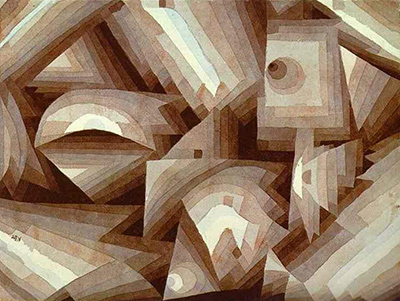
Crystal Gradation
1921
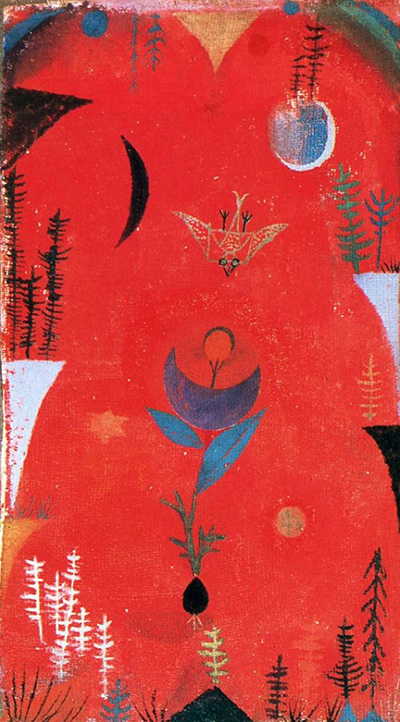
Flower Myth
1918
Red Balloon
1922
Senecio
1922
Twittering Machine
1922
Sinbad the Sailor
1923
Actor's Mask
1924
Discussion
Klee's picture and Benjamin's later angel of history do different work.
The physical mount and the disputed custody history open further questions.
Reader Insights
Which visible features of Klee's angel did Benjamin select or leave aside?
What evidence would help settle its wartime journey?
How does knowing about the hidden print affect your reading of the mount?
Join the Conversation
Share the details or sources behind your reading.
References
- Israel Museum, From Picasso to Kentridge exhibition catalogue, pp. 26–27, object record B87.0994 (English), catalogue PDF, View source.
- Oskar Bätschmann, “Angelus Novus und ‘Engel der Geschichte’: Paul Klee und Walter Benjamin,” in Engel, Teufel und Dämonen (2006), 225–42 (German), full essay, View source.
- Horst Bredekamp, “Walter Benjamins Engel der Geschichte und Albertis Flugauge,” in Der Engel der Geschichte (2025), 24–31 (German), full chapter, View source.
- Michael Maggen, “Paul Klee’s Angelus Novus: Understanding the Artistic Technique,” conservation conference abstract (2016; English), abstract, View source.
- Annie Bourneuf, “Behind the Angel of History,” interview, Journal of the History of Ideas Blog (4 September 2023; English), interview. Her full 2022 book has not yet been read for this page, View source.
- Jewish Museum, Paul Klee: Other Possible Worlds (2026), exhibition page, checklist, audio description transcript (English).
- Museum of Modern Art, Paul Klee Centennial: Prints and Transfer Drawings (1979), 8–9, technical account of oil transfer (English), catalogue PDF, View source.
- Jewish Museum, “Of Angels and Doubles: Paul Klee’s Angelus Novus from Berlin to Jerusalem,” lecture description for Annie Bourneuf, 4 June 2026 (English), museum page, View source.
- Walter Benjamin, Über den Begriff der Geschichte, especially theses VII–X, original German text (1940), Zurich University of the Arts hosted scan. The scan’s OCR contains errors; the account above paraphrases the passage, View source.
- Staatliche Museen zu Berlin, press notice on the 2008–09 Angelus novus exhibition, including original/facsimile exchange and range of interpretations (German), notice PDF, View source.
- Erdmut Wizisla, “Die Tore des Paradieses öffnen sich nach außen,” in Der Engel der Geschichte (2025), 32–41 (German), full chapter; Jörg Völlnagel, “Wenn Engel reisen...,” ibid., 42–53, full chapter. Their custody chronologies conflict.
- Zentrum Paul Klee, “Cover Star Klee,” institutional guide (German; also available in English and French), German page, English page.
- Neville Rowley, “Der Engel der Geschichte,” in Der Engel der Geschichte (2025), 8–23 (German), full chapter, View source.
- Walter Benjamin, “Ankündigung der Zeitschrift Angelus Novus,” German transcription (1922), text; University of Turin, CoSMo, study of the unrealised journal. Text transcription not yet checked against critical print edition.
- Oskar Bätschmann, cited at 2; Neville Rowley, cited at 13. Both distinguish Benjamin’s earlier uses of the image from thesis IX.
- Taisa Palhares, “Walter Benjamin and the New Angel,” in Paul Klee, Centro Cultural Banco do Brasil exhibition catalogue, printed 276–81 / PDF 140–42 (Portuguese and English), bilingual catalogue, View source.
- Staatliche Museen zu Berlin, “The Angel of History,” Bode-Museum exhibition, 8 May–13 July 2025 (English), museum page, View source.
- Jewish Museum, March 2026 exhibition-copy label, PDF p. 28; ARTnews Japan, 12 May 2026 arrival report (Japanese); Jewish Currents, 21 July 2026 account (English).