 by Tom Gurney
Tom Gurney BSc (Hons) is an art history expert with over 20 years experience
Email: tomgurney1@gmail.com / Phone: +44 7429 011000
Several late Klees
The final years of Paul Klee's work cannot be described by one mood or one kind of mark. In 1933, after the National Socialists removed him from teaching in Düsseldorf, he made drawings of threatening figures and an oil-painted face crossed by a black X. In the same year he made the luminous Fire at Full Moon. Later Bern pictures could be enormous or small, dark or vividly coloured, composed of a few heavy signs or crowded with fine lines. What connects them is a sustained effort to make images under altered political, personal and physical conditions.[1][2][3]
Klee returned to Bern with Lily in December 1933. Serious illness began in 1935, and the number of works entered in his register fell sharply in 1936. Yet in 1939 the Zentrum Paul Klee records 1,253 works, most of them drawings. Those figures describe a change in output, not a simple sequence of decline followed by recovery. Nor can the illness retrospectively diagnose a brushstroke. To understand the late work, we need to keep the documentary history, the materials and the actual pictures in view together.[4][5][6]
Contents
- What happened in 1933?
- Building a working life in Bern
- A surge of forms, 1937–39
- The 1939 drawings and angels
- What can the final pictures tell us?
What happened in 1933?
Klee had left the Bauhaus in 1931 to teach at the Düsseldorf Academy. An academy report reproduced by the Zentrum Paul Klee records his suspension from teaching on 21 April 1933; formal dismissal followed in October. The regime's public defamation of his art and the search of the family home in Dessau added to the pressure. The sequence matters. It is misleading to make a single April event cover the later dismissal, or to treat the accusation made against Klee in a Nazi administrative document as a fact about his identity.[7][1]
The family still tried to navigate a life in Germany. Klee moved belongings to Düsseldorf in May despite the suspension, according to the German exile archive's account. A letter to Felix written on 22 December conveys the strain of leaving while also showing Klee's continuing sense of humour. Klee and Lily crossed to Switzerland the next day. They had not simply changed studios; they left an employment and exhibition network damaged by official persecution. That context can inform our reading of works made in 1933, but it does not supply a one-to-one code for every shape in them.[8][1]
The Schirn Kunsthalle's 2003 exhibition identified 245 drawings from 1933 that caricatured violence, militarism, coercion and the new rulers. That is a curator's grouping within a larger year's production, not a count of every work Klee made in 1933. The drawings challenge the idea that Klee's response was only private retreat. Their grotesque bodies and charged gestures can be political without adopting the language of straightforward reportage. Any single sheet still needs its own title, date and object record before a detailed claim about what it depicts.[1]
Struck from the List (von der Liste gestrichen, 1933, 424) is one of the clearest places to test the relationship between evidence and interpretation. The ZPK-owned work is oil on paper mounted on card, about 31.5 × 24 cm. A schematic face is divided by dark diagonals, including a heavy X. The title makes exclusion part of the picture. The Arts in Exile archive says it can be interpreted as a self-portrait and links the cross to the loss of Klee's post and standing. The Jewish Museum's 2026 label goes further, saying he painted it to memorialise the whole series of events. The first is a bounded reading; the second is a stronger claim about intention for which the label does not present Klee's own statement. We can see the X and identify the title, but should attribute the proposed autobiographical meaning.[8][9]
There is a second, useful corrective to a uniformly dark account of 1933. Museum Folkwang records Fire at Full Moon (Feuer bei Vollmond, 1933, 353) as watercolour over paste colour on prepared canvas and regards a summer date as probable. Its yellow disc, red cross-like form and layered colour require visual and material attention before being converted into a political emblem. Folkwang explicitly poses, rather than settles, the possibility of a political meaning. Together, the work and Struck from the List show how different procedures and emotional registers coexisted in one year.[3]
Building a working life in Bern
The move was followed by temporary accommodation, then a more settled studio in the family's Kistlerweg 6 home from June 1934. Bern was Klee's birthplace and held long-standing friends and collectors. The Zentrum Paul Klee's account of the city names Hermann Rupf, Hanni Bürgi and Victor Surbek among an established support network. At the Kunsthalle Bern in 1935, Klee showed more than 270 works, chiefly from the preceding five years. Exile reduced his access to German institutions, but it did not make his work invisible or sever all professional connections.[10]
The pictures of these years should not be used only to illustrate that biography. Each could rework an older problem: how a figure emerges from a field, how a title changes what we see, or how a sign becomes both shape and apparent writing. Klee's late exploration of these questions had roots in his earlier painting and Bauhaus teaching. In World Harbor (welthafen, 1933), discussed in a Fondation Beyeler exhibition guide, black lines on a grey-white field can read as a mesh of signs or, prompted by the title, as many small boats. The guide stresses the viewer's role in constructing that relation between title and image. What looks like a novel late shorthand therefore also extends a longer experiment with line and legibility.[11]
In the summer of 1935 Klee became seriously ill. Walther Fuchs's documentary study follows Lily Klee's letters, contemporary accounts, treatment and photographs rather than simply reading symptoms out of pictures. The illness affected everyday life and Klee's capacity to work; the Zentrum Paul Klee records only 25 works in 1936. This is a real interruption in the register. It is not proof that the later broad lines were an involuntary response, or that every ominous title describes a symptom. Those stronger claims require work-specific evidence.[5][6]
The name scleroderma is widely attached to Klee's illness, but its history needs care. A ZPK exhibition assembled with the University of Bern medical faculty stated that the diagnosis appeared in specialist literature only 14 years after his death and remained hypothetical in the absence of contemporary doctors' records. Fuchs argues that interpretations of the final works have often leaned too heavily on that retrospective diagnosis. His study is not a claim that illness was irrelevant. It is a demand to distinguish a documented limitation, a witness's memory and a modern medical inference.[6][12]
A surge of forms, 1937–39
By 1937, Klee's work had also been attacked through the Nazi campaign against modern art. The ZPK says 102 works were confiscated from German museums. Counts of the number shown in the 1937 Entartete Kunst exhibition differ in authoritative accounts, so that narrower figure should not be used without comparing the exhibition's changing versions and inventories. Confiscation is a documented institutional fact; the precise role of the campaign in making a particular new picture is often a question of interpretation.[5][9]
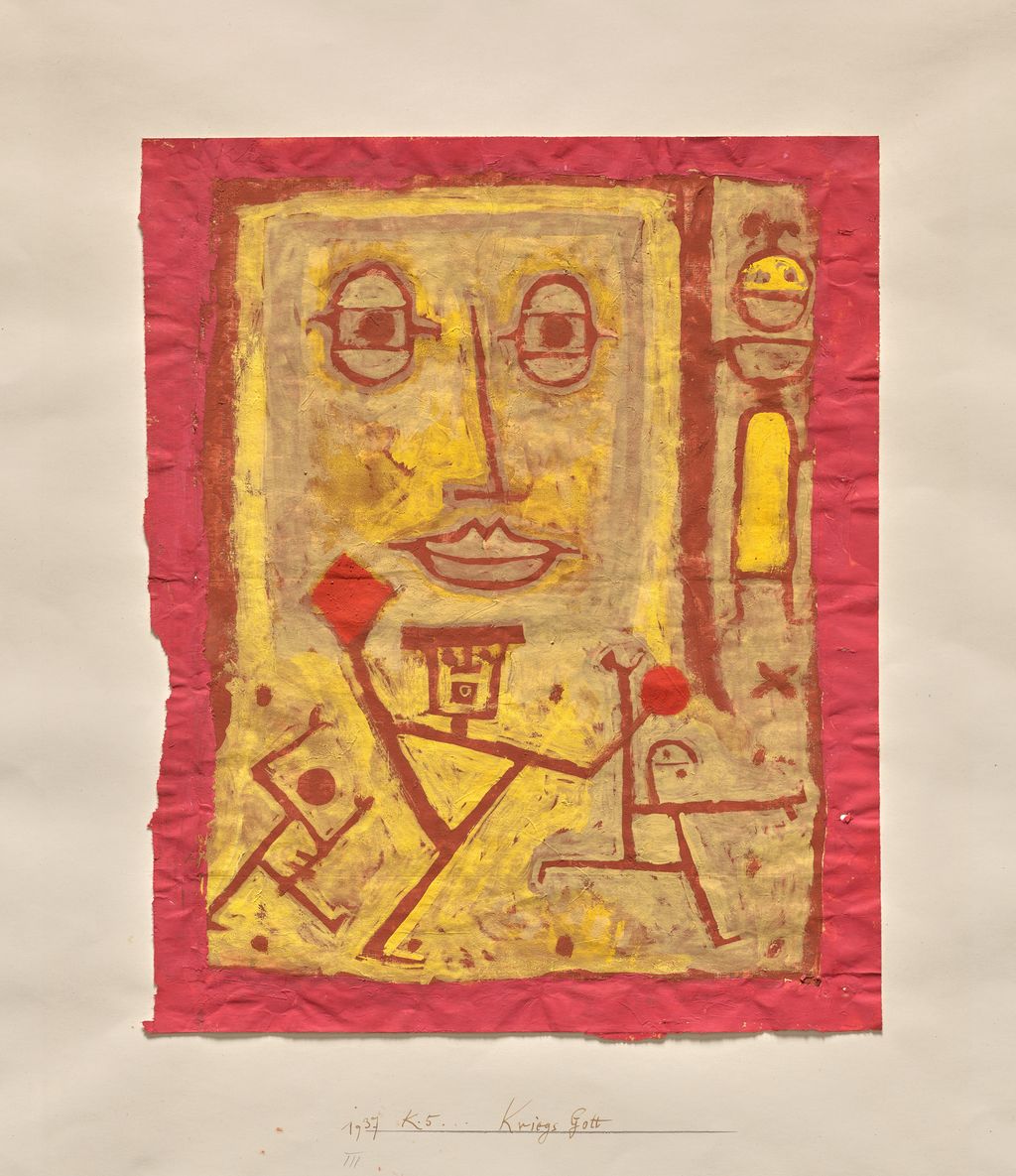
God of War (Kriegs Gott, 1937, 25), now in Cleveland, makes the political world part of its physical support. Klee painted gouache and tempera on newspaper, then attached that sheet to an artist's mount. Cleveland identifies printed text about the Spanish Civil War still visible among the marks. A large pale face and several smaller gesturing figures occupy the sheet; areas of print sit beneath and beside the paint. The newspaper is not a metaphor supplied by a critic but material in the object. Cleveland presents the work as suggesting the period's anxiety. The Jewish Museum's 2026 label brings Guernica and the war into its reading, but the surviving visible newsprint does not by itself prove that each figure stands for a specific combatant or event.[13][9]
The painting known here as Viaducts Break Ranks is Klee's Revolution des Viaductes (1937, 153), held by the Hamburger Kunsthalle. The museum identifies oil on cotton. Its repeated bridge arches appear to have legs; they lean, separate and vary in warm colours. A 2026 Jewish Museum label sees a rebuke to regimented military display in their refusal to march alike. Earlier scholarship has likewise treated the picture as a response to fascism, while the Hamburg record and the visual wit leave room to ask exactly how specific that response is. Klee's known political circumstances make the reading plausible. They do not turn the coloured arches into an artist-authored diagram with a fixed key.[14][9]
The work is also evidence against a singular late palette. Its comic motion and red, orange and yellow forms sit beside more sombre contemporaries. Nor is every change of scale a simple sign of declining dexterity. The broad figure of God of War, the ordered disorder of the viaducts and fine drawings entered in the same years demonstrate different decisions about line and surface. A comparison of actual works is more revealing than a blanket statement that illness made Klee abandon colour or detail.[13][14][6]
Klee's 1938 work offers further alternatives. Centre Pompidou describes Threatening Signs (Bedrohliche Zeichen) as paste colour and graphite on wrapping paper mounted on card, 50.3 × 35 cm. Its French catalogue essay reads the separated, thick black marks as a field of signs whose sense remains elusive. The author Guitemie Maldonado treats the intervals and coloured ground as active parts of the composition, and cautions that formal change reflects the logic of Klee's work as well as the tragedies around him. Her description makes it possible to look at the signs as spatial construction, not merely a diary of fear.[15]
Fondation Beyeler's Forest Witches (Wald-Hexen, 1938, 145) gives another test of how a late image is read. Its dark bands cross the field while passages of red and other colours catch the eye. The museum's guide locates female figures among those bars, then notes how readily they disappear back into the network. The painted structure produces a movement between recognition and uncertainty. A later medical reading may connect heavy lines to Klee's disease, but the visual operation—how signs alternately reveal and conceal bodies—can be described without claiming that a specific brush width was medically compelled.[11][6]
Insula dulcamara (1938, 481) stretches the question of signs across a much broader field. The Zentrum Paul Klee records oil and coloured paste paint on newsprint on jute on a stretcher, with its original frame strips. At 88 × 176 cm, its width is twice its height. Black strokes move through and across a pale, changing ground; some resemble letters, bodies, a vessel or a shoreline, while none compels one reading. A MoMA exhibition catalogue grouped it with six other large horizontal pictures of 1938 and argued that an enlarged line could become a shape with its own weight rather than merely an outline. That is a formal account grounded in the work's scale, not a claim that the painter had forgotten how to draw finely.[16][17]
The title has proved equally resistant to a single translation into subject matter. Insula means island; dulcamara brings together sweet and bitter, and names a plant. An older MoMA catalogue associated the scene with an island of Calypso and with the comic operatic character Dr Dulcamara, but it described “Calypso's Island” as a suggested title, not an established original inscription by Klee. The current owner caption gives the Latin title. The painting's possible snake, boat or face remains a proposal made by viewers, and no title alone proves that Klee painted an account of his medical treatment. This large, layered object helps explain why late Klee cannot be reduced to heavy black line: colour, support, format and the act of naming all do work.[16][17]
The 1939 drawings and angels
The ZPK's figure of 1,253 works in 1939 is striking beside the 25 of 1936. It counts entries in Klee's oeuvre, not 1,253 large finished canvases. Drawing was central to this renewed productivity. Titles, changing character types and recurring signs allowed one sheet to answer another, while larger and more layered works pursued different questions. Fuchs also reconstructs a period in which Klee's condition had stabilised enough for sustained work. The output cannot simply be read as a feverish final burst.[5][6]
The late angels are unusually open to tender, comic and unsettling readings. The Metropolitan Museum says Klee made 29 works featuring angels in 1939, more than in his earlier years. Its Angel Applicant (Engel-Anwärter, 1939) was made with dark gouache on newspaper, a thick graphite outline and a pale wash. The creature's face is awkward, not a polished heavenly ideal; the crescent beside it complicates the scene. The Met suggests that Klee possibly felt kinship with such incomplete figures. That qualifying word matters. An angel's title and visible imperfection are facts of the work; identifying every one with the artist's own approaching death is a later psychological proposal.[18]
The speed of 1939 production also needs to be put beside working conditions. Lily handled much correspondence and care during the illness, as Fuchs documents. Bern collectors and international dealers helped maintain circulation. An account of Klee as isolated from the world overlooks those relationships; an account of uninterrupted triumph overlooks treatment, displacement and practical dependence. The drawings belong to a life that contained both constraints and active exchange.[6][10]
What can the final pictures tell us?
Klee continued working into 1940. Fuchs reconstructs 366 numbered entries in his work register before Klee travelled to Ticino on 10 May; he considers further production after that journey unlikely. Klee first entered the Viktoria clinic at Locarno-Orselina, moved to Sant'Agnese at Locarno-Muralto on 8 June, and died there on 29 June 1940. The order comes from a specialist reconstruction of contemporary evidence; some later summaries reverse the clinics. The ZPK gives 5 July 1940 for the approval of Swiss naturalisation, after his death.[6][5]
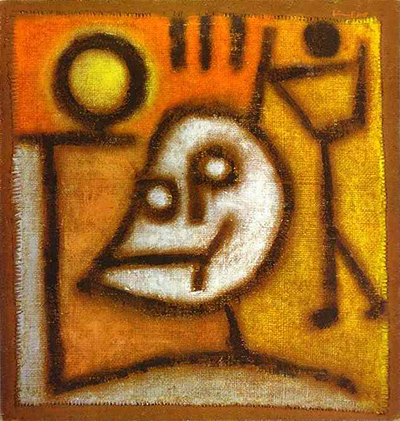
Death and Fire (Tod und Feuer, 1940, 332) invites a reading of mortality through both title and form. The ZPK identifies the letters T O D in a face-like structure and treats an autobiographical self-portrait as possible rather than certain. A Berlin museum checklist records oil and coloured paste on a layered jute support. Its material construction and spare colour are as important as the pun. An image made close to death can speak about death without becoming a medical chart or a prediction of the exact day on which its maker would die.[19]
The ZPK's Untitled (Last Still Life) (Ohne Titel [Letztes Stilleben], 1940) is oil on canvas, 100 × 80.5 cm. The Jewish Museum states that the work remained untitled and unsigned on an easel and that Felix Klee supplied the later title. The ZPK guide confirms its current designation and physical details; the story of how the title was supplied remains a curatorial account to be checked against the estate record. Its assembled figures, flowers and dark ground invite several readings. They deserve to be looked at as parts of a still life and a visual construction, even when its posthumous name pulls us toward finality.[20][9]
Daniel-Henry Kahnweiler, remembering a 1939 visit, later attributed Klee's broad late lines and planes to greater difficulty moving his arm. Fuchs records this as a witness statement. It cannot be ignored, but neither should it settle the interpretation of every sign, colour block or canvas. A better account allows physical limitation to be one condition among many: persistent experiments in writing and drawing, fresh choices of support, political experiences, studio habits and the interaction between a work's title and its form.[6][15]
Klee's last years produced political drawings, theatrical figures, angels, landscapes, colour structures and images that make letters difficult to separate from faces. The sequence is not a march toward one final style. To follow one strand, the biography gives the life chronology, materials and techniques examines the supports and paint, and the pages on Struck from the List, Viaducts Break Ranks, Insula dulcamara and Death and Fire return to individual works. Looking from one object to another reveals the continuity and variety that a single label for “late Klee” can conceal.[14][15][19]
Explore selected works from Klee’s much larger oeuvre. Titles without a link have an authenticated catalogue identity but no reviewed article yet.
Artworks directory
| Name | Date | Medium |
|---|---|---|
| A Gate | 1939 | Painting and mixed media |
| A Woman for Gods | 1938 | Watercolour and mixed media |
| Ab Ovo | 1917 | Watercolour and mixed media |
| Above Mountain Summit | 1917 | Drawing and mixed media |
| Abstract Trio | 1923 | Drawing and mixed media |
| Acrobats | 1915 | Watercolour and mixed media |
| Actor's Mask | 1924 | Painting and mixed media |
| Ad Marginem | 1930 | Drawing and mixed media |
| Ad Parnassum | 1932 | Painting and mixed media |
| Adventurer Ship | 1927 | Drawing and mixed media |
| Affected Place | 1922 | Drawing and mixed media |
| After a Sketch from Zurich | 1914 | Watercolour and mixed media |
| After Drawing | 1919 | |
| After The Floods | 1936 | Watercolour and mixed media |
| All Souls' Picture | 1921 | |
| Ancient Harmony | 1925 | Painting and mixed media |
| Angel Applicant | 1939 | Drawing and mixed media |
| Angel Serves the Desired | 1920 | |
| Angel, Still Female | 1939 | Painting and mixed media |
| Angelus Novus | 1920 | Drawing and mixed media |
| Animal Terror | 1926 | Painting and mixed media |
| Arab Song | 1932 | Painting and mixed media |
| Archangel | 1938 | Painting and mixed media |
| Architecture | 1923 | Painting and mixed media |
| Architecture of the Plain | 1923 | Drawing and mixed media |
| Around the Fish | 1926 | Painting and mixed media |
| Arrival of the Air Steamer | 1921 | Drawing and mixed media |
| Asiatic God | 1924 | Painting and mixed media |
| Astrological Fantasy Portrait | 1924 | Drawing and mixed media |
| Athlete's Head | 1932 | Watercolour and mixed media |
| Aufgehender Stern | 1931 | Painting and mixed media |
| Autumn Flower | 1922 | Painting and mixed media |
| Bad Band | 1920 | Drawing and mixed media |
| Baroque Centaur | 1939 | Painting and mixed media |
| Before the Blitz | 1923 | Drawing and mixed media |
| Before the Snow | 1929 | Drawing and mixed media |
| Besessenes Madchen | 1924 | Watercolour and mixed media |
| Bird Garden | 1924 | |
| Bird Wandering Off | 1926 | Watercolour and mixed media |
| Blossoms in the Night | 1930 | Watercolour and mixed media |
| Blue-Bird-Pumpkin | 1939 | Painting and mixed media |
| Boats in the Flood | 1937 | Painting and mixed media |
| Botanical Theatre | 1934 | Drawing and mixed media |
| Boy in Fancy Dress | 1931 | Watercolour and mixed media |
| Broken Key | 1938 | |
| Brother and Sister | 1930 | Watercolour and mixed media |
| But the Red Roof | 1935 | Painting and mixed media |
| C - C = Fisch | 1931 | Watercolour and mixed media |
| Cacti | 1912 | Painting and mixed media |
| Camel (in Rhythmic Landscape with Trees) | 1920 | Drawing and mixed media |
| Captive Pierrot | 1923 | Drawing and mixed media |
| Castle and Sun | 1928 | Drawing and mixed media |
| Cat and Bird | 1928 | Drawing and mixed media |
| Cathedrals | 1925 | Watercolour and mixed media |
| Chalice of the Heart | 1937 | Painting and mixed media |
| Characters in Yellow | 1937 | Painting and mixed media |
| Chosen Site | 1927 | Mixed media |
| Christmas Picture | 1923 | Drawing and mixed media |
| City of Towers | 1916 | Painting and mixed media |
| Clarification | 1932 | Painting and mixed media |
| Collection of Figurines | 1926 | Painting and mixed media |
| Colorful Architecture | 1917 | Painting and mixed media |
| Comedians' Handbill | 1938 | |
| Comic Opera Singer | 1927 | Painting and mixed media |
| Composition | 1939 | Painting and mixed media |
| Composition with Figures | 1915 | Drawing and mixed media |
| Composition with the Yellow Half-Moon and the Y | 1918 | Watercolour and mixed media |
| Conch–Still Life II | 1939 | Watercolour and mixed media |
| Cosmic Composition | 1919 | Painting and mixed media |
| Crystal Gradation | 1921 | Drawing and mixed media |
| Dance of the Grieving Child | 1922 | Painting and mixed media |
| Dancing Girl | 1940 | Painting and mixed media |
| Das Licht und Etliches | 1931 | Mixed media |
| Death and Fire | 1940 | Painting and mixed media |
| Death for the Idea | 1915 | |
| Demon as Pirate | 1926 | Watercolour and mixed media |
| Diana | 1931 | Painting and mixed media |
| Diavolo Player | 1923 | Drawing and mixed media |
| Die Kapelle | 1917 | Watercolour and mixed media |
| Die Vase | 1938 | Painting and mixed media |
| Doctor | 1930 | Drawing and mixed media |
| Dredger and Sailboat | 1931 | Watercolour and mixed media |
| Ein Tor | 1939 | Painting and mixed media |
| Ein Weib fur Gotter | 1938 | Mixed media |
| Embrace | 1939 | Watercolour and mixed media |
| Episode before an Arab Town | 1923 | |
| Equals Infinity | 1932 | Painting and mixed media |
| Eros | 1923 | Drawing and mixed media |
| Error on Green | 1930 | Watercolour and mixed media |
| Evening Figure | 1935 | Drawing and mixed media |
| Falling Bird | 1919 | |
| Fermata | 1932 | Watercolour and mixed media |
| Fire Clown | 1921 | Watercolour and mixed media |
| Fire Full Moon | 1933 | Watercolour and mixed media |
| Fire in the Evening | 1929 | Painting and mixed media |
| Fish in the Harbour | 1916 | Watercolour and mixed media |
| Fish Magic | 1925 | Watercolour and mixed media |
| Flock of Birds | 1917 | Drawing and mixed media |
| Flora on Sand | 1927 | Watercolour and mixed media |
| Flower Myth | 1918 | |
| Flower Stand with Watering Can and Bucket | 1910 | Watercolour and mixed media |
| Flowering Tree (Abstraction with Reference to a Flowering Tree) | 1925 | Painting and mixed media |
| Flowers in Pots | 1923 | |
| Flowers in Stone | 1939 | Painting and mixed media |
| Forest Witch | 1938 | Painting and mixed media |
| Fright of a Girl | 1922 | Drawing and mixed media |
| Fruits on Red | 1930 | Drawing and mixed media |
| Full Moon | 1919 | Mixed media |
| Föhn Wind in Franz Marc's Garden | 1915 | Watercolour and mixed media |
| Garden in St Germain, The European Quarter near Tunis | 1914 | Watercolour and mixed media |
| Ghost Chamber with the Tall Door (New Version) | 1925 | |
| Ghost of a Genius | 1922 | Drawing and mixed media |
| Girl in Mourning | 1939 | Painting and mixed media |
| Glance of a Landscape | 1926 | Watercolour and mixed media |
| Gluht Nach | 1939 | Drawing and mixed media |
| Golden Fish | 1925 | Watercolour and mixed media |
| Goldfish Wife | 1921 | Watercolour and mixed media |
| Green Plant, Blood, Louse | 1924 | Drawing and mixed media |
| Hafenbild | 1918 | Mixed media |
| Hammamet with Mosque | 1914 | Watercolour and mixed media |
| Harbour with Sailing Ships | 1937 | Painting and mixed media |
| Hauptweg und Nebenwege | 1929 | Painting and mixed media |
| Heavenly and Earthly Time | 1927 | Drawing and mixed media |
| Heroic Fiddling | 1938 | Painting and mixed media |
| Heroic Roses | 1938 | Painting and mixed media |
| Heroic Strokes of the Bow | — | Mixed media |
| Highway and Byways | 1929 | Drawing and mixed media |
| Houses near the Gravel Pit | 1913 | Watercolour and mixed media |
| Howling Dog | 1928 | Painting and mixed media |
| In the Current Six Thresholds | 1929 | Painting and mixed media |
| In the Style of Kairouan | 1914 | Drawing and mixed media |
| Individualized Altimetry of Stripes | 1930 | Painting and mixed media |
| Insula Dulcamara | 1938 | |
| Interior with the Clock | 1913 | Watercolour and mixed media |
| Irma Rossa the Animal Tamer | 1918 | Drawing and mixed media |
| Journey in Corsica | 1927 | Drawing and mixed media |
| Landscape with Bluebirds | 1919 | Watercolour and mixed media |
| Legend of the Nile | 1937 | Painting and mixed media |
| Lemon Harvest | 1937 | Watercolour and mixed media |
| Likeness in the Bower | 1930 | Watercolour and mixed media |
| Limits of Reason | 1927 | Painting and mixed media |
| Little Hope | 1938 | Watercolour and mixed media |
| Magdalena before the Conversion | 1938 | Drawing and mixed media |
| Mask of Fear | 1932 | Painting and mixed media |
| May Picture | 1925 | Painting and mixed media |
| Monument in a Cemetery | 1922 | Watercolour and mixed media |
| Monuments at G | 1929 | Watercolour and mixed media |
| Municipal Jewel | 1917 | Watercolour and mixed media |
| Mural from the Temple of Longing Thither | 1922 | |
| Nach der Uberschwemmung | 1936 | Watercolour and mixed media |
| New Harmony | 1936 | Painting and mixed media |
| New House in the Suburbs | — | Mixed media |
| Old Steamboat | 1922 | Drawing and mixed media |
| On the Edge | 1930 | Drawing and mixed media |
| Once Emerged from the Gray of Night | 1918 | Drawing and mixed media |
| One Who Understands | 1934 | Painting and mixed media |
| Oriental Pleasure Garden | 1925 | Painting and mixed media |
| Park of Idols | 1939 | Watercolour and mixed media |
| Passing by Red Pillars | 1928 | Watercolour and mixed media |
| Persian Nightingales | 1917 | Drawing and mixed media |
| Popular Wall Painting | 1922 | Painting and mixed media |
| Prestidigitator | 1927 | Watercolour and mixed media |
| Rainy Day | 1931 | Watercolour and mixed media |
| Red and White Domes | 1914 | Watercolour and mixed media |
| Red Balloon | 1922 | Drawing and mixed media |
| Redgreen and Violet-Yellow Rhythms | 1920 | Drawing and mixed media |
| Refuge | 1930 | Watercolour and mixed media |
| Rhythmic Rythmical | 1930 | Painting and mixed media |
| Saint of the Inner Light | 1921 | |
| Scaffolding of a New Building | 1930 | Painting and mixed media |
| Scholar in Dealing with Stars | 1926 | Watercolour and mixed media |
| Seated Woman | 1930 | Drawing and mixed media |
| Senecio | 1922 | Painting and mixed media |
| Separation in the Evening | 1922 | Drawing and mixed media |
| Sinbad the Sailor | 1923 | Drawing and mixed media |
| Skeptically Smiling | — | Mixed media |
| Small House in the Garden City | 1928 | Watercolour and mixed media |
| Small Portrait of a Girl in Yellow | 1925 | Painting and mixed media |
| Southern Gardens | 1919 | Watercolour and mixed media |
| Static-Dynamic Gradation | 1923 | Drawing and mixed media |
| Still Life | 1927 | Painting and mixed media |
| Still Life with Gladioli | 1932 | Watercolour and mixed media |
| Strange Garden | 1923 | Drawing and mixed media |
| Stricken City | 1936 | Painting and mixed media |
| Strong Dream | 1929 | Watercolour and mixed media |
| Struck from the List | 1933 | Drawing and mixed media |
| Structural I | 1924 | Drawing and mixed media |
| Sumpflegende | 1919 | Painting and mixed media |
| Temple Gardens | 1920 | Drawing and mixed media |
| The Arrow before the Target | 1921 | Drawing and mixed media |
| The Barbed Noose with the Mice | 1923 | Watercolour and mixed media |
| The Flora of the Heath | 1925 | Watercolour and mixed media |
| The Goldfish | 1925 | Watercolour and mixed media |
| The Hour Before One Night | 1940 | Painting and mixed media |
| The Man in Love | 1923 | |
| The Mask with the Flag | 1925 | Mixed media |
| The Pathos of Fertility | 1921 | |
| The Rhine at Duisburg | 1937 | Painting and mixed media |
| The Way to the Citadel | 1937 | Painting and mixed media |
| Three Houses and a Bridge | 1922 | Watercolour and mixed media |
| Tightrope Walker | 1923 | |
| Tomb in Three Parts | 1923 | Watercolour and mixed media |
| Tomcat's Turf | 1919 | Watercolour and mixed media |
| Tower in Orange and Green | 1922 | Drawing and mixed media |
| Tree and Architecture - Rhythms I | 1920 | Watercolour and mixed media |
| Tree and Architecture - Rhythms II | 1920 | Painting and mixed media |
| Tropical Dawn with the Owl | 1921 | Mixed media |
| Tropische Dammerung | 1921 | Painting and mixed media |
| Twittering Machine | 1922 | Drawing and mixed media |
| Variations (Progressive Motif) | 1927 | Watercolour and mixed media |
| Ventriloquist and Crier in the Moor | 1923 | |
| Viaducts Break Ranks | 1937 | Drawing and mixed media |
| Villa R | 1919 | Painting and mixed media |
| Village Carnival | 1926 | Painting and mixed media |
| Vor dem Blitz | 1923 | Drawing and mixed media |
| Wald-Hexen | 1938 | Painting and mixed media |
| Young Forest | 1925 | Drawing and mixed media |
Discussion
Klee's final years left a varied body of drawings and paintings shaped by exile, changing work conditions and sustained experiment.
Titles and dates help us read those works, while the objects themselves test our assumptions about a single late style.
Reader Insights
Which late Klee work most resists a straightforward biographical reading?
How does the support or painted surface change what you see in a work from 1933–40?
Which museum or archival source would you use to test a familiar interpretation?
Join the Conversation
Share the work and the evidence you used, and distinguish the visible feature from a proposed meaning.
References
- Schirn Kunsthalle Frankfurt, “Paul Klee: 1933,” exhibition account (English, 2003), View source.
- Zentrum Paul Klee, “Paul Klee” institutional biography and chronology (in German), View source.
- Museum Folkwang, “Fire at Full Moon,” owner record and interpretation (German and English), View source.
- Zentrum Paul Klee, “Klee in Bern” exhibition research (in German), View source.
- Zentrum Paul Klee, “Paul Klee,” 1935–40 chronology (in German), View source.
- Walther Fuchs, “Paul Klee und seine Krankheit revisited,” Zwitscher-Maschine (in German, with English summary, 2017), View source.
- Zentrum Paul Klee, Paul Klee: I Want to Know Nothing, reproduced Düsseldorf academy report and chronology (English), View source.
- Arts in Exile, “Paul Klee: Von der Liste gestrichen (1933),” object and exile chronology (English, with original German letter), View source.
- The Jewish Museum, Paul Klee: Other Possible Worlds, complete exhibition labels (English, 2026), View source.
- Zentrum Paul Klee, “Klee in Bern,” studio, friendships and 1935 exhibition (in German), View source.
- Fondation Beyeler, Paul Klee: The Abstract Dimension, gallery guide on World Harbor and Forest Witches (English), View source.
- Zentrum Paul Klee and University of Bern Medical Faculty, “Paul Klee und seine Krankheit,” exhibition account (in German, 2005), View source.
- Cleveland Museum of Art, “God of War,” owner object record, description and open-access notice (English), View source.
- Hamburger Kunsthalle, “Revolution des Viaductes,” owner object record, bibliography and provenance (in German), View source.
- Guitemie Maldonado, Centre Pompidou, “Bedrohliche Zeichen (Signes menaçants),” collection essay from Collection art graphique (in French, 2008), View source.
- Zentrum Paul Klee, “Paul-Klee-Stiftung,” current owner caption for Insula dulcamara (in German), View source.
- The Museum of Modern Art, European Master Paintings from Swiss Collections, p. 150, discussion of Insula dulcamara and the group of seven (English), View catalogue, View source.
- The Metropolitan Museum of Art, “Angel Applicant,” owner object record and interpretation (English), View source.
- Zentrum Paul Klee, Death and Fire interpretation (English), View guide; Staatliche Museen zu Berlin, Das Universum Klee work checklist, p. 10, exact material and catalogue number (in German, 2008), View checklist.
- Zentrum Paul Klee, “Ohne Titel (Letztes Stilleben),” owner digital guide (in German), View source.