 by Tom Gurney
Tom Gurney BSc (Hons) is an art history expert with over 20 years experience
Published on June 19, 2020 / Updated on July 30, 2026
Email: tomgurney1@gmail.com / Phone: +44 7429 011000
Saint George and the Dragon by Rogier van der Weyden: Introduction
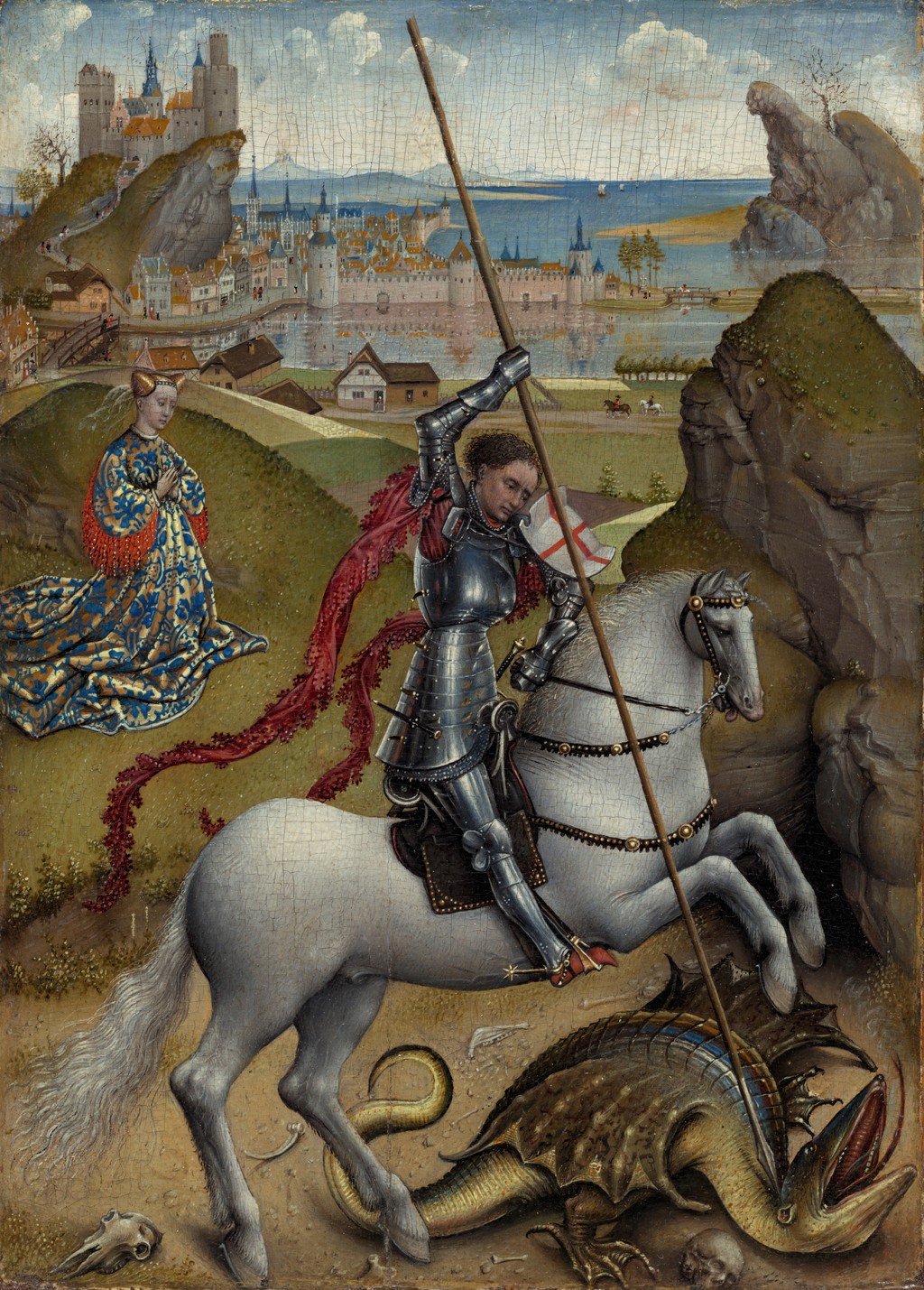
Rogier van der Weyden's Saint George and the Dragon is a tiny painting with a surprisingly expansive world inside it. The panel shows the mounted Saint George in black Gothic armour driving his lance into the dragon, while Princess Cleodolinda kneels nearby and an imaginary landscape opens behind them. It is only a small object, but it combines chivalric legend, private devotion, Early Netherlandish detail and a landscape transformed by fantasy.
The National Gallery of Art, Washington dates the painting to about 1432/1435 and identifies it as oil on panel. The painted surface measures 14.3 x 10.5 cm, and the overall panel measures 15.2 x 11.8 cm. The work entered the NGA through the Ailsa Mellon Bruce Fund and has the accession number 1966.1.1.
The National Gallery of Art record also gives the page a clear object history and a high-quality public-domain image.
At a Glance
- ArtistRogier van der Weyden
- TitleSaint George and the Dragon
- Datec. 1432/1435
- MediumOil on panel
- Painted surface14.3 x 10.5 cm
- Overall panel15.2 x 11.8 cm
- Current locationNational Gallery of Art, Washington
- Accession number1966.1.1
- Credit lineAilsa Mellon Bruce Fund
- Key themesSaint George, dragon legend, private devotion, landscape, fantasy and realism, early Rogier
Contents
- Introduction
- At a Glance
- Annotated Details
- What the Painting Shows
- Reality and Fantasy
- Landscape and Detail
- Light, Armour and Jan van Eyck
- Early Rogier and Private Devotion
- Princess, City And Rescue
- Provenance
- How to Look at the Painting
- Why It Matters
- Frequently Asked Questions
Annotated Details from Saint George and the Dragon
This small panel is rich enough for close reading because it combines heroic action, courtly fantasy, landscape and miniature-like detail. The annotations track the saint, the princess, the dragon and the wide world built behind them.
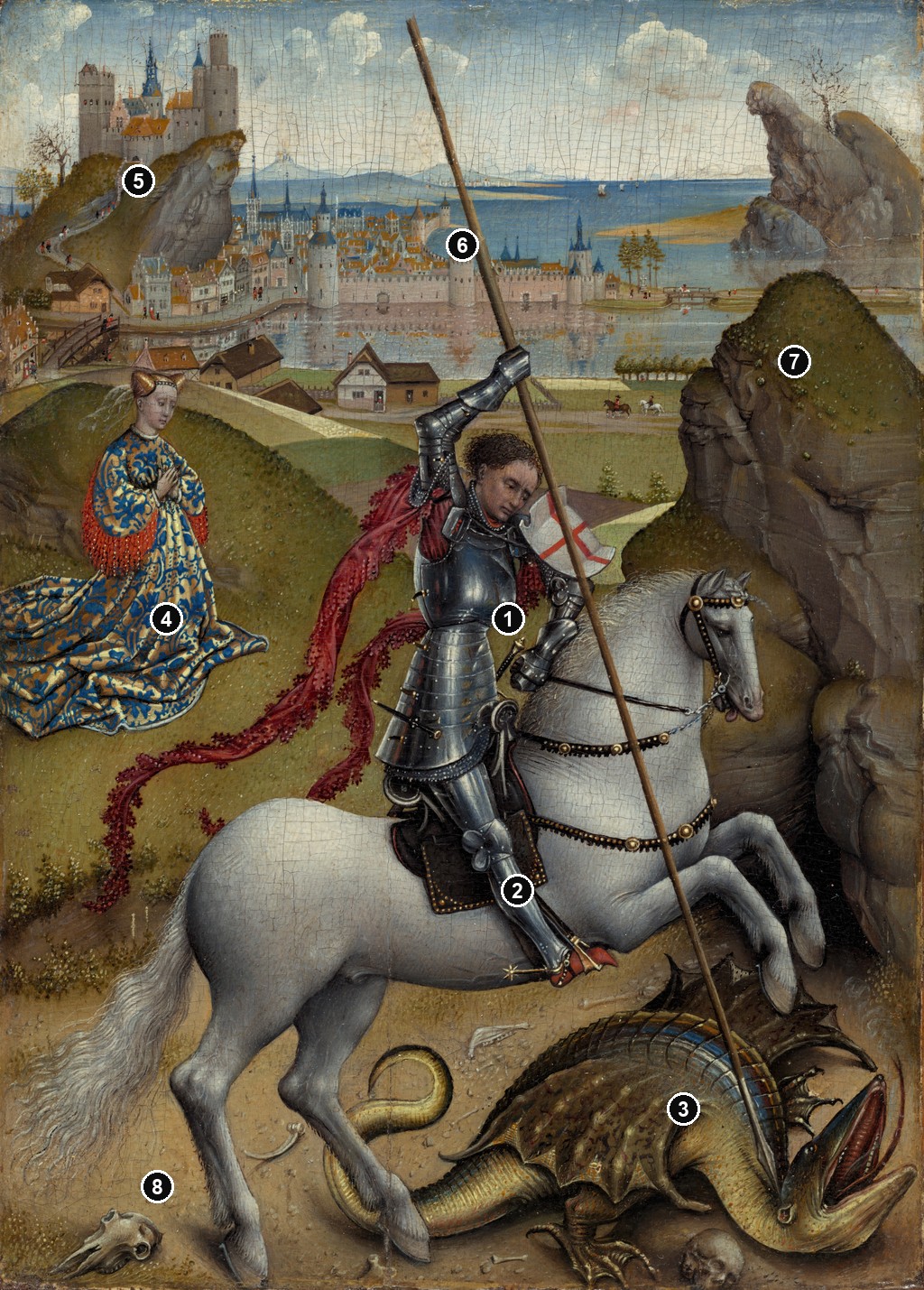
Details from SAINT GEORGE AND THE DRAGON
The selected details explain how the painting balances narrative immediacy with the intricate landscape language of early Netherlandish art.
Saint George and the lance
Saint George's raised lance creates the painting's main diagonal. The action is heroic, but it is also carefully controlled inside the panel's ornamental world.
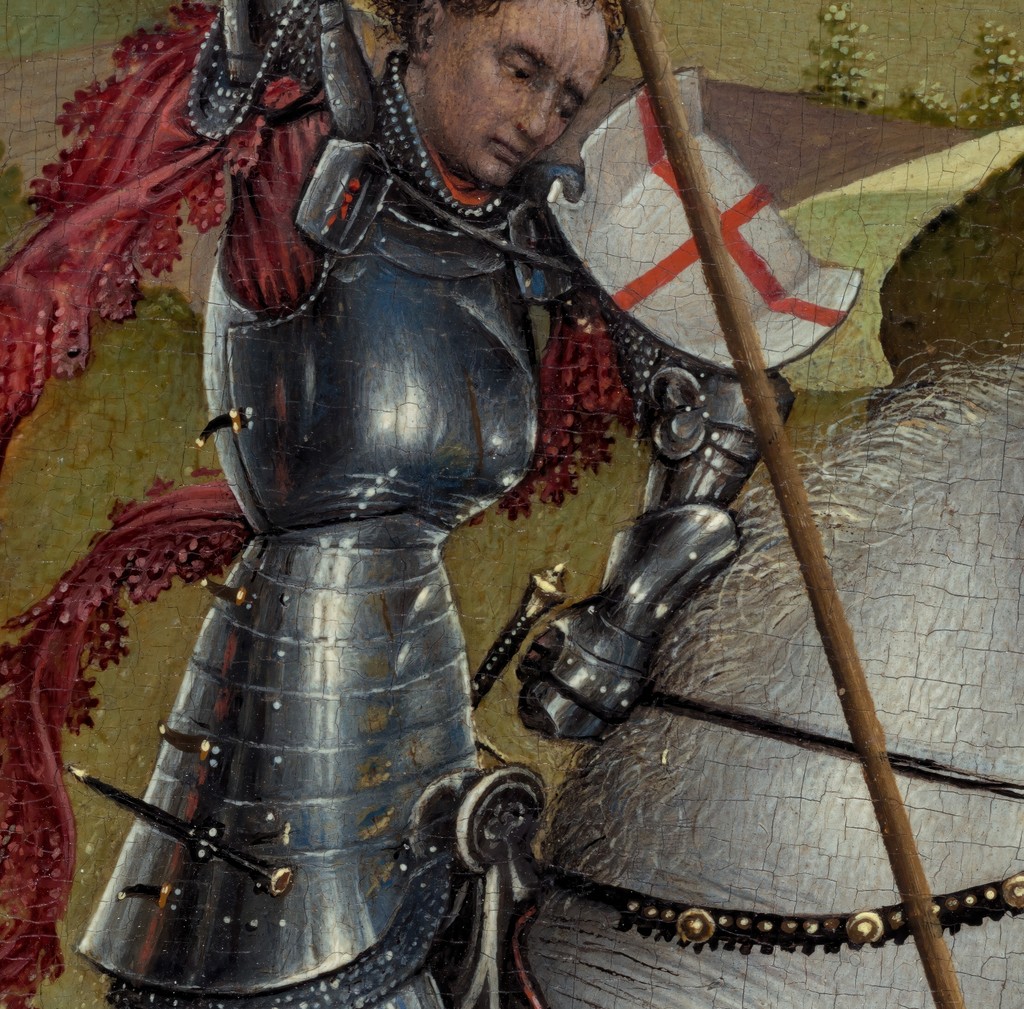
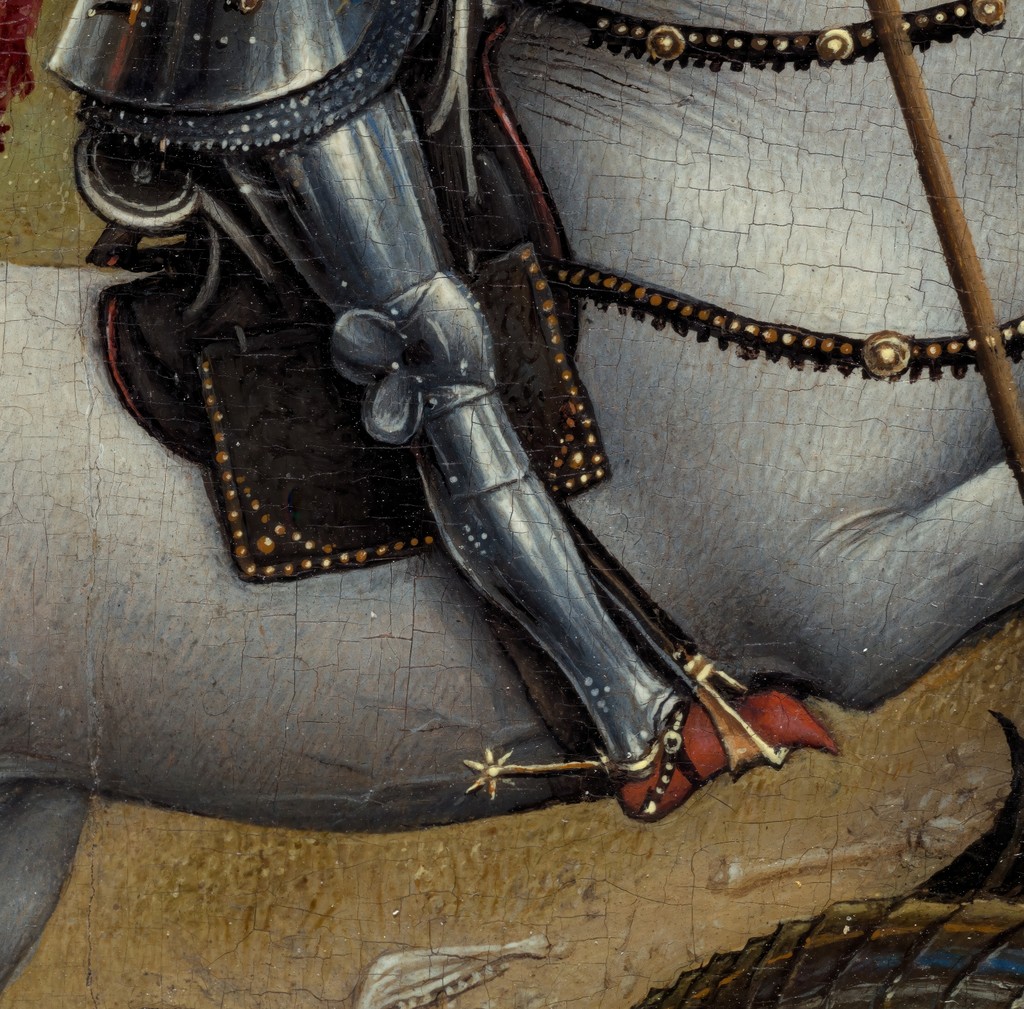
Armour and white horse
The armour and white horse display Rogier's interest in reflective surfaces and disciplined form. Their brightness gives the small panel much of its visual energy.
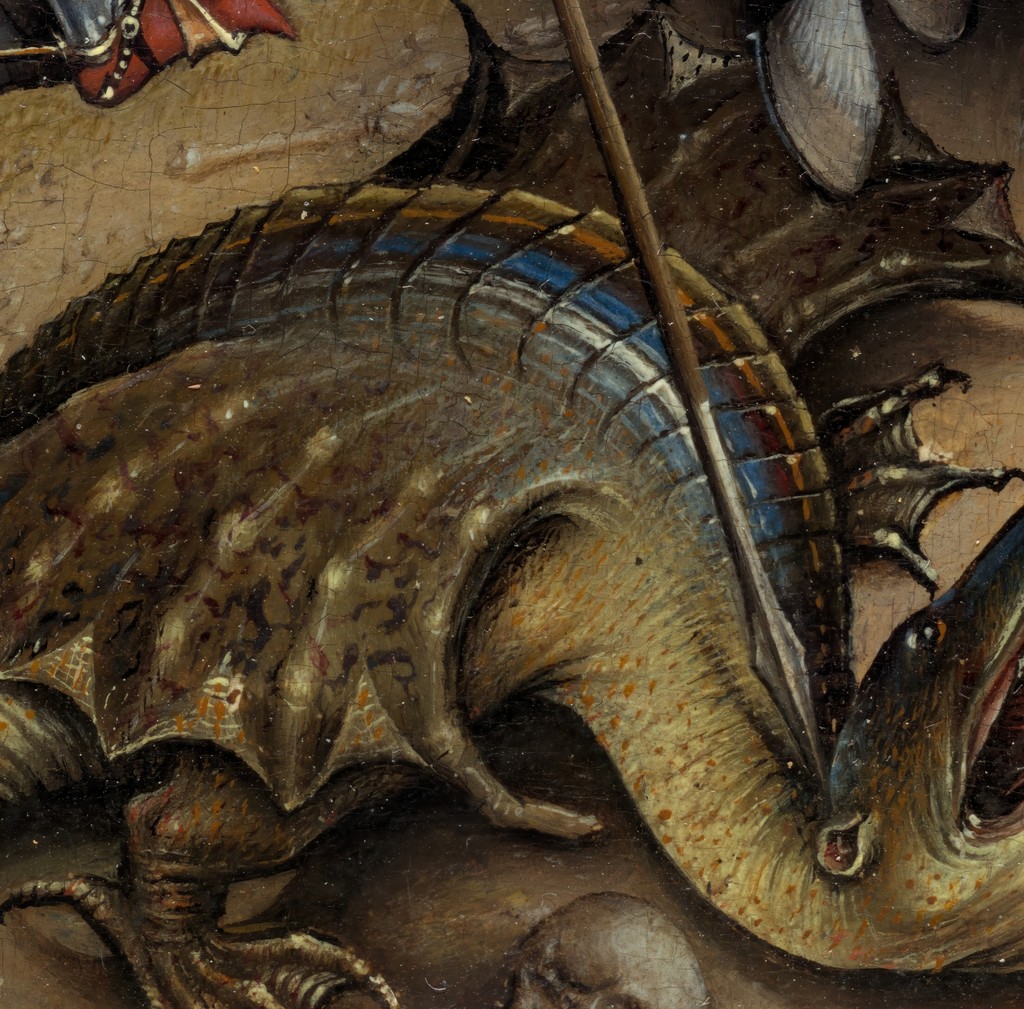
The dragon beneath the horse
The dragon is vivid but compressed beneath the horse. Rogier makes the monster threatening while keeping it subordinate to the saint's ordered movement.
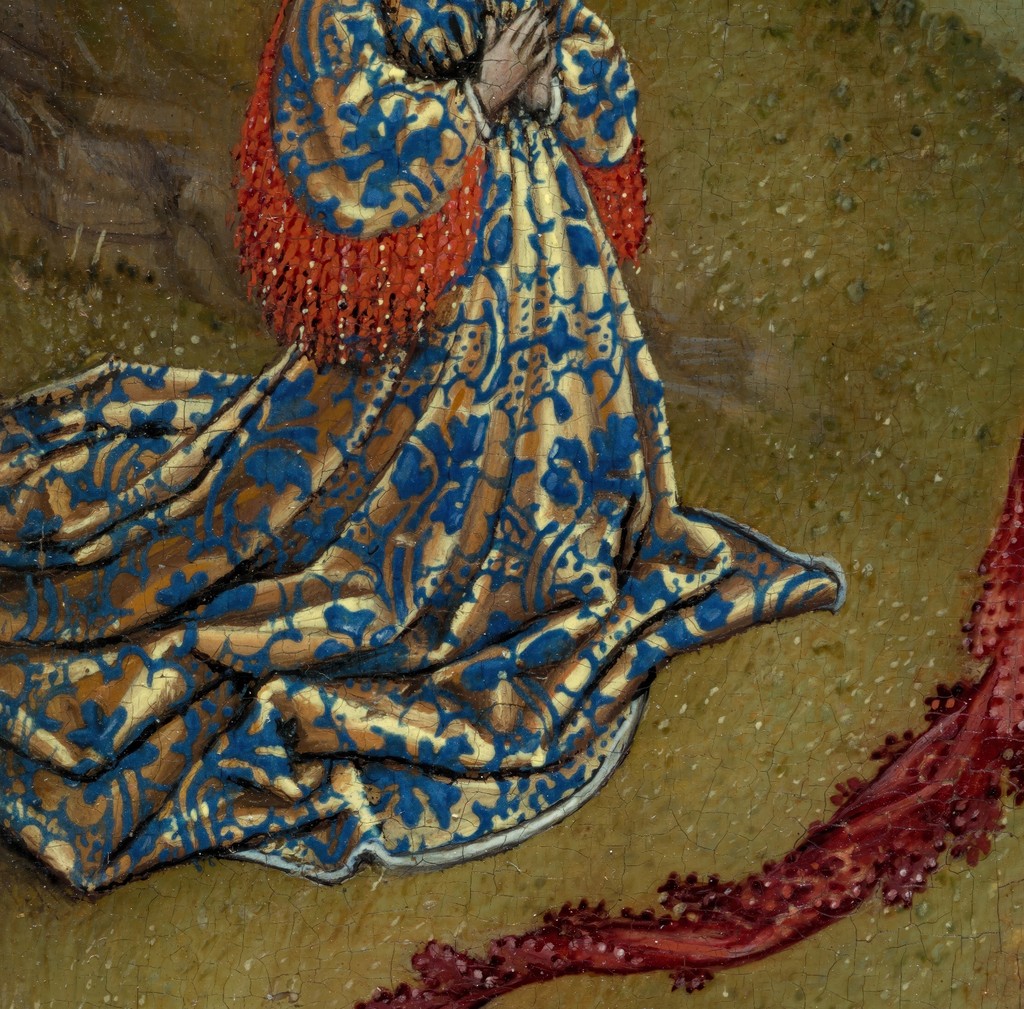
The praying princess
The princess kneels in patterned dress, turning the action into a devotional image as well as a chivalric story.
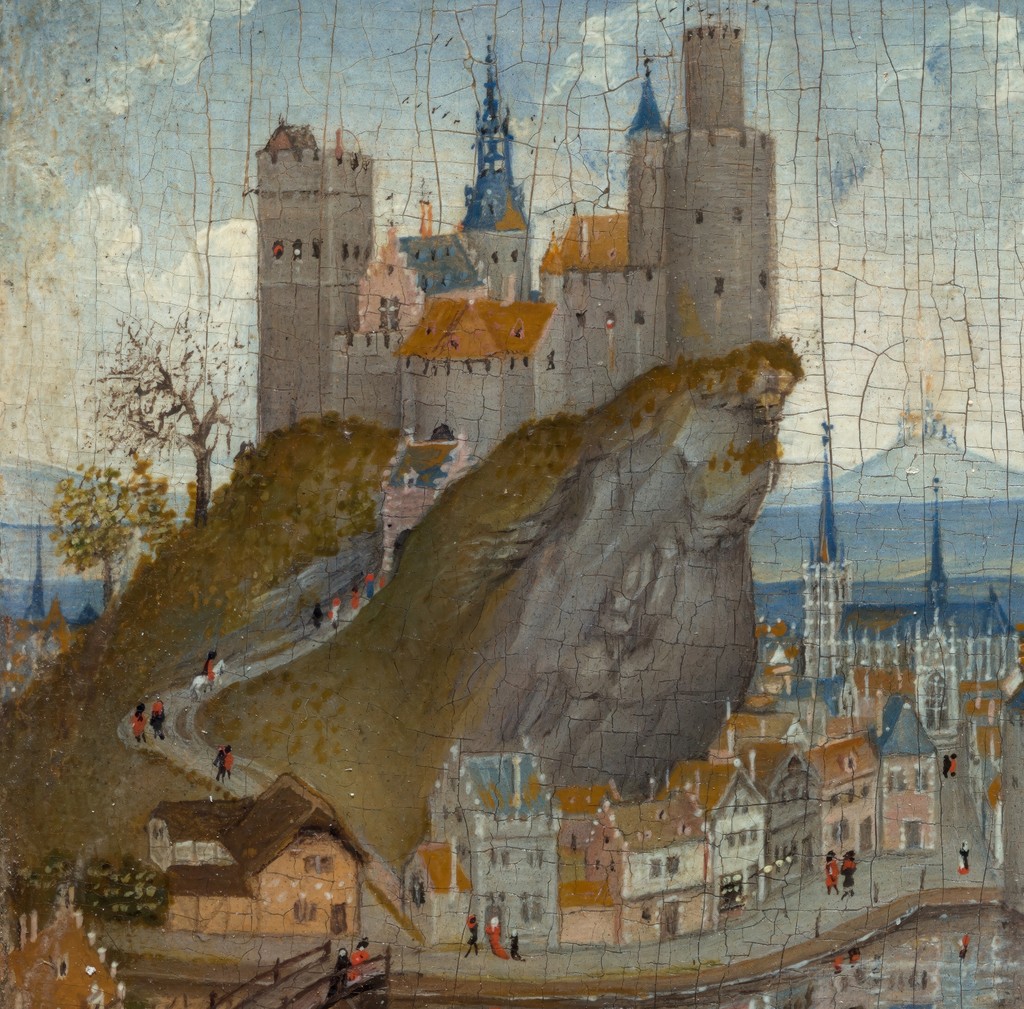
Castle and road
The castle and winding road extend the story into the distance. Tiny figures and architecture make the world feel larger than the panel's small size.
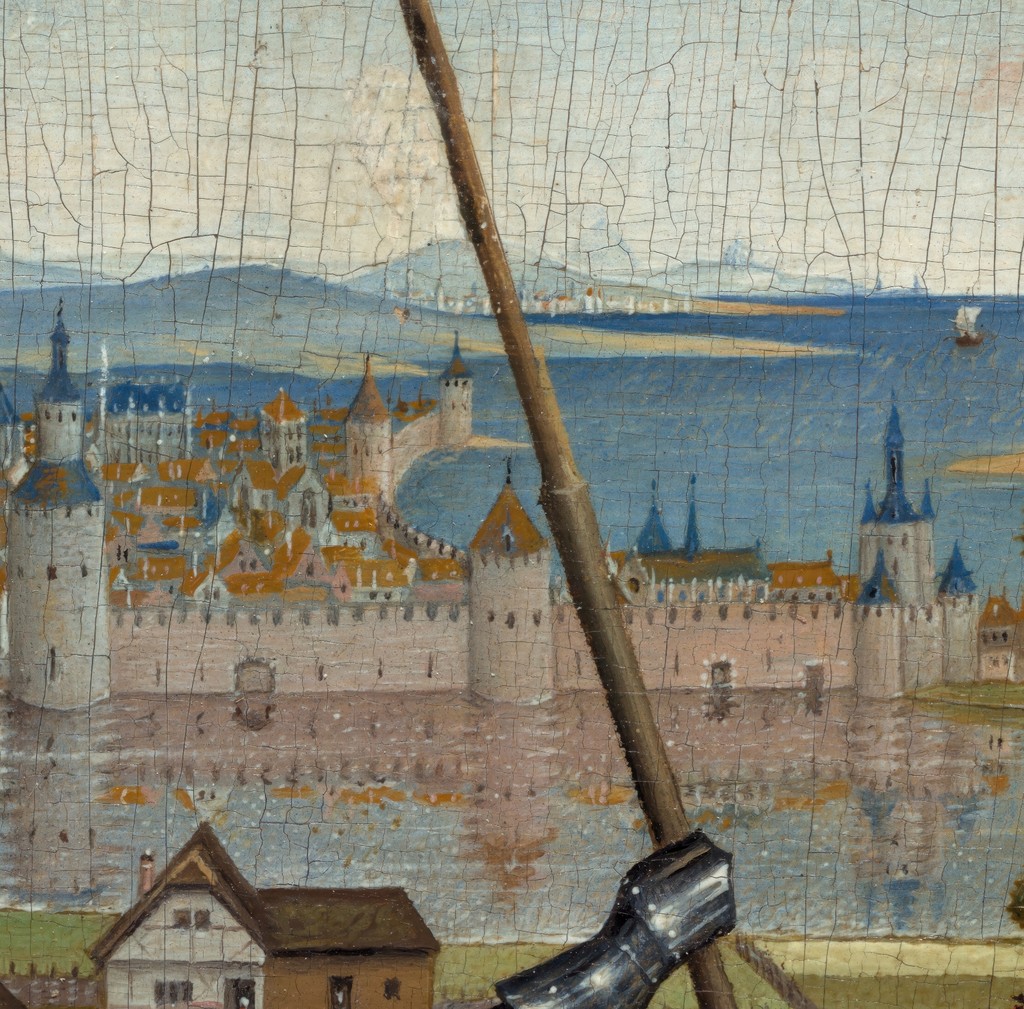
Harbour city and water
The distant harbour city shows Rogier's taste for carefully imagined places. Landscape becomes part of the narrative, not just a backdrop.
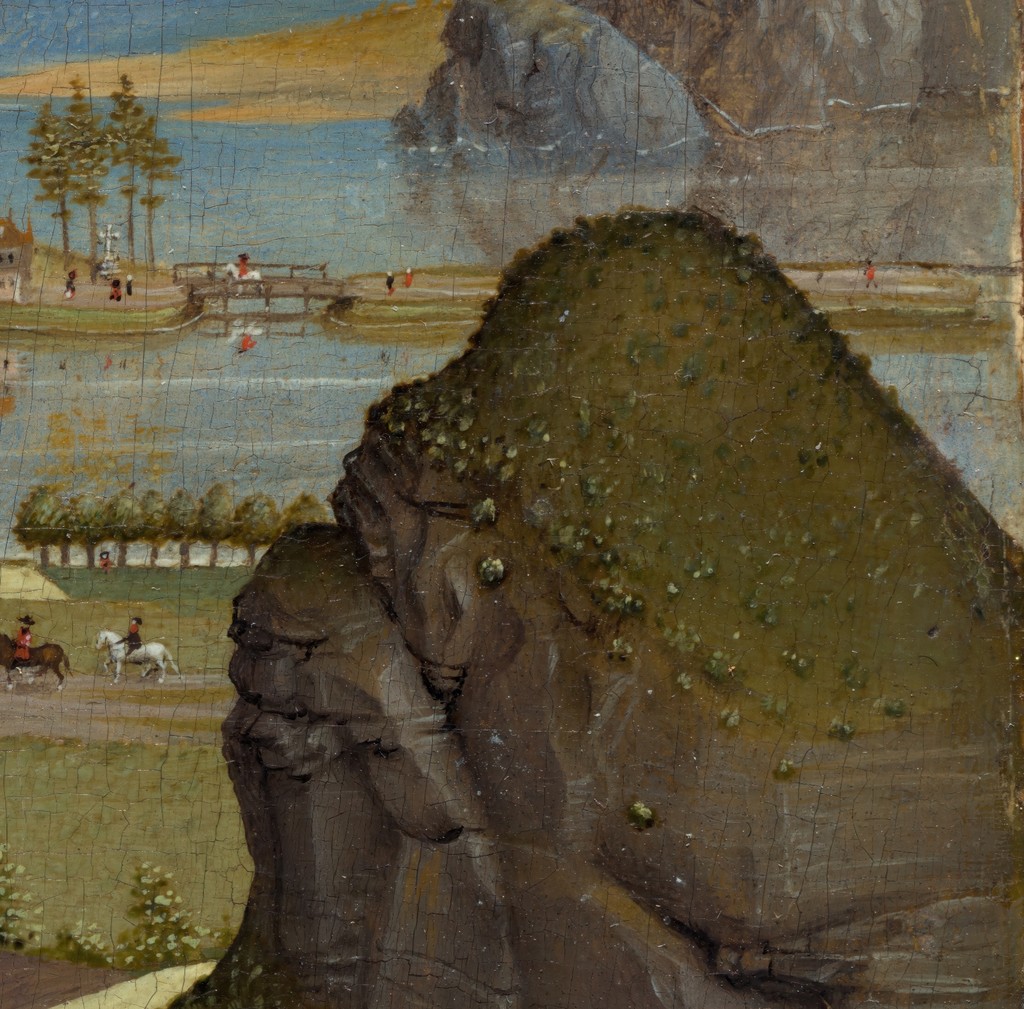
Rocky cave and landscape edge
The rocky edge frames the dragon's lair and contrasts with the ordered city beyond. The panel moves between danger, civilisation and sacred rescue.
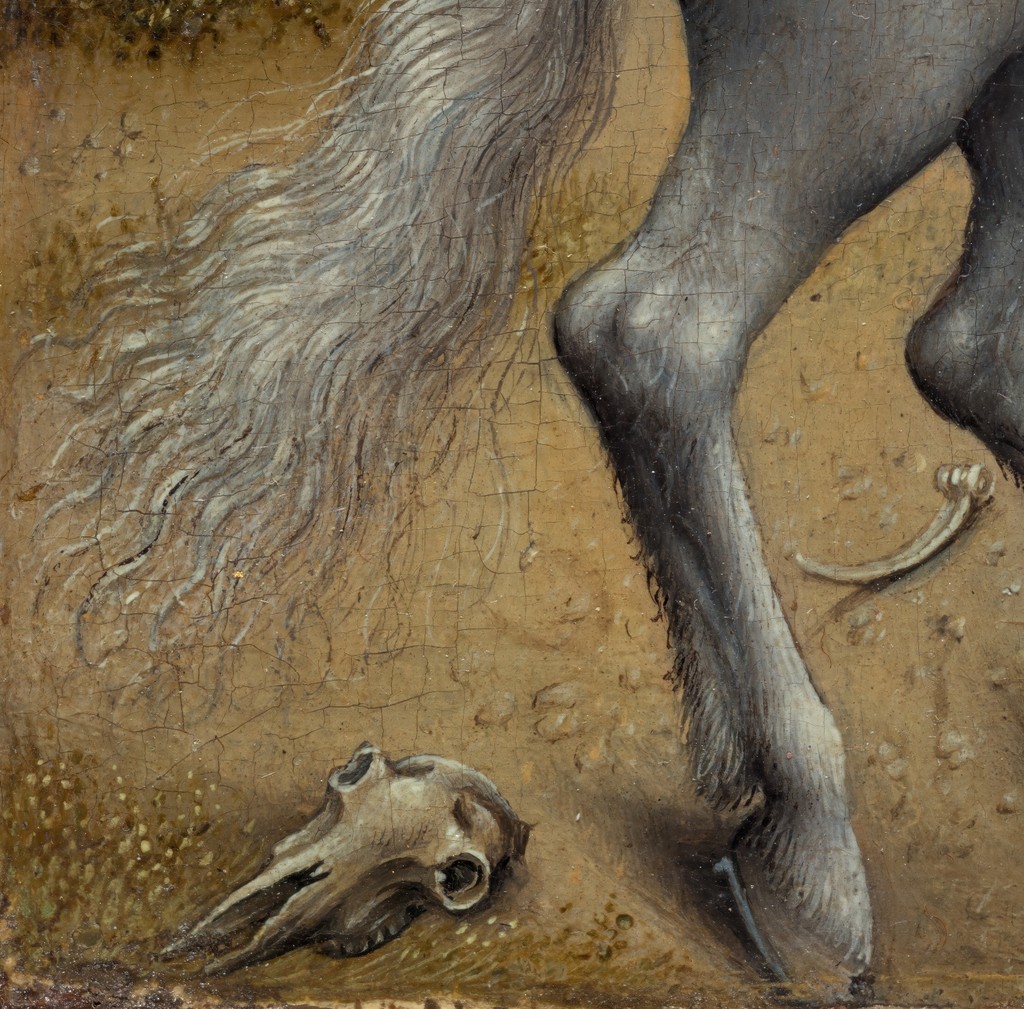
Skull and foreground signs
The skull in the foreground darkens the story's fantasy with a reminder of real danger. Such small signs keep the scene morally charged.
What the Painting Shows
Saint George rides a rearing grey horse at the centre of the composition. He wears black Gothic armour and drives a long lance diagonally into the dragon below. The NGA's visual description notes the white shield with a red cross, the burgundy-red streamers, the dragon's green body, skulls and bones scattered near the beast, and the kneeling princess in a richly patterned dress. [1]
The story comes from the popular legend of Saint George, the Roman soldier who rescues a princess from a dragon. The NGA identifies the kneeling woman as Princess Cleodolinda, who was to have been sacrificed. [1]
Rogier treats the legend as both violent and miniature. The lance gives the panel its main diagonal, and the horse's rearing movement creates energy far beyond the painting's small size. Yet the details are delicate: armour, shield, streamers, dragon, bones, city, water, ships and distant mountains all compete for attention.
The result is a small image that behaves almost like a precious illuminated scene. It invites close viewing, not broad spectacle.
Reality and Fantasy
The subject is legendary. A dragon, a heroic saint and a princess belong to a world of miracle and chivalric rescue. But the setting is not ancient Cappadocia. The NGA notes that the scene has been transformed into a contemporary Belgian countryside. [1]
This transformation is typical of Early Netherlandish imagination. Sacred and legendary events are brought into a world that viewers could recognise: local-looking landscapes, contemporary clothing, detailed surfaces and familiar forms of architecture. The dragon remains fantastic, but the world around it is described with convincing precision.
The combination gives the painting its charm and seriousness. Rogier does not make fantasy vague. He makes it exact.
That exactness gives the legend devotional force. A dragon could easily become a decorative monster. Rogier instead paints a world in which the strange and the familiar coexist. The beast is unbelievable, but the armour, landscape, city and water are painted with such care that the miracle is pulled into a credible visual world.
This is one reason the painting works well for readers who know Rogier mainly through Passion scenes. It shows that his discipline of detail could serve chivalric legend as well as Crucifixion, portraiture or Marian devotion. The same controlled eye that could render tears, veils and hands could also make armour, streamers, skulls and a dragon feel precise.
Landscape and Detail
The landscape behind Saint George is not a neutral backdrop. It expands the painting's world. The NGA describes overlapping hills, a walled city surrounded by water, a castle on a fantastic mountain, ships, blue mountains and a high horizon. [1]
These details matter because the panel is so small. Rogier turns a miniature scale into an advantage. The viewer must look closely, and close looking reveals a world that seems much larger than the panel.
The NGA also notes that the painting's attention to specific detail has led to the suggestion that the artist used a magnifying glass. [1] That idea needs to remain a suggestion, not a certainty. The safer point is that the painting displays extraordinary precision.
This precision links the panel to The Magdalen Reading, where the National Gallery records tiny book details, delicate paint handling and minute landscape elements. [3] In both works, Rogier makes small-scale viewing feel devotional.
Light, Armour and Jan van Eyck
The NGA connects the painting's interest in reflected light and atmosphere with the influence of Jan van Eyck. It points particularly to light on George's armour and the dragon's scales. [1]
Rogier and Van Eyck shared the Early Netherlandish world of oil technique, luminous detail and exact surfaces. The Saint George panel shows Rogier engaging with that visual culture while still remaining Rogier: the composition is tighter, the action sharper, and the emotional pressure more controlled than a purely optical display.
The Jan van Eyck comparison is therefore helpful for readers, especially if linked to the existing `/jan-van-eyck/` page. It need not make Rogier seem derivative; it can show how artists in the same northern world explored light, detail and sacred or legendary presence in different ways.
Early Rogier and Private Devotion
It also notes that the panel may originally have been part of a larger ensemble, perhaps a diptych, and was most likely used for private devotion. [1]
These cautions make the panel especially interesting. It may belong near the beginning of Rogier's known career, and it may have functioned as a small devotional object rather than a public altarpiece. Both possibilities fit the painting's scale and detail.
If it was part of a diptych, it would connect naturally to the broader Rogier questions of paired images, private devotion and portrait/devotional formats. That route belongs with the Workshop and Influence page and any related diptych pages.
The phrase "private devotion" is important. Saint George's victory over the dragon was not only a thrilling legend. It could become a model of spiritual combat, protection, courage and faith.
The possible diptych context also connects the panel to Virgin and Child Enthroned, because the two small works have often been discussed in relation to one another. That relationship should remain cautious, but it is useful. It shows how small devotional panels could be paired, separated, reinterpreted and collected over time.
If the painting was used privately, its small size becomes part of its meaning. The viewer would not stand before it like a large public altarpiece. The viewer would look closely, perhaps repeatedly, letting tiny details carry moral and spiritual significance. In that setting, Saint George's combat becomes a private image of courage rather than only a public legend of heroism.
Princess, City And Rescue
Princess Cleodolinda is easy to overlook because Saint George and the dragon dominate the action. Yet her kneeling figure gives the scene its human stakes. The saint is not fighting an abstract monster. He rescues a person and, by extension, a threatened community.
The city in the background extends that meaning. The danger is not confined to the foreground. The dragon threatens a social world of buildings, water, routes and inhabitants. Rogier's landscape therefore turns the legend into a civic drama. George's victory restores order to more than one endangered body.
This relationship between foreground action and distant world is one of the painting's quiet achievements. The lance pierces the dragon in the immediate scene, but the eye moves beyond the fight to the castle, town, ships and mountains. The small panel keeps opening outward.
Provenance
The NGA gives a cautious provenance. The painting may have belonged to the Grudna-Grudzinski family in Poznan, based on a coat of arms seal on the reverse, although direct mention in that collection has not been found. It later belonged to General de Plaoutine, was in Saint Petersburg by 1902, Nice by 1917 and London by 1920. Lady Evelyn Mason purchased it in 1923, it descended to Mrs. L. A. Impey, and it was bought by the NGA at Sotheby's in London in 1966. [1]
The early provenance is not fully secure, but the known modern history carries the panel through eastern European, Russian, British and American ownership before it entered the National Gallery of Art.
The painting's exhibition history also shows attribution change over time. The NGA record lists earlier exhibitions where it was shown as attributed to Hubert van Eyck before the modern Rogier attribution became established. [1] That is a useful reminder that small Early Netherlandish works often have complicated attribution histories.
That attribution history should not make the painting seem weak. It shows how Early Netherlandish works were sorted, compared and reattributed as scholarship changed. The small scale, Van Eyckian detail and old collection history all made the picture a difficult object to classify. Modern attribution to Rogier rests within a broader history of looking again.
The movement of the painting through collections also tells a modern story. A private devotional object became a collectible old master, then a museum painting in Washington. Its meaning changed with each setting. A saint once approached through prayer is now studied through provenance, style, iconography and public-domain image access.
How to Look at the Painting
Start with the lance. Its diagonal cuts through the whole panel and gives the tiny image its force.
Then look at George's armour. The light on the metal is one of the painting's most refined effects, and it helps connect the work to the wider Netherlandish interest in reflection.
Next, look at the dragon. It is monstrous, but it is painted with the same care as the rest of the scene. Fantasy is given a precise surface.
Then find the princess. Her kneeling figure gives the action its human stakes. Without her, the combat would be a display of heroism; with her, it becomes rescue.
Finally, look into the landscape. The tiny city, water, ships and mountains create an imaginative world behind the fight.
Why It Matters
The subject's visual appeal makes it a useful route into Rogier's smaller devotional works as well as his better-known altarpieces and portraits.
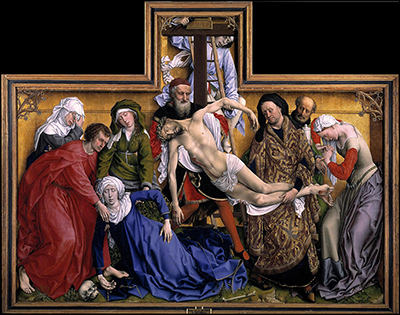
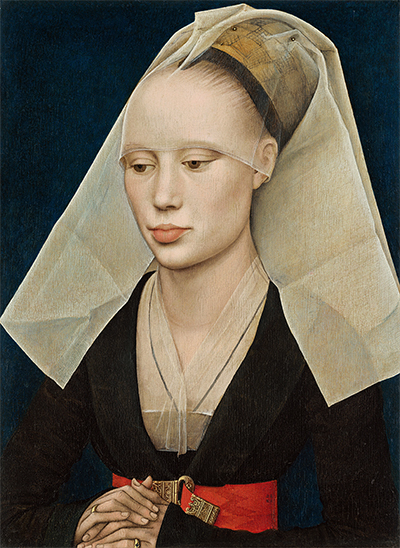
It also widens the emotional range of the cluster. The Descent from the Cross gives grief, Portrait of a Lady gives inward restraint, and Saint George and the Dragon gives action, courage and imaginative landscape. Together they prevent Rogier from being reduced to a single mood.
The panel is small, but its usefulness is large: it connects Rogier to Jan van Eyck, miniature-scale devotion, diptych questions, chivalric legend, open-access NGA sourcing and the early development of his style.
Frequently Asked Questions
It is in the National Gallery of Art, Washington, where it has the accession number 1966.1.1. [1]
The NGA dates it to about 1432/1435. [1]
The painted surface measures 14.3 x 10.5 cm, and the overall panel measures 15.2 x 11.8 cm. [1]
It shows Saint George on horseback killing the dragon, with Princess Cleodolinda kneeling nearby and an imaginative landscape behind them. [1]
The NGA says the panel was most likely used for private devotion and may have been part of a larger ensemble, perhaps a diptych. [1]
Discussion
How does Saint George and the Dragon sit within Rogier's career: as courtly legend, devotional courage, attribution question, or workshop-related image?
Reader Insights
The subject opens a different register from Passion grief, mixing courtly narrative with sacred courage and pictorial display.
This is the sort of page where evidence and caution matter: readers should know when a work is secure, debated or workshop-related.
Its value in the cluster is partly contrast. It prevents Rogier from being reduced to only portraits and Passion scenes.
Join the Conversation
Have a thought or observation about Saint George and the Dragon by Rogier van der Weyden? Share it below. Thoughtful responses may be added to this section as the Rogier van der Weyden cluster develops.
References
- National Gallery of Art, Washington, Saint George and the Dragon, collection record for 1966.1.1, accessed 2026-07-11. https://www.nga.gov/artworks/50662-saint-george-and-dragon
- National Gallery of Art, Washington, artist record for Rogier van der Weyden / Rogier de la Pasture, accessed 2026-07-11. https://www.nga.gov/collection/artist-info.1971.html
- The National Gallery, London, The Magdalen Reading, collection record for NG654, accessed 2026-07-11. https://www.nationalgallery.org.uk/paintings/rogier-van-der-weyden-the-magdalen-reading
- John Oliver Hand and Martha Wolff, Early Netherlandish Painting: The Collections of the National Gallery of Art Systematic Catalogue, Washington, 1986, listed by the NGA as a source for this object.
- John Oliver Hand, Catherine Metzger and Ron Spronk, Prayers and Portraits: Unfolding the Netherlandish Diptych, National Gallery of Art, Washington, 2006.