


 by Tom Gurney
Tom Gurney BSc (Hons) is an art history expert with over 20 years experience
Published on November 5, 2026 / Page Updated on November 5, 2026
Email: tomgurney1@gmail.com / Phone: +44 7429 011000
Introduction
Thomas Gainsborough's drawings are not a small appendix to his paintings. They are one of the clearest ways to see how he thought. In drawings, he could test landscape structure, invent roads and trees, place figures, vary light and shade, explore costume, and move between observed nature and studio imagination with unusual freedom. A painting had patrons, scale, price, likeness, exhibition and finish to consider. A drawing could be faster, more private, more exploratory and sometimes more experimental. It could also be complete in its own terms.
Gainsborough was a painter, draughtsman, printmaker and experimenter, and the British Museum identifies him explicitly across those roles.[1] That range matters because drawings sit at the centre of several parts of his practice. They connect his early looking in the countryside around Sudbury, his mature landscape invention, his figure studies, his printmaking, his studio experiments and his later interest in optical effect.[1][2][3][4] The best account of Gainsborough's drawings therefore avoids two mistakes: treating them as casual scraps, and treating every sheet as a direct plan for a painting.
The drawings show a mind that preferred movement to fixed formula. Gainsborough drew in chalk, wash, watercolour, stump, bodycolour, oil on prepared paper and mixed combinations of media.[5][6][7] Some sheets relate to paintings or prints; others seem to be independent exercises in landscape mood, figure placement or pictorial possibility.[3][5][6] His drawing practice is valuable because it reveals process without reducing art to process. It shows how an image could begin, change, gather atmosphere and move between media.
At a Glance
- ArtistThomas Gainsborough
- Core roleDrawing was central to landscape, figure, print and studio invention [1]
- MediaChalk, stump, wash, watercolour, bodycolour and oil on prepared paper [5][6][7]
- Early formationOutdoor looking around Sudbury and London training [1][2]
- Landscape modelsDutch artists including Wynants and Ruisdael [1]
- Transfer evidenceLandscape beside a lake is squared for transfer [4]
- Mixed-media exampleGrey wash and oil on brown prepared paper, varnished [6]
- Figure studyStudy of a Lady for The Richmond Water-walk [7]
- Cross-media sequenceThe Watering Place moved through chalk, oil and print [3]
- CirculationFrom the Bath years, drawings were given as presents rather than sold [11]
Contents
- Introduction
- Drawing as a Way of Thinking
- Landscape on Paper
- Media: Chalk, Wash, Watercolour and Oil
- Dutch Examples and Mature Invention
- Figures in the Landscape
- Drawing, Painting and Print
- Private Gifts and Later Scholarship
- Why Gainsborough's Drawings Matter
- Explore Related Practice
Drawing as a Way of Thinking
Gainsborough's House places the artist's earliest visual formation in the fields and woods around Sudbury, where he developed a love of landscape before his professional career was fully formed.[2] That childhood habit of outdoor looking matters for the drawings because it helps explain their constant attention to trees, tracks, banks, cottages, animals, roads and broken ground. He did not simply copy rural motifs as decorative signs. He learned how natural forms turn, lean, overlap and guide the eye.
The British Museum biography adds the formal side of this story: Gainsborough trained in London from 1740 to 1748, primarily at St Martin's Lane Academy under Gravelot and Hayman, and learned landscape painting partly by copying Dutch seventeenth-century works by artists such as Wynants and Ruisdael.[1] His drawings therefore emerge from both country experience and artistic study. They are not naïve records of nature. They are informed inventions shaped by looking at other art.
This combination explains why so many Gainsborough drawings feel natural without being topographical. A lane may bend just so; a tree trunk may lean diagonally; a cottage may close a distance; a figure may stand at exactly the point needed to animate scale. These effects can look spontaneous, but they often depend on compositional intelligence. Drawing allowed Gainsborough to work out how a landscape might lead the eye, not merely what a landscape contained.
Michael Rosenthal's account of Gainsborough's art is useful here because it treats the artist's career inside a world of professional pressure, social display and visual pleasure.[8] Drawings gave Gainsborough room away from some of those pressures. They were not free from artistic ambition, but they could remain closer to private invention. They show him making images for the eye before turning that visual intelligence toward patrons, exhibitions or larger painted works.
Landscape on Paper
Landscape was the great constant in Gainsborough's imagination, and drawings are central to that fact. The National Gallery of Art's 2003 retrospective gives a useful measure of their importance: alongside the painted works, it included thirty drawings, enough to make works on paper a structural part of the exhibition rather than a token supplement.[9] A Gainsborough exhibition without drawings would miss the engine room of his landscape art.
The Royal Collection Trust's Landscape beside a lake, dated about 1746-8, is a useful early example. It is a black and white chalk drawing on buff paper, squared for transfer, showing rocky outcrops, trees and water. The record notes that a related painting has not been identified and that the drawing is one of 25 landscape drawings in the Royal Collection firmly attributed to Gainsborough by Lindsay Stainton in 2013.[4] The sheet is important because it shows drawing as planning while also warning that planning does not always lead to a known finished painting.
The squared surface suggests a practical method: a composition could be transferred, enlarged or tested. Yet the absence of an identified related painting prevents overcertainty. Gainsborough may have intended a painting, abandoned it, changed the idea beyond recognition or used the drawing as part of a broader store of landscape inventions. This is exactly why drawing evidence needs careful handling. It reveals possibility, not always completion.
The subject itself also matters. A lake, rocky ground and trees are not grand historical drama. They are landscape elements that can be rearranged into pictorial movement. Chalk gives the sheet tonal breadth: dark masses, light touches and middle ground carried by the paper. Gainsborough's drawing practice often depends on that kind of economy. A few materials can hold space, weather and emphasis without descriptive overload.
This early sheet also complicates the idea that Gainsborough's landscapes were always late poetic fantasies. His fascination with landscape began early, and drawing was one of the places where it developed. Even when a drawing does not map a precise location, it records a sustained habit of building rural images out of forms he knew well: water, trees, paths, slopes, distance and shelter.
It also shows how the paper itself could become part of the design. Buff, brown, grey, blue or prepared supports are not neutral. They can supply the middle tone from which dark chalk and white heightening emerge. In that kind of drawing, Gainsborough did not have to describe every leaf or stone. He could let the support hold atmosphere while the chalks establish structure and light. The economy of means is part of the expressive force.
This explains why small or medium-sized sheets can feel larger than their dimensions. A dark tree mass, a pale highlight and a winding path can open a whole pictorial world. Gainsborough's drawings often create spaciousness through suggestion rather than inventory. The viewer completes distance, weather and movement from comparatively few marks.
Media: Chalk, Wash, Watercolour and Oil
Gainsborough's drawings are technically varied. The British Museum's Wooded landscape with wagon in a glade, dated 1760-65, is in black chalk and watercolour heightened with white, with an unfinished composition on the verso.[5] The curator's comments call full watercolour unusual for Gainsborough and describe the sheet as sophisticated, with possible debts to Van Dyck, William Taverner and Flemish landscape drawings.[5] That one record alone prevents any narrow definition of his draughtsmanship.
The same sheet shows how drawing could carry both finish and experiment. On one side is a worked landscape with wagon, figures and horseman; on the other is an unfinished composition with tree and hilly suggestions.[5] The sheet therefore holds two states of invention: one more developed, one provisional. Drawings often preserve exactly that doubleness. They can look like artworks and working spaces at once.
Chalk was especially important because it allowed Gainsborough to combine line, softness, smudged tone and highlight. Black chalk and stump could build figure or landscape forms; white chalk could strike light across paper; grey, brown or coloured papers could act as middle tone. This was not merely technical variety for its own sake. It allowed Gainsborough to think tonally. He could build a landscape from masses of light and shade before colour entered fully.
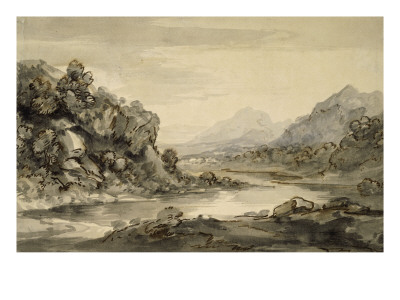
Wash gave him another kind of freedom. Brush drawing could make foliage, ground and sky move across the sheet in ways closer to painting than to line drawing. The British Museum's Wooded landscape with figures on horseback and cottage, dated 1770-75 in the record, is described as a brush drawing in grey wash, with oil, on brown prepared paper, varnished.[6] That combination of paper, wash, oil and varnish sits between drawing and painting. It shows Gainsborough working across categories rather than obeying them.
The use of oil on prepared paper matters because it shows that “drawing” does not always mean dry line. Some Gainsborough sheets are closer to small painted experiments or tonal rehearsals. The support may be paper, but the thinking can be painterly. This is why his drawings are so useful for understanding the rest of his art: they often bridge hand, brush, tone, surface and image-making in one object.
Dutch Examples and Mature Invention
Gainsborough's debt to Dutch landscape art is visible across his drawings, but it should not be understood as imitation alone. The British Museum biography says he learned landscape painting by copying Dutch seventeenth-century works by Wynants and Ruisdael.[1] The British Museum record for Wooded landscape with figures on horseback and cottage notes a diagonal tree-trunk device borrowed from artists such as Jan van Goyen and Herman Saftleven, with colouring reminiscent of van Goyen.[6] These are precise points of influence, not decorative labels.
The diagonal tree is a good example of how influence becomes structure. A slanting trunk can pull the eye, break symmetry, create depth, frame a path or give a composition movement. Gainsborough used such devices because they worked. Dutch art offered him a vocabulary for organising landscape, but his own sheets often turn that vocabulary toward softer, more pastoral or more atmospheric ends.
The same British Museum record also preserves dating caution. Although the sheet is dated 1770-75 in the object record, the curator's comments note that this type of mature Gainsborough is difficult to date precisely and that Hayes favoured the early 1780s while recognising links with compositions of the early to mid-1770s.[6] This is important because it prevents the drawings from being forced into an over-neat chronology. Style, subject and dating do not always align simply.
Mature Gainsborough drawings often feel like composed memories of landscape rather than direct records. Roads curve through woods; riders move under trees; cottages appear as resting points; distant light opens beyond foreground shadow. These effects may draw from Dutch precedent, but they also belong to Gainsborough's own way of thinking. The landscape becomes a field of passage. The viewer's eye travels through it.
That travelling eye matters. Gainsborough's drawings rarely ask only for factual inspection. They ask the eye to follow a path, move around a trunk, pause at a cottage, enter shade, cross water or notice a figure as a measure of scale. Drawing is where those visual journeys can be tested quickly. A sheet can hold the skeleton of movement before a painting gives it colour and scale.
The Dutch relation is therefore practical as much as historical. Gainsborough did not need Dutch landscape merely as subject matter; he needed its lessons in recession, framing, tonal grouping and the movement from foreground to distance. A small sheet could rehearse those lessons with extraordinary economy. A trunk blocks and invites. A path leads and disappears. A cottage interrupts the eye just long enough to make distance feel inhabited.
This also helps explain the frequency of riders, peasants, cottages and animals in the drawings. They animate space without requiring individual portrait identity. A rider can mark scale; a cottage can fix the turn of a road; a donkey, wagon or shepherd can slow the eye near the foreground. These figures are not always narrative subjects. Often they are instruments of pictorial movement.
Figures in the Landscape
Gainsborough's drawings are not all empty landscapes. Figures matter, sometimes as portrait studies, sometimes as pastoral actors, sometimes as compositional notes. The British Museum's Study of a Lady for the painting The Richmond Water-walk, dated about 1785-88, is in black chalk and stump, heightened with white, on buff paper.[7] The record places it among a group of full-length drawings of women datable by costume, especially wide hats, and connects it cautiously with the projected Richmond Water-Walk.[7]
This sheet is valuable because it shows figure drawing serving a different problem from landscape drawing. The whole body, costume, profile, hat, hand and gesture all matter. Gainsborough had to think about how a figure occupies space, how clothing carries movement, and how a body might belong inside a larger landscape composition. A drawing could isolate that problem before the larger work was settled.
The British Museum record also shows why caution is needed. A tradition identified such figures with Georgiana, Duchess of Devonshire, but John Hayes argued for their relation to the projected Richmond Water-Walk, a work apparently never finished and possibly never begun.[7] This is a perfect example of how drawing studies can be both seductive and uncertain. Costume, tradition, projection and unrealised plans all meet in the same sheet.
Gainsborough's figure drawings often resist the boundary between portrait and type. A woman in a broad hat may suggest a fashionable sitter, a studio model, a projected portrait group or a lyrical figure in a landscape. The drawing does not always answer which role comes first. Instead, it shows Gainsborough building a vocabulary of pose and silhouette that could serve several kinds of image.
This helps explain the relationship between drawings and paintings such as Mrs Richard Brinsley Sheridan or the late outdoor portraits. The figures in those paintings feel as if they belong to air, costume and movement, not just to likeness. Drawing allowed Gainsborough to develop that bodily elegance. The figure could be tested as contour, posture and tonal presence before it became a painted social identity.
The figure studies also show how drawing could detach pose from sitter. A painted portrait needs a name, a commission and a social setting. A drawn figure can hover between model, type, memory and future composition. That ambiguity is not a defect. It is one reason the drawings are so revealing. Gainsborough could explore the graceful possibilities of a hat, dress, arm, profile or turned body before those possibilities were tied to a finished pictorial situation.
In this sense the drawings belong to the history of portraiture even when they are not portraits. They investigate how bodies occupy landscape. They show how costume makes silhouette, how a gesture directs attention, and how a figure can become a moving accent within trees and air. The later painted elegance of Gainsborough's outdoor portraits is easier to understand when the drawn studies are taken seriously.
Drawing, Painting and Print
One of the clearest examples of Gainsborough moving between media is The Watering Place. The National Gallery links the oil painting to a mid-1770s chalk study and to Gainsborough's own soft-ground etching with aquatint of the same landscape idea.[3] The painting was exhibited at the Royal Academy in 1777, while the etching was not published during his lifetime.[3] This chain matters because it shows drawing as part of a larger process of transformation.
The National Gallery is careful about the differences. In the painting, the trees are denser and more imposing than in the drawing; the sandy path becomes a watering place fed by a stream; additional figures and animals appear; and the etching differs again, omitting some figures and making the trees less dense.[3] That sequence shows Gainsborough changing an idea as it moved from chalk to oil to print.
The lesson is simple but important: a drawing is not always a blueprint. It can be a starting point, a memory aid, a compositional field or a parallel version. When Gainsborough translated a drawing into a painting, he could alter scale, density, light, figure groups and narrative emphasis. When he translated an image into print, he could alter it again. Media gave him options.
This is also why the drawings belong near the prints in any account of Gainsborough. Soft-ground etching and aquatint were especially relevant because they could echo the tonal and textural qualities of chalk and wash. Drawing and printmaking are not the same practice, but for Gainsborough they were linked by an interest in line, tone, paper, pressure and atmospheric suggestion.[1][3]
The movement from drawing to print also complicates questions of audience. A private drawing might stay in the studio or pass as a gift. A painting could enter exhibition, sale or collection. A print could circulate differently, even when unpublished during the artist's lifetime. Gainsborough did not exploit printmaking commercially in the way some artists did, but his experiments show that he understood the visual possibilities of reproduction and transformation.
The Watering Place sequence is also a reminder that revision need not mean correction. The drawing, painting and etching are not simply better or worse versions of one design. Each medium asks for a different balance. Chalk can keep the image open and tonal; oil can deepen light, colour and density; etching with aquatint can restate the scene through bitten line and tone. Gainsborough's invention survives because it is flexible.
This flexibility is central to his draughtsmanship. A drawing could feed a painting, echo a painting, preserve an idea that never became a painting, or stand apart from painting altogether. The category is elastic, and that elasticity suits Gainsborough. His imagination moved by variation rather than by fixed repetition.
Private Gifts and Later Scholarship
The history of Gainsborough's drawings is partly a history of survival, dispersal and scholarship. The British Museum biography notes that drawings in its Prints and Drawings department are arranged according to Binyon's catalogue and lists John Hayes's The Drawings of Thomas Gainsborough as a major bibliographic authority.[1] The National Gallery of Art artist bibliography likewise lists Hayes's two-volume drawings catalogue of 1970 and 1971.[10] These references matter because drawings require careful attribution, dating and comparison.
The British Museum search material for Gainsborough-related drawings also preserves an important point from Kim Sloan's curatorial commentary: from his Bath years onward, Gainsborough never sold drawings but gave them away as presents.[11] That claim helps explain why drawings occupy a different social position from commissioned portraits. They could circulate through friendship, admiration and private exchange rather than through the main market in finished paintings.
This does not make the drawings slight. If anything, it makes them more revealing. A drawing given away may preserve a kind of artistic intimacy: a landscape invention, a study, a demonstration of handling, a memory of shared taste. Drawings could carry status among collectors and friends, but they did not have to answer the same demands as paid portraits. They often bring viewers closer to Gainsborough's own pleasures.
The later scholarly tradition matters because Gainsborough's drawings can be difficult. Attribution may be secure, tentative, rejected or revised. A sheet may be by Gainsborough, after Gainsborough, by an imitator, by a pupil or by a later hand working in his manner. The British Museum and Royal Collection records both show modern cataloguing as an active process, with references to Binyon, Hayes, Stainton and later reassessment.[1][4][5][6][7]
This is why drawings should be discussed with named holders and records where possible. A title, medium or date from a reproduction trail is not enough. The best evidence comes from museum catalogues, scholarly catalogues and object records that record technique, support, dimensions, attribution history and bibliography. Gainsborough's drawn world is rich, but it needs careful anchoring.
John Hayes's role is especially important because he gave the drawings a systematic scholarly framework. The repeated appearance of Hayes references in museum records and bibliographies shows how much later discussion depends on catalogue comparison rather than isolated admiration.[1][5][6][7][10] For paintings, a famous title can sometimes dominate public memory. For drawings, attribution and sequence often depend on the quieter work of comparing papers, media, handling, provenance and related compositions.
That scholarly caution should not make the drawings feel remote. It should make them more vivid. When a record identifies black chalk, stump, white heightening, prepared paper, wash, watercolour or oil, it gives the viewer a way into the physical act of making. The scholarship does not deaden the sheet. It helps the eye understand what kind of touch it is seeing.
Why Gainsborough's Drawings Matter
Gainsborough's drawings matter because they reveal the artist thinking in motion. They show landscape as a language of paths, trees, banks, water, light and figures. They show the body as silhouette, costume and gesture. They show media changing from chalk to wash to watercolour to oil on prepared paper, and from drawing to painting to etching. They show invention before finish, but they also show that a sheet of paper can be a finished visual experience.
They also help correct the common story that Gainsborough was simply a natural genius of fluent paint. His drawings show study, borrowing, revision, uncertainty and discipline. Dutch composition, Van Dyckian memory, chalk technique, studio models, figure groups, projected works and medium changes all belong to the story.[1][3][5][6][7] Fluency was real, but it was built from looking and practice.
Drawings also make sense of Gainsborough's landscape desire. His letters and later reputation often emphasise his wish to escape portrait demands and paint landscapes, but the drawings show that landscape was not merely an emotional preference. It was a technical and imaginative practice. On paper he could build worlds that were observed, remembered and invented at once.
The drawings finally matter because they keep Gainsborough open. A painting can feel resolved, even when it contains hidden change. A drawing often preserves the tremor of becoming: a line tried, a wash laid down, a figure held in balance, a path turning into space, a composition halfway between study and image. That openness is not a lack of finish. It is one of the great pleasures of his work on paper. Gainsborough's drawings let the eye watch invention taking shape.
They also protect the variety of his art. The polished society portrait, the ambitious landscape, the rustic figure group, the print experiment and the late optical image all have roots in the habits of drawing: looking, abbreviating, shifting, remembering and testing. To study the drawings is to see Gainsborough before certainty, but not before skill. It is to see an artist thinking with hand, eye and material together.
Explore Related Practice
Follow Gainsborough's drawing practice into the paintings, landscapes, prints and technical experiments that the manuscript connects directly.



Frequently Asked Questions
Discussion
Which drawing process most changes how you understand Gainsborough's finished works?
Reader Insights
How do paths, trees, cottages and figures guide the eye through a sheet?
What changes when chalk, wash, watercolour or oil on prepared paper carries the image?
Where does a drawing behave as a working stage, and where as a complete visual experience?
Join the Conversation
Share your reading below.
References
- British Museum, “Thomas Gainsborough.” View source.
- Gainsborough's House, “About Thomas Gainsborough.” View source.
- National Gallery, London, “Thomas Gainsborough, The Watering Place.” View source.
- Royal Collection Trust, “Thomas Gainsborough, Landscape beside a lake.” View source.
- British Museum, “Thomas Gainsborough, Wooded landscape with wagon in a glade.” View source.
- British Museum, “Thomas Gainsborough, Wooded landscape with figures on horseback and cottage.” View source.
- British Museum, “Thomas Gainsborough, Study of a Lady for the painting The Richmond Water-walk.” View source.
- Michael Rosenthal, The Art of Thomas Gainsborough: "A Little Business for the Eye" (New Haven and London: Yale University Press for the Paul Mellon Centre for Studies in British Art, 1999). Publication record.
- National Gallery of Art, Washington, “Thomas Gainsborough, 1727-1788.” View source.
- National Gallery of Art, Washington, “Thomas Gainsborough.” View source.
- British Museum, “Drawing after Anthonie Waterloo / Robert Price; curatorial comments on Gainsborough and drawing circles.” View source.


