 by Tom Gurney
Tom Gurney BSc (Hons) is an art history expert with over 20 years experience
Published on November 5, 2026 / Page Updated on November 5, 2026
Email: tomgurney1@gmail.com / Phone: +44 7429 011000
Introduction
Thomas Gainsborough's landscapes are not a side story to his portraits. They are one of the deepest continuities in his art, beginning with Suffolk memory and Dutch example, continuing through the practical demands of a portrait career, and returning in late works that turn roads, carts, trees, pools, cattle and rural figures into images of movement and atmosphere. The landscapes matter because they show what Gainsborough wanted painting to do when it was not bound entirely to likeness. They also help explain why so many of his portraits feel alive: even when the subject is a sitter, Gainsborough often thinks like a landscape painter.
The difficulty is that Gainsborough's landscapes are easy to simplify. One familiar story says that he loved landscape and endured portraiture. Another says that his rural scenes are charming views of the English countryside. Both contain a trace of truth, but both become misleading if left alone. Portraiture was more lucrative, and Gainsborough did continue to paint landscapes.[1] His native Suffolk mattered, and Dutch landscape painting mattered.[1][3] Yet the pictures are not simple escapes from clients or simple outdoor records. They are composed works shaped by memory, drawing, studio invention, market conditions, old-master looking, rural labour, figure study and later reception.
This account treats landscape as a career-long practice. It looks at Suffolk and common land, Dutch influence, the relation between landscape and portraiture, Bath and London ambition, rustic figures, late studio invention, collection evidence and the problem of topography. It prepares the ground for individual works such as Cornard Wood, near Sudbury, Suffolk, The Market Cart, The Watering Place, Landscape in Suffolk, A Coastal Landscape and Drinkstone Park, whose MASP title preserves uncertainty around The Woods of Cornard, without trying to turn any one of them into the whole story.
At a Glance
- Career-long practiceLandscape remained central from Suffolk youth to Gainsborough's late London years [1]
- Early anchorCornard Wood, near Sudbury, Suffolk, associated with 1748 [3]
- Key influenceDutch seventeenth-century landscape, later joined by Rubens [3][5]
- Recurring motifsRoads, carts, trees, pools, cattle, rural figures and changing light
- Land and societyCommon land, estates, labour, travel and rural activity [3][7]
- Portrait connectionLandscape settings help construct identity, movement and cultivated ease [1][8]
- Studio methodDrawing, sketches, memory and imagination were combined into convincing scenes [5][11]
- Public ambitionThe Watering Place entered the Royal Academy exhibition in 1777 [5]
- Late moodMovement, evening light and transience shape works such as The Market Cart [4]
- Linked landscape selectionSix dedicated landscape studies from the accepted 35-route plan
Contents
- Introduction
- Landscape and the Shape of the Career
- Suffolk, Common Land and Early Seeing
- Dutch Influence and English Ground
- Landscape and Portraiture Together
- Bath, London and the Studio Landscape
- Exhibition, Status and Public Ambition
- Roads, Carts and Rural Figures
- Drawing, Memory and Making
- Browse Thomas Gainsborough Landscapes
Landscape and the Shape of the Career
Gainsborough was born in Sudbury, Suffolk, and the landscape around the town became part of his imaginative equipment. Gainsborough's House describes him as a boy sketching in the woods and fields around Sudbury, and presents landscape as an abiding feature of his career.[1] That biographical fact should be used carefully. It does not mean that every later tree is a direct memory of childhood, or that every rural image is a confession. It does mean that landscape was present before the public glamour of Bath and London portraiture.
The career then moved through different pressures. After training in London, Gainsborough returned to Suffolk and worked for local patrons before moving to Ipswich. Bath brought a wider and wealthier clientele. London brought Royal Academy exhibition, royal favour and comparison with Reynolds. Through all of this, landscape persisted. Gainsborough's House notes that portraiture remained the more lucrative genre, but also that he continued to paint landscapes and often fused portrait and landscape within a single composition.[1] That fusion is one of the keys to his art.
The National Gallery describes Gainsborough's private inclination toward landscape and rustic scenes while also placing him among the leading portrait painters of later eighteenth-century England.[2] The balance matters. If landscape is treated as pure private truth and portraiture as mere work, the portraits are unfairly emptied. If portraiture is treated as the real career and landscape as decoration, the landscapes lose their force. Gainsborough's achievement lies in the tension between the two.
Landscape gave Gainsborough pictorial freedoms that portraiture could not always offer. It allowed him to explore weather, distance, paths, ponds, woods, carts, cattle, loose handling and changing light. It let him organise space without the central obligation of likeness. Yet the landscape habit also entered the portraits. Outdoor settings, wooded backgrounds and atmospheric passages are not background filler. They help make identity feel mobile and social life feel less rigid.
Suffolk, Common Land and Early Seeing
Cornard Wood, near Sudbury, Suffolk is the essential early anchor because it joins local geography, Dutch influence and social use of land. The National Gallery records the painting as a view near Great Cornard, close to Sudbury, and explains that Cornard Wood was common land where villagers had rights to gather wood, graze animals, dig materials, travel and walk.[3] That matters because the painting is not merely a pretty woodland. It is a landscape containing activity, rights, labour and local movement.
The National Gallery also notes that Gainsborough later wrote that Cornard Wood was painted at Sudbury in 1748, while he was still learning.[3] That retrospective claim gives the work unusual biographical charge. The painter, near the end of his life, could look back at an early landscape and see in it the persistence of his commitment to the genre. But the painting should not be reduced to nostalgia. Its value lies in the way it combines youth, observation, Dutch training, local ground and later memory.
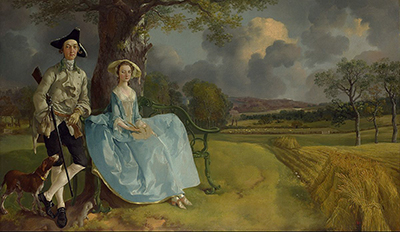
The common-land setting helps separate Gainsborough's landscapes from a single idea of rural England. Some landscapes are connected to private estate identity, most famously Mr and Mrs Andrews, where land helps construct the couple's social position.[7] Cornard Wood is different. It is rooted in shared use and local rights. People move through it, work in it and make practical claims upon it. The wooded view is therefore social as well as natural.
That distinction will matter throughout Gainsborough. Landscape can be estate, common, road, park, invented scene, coastal prospect, memory, studio theatre or market image. Good interpretation should ask what kind of land is being shown before deciding what the painting means.
Dutch Influence and English Ground
Gainsborough's early landscape art was shaped by Dutch seventeenth-century examples. Gainsborough's House notes that he was heavily influenced by Dutch landscape painting and that he could have encountered continental models through London art trade and collections.[1] The National Gallery's account of Cornard Wood names Dutch artists such as Wynants and Ruisdael as important examples, while also noting that East Anglian countryside shared visual features with the Netherlands.[3]
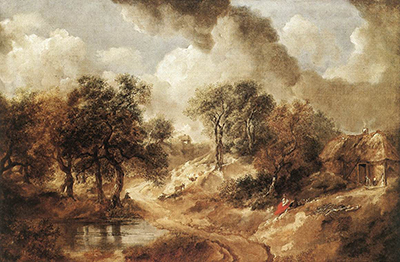
Dutch influence should not be used as a vague badge of seriousness. It helps explain specific pictorial choices: low horizons, winding paths, trees, ponds, roads, carts, ordinary figures and a taste for recognisable rural reality rather than ideal classical landscape. In Landscape in Suffolk, the Kunsthistorisches Museum-linked record on Google Arts & Culture points to traditional Dutch motifs such as a shallow pond, gnarled trees and a winding path.[10] That does not make the painting Dutch. It shows Gainsborough learning how a local English landscape could be structured through imported pictorial habits.
The phrase “English landscape” can sound natural, as if Gainsborough simply painted what was in front of him. The evidence is subtler. His landscapes are English in subject, memory and patronage, but they are also European in training and visual language. Dutch painting gave him a way to make ordinary rural ground into a picture. Rubens later offered another kind of model, especially for richness of colour and pictorial energy.[5] Gainsborough's landscapes stand between local attachment and international looking.
That double inheritance is one reason his rural scenes avoid simple topographical literalness. They often feel recognisable, but they are also composed. Trees lean, roads curve, water catches light, animals and figures punctuate space, and clouds build atmosphere. The landscape is not copied nature; it is nature remade as a pictorial argument.
Landscape and Portraiture Together
Landscape in Gainsborough is never entirely separate from portraiture. The double portrait Mr and Mrs Andrews proves this early and sharply. The National Gallery reads the painting through the relation between Robert and Frances Andrews and their land, and notes the unfinished area on Frances Andrews's lap as one of its unresolved problems.[7] The painting matters to landscape history because the setting is not a neutral backdrop. It is part of the couple's identity.
Other works use landscape more atmospherically. Mr and Mrs William Hallett, known as The Morning Walk, places a fashionable couple outdoors, walking with a dog shortly before their marriage.[8] The landscape here is not the same kind of estate statement as Mr and Mrs Andrews. It creates movement, leisure and social ease. The wooded setting helps make marriage look graceful, mobile and cultivated.
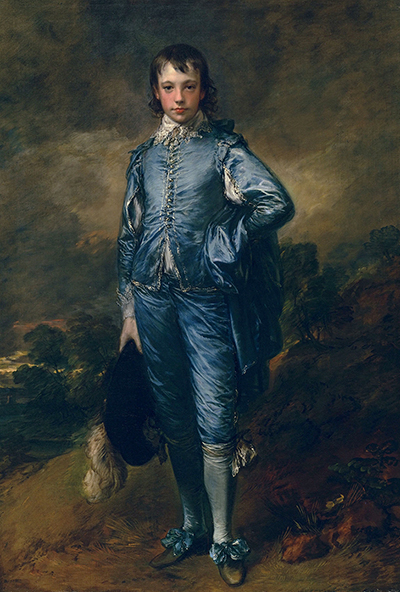
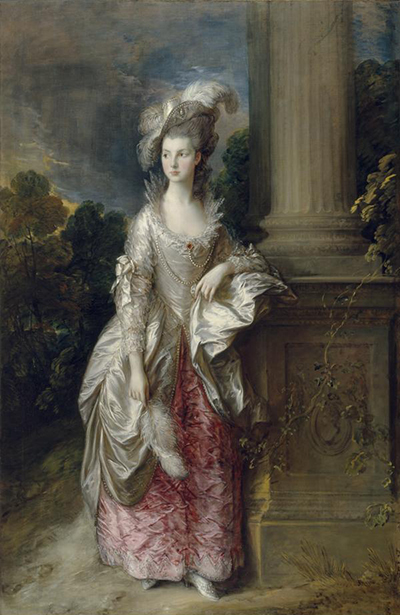
Single portraits also depend on landscape settings. A tree, a path, a distant valley or stormy sky can change the emotional temperature of a sitter. Gainsborough's portraits often feel less rigid than ceremonial portraiture because the landscape enters the figure's world. It makes air circulate around costume and status. This is one reason the boundary between portrait and landscape in Gainsborough should remain porous.
The fusion was also innovative. Gainsborough's House describes him as often combining the two genres within single compositions, while noting the lower status of landscape painting in the eighteenth century.[1] That lower status is important. Landscape could be loved, studied and sold, but portraiture carried more reliable money and social visibility. Gainsborough's hybrid works allowed landscape to enter the more prestigious field of portraiture and allowed portraiture to breathe through landscape.
Bath, London and the Studio Landscape
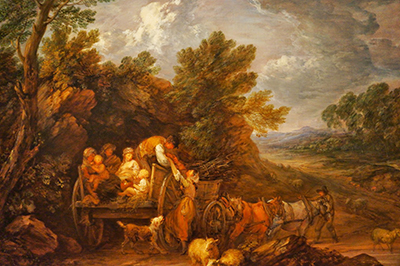
The move to Bath did not end Gainsborough's landscape practice. It changed its conditions. Bath supplied portrait clients, but the countryside around Bath also fed the imagination. The Barber Institute's The Harvest Wagon, exhibited in 1767, shows rustic figures travelling in a wagon at the end of the working day, with figures unusually prominent for a Gainsborough landscape and a setting inspired by the countryside around Bath.[9] The record also notes that the work was given to Walter Wiltshire when Gainsborough moved to London in 1774.[9] That history links landscape to patronage, friendship and movement between cities.
London brought new kinds of ambition. The Watering Place is especially important because it shows Gainsborough thinking through old-master landscape, exhibition and translation into print. The National Gallery explains that the painting echoes Rubens's The Watering Place, which Gainsborough saw in London in 1768, but turns that model into a more tranquil evening image.[5] The same record notes that Gainsborough exhibited the painting at the Royal Academy in 1777 and also made an etching of the scene.[5]
That combination matters. Landscape was not merely a private comfort hidden behind portrait commissions. It entered public exhibition. It engaged Rubens. It moved between drawing, painting and print. It could be large, ambitious and visible. When a reviewer of the 1777 Royal Academy exhibition wondered whether Gainsborough excelled more in landscape or portraiture, the question itself shows that the two fields were seen in active competition.[5]
The studio also becomes increasingly important. Some later landscapes look observed, but they are not simply outdoor transcriptions. They draw on sketches, memory, props, figure studies and compositional experiment. The Taft Museum's discussion of Gainsborough landscapes stresses that he used sketches, memory, imagination and years of observing nature to construct convincing scenes.[11] This helps prevent a false choice between truth and invention. A studio landscape can still be deeply responsive to nature.
Exhibition, Status and Public Ambition
Landscape's status in eighteenth-century Britain was complicated. Gainsborough's House notes that landscape painting was considered a lower branch of art than portraiture, even though Gainsborough helped establish the genre in England.[1] That hierarchy should not be treated as a fixed barrier. It was precisely because landscape carried lower public status that Gainsborough's persistence with it becomes so revealing. He did not only paint landscapes when no one was watching. He sent them into public view and measured them against the same world that judged his portraits.
The National Gallery of Art's 2003 retrospective record is useful because it shows the modern breadth of Gainsborough's reputation: the exhibition included paintings, drawings, portraits, landscapes and scenes of the rural poor.[6] That range matters. It confirms that the landscape question is not a narrow specialist corner of his career. It belongs to the full understanding of him as a painter who moved between social likeness, rural imagery, drawing, exhibition ambition and experiment.
Public ambition also changes the way the landscapes should be read. A work like The Watering Place was not only a private meditation on evening light. It was a Royal Academy picture, a response to Rubens, and an image that could be discussed by viewers who knew Gainsborough as a portrait painter.[5] A large late work such as The Market Cart was comparable in scale to grand full-length portraiture, which means its rustic subject was given physical presence normally associated with social display.[4] Gainsborough could elevate rural imagery without turning it into heroic classical landscape.
That is one of the distinctive tensions in the landscapes. They often present ordinary motifs: carts, pools, roads, children, cattle, woodcutters, resting figures, market produce. Yet they are worked through the ambitions of a major artist. The result is not documentary rural life, but it is not trivial decoration either. It is rural imagery made large enough, complex enough and painterly enough to challenge the hierarchy that placed landscape below portraiture.
Roads, Carts and Rural Figures
Gainsborough's landscapes are full of rural figures, carts, animals, travellers and resting bodies. These motifs can easily become sentimental if handled carelessly. A cart on a road is not automatically a symbol of wholesome country life. A peasant figure is not automatically decorative. A resting traveller, a market cart, a herdsman or a child may be part of social observation, compositional rhythm, fancy-picture invention or late memory.
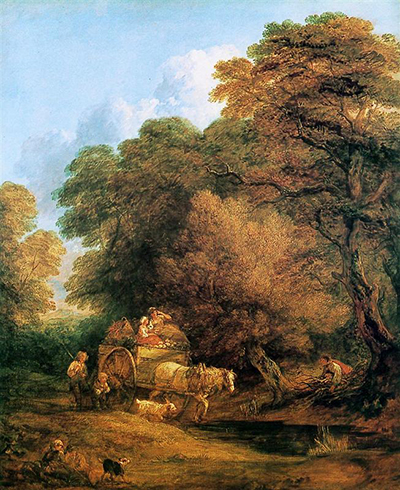
The Market Cart is the strongest late example. The National Gallery describes a horse-drawn cart moving along a woodland path, children, produce, travellers and a dog, while also noting that the painting is one of Gainsborough's last landscapes.[4] The same account warns against reading it as either accurate rural documentation or idealised landscape; it suggests the painting may be about transience.[4] That is a useful model for Gainsborough landscape interpretation because it resists both literalism and easy nostalgia.
The cart itself is a pictorial device as well as a rural object. It moves the eye through the painting. It carries people, produce, weight and time. The road bends. The wheel turns. The figures pass through a moment that will not last. Gainsborough's late rural imagery often depends on this feeling of passage. The landscape is not simply a place. It is an event.
Rural figures also serve scale and rhythm. The Taft Museum's comparison of the Taft landscape and A Coastal Landscape notes that figures and animals may have been assembled from different sketches, with some scale relations revealing the constructed nature of the scene.[11] That is important because it keeps the viewer from treating every figure as documentary evidence. Gainsborough's figures often help the eye move through trees, water and sky. They can be human, social and compositional at once.
Drawing, Memory and Making
Landscape was closely tied to drawing in Gainsborough's practice. Gainsborough's House emphasises his activity as a draughtsman and experimental maker, including soft-ground etching, aquatint and unconventional materials.[1] Those details matter because landscape invention often begins before the oil painting. A drawing may test a path, a group of trees, a pool, a cart, a cow or a figure. A later painting may gather several such studies into a scene that feels natural but was built from parts.
The Watering Place gives a clear example. The National Gallery states that the painting was based on a chalk drawing probably made in the mid-1770s, with the painted version making the trees denser and the pool more central.[5] The Market Cart also has a preparatory context: the National Gallery notes a freely painted unfinished oil sketch and a chalk-and-wash study connected to the horse and cart.[4] These details show that Gainsborough's landscapes were made through revision and transformation.
Memory is equally important, but it should not be romanticised. To say that Gainsborough remembered Suffolk does not mean that every late road is a literal remembered road. Memory in painting can be structural rather than topographical. It can shape the mood of a wooded path, the pull of evening light, the recurrence of carts, ponds and rural labour. It can also mingle with Dutch examples, Rubens, studio props and the demands of the market.
This is why landscape in Gainsborough often feels both familiar and invented. The viewer recognises a path, a pool, a tree, a cart or a sky, but the scene is arranged with painterly purpose. The landscape asks to be believed emotionally, not surveyed as a map.
Specific Places and Uncertain Titles
Some Gainsborough landscapes have strong place anchors. Cornard Wood is tied to Great Cornard, Great Henny and Sudbury, even while the National Gallery notes that the actual distances and church tower differ from the painted view.[3] That makes it a useful lesson in topography. A painting can be place-based without being a strict record. It can recognise a landscape and adjust it for pictorial effect.
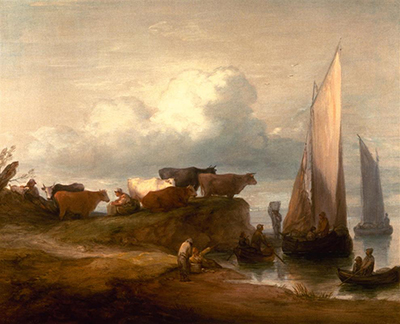
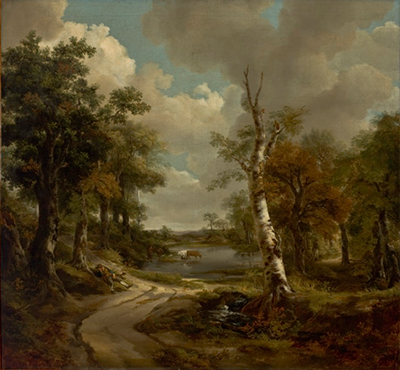
Other landscape titles require more caution. Landscape in Suffolk is anchored through a Kunsthistorisches Museum-linked Google Arts & Culture record that gives the title, date range, inventory number and discussion of Dutch motifs.[10] The record is useful, but a direct museum catalogue entry would strengthen any deep account. A Coastal Landscape is currently best supported through the Taft Museum's comparison with the Berger Collection work at the Denver Art Museum, which dates it about 1782-1784 and discusses its construction through sketches, memory and imagination.[11] Drinkstone Park is anchored by MASP, whose title connects the work with The Woods of Cornard while preserving uncertainty around that identification.[12]
These cases show why titles matter. Suffolk, Cornard, Drinkstone, coast and park are not interchangeable labels. They carry claims about place, history and identity. A responsible account of Gainsborough's landscapes should not smooth those claims into one general “English countryside.” It should preserve uncertainty where the source does.
Uncertainty can be productive. It reminds the reader that landscape painting often sits between place and invention. A title may come from later recognition, collection history or inherited usage. A scene may contain enough geographical memory to matter without offering the precision of a survey. Gainsborough's landscapes are strongest when this ambiguity is not hidden.
The MASP work is a good example because the uncertainty is visible in the institutional title rather than hidden in a footnote.[12] It is tempting to tidy such a title for readability, but the question belongs to the object. If the title joins Drinkstone Park to the Woods of Cornard with caution, the interpretation should not pretend that the place problem has disappeared. This is not pedantry. Landscape titles guide the whole reading of a picture: whether the scene is understood as Suffolk memory, topographical record, studio construction or later identification.
The same caution applies to A Coastal Landscape. The Taft Museum's comparison places the Berger Collection painting within Gainsborough's studio method, noting figures and animals that appear to have been assembled from sketches and observing scale effects that reveal invention.[11] That kind of evidence is valuable, but it does not replace a full current holder record. The best account can still discuss the painting's open coastal space and studio construction while making clear that the available evidence is not identical to a full catalogue entry.
Late Landscape and Transience
Late Gainsborough landscape has a particular mood. It is not simply softer or looser than the early work. It often feels more theatrical, more mobile and more conscious of passing time. Carts travel, figures rest, cattle drink, evening light fades, and wooded roads carry the eye beyond the immediate scene. The pictures can seem tranquil, but their tranquillity is rarely static.
The Market Cart, painted in 1786, gives this late mood a strong form.[4] Its cart moves toward market, its produce is perishable, and its figures are caught in a moment of passage. The National Gallery's account of transience is valuable because it finds meaning in movement rather than in a sentimental idea of rural innocence.[4] Gainsborough's late rural subjects can be affectionate without being merely cosy.
The Watering Place works differently. Its evening light, cattle, herdsman and water create a contemplative scene, but the painting is also a product of old-master looking, drawing and Royal Academy exhibition.[5] Its calm is constructed. It is not a direct window onto country peace. It is a picture made from memory, influence, observation and display.
The late landscapes also complicate Gainsborough's relation to modernity. He lived in a world of cities, exhibitions, aristocratic patronage and portrait demand, yet he repeatedly returned to rural forms. That return should not be turned into escapism too quickly. Rural imagery could be a place of invention, experiment, market appeal and emotional pressure all at once. The landscapes allowed Gainsborough to think about time, movement and memory in ways that portraits could not fully contain.
Late landscape also deepens the emotional problem of looking back. Gainsborough's early landscapes grew from Suffolk experience and Dutch models; the late landscapes often feel as if rural motifs have been filtered through decades of professional life. A cart is no longer only a cart. It becomes a moving form, a memory device, a scale marker and a carrier of time. A road is no longer only a passage through trees. It becomes a way of organising attention and suggesting that the scene is already passing.
This is why the late works can be tender without becoming sentimental. They recognise rural labour and rural types, but they also transform them through design. Produce may glow, children may perch on a wagon, cattle may drink, travellers may rest, yet the paint never lets the scene settle into simple illustration. Gainsborough keeps the viewer aware of movement, weather, handling and arrangement. The rural world is felt through artifice, and that artifice is part of the truth of the picture.
How to Look at a Gainsborough Landscape
A useful first question is: what kind of landscape is this? Is it a named place, a remembered Suffolk scene, a common, an estate, a wooded road, a coastal prospect, a park, an evening watering place, a market road or a studio construction? The answer changes the interpretation. Cornard Wood and Mr and Mrs Andrews both involve land, but the social meaning of common land differs from the social meaning of estate identity.[3][7]
Next, ask how figures and animals work. Are they labouring, resting, travelling, posing, grazing, watching or simply giving scale? In Gainsborough, figures are rarely neutral. They may show rural activity, guide the eye, introduce narrative, create sympathy or reveal the constructed nature of the scene. A cart, cow, dog or traveller can be both observed detail and compositional tool.
Then look at the making. Is there evidence of drawing, revision, pigment change, altered position or old-master influence? Cornard Wood has faded Prussian blue in the sky.[3] The Market Cart reveals an earlier position of the horse's head through aged paint.[4] The Watering Place grows from a chalk drawing and an encounter with Rubens.[5] Such evidence changes the way the pictures are seen.
Finally, resist the shortcut of calling every landscape “peaceful.” Gainsborough's landscapes may be tranquil, but they are also ambitious, worked, socially layered and often unsettled by movement. They show a painter using rural imagery not to avoid complexity, but to give complexity another form.
It also helps to ask what the landscape is asking the viewer to do. Some works invite recognition of place. Some invite sympathy with rural figures. Some ask the viewer to follow a path into depth or return from figures to trees. Some place social identity within land, as in Mr and Mrs Andrews.[7] Some make the viewer notice the making itself: a changed horse's head, a faded pigment, a dense tree mass altered from a drawing, a figure borrowed from a sketch.[3][4][5][11] Looking well means allowing these different invitations to remain different.
The most misleading approach is to treat every tree as biography and every rustic figure as emotion. Gainsborough's life matters, but the paintings are not diaries. Rural figures matter, but they are not always sentimental proxies for the artist. Landscape interpretation should move between evidence and looking: title, date, place, source record, visual structure, medium, condition and the actual role of figures, animals, roads and light.
Why the Landscapes Still Matter
Gainsborough's landscapes still matter because they hold together things that are often separated: local and European, observed and invented, rural and theatrical, private desire and public exhibition, painting and drawing, memory and market. They show the artist at work on problems that ran through his whole career. How can a path lead the eye? How can air become paint? How can a figure belong to a scene without dominating it? How can a landscape feel true without being merely factual?
They also reshape the portraits. Once the landscapes are taken seriously, Gainsborough's outdoor sitters look different. A wooded background is not just scenery. A sky is not just atmosphere. A path, estate, park or tree can help build social identity. Landscape was one of the ways Gainsborough made portraiture breathe.
At the same time, the landscapes deserve independence. Cornard Wood is not important only because it explains later portraits. The Market Cart is not important only because it shows late style. The Watering Place is not important only because it echoes Rubens. Each work belongs to a landscape practice that was ambitious in its own right, even when portraiture paid more and carried more immediate social prestige.
Gainsborough's landscapes are therefore not background to the career. They are the pressure beneath it. They keep returning as memory, experiment, pleasure, discipline and argument. In them, the artist found a way to make trees, roads, carts, pools, cattle, clouds and rural figures carry the same quickness of life that makes his portraits shimmer. The result is a body of landscape art that is neither simple view nor decorative retreat, but one of the most searching parts of his achievement.
Their continuing interest also lies in their resistance to tidy categories. An early Suffolk scene can be local, Dutch-inflected and later remembered. A late cart painting can be rustic, theatrical and technically self-aware. A watering place can be tranquil, Rubensian, drawn, painted, etched and publicly exhibited. A coastal view can look open and natural while still revealing the assembly of remembered motifs. Gainsborough's landscapes ask readers to hold these combinations together. They do not offer an innocent countryside outside art, society or market pressure. They offer countryside remade through a painter's eye: mobile, selective, affectionate, ambitious and alert to the passing of time.
That range is why no single landscape should be made to explain all the others. Cornard Wood gives the early, local and common-land problem. The Market Cart gives the late problem of movement and transience. The Watering Place gives old-master response and exhibition ambition. Landscape in Suffolk, A Coastal Landscape and Drinkstone Park keep title, place and evidence questions active. Together they show a painter returning to landscape not because it was simple, but because it could absorb many kinds of complexity without losing visual pleasure.
That balance of pleasure and difficulty is the real reason the landscapes remain essential to Gainsborough's achievement, and to any serious account of his art.
Browse Thomas Gainsborough Landscapes
These six linked works trace Gainsborough's dedicated landscape practice from Suffolk woodland and Bath-area rural life to late roads, coasts and uncertain place titles.
Frequently Asked Questions
Discussion
Which Gainsborough landscape most powerfully combines observed place with memory and studio invention?
Reader Insights
Where does a named Suffolk setting end and pictorial construction begin?
How do roads, carts, animals and figures turn a rural scene into an event?
Which drawing, technical change or cautious title most alters your reading?
Join the Conversation
Share your reading below.
References
- Gainsborough's House, “About Thomas Gainsborough.” View source.
- National Gallery, London, “Thomas Gainsborough.” View source.
- National Gallery, London, “Cornard Wood, near Sudbury, Suffolk.” View source.
- National Gallery, London, “The Market Cart.” View source.
- National Gallery, London, “The Watering Place.” View source.
- National Gallery of Art, Washington, “Thomas Gainsborough, 1727-1788.” View source.
- National Gallery, London, “Mr and Mrs Andrews.” View source.
- National Gallery, London, “Mr and Mrs William Hallett (‘The Morning Walk’).” View source.
- The Barber Institute of Fine Arts, “Thomas Gainsborough: The Harvest Wagon.” View source.
- Google Arts & Culture / Kunsthistorisches Museum Wien, “Landscape in Suffolk.” View source.
- Taft Museum of Art, “Life in Quietness and Ease: Thomas Gainsborough's Landscapes.” View source.
- MASP, “Drinkstone Park (The Woods of Cornard, title uncertain).” View source.