


 by Tom Gurney
Tom Gurney BSc (Hons) is an art history expert with over 20 years experience
Published on November 5, 2026 / Page Updated on November 5, 2026
Email: tomgurney1@gmail.com / Phone: +44 7429 011000
Introduction
Thomas Gainsborough's technique is often described with tempting shortcuts: loose, feathery, fluent, silvery, natural, spontaneous. Those words are not useless, but they can blur more than they explain. Gainsborough's art was not simply relaxed handling. It was a long negotiation among portrait likeness, landscape feeling, studio lighting, experimental materials, exhibition conditions, drawing, printmaking, and the practical demands of earning a living from painted people while imagining rural worlds with unusual freedom. His technique changed across his career, and even within a single painting it could shift from tight facial control to rapid foliage, from thin liquid passages to loaded touches, from descriptive clothing to atmospheric invention.
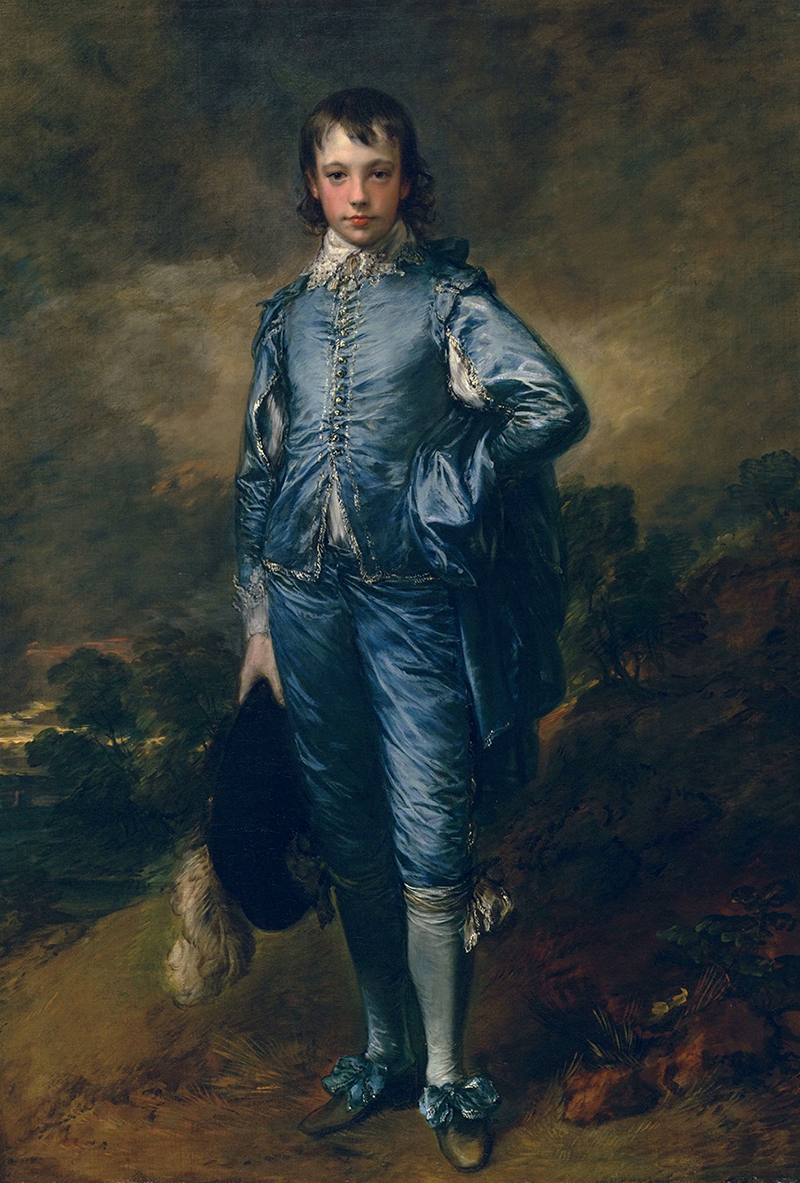
The best way to understand Gainsborough's method is to resist treating it as one style. The young painter of Cornard Wood in 1748 worked differently from the maker of Mr and Mrs Andrews around 1750, the Bath portraitist of Dr Ralph Schomberg around 1770, the ambitious creator of The Blue Boy in 1770, or the late experimenter with landscapes on glass in the 1780s.[1][2][3][4][5][6][7] Technique, for Gainsborough, was not a fixed signature laid over every subject. It was a set of choices shaped by what a work needed to do.
This matters because Gainsborough's art lives in transitions. He was a portrait painter whose private inclination leaned strongly toward landscape; a founding Royal Academician who quarrelled with exhibition hanging; a fashionable painter of sitters whose brushwork often seems to dissolve social hardness; and an artist who used technical experiment to sharpen visual experience.[8][9] His technique is therefore not only a matter of brushes and pigments. It is a way of balancing likeness, atmosphere, performance and pleasure.
At a Glance
- ArtistThomas Gainsborough
- Core mediaOil painting, drawing, printmaking and reverse-glass painting [8][11]
- Paint handlingThin liquid paint and bold unblended strokes [1][2]
- Mature touchLight, feathery strokes used selectively [8][9]
- Blue pigmentsUltramarine, smalt, Prussian blue and possibly azurite [4]
- Landscape practiceObservation, memory, invention and Dutch models [6]
- Technical imagingVisible, ultraviolet, infrared and X-radiographic evidence [3]
- Late experimentBacklit oil-on-glass landscapes viewed through a showbox [10]
- Reverse-glass methodHighlights and foreground details applied first [11]
- Display concernLighting, hanging height and viewing conditions shaped effect [1][9]
Contents
- Introduction
- Drawing, Looking and Early Landscape
- Portrait and Landscape Together
- Liquid Paint and Controlled Speed
- Studio Light and Hanging
- Colour, Pigments and Change
- Brushwork Without Cliché
- Drawing, Prints and Experiment
- The Showbox and the Eye
- Reading Technical Evidence Carefully
Drawing, Looking and Early Landscape
Gainsborough's technical identity begins with looking. Gainsborough's House places his earliest visual formation in the Sudbury countryside, where drawing outdoors became part of his childhood encounter with landscape.[8] That early attachment did not simply provide subject matter. It trained his eye in irregular forms: trees, hollow lanes, ponds, changing weather, rural figures and the broken textures of common land. Before Gainsborough became famous for society portraits, he had already built a visual memory of countryside.
Cornard Wood, near Sudbury, Suffolk, painted in 1748, shows how important that early training was. The National Gallery identifies the work as oil on canvas, made when Gainsborough was still learning his craft, and notes its relation to common land, village activity, ponds, donkeys, woodcutting and paths through the landscape.[6] The painting's technical importance lies partly in its closeness to observed nature. It is not yet a late poetic landscape, but it already turns local fact into pictorial rhythm.
The National Gallery also links Cornard Wood to Dutch landscape painting, especially the kind of recognisable reality associated with artists such as Wynants and Ruisdael.[6] Gainsborough could study Dutch works and engravings, but East Anglia itself offered comparable lowland forms: river meadows, ponds, windmills and wooded commons.[6] Technique here means translation. He learned from Dutch examples while discovering that his native landscape could supply equivalent pictorial material.
The same record notes that the Prussian blue pigment in the sky has faded to grey.[6] That detail is a useful warning for every technical account of Gainsborough. What viewers see now may not be exactly what eighteenth-century viewers saw. Colour can change; surfaces age; earlier restorations alter appearance; pigments behave differently over time. A responsible description of technique must allow for the material history of the object, not only the artist's original intention.
Gainsborough's early landscape manner also complicates the idea that he was always loose. Cornard Wood has a busy, close, descriptive quality, and the National Gallery records Gainsborough's own late reflection that the painting's touch and closeness to nature still pleased him despite what he saw as youthful limitations in composition.[6] That self-assessment is revealing. He valued touch and observation, but he also recognised composition as a separate problem. Technique was not just hand movement; it was arrangement.
Portrait and Landscape Together
The fusion of portrait and landscape is one of Gainsborough's most important technical achievements. Gainsborough's House notes that although portraiture was the more lucrative genre, he often fused portraiture and landscape within a single composition.[8] Mr and Mrs Andrews is the classic early example. Its technical interest is not only that it contains two sitters and a landscape, but that it makes the landscape carry social and visual meaning equal to the figures.
The National Gallery describes Mr and Mrs Andrews as a conversation piece in which the emphasis on landscape allowed Gainsborough to display his skill in changing weather and naturalistic scenery.[5] The cloudy sky throws light and shadow over fields and meadows, while the view across the Stour valley remains tied to local geography.[5] The technique is therefore both descriptive and expressive. Gainsborough uses weather to make land feel alive, but he also uses land to define the sitters' status.
Judy Egerton's catalogue entry adds an important technical nuance: the greyest areas of the sky contain no blue pigment, only wood charcoal and white, a method compared with grey sky passages in Dr Ralph Schomberg.[5] This tells us that Gainsborough's weather effects were not simply a matter of mixing obvious sky colours. He could build sky through restraint, greys and tonal control, drawing from Dutch landscape practice while adapting it to portraiture.
The painting also shows how different parts of a single work can demand different handling. Robert and Frances Andrews require likeness, clothing, posture and social clarity. The land requires changing light, distance, agricultural detail and atmosphere. The dog, gun, bench, cornfield, trees and distant churches all sit between portrait fact and landscape space.[5] Gainsborough's technique binds these elements without making them identical. He varies touch so that the figures stay legible while the landscape breathes.
This is why the word “unfinished” must be used carefully in Gainsborough. In Mr and Mrs Andrews, the blank area on Mrs Andrews's lap remains unresolved and has invited suggestions of a baby or a bird, but the National Gallery does not settle the question.[5] That unfinished detail is not the same as loose brushwork, nor the same as deliberate atmospheric softness. It is a specific material condition within a mostly resolved painting. Gainsborough's technique includes finish, incompletion and openness, but they do not all mean the same thing.
Liquid Paint and Controlled Speed
The National Gallery's account of Dr Ralph Schomberg gives one of the clearest public descriptions of Gainsborough's mature portrait technique. The portrait was painted in Bath around 1770, and the record describes the artificial, romantically wild landscape background as painted with speed and sureness, using bold unblended brushstrokes so fluid that dark paint has run down the canvas at the lower left.[2] That is not vague praise. It identifies a physical property of the paint: liquidity.
The same record notes that Gainsborough's daughter Margaret observed that he painted with colours that were “very liquid.”[2] The phrase is short, but it is valuable because it connects visible handling with remembered practice. Liquid paint allowed speed, softness and merging. It could let forms appear with minimal labour, or at least with labour disguised as ease. It also carried risk: runs, unevenness, fading and surface vulnerability could become part of the object's later life.
The National Gallery Technical Bulletin on Dr Ralph Schomberg places this object inside a broader examination of Gainsborough's portrait technique, including his use of six brushes, dim lighting conditions, artificial studio backgrounds, palette, paint application and views about proper hanging.[1] Those details help correct the myth of pure spontaneity. A painter who worked rapidly could still control conditions carefully. The apparent ease of the result depended on preparation, tools, studio environment and display expectations.
Controlled speed is a useful phrase for Gainsborough. In Dr Ralph Schomberg, the sitter's head, posture and identity require concentration, while the landscape background moves with bolder freedom.[2] The contrast gives the portrait much of its life. The figure remains socially and psychologically readable; the setting becomes a field of atmosphere. The quickness of the brush does not cancel structure. It creates a relationship between the stable sitter and the unsettled world around him.
The red coat in Dr Ralph Schomberg offers another material caution. The National Gallery records that the crimson pigment has faded unevenly, leaving areas of brown-beige, deep red and pink.[2] A modern viewer therefore sees not only Gainsborough's handling but the consequences of pigment change. Technical interpretation must hold both together. The coat was painted as colour, but it survives as colour altered by light and time.
Studio Light and Hanging
Gainsborough's technique depended not only on how he painted but on how he expected paintings to be seen. The Technical Bulletin's abstract names dim lighting conditions and artificial backgrounds among the factors relevant to understanding his portrait practice.[1] This is crucial. A painting designed for subdued light, close viewing or a particular height can lose force when hung badly or seen under conditions the painter did not anticipate.
The National Gallery artist record notes that Gainsborough was a founding member of the Royal Academy but later quarrelled with it over the hanging of his pictures.[9] Gainsborough's House likewise records that his relationship with the Academy became uneasy and that by 1783 he had stopped showing at its annual exhibitions, later using his own studio at Schomberg House for display.[8] This was not merely artistic temperament. It was connected to technique. Delicate colour, soft transitions and liquid handling could suffer if a picture was placed too high, too far away or in an unsympathetic light.
Studio background also matters. The wild or wooded settings behind many full-length portraits were not necessarily painted from direct outdoor observation. The Dr Ralph Schomberg record calls its landscape romantically wild yet artificial.[2] That phrase captures a major Gainsborough habit. Landscape in his portraits can feel natural without being topographical. It is made to support mood, status, silhouette and colour rather than to map a real place.
This does not make the backgrounds false in a simple way. Gainsborough had real landscape knowledge, and his invented settings draw authority from that knowledge. But the studio allowed him to control nature. He could darken a sky, loosen trees, soften distances or build a background that made the sitter more expressive. Technique here means staging: not theatrical fakery, but the crafted environment in which likeness becomes atmosphere.
Understanding lighting also helps explain why Gainsborough's surfaces can look so different across works. A painting such as Mr and Mrs Andrews uses naturalistic outdoor weather and local distance.[5] Dr Ralph Schomberg uses an artificial landscape of speed and mood.[2] The Blue Boy uses dark wooded setting and brilliant costume.[3][4] The technical question is not which one is the “real” Gainsborough. It is how he adjusted setting, light and paint to the kind of encounter each work required.
Colour, Pigments and Change
Gainsborough's colour is often admired for harmony and freshness, but technical evidence shows that colour in his works is also unstable, layered and historically altered. The Blue Boy is the clearest example. The Huntington's object record identifies several blue materials in the satin, including ultramarine, smalt, Prussian blue and possibly azurite, worked into the costume through layered marks rather than a single flat tone.[4] The famous blue costume is therefore not one colour but a constructed field of blue materials and touches.
That evidence matters because it changes the way one looks. The title The Blue Boy encourages a single-colour idea, but the painting's surface depends on variation: pale flashes, darker strokes, greys, whites, shadows and warm flesh set against the costume.[4] Gainsborough's colouristic brilliance is not simple saturation. It is orchestration. Blue becomes convincing because it is broken, layered and set against non-blue elements.
The Huntington's conservation account also shows how technical imaging can reveal what ordinary looking cannot. Visible light can identify condition issues such as abrasion, cracks and discoloured overpaint; ultraviolet light helps distinguish varnish and overpaint; infrared reflectography can reveal lower paint layers; X-radiography can show hidden structure, damage and earlier changes.[3] Such evidence does not replace looking. It makes looking more precise.
In The Blue Boy, these methods revealed an abandoned earlier portrait, a dog later covered with foliage, preparatory lines and layered brushwork in the costume.[3][4] For a technique account, the lesson is not simply that Gainsborough changed his mind. It is that the finished surface can conceal a history of reuse, revision and decision. A painting may look inevitable while carrying traces of other possibilities beneath it.
Colour change appears elsewhere too. The faded Prussian blue in Cornard Wood and the altered crimson in Dr Ralph Schomberg show that Gainsborough's palette has reached us through time, light and material behaviour.[2][6] That does not make visual pleasure unreliable, but it does make certainty dangerous. Modern viewers see surviving works, not untouched eighteenth-century appearances. Technique includes both making and ageing.
Brushwork Without Cliché
To call Gainsborough's brushwork “feathery” can be accurate, but only if the word is attached to evidence. The National Gallery artist record uses it for his mature work and links it with rich colour and the continuing popularity of his portraits.[9] Gainsborough's House similarly describes later portraits using thin paint applied in light, feathery strokes, associated with naturalism and fluidity.[8] The term therefore has a place, but it should not be applied mechanically to every painting.
Early works such as Cornard Wood and Mr and Mrs Andrews do not behave exactly like later portraits.[5][6] They can be detailed, exact, close to nature or sharply descriptive in ways that complicate the idea of universal looseness. In Mr and Mrs Andrews, the figures, clothing and land all require clarity, while certain tree passages hint at later freedom.[5] In Dr Ralph Schomberg, the artificial background is much bolder and more fluid.[2] The technique shifts with time, subject and function.
Brushwork also has social meaning. In portraits, Gainsborough's handling could soften status without removing it. A sitter might be dressed fashionably and posed with confidence, yet the paint around the figure could flicker, blur or breathe. This gives many portraits a quality unlike harder ceremonial images. The sitter remains socially present, but the surface keeps moving. The brush makes identity feel less fixed than costume alone would make it.
In landscapes, brushwork can carry mood rather than likeness. The Watering Place, exhibited at the Royal Academy in 1777, is described by the National Gallery as tranquil and contemplative, with evening light, dense trees, water and animals.[7] The record notes that contemporaries saw the influence of Rubens in Gainsborough's richer colour and energetic handling from the late 1760s, while also stressing that the work echoes rather than copies Rubens.[7] Here technique becomes memory transformed. Gainsborough absorbs an admired model but makes the result quieter and more inward.
This is why brushwork should be described as action, not decoration. A stroke can model satin, suggest foliage, soften distance, separate figure from background, imply weather or make a surface shimmer. Gainsborough's handling works because it responds to those tasks. It is not beautiful in the abstract. It is beautiful because it makes pictorial problems feel alive.
Drawing, Prints and Experiment
Gainsborough's technique cannot be confined to oil painting. Gainsborough's House describes him as an avid draughtsman and an experimental artist who used drawing and printmaking techniques, including soft-ground etching and aquatint, and unconventional materials in paint mixtures and drawings.[8] This broader practice matters because it shows him thinking across media. Line, tone, texture and light could be tested in more than one form.
The Watering Place gives a useful example of that cross-media habit. The National Gallery connects the oil painting with a mid-1770s chalk study and with Gainsborough's own soft-ground etching with aquatint of the same invention.[7] The painting, drawing and print are not identical. The painted version has denser trees, a watering place and additional figures and animals; the etching differs in several details.[7] Technique here involves translation between media, not simple repetition.
This matters for understanding Gainsborough's landscapes. A drawing could supply structure; a painting could deepen colour and atmosphere; an etching could alter emphasis and circulate a version of the invention. The artist's technical intelligence lies partly in knowing what each medium could do. Paper, copper, canvas and glass each offered different ways to test light, line and mood.
The late showbox experiments push this even further. The V&A describes Gainsborough's 1780s oil-on-glass landscapes, made to be viewed in a specially constructed showbox and backlit as an aid for planning larger compositions and exploring effects of lighting.[10] This is one of the most revealing episodes in his technique because it makes explicit what is implicit elsewhere: Gainsborough was fascinated by controlled light and by the experience of looking.
The V&A conservation account of one reverse-glass landscape explains that such works were painted on glass, viewed from the unpainted side, and made for transmitted light. The sequence of paint application was reversed: foreground and highlights came first, then further layers, with some areas thin and translucent and others more opaque. The account also notes sgraffito, where paint was scraped away to create bright highlights such as moonlight, a cottage window and a door.[11] This is not a minor curiosity. It shows Gainsborough treating technique as optical invention.
The Showbox and the Eye
The showbox helps explain Gainsborough's wider art because it reveals how intensely he thought about illumination. According to the V&A, the glass landscapes were backlit and viewed through a lens, with candlelight creating effects of glow, moonlight and changing atmosphere.[10] These works were not conventional easel paintings. They were images designed for a controlled viewing apparatus. The viewer did not simply stand before them; the viewer looked into them.
That experiment belongs to Gainsborough's late career, but it clarifies long-standing tendencies. His portraits often depend on where light falls, how faces emerge, how costume catches the eye and how backgrounds create mood. His landscapes often seem less concerned with exact geography than with the sensation of entering a particular atmosphere. The showbox made that interest literal. It used glass, candles, lens and translucency to intensify pictorial experience.
The reverse-glass process also required unusual discipline. Because the image was viewed through the glass, the painter had to think in reverse sequence, placing highlights and front details first.[11] This is almost the opposite of the myth of careless facility. It required planning, restraint and awareness of how transmitted light would transform pigment. The result was experimental, but not casual.
The showbox should not be used to explain every Gainsborough painting, but it helps define the range of his technical curiosity. He was not only a portraitist with a charming touch. He was an artist interested in how pictures operate under conditions of light, distance and viewing. His quarrels over hanging, his studio display, his liquid paint and his glass transparencies all point to the same underlying concern: a painting's effect depends on the encounter between surface and eye.
That concern also helps explain the relation between experiment and pleasure in his art. Gainsborough did not experiment in order to display apparatus for its own sake. He experimented because certain effects — moonlight, water, evening atmosphere, satin, flushed skin, moving trees, distant weather — required technical answers that ordinary description could not supply. The showbox made this pursuit unusually visible, but the same hunger for optical immediacy runs through the oil paintings. His technique is practical, poetic and perceptual at once.
The late glass works also suggest that Gainsborough's pictorial thinking was never confined to the surface directly before him. He imagined how an image might change under a lens, behind glass, through candlelight, or under an exhibition hang. That habit matters when looking back at conventional canvases. A portrait background or a landscape passage may look effortless, but it belongs to an artist who thought carefully about viewing distance, light, sequence and effect.
This is why Rosenthal's phrase “a little business for the eye” feels so apt for Gainsborough's art.[12] Technique is not merely material procedure. It is the management of visual experience. Gainsborough gives the eye work to do: move from face to foliage, from satin to shadow, from land to figure, from visible surface to hidden layer, from oil painting to printed or glass experiment. The pleasure is never passive.
Reading Technical Evidence Carefully
Technical evidence is powerful, but it has limits. Imaging can show an abandoned portrait under The Blue Boy, the hidden dog, discoloured overpaint, cross-section layers and the structure of pigments.[3][4] It can show faded sky colour in Cornard Wood or altered red in Dr Ralph Schomberg.[2][6] It can clarify how a reverse-glass transparency was built.[11] But it cannot automatically decide every question of meaning.
This distinction is important. A hidden dog in The Blue Boy tells us that Gainsborough revised the composition; it does not by itself explain every reason for the revision.[3][4] A blank lap in Mr and Mrs Andrews tells us that part of the painting remains unresolved; it does not prove exactly what was intended.[5] A faded pigment tells us that present appearance differs from earlier appearance; it does not allow a full reconstruction without further evidence. Technique deepens interpretation, but it should not be made to overclaim.
The same caution applies to general style. A statement about Dr Ralph Schomberg should not be transferred to every Gainsborough portrait. A fact about The Blue Boy should not become a rule for all blue passages. A showbox transparency should not be treated as if it explains a commissioned oil portrait from thirty years earlier. The value of technical evidence lies in its specificity.
At the same time, the specific examples do form a pattern. Across Gainsborough's work one sees interest in liquid paint, controlled light, varied finish, artificial and natural landscape settings, pigment behaviour, media translation and the visual pressure of display. The pattern is not a formula. It is a set of recurring problems he solved differently in different works.
This is the best way to approach Gainsborough's technique: not as a glossary of effects, but as a practice of adjustment. He adjusted handling to sitter, landscape, exhibition, surface, medium and mood. He could be precise without being dry, rapid without being careless, experimental without abandoning likeness, and atmospheric without losing structure. His technique matters because it makes those contradictions productive.
Why Technique Matters
Gainsborough's technique matters because it is inseparable from his meaning. The soft handling of a portrait changes how social identity feels. The weather in a landscape changes how land is understood. The blue layers of The Blue Boy make costume into spectacle. The grey sky of Mr and Mrs Andrews helps make ownership look natural and changeable. The faded pigments in Cornard Wood and Dr Ralph Schomberg remind viewers that paintings have material lives beyond the artist's hand.[2][4][5][6]
It also matters because technique explains why Gainsborough cannot be reduced to charm. His surfaces can be delightful, but that delight is built from choices: thin paint, bold unblended strokes, restrained greys, artificial backgrounds, careful lighting, experimental transparencies, and forms of finish that vary by purpose.[1][2][5][10][11] The charm is engineered. The lightness is worked for.
The strongest account of Gainsborough's technique therefore begins with objects. Cornard Wood shows youthful closeness to nature and Dutch-inflected landscape learning.[6] Mr and Mrs Andrews shows portrait and landscape fused through weather, colour and social space.[5] Dr Ralph Schomberg shows liquid paint, artificial background, fading pigment and the importance of studio and display conditions.[1][2] The Blue Boy shows layered colour, revision and conservation evidence.[3][4] The Watering Place shows drawing, painting, printmaking and Rubens refracted through Gainsborough's own evening mood.[7] The glass landscapes show late optical experiment.[10][11]
Seen together, these works reveal an artist far more technically deliberate than the myth of effortless fluency suggests. Gainsborough wanted paintings to breathe, but he knew that breathing had to be constructed. He wanted surfaces to feel alive, but he built that life through tools, materials, lighting, revision and viewing conditions. His technique is not a decorative supplement to his art. It is the means by which portraits become atmospheric, landscapes become intimate, and the act of looking becomes unusually alert.
Frequently Asked Questions
Discussion
Which technical choice most changes how you look at Gainsborough's surfaces?
Reader Insights
Where does controlled detail give way to liquid or atmospheric brushwork?
How should fading, overpaint and hidden revisions affect interpretation of the visible object?
What connects exhibition hanging, studio backgrounds and the late showbox experiments?
Join the Conversation
Share your reading below.
References
- David Bomford, Ashok Roy and David Saunders, “Gainsborough's Dr Ralph Schomberg,” National Gallery Technical Bulletin, vol. 12, 1988. View source.
- National Gallery, London, “Thomas Gainsborough, Dr Ralph Schomberg.” View source.
- The Huntington, “Project Blue Boy: Conservation.” View source.
- The Huntington, “The Blue Boy.” View source.
- National Gallery, London, “Thomas Gainsborough, Mr and Mrs Andrews.” View source.
- National Gallery, London, “Thomas Gainsborough, Cornard Wood, near Sudbury, Suffolk.” View source.
- National Gallery, London, “Thomas Gainsborough, The Watering Place.” View source.
- Gainsborough's House, “About Thomas Gainsborough.” View source.
- National Gallery, London, “Thomas Gainsborough.” View source.
- Victoria and Albert Museum, “Thomas Gainsborough's Showbox.” View source.
- Victoria and Albert Museum, “Technical examination and conservation of a reverse glass painting by Thomas Gainsborough.” View source.
- Michael Rosenthal, The Art of Thomas Gainsborough: "A Little Business for the Eye" (New Haven and London: Yale University Press for the Paul Mellon Centre for Studies in British Art, 1999). Publication record.


