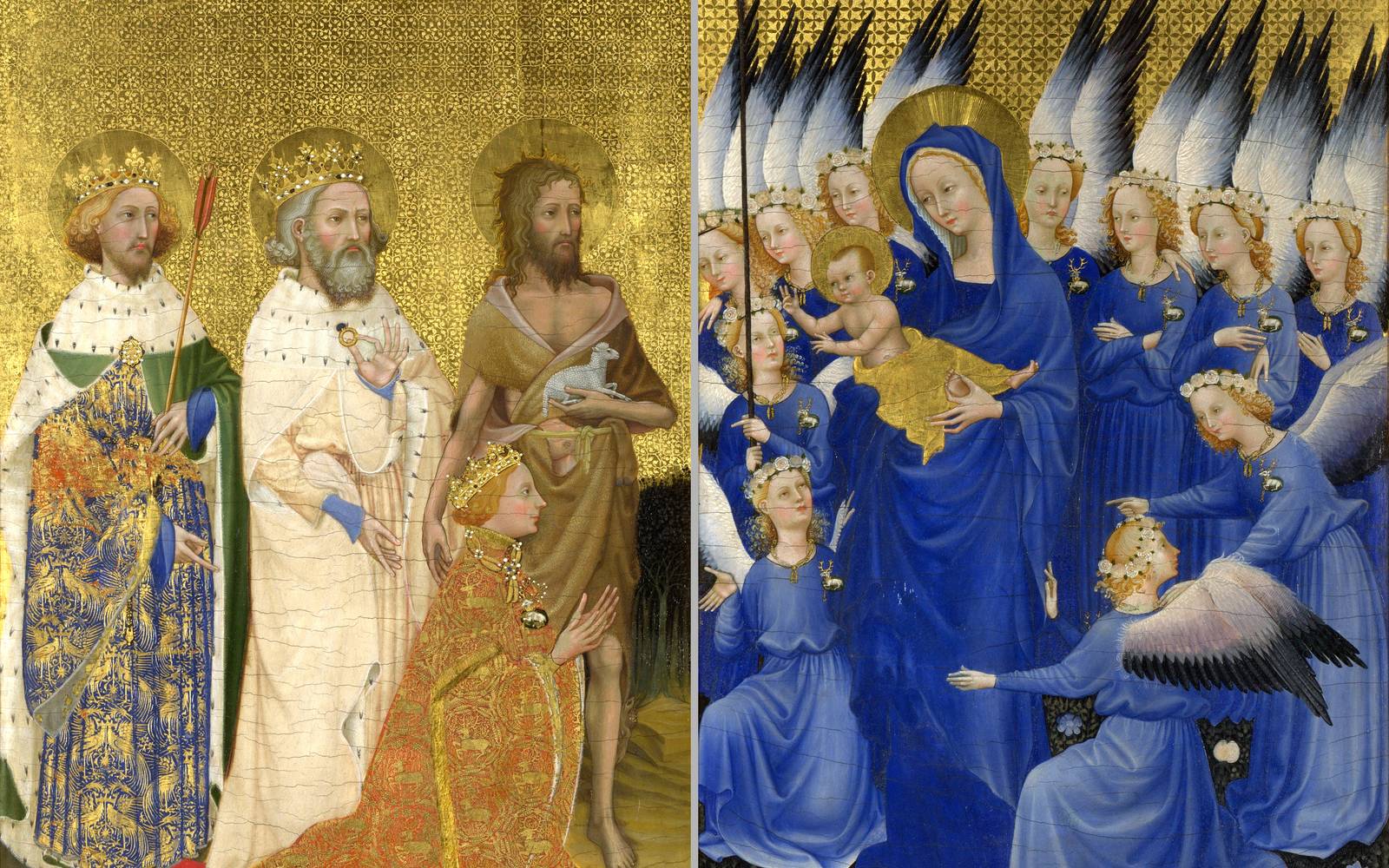
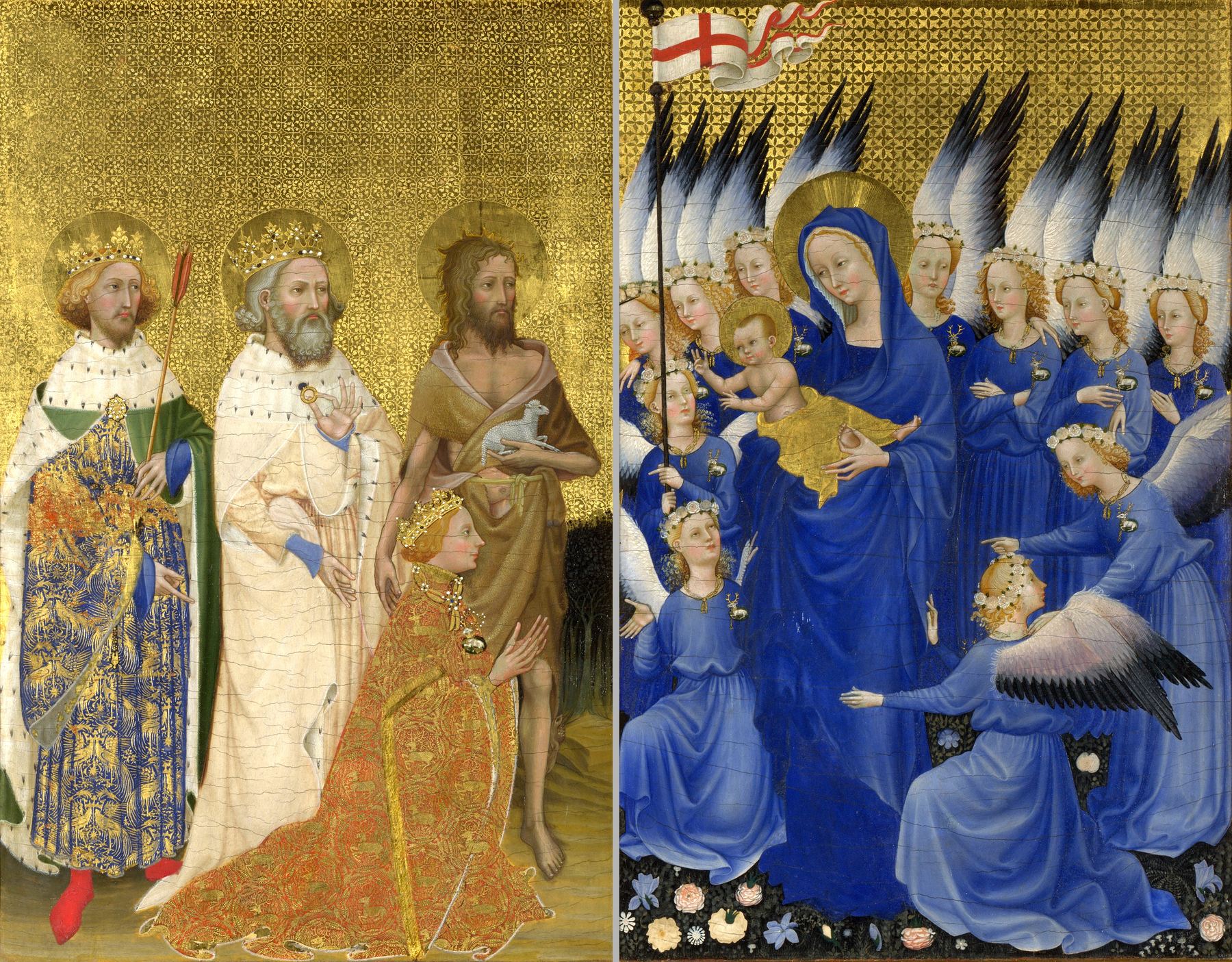
Image reference: The Wilton Diptych.
At a Glance
- Core periodApproximately 1375–1425, with regional continuities into the 1430s and 1440s
- Major centresParis, Dijon, Prague, Milan, Verona, Florence, London, Barcelona and Valencia
- Alternative termsInternational Style, Courtly Gothic and, in overlapping Central European contexts, Beautiful Style or Soft Style
- Leading artistsThe Limbourg brothers, Jacquemart de Hesdin, the Boucicaut Master, Melchior Broederlam, Claus Sluter, the Master of the Třeboň Altarpiece, Gentile da Fabriano, Lorenzo Monaco, Pisanello, Lluís Borrassà and Bernat Martorell
- Principal mediaIlluminated manuscripts, panel painting, sculpture, tapestry, metalwork, embroidery and composite altarpieces
- Known forElegant line, elongated figures, luxuriant textiles, gold, heraldry, expressive gesture and minute natural detail
- Major patronsJean de Berry, the Valois dukes of Burgundy, the Luxembourg court in Prague, Richard II and wealthy civic or ecclesiastical commissioners
- Key qualificationA historical classification, not a medieval movement's own name
- Essential tensionRegional difference remained strong inside an international network
- Long afterlifeIts court imagery, observational detail and precious surfaces fed both Early Netherlandish painting and the Italian Renaissance
Contents
- Where it fits
- What the term means
- Objects and people in motion
- Splendour and fracture
- The manuscript
- Materials and meaning
- Burgundy and Champmol
- Prague and the Beautiful Style
- Essential works
- Where to see it
Where International Gothic fits
Melchior Broederlam
Key career periodClaus Sluter
Key career periodMaster of the Třeboň Altarpiece
Key career periodLorenzo Monaco
Key career periodLluís Borrassà
Key career periodLimbourg brothers
Key career periodGentile da Fabriano
Key career periodPisanello
Key career periodBernat Martorell
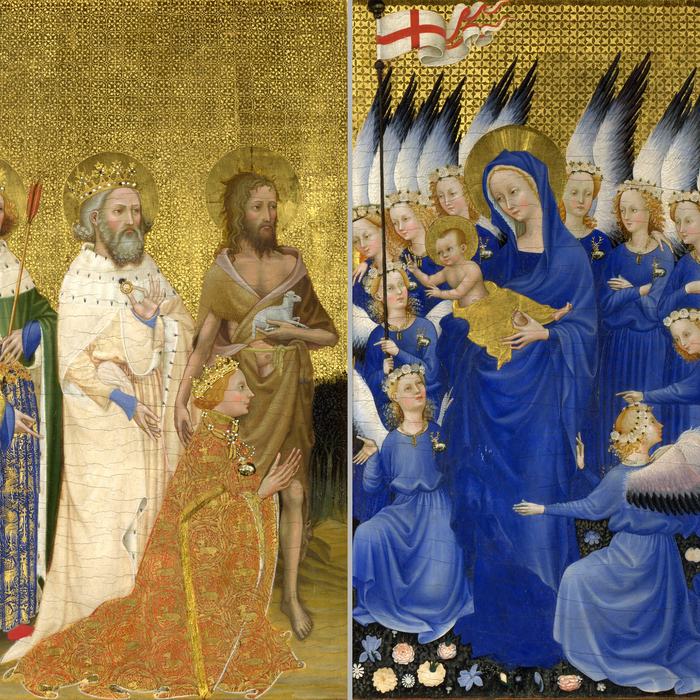
Key career periodOpen the Wilton Diptych and two worlds face one another. On the left, Richard II of England kneels behind John the Baptist, Edward the Confessor and Edmund the Martyr. On the right, the Virgin holds Christ amid eleven angels. The ground beneath the saints is dark and earthly; the heavenly company stands in a meadow so crowded with flowers that blue seems to grow through gold.
Almost every detail carries political weight. Richard’s white-hart badge appears on his robe and around the angels’ necks. A banner bearing the red cross of Saint George passes towards Christ’s blessing hand. English patron saints introduce the king to heaven, while expensive ultramarine, tooling, gilding and tiny raised dots that imitate pearl and enamel make his theology materially persuasive. The object is small enough to close, carry and use in private devotion. Sacred kingship has been made portable.[1]
The painter’s identity remains unknown. England, France, Italy and Bohemia have all entered the attribution debate, although current research considers production at Richard’s English court probable. That uncertainty is not a failure. It reveals why the diptych has become a defining work of International Gothic: its materials, techniques, types and ideas cross the national borders by which later museums organise art.[2]
International Gothic was not an association with members or a manifesto. It is a modern name for related visual languages that flourished across Europe around 1375–1425, with important continuities beyond those dates. Artists, manuscripts, textiles, drawings, precious objects and workshop practices travelled between courts and cities. Graceful figures, rippling line, fashionable dress, brilliant colour, patterned surfaces and close attention to plants and animals appeared in many regions, but never in one fixed combination.[3]
The result is an art of productive contrasts: stylisation and observation, intimacy and public authority, delicacy and violence, sacred devotion and worldly display. Its finest works do not simply decorate the end of the Middle Ages. They ask how an image can make cloth seem touchable, gold seem weightless, a saint seem present and political power seem divinely ordered.
What does “International Gothic” mean?
The adjective “international” can suggest a borderless style understood in the same way everywhere. The history was less tidy. A Parisian book, a Bohemian Madonna, a Burgundian tomb and a Valencian retable may share curving silhouettes or sumptuous surfaces while serving different institutions, audiences and devotions. The term is most useful when it identifies contact without erasing transformation.
Court manuscripts make the principle visible. Between about 1380 and 1450, books made for rulers and aristocrats combined elegant figures, extraordinary costume, naturalistic landscapes and patterned surfaces. Artists and books moved between European centres, carrying compositional ideas and workshop habits with them. Paris was a powerful centre, but movement in and out of the city mattered as much as influence radiating from it.
The language also spread through demand. A Parisian book of hours made around 1410 was illuminated by followers of the Boucicaut and Egerton masters. Its elongated bodies, swaying posture, acanthus borders, brilliant colour and scattered gold are recognisably International in style. Yet it is equally evidence of a commercial market: rising demand encouraged several specialists to collaborate, and the image of its woman owner at prayer identifies gendered use as well as sumptuous manufacture.[4]
“Gothic” is no simpler. Renaissance writers and later historians often positioned Gothic art as the condition that Italian classicism overcame. Around 1400, however, artists did not experience themselves as waiting for a better age. Gold grounds, linear rhythms and court fashion were capable of innovation. Experiments in light, landscape, anatomy and space took place inside them.
Dates must therefore remain approximate. The Wilton Diptych belongs near the end of the fourteenth century; Gentile da Fabriano’s greatest Florentine altarpiece is dated 1423; Pisanello carried aspects of courtly naturalism into the 1430s and 1440s. In Rouen and England, the Master of Sir John Fastolf continued a career rooted in Parisian training. His movement across regions demonstrates that war’s political borders did not stop the transfer of artistic knowledge.[5]
Regional names should not be treated as interchangeable labels. The Beautiful Style of Prague and Central Europe, the Soft Style of the Upper Rhine, Italian gotico internazionale and Iberian gótico internacional overlap with the larger category. Each identifies a more specific history. International Gothic is best understood as the widest map, not a substitute for every place-name beneath it.
A Europe connected by objects and people
Dynastic families created one network. The French royal house of Valois placed brothers and uncles in powerful territories. Jean de Berry amassed manuscripts, goldsmith work, tapestries and castles. Philip the Bold, duke of Burgundy, employed artists from the Low Countries and northern France at Dijon. Marriages connected rulers and possessions; gifts and diplomatic visits gave objects political lives.
Artists created another network. The Limbourg brothers came from Nijmegen and worked in France. Melchior Broederlam was based in Ypres but served the Burgundian duke. Claus Sluter came from Haarlem and transformed sculpture at Dijon. Gentile da Fabriano moved through central and northern Italy before working in Florence and Rome. A label based only on modern nationality misses the working geography.
The Boucicaut Master’s circle shows why movement was not limited to religious imagery. An illumination of Creusa receiving Medea’s poisoned jewellery places a classical tragedy inside early fifteenth-century dress and architecture. Ermine, flaming jewels, gold and saturated pigment make catastrophe visually luxurious. The International manner could stage moral history and bodily destruction as readily as prayer.[6]
Travel occurred at several scales. A painter might relocate for a commission. A manuscript could pass through inheritance. A tapestry could be rolled and carried between residences. A small devotional panel could accompany its owner. Drawings and pattern books preserved figures, animals and ornaments for reuse. Expensive blue pigments, Baltic oak, silk, gold leaf and metal thread also travelled through commercial routes.
Cities and courts were interdependent. A ruler’s commission depended on parchment makers, merchants, scribes, carpenters, carvers, gessoworkers, gilders and painters. Urban workshops gave magnificence its material form. In Florence, the patron of Gentile’s Adoration of the Magi was Palla Strozzi, an immensely wealthy banker. Courtliness was an aspiration that merchants and religious institutions could commission, not the exclusive property of kings.
Splendour in an age of fracture
The years around 1400 were not a tranquil interval of refined manners. The Hundred Years’ War continued; plague returned after the Black Death; the Western Schism divided Latin Christianity; rulers faced rebellion, deposition and assassination. Richard II lost his crown in 1399. Charles VI of France suffered periods of mental illness. The rivalry around his court culminated in the murder of Louis of Orléans in 1407 and the assassination of John the Fearless in 1419.
Luxury did not float above this instability. Devotional books organised prayer through days shaped by fear, illness and death. Dynastic monuments asserted continuity. Heraldry made loyalty visible. Portable valuables could move when households did. The Belles Heures was designed for Jean de Berry’s private prayer, but it also belonged among castles, chalices and other possessions through which an uncle of the French king displayed rank.
When the Belles Heures was temporarily unbound for conservation and exhibition, its pages could be seen as individual paintings. That rare display clarified both the miniatures’ independence and the book’s normal integrity. In use, every image belonged to a sequence of prayers, text, turning pages and bodily handling. The Valois setting joined intimate devotion to an environment of precious objects.
Jean de Berry’s itinerant household carried tapestries and furnishings among his châteaux. Tapestry supplied colour and warmth, but its mobility also made a temporary residence ceremonially complete. Collecting was not passive accumulation. By choosing, inventorying, moving and comparing objects, patrons constructed an artistic geography around themselves.
Burgundian magnificence was just as political. Philip the Bold founded the charterhouse of Champmol outside Dijon as a religious house and dynastic burial site. His successors’ artistic expenditure accompanied conflict over France. The same patronage culture that supported prayer and startling invention helped turn territorial ambition into visible legitimacy.
The manuscript as a total work
A book of hours contained prayers for lay use, commonly including the Hours of the Virgin, calendar, penitential psalms, Office of the Dead and suffrages to saints. Its form allowed an owner to structure private devotion according to the liturgical day. The richest examples added extensive picture cycles, heraldry and personal saints, creating an object at once conventional and singular.
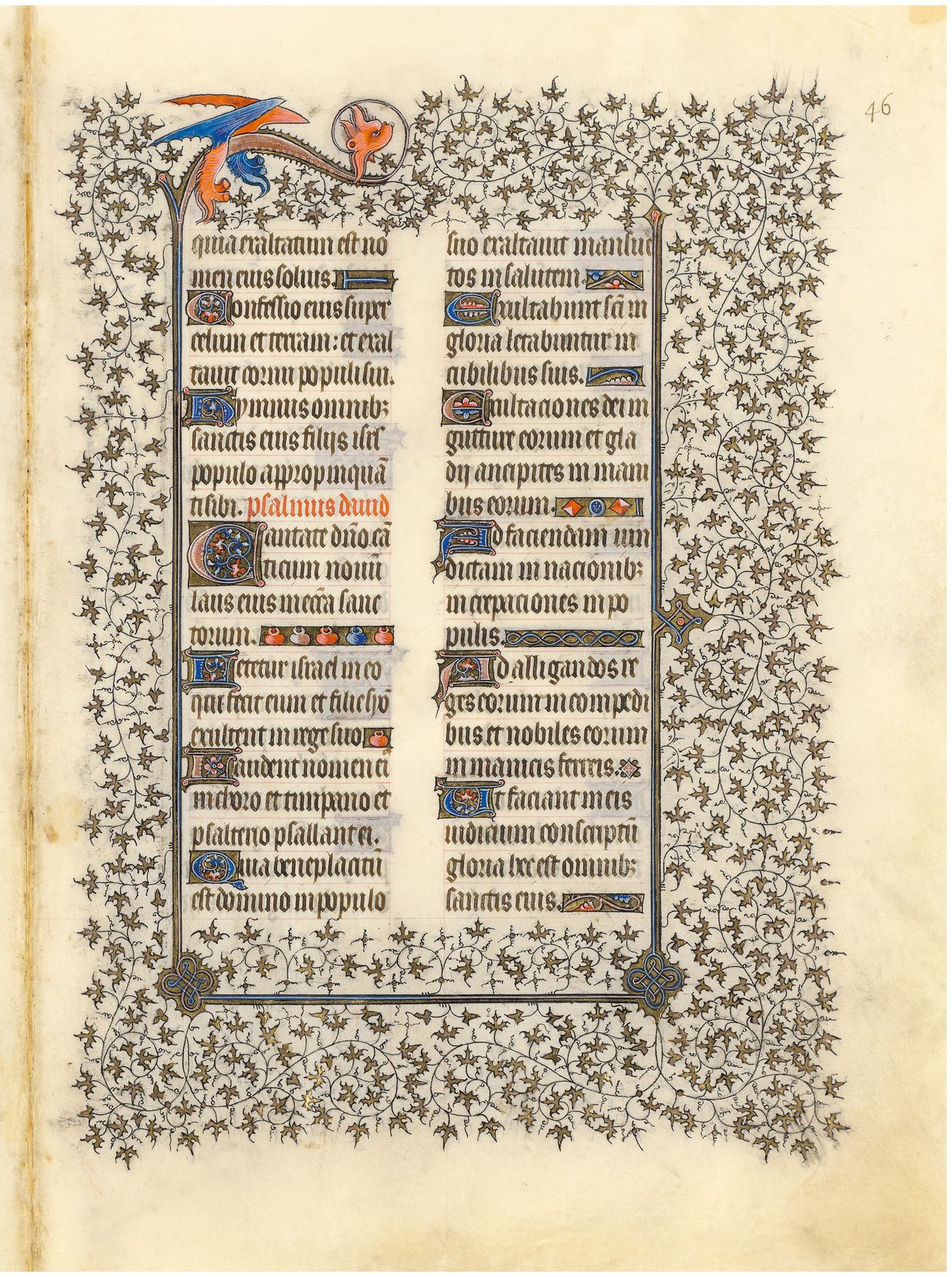
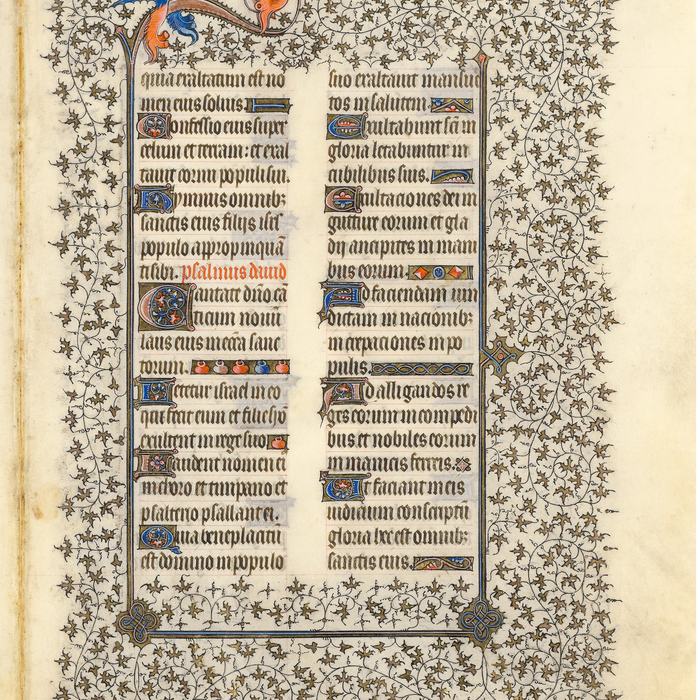
The Belles Heures, made about 1405–08/09, is the only manuscript whose miniatures were executed throughout by Herman, Paul and Jean de Limbourg. Jean de Berry gave the young brothers unusual freedom. Seven added picture-book cycles enabled experiments beyond the customary structure, while high-resolution study reveals astonishing control of tiny faces, architecture, light and surface.[7] [8]
Even this apparent unity depended on many makers. Anonymous specialists painted most borders; others prepared parchment, ruled lines, wrote text and bound the gatherings. The Limbourgs’ authorship is real, but it does not cancel collective manufacture. Their growth within the project is visible in stronger spatial construction, more concentrated emotional narrative and increasingly subtle light.[9]
Their Passion cycle demonstrates that innovation could include difficulty. Seventeen full-page scenes gave the artists unusual room to narrate Christ’s suffering, yet some early architectural elements do not produce consistent space. A column may seem near at its base and farther away at its capital. Such moments are not embarrassing failures before perspective. They show artists testing how patterned page, architecture and human drama could coexist.[10]
Jean de Berry’s patronage joined manuscript devotion to the movement of tapestries, furnishings and prized possessions among his residences.[11] At the related Valois court of Burgundy, artistic expenditure made dynastic ambition visible even while factional struggle produced murder and retaliation.[12]
The unfinished Très Riches Heures extended these ambitions. Its celebrated calendar joins seasonal labour, aristocratic activity, changing light and ducal castles. The brothers died by 1416 before completing the manuscript; later artists added to it. Treating the whole book as the untouched vision of three brothers hides both its interrupted history and the persistence of its prestige.
Parisian workshops also developed new atmospheric effects. The Boucicaut Master and related illuminators explored blue distance, night, cloud, reflections and rooms opening into landscape. A successful master’s name now often derives from one manuscript because documentary identities have been lost. That designation assembles a body of work by visual comparison; it does not prove that every page was painted by one hand.
Materials that argue
International Gothic’s preciousness was not applied after meaning. Material helped make the argument. Gold suggested incorruptibility, heavenly light and worldly cost. Ultramarine could distinguish the Virgin or announce expenditure. Punching and tooling made halos vibrate. Pastiglia or raised ornament turned flat painting into a simulation of metalwork. Brocade patterns linked sacred clothing with elite dress.
The Parement de Narbonne, made around 1375, demonstrates a different kind of splendour. Its Passion scenes and royal donors are painted in grisaille on silk. Restricted colour concentrates attention on line, expression and the visual analogy to precious woven or embroidered cloth. Charles V and Jeanne de Bourbon kneel within a program that connects personal devotion to royal identity.[13]
Panel construction likewise involved specialised knowledge. The Wilton Diptych’s two oak wings were carved to include their frames, prepared, gilded and painted on both sides. Raised touches of lead white imitate pearls and enamel. Technical analysis links the wood to the eastern Baltic, while the painted flesh and binding medium participate in wider European practices. Material evidence can narrow possibilities without naming a painter.
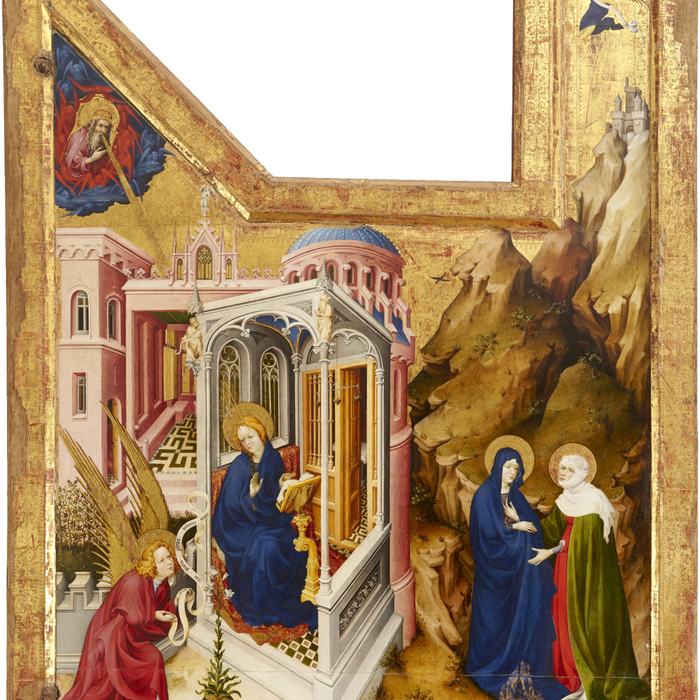
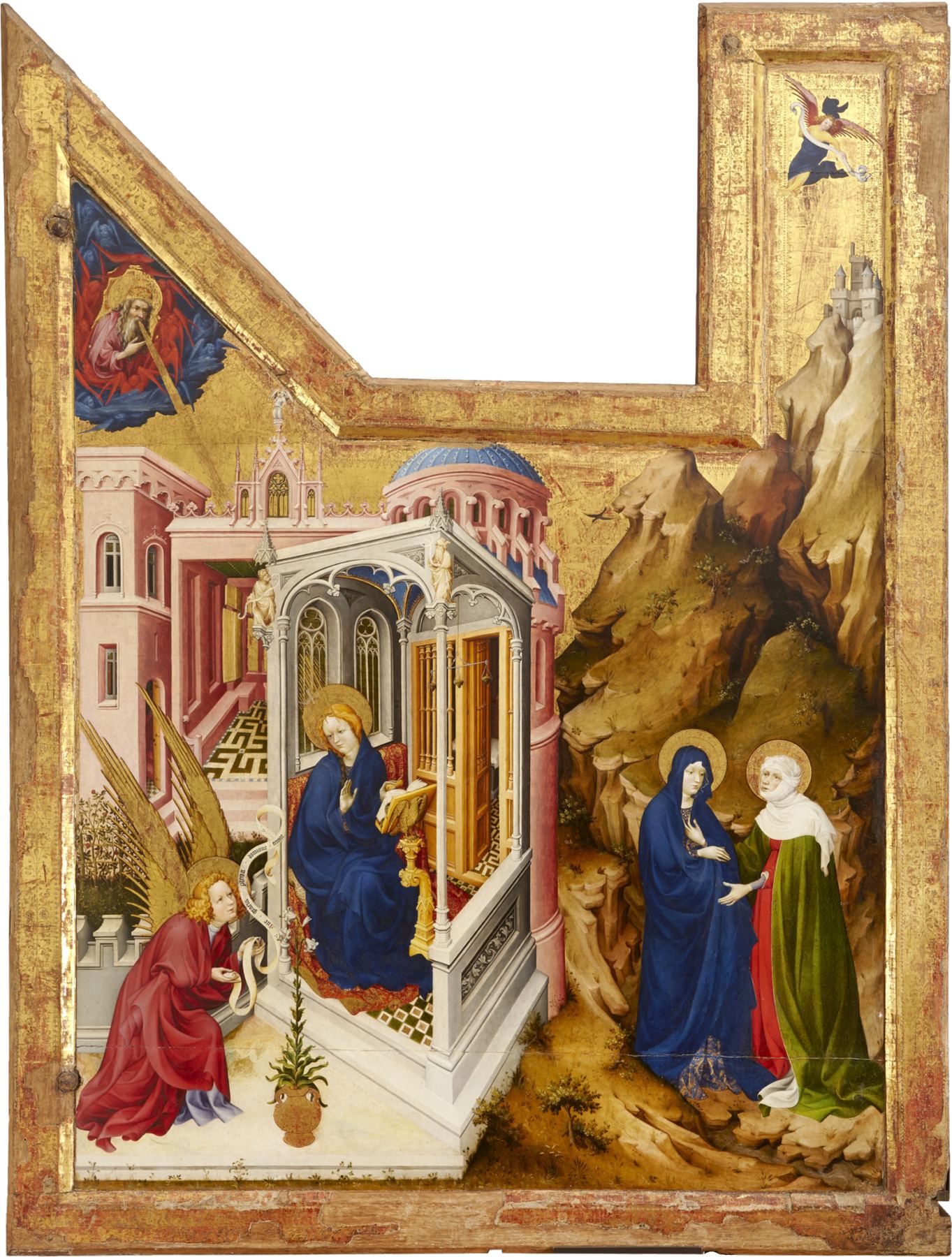
Composite altarpieces multiply the makers. At Champmol, Jacques de Baerze carved two retables commissioned in 1389. The structures travelled from Dendermonde to Ypres, where Broederlam painted and gilded them, before installation at the charterhouse in 1399. Carving opens into deep miniature theatres; painted shutters turn architecture, landscape and gold into another register of sacred history.[14]
The medieval workshop should not be imagined as a modern studio producing a lone genius’s signature object. Masters contracted work, trained assistants, shared designs and hired specialists. Guild structures governed trades. When historians use names such as “Master of the Třeboň Altarpiece,” they create a practical identity around related works. The label may describe one painter, a workshop or a changing collaboration.
Burgundy: magnificence acquires weight
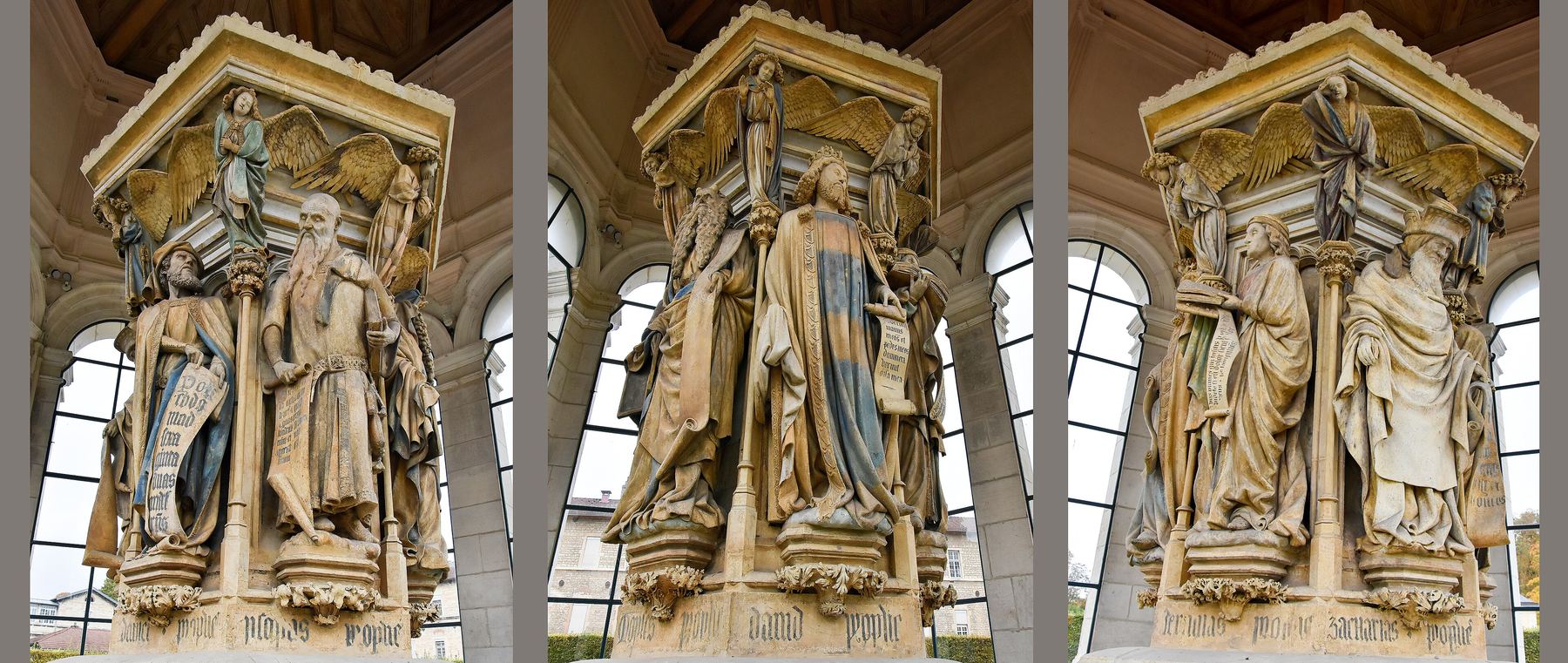
Claus Sluter disrupts the easiest picture of International Gothic. His prophets at the Well of Moses do not sway like elegant courtiers. Their heads are distinct, garments fall in thick volumes and bodily presence seems to press out from stone. Created for Champmol’s great Calvary between the mid-1390s and about 1400, the surviving hexagonal base once supported a larger sculptural group.[15]
Sluter’s naturalism is not modern because it abandons symbolism. The prophets carry texts that anticipate Christ’s death; their monumental individuality intensifies a theological structure. Paint and gilding originally increased the sculptures’ immediacy. Surface, body and prophetic word worked together.
His contribution to Philip the Bold’s tomb was equally influential. Around the base, mourning figures pass beneath an arcade as though inside a cloister. Some expose faces; some nearly disappear beneath hoods; hands grasp books, cloth or one another. Grief becomes a sequence of postures rather than a repeated emblem. Sluter died before the tomb’s completion, and Claus de Werve continued the work, reminding viewers again that artistic identity survives through workshops.[16]
The later tomb of John the Fearless and Margaret of Bavaria followed the precedent, with mourners carved by Jean de La Huerta and Antoine Le Moiturier. Repetition did not merely copy forms. It turned an invention into dynastic tradition. The figures’ controlled procession makes perpetual commemoration physically imaginable.
Facial distinction and bodily mass gave Sluter enormous influence in France, the Low Countries and the Rhineland. Yet describing him as a solitary founder of “realism” would be misleading. His work belonged to an expensive ceremonial site created by numerous artists. Its startling observation served monastic prayer and Burgundian power.[17]
Prague and the Beautiful Style
Prague had already become an imperial capital under Charles IV before International Gothic’s high phase. St Vitus Cathedral, royal foundations, relics, manuscripts, panel paintings and sculpture brought artists and materials into a city designed to embody sacred and secular authority. Under Charles and his sons, Bohemia developed visual languages with wide Central European impact.[18] To distinguish the visual movement from the buildings around it, see the guide to Gothic architecture.
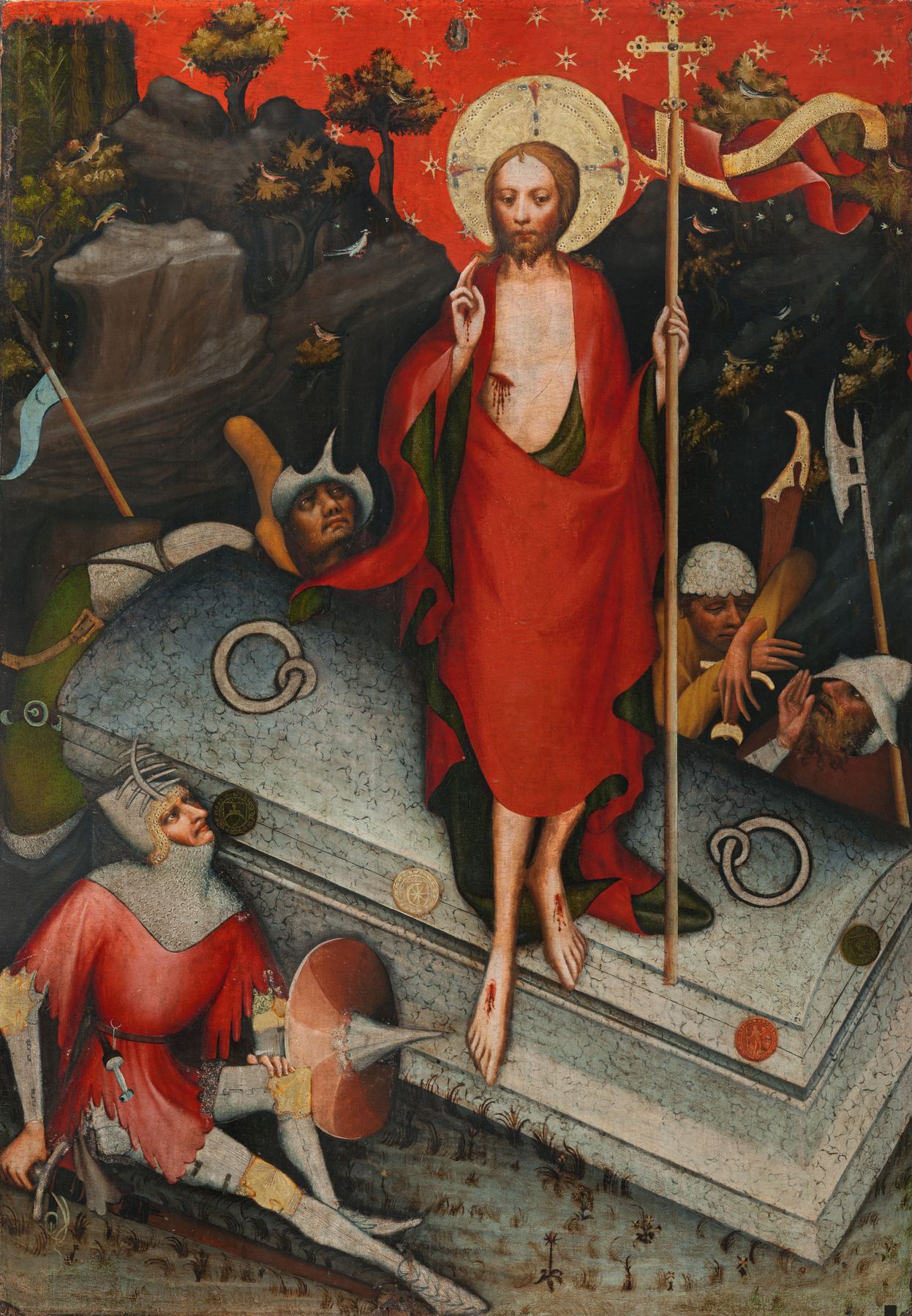
The Master of the Třeboň Altarpiece, active in the later fourteenth century, is essential to this development. Surviving panels include the Resurrection, Christ on the Mount of Olives and Entombment. Figures move with supple energy, faces carry tension and colour can create a visionary atmosphere. The works do not simply soften Gothic form; they make emotional pressure flow through line.[19]
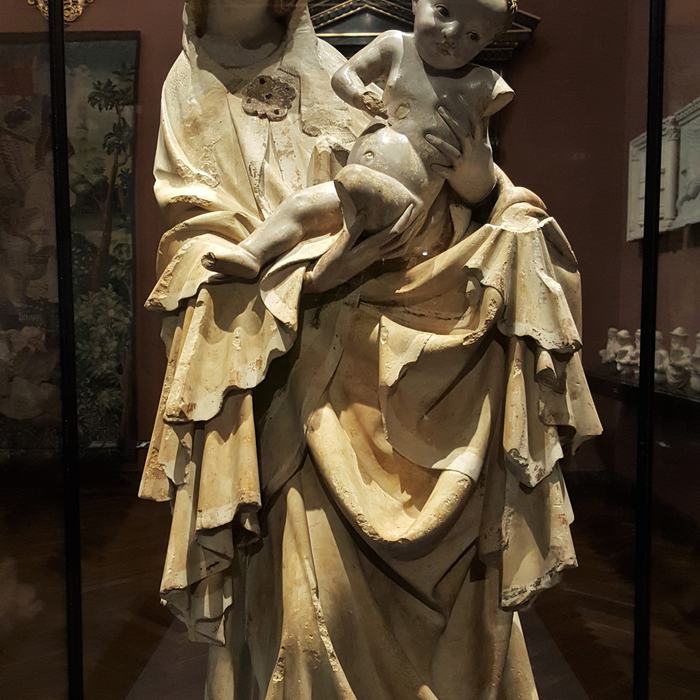
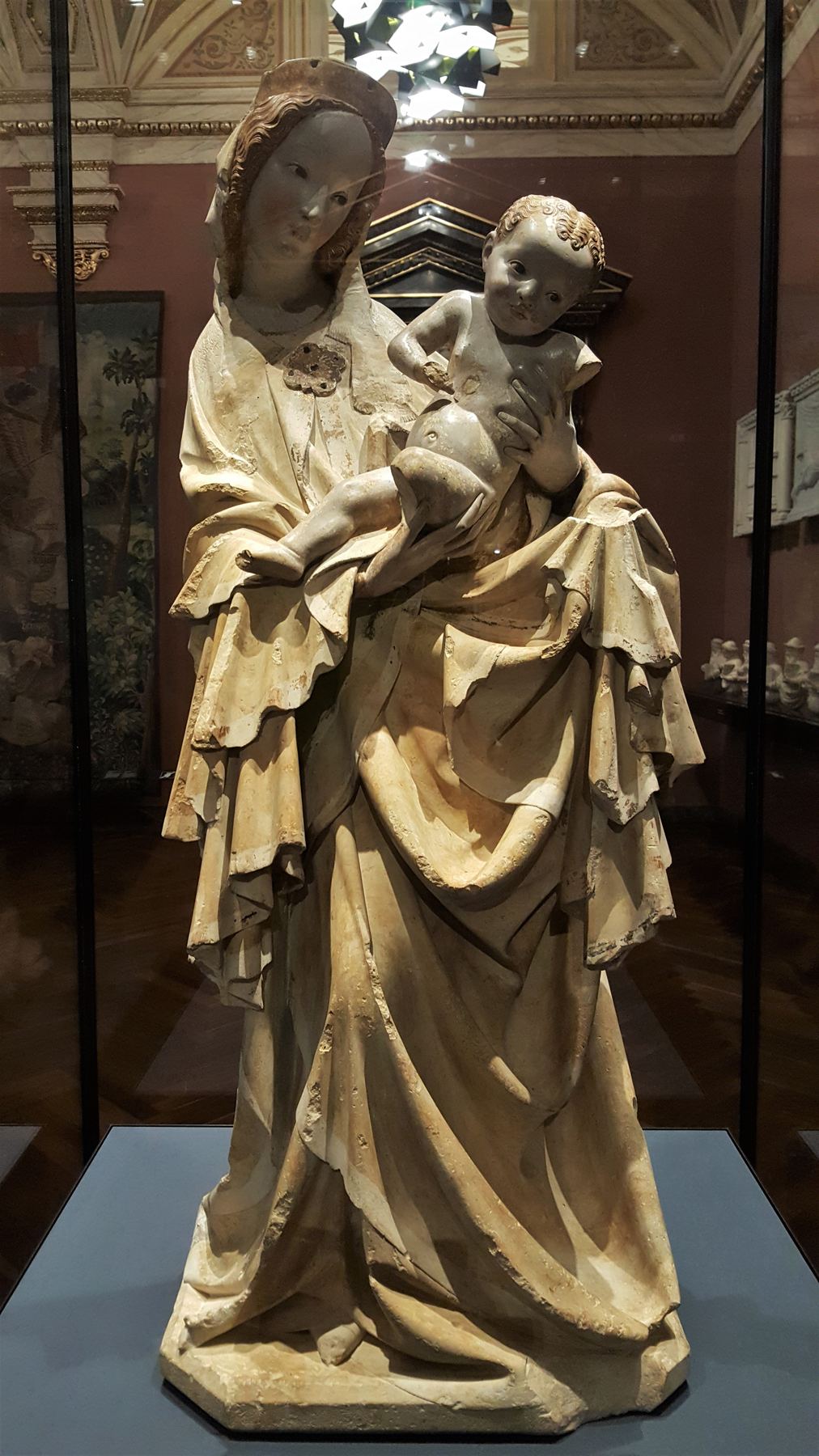
Around 1400, the Beautiful Style became especially prominent in sculpture. The Krumlov Madonna and related “Beautiful Madonnas” curve through space in a controlled S-shape. Mary balances the lively Christ Child while her mantle gathers into long, cascading folds. Tender interaction, ideal beauty and complex drapery make the body both human and ceremonial. National Gallery Prague’s collection places this achievement within a much longer Central European history.[20]
Panel supports warn against treating a reconstructed master as one material formula. Technical research identifies spruce, lime, fir, maple and beech across related Bohemian works and collections. Support, ground and later condition can help distinguish production histories that resemblance alone might compress.[21]
The regional collection also shows continuity and rupture. Works by the Třeboň Master, Krumlov Madonna circle and earlier Prague painters share space with later Central European altarpieces. “International Gothic” helps connect them to Europe; the local chronology prevents that connection from dissolving Bohemian specificity.
Beautiful Style echoes travelled towards Austria, Silesia, Poland, the Rhineland and Strasbourg. Mobility worked through sculptures, drawings and artists rather than modern state boundaries. The German terms Schöner Stil and Weicher Stil can identify related but not identical phenomena, especially the softened faces, flowing cloth and intimate Virgin-and-Child groups prominent in Central European sculpture.
Follow International Gothic through four stages
–75
Regional foundations and mobile court cultures
Sienese, Parisian and Prague traditions, royal manuscripts and long-distance materials establish several roots without producing one central source or fixed formula.
–1400
Courtly languages converge without becoming uniform
Portable devotion, Burgundian patronage and the Beautiful Style join patterned surface, expressive bodies and precious materials across England, Dijon, Prague and other centres.
–25
Manuscript, altarpiece and sculpture reach new intensity
Books, panels and objects combine close observation with court display as the Limbourgs, Gentile and regional workshops make luxury, prayer and political identity mutually reinforcing.
–50
Courtly naturalism overlaps with other modernities
Pisanello, Martorell and later workshops carry line, gold, animals and elegant narrative into decades also shaped by Renaissance perspective and Early Netherlandish oil painting.
A garden where observation becomes symbol
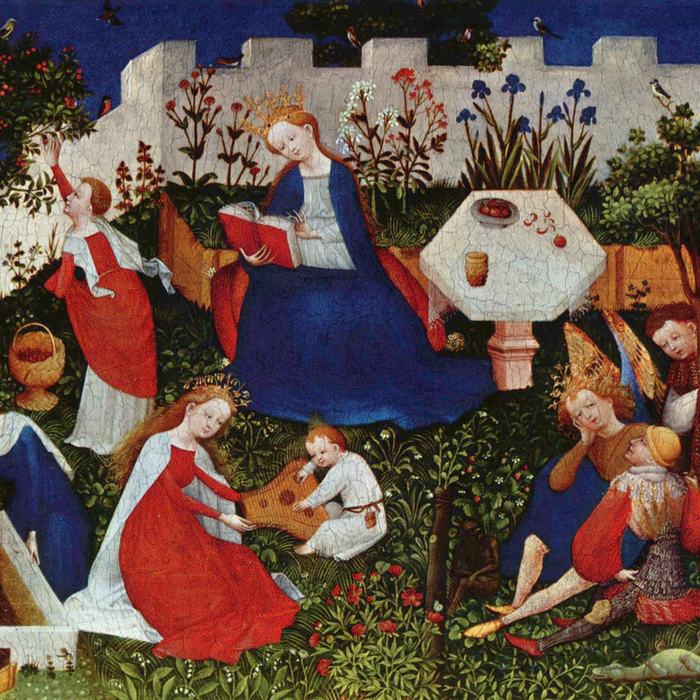
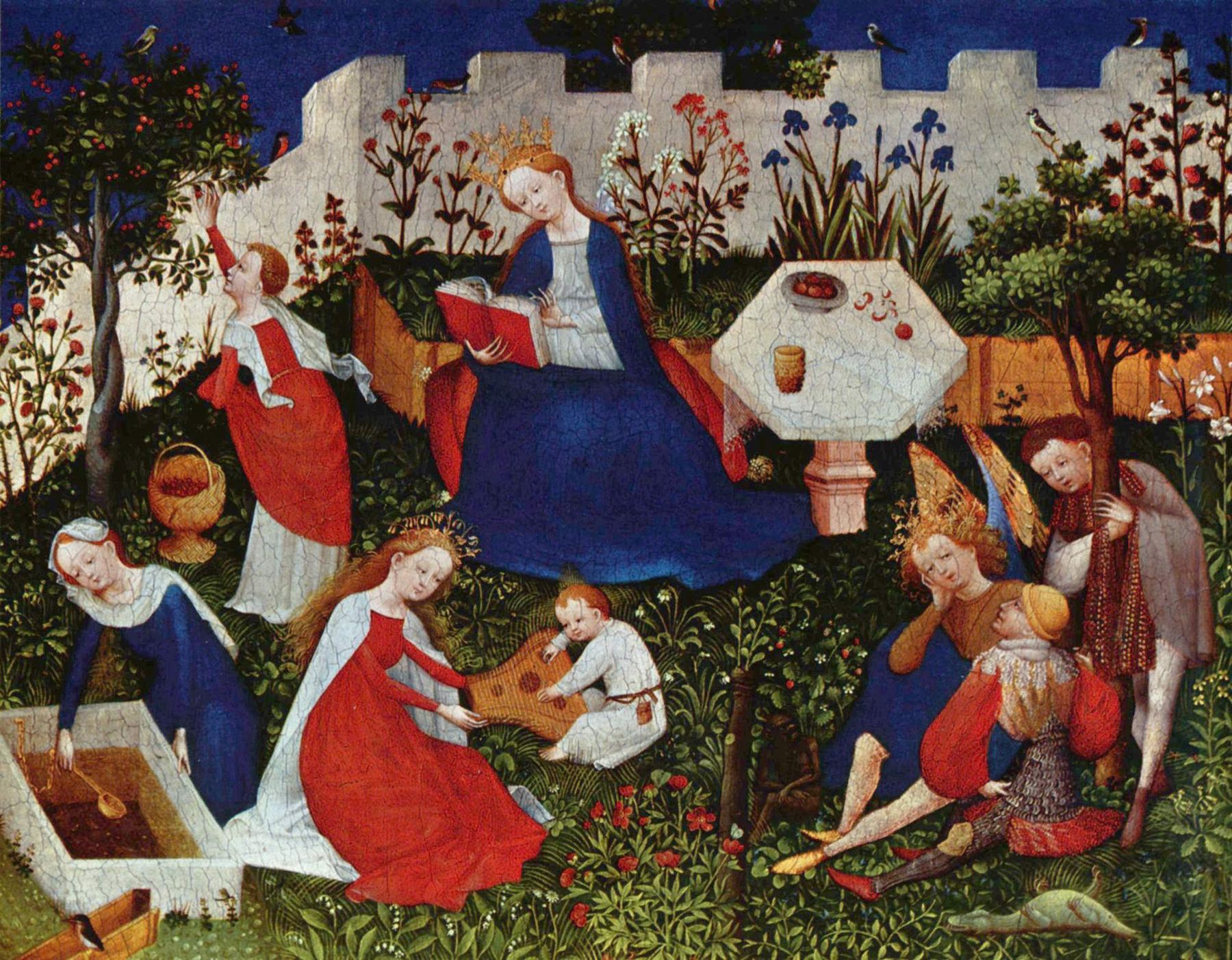
The Upper Rhenish Little Garden of Paradise, painted around 1410–20, is scarcely larger than an open book. The Virgin sits among saints in an enclosed garden. One woman plucks fruit; another draws water; the Christ Child plays music. A castle wall seals the space from the outer world.
Twenty-four plant and twelve bird species can be identified. The painter observes animal behaviour closely enough to differentiate activity, not merely outline. Yet this is not a botanical sheet. The enclosed garden refers to Mary’s virginity; flowers carry devotional associations; courtly leisure and the garden of love overlap with sacred fellowship.[22]
The picture makes one of the period’s most important principles visible: exact observation can intensify symbol. A recognizable bird does not become less theological because it is recognizable. Nature offers the viewer pleasure, knowledge and a route towards contemplation.
Its scale also matters. Close viewing rewards slow discovery—the strawberries, insects, music, feathers and leaves. International Gothic art often controls access by requiring bodily approach. A manuscript asks the owner to turn a page; a small panel asks the devotee to lean in; a tapestry surrounds an entire room; monumental sculpture addresses a moving procession.
Recent interpretation places the garden within a Europe marked by conflict and intellectual exchange and stresses its appeal to several senses. Painted fruit can imply taste; flowers, scent; music, sound; textiles, touch. The object does not literally activate those senses. It recruits memory and imagination to make vision expansive.[23] Its regional language also belonged to a mobile sculptural world in which echoes of Prague’s Beautiful Style travelled through the Rhineland and towards Poland.[24]
Italy: Gothic splendour and Renaissance experiment
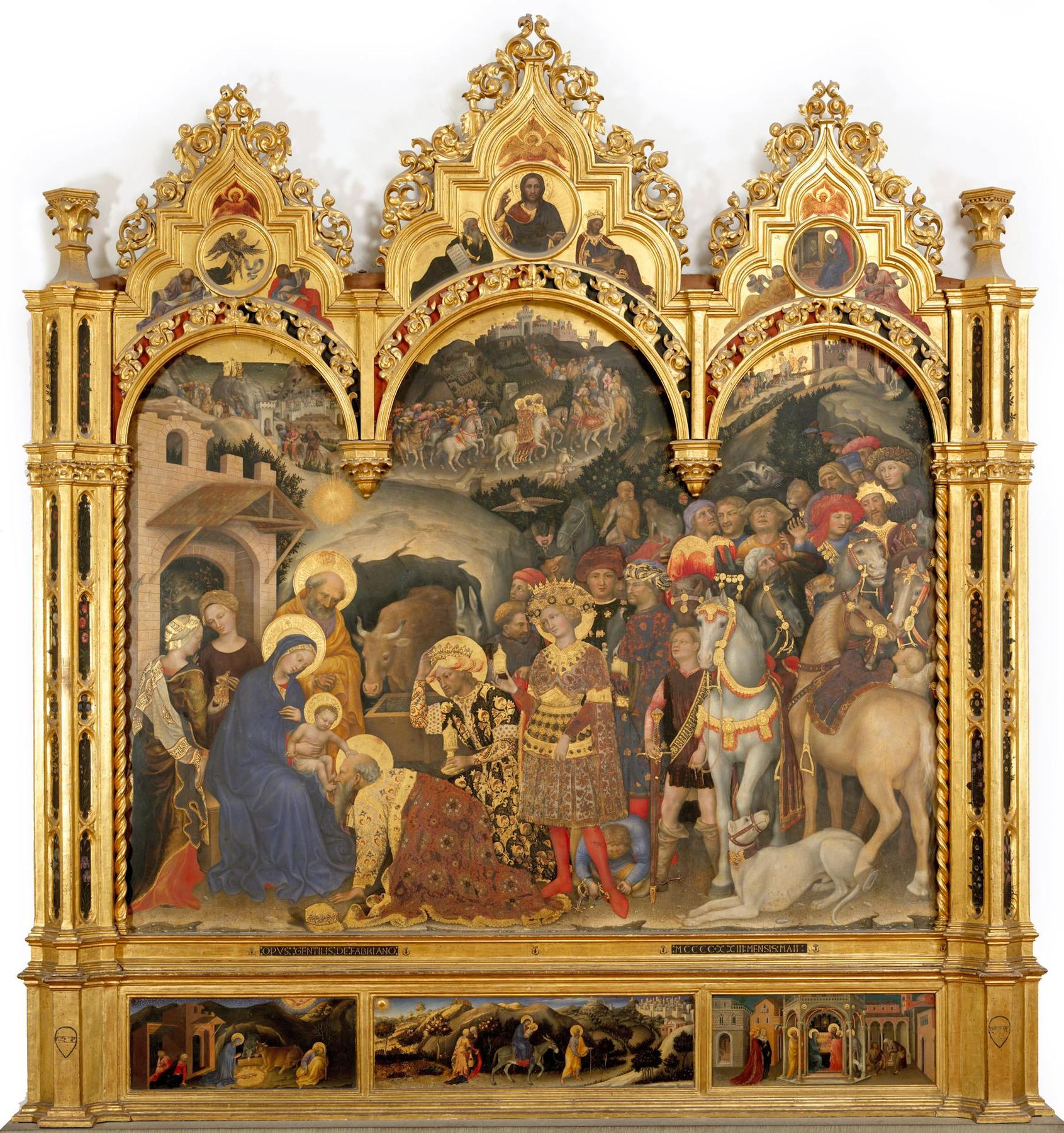
Gentile da Fabriano’s Adoration of the Magi was completed in Florence in 1423, when Masaccio and Brunelleschi were developing forms later treated as the essence of the Renaissance. Gentile’s altarpiece does not belong to a city ignorant of those experiments. It presents another prestigious modernity.
Palla Strozzi commissioned the work for his family chapel at Santa Trinita. Beneath three arches, the Magi’s journey unfolds across the upper landscape before the procession arrives at the Virgin and Child below. Courtiers, horses, attendants, monkeys, a cheetah and richly dressed kings compress sacred history into a magnificent contemporary gathering. The patron and his son enter the crowd.[25]
Gentile used large quantities of metal leaf, tooling and relief. Spurs, sword hilts, crowns and harness catch actual light. Painted jewellery draws on the techniques and authority of goldsmith work, while luxury textiles recall goods connected to Strozzi’s mercantile world. Material brilliance praises divine kingship and displays the commissioner’s resources at the same time.[26]
The predella complicates any opposition between Gothic gold and Renaissance nature. Blue skies, nocturnal illumination, receding roads and carefully observed terrain appear beneath the main panel’s sumptuous surface. Continuous narrative and changing light do not wait for the gold to disappear. They develop beside it.
Gentile’s earlier Valle Romita Polyptych joined gold with Franciscan or monastic humility. Bare feet, slender saints and a celestial coronation show that gorgeous material could frame ideals of poverty. The apparent contradiction was productive: the costly object honoured a sacred life that rejected worldly possession.[27]
Lorenzo Monaco created a distinct Florentine alternative. His enormous Coronation of the Virgin of 1414 was made for the high altar of the Camaldolese abbey of Santa Maria degli Angeli, where he was a monk. Slender bodies and sophisticated intervals of folded cloth serve contemplative transcendence. Courtly line has been transformed by monastic setting and liturgical scale.[28]
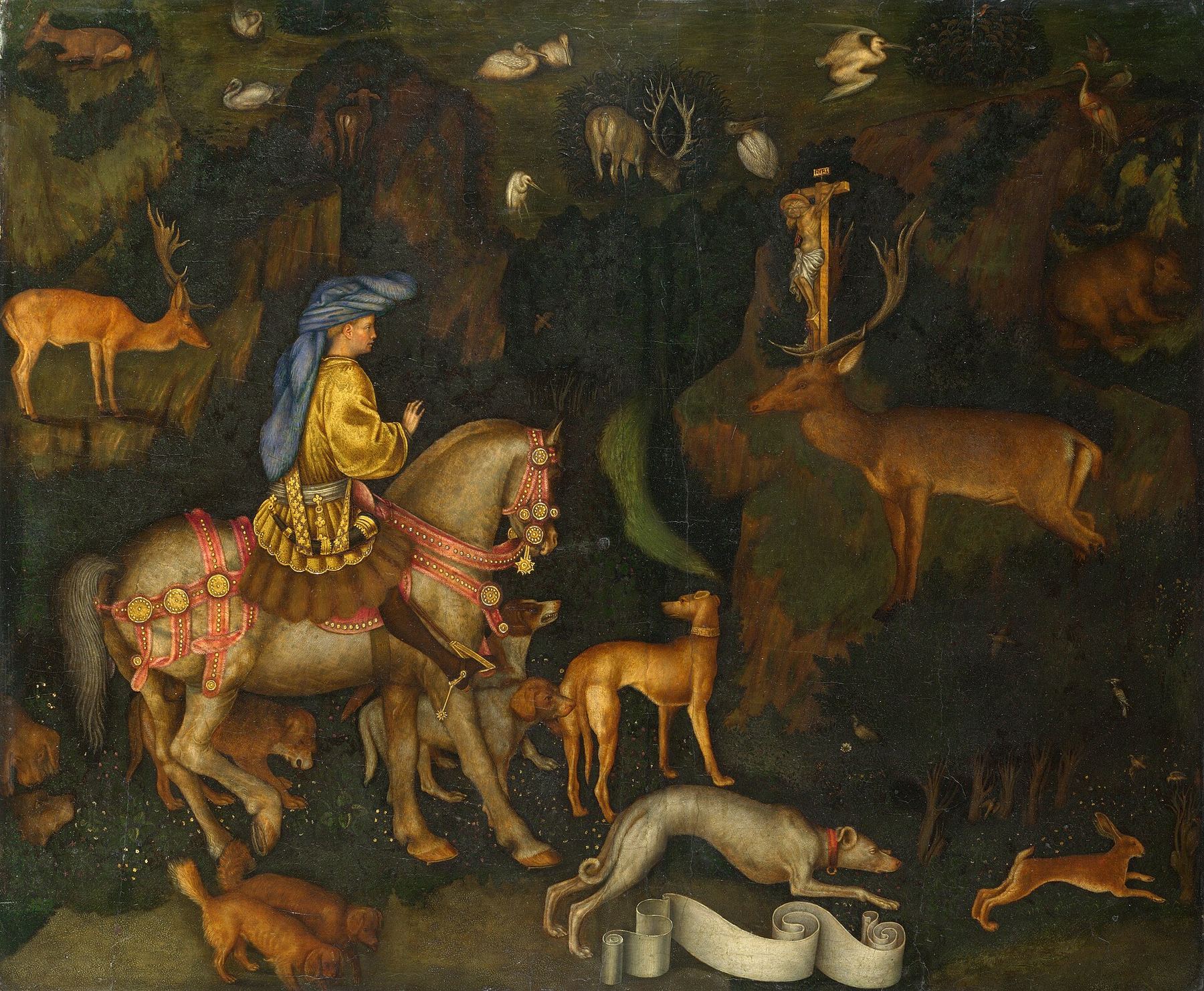
Pisanello extended this world into the middle decades of the fifteenth century. In The Vision of Saint Eustace, an ancient Roman soldier appears as a fashionable Italian prince. He halts on horseback before a stag bearing a crucifix between its antlers. Hounds, birds, a hare and a bear fill the dense landscape. The conversion story becomes an aristocratic hunt interrupted by revelation.[29]
The animals came from several modes of study. Some drawings depended on model books or earlier art; others recorded living or dead creatures. The painting’s observation is therefore neither pure copying from nature nor pure convention. Pisanello assembled a convincing world from stored and immediate knowledge.[30]
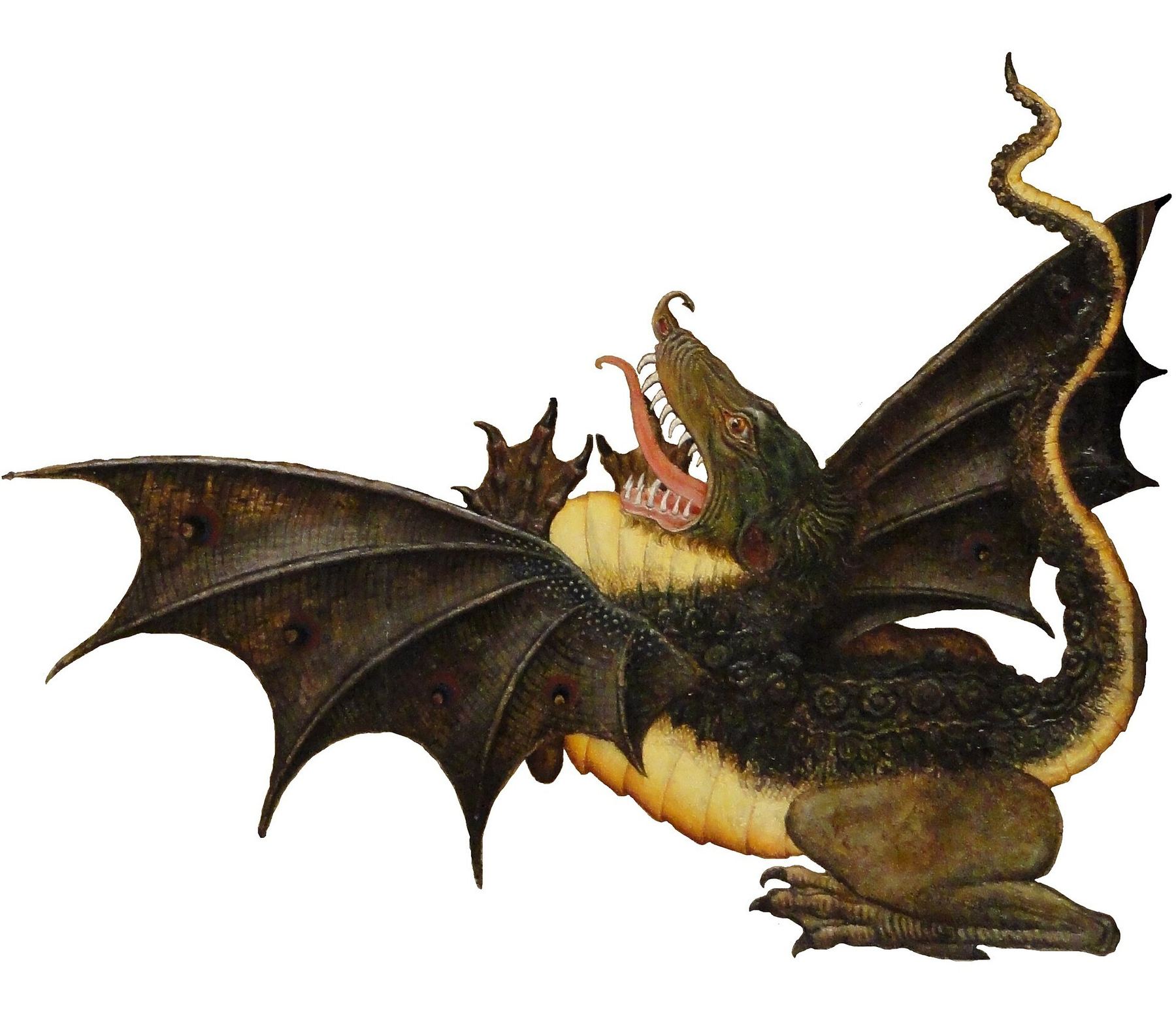
In his signed Virgin and Child with Saints, Saint George wears contemporary armour and a French-style straw hat while a dragon curls beside him. Saint Anthony’s boar, woodland creatures and decorative signature bring court fashion, wilderness and authorship into one compact surface.[31] The surviving certainty of only a few panel paintings also warns how much of a celebrated court painter’s practice has disappeared.
Pisanello later became Europe’s leading portrait medallist, serving Italian courts and rulers. The medal’s classical profile and durable bronze are often placed within Renaissance humanism, yet the close observation, heraldic intelligence and court mobility continue concerns already present in his painting and drawing.[32] Categories overlap within one career.
International Gothic artists to know
Limbourg brothers
Herman, Paul and Jean de Limbourg transformed the book of hours through page-scale narrative, new light effects and exact observation while working for Jean de Berry within a larger collaborative workshop.
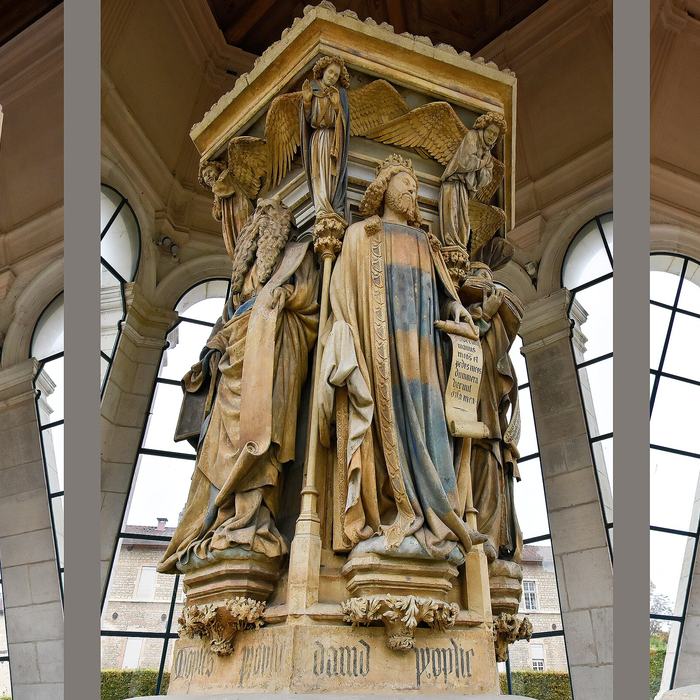
Claus Sluter
Sluter brought unprecedented bodily mass and expressive difference to the prophets and mourners at Champmol, without separating observation from theology or ducal power.
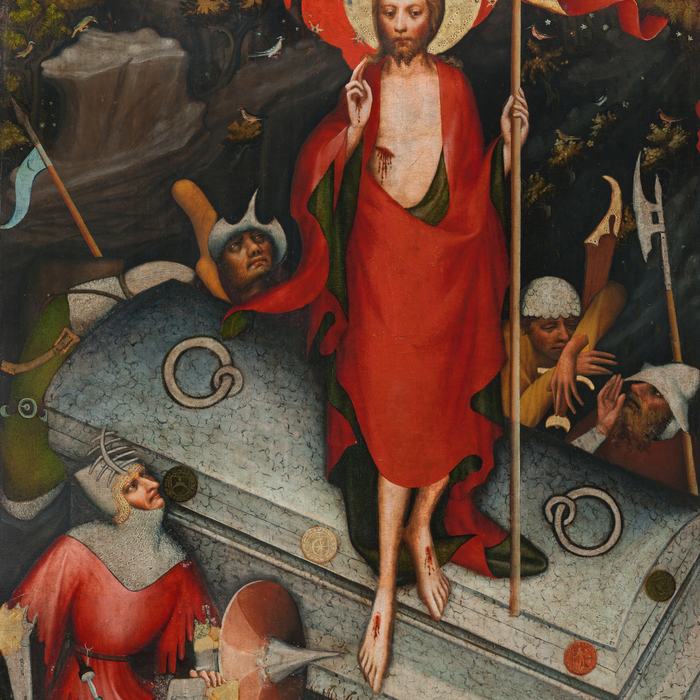
Master of the Třeboň Altarpiece
The anonymous master made spiritual pressure flow through supple bodies and luminous colour, establishing Bohemia as a creative centre rather than a receiver of western models.
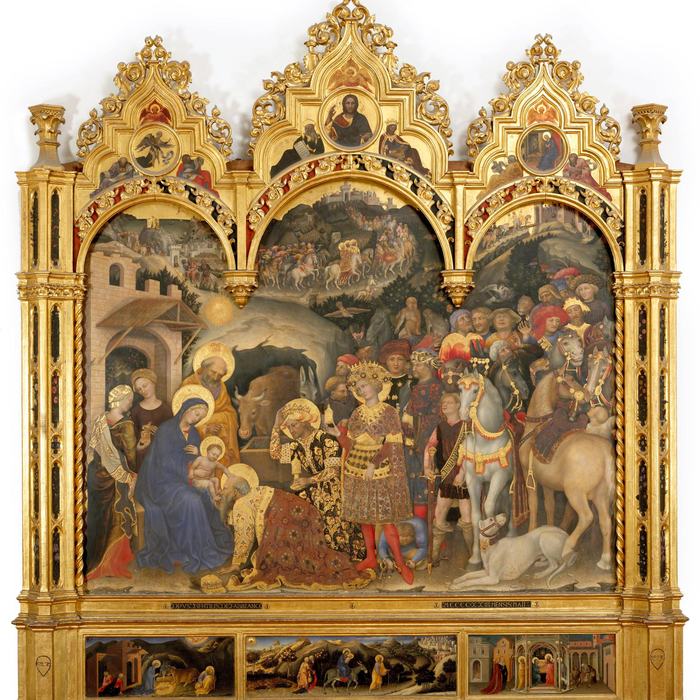
Gentile da Fabriano
Gentile moved between Italian centres and joined sumptuous surface to spatial and observational experiment; his 1423 Strozzi altarpiece makes Gothic and Renaissance chronologies overlap.
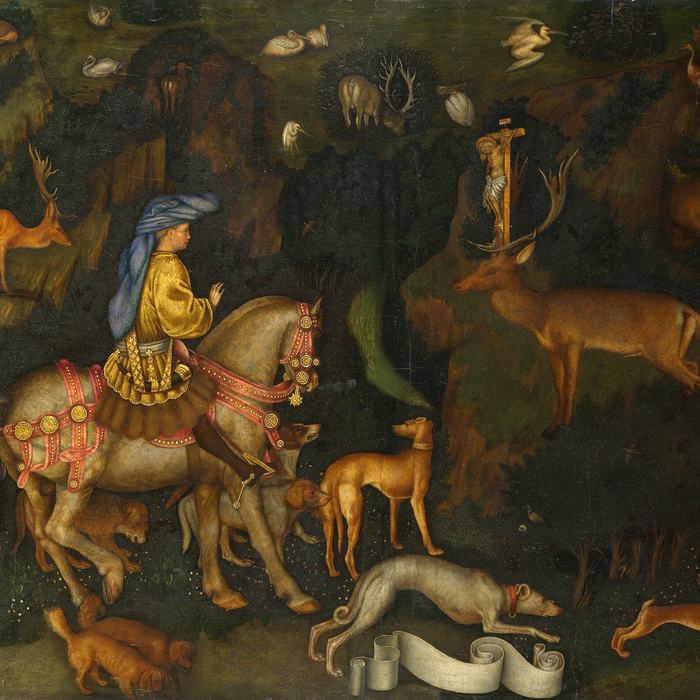
Pisanello
Pisanello carried courtly naturalism into the 1430s and 1440s, joining brilliant animal study and precious surface to classical medals and humanist patronage.
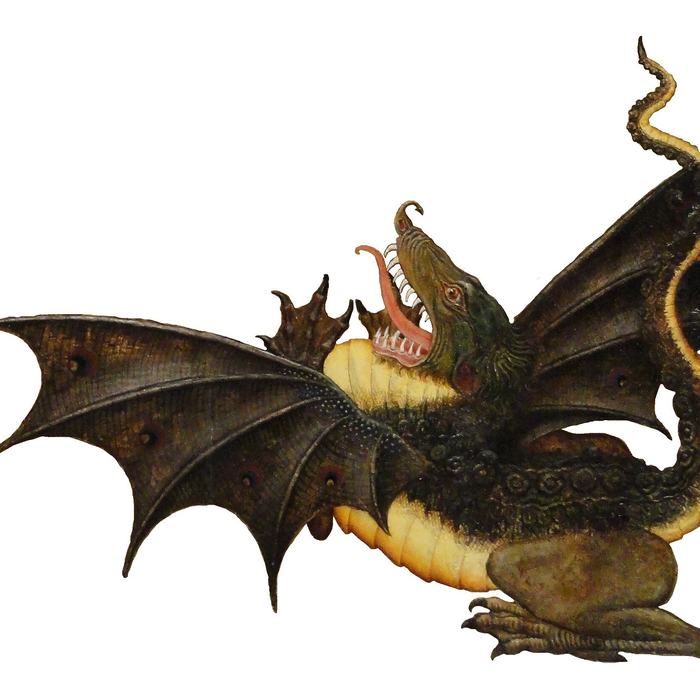
Bernat Martorell
Martorell's surviving panels show Barcelona as an active centre in which patterned elegance, close natural detail and violent sacred narrative were remade for civic and ecclesiastical patrons.
England: one survivor and a lost field
Very little English panel painting from the period survives. The Wilton Diptych is therefore both uniquely important and dangerous: one exceptional royal object cannot summarise everything made in England. Its painter’s anonymity and hybrid comparisons invite careful description rather than nationalist possession.
Richard kneels at the same scale as his saints, but heraldry makes him unmistakable. The white hart, broomcod collar, royal arms and standard construct a personal system of signs. Eleven angels may allude to his accession at the age of eleven, although such interpretations remain debated. The diptych does not illustrate a simple biblical episode. It stages access: saints present a living monarch to a heavenly court.
Its floral meadow and fashionable angels belong to the wider court language around 1400. French painting and metalwork, Sienese precedents and northern manuscripts all offer comparisons. Current scholarship has even proposed “transnational” as more exact than “international,” because the object results from practices moving through political communities rather than nations exchanging finished national styles.
The diptych’s condition and construction record use. Hinges make opening an action; painted exteriors protect and announce the interior; wear belongs to portability. When closed, the white hart rests on vegetation and the royal arms face outward. The private vision never loses public identity.
Catalonia and Valencia: active centres, not edges
Around 1400, Catalonia participated intensely in the dialogue between France and the former Low Countries on one side and Italy on the other. Its artists did not merely import a French formula. They balanced stylisation and naturalism, elegance and expression, luxurious material and technical skill through local retables, manuscripts, sculpture and civic commissions.[33]
The retable became a particularly powerful format. Multiple panels organised saints’ lives, Passion narratives and institutional identity above an altar. Architecture, gilding and painting guided movement between episodes. Complete retables by Lluís Borrassà, Joan Mates and Bernat Martorell demonstrate how a shared language could generate varied workshops and narrative rhythms.[34]
Rafael Destorrents’s Missal of Saint Eulalia renewed manuscript illumination in Barcelona. Borrassà operated one of the region’s most productive and influential studios, supplying paintings for Barcelona Cathedral and other patrons. Bernat Martorell’s Saint George panels combine saturated colour and exquisite line with the violent action of combat and martyrdom.[35]
Borrassà’s reconstructed cathedral works show why archival and conservation research matter. Six centuries of dispersal, alteration and changing display separated elements that once belonged to shared ecclesiastical settings. Recovering colour is also recovering workshop scale and patronage.[36]
Valencia was among the most innovative centres. Gherardo Starnina, Marçal de Sax and Pere Nicolau brought different experiences; Gonçal Peris, Jaume Mateu and Antoni Peris developed vigorous local production. Artists associated with one another, transferring motifs and formulas through cooperation as well as competition. The city’s position in Mediterranean trade made cultural exchange structurally normal.[37]
The great Valencian Saint George altarpiece brings northern and Italian elements together. Its battle, martyrdom and victory narratives turn chivalric sanctity into public spectacle. Calling the mixture “International Gothic” is useful precisely because it points towards exchange; the work remains Valencian in its institutional setting and visual force.[38]
Tapestry and the architecture of magnificence
The later Devonshire Hunting Tapestries, mostly made between about 1430 and 1450, show the International manner’s extended afterlife. Courtship, hunting, fashion, animals and dense flowering ground fill enormous surfaces. Costume helps date the designs; women participate in falconry; fur, silk and elaborate sleeves measure status. Hunting appears as ritual, warfare training, social display and animal violence at once.[39]
Paintings dominate many histories because they survive in museum frames, but tapestry was among the most prestigious arts of the period. Large hangings coloured rooms, softened acoustics, reduced draughts and created temporary narrative architecture. Wool supplied strength; silk added detail; metal thread intensified brilliance. Several weavers could labour side by side for years. Tapestries were portable: rolled between residences, they could convert bare walls into a royal chamber. Their movement explains circulation and their hard use helps explain the loss of so many sets.[40]
The South Netherlandish Heroes tapestries, made around 1400–10, present figures such as King Arthur beneath elaborate architectural canopies. Heraldry identifies heroes from classical, Jewish and Christian traditions, while fashionable contemporary dress turns distant exemplars into a late-medieval court. Authority becomes readable through costume, emblem and hierarchical placement.[41]
Design had to answer the medium. A painted cartoon supplied a model, but coloured wefts constructed the surface. Narratives spread across walls rather than receding into one illusionistic window. Line and pattern could remain legible despite furniture or architecture obscuring sections. Workshops in Arras, Tournai and later Brussels linked artistic invention to specialised urban industry.[42]
Panel painting had equally demanding material systems. Northern European workshop research documents specialised preparation, grounds, gilding and layered colour whose continuities cross the conventional divide at 1400.[43] Such evidence helps separate a panel’s physical origin from the stylistic labels later placed upon it.
Attribution needs the same caution. Medieval painters trained in guild workshops, worked with assistants and did not necessarily sign finished objects. A modern name such as “English or French” acknowledges that collaboration and loss can be more historically truthful than a confident national master.[44] In Prague, a small panel made for private devotion could combine local saints, costly material and a courtly scale of possession, demonstrating how preciousness extended beyond monumental commissions.[45]
Goldsmith work, embroidery and ivory similarly complicate the hierarchy of media. Painted pearls imitate enamel; manuscript borders imitate jewellery; metal objects borrow architectural forms. An altarpiece might join carpentry, carving, paint and gilding so completely that asking which art is primary misses the object’s intended unity.
Nature is never only nature
International Gothic artists looked closely. Leaves curl differently; dogs belong to distinguishable types; birds perch, fight or feed; light changes across snow and night. Yet observation always enters a designed world.
In Pisanello’s hunt, animals establish aristocratic expertise and spiritual conversion. In the Garden of Paradise, species build Marian symbolism. In calendar pages, peasants sow, harvest or warm themselves beneath castles that make hierarchy seem part of the seasons. In Gentile’s procession, exotic animals imply distance, wealth and the Magi’s imagined East.
This does not make the detail false. It makes looking culturally active. Medieval viewers could recognise a plant’s medicinal, devotional or poetic associations while admiring its likeness. A dog could be simultaneously observed creature, hunting instrument and sign of fidelity. Naturalism is a way of giving meanings persuasive bodies.
The same principle applies to portraiture. Distinctive faces may record an individual, represent a social type or intensify presence. Sluter’s prophets feel different from one another, but they also embody scriptural authority. Richard II’s smooth profile offers recognisability within an ideal royal image. The modern wish to separate likeness from symbolism does not fit these works.
Fashion, labour and hierarchy
Elaborate clothing is one of the style’s pleasures and one of its social systems. Long sleeves, fur linings, belts, jewels and headdresses identify status. Drapery allows a painter or sculptor to create rhythmic line, but the represented material also signals access to expensive trade goods.
The people who produced those effects are often less visible. Parchment came from animal skin prepared through skilled labour. Ultramarine required imported lapis lazuli and complex processing. Gold leaf had to be beaten, laid and tooled. Silk and wool moved through merchants before dyers and weavers transformed them. Courtly art depended on urban and rural work far beyond the named master’s workshop.
Represented labour also appears, especially in calendars and tapestries. Peasants prune vines, sow grain, shear sheep or bend over fields while elites feast or hunt. Such imagery records tools and seasonal tasks, but it arranges society beneath the patron’s architecture. A calendar’s agricultural cycle can acknowledge dependence on labour while presenting hierarchy as harmonious and recurrent.
Women appear as patrons, owners, saints, court participants, workers and allegorical figures. A book of hours made for a woman can preserve her image at prayer. Court women shaped dynastic exchange and commissioned art, while women participated in textile production at many levels. Documentation, however, more readily preserves male masters’ names. An inclusive account must not solve that imbalance by inventing individual authors where evidence is absent.
Violence under the beautiful surface
The word “beautiful” can make International Gothic seem emotionally mild. Its images repeatedly stage crucifixion, execution, martyrdom, warfare, hunting and grief. Beauty often intensifies rather than conceals the shock.
The Boucicaut circle renders poisoned jewellery in gleaming colour. Bernat Martorell’s Saint George drives a weapon into a dragon amid exquisite patterns. Broederlam’s painted shutters lead towards the carved Passion inside. Sluter’s prophets foresee a broken body that once rose above them. The Wilton Diptych’s serenity is inseparable from a king whose reign ended in deposition and probable starvation.
Courtly codes could aestheticise power. Armour, controlled horses and heraldry convert violence into noble identity. Hunting tapestries turn killing into ritual and spectacle. Yet the works sometimes permit instability to leak through: panicked animals, contorted martyrs, grieving mourners and sharp gestures interrupt the surface’s order.
Devotional violence also had a different purpose from entertainment. Christ’s wounds and saints’ deaths offered paths for meditation, repentance and emotional participation. Small scale could intensify the experience because a viewer approached the scene alone. The beautiful surface made prolonged attention possible; attention opened towards suffering.
From International Gothic to other modernities
Art history once arranged a clean relay: Gothic elegance yielded to Renaissance space in Italy and Early Netherlandish realism in the north. The works resist that sequence. Gentile’s 1423 altarpiece is contemporary with Florentine experiments in perspective. Pisanello’s courtly detail continues after Masaccio. The Limbourgs construct new landscapes without abandoning patterned pages.
Giotto and Sienese painters had already transformed bodies, emotion and space before the International manner’s core years. Their legacy travelled through Avignon and court collections. Later, Fra Angelico could combine gold, devotion, measured architecture and luminous natural light rather than selecting one historical side.
In the Low Countries, Jan van Eyck served the Burgundian court that inherited Valois habits of patronage. Oil technique, microscopic reflection and convincing space transformed precious observation, but court mobility, luxury material and devotional intimacy remained continuous. Early Netherlandish painting did not begin from a blank surface.
Pisanello demonstrates overlap within one artist. His drawings and animals belong to Gothic court culture; his medals engage classical form and humanist patrons. Neither identity cancels the other. The useful historical question is not “Gothic or Renaissance?” but what each work asks surface, body, space and material to do.
Northern artists later associated with the Renaissance could also preserve fantastic line, devotional intensity and densely populated nature. The strange creatures and moral landscapes of Hieronymus Bosch belong to a later world, but they remind us that close observation never forced European art onto one rationalising path.
How to look at International Gothic art
Begin with the object’s scale and use. Could it close, travel, hang across a wall, stand above an altar or address a procession? A tiny manuscript and a monumental prophet may share forms, but they organise the viewer’s body differently.
Follow line before asking whether space is realistic. Trace a mantle’s hem, the neck of a horse, a branch, an angel’s wing or a punch pattern in gold. Repeated curves often connect separate figures and materials, giving the surface a musical order.
Then look for actual and imitated materials. Does paint imitate fur, pearl, enamel, brocade or metal? Does gold reflect changing room light? Are relief details attached to the surface? Splendour is usually technical work, not a generic impression.
Identify signs of ownership and authority. Heraldry, badges, patron portraits and selected saints can make a sacred scene personally or politically specific. Ask who is permitted to approach whom. Scale and placement often establish hierarchy before facial expression does.
Examine nature twice: first for precision, then for function. Name the animal or plant if possible, but ask why it belongs there. Is it food, quarry, emblem, seasonal evidence, Marian flower, exotic wonder or a demonstration of the artist’s memory?
Search for collaboration. A border may differ from a miniature; carving may meet painted shutter; textile design may translate a cartoon. Small inconsistencies can reveal several makers rather than incompetence.
Finally, look for what elegance contains. A luxurious surface may frame labour, grief or violence. The tension between pleasure and pressure is often where the work becomes historically alive.
Essential International Gothic works
The Wilton Diptych
Unknown artist · c. 1395–99 · Portable devotion becomes an argument for sacred kingship through heraldry, ultramarine, gold and a transnational visual language whose maker remains unresolved.
Belles Heures of Jean de France, Duc de Berry
Limbourg brothers · c. 1405–08/09 · The Limbourg brothers join prayer, page-turning, minute observation and experimental narrative in the only manuscript illuminated throughout by the three brothers.
Annunciation and Visitation
Melchior Broederlam · 1390s · Painted shutters, gilded carving, architecture and landscape reveal how a Burgundian altarpiece was made through travel and collaboration between several specialist workshops.
Well of Moses
Claus Sluter and workshop · 1395–1403 · Sluter gives prophetic figures monumental bodily weight, expressive distinction and surviving traces of colour within Champmol's larger programme of prayer and dynastic power.
Resurrection from the Třeboň Altarpiece
Master of the Třeboň Altarpiece · c. 1380 · Supple figures, compressed space, saturated colour and emotional tension make the Bohemian panel a central work of Prague's distinctive contribution to the international field.
Krumlov Madonna
Master of the Krumlov Madonna · c. 1390–1400 · The Beautiful Style's ideal beauty and tender exchange are organised through an elaborate S-curve and cascading limestone drapery that makes the body ceremonial.
The Little Garden of Paradise
Upper Rhenish Master · c. 1410–20 · An enclosed sacred garden turns recognisable plants, animals, music and courtly leisure into a dense devotional world where observation continually becomes symbol.
Adoration of the Magi
Gentile da Fabriano · 1423 · Gentile's Florentine altarpiece makes travel, luxury, crowding and exotic detail coexist with new spatial experiments at precisely the moment usually assigned to the Early Renaissance.
The Vision of Saint Eustace
Pisanello · c. 1438–42 · Pisanello converts a devotional encounter into courtly hunting, heraldic surface and exact animal study, demonstrating how Gothic naturalism continued into the 1430s and 1440s.
Saint George and the Dragon
Bernat Martorell · 1434–35 · Martorell combines patterned splendour, vivid violence and civic devotion in the principal surviving panel of a Catalan altarpiece whose narrative wings are now dispersed.
Where to see International Gothic art
Displays, loans and opening arrangements change. Check current information before travelling.
- 01
National Gallery
The Wilton Diptych provides the clearest single introduction to royal devotion, transnational style, panel technique and heraldry. Pisanello's Vision of Saint Eustace extends the story into Italian court culture and animal study.
London, United Kingdom
Collection and research guideVisit official resource - 02
The Met Cloisters
The Belles Heures allows close study of Limbourg illumination, while the Heroes tapestries reveal the architectural scale of woven court imagery. Medieval sculpture and precious objects widen the comparison beyond painting.
New York, United States
Collection and research guideVisit official resource - 03
Musée des Beaux-Arts
The Champmol retables and ducal tombs bring Broederlam, Baerze, Sluter and their successors together. Few places demonstrate so clearly how painting, carving, gilding, architecture and dynastic memory formed one programme.
Dijon, France
Collection and research guideVisit official resource - 04
National Gallery Prague, Convent of St Agnes
The Třeboň Altarpiece panels, Bohemian Madonnas and Central European sculpture establish Prague as a creative centre. The collection is essential for distinguishing the Beautiful Style from a generic courtly Gothic.
Prague, Czechia
Collection and research guideVisit official resource - 05
Städel Museum
The Little Garden of Paradise rewards prolonged close viewing. Its identifiable species, sacred enclosure and courtly leisure provide an ideal test of how natural observation and symbol reinforce one another.
Frankfurt, Germany
Collection and research guideVisit official resource - 06
Uffizi Galleries
Gentile da Fabriano's Adoration of the Magi and Lorenzo Monaco's Coronation of the Virgin show two Florentine uses of Gothic splendour beside the emerging Early Renaissance.
Florence, Italy
Collection and research guideVisit official resource - 07
Museu Nacional d’Art de Catalunya
Retables, manuscript-related material, sculpture and reconstructed Catalan contexts make Barcelona's independent importance visible. Borrassà and his contemporaries emerge through workshop and institutional history.
Barcelona, Spain
Collection and research guideVisit official resource - 08
Museo del Prado
The Prado's Gothic rooms emphasise Valencia's cosmopolitan colour and artist networks. The V&A's Valencian Saint George altarpiece and later hunting tapestries extend the subject across painting and textile.
Madrid, Spain
Collection and research guideVisit official resource
Suggested books
Prague: The Crown of Bohemia, 1347–1437, edited by Barbara Drake Boehm and Jiří Fajt
A wide-ranging catalogue of Prague’s emergence as an artistic capital, covering architecture, panel painting, sculpture, manuscripts, metalwork and Jewish culture. It is the best corrective to a France-and-Italy-only account.[46]
Catalunya 1400: El gòtic internacional, edited by Rafael Cornudella with Guadaira Macías and Cèsar Favà
This exhibition catalogue establishes Catalonia as a major production centre through retables, miniatures, sculpture, precious metalwork and embroidery. Its regional depth makes the international network concrete.[47]
The Art of Illumination: The Limbourg Brothers and the Belles Heures of Jean de France, Duc de Berry, by Timothy B. Husband
The most concentrated study of one defining manuscript. Full-page reproductions and technical detail make it useful for understanding composition, border production, patronage and the extraordinary physical precision of illumination.[48]
Gothic Painting in the Catalan-Speaking Lands between the Fourteenth and Fifteenth Centuries
This scholarly regional synthesis is especially valuable for workshops, local chronology and the movement of artists and motifs between Barcelona, Valencia and neighbouring territories.[49]
Eloquent Bodies: Movement, Expression, and the Human Figure in Gothic Sculpture, by Jacqueline E. Jung
A broader study of how sculpture activates viewers and sacred spaces. It helps readers move beyond stylistic labels towards bodily encounter, gesture and the relationship between figure and setting.[50]
Major International Gothic artists
The directory combines documented artists with anonymous masters reconstructed from surviving works. Nationality labels describe working traditions only approximately in a period that predates modern nation-states.
| Name | Nationality | Key Works |
|---|---|---|
| Master of the Wilton Diptych | English or French | The Wilton Diptych |
| Limbourg brothers | Netherlandish | Belles Heures · Très Riches Heures |
| Jacquemart de Hesdin | French | Grandes Heures · Petites Heures |
| Boucicaut Master | French | Hours of Marshal Boucicaut · Creusa Receiving Medea's Gifts |
| Bedford Master | French | Bedford Hours · Salisbury Breviary |
| Master of Sir John Fastolf | French | Fastolf Hours · Book of Hours |
| Melchior Broederlam | Netherlandish | Annunciation and Visitation · Presentation and Flight into Egypt |
| Jacques de Baerze | Netherlandish | Crucifixion Retable · Saints and Martyrs Retable |
| Claus Sluter | Netherlandish | Well of Moses · Portal of Champmol |
| Claus de Werve | Netherlandish | Tomb of Philip the Bold · Well of Moses workshop |
| Jean Malouel | Netherlandish | Large Round Pietà · Christ of Pity |
| Master of the Třeboň Altarpiece | Bohemian | Resurrection · Entombment |
| Master of the Krumlov Madonna | Bohemian | Krumlov Madonna · Hallstatt Madonna |
| Master of the Little Garden of Paradise | Upper Rhenish | The Little Garden of Paradise · Annunciation |
| Gentile da Fabriano | Italian | Adoration of the Magi · Valle Romita Polyptych |
| Lorenzo Monaco | Italian | Coronation of the Virgin · Adoration of the Magi |
| Pisanello | Italian | The Vision of Saint Eustace · Virgin and Child with Saints |
| Gherardo Starnina | Italian | Thebaid · Valencian retables |
| Michelino da Besozzo | Italian | Book of Hours · Marriage of the Virgin |
| Stefano da Verona | Italian | Adoration of the Magi · Madonna of the Rose Garden |
| Masolino da Panicale | Italian | Annunciation · Temptation of Adam and Eve |
| Lluís Borrassà | Catalan | Saint Peter Retable · Barcelona Cathedral works |
| Joan Mates | Catalan | Saint Sebastian Retable · Saint Martin and Saint Ambrose |
| Rafael Destorrents | Catalan | Missal of Saint Eulalia |
| Bernat Martorell | Catalan | Saint George and the Dragon · Martyrdom of Saint George |
| Pere Nicolau | Valencian | Joys of the Virgin Retable · Sarrión retable |
| Marçal de Sax | German-Valencian | Saint George Altarpiece · Last Judgement |
| Gonçal Peris | Valencian | Saint Martin and the Poor Man · Altarpiece of Saint Barbara |
| Jaume Mateu | Valencian | Virgin and Child · Valencian retables |
| Antoni Peris | Valencian | Virgin of Milk · Valencian retables |
Frequently Asked Questions
It was real as a pattern of contact and related visual choices, but not as an organised movement with a manifesto or membership. The name was created by later historians to describe convergences across Europe around 1400.
Approximately 1375–1425 is a useful core range. Some roots are earlier, and strong continuities extend into the 1430s and 1440s. Dates vary by region and medium.
Artists, patrons, objects and techniques moved between courts and cities. Similar interests appeared from England and France to Bohemia, Italy and Iberia. “Transnational” can sometimes be more exact because modern nations did not structure the period in the same way.
Common features include elegant curving line, elongated figures, complex drapery, fashionable dress, brilliant pigment, gold, patterned surface, heraldry and close natural detail. No work needs to contain all of them.
No. The Beautiful Style is an overlapping Central European formation especially associated with Prague and sculpture around 1400. Soft Style is another related regional term. Both sit within or beside the wider International Gothic map.
The Limbourg brothers, Boucicaut Master, Broederlam, Sluter, Master of the Třeboň Altarpiece, Gentile da Fabriano, Lorenzo Monaco, Pisanello, Borrassà and Martorell are central. Many surviving works remain anonymous or are assigned to reconstructed “Masters.”
Documents have been lost, signatures were uncommon and works were collaborative. Historians group related objects under names based on a major work or former owner, such as the Master of the Třeboň Altarpiece.
No. Courts were crucial, but merchants, monasteries, cathedrals, civic institutions and urban buyers also commissioned it. Workshops and trade made elite culture possible.
They were portable, intimate, prestigious and structurally rich. Text, image, border, heraldry and prayer could be personalised, while manuscript workshops offered laboratories for new landscape, light and narrative effects.
They observed nature closely, but also used model books, earlier works, memory and symbolic conventions. A convincing animal or flower could serve devotion, hierarchy, narrative or court identity.
Not suddenly. Gothic surface and line coexisted with perspective, classical study and new bodily volume. Gentile, Fra Angelico, Pisanello and Van Eyck demonstrate overlapping solutions rather than one abrupt replacement.
The Wilton Diptych is an excellent entry because it combines portability, devotion, politics, luxury, natural detail and attribution uncertainty. Gentile’s Strozzi Adoration and the Little Garden of Paradise then reveal how different the larger field can be.
Discussion
Reader Insights
Choose one motif, material or workshop practice, trace where it travelled and then identify how each region transformed it rather than treating influence as simple copying.
Ask whether the work could close, travel, hang, stand above an altar or address a procession; scale and material organise the viewer before style does.
Look beyond gold, fashionable cloth and curving line for labour, hierarchy, dynastic anxiety, grief or violence; beauty often makes those tensions more persuasive.
Join the Conversation
Does International Gothic feel most convincing as a shared European style, or do its regional differences matter more than its similarities? Choose one work, then identify the line, material, natural detail or political sign that led you to your answer.
References
- The Wilton Diptych catalogue entry, National Gallery London, View Source
- The Wilton Diptych, National Gallery London, View Source
- Fit for a King: Courtly Manuscripts 1380–1450, J. Paul Getty Museum, View Source
- Book of Hours about 1410, J. Paul Getty Museum, View Source
- Book of Hours about 1430–1440, J. Paul Getty Museum, View Source
- Creusa Receiving the Burning Jewelry from Medea, J. Paul Getty Museum, View Source
- The Art of Illumination, Timothy B. Husband / Metropolitan Museum, View Source
- The Art of Illumination exhibition, Metropolitan Museum of Art, View Source
- The artists Herman Paul and Jean de Limbourg, Metropolitan Museum of Art, View Source
- Hours of the Passion, Metropolitan Museum of Art, View Source
- Patronage of Jean de Berry 1340–1416, Metropolitan Museum of Art, View Source
- Patronage at the Early Valois Courts 1328–1461, Metropolitan Museum of Art, View Source
- Le Parement de Narbonne, Musée du Louvre (French; consulted in French), View Source
- Les tombeaux des ducs de Bourgogne, Musée des Beaux-Arts de Dijon (French; consulted in French), View Source
- Late Medieval Sculpture in the Metropolitan 1400 to 1530, Metropolitan Museum of Art, View Source
- The Mourners, Metropolitan Museum of Art, View Source
- Set in Stone: The Face in Medieval Sculpture, Metropolitan Museum of Art, View Source
- Medieval Art in Bohemia and Central Europe 1200–1550, National Gallery Prague, View Source
- National Gallery Prague medieval collection catalogue, National Gallery Prague, View Source
- Collection of Old Masters, National Gallery Prague, View Source
- National Gallery Prague conservation bulletin 2016, National Gallery Prague, View Source
- The Little Garden of Paradise, Städel Museum, View Source
- Welcome to Paradise, Städel Museum, View Source
- Late Medieval German Sculpture, Julien Chapuis / Metropolitan Museum, View Source
- Adorazione dei Magi, Gallerie degli Uffizi (Italian; consulted in Italian), View Source
- Gioielli agli Uffizi, Gallerie degli Uffizi (Italian; consulted in Italian), View Source
- Incoronazione della Vergine e santi Valle Romita, Pinacoteca di Brera (Italian; consulted in Italian), View Source
- Coronation of the Virgin, Gallerie degli Uffizi, View Source
- The Vision of Saint Eustace, National Gallery London, View Source
- The Vision of Saint Eustace catalogue entry, National Gallery London, View Source
- The Virgin and Child with Saints, National Gallery London, View Source
- Pisanello, National Gallery of Art Washington, View Source
- Catalonia 1400: The International Gothic Style, Museu Nacional d’Art de Catalunya, View Source
- Catalunya 1400 exhibition, Museu Nacional d’Art de Catalunya, View Source
- To know more about Gothic art, Museu Nacional d’Art de Catalunya, View Source
- Lluís Borrassà: The Rediscovered Colours, Museu Nacional d’Art de Catalunya, View Source
- Salas de Pintura Gótica, Museo Nacional del Prado (Spanish; consulted in Spanish), View Source
- Twenty Objects: St George Altarpiece Valencia, Victoria and Albert Museum, View Source
- The Devonshire Hunting Tapestries, Victoria and Albert Museum, View Source
- What is tapestry?, Victoria and Albert Museum, View Source
- King Arthur from the Heroes Tapestries, Metropolitan Museum of Art, View Source
- European Tapestry Production and Patronage 1400–1600, Metropolitan Museum of Art, View Source
- Methods and materials of Northern European painting 1400–1550, National Gallery London, View Source
- English or French artist page, National Gallery London, View Source
- Recent Acquisitions 2012–2014, Metropolitan Museum of Art, View Source
- Prague The Crown of Bohemia 1347–1437, Boehm and Fajt / Metropolitan Museum, View Source
- Catalunya 1400 El gòtic internacional catalogue record, Rafael Cornudella et al. / Spanish State Archives Libraries (Catalan; consulted in Catalan), View Source
- The Art of Illumination bibliography and discussion, Metropolitan Museum of Art, View Source
- Gothic Painting in the Catalan-Speaking Lands, Catalan Historical Review, View Source
- Eloquent Bodies, Jacqueline E. Jung / Yale University Press, View Source
- International Gothic image records, Wikimedia Commons: The Wilton Diptych (Public Domain Mark 1.0; Unknown artist, The Wilton Diptych, c. 1395–99; Unknown English or French artist; photographic reproduction via Wikimedia Commons; Public Domain Mark 1.0; cropped and compressed.), Belles Heures of Jean de France, Duc de Berry (CC0 1.0 / Metropolitan Museum of Art Open Access; Limbourg brothers, Belles Heures of Jean de France, Duc de Berry, c. 1405–08/09; Limbourg brothers; image courtesy of The Metropolitan Museum of Art; CC0 1.0 / Metropolitan Museum of Art Open Access; cropped and compressed.), Annunciation and Visitation (Public domain; Melchior Broederlam, Annunciation and Visitation, 1390s; Melchior Broederlam; photographic reproduction via Wikimedia Commons; Public domain; cropped and compressed.), Well of Moses (CC BY-SA 4.0; Claus Sluter and workshop, Well of Moses, 1395–1403; Claus Sluter and workshop; photograph by Paul Hermans; CC BY-SA 4.0; cropped and compressed.), Resurrection from the Třeboň Altarpiece (Public Domain Mark 1.0; Master of the Třeboň Altarpiece, Resurrection from the Třeboň Altarpiece, c. 1380; Master of the Třeboň Altarpiece; National Gallery Prague reproduction via Wikimedia Commons; Public Domain Mark 1.0; cropped and compressed.), Krumlov Madonna (CC BY-SA 4.0; Master of the Krumlov Madonna, Krumlov Madonna, c. 1390–1400; Master of the Krumlov Madonna; photograph by Ondraness; CC BY-SA 4.0; cropped and compressed.), The Little Garden of Paradise (Public domain; Upper Rhenish Master, The Little Garden of Paradise, c. 1410–20; Upper Rhenish Master; photographic reproduction via Wikimedia Commons; Public domain; cropped and compressed.), Adoration of the Magi (Public domain artwork; Gentile da Fabriano, Adoration of the Magi, 1423; Gentile da Fabriano; web reproduction courtesy of the Uffizi Galleries; Public domain artwork; cropped and compressed.), The Vision of Saint Eustace (Public domain; Pisanello, The Vision of Saint Eustace, c. 1438–42; Pisanello; photographic reproduction via Wikimedia Commons; Public domain; cropped and compressed.), Saint George and the Dragon (Public domain; Bernat Martorell, Saint George and the Dragon, 1434–35; Bernat Martorell; photographic reproduction via Wikimedia Commons; Public domain; cropped and compressed.).