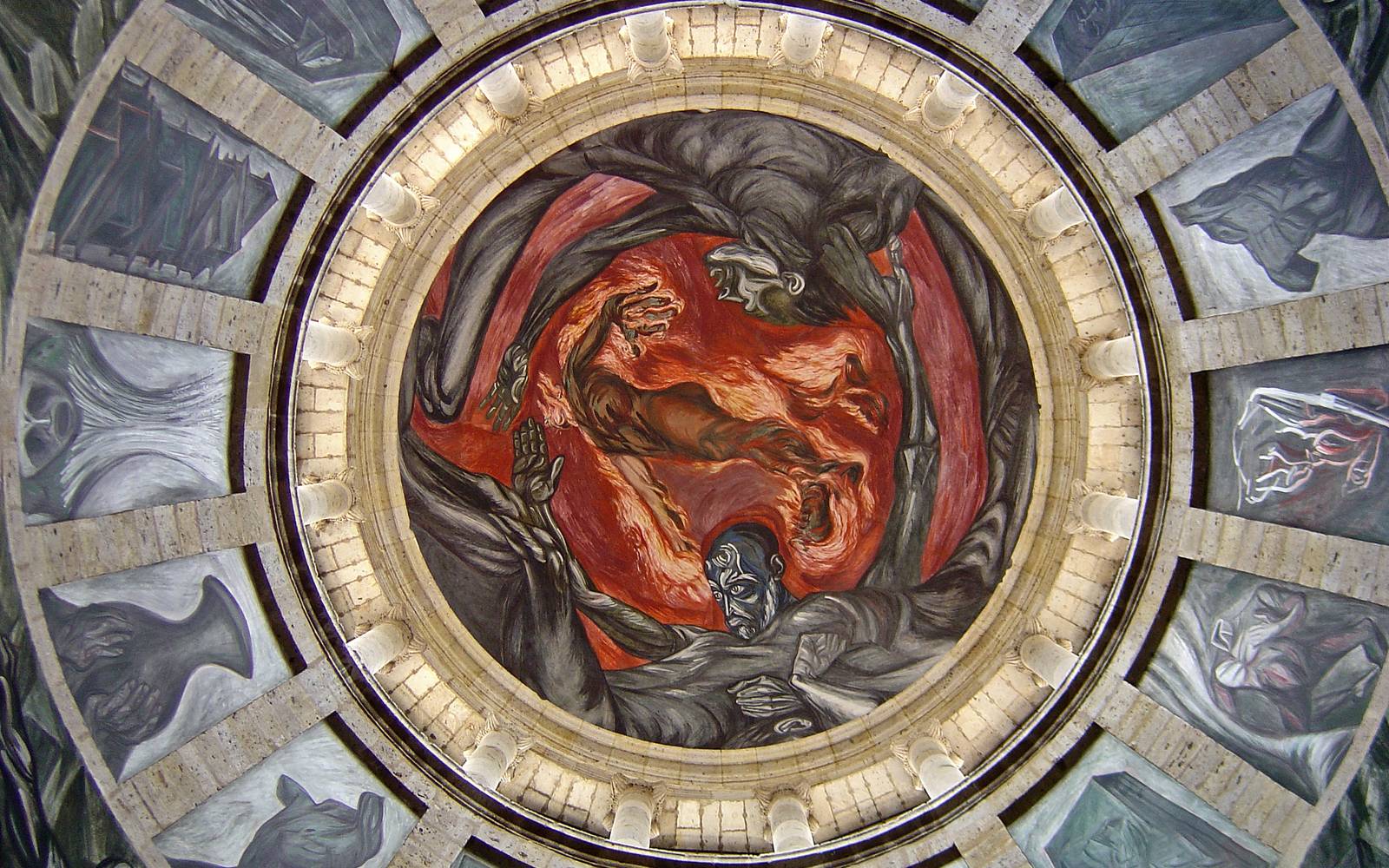
Image reference: José Clemente Orozco’s The Man of Fire.
At a Glance
- Core periodapproximately 1921–1940, with major continuations after 1940
- Country of originMexico
- Major centresMexico City, Chapingo, Cuernavaca and Guadalajara, with important US projects
- Foundational contextthe Mexican Revolution of 1910–20 and post-Revolutionary educational reform
- Leading figuresDiego Rivera, José Clemente Orozco and David Alfaro Siqueiros
- Other major participantsRoberto Montenegro, Jean Charlot, Fermín Revueltas, Fernando Leal, Ramón Alva de la Canal, Aurora Reyes, Rina Lazo, Pablo O’Higgins and Rufino Tamayo
- Important patronthe Mexican state, especially the educational programme associated with José Vasconcelos
- Key techniquesfresco, encaustic, tempera, cement-based painting, pyroxylin, spray application, photography and projected designs
- Recurring subjectsconquest, Indigenous history, agrarian reform, industrial labour, education, revolution, anti-imperialism and the future of modern society
- Essential distinctionMexican Muralism was a contested public field, not one style, party or official message
Contents
- Where it fits
- First walls
- Four stages
- Artists to know
- Rivera
- Orozco
- Siqueiros
- Essential works
- How to look
- Artist directory
Where Mexican Muralism fits
José Clemente Orozco
Key career periodDiego Rivera
Key career periodDavid Alfaro Siqueiros
Key career periodRufino Tamayo
Key career periodAurora Reyes
Key career periodPablo O’Higgins
Key career periodRina Lazo
Key career periodJorge González Camarena
Key career periodMexican Muralism made painting part of public architecture and public argument. From the early 1920s, artists covered the walls of schools, ministries, palaces, hospitals and civic buildings with histories of conquest, labour, revolution, technology and Indigenous civilisation. A spectator did not approach these works as a private owner. The spectator crossed a courtyard, climbed a stair or entered a government office, moving bodily through an account of who had made Mexico and who might inherit it.
The movement grew from a post-Revolutionary cultural programme, but it never spoke with one voice. The government offered walls and money; artists used those resources to make images that could glorify the nation, expose class power, attack imperialism or question the very revolutions they appeared to celebrate. Mexican government scholarship accordingly describes a broad field whose participants shared commitments to public and socially conscious art while maintaining distinct styles and subjects.[1]
Diego Rivera, José Clemente Orozco and David Alfaro Siqueiros became the “Three Greats.” Their importance is real, yet the phrase can make a vast, collaborative culture look like three solitary male careers. Roberto Montenegro, Fermín Revueltas, Ramón Alva de la Canal, Fernando Leal, Jean Charlot, Aurora Reyes, Rina Lazo, Pablo O’Higgins and many others altered the movement. Assistants transferred drawings, mixed plaster, photographed bodies and painted substantial passages. Muralism was both authored art and collective work.
Its deepest contradictions were not failures at the edge of an otherwise pure ideal. They gave the movement its force. A state consolidating power sponsored revolutionary imagery. Marxist artists accepted commissions from industrialists. Painters recovered a magnificent pre-Hispanic past while sometimes turning living Indigenous people into fixed national types. Works meant to endure were censored, moved or allowed to decay. Spanish-language cultural history places these tensions among nation-building, socialism, popular culture and stereotypes rather than treating the murals as transparent illustrations of one ideology.[2]
Revolution, education and the first walls
The armed phase of the Mexican Revolution destroyed lives and institutions without producing one settled political outcome. After 1920, the government of Álvaro Obregón faced the task of constructing authority across a divided country. Education became a means of integration. As minister of public education, José Vasconcelos sponsored literacy, libraries, schools, publications and visual programmes intended to make culture national and publicly legible.
The mural project was not born from nothing. Dr Atl had argued before the Revolution that artists should receive public walls. José Guadalupe Posada’s cheap printed images of urban life, death, injustice and spectacle supplied a powerful model of popular address. Pre-Hispanic sculpture and surviving colonial murals demonstrated that monumental Mexican art long predated the new state. European journeys gave painters direct knowledge of Renaissance fresco and modernist experiment.
In 1921 Rivera returned from Europe, where he had participated in Cubism alongside artists including Georges Braque. Vasconcelos’s programme offered a different scale and audience. The Museum of Modern Art’s chronology records Rivera’s return and the minister’s decision to commission works on prominent public buildings as a way of communicating post-Revolutionary ideals.[3] That connection between education, wall and audience is the institutional beginning, although no single day or picture can carry the whole origin story.
San Ildefonso as a laboratory
The former National Preparatory School at San Ildefonso became the movement’s first extraordinary laboratory. From 1922, its courtyards, stairs, arches and amphitheatre brought several young muralists into direct proximity. Rivera worked on Creation. Orozco developed a changing group of works across the main courtyard. Siqueiros attempted a complex stairwell project. Jean Charlot, Fermín Revueltas, Fernando Leal and Ramón Alva de la Canal addressed conquest, religious festival and mestizaje.
Gaceta UNAM’s centenary account stresses the seven artists working there and the way they observed, admired and competed with one another.[4] The site matters because it prevents a tidy founding narrative. The murals do not resemble one another enough to form a house style. Rivera’s hieratic allegory, Orozco’s corrosive social drama and Charlot’s compact violence show several possible futures arriving at once.
Fermín Revueltas’s Allegory of the Virgin of Guadalupe places the sacred image above figures drawn from different Mexican regions. Its pyramidal order turns Guadalupe into a sign of mestizaje and shared devotion. Nearby works by Alva de la Canal, Charlot and Leal move between Spanish arrival, the massacre at Templo Mayor and the pilgrimage to Chalma. UNAM’s Spanish study identifies these interrelated subjects and Revueltas’s youthful role.[5] Together, they demonstrate that religion could be popular culture, colonial instrument and national bond at the same time.
Siqueiros’s first mural occupies a stair, vault and divided walls in a less visible part of the complex. Parts remained unfinished. That incompletion is instructive: mural painting demanded negotiation with awkward architecture, changing plans, money, access and the limits of a new technique. UNAM research reconstructs the ensemble and Vasconcelos’s call for Siqueiros to return from Europe.[6] A movement later celebrated for mastery began through experiments that could fail in public.
The Secretariat of Public Education
At the Secretariat of Public Education, Rivera found a site suited to sustained narrative. Across two courtyards and more than a hundred panels painted between 1923 and 1928, workers mine, forge, dye cloth and teach; villagers celebrate festivals; revolutionaries gather; political emblems enter the sequence. Rather than offering one panorama, the building asks viewers to accumulate scenes as they walk.
The labour court and festival court are not sealed opposites. Work has ritual rhythm; festivals reveal social hierarchy; revolutionary images interrupt both. Rivera simplifies bodies into broad, weight-bearing forms, but his crowds are organised by task, music, procession and political affinity. UNAM’s resource on the SEP murals anchors the cycle within the institution and its educational purpose.[7]
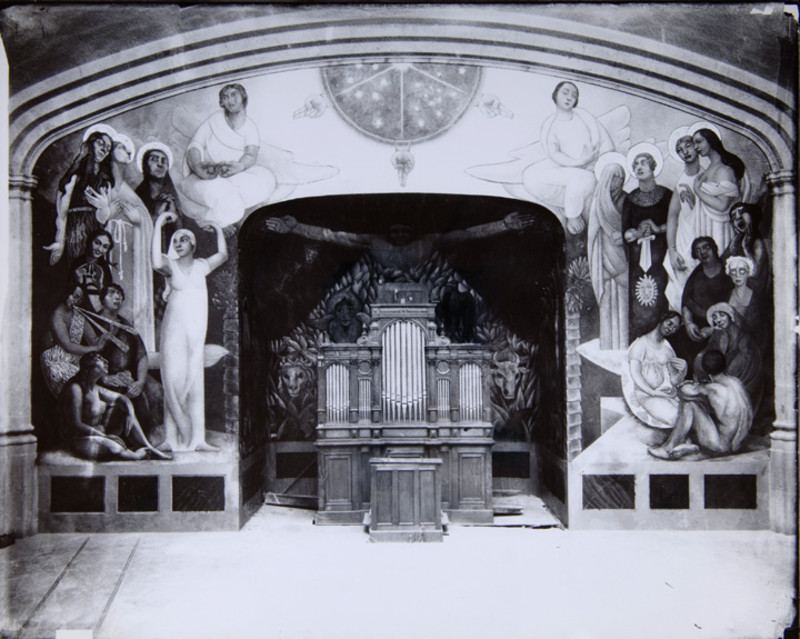
Rivera’s Creation has often been named the work that launched the renaissance, while Roberto Montenegro’s Tree of Life of 1921 is also proposed as the first mural of the programme. The difference matters less than the assumptions behind each claim. One choice privileges Rivera and the fully developed San Ildefonso campaign; another recognises an earlier, stylistically different commission. UNAM’s centenary booklet preserves this ambiguity rather than inventing an uncontested first.[8]
In 1924 the Union of Technical Workers, Painters and Sculptors issued a manifesto that rejected bourgeois individualism and advocated monumental art serving workers and peasants. Its newspaper, El Machete, joined graphic art to militant politics. Yet the artists’ declarations did not cancel the source of their walls. Ministries could suspend commissions, control buildings or change priorities. The muralists could criticise officials, resign, return or seek patrons elsewhere.
Institutional scholarship from INAH describes this relation as dialectical: the state established possibilities, while artists could reflect, complicate or challenge official positions.[9] That is more accurate than calling every mural propaganda, and more realistic than imagining autonomous painters merely borrowing neutral walls. Public art emerged through friction among author, patron, architecture and audience.
Follow Mexican Muralism through four stages
–24
Revolution, education and the first walls
State commissions at San Ildefonso and the Secretariat of Public Education bring artists, experimental techniques and competing ideas of public address into post-revolutionary institutions.
–30
A public system and national synthesis
Rivera's expanding cycles join labour, festival and historical narrative while regional commissions and distinct voices prove that muralism never settles into one style.
–36
Cross-border expansion and experiment
Rivera, Orozco and Siqueiros work in the United States, where patrons, industrial sites, censorship and new technologies reshape both Mexican muralism and American art.
A plural field, national canon and afterlives
Women muralists, later commissions, museum relocation, conservation and Chicano public art revise the canon while monumental practice continues beyond the founding generation.
Mexican Muralism artists to know
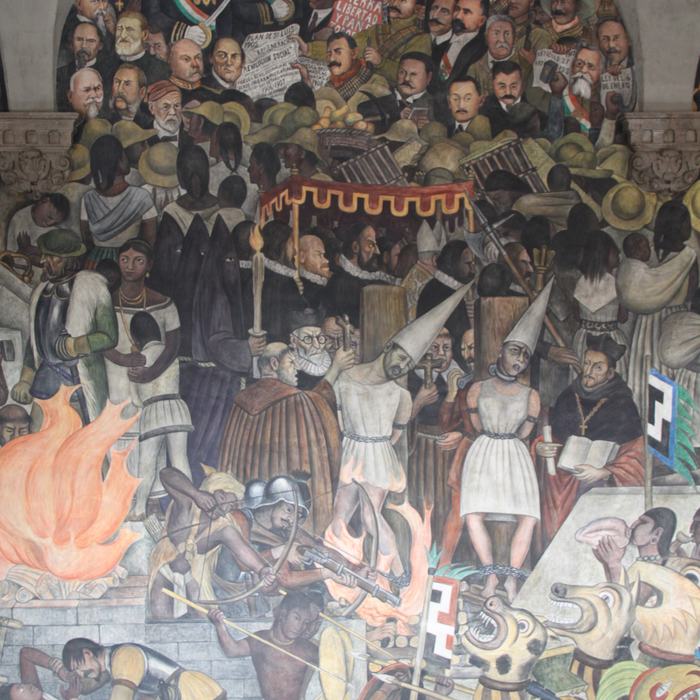
Diego Rivera
Rivera joined compressed storytelling to architectural route, making Indigenous civilisation, conquest, labour, revolution and industrial modernity parts of an immense public history.
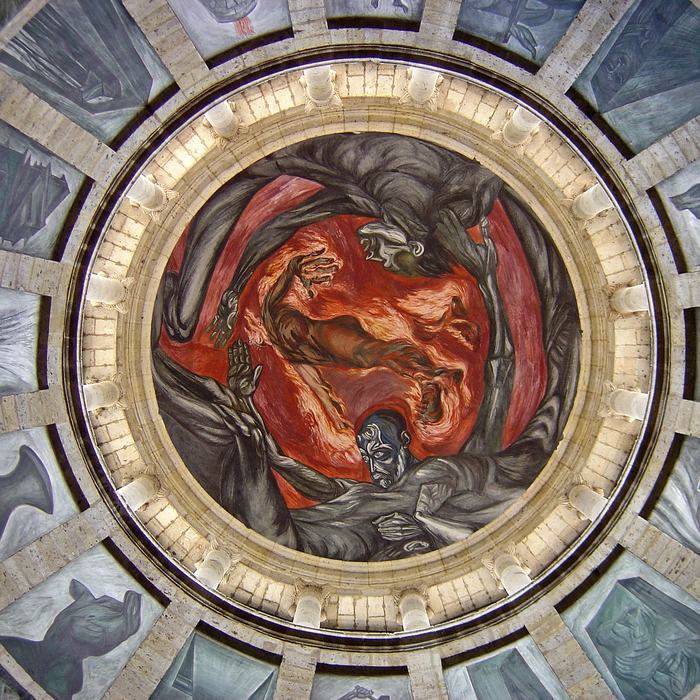
José Clemente Orozco
Orozco distrusted easy redemption. His wounded bodies, unstable crowds and darkly comic modern institutions make history an unresolved moral encounter rather than an official lesson.
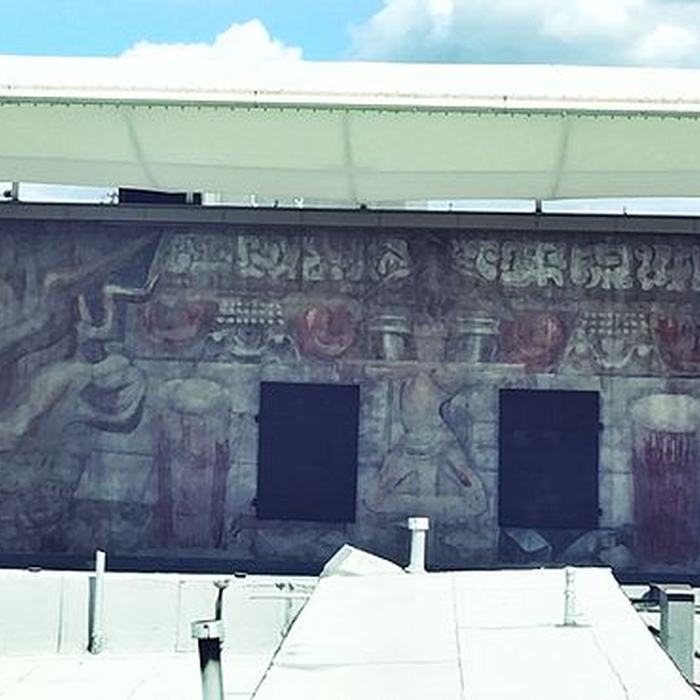
David Alfaro Siqueiros
Siqueiros treated the wall as an experimental apparatus, using cameras, projectors, industrial paints, unusual supports and organised teams to intensify mass address.
Aurora Reyes
Reyes's murals and teaching widen the field beyond the familiar triumvirate. Her work joins women, teachers, violence and collective emancipation to public education.
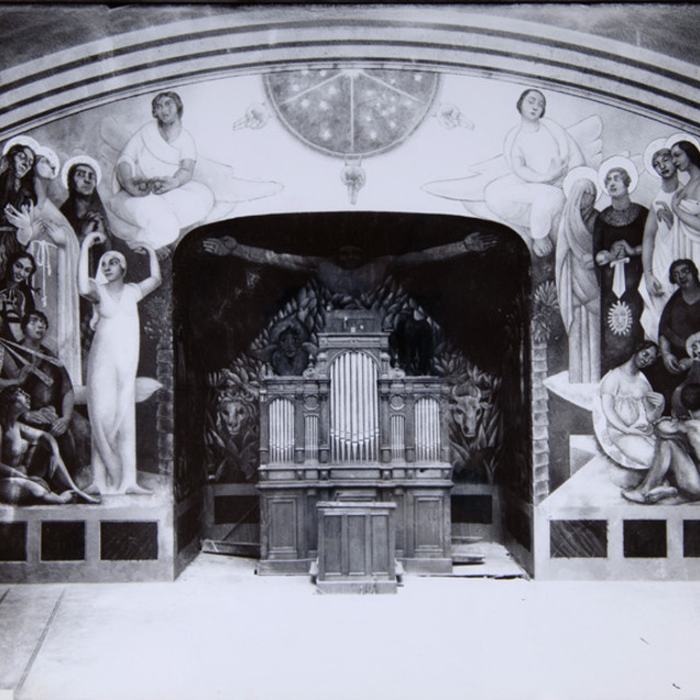
Rina Lazo
Lazo moved from assisting Rivera to making independent murals in which archaeological knowledge, modern composition and living Indigenous cultures complicate the idea of influence.
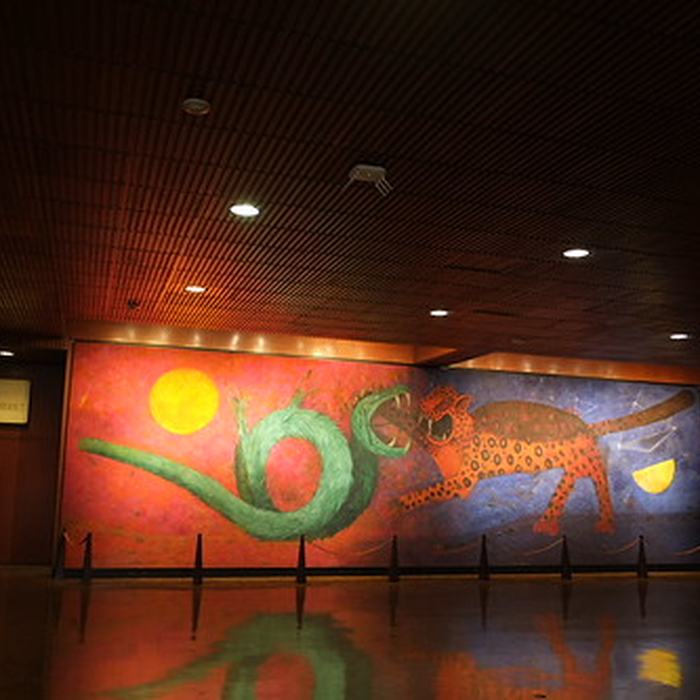
Rufino Tamayo
Tamayo rejected programmatic orthodoxy without abandoning monumental public art. His murals revise national symbols through chromatic compression, abstraction and cosmic conflict.
Rivera and the ambition to synthesise Mexico
Diego Rivera had an unusual ability to make dense historical programmes immediately readable. Figures lock into stable groups. Profiles repeat like architectural units. Hands hold tools, maize, rifles and banners with emblematic clarity. At large scale, the masses remain distinguishable by work and social position; at close range, plants, costume and tools add descriptive specificity.
His European formation mattered. Cubism taught him to compress and interlock forms. Italian mural study clarified how painting could answer a wall; the example of Michelangelo belonged to a much longer history of monumental bodies, patronage and contested sacred space. Rivera did not simply abandon Europe for an authentic Mexico. He combined imported and local methods to construct a deliberately modern national language.
MoMA’s artist study traces that shift from academic training and Parisian modernism to the Mexican fresco cycles at the SEP, Chapingo, Palacio Nacional and Palacio de Cortés.[10] The list reveals a central paradox: a style praised as accessible was produced by an exceptionally cosmopolitan artist.
Chapingo: earth, body and revolution
At the former chapel of the National School of Agriculture in Chapingo, painted from 1924 to 1927, Rivera fused land reform with cycles of fertility, death and renewal. The architecture retains a chapel’s axial structure, but sacred narrative becomes agrarian. Seed, soil, rain, pregnancy, burial and germination bind human bodies to a revolutionary future.
The programme moves from social struggle toward an apse dominated by a monumental fertile earth. Female bodies personify natural forces, while male workers and revolutionaries inhabit historical action. This division can feel celebratory and restrictive at once: women receive cosmic scale but are often made symbolic matter; men appear as political agents. The university museum describes the cycle as agrarian, sensual, vanguard and revolutionary and dates the principal work to 1924–27.[11]
Rivera’s second wife, Guadalupe Marín, and the photographer Tina Modotti are associated with figures in the cycle. Models and collaborators were not simply raw material, yet the mural’s authorship remains Rivera’s. The tension invites a larger question that recurs throughout muralism: when a public figure embodies land or nation, where does the individual person go?
Conquest and revolution in Morelos
The Palacio de Cortés in Cuernavaca offered Rivera a colonial building loaded with the violence he would depict. The US ambassador Dwight Morrow commissioned the cycle, completed in 1930. Rivera organised the history of Morelos through conquest, forced labour, religious conversion, sugar production and the agrarian revolution of Emiliano Zapata.
Spanish-language INAH scholarship shows that the commission cannot be reduced to a friendly gift of cultural diplomacy. Morrow’s patronage, Rivera’s Communist politics, the colonial architecture and the relation to his Palacio Nacional work shaped the result.[12] The building that had represented conquest became a surface on which conquest could be accused.
The national monument record adds the material terms: a payment of twelve thousand dollars, assistance from Victor Arnautoff and a long fresco sequence whose episodes culminate in Zapata.[13] Naming an assistant changes the image of the muralist at work. A monumental cycle is planned by an author but realised through logistics and hands.
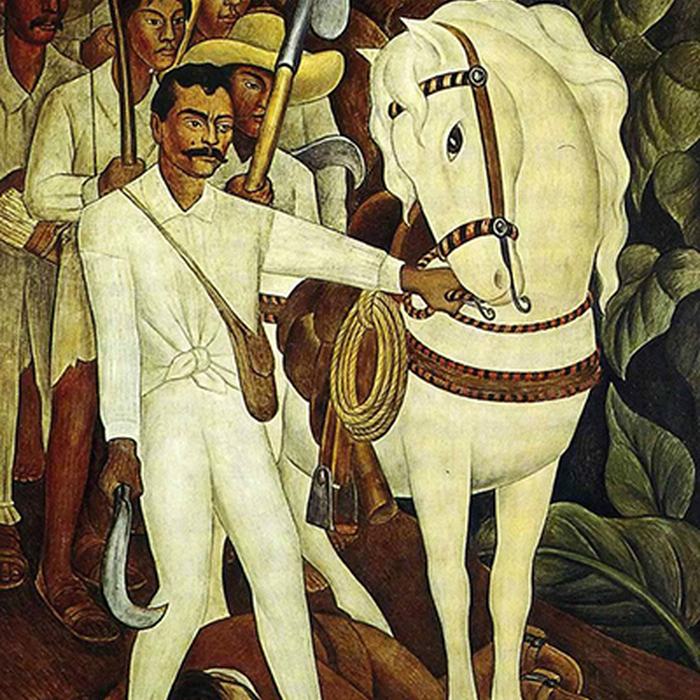
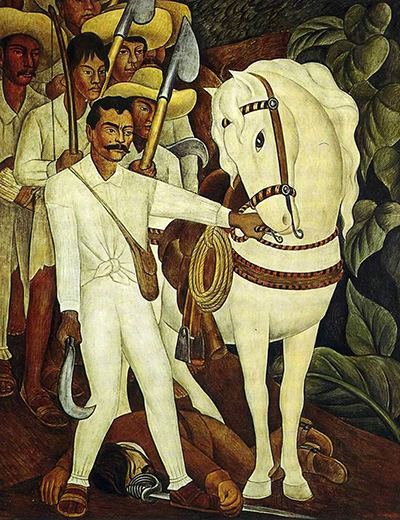
Rivera’s Zapata is not a mounted general. Dressed in white peasant clothing, he stands over a fallen hacienda owner and holds a horse by the bridle. Armed campesinos form a compressed wall behind him. The white horse, borrowed from heroic portrait conventions, has been transferred from ruler to agrarian leader. Violence remains present, but authority changes class.
Palacio Nacional and the problem of national history
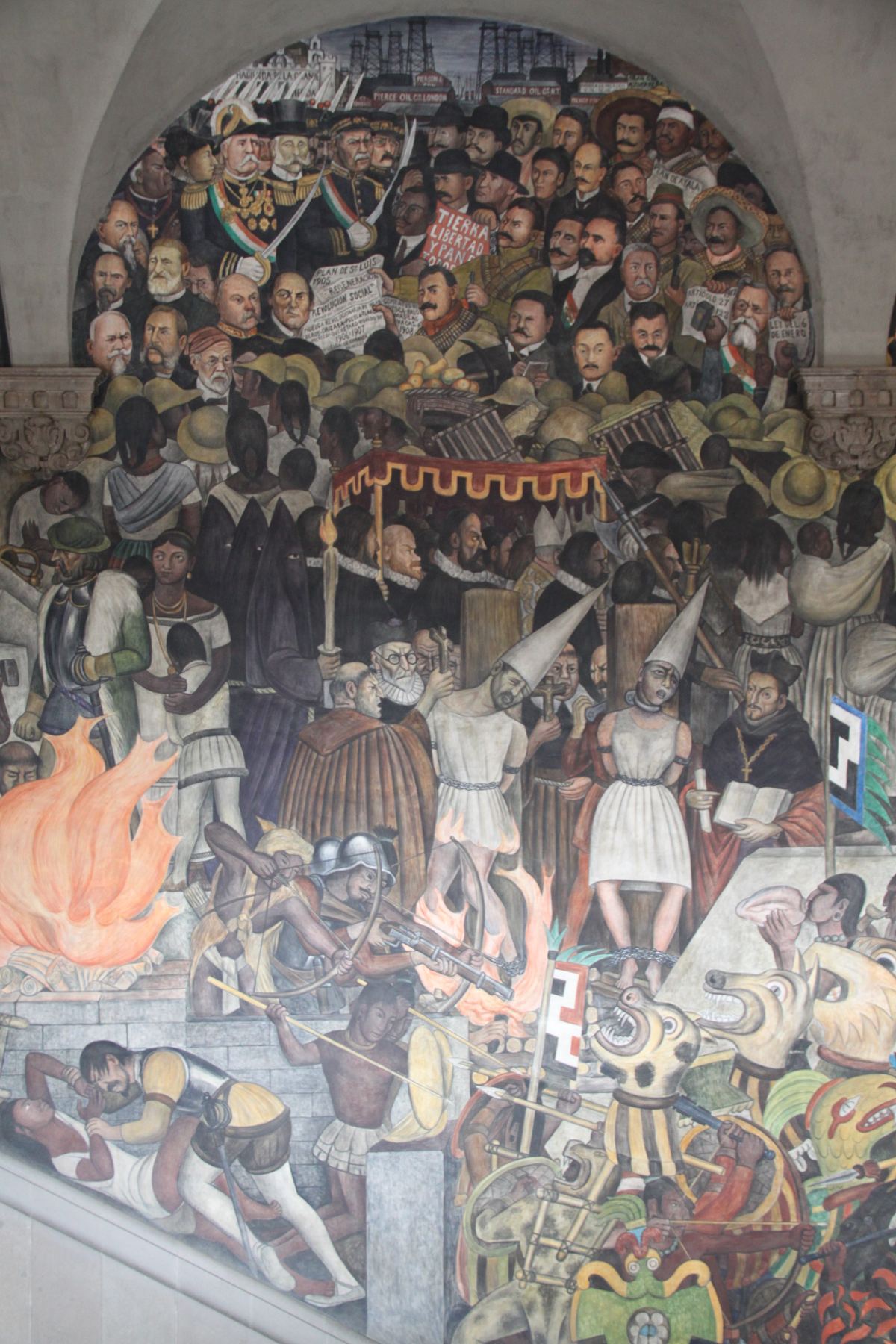
On the main stair of the Palacio Nacional, Rivera built a vast history of Mexico in which conquest, clerical power, resistance, independence, reform, dictatorship, revolution and socialist future collide. Time is arranged spatially. Viewers climb through it, unable to see every episode at once. The device makes national history both monumental and crowded.
Rivera gave pre-Hispanic civilisation grandeur, complexity and technological knowledge. He reversed the colonial academic habit of treating European arrival as the beginning of history. Yet his future-facing synthesis places many cultures inside one story of mestizo nation and class emancipation. Difference can become raw material for unity.
That problem is visible in the portable frescoes Rivera created for his 1931 Museum of Modern Art exhibition. Large blocks of plaster allowed a wall painter to enter a temporary museum. Agrarian Leader Zapata detached a scene based on Morelos from its building and turned it into a collectable object. MoMA explains that the panels addressed revolution and class inequality while solving the contradiction of exhibiting site-bound art.[14]
Portability widened Rivera’s audience but altered the politics of encounter. A government corridor or colonial palace becomes a white gallery. The spectator chooses a viewing distance rather than passing through the daily life of an institution. The portable mural is therefore both technical invention and revealing contradiction.
Critical scholarship on Rivera’s mestizaje asks us to hold recovery and reduction together. His murals assert Indigenous antiquity against colonial contempt, but their idealised bodies and unified historical arc can be paternalist or essentialist.[15] The issue is not whether Rivera “liked” Indigenous culture. It is who is permitted to speak, change and remain politically distinct within his image of national integration.
Detroit: industry under capitalist patronage
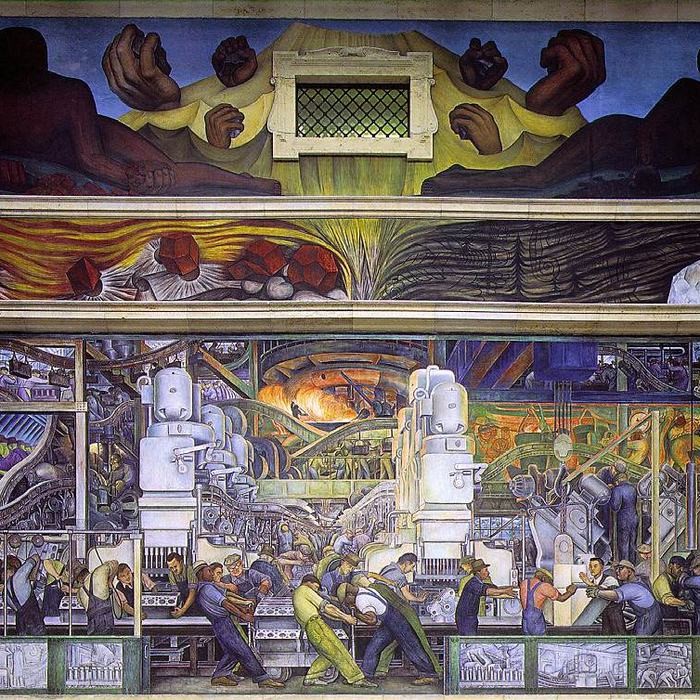
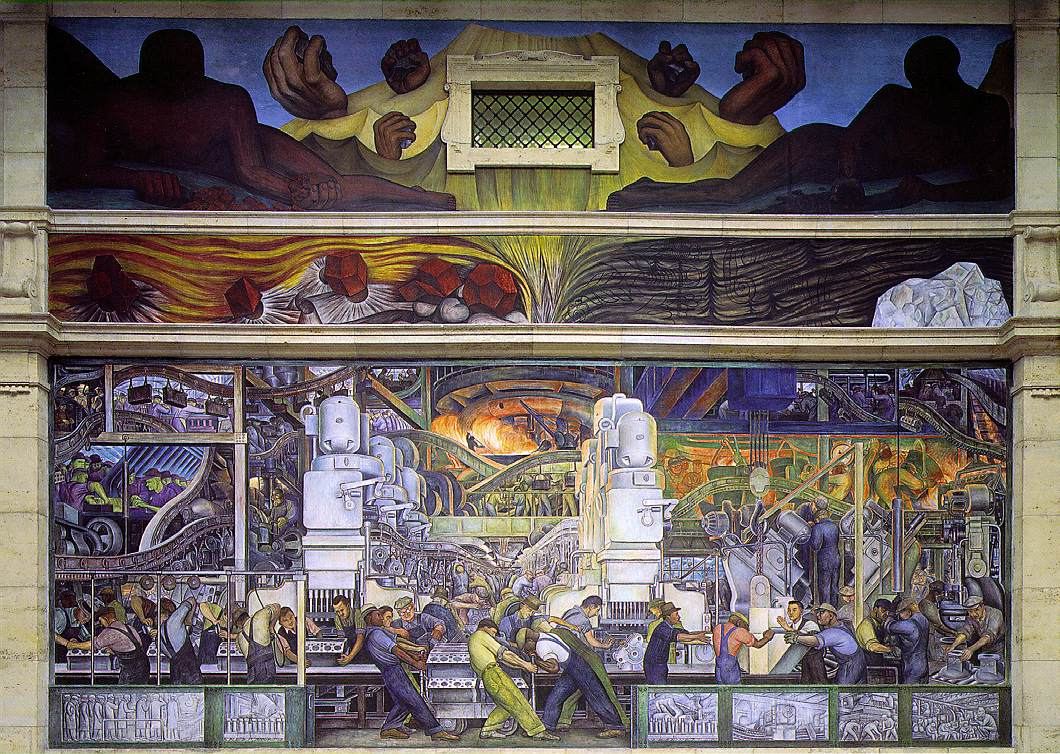
Rivera’s twenty-seven-panel Detroit Industry cycle of 1932–33 surrounds the Detroit Institute of Arts’ central court. The north and south walls organise automobile production as an immense bodily and mechanical system. Workers bend into assembly rhythms; conveyors and presses repeat limbs; raw materials and geological forces connect factory labour to the earth.
The Detroit Institute of Arts emphasises duality: technology can create and destroy, while industry depends on natural materials and human knowledge.[16] Rivera neither paints a simple advertisement nor a single condemnation. Machines have grandeur, but they demand bodies. The vaccination panel echoes a Nativity while joining science, race and modern medicine in an image that provoked religious criticism.
Edsel Ford financed the project during the Depression. The National Park Service records the commission, the Ford factory research and the mural’s importance to later US public art.[17] A Marxist painter could praise collective labour inside a museum supported by an automobile dynasty. Patron and artist did not need ideological agreement for a major work to exist; their incompatible interests remain visible within it.
Rockefeller Center and the limit of negotiation
At Rockefeller Center, negotiation broke down. Rivera’s Man at the Crossroads placed modern humanity among scientific and social possibilities and included Lenin. When Rivera refused to remove the portrait, the mural was covered and destroyed. He later recreated the composition at the Palacio de Bellas Artes as Man, Controller of the Universe.
MoMA’s surviving study preserves part of the commission’s development and makes the lost work available as process rather than intact monument.[18] The episode is frequently told as a morality play about brave artist and censoring capitalist. That conflict was real, but the story also exposes mural painting’s dependence on property. A patron who owns a wall may possess the power to erase it.
Orozco and history without reassurance
José Clemente Orozco distrusted the triumphal revolutionary story. Where Rivera often builds coherent processions, Orozco fractures groups and exposes bodies to fire, blades, machinery and ridicule. His figures can be monumental without being heroic. The force of his art lies in refusing to let one faction become history’s innocent endpoint.
Mexican museum interpretation distinguishes Orozco through this critical attitude toward nationalism and the Revolution.[19] He was not apolitical or neutral. Rather, he made political certainty itself a subject. Priests, soldiers, intellectuals, rebels and crowds can all participate in destructive systems.
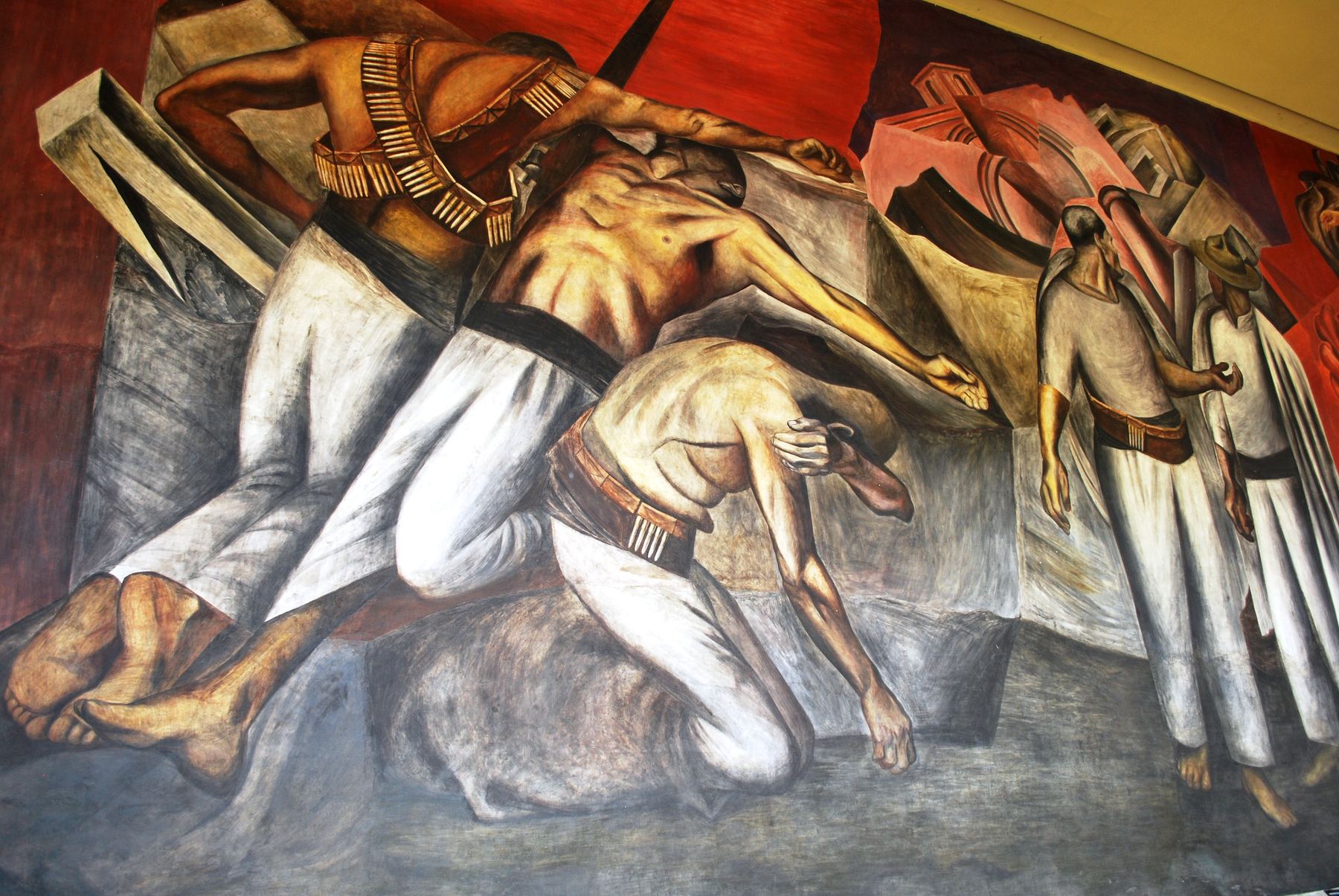
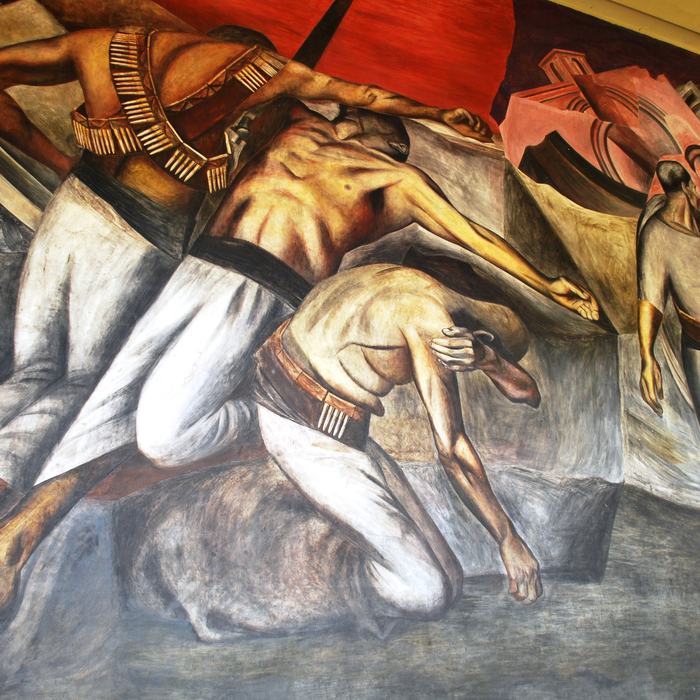
At San Ildefonso, The Trench brings three falling revolutionary fighters into a compressed triangle. One extends his arms in a pose that recalls crucifixion; another disappears under bent limbs; the third’s head drops away. Rifles form hard diagonals, but no enemy appears. Sacrifice is visible; victory is not.
Orozco revised and destroyed some early murals at the school. That self-editing belongs to a practice shaped by political volatility and changing thought. A mural can look permanent while its maker remains dissatisfied with the programme it seems to serve.
Guadalajara and The Man of Fire
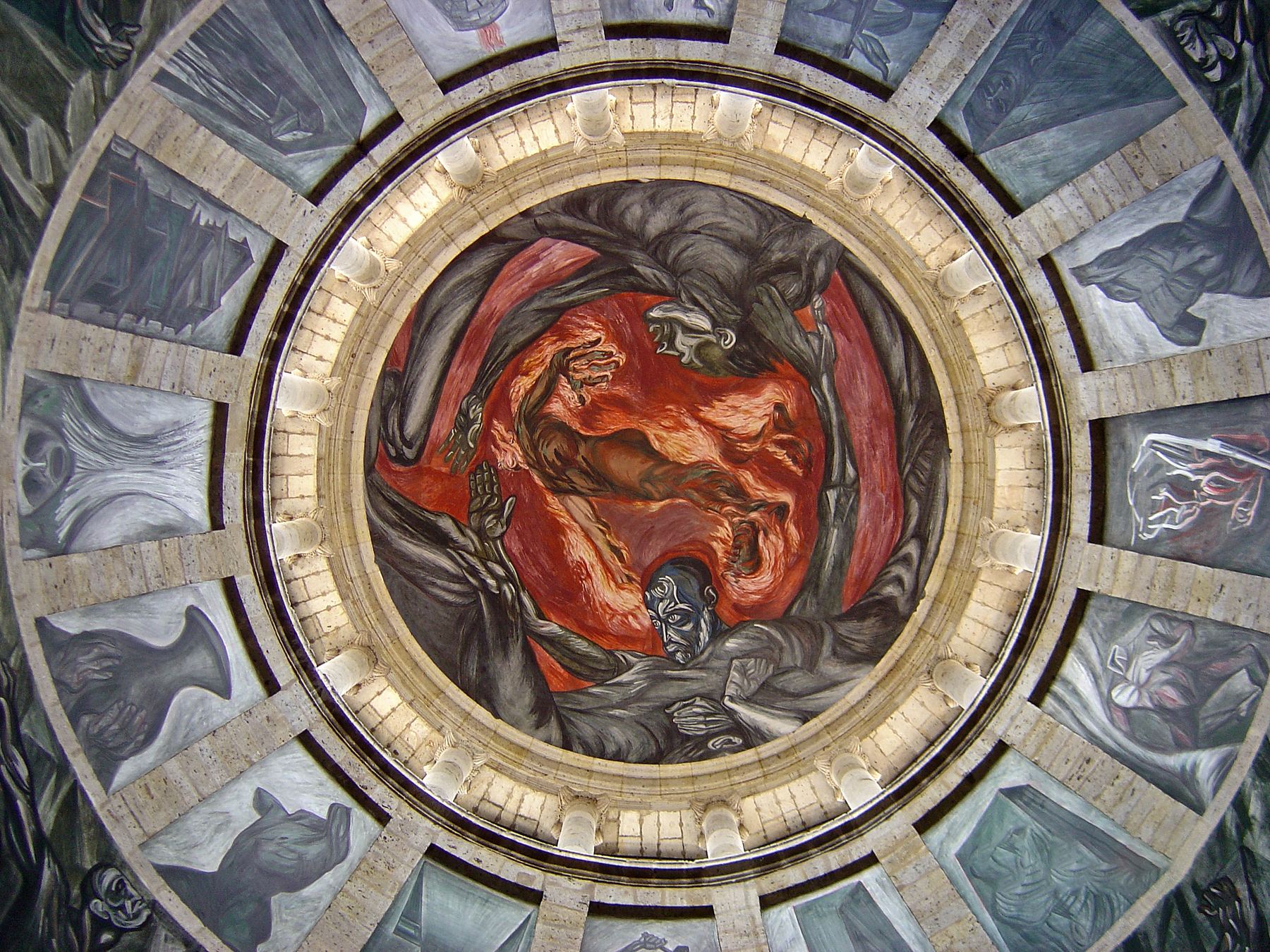
At the Hospicio Cabañas in Guadalajara, Orozco painted fifty-seven murals across a former charitable complex. Images of conquest, religion, machinery and oppression occupy walls and vaults, culminating in The Man of Fire inside the dome. Museo Cabañas identifies this broad programme and its central themes.[20]
The flaming figure rises while surrounding bodies rotate beneath. Depending on viewpoint, he ascends, burns or is consumed by the historical cycle around him. The dome denies a stable horizon. Architecture makes the spectator turn, and turning makes certainty difficult.
Nearby images do not divide Spanish evil from Indigenous innocence with perfect clarity. Armoured conquistadors become machines; priests and weapons fuse with architecture; pre-Hispanic ritual can also appear violent. Orozco’s hemispheric history is tragic because human systems repeatedly turn belief and technique toward domination.
The Epic of American Civilization
At Dartmouth College, Orozco’s twenty-four-panel Epic of American Civilization covers roughly 3,200 square feet. It moves from migration and ancient cultures through the arrival of Quetzalcoatl, conquest, industrial modernity and a transformed Christ. The Hood Museum describes the work as a cyclical account of the Americas rather than a US national success story.[21]
The cycle’s “Anglo-America” is regimented; “Hispano-America” is chaotic. Neither receives easy superiority. In Gods of the Modern World, skeletal academics deliver a stillborn body while rows of robed skeletons preside. Education that reproduces dead knowledge becomes grotesque ritual—a devastating image in a university library.
The final modern Christ has cut down his cross and raises an axe. Weapons lie in a heap. The image does not settle whether organised religion has been renewed or condemned; it replaces passive sacrifice with an act whose consequences remain uncertain.
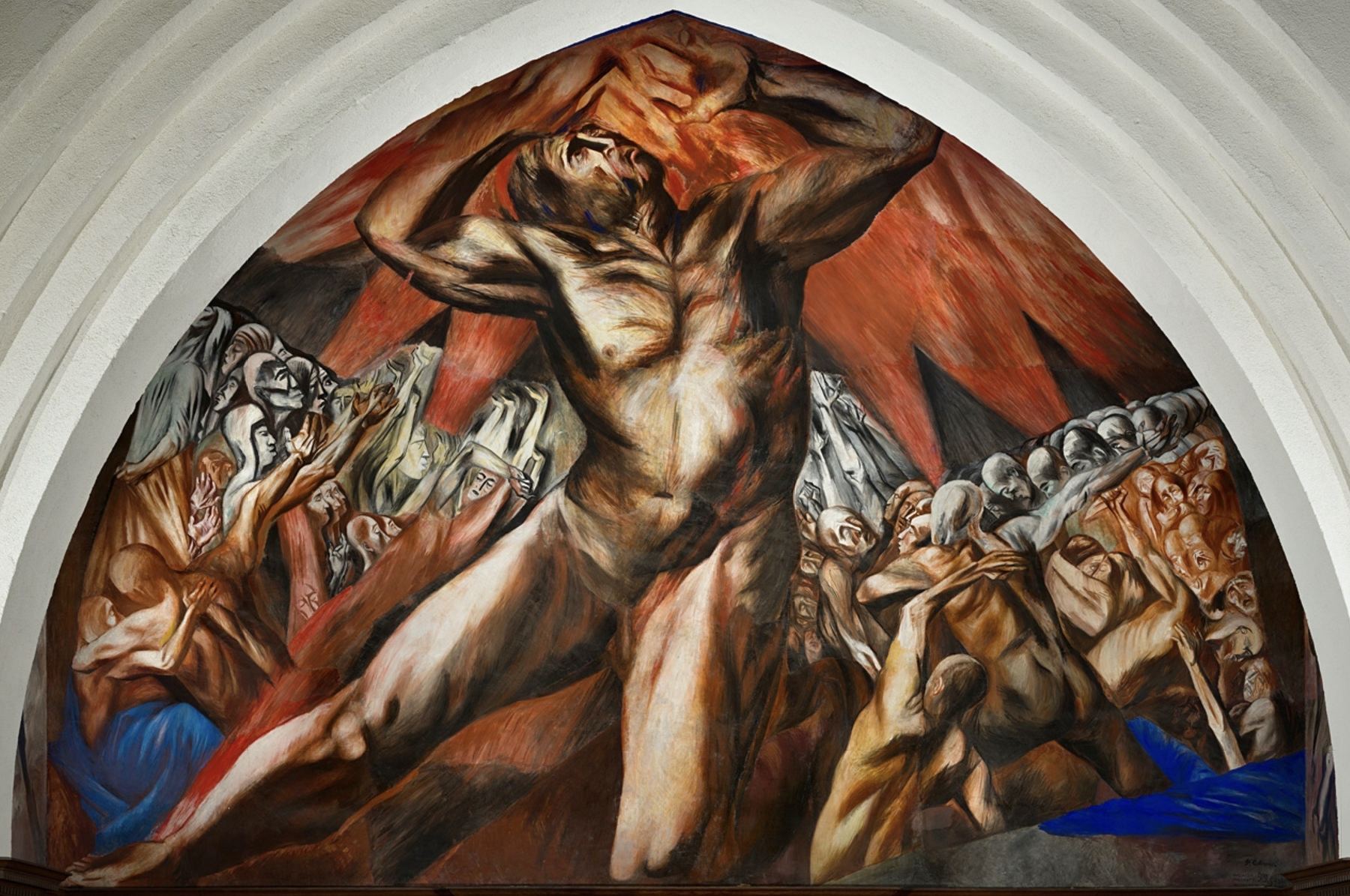
Orozco had already completed Prometheus at Pomona College in 1930, an early major US mural by one of the central Mexican artists.[22] The Titan reaches toward fire while surrounding figures protect themselves, resist or fail to understand. Knowledge is gift, danger and isolation. Even before Dartmouth, Orozco had made public enlightenment inseparable from suffering.
His career ranged from newspaper caricature and revolutionary drawings to Mexican and US cycles and late work in Guadalajara. INBAL’s Spanish biography confirms that breadth and helps prevent one tragic manner from becoming a caricature of the artist himself.[23]
Siqueiros: the wall as political technology
David Alfaro Siqueiros was the most insistent theorist of a technologically modern mural. He rejected the precious, portable easel picture, argued for collective practice and sought materials capable of addressing viewers formed by cinema, photography, industry and mass politics. Extreme foreshortening pushes bodies toward spectators; repeated viewpoints allow an image to work across a stair or curved surface.
His politics were not merely represented in paintings. He served as a soldier, organised, joined Communist campaigns, travelled, was imprisoned and took part in violent political action. INBAL connects this militant life to photography, industrial materials and experimental workshop practice.[24] The art should not be sanitised, but biography should not substitute for looking.
América Tropical
In Los Angeles in 1932, Siqueiros received a commission for an outdoor mural in Olvera Street. The expected picturesque tropical scene became an Indigenous figure crucified beneath a US eagle, with armed resistance emerging at the edge. The mural turned a civic celebration into an accusation of imperial power.
It was soon partly and then fully whitewashed. The Getty Conservation Institute records the work’s suppression, rediscovery and later importance to Chicano artists.[25] Censorship did not remove it from history. The white layer became evidence of which Indigenous and anti-imperialist images a commercial heritage district could not tolerate.
The mural’s vulnerability was also material. Siqueiros used industrial paints on exterior cement in a harsh environment. Getty scientific study identifies binders, weathering and the need for a protective shelter.[26] Experiment promised modern durability but created unfamiliar conservation problems. Innovation and decay arrived together.
Workshop, camera and collective authorship
Siqueiros’s 1936 Experimental Workshop in New York invited artists to test spray guns, liquid paint, stencils, photography, projections and collective procedure. Archival papers preserve working rules and evidence of this laboratory.[27] Among the participants was Jackson Pollock, but the connection should not become a legend in which Siqueiros single-handedly invents Abstract Expressionism. Workshop experience was one strand in Pollock’s much longer development.
Photography was more than preliminary documentation. A camera could seize a dramatic angle, enlarge a worker’s hand, repeat a crowd or construct a montage impossible to see from one standing position. Projected photographs helped teams transfer designs. Siqueiros wanted the mural to match the visual speed of film and the physical power of modern architecture.
Collective labour challenged the romantic lone artist, yet public credit still accumulated around his name. Works such as Portrait of the Bourgeoisie, made for the Mexican Electricians’ Union with Josep Renau, Antonio Pujol, Luis Arenal and others, require plural authorship. Flames, coins, military machinery and a generating dynamo surround the stair so that capitalism appears not as one ruler but as a system.
Siqueiros later gave his house and studio to the Mexican people. The Sala de Arte Público Siqueiros preserves archives, murals and the artist’s ideas about public art, including evidence from periods of imprisonment.[28] The institution makes it possible to study theory, politics and technique together rather than treating murals as detached images.
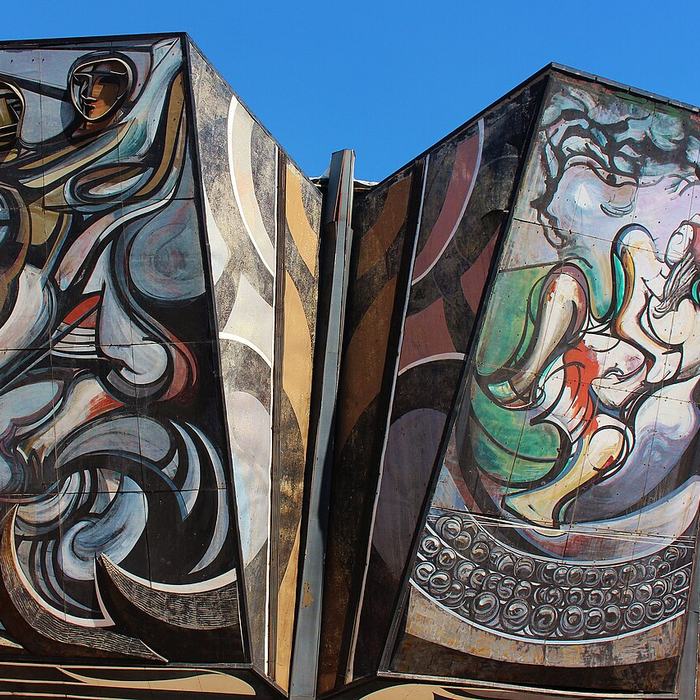
His late March of Humanity at the Polyforum extends painting across an architectural complex. Government cultural records describe approximately 2,400 square metres of mural surface, polyangular composition and industrial materials.[29] Exterior reliefs and interior painting turn the visitor into a moving participant. The grand rhetoric can overwhelm, but the work fulfils Siqueiros’s lifelong ambition to dissolve the framed picture into a total public environment.
Beyond the “Three Greats”
The “Three Greats” label gave Mexican Muralism an exportable story. It also narrowed the field. The earliest sites already included Montenegro, Revueltas, Leal, Charlot and Alva de la Canal. Later projects depended on teams. Regional commissions developed outside the capital. Artists who rejected the dominant narrative still worked monumentally.
The problem is particularly visible in the history of women. Mexican cultural research recovers a substantial group of muralists obscured by the masculine national canon.[30] Their work should not be treated as a decorative supplement or a single female alternative. They differed in politics, generation, training, nationality and technique.
Aurora Reyes
Aurora Reyes completed Attack on Rural Teachers in 1936 and is widely identified as the first Mexican woman to receive and execute a mural commission. A teacher, poet and activist, she later made several other murals concerned with education, violence and women’s civic power. INBAL records seven murals and a practice extending through drawing, painting, engraving and portraiture.[31]
In Attack on Rural Teachers, a woman is dragged by the hair while an attacker strikes. The diagonal violence is not an allegory floating above history; it responds to assaults on teachers carrying socialist education into rural communities. The teacher’s body makes state reform, local resistance and gendered brutality collide.
Archival history also shows Reyes advocating women’s rights and working within Communist politics while encountering its gender hierarchies.[32] Calling her “revolutionary” should therefore open questions rather than close them. She fought through institutions that could reproduce the exclusions they opposed.
Rina Lazo and the assistant’s path
Guatemalan-born Rina Lazo arrived in Mexico in 1947, studied at La Esmeralda and joined Rivera’s team. She worked on Dream of a Sunday Afternoon in Alameda Park and other projects before developing her own murals, prints and paintings. INBAL describes her self-identification as a Mesoamerican artist and her sustained engagement with Maya culture.[33]
The usual sentence “assistant to Rivera” is accurate but incomplete. It names access to training while keeping the better-known man at the centre. Lazo’s independent work, including the late Xibalbá: The Underworld of the Maya, asks how Mesoamerican worlds could be represented after the first post-Revolutionary canon had hardened.
Lucienne Bloch, Marion Greenwood, Grace Greenwood, Isabel Villaseñor and others further complicate nationality and authorship. Some came from the United States or Europe, worked in Mexico, assisted major projects and developed their own public art. Their participation reveals a movement built through transnational labour before it was packaged as a national style.
Essential Mexican Muralism works
Creation
Diego Rivera · 1922 · Rivera's first government-backed mural makes a modern allegory answer an architectural stage, announcing ambition before the movement had settled on a common visual language.
The Trench
José Clemente Orozco · 1926 · Orozco compresses three falling bodies into a brutal diagonal, stripping revolutionary sacrifice of pageantry and leaving solidarity inseparable from death.
Agrarian Leader Zapata
Diego Rivera · 1931 · Rivera turns agrarian revolt into a portable fresco whose frontal procession and pale horse make land reform immediately legible to an international museum public.
Prometheus
José Clemente Orozco · 1930 · Orozco places a solitary fire-bringer at the centre of a communal drama, making enlightenment, rebellion and suffering difficult to separate.
Detroit Industry, North Wall
Diego Rivera · 1932–33 · Rivera surrounds the viewer with machinery, mineral matter, workers and industrial processes, treating the modern factory as both productive system and civic epic.
The History of Mexico
Diego Rivera · 1929–35 · The Palacio Nacional stairway binds conquest, class conflict, reform and revolution into an immense historical ascent inside the symbolic centre of federal power.
The Man of Fire
José Clemente Orozco · 1939 · Orozco's foreshortened figure rises through the Hospicio Cabañas dome while the surrounding bodies rotate below, turning architecture into a vision of destruction and renewal.
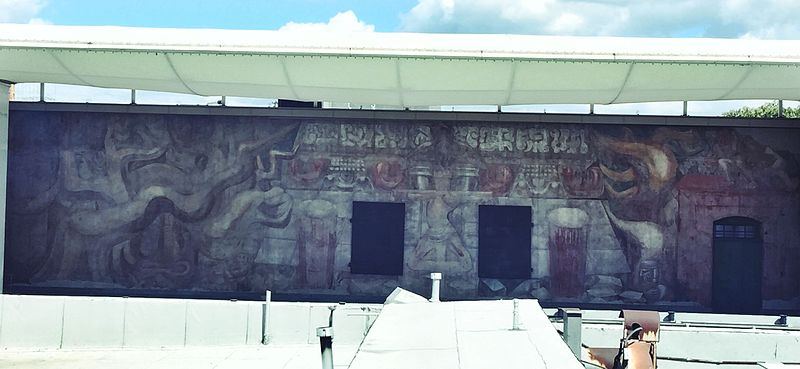
América Tropical
David Alfaro Siqueiros · 1932 · Siqueiros makes the exposed wall itself political: a crucified Indigenous figure and imperial eagle transformed a tourist commission into an anti-imperialist confrontation.
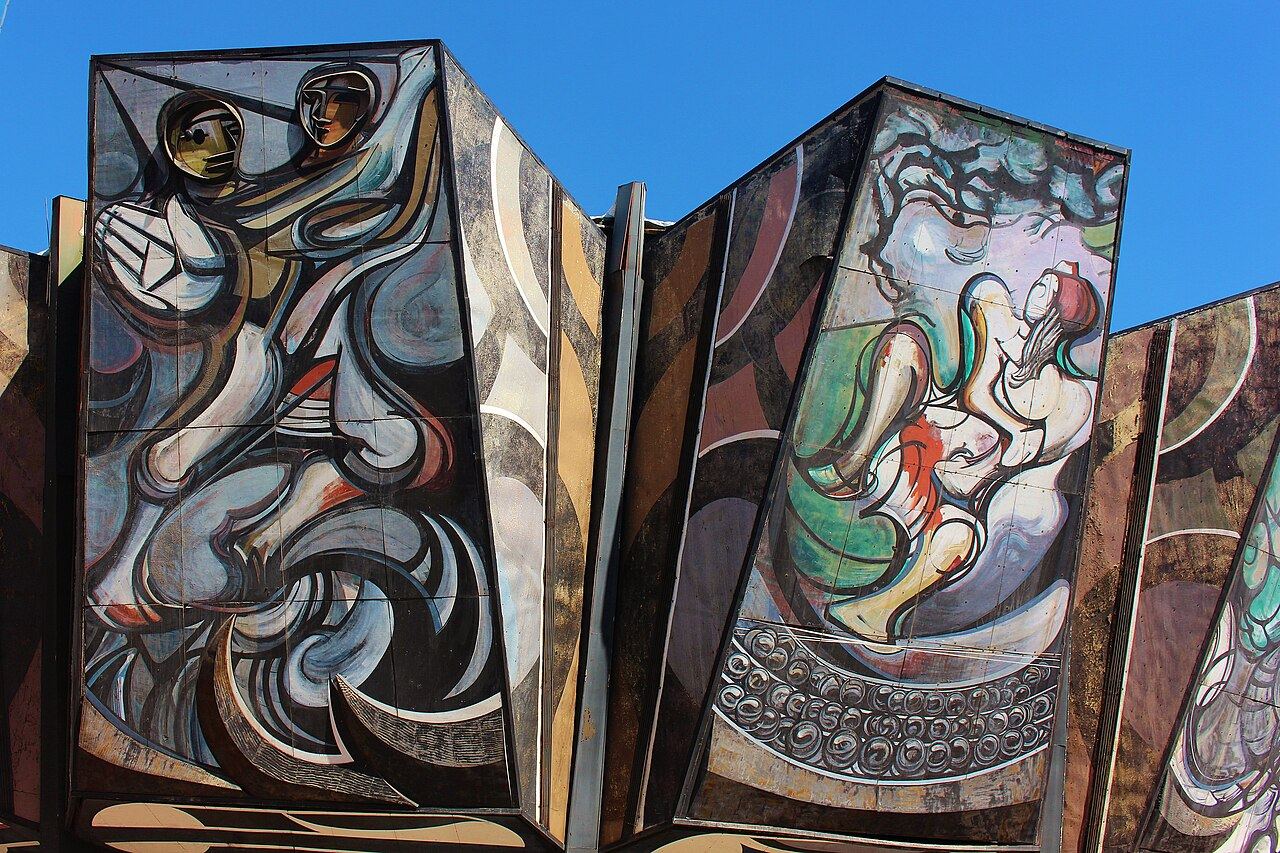
The March of Humanity (exterior detail)
David Alfaro Siqueiros · 1965–71 · The late Polyforum extends painting across sculptural exterior planes, joining industrial materials, mass address and bodily movement around the building.
Dualidad
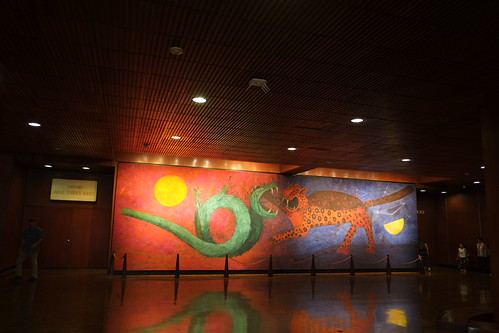
Rufino Tamayo · 1964 · Tamayo's cosmic contest between Quetzalcoatl and Tezcatlipoca revises muralism through modern colour and Mesoamerican symbolism without repeating its orthodox political rhetoric.
Mexico and the United States remade one another
Mexican Muralism crossed the border through commissions, exhibitions, reproductions, political organisations and assistants. Orozco, Rivera and Siqueiros did not arrive in a cultural vacuum. US artists already debated modern industry, regional identity and socially committed art. Mexican work supplied new solutions in scale, public address, fresco and political imagery.
The Whitney Museum’s Vida Americana research argues that Mexican artists profoundly changed US art between 1925 and 1945.[34] That claim revises a familiar history in which European abstraction alone delivers modernism to the United States. Mexico offered another modernity: monumental, figurative, technically experimental and openly concerned with class and race.
Collaboration carried knowledge. Pablo O’Higgins, born in Utah, worked with Rivera and became active in Mexican public art and printmaking. Assistants learned fresco timing, cartoon transfer and scaffold discipline while contributing their own hands and ideas. Whitney material on collective projects makes that labour visible.[35]
The influence did not produce one American mural style. New Deal commissions operated under federal agencies and local review. Artists including Grant Wood approached public narrative through regional history, while Black artists such as Charles White and Hale Woodruff used monumental form to address histories excluded from official civic imagery. Others absorbed compositional energy without adopting Mexican iconography.
The Whitney’s documentary labels connect this exchange to labour, racial representation, New Deal networks and artists with sharply different aesthetics.[36] The result is best understood as argument across a border, not Mexican origin followed by American imitation.
Siqueiros’s workshop is important within that exchange, but so are Rivera’s industrial crowds, Orozco’s anti-heroic history, the circulation of photographs and the labour of unnamed assistants. Even the controversies mattered. Whitewashing in Los Angeles and destruction in New York taught artists that a mural’s public address could provoke the owner of its wall.
Socially engaged printmaking provided another route. The Taller de Gráfica Popular shared images of workers, anti-fascism and collective struggle in reproducible form. Its direct address can be considered beside the European graphic tradition of Käthe Kollwitz, without claiming a single line of influence. Murals and prints solved different distribution problems: one fixed an image to place, the other sent it outward.
Indigenous history, national identity and the right to represent
One of muralism’s decisive achievements was to place pre-Hispanic civilisation at the centre of modern public buildings. Gods, rulers, farmers, markets, codices, pyramids and conquest no longer belonged only to archaeology. They became the deep history of the nation and a rebuke to Porfirian academic dependence on Europe.
Yet “Indigenous” is not one identity. Mexico contains distinct peoples, languages, territories and political histories. Official mural imagery often transformed that plurality into a noble ancestral type, then joined it to a future mestizo nation. INAH scholarship examines how muralism helped construct a national Indigenous identity rather than simply reflecting one already present.[37]
The distinction between past and present is crucial. Ancient civilisation may receive monumental intelligence while contemporary Indigenous figures appear as peasants, craft producers, victims or symbols of timeless rootedness. They are central to the image but not necessarily granted historical agency on their own terms.
Research into representations of Rarámuri people demonstrates what is lost when a specific community becomes a general sign of indigeneity.[38] Clothing, landscape and bodily type can make difference visible while detaching it from language, land claims and modern political life. Close looking should therefore ask not only who appears, but what forms of change the image allows them.
Siqueiros complicates this story. His modern technologies and militant internationalism did not free him from ethnographic ways of seeing. Recent Smithsonian scholarship studies how photography and visual research shaped his politics of indigeneity.[39] The camera may document an individual and still turn that person into evidence for someone else’s national argument.
Rufino Tamayo is often positioned against political muralism because he rejected its most programmatic rhetoric. That opposition can become too simple. His monumental Dualidad joins a Mesoamerican cosmic struggle to modern colour and abstraction. UNAM scholarship treats the work as a distinct intervention in Mexican political and cultural thought.[40] Muralism’s later history includes artists revising its symbols, not merely accepting or abandoning them.
Museums, movement and conservation
The Museo del Palacio de Bellas Artes helped turn a contested movement into a national canon. Rivera and Orozco were commissioned for the building around its 1934 opening; Siqueiros followed in the 1940s, and later works by Tamayo and other muralists expanded the ensemble. INBAL’s collection history records this institutional sequence.[41]
Some murals in Bellas Artes were moved from their original sites. Museum display can save threatened work and allow comparison, but it changes scale, route and social context. The museum’s own Spanish guide documents collection formation and relocation.[42] Visitors should ask what kind of building a work once addressed and what audience entered it there.
Conservation is never only cosmetic. Fresco becomes chemically bound to plaster; experimental paint may sit on cement or industrial board; earthquakes move walls; moisture carries salts; air pollution darkens surfaces. Restorers must decide whether to clean, reintegrate losses, expose earlier states or preserve later interventions.
The conservation of América Tropical is especially instructive. Rather than repainting Siqueiros’s image into false completeness, the project stabilised the fragment and built interpretation around both creation and whitewashing. Getty’s account calls this an “unwhitewashing,” making suppression part of the public record.[43] Damage can be evidence when the damage was political.
Origin stories require similar care. Posada is often presented as a straightforward revolutionary precursor. Museo Nacional de Arte research shows that his role as the source of modern Mexican nationalism was actively constructed after his death by Charlot, Rivera and others.[44] This does not diminish his printmaking. It reveals how movements invent ancestors suited to their own ambitions.
Muralism remains distributed across buildings rather than confined to one museum. Current Mexican cultural routes connect the Palacio Nacional, SEP, San Ildefonso, Bellas Artes and other sites as living public heritage.[45] The very act of making a route changes access: works once encountered during school or government business become destinations in art history.
The movement’s afterlives extend beyond tourism. Chicano muralists reclaimed walls for neighbourhood history, labour, migration and Indigenous ancestry, often under conditions unlike state-sponsored Mexico. Contemporary artists have used mosaics, aerosol, digital projection and community workshops. What persists is not a fixed look but the wager that a wall can organise memory in public.
How to look at a Mexican mural
1. Begin with the building
Identify the original function of the site. A school, ministry, chapel, union headquarters, museum and commercial arcade produce different publics and limits. Ask whether entry was genuinely open when the mural was made.
2. Walk the intended route
Do not judge a cycle from its most reproduced panel. Follow stairs, corners and courts. Notice which image appears first, which is overhead and which can only be seen after turning.
3. Find the patron
State ministries, universities, unions, diplomats and industrialists commissioned different works. Patronage explains opportunity and conflict; it does not automatically determine meaning.
4. Separate historical layers
Distinguish pre-Hispanic past, Spanish conquest, independence, Reform, Revolution and projected future. Muralists often place several periods in one field, making chronology a political composition.
5. Look at labour
Who works, with what tools and under whose direction? Compare heroic workers with assistants who physically made the mural but may not appear in its official authorship.
6. Test the national “we”
When a mural claims to picture Mexico, ask which regions, genders, classes and Indigenous peoples receive voice. Unity may be necessary to the narrative and still conceal difference.
7. Inspect the surface
Fresco has different seams and ageing from pyroxylin or exterior cement paint. Cracks, colour shifts, transferred cartoons and sprayed passages reveal process.
8. Include the work’s later life
Whitewashing, destruction, relocation and restoration alter meaning. A mural’s history continues after the artist leaves the scaffold.
Where to see Mexican Muralism
Access, displays and government-building arrangements can change. Check current conditions before travelling.
- 01
Antiguo Colegio de San Ildefonso, Mexico City
The essential starting point for the experimental plurality of 1922–26. Rivera, Orozco, Siqueiros, Charlot, Revueltas, Leal and Alva de la Canal respond to different architectural spaces within one complex.
Mexico City, Mexico
The movement's experimental beginningsVisit official website - 02
Museo Vivo del Muralismo, Mexico City
The former Secretariat of Public Education contains Rivera’s enormous cycle of labour, festivals and revolutionary politics. Allow time to walk both courtyards rather than searching for a single famous panel.
Mexico City, Mexico
Rivera's Secretariat cycleVisit official website - 03
Palacio Nacional, Mexico City
Rivera’s stairway history places conquest, reform, revolution and future inside the symbolic centre of federal power. Access arrangements can change because this remains a government site.
Mexico City, Mexico
Rivera's national history cycleVisit official website - 04
Museo del Palacio de Bellas Artes, Mexico City
A concentrated comparison among Rivera, Orozco, Siqueiros, Tamayo and later muralists. Several works have been transferred, so use the labels to reconstruct their first settings.
Mexico City, Mexico
A concentrated cross-generational canonVisit official website - 05
Universidad Autónoma Chapingo, State of Mexico
Rivera’s former chapel cycle makes agrarian revolution, fertility and the human body answer the architecture. The wider university collection extends beyond this one room.
Texcoco, Mexico
Rivera's agrarian chapel cycleVisit official website - 06
Museo Cabañas, Guadalajara
Orozco’s fifty-seven murals culminate beneath the dome in The Man of Fire. The building’s long axes and vaults make movement essential to interpretation.
Guadalajara, Mexico
Orozco's fifty-seven muralsVisit official website - 07
Detroit Institute of Arts, Detroit
Detroit Industry surrounds Rivera Court and rewards repeated circuits. Compare factory sequence, geological panels, vaccination imagery and the changing viewpoints at floor level.
Detroit, USA
Rivera's Detroit IndustryVisit official website - 08
Dartmouth College, Hanover, New Hampshire
Orozco’s Epic of American Civilization remains in Baker-Berry Library, with interpretation led by the Hood Museum. Its location inside a working university is central to Gods of the Modern World.
Hanover, USA
Orozco's Epic of American CivilizationVisit official website
Suggested books
Mary K. Coffey, How a Revolutionary Art Became Official Culture
The clearest sustained study of muralism’s institutional paradox. Coffey asks how art formed through revolutionary ambition became part of museums and a state culture that could legitimise political authority.[46] Read it when the easy opposition between radical painter and conservative government begins to break down.
James Oles, Art and Architecture in Mexico
Oles places muralism within roughly five centuries of Mexican visual and architectural history.[47] The broader frame prevents the 1920s from appearing as an isolated miracle and connects walls to colonial institutions, modern buildings, photography, print and later art.
Leonard Folgarait, Mural Painting and Social Revolution in Mexico, 1920–1940
Folgarait analyses the patronage system, visual strategies and ideological work of major cycles rather than treating pictures as self-explanatory documents.[48] It is especially useful for readers interested in how scale, architecture and state policy produce meaning together.
Desmond Rochfort, Mexican Muralists: Orozco, Rivera, Siqueiros
Rochfort offers an accessible comparative history of the Three Greats and their principal murals.[49] Its focus is narrower than the movement now requires, but that concentration makes it valuable for tracing differences among their lives, imagery and sites.
Barbara Haskell, ed., Vida Americana: Mexican Muralists Remake American Art, 1925–1945
This catalogue reconstructs cross-border exchange and documents the impact of Mexican art on more than seventy artists in the United States.[50] It is the strongest corrective to a US modernism narrated mainly through Europe and abstraction.
Major artists associated with Mexican Muralism
| Name | Nationality | Key Works |
|---|---|---|
| Diego Rivera | Mexican | Creation · The History of Mexico · Detroit Industry |
| José Clemente Orozco | Mexican | The Trench · Prometheus · The Man of Fire |
| David Alfaro Siqueiros | Mexican | América Tropical · Portrait of the Bourgeoisie · The March of Humanity |
| Roberto Montenegro | Mexican | The Tree of Life · public murals and stage design |
| Fermín Revueltas | Mexican | Allegory of the Virgin of Guadalupe · Dance of the Deer |
| Ramón Alva de la Canal | Mexican | The Landing of the Spanish and the Cross Planted in New Lands |
| Fernando Leal | Mexican | The Feast of the Lord of Chalma · Bolívarian Epic |
| Jean Charlot | French-Mexican | The Massacre in the Main Temple · The Cotton Epic |
| Aurora Reyes | Mexican | Attack on the Rural Teachers · First Meeting |
| Rina Lazo | Guatemalan-Mexican | Venerable Grandfather Water · The Four Elements |
| Pablo O’Higgins | US-Mexican | The Struggle against Racial Discrimination · Market scenes |
| Rufino Tamayo | Mexican | Dualidad · Birth of Our Nationality |
| Dr. Atl | Mexican | volcano landscapes · Cosmogony |
| José Guadalupe Posada | Mexican | Calavera Catrina · popular political prints |
| Xavier Guerrero | Mexican | former Secretariat of Education murals · University of Guadalajara murals |
| Amado de la Cueva | Mexican | University of Guadalajara murals |
| Jorge González Camarena | Mexican | Liberación · La Patria |
| Juan O’Gorman | Mexican | UNAM Central Library mosaics · Independence of Mexico |
| Carlos Mérida | Guatemalan-Mexican | The Four Elements · Benito Juárez housing mosaics |
| Isabel Villaseñor | Mexican | prints, paintings and public cultural work |
| Lucienne Bloch | Swiss-American | The Cycle of a Woman’s Life · Rivera mural documentation |
| Marion Greenwood | American | Market in Taxco · Morelos murals |
| Grace Greenwood | American | Mexican public murals |
| Leopoldo Méndez | Mexican | anti-fascist prints · Taller de Gráfica Popular |
Frequently Asked Questions
It was a broad public-art movement that developed after the Mexican Revolution, especially from 1921. Artists painted large architectural cycles about history, labour, Indigenous civilisation, politics and modern life. The movement included government commissions but was never one official style.
There is no single founder. José Vasconcelos created crucial state opportunities; Dr Atl had earlier advocated monumental public art; Roberto Montenegro made an important 1921 mural; and the artists working at San Ildefonso in 1922 established several competing directions. Rivera, Orozco and Siqueiros soon became its most famous figures.
Diego Rivera, José Clemente Orozco and David Alfaro Siqueiros. The label recognises their enormous achievements and international reach, but it can obscure other muralists, women, assistants and regional practices. It should be a starting point, not the movement’s boundary.
Some murals supported national education and helped legitimise the post-Revolutionary state. Others criticised class domination, capitalism, clerical power or imperialism, sometimes inside state buildings. “Propaganda” captures deliberate public persuasion but can conceal disagreement, formal complexity and conflict with patrons.
No. Rivera became renowned for fresco, in which pigment is applied to wet plaster. Artists also used encaustic, tempera, cement-based methods, pyroxylin and other industrial paints. Siqueiros actively experimented with spray equipment, photography and new supports.
Rivera often built legible historical syntheses around labour and national development. Orozco approached history tragically and distrusted heroic certainty. Siqueiros joined militant politics to photographic, industrial and polyangular experiment. Each changed across a long career, so these distinctions are guides rather than fixed formulas.
Muralists gave pre-Hispanic civilisations a central place in national history and challenged academic dependence on Europe. At the same time, official indigenismo could compress distinct living peoples into idealised ancestors, peasants or national types. The imagery is both a recovery and a field requiring criticism.
Yes. Aurora Reyes, Rina Lazo, Marion Greenwood, Grace Greenwood, Isabel Villaseñor and Lucienne Bloch are among the important names. Women painted independent commissions, assisted major cycles, photographed works, taught and organised. Their careers differ and should not be reduced to one corrective category.
US universities, museums, civic bodies and private patrons offered large commissions during the Depression. The artists also found audiences for debates over industry, race and hemispheric history. Their work influenced New Deal muralists, Social Realists and later modern artists, while US patronage and technology affected them in return.
The patron objected to Rivera’s inclusion of Lenin and asked for its removal. Rivera refused, and the work was covered and destroyed. He recreated the composition in Mexico City. The episode demonstrates the vulnerability of public art when the commissioning owner controls the wall.
Siqueiros transformed a picturesque Los Angeles commission into an anti-imperialist image centred on a crucified Indigenous figure beneath a US eagle. Its political content conflicted with the commercial civic setting. The surviving fragment is now conserved together with the history of its censorship.
No. The 1920s and 1930s form its foundational period, but major works continued for decades. Museums and the state institutionalised parts of the movement; Tamayo and others revised its language; Chicano and community muralists developed new public practices. Its legacy is continuing and contested.
Discussion
Which mural changes most when you consider the wall around it—the ministry that commissioned it, the stair that controls your view, the assistant who helped make it, or the later act of censorship or conservation? Share the detail that altered your reading, and say whether it made the work feel more public, more political or more uncertain.
Reader Insights
Ask who used the school, ministry, chapel, library or factory and how its route controls what can be seen together.
Distinguish a genuinely accessible audience from the ideal public imagined by patron, artist or later museum interpretation.
Look for fresco, encaustic, industrial paint, projection, photography, scaffolding and team labour rather than treating every wall as the same medium.
Join the Conversation
Which mural changes most when you walk its architecture rather than viewing a reproduced panel?
References
- A un siglo del muralismo, Secretaría de Cultura Gobierno de México (Spanish; consulted in Spanish), View Source
- México y la Revolución, Secretaría de Cultura Gobierno de México (Spanish; consulted in Spanish), View Source
- Diego Rivera Mobile Chronology, Museum of Modern Art, View Source
- Una mirada renovada sobre el movimiento muralista, Gaceta UNAM (Spanish; consulted in Spanish), View Source
- Fermín Revueltas el más joven del muralismo mexicano, UNAM Global (Spanish; consulted in Spanish), View Source
- El primer mural de David Alfaro Siqueiros, Gaceta UNAM (Spanish; consulted in Spanish), View Source
- Murales de la SEP, Universidad Nacional Autónoma de México (Spanish; consulted in Spanish), View Source
- La Escuela Nacional Preparatoria, UNAM (Spanish; consulted in Spanish), View Source
- Presentación: muralismo historia regional e instituciones, INAH Con-temporánea (Spanish; consulted in Spanish), View Source
- Diego Rivera, Museum of Modern Art, View Source
- Capilla Riveriana, Museo Nacional de Agricultura Universidad Autónoma Chapingo (Spanish; consulted in Spanish), View Source
- Estética y política de Diego Rivera en Palacio de Cortés, INAH Centro Morelos (Spanish; consulted in Spanish), View Source
- Mural Historia del estado de Morelos Conquista y Revolución, INAH Catálogo Nacional de Monumentos Históricos (Spanish; consulted in Spanish), View Source
- Diego Rivera Murals for The Museum of Modern Art, Museum of Modern Art, View Source
- Painting Mestizaje in a New Light, Oxford University Press, View Source
- Detroit Industry Murals, Detroit Institute of Arts, View Source
- Detroit Industry Murals National Historic Landmark, US National Park Service, View Source
- Man at the Crossroads, Museum of Modern Art, View Source
- Destacadas José Clemente Orozco, Museo de Arte Moderno INBAL (Spanish; consulted in Spanish), View Source
- José Clemente Orozco en Museo Cabañas, Museo Cabañas Gobierno de Jalisco (Spanish; consulted in Spanish), View Source
- Orozco's Epic of American Civilization, Hood Museum of Art Dartmouth, View Source
- José Clemente Orozco's Prometheus, Pomona College Museum of Art, View Source
- José Clemente Orozco uno de los pilares del muralismo mexicano, Secretaría de Cultura INBAL (Spanish; consulted in Spanish), View Source
- David Alfaro Siqueiros artista que renovó los cánones de la pintura, Secretaría de Cultura INBAL (Spanish; consulted in Spanish), View Source
- Conservation of América Tropical, Getty Conservation Institute, View Source
- Scientific Study of América Tropical, Getty Conservation Institute, View Source
- David Alfaro Siqueiros Papers Finding Aid, Getty Research Institute, View Source
- Sala de Arte Público Siqueiros, Instituto Nacional de Bellas Artes (Spanish; consulted in Spanish), View Source
- Polyforum Cultural Siqueiros, Secretaría de Cultura Gobierno de México (Spanish; consulted in Spanish), View Source
- Las grandes mujeres del muralismo en México, Secretaría de Cultura Gobierno de México (Spanish; consulted in Spanish), View Source
- Aurora Reyes primera muralista mexicana, Instituto Nacional de Bellas Artes (Spanish; consulted in Spanish), View Source
- AGN recuerda a Aurora Reyes muralista y poeta revolucionaria, Archivo General de la Nación (Spanish; consulted in Spanish), View Source
- Rina Lazo muralista y grabadora pintora mesoamericana, Instituto Nacional de Bellas Artes (Spanish; consulted in Spanish), View Source
- Vida Americana Mexican Muralists Remake American Art, Whitney Museum of American Art, View Source
- Vida Americana Art and Themes, Whitney Museum of American Art, View Source
- Vida Americana Wall Labels, Whitney Museum of American Art, View Source
- El muralismo mexicano y la construcción de la identidad nacional indígena, Cuicuilco INAH (Spanish; consulted in Spanish), View Source
- La representación rarámuri en el muralismo mexicano, SciELO México (Spanish; consulted in Spanish), View Source
- Siqueiros Ethnography and the Visual Politics of Indigeneity, Smithsonian American Art, View Source
- Dualidad de Rufino Tamayo, Revista Mexicana de Ciencias Políticas y Sociales UNAM (Spanish; consulted in Spanish), View Source
- El Palacio de Bellas Artes alberga la obra de los grandes del muralismo mexicano, Instituto Nacional de Bellas Artes (Spanish; consulted in Spanish), View Source
- Cuadernillo Museo del Palacio de Bellas Artes, Museo del Palacio de Bellas Artes (Spanish; consulted in Spanish), View Source
- The Unwhitewashing of América Tropical, Getty, View Source
- Posada Transmisor, Museo Nacional de Arte (Spanish; consulted in Spanish), View Source
- Rutas del muralismo mexicano, Secretaría de Cultura Gobierno de México (Spanish; consulted in Spanish), View Source
- How a Revolutionary Art Became Official Culture, Mary K Coffey Duke University Press, View Source
- Art and Architecture in Mexico, James Oles Thames and Hudson, View Source
- Mural Painting and Social Revolution in Mexico 1920–1940, Leonard Folgarait Cambridge University Press, View Source
- Mexican Muralists Orozco Rivera Siqueiros, Desmond Rochfort Laurence King, View Source
- Vida Americana, Barbara Haskell Yale University Press, View Source
- Mexican Muralism image records, Wikimedia Commons: Creation (Public domain; Wikimedia Commons), The Trench (CC BY-SA 3.0; Thelmadatter / Wikimedia Commons), Agrarian Leader Zapata (Existing approved site asset; TheHistoryOfArt.org Diego Rivera cluster), Prometheus (Public domain in the United States; Wikimedia Commons), Detroit Industry, North Wall (Public domain in the United States; Wikimedia Commons), The History of Mexico (CC0 1.0; Brad Mering / Wikimedia Commons), The Man of Fire (CC BY-SA 4.0; P. Hughes / Wikimedia Commons), América Tropical (CC BY-SA 4.0; Cortegavega / Wikimedia Commons), The March of Humanity (exterior detail) (CC BY-SA 4.0; Mario Yaír TS / Wikimedia Commons), Dualidad (CC BY 2.0; Nicolás Boullosa / Wikimedia Commons).