by Tom Gurney
Tom Gurney BSc (Hons) is an art history expert with over 20 years experience
Published on June 19, 2020 / Updated on November 5, 2026
Email: tomgurney1@gmail.com / Phone: +44 7429 011000
Consul Christen Sandberg
A large, bearded man stands with his hands in his pockets before a pale panelled door. His tan suit occupies most of the tall canvas, and his dark shoes rest conspicuously near its lower edge. The setting contains few objects, yet the sitter's body, the door and the patterned floor create an imposing encounter.
Edvard Munch began this portrait of Christen Sandberg in 1901 and later altered it. MUNCH in Oslo now dates the painting 1901/1910 and records it as MM.M.00003, Woll M 498. The oil canvas measures 215 × 146.5 centimetres: the standing figure meets the viewer on a scale that a small reproduction cannot fully convey. [1]
At a Glance
Two stages of the Sandberg portrait
Contents
Who was Christen Sandberg?
Sandberg was a Norwegian naval officer, businessman and author who also served as German vice-consul. MUNCH's account describes his sociability and friendships within artistic and bohemian circles. His title therefore identifies one part of a varied public life rather than explaining every aspect of the person before us. [2]
The sparse interior concentrates attention on the physical presence of a recognisable individual. Sandberg occupies the space through his stance, clothing and scale. The door and the floor give that presence a tangible setting.
That choice makes the clothing and stance particularly important. Sandberg's suit establishes a public appearance, but the hands in his pockets give the pose an informality that differs from a rigid ceremonial portrait. Munch holds those qualities together without needing to turn the painting into an illustrated biography.
A body that fills the canvas
The figure's breadth is immediately apparent. His jacket spreads across the centre, its pale brown mass interrupted by the white shirt and darker shapes at the neck and waist. The bent elbows widen the silhouette. Below them, the trousers narrow towards the small, dark concentrations of the shoes.
His hands remain concealed. Their absence directs attention towards the pose as a whole: shoulders, elbows, torso and the distribution of weight. There is no pointing finger or held object to give the scene a single explanatory action. The sitter's presence has to emerge through the way his body occupies the available space.
The head creates a different concentration. Beard, hair and facial features gather above the comparatively broad and open passages of the suit. Look from that head down to the feet and back again. Munch makes the complete standing body essential, even though our attention repeatedly returns to the face.
The surrounding margins matter too. Sandberg is close to the picture's boundaries, especially below. His size is not expressed only by anatomical proportions; it is also produced by the limited space left around him. The room seems to have been arranged around his occupation of it.
The door and the floor
Behind the sitter, the door supplies a network of straighter lines. Its rectangular panels give the body something firm to stand against. The comparison makes the jacket's uneven edges and the angles of elbows and legs more noticeable. Architecture establishes a measured structure without turning the man into another symmetrical panel.
The pale door also separates much of his outline from the background. At the side, a warmer wall surface changes that relationship. The interior is simple enough to read quickly, but its variations prevent the silhouette from floating against a single uniform field.
At the bottom, differently coloured floor shapes establish a shallow space around the shoes. They show enough of the ground to anchor the standing figure, while their changing angles send the eye back towards him. The floor is especially consequential because the lower edge was a practical problem in the painting's history.
A portrait with a changing lower edge
MUNCH's interpretation states that the portrait was painted in Moss and exhibited in Kristiania in 1901. In its initial form, part of a leg was cut by the bottom edge. The museum suggests that this was probably the state first shown to the public. [2]
It reappeared in 1903 as a new version, probably with the lower canvas rolled behind the stretcher to end above the knees. [2]
That proposed alteration would have changed the relationship between the face and the remaining body. The head could still anchor the portrait, while the elbows and pockets would acquire greater prominence near the shortened lower edge. [2]
The museum proposes a further change around 1909: unrolling the canvas, adding a strip to accommodate the left foot, and concealing damage with a door detail. Its current 1901/1910 dating retains the distinction between the initial portrait and later work. The exact sequence remains qualified. [1] [2]
This history brings us back to something immediately visible: how much the shoes and floor contribute to the figure's presence. A portrait ending above the knees would offer another relationship with the sitter. Restoring the full body makes his stance and the space beneath him part of the encounter again.
Painted presence rather than polish
The suit is described through changes of tone and direction rather than a uniformly smooth finish. Its pale passages remain active beside the darker marks that define pockets, folds and openings. Munch does enough to establish the cloth while keeping the brushwork visible within it.
Similar contrasts occur around the head. Darker areas gather the beard and hair into a strong shape, while lighter marks bring parts of the face forward. The portrait can seem emphatic at a distance and more changeable as we examine the individual passages. Its authority comes partly from that movement between a commanding whole and an openly painted surface.
The door's handle provides a smaller accent beside the body. As a visible detail it helps identify the background as a usable interior, not an abstract arrangement of rectangles. Knowing the museum's account of repair gives it another history, but that knowledge need not overwhelm what it does in the composition.
What the pose allows us to know
A broad stance, concealed hands and an imposing scale can suggest confidence or self-possession. Those are responses to the painted arrangement. They do not give direct access to Sandberg's private feelings during a sitting, or establish a complete psychological character from the position of his elbows.
The most useful comparison is between the portrait's formality and its bodily ease. His public title and full-length presentation lend weight to the encounter; the pockets, folds and unevenly distributed gestures keep it from becoming an entirely ceremonial image. Munch does not need to resolve that tension into a single label.
Return finally to the shoes near the lower edge. Their inclusion was important enough for the canvas itself to be changed. They complete a figure whose presence depends on more than the face alone. The portrait's unusual physical history and its immediate visual force meet at that ordinary point of contact between a standing man and the floor.
Selected Munch paintings
Selected paintings documented by MUNCH, SMK and the Getty. Repeated titles identify separate objects. Each collection record gives the source for its title, date and medium.
| Name | Date | Medium |
|---|---|---|
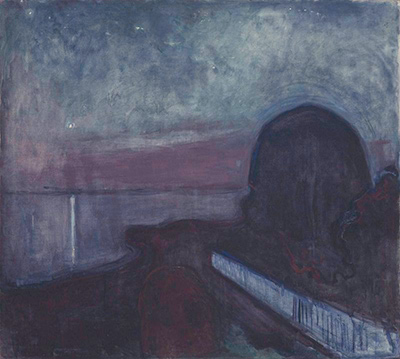
| Starry Night — Åsgårdstrand | 1893 | Oil on canvas |
| Metabolism | 1898–1899 | Oil on canvas |
| Red and White | 1899–1900 | Oil on canvas |
| Consul Christen Sandberg | 1901/1910 | Oil on canvas |
| The Researchers | 1911/1925–27? | Oil on canvas |
| On the Sofa | 1913 | Oil on canvas |
| Workers on their Way Home — Oslo | 1913–1914 | Oil on canvas |
| Workers on their Way Home — Copenhagen | 1914 | Oil on canvas |
| Starry Night — Ekely, upright version | 1922–1924 | Oil on canvas |
| Starry Night — another Ekely version | 1922–1924 | Oil on canvas |
| Woman | 1925 | Oil on canvas |
Frequently Asked Questions
Sandberg was a Norwegian German vice-consul whose career also included business, writing and naval service. [2]
Discussion
A full-length portrait whose stance and physical alterations invite comparison.
Reader Insights
How do the hands in the pockets affect the portrait's formality?
What would change if the picture ended above the sitter's knees?
Which parts of the room make Sandberg seem most imposing?
Join the Conversation
Share a detail, comparison or question about Consul Christen Sandberg below.
References
- MUNCH, Consul Christen Sandberg, 1901/1910, MM.M.00003, Woll M 498. Current catalogue, sitter identification and dimensions. View source.Splash image: Consul Christen Sandberg, 1901/1910. Oil on canvas; image 215 × 146.5 cm. MUNCH, Oslo, MM.M.00003.
- MUNCH, Consul Christen Sandberg, collection interpretation contributed to Google Arts & Culture. Sitter biography, early exhibition and probable changes to the canvas and stretcher. View source.